


Abstract
Vehicle emissions are key precursors to near-ground ozone and secondary aerosol formation. While China’s clean air actions have significantly reduced particulate pollution, ozone levels continue to rise in some city clusters, calling for a deeper understanding of volatile organic compound (VOC) emissions from gasoline vehicles. This study systematically evaluated the impacts of fuel composition (China 6b vs. Methyl tert-butyl ether -free (MTBE-free) gasoline), engine type (Port fuel injection (PFI) vs. Gasoline direct injection (GDI)), and ambient temperature (25 °C vs. −7 °C) on VOC emissions and ozone formation potential (OFP) under the World Harmonized Light-Duty Test Cycle (WLTC). Results of dynamometer experiments showed that MTBE-free gasoline reduced total VOC emissions by 47% compared to China 6b fuel, with aromatics accounting for 69% of this reduction. PFI vehicles exhibited higher VOC emissions than GDI vehicles at 25 °C, though this difference diminished at −7 °C. Low temperatures significantly increased VOC emissions and OFP, increasing by a factor of 10–13 compared to 25 °C. Aromatics were the dominant OFP contributors under all conditions. Our findings highlight the importance of fuel reformulation and temperature-specific emission controls in mitigating ozone pollution, particularly under cold-start conditions.
1. Introduction
Due to the stringent measures in the Air Pollution Prevention and Control Action Plan taken by the Chinese government, air pollutant emissions have decreased significantly over the past decade, leading to notable improvements in air quality [1,2]. For instance, Zhang et al. [3] reported a 38% reduction in PM2.5 concentrations in the Beijing-Tianjin-Hebei region during 2013–2017. However, as particulate matter levels have declined, high concentrations of ground-level ozone have emerged as a serious air quality issue in urban areas in recent years, particularly in the Pearl River Delta region. This trend raises concerns due to ozone’s environmental impact and associated health risks [4,5]. Volatile organic compounds (VOCs) are key precursors of ozone formation through atmospheric photochemical reactions. Briefly, the photolysis of NO2 leads to ozone generation, but ozone is rapidly consumed through reaction with NO. In the presence of VOCs, however, radical pathways are initiated that promote net ozone production. A detailed mechanism is provided by Carter et al. [6]. Therefore, accurately quantifying VOC emission sources is essential for analyzing and mitigating ozone pollution in urban regions.
Gasoline vehicles have become one of the most important sources of VOC emissions in urban areas, caused by the rapid growth in the number of vehicles over the past two decades [5,7]. This sharp increase in vehicle population has led to traffic congestion, urban air pollution, rapid fossil fuel consumption and rising greenhouse gas emissions [5,8]. In response, the Chinese government has implemented stricter emission standards for new light-duty vehicles and introduced more stringent fuel consumption regulations to curb vehicle emissions and reduce fossil fuel use. Refineries have also been required to produce ultralow sulfur gasoline. Since desulfurization in the refining process can lower the octane number of gasoline, one common solution has been to add methyl tert-butyl ether (MTBE) as an octane enhancer [5,9]. However, MTBE usage involves environmental and health trade-offs. As early as 1996, the American National Research Council published a book illustrating the paradoxical impact of MTBE addictive to vehicle gaseous pollutant emission and detrimental public health risk [10]. Subsequently, the California Air Resources Board (CARB) declared MTBE as an environmental threat in 1999 [11]. California began phasing out the use of MTBE in gasoline in the early 2000s, and MTBE was largely replaced by ethanol [12]. Following a similar path, the Chinese government initiated pilot programs in 2017 to promote the commercial use of ethanol-blended gasoline, aiming to substitute MTBE. A nationwide rollout of this policy was planned for 2020 [13].
Several studies have investigated different factors influencing total hydrocarbon (THC) tailpipe emissions from gasoline vehicles, including gasoline composition, fuel injection technology, engine start condition and soak temperature. Zhu et al. [14] compared the impact of different fuel injection technologies on gaseous pollutant emissions under both high (30 °C) and low (−7 °C) temperatures. It was found that THC emissions from port fuel injection (PFI) were lower than those from gasoline direct injection (GDI) vehicles at high temperatures, whereas the opposite trend was observed at low temperatures. In contrast, Saliba et al. [15] found that GDI vehicles emitted less THC than PFI vehicles. In another study, Zhu et al. [14] investigated the impact of olefin and aromatic content in gasoline on THC tailpipe emissions, showing that reduced aromatic content led to increased THC emission, but variations in olefin content had no obvious changes. However, existing studies have mainly focused on THC emissions and have examined individual influencing factors, such as fuel composition or injection technology, often under limited operating conditions. Comprehensive characterization of speciated VOC tailpipe emissions remains limited, particularly under cold ambient temperatures and in scenarios involving MTBE-free gasoline.
To address these gaps, this study provides a systematic assessment of VOC emission characteristics and ozone formation potential from light-duty gasoline vehicles (LDGVs) by jointly considering fuel type (China 6b vs. MTBE-free gasoline), injection technology (PFI versus GDI), and ambient temperature under cold-start conditions using the World Light-duty Test Cycle. By focusing on detailed VOC speciation rather than bulk hydrocarbon emissions, this work offers new insights into the atmospheric and policy implications of fuel reformulation and temperature-dependent vehicular emissions.
In this study, we prepared two types of fuels, including commercial China 6b gasoline and MTBE-free gasoline (designated as MTBE0). Two China 5 gasoline vehicles with different fuel injection technologies were selected for laboratory dynamometer tests. We evaluated the effects of different ambient temperatures on vehicle VOC tailpipe emissions under cold-start conditions using World Light-duty Test Protocol (WLTC). Our results provide important evidence to support the development of effective ozone pollution control strategies in urban areas.
2. Method
2.1. Tested Fuels and Vehicles
In this study, two vehicles were employed to compare the VOC emissions under dynamometer testing. One was equipped with a PFI engine and the other with a GDI engine. The PFI vehicle (model: Lavida, Volkswagen, Shanghai, China.) and GDI vehicle (model: Malibu, Chevrolet, Detroit, MI, USA.) were both manufactured in 2017, complying with the China 5 emission standard. By the end of 2018 China’s light-duty passenger vehicle (LDPV) stock had grown to the order of hundreds of millions of vehicles, and vehicles meeting the China-5 standard had become a substantial and rapidly growing component of the in-use fleet following the nationwide rollout of China-5 in 2016–2017 [16]. This proportion is expected to continue growing due to increasing sales of new vehicle and the gradual phase-out of older ones. Detailed specifications of the tested LDPVs are provided in Table 1.
Table 1.
Summary of vehicle specifications.
Two fuels were applied to evaluate the impact of fuel composition on VOC emissions from different engine types. The fuels, including conventional China 6b and MTBE0, were prepared by the Sinopec Research Institute of Petroleum Processing (RIPP, Beijing, China.). The China 6b fuel complied with the national China 6b fuel standard, and the primary difference between China 6b fuel and MTBE0 fuel was that the China 6b fuel was 10% MTBE blending. Detailed compositional specifications of the two fuels are listed in Table 2.
Table 2.
Fuel properties and composition of China 6b gasoline and MTBE-free gasoline (MTBE0) used in this study.
2.2. Experimental Setup and Driving Cycle
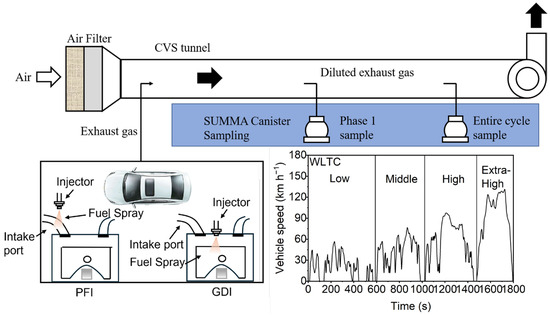
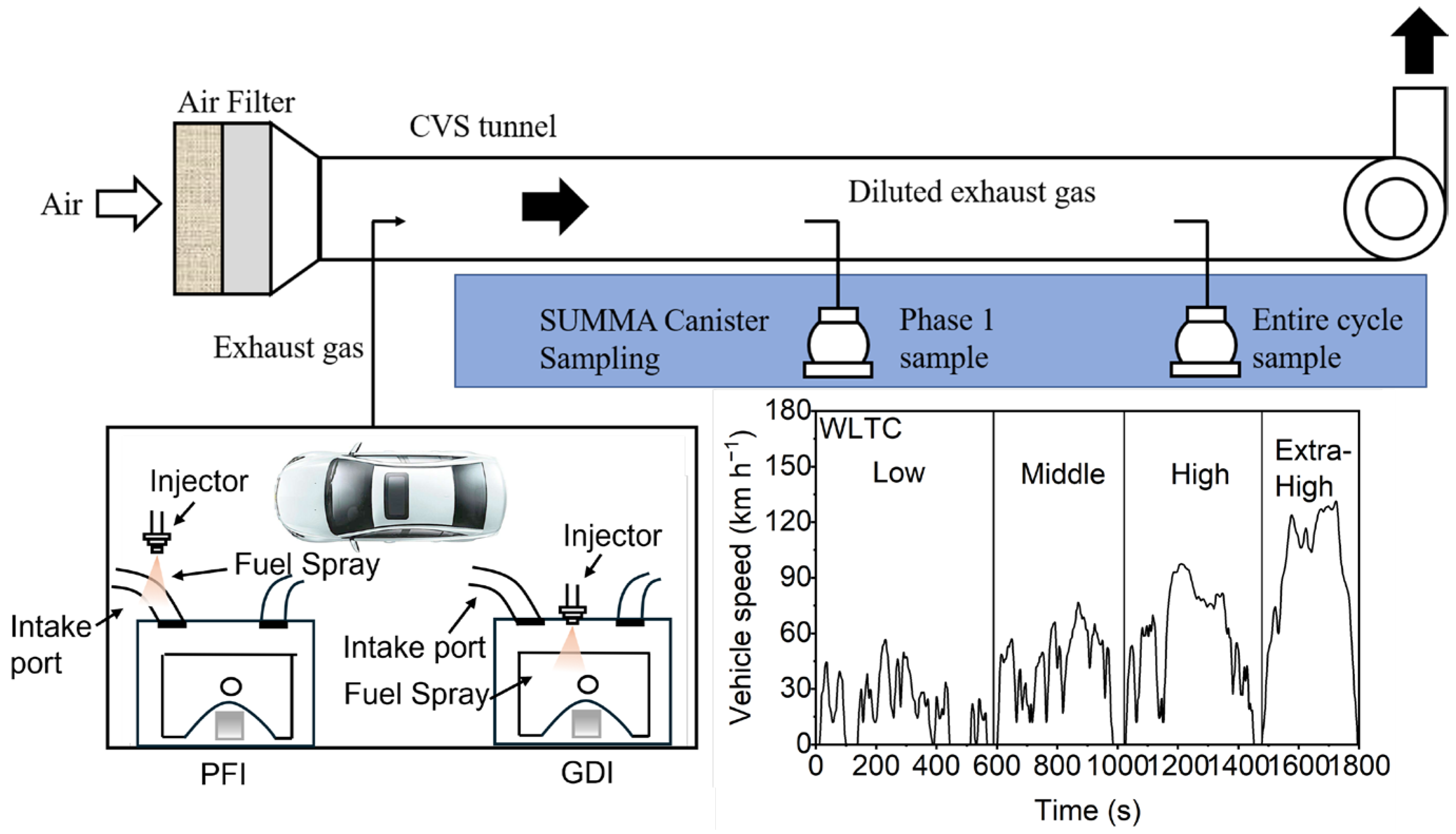
All tests were conducted at the China Automotive Technology and Research Center (CATARC). The experimental platform consisted of a full-flow constant volume sampler (CVS, Model 7400T, Horiba, Kyoto, Japan), a light-duty classic dynamometer, and a SUMMA canister sampling system. Exhaust gas was sampled downstream of the vehicle after-treatment system (i.e., after the three-way catalyst), thereby representing tailpipe emissions directly released into the atmosphere. The exhaust from the tested vehicle was introduced into the CVS, which was applied to dilute the exhaust at a fixed flow rate of 10.6 m3/min. Diluted exhaust samples were collected using SUMMA canisters (Entech Instruments Inc., Simi Valley, CA, USA). All the SUMMA canisters were cleaned by high-purity nitrogen and vacuumed according to U.S. EPA method TO-14 before the test.
The WLTC was applied in the test, which has been adopted as the regulatory test cycle under the China 6 emission standard since 2016 [17]. The average and maximum speeds for the cycle were of 47 km h−1 and 130 km h−1, and the cycle was divided into four speed phases, representing low (589 s), medium (433 s), high (455 s), and extra-high-speed (323 s) phases. To estimate the contribution of cold-start emissions, each vehicle was soaked for 6 h at the target temperature to stabilize coolant/oil and catalyst temperatures before testing according to the China 6 emission standard. To explore the impact of ambient temperature, vehicles were operated at both 25 °C and −7 °C. Furthermore, SUMMA canisters were collected simultaneously through the entire WLTC and the low-speed phase (designated as WLTC entire and WLTC P1). The WLTC P1 samples were analyzed specifically to represent VOC emissions under cold-start conditions. The overall sampling scheme is illustrated in Figure 1.
Figure 1.
The sampling diagrams of the dynamometer experiment in this study.
2.3. Chemical Analysis
After sampling, the SUMMER canisters were connected to a precision diluter (Model 4700, Entech Instruments Inc., Simi Valley, CA, USA) to adjust VOC concentrations within the detectable range of gas chromatography-mass spectrometry (GC-MS) system. The samples were then processed using a preconcentrator (Model 7200, Entech Instruments Inc., Simi Valley, CA, USA) to remove interferents such as CO2 and N2 while concentrating target VOCs. A total of 56 VOC species specified in the U.S. EPA Photochemical Assessment Monitoring Stations (PAMS) program were analyzed by GC-MS (Model 7890A/5975C, Agilent Technologies, Santa Clara, CA, USA). It should be noted that due to a 5.5 min solvent delay times, compounds with short retention times, including C2-C3 alkanes, alkenes, and acetylene could not be quantified.
VOC components were separated using a high-resolution capillary column (DP-624, 60 m × 0.25 mm ID × 1.40 mm film thickness). The column pressure was maintained at 19.654 psi, and the injector temperature was set to 250 °C. The GC oven temperature program was as follows: 40 °C for 3 min; increased to 90 °C at 8 °C min−1; increased to 200 °C at 6 °C min−1. The MS operated with an ionization temperature of 250 °C in full scan mode (m/z 30–360) for qualitative analysis.
For quality assurance and quality control (QA/QC), blank samples underwent the same procedures of dilution, preconcentration, and chemical analysis procedures. VOC concentrations were quantified using a U.S. EPA PAMS standard gas mixture (8 ng mL−1, 50–800 mL). The linear correlation coefficients (R) of the calibration ranged from 0.9965 to 0.9989.
2.4. Calculation of Emission Factor
The emission factors (EF) were calculated for each VOC species and driving cycle EFphase using Equation (1):
where is the EF (mg km−1) of VOC species j during driving phase k; is the detected mass (mg) of VOC j during driving phase k quantified by GC-MS after subtracting background concentration; is the average dilution ratio for driving phase k; and is the driving distance (km) for driving phase k [18,19].
The environmental impact of vehicle tailpipe VOC emissions was evaluated through ozone formation potential (OFP)OFP was calculated using the maximum incremental reactivity (MIR) method, s illustrated in Equation (2):
where the OFPk,t is the OFP for driving phase k at t temperature (mg O3 km−1); EFi,j,t is the EF of the species i for driving phase j at t temperature (mg km−1); (MIR)j is the MIR of species j (mg O3 mg VOCs−1) [6,20,21].
3. Results and Discussion
3.1. VOC Composition and Emission Factors
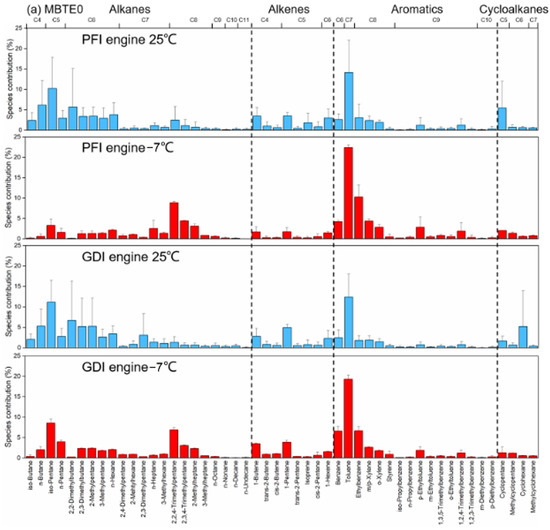
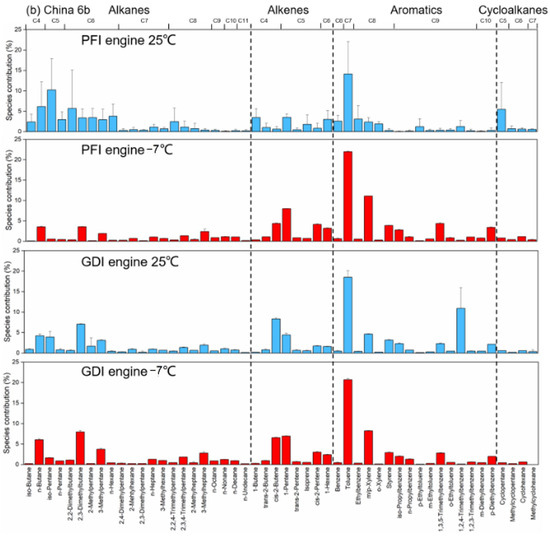
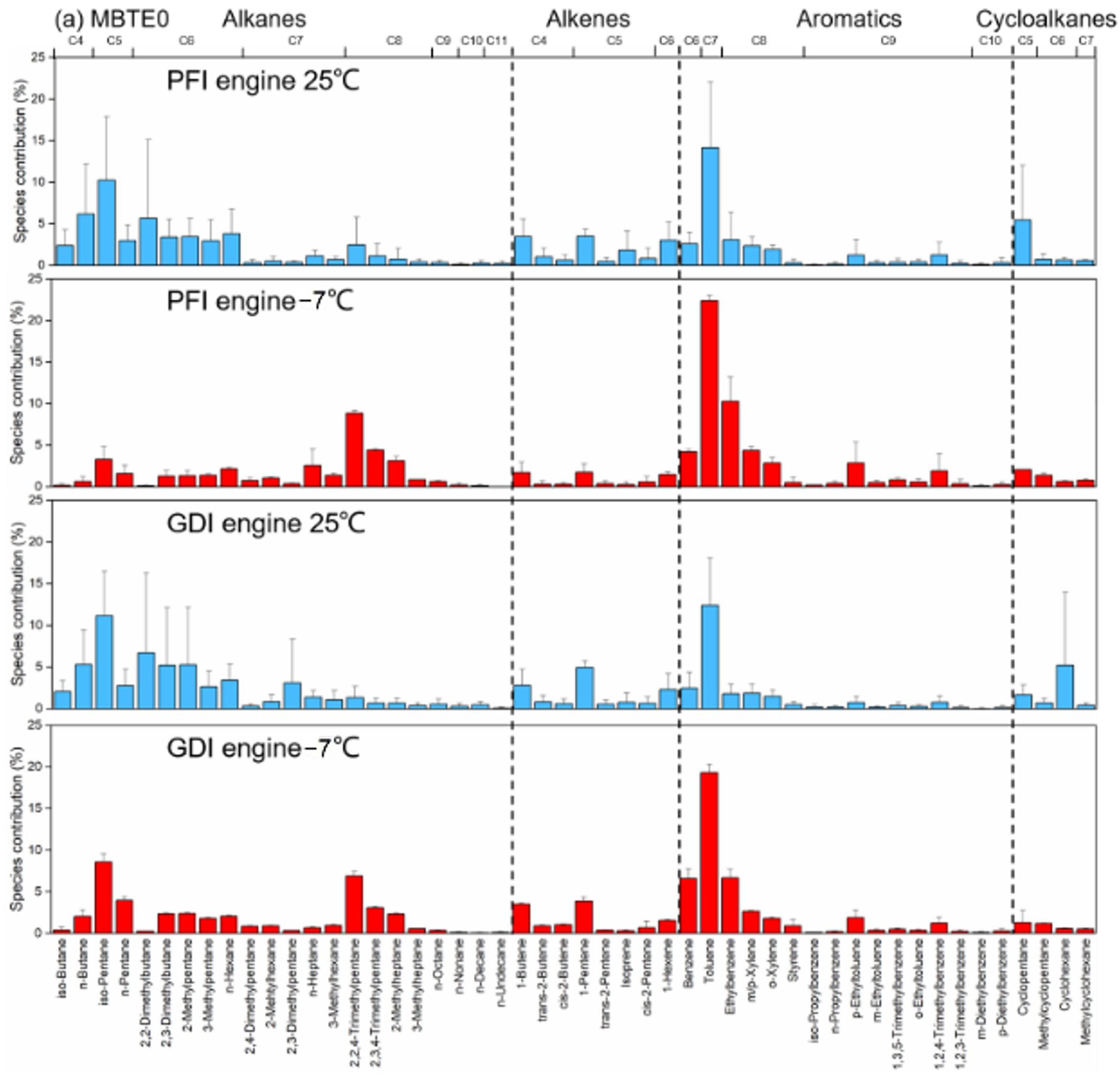
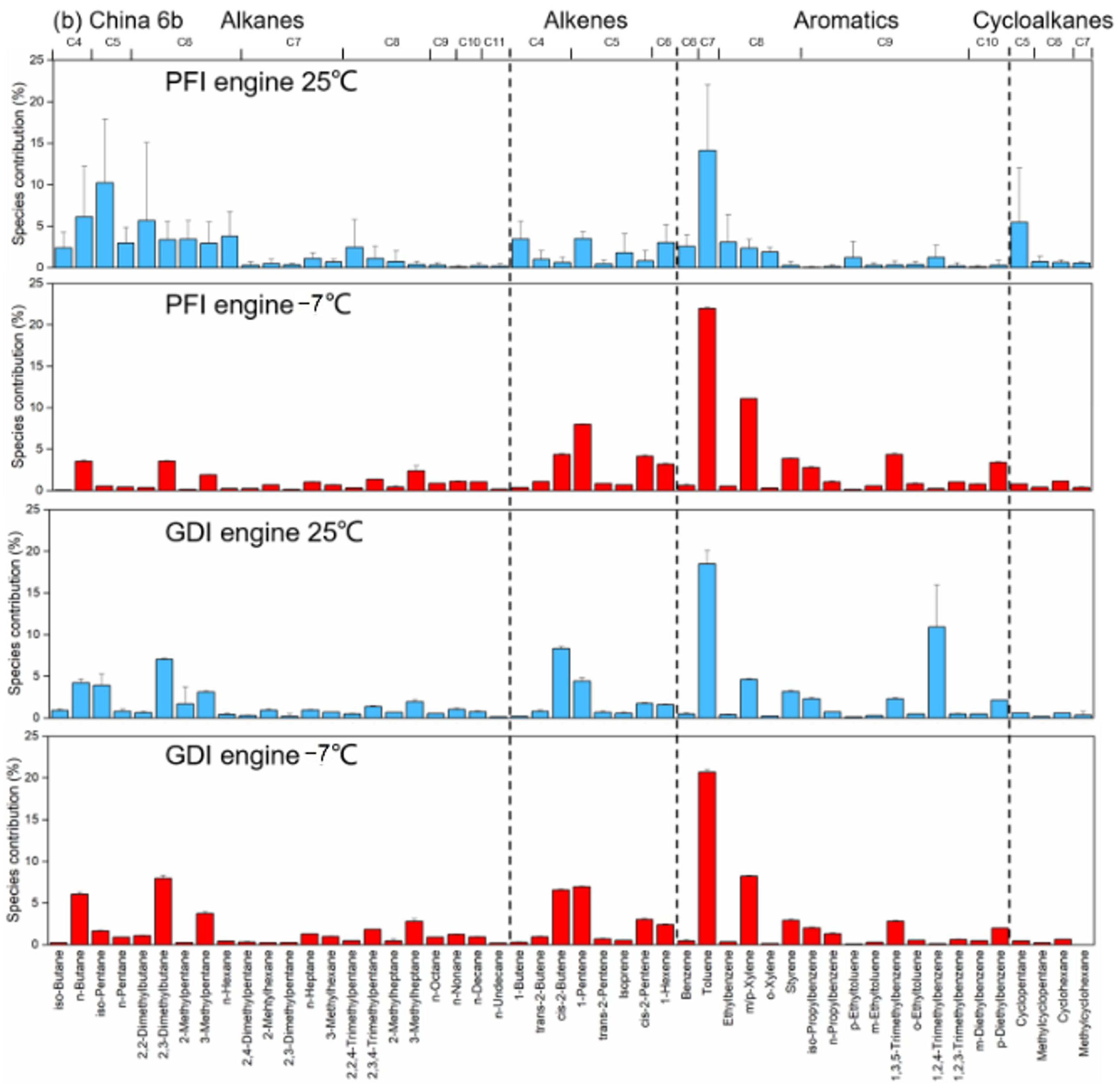
In this study, 51 VOC species were quantified, comprising 23 alkanes, 4 cycloalkanes, 8 alkenes, and 16 aromatics. Figure 2 and Figure 3 display the average mass distribution by individual VOC species and chemical groups. The unburned gasoline components, such as toluene (18 ± 5%, range from 14~22%) and iso-pentane (3~11%), are the first and second most abundant species in the exhaust VOC emissions. The top 15 compounds collectively account for nearly 70% of total VOC emissions, consistent with their identification as major species in previous studies [22]. For example, Cao et al. [19] reported that these compounds contributed approximately 30% of VOC emissions (among 74 VOC species) in tailpipe measurements. Similarly, these species showed prominent concentrations in tunnel ambient air samples.
Figure 2.
Distribution of 51 VOCs from gasoline vehicles using (a) MTBE0 and (b) China 6b gasoline with different engine technologies and at different temperatures (blue represents 25 °C, red represents −7 °C).
Figure 3.
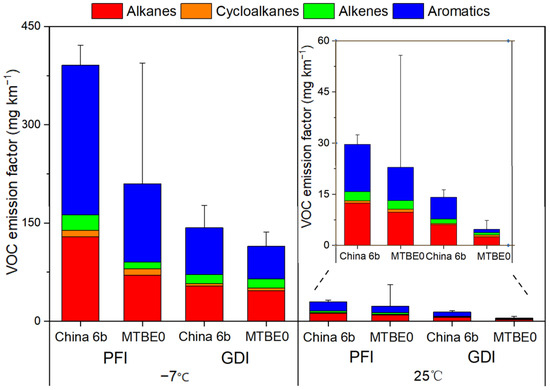
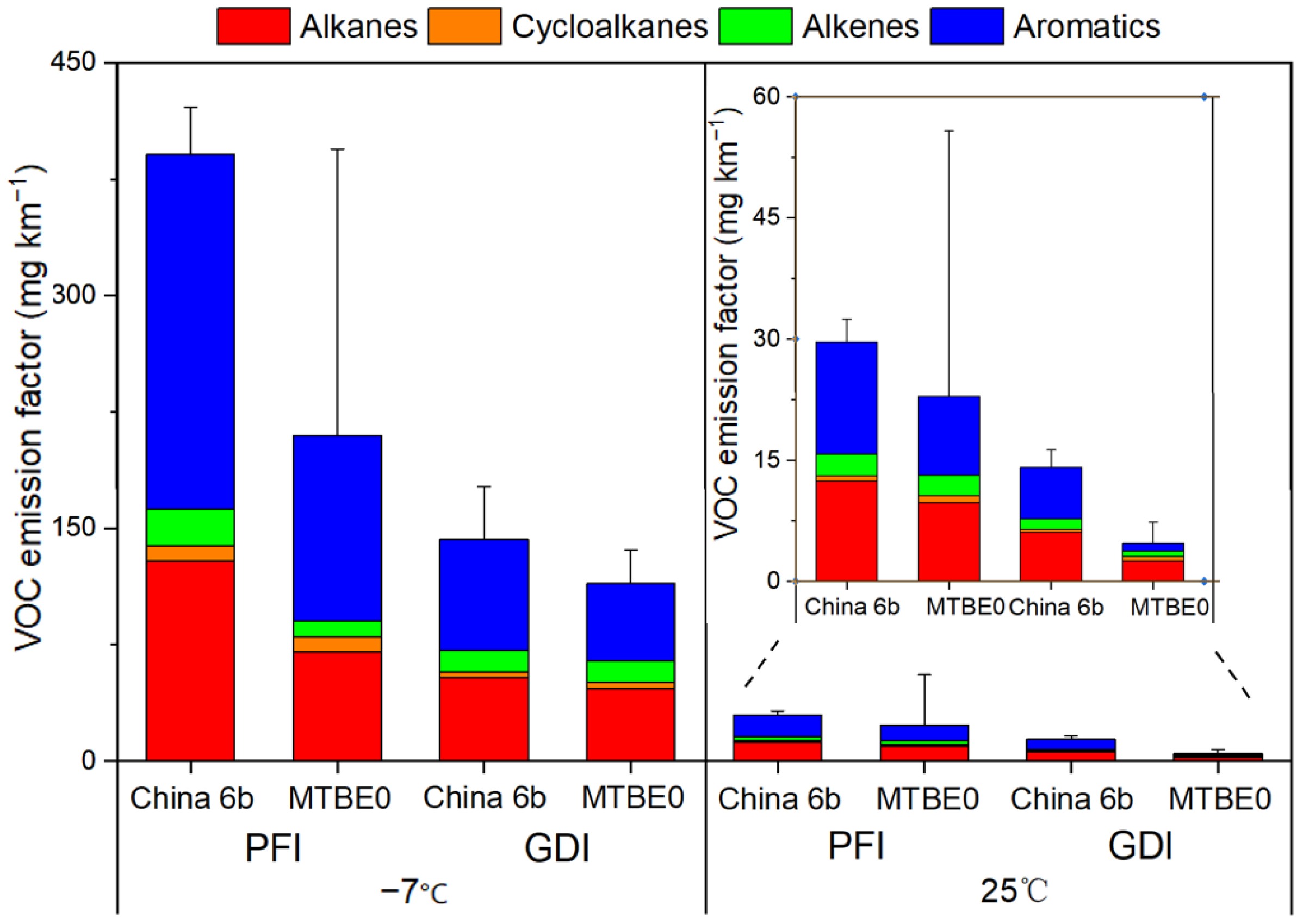
EFs of VOC groups for different fuel types, engine technologies and ambient temperatures.
During the entire WLTC, the distribution of VOC emissions is 42 ± 7% for alkanes, 4 ± 2% for cycloalkanes, 10 ± 3% for alkenes, and 44 ± 12% for aromatics. The dominant contributors in our study are consistent with previous studies on LDGVs. For example, Cao et al. [22] reported that similar VOC dominators (36% for alkanes and 33% for aromatics) based on measurements of 30 in-use gasoline vehicles in Beijing using a portable emission measurement system (PEMS). Moreover, the aromatic fraction observed in this study was higher than values reported by Guo et al. [23] (19–23%), which may be partly attributed to differences in experimental design, particularly the inclusion of cold-start conditions in the present work. This interpretation is qualitatively supported by the findings of George et al. [24], who observed an increase in aromatic contributions during the cold-start phase under 24 °C, indicating that cold-start operation can be associated with elevated aromatic emissions. Given the well-documented health risks associated with exposure to BTEX (benzene, toluene, ethylbenzene, and xylene), particular attention should be paid to these compounds, as they accounted for approximately 14% of total VOC emissions in this study.
Table 3 compares the VOC EFs obtained in this study with those reported in several previous publications. The average VOC EF for LDGVs measured in this work is 19 ± 19 mg/km. This value is consistent with results from other studies that employed dynamometer, portable emission measurement system (PEMS), or tunnel-based methods, despite differences in the number and type of VOC species quantified across studies. For instance, Wang et al. [18] reported a VOC EF of 20 ± 11 mg·km−1 for China 5 vehicles, which aligns closely with our findings. Similarly, Cao et al. [22] documented an average EF of 15 ± 8 mg·km−1 for China 4 vehicles under real-driving conditions, while tunnel studies by Song et al. [25] yielded slightly higher estimates of 33 ± 3 mg·km−1 and 45 ± 11 mg·km−1 for fleet-average emissions in Beijing and Tianjin, respectively. The observed agreement supports the reliability of our emission measurements and underscores the general trend of decreasing VOC emissions from LDGVs with the implementation of more stringent emission standards in China.
Table 3.
VOC EFs for LDGVs in this study and previous publications.
3.2. Effect of Fuel Properties and Engine Types on VOC Emissions
As noted in Section 3.1, VOC emissions were significantly lower when using MTBE0 fuel compared to China 6b fuel. The average VOC EF of tested vehicles is 144 ± 162 mg km−1 with China 6b fuel. When using MTBE0 fuel, the VOC emissions range from 2 to 340 mg km−1, with a mean value of 77 ±100 mg km−1, representing a 47% reduction. The substantial standard deviation observed is primarily due to the significantly higher VOC emissions recorded under −7 °C, which will be discussed in detail in the next section.
The emission reduction was largely attributable to decreased aromatic compound emissions. Specifically, aromatic EFs decline from 80 ± 96 mg km−1 with China 6b fuel to 38 ± 60 mg km−1 with MBTE0 fuel, accounting for 69% of the total VOC reduction. Interestingly, although MTBE0 fuel contained lower aromatic content than China 6b fuel (28% versus 31%), the proportional contribution of aromatics to total VOC emissions increased. The average aromatic fraction was 50 ± 6% for China 6b fuel, compared to 35 ± 15% for MTBE0 fuel. This phenomenon may be explained by the conversion of some aromatic compounds in MTBE0 fuel into higher molecular weight species that partition into the particulate phase, such as polycyclic aromatic hydrocarbons (PAHs). Thus, simultaneous sampling and toxicological assessment of both gaseous and particulate phases would provide valuable insights into the impact of fuel properties on VOC emissions. Considering the planned nationwide implementation of ethanol-blended gasoline (E10), which contains 10% ethanol in an MTBE0 base, comprehensive emission comparisons between E10 and China 6b fuel are strongly recommended for future research.
Based on the comparison of the two tested vehicles, the mean VOC EFs of the PFI vehicle (117 ± 132 mg km−1) are higher than that of the GDI vehicle (63 ± 78 mg km−1) under the same testing conditions. As ambient temperature and driving cycle are well-controlled in this study, the observed difference in VOC EFs may by derived from other influencing factors, such as engine type or related design characteristics. Previous studies have reported that engine technology can affect VOC emissions from gasoline vehicles. For instance, Wang et al. [9] 2020 reported that tailpipe VOC emissions from PFI engines could be up to 100 times greater than those from GDI engines under specific operating conditions (2000 r/min and 50% of the full load). This phenomenon may likely be attributed to fundamental distinctions in fuel injection mechanisms [26,27,28]. Similar tendencies have also been reported by Zeng et al. [29]. In addition, Karavalakis et al. [30] observed higher THC emissions from a PFI engine vehicle (7 ± 3 mg mile−1) compared to four GDI engine vehicles (ranging from 5 to 6 mg mile−1) under the LA92 driving cycle. Given that VOCs significantly contribute to secondary organic aerosol (SOA) formation, future research should extend beyond the current emphasis on primary particulate emissions from GDI vehicles. Specifically, more attention should be directed toward evaluating the secondary aerosol formation potential of PFI vehicle emissions, particularly in relation to the influence of fuel composition.
3.3. Impact of Ambient Temperature and Cold-Start on VOC Emissions
Previous studies have reported dramatic increases in vehicle emissions, including black carbon, under low ambient temperatures for both GDI and PFI vehicles. To explore the impact of ambient temperatures on VOC emissions, both two vehicles were further operated at −7 °C under the WLTC. As shown in Figure 3, ambient temperature emerged as the most influential factor affecting VOC exhaust emissions among all variables studied in this work. Specifically, VOC emissions increased by a factor of 11 ± 3 for PFI engine vehicles and 10 ± 1 for GDI vehicles under low-temperature conditions. This pronounced enhancement can be primarily attributed to combustion deterioration at low temperatures. The reduced clearance between the cylinder and piston impedes flame propagation, while the colder cylinder wall promotes increased flame quenching of fuel droplets [15,31,32]. These combined effects lead to incomplete combustion, thereby elevating VOC emissions substantially during cold-temperature operation.
To further characterize cold-start effects, VOC emissions were sampled during the WLTC Phase 1 (low-speed phase). At 25 °C, the cold-start phase accounted for 64 ± 24% of total VOC emissions, a proportion notably lower than that observed at −7 °C (93 ± 8%). It could also be found that, 25 °C, the cold-start contribution was more pronounced in PFI vehicles (79 ± 7%) than in GDI vehicles (53 ± 28%). However, this difference diminished at −7 °C, where both engine types exhibited similar cold-start contributions (PFI: 92 ± 4%; GDI: 93 ± 10%). These results suggest that VOC emissions from GDI vehicles under hot-stabilized operating conditions warrant greater attention. The elevated VOC emissions from PFI engines during cold-start are primarily attributable to incomplete combustion resulting from fuel enrichment strategies and the delayed light-off of the catalytic converter. For GDI engines, the phenomenon may be explained by fuel impingement on the cylinder wall, leading to unburned hydrocarbon release [30,33].
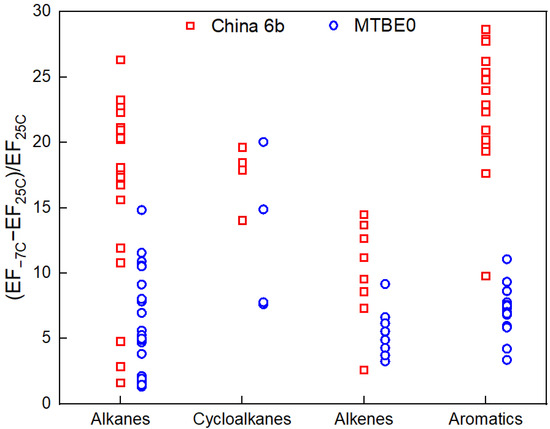
Figure 4 illustrates the relative changes in VOC emissions by chemical group between 25 °C and −7 °C during WLTC phase 1 (cold-start). Alkanes exhibited the widest range of relative changes among all groups. When using China 6b fuel, alkane emissions during the WLTC phase increased by an average factor of 17 ± 8 (ranging from 0 to 24), while with MTBE0 fuel, the increase averaged 7 ± 5 (ranging from 1 to 17). In contrast, aromatic compounds showed the highest magnitude of enhancement increasing by 24 ± 5 times with China 6b fuel and 8 ± 2 times with MTBE0 fuel. BTEX species were the dominant contributors within this group, with n-propylbenzene showing the most pronounced temperature sensitivity, increasing by up to 30 times in China 6b fuel emissions. Elevated BTEX emissions are of particular concern due to their well-established adverse health effects, including carcinogenic risks (e.g., benzene) and neurotoxic impacts, highlighting the importance of controlling cold-start aromatic emissions in urban environments [34].
Figure 4.
Relative changes in VOC emissions by chemical group between 25 °C and −7 °C during cold-start operation.
These findings align with previous dynamometer studies. George et al. [24] similarly reported that aromatic compounds exhibited the greatest relative changes between 24 °C and −7 °C. The more pronounced emission increases observed with China 6b fuel versus MTBE0 indicate that engines likely require greater fuel enrichment during cold-start at low temperatures when using China 6b. This richer combustion condition subsequently leads to elevated unburned fuel emissions.
3.4. Ozone Formation Potentials
Ground-level ozone formation in urban atmospheres is driven by photochemical reactions involving VOCs and nitrogen oxides (NOx) under solar radiation. In this process, VOC oxidation promotes the conversion of NO to NO2, which subsequently undergoes photolysis to produce ozone, together with other secondary photochemical smog components. Therefore, vehicular VOC emissions play a critical role in regulating ozone formation potential.
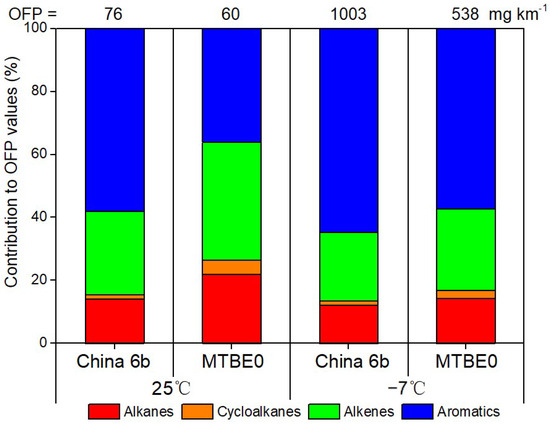
The total ozone formation potentials (ΣOFPs) of the VOC emissions in this study were quantified using MIR method [6], which evaluates the contribution of individual VOC species to ground-level ozone formation. The MIR values applied in OFP calculations are provided in Table S1. Figure 5 illustrates the contribution of different VOC groups to total OFPs under the WLTC for China 6b and MTBE0 fuels at 25 °C and −7 °C.
Figure 5.
Contribution of VOC groups to total OFP under different fuel and temperature conditions.
The average OFP values are 76.4 ± 33.9 mg O3 km−1 and 1002.2 ± 560.0 mg O3 km−1 for China 6b fuel at 25 °C and −7 °C. For MTBE0 fuel, the corresponding values were 60.0 ± 83.9 mg O3 km−1 and 537.4 ± 390.0 mg O3 km−1, respectively. The general trend showed lower ΣOFPs for MTBE0 fuel compared to China 6b, consistent with its lower VOC emissions. However, the influence of fuel type on OFP was less pronounced than that of temperature. The average OFP value at −7 °C is 13.1 times higher than at 25 °C for China 6b fuel and 9.0 times higher for MTBE0 fuel, reflecting the same pattern observed for VOC emission factors across temperatures. The OFP values estimated in this study are similar to reported on-road measurement of LDGVs in China (70.7 mg O3 km−1) [18]. When compared with the OFP values in Guo et al. [23] (354 to 1056 mg O3 km−1), our results are much lower. This reduction can be largely attributed to the implementation of stricter emission standards, which have significantly curtailed VOC emissions from vehicles.
As shown in Figure 5, aromatics constituted the dominant contributor to OFP across both fuels and temperatures, followed by alkenes. In contrast, alkanes played a minor role in ozone formation despite their substantial mass in emissions. With the ongoing nationwide promotion of ethanol-blended gasoline in China, the distribution of OFP contributions among VOC classes is expected to shift. Previous studies indicate that increasing ethanol blend ratios reduce the relative contribution of aromatics to total OFP. Therefore, systematic assessment of the ozone formation potential associated with ethanol-blended fuels should be prioritized in future research.
It should be noted that ozone formation is governed by the photochemical interactions between VOCs and NOx, and the actual ozone yield depends strongly on the ambient NOx concentrations. The MIR-based OFP applied in this study represents the maximum ozone formation potential of individual VOC species with an optimized NOx concentration, rather than the actual amount of ozone formed in the atmosphere. As the NOx concentrations encountered by vehicle exhaust after release into the ambient air cannot be uniquely determined, this approach provides an upper-bound estimate of ozone formation potential and may overestimate ozone production. Nevertheless, the MIR method remains a useful metric for comparing the relative ozone-forming importance of VOC species and emission profiles across different fuels, temperatures, and operating conditions.
3.5. Discussion and Limitations
This study has some limitations that should be acknowledged. First, only two gasoline vehicles were tested, which may limit the statistical representativeness of the absolute VOC EFs and introduce uncertainties associated with vehicle-to-vehicle variability. To evaluate the reliability of the measured results, the VOC EFs and compositional profiles obtained in this study were compared with those reported in previous studies, showing generally comparable magnitudes and dominant categories [19]. More importantly, the primary objective of this work is to examine the effects of ambient temperature and fuel composition on VOC emissions. These effects were investigated using a controlled, within-vehicle experimental design, in which temperature and fuel type were varied while other parameters remained constant for the same vehicle. This approach minimizes inter-vehicle variability and enables a more robust assessment of the relative impacts of these factors on VOC emissions [24].
Second, C2-C3 hydrocarbons were not quantitatively determined in this study due to analytical limitations of the GC-MS technique. Previous studies have reported that C2-C3 hydrocarbons account for an average of approximately 17.8% of total tailpipe VOC emissions from gasoline vehicle [35], with C2-C3 alkanes and C2-C3 alkenes contributing 14.4% and 3.4%, respectively. As a result, the total VOC EFs reported here may be underestimated. In terms of ozone formation potential, ethane and propane exhibit relatively low MIR values and therefore contribute less to ozone formation. However, ethene and propene have MIR values comparable to those of some detected alkenes and aromatic compounds (Table S1). The absence of these reactive C2-C3 alkenes in the quantitative analysis may thus also lead to an underestimation of the calculated ozone formation potential.
Third, the organic species considered in this study were limited to VOCs and did not include semi-volatile organic compounds (SVOCs) or PAHs. They are recognized as important precursors for secondary organic aerosol (SOA) formation and are associated with adverse toxicological effects. The exclusion of SVOCs and PAHs therefore does not substantially affect the assessment of ozone formation potential in this work, but it may lead to an underestimation of the broader atmospheric and health-related impacts of gasoline vehicle emissions.
Future studies incorporating a larger vehicle sample size, advanced analytical techniques, and an expanded range of organic species (VOCs, SVOCs, and PAHs) would help improve the representativeness and completeness of vehicular organic emission characterization, as well as the assessment of their multiphase chemical evolution and health implications.
4. Conclusions
This study provides a systematic evaluation of how fuel properties, engine type, and ambient temperature affect VOC emissions and ozone formation potential from light-duty gasoline vehicles. The use of MTBE-free gasoline significantly reduced both VOC emissions and OFP compared to conventional China 6b fuel, primarily due to lower aromatic content. Engine technology also played an important role, with PFI vehicles emitting more VOCs than GDI vehicles under normal temperatures, though the difference became negligible under cold conditions (−7 °C). Critically, low ambient temperature drastically increased VOC emissions and OFP by approximately an order of magnitude, underscoring the importance of accounting for seasonal and regional temperature variations in emission inventories and control strategies. Aromatics consistently dominated OFP across all scenarios, suggesting that future fuel reformulation and emission standards should prioritize aromatic reduction. As China moves toward ethanol-blended gasoline, further research is urgently needed to evaluate its effects on both gaseous and particulate emissions under real-world driving conditions.
Supplementary Materials
The following supporting information can be downloaded at: https://www.mdpi.com/article/10.3390/atmos17010074/s1, Table S1: Maximum incremental reactivity for VOC species.
Author Contributions
Conceptualization, writing—original draft preparation, project administration, C.Z.; methodology, visualization, writing—original draft preparation, Q.X.; methodology, visualization, writing—original draft, W.J.; data curation, validation, writing—review and editing, X.H.; data curation, visualization, J.Z.; resources, visualization, Y.D.; formal analysis, Y.L.; supervision, project administration, M.L. All authors have read and agreed to the published version of the manuscript.
Funding
This research was funded by the Key Technologies for Near-Zero Emission of High-Efficiency Diesel Engines Based on Virtual Platforms (Guike AB24010122), the Guangdong Basic and Applied Basic Research Foundation (China) (No. 2025A1515011003), and the Independent Research Project of CATARC Automotive Test Center (Guangzhou) Co., Ltd. (GZKY-20253C01005). And the APC was funded by the Independent Research Project of CATARC Automotive Test Center (Guangzhou) Co., Ltd. (GZKY-20253C01005).
Institutional Review Board Statement
Not applicable.
Informed Consent Statement
Not applicable.
Data Availability Statement
The data presented in this study are not publicly available but are available from the corresponding author upon reasonable request.
Conflicts of Interest
Author Chongzhi Zhong, Qiyuan Xie, Weida Ju, and Mingjing Luo are employees of CATARC Automotive Test Center (Guangzhou) Co., Ltd. The remaining authors declare that the research was conducted in the absence of any commercial or financial relationships that could be construed as a potential conflict of interest.
Abbreviations
The following abbreviations are used in this manuscript:
| VOCs | Volatile organic compounds |
| MTBE | Methyl tert-butyl ether |
| CARB | California Air Resources Board |
| THC | Hydrocarbon |
| PFI | Port fuel injection |
| GDI | Gasoline direct injection |
| MTBE0 | MTBE-free |
| WLTC | World Light-duty Test Protocol |
| LDPVs | Light-duty passenger vehicles |
| RIPP | Research Institute of Petroleum Processing |
| CATARC | China Automotive Technology and Research Center |
| CVS | Constant volume sampler |
| GC-MS | Gas chromatography-mass spectrometry |
| PAMS | Photochemical Assessment Monitoring Stations |
| QA/QC | Quality assurance and quality control |
| EF | Emission factors |
| OFP | Ozone formation potential |
| MIR | Maximum incremental reactivity |
| PEMS | Portable emission measurement system |
| BTEX | Benzene, toluene, ethylbenzene, and xylene |
| PAHs | Polycyclic aromatic hydrocarbons |
| E10 | Ethanol-blended gasoline |
| SOA | Secondary organic aerosol |
References
- Zheng, B.; Tong, D.; Li, M.; Liu, F.; Hong, C.; Geng, G.; Li, H.; Li, X.; Peng, L.; Qi, J.; et al. Trends in China’s Anthropogenic Emissions since 2010 as the Consequence of Clean Air Actions. Atmos. Chem. Phys. 2018, 18, 14095–14111. [Google Scholar] [CrossRef] [Scilit]
- Wen, Z.; Ma, X.; Xu, W.; Si, R.; Liu, L.; Ma, M.; Zhao, Y.; Tang, A.; Zhang, Y.; Wang, K.; et al. Combined Short-Term and Long-Term Emission Controls Improve Air Quality Sustainably in China. Nat. Commun. 2024, 15, 5169. [Google Scholar] [CrossRef] [Scilit] [PubMed]
- Zhang, Q.; Zheng, Y.; Tong, D.; Shao, M.; Wang, S.; Zhang, Y.; Xu, X.; Wang, J.; He, H.; Liu, W.; et al. Drivers of Improved PM2.5 Air Quality in China from 2013 to 2017. Proc. Natl. Acad. Sci. USA 2019, 116, 24463–24469. [Google Scholar] [CrossRef] [Scilit]
- Yim, S.H.L.; Wang, M.; Gu, Y.; Yang, Y.; Dong, G.; Li, Q. Effect of Urbanization on Ozone and Resultant Health Effects in the Pearl River Delta Region of China. J. Geophys. Res. Atmos. 2019, 124, 11568–11579. [Google Scholar] [CrossRef] [Scilit]
- Zheng, J.; Shao, M.; Che, W.; Zhang, L.; Zhong, L.; Zhang, Y.; Streets, D. Speciated VOC Emission Inventory and Spatial Patterns of Ozone Formation Potential in the Pearl River Delta, China. Environ. Sci. Technol. 2009, 43, 8580–8586. [Google Scholar] [CrossRef] [Scilit]
- Carter, W.P.L. Development of Ozone Reactivity Scales for Volatile Organic Compounds. Air Waste 1994, 44, 881–899. [Google Scholar] [CrossRef] [Scilit]
- Wang, J.; Jin, L.M.; Gao, J.H.; Shi, J.W.; Zhao, Y.L.; Liu, S.X.; Jin, T.S.; Bai, Z.P.; Wu, C.Y. Investigation of speciated VOC in gasoline vehicular exhaust under ECE and EUDC test cycles. Sci. Total Environ. 2013, 445–446, 110–116. [Google Scholar] [CrossRef] [Scilit]
- Duan, L.; Song, L.; Wang, W.; Jian, X.; Heijungs, R.; Chen, W.-Q. Urbanization Inequality: Evidence from Vehicle Ownership in Chinese Cities. Humanit. Soc. Sci. Commun. 2024, 11, 703. [Google Scholar] [CrossRef] [Scilit]
- Wang, H.; He, X.; Liang, X.; Choma, E.F.; Liu, Y.; Shan, L.; Zheng, H.; Zhang, S.; Nielsen, C.P.; Wang, S.; et al. Health Benefits of On-Road Transportation Pollution Control Programs in China. Proc. Natl. Acad. Sci. USA 2020, 117, 25370–25377. [Google Scholar] [CrossRef] [Scilit] [PubMed]
- Toxicological and Performance Aspects of Oxygenated Motor Vehicle Fuels; National Academies Press: Washington, DC, USA, 1996; p. 5321. ISBN 978-0-309-05545-1.
- California Air Resources Board. California Reformulated Gasoline Phase 3 Rulemaking; California Air Resources Board: Sacramento, CA, USA, 1996. Available online: https://ww2.arb.ca.gov/resources/documents/california-reformulated-gasoline-phase-3-carfg3 (accessed on 12 December 2025).
- Anderson, S.T.; Elzinga, A. A Ban on One Is a Boon for the Other: Strict Gasoline Content Rules and Implicit Ethanol Blending Mandates. J. Environ. Econ. Manag. 2014, 67, 258–273. [Google Scholar] [CrossRef] [Scilit]
- Zhang, Z.; Zhang, L.; Wu, S. Does Ethanol-Blended Gasoline Policy Improve Air Quality in China? Energy Econ. 2024, 134, 107579. [Google Scholar] [CrossRef] [Scilit]
- Zhu, R.; Hu, J.; Bao, X.; He, L.; Lai, Y.; Zu, L.; Li, Y.; Su, S. Tailpipe Emissions from Gasoline Direct Injection (GDI) and Port Fuel Injection (PFI) Vehicles at Both Low and High Ambient Temperatures. Environ. Pollut. 2016, 216, 223–234. [Google Scholar] [CrossRef] [Scilit]
- Saliba, G.; Saleh, R.; Zhao, Y.; Presto, A.A.; Lambe, A.T.; Frodin, B.; Sardar, S.; Maldonado, H.; Maddox, C.; May, A.A.; et al. Comparison of Gasoline Direct-Injection (GDI) and Port Fuel Injection (PFI) Vehicle Emissions: Emission Certification Standards, Cold-Start, Secondary Organic Aerosol Formation Potential, and Potential Climate Impacts. Environ. Sci. Technol. 2017, 51, 6542–6552. [Google Scholar] [CrossRef] [Scilit]
- International Energy Agency (IEA). Global EV Outlook 2019: Scaling-Up the Transition to Electric Mobility. 2019. Available online: https://www.iea.org/reports/global-ev-outlook-2019 (accessed on 12 December 2025).
- GB 18352.6-2016; Limits and Measurement Methods for Emissions from Light-Duty Vehicles (CHINA 6). Ministry of Ecology and Environment of the People’s Republic of China: Beijing, China, 2016.
- Wang, M.; Li, S.; Zhu, R.; Zhang, R.; Zu, L.; Wang, Y.; Bao, X. On-Road Tailpipe Emission Characteristics and Ozone Formation Potentials of VOCs from Gasoline, Diesel and Liquefied Petroleum Gas Fueled Vehicles. Atmos. Environ. 2020, 223, 117294. [Google Scholar] [CrossRef] [Scilit]
- Zhang, Q.; Wu, L.; Fang, X.; Liu, M.; Zhang, J.; Shao, M.; Lu, S.; Mao, H. Emission Factors of Volatile Organic Compounds (VOCs) Based on the Detailed Vehicle Classification in a Tunnel Study. Sci. Total Environ. 2018, 624, 878–886. [Google Scholar] [CrossRef] [Scilit] [PubMed]
- Gentner, D.R.; Worton, D.R.; Isaacman, G.; Davis, L.C.; Dallmann, T.R.; Wood, E.C.; Herndon, S.C.; Goldstein, A.H.; Harley, R.A. Chemical Composition of Gas-Phase Organic Carbon Emissions from Motor Vehicles and Implications for Ozone Production. Environ. Sci. Technol. 2013, 47, 11837–11848. [Google Scholar] [CrossRef] [Scilit] [PubMed]
- Wang, R.; Zhang, S.; Xue, J.; Guo, L.; Li, L. Speciated VOCs Emissions and Ozone Formation Potential from On-Road Vehicles in North China Plain Based on Detailed and Localized Source Profiles. Environ. Technol. Innov. 2023, 32, 103422. [Google Scholar] [CrossRef] [Scilit]
- Cao, X.; Yao, Z.; Shen, X.; Ye, Y.; Jiang, X. On-Road Emission Characteristics of VOCs from Light-Duty Gasoline Vehicles in Beijing, China. Atmos. Environ. 2016, 124, 146–155. [Google Scholar] [CrossRef] [Scilit]
- Guo, H.; Cheng, H.R.; Ling, Z.H.; Louie, P.K.K.; Ayoko, G.A. Which Emission Sources Are Responsible for the Volatile Organic Compounds in the Atmosphere of Pearl River Delta? J. Hazard. Mater. 2011, 188, 116–124. [Google Scholar] [CrossRef] [Scilit]
- George, I.J.; Hays, M.D.; Herrington, J.S.; Preston, W.; Snow, R.; Faircloth, J.; George, B.J.; Long, T.; Baldauf, R.W. Effects of Cold Temperature and Ethanol Content on VOC Emissions from Light-Duty Gasoline Vehicles. Environ. Sci. Technol. 2015, 49, 13067–13074. [Google Scholar] [CrossRef] [Scilit]
- Song, C.; Liu, Y.; Sun, L.; Zhang, Q.; Mao, H. Emissions of Volatile Organic Compounds (VOCs) from Gasoline- and Liquified Natural Gas (LNG)-Fueled Vehicles in Tunnel Studies. Atmos. Environ. 2020, 234, 117626. [Google Scholar] [CrossRef] [Scilit]
- Maricq, M.M.; Szente, J.J.; Adams, J.; Tennison, P.; Rumpsa, T. Influence of Mileage Accumulation on the Particle Mass and Number Emissions of Two Gasoline Direct Injection Vehicles. Environ. Sci. Technol. 2013, 47, 11890–11896. [Google Scholar] [CrossRef] [Scilit] [PubMed]
- Xu, F.; Chen, L.; Stone, R. Effects of a Catalytic Volatile Particle Remover (VPR) on the Particulate Matter Emissions from a Direct Injection Spark Ignition Engine. Environ. Sci. Technol. 2011, 45, 9036–9043. [Google Scholar] [CrossRef] [Scilit] [PubMed]
- Zhang, Z.; Man, H.; Zhao, J.; Jiang, Y.; Zeng, M.; Cai, Z.; Huang, C.; Huang, W.; Zhao, H.; Jing, S.; et al. Primary Organic Gas Emissions in Vehicle Cold Start Events: Rates, Compositions and Temperature Effects. J. Hazard. Mater. 2022, 435, 128979. [Google Scholar] [CrossRef] [Scilit] [PubMed]
- Zeng, L.; Zheng, X.; He, X.; Zhong, C.; Wang, F.; Xie, Q.; Guo, S.; Liang, Y.; Ding, Y.; Zhang, Z.; et al. Speciated Intermediate-Volatility and Semivolatile Organic Compounds (I/SVOCs) from Light-Duty Gasoline Vehicles: Impacts of Engine and Aftertreatment Technologies. Environ. Sci. Technol. 2025, 59, 22759–22771. [Google Scholar] [CrossRef] [Scilit]
- Karavalakis, G.; Short, D.; Vu, D.; Villela, M.; Asa-Awuku, A.; Durbin, T.D. Evaluating the Regulated Emissions, Air Toxics, Ultrafine Particles, and Black Carbon from SI-PFI and SI-DI Vehicles Operating on Different Ethanol and Iso-Butanol Blends. Fuel 2014, 128, 410–421. [Google Scholar] [CrossRef] [Scilit]
- Fu, H.; Wang, Y.; Li, X.; Shuai, S. Impacts of Cold-Start and Gasoline RON on Particulate Emission from Vehicles Powered by GDI and PFI Engines; SAE Technical Paper 2014-01-2836; SAE International: Warrendale, PA, USA, 2014. [Google Scholar] [CrossRef] [Scilit]
- Yusuf, A.A.; Inambao, F.L. Effect of Cold Start Emissions from Gasoline-Fueled Engines of Light-Duty Vehicles at Low and High Ambient Temperatures: Recent Trends. Case Stud. Therm. Eng. 2019, 14, 100417. [Google Scholar] [CrossRef] [Scilit]
- Yu, W.; Li, J.; Hao, C.; Ge, Y.; Wang, X.; Zhang, M.; Wang, Y. VOC Species Emissions from Gasoline Direct Injection (GDI) and Port Fuel Injection (PFI) Vehicles Combusting Different Gasoline. Sci. Total Environ. 2024, 954, 176234. [Google Scholar] [CrossRef] [Scilit]
- Breton, R.M.C.; Breton, J.G.C.; De La Luz Espinosa Fuentes, M.; Guzman, A.A.E.; Martinez, R.G.; Ucan, C.A.A.; Romero, C.M.; Del Carmen Lara Severino, R.; Lozada, S.E.C.; Chi, M.P.U.; et al. Health Risk Assessment by Exposure to BTEX Ambient Levels in the Metropolitan Area of Monterrey During Two Climatic Seasons. Atmosphere 2025, 16, 183. [Google Scholar] [CrossRef] [Scilit]
- Ho, K.F.; Lee, S.C.; Ho, W.K.; Blake, D.R.; Cheng, Y.; Li, Y.S.; Ho, S.S.H.; Fung, K.; Louie, P.K.K.; Park, D. Vehicular Emission of Volatile Organic Compounds (VOCs) from a Tunnel Study in Hong Kong. Atmos. Chem. Phys. 2009, 9, 7491–7504. [Google Scholar] [CrossRef] [Scilit]

Disclaimer/Publisher’s Note: The statements, opinions and data contained in all publications are solely those of the individual author(s) and contributor(s) and not of MDPI and/or the editor(s). MDPI and/or the editor(s) disclaim responsibility for any injury to people or property resulting from any ideas, methods, instructions or products referred to in the content. |
© 2026 by the authors. Licensee MDPI, Basel, Switzerland. This article is an open access article distributed under the terms and conditions of the Creative Commons Attribution (CC BY) license.