

A Study on the Increase in Measured Methane Concentration Values During the 2024 Noto Peninsula Earthquake
Abstract
1. Introduction
1.1. Historical Background: Ignition Sources of Earthquake Fires Remain Unresolved
1.2. Emergence of the Methane Release Hypothesis
1.3. Outstanding Scientific Controversies
- Can seismic shaking trigger the release of subsurface gas?
- Does methane undergo seismically induced exsolution, as confirmed for CO2?
- Is pre-existing gas accumulation sufficient to assess hazard levels?
- Does subsurface gas significantly contribute to the intensification of earthquake fires?
- Do coseismic anomalies in atmospheric methane concentration actually occur?
1.4. Theoretical Framework: CO2 Exsolution Mechanism by Crews et al.
1.5. Extension to Methane and Implications for Hazard
1.6. Knowledge Gap: No Direct Observations in the Noto Peninsula Earthquake
1.7. Purpose of This Study
1.8. Overview of the Approach
1.9. Contributions of This Study
- It provides the first identification of coseismic methane concentration anomalies associated with the Noto Peninsula Earthquake.
- It offers a multi-disciplinary evaluation of their potential subsurface origin.
- It introduces a new perspective for assessing post-earthquake fire hazards by considering rapid methane release triggered by seismic shaking.
2. Materials and Methods
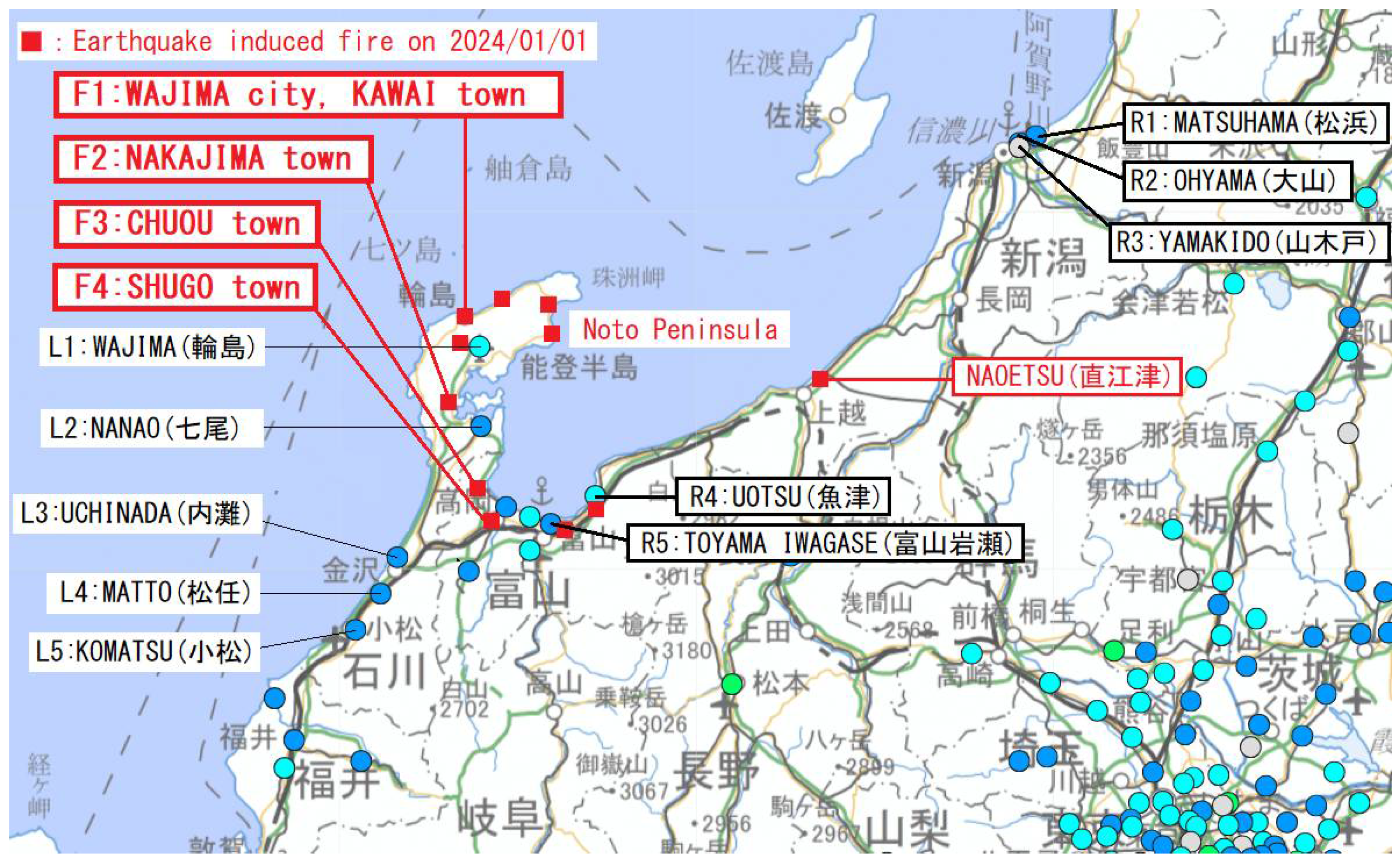
2.1. Methane Gas Data, Seismic Intensity Distribution, and Locations of Earthquake Fires During the Noto Peninsula Earthquake
2.1.1. Methane Concentration Data (AEROS/Soramame-Kun)
Calibration and Quality Control of CH4 and NMHC Measurements
2.1.2. Preliminary vs. Finalized Values
2.1.3. Methane Observation Stations
2.1.4. Earthquake-Induced Fire Locations
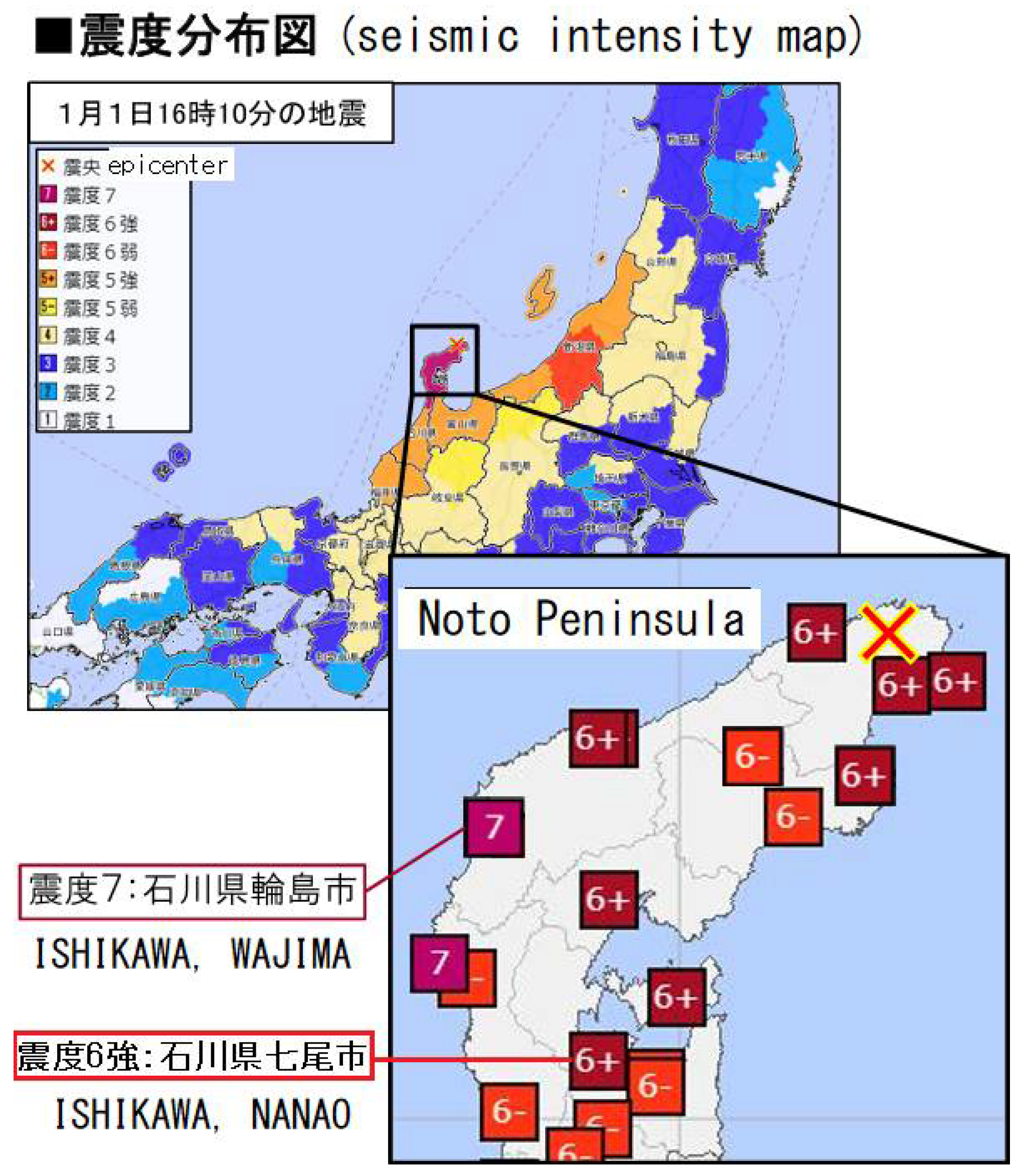
2.1.5. Seismic Intensity Distribution and Earthquake Catalog
2.2. Possibility That the Increase in Methane Concentration Originated from Subsurface Natural Gas
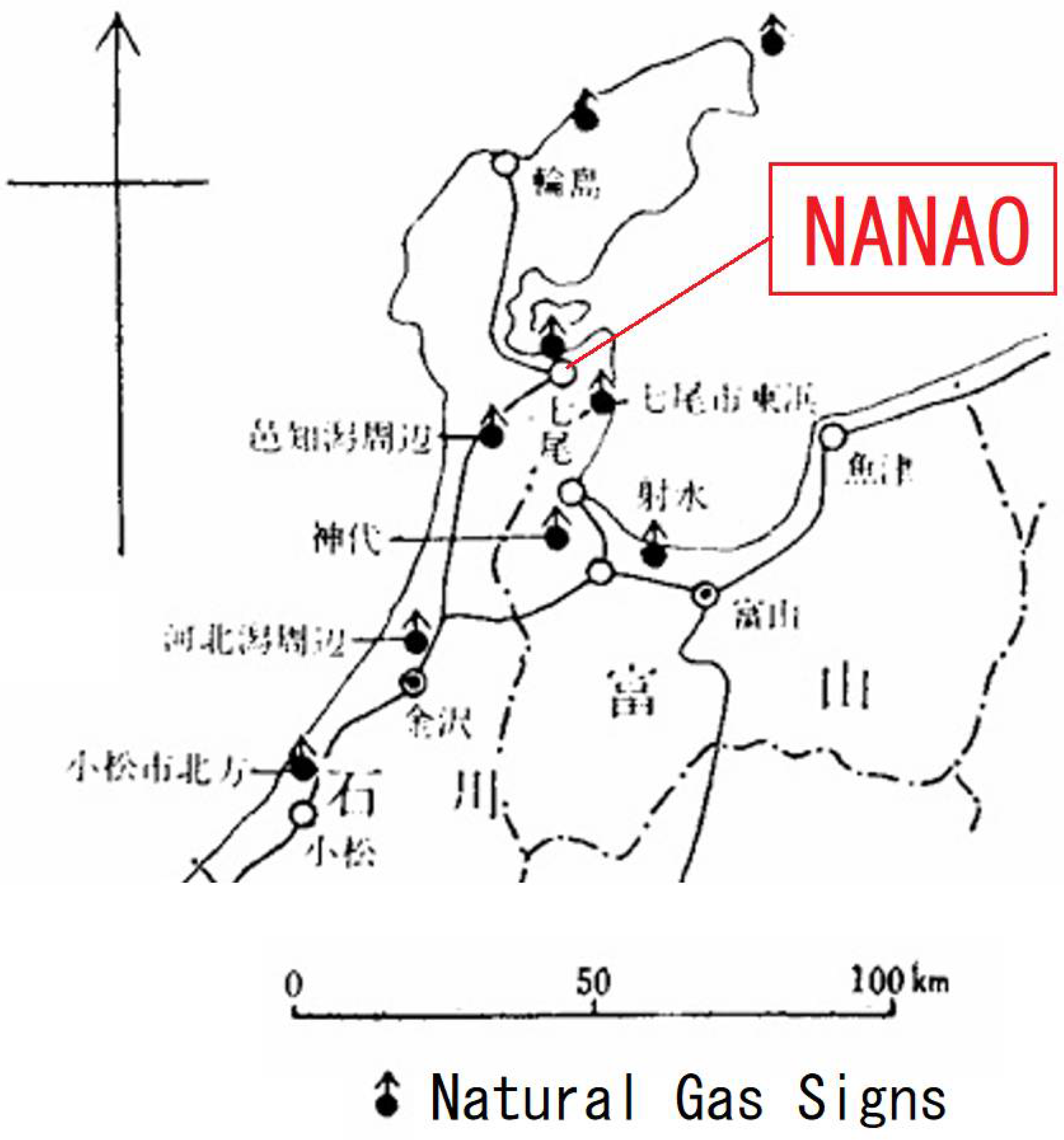
2.2.1. Historical Evidence of Natural Gas in the Nanao Area
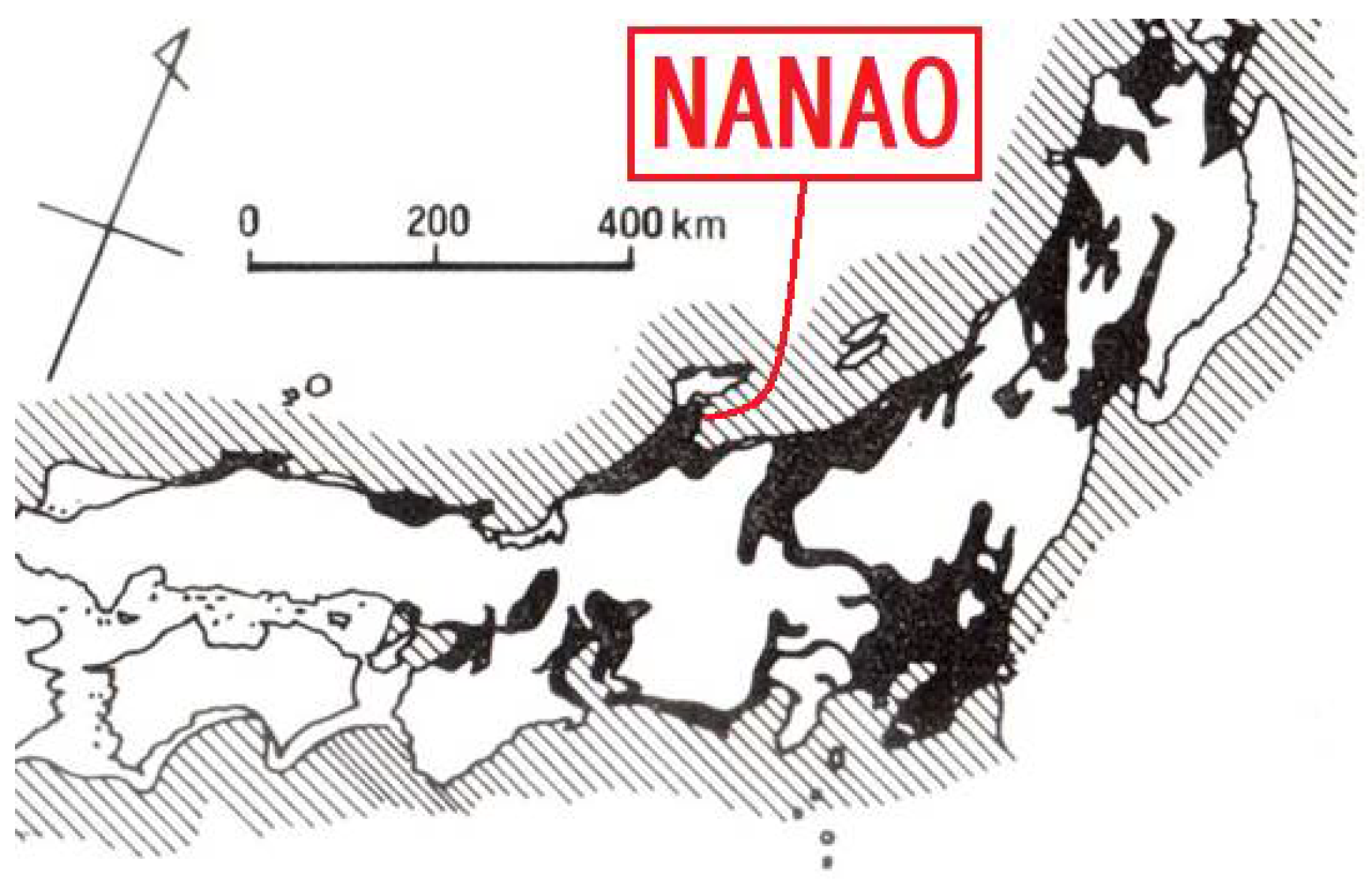
2.2.2. Distribution of Water-Soluble Gas Fields
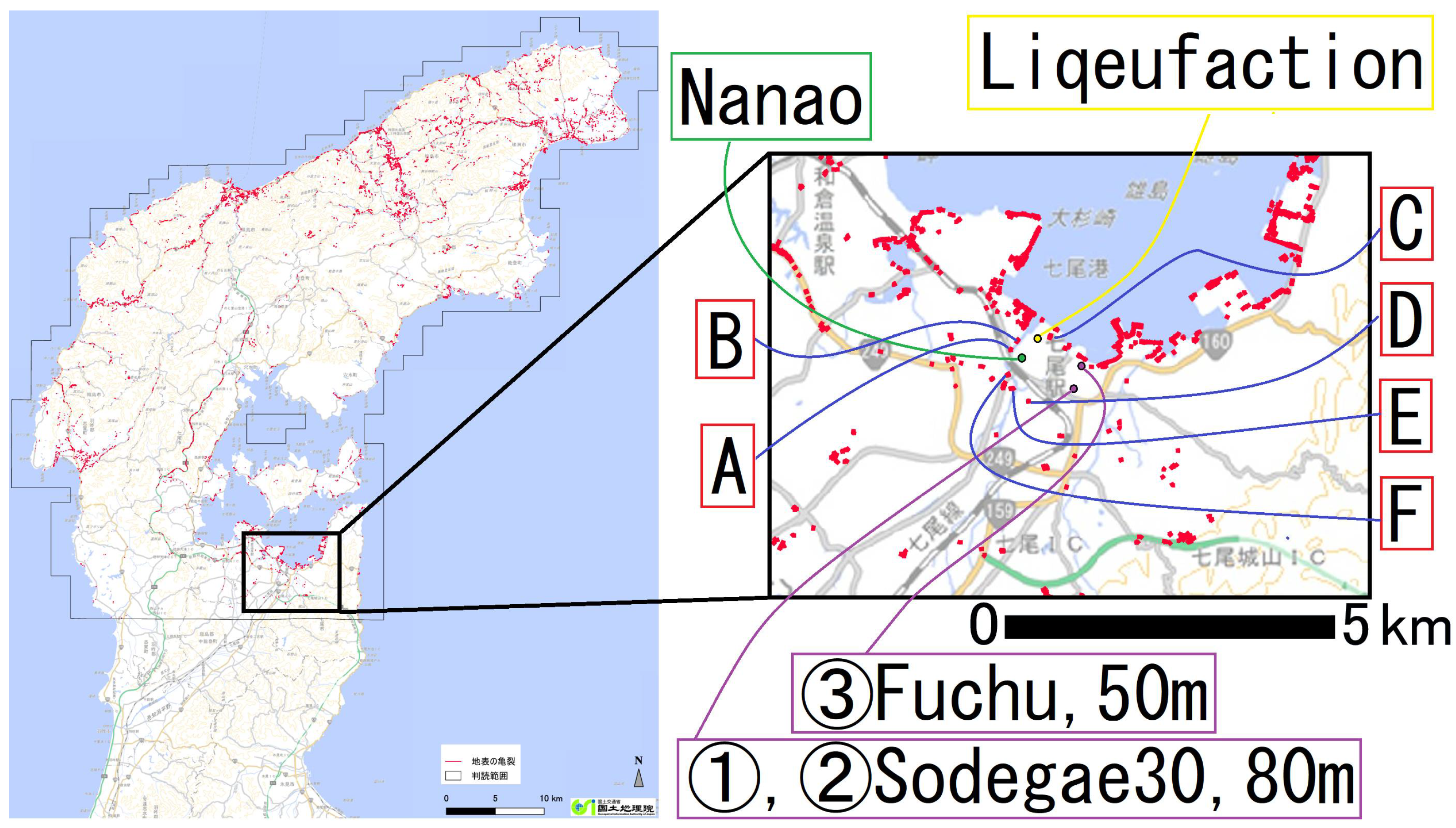
2.2.3. Surface Fissures and Liquefaction
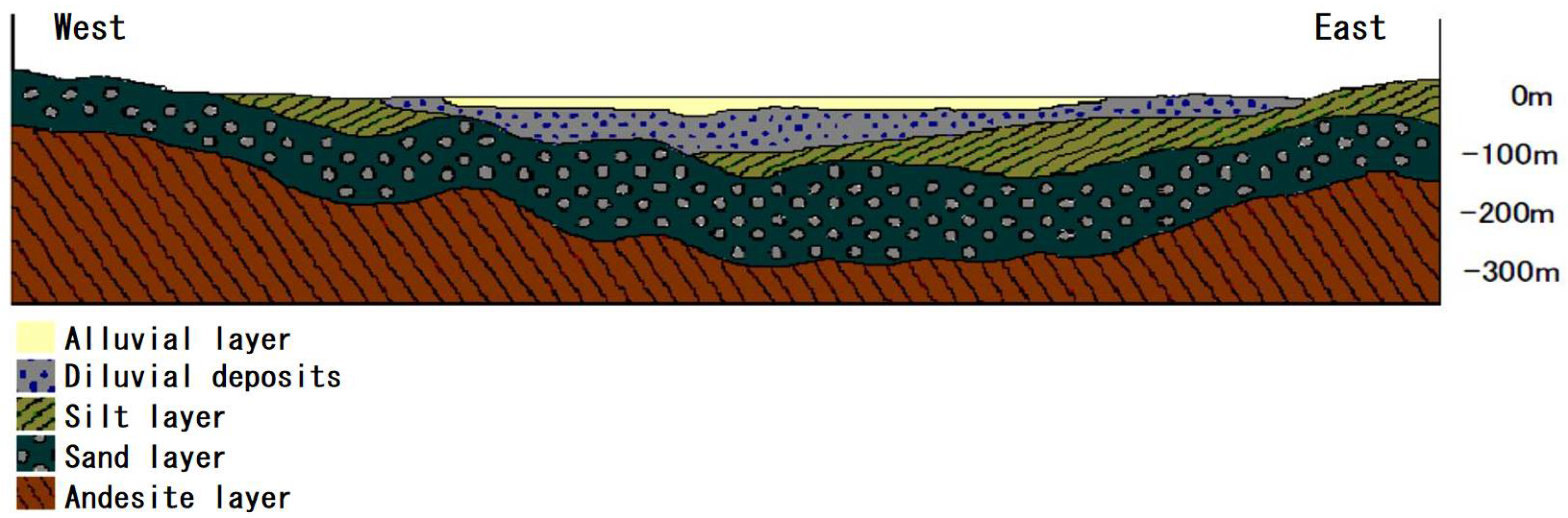
2.2.4. Geological Structure of the Nanao Region
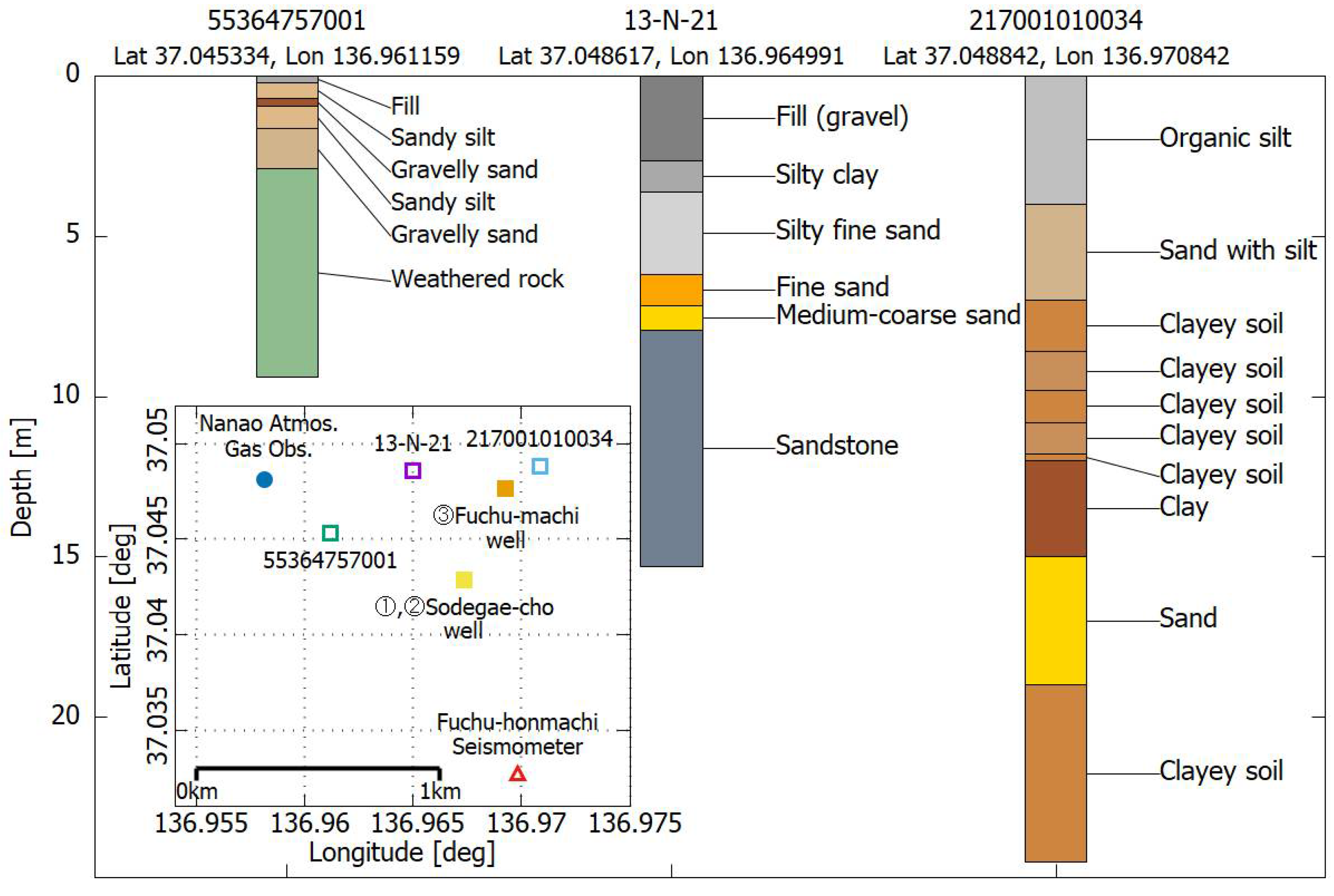
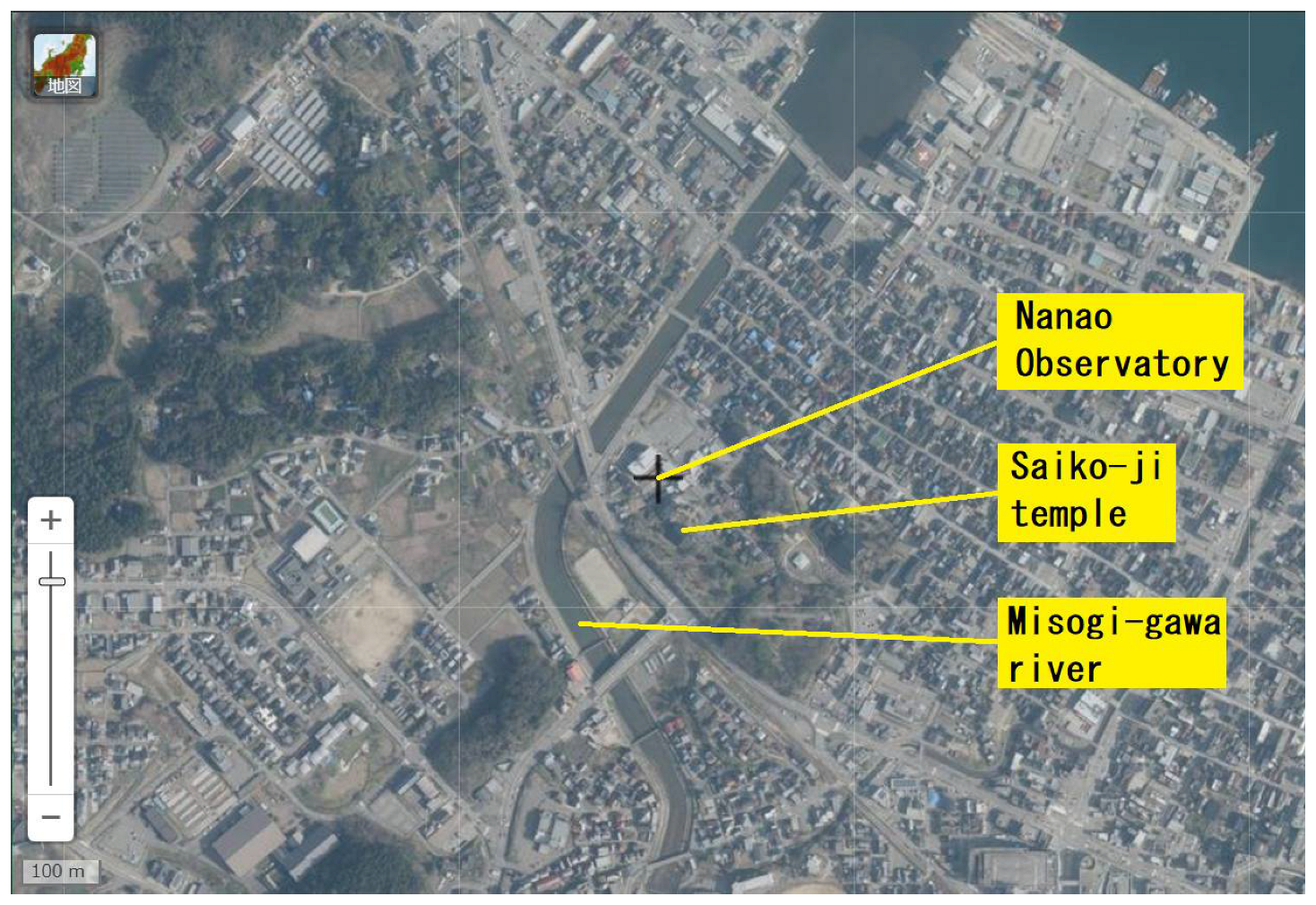
2.2.5. Borehole Stratigraphy near the Nanao Station
- Borehole 55364757001 reaches weathered rock at shallow depth (high permeability).
- Borehole 217001010034 is overlain by thick, soft sediments (likely causing strong shaking amplification).
- Site 13-N-21 exhibits intermediate characteristics. Liquefaction along the coastline suggests that methane stored beneath clay layers may have been released.

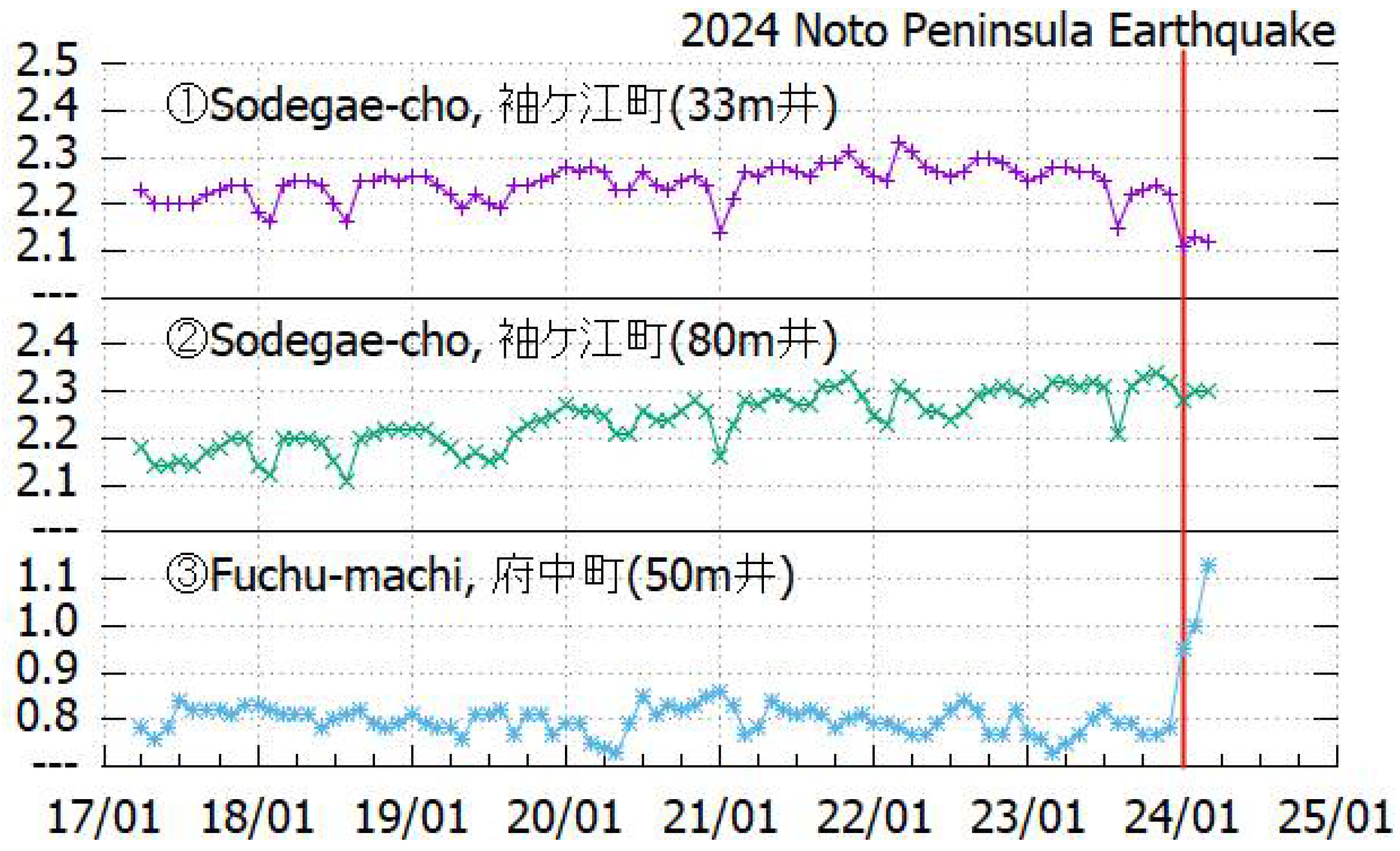
2.2.6. Groundwater Level Variations
2.3. Four Possible Non-Subsurface Explanations for the Increase in Methane Concentration
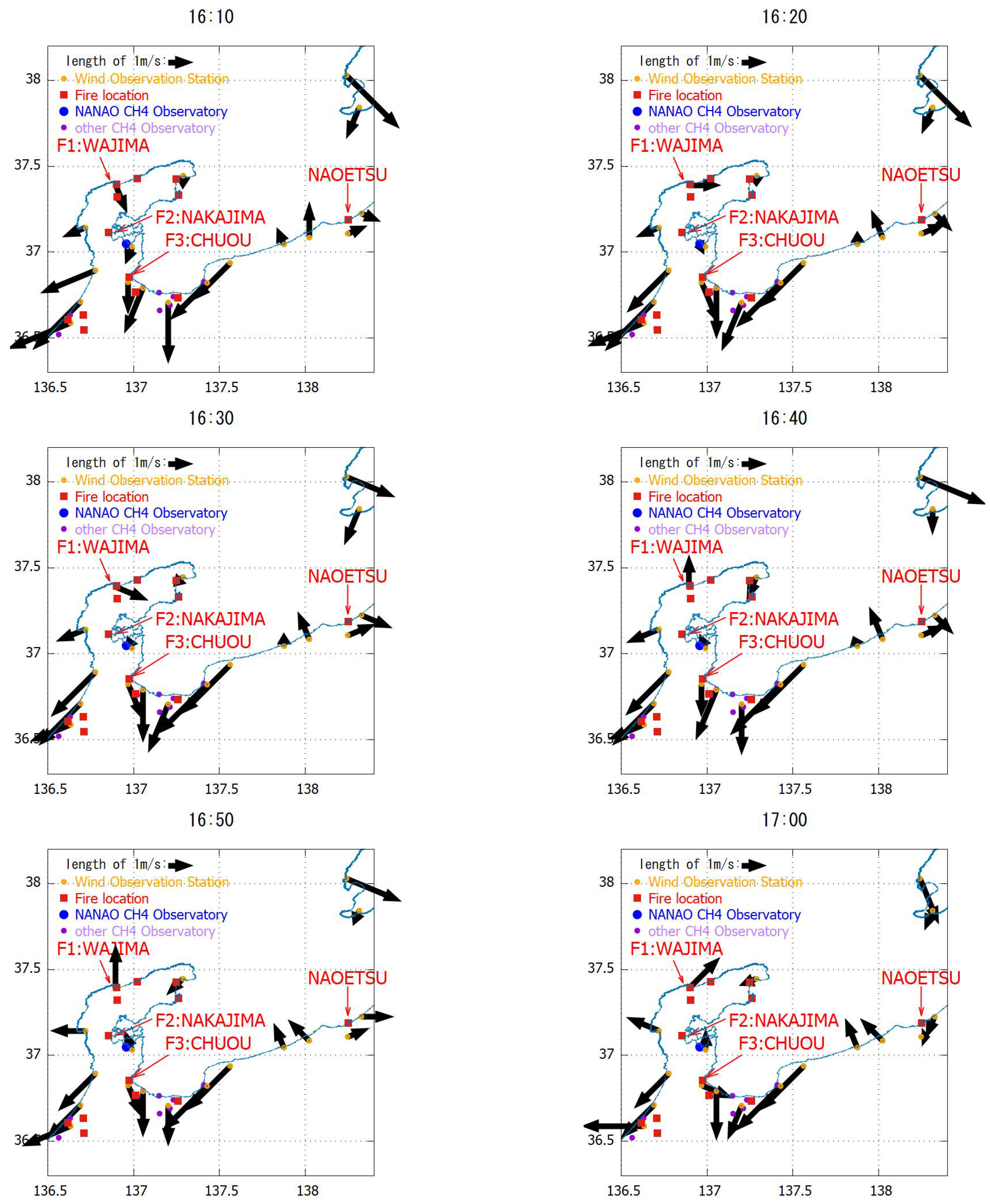
2.3.1. Influence of Fire Smoke Plumes
2.3.2. Influence of Ruptured City Gas Pipelines
2.3.3. Influence of Instrument Malfunction
2.3.4. Influence of Damaged Gas Cylinders
3. Results
3.1. Visualization and Temporal Analysis of Methane Concentration Data
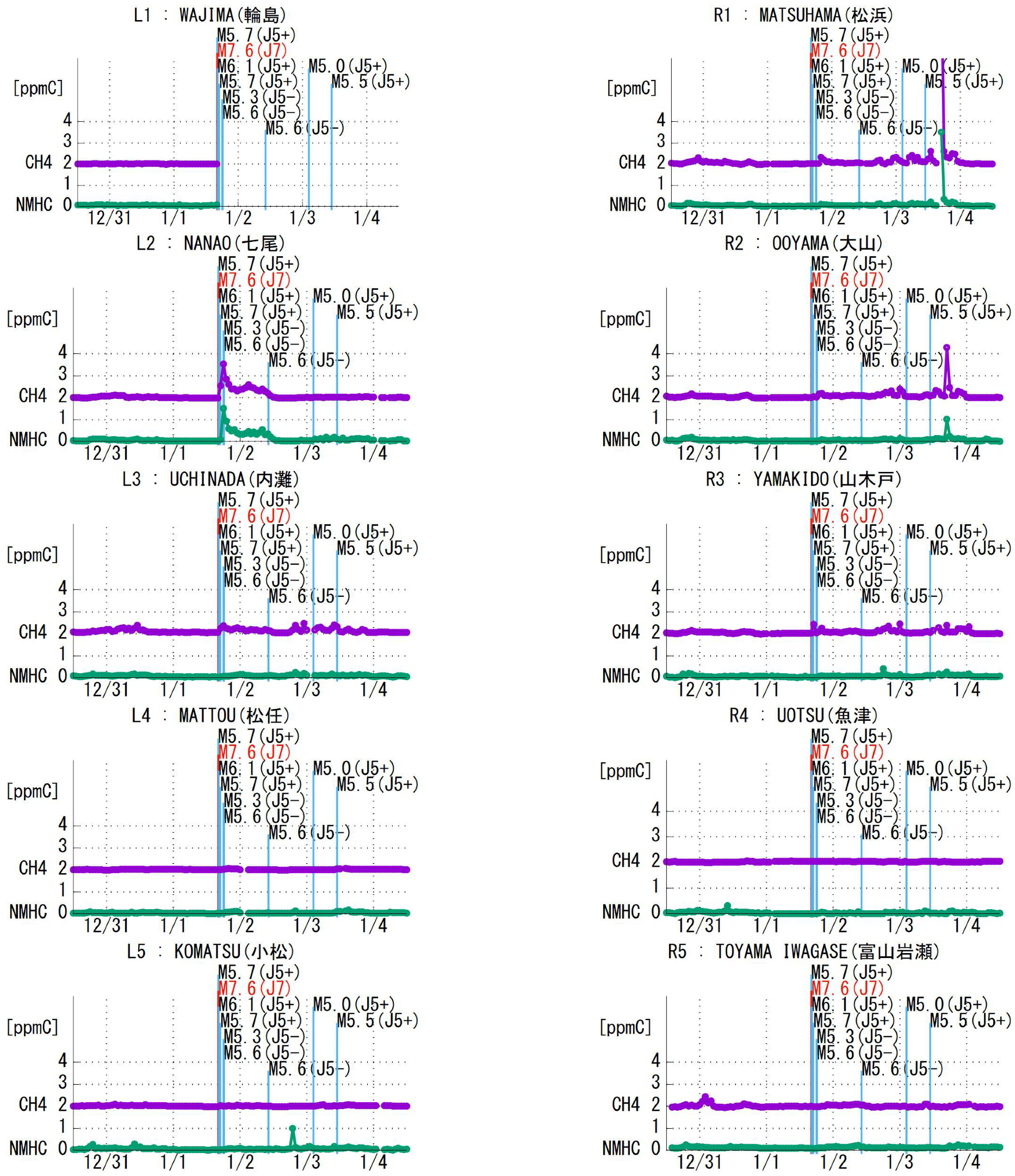
3.1.1. Time-Series at All Observation Stations (Figure 9)

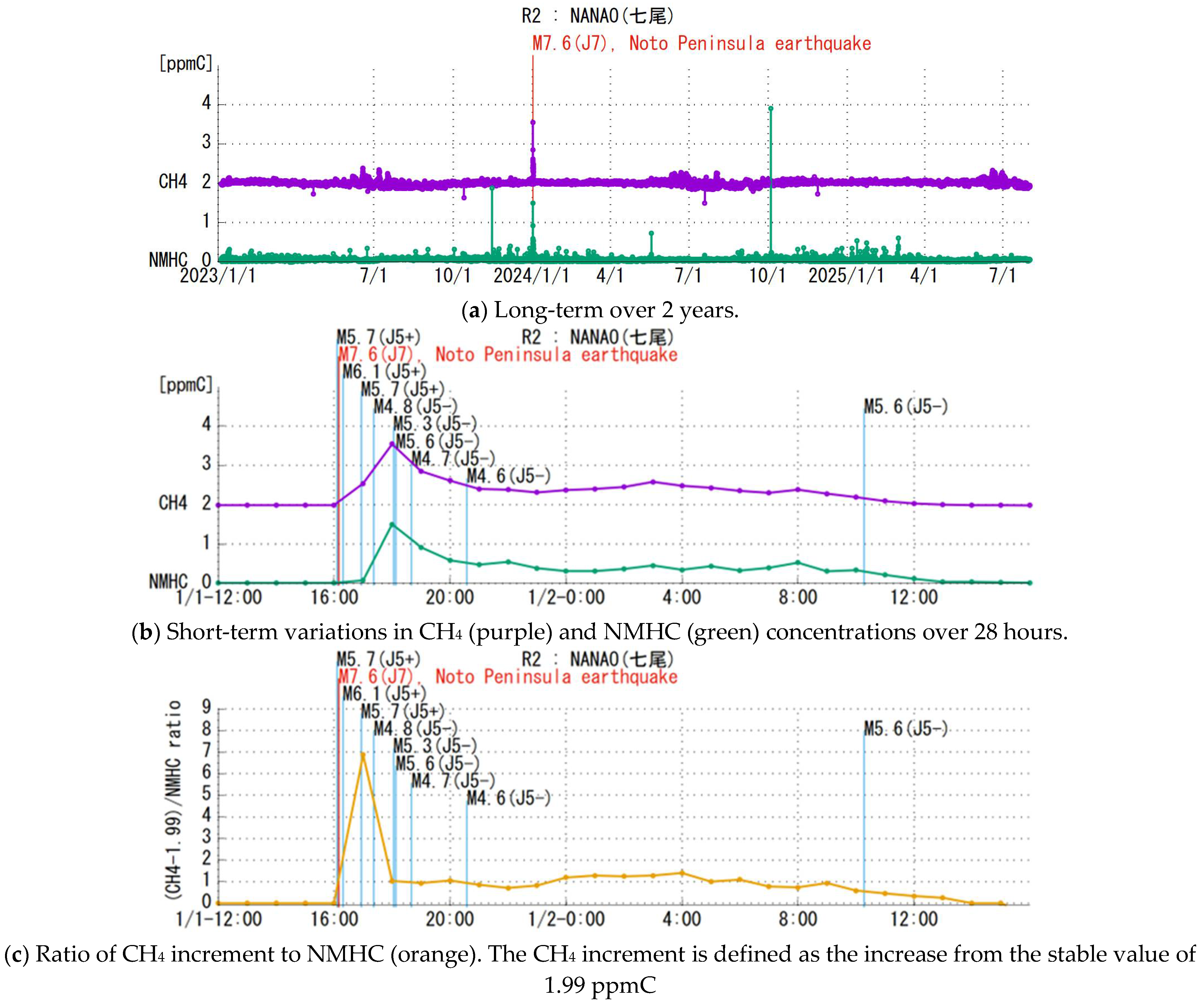
3.1.2. Long-Term Variations at the Nanao Observation Station (Figure 10a)

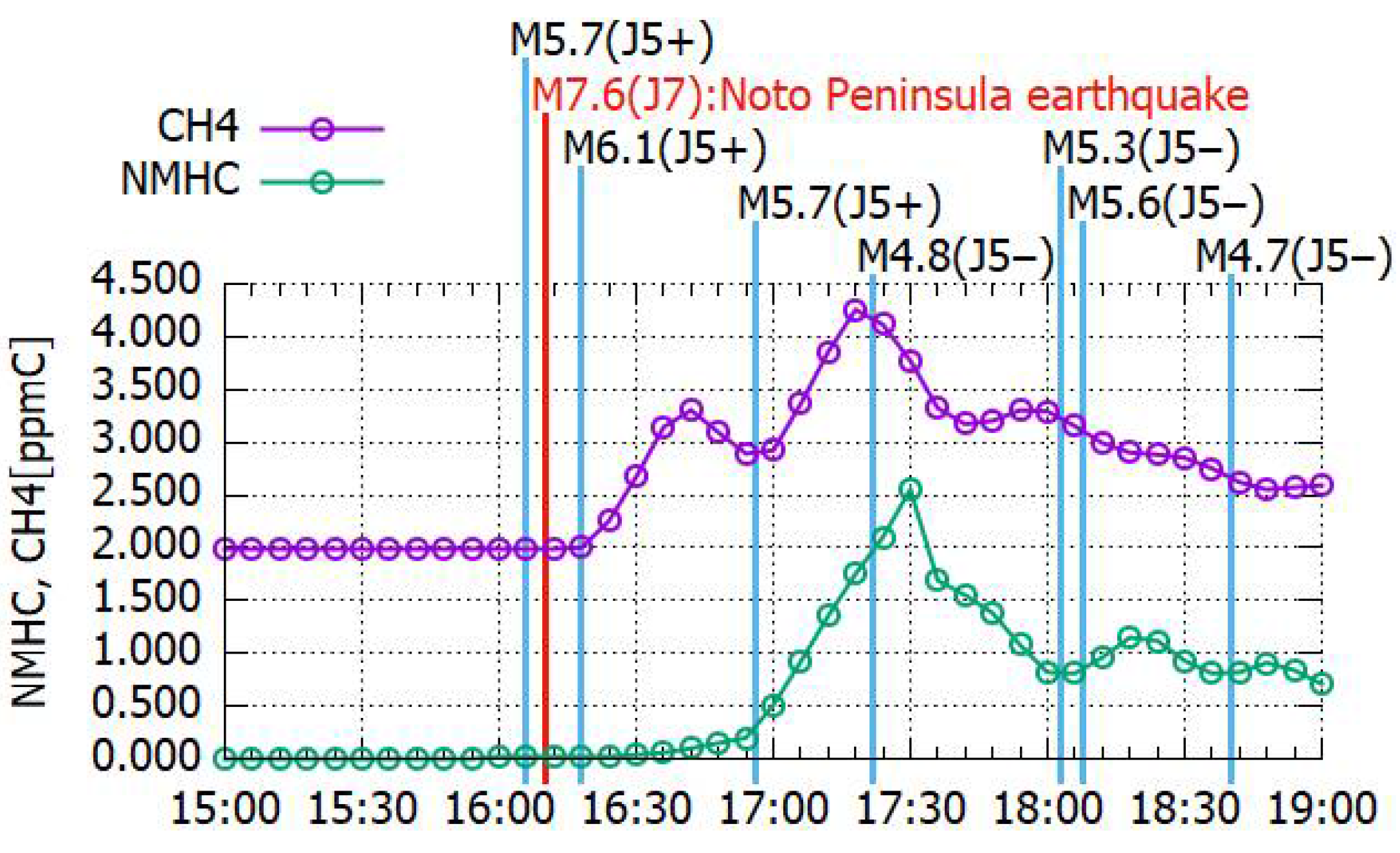
3.1.3. Short-Term Variations at the Nanao Station (Figure 10b)
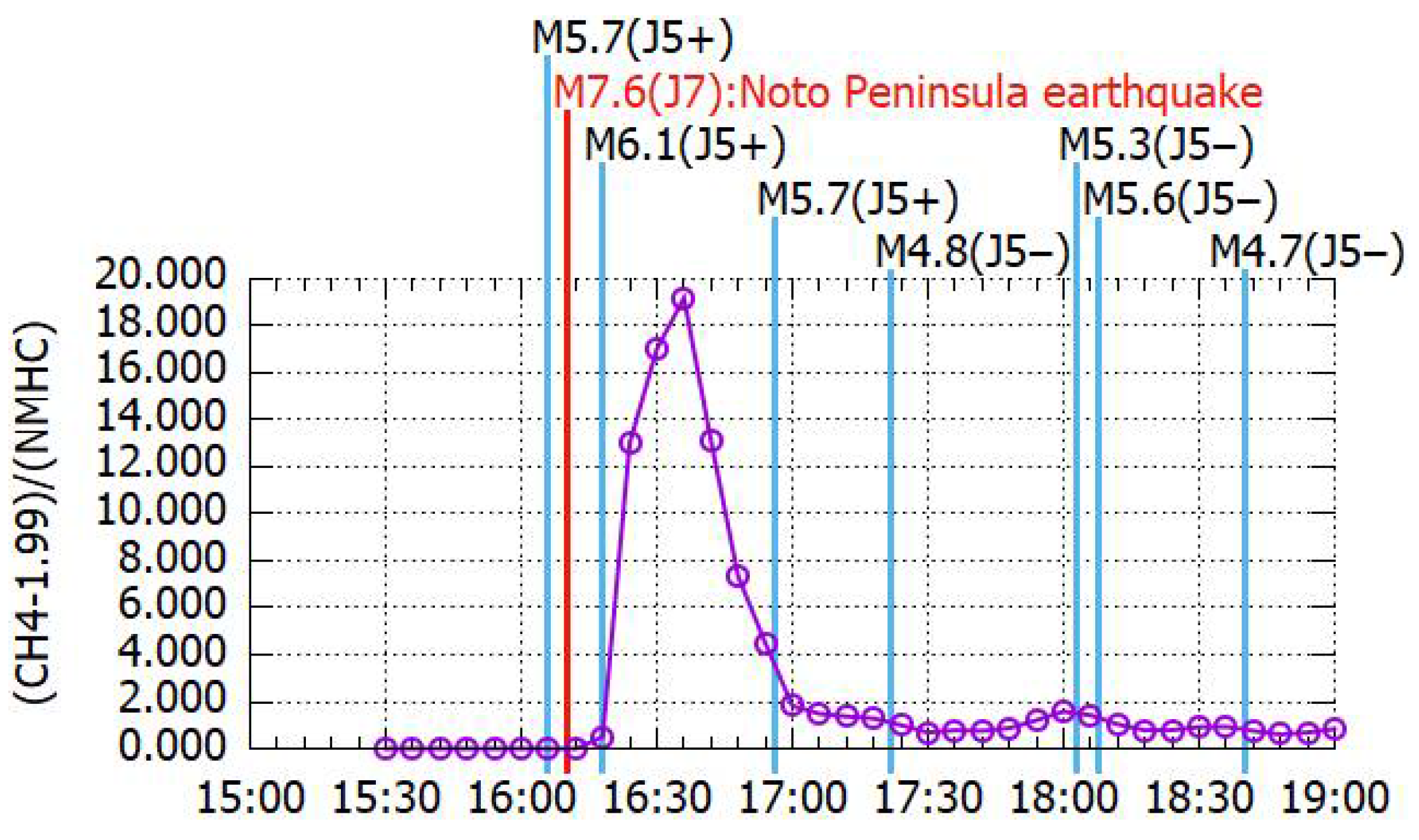
3.1.4. CH4/NMHC Ratio Analysis (Figure 10c)
3.2. Examination of Methane Emission Mechanisms at the Nanao Observation Station
3.2.1. Existence of Subsurface Gas Reservoirs
3.2.2. Clay-Cap Rupture and Shallow Gas Exsolution
3.2.3. Excess Pore-Water Pressure Hypothesis (Crews et al.)
- Condition 1: Presence of dissolved gas.
- From Figure 3 and Figure 4 and reference [10,11], it has been confirmed that water-soluble gases are dissolved in groundwater. Although direct information on saturation is not available, the unilateral rise in groundwater level after the earthquake shown in Figure 8 suggests a transition from saturation to degassing.
- Condition 2: Strong shaking and frequency components.
- Condition 3: Formation of pathways for sudden pressure drop.
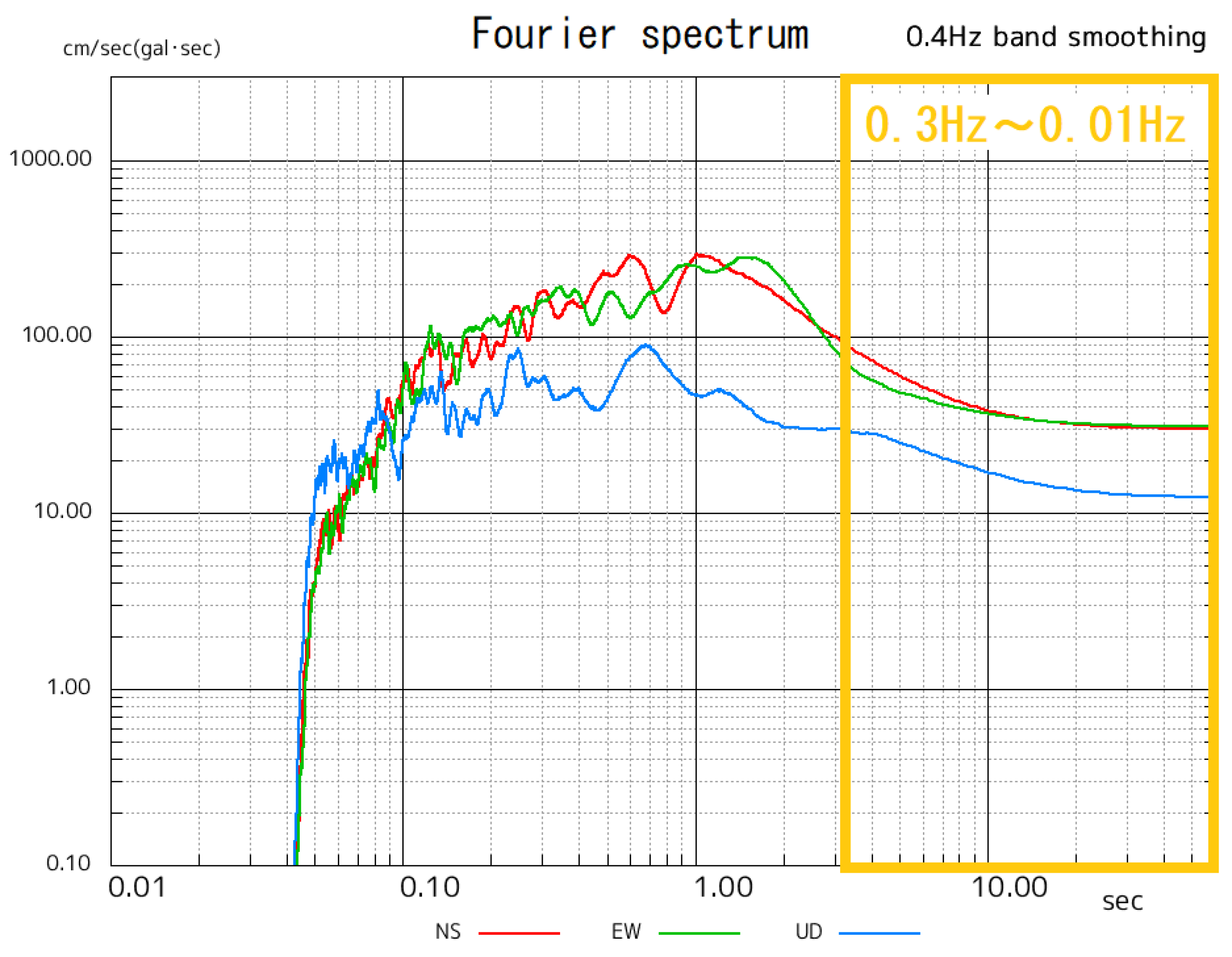
3.2.4. Summary of Conditions and Integrated Interpretation
3.3. Examination of Four Non-Subsurface Possibilities for Concentration Increase
3.3.1. Influence of Fire Smoke
3.3.2. Influence of Urban Gas Pipeline Rupture
Central Government Data
- Urban gas:
- No supply disruption in general gas pipeline operations. Although gas transmission from the Naoetsu LNG terminal was suspended for safety, backup supply ensured continuity.
- Gas retail business (simplified gas):
- One simplified gas housing complex in Ishikawa Prefecture experienced landslide damage to a main branch pipeline due to the earthquake. This system was LP gas, which does not contain methane.
- Heat supply business:
- No supply disruption and no damage reported.
- LP gas:
- No damage information at the time.

| Supervised Business | Contents |
|---|---|
| City Gas | As of 7:00 a.m. on Tuesday, 2 January, there are no supply disruptions for the general gas pipeline business. At the INPEX Naoetsu LNG Terminal, gas transmission has been suspended to ensure safety following the earthquake. After the tsunami warning is lifted, the terminal will be inspected, and gas transmission is scheduled to resume. Currently, backup gas supply is being received from Shizuoka Gas. Based on the current situation, gas supply is expected to continue until around 6:00 p.m. on Wednesday, 3 January. If the restart of gas transmission from the Naoetsu LNG Terminal is further delayed beyond that point, arrangements are being made to continue gas supply by receiving backup supply from Tokyo Gas. Once the tsunami warning is lifted, the terminal will be inspected, and gas transmission is scheduled to resume. |
| Gas Retail Business | At one simplified gas complex in Ishikawa Prefecture, an earthquake caused a landslide that damaged the main gas pipeline. The area is currently restricted due to fire department operations, making entry impossible. Future restoration measures are undetermined. |
| Heat Supply Business | There are no supply disruptions, and no damage reports have been received. |
| LP Gas | No damage reports at this time. |
| Date and Time Sent | Response Content |
|---|---|
| 5 November, 2024, 9:09 p.m. | There are no city gas providers in Nanao City, Ishikawa Prefecture, and no city gas supply areas exist. Consequently, no city gas supply facilities (such as city gas pipelines) are present. Therefore, no city gas accidents occur. |
Local Government Inquiry
3.3.3. Reliability of Methane Measurements (Instrument Error Check)
3.3.4. Influence of Damaged Gas Cylinders
4. Discussion
4.1. Range of Methane Emission Sources Recorded at the Nanao Observation Station
4.2. Consideration of CH4 Emission Timing at the Nanao Observation Station
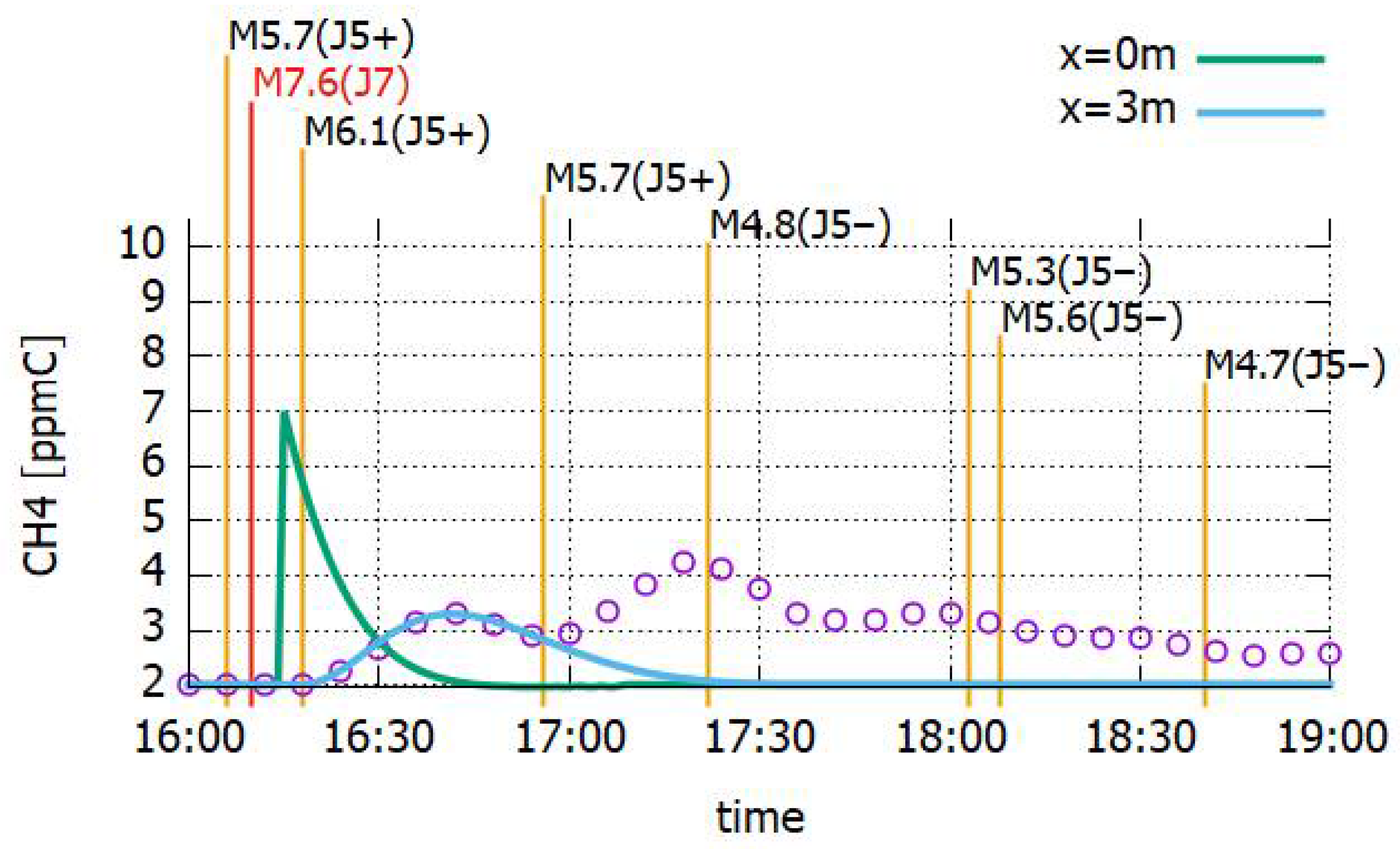
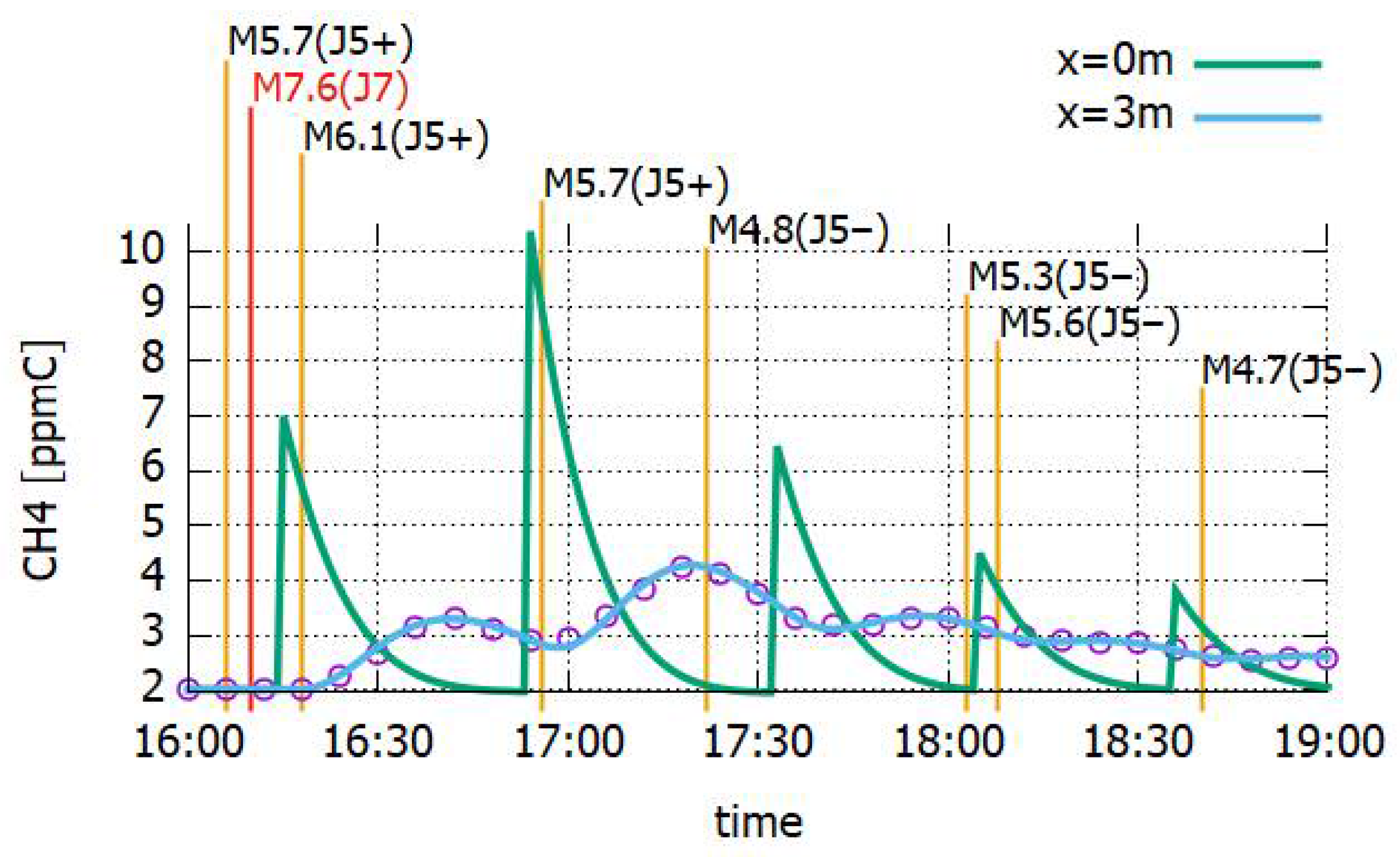
4.2.1. Estimation Method of Methane Emission Timing Using the Explicit Solution of the One-Dimensional Advection–Diffusion Equation
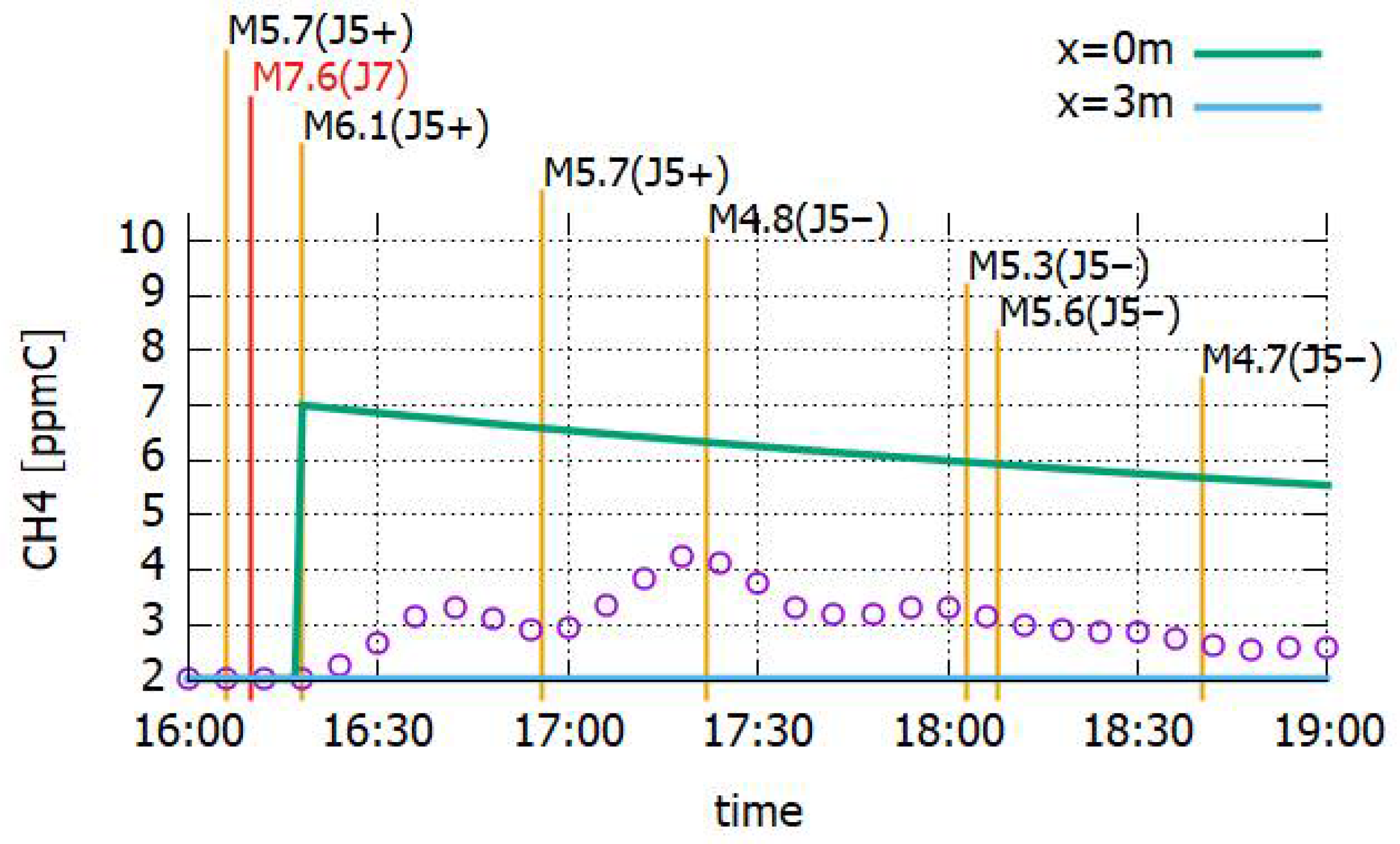
- STEP A: Assume the temporal variation in methane concentration at 0 m above ground.
- STEP B: Calculate the temporal variation in methane concentration at 3 m above ground.
- STEP C: Repeat Steps A → B until the early peak waveform observed in Figure 13 is reproduced.
4.2.2. Simulation Results and Methane Release Time
4.3. Possibility of Biogenic Methane and Shallow Organic Sources
4.4. Limitations
5. Conclusions
Funding
Institutional Review Board Statement
Informed Consent Statement
Data Availability Statement
Acknowledgments
Conflicts of Interest
Abbreviations
| AEROS | Atmospheric Environmental Regional Observation System |
| M | Magnitude |
| J | Japanese seismic intensity |
| NMHC | Non-Methane Hydrocarbons Gas |
References
- Enomoto, Y.; Komatsubara, T. Earthquakes and their geological environment associated with natural gas eruptions and fire damage: The 1923 Great Kanto Earthquake, historical precedents, and the 2024 Noto Peninsula Earthquake. Chikyu Mon. 2024, 46, 842–859. (In Japanese) [Google Scholar]
- Fire and Disaster Management Agency. Fire Cause Investigation Report by the Director General of the Fire and Disaster Management Agency on the Large-Scale Urban Fire in Wajima City, Ishikawa Prefecture, Triggered by the 2024 Noto Peninsula Earthquake; Fire and Disaster Management Agency: Tokyo, Japan, 2024; pp. 1–66.
- Enomoto, Y.; Komatsubara, T.; Kiyashu, S. Ignition of subterranean methane: Unveiling a new geohazard in Japan following the 2024 Noto Peninsula Earthquake. Npj Nat. Hazards 2025, 2, 31. [Google Scholar] [CrossRef]
- Crews, J.B.; Cooper, C.A. Transient pore pressure response to confining stress excursions in Berea sandstone flooded with an aqueous solution of CO2. Water Resour. Res. 2014, 50, 4775–4786. [Google Scholar] [CrossRef]
- Crews, J.B.; Cooper, C.A. Experimental evidence for seismically initiated gas bubble nucleation and growth in groundwater as a mechanism for coseismic borehole water level rise and remotely triggered seismicity. J. Geophys. Res. Solid Earth 2014, 119, 7079–7091. [Google Scholar] [CrossRef]
- Roeloffs, E.A. Persistent water level changes in a well near Parkfield, California, due to local and distant earthquakes. J. Geophys. Res. Solid Earth 1998, 103, 869–889. [Google Scholar] [CrossRef]
- Crews, J.B.; Rybarski, S. The Role of Seismically Initiated CO2 Gas Bubble Growth in Groundwater as a Mechanism for Remotely Triggered Seismicity. Final Technical Report, USGS NEHRP Grant G15AP00058. 2016. Available online: https://dl1.icdst.org/pdfs/files3/ea73b7cd7cc0475d9cb3dac7d1771c5c.pdf (accessed on 25 November 2025).
- Atmospheric Environmental Regional Observation System (AEROS). Soramame-Kun. Available online: https://soramame.env.go.jp/ (accessed on 5 January 2024).
- Ministry of Land, Infrastructure, Transport and Tourism. Overview of the Noto Peninsula Earthquake in the 6th year of Reiwa. Available online: https://www.mlit.go.jp/mizukokudo/sewerage/content/001729914.pdf (accessed on 3 June 2025).
- Geological Survey of Japan. Natural gas in central Japan. Chishitsu News 1961, 7. Available online: https://www.gsj.jp/publications/pub/chishitsunews/news1961-07.html (accessed on 30 November 2025). (In Japanese).
- Japanese Association for Petroleum Technology. Petroleum Industry Handbook; Japanese Association for Petroleum Technology: Tokyo, Japan, 1983; p. 710. [Google Scholar]
- Geospatial Information Authority of Japan. Surface Cracks Associated with the 2024 Noto Peninsula Earthquake. Available online: https://www.gsi.go.jp/common/000255658.pdf (accessed on 30 November 2025).
- Wakamatsu, K.; Yoshida, N.; Tohno, I.; Aoyama, S. Soil Conditions and Liquefaction History in Areas Affected by Liquefaction in the Noto Peninsula Earthquake of Reiwa 6. 5 May 2024, p. 5. Available online: https://www.jaee.gr.jp/jp/wp-content/uploads/2024/01/20240101noto_wakamatsu_no2.pdf (accessed on 30 November 2025).
- Ishikawa Prefecture. Report on Groundwater Conservation Measures Survey (石川県地下水保全対策調査報告書). Ishikawa Prefecture, Environment Department. Available online: https://www.pref.ishikawa.lg.jp/kankyo/shiryo/tika/tyousahoukokusyo.html (accessed on 28 November 2025). (In Japanese)
- Nanao City. Report on Ground Subsidence in Nanao City (七尾市地盤沈下調査報告書). Nanao City, Environment Division. Available online: https://www.city.nanao.lg.jp/kankyo/kurashi/recycling/kankyo/documents/r3_5jibanntinnka.pdf (accessed on 28 November 2025). (In Japanese)
- National Research Institute for Earth Science and Disaster Resilience (NIED). National Land Ground Information Search Site. Available online: https://www.kunijiban.pwri.go.jp/viewer/ (accessed on 30 November 2025).
- Yahoo! Earthquake Information. Available online: https://typhoon.yahoo.co.jp/weather/jp/earthquake/list/ (accessed on 30 November 2025).
- Japan Meteorological Agency. 4:10 p.m. Earthquake in Noto District, Ishikawa Prefecture: Seismic Intensity Analysis for Fuchu-Honmachi, Nanao City. 1 January 2024. Available online: https://www.data.jma.go.jp/eqev/data/kyoshin/jishin/2401011610_noto/wave/wav20240101000141333.png (accessed on 30 November 2025). (In Japanese)
- Nishino, T. About the Earthquake Fires and Tsunami Fires Associated with the 2024 Noto Peninsula Earthquake. Disaster Prevention Research Institute, Kyoto University. 24 January 2024. Available online: https://www.dpri.kyoto-u.ac.jp/contents/wp-content/uploads/2024/01/Nishino_20240122_Fire-following-earthquake-aspects-of-the-2024-Noto-Peninsula-earthquake.pdf (accessed on 3 June 2025).
- Fire and Disaster Management Agency. A Fire Situation Following the Noto Peninsula Earthquake. Available online: https://www.fdma.go.jp/singi_kento/kento/items/post-148/01/sankou1.pdf (accessed on 14 August 2025). (In Japanese)
- Japan Meteorological Agency. Available online: https://www.data.jma.go.jp/stats/etrn/index.php (accessed on 30 November 2025).
- Cabinet Office; Government of Japan. Disaster Damage Caused by the Noto Peninsula Earthquake of 2024. Available online: https://www.bousai.go.jp/updates/r60101notojishin/index.html (accessed on 30 November 2025).
- Fujita, S. Comparison of various equations for diffusion coefficients in the gas phase. Chem. Eng. 1964, 28, 251–254. (In Japanese) [Google Scholar]
- Sánchez-Sosa, J.E.; Castillo-Mixcóatl, J.; Beltrán-Pérez, G.; Muñoz-Aguirre, S. An application of the Gaussian plume model to localization of an indoor gas source with a mobile robot. Sensors 2018, 18, 4375. [Google Scholar] [CrossRef] [PubMed]
- Michio, S.; Masakazu, N.; Kazuya, M.; Kenji, A.; Kenichi, T.; Tomichi, T. Estimation of gas migration pathways around faults based on the distribution of atmospheric methane near ground surface. Annu. Rep. Fukada Geol. Inst. 2021, 22, 119–137. (In Japanese) [Google Scholar]
- Niwa, M.; Shimada, K.; Goto, A.; Shimo, M. Efficient Detection of Methane Seepage Using a Vehicle-Mounted Cavity Ring-Down Spectroscopy Analyzer; JAEA-Research; Japan Atomic Energy Agency: Fukui, Japan, 2022; p. 004.
- Okamoto, H.; Gomi, Y. Empirical research study on diffusion behavior of gas leaks in the ground: The numerical simulation model’s applicability verification. Saf. Eng. 2010, 49, 38–46. (In Japanese) [Google Scholar]
- Ogihara, T. One-Dimensional Advection–Diffusion Equation. p. 7. Available online: https://www.ep.sci.hokudai.ac.jp/~gfdlab/comptech/resume/210_advdiv/2012_0216-ogihara.pdf (accessed on 30 November 2025). (In Japanese).
- Musashino University. Part 16: Numerical Solution of One-Dimensional Diffusion Equation. Available online: https://www.musashino-u.ac.jp/d_ueyama/tutorials/c-lang/16.html (accessed on 30 November 2025). (In Japanese).




| Time | L1: WAJI MA | L2: NANA O | L3: UCHI NADA | L4: MATT OU | L5: KOMA TSU | R1: MATSU HAMA | R2: OO YAMA | R3: YAMA KIDO | R4: UO TSU | R5: IWA GASE |
|---|---|---|---|---|---|---|---|---|---|---|
| 1/1 12:00 | 2.01 | 1.99 | 2.05 | 2.01 | 1.99 | 2.00 | 2.01 | 2.02 | 2.05 | 1.99 |
| 13:00 | 2.00 | 1.99 | 2.06 | 2.00 | 1.99 | 2.01 | 2.01 | 2.02 | 2.05 | 1.98 |
| 14:00 | 2.01 | 1.99 | 2.06 | 2.01 | 1.99 | 2.01 | 2.02 | 2.03 | 2.05 | 2.00 |
| 15:00 | 2.01 | 1.99 | 2.07 | 2.01 | 1.99 | 2.02 | 2.01 | 2.02 | 2.05 | 1.98 |
| 16:00 | 2.01 | 1.99 | 2.06 | 2.01 | 1.99 | 2.02 | 2.01 | 2.02 | 2.05 | 2.00 |
| 17:00 | 2.54 | 2.27 | 2.01 | 2.02 | 2.03 | 2.05 | 2.44 | 2.05 | 1.98 | |
| 18:00 | 3.54 | 2.36 | 2.02 | 2.00 | 2.03 | 2.03 | 2.05 | 2.05 | 1.99 | |
| 19:00 | 2.85 | 2.27 | 2.05 | 2.01 | 2.03 | 2.18 | 2.12 | 2.05 | 1.99 | |
| 20:00 | 2.61 | 2.21 | 2.06 | 2.02 | 2.33 | 2.19 | 2.26 | 2.05 | 2.00 | |
| 21:00 | 2.40 | 2.17 | 2.04 | 2.01 | 2.21 | 2.10 | 2.10 | 2.04 | 2.01 | |
| 22:00 | 2.38 | 2.25 | 2.05 | 2.01 | 2.11 | 2.09 | 2.10 | 2.04 | 2.06 | |
| 23:00 | 2.31 | 2.28 | 2.05 | 2.04 | 2.12 | 2.06 | 2.07 | 2.04 | 2.04 | |
| 1/2 00:00 | 2.37 | 2.21 | 2.01 | 2.03 | 2.07 | 2.08 | 2.08 | 2.04 | 2.05 | |
| 01:00 | 2.40 | 2.22 | - | 2.00 | 2.06 | 2.09 | 2.08 | 2.03 | 2.05 | |
| 02:00 | 2.45 | 2.14 | - | 2.02 | 2.08 | 2.10 | 2.07 | 2.05 | 2.02 | |
| 03:00 | 2.58 | 2.15 | 2.00 | 2.02 | 2.07 | 2.05 | 2.05 | 2.05 | 2.02 | |
| 04:00 | 2.48 | 2.19 | 2.00 | 2.00 | 2.06 | 2.07 | 2.09 | 2.05 | 2.06 | |
| 05:00 | 2.43 | 2.17 | 2.00 | 2.00 | 2.03 | 2.08 | 2.11 | 2.05 | 2.04 | |
| 06:00 | 2.35 | 2.17 | 2.00 | 2.02 | 2.05 | 2.10 | 2.13 | 2.04 | 2.05 | |
| 07:00 | 2.30 | 2.14 | 2.00 | 2.02 | 2.05 | 2.11 | 2.12 | 2.03 | 2.06 | |
| 08:00 | 2.38 | 2.13 | 2.00 | 2.01 | 2.04 | 2.10 | 2.14 | 2.03 | 2.08 | |
| 09:00 | 2.28 | 2.20 | 2.00 | 2.00 | 2.06 | 2.08 | 2.11 | 2.04 | 2.08 | |
| 10:00 | 2.19 | 2.15 | 2.00 | 2.00 | 2.06 | 2.09 | 2.07 | 2.04 | 2.04 | |
| 11:00 | 2.09 | 2.13 | 2.00 | 2.00 | 2.05 | 2.08 | 2.06 | 2.05 | 2.04 | |
| 12:00 | 2.03 | 2.06 | 2.00 | 1.99 | 2.06 | 2.05 | 2.04 | 2.01 |
| F1:WAJIMA, N39 km | SHIGA, WNW24 km | F3:HIMI, S21 km | L2:Nanao, 0 km | |||||
|---|---|---|---|---|---|---|---|---|
| Time | Wind Direction | Speed [m/s] | Wind Direction | Speed [m/s] | Wind Direction | Speed [m/s] | Wind Direction | Speed [m/s] |
| 16:00 | N | 1.4 | ENE | 1.3 | NNW | 1.9 | NNE | 0.8 |
| 16:10 | NNW | 1.3 | ENE | 1.0 | N | 1.4 | NNE | 0.7 |
| 16:20 | W | 1.4 | ENE | 1.0 | NNW | 2.2 | E | 0.4 |
| 16:30 | WNW | 1.6 | ENE | 1.4 | NNW | 1.8 | SSE | 0.5 |
| 16:40 | S | 1.4 | ENE | 1.6 | N | 1.5 | SSE | 0.6 |
| 16:50 | S | 2.1 | E | 1.6 | NNW | 1.5 | SSE | 0.8 |
| 17:00 | SW | 2.1 | ESE | 1.6 | WNW | 1.5 | S | 0.8 |
| 17:10 | SSW | 1.4 | ESE | 1.6 | WSW | 1.7 | S | 0.7 |
| 17:20 | SSW | 2.6 | ESE | 1.6 | WSW | 1.4 | S | 0.6 |
| 17:30 | SW | 2.7 | E | 1.5 | W | 1.3 | SSE | 0.7 |
| 17:40 | SW | 2.4 | E | 1.3 | W | 1.7 | S | 0.8 |
| 17:50 | SSW | 2.2 | E | 1.2 | W | 1.4 | S | 0.6 |
| 18:00 | S | 1.3 | E | 1.2 | SW | 1.3 | S | 0.6 |
| Date and Time | Question and Answer |
|---|---|
| 1 November, 2024 (Question) | Are there any record of reports received by Nanao City about a city gas leak occurring between 4:00 p.m. on 1 January and 12:00 p.m. on 2 January? |
| 5 November, 2024 (Answer) | No such information has been reported (though several cases of leaks from LP gas cylinders have been reported). To begin with, we understand that Nanao City has virtually no city gas. Primarily, gas companies and the administration do not provide widespread city gas supply to the public. (Omitted) Methane fermentation is not conducted at the sewage treatment plant. While there is a national petroleum and gas reserve base, it stores only propane and butane. |
| Time | CH4 | NMHC | Hourly Average CH4 (CH4 in Figure 10b) Other Comments | Time | CH4 | NMHC | Hourly Average CH4 (CH4 in Figure 10b) Other Comments |
|---|---|---|---|---|---|---|---|
| 15:00 | 1.99 | 0 | 17:00 | 2.92 | 0.51 | CH4, NMHC increase | |
| 15:06 | 1.99 | 0 | 17:06 | 3.36 | 0.92 | ||
| 15:12 | 1.99 | 0 | 17:12 | 3.85 | 1.35 | ||
| 15:18 | 1.99 | 0 | 17:18 | 4.25 | 1.75 | CH4 2nd peak | |
| 15:24 | 1.99 | 0 | 17:24 | 4.11 | 2.1 | ||
| 15:30 | 1.99 | 0.01 | 17:30 | 3.77 | 2.55 | NMHC 1st peak | |
| 15:36 | 1.99 | 0.01 | 17:36 | 3.32 | 1.69 | ||
| 15:42 | 1.99 | 0.01 | 17:42 | 3.17 | 1.55 | ||
| 15:48 | 1.99 | 0.01 | 17:48 | 3.2 | 1.38 | ||
| 15:54 | 1.99 | 0.01 | 1.99 (1.99) | 17:54 | 3.3 | 1.08 | 3.535 (3.54) |
| 16:00 | 1.99 | 0.02 | 18:00 | 3.29 | 0.82 | 18:03 M5.3 | |
| 16:06 | 1.99 | 0.02 | 16:06 M5.7, 16:10 M7.6 | 18:06 | 3.15 | 0.81 | 18:08 M5.6 |
| 16:12 | 1.99 | 0.02 | 18:12 | 2.99 | 0.96 | ||
| 16:18 | 2.00 | 0.02 | 16:18 M6.1 | 18:18 | 2.9 | 1.15 | |
| 16:24 | 2.25 | 0.02 | CH4 steep increase | 18:24 | 2.88 | 1.12 | |
| 16:30 | 2.67 | 0.04 | 18:30 | 2.85 | 0.93 | ||
| 16:36 | 3.14 | 0.06 | 18:36 | 2.75 | 0.81 | ||
| 16:42 | 3.3 | 0.10 | CH4 1st peak | 18:42 | 2.62 | 0.82 | |
| 16:48 | 3.09 | 0.15 | 18:48 | 2.55 | 0.91 | ||
| 16:54 | 2.89 | 0.20 | 2.531 (2.54), 16:56 M5.7 | 18:54 | 2.57 | 0.84 | 2.855 (2.85) |
| Time | Wind Direction | Wind Speed [m/s] | 10 min Traveling Distance [m] | CH4 Concentration [ppmC] |
|---|---|---|---|---|
| 16:00–16:10 | NNE | 0.7 | 420 | 16:00 (15:57–16:03), 1.99 16:06 (16:03–16:09), 1.99 |
| 16:10–16:20 | E | 0.4 | 240 | 16:12 (16:09–16:15), 1.99 16:18 (16:15–16:21), 2.00 |
| 16:20–16:30 | SSE | 0.5 | 300 | 16:24 (16:21–16:27), 2.25 16:30 (16:27–16:33), 2.67 |
| 16:30–16:40 | SSE | 0.6 | 360 | 16:36 (16:33–16:39), 3.14 |
| 16:40–16:50 | SSE | 0.8 | 480 | 16:42 (16:39–16:45), 3.3 (peak) 16:48 (16:45–16:51), 3.09 |
Disclaimer/Publisher’s Note: The statements, opinions and data contained in all publications are solely those of the individual author(s) and contributor(s) and not of MDPI and/or the editor(s). MDPI and/or the editor(s) disclaim responsibility for any injury to people or property resulting from any ideas, methods, instructions or products referred to in the content. |
© 2025 by the author. Licensee MDPI, Basel, Switzerland. This article is an open access article distributed under the terms and conditions of the Creative Commons Attribution (CC BY) license.
Share and Cite
Kaji, R. A Study on the Increase in Measured Methane Concentration Values During the 2024 Noto Peninsula Earthquake. Atmosphere 2026, 17, 39. https://doi.org/10.3390/atmos17010039
Kaji R. A Study on the Increase in Measured Methane Concentration Values During the 2024 Noto Peninsula Earthquake. Atmosphere. 2026; 17(1):39. https://doi.org/10.3390/atmos17010039
Chicago/Turabian StyleKaji, Ryosaku. 2026. "A Study on the Increase in Measured Methane Concentration Values During the 2024 Noto Peninsula Earthquake" Atmosphere 17, no. 1: 39. https://doi.org/10.3390/atmos17010039
APA StyleKaji, R. (2026). A Study on the Increase in Measured Methane Concentration Values During the 2024 Noto Peninsula Earthquake. Atmosphere, 17(1), 39. https://doi.org/10.3390/atmos17010039