Article

Community Annoyance Due to Settleable Dust: Influential Factors in Air Pollution Perception

by
Milena Machado
1,*,
Franciele Ribeiro Cavalcante
2,
Wilson Carminatti Benaquio
1,2,
Paulo Roberto Prezotti Filho
1,
Severine Frère
3,
Márton Ispány
4,
Pascal Bondon
5,
Valdério Anselmo Reisen
2,5,6 and
Jane Meri Santos
2
1
Federal Institute of Science and Technology of Espírito Santo, Vitória 29056-255, Espírito Santo, Brazil
2
Department of Environmental Engineering, Federal University of Espírito Santo, Vitória 29075-910, Espírito Santo, Brazil
3
Maison de la Recherche en Sciences de l’Homme, Université du Littoral Côte d’Opale, 59140 Dunkerque, France
4
Faculty of Informatics, University of Debrecen, 4032 Debrecen, Hungary
5
Laboratoire des Signaux et Systèmes, CentraleSupélec, CNRS, Université Paris-Saclay, 91190 Gif-sur-Yvette, France
6
Institute of Mathematics and Statistics, Federal University of Bahia, Salvador 40170-110, Bahia, Brazil
*
Author to whom correspondence should be addressed.
Atmosphere 2026, 17(1), 15; https://doi.org/10.3390/atmos17010015
Submission received: 21 November 2025 / Revised: 17 December 2025 / Accepted: 18 December 2025 / Published: 23 December 2025
(This article belongs to the Special Issue Climate Changes, Air Quality and Human Health in South America)

Abstract

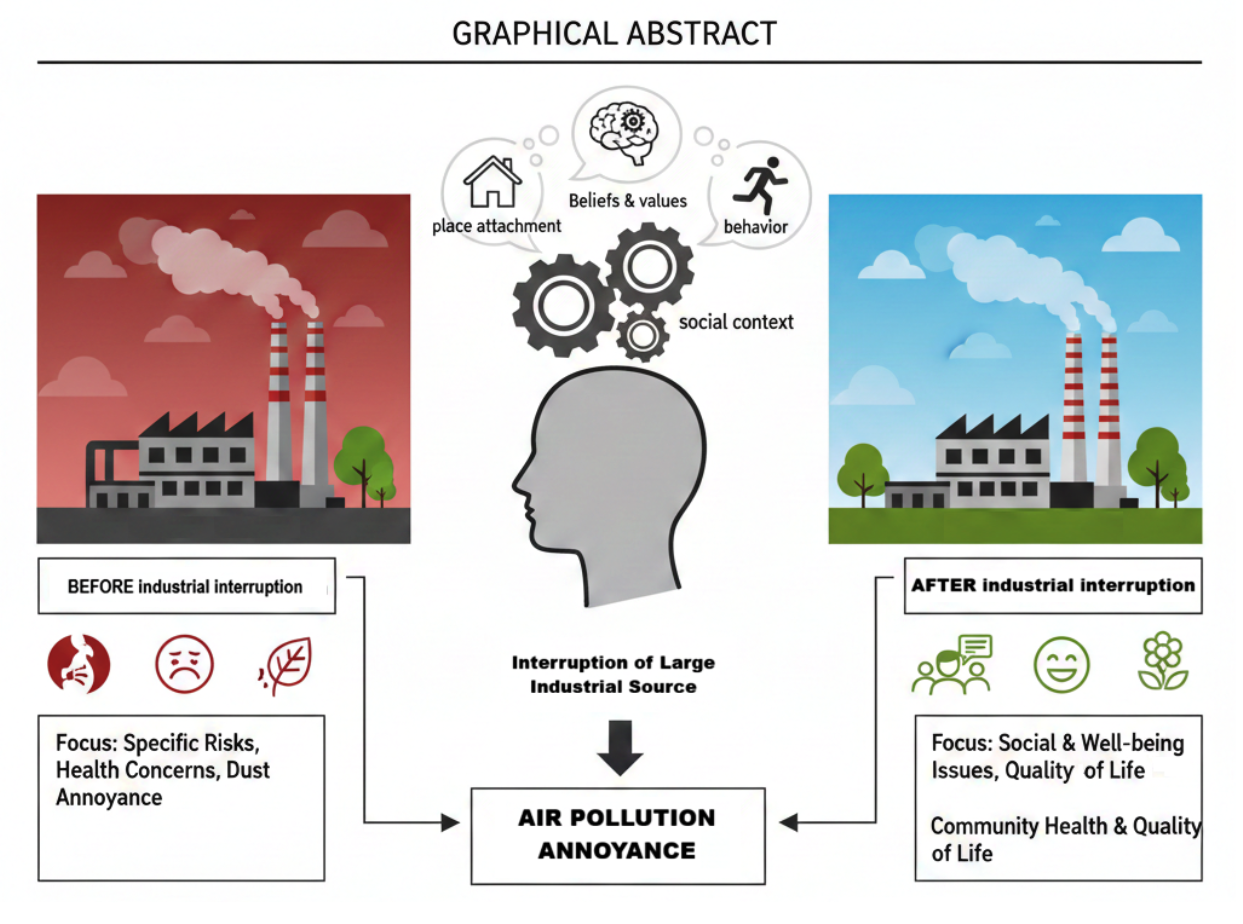
Subjective assessments of air pollution annoyance reveal that individuals’ focus on specific risks is influenced by their attachment to place, beliefs, values, and behavior rather than the composition or toxic effects of air pollutants. Additionally, the social context plays a role in shaping how communities react to and perceive air pollution impacts. This study examines residents’ environmental perceptions regarding the effects of settleable particles before and after the interruption of a large industrial source in the southern region of Espírito Santo, Brazil (South America). A second objective was to model the relationship between air pollution annoyance and other perceived variables under both scenarios. Data were collected through surveys conducted before and after the interruption of the industrial plant. The Pearson chi-square test and ordinal logistic regression model analyzed the data. Results indicate a shift in residents’ concerns with a focus on social and well-being issues. We also found a small number of items relating to dust annoyance and home ownership that can be used to predict the air pollution impact for individual community members. The findings show that settleable particles are directly perceived by exposed populations and significantly affect community health and quality of life.

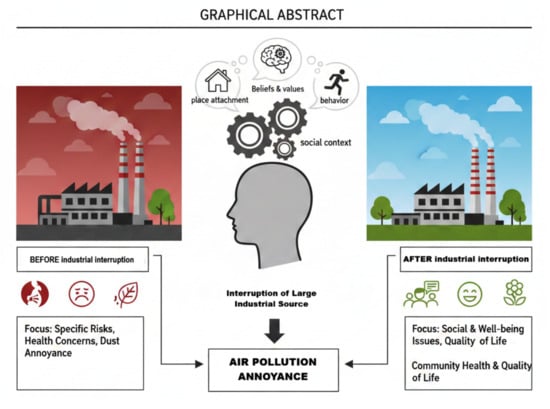
Graphical Abstract

1. Introduction

Heavy industries located near residential areas can cause annoyance to residents due to air pollution, which is perceived through impaired visibility, unpleasant odors, or dust [1,2,3], for instance. Although this may or may not cause direct health problems, it significantly affects quality of life [4,5]. The World Health Organization (WHO) defines health as a “state of complete physical, mental, and social well-being, and not simply the absence of disease or illness” [6].
Therefore, annoyance caused by air pollution should be considered a public health issue.
Dust consists of particulate matter (PM) with a broad particle size range from a few nanometers to several micrometers [7]. It is generated through natural processes (such as soil erosion, vegetation, and sea spray) and human activities (including construction sites, unpaved roads, combustion processes, and various industrial operations). Typically, particles larger than 10 µm settle close to the source, while smaller particles remain suspended and can travel long distances. Settleable particulate matter (SPM), of which particles larger than PM10 are the bulk constituent in mass, is inconvenient to public welfare [8,9]. SPM on the ground or surfaces causes soiling in residential and urban environments, leading to material degradation or the need for constant cleaning. This can impair the use and enjoyment of property and disrupt normal societal activities [8,10,11].
Many studies have shown a significant relationship between the PM concentration or deposition rate and annoyance levels. Research conducted in several European cities has identified PM2.5 and NO2 as important determinants of perceived air pollution annoyance [12]. Evidence from northern Europe has also shown exposure–response relationships between vehicular pollution and annoyance using regression-based approaches [13]. Other authors have focused on perceptual and visual dimensions of air pollution. Associations between air quality perception and visual impairment caused by suspended particles have been reported [14], and the presence of visible industrial plumes has been shown to influence well-being and emotional responses [15]. In addition, the relevance of settleable particle deposition rates has been discussed in the context of developing annoyance-related air quality guidelines [11]. Studies have also investigated broader psychosocial outcomes. Links between particulate matter exposure and subjective well-being indicators, such as life satisfaction and happiness, have been identified [2,16]. Multivariate analyses have further indicated that air pollution-related annoyance is associated with qualitative variables, including the perceived importance of air quality, perceived exposure to industrial risk, evaluation of air quality, and perceived air pollution [17]. Exposure response analyses based on questionnaire data and measured concentrations of total suspended particles (TSP and PM10) have shown that higher PM levels are associated with an increased probability of annoyance [8]. Despite these contributions, most investigations have been conducted under relatively stable emission scenarios, resulting in limited evidence on how abrupt interruptions of industrial activities affect both objective air quality indicators and community perceptions, particularly when social and economic dimensions are involved. An intervention study conducted near a sintering plant on the east coast of Sweden evaluated community perceptions regarding the effectiveness of emission reduction measures, changes in dust levels, risk perception, and reported health symptoms using questionnaire-based assessments [18]. Their analysis, conducted using path analysis techniques, indicated that the intervention was successful as planned. After the sintering plant was closed, the environment was perceived as being less dusty, the residents were more positive in their risk perception, and they reported less annoyance due to dust, soot and odorous substances. Nonetheless, their study did not evaluate whether the community’s perception of reduced dust and improvement in health symptoms was affected by the social and economic impacts on the community resulting from the industrial intervention. This study examines a distinctive scenario involving an environmental disaster that led to a five-year suspension of a pelletizing industry’s operations in a city on the southern coast of Brazil. It aims to assess the community’s perceptions of settleable particles reduction resulting from the operational shutdown and its effects on risk perception and routine habits as well as social, emotional, and economic conditions. A second objective is to identify the relationship between air pollution annoyance and other significant perceived variables, considering both research scenarios. This study was only possible because a few years before the disaster, a survey had been conducted in the study area surrounding the pelletizing plant, collecting data on public annoyance caused by settleable particles [19].

2. Materials and Methods

2.1. Study Region

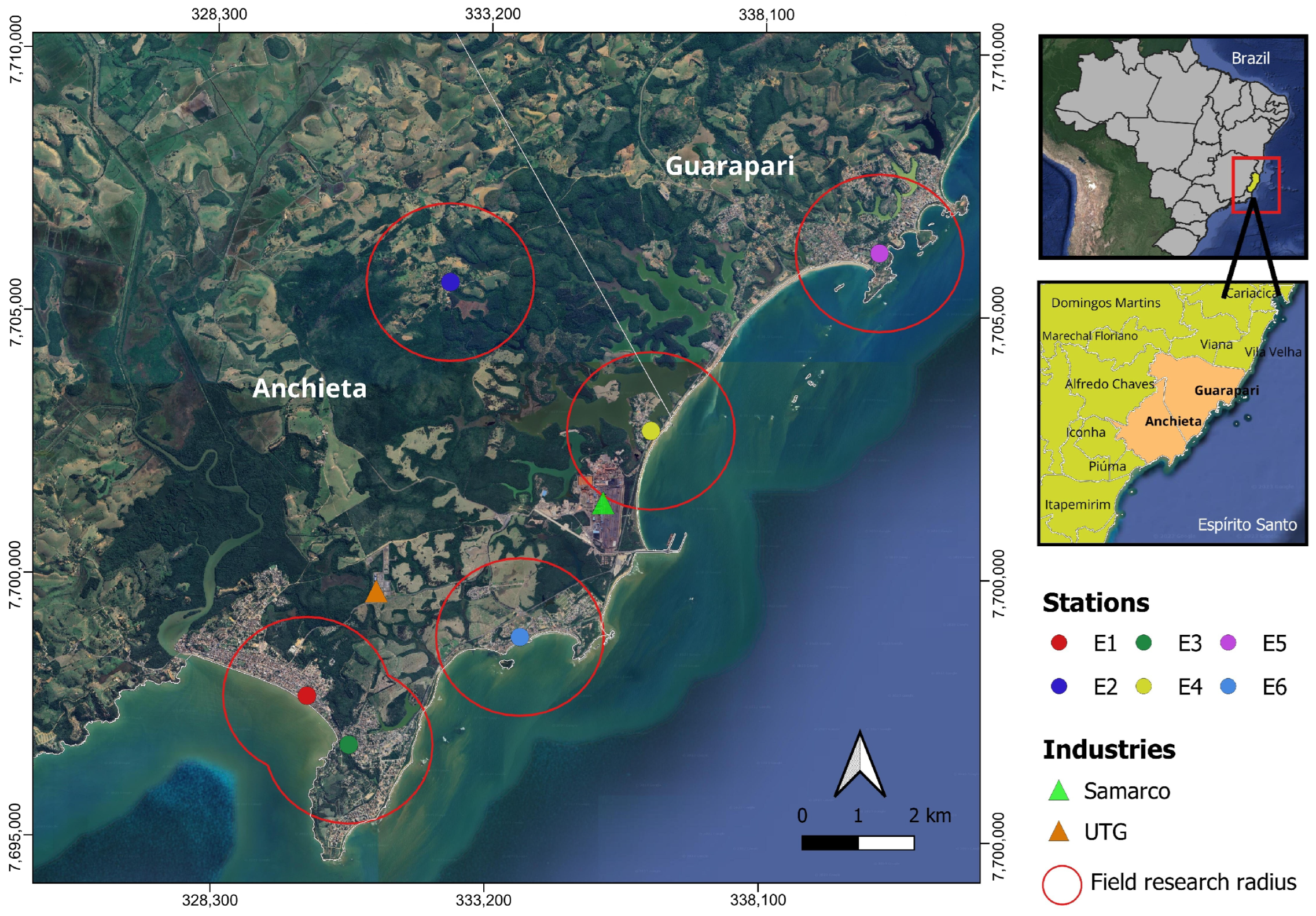
The cities of Anchieta and Guarapari in southern Brazil form an urban and industrialized area that includes a natural gas production plant, a pelletizing industry, and a port for exporting goods (Figure 1). The study region has two distinct seasons: the first is from September to March (Summer) characterized by high precipitation and north/northeast wind direction, and the second is from April to August (winter) with prevailing lower precipitation and southern wind direction.
Although the area is also a tourist destination with many wild beaches, tourism plays a less significant role in the regional economy. According to the Brazilian Institute of Geography and Statistics (IBGE), the region had a population of 16,362 inhabitants as of the 2022 Demographic Census. The industrialization of this region has negatively impacted the environment, directly influencing the quality of life and causing health issues [20]. The authors interviewed workers at the pelletizing plant with the aim of identifying the perceived risk factors and workload. The processes with air pollution emissions most frequently reported by workers were the movement of pellets to the conveyor belts and to the yard, storage in piles, pellet recovery and transport to the port. Exposure to heat, noise, sounds and air pollution in the form of particles, soot and toxic gases resulting from some processes can cause physiological consequences, such as respiratory, skin and eye problems, nasal obstruction, allergies, asthma attacks, coughing, and chest pain. According to the authors, these negative charges and risks, which turn into physiological symptoms, are confirmed in data from the Espírito Santo State Health Department on deaths resulting from neoplasms.
In 2012, a survey conducted in this region indicated that about 80% of the population reported annoyance caused by air pollution (with the majority identifying settleable particles as the main form of air pollution in the region) [19]. In that study, respondents reported having to keep windows closed to keep out dust from outside, frequently going to the doctor because of respiratory problems, and not having knowledge about air quality monitoring in the region. The authors presented an empirical correlation model in which a significant relationship was found between the discomfort caused by dust and gender, the occurrence of respiratory problems, risk perception and assessment, and the importance of air quality.
In November 2015, a major tailings dam rupture occurred at a mining plant in the city of Mariana, approximately 400 km away from Anchieta and Guarapari, which was reported as the largest environmental disaster in Brazil’s history imposing an unprecedented risk to biodiversity [21,22]. This mining plant produced the iron ore used by the pelletizing company in Anchieta. Consequently, following the disaster in Mariana, the pelletizing industry in Anchieta halted pellet production, and the port used for exporting these products became inactive. This series of events significantly impacted the employment and economic conditions of both Anchieta and Guarapari as well as considerably decreased the air pollution in the region.

2.2. Data Sets

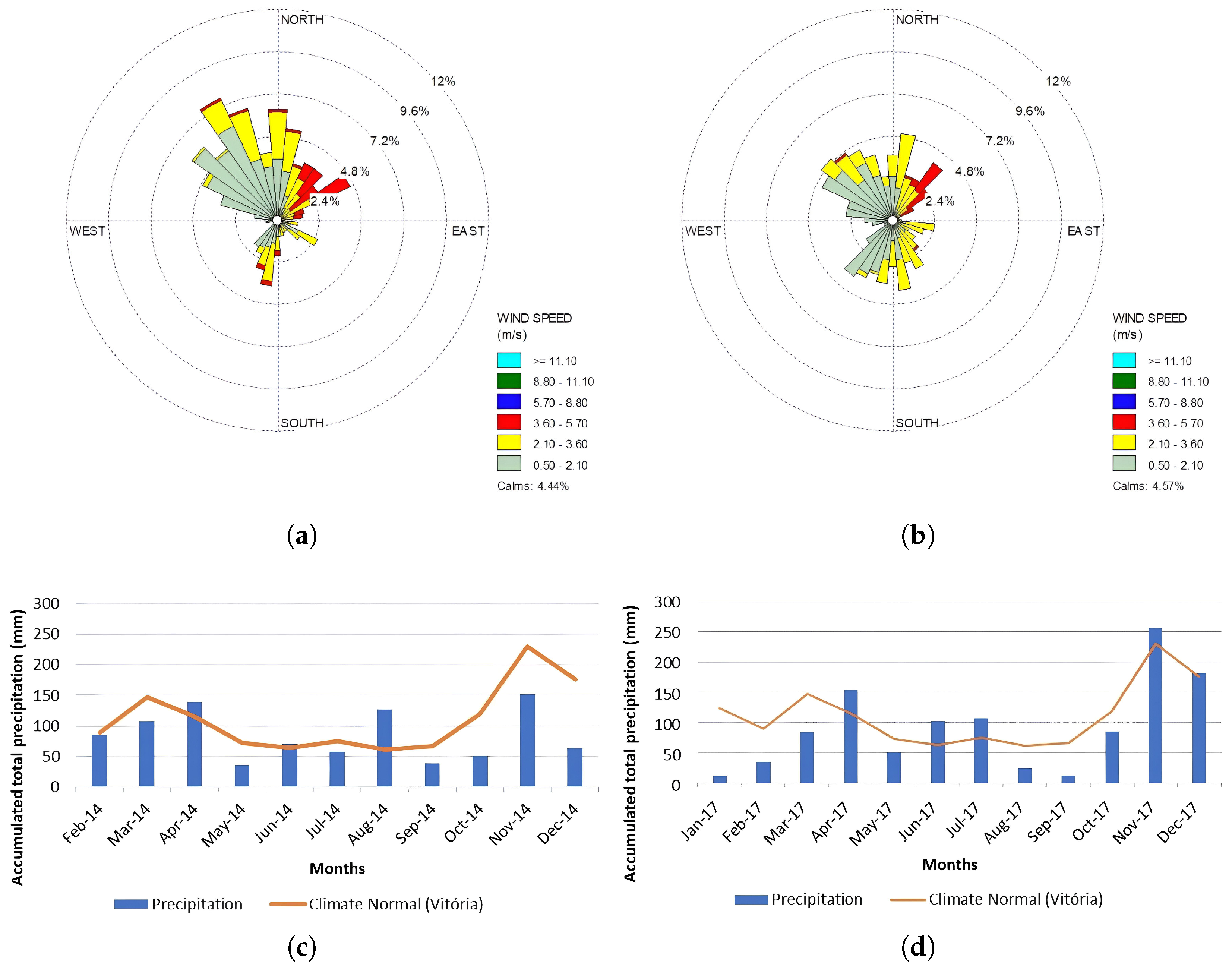
Two structured face-to-face surveys were conducted in urban regions in March 2014 and March 2017, respectively, prior to and after the interruption of the pelletizing plant operation. Figure 2 presents the wind rose and monthly precipitation graphs for the survey periods: the wind rose for (a) March 2014 and (b) March 2017, and the monthly precipitation graphs for (c) 2014 and (d) 2017 during the years in which the survey was carried out.
The wind roses shown in Figure 2 were generated using meteorological data from a station operated by the Brazilian National Institute of Meteorology (INMET) located at 20.27° S latitude and 40.31° W longitude. This station is situated in a nearby municipality and represents the closest location with continuous data available for the selected periods in a region with meteorological characteristics similar to the study area.
The surveys were conducted using the same questionnaire previously applied in a study carried out in the study region [19]. The same questionnaire was also used for other studies conducted in different regions [11,17]. The questionnaire comprised closed-ended questions with response options as a Likert scale including both (categorical and numerical scales). For example, one question asked: “How annoyed do you feel by dust from outside?”. The response options were: 1—Not annoyed, 2—Slightly annoyed, 3—Moderate annoyed, 4—Very annoyed, and 5—Extremely annoyed.
It is important to explain that all variables analyzed in this study represent the following questionnaire constructs: 1— Assessment and monitoring of air quality; 2—Discomfort caused by pollution and dust; 3—Impacts and losses caused in daily life and health; 4—Identification of sources of air and dust pollution; 5—Sociodemographic aspects.
The residents were selected randomly in the sub-regions located in a radius of 1.5 km around six air quality monitoring stations operated by the local environmental protection agency: Anchieta-sede (E-1), Belo Horizonte (E-2), Guanabara (E-3), Maemba (E-4), Meaipe (E-5), and Ubu (E-6) as shown in Figure 1. A simple stratified random sampling with proportional allocation was used [23]. The sample sizes satisfy the following equations:
n N 1 + ( N 1 ) p ( 1 p ) d Z α 2 1
and
n i = N i N n , i = 1 , , 6 .
In (1) and (2), n is the sample size, N is the total population size, 1 α is the confidence level, Z α is the ( 1 α / 2 ) -th percentile of the probability distribution of the data, p is the population proportion, d is the margin of error equal to 0.05, N i is the population size in the i-th sub-region, and n i is the sample size in the i-th sub-region. Due to the population’s known variability (in 2012 survey) p = 0.8 was considered along with an acceptable margin of error of d = 0.05 . Thus, the minimum sample size calculated was 130 respondents. However, we decided to be conservative and considered all respondents who agreed to participate (answering the questionnaire), as shown in Table 1.
The same 258 respondents from 2014 were selected for the 2017 survey with the addition of new respondents (after the industry shutdown, many residents who participated in the 2014 survey lost their jobs and moved away from the region). Also, further questions about the industry closure were included in the 2017 survey. Table 1 displays the population and sample sizes (considering the proportional differences) for both surveys.

2.3. Pearson’s Chi-Square Test

Pearson’s chi-square homogeneity tests [24] was implemented to compare the responses from the two surveys and verify whether the differences are statistically significant at a the significance level of 5%. The two hypotheses of the homogeneity test are outlined below:
H0. 
The distributions of responses in the 2014 and 2017 surveys are the same.
H1. 
The distributions of responses in the 2014 and 2017 surveys are not the same.
The statistic for testing H0 is
X 2 = i = 1 l j = 1 r ( n i j μ i j ) 2 μ i j ,
where n i j is the number of respondents (observed value) from each class i j of the contingency table in which the rows correspond to the possible configurations of the covariates, and the columns are the categories of the ordinal responses. The expected number μ i j for the class i j is the product of n = n i j by the probability of occurrence of class i j . Lastly, l and r are the numbers of rows and columns of the contingency table. Under H0, the distribution of X 2 is approximated by a chi-squared distribution with ( l 1 ) ( r 1 ) degrees of freedom, and H0 is rejected when the observed value of X 2 is larger than the ( 1 α ) th quantile of this distribution with α = 0.05 .
Subsequently, Pearson’s chi-square independence test was carried out in order to verify which variables were significant for inclusion in the regression model. That is, from the Pearson chi-square independence test results, only the categories of significant variables will be selected for inclusion in the regression model.

2.4. Ordinal Logistic Regression

The ordinal logistic regression (OLR) model is an essential statistical tool widely used to measure and quantify the relationship between an ordered response variable and one or a set of explanatory variables; see, e.g., [24,25,26,27].
Here, the response variable is the degree of annoyance Y with five categories c = 5 : extremely annoyed, very annoyed, moderately annoyed, little annoyed, not annoyed. The covariates X = ( X 1 , , X k ) are presented in Section 3.2, and X is the transpose of X . The conditional probabilities of Y [24] are modelized by
π j = P ( Y = j X ) = exp α j + ϕ j β X i = 1 c exp α i + ϕ i β X , j = 1 , , c ,
where α c = 0 and ϕ c = 0 are introduced to simplify the notation. Parameter α j is the intercept related to the j t h category of Y, while β = ( β 1 , , β k ) is the vector of coefficients independent of the categories of Y and corresponds to the effects of the covariates on the response variable. It follows from (4) that
log π j π c = α j + ϕ j β X , j = 1 , , c 1 .
Therefore, for r = 1 , , k , ϕ j β r is the coefficient of the explanatory variable X r in the log odds ratio (OR) for categories j and c of Y. The parameters to estimate in (4) are α j , ϕ j for j = 1 , , c 1 and β . To avoid identifiability difficulties, we set ϕ 1 = 1 . The parameters are estimated by maximizing the conditional likelihood; see [28]. SPSS (version 20.0, IBM Corp., Armonk, NY, USA) and R (version 3.6.1, R Foundation for Statistical Computing, Vienna, Austria) software were used to perform the statistical data analysis.

3. Results

3.1. Comparing Before and After the Interruption in the Industrial Activities

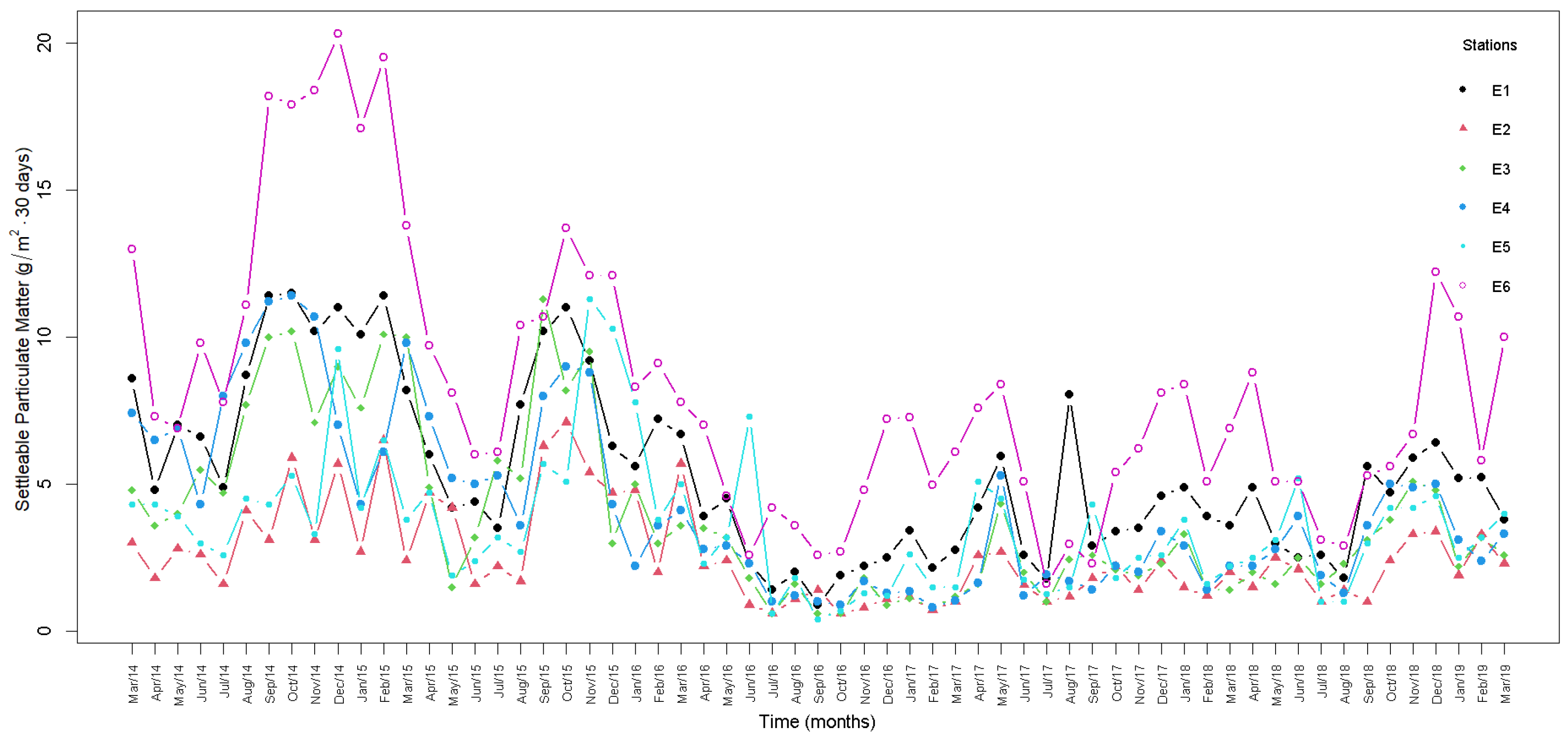
Figure 3 shows the SPM time series measured at the air quality monitoring stations. It is clear that SPM decreased from January 2016 onwards at all monitoring stations when the full stop of the pelletizing plant operation occurred. Before January 2016, several SPM peak values larger than 10 g/m2/30 days were observed. In most countries that have an air quality standard for SPM, the limits range from 5 to 10 g/m2 per 30 days [11].
Table 2 shows the demographic characteristics of the respondents for both surveys. According to Pearson chi-square analyses (p-value), there is no significant difference between gender and level of education distributions in both samples. However, the age range and occupational situation distribution were significantly different. Regarding the age extracts, in any case, most of the respondents are over 35 years old. As for occupation, the population shifted from employed in 2014 to unemployed, retired and freelancer. Table 3, Table 4, Table 5 and Table 6 present the results (frequency, percentage and p-value) of both surveys according to the following: annoyance due to air pollution and dust (Table 3), assessment of air quality and industrial risk perception (Table 4), air pollution perception (Table 5), and consequences of air pollution in quality of life and health (Table 6). Pearson chi-square analyses were performed to compare frequency distributions for the responses in each analyzed construct for both surveys. This procedure is based on [18].
Table 3 displays significant differences between the surveys (p-value less than 0.05 for all three variables). Before the industry interruption, only 2.33% of respondents reported not feeling annoyed by air pollution, while after the interruption, this number rose to 37.79%. In 2014, about 49.22% of the respondents were very and extremely annoyed by dust from outside, but in 2017, this changed to 28.76%. In 2014, the industries were identified by almost 79.46% of respondents as the primary source of dust. However, in 2017, other sources of dust such as vehicles, construction work and unpaved streets also emerged as important contributors, representing 18.44%, 18.00% and 16.64%, respectively.
Table 4 presents significant differences in responses regarding air quality, industrial risk perception, air quality importance and monitoring. In 2014, 12.79% of respondents considered the air quality to be terrible, and 18.22% considered the air quality to be good, while in 2017, only 2.71% considered the air quality to be terrible, and 46.11% considered the air quality to be good. As for industrial risk perception, the results show that the perception of risk has decreased considerably. In 2014, the percentage of very and extremely exposed was more than 50%, while in 2017, this percentage decreased to almost 19%.
In 2014 (see Table 4), about 58.91% indicated that air quality is never monitored, whilst the number dropped to 31.83% in 2017. Nevertheless, about 22–25% of the population reported not being informed about air quality monitoring in both surveys.
Table 5 presents strong differences, comparing perceived air pollution to particles/dust, odour, and air opacity. In 2014, particles/dust was identified as the main form of air pollution, frequently/always perceived by 71.73% of respondents, which was followed by air opacity (20.16%) and odour (9.30%). In 2017, 47.19% frequently/always perceived air pollution by dust, 12% perceived odour, and 7.23% the air opacity, showing a shift toward odour perception and a decrease in the perception of dust and opacity. As shown in a previous study [18], the population experienced improved air quality following the closure of an industrial sintering plant, which was largely due to the decreased presence of dust, soot, and opacity.
Table 6 presents the quotidian consequences of air pollution affecting life quality/routine habits. In 2014, 89.14% of respondents informed that they frequently/always clean the house to remove dust, and 36.82% reported frequently/always closing the windows to prevent dust entering from outside. In 2017, these frequencies slightly decreased: 76.31% reported that they frequently/always clean the house to remove dust, and 34.90% reported closing the windows to prevent dust. The frequency of closing the windows to prevent dust did not decrease considerably. The surveys were conducted in March (during summer in the southern hemisphere), which may explain this behavior, since many houses do not have air conditioning systems.
In 2014, 27.52% of respondents reported always/frequently attending the doctor for an illness caused by the presence of particles in the household, while in 2017, the percentage dropped to 15.19%. In both surveys, the main symptoms reported by the respondents that were caused by dust were rhinitis, sinusitis, and allergy.
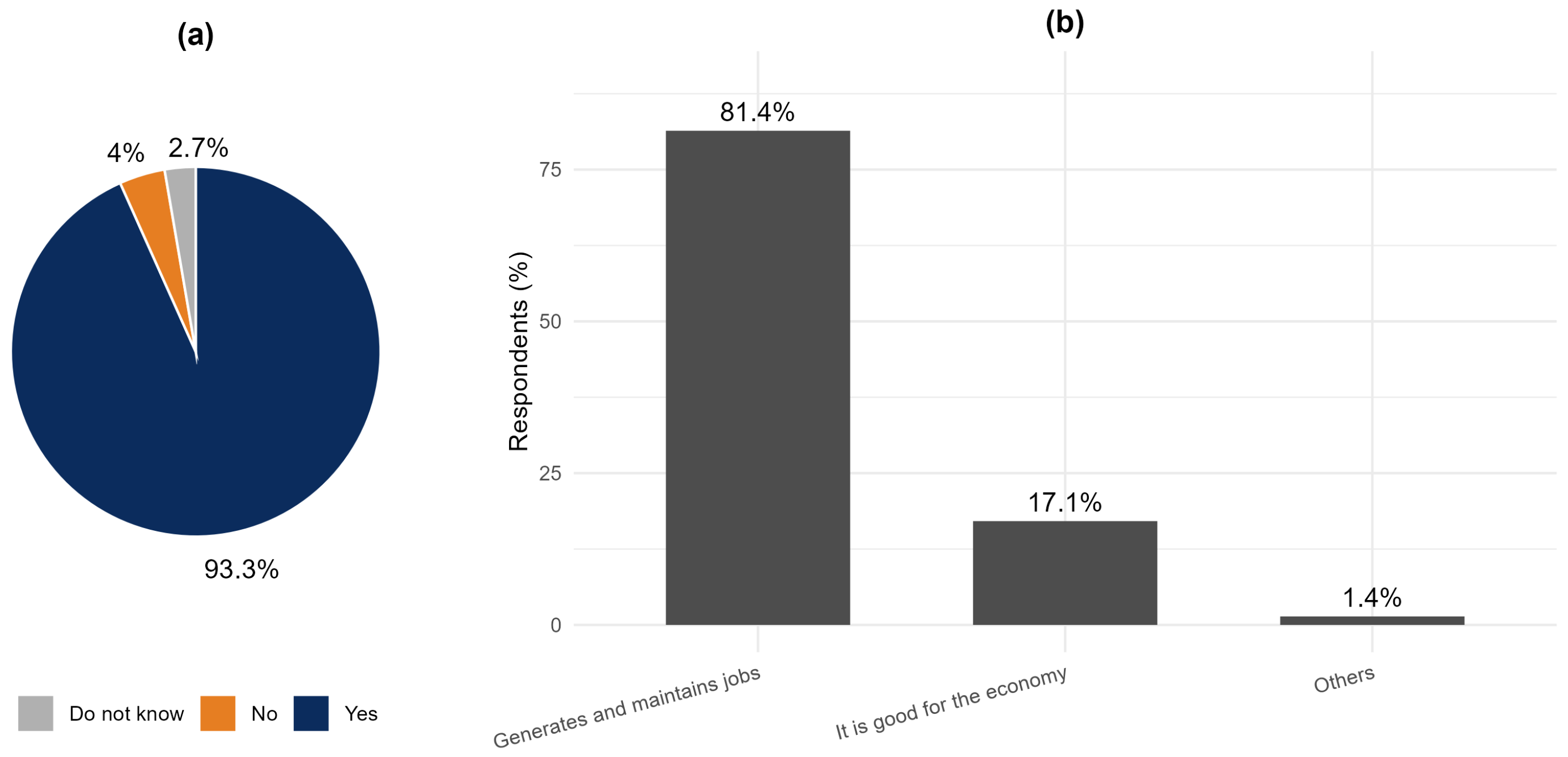
The last two questions in 2017 survey were “Would you like the return of the industrial activities of the pelletizing plant? If yes, what are the main reasons for that?”. The results are presented in Figure 4. More than 90% of the respondents favored the return of industrial activities to the pelletizing plant. The first reasons listed were to create and keep jobs (81%) and the plant’s importance to the economy in the region (17%).

3.2. Determinants of Annoyance Due to Sedimented Dust

The independence test allows one to determine whether two categorical variables, which belong to the same sample, are independent or associated with each other [29]. The independence test was carried out between the annoyance variable and the explanatory variables (we selected the variables with significant p-values presented in Table 2, Table 3, Table 4, Table 5 and Table 6) to verify their association at a significance level of 5%.
Table 7 presents a complete list of the selected variables and their categories. These variables were subjected to the independence test, with the exception of the variable dust reduction perception, which was only tested in the 2017 survey, as it refers to the respondents’ perception after the activities at the pelletizing plant stopped. The results of the chi-square test, including degrees of freedom, number of respondents, and p-values for each variable, are presented in Table 8. To ensure comparability between the two survey periods and to identify robust determinants of annoyance, only variables presenting statistically significant chi-square test results in both years were retained for further analysis. Based on this criterion, significant variables from both surveys were selected for inclusion in the regression models applied before and after the interruption of the pelletizing plant, which was in accordance with the procedure described in [30]. Subsequently, each selected variable was examined using univariate ordinal logistic regression models (see Appendix A). From these univariate analyses, variables with positive and statistically significant coefficient estimates were selected to evaluate the combined effects of multiple determinants on the degree of annoyance in the multivariate models.

3.3. OLR Model Results

The ordinal logistic regression model (OLR) was applied to identify the categories and variables associated with levels of annoyance due to settleable particles (SPM). According to Section 2.3, the response variable Y, the annoyance degree with five ordered categories—extremely annoyed ( Y = 1 ), very annoyed ( Y = 2 ), moderately annoyed ( Y = 3 ), slightly annoyed ( Y = 4 ) and not annoyed ( Y = 5 )—became the references category. It was necessary to group the categories (little and not) because in stereotype models for ordinal variables, grouping categories with low frequency is used to ensure parameter identifiability, avoid convergence issues in the maximum likelihood estimation process, and reduce the variance of the estimates. Categories with few observations contribute to numerical instabilities and may lead to the singularity of the information matrix. When preserving the natural order of the variable, grouping enhances the robustness, efficiency, and interpretability of the model. All NK/NA responses were excluded from this analysis, resulting in a sample size n = 249 in 2014 and n = 501 in 2017.
The OLR models were run with the rrvglm command from the VGAM package implemented by R software Version 3.6.1. The estimations of the products ϕ j β r defined in (5) and the odds ratio (OR) exp ( ϕ j β r ) [31] are presented in Table 9 for the data sets obtained in the 2014 and 2017 surveys, respectively. For both models, the estimated odds ratios (ORs) are associated with each of the grouped annoyance response categories: (1) extremely annoyed, (2) very annoyed, and (3) moderately annoyed.
When analyzing the results in Table 9, the significant variables common to both the 2014 and 2017 models include air quality perception (Qdoar2 and Qdoar3), industrial risk exposure (Risk2 and Risk3), and perceived dust (PDep2 and PDep3). Consistent across both models, there was a marked decrease in OR values, which demonstrates that the population perceived improved air quality, reduced industrial risk, and less dust after the pelletizing plant ceased operations.

4. Discussion

The comparison between surveys conducted before and after the stoppage of the pelletizing plant revealed substantial shifts in the population’s perceptions of air quality, risk, and everyday behaviors related to dust exposure. After the closure, the proportion of respondents who perceived the air as “good” or “excellent” increased markedly, while reports of strong annoyance and risk perception declined. These patterns are consistent with previous findings showing that interventions reducing industrial emissions lead to a sense of lower exposure and improved environmental conditions [18].
A relevant change also occurred in how people perceived the monitoring and control of air quality. Although a significant share of respondents still declared not being informed about local monitoring, the proportion who believed that air quality was “never monitored” decreased after the closure. This could indicate that public communication about environmental monitoring improved in the period following the shutdown—possibly influenced by the national media coverage of the Mariana environmental disaster—or, alternatively, that there remains confusion among residents between monitoring practices and regulatory control.
Behavioral habits reflected both improvements and the persistence of defensive routines. Although the frequency of cleaning activities decreased slightly, closing windows to avoid dust remained common. As the surveys were conducted in March (summer in the southern hemisphere), high temperatures and the limited availability of air-conditioning systems may help explain the persistence of this behavior. Even under improved air quality conditions, such habits may persist due to climatic factors and housing characteristics. Despite improvements in perceived air quality and reductions in annoyance, the community’s economic dependence on the plant strongly influenced public opinion about its reopening. More than 90% of respondents expressed support for resuming industrial activities, primarily citing job creation and the plant’s importance to the regional economy. This apparent contradiction highlights the tension between environmental and socioeconomic priorities. Individuals tend to value environmental quality more once basic material and security needs are satisfied [32,33]. Thus, even though residents recognized the environmental benefits of the shutdown, the perceived threat to economic stability led many to favor the return of operations.
The ordinal logistic regression models further reinforce these patterns by quantifying how perceptions of air quality and risk were associated with annoyance before and after the industrial stoppage. In the 2014 model (Table 9), the variables Qdoar2 and Qdoar3 (air quality perception) showed strong associations with annoyance. For instance, the category Qdoar3, corresponding to respondents who rated air quality as bad or terrible, had an OR of 149 (see Table 9), indicating that these respondents were 149 times more likely to report extreme annoyance due to dust. In contrast, in the 2017 model (Table 9), the corresponding value decreased substantially (OR ≈ 3.9), confirming that the association between perceived air quality and annoyance weakened after the shutdown. Such attenuation mirrors the results presented in [18], following the closure of a sintering plant in Sweden.
In 2014, the variables “visiting a doctor” (Pmed2 and Pmed3) were also significant (Table 9): respondents who often or always sought medical care were 3.4 and 2.3 times more likely, respectively, to report high annoyance. This association reflects the elevated particulate matter concentrations during the plant’s operation, which is when pollution-related symptoms and medical consultations were more frequent. Similarly, individuals who considered air quality very or extremely important (ImpQAR2 and ImpQAR3) were about four times more likely to report extreme annoyance, which is consistent with a study conducted in the same region [19].
In 2017 (Table 9), two additional variables became relevant: perceived health symptoms Health2 and Health3) and cleaning frequency (Clean2 and Clean3). Those who reported frequent health symptoms were 1.2 and 1.5 times more likely to feel extremely annoyed, which was possibly due to the higher proportion of respondents over 55 years old in that survey. This result contributes to other documented findings from studies that show an association between air pollution and the occurrence of symptoms and health effects [34,35]. The association with cleaning habits suggests that although industrial emissions declined, other sources—such as vehicular traffic and soil resuspension—continued to affect daily experiences of air pollution. This result contributes to the fact that air pollution negatively affects quality of life [4,5]. These findings collectively suggest that SPM concentration is a direct contributor to dust-related annoyance. Furthermore, it is clear that industrial emissions directly influence the perception of air pollution, subsequently impacting an individual’s assessment of health symptoms, industrial risks, air quality, and overall annoyance levels.

5. Conclusions

This study evaluated changes in community perceptions of settleable dust and air pollution annoyance before and after the interruption of a large pelletizing industry in a coastal urban–industrial region of southern Brazil. The comparison of perception surveys conducted in two distinct periods allowed the assessment of how changes in industrial activity influenced annoyance, risk perception, and everyday behaviors related to dust exposure. The results indicate that the interruption of industrial activities was associated with a reduction in perceived dust exposure, industrial risk, and annoyance levels. Variables related to perceived air quality, industrial risk exposure, and dust deposition remained associated with annoyance in both survey periods, although their influence decreased after the shutdown. Despite these environmental improvements, most residents expressed support for the resumption of industrial activities, which was mainly due to employment and regional economic considerations. These findings highlight the complex relationship between environmental quality and socioeconomic needs in industrialized communities and underline the importance of considering both dimensions when evaluating air pollution impacts.

Author Contributions

M.M. and J.M.S. contributed to the study conceptualization. Data collection was performed by M.M. and F.R.C., M.I., V.A.R., S.F., W.C.B. and P.R.P.F. contributed to the design of the methodology and analysis. The manuscript was written by M.M., P.B., M.I., P.R.P.F., F.R.C., W.C.B. and J.M.S. All authors reviewed the manuscript and contributed to the data analysis. All authors have read and agreed to the published version of the manuscript.

Funding

The research was supported by FAPES (Fund Number: 30977.419.24384.26042016), CNPq, and CAPES (Brazilian governmental agencies for technology development and scientific research). The authors wish to acknowledge the valuable to CentraleSupélec for their financial aids.

Institutional Review Board Statement

Not applicable.

Informed Consent Statement

Not applicable.

Data Availability Statement

The data presented in this study are available on request from the corresponding author.

Conflicts of Interest

The authors have no relevant financial or non-financial interest to disclose.

Appendix A

The appendix contains the full results for both the complete and univariate models.

Appendix A.1. Models for 2014

Appendix A.1.1. Complete Model for 2014

The complete model takes into account all available explanatory variables.
Table A1 presents the estimated coefficients for the full model fitted to the 2014 data. Variables such as Qdoar3, Risk2, Risk3, Close3, and Pmed2 show statistically significant effects, with p-values below the 0.05 threshold, indicating strong evidence of association with the outcome. Notably, Qdoar3 has a particularly high coefficient (5.00856) and a very low p-value (<0.0001), suggesting a strong influence in the model.
Table A1. Estimated coefficients for the complete model for 2014.
EstimateStd. Errorz ValuePr(>|z|)
I(latvar.mat):10.593440.075297.882100.00000
I(latvar.mat):20.182660.073292.492430.00634
(Intercept):1−9.976002.30445−4.329020.00001
(Intercept):2−3.976661.29550−3.069600.00107
(Intercept):3−0.533970.63047−0.846930.19852
ImpQAR21.519941.619320.938630.17396
ImpQAR31.577131.557141.012830.15557
Qdoar21.448930.893551.621550.05245
Qdoar35.008561.150524.353320.00001
Risk22.048340.934762.191300.01422
Risk33.716680.954173.895210.00005
PDep21.682391.644911.022790.15320
Pdep32.990461.680461.779550.03757
Close20.092720.687340.134890.44635
Close32.307280.764763.016990.00128
Pmed21.241360.690551.797630.03612
Pmed30.860030.786651.093280.13714
In contrast, variables such as Close2, Pmed3, and ImpQAR2 have p-values well above 0.05, indicating no significant effect at conventional levels.
Table A2. Odds ratios (OR) for the complete model for 2014.
exp ( ϕ 1 β r ) exp ( ϕ 2 β r ) exp ( ϕ 3 β r )
ImpQAR24.571972.464501.32000
ImpQAR34.841042.549571.33386
Qdoar24.258552.362801.30299
Qdoar3149.6889319.535952.49643
Risk27.755013.372171.45375
Risk341.127519.075771.97168
PDep25.378372.713901.35975
PDep319.894865.898191.72674
Close21.097151.056561.01708
Close310.047113.932301.52417
Pmed23.460312.088961.25451
Pmed32.363241.665921.17010
Variables such as Qdoar3 and Risk3 exhibit very high odds ratios, suggesting a strong association with the outcome of interest. In general, OR values greater than 1 indicate an increased likelihood associated with a rise in the corresponding predictor variable.

Appendix A.1.2. Model with ImpQAR 2014

This model considers only the ImpQAR variable, allowing for an isolated assessment of its effect on the outcome.
Table A3. Estimated coefficients for the ImpQAR 2014 model.
EstimateStd. Errorz ValuePr(>|z|)
I(latvar.mat):1−0.863130.75930−1.136730.12783
I(latvar.mat):2−0.144070.45974−0.313360.37700
(Intercept):10.385880.521890.739400.22983
(Intercept):20.934500.472581.977450.02400
(Intercept):30.710180.235803.011710.00130
ImpQAR2−0.939320.62284−1.508130.06576
ImpQAR30.181260.521240.347750.36401
Table A4. Odds ratios (OR) for the ImpQAR 2014 model.
exp ( ϕ 1 β r ) exp ( ϕ 2 β r ) exp ( ϕ 3 β r )
ImpQAR20.390892.249611.14491
ImpQAR31.198730.855170.97422
The impact of air quality ImpQAR, when analyzed alone, did not show a statistically significant association in the model. This is suggested by the high p-values and the odds ratios close to 1 for some of the coefficients.

Appendix A.1.3. Model with Qdoar 2014

In this model, only the Qdoar variable was used as a predictor.
Table A5. Estimated coefficients for the Qdoar 2014 model.
EstimateStd. Errorz ValuePr(>|z|)
I(latvar.mat):10.579860.091226.356650.00000
I(latvar.mat):20.249060.112712.209830.01356
(Intercept):1−3.275940.78106−4.194210.00001
(Intercept):2−0.338780.37421−0.905340.18264
(Intercept):30.230520.317940.725060.23421
Qdoar23.220320.800114.024860.00003
Qdoar37.437941.086706.844530.00000
Table A6. Odds ratios (OR) for the Qdoar 2014 model.
exp ( ϕ 1 β r ) exp ( ϕ 2 β r ) exp ( ϕ 3 β r )
Qdoar225.036186.471042.23013
Qdoar31699.2382974.661566.37580
The results indicate a strong association between the Qdoar variable and the analyzed outcome especially for category 3. Its extremely high ORs point to a substantial increase in the odds of the event occurring.

Appendix A.1.4. Model with Risk 2014

In this model, only the Risk variable was used as a predictor.
Table A7. Estimated coefficients for the Risk 2014 model.
EstimateStd. Errorz ValuePr(>|z|)
I(latvar.mat):10.936420.133876.994970.00000
I(latvar.mat):20.346880.120702.873970.00203
(Intercept):1−1.942330.56152−3.459030.00027
(Intercept):2−0.849250.41774−2.032970.02103
(Intercept):30.243120.305260.796430.21289
Risk21.770270.609492.904490.00184
Risk34.125220.783545.264850.00000
Table A8. Odds ratios (OR) for the Risk 2014 model.
exp ( ϕ 1 β r ) exp ( ϕ 2 β r ) exp ( ϕ 3 β r )
Risk25.872435.247291.84795
Risk361.8811947.604614.18273
The results show a significant association between the Risk variable and the analyzed outcome, particularly for category 3. Its high odds ratios indicate a substantial increase in the odds of the event occurring as the categories progress.

Appendix A.1.5. Model with PDep 2014

In this model, only the PDep variable was used as a predictor.
Table A9. Estimated coefficients for the PDep 2014 model.
EstimateStd. Errorz ValuePr(>|z|)
I(latvar.mat):10.623730.173653.591860.00016
I(latvar.mat):20.032940.121300.271580.39297
(Intercept):1−3.480341.70366−2.042870.02053
(Intercept):2−0.983490.86363−1.138790.12740
(Intercept):30.650000.404511.606870.05404
PDep21.484581.482141.001650.15826
PDep34.560431.767902.579570.00495
Table A10. Odds ratios (OR) for the PDep 2014 model.
exp ( ϕ 1 β r ) exp ( ϕ 2 β r ) exp ( ϕ 3 β r )
PDep24.413112.524331.05012
PDep395.6249517.192481.16210
The results point to a relevant association between the PDep variable and the analyzed outcome, especially in category 3. This category shows high odds ratios, suggesting a significant increase in the odds of the event occurring.

Appendix A.1.6. Model with Close 2014

In this model, only the Close variable was used as a predictor.
Table A11. Estimated coefficients for the Close 2014 model.
EstimateStd. Errorz ValuePr(>|z|)
I(latvar.mat):10.224590.140731.595940.05525
I(latvar.mat):20.098680.171240.576270.28222
(Intercept):1−1.486990.65863−2.257700.01198
(Intercept):20.947960.275403.442060.00029
(Intercept):30.639120.288962.211800.01349
Close20.793180.840270.943960.17259
Close33.162470.812763.891030.00005
Table A12. Odds ratios (OR) for the Close 2014 model.
exp ( ϕ 1 β r ) exp ( ϕ 2 β r ) exp ( ϕ 3 β r )
Close22.210421.195001.08142
Close323.628912.034541.36626
Notably, the Close3 variable exhibits high odds ratios, indicating a substantial increase in the odds of the event of interest for this category.

Appendix A.1.7. Model with Pmed 2014

In this model, only the Pmed variable was used as a predictor.
Table A13. Estimated coefficients for the Pmed 2014 model.
EstimateStd. Errorz ValuePr(>|z|)
I(latvar.mat):10.483640.136263.549490.00019
I(latvar.mat):20.117870.185920.633960.26305
(Intercept):1−1.298650.47126−2.755720.00293
(Intercept):20.617000.320741.923650.02720
(Intercept):30.628260.286742.191060.01422
Pmed21.509880.630292.395550.00830
Pmed33.361820.738194.554150.00000
Table A14. Odds ratios (OR) for the Pmed 2014 model.
exp ( ϕ 1 β r ) exp ( ϕ 2 β r ) exp ( ϕ 3 β r )
Pmed24.526192.075581.19479
Pmed328.841575.083061.48625
It is noted that the Pmed2 and Pmed3 categories presented high odds ratios, particularly for the first response component. This suggests a strong association with increased odds of the event.

Appendix A.1.8. Model with Health 2014

In this model, only the Health variable was used as a predictor.
Table A15. Estimated coefficients for the Health 2014 model.
EstimateStd. Errorz ValuePr(>|z|)
I(latvar.mat):10.838770.205384.083940.00002
I(latvar.mat):20.738230.183284.027870.00003
(Intercept):10.885950.461271.920650.02739
(Intercept):21.500070.403683.715970.00010
(Intercept):31.887740.424014.452130.00000
Health2−1.034130.72165−1.433000.07593
Health3−2.450490.62930−3.894020.00005
Table A16. Odds ratios (OR) for the Health 2014 model.
Exp_CoefExp_Mult_Latvar1Exp_Mult_Latvar2
Health20.355540.420040.46607
Health30.086250.128040.16381

Appendix A.1.9. Model with Clean 2014

In this model, only the Clean variable was used as a predictor.
Table A17. Estimated coefficients for the Clean 2014 model.
EstimateStd. Errorz ValuePr(>|z|)
I(latvar.mat):1−0.449020.55754−0.805350.21031
I(latvar.mat):2−1.085690.80390−1.350530.08842
(Intercept):10.334730.535470.625100.26595
(Intercept):2−0.005550.36810−0.015080.49398
(Intercept):3−0.200680.39222−0.511660.30445
Clean2−1.714900.96301−1.780780.03747
Clean3−0.642300.52185−1.230830.10919
Table A18. Odds ratios (OR) for the Clean 2014 model.
Exp_CoefExp_Mult_Latvar1Exp_Mult_Latvar2
Clean20.179982.159826.43563
Clean30.526081.334302.00841

Appendix A.2. Models for 2017

Appendix A.2.1. Complete Model for 2017

The complete model for 2017 takes into account all available explanatory variables.
In the coefficient table of the complete model for 2017, we observe that all intercepts and variables such as Qdoar2, Qdoar3, Risk2, and Risk3 have extremely low p-values, indicating that these factors are statistically significant for the model. The variable Clean2 has a p-value of 0.16471, suggesting that there is not enough evidence to consider it significant.
Table A19. Estimated coefficients for the complete model for 2017.
EstimateStd. Errorz ValuePr(>|z|)
I(latvar.mat):11.358250.267415.079210.00000
I(latvar.mat):20.527020.127384.137520.00002
(Intercept):1−5.166550.72340−7.142060.00000
(Intercept):2−5.318680.65695−8.096010.00000
(Intercept):3−2.283600.31427−7.266360.00000
Qdoar20.553120.247692.233070.01277
Qdoar31.371030.511662.679570.00369
Risk20.496440.290471.709080.04372
Risk30.544090.300691.809450.03519
PDep20.621530.370311.678400.04663
PDep31.106310.374432.954650.00157
Indust21.176650.358763.279800.00052
Indust31.904730.387814.911510.00000
Clean20.345990.354760.975290.16471
Clean30.347310.354860.978730.16386
Health20.225830.278310.811420.20856
Health30.462220.285511.618920.05273
Table A20. Odds ratios (OR) for the complete model for 2017.
exp ( ϕ 1 β r ) exp ( ϕ 2 β r ) exp ( ϕ 3 β r )
Qdoar21.738662.119701.33844
Qdoar33.939426.437972.05971
Risk21.642871.962651.29906
Risk31.723042.093871.33209
PDep21.861782.326121.38758
Pdep33.023194.493601.79150
Indust23.243494.944071.85915
Indust36.7175813.291232.72872
Clean21.413391.599911.20003
Clean31.415251.602771.20086
Health21.253361.358971.12639
Health31.587591.873501.27583
The odds ratios (ORs) indicate that the variable Indust3 has an extremely high value of 6.71758, suggesting a significant impact on the outcome. The variable Qdoar3 also shows a high OR of 3.93942, indicating a strong association with the event of interest.

Appendix A.2.2. Model with Qdoar 2017

In this model, only the Qdoar variable was used as a predictor.
Table A21. Estimated coefficients for the Qdoar 2017 model.
EstimateStd. Errorz ValuePr(>|z|)
I(latvar.mat):11.069960.270783.951470.00004
I(latvar.mat):20.758830.210473.605360.00016
(Intercept):1−3.137470.30357−10.335320.00000
(Intercept):2−2.017710.18849−10.704810.00000
(Intercept):3−1.525310.15664−9.737600.00000
Qdoar21.165710.315143.699010.00011
Qdoar32.701540.760863.550660.00019
Table A22. Odds ratios (OR) for the Qdoar 2017 model.
exp ( ϕ 1 β r ) exp ( ϕ 2 β r ) exp ( ϕ 3 β r )
Qdoar23.208213.480832.42197
Qdoar314.9026118.003167.76801
The odds ratios for Qdoar2 and Qdoar3 are substantially high, at 3.20821 and 14.90261, respectively. This suggests that as the air quality categories increase, the odds of the event of interest also rise considerably.

Appendix A.2.3. Model with Risk 2017

The Risk 2017 model focuses on the analysis of the Risk variable.
Table A23. Estimated coefficients for the Risk 2017 model.
EstimateStd. Errorz ValuePr(>|z|)
I(latvar.mat):10.653950.230792.833530.00230
I(latvar.mat):20.025970.174720.148640.44092
(Intercept):1−3.272630.37532−8.719560.00000
(Intercept):2−1.753350.17947−9.769580.00000
(Intercept):3−1.117730.14345−7.791890.00000
Risk21.050500.518702.025240.02142
Risk31.816920.502403.616440.00015
Table A24. Odds ratios (OR) for the Risk 2017 model.
exp ( ϕ 1 β r ) exp ( ϕ 2 β r ) exp ( ϕ 3 β r )
Risk22.859081.987681.02766
Risk36.152883.281061.04832
The odds ratios for Risk2 and Risk3 indicate a considerable impact on the event of interest. The OR for Risk3 (6.15288) suggests a strong positive association with the event, while Risk2 also shows a significant, though less pronounced, effect with an OR of 2.85908.

Appendix A.2.4. Model with PDep 2017

The PDep 2017 model focuses on the analysis of the PDep variable.
Table A25. Estimated coefficients for the PDep 2017 model.
EstimateStd. Errorz ValuePr(>|z|)
I(latvar.mat):11.473320.564202.611330.00451
I(latvar.mat):20.428700.206602.075040.01899
(Intercept):1−3.825050.55540−6.887070.00000
(Intercept):2−3.413540.50596−6.746630.00000
(Intercept):3−1.598910.23349−6.847800.00000
PDep21.129450.422802.671360.00378
PDep31.938190.652612.969880.00149
Table A26. Odds ratios (OR) for the PDep 2017 model.
exp ( ϕ 1 β r ) exp ( ϕ 2 β r ) exp ( ϕ 3 β r )
PDep23.093955.280611.62286
PDep36.9461317.384372.29537
The odds ratios for the PDep2 and PDep3 variables indicate a marked impact on the event of interest. The OR for PDep3 (6.94613) suggests a very strong positive association, while PDep2 also has a significant effect with an OR of 3.09395.

Appendix A.2.5. Model with IndustA 2017

The Indust 2017 model evaluates the Indust variable.
Table A27. Estimated coefficients for the Indust 2017 model.
EstimateStd. Errorz ValuePr(>|z|)
I(latvar.mat):11.732670.436833.966430.00004
I(latvar.mat):20.662800.189063.505830.00023
(Intercept):1−3.354030.35715−9.391020.00000
(Intercept):2−3.246530.33167−9.788460.00000
(Intercept):3−1.575850.16269−9.686450.00000
Indust21.243680.357753.476340.00025
Indust32.018630.488674.130880.00002
Table A28. Odds ratios (OR) for the Indust 2017 model.
exp ( ϕ 1 β r ) exp ( ϕ 2 β r ) exp ( ϕ 3 β r )
Indust23.468348.626822.28031
Indust37.5279933.036323.81122
The odds ratios show that Indust2 increases the odds of the event occurring by approximately 3.5 times, while Indust3 raises the odds by more than 7.5 times, reinforcing its greater impact.

Appendix A.2.6. Model with Clean 2017

The Clean 2017 model evaluates the Clean variable.
Table A29. Estimated coefficients for the Clean 2017 model.
EstimateStd. Errorz ValuePr(>|z|)
I(latvar.mat):10.681170.288292.362770.00907
I(latvar.mat):20.365090.184561.978170.02395
(Intercept):1−4.291120.75735−5.665990.00000
(Intercept):2−2.474020.35673−6.935200.00000
(Intercept):3−1.681080.27525−6.107460.00000
Clean21.633090.665542.453790.00707
Clean32.370520.849502.790500.00263
Table A30. Odds ratios (OR) for the Clean 2017 model.
exp ( ϕ 1 β r ) exp ( ϕ 2 β r ) exp ( ϕ 3 β r )
Clean25.119693.041711.81526
Clean310.702945.026552.37608
The odds ratios indicate that the Clean2 variable increases the odds of the event occurring by approximately 5.12 times, while Clean3 raises these odds by more than 10.7 times.

Appendix A.2.7. Model with Health 2017

The Health 2017 model analyzes the Health variable.
Table A31. Estimated coefficients for the Health 2017 model.
EstimateStd. Errorz ValuePr(>|z|)
I(latvar.mat):11.221300.397593.071750.00106
I(latvar.mat):20.366100.204261.792330.03654
(Intercept):1−3.260750.36567−8.917090.00000
(Intercept):2−2.301940.25782−8.928410.00000
(Intercept):3−1.326140.17680−7.500850.00000
Health20.672500.322782.083440.01861
Health31.634360.503373.246820.00058
Table A32. Odds ratios (OR) for the Health 2017 model.
exp ( ϕ 1 β r ) exp ( ϕ 2 β r ) exp ( ϕ 3 β r )
Health21.959132.273511.27916
Health35.126187.359911.81910
The odds ratios show that Health2 nearly doubles the odds of the event occurring (OR ≈ 1.96), and Health3 increases these odds by more than 5 times (OR ≈ 5.13).

Appendix A.2.8. Model with ImpQAR 2017

The ImpQAR 2017 model analyzes the ImpQAR variable.
Table A33. Estimated coefficients for the ImpQAR 2017 model.
EstimateStd. Errorz ValuePr(>|z|)
I(latvar.mat):10.810630.918620.882440.18877
I(latvar.mat):2−0.076730.43304−0.177180.42968
(Intercept):1−3.229540.65627−4.921040.00000
(Intercept):2−1.935690.46985−4.119770.00002
(Intercept):3−1.045030.28272−3.696380.00011
ImpQAR20.588690.582631.010410.15615
ImpQAR30.898500.819101.096930.13634
Table A34. Odds ratios (OR) for the ImpQAR 2017 model.
Exp_CoefExp_Mult_Latvar1Exp_Mult_Latvar2
ImpQAR21.801631.611570.95584
ImpQAR32.455922.071670.93338

Appendix A.2.9. Model with Close 2017

The Close 2017 model analyzes the Close variable.
Table A35. Estimated coefficients for the Close 2017 model.
EstimateStd. Errorz ValuePr(>|z|)
I(latvar.mat):1−1.845902.13071−0.866330.19315
I(latvar.mat):2−1.109021.40357−0.790140.21472
(Intercept):1−2.389080.27880−8.569130.00000
(Intercept):2−1.866230.22290−8.372470.00000
(Intercept):3−1.349280.19138−7.050390.00000
Close2−0.375090.40842−0.918380.17921
Close3−0.423130.45466−0.930650.17602
Table A36. Odds Ratios (OR) for the Close 2017 model.
Exp_CoefExp_Mult_Latvar1Exp_Mult_Latvar2
Close20.687231.998451.51585
Close30.654992.183791.59881

Appendix A.2.10. Model with Pmed 2017

The Pned 2017 model analyzes the Pmed variable.
Table A37. Estimated coefficients for the Pmed 2017 model.
EstimateStd. Errorz ValuePr(>|z|)
I(latvar.mat):10.936180.381822.451880.00711
I(latvar.mat):20.710680.325552.183000.01452
(Intercept):1−3.168260.35233−8.992340.00000
(Intercept):2−1.953760.19597−9.969670.00000
(Intercept):3−1.473730.16586−8.885580.00000
Pmed21.209170.431992.799080.00256
Pmed31.268030.584212.170520.01498
Table A38. Odds ratios (OR) for the Pmed 2017 model.
Exp_CoefExp_Mult_Latvar1Exp_Mult_Latvar2
Pmed23.350693.101862.36159
Pmed33.553863.277602.46248

Appendix A.2.11. Model with RedDust 2017

The RedDust 2017 model analyzes the RedDust variable.
Table A39. Estimated coefficients for the RedDust 2017 model.
EstimateStd. Errorz ValuePr(>|z|)
I(latvar.mat):11.119783.883230.288360.38653
I(latvar.mat):25.7998420.390260.284440.38804
(Intercept):1−2.598760.22348−11.628680.00000
(Intercept):2−1.435840.13521−10.619580.00000
(Intercept):3−1.293840.22386−5.779690.00000
RedDust20.202060.703520.287210.38697
RedDustg3−0.005190.06576−0.078940.46854
Table A40. Odds ratios (OR) for the RedDust 2017 model.
Exp_CoefExp_Mult_Latvar1Exp_Mult_Latvar2
RedDust21.223921.253903.22816
RedDust30.994820.994200.97034

References

  1. Orru, H.; Idavain, J.; Pindus, M.; Orru, K.; Kesanurm, K.; Lang, A.; Tomasova, J. Residents’ Self-Reported Health Effects and Annoyance in Relation to Air Pollution Exposure in an Industrial Area in Eastern-Estonia. Int. J. Environ. Res. Public Health 2018, 15, 252. [Google Scholar] [CrossRef]
  2. Orru, K.; Orru, H.; Maasikmets, M.; Hendrikson, R.; Ainsaar, M. Well-being and environmental quality: Does pollution affect life satisfaction? Qual. Life Res. 2016, 25, 699–705. [Google Scholar] [CrossRef]
  3. Claeson, A.S.; Lidén, E.; Nordin, M.; Nordin, S. The role of perceived pollution and health risk perception in annoyance and health symptoms: A population-based study of odorous air pollution. Int. Arch. Occup. Environ. Health 2013, 86, 367–374. [Google Scholar] [CrossRef] [PubMed]
  4. Cichowicz, R.; Bochenek, A.D. Assessing the effects of urban heat islands and air pollution on human quality of life. Anthropocene 2024, 46, 100433. [Google Scholar] [CrossRef]
  5. Tan, J.; Chen, N.; Bai, J.; Yan, P.; Ma, X.; Ren, M.; Maitland, E.; Nicholas, S.; Cheng, W.; Leng, X.; et al. Ambient air pollution and the health-related quality of life of older adults: Evidence from Shandong China. J. Environ. Manag. 2023, 336, 117619. [Google Scholar] [CrossRef]
  6. World Health Organization. Constitution of the World Health Organization; World Health Organization: Geneva, Switzerland, 2006.
  7. Holgate, S.T.; Samet, J.M.; Koren, H.S.; Maynard, R.L. (Eds.) Air Pollution and Health; Academic Press: San Diego, CA, USA, 1999. [Google Scholar]
  8. Machado, M.; Santos, J.M.; Reisen, V.A.; e Silva, A.F.P.; Junior, N.C.R.; Bondon, P.; Mavroidis, I.; Prezotti Filho, P.R.; Frere, S.; Lima, A.T. Parameters influencing population annoyance pertaining to air pollution. J. Environ. Manag. 2022, 323, 115955. [Google Scholar] [CrossRef]
  9. Machado, M.; Reisen, V.A.; Santos, J.M.; Júnior, N.C.R.; Frère, S.; Bondon, P.; Ispany, M.; Cotta, H.H.A. Use of multivariate time series techniques to estimate the impact of particulate matter on the perceived annoyance. Atmos. Environ. 2020, 222, 117080. [Google Scholar] [CrossRef]
  10. Cavalcante, F.R.; Machado, M.; Reisen, V.A.; Furieri, B.; Goulart, E.V.; Ponce de Leon, A.; Reis, N.C., Jr.; Frère, S.; Santos, J.M. Determinants of Odor-Related Perception: Analysis of Community Response. Atmosphere 2025, 16, 1176. [Google Scholar] [CrossRef]
  11. Machado, M.; Santos, J.M.; Reisen, V.A.; Reis, N.C., Jr.; Mavroidis, I.; Lima, A.T. A new methodology to derive settleable particulate matter guidelines to assist policy-makers on reducing public nuisance. Atmos. Environ. 2018, 182, 242–251. [Google Scholar] [CrossRef]
  12. Rotko, T.; Oglesby, L.; Künzli, N.; Carrer, P.; Nieuwenhuijsen, M.J.; Jantunen, M. Determinants of perceived air pollution annoyance and association between annoyance scores and air pollution (PM2.5, NO2) concentrations in the European EXPOLIS study. Atmos. Environ. 2002, 36, 4593–4602. [Google Scholar] [CrossRef]
  13. Amundsen, A.; Klæboe, R.; Fyhri, A. Annoyance from vehicular air pollution: Exposure–response relationships for Norway. Atmos. Environ. 2008, 42, 7679–7688. [Google Scholar] [CrossRef]
  14. Nikolopoulou, M.; Kleissl, J.; Linden, P.; Lykoudis, S. Pedestrians’ perception of environmental stimuli through field surveys: Focus on particulate pollution. Sci. Total Environ. 2011, 409, 2493–2502. [Google Scholar] [CrossRef]
  15. Li, Q.; Wu, J.; Zhao, X.; Gu, X.; Ji, R. Separation and identification of microplastics from soil and sewage sludge. Environ. Pollut. 2019, 254, 113076. [Google Scholar] [CrossRef]
  16. Yang, J.; Qu, S.; Liu, M.; Liu, X.; Gao, Q.; He, W.; Ji, J.S.; Bi, J. Gray cityscape caused by particulate matter pollution hampers human stress recovery. J. Clean. Prod. 2021, 279, 123215. [Google Scholar] [CrossRef]
  17. Machado, M.; Santos, J.M.; Frere, S.; Chagnon, P.; Reisen, V.A.; Bondon, P.; Ispány, M.; Mavroidis, I.; Reis, N.C., Jr. Deconstruction of annoyance due to air pollution by multiple correspondence analyses. Environ. Sci. Pollut. Res. 2021, 28, 47904–47920. [Google Scholar] [CrossRef]
  18. Stenlund, T.; Lidén, E.; Andersson, K.; Garvill, J.; Nordin, S. Annoyance and health symptoms and their influencing factors: A population-based air pollution intervention study. Public Health 2009, 123, 339–345. [Google Scholar] [CrossRef]
  19. Machado, M.; Santos, J.M.; Borges, W. Estudo dos fatores determinantes do incômodo causado pela poluição do ar através de survey. In Proceedings of the XXXIV Encontro Nacional de Engenharia de Produção (ENEGEP), ABEPRO, Curitiba, PR, Brazil, 7–10 October 2014. [Google Scholar]
  20. Freire, L.M.d.B.; Prescholdt, S.G.d.A. Desenvolvimento às avessas e depredação socioambiental por uma mineradora. Serv. Soc. Soc. 2015, 476–500. [Google Scholar] [CrossRef]
  21. Lacaz, F.A.d.C.; Porto, M.F.d.S.; Pinheiro, T.M.M. Tragédias brasileiras contemporâneas: O caso do rompimento da barragem de rejeitos de Fundão/Samarco. Rev. Bras. Saúde Ocup. 2017, 42, e9. [Google Scholar] [CrossRef]
  22. Meira, R.M.; Peixoto, A.L.; Coelho, M.A.; Ponzo, A.P.; Esteves, V.G.; Silva, M.C.; Câmara, P.E.; Meira-Neto, J.A. Brazil’s mining code under attack: Giant mining companies impose unprecedented risk to biodiversity. Biodivers. Conserv. 2016, 25, 407–409. [Google Scholar] [CrossRef]
  23. Ziegel, E.R. Sample Survey: Principles and Methods. Technometrics 2004, 46, 120–121. [Google Scholar] [CrossRef]
  24. Agresti, A. An Introduction to Categorical Data Analysis; John Wiley & Sons: Hoboken, NJ, USA, 2018. [Google Scholar]
  25. Wroniszewska, A.; Zwoździak, J. Odor annoyance assessment by using logistic regression on an example of the municipal sector. Sustainability 2020, 12, 6102. [Google Scholar] [CrossRef]
  26. Abraham, B.; Ledolter, J. Student Solutions Manual for Introduction to Regression Modeling; Thomson Brooks/Cole: Pacific Grove, CA, USA, 2006. [Google Scholar]
  27. Hosmer, D.W., Jr.; Lemeshow, S.; Sturdivant, R.X. Applied Logistic Regression; John Wiley & Sons: Hoboken, NJ, USA, 2013; Volume 398. [Google Scholar]
  28. Anderson, J.A. Regression and ordered categorical variables. J. R. Stat. Soc. Ser. B (Methodol.) 1984, 46, 1–22. [Google Scholar] [CrossRef]
  29. Agresti, A. Analysis of Ordinal Categorical Data; John Wiley & Sons: Hoboken, NJ, USA, 2010; Volume 656. [Google Scholar]
  30. Hayes, J.; Stevenson, R.; Stuetz, R. Survey of the effect of odour impact on communities. J. Environ. Manag. 2017, 204, 349–354. [Google Scholar] [CrossRef]
  31. Baxter, L.A.; Finch, S.J.; Lipfert, F.W.; Yu, Q. Comparing estimates of the effects of air pollution on human mortality obtained using different regression methodologies. Risk Anal. 1997, 17, 273–278. [Google Scholar] [CrossRef]
  32. Hu, Q.; Feng, Y.; Xu, M. Are there heterogeneous impacts of air pollution on mental health? Front. Public Health 2021, 9, 780022. [Google Scholar]
  33. Benson, S.G.; Dundis, S.P. Understanding and motivating health care employees: Integrating Maslow’s hierarchy of needs, training and technology. J. Nurs. Manag. 2003, 11, 315–320. [Google Scholar] [CrossRef] [PubMed]
  34. Galvao, E.S.; Junior, N.C.R.; Goulart, E.V.; Kumar, P.; Santos, J.M. Refining Children’s exposure assessment to NO2, SO2, and O3: Incorporating indoor-to-outdoor concentration ratios and individual daily routine. Chemosphere 2024, 364, 143155. [Google Scholar] [CrossRef]
  35. Faria, T.; Martins, V.; Canha, N.; Diapouli, E.; Manousakas, M.; Fetfatzis, P.; Gini, M.; Almeida, S. Assessment of children’s exposure to carbonaceous matter and to PM major and trace elements. Sci. Total Environ. 2022, 807, 151021. [Google Scholar] [CrossRef]
Figure 1. Study area and air quality monitoring stations.
Atmosphere 17 00015 g001
Figure 2. Wind roses for the periods in which the surveys were conducted: (a) March 2014 and (b) March 2017 and precipitation during the years of the research: (c) 2014 and (d) 2017.
Atmosphere 17 00015 g002
Figure 3. Dust rate time series from the six air quality monitoring stations (2014–2019).
Atmosphere 17 00015 g003
Figure 4. Public perception regarding the resumption of industrial activities of the pelletizing plant: (a) respondents’ willingness to support the return of industrial activities; (b) main reasons reported by respondents in favor of the plant’s return.
Atmosphere 17 00015 g004
Table 1. Population of sub-regions and surveys.
Sub-RegionHabitantsSurvey 2014Survey 2017
Meaípe (E5)2.7504393
Anchieta sede (E1)6.762107229
Guanabara (E3)1.8052861
Maembá (E4)2.0453269
Ubu (E6)1.9043064
Belo Horizonte (E2)1.9061737
Total16.362258553
Table 2. Frequency and percentage data on demographics for the 2014 and 2017 surveys (NA/NK = not answered/not know).
20142017p-Value
Gender 0.37
Male124 (48.06%)285 (51.54%)
Female134 (51.94%)268 (48.46%)
Age (years) 0.00
16–2434 (13.18%)77 (13.92%)
25–3466 (25.58%)95 (17.18%)
35–54103 (39.92%)210 (37.97%)
55+47 (18.22%)169 (30.56%)
NA/NK8 (3.10%)2 (0.36%)
Levels of education 0.36
Primary school113 (43.8%)234 (42.31%)
High school108 (41.9%)220 (39.78%)
University36 (14.0%)90 (16.27%)
NA/NK1 (0.4%)9 (1.63%)
Occupation 0.00
Employed155 (60.08%)124 (22.42%)
Unemployed35 (13.57%)140 (25.32%)
Retired20 (7.75%)94 (17.00%)
Student12 (4.65%)40 (7.23%)
Freelancer29 (11.24%)146 (26.40%)
NA/NK7 (2.71%)9 (1.63%)
Table 3. Questions and response absolute frequencies (%) pertaining to annoyance for the 2014 and 2017 surveys (NK/NA: not known/not answered).
20142017p-Value
How annoyed do you feel by air
pollution? <0.05
Not annoyed6 (2.33%)209 (37.79%)
A little28 (10.85%)123 (22.24%)
Moderate68 (26.36%)109 (19.71%)
Very111 (43.02%)87 (15.73%)
Extremely45 (17.44%)25 (4.52%)
At home, how annoyed do you feel
by dust from outside? <0.05
Not annoyed6 (2.33%)229 (41.41%)
A little75 (29.07%)70 (12.66%)
Moderate49 (18.99%)93 (16.82%)
Very58 (22.48%)139 (25.14%)
Extremely69 (26.74%)20 (3.62%)
NK/NA1 (0.39%)2 (0.36%)
In your opinion, where does this
dust come from? <0.05
Vehicles (cars)34 (13.18%)102 (18.44%)
Industrial sources205 (79.46%)249 (45.03%)
Unpaved streets9 (3.49%)92 (16.64%)
Construction work17 (6.00%)94 (18.00%)
Sea breeze2 (0.78%)21 (3.80%)
Quarry exploration0 (0.00%)15 (2.71%)
NK/NA4 (1.55%)59 (10.67%)
Table 4. Questions and response absolute frequencies (%) pertaining to assess air quality and industrial risk perception for 2014 and 2017 surveys (NK/NA: not known/not answered).
20142017p-Value
How do you assess air quality in your
neighborhood? <0.05
(perception of air quality)
Terrible33 (12.79%)15 (2.71%)
Bad25 (9.69%)21 (3.80%)
Regular150 (58.14%)200 (36.17%)
Good47 (18.22%)255 (46.11%)
Excellent3 (1.16%)58 (10.49%)
NK/NA0 (0.00%)4 (0.72%)
How do you feel about industrial risk? <0.05
(perception of industrial risk)
Nothing exposed16 (6.20%)193 (34.90%)
A little36 (13.95%)127 (22.97%)
Moderate69 (26.74%)111 (20.07%)
Very92 (35.66%)76 (13.74%)
Extremely exposed41 (15.89%)26 (4.70%)
NK/NA4 (1.55%)20 (3.62%)
How important is the quality
of the air to you? <0.05
(air quality importance)
Extremely144 (55.81%)186 (33.60%)
Very important99 (38.37%)296 (53.50%)
Moderate importance9 (3.49%)56 (10.10%)
Slightly important3 (1.16%)4 (0.70%)
Not important at all0 (0.00%)7 (1.30%)
NK/NA3 (1.16%)4 (0.70%)
Do you think that air quality is monitored
in your neighborhood/region? <0.05
(perception of air quality monitoring)
Never152 (58.91%)176 (31.83%)
Rarely18 (6.98%)81 (14.65%)
Sometimes23 (8.91%)70 (12.66%)
Frequently3 (1.16%)42 (7.59%)
Always5 (1.94%)41 (7.41%)
NK/NA57 (22.09%)143 (25.86%)
Table 5. Questions and response absolute frequencies (%) pertaining to perceived air pollution forms for the 2014 and 2017 surveys (NK/NA: not known/not answered).
20142017p-Value
Do you perceived air pollution through
dust, particles, flakes, etc.? <0.05
(perceived dust)
Never1 (0.39%)47 (8.50%)
Rarely15 (5.81%)97 (17.54%)
Sometimes57 (22.09%)142 (25.68%)
Frequently105 (40.70%)149 (26.94%)
Always80 (31.01%)112 (20.25%)
NK/NA0 (0.00%)6 (10.8%)
Do you perceive air pollution through
odour/bad smell? 0.13
(perceived odour)
Never102 (39.53%)211 (38.16%)
Rarely76 (29.46%)114 (20.61%)
Sometimes50 (19.38%)139 (25.14%)
Frequently12 (4.65%)54 (9.76%)
Always12 (4.65%)32 (5.79%)
NK/NA6 (2.33%)3 (0.54%)
Do you perceive air pollution due to
air opacity/smoke? <0.05
(perceived opacity)
Never37 (14.34%)273 (49.37%)
Rarely93 (36.05%)98 (17.72%)
Sometimes75 (29.07%)120 (21.70%)
Frequently31 (12.02%)40 (7.23%)
Always21 (8.14%)19 (3.44%)
NK/NA1 (0.39%)3 (0.54%)
Table 6. Questions and response absolute frequencies (%) pertaining to consequences of air pollution in daily life in the 2014 and 2017 surveys (NK/NA: not known/not answered).
20142017p-Value
How often do you clean your house to
remove the dust caused by air pollution? <0.05
(cleaning the house)
Never0 (0.00%)17 (3.07%)
Rarely2 (0.78%)46 (8.32%)
Sometimes25 (9.69%)65 (11.75%)
Frequently90 (34.88%)183 (33.09%)
Always140 (54.26%)239 (43.22%)
NK/NA1 (0.39%)3 (0.54%)
Do you close the windows to
prevent dust from outside? <0.05
(closing the windows)
Never16 (6.20%)172 (31.10%)
Rarely64 (24.81%)70 (12.66%)
Sometimes82 (31.78%)113 (20.43%)
Frequently37 (14.34%)93 (16.82%)
Always58 (22.48%)100 (18.08%)
NK/NA1 (0.39%)5 (0.90%)
Do you see doctor or go to health
center because of the dust? <0.05
(visiting a doctor)
Never55 (21.32%)195 (35.26%)
Rarely35 (13.57%)118 (21.34%)
Sometimes95 (36.82%)151 (27.31%)
Frequently32 (12.40%)48 (8.68%)
Always39 (15.12%)36 (6.51%)
NK/NA2 (0.78%)5 (0.90%)
What are the main health symptoms you
experience due to dust, in your opinion? 0.64
(perceived health symptoms)
Rhinitis, sinusitis, allergy155 (60.08%)333 (60.22%)
Cough, throat and ear irritation33 (12.79%)62 (11.21%)
Shortness of breath, difficulty breathing11 (4.26%)36 (6.51%)
Skin peeling, dry skin2 (0.39%)10 (1.81%)
Others1 (0.39%)2 (0.36%)
NK/NA56 (21.71%)110 (19.89%)
Table 7. The variable names and their categories.
Variable NameCodeCategories
Annoyance due to air pollution (response var.)(Annoy)extremely (1), very (2), moderate (3), little/nothing (4)
Air quality importance(ImpQAR)no importance/little/moderate (1), very (2), extremely (3)
Perception of air quality(Qdoar)excellent/good (1), fair (2), bad/terrible (3)
Industrial risk exposure(Risk)nothing/little (1), moderate (2), very/extremely (3)
Perceived dust(PDep)never/rarely (1), sometimes (2), often/always (3)
Annoyance due to dust inside the house(IndustA)nothing/little (1), moderate (2), very/extremely (3)
Cleaning the house(Clean)never/rarely/sometimes (1), often (2), always (3)
Closing the windows(Close)never/rarely (1), sometimes (2), often/always (3)
Visiting a doctor(Pmed)never/rarely (1), sometimes (2), often/always (3)
Perceived health symptoms(Health)never/rarely (1), sometimes (2), often/always (3)
Dust reduction perception(RedDust)nothing/little (1), moderate (2), very/extremely (3)
Table 8. Chi-square independence tests between degree of air pollution annoyance and explanatory variables (2014 and 2017).
20142017
Variable Name χ 2 dfnp-Value χ 2 dfnp-Value
Air Quality Importance46.26122550.0015.4165490.49
Air Quality Assessment181.4162580.00125.61165490.00
Industrial Risk Exposure134.18162540.0066.22165330.00
Dust Deposition Perception116.90162580.00112.13165470.00
Odor Perception28.85162520.0272.12165500.00
Opacity Perception55.23162570.0063.16165500.00
Indoor Dust Annoyance127.62162570.00209.42165510.00
Dust Source42.39202560.0023.62504820.26
House Cleaning Frequency68.14122570.0050.86165500.00
Closing Windows78.84162570.0024.94165480.07
Doctor Visits Frequency81.34162560.0065.01165480.00
Health Problems Frequency53.59162460.0096.48165470.00
Air Pollution Source36.92162540.0025.46204940.18
Dust Reduction Perception----38.02165390.00
Occupation21.08202510.1725.9165440.05
Smoking10.8782560.212.6785480.95
Gender9.6042580.0515.0045530.02
Age Group12.04122500.4424.43125510.02
Education29.56242570.2018.27245440.78
Table 9. Estimated OR for the covariates in the 2014 and 2017 models.
20142017
ϕ 1 β r (OR) ϕ 2 β r (OR) ϕ 3 β r (OR) ϕ 1 β r (OR) ϕ 2 β r (OR) ϕ 3 β r (OR)
ImpQAR21.52 (4.57)0.90 (2.46)0.28 (1.32)
ImpQAR31.58 (4.84)0.94 (2.55)0.29 (1.33)
Qdoar21.45 (14.26)0.86 (2.36)0.26 (1.30)0.55 (1.74)0.75 (2.12)0.29 (1.34)
Qdoar35.01 (149.7)2.97 (19.53)0.91 (2.50)1.37 (3.94)1.86 (6.44)0.72 (2.06)
Risk22.05 (7.75)1.22 (3.37)0.37 (1.45)0.50 (1.64)0.67 (1.96)0.26 (1.30)
Risk33.72 (41.13)2.21 (9.07)0.68 (1.97)0.54 (1.72)0.74 (2.09)0.29 (1.33)
PDep21.68 (5.38)1.00 (2.71)0.31 (1.36)0.62 (1.86)0.84 (2.33)0.33 (1.39)
PDep32.99 (19.89)1.77 (5.90)0.55 (1.73)1.11 (3.02)1.50 (4.49)0.58 (1.79)
Close20.09 (1.10)0.06 (1.06)0.02 (1.02)
Close32.31 (10.05)1.37 (3.93)0.42 (1.52)
Pmed21.24 (3.46)0.74 (2.09)0.23 (1.25)
Pmed30.86 (2.36)0.51 (1.66)0.16 (1.17)
Indust21.18 (3.24)1.60 (4.94)0.62 (1.86)
Indust31.90 (6.72)2.59 (13.29)1.00 (2.73)
Clean20.35 (1.41)0.47 (1.60)0.18 (1.20)
Clean30.35 (1.42)0.47 (1.60)0.18 (1.20)
Health20.23 (1.25)0.31 (1.36)0.12 (1.13)
Health30.46 (1.59)0.63 (1.87)0.24 (1.28)
Disclaimer/Publisher’s Note: The statements, opinions and data contained in all publications are solely those of the individual author(s) and contributor(s) and not of MDPI and/or the editor(s). MDPI and/or the editor(s) disclaim responsibility for any injury to people or property resulting from any ideas, methods, instructions or products referred to in the content.