Article

Divergent Characteristics of PCDD/Fs During Dust Storms and Haze Episodes in East China: Congener Profiles, Enrichment Mechanisms, and Health Risks

Nanjing Institute of Environmental Sciences, Ministry of Ecology and Environment (MEE), Nanjing 210042, China
*
Author to whom correspondence should be addressed.
These authors contributed equally to this work.
Atmosphere 2026, 17(1), 111; https://doi.org/10.3390/atmos17010111
Submission received: 8 December 2025 / Revised: 12 January 2026 / Accepted: 19 January 2026 / Published: 21 January 2026
(This article belongs to the Section Air Quality and Health)

Abstract

To date, dust storms and haze episodes have rarely been compared with pollution characteristics of polychlorinated dibenzo-p-dioxins and dibenzofurans (PCDD/Fs) and particulate matter, as well as human health risks due to a lack of efficient data. In this study, we selected dust storms and haze episodes in East China during 2023, monitored the concentrations of PCDD/Fs in ambient air, further revealed the main characteristic variations in PCDD/Fs toxic equivalent (TEQ) concentration and congener distribution in ambient air, and assessed the human health risk posed by dust storms and haze episodes. The results show that the TEQ concentration of PCDD/Fs in ambient air was 147.6 fg-TEQ/m3 in haze episodes compared with 48.7 fg-TEQ/m3 for dust storms and 25.8 fg-TEQ/m3 for a good weather day. This indicates that the concentration for PCDD/Fs and PM2.5 in haze episodes was 3.03 times and 0.733 times, respectively, compared with dust storms. Moreover, the variations for particulate matter of air pollution during 2022–2023, as well as the relationship between PCDD/Fs and PM2.5 in East China was also systematically revealed. The results reveal that the concentration of PM2.5 shows a positive correlation with PCDD/Fs. Furthermore, the human health risk of dust storms was also compared with haze episodes. Accordingly, this study could fill the knowledge gap of dust storms and haze episodes on the transmission of PCDD/Fs in the ambient air of East China and provide a scientific reference for monitoring and early warning of PCDD/Fs.

1. Introduction

Ever since 1977, Polychlorinated dibenzo-p-dioxins and dibenzofurans (PCDD/Fs) have been widely regarded as a class of persistent organic pollutants that have garnered extensive attention due to their extreme toxicity, environmental persistence, and significant risks to both ecosystems and human health [1,2,3,4]. Atmospheric PCDD/Fs typically exist in both gaseous and particulate phases [5,6]. Moreover, gaseous PCDD/Fs consisted mainly of low-chlorinated congeners, which can be effectively removed from the environment via photodegradation and oxidation by ·OH radicals. In contrast, PCDD/Fs in the particulate phase primarily consist of high-chlorinated congeners, tending to associate with fine atmospheric particulate matter (e.g., PM2.5 and PM10) [7,8,9]. This enables their long-range transport and eventual deposition into soil and aquatic systems. Through bioaccumulation and biomagnification, these compounds can enter the food chain and increase the human health risk. Recent results have verified that atmospheric PCDD/Fs are predominantly particle-bound (e.g., above 90%), with a substantial fraction associated with fine particles (often PM2.5), and PCDD/F levels tend to covary with particulate matter concentrations [10,11,12]. This highlights a strong correlation between PCDD/Fs levels and atmospheric particulate concentrations. During dust storms and haze episodes, for example, the sharply increased concentration of PM10 and PM2.5 can potentially facilitate the enhanced atmospheric transport and local accumulation of PCDD/Fs. Thus, these episodes may substantially alter the environmental fate and human exposure risk associated with dioxins.
To date, the characteristics and distribution of PCDD/Fs during dust storms and haze episodes have merely been investigated and compared with the relationship of PM2.5. To our best knowledge, the dust storms as well as haze episodes occurred suddenly and unpredictably, and this poses significant challenges to the timely sampling and systematic monitoring of atmospheric dioxins. This results in a dearth of relevant field data in both domestic and international literature [10,11,12], especially in the past five years. As a consequence, the behavior of PCDD/Fs under rapidly changing air quality conditions of dust storms and haze episodes remains insufficiently understood, especially in the context of congener profiles and source contributions. Moreover, we are usually informed of good air quality for haze episodes (e.g., 35–75 for PM2.5) compared with moderate or unhealthy air quality for dust storms (e.g., above 150 for PM2.5). However, the dust storms and haze episodes might complicate the dispersion of fine particulates, theoretically causing a significant increase in the concentration of PCDD/Fs in the local atmosphere. Notably, it is essential to identify human health risks and comprehensively understand the variations in PCDD/F concentrations and congener distribution patterns during these episodes. Therefore, it is vital and essential to reveal the impact of dust storms and haze episodes on the concentration of PCDD/Fs in ambient air and their congener distribution characteristics. In addition, revealing the distribution patterns and main sources of PCDD/Fs could further assist with precise atmospheric pollution control and provide a theoretical model for revealing the correlation between particulate concentration and PCDD/Fs. Thus, this could simplify the monitoring and early warning of PCDD/F concentrations in ambient air.
Therefore, we herein selected two representative dust storms and haze episodes in East China during 2023 (the sudden dust weather in April and a haze pollution process in November), respectively, further revealed the concentration variations in PCDD/Fs and PM2.5, and the congener distribution characteristics of dioxin, and eventually compared the human health risk of dust storms and haze episodes. By systematically monitoring the concentrations and congener distributions of PCDD/Fs in ambient air during these events, we aim to elucidate the key factors governing the atmospheric behavior of PCDD/Fs under conditions of dust storms and haze episodes. Our findings are expected to bridge the current knowledge gap and provide a scientific basis for improving the monitoring, assessment, and early warning of dioxin pollution during dust storms and haze episodes.

2. Experimental Materials and Methods

2.1. The Ambient Air Sampling Design

In this study, the polychlorinated dibenzo-p-dioxins and dibenzofurans (PCDD/Fs) in ambient air across distinct air pollution of dust storms and haze episodes were sampled in East China, Jiangsu Province. Eight samples were collected at strategic time points corresponding to the defined meteorological and air quality conditions. The sampling site was located in a city in East China, an urban background location minimally influenced by immediate local point sources. Concurrent measurements of meteorological parameters and PM2.5 concentrations were recorded during each sampling event to provide context for interpreting PCDD/F levels.
The sampling campaign captured three characteristic air quality scenarios: (1) In Group A (clean days; PM2.5: PM10 = 0.32), samples 1#, 2#, and 8# were collected under conditions of excellent air quality in November 2022; (2) In Group B (dust storm; PM2.5: PM10 = 0.21), samples 3# and 4# were obtained during a significant dust storm event in April 2023; (3) In Group C (haze episode; PM2.5: PM10 = 0.56), samples 5#, 6#, and 7# were collected during a haze pollution period in November 2023.

2.2. The Ambient Air Sampling and Sample Preparation

The ambient air sampling was performed with a Shibata HV-CW high-volume air sampler (Shibata Scientific Technology Ltd., Tokyo, Japan) operated at a constant flow rate of 700 L/min. Notably, each sample was collected over a continuous 24 h period, and the sampling protocol adhered to the Chinese national standard method for dioxin analysis (HJ 77.2-2008 [13], Determination of Dioxin-like Compounds in Ambient Air and Waste Gas) to ensure data reliability and comparability.
The sampler was equipped with a quartz fiber filter (QFF, 8 × 10 inches, Pallflex, Bellefonte, PA, USA) and a downstream polyurethane foam (PUF) plug (Supelco, Putnam, CT, USA) to collect particulate-phase and gaseous-phase PCDD/Fs, respectively. Prior to deployment, all sampling media underwent rigorous cleaning to minimize background contamination. As for quartz fiber filters (QFFs), the QFFs were pre-combusted in a muffle furnace at 450 °C for 4 h to remove organic impurities. After cooling in a desiccator for 24 h, they were individually wrapped in pre-baked aluminum foil and sealed until use. Moreover, the polyurethane foam (PUF) plugs were subjected to ultrasonic extraction with high-purity acetone (3 cycles, 30 min each), followed by drying in a temperature-controlled oven at 60 °C until complete solvent removal.

2.3. Chemical Analysis and Quantification Analysis of Dioxin in Ambient Air

After the sample collection procedure, both quartz fiber filters (QFFs) and polyurethane foam (PUF) plugs were immediately sealed in pre-cleaned amber glass containers. All samples were transported to the laboratory under refrigeration and stored at –20 °C until analysis to prevent analyte degradation. Moreover, the sample preparation and analysis followed the Chinese national standard method HJ/T 77.2-2008 with slight modifications. Prior to extraction, the isotopically labeled internal standards (10 μL; either U.S. EPA 23 ISS or U.S. EPA 1613 RSS, 100 pg/μL, Cambridge Isotope Laboratories, Cambridge, MA, USA) had been spiked to quantify recovery rates for sampling ambient air samples and purification of samples, respectively. PCDD/Fs were then extracted from the combined QFF and PUF media via Soxhlet extraction with a dichloromethane/n-hexane mixture (1:1, v/v) for a minimum of 24 h, respectively.
Furthermore, the extracts were further concentrated using a rotary evaporator and subsequently purified by multilayer silica gel column chromatography to eliminate interfering compounds. The purified fraction was carefully concentrated to approximately 20 μL under a gentle, high-purity nitrogen stream (N2, 99.999%). Before the final instrumental analysis, 10 μL of the injection internal standard (U.S. EPA 1613 ISS, 50 pg/μL, Cambridge Isotope Laboratories, Cambridge, MA, USA) was added.
Additionally, the quantification of 17 toxic 2,3,7,8-substituted PCDD/F congeners was performed using high-resolution gas chromatography coupled with high-resolution mass spectrometry (HRGC/HRMS; Agilent 6890N gas chromatograph (Santa Clara, CA, USA) interfaced with a Waters Autospec Premier mass spectrometer (Milford, MA, USA)). The system operated in selected ion monitoring (SIM) mode, maintaining a resolving power of ≥10,000 (10% valley definition). Method blanks and procedural recovery standards were processed concurrently with each batch of samples. All data were validated according to the quality control and assurance criteria stipulated in HJ/T 77.2-2008.

3. Results and Discussion

3.1. Variation for Particulate Matter of Air Pollution in a City of East China During 2022–2023

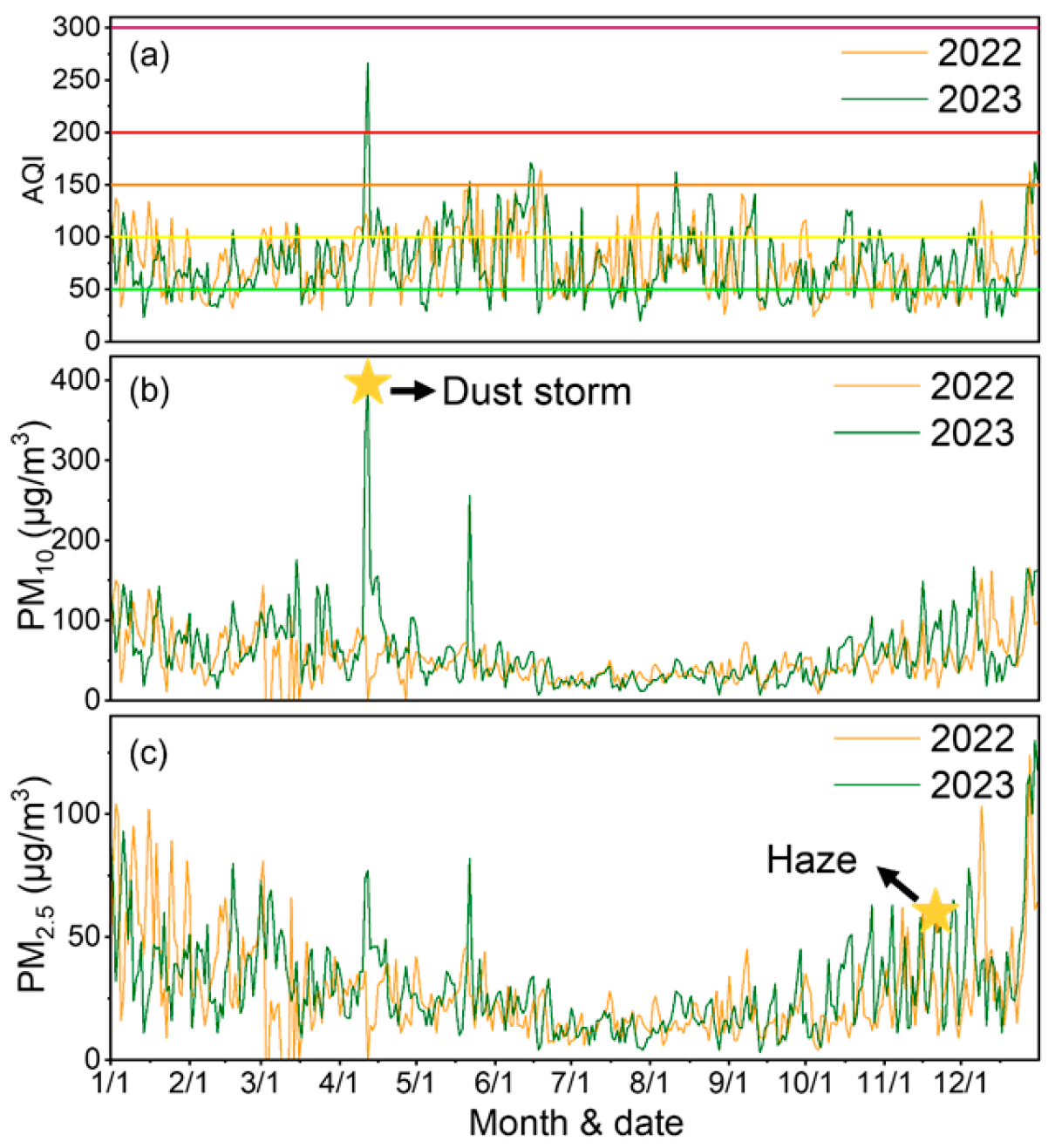
Figure 1a–c describe the variations in Air Quality Index (AQI) and primary characteristics for particulate matter (e.g., PM2.5 and PM10) in a city in East China during 2022–2023. The results in Figure 1a–c show that (1) as for the temporal variations in AQI, PM2.5, and PM10, the clear interannual differences and pronounced seasonal patterns in a city of East China during 2022–2023 could be clearly observed, and (2) overall, air quality in 2023 was generally better than in 2022, although several extreme pollution events including dust storm (PM10) in April and haze (PM2.5) in November were more prominent in 2023. For example, as shown in Figure 1a, we could clearly observe that the variations in the AQI basically fluctuated between low- and moderate-pollution levels throughout both years, although the higher values typically occurred in the winter season (January–March and November–December, respectively). Compared with 2022, the AQI curve for 2023 remained consistently lower for most months. This indicates an overall improvement in the baseline air quality of a city in East China, except for two notable peaks in 2023. This sharp increase corresponded to a dust storm episode in April, and a winter haze in November–December. These events apparently caused the short-term but significant deterioration of API despite the overall annual improvement.
As shown in Figure 1b, the PM10 concentrations in 2022 without extreme events were relatively stable, with the annual average concentration of ~50 μg/m3. In contrast, the PM10 concentrations in 2023 showed stronger variability during the spring season, culminating in an exceptionally high peak (e.g., ~380 μg m−3) in mid-April linked to a regional dust storm. This event could clearly reflect the influence of long-range transport from northern dust source regions. During the summer and autumn seasons of both years, PM10 basically remained at relatively low levels, and the annual average concentration was 59.4 μg/m3. This could be ascribed to favorable dispersion and frequent precipitation, followed by moderate increases during the winter season.
Figure 1c describes the variations in PM2.5 in a city in East China during 2022–2023. Apparently, the PM2.5 concentrations followed a typical seasonal structure, with elevated levels in winter and significantly lower values in summer. Throughout 2023, the annual average PM2.5 concentrations were 29.8 μg/m3, which was larger than 27.4 μg/m3 in 2022. This indicates the improved atmospheric dispersion and possible reduced precursor emissions. Nevertheless, in November–December 2023, the PM2.5 concentrations exhibited a steep rise. This reflects a severe haze episode driven by stagnant meteorological conditions, enhanced secondary aerosol formation, and intensified regional transport. This winter haze was more pronounced than that observed in 2022.
Collectively, we could experience overall improved air quality in 2023 compared with 2022, except for more distinct extreme pollution events, including a severe dust storm affecting PM10 in April and an intense winter haze dominated by PM2.5 in November–December. Thus, a city in East China reported that both years could fully satisfy the annual mean limits defined by China’s Ambient Air Quality Standard (GB 3095-2012) [14]. A city in East China, however, is facing multiple particulate pollution challenges, although air quality was excellent in the summer. For example, the composite pollution was dominated by fine particles (PM2.5) in the winter, and the dust pollution was dominated by coarse particles (PM10) in the spring. In addition, the extreme pollution events of dust storms could pose a new threat to attaining annual concentration standards as well as a human health risk. In the following section, we will further discuss a strong dust storm in April (PM10) and a severe winter haze episode in November–December (PM2.5).
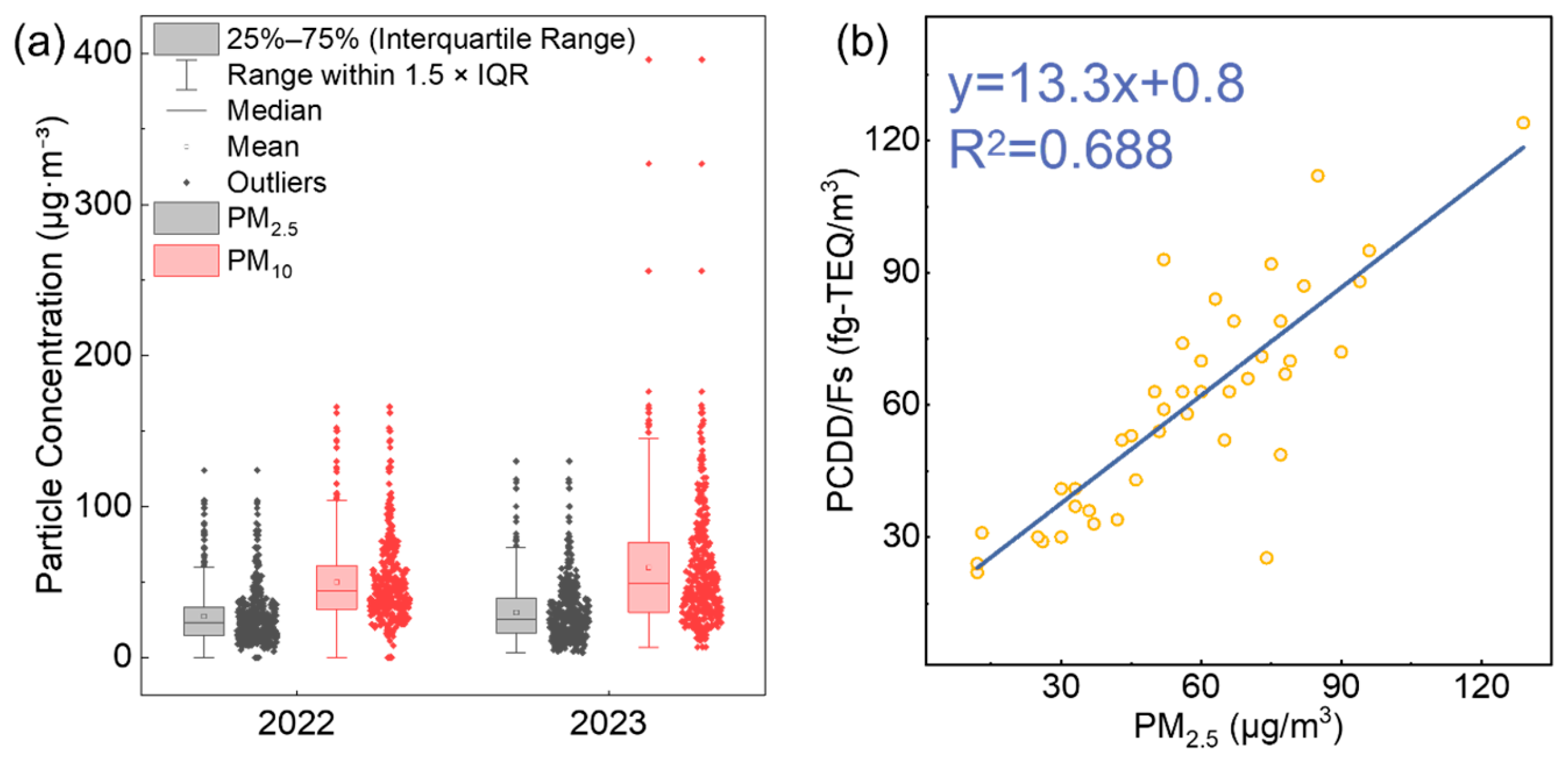
Figure 2a compares the variations in particle concentration (PM10 and PM2.5) in ambient air in a city in East China in 2022 and 2023. Based on the boxplot analysis shown in Figure 2a, we could infer that both PM10 and PM2.5 exhibited slightly higher annual means and medians in 2023 compared with 2022. This indicates an overall deterioration in background air quality. However, the distributions of a longer right tail and a wider variability range in 2023 might be caused primarily by a severe dust storm in April (PM10) and intensive winter haze episodes in November–December (PM2.5). These results also suggest that as the frequency and magnitude of extreme pollution events increased, the great interannual instability could occur and deteriorate the annual pollution level.
Figure 2b reveals the relationship between PM2.5 and PCDD/Fs in the ambient atmosphere in a city in East China. Equation (1) describes a statistically significant linear positive correlation between PM2.5 and PCDD/Fs concentrations. The scatter points closely follow an upward trend line with a high goodness of fit (y = 13.3 x + 0.8, R2 = 0.688). This indicates that the increases in fine particulate matter (PM2.5) are strongly associated with the elevated particle-bound dioxin levels in the ambient atmosphere. To the best of our knowledge, the highly lipophilic PCDD/Fs were prone to readily adsorbing onto the surface of fine particles (PM2.5) owing to their large specific surface area. The high slope (e.g., 13.3) shown in Figure 2b strongly suggests that the increases in PM2.5 concentration are likely accompanied by the increased contributions from specific industrial or combustion sources. Notably, the widely reported common pollution sources [15,16,17], including waste incineration, iron and steel smelting, and non-ferrous metal production, could emit PM2.5 and PCDD/Fs through large volume flue gas emissions simultaneously. The emissions from these sources release both primary particles and PCDD/Fs in the air and lead to a simultaneous increase in the concentrations of both PM2.5 and PCDD/Fs [10,11,12]. This provides crucial clues for source apportionment and the development of targeted control strategies. Consequently, PM2.5 could act as a key physical carrier for the transport, deposition, and human respiratory exposure of PCDD/Fs in the atmospheric conditions.
P C D D / F s = 13.3 × P M 2.5 + 0.8
where PCDD/Fs are the concentration of dioxin in the ambient atmosphere, and PM2.5 is the concentration of fine particulate matter (PM2.5).

3.2. Characteristics of Dioxin Under Different Pollution Episodes

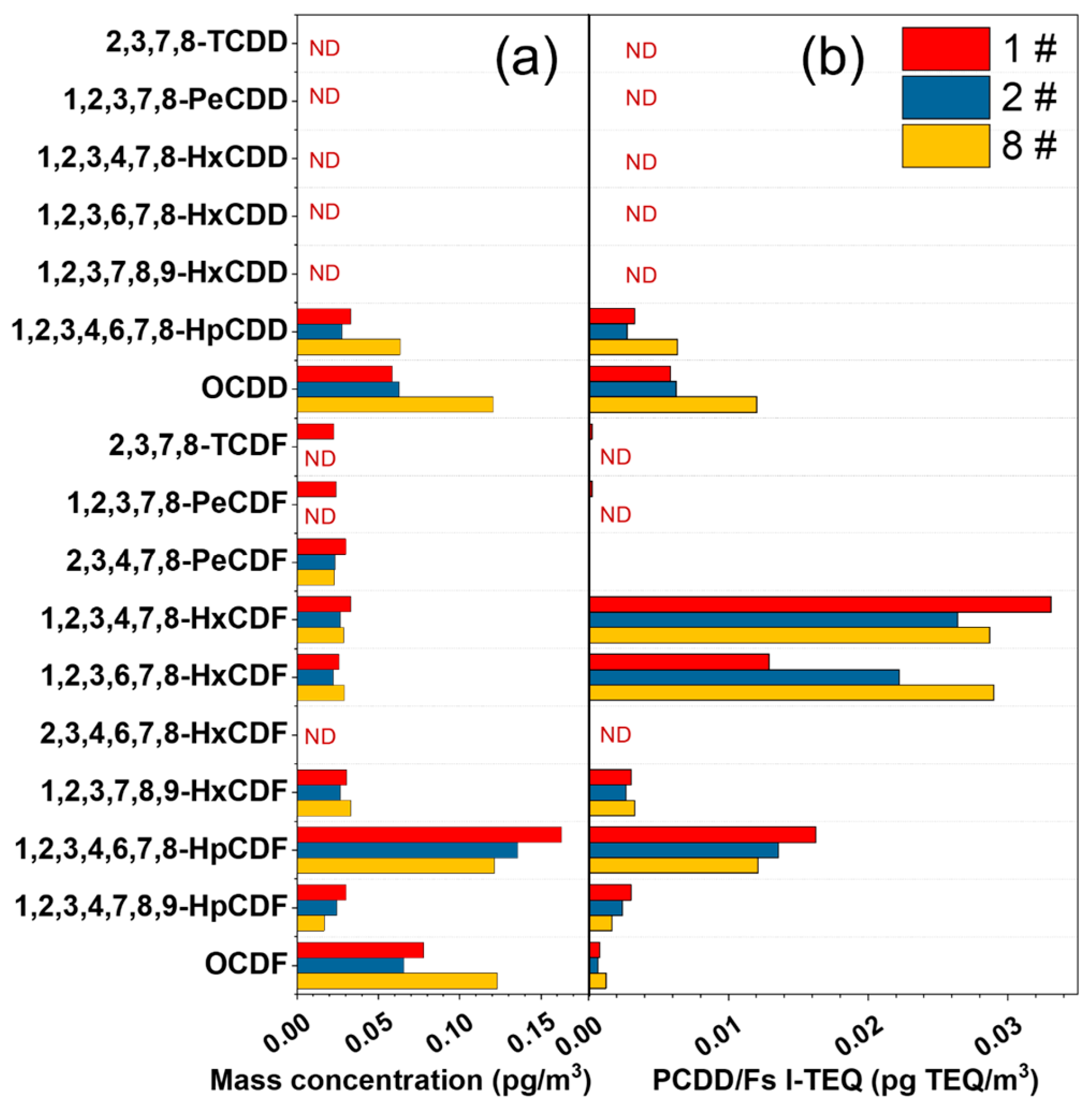
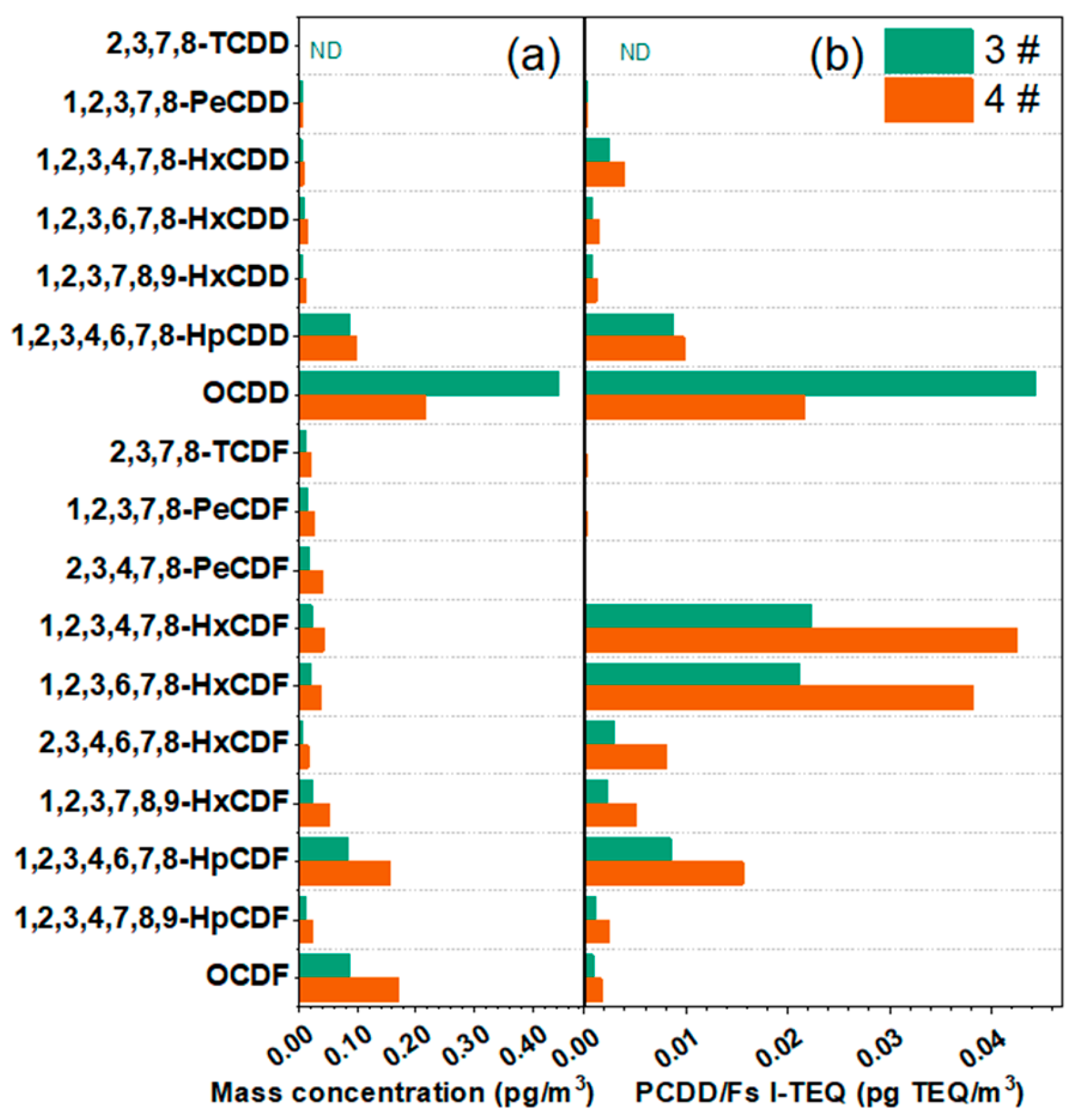
Table 1 compares the Mass and TEQ concentration of PCDD/Fs and PM2.5 in ambient air in a city in East China in 2023. As presented in Table 1, both the mass concentrations and toxic equivalent (TEQ) concentrations of PCDD/Fs in ambient air exhibited evident variability under different atmospheric pollution conditions. In Group A with excellent air quality, for example, the mass concentrations of PCDD/Fs remained at relatively low levels, with values ranging from 414.0 to 558.6 fg/m3. The corresponding TEQ values varied between 22.4 and 31.3 fg-TEQ/m3, accompanying with the concentration of particulate matter within 12–13 μg/m3. Long-term observations at the Lulin high-altitude background station in Taiwan have similarly shown that atmospheric PCDD/Fs remain at very low fg-TEQ·m−3 levels under clean-air conditions, confirming that low background concentrations are typical for East Asian regions with minimal local emissions [18]. Figure 3 describes the variations in dioxin congener profiles in clean-air samples (1#, 2#, and 8#). These background levels reflect limited emissions and effective atmospheric dispersion mechanisms, which are consistent with the results reported in other Chinese cities under similar clean-air scenarios [8,19,20,21,22]. Figure 4 describes the variations in dioxin congener profiles in clean-air samples (3# and 4#) in Group B during dust storm episodes. For comparison, a clear escalation in PCDD/Fs levels could be observed. As particulate matter surged to 74–77 μg/m3, the mass concentrations of dioxin increased to 855.1 fg/m3 for sample 3# and 942.4 fg/m3 for sample 4#, respectively. The TEQ concentrations corresponded to 25.3 fg-TEQ/m3 and 48.7 fg-TEQ/m3, respectively. The dioxin congener profiles in dust storm samples could be observed in Figure 4. This suggests that dust storms can facilitate the transport and enrichment of particulate-bound dioxins, possibly through the resuspension of contaminated surface soil or the scavenging of pollutants during long-range dust movement. Nevertheless, the increment in TEQs was less dramatic than the rise in total PCDD/Fs mass concentration. This also indicates that dust storm events could contribute substantially to the overall toxic burden and deteriorate the AQI (e.g., 189 for sample 3#, and 266 for sample 4#).
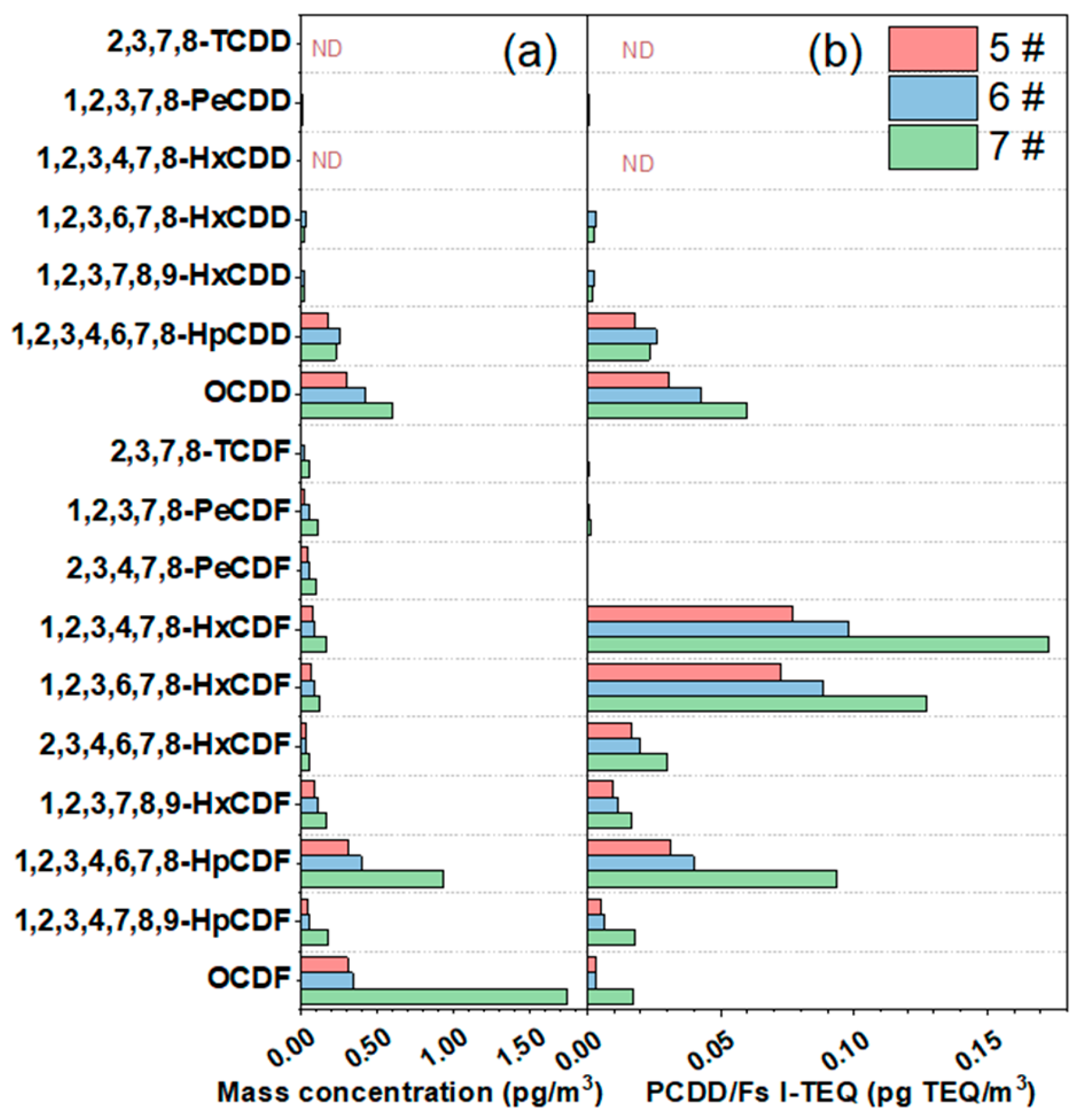
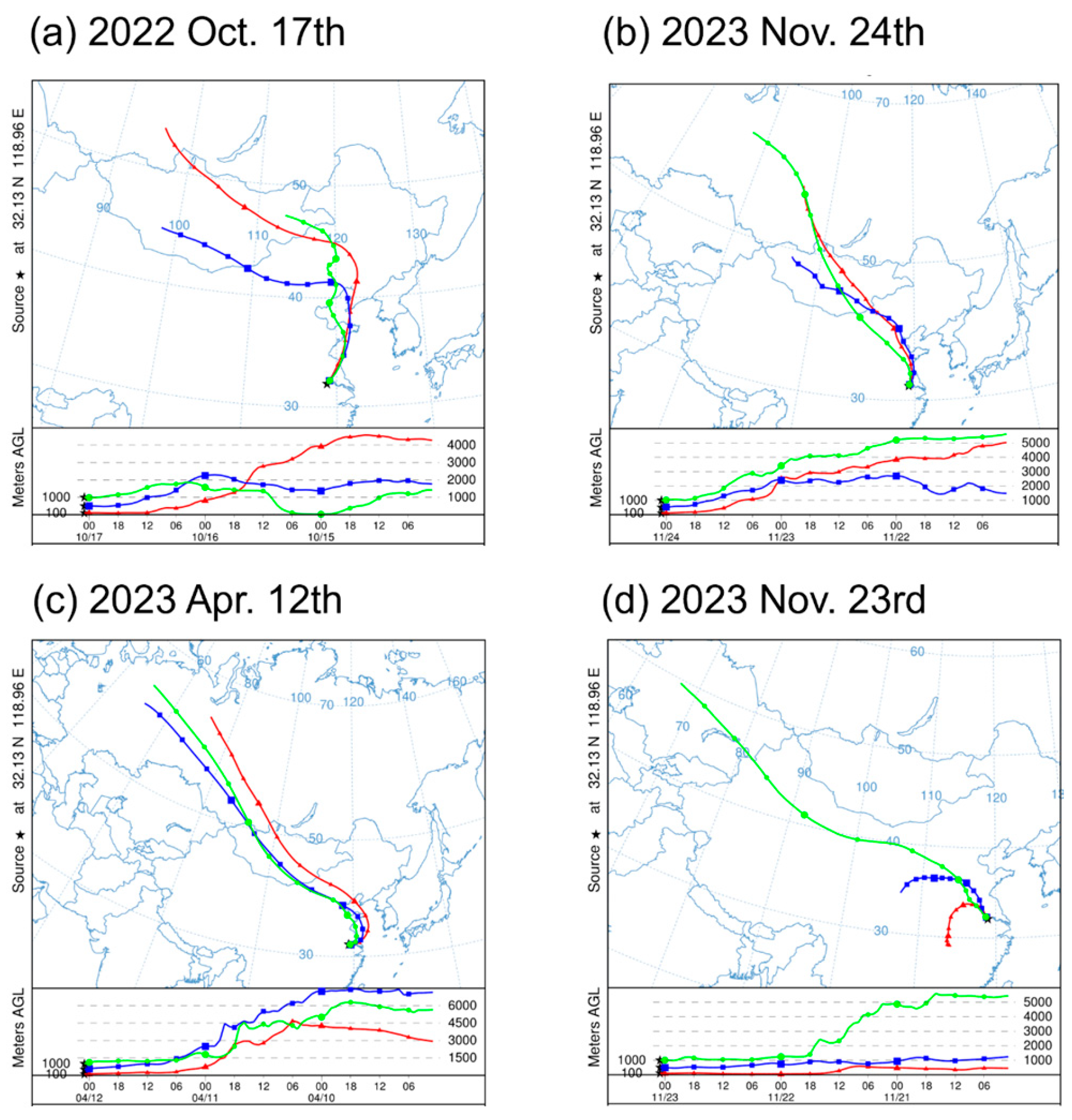
For comparison, Figure 5 describes the most pronounced increase in both PCDD/Fs concentrations and TEQ concentrations in Group C of haze episodes. For example, the mass concentrations exceeded 1500 fg/m3 in all haze samples and could reach up to 4562.3 fg/m3 (in sample 7#). Meanwhile, the corresponding TEQ values were calculated as 63.4, 92.5, and 147.6 fg-TEQ/m3, respectively. These data were nearly four times the average data reported in Group A with clean days. The dioxin congener profiles in haze samples could be observed in Figure 5. To the best of our knowledge, this dramatic enrichment could be attributed to several synergistic factors. For example, the stagnant atmospheric conditions and low-boundary-layer height could greatly inhibit the pollutant dispersion [23]. Moreover, the continuous release of dioxin and particulate matter from coal-fired power plants, traffic, and waste incineration further increases the burden of air [12]. Furthermore, the abundance of fine particles generated via secondary aerosol formation during haze events provides more surfaces for dioxin adsorption, further exacerbating the accumulation of toxic congeners. Additionally, Figure 6a–d describe the three-day haze trajectories during the period of 21–23 November 2023, which were calculated using the HYSPLIT model [24]. As shown in Figure 6b, the trajectories calculated for a city in East China reveal that the air masses seem to have originated from the Mongolian plateau without crossing the Shandong Peninsula and the coast of the Yellow Sea, as shown in Figure 6c for haze episodes. Hence, we consider that the dust in April of 2023 not only brings cold air, but also transports air pollutants and dust over long distances to a city in East China.
d c = i = 4 8 f i × n i
where dc is the chlorination degree, fi is the molar percentage of PCDD-, PCDF-, or PCDD/F-congeners, and ni is the number of hydrogen atoms substituted by chlorine.
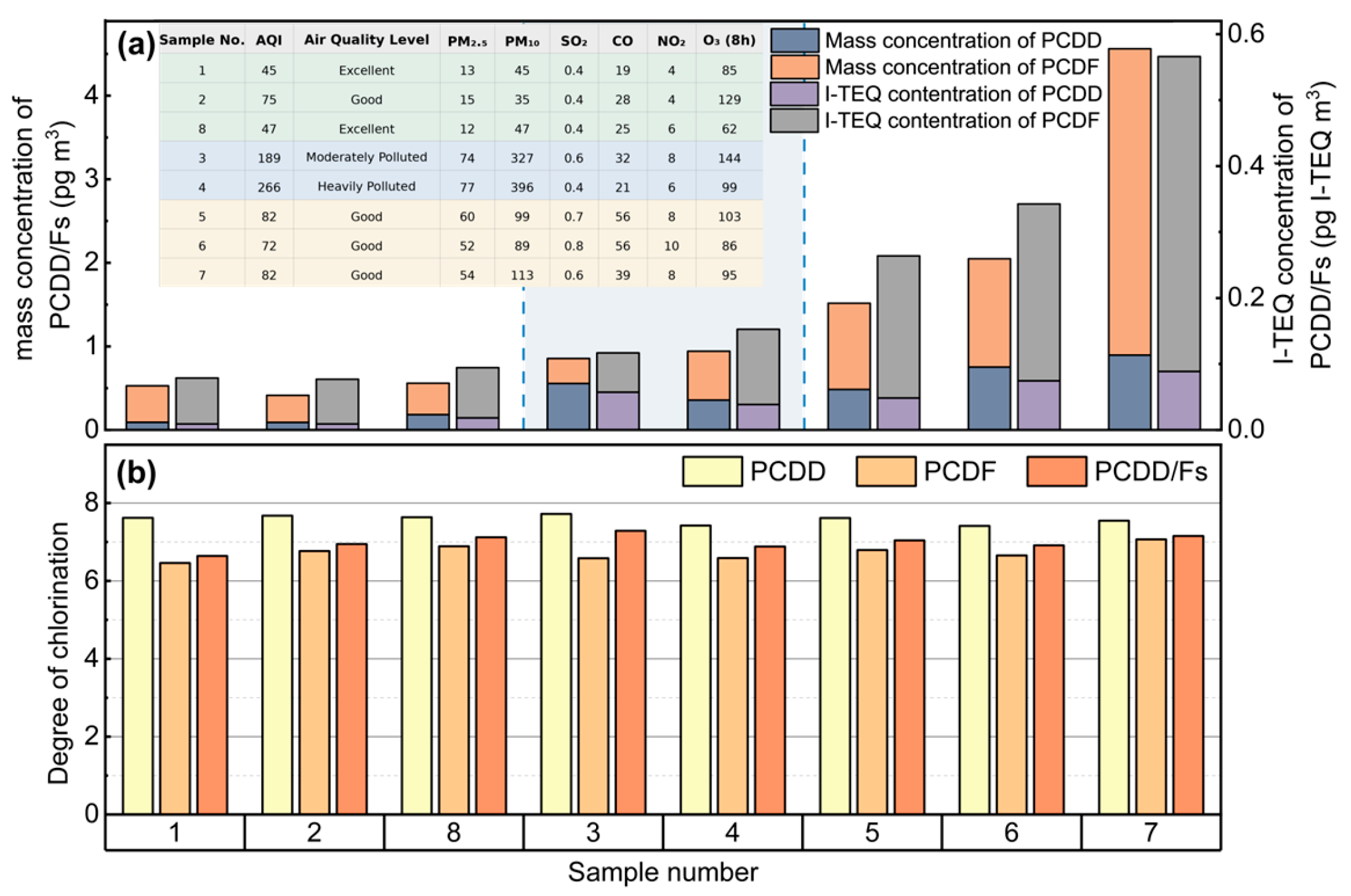
Figure 7a,b compare the mass concentration, I-TEQ concentration, and the degree of chlorination (DoC) of PCDD/Fs in all samples used in this study. Equation (2) describes the chlorination degree of PCDD/Fs in all samples. Under the conditions of clear weather (Samples 1#, 2#, 8#), total PCDD/F DoC ranges from 6.64 to 7.12, accompanied by a mean of 6.90. This represents background atmospheric conditions dominated by aged, regionally transported congeners. For comparison, the dust samples (3# and 4#) exhibit a broader spread (6.88–7.29), and sample 3# shows the highest DoC at 7.29. This suggests mixed influences of resuspended particulate-bound PCDD/Fs and limited atmospheric processing. In contrast, the haze samples (5#, 6#, and 7#) display consistently elevated DoC values varying within the range of 6.92–7.15 (mean 7.04). This indicates enrichment of higher chlorinated congeners. Moreover, across all samples, PCDD shows higher DoC (7.41–7.72) than PCDF (6.46–7.07), consistent with the greater thermodynamic stability of highly chlorinated PCDD congeners during atmospheric aging. The enhanced DoC under haze conditions aligns with previous evidence that fine, carbonaceous, and metal-containing particles favor heterogeneous chlorination and secondary formation pathways of PCDD/Fs. These results suggest that meteorology-dependent atmospheric processing, rather than primary emissions alone, plays a key role in shaping PCDD/F homolog distributions.
These findings collectively indicate that haze episodes pose the most severe risk for dioxin pollution among the three types of atmospheric episodes, although the AQI (within 72–82) is regarded as Good. For comparison, the dust storms can transport large quantities of particulate matter and some dioxins, and are thought to be heavily polluted with an AQI of 189–266. However, their contribution to the toxic equivalent concentration of dioxin is limited compared to the haze episodes. In contrast, the haze episodes not only increase the total burden of PCDD/Fs but also favor the accumulation of the most toxic congeners. This thereby represents a period of heightened exposure risk for the urban population. Thus, special attention should be given to haze episodes in both dioxin monitoring and public health protection, as this represents a critical window for the implementation of targeted emission control and early warning strategies.

3.3. Health Risk Assessment of Inhalation Exposure to PCDD/Fs

Equation (3) describes the ratio of PM2.5/PM10 (nominated as R), which is proposed as a key parameter for identifying the pollution sources and types. Based on Equation (3), we could calculate R as 0.32 in Group A (clean days; samples 1#, 2#, and 8#), 0.21 in Group B (dust storm; samples 3# and 4#), and 0.56 in Group C (haze episode; samples 5#, 6#, and 7#). To the best of our knowledge, the greater contributions from combustion processes, including vehicles, industry, coal burning, and atmospheric secondary chemical reactions, could be achieved with the high ratio of R (>0.5–0.6) [15,16,17]. This implies more complex pollution and higher health risks [25]. The winter season generally conforms to this characteristic. Moreover, the low ratio of R (<0.3–0.4) typically indicates dominance by coarse particle sources such as resuspended dust, soil dust, and transport dust. The spring peak in 2022 clearly reflected this situation.
R = P M 2.5 P M 10
where PM2.5 and PM10 are the concentrations of particulate matter in the atmospheric environment (unit: μg/m3).
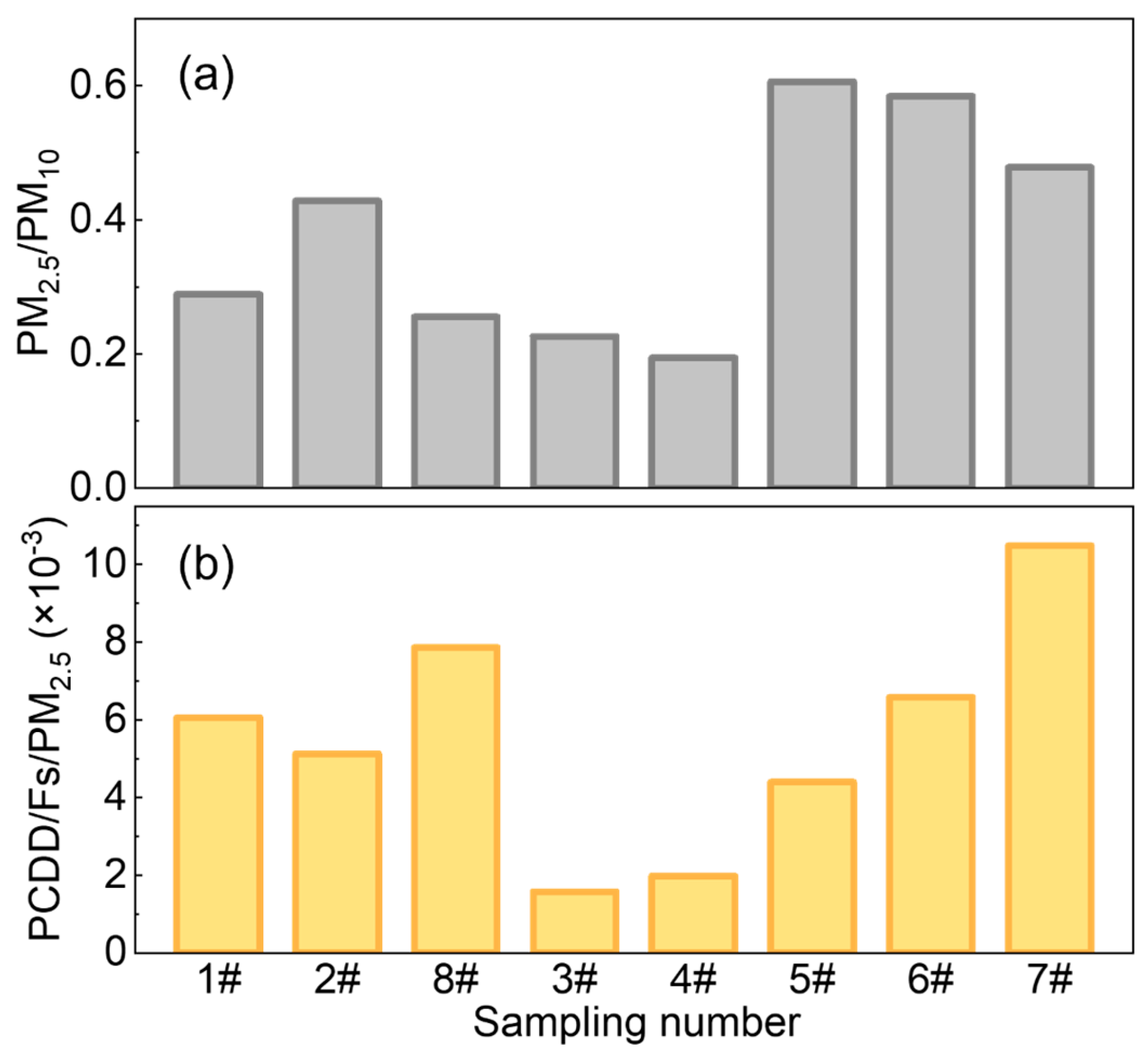
Figure 8a shows the variations in PM2.5/PM10 ratios among clean, dust storms, and haze conditions, reflecting the distinct particle size distributions driven by different emission sources and atmospheric processes. During clean days (1#, 2#, and 8#), the ratios ranged between approximately 0.25 and 0.43. This indicates a relatively larger contribution of coarse particles and efficient atmospheric dispersion. In contrast, the dust storm samples (3# and 4#) exhibited the lowest ratios (≈0.17–0.22), which were consistent with the dominance of mineral dust. By comparison, haze day samples (5#, 6#, and 7#) showed substantially the highest PM2.5/PM10 ratios (~0.48–0.60). This suggests an accumulation of fine particulate matter. This enhancement is likely driven by stagnant meteorological conditions, secondary aerosol formation, and the aged accumulation of combustion-related particles [15,16,17], all of which preferentially increase the fine-mode fraction. Overall, these results demonstrate that the PM2.5/PM10 ratio is a sensitive indicator of dominant pollution types, with low values characterizing dust-influenced coarse particle events and high values reflecting haze-related fine-particle enrichment.
R a t i o = P C D D / F s P M 2.5
where PM2.5 (unit: μg/m3) and PCDD/Fs (unit: pg/m3) are the concentration of particulate matter dioxin in the atmospheric environment.
Equation (4) describes the variations in PCDD/Fs-to-PM2.5 ratios, which could exhibit pronounced variability among clean, dust storms, and haze episodes. This revealed substantial differences in the intrinsic toxicity per unit particle mass. As shown in Figure 8b, clean-day samples (1#, 2#, and 8#) showed moderate ratios (≈5–8 pg μg−1). This reflected the typical background influence of combustion-derived fine particles. In contrast, dust storm samples (3# and 4#) presented the lowest ratios (≈1.4–1.9 pg μg−1), despite their elevated PM2.5 levels. This reduction indicates a strong dilution effect, as mineral dust overwhelmingly contributed to the particle mass but carries minimal PCDD/Fs. This thereby suppressed the toxicity per unit PM2.5 mass. Conversely, the haze episodes (5#, 6#, and 7#) exhibited substantially the highest ratios (≈4.3–10.5 pg μg−1), suggesting strong enrichment of PCDD/Fs on fine particles. Such enhancement was consistent with stagnant atmospheric conditions favoring secondary aerosol formation, adsorption of semi-volatile PCDD/Fs onto organic-rich PM2.5, and the accumulation of aged combustion aerosols. Thus, these findings support a key mechanistic implication that dust storms could increase overall particulate loading yet effectively dilute particle-bound toxicity. For comparison, haze episodes function as efficient concentrators of PCDD/Fs, substantially elevating toxicity per unit PM2.5 mass [26]. This distinction underscores the need for differentiated risk assessment frameworks for coarse-dust-dominated and secondary-organic-aerosol-dominated pollution events.
A D D o r a l e q = C air × I R × E F × E D × f r B W × A T × f a
R i s k = A D D o r a l e q × S F 0
H Q = A D D o r a l e q R f D 0
where Cair is the TEQ concentration of PCDD/Fs in atmospheric environment (pg I-TEQ/m3); IR is the daily Inhalation Rate (m3/d; for adult, 20 m3/d; for children, 10 m3/d) [27]; EF is the Exposure Frequency (e.g., 365 day/year); ED is Exposure Duration (e.g., 70 year for adult); fr is Inhalation Absorption Factor (0.75); BW is the Body Weight (BW; for adult, 70 kg; for children, 16 kg); AT is Averaging Time (25,550 day); fa is Absorption Factor [28] (0.5 recommended by WHO); SF0 is Slope Factor (1.0 × 10⁵ recommended by the EU RIVM); RfD0 is Reference Dose (WHO: 1~4 pg-TEQ/kg/day; we herein selected 2 pg-TEQ/kg/day).
Equations (5)–(7) describe the lifetime average daily dose (ADD), cancer risk (CR), and non-cancer hazard quotient (HQ) using the Nouwen inhalation exposure model [29,30] to quantify the human health implications of particle-bound dioxins under different atmospheric conditions. Based on the toxic equivalent concentrations (TEQ) of PCDD/Fs in ambient air and the USEPA Exposure Factors Handbook and WHO/IPCS recommendations, we estimated the inputs and default parameters with three atmospheric scenarios, including good air quality, dust storms, and haze episodes. The results (Table 2) were drawn as follows:
For adults, we calculated the ADD values as 0.011, 0.016, and 0.043 pg-TEQ·kg−1·day−1 under good, dust storm, and haze conditions, respectively. These doses are lower than the WHO tolerable daily intake (TDI) of 1–4 pg-TEQ·kg−1·day−1 and therefore represent a minor contribution to the total non-dietary exposure [31]. The corresponding HQ values (5.5 × 10⁻³, 7.9 × 10⁻³, and 2.16 × 10⁻²) are all far below the threshold of unity. This indicates the negligible non-cancer health concern from short-term inhalation of PCDD/Fs even during severe particle pollution. The estimated lifetime cancer risks are calculated as 1.1 × 10⁻³, 1.6 × 10⁻³, and 4.3 × 10⁻³. These values exceed the commonly applied regulatory benchmark of 10−6–10−4 for permissible incremental cancer risk, but they should be interpreted as upper-bound estimates because the model assumes continuous exposure at the same concentration for 70 years. In reality, dust storms and haze events occur intermittently, and thus their true contribution to lifetime cancer burdens would be substantially lower. Nevertheless, the higher CR observed during haze episodes reflects the significant enrichment of fine PM2.5-bound PCDD/Fs under stagnant meteorological conditions. These CR values represent the upper-bound and conservative estimates based on continuous exposure assumptions. Actual episodic exposure is significantly lower.
For comparison, children are typically more vulnerable to airborne toxicants owing to their higher inhalation rate per unit body weight. Using representative parameters (IR = 10 m3·day−1 and BW = 16 kg), the inhalation dose of children is approximately 2.2-fold higher than that of adults under identical TEQ concentrations. As a result, the estimated cancer risks for children are 2.4 × 10⁻³ (good air), 3.5 × 10⁻³ (dust storms), and 9.4 × 10⁻³ (haze episodes). Similarly, the HQ values for children are 1.2 × 10⁻², 1.7 × 10⁻², and 4.7 × 10⁻², which are all still <1. This indicates acceptable non-cancer effects. Although children exhibit higher intake-normalized exposure, the cancer risks remain upper-bound estimates and should not be interpreted as real-world lifetime values. Instead, these results highlight that children are a more sensitive subgroup, experiencing significantly greater body weight-adjusted uptake of particle-bound dioxins during pollution episodes. These results indicate a clear gradient of inhalation exposure and associated risk: haze episodes > dust storm > good air quality. From a non-cancer perspective, the risks for both adults and children are within acceptable limits (HQ << 1). The conservative cancer risk estimates, however, exceed the typical regulatory target range, especially during haze episodes. This highlights that high-PM2.5 events considerably elevate the particle-bound dioxin burden and should be regarded as a relevant supplementary pathway in cumulative risk assessment, although inhalation contributes relatively little to total PCDD/Fs exposure compared with diet.

4. Conclusions

In this study, we systemically compared the variations in PM2.5 and PM10 from 2022 to 2023 in a city in East China, which further revealed the relationship between PM2.5 and dioxin in the atmospheric air, and eventually emphasized elucidating the variations in pollution characteristics, including dioxin and PM2.5, and compared the human health risk during dust storms and haze episodes. The main conclusions could be summarized as follows:
Overall, dust storms in April and haze episodes in November of 2023 deteriorated the air quality compared with that in 2022. Moreover, PM2.5 serves as a major carrier for PCDD/Fs in urban and haze conditions, and that air quality deterioration, as reflected by rising PM2.5, directly translates to heightened dioxin exposure risk. Thus, controlling PM2.5 may not only reduce particulate mass concentration but also synergistically decrease population exposure to dioxins and other toxic organic pollutants adsorbed onto them. The TEQ concentration of PCDD/Fs in ambient air was 0.1476 pg-TEQ/m3 on a haze day compared with 0.0487 pg-TEQ/m3 for dust storms and 0.0258 pg-TEQ/m3 for a good weather day. Notably, the concentration for PCDD/Fs and PM2.5 on haze days was 3.03 times and 0.733 times, respectively, compared with dust storms. Furthermore, the enhanced risks during haze episodes are attributable to the strong enrichment of PCDD/Fs on fine particles, increased atmospheric residence time, and restricted boundary-layer dispersion. By contrast, dust storms elevate TEQs primarily through coarse mineral particles, resulting in lower toxic potency and weaker enhancement of child-normalized exposure. Based on the daily available AQI index for dust storms (e.g., heavily polluted) and haze episodes (e.g., good), however, the population may overlook the Health Hazards and Risks of Haze Exposure with dioxins during haze episodes. Notably, the human health risks for both PCDD/Fs and PM2.5 during the haze episodes will be studied in future research. To the best of our knowledge, this study could fill the knowledge gap of dust storm and haze episodes on the transmission of PCDD/Fs in the ambient air of a city in East China and provides a scientific reference for monitoring and early warning of PCDD/Fs during haze episodes.

Author Contributions

Conceptualization, X.S., J.Y. and C.L.; Methodology, X.S., J.Y. and C.L.; Software, J.Y. and C.L.; Validation, Y.J.; Formal analysis, X.S. and Y.J.; Investigation, X.S. and C.L.; Resources, Y.Z.; Data curation, X.S. and Y.Z.; Writing—original draft, X.S., J.Y. and Y.J.; Writing—review & editing, X.S., J.Y. and Y.J.; Visualization, X.S., C.L. and Y.Z.; Supervision, Y.J.; Project administration, Y.J.; Funding acquisition, Y.J. All authors have read and agreed to the published version of the manuscript.

Funding

The Central Scientific Research Projects for Public Welfare Research Institutes (Grant No.: GYZX210301) and the International Cooperation Project of Nanjing Science and Technology Bureau (Grant No.: 202401026).

Institutional Review Board Statement

Not applicable.

Informed Consent Statement

Not applicable.

Data Availability Statement

The data presented in this study are available on request from the corresponding author.

Acknowledgments

The authors acknowledge the help of Yani Huang and Jixia Xie for analysis of dioxin. Moreover, the main opinions and conclusions in this manuscript are those of the authors and should not be regarded as the opinions of the Ministry of Ecology and Environment (MEE) of P. R. China.

Conflicts of Interest

The authors declare no conflicts of interest.

References

  1. Olie, K.; Vermeulen, P.L.; Hutzinger, O. Chlorodibenzo-p-dioxins and chlorodibenzofurans are trace components of fly ash and flue gas of some municipal incinerators in The Netherlands. Chemosphere 1977, 6, 455–459. [Google Scholar] [CrossRef]
  2. Deng, D.; Qiao, J.; Liu, M.; Kołodyńska, D.; Zhang, M.; Dionysiou, D.D.; Ju, Y.; Ma, J.; Chang, M.-B. Detoxification of municipal solid waste incinerator (MSWI) fly ash by single-mode microwave (MW) irradiation: Addition of urea on the degradation of dioxin and mechanism. J. Hazard. Mater. 2019, 369, 279–289. [Google Scholar] [CrossRef]
  3. Ju, Y.; Deng, D.; Li, H.; You, Y.; Qiao, J.; Su, L.; Xing, W.; Liang, M.; Dionysiou, D.D. Rapid detoxification of dioxin and simultaneous stabilization of targeted heavy metals: New insight into a microwave-induced pyrolysis of fly ash. Chem. Eng. J. 2022, 429, 131939. [Google Scholar] [CrossRef]
  4. Ju, Y.; Zhang, K.; Yang, T.; Deng, D.; Qiao, J.; Wang, P.; You, Y.; Du, L.; Chen, G.; Kołodyńska, D.; et al. The influence of a washing pretreatment containing phosphate anions on single-mode microwave-based detoxification of fly ash from municipal solid waste incinerators. Chem. Eng. J. 2020, 387, 124053. [Google Scholar] [CrossRef]
  5. Trinh, M.M.; Chang, M.B. Review on occurrence and behavior of PCDD/Fs and dl-PCBs in atmosphere of East Asia. Atmos. Environ. 2018, 180, 23–36. [Google Scholar] [CrossRef]
  6. Guo, Z.; Sun, S.; Cao, R.; Jiang, N.; Liang, N.; Wang, Z.; Guo, J.; Li, M.; Liu, X.; Geng, N.; et al. Tracing toxic pollutants in coastal urban atmosphere: A case study on the particle-size distribution, sources, and health risks of PCDD/Fs, PCBs, PAHs, and substituted PAHs. J. Hazard. Mater. 2025, 498, 139833. [Google Scholar] [CrossRef] [PubMed]
  7. Tuan, N.T.; Le, H.A.; Linh, B.D.; Chi, N.D.T.; Thang, N.D.; Ly, N.T.T.; Thu, N.T.; Huyen, P.T. Unveiling respiratory health risks: PCDD/Fs adhering to particulate matter (PM10 and PM2.5) in Bien Hoa City, Dong Nai, Vietnam. Environ. Adv. 2024, 17, 100560. [Google Scholar] [CrossRef]
  8. Mila, A.; Cao, R.; Geng, N.; Zhu, X.; Chen, J. Characteristics of PAHs, PCDD/Fs, PCBs and PCNs in atmospheric fine particulate matter in Dalian, China. Chemosphere 2022, 288, 132488. [Google Scholar] [CrossRef]
  9. Liu, Y.; Peng, P.; Li, X.; Zhang, S.; Ren, M. Polychlorinated dibenzo-p-dioxins and dibenzofurans (PCDD/Fs) in water and suspended particulate matter from the Xijiang River, China. J. Hazard. Mater. 2008, 152, 40–47. [Google Scholar] [CrossRef]
  10. Zhang, X.; Zheng, M.; Liang, Y.; Liu, G.; Zhu, Q.; Gao, L.; Liu, W.; Sun, X. Particle size distributions and gas–particle partitioning of polychlorinated dibenzo-p-dioxins and dibenzofurans in ambient air during haze days and normal days. Sci. Total Environ. 2016, 573, 876–882. [Google Scholar] [CrossRef]
  11. Zhang, X.; Zhu, Q.-Q.; Dong, S.-J.; Zhang, H.-X.; Wang, X.-K.; Wang, M.; Gao, L.-R.; Zheng, M.-H. Particle Size Distributions of PCDD/Fs and PBDD/Fs in Ambient Air in a Suburban Area in Beijing, China. Aerosol Air Qual. Res. 2015, 15, 1933–1943. [Google Scholar] [CrossRef]
  12. Pan, S.Y.; Liou, Y.T.; Chang, M.B.; Chou, K.; Ngo, T.H.; Chi, K.H. Characteristics of PCDD/Fs in PM2.5 from emission stacks and the nearby ambient air in Taiwan. Sci. Rep. 2021, 11, 8093. [Google Scholar] [CrossRef]
  13. HJ 77.2-2008; Ambient Air and Waste Gas Determination of Polychlorinated Dibenzo-p-Dioxins (PCDDs) and Pol-Ychlorinated Dibenzofurans (PCDFs) Isotope Dilution HRGC-HRMS. Ministry of Ecology and Environment: Beijing, China, 2008.
  14. GB 3095-2012; Ambient Air Quality Standards. Ministry of Ecology and Environment: Beijing, China, 2012.
  15. Ehrlich, C.; Noll, G.; Kalkoff, W.-D.; Baumbach, G.; Dreiseidler, A. PM10, PM2.5 and PM1.0—Emissions from indus-trial plants—Results from measurement programmes in Germany. Atmos. Environ. 2007, 41, 6236–6254. [Google Scholar] [CrossRef]
  16. Lv, D.; Chen, Y.; Zhu, T.; Li, T.; Shen, F.; Li, X.; Mehmood, T. The pollution characteristics of PM10 and PM2.5 during summer and winter in Beijing, Suning and Islamabad. Atmos. Pollut. Res. 2019, 10, 1159–1164. [Google Scholar] [CrossRef]
  17. Allen, R.W.; Gombojav, E.; Barkhasragchaa, B.; Byambaa, T.; Lkhasuren, O.; Amram, O.; Takaro, T.K.; Janes, C.R. An assessment of air pollution and its attributable mortality in Ulaanbaatar, Mongolia. Air Qual. Atmos. Health 2013, 6, 137–150. [Google Scholar] [CrossRef] [PubMed]
  18. Chi, K.-H.; Hung, N.T.; Chang, M.-B.; Lin, C.-Y.; Li, C.-T. Increase of Ambient PCDD/F and PCB Concentrations in Northern Taiwan during Asian Dust Storm and Winter Monsoon Episodes. Aerosol Air Qual. Res. 2014, 14, 1323–1332. [Google Scholar] [CrossRef]
  19. Yu, X.; Tian, H.; Sun, H.; Hsieh, Y.-K.; Tian, X. Atmospheric Total-PCDD/Fs-WHO2005-TEQ Concentrations and Dry Deposition Fluxes in Shanghai and Nanjing, China. Aerosol Air Qual. Res. 2021, 21, 210059. [Google Scholar] [CrossRef]
  20. Liu, X.; Cui, K.; Hsieh, Y.-K.; Wang, Y.-F.; Wang, R. Study on air quality index, atmospheric pollutants and dry deposition of PCDD/Fs in the ambient air near Southwest China. Aerosol Air Qual. Res. 2022, 22, 220160. [Google Scholar] [CrossRef]
  21. Pan, S.Y.; Hsu, Y.S.; Hsu, Y.C.; Ngo, T.H.; Chou, C.C.K.; Lin, N.H.; Chi, K.H. The Long-Term Monitoring of Atmospheric Polychlorinated Dibenzo-p-Dioxin Dibenzofurans at a Background Station in Taiwan during Biomass Burning Seasons in El Niño and La Niña Events. Atmosphere 2024, 15, 1002. [Google Scholar] [CrossRef]
  22. Zhao, R.; Cui, K.; Wang, W.; Wang, L.C.; Yan, P. Atmospheric PM2.5 and Total PCDD/Fs-WHO2005-TEQ Levels: A Case of Handan and Kaifeng Cities, China. Aerosol Air Qual. Res. 2018, 18, 994–1007. [Google Scholar] [CrossRef]
  23. Cao, R.; Zhang, H.; Zhao, L.; Zhang, Y.; Geng, N.; Teng, M.; Zou, L.; Gao, Y.; Ni, Y.; Fu, Q.; et al. Hazy Weather–Induced Variation in Environmental Behaviors of Persistent Organic Pollutants: A Case Study for PCDD/Fs and PBDEs in Eastern China. Environ. Sci. Technol. 2018, 52, 8173–8182. [Google Scholar] [CrossRef]
  24. Lee, S.-J.; Park, H.; Choi, S.-D.; Lee, J.-M.; Chang, Y.-S. Assessment of variations in atmospheric PCDD/Fs by Asian dust in Southeastern Korea. Atmos. Environ. 2007, 41, 5876–5886. [Google Scholar] [CrossRef]
  25. Hung, N.T.; Ting, H.W.; Chi, K.H. Evaluation of the Relative Health Risk Impact of Atmospheric PCDD/Fs in PM2.5 in Taiwan. Aerosol Air Qual. Res. 2018, 18, 2591–2599. [Google Scholar] [CrossRef]
  26. Chi, K.H.; Huang, Y.-T.; Nguyen, H.M.; Tran, T.T.-H.; Chantara, S.; Ngo, T.H. Characteristics and Health Impacts of PM2.5-Bound PCDD/Fs in Three Asian Countries. Environ. Int. 2022, 167, 107441. [Google Scholar] [CrossRef]
  27. US EPA. Exposure and Human Health Reassessment of 2,3,7,8-Tetrachlorodibenzo-p-Dioxin (TCDD) and Related Compounds; US EPA: Washington, DC, USA, 2003.
  28. WHO. Air Quality Guidelines for Particulate Matter, Ozone, Nitrogen Dioxide and Sulfur Dioxide; WHO: Geneva, Switzerland, 2005. [Google Scholar]
  29. Nouwen, J.; Cornelis, C.; De Fré, R.; Wevers, M.; Viaene, P.; Mensink, C.; Patyn, J.; Verschaeve, L.; Hooghe, R.; Maes, A.; et al. Health Risk Assessment of Dioxin Emissions from Municipal Waste Incinerators: The Neerlandquarter (Wilrijk, Belgium). Chemosphere 2001, 43, 909–923. [Google Scholar] [CrossRef]
  30. Ma, X.; Jiang, X.G.; Jin, Y.Q.; Liu, H.M.; Li, X.D.; Chen, T.; Yan, J.H. Dispersion Modeling and Health Risk Assessment of Dioxin Emissions from Municipal Solid Waste Incinerators: A Case Study from China. J. Zhejiang Univ. Sci. A 2012, 13, 69–78. [Google Scholar] [CrossRef]
  31. van Leeuwen, F.X.R.; Feeley, M.; Schrenk, D.; Larsen, J.C.; Farland, W.; Younes, M. Dioxins: WHO’s Tolerable Daily Intake (TDI) Revisited. Chemosphere 2000, 40, 1095–1101. [Google Scholar] [CrossRef] [PubMed]
Figure 1. The variations of (a) AQI, (b) PM10, and (c) PM2.5 in a city of East China in 2022–2023 (these data were obtained from the official website of Municipal Bureau of Ecology and Environment. Note: ★ represents the sampling time for dust storms and haze episodes).
Atmosphere 17 00111 g001
Figure 2. (a) Variations in particle concentration (PM10 and PM2.5) in ambient air in a city in East China in 2022 and 2023; (b) Relationship between PCDD/Fs and PM2.5 concentration in ambient air.
Atmosphere 17 00111 g002
Figure 3. Variations in (a) mass concentration and (b) TEQ concentration for dioxin congener profiles in clean-air samples (1#, 2#, and 8#; ND: not detected).
Atmosphere 17 00111 g003
Figure 4. Variations in (a) mass concentration and (b) TEQ concentration for dioxin congener profiles in dust storm samples (3# and 4#; ND: not detected).
Atmosphere 17 00111 g004
Figure 5. Variations in (a) mass concentration and (b) TEQ concentration for dioxin congener profiles in Haze samples (5#, 6#, and 7#; ND: not detected).
Atmosphere 17 00111 g005
Figure 6. (ad) Three-day trajectories of sampling sites using the HYSPLITT 4 model for Group A–C during the sand storms and haze episodes (23–24 November 2023).
Atmosphere 17 00111 g006
Figure 7. (a) Variations in mass concentration (pg/m3) and I-TEQ concentration (pg I-TEQ/m3), (b) degree of chlorination for dioxin in all samples (1#, 2#, 8#, 3#, 4#, 5#, 6#, and 7#) in this study. The key parameters of sampling are shown in the inset of (a).
Atmosphere 17 00111 g007
Figure 8. Variations in ratio for (a) PM2.5/PM10 and (b) dioxin/PM2.5 in ambient air under clean air, dust storms, and haze episodes.
Atmosphere 17 00111 g008
Table 1. The Mass and TEQ concentrations of PCDD/Fs and PM2.5 in ambient air in a city in East China.
SamplesGroup A—CleanGroup B—DustGroup C—Haze
1#2#8#3#4#5#6#7#
Sample Date2022.102022.102023.112023.042023.042023.112023.112023.11
PM2.51312127477605254
2378-TCDDNDNDNDNDNDNDNDND
12378-PeCDDNDNDND4.97.2ND11.615.3
123478-HxCDDNDNDND4.97.8NDNDND
123678-HxCDDNDNDND7.714.4ND33.224.0
123789-HxCDDNDNDND7.012.2ND25.222.5
1234678-HpCDD32.927.563.486.498.5177.0258.0233.0
OCDD58.562.6120.4444.0217.0307.7424.0600.0
ΣPCDDs91.490.1183.8554.9357.1484.7752894.8
ΣTEQ PCDDs1.41.21.55.78.24.215.816.4
2378-TCDF22.8NDND12.021.0ND25.161.9
12378-PeCDF24.1NDND15.025.930.463.5118.6
23478-PeCDF30.023.123.018.940.650.862.9105.9
123478-HxCDF33.126.428.722.342.576.997.7173.0
123678-HxCDF25.822.229.021.238.272.888.3127.0
123789-HxCDFNDNDND6.016.232.939.660.1
234678-HxCDF30.426.633.022.651.296.0116.0166.0
1234678-HpCDF162.5135.7121.284.8156.0311.0399.0938.0
1234789-HpCDF30.324.216.711.123.751.261.6177.0
OCDF77.965.7123.286.3170.0309.0343.01740.0
ΣPCDFs436.9323.9374.8300.2585.310311296.73667.5
ΣTEQ PCDFs29.921.322.419.640.559.376.7131.1
ΣPCDD/Fs528.3414.0558.6855.1942.41515.72048.74562.3
ΣTEQ PCDD/Fs31.322.423.925.348.763.492.5147.6
Notes: Mass concentration unit of dioxin, femtograms per cubic meter (fg/m3); toxicity equivalent concentration unit of dioxin, femtogram toxicity equivalents per cubic meter (fg-TEQ/m3); PM2.5 concentration unit, micrograms per cubic meter (μg/m3); ND: not detected.
Table 2. The human health risk of particle-bound dioxins under different atmospheric conditions using the Nouwen inhalation exposure model.
ScenarioAdult ADD (pg · kg−1 · d−1)Adult HQAdult CRChild ADD (pg · kg−1 · d−1)Child HQChild CR
Good air0.0115.5 × 10−31.1 × 10−30.0241.2 × 10−22.4 × 10⁻³
Dust storm0.0167.9 × 10−31.6 × 10−30.0351.7 × 10−23.5 × 10⁻³
Haze0.0432.16 × 10−24.3 × 10−30.0944.7 × 10−29.4 × 10⁻³
Disclaimer/Publisher’s Note: The statements, opinions and data contained in all publications are solely those of the individual author(s) and contributor(s) and not of MDPI and/or the editor(s). MDPI and/or the editor(s) disclaim responsibility for any injury to people or property resulting from any ideas, methods, instructions or products referred to in the content.