Article

Explaining Street-Level Thermal Variability Through Semantic Segmentation and Explainable AI: Toward Climate-Responsive Building and Urban Design


1
Department of Urban Engineering, College of Engineering, Chungbuk National University, Chungdae-ro 1, Seowon-gu, Cheongju 28644, Republic of Korea
2
Institute of Sustainable Earth and Environmental Dynamics (SEED), Pukyong National University, 365 Sinseon-ro, Nam-gu, Busan 48547, Republic of Korea
3
Department of Environmental Atmospheric Sciences, Pukyong National University, 45 Yongso-ro, Nam-gu, Busan 48513, Republic of Korea
4
Center for Ocean-Land-Atmosphere Studies, George Mason University, Fairfax, VA 22030, USA
*
Authors to whom correspondence should be addressed.
Atmosphere 2025, 16(12), 1413; https://doi.org/10.3390/atmos16121413
Submission received: 15 November 2025 / Revised: 12 December 2025 / Accepted: 16 December 2025 / Published: 18 December 2025
(This article belongs to the Special Issue Urban Adaptation to Heat and Climate Change)

Abstract

Understanding outdoor thermal environments at fine spatial scales is essential for developing climate-responsive urban and building design strategies. This study investigates the determinants of local air temperature deviations in Seoul, Korea, using high-resolution in situ sensor data integrated with multi-source urban and building information. Hourly temperature records from 436 road-embedded sensors (March 2024–February 2025) were transformed into relative metrics representing deviations from the network-wide mean and were combined with semantic indicators derived from street-view imagery—Green View Index (GVI), Road View Index (RVI), Building View Index (BVI), Sky View Index (SVI), and Street Enclosure Index (SEI)—along with land-cover and building attributes such as impervious surface area (ISA), gross floor area (GFA), building coverage ratio (BCR), and floor area ratio (FAR). Employing an eXtreme Gradient Boosting (XGBoost)–Shapley Additive exPlanations (SHAP) framework, the study quantifies nonlinear and interactive relationships among morphological, environmental, and visual factors. SEI, BVI, and ISA emerged as dominant contributors to localized heating, while RVI, GVI, and SVI enhanced cooling potential. Seasonal contrasts reveal that built enclosure and vegetation visibility jointly shape micro-scale heat dynamics. The findings demonstrate how high-resolution, observation-based data can guide climate-responsive design strategies and support thermally adaptive urban planning.

1. Introduction

Climate change has intensified the frequency and magnitude of extreme heat events, posing escalating risks to urban populations worldwide [1,2]. As global warming continues, cities—home to more than half of the world’s population—have become focal points of thermal stress due to their dense built environments and high anthropogenic heat emissions [3,4,5]. The urban thermal environment plays a pivotal role in shaping human health, outdoor comfort, and building energy demand, directly influencing the livability and sustainability of cities [6,7,8]. Rapid urbanization and the widespread replacement of natural land covers with impervious surfaces exacerbate heat accumulation, particularly within densely developed urban cores, leading to pronounced intra-urban temperature gradients [9,10,11]. Understanding the mechanisms that drive such spatial variability is therefore essential for developing climate-responsive design strategies that enhance both outdoor thermal comfort and energy efficiency [8,12].
Among the multiple factors shaping the urban thermal environment, road spaces play a particularly critical role [13]. Urban structures are organized around extensive road networks, and roads occupy a substantial share of the total surface area [14,15]. Constructed predominantly from impervious materials such as asphalt and concrete, roads exhibit strong heat-storage and release capacities while also concentrating on human activities, including traffic and pedestrian movement [16,17]. For example, in Warsaw (Poland), city roads cover more than 10% of urban area [18]. Consequently, the thermal behavior of road surfaces constitutes a key component of urban heat dynamics and is increasingly emphasized in the context of urban climate management and design [19,20].
Recent research has highlighted the street-level thermal environment, underscoring the spatial heterogeneity of urban heat [21,22]. At this finer scale, localized air temperatures are strongly influenced by pavement material, traffic intensity, and shading from surrounding buildings or vegetation [23,24]. Empirical and simulation-based analyses demonstrate that street geometry, enclosure, and surface composition critically determine both local air temperature and outdoor comfort [25,26]. Average building height and canyon aspect ratio regulate background temperature and radiative exchange, especially in cities with marked seasonal contrasts [25], while variations in sky-view factor and shadow ratio explain intra-urban differences between residential and commercial corridors [26]. The expansion of enclosed street canyons further amplifies heat accumulation by trapping longwave radiation and restricting airflow [27].
Other studies have examined the combined effects of urban morphology and greenery, revealing that city-scale albedo and vegetation coverage largely govern localized heat intensity [28,29]. Differences between surface and air-temperature responses to building height and coverage highlight the importance of multi-level temperature observation frameworks [30]. Collectively, these findings show that road-scale thermal dynamics emerge from three-dimensional interactions among built form, openness, and vegetation [31,32].
Despite these advances, most existing studies rely heavily on satellite-based or ground-station data, which struggle to represent micro-scale thermal variability [33]. Satellite imagery provides broad spatial coverage but is constrained by imaging conditions and typically limited to daytime acquisitions [24,34,35]. Landsat products, while widely used, suffer from low temporal resolution and cloud contamination, reducing observation consistency [24,36]. Ground-based weather stations, in contrast, are sparse and usually located in open terrain, failing to capture fine-grained microclimatic variations within dense urban fabrics [37,38].
To overcome these limitations, image-based analyses have recently expanded the capacity to investigate micro-scale urban thermal environments. By extracting surface characteristics—such as vegetation, building façades, and sky openness—from high-resolution street-view or remote-sensing imagery, researchers can now capture the fine spatial variability of road-level heat conditions [39,40]. Advances in deep learning, particularly semantic segmentation, enable pixel-level identification of urban features, allowing the integration of visual indicators with climatic or morphological data [41,42]. These developments establish a methodological foundation for linking streetscape composition with thermal patterns across urban road networks.
Simultaneously, machine-learning (ML) techniques have gained traction in urban climate and building-energy research for their ability to capture nonlinear and interactive effects among diverse environmental factors [43,44]. Unlike traditional regression or physics-based approaches, ML models learn directly from large, heterogeneous datasets, improving predictive accuracy in complex urban settings [43,44,45]. However, their interpretability remains limited—the so-called black-box problem [46,47]. To address this issue, explainable artificial intelligence (XAI) frameworks—particularly SHAP (SHapley Additive exPlanations) applied to gradient-boosting models—have been developed to quantify the relative contribution of each variable to model outcomes [47,48,49]. The integration of XAI and ML thus enables both robust prediction of localized temperature variations and transparent interpretation of how micro-scale environmental characteristics collectively shape urban heat dynamics [46].
Nevertheless, research on micro-scale urban heat remains constrained by data scarcity and methodological fragmentation. Many studies depend on satellite-derived surface temperatures or sparse meteorological data, which inadequately represent the complex variability within road canyons [24,38]. Furthermore, although deep learning and ML have advanced spatial resolution and predictive capability, most models still emphasize pattern recognition rather than causal interpretation, offering limited insights into the physical mechanisms linking urban form and localized air temperature [46,47]. These limitations underscore the need for an integrated, interpretable framework that combines high-resolution observation-based data with transparent analytical methods.
This study addresses these gaps by integrating road-level air-temperature observations from the S-DoT (Smart Seoul Data of Things) sensor network with semantic indicators derived from deep-learning-based image segmentation, analyzed through an XAI-enhanced ML framework. This approach enables quantification of how micro-scale urban environments shape localized air-temperature variations and identification of the relative influence of physical and visual features such as enclosure, greenery, and surface materials. Through this empirical and interpretable methodology, the study advances the understanding of street-level thermal dynamics and provides actionable insights for data-driven, transparent, and climate-responsive urban design and adaptation strategies.

2. Materials and Methods

2.1. Study Area

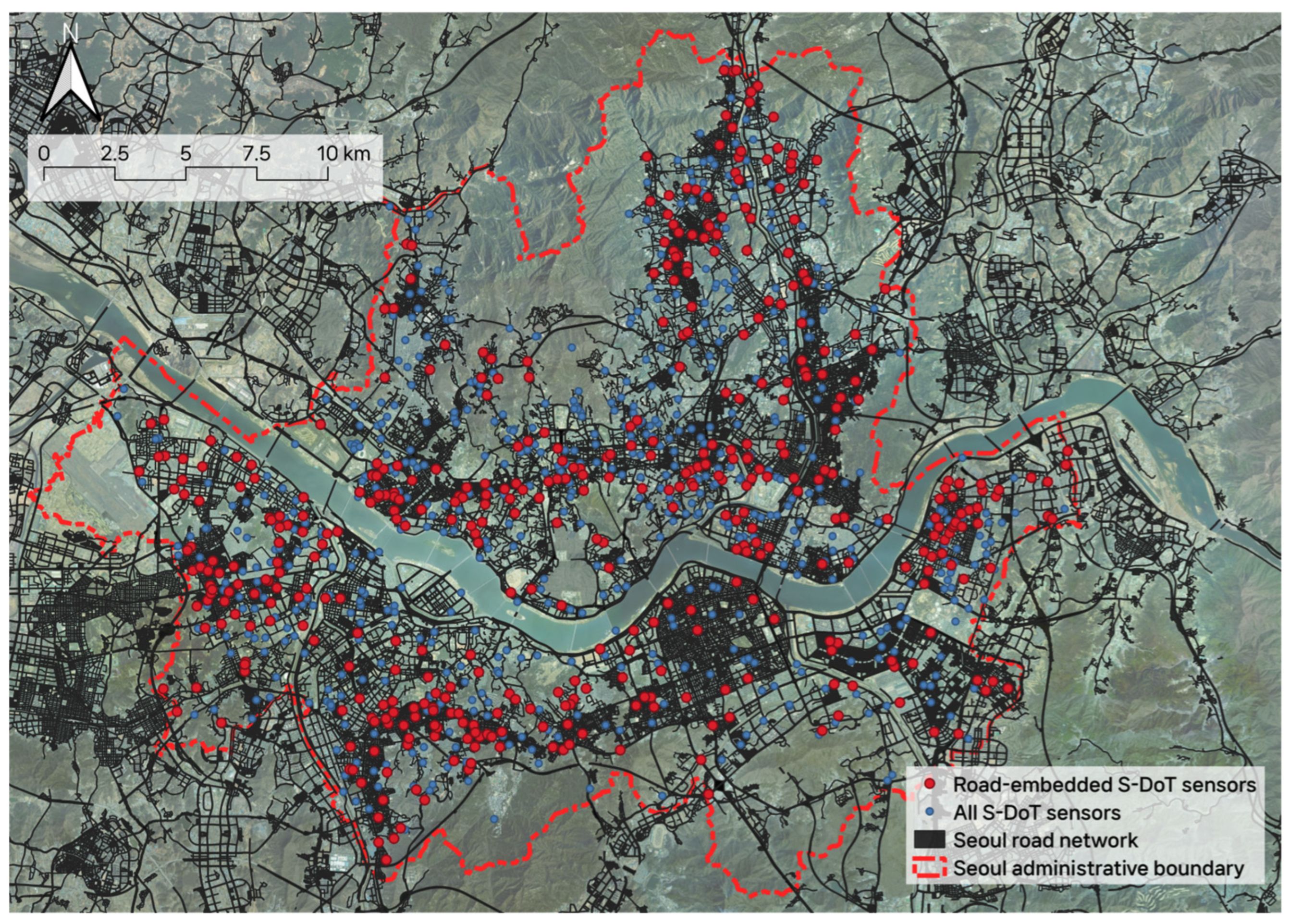
This study focuses on Seoul, Republic of Korea, the nation’s capital and largest metropolis (Figure 1). Seoul is characterized by a dense urban morphology, heterogeneous land uses, and highly variable microclimatic conditions [50]. Its road network spans from wide arterial corridors to narrow residential streets integrated within mixed-use districts, reflecting the city’s complex spatial structure [51]. Variations in street width, surrounding building height, and roadside vegetation create an ideal context for investigating how micro-scale urban form influences thermal conditions at the street level [52,53].
The analysis covers a full annual cycle (March 2024–February 2025), capturing Seoul’s distinct seasonal transitions within a temperate monsoon climate, characterized by hot, humid summers and cold, dry winters [54]. This temporal scope enables a comprehensive examination of both seasonal and diurnal variations in street-level thermal dynamics, thereby facilitating a more context-sensitive understanding of microclimatic behavior across diverse urban settings.

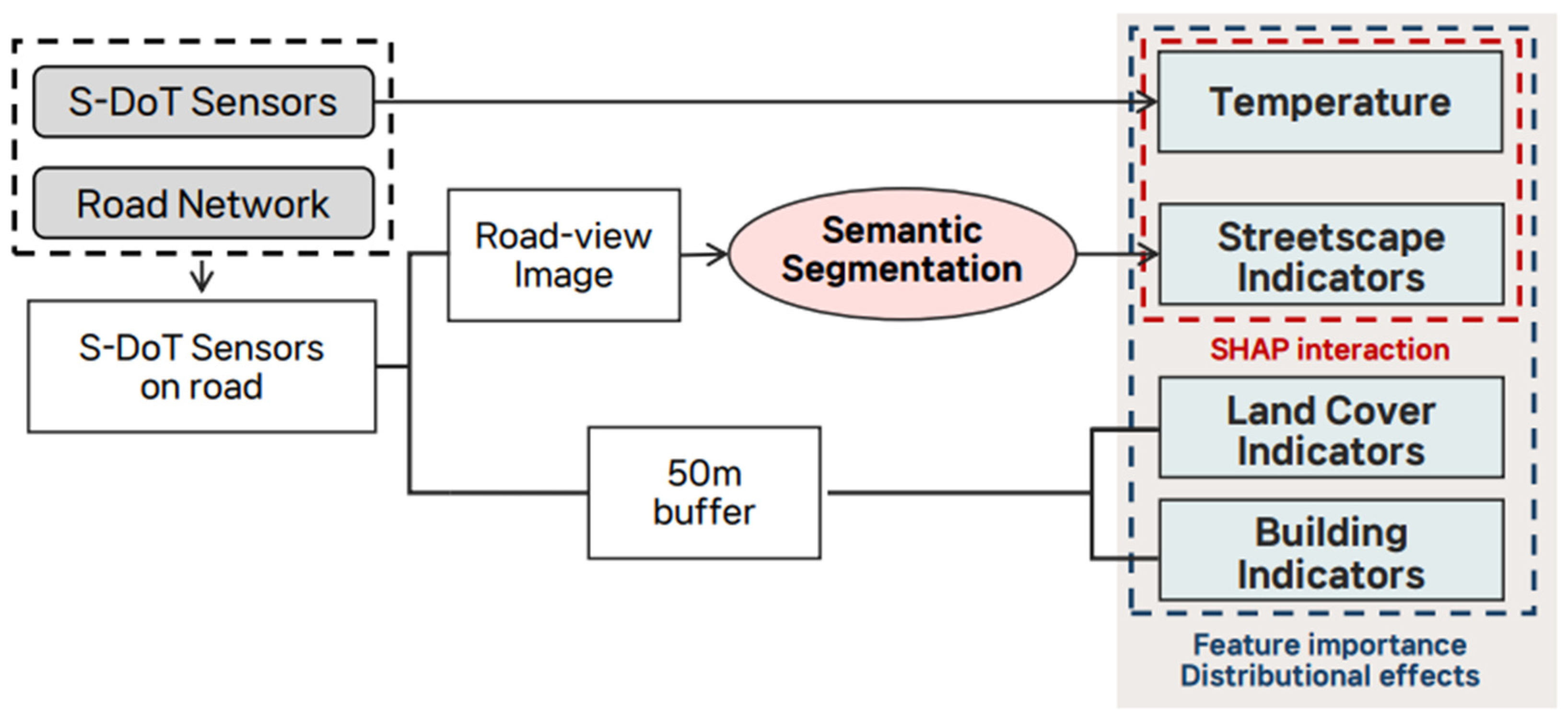
2.2. Research Framework

This study integrates multi-source urban datasets to examine the determinants of street-level air-temperature variations in Seoul. Road network shapefiles were first used to identify S-DoT sensors located directly along road segments. Hourly air-temperature records from each selected sensor were then paired with corresponding road-view images, which were analyzed through semantic segmentation using the SegFormer-B4 model. This process yielded a set of visual indicators—the Green View Index (GVI), Road View Index (RVI), Building View Index (BVI), and Sky View Index (SVI)—that quantitatively describe the compositional attributes of the immediate streetscape.
To capture the influence of surrounding morphological and environmental conditions, a 50 m buffer was generated around each sensor location. Within this buffer, land-cover data were used to calculate impervious surface area (ISA), green space (Green), and water coverage (Water), while building registry data provided additional indicators including building coverage ratio (BCR), floor area ratio (FAR), average building height (Height), and gross floor area (GFA).
The resulting integrated dataset was analyzed using Extreme Gradient Boosting (XGBoost) regression, combined with explainable artificial intelligence (XAI) techniques. SHAP-based interpretation—including feature-importance ranking, summary and dependence plots, and waterfall charts—was applied to identify the relative contributions and interaction effects of explanatory variables on street-level thermal conditions. The overall analytical workflow is illustrated in Figure 2.

2.3. Data

This study employs three primary datasets (Table 1): temperature, streetscape indicators, and surrounding spatial characteristics. Regarding the temperature data, while raw measurements were collected as absolute air temperatures, the primary variable for analysis was derived as the relative air temperature deviation ( T e m p i , t r e l ). This deviation represents the difference between each S-DoT sensor’s reading and the contemporaneous mean across all sensors, thereby isolating localized thermal variations along the urban road network from the background climate. The derivation of streetscape indicators is described in detail in the subsequent section.
To represent the built and natural environment surrounding each sensor, spatial attributes were compiled using external geospatial datasets. While the analytical framework applies a 50 m buffer for contextualization, the present section focuses on the data sources and definitions of those variables. Land-cover information from the Environmental Geographic Information Service (EGIS) provided measures of impervious surface area (ISA), green space (Green), and water surface area (Water). Building characteristics retrieved from the V-World Digital Twin Platform—including building height, gross floor area (GFA), building coverage ratio (BCR), and floor area ratio (FAR)—were then linked to each sensor location. Together, these datasets supply the morphological inputs necessary for evaluating how local spatial structure contributes to micro-scale air-temperature variation across the road network.
Together, these variables represent the morphological and environmental context surrounding each sensor, providing a comprehensive basis for assessing how local spatial structure influences micro-scale air-temperature variability across Seoul’s urban road network.

2.3.1. Relative Air Temperature

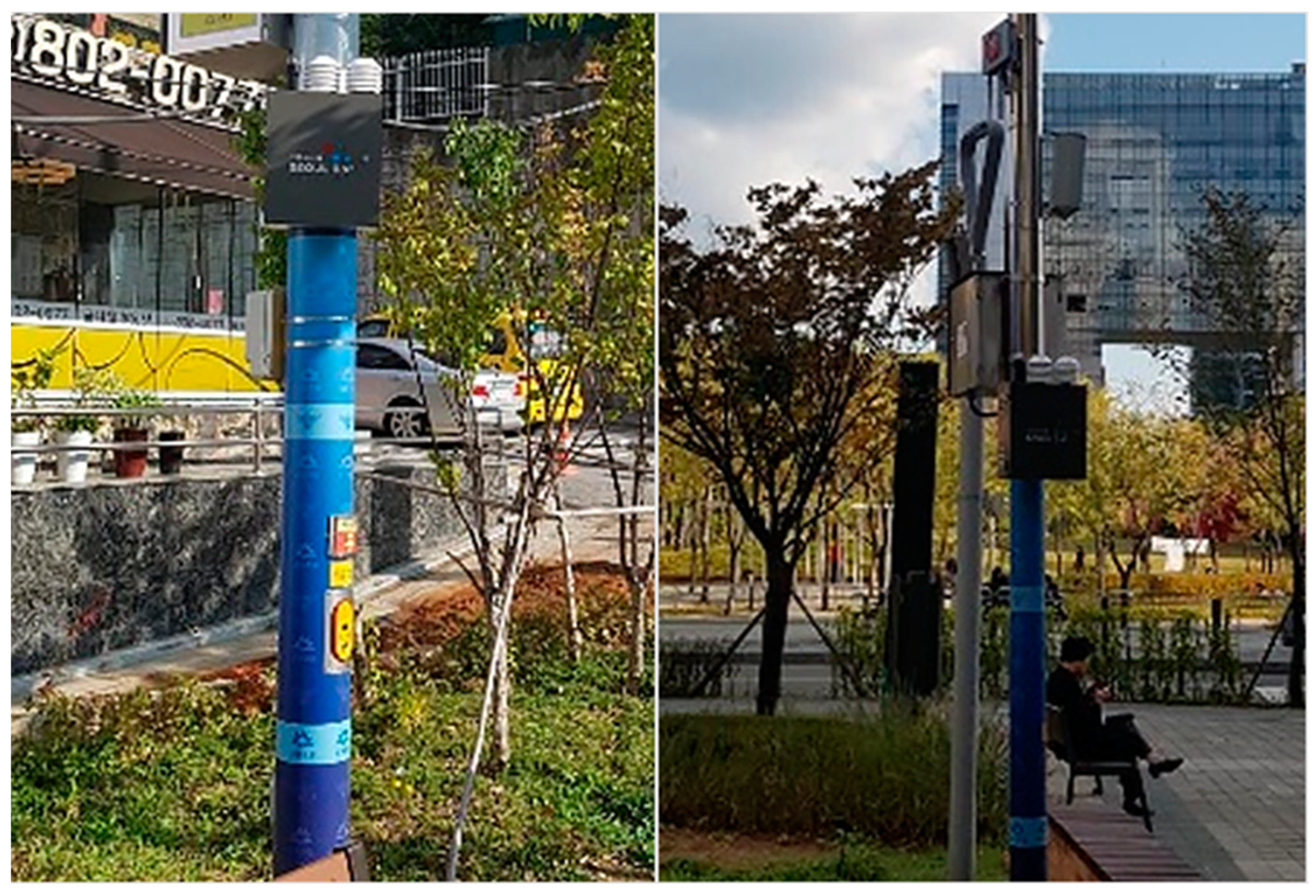
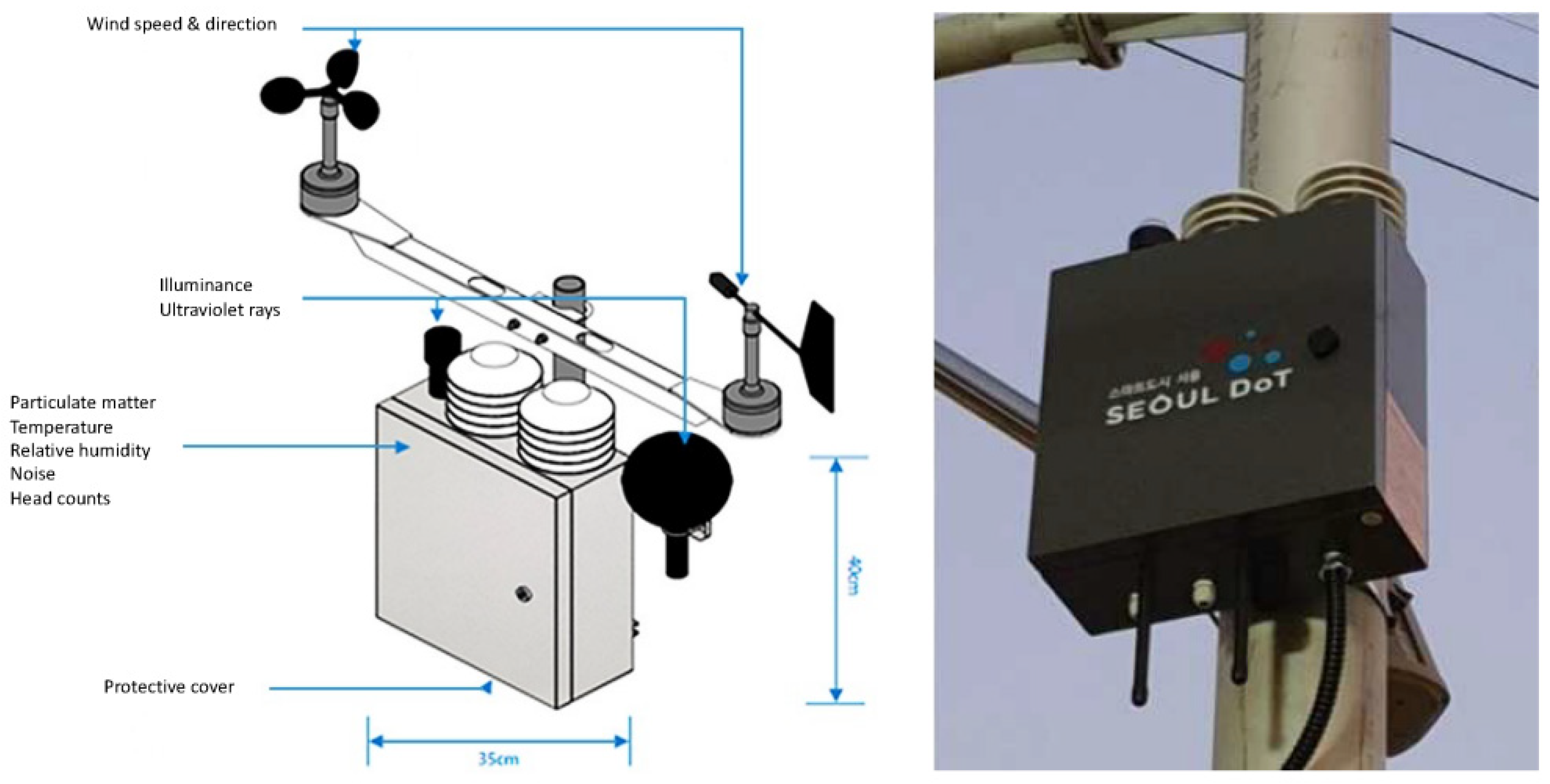
Hourly air-temperature data were obtained from S-DoT (Figure 3) environmental monitoring network, accessible through the Seoul Open Data Plaza. The S-DoT system comprises approximately 1100 sensors distributed across residential, commercial, industrial, road, and park areas, recording environmental variables such as air temperature and humidity at an hourly resolution (including minimum, maximum, and mean values). These sensors are typically installed on existing roadside infrastructure, such as CCTV poles or streetlights, at heights of approximately 3 m above ground level (Figure 4).
To focus specifically on street canyon thermal conditions, road network data from the V-World Digital Twin Platform were employed to identify sensors located directly along road segments. Following this spatial filtering process, 436 S-DoT sensors were selected for analysis.
To ensure high data reliability, routine weekly inspections of the S-DoT sensors were conducted. Subsequently, a rigorous quality control process was applied to this subset. Measurement outliers were removed based on physical range checks, specifically excluding readings outside the range of −25 °C to 40 °C as well as sub-zero temperatures recorded during the summer season. Sensors with significant data gaps due to network instability were also excluded. Consequently, a total of 420 unique sensors were retained for the final analysis. Specifically, 408 sensors were consistently available across both seasons, while 9 sensors were valid only for the summer period and 3 sensors only for the winter period due to seasonal data loss. As a result, the effective sample size was 417 for the summer analysis and 411 for the winter analysis.
Following this quality control, the daily mean absolute temperature T e m p i , t for each sensor was calculated as the arithmetic mean of all valid hourly observations recorded on that specific date. Since sensors with significant data gaps or persistent malfunctions were already excluded during the preprocessing stage, no additional threshold for daily temporal validity was applied. This approach maximizes the utilization of the available high-resolution S-DoT data while maintaining the integrity of the seasonal analysis.
Given the study’s objective of integrating street-level temperature observations with road-view image analysis to examine how micro-scale road environments influence local thermal conditions, the dependent variable was defined as the relative temperature deviation ( T e m p i , t r e l ) at each sensor location. This measure was calculated as:
T e m p i , t r e l = T e m p i , t T e m p i , t ¯
where T e m p i , t is the daily mean absolute temperature recorded by sensor ( i ) at specified date ( t ), and T e m p i , t ¯ denotes the contemporaneous city-wide mean absolute temperature across all other sensors excluding i . This deviation-based metric enables the analysis to capture whether a given road segment is systematically warmer or cooler than the citywide background at each time step, thereby linking local street environments to observed thermal variations through XAI methods.

2.3.2. Streetscape Indicators

Image segmentation is a computer-vision technique that assigns each pixel in a digital image to a semantic class, thereby delineating objects and their boundaries at a fine spatial scale [55,56]. Unlike image classification, which assigns a single label to an entire image, or object detection, which draws bounding boxes around detected objects, semantic segmentation provides pixel-level interpretation of urban scenes [57,58,59]. This level of detail has become increasingly valuable in urban-climate research, as it enables fine-scale assessments of surface materials, vegetation, and sky exposure within streetscapes [39,40].
Recent studies have applied semantic segmentation of street-view imagery to generate high-resolution representations of urban and road-level thermal environments. By integrating diverse image sources—including thermal, infrared, and remote-sensing data—these approaches have improved the delineation of urban surfaces and the mapping of spatial temperature variations [39,40,41]. Building upon this methodological foundation, deep-learning models have been extended to incorporate meteorological inputs for real-time prediction of road-surface conditions and to enhance the semantic recognition of traffic scenes through geometric and sequential image analysis [42,60]. Collectively, these studies demonstrate that the integration of semantic segmentation and deep learning has become an effective approach for micro-scale observation and interpretation of the urban thermal environment.
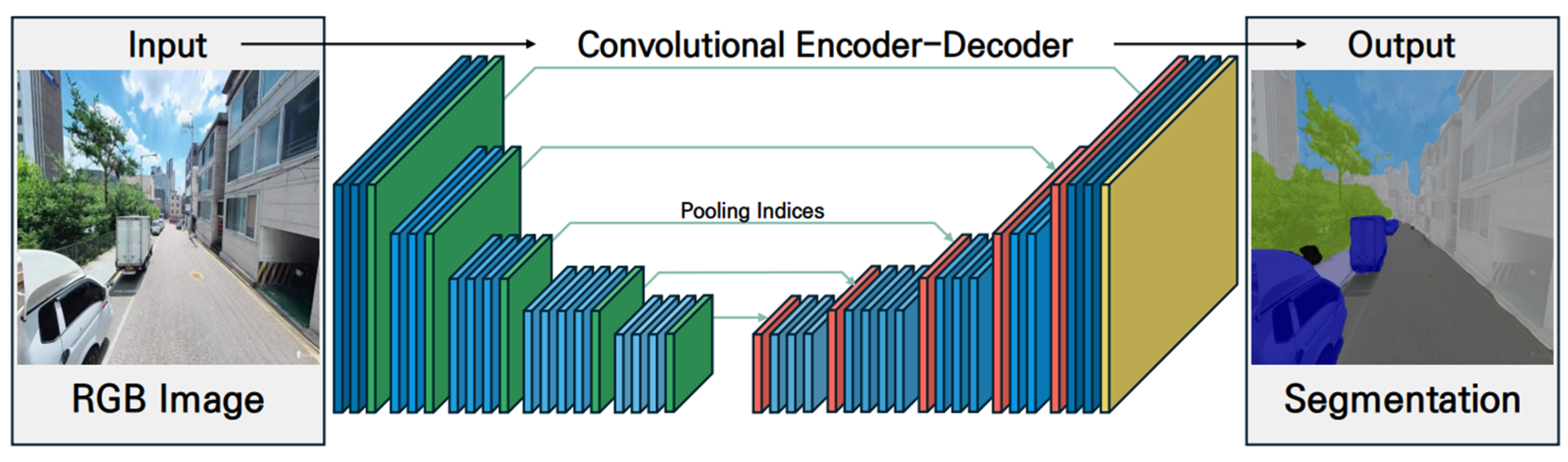
In this study, street-view images corresponding to each S-DoT sensor location were obtained from Kakao Map’s Street View service (https://map.kakao.com/) in September 2023. The images were processed using the SegFormer-B4 model—a transformer-based semantic-segmentation network pre-trained on the ADE20K dataset—as implemented through NVIDIA’s framework. Each pixel was classified into one of several semantic categories (e.g., vegetation, road, building, sky, and vehicle). From the resulting segmentation masks, four quantitative indicators were derived: the Green View Index (GVI), Road View Index (RVI), Building View Index (BVI), and Sky View Index (SVI). Figure 5 illustrates the segmentation workflow used in this study (adapted from [61]). These indices—representing the proportion of the visible streetscape occupied by each element—were subsequently used to assess how micro-scale environmental composition relates to street-level relative air temperature. To capture the relative dominance of buildings over roads, a Street Enclosure Index (SEI) was computed following [62], defined as SEI = BVI / RVI, and standardized to minimize the influence of outliers.

2.4. Analytical Methods

This study employed an artificial-intelligence (AI) approach to examine the relationship between urban micro-environmental indicators and localized temperature deviations, rather than relying on conventional linear-regression or physics-based models. Traditional approaches often fail to capture the nonlinear and irregular patterns inherent in urban thermal environments [63]. In contrast, ensemble tree-based algorithms such as Extreme Gradient Boosting (XGBoost) can directly learn complex interactions from data while providing strong capabilities for handling overfitting and missing values Compared with other algorithms—including Random Forests, Support Vector Machines (SVMs), and Neural Networks—XGBoost offers faster training speed, more stable performance on large-scale datasets, and improved generalization through built-in regularization, making it particularly suitable for this analysis [64,65]. Moreover, its compatibility with explainable artificial-intelligence (XAI) frameworks ensures both predictive accuracy and transparent interpretability [65].
Specifically, SHAP (SHapley Additive Explanations), grounded in cooperative-game theory, decomposes model predictions into feature-level contributions and reveals nonlinear interactions among variables, thereby offering insights into how micro-scale urban environments jointly shape localized temperature patterns [49].
The dependent variable was defined as the relative temperature deviation ( T e m p i , t r e l ), calculated as the difference between each sensor’s daily mean absolute temperature ( T e m p i , t ) and the contemporaneous city-wide mean ( T e m p i , t ¯ ). This metric captures whether each location was relatively warmer or cooler than the urban background on a given day.
Independent variables included (i) micro-scale indicators derived from semantic segmentation of street-view images (GVI, RVI, BVI, SVI, and SEI); (ii) building-scale characteristics within a 50 m buffer (Height, GFA, BCR, FAR); and (iii) land-cover indicators (ISA, Water). To reduce skewness, continuous spatial variables were log-transformed using l o g ( x + 1 ) . Furthermore, to mitigate the influence of outliers and ensure robust model training, all variables were preprocessed by excluding data points falling outside the 5th and 95th percentiles, consistent with the quality control procedures described in Section 3.2.1.
For interpretability, SHAP values were computed to attribute the contribution of each feature to model predictions in an additive and locally consistent manner. For each observation i , the predicted value y ^ i is expressed as:
y ^ i = ϕ 0 + j = 1 M ϕ j
where ϕ 0 represents the expected model output across all samples, and ϕ j is the Shapley value of feature j . The Shapley value ϕ j is computed as:
ϕ j =   S F { j } S ! ( M S 1 ) ! M ! f S j x S j f S ( x s )
with S denoting all possible feature subsets excluding j . To evaluate pairwise feature interactions, SHAP interaction values were also derived as:
ϕ i j ( I ) = S F { i , j } S ! ( M S 2 ) ! 2 ( M 1 ) ! f S i , j x S i , j f S i x S i f S j x S j + f S ( x S )
which isolate the joint contribution of two variables beyond their individual effects.
This integrated XGBoost–SHAP framework achieved both predictive accuracy and transparent interpretability, providing robust, data-driven insights into how micro-scale urban environmental factors influence localized temperature variations across Seoul.

3. Results

3.1. Descriptive Analysis

Table 2 summarizes the descriptive statistics of all variables employed in this study, encompassing temperature, streetscape indicators, and surrounding spatial characteristics. To clearly distinguish between the overall urban climate context and micro-scale thermal variations, both absolute temperature ( T e m p i , t ) and relative temperature deviation ( T e m p i , t r e l )—the dependent variable of this study—are presented.
The mean absolute air temperature was 15.93 °C (SD = 10.94 °C), reflecting a distinct seasonal contrast between summer (28.10 °C) and winter (1.19 °C). Regarding the dependent variable, while the arithmetic mean of the relative deviation ( T e m p i , t r e l ) is inherently zero, its standard deviation of 0.84 °C (Summer: 0.77 °C, Winter: 0.94 °C) indicates significant spatial heterogeneity. This variance quantifies the magnitude of localized warming or cooling relative to the urban background, justifying its use as the primary target for the subsequent XGBoost modeling.
Among the streetscape indicators presented in Table 2, the Green View Index (GVI), Road View Index (RVI), and Building View Index (BVI) exhibited mean proportions of 0.12, 0.26, and 0.42, respectively. The Sky View Index (SVI) remained relatively low, whereas the Other View Index (OVI) averaged 0.12, reflecting a limited presence of auxiliary urban elements such as poles, signboards, or street furniture. The Street Enclosure Index (SEI) recorded a mean value of 2.13, representing the overall degree of enclosure within the observed street environments.
Regarding the built and land-cover context, the mean ISA within a 50 m buffer around each sensor was approximately 7010 m2, while green space and water surface area averaged 606.6 m2 and 209.6 m2, respectively. The average building height was 8.69 m, and the mean GFA was 1566 m2. BCR and FAR averaged 25.27% and 90.33%, respectively, indicating a moderate level of development intensity in the surroundings of the observed street segments.

3.2. Model Results

3.2.1. Hyper-Parameter Tuning

Prior to training, outliers falling outside the 5th and 95th percentiles were removed, and morphological variables were log-transformed to address skewness. Variable selection was guided by urban climatology literature; however, to resolve perfect multicollinearity arising from compositional data (summing to 100%), Green was excluded due to a high Variance Inflation Factor (VIF), and OVI was removed due to limited theoretical relevance. The remaining 11 variables were retained, as the Gradient Boosting Decision Tree (GBDT) algorithm is inherently robust to multicollinearity [66].
The dataset was randomly split into training (80%) and test (20%) sets with a fixed random seed (42) for reproducibility. The XGBoost model was trained using empirically tuned hyperparameters: n_estimators = 500, learning_rate = 0.05, max_depth = 5, subsample = 0.8, and colsample_bytree = 0.8. Model performance was evaluated using R2, RMSE, and MAE.
For the full observation period, the model achieved R2 = 0.603, RMSE = 0.492, and MAE = 0.353, indicating satisfactory predictive capability in explaining localized temperature variations. Seasonal models exhibited consistent performance, with R2 = 0.528 (RMSE = 0.490, MAE = 0.330) in summer and R2 = 0.752 (RMSE = 0.437, MAE = 0.314) in winter. These results demonstrate that the model performed reliably across all temporal subsets, with higher explanatory power observed during winter, likely due to reduced atmospheric instability and fewer heat-exchange anomalies compared to summer conditions.

3.2.2. Feature Importance

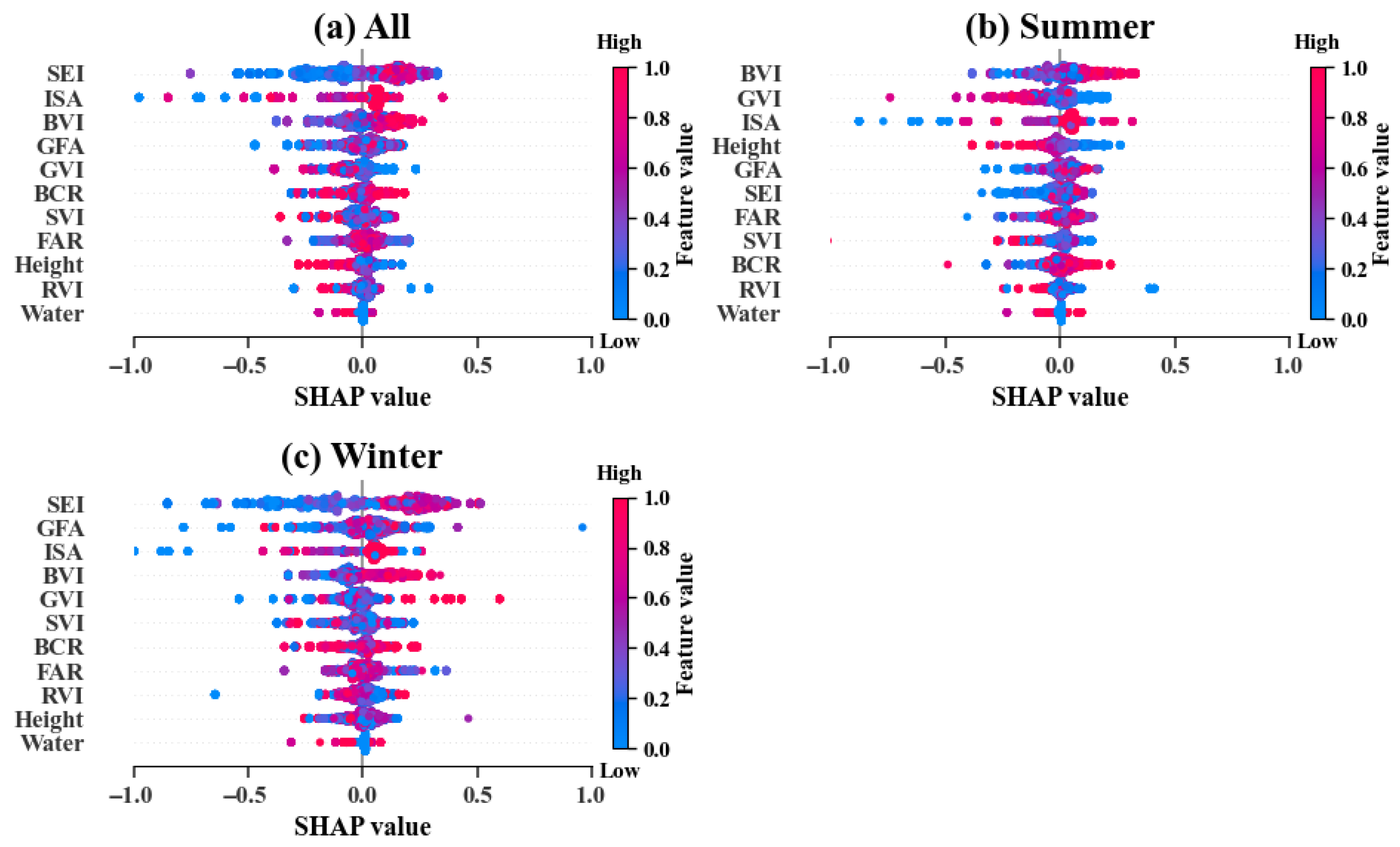
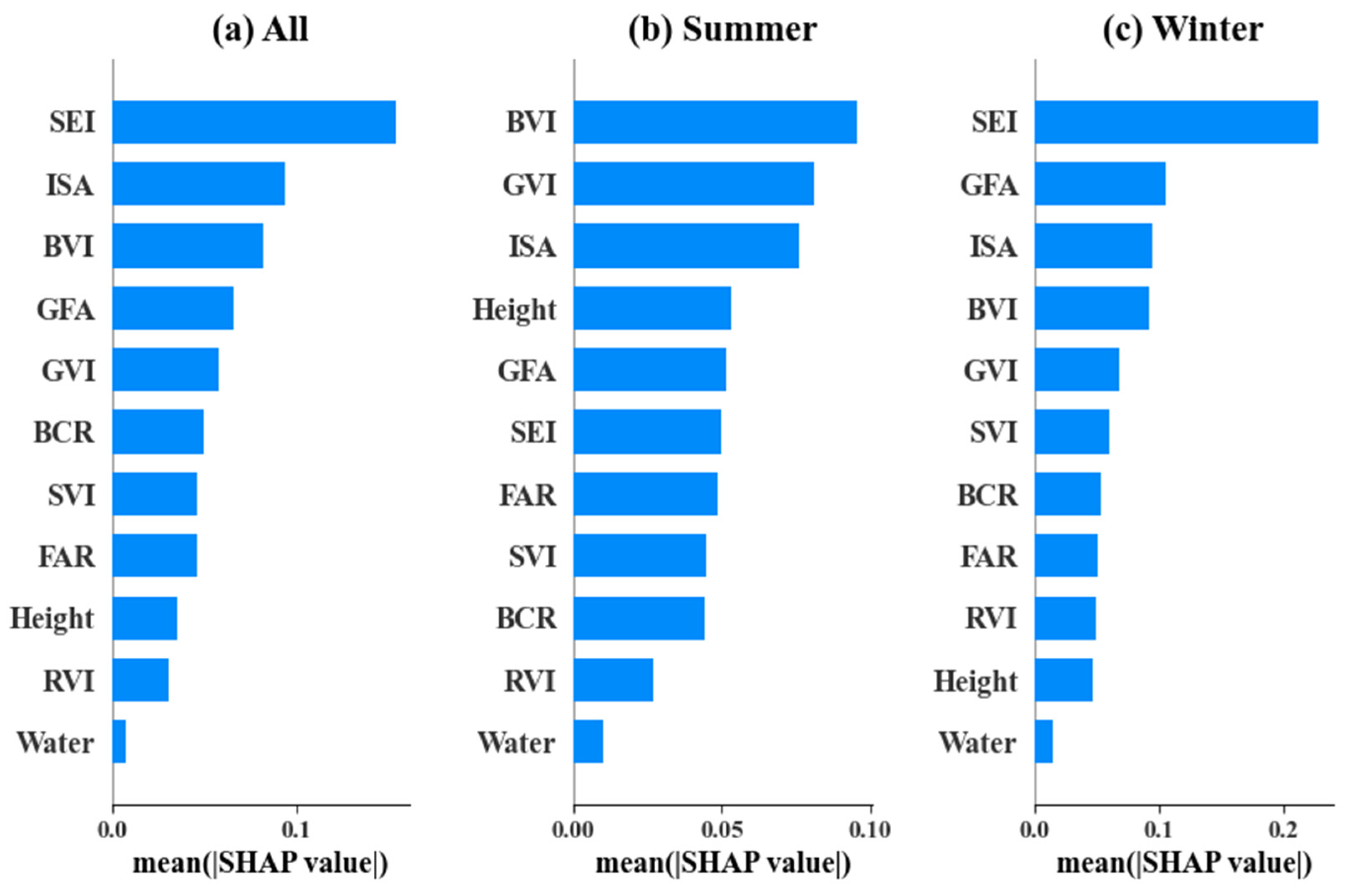
Figure 6 presents the SHAP-based global feature importance for the (a) all-period, (b) summer, and (c) winter models.
In the all-period model (Figure 6a), SEI exhibited the highest contribution, followed by ISA, BVI, and GFA. GVI and BCR also showed moderate importance, whereas RVI and Water were comparatively minor predictors.
In the summer model (Figure 6b), BVI emerged as the most influential variable, followed by GVI and ISA. Height, GFA, and SEI also made meaningful contributions, while RVI and Water remained the least significant factors.
In the winter model (Figure 6c), SEI again dominated as the top predictor, with GFA, ISA, and BVI following in relative importance. GVI and SVI had moderate effects, while Height and Water exhibited minimal influence.
Overall, SEI and BVI consistently appeared as key determinants of relative temperature deviations across all periods. The relative influence of GVI was more pronounced in summer, reflecting the cooling potential of vegetation during warm months, whereas the importance of SEI and GFA increased in winter, likely due to enhanced radiative trapping and heat retention in more enclosed and built-up street environments.
Figure 7 presents the SHAP distribution plots for the (a) all-period, (b) summer, and (c) winter models. In the all-period model (Figure 7a), higher values of SEI, ISA, and BVI were generally associated with positive SHAP values. This indicates that these variables contribute to positive temperature deviations, meaning local warming relative to the city-wide mean. In contrast, Water and RVI exhibited weak and inconsistent relationships with the target variable.
In the summer model (Figure 7b), BVI showed the strongest positive association, followed by GVI and ISA. The GVI displayed a clear negative association or cooling effect, with lower vegetation visibility corresponding to positive SHAP values which signify relative warming. Areas characterized by greater ISA also produced higher SHAP values, reinforcing the link between built-up intensity and local warming.
In the winter model (Figure 7c), SEI exhibited a wide range of positive SHAP values, with higher SEI consistently linked to stronger positive contributions. GFA and ISA were similarly skewed toward positive SHAP distributions, while BVI showed moderate but generally positive effects. Conversely, GVI and SVI demonstrated more balanced distributions around zero, and both RVI and Water were concentrated near zero, indicating minimal seasonal influence.
Across all seasons, SEI and ISA maintained consistent positive effects, underscoring their structural role in localized warming. However, the magnitude and pattern of influence varied seasonally: in summer, GVI exerted a stronger moderating (cooling) effect, whereas in winter, SEI and GFA emerged as the dominant explanatory factors, reflecting enhanced radiative trapping and heat retention within more enclosed and built-up street configurations.

3.2.3. SHAP Dependence

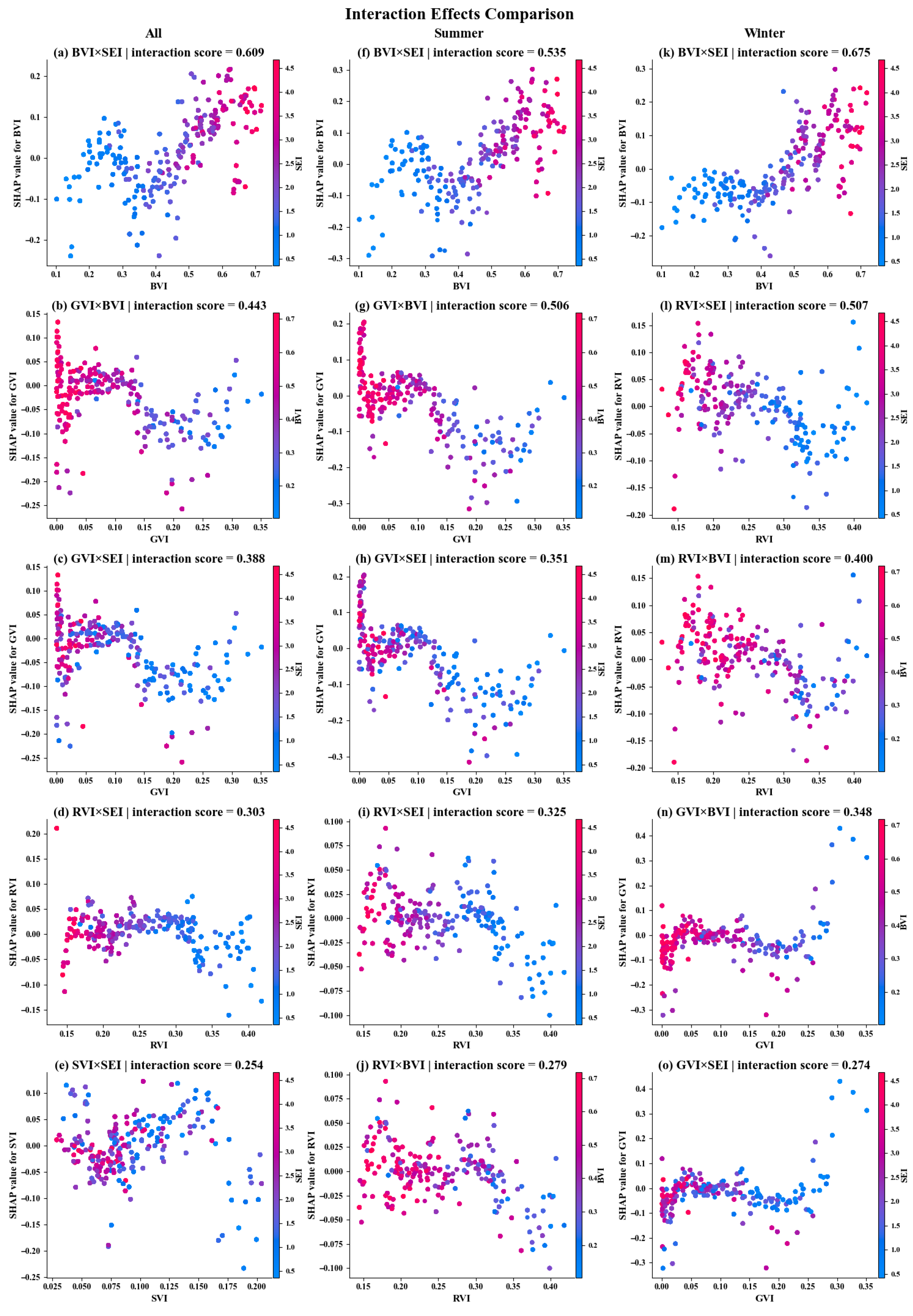
Figure 8 presents the five most significant SHAP-based interaction effects for the (a–e) all-period, (f–j) summer, and (k–o) winter models. The figure integrates the strongest and most representative variable pairs across all temporal subsets.
Across all models, the BVI × SEI interaction exhibited the highest interaction scores (0.609, 0.535, and 0.675 for the all-period, summer, and winter models, respectively). Higher values of both BVI and SEI were consistently associated with positive SHAP values, indicating that the simultaneous increase in building dominance and street enclosure amplifies positive temperature deviations, thereby intensifying local warming relative to the city-wide background. This tendency was most pronounced in winter, suggesting that enclosed street canyons intensified heat retention during colder periods.
The GVI × BVI (0.443–0.506–0.348) and GVI × SEI (0.388–0.351–0.274) interactions displayed an inverse relationship, whereby higher GVI values corresponded to lower SHAP values when BVI or SEI increased. These patterns imply that visible vegetation effectively mitigates the relative warming effects typically driven by buildings and enclosure, particularly during the summer season.
The RVI × SEI (0.303–0.325–0.507) and RVI × BVI (0.279–0.400) pairs indicated that higher RVI values tended to offset the positive SHAP contributions of SEI and BVI, suggesting that open road surfaces weakened the thermal amplification associated with enclosed or highly built-up environments. These interactions were more pronounced in winter. Additional effects were observed for SVI × SEI (0.254–0.215) and BVI × SVI (0.224), where greater sky visibility slightly reduced SHAP values under increasing SEI or BVI, reinforcing the moderating influence of openness on local thermal accumulation.
Seasonal contrasts were evident. In summer, GVI × BVI and GVI × SEI displayed relatively higher interaction scores, highlighting the strong cooling and shading role of vegetation. In winter, the dominance of BVI × SEI, RVI × SEI, and RVI × BVI interactions reflected the intensified thermal effects of built and enclosed environments, with RVI and SVI providing only limited compensatory effects. Overall, SEI and BVI consistently emerged as core joint determinants of localized warming across seasons, while GVI, RVI, and SVI functioned as secondary moderating factors, mitigating—but not eliminating—the structural drivers of micro-scale temperature variation.

4. Discussion

This study investigated how micro-scale urban environments influence spatial variations in relative air temperature ( T e m p i , t r e l ) by integrating high-resolution S-DoT sensor data with semantic indicators derived from street-view image segmentation. Unlike traditional studies that rely on satellite-derived Land Surface Temperature (LST), which often identify Impervious Surface Area (ISA) as the sole dominant factor [67,68], our analysis of road-level temperature deviations reveals that 3D geometric factors play a more critical role in regulating the thermal anomalies actually experienced by pedestrians.
The SHAP-based feature importance analysis demonstrated that SEI and BVI consistently dominated as key determinants of positive temperature deviations (localized warming relative to the network average), followed by ISA. These results challenge the conventional emphasis on SVF as the primary predictor of the UHI effect [69,70]. While SVF focuses on the openness of the sky, our findings suggest that in high-density vertical cities like Seoul, the explicit semantic classification of vertical obstacles (SEI and BVI)—representing the tangible presence of walls and flow-blocking structures—offers superior power in predicting how much a specific street segment deviates from the citywide mean temperature [71]. In compact street canyons, reduced sky exposure limits longwave radiation loss, while impervious surfaces enhance heat storage, collectively driving higher relative temperatures compared to the network average. This corroborates recent arguments that “eye-level” feature perception captures the radiative trapping and wind blockage effects of street canyons more effectively than overhead geometric metrics alone [72].
Although SEI and BVI consistently emerge as significant predictors across seasons, their impact on relative temperature deviations ( T e m p i , t r e l ) is modulated by seasonal solar geometry. Variations in Sun elevation alter the proportion of shaded versus insolated surfaces, influencing daytime heat gain. Nevertheless, the underlying geometric enclosure consistently shapes nighttime cooling efficiency, contributing to cumulative heat retention relative to the network average, especially in confined canyons. These findings refine existing literature by demonstrating how enclosure interacts with seasonally varying solar exposure to regulate micro-scale spatial thermal anomalies.
Pronounced seasonal differences were observed in how urban features drive these spatial deviations. In summer, the combined effects of BVI and ISA produced the highest positive contributions to T e m p i , t r e l , while GVI exhibited a robust negative relationship with the dependent variable. This confirms that visible greenery maintains cooler micro-climates relative to the urban average through evapotranspiration and shading [25,28]. In contrast, winter patterns were dominated by SEI and GFA. Under lower solar radiation and weaker convective exchange, the accumulation of heat within enclosed and high-volume built forms dominated the local thermal regime. This seasonal shift highlights the dual nature of the “canyon effect” on relative temperature: while high enclosure (SEI) and building mass (GFA) exacerbate summer heat stress, they effectively act as a thermal buffer in winter, maintaining higher relative temperatures that mitigate cold stress compared to more open areas [73].
The interaction analysis deepened these findings by identifying nonlinear synergies that determine whether a street segment behaves as a relative heat sink or source. The BVI × SEI interaction exhibited the highest contribution, confirming that simultaneous increases in building density and enclosure disproportionately amplify localized heat accumulation relative to the average. Conversely, GVI × BVI and GVI × SEI interactions revealed that visible vegetation mitigates the positive thermal deviations caused by dense morphologies, particularly during summer. These results empirically demonstrate that the balance between built form and green exposure determines the intensity of spatial temperature anomalies [26,27].
Moreover, the RVI × SEI and RVI × BVI interactions indicate that open road corridors can partially offset the thermal amplification of compact canyons by facilitating airflow and radiative escape. Similarly, SVI × SEI and BVI × SVI interactions showed that sky openness contributes to mitigating relative heat retention. Together, these findings confirm that road-level thermal behavior is an emergent property of interacting morphological dimensions rather than the result of isolated features.
In summary, this study provides empirical evidence of road-scale thermal variability that cannot be detected by conventional data. It emphasizes that localized air temperature deviation is governed by the combined configuration of built density, enclosure, openness, and greenery. Urban design strategies promoting balanced spatial enclosure, adequate sky exposure, and visible vegetation can effectively moderate micro-scale spatial warming deviations while sustaining urban compactness and energy efficiency. The integrative framework presented here contributes to the development of climate-responsive design approaches that support the dual goals of thermal comfort and reduced building cooling demand.

5. Conclusions

This study aimed to identify the determinants of spatial air temperature deviations ( T e m p i , t r e l ) at the street level in Seoul by integrating multi-source urban data with explainable artificial intelligence (XAI). Hourly temperature data from S-DoT road sensors were transformed into relative temperature metrics—representing deviations from the network-wide hourly mean—to isolate the influence of micro-scale streetscape characteristics. These indicators (GVI, RVI, BVI, SVI, SEI) were combined with surrounding land cover and building morphology variables (ISA, Green, Water, Height, GFA, BCR, FAR) within a 50 m buffer. Through an XGBoost–SHAP framework, the study quantified the nonlinear relationships and interaction effects that drive localized thermal anomalies.
Methodologically, this study demonstrates the potential of AI-based semantic segmentation and sensor-derived data for capturing fine-grained urban thermal heterogeneity. The combination of deep learning and explainable machine learning offers a reproducible framework that moves beyond conventional satellite or stationary observations, enabling scalable yet interpretable assessments of spatial temperature offsets at the street level. The XGBoost–SHAP approach not only achieved high predictive accuracy but also provided transparent insight into variable interactions, clarifying how specific combinations of built and green features amplify or mitigate relative temperature deviations.
Nevertheless, certain limitations remain. The use of daily mean relative temperature may obscure short-term microclimatic fluctuations, such as diurnal cycles or hourly heat-event extremes. Future studies should focus on temporal granularity to capture how these spatial deviations evolve throughout the day. Additionally, while S-DoT sensors provide extensive coverage, their spatial distribution is not perfectly uniform, potentially biasing results toward road-dense districts. Future research could integrate nighttime radiative data, CFD-based simulations, or multi-city comparisons to validate the robustness of enclosure-related thermal mechanisms across different climatic contexts. In particular, applying the proposed analytical framework to cities located in different latitudes and characterized by distinct urban geometry patterns would help assess the robustness of enclosure-related thermal mechanisms under varying solar angles and canyon configurations. Moreover, incorporating large-scale atmospheric circulation patterns—such as regional wind regimes or synoptic pressure systems—would further clarify how broader climatological forces interact with local morphological controls to shape micro-scale thermal environments.
In conclusion, this study underscores that localized air temperature is an emergent property governed by the spatial configuration of built and green forms. Our findings provide a conceptual and methodological foundation for climate-responsive urban design, moving beyond absolute temperature monitoring to focus on managing spatial temperature anomalies for enhanced pedestrian thermal comfort.

Author Contributions

Conceptualization, Y.L., M.K. and E.S.; methodology, Y.L. and M.K.; software, Y.L.; validation, Y.L. and M.K.; formal analysis, Y.L.; investigation, Y.L.; resources, E.S.; data curation, Y.L.; writing—original draft preparation, Y.L.; writing—review and editing, M.K. and E.S.; visualization, Y.L.; supervision, M.K. and E.S.; project administration, M.K. and E.S.; funding acquisition, E.S. All authors have read and agreed to the published version of the manuscript.

Funding

This research was funded by Global–Learning & Academic research institution for Master’s·PhD students, and Postdocs (LAMP) Program of the National Research Foundation of Korea (NRF) grant funded by the Ministry of Education (No. RS-2023-00301702). Eunkyo Seo was supported by the Korea Meteorological Administration Research and Development Program under Grant (No. RS-2025-02313090).

Institutional Review Board Statement

Not applicable.

Informed Consent Statement

Not applicable.

Data Availability Statement

The data that support the findings of this study are available from the corresponding author upon reasonable request.

Acknowledgments

This work was supported by the research grant of the Chungbuk National University in 2024.

Conflicts of Interest

The authors declare no conflicts of interest.

References

  1. Mora, C.; Dousset, B.; Caldwell, I.R.; Powell, F.E.; Geronimo, R.C.; Bielecki, C.R.; Counsell, C.W.; Dietrich, B.S.; Johnston, E.T.; Louis, L.V.; et al. Global risk of deadly heat. Nat. Clim. Change 2017, 7, 501–506. [Google Scholar] [CrossRef]
  2. Tuholske, C.; Caylor, K.; Funk, C.; Verdin, A.; Sweeney, S.; Grace, K.; Peterson, P.; Evans, T. Global urban population exposure to extreme heat. Proc. Natl. Acad. Sci. USA 2021, 118, e2024792118. [Google Scholar] [CrossRef]
  3. Harmay, N.S.M.; Choi, M. The urban heat island and thermal heat stress correlate with climate dynamics and energy budget variations in multiple urban environments. Sustain. Cities Soc. 2023, 91, 104422. [Google Scholar] [CrossRef]
  4. Khan, A.; Vasilakopoulou, K.; Santamouris, M. Exploring the potential impacts of anthropogenic heating on urban climate during heatwaves. Sci. Rep. 2025, 15, 1–14. [Google Scholar] [CrossRef]
  5. Maxwell, K.B.; Julius, S.H.; Grambsch, A.E.; Kosmal, A.R.; Larson, E.; Sonti, N. Chapter 11: Built Environment, Urban Systems, and Cities. In Impacts, Risks, and Adaptation in the United States: The Fourth National Climate Assessment; National Aeronuatics and Space Administration: Washington, DC, USA, 2018; Volume II. [Google Scholar]
  6. Santamouris, M. Recent progress on urban overheating and heat island research. Integrated assessment of the energy, environmental, vulnerability and health impact. Synergies with the global climate change. Energy Build. 2020, 207, 109482. [Google Scholar] [CrossRef]
  7. Zhao, L.; Qamruzzaman, M. Do Urbanization, Remittances, and Globalization Matter for Energy Consumption in Belt and Road Countries: Evidence from Renewable and Non-Renewable Energy Consumption. Front. Environ. Sci. 2022, 10, 930728. [Google Scholar] [CrossRef]
  8. Das, S.; Choudhury, M.R.; Chatterjee, B.; Das, P.; Bagri, S.; Paul, D.; Bera, M.; Dutta, S. Unraveling the urban climate crisis: Exploring the nexus of urbanization, climate change, and their impacts on the environment and human well-being—A global perspective. AIMS Public. Health 2024, 11, 963. [Google Scholar] [CrossRef]
  9. Agan, P.N. Urban Heat Island Effects; A De-Greening Process, Implication for Environmental Sustainability and Quality of Urban Life. A Review. Adv. Hydrol. Meteorol. 2021, 1, 1–7. [Google Scholar] [CrossRef]
  10. Gerçek, D.; Güven, I.T.; Oktay, I. Analysis of the Intra-City Variation of Urban Heat Island and its Relation to Land Surface/Cover Parameters. ISPRS Ann. Photogramm. Remote Sens. Spat. Inf. Sci. 2016, 3, 123–129. [Google Scholar] [CrossRef]
  11. MacLachlan, A.; Biggs, E.; Roberts, G.; Boruff, B. Urbanisation-Induced Land Cover Temperature Dynamics for Sustainable Future Urban Heat Island Mitigation. Urban. Sci. 2017, 1, 38. [Google Scholar] [CrossRef]
  12. Zhang, Y.; Cai, Q. Impact Mechanism of New Urbanization on Environmental Pollution: Empirical Analysis Based on Spatial Panel Model. Front. Public. Health 2022, 10, 928100. [Google Scholar] [CrossRef]
  13. Ibrahim, S.H.; Ibrahim, N.I.A.; Wahid, J.; Goh, N.A.; Koesmeri, D.R.A.; Nawi, M.N.M. The impact of road pavement on urban heat island (UHI) phenomenon. Int. J. Technol. 2018, 9, 1597–1608. [Google Scholar] [CrossRef]
  14. Taillanter, E.; Barthelemy, M. Evolution of road infrastructure in large urban areas. Phys. Rev. E 2023, 107, 034304. [Google Scholar] [CrossRef]
  15. Guerra, E.; Duranton, G.; Ma, X. Urban Roadway in America: The Amount, Extent, and Value. J. Am. Plan. Assoc. 2025, 91, 102–116. [Google Scholar] [CrossRef]
  16. Zhu, R.; Wong, M.S.; Guilbert, É.; Chan, P.W. Understanding heat patterns produced by vehicular flows in urban areas. Sci. Rep. 2017, 7, 1–14. [Google Scholar] [CrossRef]
  17. Mohajerani, A.; Bakaric, J.; Jeffrey-Bailey, T. The urban heat island effect, its causes, and mitigation, with reference to the thermal properties of asphalt concrete. J. Environ. Manag. 2017, 197, 522–538. [Google Scholar] [CrossRef]
  18. Kuchcik, M.; Czarnecka, K.; Błażejczyk, K. Urban heat island in Warsaw (Poland): Current development and projections for 2050. Urban Clim. 2024, 55, 101901. [Google Scholar] [CrossRef]
  19. Ali, M.; Bicer, Y.; Al-Ansari, T.; Amhamed, A.I. A systematic review of heat recovery from roads for mitigating urban heat island effects: Current state and future directions. Front. Built Environ. 2023, 9, 1292913. [Google Scholar] [CrossRef]
  20. Nwakaire, C.M.; Onn, C.C.; Yap, S.P.; Yuen, C.W.; Onodagu, P.D. Urban Heat Island Studies with emphasis on urban pavements: A review. Sustain. Cities Soc. 2020, 63, 102476. [Google Scholar] [CrossRef]
  21. Tun, K.Z.; Pramanik, M.; Mallick, S.K.; Chakrabortty, R.; Halder, B.; Moharir, K.N.; Pande, C.B.; Zhran, M. Cooling the cities: A comprehensive review of urban heat island mitigation strategies in Southeast Asia. Hum. Settl. Sustain. 2025, 1, 91–102. [Google Scholar] [CrossRef]
  22. Yue, W.; Liu, X.; Zhou, Y.; Liu, Y. Impacts of urban configuration on urban heat island: An empirical study in China mega-cities. Sci. Total Environ. 2019, 671, 1036–1046. [Google Scholar] [CrossRef]
  23. Huang, C.; Liu, K.; Ma, T.; Xue, H.; Wang, P.; Li, L. Analysis of the impact mechanisms and driving factors of urban spatial morphology on urban heat islands. Sci. Rep. 2025, 15, 18589. [Google Scholar] [CrossRef]
  24. Ahmed, A.N.; AlDahoul, N.; Aziz, N.A.; Huang, Y.F.; Sherif, M.; El-Shafie, A. The urban heat Island effect: A review on predictive approaches using artificial intelligence models. City Environ. Interact. 2025, 28, 100234. [Google Scholar] [CrossRef]
  25. Sun, C.; Lian, W.; Liu, L.; Dong, Q.; Han, Y. The impact of street geometry on outdoor thermal comfort within three different urban forms in severe cold region of China. Build. Environ. 2022, 222, 109342. [Google Scholar] [CrossRef]
  26. Chen, Q.; Liu, R.; Cheng, Q.; Chen, Y.; Cao, S.; Du, M.; Li, K. Evaluating the impact of sky view factor and building shadow ratio on air temperature in different residential and commercial building scenarios: A case study of Beijing, China. Urban. Clim. 2023, 49, 101509. [Google Scholar] [CrossRef]
  27. Khalvandi, R.; Karimimoshaver, M. Urban street canyons and heat islands: A systematic review on morphological solutions. Results Eng. 2025, 27, 106542. [Google Scholar] [CrossRef]
  28. Sangiorgio, V.; Fiorito, F.; Santamouris, M. Development of a holistic urban heat island evaluation methodology. Sci. Rep. 2020, 10, 1–13. [Google Scholar] [CrossRef]
  29. Musco, F. (Ed.) Counteracting Urban Heat Island Effects in a Global Climate Change Scenario; Springer: Berlin/Heidelberg, Germany, 2016. [Google Scholar]
  30. Hong, T.; Heo, Y. Exploring the impact of urban factors on land surface temperature and outdoor air temperature: A case study in Seoul, Korea. Build. Environ. 2023, 243, 110645. [Google Scholar] [CrossRef]
  31. Ding, L.; Xiao, X.; Wang, H. Temporal and spatial variations of urban surface temperature and correlation study of influencing factors. Sci. Rep. 2025, 15, 1–13. [Google Scholar] [CrossRef]
  32. Unger, J. Intra-urban relationship between surface geometry and urban heat island: Review and new approach. Clim. Res. 2004, 27, 253–264. [Google Scholar] [CrossRef]
  33. Kuchcik, M.; Dudek, W.; Błazejczyk, K.; Milewski, P.; Błazejczyk, A. Two faces to the greenery on housing estates–mitigating climate but aggravating allergy. A Warsaw case study. Urban. For. Urban. Green. 2016, 16, 170–181. [Google Scholar] [CrossRef]
  34. Li, J.; Song, C.; Cao, L.; Zhu, F.; Meng, X.; Wu, J. Impacts of landscape structure on surface urban heat islands: A case study of Shanghai, China. Remote Sens. Environ. 2011, 115, 3249–3263. [Google Scholar] [CrossRef]
  35. Wang, R.; Gao, W.; Peng, W. Downscale MODIS Land Surface Temperature Based on Three Different Models to Analyze Surface Urban Heat Island: A Case Study of Hangzhou. Remote Sens. 2020, 12, 2134. [Google Scholar] [CrossRef]
  36. Rashid, N.; Alam, J.A.M.M.; Chowdhury, M.A.; Islam, S.L.U. Impact of landuse change and urbanization on urban heat island effect in Narayanganj city, Bangladesh: A remote sensing-based estimation. Environ. Chall. 2022, 8, 100571. [Google Scholar] [CrossRef]
  37. Cao, J.; Zhou, W.; Zheng, Z.; Ren, T.; Wang, W. Within-city spatial and temporal heterogeneity of air temperature and its relationship with land surface temperature. Landsc. Urban. Plan. 2021, 206, 103979. [Google Scholar] [CrossRef]
  38. Amani-Beni, M.; Chen, Y.; Vasileva, M.; Zhang, B.; di Xie, G. Quantitative-spatial relationships between air and surface temperature, a proxy for microclimate studies in fine-scale intra-urban areas? Sustain. Cities Soc. 2022, 77, 103584. [Google Scholar] [CrossRef]
  39. Ramani, V.; Arjunan, P.; Poolla, K.; Miller, C. Semantic segmentation of longitudinal thermal images for identification of hot and cool spots in urban areas. Build. Environ. 2024, 249, 111112. [Google Scholar] [CrossRef]
  40. Kawakubo, S.; Arata, S.; Demizu, Y.; Kamata, T.; Narumi, D.; Asawa, T.; Ihara, T. Visualization of urban roadway surface temperature by applying deep learning to infrared images from mobile measurements. Sustain. Cities Soc. 2023, 99, 104991. [Google Scholar] [CrossRef]
  41. Xiong, S.; Ma, C.; Yang, G.; Song, Y.; Liang, S.; Feng, J. Semantic segmentation of remote sensing imagery for road extraction via joint angle prediction: Comparisons to deep learning. Front Earth Sci 2023, 11, 1301281. [Google Scholar] [CrossRef]
  42. Zhang, M.; Guo, H.; Li, J.Y.; Li, L.; Zhu, F. A Deep Learning Approach for Enhanced Real-Time Prediction of Winter Road Surface Temperatures in High-Altitude Mountain Areas. Promet Traffic Transp. 2024, 36, 958–972. [Google Scholar] [CrossRef]
  43. Kebede, Y.B.; Der Yang, M.; Huang, C.W. Real-time pavement temperature prediction through ensemble machine learning. Eng. Appl. Artif. Intell. 2024, 135, 108870. [Google Scholar] [CrossRef]
  44. Adeniran, I.A.; Nazeer, M.; Wong, M.S.; Chan, P.W. An improved machine learning-based model for prediction of diurnal and spatially continuous near surface air temperature. Sci. Rep. 2024, 14, 1–18. [Google Scholar] [CrossRef]
  45. Tanoori, G.; Soltani, A.; Modiri, A. Machine Learning for Urban Heat Island (UHI) Analysis: Predicting Land Surface Temperature (LST) in Urban Environments. Urban. Clim. 2024, 55, 101962. [Google Scholar] [CrossRef]
  46. Yang, R.; Hu, J.; Li, Z.; Mu, J.; Yu, T.; Xia, J.; Li, X.; Dasgupta, A.; Xiong, H. Interpretable machine learning for weather and climate prediction: A review. Atmos. Environ. 2024, 338, 120797. [Google Scholar] [CrossRef]
  47. Vengatesh, T.; Bhangale, K.B.; Ronicca, M.S.; Gaantayat, H.; Viswanathan, R.; Suthar, M.B.; Vanathi, D.; Goyal, S. Explainable AI For Environmental Decision Support: Interpreting Deep Learning Models in Climate Science. Int. J. Environ. Sci. 2025, 11, 1078–1088. [Google Scholar] [CrossRef]
  48. Lundberg, S.M.; Lee, S.I. A Unified Approach to Interpreting Model Predictions. Adv. Neural Inf. Process. Syst. 2017, 2017, 4766–4775. Available online: https://arxiv.org/pdf/1705.07874 (accessed on 5 October 2025).
  49. Ponce-Bobadilla, A.V.; Schmitt, V.; Maier, C.S.; Mensing, S.; Stodtmann, S. Practical guide to SHAP analysis: Explaining supervised machine learning model predictions in drug development. Clin. Transl. Sci. 2024, 17, e70056. [Google Scholar] [CrossRef]
  50. Li, N.; Quan, S.J. Discovering urban block typologies in Seoul: Combining planning knowledge and unsupervised machine learning. Cities 2024, 150, 104988. [Google Scholar] [CrossRef]
  51. Kim, H.K.; Sohn, D.W. An analysis of the relationship between land use density of office buildings and urban street configuration: Case studies of two areas in Seoul by space syntax analysis. Cities 2002, 19, 409–418. [Google Scholar] [CrossRef]
  52. Lee, S.; Kwon, Y. The Impact of Urban Street Canyon Morphology on the Microclimate Environment: The Case of the Representative Business Districts in Seoul, Korea. AESOP, 2023. Available online: https://hdl.handle.net/20.500.14235/1260 (accessed on 29 September 2025).
  53. Kim, S.W.; Brown, R.D. Development of a micro-scale heat island (MHI) model to assess the thermal environment in urban street canyons. Renew. Sustain. Energy Rev. 2023, 184, 113598. [Google Scholar] [CrossRef]
  54. Choi, H.; Kim, J.; Choi, Y.; Hur, I.; Lee, T.; Kim, S.; Min, S.; Lee, D.; Choi, D.; Sung, H.M.; et al. The Recent Climatic Characteristic and Change in the Republic of Korea based on the New Normals (1991~2020). Atmosphere 2023, 33, 477–492. [Google Scholar] [CrossRef]
  55. Haifeng, D. The process of partitioning a digital image into multiple segments. Int. J. Swarm Intell. Evol. Comput. 2021, 10, 1000e199. [Google Scholar] [CrossRef]
  56. Singh, K.K.; Singh, A. A Study of Image Segmentation Algorithms for Different Types of Images. Int. J. Comput. Sci. Issues 2012, 7., 414–417. [Google Scholar]
  57. Kutuk, Z.; Algan, G. Semantic Segmentation for Thermal Images: A Comparative Survey. In Proceedings of the IEEE Computer Society Conference on Computer Vision. and Pattern Recognition Workshops, New Orleans, LA, USA, 19–20 June 2022; Volume 2022, pp. 285–294. [Google Scholar] [CrossRef]
  58. Chen, L.C.; Papandreou, G.; Kokkinos, I.; Murphy, K.; Yuille, A.L. DeepLab: Semantic Image Segmentation with Deep Convolutional Nets, Atrous Convolution, and Fully Connected CRFs. IEEE Trans. Pattern Anal. Mach. Intell. 2016, 40, 834–848. [Google Scholar] [CrossRef] [PubMed]
  59. Long, J.; Shelhamer, E.; Darrell, T. Fully Convolutional Networks for Semantic Segmentation. Ann. Surg. 2014, 128, 188–194. Available online: https://arxiv.org/pdf/1411.4038 (accessed on 29 September 2025).
  60. Li, Y.; Zhu, C.; Liu, Y.; Hong, Y.; Wang, J. Geometric and semantic analysis of road image sequences for traffic scene construction. Neurocomputing 2021, 465, 336–349. [Google Scholar] [CrossRef]
  61. Badrinarayanan, V.; Kendall, A.; Cipolla, R. SegNet: A Deep Convolutional Encoder-Decoder Architecture for Image Segmentation. IEEE Trans. Pattern Anal. Mach. Intell. 2017, 39, 2481–2495. [Google Scholar] [CrossRef]
  62. Xi, C.; Han, L.; Wang, J.; Feng, Z.; Kumar, P.; Cao, S.J. How can greenery space mitigate urban heat island? An analysis of cooling effect, carbon sequestration, and nurturing cost at the street scale. J. Clean. Prod. 2023, 419, 138230. [Google Scholar] [CrossRef]
  63. Ali, U.; Shamsi, M.H.; Hoare, C.; Mangina, E.; O’Donnell, J. Review of urban building energy modeling (UBEM) approaches, methods and tools using qualitative and quantitative analysis. Energy Build. 2021, 246, 111073. [Google Scholar] [CrossRef]
  64. He, J.; Shi, Y.; Xu, L.; Lu, Z.; Feng, M.; Tang, J.; Guo, X. Exploring the scale effect of urban thermal environment through XGBoost model. Sustain. Cities Soc. 2024, 114, 105763. [Google Scholar] [CrossRef]
  65. Tarwidi, D.; Pudjaprasetya, S.R.; Adytia, D.; Apri, M. An optimized XGBoost-based machine learning method for predicting wave run-up on a sloping beach. MethodsX 2023, 10, 102119. [Google Scholar] [CrossRef] [PubMed]
  66. Chen, T.; Guestrin, C. XGBoost: A scalable tree boosting system. Proc. ACM SIGKDD Int. Conf. Knowl. Discov. Data Min. 2016, 2016, 785–794. [Google Scholar] [CrossRef]
  67. Yuan, F.; Bauer, M.E. Comparison of impervious surface area and normalized difference vegetation index as indicators of surface urban heat island effects in Landsat imagery. Remote Sens. Environ. 2007, 106, 375–386. [Google Scholar] [CrossRef]
  68. Voogt, J.A.; Oke, T.R. Thermal remote sensing of urban climates. Remote Sens. Environ. 2003, 86, 370–384. [Google Scholar] [CrossRef]
  69. Oke, T.R. Canyon geometry and the nocturnal urban heat island: Comparison of scale model and field observations. J. Climatol. 1981, 1, 237–254. [Google Scholar] [CrossRef]
  70. Unger, J. Connection between urban heat island and sky view factor approximated by a software tool on a 3D urban database. Int. J. Environ. Pollut. 2009, 36, 59–80. [Google Scholar] [CrossRef]
  71. Middel, A.; Lukasczyk, J.; Maciejewski, R.; Demuzere, M.; Roth, M. Sky View Factor footprints for urban climate modeling. Urban. Clim. 2018, 25, 120–134. [Google Scholar] [CrossRef]
  72. Gong, F.Y.; Zeng, Z.C.; Zhang, F.; Li, X.; Ng, E.; Norford, L.K. Mapping sky, tree, and building view factors of street canyons in a high-density urban environment. Build. Environ. 2018, 134, 155–167. [Google Scholar] [CrossRef]
  73. Santamouris, M. Cooling the cities—A review of reflective and green roof mitigation technologies to fight heat island and improve comfort in urban environments. Solar Energy 2014, 103, 682–703. [Google Scholar] [CrossRef]
Figure 1. Spatial distribution of S-DoT sensors and road network in Seoul. The background satellite imagery is provided by TMS for Korea (source: https://www.vworld.kr) and visualized using QGIS 3.40.
Atmosphere 16 01413 g001
Figure 2. Research Framework.
Atmosphere 16 01413 g002
Figure 3. External structure of the S-DoT environmental monitoring unit, equipped with sensors measuring air temperature, humidity, illuminance, UV radiation, and wind direction and speed (Source: Smart Seoul Portal, https://smart.seoul.go.kr/board/41/1243/board_view.do (accessed on 5 October 2025)).
Atmosphere 16 01413 g003
Figure 4. Examples of S-DoT installations on roadside utility poles in Seoul, showing typical mounting height and urban deployment context (Source: Smart Seoul Portal, https://smart.seoul.go.kr/board/41/1243/board_view.do (accessed on 5 October 2025)).
Atmosphere 16 01413 g004
Figure 5. Illustration of the encoder–decoder process in semantic image segmentation, based on [61] and referenced from the NVDIA Image Segmentation Collection (https://catalog.ngc.nvidia.com/orgs/nvidia/collections/imagesegmentation (accessed on 5 October 2025)). The blue blocks represent convolutional layers combined with batch normalization and ReLU activation, which extract hierarchical features from the input street-level imagery. The green blocks denote max-pooling layers that downsample spatial resolution and store pooling indices. The red blocks indicate upsampling layers in the decoder, which use the stored pooling indices to reconstruct higher-resolution feature maps. The yellow blocks correspond to the final softmax classifier that produces pixel-wise semantic labels.
Atmosphere 16 01413 g005
Figure 6. SHAP-based global feature importance for (a) all-period, (b) summer, and (c) winter models.
Atmosphere 16 01413 g006
Figure 7. SHAP value distributions of the XGBoost model for (a) all-period, (b) summer, and (c) winter datasets. Each point represents an observation, where color indicates the feature value (high to low).
Atmosphere 16 01413 g007
Figure 8. Five most significant SHAP dependence plots for (ae) all-period, (fj) summer, and (ko) winter models. Each panel illustrates the dependence of SHAP values for one variable on another, showing how their combined variation influences localized temperature differences.
Atmosphere 16 01413 g008
Table 1. Description of datasets used in this study.
CategoryVariableDescriptionSource
Relative Air Temperature T e m p i , t r e l (°C)Deviation of sensor i temperature at   time   t Seoul Open Data Plaza
(https://data.seoul.go.kr/ (accessed on 1 August 2025))
Streetscape IndicatorsGVI (%*)Share of streetscape area covered by vegetation such as trees, grass, and plantsSelf-constructed
RVI (%*)Share of streetscape occupied by road and paved surfaces
BVI (%*)Share of streetscape occupied by building facades and structures
SVI (%*)Share of streetscape corresponding to the sky and clouds
OVI (%*)Share of streetscape occupied by other urban elements such as signs and vehicles
SEI (-)Index of street enclosure
Surrounding
Spatial Characteristics
Land CoverISA (m2)Total area of impervious surfacesEnvironmental Geographic Information Service
(https://egis.me.go.kr (accessed on 1 August 2025))
Green (m2)Total area of vegetated surfaces
Water (m2)Total area of water surfaces
BuildingHeight (m)Building heightV-World Digital Twin Platform
(https://www.vworld.kr/v4po_main.do (accessed on 1 August 2025))
GFA (m2)Gross floor area of buildings
BCR (%)Building coverage ratio of buildings
FAR (%)Floor area ratio of buildings
* Variables expressed as proportions (0–1).
Table 2. Descriptive statistics of dependent and independent variables.
CategoryVariableTotalSummerWinter
MeanStdMeanStdMeanStd
Temperature T e m p i , t (°C)15.9310.9428.102.971.193.69
T e m p i , t r e l (°C)0.000.840.000.770.000.94
Streetscape
Indicators
GVI (%*)0.120.120.120.120.120.12
RVI (%*)0.260.090.260.090.260.09
BVI (%*)0.420.190.420.190.420.20
SVI (%*)0.010.060.010.060.100.06
OVI (%*)0.120.080.120.080.120.08
SEI (-)2.132.172.152.112.122.12
Surrounding Spatial CharacteristicsLand CoverISA (m2)7010.121445.267010.941450.247007.351442.12
Green (m2)606.601297.56601.081297.40610.611296.56
Water (m2)209.61678.73214.02683.54208.54676.82
BuildingHeight (m)8.697.888.577.788.747.94
GFA (m2)1566.602953.531508.042556.351596.293192.77
BCR (%)25.2714.2125.1714.1725.3014.23
FAR (%)90.3373.3889.7373.5490.3172.63
Number of Sensors420417411
Total Observations (N)3,609,676824,232950,593
* Variables expressed as proportions (0–1).
Disclaimer/Publisher’s Note: The statements, opinions and data contained in all publications are solely those of the individual author(s) and contributor(s) and not of MDPI and/or the editor(s). MDPI and/or the editor(s) disclaim responsibility for any injury to people or property resulting from any ideas, methods, instructions or products referred to in the content.