
Evaluation of Cloud Fraction Data for Modelling Daily Surface Solar Radiation: Application to the Lake Baikal Region



Abstract
1. Introduction
2. Materials and Methods
2.1. Materials
- TERRA\MODIS and AQUA\MODIS. Two datasets of the MOD06 product (MODIS Cloud Product) were used, namely the Cloud_Fraction datasubset, based on measurements from the Terra and Aqua satellites equipped with MODIS (Moderate Resolution Imaging Spectroradiometer) scanners. Both data sets have a spatial resolution of 0.1° by latitude and longitude in the WGS84 geographic coordinate system. The temporal resolution of the imagery for each satellite is one pass per day. The data was provided by NASA Earth Observations [47,62]. Cloud cover values are encoded as integers in the range 0 to 255, where 0 typically represents no clouds and 255 represents full cloud cover or no valid data. In the following text, data from the Terra satellite is referred to as “TERRA” and data from the Aqua satellite is referred to as “AQUA”.
- MetOp\AVHRR. The CLARA-A3 CFC (Cloud Fractional Cover, version 3.0) product, based on observations from the AVHRR (Advanced Very High-Resolution Radiometer) sensor onboard the MetOp satellite series (https://wui.cmsaf.eu/safira/action/viewProduktDetails?fid=40&eid=22257_22484 (accessed on 16 November 2024)), provides cloud cover estimates on a regular latitude–longitude grid with a spatial resolution of 0.25° in the WGS84 geographic coordinate system. Cloud fractional cover values range from 0 to 100, representing the percentage of cloud cover within each grid cell. The MetOp satellite performs, on average, two overpasses per day, yielding a temporal sampling frequency of approximately two observations per day. The data is provided by the EUMETSAT Satellite Application Facility on Climate Monitoring (CM SAF) [63,64]. Hereafter, this dataset is referred to as “AVHRR”.
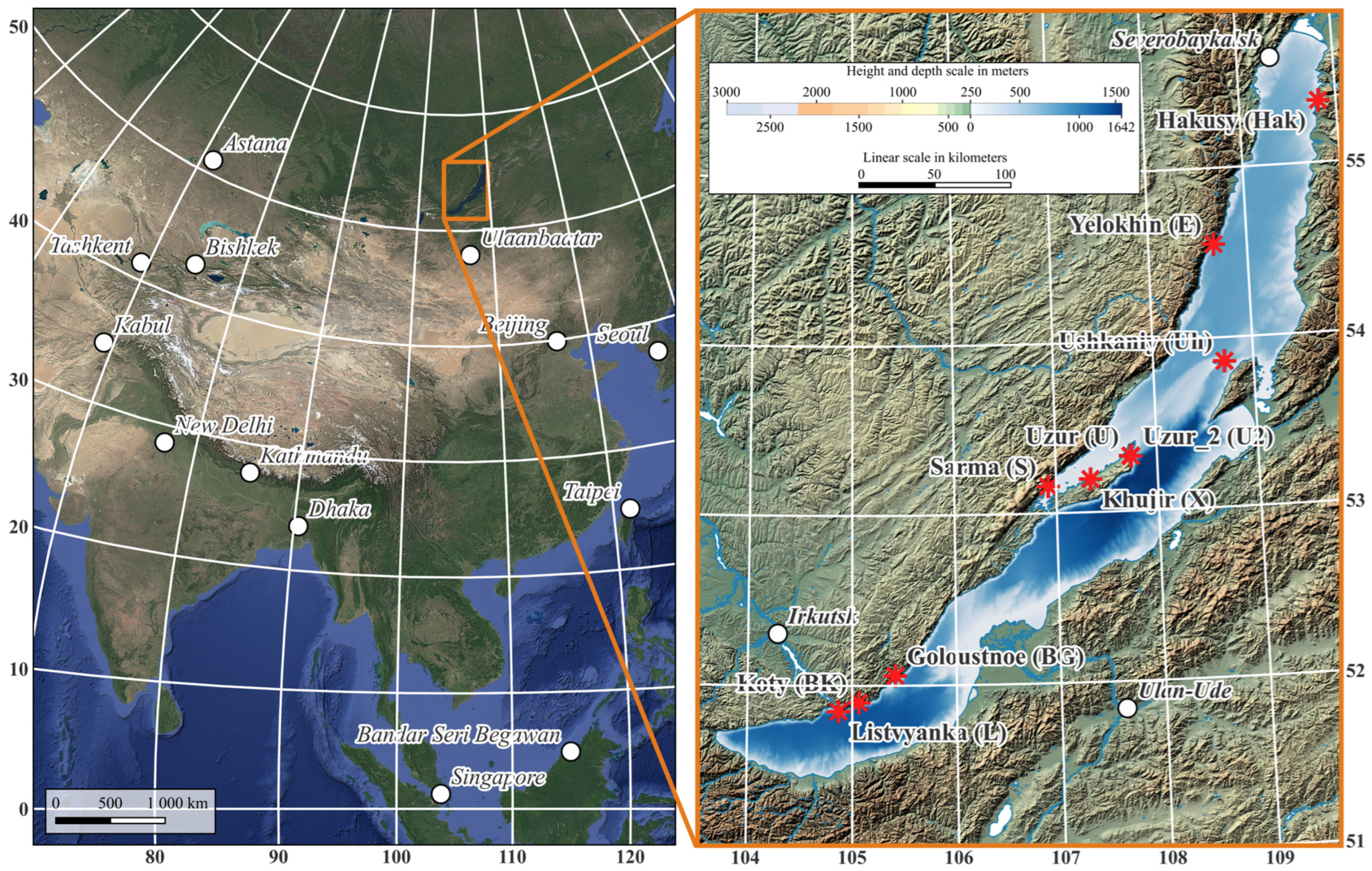
- Weather station data. Cloud cover observations recorded every 3 h at six meteorological stations (Yelokhin, Uzur, Khujir, B. Goloustnoe, Ushkaniy, and Sarma) (Figure 1), were provided in CSV format by the Russian Federal Service for Hydrometeorology and Environmental Monitoring (Roshydromet) [65]. For consistency in modelling, daily mean cloud cover values were calculated and converted into raster format, assigning a uniform value to all pixels within each modelling site.
2.2. Methods
2.2.1. Modelling the Annual Cycle of SSR
- δ—solar declination (in degrees),
- n—day of the year (ranging from 1 to 365).
- t—local solar time (in hours).
- θz—solar zenith angle (in degrees),
- φ—latitude of the calculation point.
2.2.2. Cloud Cover
2.2.3. Terrain
2.2.4. Model Accuracy Assessment
3. Results and Discussion
3.1. Observations
3.2. Modelling
4. Conclusions
Author Contributions
Funding
Institutional Review Board Statement
Informed Consent Statement
Data Availability Statement
Conflicts of Interest
Appendix A

| Meteo _Exp | Meteo _Line | Era_5 | TERRA _Exp | AQUA _Exp | AVHRR _Exp | TERRA _Line | AQUA _Line | AVHRR _Line | Site |
|---|---|---|---|---|---|---|---|---|---|
| R2 | |||||||||
| 0.61 | 0.36 | 0.73 | 0.57 | 0.58 | 0.56 | 0.25 | 0.26 | 0.28 | BG |
| 0.10 | 0.24 | 0.08 | 0.28 | 0.16 | 0.30 | 0.22 | 0.23 | 0.11 | E |
| 0.34 | 0.00 | 0.81 | 0.63 | 0.57 | 0.78 | 0.33 | 0.23 | 0.64 | S |
| 0.70 | 0.51 | 0.78 | 0.63 | 0.64 | 0.63 | 0.37 | 0.37 | 0.39 | U |
| 0.43 | 0.23 | 0.45 | 0.31 | 0.31 | 0.38 | 0.02 | 0.01 | 0.09 | U2 |
| 0.32 | 0.11 | 0.13 | 0.46 | 0.44 | 0.50 | 0.10 | 0.08 | 0.19 | Uh |
| 0.30 | 0.05 | 0.78 | 0.63 | 0.65 | 0.68 | 0.35 | 0.39 | 0.49 | X |
| - | - | 0.78 | 0.60 | 0.56 | 0.71 | 0.32 | 0.27 | 0.57 | BK |
| - | - | 0.53 | 0.40 | 0.35 | 0.50 | 0.07 | 0.01 | 0.28 | L |
| - | - | 0.00 | 0.30 | 0.40 | 0.37 | 0.20 | 0.27 | 0.38 | Hak |
| RMSE, MJ/m2 | |||||||||
| 4.328 | 5.496 | 3.600 | 4.532 | 4.444 | 4.588 | 5.948 | 5.905 | 5.828 | BG |
| 4.671 | 5.972 | 7.392 | 4.183 | 4.505 | 4.118 | 5.435 | 5.860 | 5.175 | E |
| 6.159 | 7.563 | 3.326 | 4.585 | 4.958 | 3.537 | 6.189 | 6.648 | 4.545 | S |
| 4.180 | 5.327 | 3.521 | 4.611 | 4.533 | 4.605 | 6.040 | 6.029 | 5.950 | U |
| 5.846 | 6.826 | 5.763 | 6.464 | 6.474 | 6.140 | 7.705 | 7.718 | 7.419 | U2 |
| 4.991 | 5.740 | 5.676 | 4.442 | 4.523 | 4.273 | 5.773 | 5.824 | 5.454 | Uh |
| 6.149 | 7.536 | 3.477 | 4.488 | 4.386 | 4.182 | 5.927 | 5.733 | 5.272 | X |
| - | - | 3.260 | 4.412 | 4.654 | 3.763 | 5.760 | 5.998 | 4.607 | BK |
| - | - | 5.378 | 6.107 | 6.331 | 5.542 | 7.576 | 7.829 | 6.677 | L |
| - | - | 5.846 | 4.893 | 4.508 | 4.637 | 5.234 | 5.004 | 4.603 | Hak |
| MARE | |||||||||
| 0.30 | 0.36 | 0.32 | 0.34 | 0.35 | 0.34 | 0.44 | 0.46 | 0.43 | BG |
| 0.37 | 0.50 | 0.82 | 0.35 | 0.36 | 0.33 | 0.47 | 0.51 | 0.44 | E |
| 0.41 | 0.50 | 0.34 | 0.32 | 0.35 | 0.26 | 0.43 | 0.49 | 0.34 | S |
| 0.29 | 0.34 | 0.41 | 0.32 | 0.32 | 0.33 | 0.42 | 0.43 | 0.43 | U |
| 0.35 | 0.42 | 0.48 | 0.39 | 0.40 | 0.35 | 0.50 | 0.50 | 0.45 | U2 |
| 0.37 | 0.41 | 0.55 | 0.31 | 0.30 | 0.30 | 0.41 | 0.39 | 0.38 | Uh |
| 0.42 | 0.50 | 0.36 | 0.31 | 0.30 | 0.31 | 0.42 | 0.40 | 0.40 | X |
| 0.32 | 0.34 | 0.35 | 0.29 | 0.42 | 0.44 | 0.34 | BK | ||
| 0.49 | 0.48 | 0.48 | 0.43 | 0.55 | 0.55 | 0.48 | L | ||
| 0.67 | 0.35 | 0.36 | 0.31 | 0.42 | 0.45 | 0.35 | Hak | ||
References
- Campbell, G.S.; Norman, J.M. Radiation Basics. In An Introduction to Environmental Biophysics; Springer: New York, NY, USA, 1998; pp. 147–165. [Google Scholar] [CrossRef]
- Muneer, T. Solar Radiation and Daylight Models, 2nd ed.; Elsevier Butterworth Heinemann: Amsterdam, The Netherlands, 2004; pp. 13–17. [Google Scholar]
- Stocker, T.F.; Qin, D.; Plattner, G.-K.; Tignor, M.; Allen, S.K.; Boschung, J.; Nauels, A.; Xia, Y.; Bex, V.; Midgley, P.M. (Eds.) IPCC, 2013: Climate Change 2013: The Physical Science Basis. Contribution of Working Group I to the Fifth Assessment Report of the Intergovernmental Panel on Climate Change; Cambridge University Press: Cambridge, UK; New York, NY, USA, 2013; p. 1535. [Google Scholar]
- Neves, D.; Brito, M.C.; Silva, C.A. Impact of solar and wind forecast uncertainties on demand response of isolated microgrids. Renew. Energy 2016, 87, 1003–1015. [Google Scholar] [CrossRef]
- López-Velázquez, J.E.; Velázquez-Limón, N.; Islas-Pereda, S.; Flores-Jiménez, D.E.; Santillan-Soto, N.; Ríos-Arriola, J. An Assessment of the Weather Research and Forecasting Model for Solar Irradiance Forecasting under the Influence of Cold Fronts in a Desert in Northwestern Mexico. Atmosphere 2024, 15, 1300. [Google Scholar] [CrossRef]
- Cierniewski, J.; Ceglarek, J. Annual Dynamics of Shortwave Radiation as Consequence of Smoothing Previously Plowed Bare Arable Land Surface in Europe. Remote Sens. 2024, 16, 2476. [Google Scholar] [CrossRef]
- WMO. Essential Climate Variables. Global Climate Observing System (World Meteorological Organization). Available online: https://gcos.wmo.int/site/global-climate-observing-system-gcos/essential-climate-variables (accessed on 10 September 2025).
- Roca-Fernández, C.; Pons, X.; Ninyerola, M. A Comparison of Different Solar Radiation Models in the Iberian Peninsula. Atmosphere 2025, 16, 590. [Google Scholar] [CrossRef]
- Asilevi, P.J.; Quansah, E.; Amekudzi, L.K.; Annor, T.; Klutse, N.A.B. Modeling the spatial distribution of Global Solar Radiation (GSR) over Ghana using the Ångström-Prescott sunshine duration model. Sci. Afr. 2019, 4, e00094. [Google Scholar] [CrossRef]
- Yichuan, M.; Tao, H.; Shunlin, L.; Xiongxin, X. Quantifying the impacts of DEM uncertainty on clear-sky surface shortwave radiation estimation in typical mountainous areas. Agric. For. Meteorol. 2022, 327, 109222. [Google Scholar] [CrossRef]
- Beguería, S.; Vicente-Serrano, S.M.; Gutiérrez-Llorente, J.M.; Brands, S.; Gil-Guallar, M.; Royo-Aranda, A.; del Mar Rondón-Velasco, M.; Torralba-Gallego, A.; Luna, Y.; Morata, A. A hierarchical Bayesian spatio-temporal model for estimating solar radiation from sunshine duration records. Renew. Energy 2026, 256, 123943. [Google Scholar] [CrossRef]
- Mohammadi, B.; Moazenzadeh, R.; Bao Pham, Q.; Al-Ansari, N.; Ur Rahman, K.; Tran Anh, D.; Duan, Z. Application of ERA-Interim, empirical models, and an artificial intelligence-based model for estimating daily solar radiation. Ain Shams Eng. J. 2022, 13, 101498. [Google Scholar] [CrossRef]
- Han, J.; Jiang, B.; Zhao, Y.; Peng, J.; Li, S.; Liang, H.; Yin, X.; Chen, Y. A General Model for Converting All-Wave Net Radiation at Instantaneous to Daily Scales Under Clear Sky. Remote Sens. 2025, 17, 2364. [Google Scholar] [CrossRef]
- Nwokolo, S.C.; Ogbulezie, J.C. A quantitative review and classification of empirical models for predicting global solar radiation in West Africa. Beni-Suef Univ. J. Basic Appl. Sci. 2018, 7, 367–396. [Google Scholar] [CrossRef]
- Babatunde, O.M.; Munda, J.L.; Hamam, Y.; Monyei, C.G. A critical overview of the (Im)practicability of solar radiation forecasting models. E-Prime Adv. Electr. Eng. Electron. Energy 2023, 5, 100213. [Google Scholar] [CrossRef]
- Gürel, A.E.; Ağbulut, Ü.; Bakır, H.; Ergün, A.; Yıldız, G. A state of art review on estimation of solar radiation with various models. Heliyon 2023, 9, e13167. [Google Scholar] [CrossRef]
- Khatib, T.; Mohamed, A.; Sopian, K. A review of solar energy modeling techniques. Renew. Sustain. Energy Rev. 2012, 16, 2864–2869. [Google Scholar] [CrossRef]
- Etuk, S.E.; Nwokolo, S.C.; Okechukwu, E.A. Modelling and estimating photosynthetically active radiation from measured global solar radiation at Calabar, Nigeria. Phys. Sci. Int. J. 2016, 12, 1–12. [Google Scholar] [CrossRef]
- Prieto, J.I.; García, D. Global solar radiation models: A critical review from the point of view of homogeneity and case study. Renew. Sustain. Energy Rev. 2022, 155, 111856. [Google Scholar] [CrossRef]
- Wane, O.; Ramírez Ceballos, J.A.; Ferrera-Cobos, F.; Navarro, A.A.; Valenzuela, R.X.; Zarzalejo, L.F. Comparative Analysis of Photosynthetically Active Radiation Models Based on Radiometric Attributes in Mainland Spain. Land 2022, 11, 1868. [Google Scholar] [CrossRef]
- Martim, C.C.; Paulista, R.S.D.; Castagna, D.; Borella, D.R.; de Almeida, F.T.; Damian, J.G.R.; de Souza, A.P. Daily Estimates of Global Radiation in the Brazilian Amazon from Simplified Models. Atmosphere 2024, 15, 1397. [Google Scholar] [CrossRef]
- Kambezidis, H.D.; Patelis, E.; Kavadias, K.A. An in-depth analysis of the Ångström—Prescott-type solar models: Application for Athens, Greece. Acad. Environ. Sci. Sustain. 2025, 2, 1–31. [Google Scholar] [CrossRef]
- Demir, V. Evaluation of Solar Radiation Prediction Models Using AI: A Performance Comparison in the High-Potential Region of Konya, Türkiye. Atmosphere 2025, 16, 398. [Google Scholar] [CrossRef]
- Mohammadi, M.; Jamshidi, S.; Rezvanian, A.; Gheisari, M.; Kumar, A. Advanced fusion of MTM-LSTM and MLP models for time series forecasting: An application for forecasting the solar radiation. Meas. Sens. 2024, 33, 101179. [Google Scholar] [CrossRef]
- Mendyl, A.; Demir, V.; Omar, N.; Orhan, O.; Weidinger, T. Enhancing Solar Radiation Forecasting in Diverse Moroccan Climate Zones: A Comparative Study of Machine Learning Models with Sugeno Integral Aggregation. Atmosphere 2024, 15, 103. [Google Scholar] [CrossRef]
- Ding, Y.; Wang, Y.; Li, Z.; Zhao, L.; Shi, Y.; Xing, X.; Chen, S. Improving Solar Radiation Prediction in China: A Stacking Model Approach with Categorical Boosting Feature Selection. Atmosphere 2024, 15, 1436. [Google Scholar] [CrossRef]
- Wang, H.; Wang, Y. Evaluation of the Accuracy and Trend Consistency of Hourly Surface Solar Radiation Datasets of ERA5, MERRA-2, SARAH-E, CERES, and Solcast over China. Remote Sens. 2025, 17, 1317. [Google Scholar] [CrossRef]
- Jadhav, A.V.; Belange, K.; Gajbhiv, N.; Kumar, V.; Rahul, P.R.C.; Sudeepkumar, B.L.; Bhawar, R.L. Evaluation of the Reanalysis and Satellite Surface Solar Radiation Datasets Using Ground-Based Observations over India. Atmosphere 2025, 16, 957. [Google Scholar] [CrossRef]
- Saint-Drenan, Y.M.; Wald, L. On the Assessment of Hourly Means of Solar Irradiance at Ground Level in Clear-Sky Conditions by the ERA5, JRA-3Q, and MERRA-2 Reanalyses. Atmosphere 2025, 16, 949. [Google Scholar] [CrossRef]
- Xian, C.; Jin, M.; Wang, M. Evaluation of Correction Methods for ERA5 Shortwave Radiation Biases in China’s Second-Step Topographic Region: A Case Study of Hubei Province. Atmosphere 2025, 16, 1008. [Google Scholar] [CrossRef]
- Baranovskiy, N.V.; Yankovich, E.P. Geoinformation system for prediction of forest fire danger caused by solar radiation using remote sensing. In Proceedings of the SPIE Remote Sensing, Toulouse, France, 21 September 2015; SPIE: Bellingham, WA, USA, 2015; Volume 9640, p. 96402B. [Google Scholar] [CrossRef]
- Xin, Q.; Gong, P.; Suyker, A.E.; Si, Y. Effects of the partitioning of diffuse and direct solar radiation on satellite-based modeling of crop gross primary production. Int. J. Appl. Earth Obs. Geoinf. 2016, 50, 51–63. [Google Scholar] [CrossRef]
- Teixeira, A.H.; Leivas, J.; Andrade, R.; Hernandez, F.; Franco, R. Modelling radiation and energy balances with Landsat 8 images under different thermohydrological conditions in the Brazilian semi-arid region. In Proceedings of the SPIE Remote Sensing for Agriculture, Ecosystems, and Hydrology XVII, Toulouse, France, 21 September 2015; SPIE: Bellingham, WA, USA, 2015; Volume 9637, p. 96370Z. [Google Scholar] [CrossRef]
- Dobrohotov, A.V.; Maksenkova, I.L.; Kozyreva, L.V. Avtomatizirovannyj raschet prostranstvennogo raspredeleniya sostavlyayushchih energeticheskogo balansa s ispol’zovaniem dannyh DZZ i nazemnyh meteorologicheskih izmerenij. In Primenenie Sredstv Distancionnogo Zondirovaniya Zemli v Sel’skom Hozyajstve; Agrophysical Research Institute: Saint Petersburg, Russia, 2018; pp. 305–309. (In Russian) [Google Scholar]
- Gorbarenko, E.V. A possibility of determination of earth surface radiation budget from calculated and satellite data. Russ. Meteorol. Hydrol. 2017, 42, 745–752. [Google Scholar] [CrossRef]
- Nefedova, L.V.; Rafikova, Y.Y. Assessment of the Stability of Solar Energy Resources by Statistical and Geoinformation Methods. Appl. Sol. Energy 2022, 58, 438–443. [Google Scholar] [CrossRef]
- Piskunova, D.; Chubarova, N.; Poliukhov, A.; Zhdanova, E. Radiative Regime According to the New RAD-MSU(BSRN) Complex in Moscow: The Roles of Aerosol, Surface Albedo, and Sunshine Duration. Atmosphere 2024, 15, 144. [Google Scholar] [CrossRef]
- Stamatis, M.; Hatzianastassiou, N.; Korras-Carraca, M.B.; Matsoukas, C.; Wild, M.; Vardavas, I. An Assessment of Global Dimming and Brightening during 1984–2018 Using the FORTH Radiative Transfer Model and ISCCP Satellite and MERRA-2 Reanalysis Data. Atmosphere 2023, 14, 1258. [Google Scholar] [CrossRef]
- Hetrick, W.A.; Rich, P.M.; Barnes, F.J. GIS-based Solar Radiation Flux Models. In GIS, Photogrammetry, and Modeling; American Society for Photogrammetry and Remote Sensing: New York, NY, USA, 1993; Volume 3, pp. 132–143. [Google Scholar]
- Pons, X.; Ninyerola, M. Mapping a topographic global solar radiation model implemented in a GIS and refined with ground data. Int. J. Climatol. 2008, 28, 1821–1834. [Google Scholar] [CrossRef]
- Anselmo, S.; Safaeianpour, A.; Moghadam, S.T.; Ferrara, M. GIS-based solar radiation modelling for photovoltaic potential in cities: A sensitivity analysis for the evaluation of output variability range. Energy Rep. 2024, 12, 4656–4669. [Google Scholar] [CrossRef]
- Li, Q.; Bessafi, M.; Li, P. Mapping Prediction of Surface Solar Radiation with Linear Regression Models: Case Study over Reunion Island. Atmosphere 2023, 14, 1331. [Google Scholar] [CrossRef]
- Shajdulina, A.A. Raschety postupleniya solnechnoj radiacii na sklony v period snegotayaniya. Vestn. Voronezh. Gos. Univ. 2022, 1, 50–58. (In Russian) [Google Scholar]
- Ďuračiová, R.; Pružinec, F. Effects of Terrain Parameters and Spatial Resolution of a Digital Elevation Model on the Calculation of Potential Solar Radiation in the Mountain Environment: A Case Study of the Tatra Mountains. ISPRS Int. J. Geo-Inf. 2022, 11, 389. [Google Scholar] [CrossRef]
- Thomas, C.; Wandji Nyamsi, W.; Arola, A.; Pfeifroth, U.; Trentmann, J.; Dorling, S.; Laguarda, A.; Fischer, M.; Aculinin, A. Smart Approaches for Evaluating Photosynthetically Active Radiation at Various Stations Based on MSG Prime Satellite Imagery. Atmosphere 2023, 14, 1259. [Google Scholar] [CrossRef]
- Agugiaro, G.; Remondino, F.; Stevanato, G.; De Filippi, R.; Furlanello, C. Estimation of Solar Radiation on Building Roofs in Mountainous Areas. In Proceedings of the ISPRS Conference PIA 2011: Photogrammetric Image Analysis, Munich, Germany, 5–7 October 2011; International Archives of the Photogrammetry, Remote Sensing and Spatial Information Sciences; ISPRS: Munich, Germany, 2011; Volume XXXVIII-3/W22, pp. 155–160. [Google Scholar]
- Platnick, S.; Meyer, K.G.; King, M.D.; Wind, G.; Amarasinghe, N.; Marchant, B.; Arnold, G.T.; Zhang, Z.; Hubanks, P.A. The MODIS Cloud Optical Property Retrieval: Over Land and Ocean. IEEE Trans. Geosci. Remote Sens. 2017, 55, 51–72. [Google Scholar] [CrossRef]
- Akitsu, T.K.; Nasahara, K.N.; Ijima, O.; Hirose, Y.; Ide, R.; Takagi, K.; Kume, A. The variability and seasonality in the ratio of photosynthetically active radiation to solar radiation: A simple empirical model of the ratio. Int. J. Appl. Earth Obs. Geoinf. 2022, 108, 102724. [Google Scholar] [CrossRef]
- Kambezidis, H.D.; Psiloglou, B.E. Estimation of the Optimum Energy Received by Solar Energy Flat-Plate Convertors in Greece Using Typical Meteorological Years. Part I: South-Oriented Tilt Angles. Appl. Sci. 2021, 11, 1547. [Google Scholar] [CrossRef]
- Farahat, A.; Kambezidis, H.D.; Almazroui, M.; Al Otaibi, M. Solar Potential in Saudi Arabia for Inclined Flat-Plate Surfaces of Constant Tilt Tracking the Sun. Appl. Sci. 2021, 11, 7105. [Google Scholar] [CrossRef]
- Liu, W.; Guan, H.; Gutierrez-Jurado, H.A.; Banks, E.W.; He, X.; Zhang, X. Modelling quasi-three-dimensional distribution of solar irradiance on complex terrain. Environ. Model. Softw. 2022, 149, 105293. [Google Scholar] [CrossRef]
- Hofierka, J.; Suri, M.; Huld, T.R. sun—GRASS GIS Manual. Available online: https://grass.osgeo.org/grass83/manuals/r.sun.html (accessed on 11 January 2023).
- Olpenda, A.S.; Stereńczak, K.; Będkowski, K. Modeling Solar Radiation in the Forest Using Remote Sensing Data: A Review of Approaches and Opportunities. Remote Sens. 2018, 10, 694. [Google Scholar] [CrossRef]
- Bychkov, I.V.; Gagarinova, O.V.; Orlova, I.I.; Bogdanov, V.N. Water protection zoning as an instrument of preservation for Lake Baikal. Water 2018, 10, 1474. [Google Scholar] [CrossRef]
- UNESCO/ICOMOS Documentation Centre. Properties Included in the World Heritage List. Available online: https://unesdoc.unesco.org/ark:/48223/pf0000105529?posInSet=31&queryId=341e4a81-ca3c-4864-ab02-4a782f8f70d9 (accessed on 27 October 2025).
- Barlage, M.; Chen, F. Human Impacts on Land Surface—Atmosphere Interactions. In Fast Processes in Large-Scale Atmospheric Models: Progress, Challenges, and Opportunities; John Wiley & Sons, Inc.: Hoboken, NJ, USA, 2023; pp. 213–228. [Google Scholar] [CrossRef]
- Farr, T.G.; Rosen, P.A.; Caro, E.; Crippen, R.; Duren, R.; Hensley, S.; Kobrick, M.; Paller, M.; Rodriguez, E.; Roth, L.; et al. The Shuttle Radar Topography Mission. Rev. Geophys. 2007, 45, RG2004. [Google Scholar] [CrossRef]
- NASA Earth Observations (NEO). MODIS/Aqua Aerosol Optical Depth (AOD) 550 nm—Monthly Product. Available online: https://neo.gsfc.nasa.gov/view.php?datasetId=MODAL2_M_AER_OD (accessed on 15 June 2025).
- Levy, R.C.; Levetin, S.W.; Kleidman, R.; Mattoo, S.; Ichoku, C.; Kahn, R.; Remer, L.A. The Collection 5 MODIS aerosol products over land and ocean. Atmos. Meas. Tech. 2013, 6, 2989–3034. [Google Scholar] [CrossRef]
- European Commission; Joint Research Centre (JRC). PVGIS User Manual. Available online: https://joint-research-centre.ec.europa.eu/photovoltaic-geographical-information-system-pvgis/getting-started-pvgis/pvgis-user-manual_en (accessed on 5 July 2025).
- Huld, T.; Friesen, G.; Skoczek, A.; Kenny, R.L.; Cebollero, E.; Crítz, D. A power-duration approach to modelling long-term energy yield in heavily clouded locations. Sol. Energy 2016, 137, 42–52. [Google Scholar] [CrossRef]
- NASA Earth Observations (NEO). MODIS/Aqua Cloud Fraction Daily L3 Global 1 × 1 deg (MODAL2_D_CLD_FR). Available online: https://neo.gsfc.nasa.gov/view.php?datasetId=MODAL2_D_CLD_FR (accessed on 15 June 2025).
- European Organisation for the Exploitation of Meteorological Satellites (EUMETSAT). CM SAF CLARA-SAL Daily and Monthly Cloud, Albedo and Radiation Dataset from AVHRR Data; Product ID: CLA_SAL_ARC_2.0. Available online: https://wui.cmsaf.eu/safira/action/viewProduktDetails?fid=40&eid=22257_22484 (accessed on 6 July 2024).
- Karlsson, K.G.; Anttila, K.; Trentmann, J.; Stengel, M.; Fokke Meirink, J.; Devasthale, A.; Hanschmann, T.; Kothe, S.; Jääskeläinen, E.; Sedlar, J.; et al. CLARA-A2: The second edition of the CM SAF cloud and radiation data record from 34 years of global AVHRR data. Atmos. Chem. Phys. 2017, 17, 5809–5828. [Google Scholar] [CrossRef]
- Dementeva, T.V. Average Monthly Amount of Total Cloudiness and Low-Level Cloudiness. Database Description. All-Russian Research Institute of Hydrometeorological Information—World Data Center. 2020. Available online: http://meteo.ru/data/monthly-clouds/ (accessed on 6 July 2025).
- ECMWF. ERA5: Data Documentation. Available online: https://confluence.ecmwf.int/display/CKB/ERA5%3A+data+documentation (accessed on 18 July 2025).
- Hersbach, H.; Bell, B.; Berrisford, P.; Biavati, G.; Horányi, A.; Muñoz Sabater, J.; Nicolas, J.; Peubey, C.; Radu, R.; Rozum, I.; et al. The ERA5 Global Reanalysis. Q. J. R. Meteorol. Soc. 2020, 146, 1999–2049. [Google Scholar] [CrossRef]
- Kiselev, M.V.; Voropay, N.N.; Dyukarev, E.A.; Kurakov, S.A.; Kurakova, P.S.; Makeev, E.A. Automatic meteorological measuring systems for microclimate monitoring. IOP Conf. Ser. Earth Environ. Sci. 2018, 190, 012031. [Google Scholar] [CrossRef]
- Makarov, M.; Aslamov, I.; Gnatovsky, R. Environmental monitoring of the littoral zone of Lake Baikal using a network of automatic hydro-meteorological stations: Development and trial run. Sensors 2021, 21, 7659. [Google Scholar] [CrossRef]
- Dyukarev, E.; Voropay, N.; Vasilenko, O.; Rasputina, E. Validation of remotely sensed land surface temperature at Lake Baikal’s surroundings using in situ observations. Land 2024, 13, 555. [Google Scholar] [CrossRef]
- Duffie, J.A.; Beckman, W.A. Solar Engineering of Thermal Processes, 5th ed.; Wiley: Hoboken, NJ, USA, 2020. [Google Scholar]
- Gueymard, C.A. A reevaluation of the solar constant based on a 42-year total solar irradiance time series and a reconciliation of spaceborne observations. Sol. Energy 2018, 168, 2–9. [Google Scholar] [CrossRef]
- Spencer, J.W. Fourier Series Representation of the Position of the Sun. Search 1971, 2, 172. [Google Scholar]
- Iqbal, M. An Introduction to Solar Radiation; Academic Press: New York, NY, USA, 1983. [Google Scholar]
- Kasten, F.; Young, A.T. Revised Optical Air Mass Tables and Approximation Formula. Appl. Opt. 1989, 28, 4735–4738. [Google Scholar] [CrossRef] [PubMed]
- Kasten, F. A Simple Parameterization of the Pyrheliometric Equation. Meteorol. Z. 1990, 2, 51–54. [Google Scholar]
- Wallace, J.M.; Hobbs, P.V. Atmospheric Science: An Introductory Survey, 2nd ed.; Academic Press: Amsterdam, The Netherlands, 2006. [Google Scholar]
- Bohren, C.F.; Albrecht, B.A. Atmospheric Thermodynamics; Oxford University Press: New York, NY, USA, 1998. [Google Scholar]
- Reindl, D.T.; Beckman, W.A.; Duffie, J.A. Diffuse Fraction Correlations. Sol. Energy 1990, 45, 1–7. [Google Scholar] [CrossRef]
- Liu, B.Y.H.; Jordan, R.C. The Interrelationship and Characteristic Distribution of Direct, Diffuse and Total Solar Radiation. Sol. Energy 1960, 4, 1–19. [Google Scholar] [CrossRef]
- Tyumentseva, E.M.; Orel, G.F. Atmospheric Processes in the South Baikal Basin and Their Role in Relief Formation. Atmosphere 2018, 9, 176. [Google Scholar] [CrossRef]
- Oyewola, O.M.; Ojo, O.S.; Ajayi, V.O.; Akinsanola, A.A.; Abatan, A.A. Global Solar Radiation Predictions in Fiji Islands Based on Empirical Models. Alex. Eng. J. 2022, 61, 8559–8571. [Google Scholar] [CrossRef]
- Zhang, Z.; Ao, Z.; Wu, W.; Wang, Y.; Xin, Q. Developing a Multi-Scale Convolutional Neural Network for Spatiotemporal Fusion to Generate MODIS-like Data Using AVHRR and Landsat Images. Remote Sens. 2024, 16, 1086. [Google Scholar] [CrossRef]
- Demircan, C.; Bayrakçı, H.C.; Keçebaş, A. Machine Learning-Based Improvement of Empiric Models for an Accurate Estimating Process of Global Solar Radiation. Sustain. Energy Technol. Assess. 2020, 37, 100574. [Google Scholar] [CrossRef]


| a | b | c | d | f | Site |
|---|---|---|---|---|---|
| −0.6062 | 640 | 4.5352 × 10⁻³ | −2.477 | 0 | BG |
| −0.6062 | 640 | 4.5352 × 10⁻³ | −2.477 | 0 | BK |
| −0.6062 | 640 | 0.524535 | −2.477 | 0 | E |
| 8.00 × 10⁴ | 600 | 5 × 10⁻⁷ | −2.477 | 0 | L |
| 8.00 × 10⁴ | 620 | 5 × 10⁻⁷ | −2.477 | 0 | S |
| 8.00 × 10⁴ | 620 | 5 × 10⁻⁷ | −2.477 | 0 | U |
| −2.062 × 10⁻³ | 750 | 5 × 10⁻⁷ | −0.077 | 0 | U2 |
| −2.062 × 10⁻³ | 1200 | 5 × 10⁻⁷ | −0.077 | 0 | Uh |
| −2.062 × 10⁻³ | 650 | 5 × 10⁻⁷ | −0.077 | 0 | X |
| −2.062 × 10⁻³ | 600 | 5 × 10⁻⁷ | −0.077 | −0.2 | Hak |
| Cloud Cover Data Source | BG | S | U | X | BK | Uh | L | U2 | Hak | E | Average |
|---|---|---|---|---|---|---|---|---|---|---|---|
| AQUA | 0.64 | 0.57 | 0.6 | 0.58 | 0.61 | 0.54 | 0.53 | 0.52 | 0.57 | 0.5 | 0.57 |
| TERRA | 0.61 | 0.64 | 0.64 | 0.62 | 0.57 | 0.52 | 0.52 | 0.49 | 0.6 | 0.52 | 0.57 |
| AVHRR | 0.63 | 0.63 | 0.61 | 0.68 | 0.58 | 0.54 | 0.5 | 0.51 | 0.58 | 0.5 | 0.58 |
| MS | 0.63 | 0.51 | 0.65 | 0.5 | 0.5 | 0.53 | 0.5 | 0.47 | 0.4 | 0.52 | 0.52 |
| BG | S | U | X | BK | Uh | L | U2 | Hak | E | Season |
|---|---|---|---|---|---|---|---|---|---|---|
| 367.47 | 323.99 | 315.06 | 330.54 | 373.42 | 240.46 | 409.64 | 370.65 | 205.90 | 237.65 | Winter |
| 1365.24 | 1418.17 | 1448.71 | 1395.43 | 1413.56 | 1373.61 | 1594.16 | 1721.12 | 1097.28 | 980.62 | Spring |
| 1524.61 | 1647.52 | 1655.59 | 1646.75 | 1474.46 | 1554.19 | 1700.08 | 1636.28 | 1270.82 | 1137.95 | Summer |
| 702.22 | 713.36 | 678.92 | 678.36 | 659.47 | 555.35 | 720.09 | 674.31 | 489.59 | 556.43 | Autumn |
| 3959.54 | 4103.04 | 4098.28 | 4051.08 | 3920.92 | 3723.61 | 4423.96 | 4402.37 | 3063.58 | 2912.65 | Total |
| R2 | RMSE, MJ/m2 | MARE | MRE | Model |
|---|---|---|---|---|
| 0.54 | 4.538 | 0.33 | −0.18 | AVHRR_Exp |
| 0.48 | 4.872 | 0.35 | −0.15 | TERRA_Exp |
| 0.47 | 4.932 | 0.36 | −0.18 | AQUA_Exp |
| 0.40 | 5.189 | 0.36 | −0.17 | Meteo_Exp |
| 0.37 | 4.724 | 0.48 | 0.44 | ERA5 |
| 0.32 | 5.553 | 0.40 | −0.34 | AVHRR_Line |
| 0.18 | 6.159 | 0.45 | −0.33 | TERRA_Line |
| 0.15 | 6.255 | 0.46 | −0.36 | AQUA_Line |
| 0.10 | 6.352 | 0.43 | −0.31 | Meteo_Line |
Disclaimer/Publisher’s Note: The statements, opinions and data contained in all publications are solely those of the individual author(s) and contributor(s) and not of MDPI and/or the editor(s). MDPI and/or the editor(s) disclaim responsibility for any injury to people or property resulting from any ideas, methods, instructions or products referred to in the content. |
© 2025 by the authors. Licensee MDPI, Basel, Switzerland. This article is an open access article distributed under the terms and conditions of the Creative Commons Attribution (CC BY) license (https://creativecommons.org/licenses/by/4.0/).
Share and Cite
Golubets, D.; Voropay, N.; Dyukarev, E.; Aslamov, I. Evaluation of Cloud Fraction Data for Modelling Daily Surface Solar Radiation: Application to the Lake Baikal Region. Atmosphere 2025, 16, 1405. https://doi.org/10.3390/atmos16121405
Golubets D, Voropay N, Dyukarev E, Aslamov I. Evaluation of Cloud Fraction Data for Modelling Daily Surface Solar Radiation: Application to the Lake Baikal Region. Atmosphere. 2025; 16(12):1405. https://doi.org/10.3390/atmos16121405
Chicago/Turabian StyleGolubets, Dmitry, Nadezhda Voropay, Egor Dyukarev, and Ilya Aslamov. 2025. "Evaluation of Cloud Fraction Data for Modelling Daily Surface Solar Radiation: Application to the Lake Baikal Region" Atmosphere 16, no. 12: 1405. https://doi.org/10.3390/atmos16121405
APA StyleGolubets, D., Voropay, N., Dyukarev, E., & Aslamov, I. (2025). Evaluation of Cloud Fraction Data for Modelling Daily Surface Solar Radiation: Application to the Lake Baikal Region. Atmosphere, 16(12), 1405. https://doi.org/10.3390/atmos16121405