
Article

Attribution of Black Carbon Variability in China (2000–2019) from a Perspective of Machine Learning


1
State Key Laboratory of Information Engineering in Surveying, Mapping and Remote Sensing, Wuhan University, Wuhan 430079, China
2
Hubei Luojia Laboratory, Wuhan 430079, China
3
Institute for Carbon Neutrality, Wuhan University, Wuhan 430079, China
4
School of Geography and Information Engineering, China University of Geosciences, Wuhan 430072, China
5
School of Electronic Information, Wuhan University, Wuhan 430079, China
*
Author to whom correspondence should be addressed.
Atmosphere 2025, 16(12), 1378; https://doi.org/10.3390/atmos16121378
Submission received: 27 October 2025 / Revised: 27 November 2025 / Accepted: 5 December 2025 / Published: 5 December 2025
(This article belongs to the Section Aerosols)

Abstract

Substantial black carbon (BC) emissions in China have raised serious concerns owing to their significant influence on climate change and health. However, knowledge around the relative contributions of emissions and meteorological conditions to BC dynamics is limited but essential for air pollution management. Therefore, emission-driven (BCEMI) and meteorology-driven (BCMET) BC concentrations in China during 2000–2019 were quantified by a machine learning framework, focusing on five regions (NC: North China, YRD: Yangtze River Delta, PRD: Pearl River Delta, SCB: Sichuan Basin, and CC: Central China). Furthermore, driving mechanisms of key meteorological factors were investigated using Shapley Additive Explanation (SHAP). Results show a dominant role of emissions in shaping BC variability, with ratios of regional average BCEMI changes to total changes ranging from −140.50% to 76.40%. Especially, the most pronounced decrease occurred in NC during 2013–2019, with BCEMI dropping by 1.56 μg/m3. Even so, the impact of extremely adverse meteorological conditions on BC variations cannot be ignored. The highest annual mean BCMET in YRD (0.17 μg/m3) and PRD (0.30 μg/m3) was observed in 2004, while positive BCMET in NC, SCB, and CC peaked in 2013, with values of 0.26, 0.18, and 0.18 μg/m3, respectively. Regarding SHAP values of each feature, meteorological effects in NC, YRD, SCB and CC were dominated by boundary layer height and temperature, whereas those in PRD were mainly regulated by precipitation and wind. These findings provide a new perspective for attributing BC variability and offer valuable insights for optimizing regional BC control strategies and air quality models.

1. Introduction

Black carbon (BC) stands out as one of the focal issues of global concern due to its significant contribution to climate change and health effects [1,2,3]. Known as soot, BC aerosols refer to the product of incomplete combustion of carbonaceous materials (fossil fuels, biofuels and biomass) under the oxygen-deficient condition [4]. As the dominant light-absorbing component of atmospheric aerosols, BC ranks third among forcers driving global warming, only after carbon dioxide (CO2) and methane (CH4) [5,6,7]. Unlike CO2, BC is deemed a short-lived climate forcer (SLCF) since it remains in the atmosphere for a short period (4–7 days) [8,9]. Consequently, policy interventions aimed to reduce BC emissions could yield faster climate benefits compared to those targeting greenhouse gases (GHGs) [10,11]. Beyond the warming effect, BC can not only drive the air quality deterioration, leading to the haze pollution, but also further exacerbate flood/drought events by disrupting global circulation and hydrological cycles [12,13]. On top of that, the porosity and high specific surface area of BC particles facilitate the penetration of toxic organic pollutants and heavy metals into the human body, inducing respiratory/cardiovascular diseases, and even cancer, thereby contributing to the increased morbidity and mortality [14,15,16,17,18]. Hence, the above-mentioned extensive impacts underscore the critical need for in-depth research on BC aerosols.
Driven by the accelerated urbanization and industrialization after 2000, China leads the world in BC emissions [4,19,20,21]. The profound effects of such substantial BC emissions on the environmental system and public health have drawn considerable attention [10,12,13]. It is worth noting that recent studies have reported a downward trend in BC load across China over the past decade [21,22,23]. Dynamics in air pollutants, including BC, are mainly shaped by two key factors: anthropogenic emissions and meteorological conditions [24,25]. Clear attribution of ambient air pollutant variability to anthropogenic and meteorological drivers remains a critical foundation for both atmospheric research and policy development. It can not only assess the effectiveness of clean air measures, thereby formulating more effective regulatory strategies, but also advance predictive modeling of air quality by enhancing the understanding of atmospheric pollution processes [26,27]. In particular, BC is primarily anthropogenic and highly sensitive to combustion-related sources such as industry, transportation and residential burning, making it a useful indicator for evaluating emission reduction policies targeting these sectors [2,28]. However, compared to the extensive research on PM2.5, limited work has focused on BC. For instance, variations in BC associated with source emissions and meteorology over China were analyzed via accounting for meteorological factors based on on-site data [28,29,30]. Some studies indirectly explored the role of human activities on BC by discussing the relationship between BC load and socio-economic indicators [31,32,33]. Despite several efforts to clarify the influence of anthropogenic emissions and meteorological conditions on BC changes in China, existing findings remain limited by insufficient temporal and spatial coverage. Thus, a comprehensive quantification of their relative contributions to BC dynamics across China is urgently needed to provide a more robust empirical basis not only for assessing air quality benefits but also for prioritizing targeted emission reduction strategies at the regional level.
The challenge of decoupling the complicated relationship between emission/meteorology and BC is to pick an effective methodology capable of handling massive datasets while capturing the nonlinear interactions among various factors [34,35]. There are two approaches for isolating the relative contribution of various factors, that is, the model simulation and mathematical statistics method [36,37]. The core of the former lies in simulating diverse atmospheric environments under different meteorological conditions and emission scenarios, which is restricted by the performance of climate models, the precision of emission inventories, complex parameter configurations, and incomplete chemical kinetic mechanisms [30,38,39,40]. In contrast, the statistical method offers clear advantages in terms of the data requirement, computational efficiency, as well as practicality, making it a simpler and more effective solution. The multiple linear regression (MLR) model coupled with the Kolmogorov–Zurbenko filter has been widely applied, but it is limited in its ability to reflect the nonlinear interaction between factors [26,41,42]. Machine-learning (ML) methods provide an attractive pathway for disentangling the intertwined effects of emissions and meteorology on BC, due to their flexibility, robustness, and strong generalization capability [43,44,45]. Especially, algorithms such as the random forest (RF) and extreme gradient boosting (XGBoost) are adept at modeling the non-linearities and high-order interactions that characterize the response of BC to boundary-layer dynamics, synoptic circulation, and emission patterns [27,46,47]. Therefore, ML makes it possible to precisely elucidate the relative contributions of anthropogenic emissions and meteorological conditions in China’s BC dynamics.
Herein, this study aims to (1) estimate the emission-driven and meteorology-driven BC mass concentrations from 2000 to 2019 in China based on the meteorological normalization approach, (2) quantify the relative contributions of anthropogenic emissions and meteorological conditions to BC changes from the perspective of ML, and (3) identify the dominant meteorological features driving BC variabilities. By adopting a data-driven and explainable ML framework, this work provides valuable insights for both BC forecast and pollution control at a regional scale under a changing climate.

2. Materials and Methods

2.1. Study Area

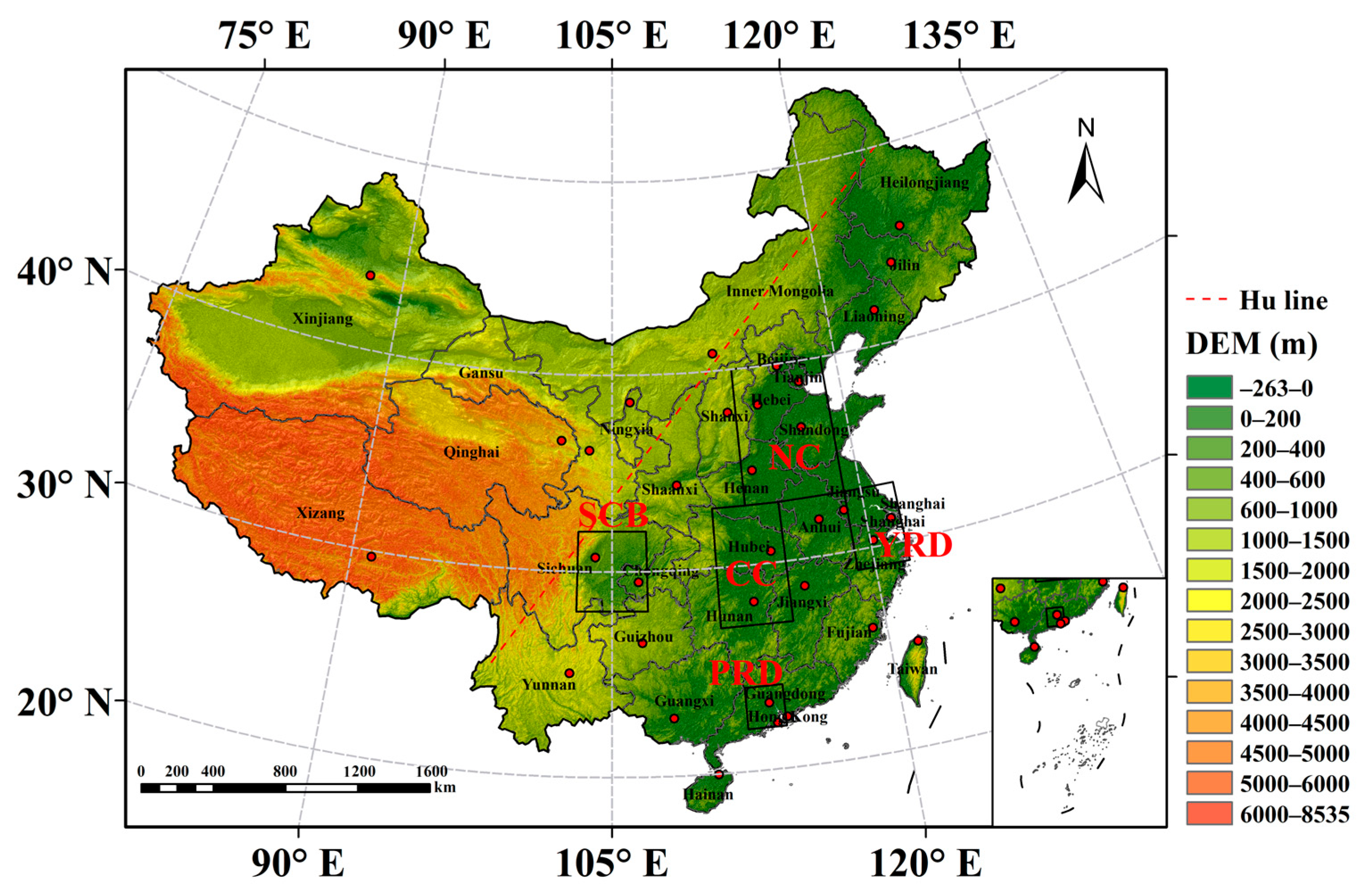
The geographical location of the study area (China) is depicted in Figure 1. Five key regions were selected for focused analysis, namely, North China (NC), Yangtze River Delta (YRD), Pearl River Delta (PRD), Sichuan Basin (SCB), and Central China (CC) (for coordinates, see Table S1). All these regions were characterized by a relatively high BC pollution level due to the dense population and active human activities, making them central targets of national clean-air actions [24]. In terms of BC sources, the high BC concentrations in these regions are mainly driven by heavy traffic, industry processes, residential combustion, and seasonal heating [48]. In terms of meteorological conditions, in NC, CC and SCB regions, frequent low boundary layer heights and inversions were observed in winter, which favor the accumulation of air pollutant particles near the surface [48,49]. The mountains surrounding the NC and basin topography of the SCB act as natural barriers, inhibiting the dispersion of BC particles [50,51]. In contrast, meteorological conditions in coastal regions, especially in the PRD, are different from those in inland regions. Specifically, there is heavy rainfall during summer, which can enhance the wet scavenging [52].

2.2. Data Sources

Daily BC mass concentration data over China from 2000 to 2019 was obtained from the Tracking Air Pollution in China (TAP) datasets (http://tapdata.org.cn/, accessed on 12 October 2024), with a resolution of 10 km × 10 km. The TAP datasets were developed by combining the Weather Research and Forecasting (WRF)/Community Multiscale Air Quality (CMAQ) modeling system, multisource-fusion data, and a machine learning algorithm [22,53]. The evaluation shows good agreement with BC observations (correlation coefficient: 0.64) and a significant improvement of overestimation on a daily scale compared to data from Modern-Era Retrospective analysis for Research and Applications Version 2 (MERRA-2) and Copernicus Atmospheric Monitoring Service (CAMS) [22]. To analyze the impact of meteorological factors on BC mass concentrations, meteorological data in China during the study period were acquired from the European Centre for Medium-Range Weather Forecasts (ECMWF, https://www.ecmwf.int/, accessed on 12 October 2024) ERA5 dataset. Daily temperature (T2m), surface pressure (SP), total precipitation (TP), surface solar radiation (SSRD), wind speed (WS), and wind direction (WD) data were collected at a spatial resolution of 0.1° × 0.1° [54,55]. The hourly boundary layer height (BLH) was processed to a temporal resolution of 1 day using Climate Data Operators (CDOs) (https://code.mpimet.mpg.de/projects/cdo, accessed on 24 October 2024). Monthly sector BC emissions from 2000 to 2019 were obtained from MEIC (http://meicmodel.org.cn/, accessed on 20 November 2025) data, with a spatial resolution of 0.25° × 0.25° [56].

2.3. Methods

2.3.1. Theil–Sen Slope Estimation

Trend analysis is widely used to explore interannual variation patterns in temporal dynamics [57,58]. In this study, BC trends and their confidence level were assessed by applying the Theil–Sen slope estimation and Mann–Kendall statistical test. The non-parametric approach proposed by Theil [59] and Sen [60] was applied to estimate the trend of long-term BC mass concentrations. This method fits a line to sample points by determining the median of slopes for all lines formed by paired points, without assuming any specific data distribution. It is characterized by high efficiency and robustness to outliers, making it widely used to capture trends in time series data. The Theil–Sen slope is calculated as follows:
β B C = M e d i a n ( B C j B C i ) / j i ,   j > i
where B C i and B C j represent monthly mass concentrations of BC in the j t h and the i t h month, respectively. β B C > 0 indicates an increasing trend; otherwise, there is a decreasing trend.

2.3.2. Mann–Kendall Test

The significance of BC trends was assessed following the Mann–Kendall statistical test [61,62]. The test statistic S is expressed:
S = i = 1 n 1 j i + 1 n s g n ( B C j - B C i )
where n represents the number of sample points, and sgn ( B C j B C i ) is defined as:
s g n ( B C j B C i ) = + 1 B C j B C i > 0 0       B C j B C i = 0 1 B C j B C i < 0
The Z value is calculated by normalizing S .
Z = ( S 1 ) / v a r ( S ) S > 0 0 S = 0 ( S + 1 ) / v a r ( S ) S < 0
The probability distribution of the statistic tends to be a normal distribution with a mean of zero when sufficient data are available. var ( S ) is given by:
v a r ( S ) = n ( n 1 ) ( 2 n + 5 ) - i = 1 P t i t i 1 2 t i + 5 / 18
where P is the number of tied groups (that is, a group of sample points with the same value), and t i means the number of data points in the i t h group. If there is no tied group, the term i = 1 P t i ( t i 1 ) ( 2 t i + 5 ) can be ignored. Subsequently, the significance corresponding to the Z-value is determined based on the standard normal distribution table with two-tailed confidence levels (α = 0.1, 0.05, and 0.01). If Z > Z 1 a / 2 , the null hypothesis (H0) is rejected, indicating a statistically significant trend. Otherwise, H0 is valid, suggesting the trend is not statistically significant. Specifically, the trend passes the significance test at confidence levels of 90%, 95% and 99%, when | Z |   1.28, 1.64 and 2.32, respectively.

2.3.3. Meteorological Normalization Approach

In this study, an explainable ML framework was developed to achieve the meteorological normalization of daily BC mass concentrations for each grid cell in China from 2000 to 2019. Specifically, the XGBoost model was applied in a Python 3.8 environment. XGBoost is a gradient boosting algorithm based on decision trees that iteratively adds new trees to correct the residuals of previous ones [63]. Each tree is constructed to minimize a regularized loss function, thereby improving generalization and mitigating over-fitting. Its high computational efficiency/accuracy and robustness to over-fitting make it suitable for large-scale regression tasks [64,65]. The XGBoost model was built based on the response variable (BC concentration) and explanatory variables (time and meteorological features). Time features, including Unix time (UT; number of seconds since 1 January 1970), Julian Day (JD), and weekday (day of the week, DOW), were selected as proxies for the trends of emission intensity with seasonal, weekly cycles [45,46,66]. UT represents the trend in time, which captures the long-term change in air pollutants due to changes in policies/regulations [45,46]. For each grid cell in China, the XGBoost model was trained on 70% of the total dataset, with the remaining 30% reserved for testing. The details of the model hyperparameters can be found in the Text S1. The coefficient of determination (R2) and root mean square error (RMSE) were used to evaluate the model performance, yielding comparable results (R2~0.75 and RMSE~0.61) to those from other studies [44,46,67].
Emission-driven and meteorology-driven BC was quantified following the meteorological normalization technology proposed by Grange et al. [46]. This approach has been widely adopted in previous studies to isolate the effect of meteorological factors on air pollutants using field measurements or simulated data [35,47,68,69,70,71,72]. Note that our aim is to estimate the relative contributions of emissions and meteorological conditions to long-term BC dynamics, rather than short-term or instantaneous meteorological dependencies. Specifically, the meteorologically normalized BC concentration at a particular time was calculated by averaging multiple predictions of the XGBoost model. For each prediction, the explanatory variables, with the exception of the trend term (UT), were sampled without replacement and randomly allocated to a dependent variable observation (BC concentration). The multiple predictions were then averaged (arithmetic mean) to obtain the meteorologically normalized concentration. In other words, the de-weathered BC (BCdew) at a certain time refers to the ambient level of source emissions (namely, BCEMI) under averaged meteorological conditions, expressed as follows:
B C E M I   =   B C d e w   =   1 n i = 1 n C i , p r e d
where n represents the total number of iterations (n = 1000 in this study); Ci,pred represents the XGBoost model-predicted BC concentration for a given meteorological condition.

2.3.4. Shapley Additive Explanation (SHAP) Method

Despite the high accuracy and computational efficiency, ML models such as XGBoost remain difficult to interpret due to the “black-box” nature [73]. To overcome this limitation and enhance the understanding of model decisions, SHAP was integrated with the ML framework mentioned in Section 2.3.3, thereby quantifying the influence of each input feature on BC variability. Compared to full SHAP value estimation, the SHAP method for tree-based models (e.g., XGBoost) achieves faster computation without compromising accuracy [74,75]. SHAP, an additive feature-attribution approach derived from cooperative game theory, assigns each predictor a Shapley value to explain model outputs [74,76,77]. Owing to its strong interpretability and compatibility with diverse models, it has been widely adopted in atmospheric science research [69,78]. The marginal contribution of each feature is derived from the average difference in model predictions with and without the feature. The core equation for the calculation is presented in Equation (7).
g ( F ) = ϕ 0 + i = 1 M ϕ i F i
where g denotes the explanatory model; F refers to the simplified feature set; M is the number of features considered in the model; ϕ 0 indicates expected model output across the dataset; and ϕ i denotes the SHAP value assigned to the i-th feature. A negative (positive) SHAP value suggests that the feature contributes to a decrease (increase) in BC levels. The greater the absolute SHAP value, the more significant the impact of the feature on the model output. In this work, the “shap” python package (https://github.com/slundberg/shap, accessed on 15 November 2024) was utilized to perform the analysis.

3. Results and Discussion

3.1. Overall Variations

3.1.1. Spatial and Temporal Changes in BC Concentrations

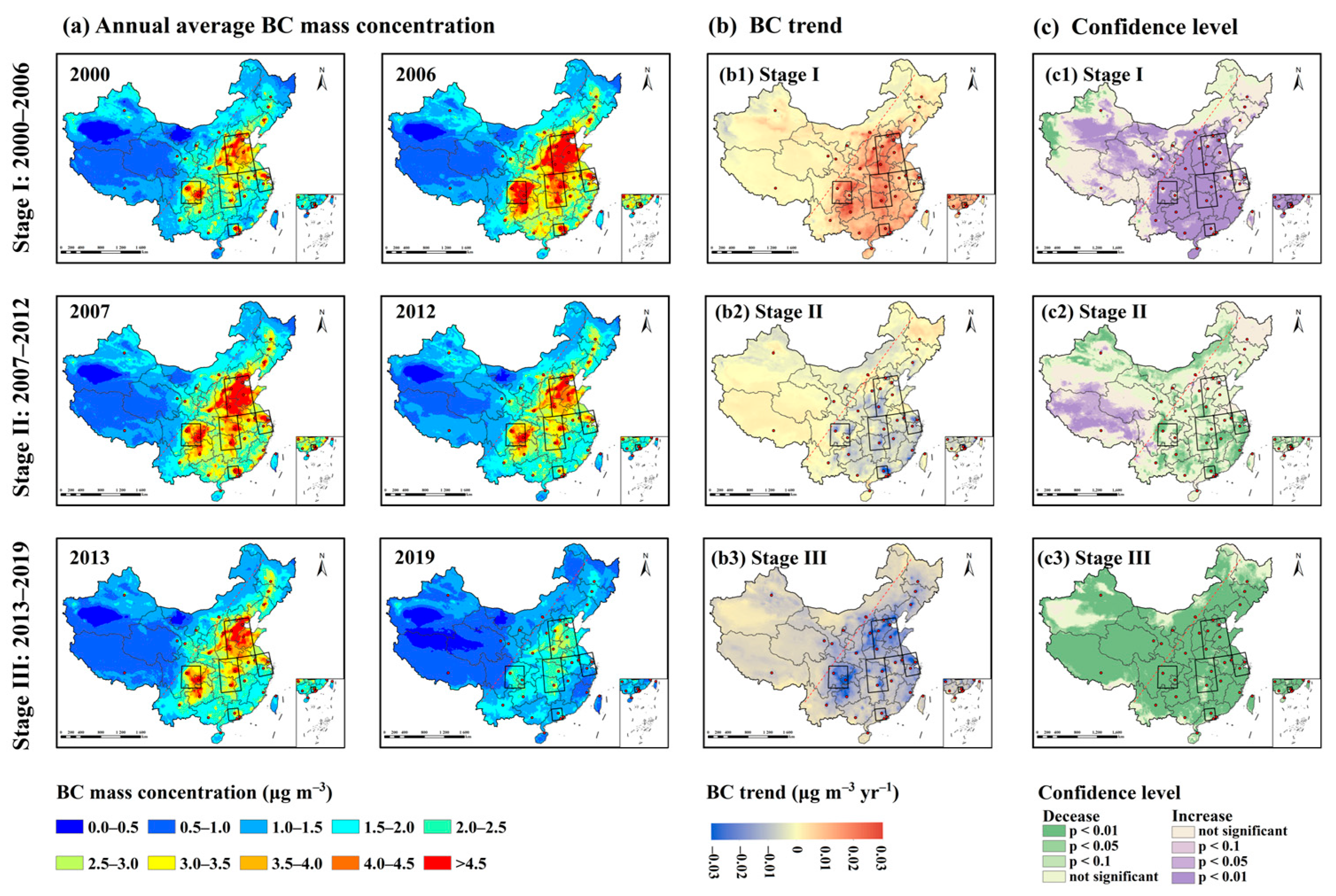
Given the result reported by Liu et al. [22] and the implementation of multiple air pollution control strategies in China since 2013, the temporal change in BC mass concentrations was divided into three stages: Stage I (2000–2006), Stage II (2007–2012), and Stage III (2013–2019) [79]. The spatial distribution of BC mass concentrations, their trends, and the associated confidence level during the above three stages in China are presented in Figure 2.
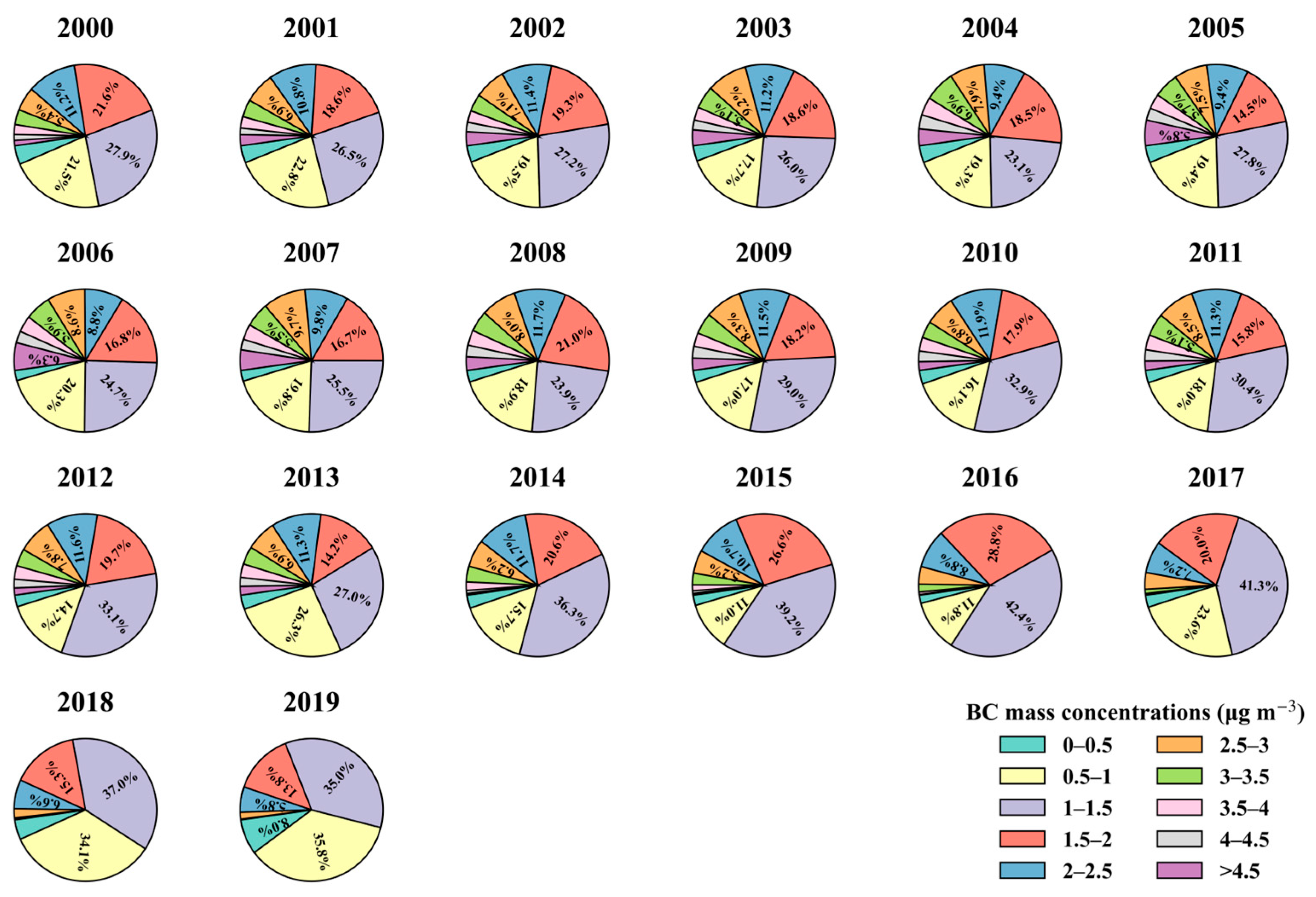
In general, average annual BC mass concentrations in China during the study period exhibited a clear geographical pattern, which was consistent with the “East High-West Low” law observed in previous studies [19,33,80]. High values of BC concentrations (greater than 3.0 μg m−3) were mainly found in NC, CC, and East China. Notably, these regions were centered on provincial capitals east of the Hu Line, expanding year by year from Stage I to Stage II but contracting in Stage III. Specifically, the percentage of high BC concentrations during Stage I peaked at 18.53% in 2006, with an increase of 9.31% compared to that in 2000 (Figure 3). By contrast, the part corresponding to high BC concentrations declined after 2006. As of 2014, high BC concentrations only accounted for 6.57% of the national territory, while Low BC concentrations (less than 2.0 μg m−3) even exceeded 90% in 2018. Spatially, low BC concentrations were predominantly distributed in Northwest, Southwest and Northeast China, especially in the Qinghai–Tibet Plateau, Tarim Basin, Junggar Basin and Badain Jaran Desert. This spatial pattern of BC concentrations was mainly linked to the distribution of urbanization in China. The southeast half of the Hu Line accounts for approximately 90% of the population and major industrial activities, characterized by huge energy consumption (particularly from fossil fuels), which leads to a high BC emission [81,82,83]. In addition, topographical and meteorological conditions play a crucial role in shaping the spatial distribution of BC in China. For instance, the unfavorable terrain/stagnant weather in the SCB and Beijing–Tianjin–Hebei region could hinder the dispersion of air pollutants, resulting in the accumulation of BC aerosols near the surface [50,84,85].

3.1.2. Changes in BC Trends

In terms of the overall temporal change, BC trends exhibit an initial considerable increase in Stage I, followed by a slight decrease in Stage II, and ending with a significant decrease in Stage III (Figure 2). Specifically, the proportion of BC trends within the bins of 0.01 to 0.02 μg m−3 yr−1 covered 16.29% of the national territory in Stage I, while the ratio of BC trends within the bins of −0.02 to −0.01 μg m−3 yr−1 reached 3.70% and 21.74% in Stage II and Stage III, respectively (Table 1). Moreover, 90.65%, 46.88% and 97.57% of BC trends within these bins passed the confidence test at the p < 0.01 level, revealing the significance of the increasing trend in Stage I and the decreasing trend in Stage III (Table 2). It is worth noting that regions with high positive Theil–Sen slope values in Stage I mostly overlapped with areas exhibiting significant negative trends in Stages II and III, including NC, CC, and South China east of the Hu Line. Specifically, the most pronounced trends were found in NC, YRD, and SCB, with maximum values reaching +0.04, −0.06 and −0.05 μg m−3 yr−1 in Stage I, II and III, respectively. These regions aligned with areas characterized by high BC concentrations. In other words, the higher the BC mass concentration, the higher the absolute value of the Theil–Sen slope. This suggests a potential correlation between the factors contributing to elevated BC levels and those driving their decline, which will be discussed in subsequent sections. To simplify the analysis, attention will be concentrated on the five key regions (Figure 1) with higher BC concentrations.

3.2. Relative Contributions of Emissions and Meteorological Conditions

3.2.1. Annual Changes

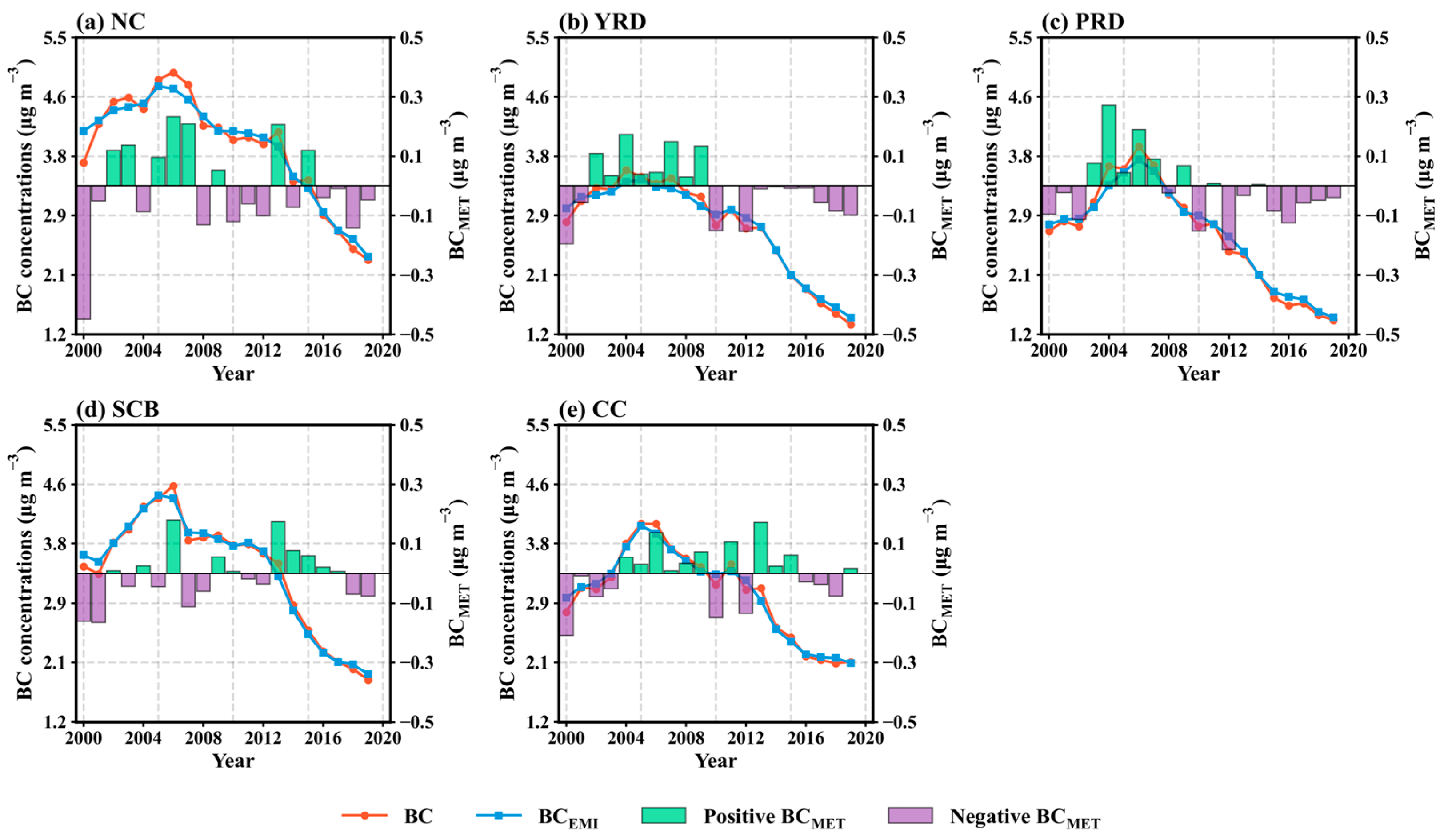
It is essential to decouple meteorological effects from emission-driven changes, as variations in meteorological conditions can significantly affect air pollutant concentrations, even if emissions remain constant [70]. Figure 4 depicts the annual variations in original, de-weathered (emission-driven, denoted as BCEMI) and meteorology-driven BC concentrations (denoted as BCMET) in the five regions over China from 2000 to 2019. The green (positive) and purple (negative) bars represent the meteorological effect, where the former indicates that meteorological conditions exacerbate the accumulation of BC particles, while the latter refers to situations in which meteorological influences mitigate the impact of anthropogenic sources.
Overall, the trend in annual mean changes in original BC and BCEMI concentrations from 2000 to 2019 was generally consistent across all regions. Specifically, these variations exhibited an initial increase followed by an obvious decline. However, the magnitude of BC load, decline rates and turning points varied from region to region. Among the five regions, the highest BCEMI concentrations were observed in NC and SCB, followed by PRD and CC, with the lowest in YRD. Specifically, the average (maximum) BCEMI concentrations from 2000 to 2019 in the NC, SCB, PRD, CC, and YRD regions were 3.91 (4.78), 3.40 (4.47), 2.67 (3.73), 3.07 (4.03), and 2.78 (3.45) μg m−3. Notably, BCEMI in NC exhibited the most pronounced decrease after 2013, indicating that emission control policies in this area have been particularly effective for BC. Specifically, bulk coal consumption in the “2 + 26” region experienced a substantial decline as a result of multiple measures, such as the “Coal to Gas” project, the phase-out of coal-fired boilers and kilns, staggered industrial production during the heating season, and enhanced energy efficiency [24,86,87]. As shown in Figure S1, the most significant decrease in annual average total BC emissions was also found in NC after 2013, which was consistent with Figure 4. Especially for the industry sector, BC emissions in NC decreased by 61.49% from 2013 to 2019.
Regarding annual variations in BCMET, there was significant spatial heterogeneity. For YRD and PRD, meteorological factors predominantly exerted a positive influence on BC concentrations from 2000 to 2013, with BCMET peaking in 2004 at 0.17 and 0.27 μg m−3, respectively. As reported by Xiao et al. [47], 2004 was also a meteorologically unfavorable year for PM2.5 in both regions. In contrast, positive BCMET in the NC, SCB, and CC regions peaked in 2013, with respective values of 0.21, 0.17, and 0.17 μg m−3. After 2013, a declining trend in meteorological influence was observed across all regions. This was partly due to the severely unfavorable weather conditions in 2013, and partly due to anthropogenic influence after 2013, which may reduce extreme climate events by altering atmospheric circulation modes [88,89,90]. In terms of seasonal changes (Figure S2), a distinct pattern in BC levels was observed across inland regions, characterized by higher BCEMI values and stronger meteorological effects during winter (December–January–February). Especially in NC, SCB, and CC, winter meteorological conditions dominated the annual meteorological influence on BC, mainly due to unfavorable atmospheric conditions and intensive heating activities [42,91,92].
To sum up, we observed similar variations in BCEMI and meteorological effects compared to PM2.5 results from previous studies. However, some uncertainties remain, mainly attributed to three factors: (i) the distinct physicochemical properties of the pollutants; (ii) differences in meteorological normalization methods and model configurations; and (iii) varying mechanisms by which regional control measures and meteorological conditions affect different pollutants [25,47].

3.2.2. Stage Changes

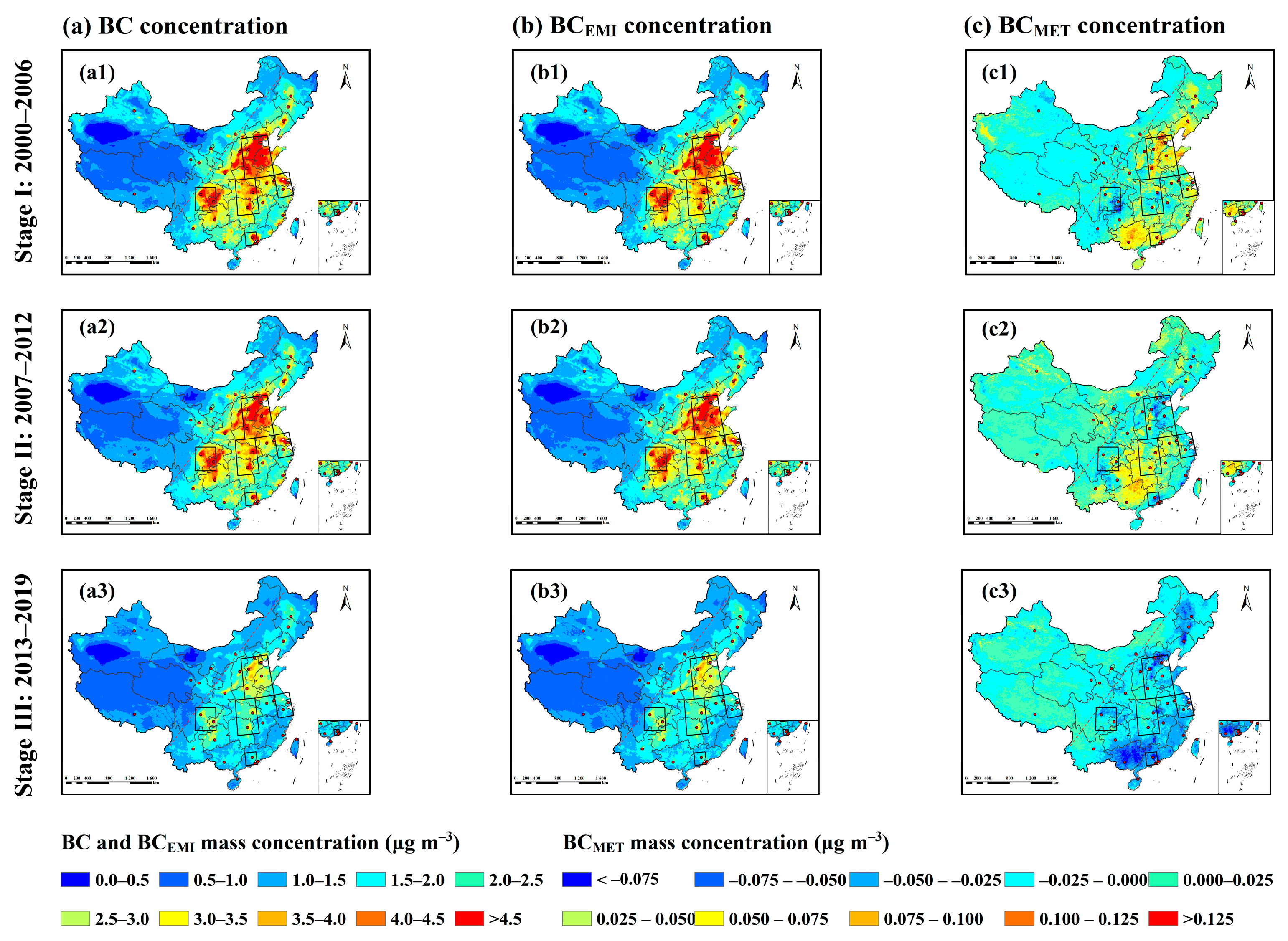
The spatial distribution of BC, BCEMI, and BCMET average mass concentrations during the three stages in China is presented in Figure 5. In general, the average BC and BCEMI concentrations showed similar spatial patterns and magnitudes of variation across all stages (Figure 5a,b). This is consistent with the results discussed in Figure 2. Regarding stage differences, the most significant changes in average BC and BCEMI concentrations were observed in the five key regions selected in this study (NC, YRD, PRD, SCB, and CC). In contrast, the spatial distribution of BCMET average concentrations across different stages was more complex. Specifically, positive BCMET values (~0.05 μg m−3) were observed in the NC, YRD, and PRD regions in Stage I, while significant negative BCMET values (lower than −0.05 μg m−3) were found in the southwest of the SCB region. During Stage II and Stage III, the negative effect of meteorological conditions was more pronounced in the NC, YRD, and PRD regions. This was particularly evident in the Northeast Plain, NC, and the hilly areas of Guangdong and Guangxi (with BCMET of −0.075 μg m−3), indicating that meteorological conditions in these regions were favorable for the decrease in BC concentrations. Notably, in the SCB and CC regions, BCMET values changed from positive to negative from Stage II to Stage III, mainly related to the meteorological conditions in certain years (such as 2013) discussed in Section 3.2.1. The above results reveal that the influences of anthropogenic emissions and meteorological conditions on changes in BC concentrations follow a similar pattern at both the interannual scale and the stage scale.
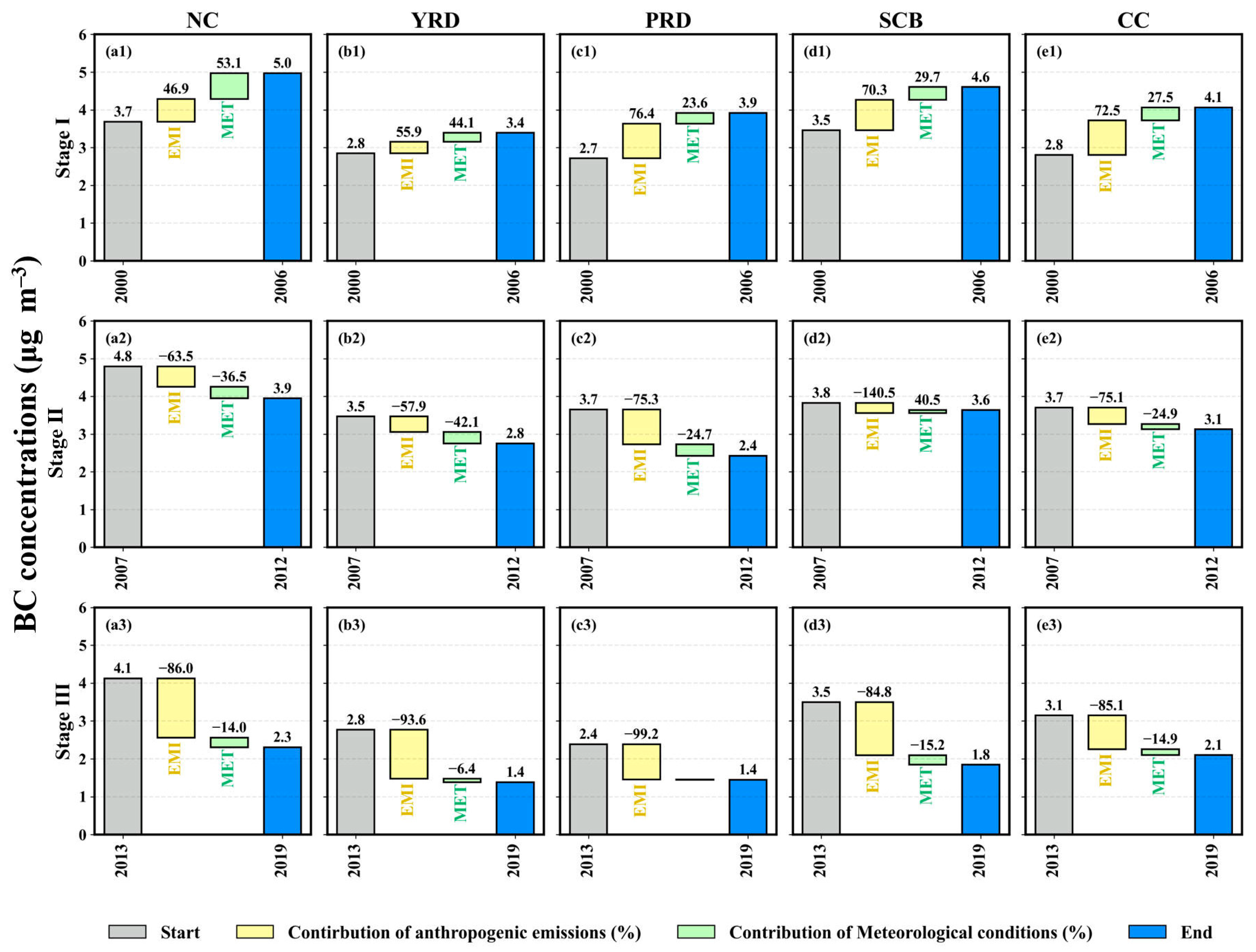
Furthermore, considering the five key regions, the regional average relative contributions of emissions and meteorological conditions to BC concentrations were quantified during the three stages, as shown in Figure 6. The difference between BCEMI concentrations from the start to the end of each stage represents the change caused by anthropogenic emissions, while the difference between BC and BCEMI concentrations during that stage represents the change caused by meteorological conditions.
In Stage I, the most significant increases in BC concentrations were found in the PRD and CC regions, rising by 44.32% and 44.87%. Increases in NC and SCB ranked second, at 34.89% and 33.14%, respectively. Anthropogenic contributions to changes in BC concentrations ranged from 46.87% to 76.44%, while the influence of meteorological conditions accounted for 23.56% to 53.13%. This indicates that, although rapid industrialization and urbanization were the main drivers during Stage I, the suppressing effect of meteorological conditions on pollutant dispersion should not be overlooked. Especially, meteorological conditions played a dominant role in NC, with a positive contribution of over 50%. In Stage II, a decline higher than 20% (33.62%) in BC concentrations was only observed in PRD, of which 75.30% was attributed to anthropogenic emissions. The observed improvement can be largely attributed to a series of regional initiatives implemented in PRD since the 11th Five-Year Plan, including the Guangdong Provincial Regulations on Air Pollution Prevention and Control, the 2010 Guangzhou Asian Games, and industrial relocation programs [93,94]. By contrast, meteorological conditions had a positive influence on BC concentrations in SCB, accounting for 40.51% of the change. It is worth noting that although both NC and SCB are characterized by unfavorable terrain for dispersion and seasonal stagnant weather conditions, the meteorological contributions to BC concentrations during Stages I and II differed significantly [95]. This contrast can be explained by the combined influence of large-scale circulation variability and region-specific emission dynamics [47,96]. Specifically, in Stage I, the situation in NC was possibly shaped by both high but stable emissions and unfavorable meteorological conditions related to the weak East Asian winter monsoon (EAWM) [97,98]. By contrast, Stage II in SCB was marked by a substantial intensification of adverse meteorological conditions, as evidenced by the prolonged “Southwest Drought” and low WS during 2009–2011, strong temperature inversions, and frequent stagnant weather [99,100]. Moreover, the slowdown in emissions growth may magnify the impact of meteorological factors on BC concentrations. During Stage III, BC concentrations fell by more than 30% in every region, with over 80% of the reduction attributed to emissions. Especially, the decrease in BC concentrations for NC reached 1.56 μg m−3, of which anthropogenic emissions contributed 85.99%. Compared with Stage II, the findings underscore the substantial impact of air pollution control measures implemented after 2013—particularly for BC, which, as a tracer of combustion-related emissions, responds most directly to emission reduction policies [101]. However, while emissions dominated BC changes in China, meteorological conditions also played a significant role. Particularly, meteorological conditions should be taken into account in the formulation of control strategies for regions like NC and SCB.

3.2.3. BC Trends After Adjusting the Meteorological Effects

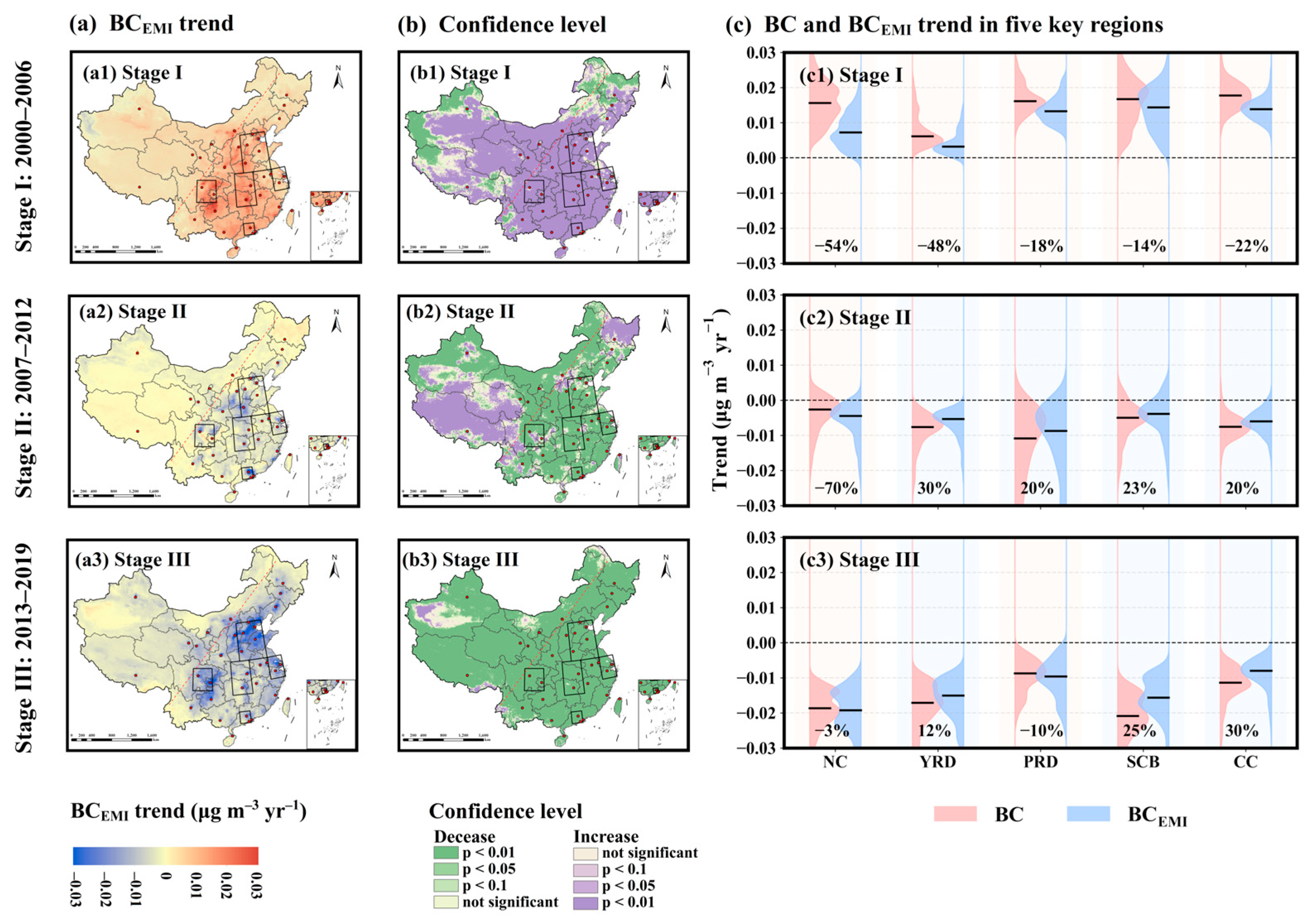
Figure 7 depicts the trend of BCEMI concentrations, their confidence level, and the comparison between regional BC and BCEMI trends during different stages. In general, BCEMI trends were consistent with the spatial pattern of original BC trends (Figure 2b), while the corresponding confidence level of BCEMI trends was enhanced (Figure 7b). In terms of regional comparison (Figure 7c), the density distribution of BCEMI trends closely resembled that of original BC trends. However, varying degrees of central shifts between the two were observed, reflecting the impact of long-term meteorological changes or abnormal weather events in specific years.
During Stage I, compared with BC trends, BCEMI trends increased by 6.21% in the bin of −0.01 to 0.01 μg m−3 but decreased by 6.59% in the bin of 0.01 to 0.03 μg m−3 (Table 3). Moreover, the median of BCEMI trends was lower than that of original BC trends across the five regions, suggesting that there was an overestimation of the extent of anthropogenic pollution increase in the original BC trends. This result agrees with Figure 6, that is, the meteorological conditions played a critical role in driving the accumulation of BC particles during Stage I. Especially, the most notable reduction (54%) in the median of trends was found in NC, from 0.016 to 0.007 μg m−3 yr−1. During Stages II and III, compared with BC trends, BCEMI trends in the bin of −0.01 to 0 μg m−3 increased by 2.73% and 3.56%, respectively, whereas those in the bin of −0.02 to −0.01 μg m−3 decreased by 1.06% and 6.06%, respectively. These changes indicate a complex effect of meteorological conditions on BC, leading to the nonlinear response of BC concentrations to emission controls: under unfavorable meteorological conditions (such as those in 2013), even substantial emission control efforts may fail to yield noticeable decreases in average BC levels at a large spatial scale [89,102]. It’s worth noting that the median BCEMI trend in NC decreased by 70.10% (3.38%) compared to the median BC trend, from −0.003 (−0.018) to −0.005 (−0.019) μg m−3 yr−1 in Stage II (III). Together with Figure 6, these results emphasize subtle regional differences in underlying driving mechanisms between the NC and other regions. Specifically, improvements in BC pollution levels over NC was mainly driven by emission control, but meteorological conditions masked a considerable part of the emission reduction effect. Hence, it is essential to perform meteorological normalization of BC concentrations, particularly for regions with significant meteorological variability or frequent extreme weather events [46]. Accounting for the impact of meteorological conditions not only allow for a more accurate understanding of the contribution of emission control measures, but also facilitates the development of regionally tailored mitigation strategies.

3.3. Driving Mechanisms of Meteorological Factors Affecting BC

3.3.1. SHAP-Based Importance of Different Features

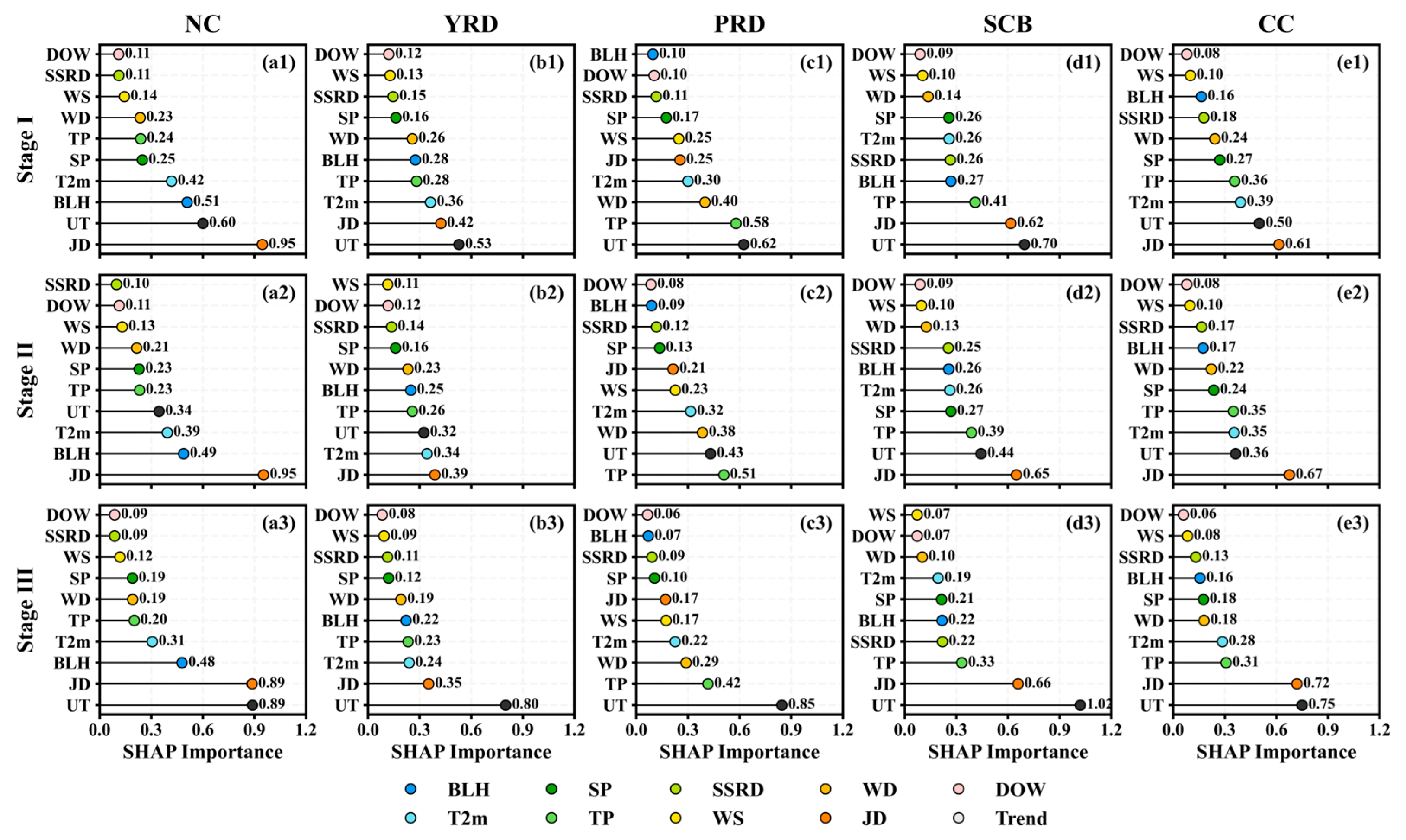
To gain deeper insight into the driving mechanisms of meteorological factors on the changes in BC concentrations, Figure 8 displays the SHAP-based importance for all features in the five regions during different periods.
As shown in Figure 8, most UT ranked first (or second) among all variables in each region. This reaffirms the significant impact of anthropogenic emissions on long-term trends, which is consistent with the findings in Figure 6. Whether from the perspective of stage or season (Figure S3), there was a temporal consistency in the SHAP importance ranking of meteorological features, indicating that their influence mechanisms on BC aerosols were relatively stable in each region. Moreover, a gradual decline in the SHAP importance values of most meteorological features was observed over time, which was mainly related to the enhanced environmental governance and evolving background atmospheric conditions [88,103]. In terms of regional patterns, for NC, BLH (SHAP: 0.49 ± 0.01), T2m (SHAP: 0.37 ± 0.05), and SP (SHAP: 0.22 ± 0.02) stood out as the leading meteorological variables, underscoring the critical role of atmospheric dispersion capacity in determining BC levels [102]. In comparison, TP was found to be a key driver in the YRD, PRD, SCB, and CC regions (SHAP: 0.37 ± 0.10), suggesting that the abundance of precipitation strongly affected the wet removal of BC aerosols in these areas. Besides, the influence of WD was particularly pronounced in PRD, likely due to the monsoonal climate, with SHAP importance values of 0.40, 0.38, and 0.29 during Stages I, II, and III, respectively [104,105]. For SCB, the unique topographical features—characterized by strong terrain enclosure, weak solar radiation, high cloud cover, and limited dispersion capacity—made SSRD and SP particularly relevant variables in driving BC changes (with mean SHAP values of 0.24 and 0.25, respectively) [99,100]. As for CC, the importance of T2m was significant (SHAP: 0.34 ± 0.05), which may work together with the high humidity and abundant precipitation to facilitate the active formation and transformation of secondary aerosols, thereby contributing to the overall BC burden [106,107].

3.3.2. Seasonal SHAP Values of Meteorological Factors

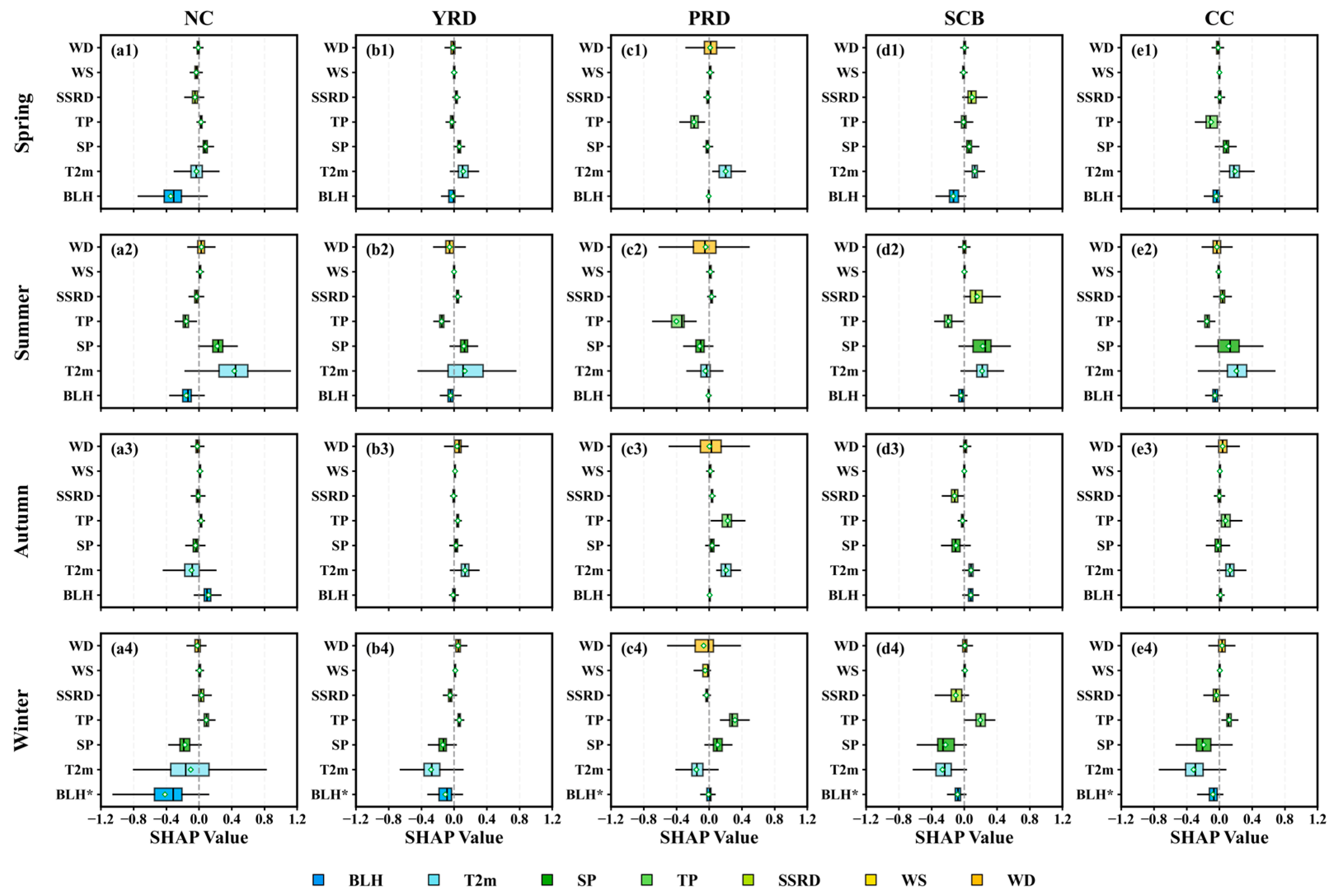
Seasonal SHAP values of each meteorological variable are presented in Figure 9 in order to further explore the varying BC responses to changes in key meteorological drivers discussed above. Note that these changes reflect the governing regulatory mechanisms of meteorological factors within a specific environmental context, as there are complex interactions among meteorological variables rather than a single effect [103].
During summer/winter, similar patterns of meteorological driving mechanisms were observed across NC, YRD, SCB, and CC. Specifically, in summer (June, July, and August), most SHAP values of TP were negative (~−0.15), while positive marginal contributions of T2m (0.20 ± 0.08) and SP (0.17 ± 0.04) were captured in the model. During summer, the high-pressure system is usually accompanied by a high T2m and strong SSRD, which likely contribute to the increased BC concentrations by promoting coal-fired emissions (such as peak power consumption for air conditioning pushing up power plant loads) and enhancing the oxidation of volatile organic compounds (VOCs) to form secondary aerosols [108,109]. In contrast, abundant rainfall in summer plays a greater role in wet removal processes, thereby mitigating BC accumulation [80,110]. During winter, the law was reversed due to weaker SSRD and precipitation, as well as active heating activities driven by low temperatures. In terms of BLH, BLH and BC concentrations were generally negatively correlated, especially in NC during winter (−0.38). This relationship can be explained by the fact that higher BLH enhances the vertical mixing and dispersion of BC, whereas lower BLH tends to inhibit the dispersion of air pollutants [111,112]. Furthermore, it is worth noting that positive feedback exists between BC and planetary boundary layer, whereby absorbing aerosols not only change atmospheric thermodynamics and stability, but also suppress the BLH, thereby exacerbating air pollution [13].
Compared with other regions, results show that the meteorological effect on BC level in PRD during summer was mainly controlled by precipitation and wind. Precipitation exerted a strong negative influence on BC concentrations (with a mean SHAP value of −0.38), resulting from frequent short-term heavy precipitation events [25,52,105]. For WD, Q1 and Q3 of SHAP values were −0.017 and 0.07, indicating a relatively small effect of wind on BC. However, the minimum and maximum SHAP values reached −0.64 and 0.47, respectively. This indicates that wind had a significant effect on changes in BC concentrations under specific conditions, possibly related to strong wind with clean/polluted air masses [105]. Positive SHAP values of TP were observed in PRD during winter, mainly due to the limited wet removal under low precipitation conditions [105]. To conclude, the influence of meteorological factors on BC concentrations shows clear spatial and seasonal dependence, which was jointly determined by the combined effects of topography, the interaction of meteorological factors, as well as feedback mechanisms between meteorology and pollution.

3.4. Uncertainty and Limitations

This attribution of BC concentration variability in this study relies on TAP BC concentration data, ECMWF ERA5 meteorological dataset, and meteorological normalization methods, which were the source of uncertainty and limitations.
In terms of TAP data, the uncertainty in BC concentration arises from four aspects: WRF-CMAQ simulations, multisource-fusion PM2.5 data, the CF revision model trained on collected ground observations, and emission inventories [22]. Specifically, TAP BC observations are affected by instrument algorithms, station representativeness, and missing data processing [22]. Seasonal or regional systematic biases may be passed on to BCEMI estimation, although random errors can be partially offset in the resampling mean. Besides, the emission inventory containing systematic biases and smoothing effects may weaken the alignment with policy timing and affect the interpretation of the magnitude and time lag of emissions-driven BC change [113]. Regarding the ERA5 dataset, meteorological data contains regional biases in near-surface variables related to complex underlying surface, potentially weakening the XGBoost model’s response to extreme meteorological conditions and affecting the representativeness of mean meteorological conditions [54,55]. Specifically, these biases may perturb the response function of BC concentrations and meteorological features during model training, thereby leading to a mismatch between some meteorological signals and BCEMI concentrations during the resampling process.
In terms of approach, as a predictive model, XGBoost not only fails to directly identify causal effects but may also be sensitive to data imbalances caused by extreme or rare meteorological conditions [65]. To mitigate these issues, we employ the SHAP method to enhance interpretability and use cross-validation together with Monte Carlo resampling to reduce uncertainty, thereby strengthening the robustness of conclusions. Nevertheless, systematic biases and the lack of detailed causal identifiability remain the principal limitations of this study, posing challenges to a deeper understanding of the mechanisms by which emissions and meteorological conditions affect BC concentrations.
In the future, multi-source data fusion and systematic consistency assessments will help correct systematic biases in emission inventories and meteorological datasets [114]. Furthermore, we hope to enhance the reliability and interpretability of attributions through multi-model integration (such as combining ML models with chemical transport models) in future work, revealing mechanisms in a more scientifically rigorous way [115].

4. Conclusions

Focusing on five key regions, the relative contributions of anthropogenic emissions and meteorological conditions on BC dynamics in China were estimated by applying an explainable ML framework, based on TAP BC and ERA5 meteorological data. Moreover, the SHAP method was used to explore the influence of meteorological factors on BC concentrations, providing an interpretable data-driven perspective for understanding driving mechanisms. The main findings are as follows:
(1)
In terms of the spatial distribution, BC concentrations exhibited an “East High-West Low” pattern. In terms of temporal variations, BC concentrations over China increased significantly during Stage I, decreased gradually during Stage II, and dropped rapidly during Stage III. Specifically, the proportion of BC trends within the bins of 0.01 to 0.02 μg m−3 yr−1 covered 16.29% of the national territory in Stage I, while the ratio of BC trends within the bins of −0.02 to −0.01 μg m−3 yr−1 reached 3.70% and 21.74% in Stage II and Stage III, respectively.
(2)
Anthropogenic emissions dominated the variability of BC load in China from 2000 to 2019. Regarding BC changes during the three stages, the proportion of regional average BCEMI to regional average BC concentrations ranged from −140.50% to 76.40%. Especially, the most significant decrease was found in NC during Stage III, with a BCEMI reduction of more than 1.5 μg m−3, confirming the effectiveness of emission control policies for BC in this area.
(3)
The influence of meteorological conditions on the interannual fluctuations and long-term trends of BC was complex and spatially heterogeneous, potentially exaggerating the level of anthropogenic pollution or obscuring the effects of emission controls. As for the annual mean meteorological effect, the highest BCMET value in YRD (0.17 μg m−3) and PRD (0.27 μg m−3) was observed in 2004, while positive BCMET in NC, SCB, and CC peaked in 2013, with values of 0.21, 0.17, and 0.17 μg m−3, respectively.
(4)
There were relatively stable pathways of meteorological factors affecting BC for each region, evidenced by almost unchanged rankings of BLH, T2m, TP, SP, WD, WS and SSRD across different stages and seasons. Furthermore, clear patterns were observed in the meteorological driving mechanisms across the five regions during summer/winter.
To sum up, this study highlights the potential of ML-based attribution analysis to decouple the interference of meteorological factors on BC dynamics, so as to more accurately identify the true effect of anthropogenic emission changes on BC pollution levels. Findings of this study not only clarify the BC control effect of the five key regions, but also put forward data-driven insights to support the formulation of targeted regional BC control strategies under a changing climate.

Supplementary Materials

The following supporting information can be downloaded at: https://www.mdpi.com/article/10.3390/atmos16121378/s1, Text S1: eXtreme Gradient Boosting (XGBoost) model settings; Table S1: Five key regions were selected as shown in Figure 1. Each region is defined by the latitude and longitude at the lower-left and upper-right corner; Figure S1: Annual variation in BC sector emissions (including agriculture, industry, power, residential, and transportation) from 2000 to 2019 in different regions: (a) NC; (b) YRD; (c) PRD; (d) SCB; and (e) CC; Figure S2: Seasonal mean BC concentrations of original (BC, red line), emission-driven (BCEMI, blue line), and meteorology-related (BCMET) from 2000 to 2021 in different regions: (a) NC; (b) YRD; (c) PRD; (d) SCB; and (e) CC. For BCMET, green represents positive contribution and purple represents negative contribution. Seasons are defined as follows: spring (December–February), summer (March–May), autumn (June–August), and winter (September–November); Figure S3: The importance of each feature to BC in the key five major urban agglomerations: (a) NC; (b) YRD; (c) PRD; (d) SCB; and (e) CC in different seasons. Seasons are defined as follows: spring (December–February), summer (March–May), autumn (June–August), and winter (September–November).

Author Contributions

Conceptualization, R.F. and Y.M.; methodology, R.F. and Y.M.; software, R.F.; validation, S.J. and B.L.; formal analysis, R.F.; investigation, R.F.; resources, R.F.; data curation, S.J.; writing—original draft preparation, R.F.; writing—review and editing, R.F. and Y.M.; visualization, R.F.; supervision, S.J., B.L., Y.L. and W.G.; project administration, S.J.; funding acquisition, Y.M., W.G., B.L. and Y.L. All authors have read and agreed to the published version of the manuscript.

Funding

This study was supported by the Key R&D projects in Hubei Province (Grant No. 2021BCA220), the National Natural Science Foundation of China (Grant No. 42071348), and the National Key Research and Development Program of China (Grant No. 2023YFC3007803).

Institutional Review Board Statement

Not applicable.

Informed Consent Statement

Not applicable.

Data Availability Statement

BC data was obtained from TAP datasets (http://tapdata.org.cn/), meteorological data were acquired from ECMWF (https://www.ecmwf.int/) ERA5 dataset, and BC emissions was obtained from MEIC (http://meicmodel.org.cn/) data.

Acknowledgments

We would like to acknowledge the TAP and MEIC team for kindly providing BC aerosol products. We also thank all the scientific groups involved in processing and providing the ECMWF data, as well as the auxiliary data used in our study.

Conflicts of Interest

The authors declare no conflicts of interest.

References

  1. Baumgartner, J.; Zhang, Y.; Schauer, J.J.; Huang, W.; Wang, Y.; Ezzati, M. Highway proximity and black carbon from cookstoves as a risk factor for higher blood pressure in rural China. Proc. Natl. Acad. Sci. USA 2014, 111, 13229–13234. [Google Scholar] [CrossRef] [PubMed]
  2. Bond, T.C.; Doherty, S.J.; Fahey, D.W.; Forster, P.M.; Berntsen, T.; DeAngelo, B.J.; Flanner, M.G.; Ghan, S.; Kärcher, B.; Koch, D.; et al. Bounding the Role of Black Carbon in the Climate System: A Scientific Assessment. J. Geophys. Res. Atmos. 2013, 118, 5380–5552. [Google Scholar] [CrossRef]
  3. Wei, J.; Wang, J.; Li, Z.; Kondragunta, S.; Anenberg, S.; Wang, Y.; Zhang, H.; Diner, D.; Hand, J.; Lyapustin, A.; et al. Long-term mortality burden trends attributed to black carbon and PM2·5 from wildfire emissions across the continental USA from 2000 to 2020: A deep learning modelling study. Lancet Planet. Health 2023, 7, e963–e975. [Google Scholar] [CrossRef]
  4. Bond, T.C.; Streets, D.G.; Yarber, K.F.; Nelson, S.M.; Woo, J.-H.; Klimont, Z. A Technology-Based Global Inventory of Black and Organic Carbon Emissions from Combustion. J. Geophys. Res. Atmos. 2004, 109. [Google Scholar] [CrossRef]
  5. Jacobson, M.Z. Strong Radiative Heating due to the Mixing State of Black Carbon in Atmospheric Aerosols. Nature 2001, 409, 695–697. [Google Scholar] [CrossRef]
  6. Ramanathan, V.; Carmichael, G. Global and Regional Climate Changes due to Black Carbon. Nat. Geosci. 2008, 36, 335–358. [Google Scholar] [CrossRef]
  7. IPCC. Climate Change 2021: The Physical Science Basis. In Contribution of Working Group I to the Sixth Assessment Report of the Intergovernmental Panel on Climate Change; Cambridge University Press: Cambridge, UK; New York, NY, USA, 2021. [Google Scholar] [CrossRef]
  8. Ogren, J.A.; Charlson, R.J. Elemental carbon in the atmosphere: Cycle and lifetime. Tellus B 1983, 35B, 241–254. [Google Scholar] [CrossRef]
  9. Reddy, M.S.; Boucher, O. Climate impact of black carbon emitted from energy consumption in the world’s regions. Geophys. Res. Lett. 2007, 34, L11802. [Google Scholar] [CrossRef]
  10. Kopp, R.E.; Mauzerall, D.L. Assessing the climatic benefits of black carbon mitigation. Proc. Natl. Acad. Sci. USA 2010, 107, 11703–11708. [Google Scholar] [CrossRef] [PubMed]
  11. Rypdal, K.; Rive, N.; Berntsen, T.K.; Klimont, Z.; Mideksa, T.K.; Myhre, G.; Skeie, R.B. Costs and global impacts of black carbon abatement strategies. Tellus B 2009, 61, 625–641. [Google Scholar] [CrossRef][Green Version]
  12. Menon, S.; Hansen, J.; Nazarenko, L.; Luo, Y. Climate Effects of Black Carbon Aerosols in China and India. Science 2002, 297, 2250–2253. [Google Scholar] [CrossRef]
  13. Ding, A.J.; Huang, X.; Nie, W.; Sun, J.N.; Kerminen, V.-M.; Petäjä, T.; Su, H.; Cheng, Y.F.; Yang, X.-Q.; Wang, M.H.; et al. Enhanced Haze Pollution by Black Carbon in Megacities in China. Geophys. Res. Lett. 2016, 43, 2873–2879. [Google Scholar] [CrossRef]
  14. Armstrong, B.; Hutchinson, E.; Unwin, J.; Fletcher, T. Lung Cancer Risk after Exposure to Polycyclic Aromatic Hydrocarbons: A Review and Meta-Analysis. Environ. Health Perspect. 2004, 112, 970–978. [Google Scholar] [CrossRef] [PubMed]
  15. Luben, T.J.; Nichols, J.L.; Dutton, S.J.; Kirrane, E.; Owens, E.O.; Datko-Williams, L.; Madden, M.; Sacks, J.D. A systematic review of cardiovascular emergency department visits, hospital admissions and mortality associated with ambient black carbon. Environ. Int. 2017, 107, 154–162. [Google Scholar] [CrossRef] [PubMed]
  16. Magalhaes, S.; Baumgartner, J.; Weichenthal, S. Impacts of exposure to black carbon, elemental carbon, and ultrafine particles from indoor and outdoor sources on blood pressure in adults: A review of epidemiological evidence. Environ. Res. 2017, 161, 345–353. [Google Scholar] [CrossRef]
  17. Koelmans, A.A.; Jonker, M.T.; Cornelissen, G.; Bucheli, T.D.; Van Noort, P.C.; Gustafsson, Ö. Black carbon: The reverse of its dark side. Chemosphere 2006, 63, 365–377. [Google Scholar] [CrossRef]
  18. Brugge, D.; Durant, J.L.; Rioux, C. Near-Highway Pollutants in Motor Vehicle Exhaust: A Review of Epidemiologic Evidence of Cardiac and Pulmonary Health Risks. Environ. Health 2007, 6, 23. [Google Scholar] [CrossRef] [PubMed]
  19. Wang, R.; Tao, S.; Wang, W.; Liu, J.; Shen, H.; Shen, G.; Wang, B.; Liu, X.; Li, W.; Huang, Y.; et al. Black Carbon Emissions in China from 1949 to 2050. Environ. Sci. Technol. 2012, 46, 7595–7603. [Google Scholar] [CrossRef]
  20. Klimont, Z.; Kupiainen, K.; Heyes, C.; Purohit, P.; Cofala, J.; Rafaj, P.; Borken-Kleefeld, J.; Schöpp, W. Global anthropogenic emissions of particulate matter including black carbon. Atmos. Chem. Phys. 2017, 17, 8681–8723. [Google Scholar] [CrossRef]
  21. Cai, J.; Jiang, H.; Chen, Y.; Liu, Z.; Han, Y.; Shen, H.; Song, J.; Li, J.; Zhang, Y.; Wang, R.; et al. Char dominates black carbon aerosol emission and its historic reduction in China. Nat. Commun. 2023, 14, 6444. [Google Scholar] [CrossRef]
  22. Liu, S.; Geng, G.; Xiao, Q.; Zheng, Y.; Liu, X.; Cheng, J.; Zhang, Q. Tracking Daily Concentrations of PM2.5 Chemical Composition in China since 2000. Environ. Sci. Technol. 2022, 56, 16517–16527. [Google Scholar] [CrossRef]
  23. Jin, S.; Ma, Y.; Huang, Z.; Huang, J.; Gong, W.; Liu, B.; Wang, W.; Fan, R.; Li, H. A comprehensive reappraisal of long-term aerosol characteristics, trends, and variability in Asia. Atmos. Chem. Phys. 2023, 23, 8187–8210. [Google Scholar] [CrossRef]
  24. Zhang, Q.; Zheng, Y.; Tong, D.; Shao, M.; Wang, S.; Zhang, Y.; Xu, X.; Wang, J.; He, H.; Liu, W.; et al. Drivers of improved PM 2.5 air quality in China from 2013 to 2017. Proc. Natl. Acad. Sci. USA 2019, 116, 24463–24469. [Google Scholar] [CrossRef]
  25. Chen, Z.; Chen, D.; Zhao, C.; Kwan, M.-P.; Cai, J.; Zhuang, Y.; Zhao, B.; Wang, X.; Chen, B.; Yang, J.; et al. Influence of meteorological conditions on PM2.5 concentrations across China: A review of methodology and mechanism. Environ. Int. 2020, 139, 105558. [Google Scholar] [CrossRef]
  26. Seo, J.; Park, D.-S.R.; Kim, J.Y.; Youn, D.; Bin Lim, Y.; Kim, Y. Effects of meteorology and emissions on urban air quality: A quantitative statistical approach to long-term records (1999–2016) in Seoul, South Korea. Atmos. Chem. Phys. 2018, 18, 16121–16137. [Google Scholar] [CrossRef]
  27. Song, Y.; Wu, H.; Dai, Q.; Liu, X.; Zhang, Y.; Feng, Y. Differentiating Periodic Drivers of Air Quality Changes: A Two-Step Decomposition Approach Integrating Machine Learning and Wavelet Analysis. J. Geophys. Res. Atmos. 2024, 129, e2023JD039658. [Google Scholar] [CrossRef]
  28. Abulimiti, A.; Zhang, Y.; Yu, M.; Hong, Y.; Lin, Y.-C.; Gul, C.; Cao, F. Sources and trends of black carbon aerosol in the megacity of Nanjing, eastern China, after the China Clean Action Plan and Three-Year Action Plan. Atmos. Chem. Phys. 2025, 25, 6161–6178. [Google Scholar] [CrossRef]
  29. Cao, J.-J.; Zhu, C.-S.; Chow, J.C.; Watson, J.G.; Han, Y.-M.; Wang, G.-H.; Shen, Z.-X.; An, Z.-S. Black carbon relationships with emissions and meteorology in Xi’an, China. Atmos. Res. 2009, 94, 194–202. [Google Scholar] [CrossRef]
  30. Cheng, X.; Yu, J.; Chen, L.; Sun, Y.; Zhang, H.; Gao, S.; Kong, S.; Zheng, H.; Wang, H. Influence of pollution control measures on the reduction of black carbon in an urban site of megacity, Tianjin, China based on ground-monitored and MERRA-2 reanalysis data. Sci. Total Environ. 2024, 912, 169466. [Google Scholar] [CrossRef]
  31. Meng, J.; Liu, J.; Guo, S.; Li, J.; Li, Z.; Tao, S. Trend and driving forces of Beijing’s black carbon emissions from sectoral perspectives. J. Clean. Prod. 2016, 112, 1272–1281. [Google Scholar] [CrossRef]
  32. Xu, H.; Ren, Y.; Zhang, W.; Meng, W.; Yun, X.; Yu, X.; Li, J.; Zhang, Y.; Shen, G.; Ma, J.; et al. Updated Global Black Carbon Emissions from 1960 to 2017: Improvements, Trends, and Drivers. Environ. Sci. Technol. 2021, 55, 7869–7879. [Google Scholar] [CrossRef]
  33. He, C.; Niu, X.; Ye, Z.; Wu, Q.; Liu, L.; Zhao, Y.; Ni, J.; Li, B.; Jin, J. Black carbon pollution in China from 2001 to 2019: Patterns, trends, and drivers. Environ. Pollut. 2023, 324, 12. [Google Scholar] [CrossRef]
  34. Peischl, J.; Aikin, K.C.; McDonald, B.C.; Harkins, C.; Middlebrook, A.M.; Langford, A.O.; Cooper, O.R.; Chang, K.-L.; Brown, S.S. Quantifying anomalies of air pollutants in 9 U.S. cities during 2020 due to COVID-19 lockdowns and wildfires based on decadal trends. Elem. Sci. Anthr. 2023, 11, 00029. [Google Scholar] [CrossRef]
  35. Falocchi, M.; Zardi, D.; Giovannini, L. Giovannini, Meteorological normalization of NO2 concentrations in the Province of Bolzano (Italian Alps). Atmos. Environ. 2021, 246, 118048. [Google Scholar] [CrossRef]
  36. Nunes, R.A.O.; Alvim-Ferraz, M.C.M.; Martins, F.G.; Calderay-Cayetano, F.; Durán-Grados, V.; Moreno-Gutiérrez, J.; Jalkanen, J.-P.; Hannuniemi, H.; Sousa, S.I.V. Shipping emissions in the Iberian Peninsula and the impacts on air quality. Atmos. Chem. Phys. 2020, 20, 9473–9489. [Google Scholar] [CrossRef]
  37. Henneman, L.R.; Holmes, H.A.; Mulholland, J.A.; Russell, A.G. Meteorological detrending of primary and secondary pollutant concentrations: Method application and evaluation using long-term (2000–2012) data in Atlanta. Atmos. Environ. 2015, 119, 201–210. [Google Scholar] [CrossRef]
  38. Zhong, Q.; Ma, J.; Shen, G.; Shen, H.; Zhu, X.; Yun, X.; Meng, W.; Cheng, H.; Liu, J.; Li, B.; et al. Distinguishing Emission-Associated Ambient Air PM2.5 Concentrations and Meteorological Factor-Induced Fluctuations. Environ. Sci. Technol. 2018, 52, 10416–10425. [Google Scholar] [CrossRef] [PubMed]
  39. Otero, N.; Sillmann, J.; Mar, K.A.; Rust, H.W.; Solberg, S.; Andersson, C.; Engardt, M.; Bergström, R.; Bessagnet, B.; Colette, A.; et al. A multi-model comparison of meteorological drivers of surface ozone over Europe. Atmos. Chem. Phys. 2018, 18, 12269–12288. [Google Scholar] [CrossRef]
  40. Sokhi, R.S.; Moussiopoulos, N.; Baklanov, A.; Bartzis, J.; Coll, I.; Finardi, S.; Friedrich, R.; Geels, C.; Grönholm, T.; Halenka, T.; et al. Advances in air quality research—Current and emerging challenges. Atmos. Chem. Phys. 2022, 22, 4615–4703. [Google Scholar] [CrossRef]
  41. Wang, S.; Liu, X.; Yang, X.; Zou, B.; Wang, J. Spatial variations of PM2.5 in Chinese cities for the joint impacts of human activities and natural conditions: A global and local regression perspective. J. Clean. Prod. 2018, 203, 143–152. [Google Scholar] [CrossRef]
  42. Zhai, S.; Jacob, D.J.; Wang, X.; Shen, L.; Li, K.; Zhang, Y.; Gui, K.; Zhao, T.; Liao, H. Fine particulate matter (PM2.5) trends in China, 2013–2018: Separating contributions from anthropogenic emissions and meteorology. Atmos. Chem. Phys. 2019, 19, 11031–11041. [Google Scholar] [CrossRef]
  43. Hastie, T.; Tibshirani, R.; Friedman, J. The Elements of Statistical Learning: Data Mining, Inference, and Prediction; Springer: Berlin/Heidelberg, Germany, 2009. [Google Scholar] [CrossRef]
  44. Zheng, H.; Kong, S.; Zhai, S.; Sun, X.; Cheng, Y.; Yao, L.; Song, C.; Zheng, Z.; Shi, Z.; Harrison, R.M. An intercomparison of weather normalization of PM2.5 concentration using traditional statistical methods, machine learning, and chemistry transport models. Npj Clim. Atmos. Sci. 2023, 6, 214. [Google Scholar] [CrossRef]
  45. Vu, T.V.; Shi, Z.; Cheng, J.; Zhang, Q.; He, K.; Wang, S.; Harrison, R.M. Assessing the impact of clean air action on air quality trends in Beijing using a machine learning technique. Atmos. Chem. Phys. 2019, 19, 11303–11314. [Google Scholar] [CrossRef]
  46. Grange, S.K.; Carslaw, D.C.; Lewis, A.C.; Boleti, E.; Hueglin, C. Random forest meteorological normalisation models for Swiss PM10 trend analysis. Atmos. Chem. Phys. 2018, 18, 6223–6239. [Google Scholar] [CrossRef]
  47. Xiao, Q.; Zheng, Y.; Geng, G.; Chen, C.; Huang, X.; Che, H.; Zhang, X.; He, K.; Zhang, Q. Separating emission and meteorological contributions to long-term PM2.5 trends over eastern China during 2000–2018. Atmos. Chem. Phys. 2021, 21, 9475–9496. [Google Scholar] [CrossRef]
  48. Shi, Y.; Liu, B.; Chen, S.; Gong, W.; Ma, Y.; Zhang, M.; Jin, S.; Jin, Y. Characteristics of aerosol within the nocturnal residual layer and its effects on surface PM2.5 over China. Atmos. Environ. 2020, 241, 117841. [Google Scholar] [CrossRef]
  49. Petäjä, T.; Järvi, L.; Kerminen, V.-M.; Ding, A.; Sun, J.; Nie, W.; Kujansuu, J.; Virkkula, A.; Yang, X.; Fu, C.; et al. Enhanced air pollution via aerosol-boundary layer feedback in China. Sci. Rep. 2016, 6, 18998. [Google Scholar] [CrossRef]
  50. Liao, T.; Wang, S.; Ai, J.; Gui, K.; Duan, B.; Zhao, Q.; Zhang, X.; Jiang, W.; Sun, Y. Heavy pollution episodes, transport pathways and potential sources of PM2.5 during the winter of 2013 in Chengdu (China). Sci. Total Environ. 2017, 584, 1056–1065. [Google Scholar] [CrossRef]
  51. An, Z.; Huang, R.-J.; Zhang, R.; Tie, X.; Li, G.; Cao, J.; Zhou, W.; Shi, Z.; Han, Y.; Gu, Z.; et al. Severe haze in northern China: A synergy of anthropogenic emissions and atmospheric processes. Proc. Natl. Acad. Sci. USA 2019, 116, 8657–8666. [Google Scholar] [CrossRef]
  52. Zhao, X.; Sun, Y.; Zhao, C.; Jiang, H. Impact of Precipitation with Different Intensity on PM2.5 over Typical Regions of China. Atmosphere 2020, 11, 906. [Google Scholar] [CrossRef]
  53. Geng, G.; Zhang, Q.; Tong, D.; Li, M.; Zheng, Y.; Wang, S.; He, K. Chemical composition of ambient PM2.5 over China and relationship to precursor emissions during 2005–2012.  Atmos. Chem. Phys. 2017, 17, 9187–9203. [Google Scholar] [CrossRef]
  54. Hersbach, H.; Bell, B.; Berrisford, P.; Hirahara, S.; Horányi, A.; Muñoz-Sabater, J.; Nicolas, J.; Peubey, C.; Radu, R.; Schepers, D.; et al. The ERA5 global reanalysis. Q. J. R. Meteorol. Soc. 2020, 146, 1999–2049. [Google Scholar] [CrossRef]
  55. Muñoz-Sabater, J.; Dutra, E.; Agustí-Panareda, A.; Albergel, C.; Arduini, G.; Balsamo, G.; Boussetta, S.; Choulga, M.; Harrigan, S.; Hersbach, H.; et al. ERA5-Land: A state-of-the-art global reanalysis dataset for land applications. Earth Syst. Sci. Data 2021, 13, 4349–4383. [Google Scholar] [CrossRef]
  56. Tong, D.; Cheng, J.; Liu, Y.; Yu, S.; Yan, L.; Hong, C.; Qin, Y.; Zhao, H.; Zheng, Y.; Geng, G.; et al. Dynamic projection of anthropogenic emissions in China: Methodology and 2015–2050 emission pathways under a range of socio-economic, climate policy, and pollution control scenarios. Atmos. Chem. Phys. 2020, 20, 5729–5757. [Google Scholar] [CrossRef]
  57. Schmale, J.; Sharma, S.; Decesari, S.; Pernov, J.; Massling, A.; Hansson, H.-C.; von Salzen, K.; Skov, H.; Andrews, E.; Quinn, P.K.; et al. Pan-Arctic seasonal cycles and long-term trends of aerosol properties from 10 observatories. Atmos. Chem. Phys. 2022, 22, 3067–3096. [Google Scholar] [CrossRef]
  58. Masiol, M.; Squizzato, S.; Chalupa, D.C.; Utell, M.J.; Rich, D.Q.; Hopke, P.K. Long-term trends in submicron particle concentrations in a metropolitan area of the northeastern United States. Sci. Total Environ. 2018, 633, 59–70. [Google Scholar] [CrossRef] [PubMed]
  59. Theil, H. A rank-invariant method of linear and polynomial regression analysis. Proc. K. Ned. Akad. Wet. Ser. A-Math. Sci. 1950, 53, 386–392, 521. [Google Scholar] [CrossRef]
  60. Sen, P. Estimates of the Regression Coefficient Based on Kendall’s Tau. J. Am. Stat. Assoc. 1968, 63, 1379–1389. [Google Scholar] [CrossRef]
  61. Mann, H. Non-Parametric Test Against Trend. Econometrica 1945, 13, 245–259. [Google Scholar] [CrossRef]
  62. Kendall, M. Rank Correlation Methods; Charles Grifin: London, UK, 1975. [Google Scholar]
  63. Imani, M.; Beikmohammadi, A.; Arabnia, H.R. Comprehensive Analysis of Random Forest and XGBoost Performance with SMOTE, ADASYN, and GNUS Under Varying Imbalance Levels. Technologies 2025, 13, 88. [Google Scholar] [CrossRef]
  64. Alfasanah, Z.; Niam, M.Z.H.; Wardiani, S.; Ahsan, M.; Lee, M.H. Monitoring air quality index with EWMA and individual charts using XGBoost and SVR residuals. MethodsX 2024, 14, 103107. [Google Scholar] [CrossRef] [PubMed]
  65. Chen, T.; Guestrin, C. XGBoost: A Scalable Tree Boosting System. In Proceedings of the 22nd ACM SIGKDD International Conference on Knowledge Discovery and Data Mining, San Francisco, CA, USA, 13–17 August 2016; Association for Computing Machinery: San Francisco, CA, USA; pp. 785–794. [Google Scholar] [CrossRef]
  66. Carslaw, D.C.; Taylor, P.J. Analysis of air pollution data at a mixed source location using boosted regression trees. Atmos. Environ. 2009, 43, 3563–3570. [Google Scholar] [CrossRef]
  67. Aman, N.; Panyametheekul, S.; Pawarmart, I.; Xian, D.; Gao, L.; Tian, L.; Manomaiphiboon, K.; Wang, Y. Machine learning-based quantification and separation of emissions and meteorological effects on PM2.5 in Greater Bangkok. Sci. Rep. 2025, 15, 14775. [Google Scholar] [CrossRef]
  68. Qi, L.; Zheng, H.; Ding, D.; Wang, S. A comparison of meteorological normalization of PM2.5 by multiple linear regression, general additive model, and random forest methods. Atmos. Environ. 2024, 338, 120854. [Google Scholar] [CrossRef]
  69. Stirnberg, R.; Cermak, J.; Kotthaus, S.; Haeffelin, M.; Andersen, H.; Fuchs, J.; Kim, M.; Petit, J.-E.; Favez, O. Meteorology-driven variability of air pollution (PM1) revealed with explainable machine learning. Atmos. Chem. Phys. 2021, 21, 3919–3948. [Google Scholar] [CrossRef]
  70. Grange, S.K.; Carslaw, D.C. Using meteorological normalisation to detect interventions in air quality time series. Sci. Total Environ. 2019, 653, 578–588. [Google Scholar] [CrossRef]
  71. Upadhyay, A.; Jiang, J.; Cheng, Y.; Vasilakos, P.; Chen, Y.; Banos, D.T.; Flückiger, B.; Manousakas, M.I.; Prévôt, A.S.; Modini, R.L.; et al. High-resolution modelling of particulate matter chemical composition over Europe: Brake wear pollution. Environ. Int. 2025, 202, 109615. [Google Scholar] [CrossRef]
  72. Gora, K.; Rzeszutek, M. Comparison of Selected Ensemble Supervised Learning Algorithms Used for Meteorological Normalisation of Particulate Matter (PM10). Sustainability 2025, 17, 5274. [Google Scholar] [CrossRef]
  73. Linardatos, P.; Papastefanopoulos, V.; Kotsiantis, S. Explainable AI: A Review of Machine Learning Interpretability Methods. Entropy 2020, 23, 18. [Google Scholar] [CrossRef] [PubMed]
  74. Lundberg, S.; Lee, S.-I. A Unified Approach to Interpreting Model Predictions. Adv. Neural Inf. Process. Syst. 2017, 30. [Google Scholar] [CrossRef]
  75. Lundberg, S.; Erion, G.; Lee, S.-I. Consistent Individualized Feature Attribution for Tree Ensembles. arXiv 2019, arXiv:1706.06060. [Google Scholar] [CrossRef]
  76. Lundberg, S.M.; Erion, G.; Chen, H.; DeGrave, A.; Prutkin, J.M.; Nair, B.; Katz, R.; Himmelfarb, J.; Bansal, N.; Lee, S.-I. From Local Explanations to Global Understanding with Explainable AI for Trees. Nat. Mach. Intell. 2020, 2, 56–67. [Google Scholar] [CrossRef]
  77. Shapley, L.S. 17. A Value for n-Person Games. In Contributions to the Theory of Games, Volume II; Harold William, K., Albert William, T., Eds.; Princeton University Press: Princeton, NJ, USA, 1953; pp. 307–318. [Google Scholar] [CrossRef]
  78. Song, C.; Becagli, S.; Beddows, D.C.S.; Brean, J.; Browse, J.; Dai, Q.; Dall’osto, M.; Ferracci, V.; Harrison, R.M.; Harris, N.; et al. Understanding Sources and Drivers of Size-Resolved Aerosol in the High Arctic Islands of Svalbard Using a Receptor Model Coupled with Machine Learning. Environ. Sci. Technol. 2022, 56, 11189–11198. [Google Scholar] [CrossRef]
  79. State Council of the People’s Republic of China. Notice of the General Office of The State Council on Issuing the Air Pollution Prevention and Control Action Plan. 2013. Available online: http://www.gov.cn/zwgk/2013--09/12/content_2486773.htm (accessed on 20 March 2025).
  80. Zhang, Y.; Li, Y.; Guo, J.; Wang, Y.; Chen, D.; Chen, H. The climatology and trend of black carbon in China from 12-year ground observations. Clim. Dyn. 2019, 53, 5881–5892. [Google Scholar] [CrossRef]
  81. Hu, H. The distribution of population in China, with statistics and maps. Acta Geogr. Sin. 1935, 2, 33–74. [Google Scholar]
  82. Kong, X.; Fu, M.; Zhao, X.; Wang, J.; Jiang, P. Ecological effects of land-use change on two sides of the Hu Huanyong Line in China. Land Use Policy 2022, 113, 105895. [Google Scholar] [CrossRef]
  83. Chen, D.; Zhang, Y.; Yao, Y.; Hong, Y.; Guan, Q.; Tu, W. Exploring the spatial differentiation of urbanization on two sides of the Hu Huanyong Line—Based on nighttime light data and cellular automata. Appl. Geogr. 2019, 112, 102081. [Google Scholar] [CrossRef]
  84. Andersson, A.; Deng, J.; Du, K.; Zheng, M.; Yan, C.; Sköld, M.; Gustafsson, Ö. Regionally-Varying Combustion Sources of the January 2013 Severe Haze Events over Eastern China. Environ. Sci. Technol. 2015, 49, 2038–2043. [Google Scholar] [CrossRef]
  85. Su, T.; Li, Z.; Kahn, R. Relationships between the planetary boundary layer height and surface pollutants derived from lidar observations over China: Regional pattern and influencing factors. Atmos. Chem. Phys. 2018, 18, 15921–15935. [Google Scholar] [CrossRef]
  86. China’s Ministry of Environmental Protection. Civilian Bulk Coal Governance Is Still a Key Direction that BTH Region and Its Surrounding Areas Need to Adhere to. 2020. Available online: http://www.mee.gov.cn/ywgz/dqhjbh/dqhjzlgl/202003/t20200310_768238.shtml (accessed on 20 March 2025).
  87. Chinese State Council. Three-Year Action Plan to Beat Air Pollution. 2018. Available online: https://www.gov.cn/zhengce/content/2018-07/03/content_5303158.htm (accessed on 20 March 2025).
  88. Zhang, X.; Xu, X.; Ding, Y.; Liu, Y.; Zhang, H.; Wang, Y.; Zhong, J. The impact of meteorological changes from 2013 to 2017 on PM2.5 mass reduction in key regions in China. Sci. China Earth Sci. 2019, 62, 1885–1902. [Google Scholar] [CrossRef]
  89. Cai, W.; Li, K.; Liao, H.; Wang, H.; Wu, L. Weather conditions conducive to Beijing severe haze more frequent under climate change. Nat. Clim. Change 2017, 7, 257–262. [Google Scholar] [CrossRef]
  90. Li, K.; Liao, H.; Cai, W.; Yang, Y. Attribution of Anthropogenic Influence on Atmospheric Patterns Conducive to Recent Most Severe Haze Over Eastern China. Geophys. Res. Lett. 2018, 45, 2072–2081. [Google Scholar] [CrossRef]
  91. Chen, Z.; Chen, D.; Wen, W.; Zhuang, Y.; Kwan, M.-P.; Chen, B.; Zhao, B.; Yang, L.; Gao, B.; Li, R.; et al. Evaluating the “2+26” regional strategy for air quality improvement during two air pollution alerts in Beijing: Variations in PM2.5 concentrations, source apportionment, and the relative contribution of local emission and regional transport. Atmos. Chem. Phys. 2019, 19, 6879–6891. [Google Scholar] [CrossRef]
  92. Liu, J.; Mauzerall, D.L.; Chen, Q.; Zhang, Q.; Song, Y.; Peng, W.; Klimont, Z.; Qiu, X.; Zhang, S.; Hu, M.; et al. Air pollutant emissions from Chinese households: A major and underappreciated ambient pollution source. Proc. Natl. Acad. Sci. USA 2016, 113, 7756–7761. [Google Scholar] [CrossRef]
  93. Bian, Y.; Huang, Z.; Ou, J.; Zhong, Z.; Xu, Y.; Zhang, Z.; Xiao, X.; Ye, X.; Wu, Y.; Yin, X.; et al. Evolution of anthropogenic air pollutant emissions in Guangdong Province, China, from 2006 to 2015. Atmos. Chem. Phys. 2019, 19, 11701–11719. [Google Scholar] [CrossRef]
  94. Lu, X.; Chen, Y.; Huang, Y.; Lin, C.; Li, Z.; Fung, J.C.; Lau, A.K. Differences in concentration and source apportionment of PM2.5 between 2006 and 2015 over the PRD region in southern China. Sci. Total Environ. 2019, 673, 708–718. [Google Scholar] [CrossRef]
  95. Lu, H.; Xie, M.; Liu, B.; Liu, X.; Feng, J.; Yang, F.; Zhao, X.; You, T.; Wu, Z.; Gao, Y. Impact of atmospheric thermodynamic structures and aerosol radiation feedback on winter regional persistent heavy particulate pollution in the Sichuan-Chongqing region, China. Sci. Total Environ. 2022, 842, 156575. [Google Scholar] [CrossRef]
  96. Jeong, J.I.; Park, R.J. Winter monsoon variability and its impact on aerosol concentrations in East Asia. Environ. Pollut. 2017, 221, 285–292. [Google Scholar] [CrossRef] [PubMed]
  97. Lei, Y.; Zhang, Q.; He, K.B.; Streets, D.G. Primary anthropogenic aerosol emission trends for China, 1990–2005. Atmos. Chem. Phys. 2011, 11, 931–954. [Google Scholar] [CrossRef]
  98. Xie, M.; Shu, L.; Wang, T.; Gao, D.; Li, S.; Zhuang, B.; Huang, A.; Fang, D.; Han, Y.; Li, M.; et al. Inter-annual variation of aerosol pollution in East Asia and its relation with strong/weak East Asian winter monsoon. Atmos. Chem. Phys. Discuss. 2017, 2017, 1–38. [Google Scholar] [CrossRef]
  99. Ning, G.; Wang, S.; Yim, S.H.L.; Li, J.; Hu, Y.; Shang, Z.; Wang, J.; Wang, J. Impact of low-pressure systems on winter heavy air pollution in the northwest Sichuan Basin, China. Atmos. Chem. Phys. 2018, 18, 13601–13615. [Google Scholar] [CrossRef]
  100. Liao, T.; Gui, K.; Jiang, W.; Wang, S.; Wang, B.; Zeng, Z.; Che, H.; Wang, Y.; Sun, Y. Air stagnation and its impact on air quality during winter in Sichuan and Chongqing, southwestern China. Sci. Total Environ. 2018, 635, 576–585. [Google Scholar] [CrossRef] [PubMed]
  101. Zheng, B.; Tong, D.; Li, M.; Liu, F.; Hong, C.; Geng, G.; Li, H.; Li, X.; Peng, L.; Qi, J.; et al. Trends in China’s anthropogenic emissions since 2010 as the consequence of clean air actions. Atmos. Chem. Phys. 2018, 18, 14095–14111. [Google Scholar] [CrossRef]
  102. Yin, Z.; Wang, H.; Chen, H. Understanding severe winter haze events in the North China Plain in 2014: Roles of climate anomalies. Atmos. Chem. Phys. 2017, 17, 1641–1651. [Google Scholar] [CrossRef]
  103. Dai, T.; Dai, Q.; Ding, J.; Liu, B.; Bi, X.; Wu, J.; Zhang, Y.; Feng, Y. Measuring the Emission Changes and Meteorological Dependence of Source-Specific BC Aerosol Using Factor Analysis Coupled With Machine Learning. J. Geophys. Res. Atmos. 2023, 128, e2023JD038696. [Google Scholar] [CrossRef]
  104. Fan, S.J.; Fan, Q.; Yu, W.; Luo, X.Y.; Wang, B.M.; Song, L.L.; Leong, K.L. Atmospheric boundary layer characteristics over the Pearl River Delta, China, during the summer of 2006: Measurement and model results. Atmos. Chem. Phys. 2011, 11, 6297–6310. [Google Scholar] [CrossRef]
  105. Xie, J.; Liao, Z.; Fang, X.; Xu, X.; Wang, Y.; Zhang, Y.; Liu, J.; Fan, S.; Wang, B. The characteristics of hourly wind field and its impacts on air quality in the Pearl River Delta region during 2013–2017. Atmos. Res. 2019, 227, 112–124. [Google Scholar] [CrossRef]
  106. Fan, R.; Ma, Y.; Cao, W.; Jin, S.; Liu, B.; Wang, W.; Li, H.; Gong, W. New insights into black carbon light absorption enhancement: A comprehensive analysis of two differential behaviors. Environ. Pollut. 2024, 355, 124175. [Google Scholar] [CrossRef]
  107. Dong, Z.; Li, X.; Su, F.; Kong, Z.; Shang, L.; Li, Z.; Zhang, R. Molecular-scale investigation on the composition, sources and secondary generation of organic aerosols in polluted central China. J. Clean. Prod. 2024, 434, 139830. [Google Scholar] [CrossRef]
  108. Wang, G.; Deng, J.; Zhang, Y.; Zhang, Q.; Duan, L.; Hao, J.; Jiang, J. Air pollutant emissions from coal-fired power plants in China over the past two decades. Sci. Total Environ. 2020, 741, 140326. [Google Scholar] [CrossRef]
  109. Li, C.; Li, Q.; Tong, D.; Wang, Q.; Wu, M.; Sun, B.; Su, G.; Tan, L. Environmental impact and health risk assessment of volatile organic compound emissions during different seasons in Beijing. J. Environ. Sci. 2020, 93, 1–12. [Google Scholar] [CrossRef]
  110. Oshima, N.; Kondo, Y.; Moteki, N.; Takegawa, N.; Koike, M.; Kita, K.; Matsui, H.; Kajino, M.; Nakamura, H.; Jung, J.S.; et al. Wet removal of black carbon in Asian outflow: Aerosol Radiative Forcing in East Asia (A-FORCE) aircraft campaign. J. Geophys. Res. Atmos. 2012, 117. [Google Scholar] [CrossRef]
  111. Li, H.; Liu, B.; Gong, W.; Ma, Y.; Jin, S.; Wang, W.; Fan, R.; Jiang, S. Influence of clouds on planetary boundary layer height: A comparative study and factors analysis. Atmos. Res. 2025, 314, 107784. [Google Scholar] [CrossRef]
  112. Liu, D.; Ding, S.; Zhao, D.; Hu, K.; Yu, C.; Hu, D.; Wu, Y.; Zhou, C.; Tian, P.; Liu, Q.; et al. Black Carbon Emission and Wet Scavenging From Surface to the Top of Boundary Layer Over Beijing Region. J. Geophys. Res. Atmos. 2020, 125, e2020JD033096. [Google Scholar] [CrossRef]
  113. Zhang, Q.; Streets, D.G.; Carmichael, G.R.; He, K.B.; Huo, H.; Kannari, A.; Klimont, Z.; Park, I.S.; Reddy, S.; Fu, J.S.; et al. Asian emissions in 2006 for the NASA INTEX-B mission. Atmos. Chem. Phys. 2009, 9, 5131–5153. [Google Scholar] [CrossRef]
  114. Wang, X.; Zhu, J.; Jiao, G.; Chen, X.; Yang, Z.; Chen, L.; Jin, X.; Liao, H. Meteorological influence on surface ozone trends in China: Assessing uncertainties caused by multi-dataset and multi-method. Atmos. Chem. Phys. 2025, 25, 13863–13878. [Google Scholar] [CrossRef]
  115. Chelhaoui, Y.; El Ass, K.; Lachatre, M.; Bouakline, O.; Khomsi, K.; El Moussaoui, T.; Arrad, M.; Eddaif, A.; Albergel, A. A new optimized hybrid approach combining machine learning with WRF-CHIMERE model for PM10 concentration prediction. Model. Earth Syst. Environ. 2024, 10, 5687–5701. [Google Scholar] [CrossRef]
Figure 1. The geographical location of the study area (China), where rectangles represent five key regions (including YRD, NC, CC, SCB, and PRD), the red dotted line indicates the Hu Huanyong Line (Hu line).
Atmosphere 16 01378 g001
Figure 2. The spatial distribution of (a) annual average BC mass concentrations; (b) BC trends; and (c) their confidence level across China during three stages. Note that the geographic coordinate system and extent of this figure are the same as those of Figure 1.
Atmosphere 16 01378 g002
Figure 3. The BC fraction of annual average BC mass concentrations across China during the period of 2000 to 2019.
Atmosphere 16 01378 g003
Figure 4. Annual mean BC concentrations of original (BC, red line), emission-driven (BCEMI, blue line), and meteorology-driven (BCMET) from 2000 to 2019 in different regions: (a) NC; (b) YRD; (c) PRD; (d) SCB; and (e) CC. For BCMET, green represents a positive contribution and purple represents a negative contribution.
Atmosphere 16 01378 g004
Figure 5. The spatial distribution of (a1a3) BC, (b1b3) BCEMI, and (c1c3) BCMET mass concentrations across China during different periods. The rows of subplots, from top to bottom, represent Stage I, Stage II, and Stage III, respectively.
Atmosphere 16 01378 g005
Figure 6. Changes in BC mass concentration driven by anthropogenic emissions and meteorological conditions in the five key regions: (a1a3) NC; (b1b3) YRD; (c1c3) PRD; (d1d3) SCB; and (e1e3) CC during different periods. The rows of subplots, from top to bottom, represent Stage I, Stage II, and Stage III, respectively. The gray (blue) bars represent BC concentrations in the initial (final) years of each stage and yellow (green) bars indicate the contribution of anthropogenic emissions (meteorological conditions) to the observed changes in BC concentrations.
Atmosphere 16 01378 g006
Figure 7. The spatial distribution of (a) BCEMI trends; (b) their confidence level across China; and (c) comparison between trends of original BC and BCEMI in the five regions during different periods. In (c), red and blue shadows represent the density curves of the BC and BCEMI trends, respectively. The black central line indicates the median of data samples in each region, and the labeled percentages denote differences between the BCEMI and original BC trends.
Atmosphere 16 01378 g007
Figure 8. The importance of each feature to BC in the five major urban agglomerations: (a1a3) NC; (b1b3) YRD; (c1c3) PRD; (d1d3) SCB; and (e1e3) CC during different stages.
Atmosphere 16 01378 g008
Figure 9. Box plot of SHAP values for meteorological factors in (a1a4) NC; (b1b4) YRD; (c1c4) PRD; (d1d4) SCB; and (e1e4) CC during different seasons. The left and right edges of each box represent the 25th (Q1) and 75th (Q3) percentiles, respectively. The line and square within each box indicate the median and mean values, respectively.
Atmosphere 16 01378 g009
Table 1. The fraction of different BC trend bins during the three stages.
BC Trend (μg m−3 yr−1)Stage IStage IIStage III
Fraction (%)Fraction (%)Fraction (%)
0.02–0.033.5900
0.01–0.0216.290.050
0.00–0.0161.3734.521.06
−0.01–0.0018.7161.3472.23
−0.02–−0.010.043.7021.74
−0.03–−0.0200.394.97
Table 2. The fraction of different confidence level for different BC trend bins during the three stages.
BC Trend (μg m−3 yr−1)Confidence LevelStage IStage IIStage III
Fraction (%)Fraction (%)Fraction (%)
0.02–0.03p < 0.0196.58--
p < 0.053.21--
p < 0.10.21--
Not significant0--
0.01–0.02p < 0.0190.6664.44-
p < 0.058.5720.00-
p < 0.10.676.67-
Not significant0.108.89-
0.00–0.01p < 0.0124.6710.170
p < 0.0518.8419.280.47
p < 0.110.458.221.33
Not significant46.0462.3398.20
−0.01–0.00p < 0.018.506.2369.10
p < 0.057.0615.3212.42
p < 0.15.0311.935.08
Not significant79.4166.5213.40
−0.02–−0.01p < 0.01100.0046.8897.57
p < 0.05035.262.43
p < 0.109.910
Not significant07.950
−0.03–−0.02p < 0.01-92.81100.00
p < 0.05-7.190
p < 0.1-00
Not significant-00
Table 3. The fraction of different BCEMI trend bins during the three stages. The numbers in brackets represent the difference between the percentage of the BCEMI trend and that of the original BC trend.
BCEMI Trend (μg m−3 yr−1)Stage IStage IIStage III
Fraction (%)Fraction (%)Fraction (%)
0.02–0.031.41 (−2.18)0 (+0)0 (+0)
0.01–0.0212.28 (−4.41)0.02 (−0.03)0 (+0)
0.00–0.0164.41 (+3.04)32.72 (−1.80)4.25 (+3.19)
−0.01–0.0021.88 (+3.17)64.07 (+2.73)75.79 (+3.56)
−0.02–−0.010.02 (−0.02)2.64 (−1.06)15.68 (−6.06)
−0.03–−0.020 (+0)0.55 (+0.16)4.28 (+0.09)
Disclaimer/Publisher’s Note: The statements, opinions and data contained in all publications are solely those of the individual author(s) and contributor(s) and not of MDPI and/or the editor(s). MDPI and/or the editor(s) disclaim responsibility for any injury to people or property resulting from any ideas, methods, instructions or products referred to in the content.