Article

Simplifying Air Quality Forecasting: Logistic Regression for Predicting Particulate Matter in Chile


by
Andrés M. Vélez-Pereira
1,*,
Nicole Núñez-Magaña
2,
Danay Barreau
2,
Karim Bremer
2 and
David J. O’Connor
3
1
Departamento de Ingeniería Mecánica, Facultad de Ingeniería, Universidad de Tarapacá, Arica 1000000, Chile
2
Departamento de Química, Facultad de Ciencias, Universidad de Tarapacá, Arica 1000000, Chile
3
School of Chemical Sciences, Dublin City University, D09 E432 Dublin, Ireland
*
Author to whom correspondence should be addressed.
Atmosphere 2025, 16(12), 1377; https://doi.org/10.3390/atmos16121377
Submission received: 30 October 2025 / Revised: 24 November 2025 / Accepted: 2 December 2025 / Published: 5 December 2025

Abstract

Widespread residential wood burning in southern Chile combined with cold climate conditions cause severe episodes of particulate matter (PM2.5 and PM10) pollution. In this study, we used logistic regression to predict daily exceedances of fine (PM2.5) and coarse (PM10) particulate levels at multiple urban sites, assessing model performance under different air quality standards. Results showed a clear latitudinal gradient in air pollution, with communities further south experiencing significantly higher PM levels and more frequent threshold exceedances, likely due to higher per capita firewood use and cooler temperatures. The logistic models achieved their best predictive accuracy under the strictest European (ESP) air quality standards (F1-scores up to ~0.72 for PM10 and ~0.59 for PM2.5), while Chile’s national (NCh) thresholds significantly underestimated pollution events. Additionally, annual per capita wood energy consumption in the far south was several times higher than in central Chile, contributing to disproportionately high emissions. These findings highlight the need to adopt more protective air quality standards and reduce wood-fueled emissions to improve early warning systems and decrease particulate exposure in southern Chile.

1. Introduction

Air pollution is recognized as one of the most pressing environmental challenges globally, with well-documented impacts on human health, ecosystems, and the climate [1]. Epidemiological evidence indicates mortality rates several times higher than those associated with malaria or HIV (Human Immunodeficiency Virus), contributing to an estimated 5.5 million premature deaths worldwide each year [2,3,4]. Particulate matter (PM) is considered the most harmful air pollutant [5]. Smaller particle sizes are directly associated with increased adverse health effects [6], longer atmospheric lifetimes, and greater transport distances, collectively increasing the likelihood of exposure [7]. However, the chemical composition of PM is crucial for improving risk assessment [8]. Therefore, fine particles with an aerodynamic diameter less than 2.5 μm (PM2.5) pose a greater health risk than larger particles with an aerodynamic diameter of 10 μm (PM10) [9,10,11], since they can penetrate the lower respiratory tract and even enter the bloodstream [5,12].
Exposure to PM is associated with serious diseases, including stroke, heart disease, and respiratory infections, among others [10,13,14,15,16]. Increasing evidence from epidemiological and toxicological studies suggests that particles from various sources can have different health effects. However, most research has concentrated on fine particles, which primarily originate from combustion processes [4,17,18]. In many regions, especially in low- and middle-income countries, households continue to burn solid fuels (biomass) to meet basic energy needs (cooking and heating). Unfortunately, this combustion releases pollutants that deteriorate indoor air quality and add to PM2.5 levels in the environment, leading to adverse health impacts [11,19,20,21]. This dependence has been reported from socioeconomic perspectives [22,23,24], from air-quality and wood-smoke tracer analyses [25,26], and through policy evaluations related to critical-episode management [27,28].
Emission factors and chemical profiles from wood combustion vary by species and combustion conditions, with higher moisture content and incomplete combustion increasing PM2.5 and toxic compounds, such as PAHs [29,30,31]. Biomass burning is the primary source of PM2.5 emissions in Chile, accounting for 92,7% of the national total in 2022, with 68% of this due to residential wood burning (40.8% urban and 27.2% rural). The rest is from forest fires [32]. For PM10, the percentage is 93.2%, comprising 37% from urban wood burning, 24.9% from rural wood burning, and 30.9% from forest fires [32]. This is concentrated in the central and southern regions, where over 80% of urban households and nearly all rural households rely on firewood for heating due to its low cost, despite its harmful effects [25,33]. Reports from the Chilean Ministry of Energy [34] show that biomass consumption is concentrated in the south-central regions, with Biobío accounting for 40% of the national total, followed by Los Lagos (15%), La Araucanía (11%), and Maule (10%). Despite this regional distribution, national biomass consumption is almost evenly split between the industrial (52%) and residential (47%) sectors, a balance that becomes more significant in areas where household reliance on firewood is particularly high.
As a result, cities in the south experience recurrent critical episodes of air pollution, with PM2.5 and PM10 concentrations that systematically exceed primary air quality standards [11,35], leading several municipalities in the center-south of the country to be officially designated as “saturated zones” [19,36]. In Chile, this legal classification is applied when municipalities record prolonged periods with pollutant concentrations above regulatory thresholds. The health burden caused by PM2.5 is significant, estimated to result in approximately 3000 hospitalizations and 4500 deaths each year [25]. To address this problem, decontamination plans in Chile aim to reduce PM emissions, especially PM2.5 and PM10. These plans include measures such as thermal refurbishment, replacement of polluting heaters, promotion of dry firewood, and stricter regulation of emissions. The costs of implementing these plans vary by region and require substantial financial resources with medium-term implementation horizons [37].
Beyond high levels of atmospheric pollutants, adverse health effects are also influenced by the toxicological characteristics of particulate matter. Oxidative stress has been identified as a key mechanism, caused by an imbalance between reactive oxygen species (ROS) production and the body’s antioxidant defenses, which ultimately results in cellular and tissue damage [4,17,18]. This process is especially relevant for particles from wood combustion, which contain redox-active compounds like transition metals and polycyclic aromatic hydrocarbons that facilitate ROS formation [38]. The ability of particles to induce ROS production, known as oxidative potential (OP), has been extensively linked to biomass burning emissions [31,38,39]. Consequently, reliance on firewood for residential heating in southern Chile not only drives recurrent critical episodes in saturated areas but also poses a significant health risk due to the oxidative potential of emitted particles. Forecasting these episodes is therefore crucial to protect vulnerable populations [40,41]. These events are strongly modulated by meteorology and topography, a condition documented for the center-south of the country [42]. In this context, the Climate Science and Resilience Center (CR2) recommends strengthening the information base for decision-making through simulations and projections that enable early warnings and ex-ante evaluation of measures.
In atmospheric forecasting of air quality events, numerical weather prediction (NWP) models are commonly used because they can simulate atmospheric dynamics based on physical equations [43]. However, their use has limitations, including high computational costs, strict latency requirements, and reliance on accurate initial conditions, which can impact the accuracy of the location, timing, and strength of the predicted events [43,44,45]. In addition, these models face constraints in computing capacity, data availability, and assimilation, as well as challenges in predicting rare events and communicating uncertainty [46,47]. In response, machine learning (ML) models have been adopted as an alternative because they reduce reliance on complete emissions inventories and enable direct analysis of observed data. However, they also face challenges such as limited availability and short climate record durations, which can hinder statistical prediction performance [48]. Despite these models having an advantage for a few to medium-sized datasets and the ability to reduce variance, they also pose a risk of overfitting, making it difficult to achieve a straightforward interpretation, and have a low ability to capture the full complexity of pollutant behavior [49,50,51,52].
Given these constraints, threshold-based prediction provides an alternative that combines efficiency and clarity in interpretation. This method relies on models like logistic regression (Logit), which allow for estimating the probability of exceeding a critical concentration level using a binary response. This maintains accuracy while providing straightforward explanations of each predictor variable’s impact [52,53,54]. Logit offers flexibility and simplicity, making it suitable even for users without advanced knowledge of atmospheric science [55], and it delivers dependable daily predictions along with a transparent view of the key influencing factors [51]. Therefore, this study aims to develop and evaluate a logistic regression model based on concentration thresholds to predict daily air quality categories in southern Chile.

2. Materials and Methods

2.1. Study Area

Chile extends between 17°30′ S and 56°30′ S in the extreme southwest of South America. This study focuses on seven communes located between Curicó (approximately 34.98° S) and Coyhaique (approximately 45.57° S), spanning the central and southern regions of the country (Figure 1). These localities represent diverse geographic, climatic, and demographic conditions. Yet, all have been officially designated as saturated zones for particulate matter (PM10 and/or PM2.5) by the Ministry of the Environment, where residential wood burning is the dominant pollution source, particularly in central and southern Chile [56,57]. According to Chilean regulations, a saturated zone is declared when long-term PM2.5 or PM10 levels exceed national thresholds, either by surpassing annual or multi-year averages or by frequent exceedances of 24 h concentration limits [58,59]. The geographic, demographic, and meteorological characteristics of the selected communes, along with their legal classification as saturated zones, are summarized in Table 1.

2.2. Database

The data used in this study were obtained from SINCA, the National Air Quality Information System of Chile (https://sinca.mma.gob.cl/, accessed 10 January 2025). The selected stations are located in central–southern Chile, in communes officially designated as saturated zones due to residential wood burning as the primary energy source for heating. All seven stations are automatic beta attenuation monitors (Met One BAM-1020, Met One Instruments Inc., Grants Pass, OR, USA) that provide daily concentrations of PM10 and PM2.5, along with meteorological variables including maximum and minimum temperature (Tmax, Tmin), precipitation (pp), relative humidity (HR), and wind speed (WS). For rainfall, additional lagged variables (1-, 2-, and 3-day delays) were derived to account for its role in atmospheric cleansing processes. All data used in this study originate from stations validated by the Chilean Ministry of the Environment and meet national quality assurance criteria, in accordance with the methodologies and reference standards established by the United States Environmental Protection Agency (U.S. EPA) for particulate matter and meteorological monitoring. Each station provides at least ten years of valid data, with annual completeness above 75%. Across the study area, maximum temperatures range from 21 °C in the north to 13 °C in the south, while minimum temperatures vary from 8.6 °C to 4.2 °C. Precipitation shows a strong north–south gradient, ranging from ~260 mm/year to ~1280 mm/year, and relative humidity ranges from 37% to 80%.

2.3. Threshold Forecast Design

Daily exceedance forecasts for particulate matter (PM10 and PM2.5) were generated using logistic regression. Three sets of concentration thresholds were evaluated: (i) NCh, corresponding to the values defined in the Chilean Primary Air Quality Standard for Respirable Particulate Matter; (ii) INT, based on the ranges of the U.S. Environmental Protection Agency (EPA) Air Quality Index (AQI); (iii) ESP, based on the European Air Quality Index established by the European Environment Agency (EEA). All thresholds were analyzed under the same logistic regression framework (Table 2).
The predictor variables included the daily meteorological observations previously described. Logistic regression was implemented as a binary classifier that estimates the probability that pollutant concentrations on a given day exceed the established threshold. To define the critical probability of exceedance, the cut-off values were adjusted according to the observed frequency of threshold exceedances in the historical database, rather than fixing the standard value of 0.5. This approach avoids systematic overestimation in cases where exceedances are relatively infrequent, and is consistent with previous studies highlighting the importance of presence/absence proportions in the success of binary models [53,60]. The general formulation is expressed as:
f x = l o g   p 1 p   = β 0 + β 1 x 1 + + β n x n
where x1, …, xn represent the predictors or explanatory variables, and p corresponds to the probability of exceeding the concentration threshold on a given day. From a mathematical perspective, the logistic model is a parametric, additive, and flexible model with an easy-to-interpret binary response. The sign of the parameter β (coefficient of the predictor) indicates the direction of the effect (positive or negative), and its magnitude indicates the weight of the predictor in the equation [53]. All models were trained using data prior to 31 December 2022 and tested with the two most recent years of data, from 1 January 2023 onward.
The effectiveness of the model was assessed by contrasting its classification results with actual observed data different to training. During the training phase, three different metrics were employed to measure how well the model performed. Sensitivity (percentage of true positives to total observed positives) is defined as:
S e n s i t i v i t y   ( S E N ) = T P T P + F N
Specificity (percentage of true negatives to total observed negatives) defined as:
S p e c i f i c i t y   ( S P C ) = T N T N + F P
where TP: true positives, FN: false negatives, TN: true negatives, and FP: false positives.
F1-score is a combination of the harmonic mean of precision and recovery; that is, it helps to balance recovery and precision. Its range is [0, 1]. It punishes extreme values and indicates the accuracy and robustness of the classification model. The higher the F1-score, the better the model. It is an effective metric that considers the unbalanced distribution of classes in the data [61,62]. All analyses were performed using R version 4.3.3 (R Foundation for Statistical Computing, Vienna, Austria) in RStudio version 2023.06.02+561 (Posit Software, Boston, MA, USA).
F 1   S c o r e = 2   T P 2   T P + F P + F N

3. Results

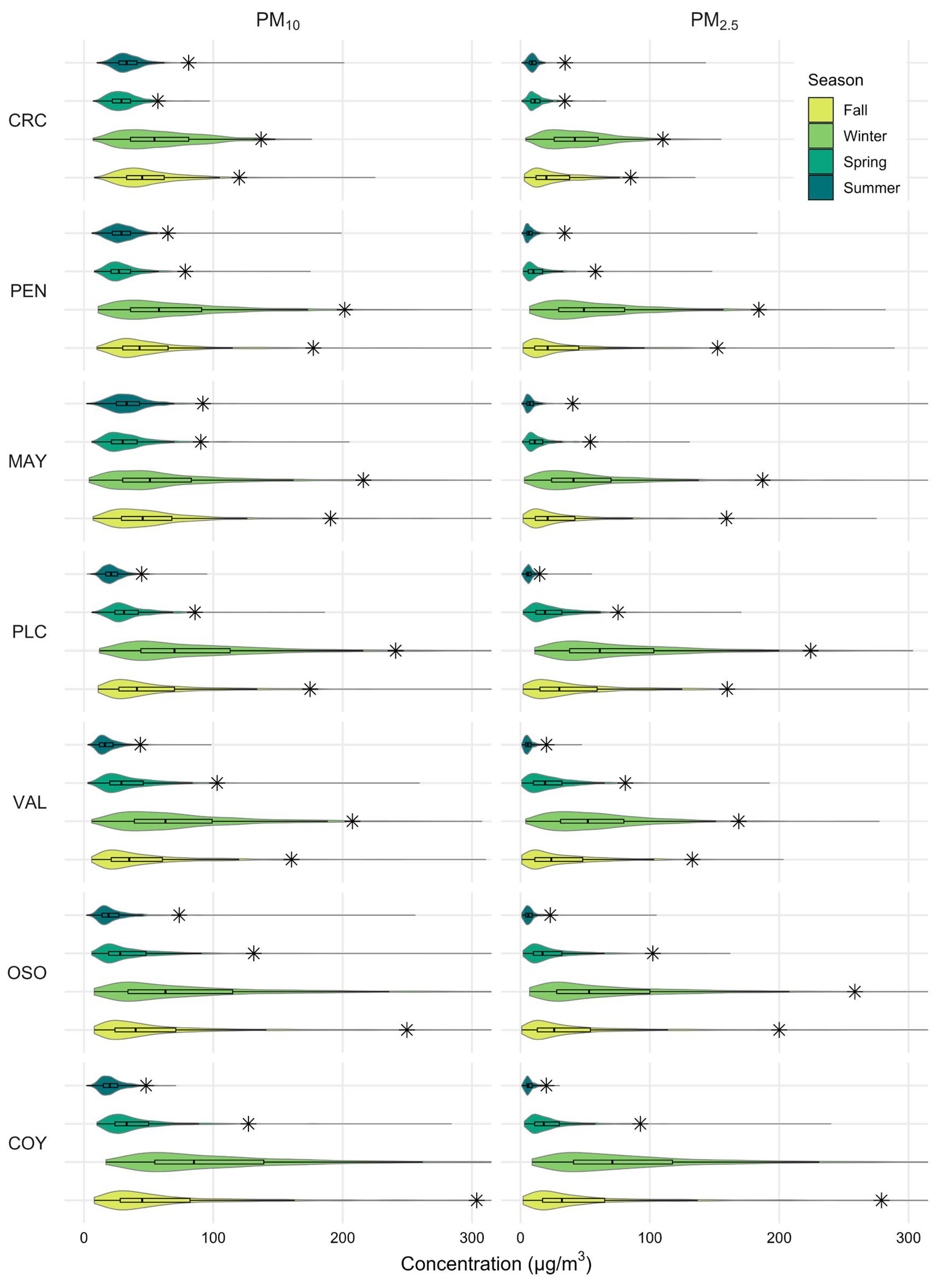
Table 3 shows PM concentrations during the period and the areas of study. In the case of PM10, the CRC station (located in the Maule region), the furthest north, recorded the lowest mean, maximum, and minimum values. Moving southward, PM10 concentrations progressively increased, reaching their highest levels at the COY station (Aysén region), and a similar north–south gradient was observed for PM2.5. At CRC, the lowest values were noted for all parameters, whereas COY exhibited the highest. This pattern is corroborated by 98% percentile on both size of PM; increasing southward, which indicate more days with a critical episode, as shown in the daily and annual exceedances in Table 3. Notably, despite being among the southernmost and least populated regions (with 91,492 inhabitants), Aysen exhibits the highest PM concentrations for both pollutants (Figure 2). Conversely, Maule, located further north and with a population of over ten times larger (908,097 inhabitants), consistently presented the lowest concentration. The observed variation suggests a higher per capita consumption of firewood in the southern regions, resulting in greater particulate emissions per inhabitant. The trend is likely related to increased energy demand for residential heating, driven by the temperature decline observed along the latitudinal gradient, which decreases between −0.38 and −0.70 °C per 100 km.
Both PM10 and PM2.5 levels exhibited a clear seasonality, with concentrations peaking during the colder months. At the northernmost station (CRC), a marked increase was observed between April and October, followed by an abrupt decline. As latitude increases, the seasonal gradient becomes less steep, likely reflecting lower maximum and minimum temperatures in southern regions (Supplementary Material Figures S1–S7). This effect is more pronounced for PM2.5 than for PM10, as indicated by the stronger negative correlation between temperature and particulate matter concentrations; colder conditions are consistently associated with higher pollutant levels, particularly in the southern stations during autumn and winter (Supplementary Material Figures S1–S7). Heatmaps for all stations further support this pattern, confirming that the highest PM10 and PM2.5 concentrations occur during the cold season. However, a decline in the number of extreme events (pre-emergency and emergency days) has been observed in recent years (Supplementary Material Figures S1–S7).
Table 4 summarizes the percentage distribution of days by categorical air quality thresholds under the Chilean (NCh), U.S. (INT), and European (ESP) standards. For PM10, the NCh thresholds classified almost all days as Good quality (94–99%), with only a small fraction (<6%) falling into Regular or Alert categories. Under the INT standard, the proportion of Good days decreased markedly (72–81%), while Regular conditions increased to 19–28%. The ESP thresholds, being considerably more stringent, reclassified most days as Regular or worse: Good quality accounted for only 14–31% of the records and Regular levels dominated (66–84%). Episodes categorized as Alert, Pre-emergency, or Emergency were also more frequent under the ESP standard, reflecting a higher sensitivity to exceedances.
For PM2.5, a similar but more pronounced trend was observed. The NCh standard labeled 75–87% of the days as Good quality, while INT reduced this proportion to 29–40%, increasing the share of Regular conditions to 54–68%. Under the ESP thresholds, the stricter limits further shifted the classification: only 32–45% of the days were considered Good, while 51–66% were Regular, and up to 49% fell within Alert or more severe categories. This comparison highlights that the application of international and European air quality criteria substantially increases the number of days classified in poorer air quality categories, particularly for PM2.5, emphasizing the relative leniency of the national standard (NCh) in evaluating exposure risk. The observed differences arise mainly from the stricter concentration limits defined by the European and U.S. standards (e.g., 50 µg/m3 for 24 h PM10 in the EU vs. 150 µg/m3 in Chile). Consequently, adopting international thresholds would substantially increase the number of alert and pre-emergency days, particularly for PM2.5, implying a greater perceived health risk and the need for more frequent mitigation measures.
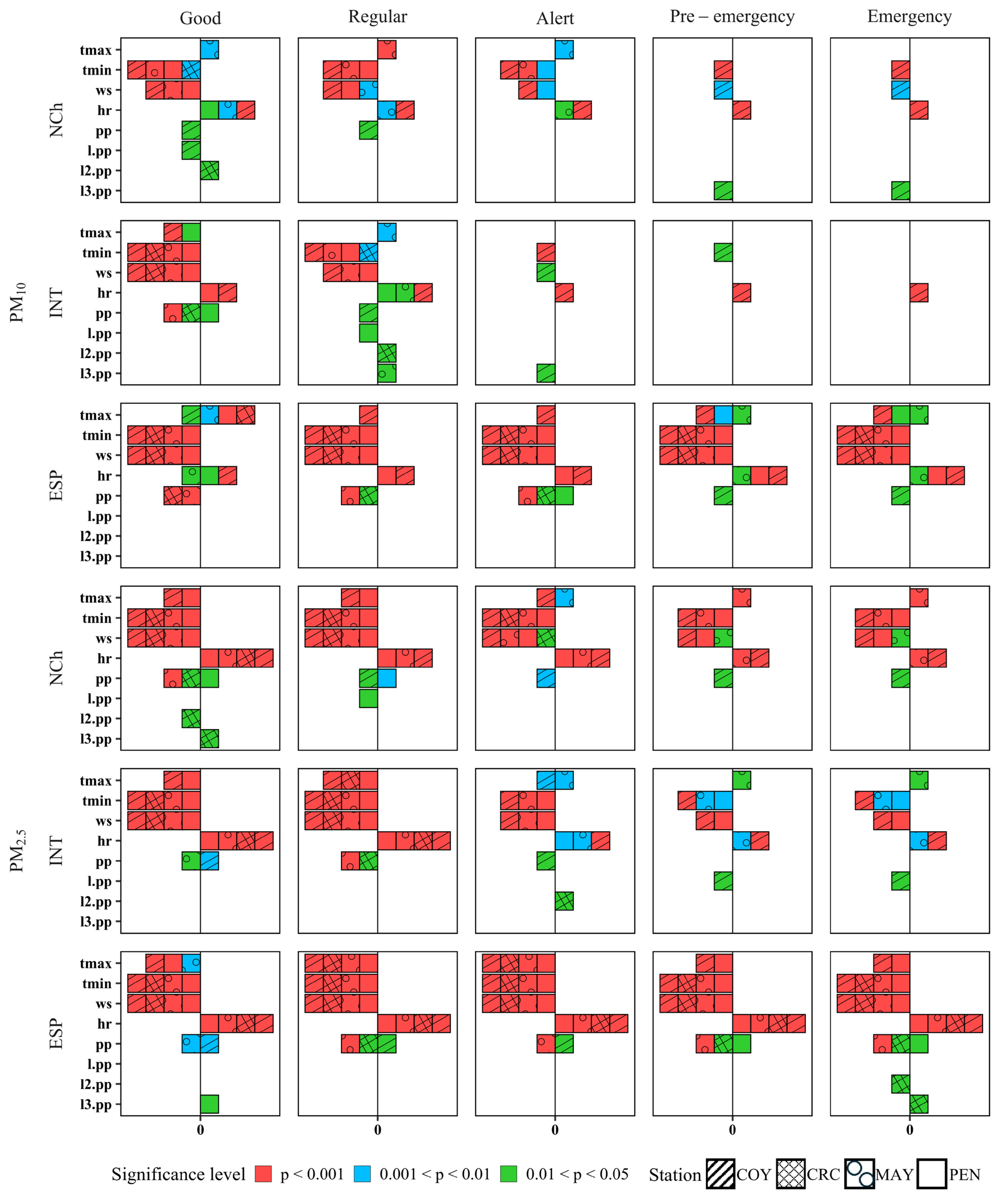
Figure 3 shows the type of relationships (positive or negative) and statistical significance of meteorological predictors on logistic regression models, disaggregated by regulatory thresholds (ESP, INT, NCh), PM fractions (PM10 and PM2.5), and monitoring stations (COY, CRC, MAY, PEN). Predictors include maximum and minimum temperature (Tmax, Tmin), wind speed (ws), relative humidity (HR), precipitation (pp), and lagged precipitation variables (l1.pp, l2.pp, l3.pp). Bar colours indicate significance levels (red: p ≤ 0.01, blue: 0.01 < p ≤ 0.05, green: 0.05 < p ≤ 0.1), and the position above or below the zero line reflects the direction of the effect.
Under ESP thresholds for PM10, Tmin and ws generally exhibit a significant negative association, while HR consistently shows a positive influence. Tmax displays a significant positive association only in CRC and PEN stations. INT thresholds show similar patterns, with minor differences in significance levels. In NCh thresholds, Tmin and Ws maintain significant negative associations across most stations and air quality categories, although Ws shows weaker effects under Moderate to Very Poor conditions. HR remains positively associated at the COY station across all thresholds, with reduced significance in MAY in the Fair, Good, and Moderate categories.
For PM2.5, ESP thresholds show a consistent negative influence of Tmax, Tmin, and Ws across most categories, except for MAY under Good air quality, where significance is lower. HR exhibits a strong and positive association across nearly all thresholds and stations. Under INT thresholds, Tmin and Ws remain negatively associated, although significance decreases under Poor and Very Poor levels in MAY and PEN. Tmax also shows a significant negative effect in most stations under Fair and Good air quality. HR shows positive effects throughout in COY, with reduced significance in Moderate to Very Poor categories. NCh thresholds confirm these trends, with Tmin and Ws consistently showing significant negative effects across all air quality levels, and Tmax showing significant influence in Fair to Moderate levels. HR maintains a positive and significant association across most thresholds and stations. Precipitation variables (PP and its lagged terms) show more heterogeneous patterns, with fewer significant associations. These effects tend to be sporadic and station-specific, with occasional positive influences at higher pollution levels, though no consistent trend is observed across thresholds or PM fractions.
Overall, results indicate a predominance of negative associations for Tmin and Ws and positive associations for HR, highlighting their importance in modulating PM concentrations. Spatial variability is notable, with stations like COY and CRC exhibiting more consistent significant effects, particularly under the local NCh threshold. These findings suggest that both the regulatory framework and meteorological dynamics play a key role in shaping air pollution episodes (Supplementary Material Tables S1–S10).
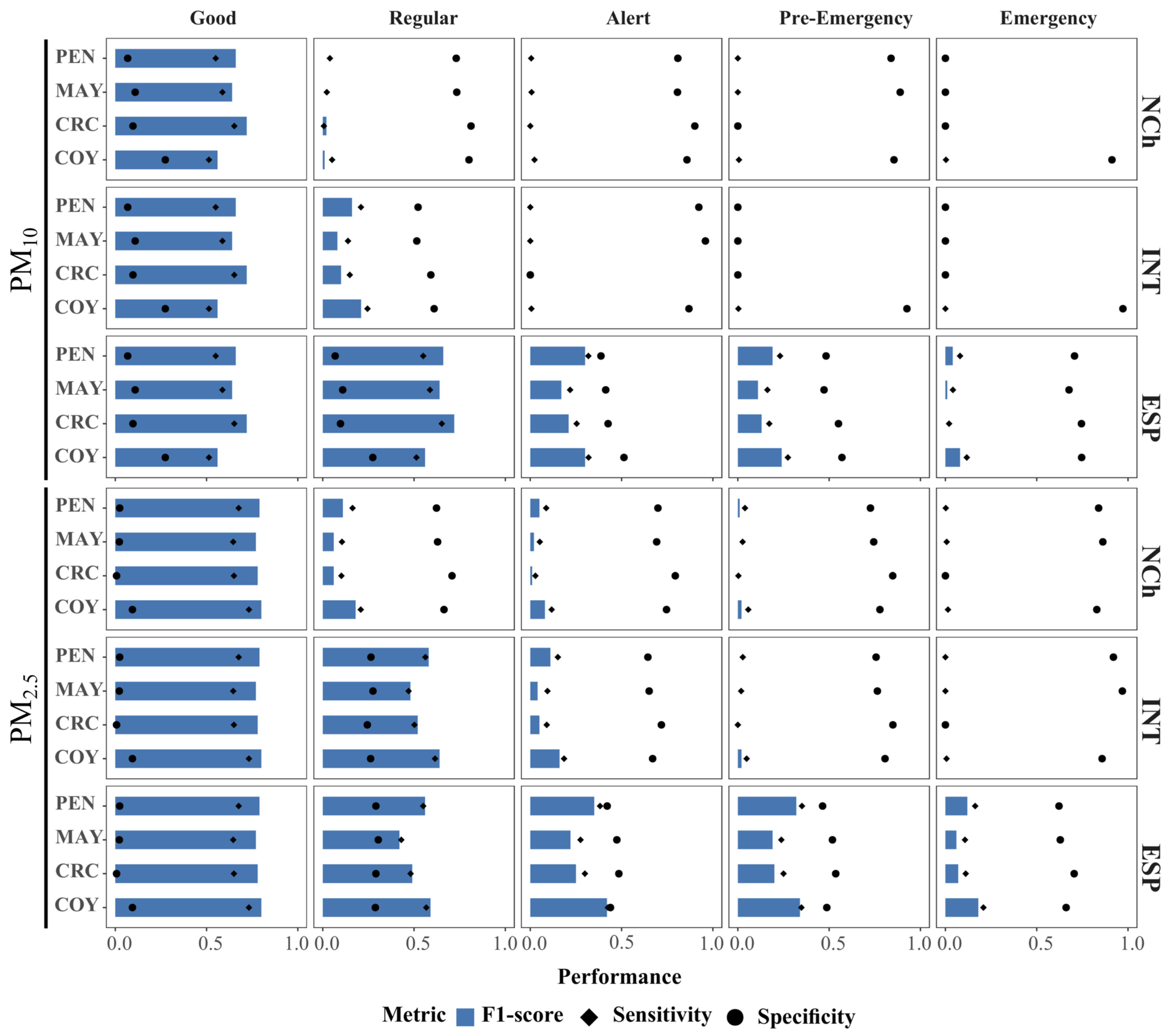
Figure 4 summarizes the predictive performance of the logistic regression models for PM10 and PM2.5 according to the sensitivity, specificity, and F1-Score metrics across the three regulatory standards (NCh, INT, ESP) and concentration thresholds (Good, Regular, Alert, Pre-emergency, Emergency). Sensitivity represents the model’s ability to correctly predict exceedances, whereas specificity indicates its ability to correctly identify non-exceedances. The F1-Score provides a balanced indicator of model performance, integrating both sensitivity and precision into a single metric for comparison among stations, thresholds, and standards.
For PM10, the results show that under the NCh standard, sensitivity values are extremely low across all stations and thresholds (generally below 5%), indicating a limited capacity to detect exceedances. Specificity, however, remains consistently high—often exceeding 80%, reflecting that the model reliably predicts non-exceedance conditions. The resulting F1-Scores are therefore close to zero, revealing an imbalance between the two metrics. Under the INT thresholds, sensitivity improves slightly (up to 24.5% at COY), particularly at the Regular category, while specificity declines moderately. The model becomes more reactive to exceedances, but still misses a large proportion of critical days. In contrast, the ESP thresholds, which are more restrictive, yield a substantial increase in sensitivity (reaching 65.2% at CRC) and higher F1-Scores (up to 0.72), although specificity drops markedly (as low as 10%). This indicates that while the model better detects exceedances under stricter criteria, it also generates more false alarms. Across stations, COY exhibits the highest specificity at the Emergency threshold (74.6%), whereas CRC achieves the best overall balance between sensitivity and accuracy under the Regular ESP threshold.
For PM2.5, the general behavior is similar but with slightly better overall performance. Under NCh, sensitivity values remain low (typically ≤ 20%), while specificity is higher (70–86%), again producing low F1-Scores (≤0.18). The INT thresholds markedly enhance model responsiveness, with sensitivity reaching 61.5% and F1-Score 0.64 at COY, though specificity decreases, particularly at lower thresholds. The ESP thresholds maintain high sensitivity (up to 56.7% at COY) and moderate F1-Scores (0.59), with specificity values around 30–70%. The consistency of results between COY and CRC suggests that southern and northern stations perform differently depending on the standard applied, but both yield their highest combined accuracy under the ESP Regular threshold.
When comparing pollutants and standards, PM2.5 shows overall higher F1-Scores than PM10, indicating that the model better captures exceedances of fine particles. The NCh thresholds are associated with the most conservative performance, high specificity and very low sensitivity, whereas ESP thresholds provide the best trade-off between detection and accuracy. In both pollutants, the highest sensitivity and F1-Scores are found at the Regular ESP thresholds, while maximum specificity occurs at the Emergency thresholds under INT and NCh. This pattern reflects a systematic shift: as thresholds become more restrictive, the model’s capacity to detect exceedances improves, but its precision in identifying non-exceedances declines.

4. Discussion

In high-latitude regions with prolonged cold seasons, residential wood combustion remains a major source of domestic heating. Recent studies highlight its relevance for particulate pollution through improved emission inventories [63], long-term trend analyses [64], quantified contributions to PM2.5 concentrations [65], and dispersion modelling under different meteorological scenarios [66]. This broader evidence helps contextualize our findings, particularly the behavior of CRC and PEN, where our logistic models showed a higher probability of exceeding the Regular and Alert thresholds during periods of reduced atmospheric ventilation. Such patterns are consistent with the accumulation dynamics described in previous studies, in which limited dispersion enhances the impact of local heating emissions [67,68].
However, the magnitude of contributions reported elsewhere, such as the 0.5–2 µg/m3 annual averages attributed to wood combustion in major Finnish cities [69], does not translate directly to the communes analyzed here. Instead, our results suggest that the exceedance behavior is driven less by heating-related demand and more by structural and meteorological factors specific to each station. For example, the markedly lower exceedance probabilities in COY indicate more efficient dispersion conditions, consistent with its urban configuration and exposure to better ventilation.
In contrast, the communes analyzed in southern Chile show considerably higher values (Table 3 and Supplementary Material Table S11). Previous studies have demonstrated that residential wood burning accounts for 80–90% of total PM2.5 emissions during winter in southern Chile [26,70,71,72]. Based on data from Chile’s National Energy Balance [73], annual per capita firewood consumption ranges from 9.3 GJ person−1 year−1 in Maule to 46.1 GJ person−1 year−1 in Aysén, increasing southward with decreasing temperature. These values are two to five times higher than those reported for European countries, typically varies between 1.6 and 8.6 GJ person−1 year−1 [74]. Such high per capita consumption underscores the strong reliance on biomass for residential heating in southern Chile and helps explain the persistently elevated PM2.5 concentrations observed during winter months (Supplementary Material Figure S8). Furthermore, these markedly elevated concentrations likely could be attributed by weaker appliance regulation, the widespread use of inefficient heating technologies, and lower urban density.
Several studies have demonstrated that stricter appliance standards and improved combustion technologies substantially reduce particulate emissions from residential wood burning. Kukkonen et al. [68] reviewed PM2.5 emissions in four Nordic cities and detailed how the Ecodesign Directive (EU 2015/1185) and the Ambient Air Quality Directive (2008/50/EC) have established emission ceilings for solid-fuel appliances, achieving significant reductions despite the persistence of older, unregulated installations. Skreiberg et al. [75] reported that modern certified stoves can emit over 80% less particulate matter than older models, mainly due to improved combustion efficiency and fuel quality. Conversely, in Chile, regulatory progress has been slower. Farías et al. [76] found that before Supreme Decrees 39/2011 and 46/2013, domestic heaters emitted 4–20 g h−1 of PM, whereas certified models now achieve <3.5 g h−1. Furthermore, fuel quality remains a major factor; an increasing wood moisture to 25% can double PM2.5 emissions per kg of wood and significantly raise particle numbers and PAH content from incomplete combustion [30].
Differences in PM levels are driven not only by emission intensity and heating technology but also by land-use configuration and atmospheric ventilation capacity. Urban areas located in valleys or topographic depressions are particularly vulnerable due to the combination of high local emissions and unfavorable meteorological conditions for dispersion [77]. During clear, cold nights, surface cooling generates strong thermal inversions that restrict vertical mixing and trap pollutants near the ground [78,79]. This mechanism has been repeatedly observed in mountainous regions [77] and extensively documented across Chilean cities in the central and southern zones [27,28,33,42,80]. Overall, low temperatures, weak winds, and frequent inversions act as natural amplifiers of residential emissions, explaining the persistence of critical pollution episodes in saturated areas where wood burning remains the dominant energy source.
The combined effect of emission intensity, fuel characteristics, and atmospheric stability defines the conditions under which pollution events develop. To further explore how these environmental factors interact, the following analysis evaluates the role of meteorological predictors in determining exceedance probabilities for PM10 and PM2.5 concentrations across stations. Previous research confirms that particulate matter concentrations systematically increase under conditions of low temperature, poor ventilation, and elevated relative humidity. In particular, inverse relationships with low minimum and maximum temperatures and wind speed suggest that cold, stagnant air limits dispersion. By contrast, relative humidity often shows a positive association, likely due to the hygroscopic growth of fine particles (PM10/PM2.5), which increases their mass and lowers their residence time in humid conditions [81,82]. Concha & Rivera [28] confirm the findings, highlighting the synergy between atmospheric stability and domestic combustion sources as the main determinant of winter pollution in topographically restricted urban contexts. In the case of precipitation, no statistically significant effect on PM concentrations was observed; consistent with Mardones & Cornejo [27], who indicate that increased use of heating can counteract the natural removal of particles during rainy events. Similarly, a direct relation between high PM concentrations and precipitation suggests that rainfall is not always a mitigating factor [8,33,55]. The reason is that the rainy season in central-south Chile typically features lightning, with isolated heavy precipitation concentrated during the winter months [83].
This coupling between meteorology and emissions explains the recurrence of critical episodes in saturated areas of Chile. It underscores the need to incorporate meteorological variables into air quality forecasting and planning systems, as recent records from the Ministry of the Environment (MMA) and SINCA show that critical episodes involving PM10 and PM2.5 remain highly frequent and recurrent in the central and southern parts of the country. During the period April–September 2024, Coyhaique recorded 27 critical episodes, including 10 pre-emergencies and 2 emergencies, followed by Osorno with 14, Los Ángeles with 10, and Chillán with 11. These are consistent with the historical patterns reported by REMA 2021, where the 98th percentile of PM10 and PM2.5 concentrations in these same municipalities greatly exceeded regulatory values, reaching averages close to or above 150 µg/m3.
Beyond meteorological controls, our results indicate that local emission patterns strongly modulate the probability of exceeding particulate thresholds. In the studied communes, residential wood combustion remains a dominant source of primary PM emissions [84,85], and its influence becomes particularly evident under conditions of limited dispersion. The higher exceedance probabilities observed in CRC and PEN are consistent with areas where firewood remains the primary heating fuel and where combustion inefficiencies, especially the burning of wet or “green” wood, significantly increase PM emission factors [86]. These characteristics amplify the sensitivity of air quality to periods of atmospheric stability, explaining why our models show sharp increases in predicted exceedances under shallow boundary-layer depths.
The contrast with neighboring countries such as Argentina, Peru, and Bolivia, where natural gas availability reduces emissions from solid fuels [87], highlights that the magnitude of threshold transitions in southern Chile is determined less by regional climate and more by the intensity and persistence of local combustion sources. The limited public awareness of the air-quality impacts of wood burning reported in previous studies [88,89] further contributes to sustained emission levels, which, in turn, increase the likelihood that episodes of low ventilation will trigger higher regulatory categories in our classification models.
Estimates based on national surveys and regional studies confirm the extent of firewood use as an energy source in southern Chile. According to the 2013 CASEN Survey (Encuesta de Caracterización Socioeconómica Nacional), 81.8% of households in the south-central regions reported using firewood for heating or cooking, underscoring its dominant role in the country’s residential energy matrix [90]. Even more strikingly, a study conducted in the city of Osorno found that 95.5% of households purchased firewood for domestic use, revealing the profound dependence on this fuel in colder southern regions [89]. Consequently, the results of this study should be interpreted within this broader socio-environmental framework, where effective air quality management demands integrated policies that combine energy efficiency, environmental education, and social equity; simultaneously addressing the economic accessibility, thermal culture, and energy vulnerability that characterize southern Chile. International experience indicates that community education campaigns and household stove modernization programs could help substantially mitigate this burden, potentially reducing emissions from wood burning by up to 60% by 2030 [68,69].
Model validation results (Figure 4) reveal that the best performance was obtained under the ESP thresholds, where the model achieved the highest sensitivities and F1-scores, particularly for the Regular category. For instance, at CRC, PM10 reached a sensitivity of 65.2% and an F1-score of 0.72, while at COY, PM2.5 achieved 56.7% and 0.59, respectively. These values indicate that, when the thresholds are less restrictive, the model achieves a better balance between sensitivity and accuracy, effectively identifying polluted days. In contrast, under the NCh and INT standards, performance declined markedly, especially for the Pre-emergency and Emergency categories, where both sensitivity and F1-score were near zero. This indicates that the model behaves conservatively, avoiding false alarms but failing to detect most critical pollution events.
Station-specific validation highlights clear spatial contrasts. COY, located in the southernmost region with the highest exceedance frequency, showed the greatest predictive consistency under the ESP framework. Superior performance likely stems from the greater frequency and persistence of critical episodes, which provide the model with a larger sample of positive cases and, consequently, a stronger learning base. This behavior aligns with observations by Vélez-Pereira et al. [51], who reported that logistic regression models perform better in areas with frequent exceedances. At the same time, sensitivity decreases in cleaner environments with fewer high-pollution days.
This relationship between model performance and threshold severity also reflects a structural and political dimension. Although the World Health Organization (WHO) recommends stricter guideline values for PM10 and PM2.5, Chile maintains comparatively lenient national standards due to the socioeconomic implications of adopting more stringent limits—particularly in the south, where residential heating depends heavily on firewood. Studies by Schueftan and Sommerhoff [56] and Vergara-Vásquez et al. [8] emphasize that energy vulnerability and the high costs of transitioning to cleaner heating systems constrain the implementation of rigorous air-quality policies. Consequently, higher sensitivities under ESP thresholds do not merely reflect better statistical performance but also mirror the reality of more frequent exceedances relative to international benchmarks. In that sense, the model’s predictive response captures both the regulatory context and the energy dependence that shape southern Chile’s air-quality dynamics, where achieving WHO-level standards would require substantial socioeconomic transformation.
When compared with other modeling strategies, logistic regression achieved a satisfactory balance between sensitivity and precision, yielding competitive F1-scores relative to multiple linear models [91,92]. While advanced nonlinear or machine learning methods, such as Random Forest, Support Vector Machines, or Neural Networks, often deliver higher predictive accuracy [49,93,94,95], yet they also demand greater computational resources and often sacrifice interpretability. In contrast, logistic regression preserves clarity and transparency, relying on interpretable coefficients and modest data requirements, features that make it particularly suitable for local-scale applications and institutional contexts with limited technical capacity.
Although the model developed in this study does not match the precision of high-resolution numerical forecasts or complex data-driven approaches, logistic regression offers an accessible and transparent framework for supporting air quality management. The method identifies probabilistic risk scenarios by integrating meteorological and socio-environmental variables that explain threshold exceedances. Within the framework of Chile’s Atmospheric Decontamination Plans (PDA); for example, DS No. 7/2019 for Coyhaique; such modeling can complement operational systems by identifying periods and locations with a higher likelihood of standard exceedance, guiding preventive and adaptive management actions. In summary, logistic regression represents a pragmatic, interpretable, and low-cost analytical tool that complements more sophisticated prediction models. Beyond forecasting, the approach strengthens understanding of how meteorological, regulatory, and social drivers converge to shape air pollution patterns, providing a sound empirical foundation for advancing air-quality governance in southern Chile.

5. Conclusions

This study shows that logistic regression effectively models the relationship between weather conditions and the chances of surpassing PM10 and PM2.5 concentration limits in various urban areas of southern Chile. Instead of aiming for long-term predictions, the model offers a clear, quantitative way to estimate the likelihood of exceedance using easily accessible weather data, making it a straightforward and efficient tool for short-term risk assessment. The differences seen between stations emphasize the significant role of local dispersion and emission patterns in the model’s predictions. Thresholds linked to poor air circulation showed the greatest sensitivity to weather changes, aligning with patterns seen in areas impacted by residential burning. Comparing different regulatory standards shows that the probabilities of exceeding limits vary greatly depending on how these thresholds are defined—highlighting the need to consider these definitions carefully when analyzing pollution episodes. Overall, our results suggest that logistic models are a valuable part of early warning systems for particulate matter pollution, especially where detailed emission data is lacking but weather data is regularly available. Future research should explore building on this approach with validation metrics that account for uncertainty, alternative machine learning methods, and combining these models with dispersion or chemical transport models to improve the reliability and usefulness of exceedance forecasts in complex terrains and diverse emission settings.

Supplementary Materials

The following supporting information can be downloaded at: https://www.mdpi.com/article/10.3390/atmos16121377/s1, Figure S1: Daily, monthly, and weekly behavior of PM10 and PM2.5 concentrations in Curicó (CRC), Maule Region; Figure S2: Daily, monthly, and weekly behavior of PM10 and PM2.5 concentrations in Puren (PEN), Ñuble Region; Figure S3: Daily, monthly, and weekly behavior of PM10 and PM2.5 concentrations in 21 de Mayo (MAY), Biobío Region; Figure S4: Daily, monthly, and weekly behavior of PM10 and PM2.5 concentrations in Padre Las Casas (PLC), Araucanía Region; Figure S5: Daily, monthly, and weekly behavior of PM10 and PM2.5 concentrations in Valdivia (VAL), Los Ríos Region; Figure S6: Daily, monthly, and weekly behavior of PM10 and PM2.5 concentrations in Osorno (OSO), Los Lagos Region; Figure S7: Daily, monthly, and weekly behavior of PM10 and PM2.5 concentrations in Coyhaique (COY), Aysén Region; Figure S8: Seasonal cycle of daily mean concentrations of PM10 and PM2.5 for all stations included in the study; Table S1: Logistic regression coefficients for the Good category according to the Chilean, International, and European thresholds for PM10; Table S2: Logistic regression coefficients for the Regular category according to the Chilean, International, and European thresholds for PM10; Table S3: Logistic regression coefficients for the Alert category according to the Chilean, International, and European thresholds for PM10; Table S4: Logistic regression coefficients for the Pre-emergency category according to the Chilean, International, and European thresholds for PM10; Table S5: Logistic regression coefficients for the Emergency category according to the Chilean, International, and European thresholds for PM10; Table S6: Logistic regression coefficients for the Good category according to the Chilean, International, and European thresholds for PM2.5; Table S7: Logistic regression coefficients for the Regular category according to the Chilean, International, and European thresholds for PM2.5; Table S8: Logistic regression coefficients for the Alert category according to the Chilean, International, and European thresholds for PM2.5; Table S9: Logistic regression coefficients for the Pre-emergency category according to the Chilean, International, and European thresholds for PM2.5; Table S10: Logistic regression coefficients for the Emergency category according to the Chilean, International, and European thresholds for PM2.5; Table S11: Comparative summary of annual PM concentrations and per capita emissions in wood-burning-dependent cities from Europe and Chile. References [96,97,98,99,100,101,102,103,104] are cited in the supplementary materials.

Author Contributions

Conceptualization, A.M.V.-P.; methodology, A.M.V.-P.; software, D.B., K.B. and N.N.-M.; validation, A.M.V.-P.; formal analysis, D.B., K.B. and N.N.-M.; investigation, A.M.V.-P., D.B., K.B. and N.N.-M.; resources, A.M.V.-P. and D.J.O.; data curation, D.B., K.B. and N.N.-M.; writing—original draft preparation, D.B., K.B. and N.N.-M.; writing—review and editing, A.M.V.-P. and D.J.O.; visualization, D.B., K.B. and N.N.-M.; supervision, A.M.V.-P.; project administration, A.M.V.-P.; funding acquisition, A.M.V.-P. All authors have read and agreed to the published version of the manuscript.

Funding

This research received no external funding, and D.J.OC funded the APC.

Institutional Review Board Statement

Not applicable.

Informed Consent Statement

Not applicable.

Data Availability Statement

The data supporting the findings of this study are publicly available from the National Air Quality Information System of Chile (SINCA) at https://sinca.mma.gob.cl/. All datasets used in the analysis are open access and have been described in detail in the Methodology section.

Acknowledgments

The authors would like to thank L.M. Hernández-Beleño for his valuable support in debugging and managing the R scripts used in this study.

Conflicts of Interest

The authors declare that they have no conflicts of interest.

Abbreviations

The following abbreviations are used in this manuscript:
AQIAir Quality Index
COYCoyhaique monitoring station
CRCCuricó monitoring station
CR2Climate Science and Resilience Center (Centro de Ciencia del Clima y la Resiliencia, Chile)
EEAEuropean Environment Agency
EPAEnvironmental Protection Agency
ESPEuropean Air Quality Standard
HRRelative Humidity
INTInternational Air Quality Index (U.S. EPA)
LogitLogistic Regression Model
l1.ppPrecipitation with a one-day lag
l2.ppPrecipitation with a two-day lag
l3.ppPrecipitation with a three-day lag
MAY21 de Mayo monitoring station
MLMachine Learning
NChChilean Primary Air Quality Standard
OPOxidative Potential
OSOOsorno monitoring station
PAHsPolycyclic Aromatic Hydrocarbons
PENPemuco monitoring station
PMParticulate Matter
PM2.5Particulate Matter with aerodynamic diameter ≤ 2.5 μm
PM10Particulate Matter with aerodynamic diameter ≤ 10 μm
PPPrecipitation
SINCANational Air Quality Information System of Chile (Sistema de Información Nacional de Calidad del Aire)
wsWind speed

References

  1. Matamoros, J.R.; Ramírez, M.A.M.; Zamorano, S.M.B. La relación entre la contaminación del aire por material particulado y la salud de la vegetación urbana. Rev. SPINOR 2025, 60, 78–85. [Google Scholar]
  2. Rovira, J.; Domingo, J.L.; Schuhmacher, M. Calidad Del Aire, Impactos En La Salud y Carga de Enfermedad Por Contaminación Atmosférica (PM10, PM2.5, NO2 y O3): Aplicación Del Modelo AirQ+ a La Comarca Del Camp de Tarragona (Cataluña, España). Sci. Total Environ. 2020, 703, 135538. [Google Scholar] [CrossRef] [PubMed]
  3. Anjum, M.S.; Ali, S.M.; Imad-Ud-Din, M.; Subhani, M.A.; Anwar, M.N.; Nizami, A.-S.; Ashraf, U.; Khokhar, M.F. An Emerged Challenge of Air Pollution and Ever-Increasing Particulate Matter in Pakistan; A Critical Review. J. Hazard. Mater. 2021, 402, 123943. [Google Scholar] [CrossRef] [PubMed]
  4. Stockfelt, L.; Andersson, E.M.; Molnár, P.; Gidhagen, L.; Segersson, D.; Rosengren, A.; Barregard, L.; Sallsten, G. Long-Term Effects of Total and Source-Specific Particulate Air Pollution on Incident Cardiovascular Disease in Gothenburg, Sweden. Environ. Res. 2017, 158, 61–71. [Google Scholar] [CrossRef]
  5. Mannucci, P.M.; Harari, S.; Martinelli, I.; Franchini, M. Effects on Health of Air Pollution: A Narrative Review. Intern. Emerg. Med. 2015, 10, 657–662. [Google Scholar] [CrossRef]
  6. Kim, K.-H.; Kabir, E.; Kabir, S. A Review on the Human Health Impact of Airborne Particulate Matter. Environ. Int. 2015, 74, 136–143. [Google Scholar] [CrossRef]
  7. Harrison, R.M. Airborne Particulate Matter. Philos. Trans. R. Soc. A Math. Phys. Eng. Sci. 2020, 378, 20190319. [Google Scholar] [CrossRef]
  8. Vergara-Vásquez, E.; Beleño, L.M.H.; Castrillo-Borja, T.T.; Bolaño-Ortíz, T.R.; Camargo-Caicedo, Y.; Vélez-Pereira, A.M. Airborne Particulate Matter Integral Assessment in Magdalena Department, Colombia: Patterns, Health Impact, and Policy Management. Heliyon 2024, 10, e36284. [Google Scholar] [CrossRef]
  9. Mahmud, S.; Ridi, T.B.I.; Miah, M.S.; Sarower, F.; Elahee, S. Implementing Machine Learning Algorithms to Predict Particulate Matter (PM2.5): A Case Study in the Paso Del Norte Region. Atmosphere 2022, 13, 2100. [Google Scholar] [CrossRef]
  10. de Souza, A.; de Oliveira-Júnior, J.F.; Cardoso, K.R.A.; Fernandes, W.A.; Pavao, H.G. The Impact of Meteorological Variables on Particulate Matter Concentrations. Atmosphere 2025, 16, 875. [Google Scholar] [CrossRef]
  11. Solís, R.; Toro, R.; Gomez, L.; Vélez-Pereira, A.M.; López, M.; Fleming, Z.L.; Fierro, N.; Leiva, M. Long-Term Airborne Particle Pollution Assessment in the City of Coyhaique, Patagonia, Chile. Urban Clim. 2022, 43, 101144. [Google Scholar] [CrossRef]
  12. Rajput, P.; Izhar, S.; Gupta, T. Deposition Modeling of Ambient Aerosols in Human Respiratory System: Health Implication of Fine Particles Penetration into Pulmonary Region. Atmos. Pollut. Res. 2019, 10, 334–343. [Google Scholar] [CrossRef]
  13. Orellano, P.; Reynoso, J.; Quaranta, N.; Bardach, A.; Ciapponi, A. Short-Term Exposure to Particulate Matter (PM10 and PM2.5), Nitrogen Dioxide (NO2), and Ozone (O3) and All-Cause and Cause-Specific Mortality: Systematic Review and Meta-Analysis. Environ. Int. 2020, 142, 105876. [Google Scholar] [CrossRef] [PubMed]
  14. Karanasiou, A.; Alastuey, A.; Amato, F.; Renzi, M.; Stafoggia, M.; Tobias, A.; Reche, C.; Forastiere, F.; Gumy, S.; Mudu, P.; et al. Short-Term Health Effects from Outdoor Exposure to Biomass Burning Emissions: A Review. Sci. Total Environ. 2021, 781, 146739. [Google Scholar] [CrossRef] [PubMed]
  15. Dąbrowiecki, P.; Chciałowski, A.; Dąbrowiecka, A.; Badyda, A. Ambient Air Pollution and Risk of Admission Due to Asthma in the Three Largest Urban Agglomerations in Poland: A Time-Stratified, Case-Crossover Study. Int. J. Environ. Res. Public Health 2022, 19, 5988. [Google Scholar] [CrossRef]
  16. Wu, D.; Chen, L.; Ma, Z.; Zhou, D.; Fu, L.; Liu, M.; Zhang, T.; Yang, J.; Zhen, Q. Source Analysis and Health Risk Assessment of Polycyclic Aromatic Hydrocarbon (PAHs) in Total Suspended Particulate Matter (TSP) from Bengbu, China. Sci. Rep. 2024, 14, 5080. [Google Scholar] [CrossRef]
  17. Deng, Q.; Lu, C.; Li, Y.; Chen, L.; He, Y.; Sundell, J.; Norbäck, D. Association between Prenatal Exposure to Industrial Air Pollution and Onset of Early Childhood Ear Infection in China. Atmos. Environ. 2017, 157, 18–26. [Google Scholar] [CrossRef]
  18. Ghosh, S.; Rabha, R.; Chowdhury, M.; Padhy, P.K. Caracterización de Las Fuentes y Especies Químicas de PM10 y Evaluación de Los Riesgos Para La Salud Humana En Zonas Semiurbanas, Urbanas e Industriales de Bengala Occidental (India). Chemosphere 2018, 207, 626–636. [Google Scholar] [CrossRef]
  19. Perez, P.; Menares, C.; Ramírez, C. PM2.5 Forecasting in Coyhaique, the Most Polluted City in the Americas. Urban Clim. 2020, 32, 100608. [Google Scholar] [CrossRef]
  20. Chowdhury, S.; Pillarisetti, A.; Oberholzer, A.; Jetter, J.; Mitchell, J.; Cappuccilli, E.; Aamaas, B.; Aunan, K.; Pozzer, A.; Alexander, D. A Global Review of the State of the Evidence of Household Air Pollution’s Contribution to Ambient Fine Particulate Matter and Their Related Health Impacts. Environ. Int. 2023, 173, 107835. [Google Scholar] [CrossRef]
  21. Jiang, K.; Xing, R.; Luo, Z.; Li, Y.; Wang, J.; Zhang, W.; Zhu, Y.; Men, Y.; Shen, G.; Tao, S. Unclean but Affordable Solid Fuels Effectively Sustained Household Energy Equity. Nat. Commun. 2024, 15, 9761. [Google Scholar] [CrossRef] [PubMed]
  22. Plass Carvallo, M. Contaminación Atmosférica en el sur de Chile: Una Aproximación Cualitativa a Las Prácticas Sociales de Consumo de Leña en Temuco y Padre Las Casas; Universidad de Chile: Santiago, Chile, 2020. [Google Scholar]
  23. Durán Pulgar, S. Contaminación Atmosférica y Consumo de Leña en Valdivia: 2004–2018; Universidad de Chile: Santiago, Chile, 2019. [Google Scholar]
  24. Calvo Gallardo, R.I. El Efecto de la Pobreza Energética en la Reducción de Contaminación Atmosférica por Material Particulado 2,5; Universidad de Chile: Santiago, Chile, 2021. [Google Scholar]
  25. Huneeus, N. El Aire que Respiramos: Pasado, Presente y Futuro—Contaminación Atmosférica por MP2.5 en el Centro y sur de Chile; Centro de Ciencia del Clima y la Resiliencia (CR)2: Santiago, Chile, 2020; (ANID/FONDAP/15110009). [Google Scholar]
  26. Quinteros, M.E.; Blanco, E.; Sanabria, J.; Rosas-Diaz, F.; Blazquez, C.A.; Ayala, S.; Cárdenas-R, J.P.; Stone, E.A.; Sybesma, K.; Delgado-Saborit, J.M.; et al. Spatio-Temporal Distribution of Particulate Matter and Wood-Smoke Tracers in Temuco, Chile: A City Heavily Impacted by Residential Wood-Burning. Atmos. Environ. 2023, 294, 119529. [Google Scholar] [CrossRef]
  27. Mardones, C.; Cornejo, N. Ex—Post Evaluation of a Program to Reduce Critical Episodes Due to Air Pollution in Southern Chile. Environ. Impact Assess. Rev. 2020, 80, 106334. [Google Scholar] [CrossRef]
  28. Concha, C.; Rivera, N.M. Wood-Burning Restrictions and Air Pollution: The Case of Air Quality Warnings in Southern Chile. Environ. Dev. Econ. 2025, 1–22. [Google Scholar] [CrossRef]
  29. Cereceda-Balic, F.; Toledo, M.; Vidal, V.; Guerrero, F.; Diaz-Robles, L.A.; Petit-Breuilh, X.; Lapuerta, M. Emission Factors for PM2.5, CO, CO2, NOx, SO2 and Particle Size Distributions from the Combustion of Wood Species Using a New Controlled Combustion Chamber 3CE. Sci. Total Environ. 2017, 584–585, 901–910. [Google Scholar] [CrossRef]
  30. Guerrero, F.; Yáñez, K.; Vidal, V.; Cereceda-Balic, F. Effects of Wood Moisture on Emission Factors for PM2.5, Particle Numbers and Particulate-Phase PAHs from Eucalyptus Globulus Combustion Using a Controlled Combustion Chamber for Emissions. Sci. Total Environ. 2019, 648, 737–744. [Google Scholar] [CrossRef]
  31. Jimenez, J.; Farias, O.; Quiroz, R.; Yañez, J. Emission Factors of Particulate Matter, Polycyclic Aromatic Hydrocarbons, and Levoglucosan from Wood Combustion in South-Central Chile. J. Air Waste Manag. Assoc. 2017, 67, 806–813. [Google Scholar] [CrossRef]
  32. Ministerio del Medio Ambiente. Informe del Estado del Medio Ambiente 2024; Ministerio del Medio Ambiente de Chile: Santiago, Chile, 2024. [Google Scholar]
  33. Quinteros, M.E.; Blazquez, C.; Ayala, S.; Kilby, D.; Cárdenas-R, J.P.; Ossa, X.; Rosas-Diaz, F.; Stone, E.A.; Blanco, E.; Delgado-Saborit, J.-M.; et al. Development of Spatio-Temporal Land Use Regression Models for Fine Particulate Matter and Wood-Burning Tracers in Temuco, Chile. Environ. Sci. Technol. 2023, 57, 19473–19486. [Google Scholar] [CrossRef]
  34. Ministerio de Energía de Chile. Informe Balance Nacional de Energía 2020; Ministerio de Energía de Chile: Santiago, Chile, 2022. [Google Scholar]
  35. Basoa, K.; Fleming, Z.L.; Leiva, M.A.; Concha, C.; Menares, C. Current Status, Trends, and Future Directions in Chilean Air Quality: A Data-Driven Perspective. Atmosphere 2025, 16, 733. [Google Scholar] [CrossRef]
  36. Molnar, C. Interpretable Machine Learning; Lulu.com: Morrisville, NC, USA, 2020; ISBN 978-0-244-76852-2. [Google Scholar]
  37. Ministerio del Medio Ambiente Planes de Prevención y/o Descontaminación Atmosférica (PPDA). Available online: https://ppda.mma.gob.cl/ (accessed on 2 October 2024).
  38. Bates, J.T.; Fang, T.; Verma, V.; Zeng, L.; Weber, R.J.; Tolbert, P.E.; Abrams, J.Y.; Sarnat, S.E.; Klein, M.; Mulholland, J.A.; et al. Review of Acellular Assays of Ambient Particulate Matter Oxidative Potential: Methods and Relationships with Composition, Sources, and Health Effects. Environ. Sci. Technol. 2019, 53, 4003–4019. [Google Scholar] [CrossRef]
  39. Bates, J.T.; Weber, R.J.; Abrams, J.; Verma, V.; Fang, T.; Klein, M.; Strickland, M.J.; Sarnat, S.E.; Chang, H.H.; Mulholland, J.A.; et al. Reactive Oxygen Species Generation Linked to Sources of Atmospheric Particulate Matter and Cardiorespiratory Effects. Environ. Sci. Technol. 2015, 49, 13605–13612. [Google Scholar] [CrossRef]
  40. Lilhore, U.K.; Simaiya, S.; Singh, R.K.; Baqasah, A.M.; Alroobaea, R.; Alsafyani, M.; Alhazmi, A.; Khan, M.D.M. Advanced Air Quality Prediction Using Multimodal Data and Dynamic Modeling Techniques. Sci. Rep. 2025, 15, 27867. [Google Scholar] [CrossRef]
  41. Rosca, C.-M.; Carbureanu, M.; Stancu, A. Data-Driven Approaches for Predicting and Forecasting Air Quality in Urban Areas. Appl. Sci. 2025, 15, 4390. [Google Scholar] [CrossRef]
  42. Gramsch, E.; Cáceres, D.; Oyola, P.; Reyes, F.; Vásquez, Y.; Rubio, M.A.; Sánchez, G. Influencia de La Inversión Térmica Superficial y de Subsidencia En La Concentración de PM2.5 y Carbono Negro. Atmos. Environ. 2014, 98, 290–298. [Google Scholar] [CrossRef]
  43. Sharp, R.; Ihshaish, H.; Deza, J.I. Wind Power Ramp Characterisation and Forecasting Using Numerical Weather Prediction and Machine Learning Models; SSRN: Rochester, NY, USA, 2021. [Google Scholar]
  44. Boukabara, S.-A.; Krasnopolsky, V.; Stewart, J.Q.; Maddy, E.S.; Shahroudi, N.; Hoffman, R.N. Leveraging Modern Artificial Intelligence for Remote Sensing and NWP: Benefits and Challenges. Bull. Am. Meteorol. Soc. 2019, 100, ES473–ES491. [Google Scholar] [CrossRef]
  45. Lagasio, M.; Pulvirenti, L.; Parodi, A.; Boni, G.; Pierdicca, N.; Venuti, G.; Realini, E.; Tagliaferro, G.; Barindelli, S.; Rommen, B. Effect of the Ingestion in the WRF Model of Different Sentinel-Derived and GNSS-Derived Products: Analysis of the Forecasts of a High Impact Weather Event. Eur. J. Remote Sens. 2019, 52, 16–33. [Google Scholar] [CrossRef]
  46. Lee, J.-B.; Lee, J.-B.; Koo, Y.-S.; Kwon, H.-Y.; Choi, M.-H.; Park, H.-J.; Lee, D.-G. Development of a Deep Neural Network for Predicting 6&thinsp;h Average PM2.5 Concentrations up to 2 Subsequent Days Using Various Training Data. Geosci. Model Dev. 2022, 15, 3797–3813. [Google Scholar] [CrossRef]
  47. Brotzge, J.A.; Berchoff, D.; Carlis, D.L.; Carr, F.H.; Carr, R.H.; Gerth, J.J.; Gross, B.D.; Hamill, T.M.; Haupt, S.E.; Jacobs, N.; et al. Challenges and Opportunities in Numerical Weather Prediction. Bull. Am. Meteorol. Soc. 2023, 104, E698–E705. [Google Scholar] [CrossRef]
  48. He, S.; Li, X.; DelSole, T.; Ravikumar, P.; Banerjee, A. Sub-Seasonal Climate Forecasting via Machine Learning: Challenges, Analysis, and Advances. Proc. AAAI Conf. Artif. Intell. 2021, 35, 169–177. [Google Scholar] [CrossRef]
  49. Vallejo, F.; Yánez, D.; Viñán-Guerrero, P.; A Díaz-Robles, L.; Oyaneder, M.; Reinoso, N.; Billartello, L.; Espinoza-Pérez, A.; Espinoza-Pérez, L.; Pino-Cortés, E. Enhancing Air Quality Predictions in Chile: Integrating ARIMA and Artificial Neural Network Models for Quintero and Coyhaique Cities. PLoS ONE 2025, 20, e0314278. [Google Scholar] [CrossRef]
  50. Vélez-Pereira, A.M.; De Linares, C.; Belmonte, J. Aerobiological Modeling I: A Review of Predictive Models. Sci. Total Environ. 2021, 795, 148783. [Google Scholar] [CrossRef] [PubMed]
  51. Vélez-Pereira, A.M.; De Linares, C.; Canela, M.-A.; Belmonte, J. Logistic Regression Models for Predicting Daily Airborne Alternaria and Cladosporium Concentration Levels in Catalonia (NE Spain). Int. J. Biometeorol. 2019, 63, 1541–1553. [Google Scholar] [CrossRef]
  52. Mejía Martínez, N.; Montes Martín, L.M. Application of Statistical Modeling Techniques for PM10 Levels Forecast in Bogotá; Universidad de los Andes: Bogotá, Colombia, 2018. [Google Scholar]
  53. Vélez-Pereira, A.M.; De Linares, C.; Canela, M.A.; Belmonte, J. A Comparison of Models for the Forecast of Daily Concentration Thresholds of Airborne Fungal Spores. Atmosphere 2023, 14, 1016. [Google Scholar] [CrossRef]
  54. Martínez-Bracero, M.; Vélez-Pereira, A.M.; Markey, E.; Clancy, J.H.; Sarda-Estève, R.; O’Connor, D.J. Comparative Analysis of Grass Pollen Dynamics in Urban and Rural Ireland: Identifying Key Sources and Optimizing Prediction Models. Atmosphere 2024, 15, 1198. [Google Scholar] [CrossRef]
  55. Rizzo, L.V.; Miranda, A.G.B. Short Term Forecasting of Persistent Air Quality Deterioration Events in the Metropolis of Sao Paulo. Urban Clim. 2024, 55, 101876. [Google Scholar] [CrossRef]
  56. Schueftan, A.; Sommerhoff, J.; González, A.D. Firewood Demand and Energy Policy in South-Central Chile. Energy Sustain. Dev. 2016, 33, 26–35. [Google Scholar] [CrossRef]
  57. Cortés, A.; Ridley, I. Efectos de La Combustión a Leña En La Calidad Del Aire Intradomiciliario: La Ciudad de Temuco Como Caso de Estudio. Rev. INVI 2013, 28, 257–271. [Google Scholar] [CrossRef]
  58. Ministerio del Medio Ambiente de Chile. Decreto Supremo No 12 Establece Norma Primaria de Calidad Ambiental Para Material Particulado Fino Respirable MP2.5; Ministerio del Medio Ambiente de Chile: Santiago, Chile, 2011. [Google Scholar]
  59. Ministerio del Medio Ambiente de Chile. Decreto Supremo No 12 Establece Norma Primaria de Calidad Ambiental Para Material Particulado Fino Respirable MP10; Ministerio del Medio Ambiente de Chile: Santiago, Chile, 2022. [Google Scholar]
  60. Real, R.; Barbosa, A.M.; Vargas, J.M. Obtaining Environmental Favourability Functions from Logistic Regression. Environ. Ecol. Stat. 2006, 13, 237–245. [Google Scholar] [CrossRef]
  61. Pant, A.; Sharma, S.; Pant, K. Evaluation of Machine Learning Algorithms for Air Quality Index (AQI) Prediction. J. Reliab. Stat. Stud. 2023, 16, 229–242. [Google Scholar] [CrossRef]
  62. Matara, C.M.; Nyambane, S.O.; Yusuf, A.O.; Ochungo, E.A.; Khattak, A. Classification of Particulate Matter (PM2.5) Concentrations Using Feature Selection and Machine Learning Strategies. LOGI Sci. J. Transp. Logist. 2024, 15, 85–96. [Google Scholar] [CrossRef]
  63. Zalzal, J.; Liu, Y.; Smargiassi, A.; Hatzopoulou, M. Improving Residential Wood Burning Emission Inventories with the Integration of Readily Available Data Sources. Sci. Total Environ. 2024, 946, 174226. [Google Scholar] [CrossRef]
  64. Font, A.; Ciupek, K.; Butterfield, D.; Fuller, G.W. Long-Term Trends in Particulate Matter from Wood Burning in the United Kingdom: Dependence on Weather and Social Factors. Environ. Pollut. 2022, 314, 120105. [Google Scholar] [CrossRef] [PubMed]
  65. Kangas, L.; Kukkonen, J.; Kauhaniemi, M.; Riikonen, K.; Sofiev, M.; Kousa, A.; Niemi, J.V.; Karppinen, A. The Contribution of Residential Wood Combustion to the PM2.5 Concentrations in the Helsinki Metropolitan Area. Atmos. Chem. Phys. 2024, 24, 1489–1507. [Google Scholar] [CrossRef]
  66. Wolf, T.; Pettersson, L.H.; Esau, I. Dispersion of Particulate Matter (PM2.5) from Wood Combustion for Residential Heating: Optimization of Mitigation Actions Based on Large-Eddy Simulations. Atmos. Chem. Phys. 2021, 21, 12463–12477. [Google Scholar] [CrossRef]
  67. Orru, H.; Olstrup, H.; Kukkonen, J.; López-Aparicio, S.; Segersson, D.; Geels, C.; Tamm, T.; Riikonen, K.; Maragkidou, A.; Sigsgaard, T.; et al. Health Impacts of PM2.5 Originating from Residential Wood Combustion in Four Nordic Cities. BMC Public Health 2022, 22, 1286. [Google Scholar] [CrossRef]
  68. Kukkonen, J.; López-Aparicio, S.; Segersson, D.; Geels, C.; Kangas, L.; Kauhaniemi, M.; Maragkidou, A.; Jensen, A.; Assmuth, T.; Karppinen, A.; et al. The Influence of Residential Wood Combustion on the Concentrations of PM2.5 in Four Nordic Cities. Atmos. Chem. Phys. 2020, 20, 4333–4365. [Google Scholar] [CrossRef]
  69. Savolahti, M.; Lehtomäki, H.; Karvosenoja, N.; Paunu, V.-V.; Korhonen, A.; Kukkonen, J.; Kupiainen, K.; Kangas, L.; Karppinen, A.; Hänninen, O. Residential Wood Combustion in Finland: PM2.5 Emissions and Health Impacts with and without Abatement Measures. Int. J. Environ. Res. Public Health 2019, 16, 2920. [Google Scholar] [CrossRef]
  70. Reyes, F.; Ahumada, S.; Rojas, F.; Oyola, P.; Vásquez, Y.; Aguilera, C.; Henriquez, A.; Gramsch, E.; Kang, C.-M.; Saarikoski, S.; et al. Impact of Biomass Burning on Air Quality in Temuco City, Chile. Aerosol Air Qual. Res. 2021, 21, 210110. [Google Scholar] [CrossRef]
  71. Hellack, B.; Kuhlbusch, T.; Vázquez, Y.; Reyes, F.; Oyola, P.; Gidhagen, L. Air Pollution Due Residential Wood Burning In Southern Chile And Potential Emission Reduction. ISEE Conf. Abstr. Environ. Health Perspect. 2015, 2015, 3595. [Google Scholar] [CrossRef]
  72. Ministerio de Energía Gobierno de Chile. Estrategia de Transición Energética Residencial; Ministerio de Energía Gobierno de Chile: Santiago, Chile, 2020. [Google Scholar]
  73. Ministerio de Energía. División de Planificación Estratégica y Desarrollo Sostenible Cuadro Regional de Consumo, Balance Nacional de Energía BNE 2023; Ministerio de Energía: Santiago, Chile, 2024. [Google Scholar]
  74. van der Gon, H.A.C.D.; Bergström, R.; Fountoukis, C.; Johansson, C.; Pandis, S.N.; Simpson, D.; Visschedijk, A.J.H. Particulate Emissions from Residential Wood Combustion in Europe—Revised Estimates and an Evaluation. Atmos. Chem. Phys. 2015, 15, 6503–6519. [Google Scholar] [CrossRef]
  75. Skreiberg, Ø.; Seljeskog, M.; Kausch, F. A Critical Review and Discussion on Emission Factors for Wood Stoves. Chem. Eng. Trans. 2022, 92, 235–240. [Google Scholar] [CrossRef]
  76. Farías, O.; Jiménez, J.; Salgado, C. Impacto de La Normativa Ambiental Chilena Sobre El Desarrollo Tecnólogico de Calefactores a Biomasa. In Proceedings of the Congreso Iberoamericano de Ingeniería Mecánica CIBEM, Lisbon, Portugal, 23–26 October 2019; Univesidade Nova de Lisboa: Lisbon, Portugal, 2019; p. 164. [Google Scholar]
  77. Glojek, K.; Močnik, G.; Alas, H.D.C.; Cuesta-Mosquera, A.; Drinovec, L.; Gregorič, A.; Ogrin, M.; Weinhold, K.; Ježek, I.; Müller, T.; et al. The Impact of Temperature Inversions on Black Carbon and Particle Mass Concentrations in a Mountainous Area. Atmos. Chem. Phys. 2022, 22, 5577–5601. [Google Scholar] [CrossRef]
  78. Lyamani, H.; Olmo, F.J.; Alados-Arboledas, L. Physical and Optical Properties of Aerosols over an Urban Location in Spain: Seasonal and Diurnal Variability. Atmos. Chem. Phys. 2010, 10, 239–254. [Google Scholar] [CrossRef]
  79. Sandradewi, J.; Prévôt, A.S.H.; Szidat, S.; Perron, N.; Alfarra, M.R.; Lanz, V.A.; Weingartner, E.; Baltensperger, U. Using Aerosol Light Absorption Measurements for the Quantitative Determination of Wood Burning and Traffic Emission Contributions to Particulate Matter. Environ. Sci. Technol. 2008, 42, 3316–3323. [Google Scholar] [CrossRef]
  80. Molina, C.; Toro, A.R.; Morales, S.R.G.E.; Manzano, C.; Leiva-Guzmán, M.A. Particulate Matter in Urban Areas of South-Central Chile Exceeds Air Quality Standards. Air Qual. Atmos. Health 2017, 10, 653–667. [Google Scholar] [CrossRef]
  81. Zender-Świercz, E.; Galiszewska, B.; Telejko, M.; Starzomska, M. The Effect of Temperature and Humidity of Air on the Concentration of Particulate Matter—PM2.5 and PM10. Atmos. Res. 2024, 312, 107733. [Google Scholar] [CrossRef]
  82. Merenda, B.; Drzeniecka-Osiadacz, A.; Sówka, I.; Sawiński, T.; Samek, L. Influence of Meteorological Conditions on the Variability of Indoor and Outdoor Particulate Matter Concentrations in a Selected Polish Health Resort. Sci. Rep. 2024, 14, 19461. [Google Scholar] [CrossRef]
  83. Soto-Escobar, C.; Zambrano-Bigiarini, M.; Tolorza, V.; Garreaud, R. Gridded Intensity-Duration-Frequency (IDF) Curves: Understanding Precipitation Extremes in a Drying Climate. EGUsphere 2025, 1–44. [Google Scholar] [CrossRef]
  84. Araya, P. Firewood Heating and Pollution in the South of Chile: A Systems Approach for a Comprehensive Literature Review. In Proceedings of the 33rd International on Passive and Low Energy Architecture Conference: Design to Thrive, PLEA 2017, Edinburgh, UK, 2–5 July 2017. [Google Scholar]
  85. Schueftan, A.; González, A.D. Reduction of Firewood Consumption by Households in South-Central Chile Associated with Energy Efficiency Programs. Energy Policy 2013, 63, 823–832. [Google Scholar] [CrossRef]
  86. Álvarez, B.; Boso, À.; Rodríguez, I.; Hofflinger, Á.; Vallejos-Romero, A. Who Buys Certified Firewood? Individual Determinants of Clean Fuel Adoption for Promoting the Sustainable Energy Transition in Southern Chile. Energ. Sustain. Soc. 2021, 11, 29. [Google Scholar] [CrossRef]
  87. Jorquera, H.; Villalobos, A.M.; Schauer, J.J. Wood Burning Pollution in Chile: A Tale of Two Mid-Size Cities. Atmos. Pollut. Res. 2021, 12, 50–59. [Google Scholar] [CrossRef]
  88. Boso, À.; Oltra, C.; Hofflinger, Á. Participation in a Programme for Assisted Replacement of Wood-Burning Stoves in Chile: The Role of Sociodemographic Factors, Evaluation of Air Quality and Risk Perception. Energy Policy 2019, 129, 1220–1226. [Google Scholar] [CrossRef]
  89. Bustos, Y.; Ferrada, L.M. Consumo Residencial de Leña, Análisis Para La Ciudad de Osorno En Chile. Idesia 2017, 35, 95–105. [Google Scholar] [CrossRef]
  90. Ferrada, L.M.; Torres, G.; Montaña, V.; Sáez, N.; Ferrada, L.M.; Torres, G.; Montaña, V.; Sáez, N. Consumo de leña en el centro y sur de Chile: Determinantes y diferencias regionales. Madera Bosques 2022, 28. [Google Scholar] [CrossRef]
  91. Abdullah, S.; Ismail, M.; Fong, S.Y. Multiple Linear Regression (MLR) Models for Long Term Pm10 Concentration Forecasting during Different Monsoon Seasons. J. Sustain. Sci. Manag. 2017, 12, 60–69. [Google Scholar]
  92. Morantes-Quintana, G.R.; Rincón-Polo, G.; Pérez-Santodomingo, N.A.; Morantes-Quintana, G.R.; Rincón-Polo, G.; Pérez-Santodomingo, N.A. Modelo de Regresión Lineal Múltiple Para Estimar Concentración de PM1. Rev. Int. Contam. Ambient. 2019, 35, 179–194. [Google Scholar] [CrossRef]
  93. Yahaya, A.S.; Hazrul, A.H.; Hamid, M.H.A. Prediction Of Pm10 Concentrations Using Logistic Regression Analysis: Case Study In Jerantut. In Multidisciplinary Research as Agent of Change for Industrial Revolution 4.0; European Proceedings of Social and Behavioural Sciences: Nicosia, Cyprus, 2020. [Google Scholar] [CrossRef]
  94. Castelli, M.; Clemente, F.M.; Popovič, A.; Silva, S.; Vanneschi, L. A Machine Learning Approach to Predict Air Quality in California. Complexity 2020, 2020, 8049504. [Google Scholar] [CrossRef]
  95. García Correa, D.E. Prototipo de Red Neuronal Artificial Para el Pronóstico de Eventos Críticos por Partículas PM2.5 en el Centro de la Ciudad de Manizales; Fundación Universitaria Los Libertadores: Cundinamarca, Colombia, 2021. [Google Scholar]
  96. Mardoñez, V.; Pandolfi, M.; Borlaza, L.J.S.; Jaffrezo, J.-L.; Alastuey, A.; Besombes, J.-L.; Isabel, M.R.; Perez, N.; Močnik, G.; Ginot, P.; et al. Source Apportionment Study on Particulate Air Pollution in Two High-Altitude Bolivian Cities: La Paz and El Alto. Atmos. Chem. Phys. 2023, 23, 10325–10347. [Google Scholar] [CrossRef]
  97. de la Campa, A.M.S.; Salvador, P.; Fernández-Camacho, R.; Artiñano, B.; Coz, E.; Márquez, G.; Sánchez-Rodas, D.; de la Rosa, J. Characterization of Biomass Burning from Olive Grove Areas: A Major Source of Organic Aerosol in PM10 of Southwest Europe. Atmos. Res. 2018, 199, 1–13. [Google Scholar] [CrossRef]
  98. Sarigiannis, D.A.; Karakitsios, S.P.; Kermenidou, M.; Nikolaki, S.; Zikopoulos, D.; Semelidis, S.; Papagiannakis, A.; Tzimou, R. Total Exposure to Airborne Particulate Matter in Cities: The Effect of Biomass Combustion. Sci. Total Environ. 2014, 493, 795–805. [Google Scholar] [CrossRef]
  99. Fuller, G.W.; Tremper, A.H.; Baker, T.D.; Yttri, K.E.; Butterfield, D. Contribución de La Quema de Madera a Las PM10 En Londres. Atmos. Environ. 2014, 87, 87–94. [Google Scholar] [CrossRef]
  100. Hellén, H.; Hakola, H.; Haaparanta, S.; Pietarila, H.; Kauhaniemi, M. Influence of Residential Wood Combustion on Local Air Quality. Sci. Total Environ. 2008, 393, 283–290. [Google Scholar] [CrossRef]
  101. Borchers-Arriagada, N.; Hoorn, S.V.; Cope, M.; Morgan, G.; Hanigan, I.; Williamson, G.; Johnston, F.H. La Carga de Mortalidad Atribuible a Las Partículas de Humo de Estufas de Leña (PM2.5) En Australia. Sci. Total Environ. 2024, 921, 171069. [Google Scholar] [CrossRef]
  102. Borchers-Arriagada, N.; Palmer, A.J.; Bowman, D.M.; Williamson, G.J.; Johnston, F.H. Health Impacts of Ambient Biomass Smoke in Tasmania, Australia. Int. J. Environ. Res. Public Health 2020, 17, 3264. [Google Scholar] [CrossRef]
  103. Hassani, A.; Schneider, P.; Vogt, M.; Castell, N. Low-Cost Particulate Matter Sensors for Monitoring Residential Wood Burning. Environ. Sci. Technol. 2023, 57, 15162–15172. [Google Scholar] [CrossRef]
  104. Semmens, E.O.; Noonan, C.W.; Allen, R.W.; Weiler, E.C.; Ward, T.J. Indoor Particulate Matter in Rural, Wood Stove Heated Homes. Environ. Res. 2015, 138, 93–100. [Google Scholar] [CrossRef]
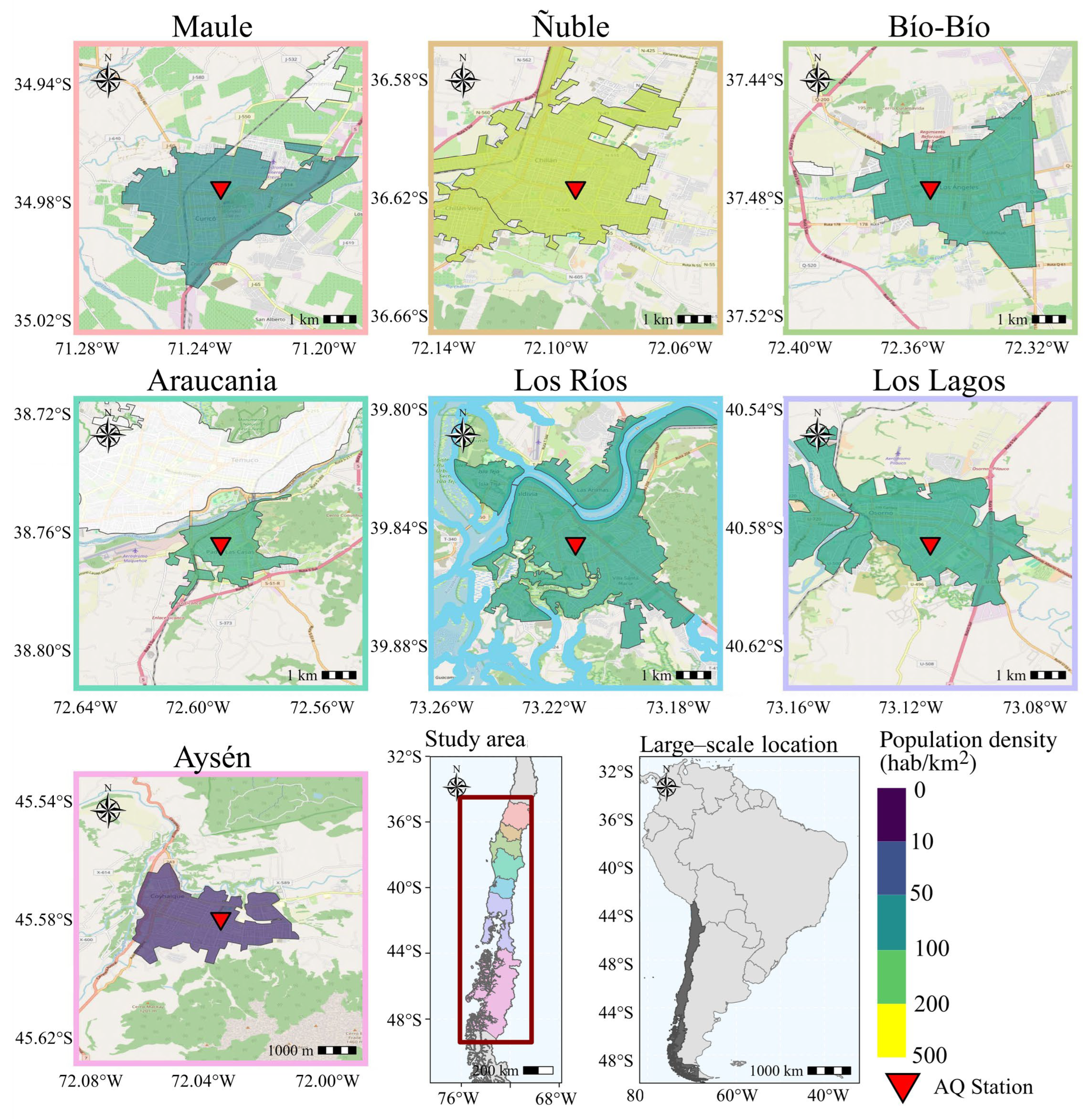
Figure 1. Macro-, meso-, and micro-scale location of the monitoring stations representing air quality in saturated zones affected by biomass burning in central–southern Chile.
Atmosphere 16 01377 g001
Figure 2. Seasonal variation in daily mean PM10 and PM2.5 concentrations at stations from central to southern Chile (2013–2024). ∗ is the 98th percentile.
Atmosphere 16 01377 g002
Figure 3. Frequency and significance level of meteorological predictors for each particulate matter type (PM10 and PM2.5) and regulatory concentration threshold (ESP: European Environment Agency, INT: International, NCh: Chilean) based on logistic regression models. Predictors include: tmax (maximum temperature), tmin (minimum temperature), ws (wind speed), hr (relative humidity), pp (precipitation on the day of measurement), l1.pp (precipitation one day before), l2.pp (precipitation two days before), and l3.pp (precipitation three days before). Bar colours represent the level of statistical significance (red: p ≤ 0.01, blue: 0.01 < p ≤ 0.05, green: 0.05 < p ≤ 0.1), and direction (positive or negative) is indicated by position above or below the zero line.
Atmosphere 16 01377 g003
Figure 4. Performance of logistic regression models for PM10 and PM2.5 prediction under air quality standards using Sensitivity, Specificity, and F1-Score across concentration thresholds and monitoring stations.
Atmosphere 16 01377 g004
Table 1. Geographic, demographic, air quality, and meteorological characteristics of the selected communes, together with their legal classification as saturated zones.
Geographical CharacteristicsMonitoring NetworkSaturate Zone Information
Air QualityMeteorological Condition
RegionStationPopulationCoordinatesPeriod%Data (PM10)%Data (PM25)Valid YearsTmin (°C)Tmax (°C)Prec (mm)HR (%)DS * N°DS YearPollutant
MauleCurico—CRC159,96834°59′ S, 71°14′ W2014–202498.597.2118.621.7365.768.282011PM10
ÑublePuren—PEN190,38236°36′ S, 72°06′ W2013–202498.497.8127.720.8563.170.2362013PM10, PM2.5
Biobío21 de mayo —MAY219,44137°28′ S, 72°21′ W2013–202498.697.9128.620.3620.966.9112015PM10, PM2.5
La AraucaniaPadre casas II—PLC80,65638°46′ S, 72°36′ W2014–202479.888.7108.215.4258.579.222013PM2.5
Los RiosValdivia—VAL170,04339°48′ S, 73°14′ W2008–202484.172.8157.617.51276.574.1172014PM10, PM2.5
Los LagosOsorno—OSO166,45540°34′ S, 73°08′ W2009–202478.478.5136.4171051.974272012PM10, PM2.5
AysenCoyhaique II—COY57,82345°34′ S, 72°04′ W2014–202497.698.1114.213.7473.237.133/152012/2016PM10, PM2.5
Tmin: Minimum temperature. Tmax: Maximum temperature. Prec: Precipitation. HR: Relative humidity. DS: Supreme decree. * Supreme Decree issued by the Chilean Ministry of the Environment that officially declares an area as having air-quality problems. The year corresponds to the formal notification of the saturated zone status, which is one of the inclusion criteria described in the Methods section.
Table 2. Daily average concentration thresholds for PM10 and PM2.5 used to classify air quality according to the Chilean Standard (NCh), the U.S. EPA/International guideline (Int), and the Spanish Standard (Esp).
StandardPollutantsGoodRegularAlertPre-EmergencyEmergency
NChPM100–149150–194195–239240–329≥330
PM2.50–5051–7980–109110–169≥170
IntPM100–5455–154155–354355–424≥425
PM2.50–910–35.435.5–125.4125.5–225.4≥225.5
EspPM100–2021–4041–5051–99≥100
PM2.50–1019–2021–2526–49≥50
The concentration ranges are in µg/m3 for PM10 and PM2.5 were maintained according to the values defined by each reference agency. The qualitative categories selected were preserved from the Chilean regulatory framework, and their consistency with international standards was verified.
Table 3. Descriptive statistics and frequency of annual and daily exceedances of PM10 and PM2.5 by season.
PollutantStationMinimum ± SDMean ± SDMaximum ± SDAbsolute MaximumPeak Date (dd-mm-yy)P98%CV% of National Standard Exceedance
DailyAnnual
PM10CRC9.95 ± 1.7644.36 ± 5.25165.82 ± 28.56225.0024-Apr-15120.50.121.318.2
PEN9.92 ± 2.1847.33 ± 4.58262.16 ± 40.18330.0028-Apr-15168.00.104.833.3
MAY7.42 ± 2.6448.53 ± 6.67301.20 ± 79.40480.0004-Feb-23174.00.144.450.0
PLC8.48 ± 2.9650.50 ± 8.32252.30 ± 56.83339.0022-May-18186.10.176.833.3
VAL 6.49 ± 1.8444.54 ± 10.73218.30 ± 48.21300.3527-May-16168.80.244.723.1
OSO7.12 ± 3.1353.98 ± 19.00347.92 ± 101.11628.0030-Jul-12252.30.358.546.2
COY 9.27 ± 4.1862.41 ± 14.06420.91 ± 99.02562.0002-Jun-18283.50.2311.172.7
PM2.5CRC2.82 ± 1.1924.54 ± 1.90133.65 ± 16.61155.0016-Jun-1892.00.0813.2100.0
PEN2.25 ± 0.7230.61 ± 3.46231.71 ± 40.31289.0017-May-13148.30.1119.2100.0
MAY2.15 ± 0.9128.70 ± 2.88257.63 ± 69.17434.0004-Feb-23143.60.1015.9100.0
PLC1.72 ± 0.6539.18 ± 6.89239.35 ± 60.58319.0022-May-18176.00.1826.0100.0
VAL 2.81 ± 1.8632.48 ± 5.50187.43 ± 42.48277.2824-Jul-09131.20.1722.2100.0
OSO2.88 ± 2.5638.29 ± 8.53310.08 ± 78.78474.0016-Jul-12192.60.2222.9100.0
COY 2.34 ± 1.1846.20 ± 10.14390.55 ± 98.78543.0002-Jun-18248.00.2227.7100.0
CV: coefficient of variation. SD: standard deviation.
Table 4. Percentage of data by categorical air quality threshold according to the different standards applied.
PollutantCategory 1NChINTESP
CRCPENMAYCOYCRCPENMAYCOYCRCPENMAYCOY
PM10Good99.497.397.494.680.376.981.071.815.613.722.431.0
Regular0.62.72.65.318.722.518.627.581.484.275.366.3
Alert0.10.30.72.20.62.31.91.033.837.630.836.7
Pre-emergency0.00.00.11.00.00.00.10.321.925.822.830.4
Emergency0.00.00.10.30.00.00.10.03.27.66.813.3
PM2.5Good87.484.486.175.236.040.340.029.441.344.045.632.3
Regular11.615.513.524.558.756.054.467.754.253.150.665.5
Alert 3.98.98.414.319.624.320.932.832.636.432.648.8
Pre-emergency0.73.94.08.10.42.72.76.027.932.928.541.7
Emergency0.00.40.82.40.00.00.11.313.516.314.125.2
NCh: Chilean Air Quality Standard; INT: Air Quality Index; ESP: European Environment Agency; CRC: Curicó; PEN: Pemuco; MAY: 21 de Mayo; COY: Coyhaique. 1 Qualitative air quality categories were taken from Chilean legislation and harmonized with the corresponding international (EPA) and European (EEA) standards.
Disclaimer/Publisher’s Note: The statements, opinions and data contained in all publications are solely those of the individual author(s) and contributor(s) and not of MDPI and/or the editor(s). MDPI and/or the editor(s) disclaim responsibility for any injury to people or property resulting from any ideas, methods, instructions or products referred to in the content.