Article

Analyzing Stratospheric Polar Vortex Strength and Persistence Under Different QBO and ENSO Phases: Insights from the Model Study


1
Voeikov Main Geophysical Observatory, Saint Petersburg 194021, Russia
2
Department of Atmospheric Physics, Saint Petersburg University, Saint Petersburg 199034, Russia
3
Department of Meteorological Forecasting, Russian State Hydrometeorological University, Saint Petersburg 195196, Russia
4
Pushkov Institute of Terrestrial Magnetism, Ionosphere, and Radio Wave Propagation (IZMIRAN), Russian Academy of Sciences, Moscow 108840, Russia
*
Author to whom correspondence should be addressed.
Atmosphere 2025, 16(12), 1371; https://doi.org/10.3390/atmos16121371
Submission received: 8 October 2025 / Revised: 19 November 2025 / Accepted: 28 November 2025 / Published: 2 December 2025
(This article belongs to the Section Upper Atmosphere)

Abstract

The influence of tropical oscillations on the thermodynamics of the middle and upper atmosphere at high latitudes was studied using a nonlinear model of the general circulation of the middle and upper atmosphere (MUAM). The observed oscillations include the quasi-biennial oscillation of the zonal wind in the equatorial stratosphere (QBO) and the El Niño–Southern Oscillation (ENSO). The main focus of this work is to study the influence of these oscillations on the strength and persistence of the stratospheric polar vortex. Four ensemble calculations were carried out (10 runs for each QBO and ENSO phase combination) for January–February. It was shown that the polar vortex and Eliassen–Palm (EP) flux divergence were especially strong under La Niña and the westerly QBO phase (wQBO). This was accompanied by a strengthening of the residual mean circulation (RMC) from the summer to the winter hemisphere, causing positive temperature anomalies in the polar mesosphere and negative anomalies in the stratosphere. The greatest RMC weakening and the weakest and warmest polar vortex occurred during El Niño and eQBO conditions in January and during El Niño and wQBO conditions in February. Such diverse manifestations of tropical oscillations via teleconnections can provide valuable information for predicting the frequency and intensity of sudden stratospheric warmings (SSWs) and subsequent extreme cold wave events in the troposphere. Specifically, SSWs are the least probable during La Niña and wQBO conditions in both January and February. The QBO phase most significantly influences the polar vortex during El Niño events in both months. We conclude that SSW development is more favorable during eQBO in January and wQBO in February under El Niño conditions.

1. Introduction

In the context of global climate change, it has become obvious that there is a need for a more in-depth study of not only the processes within the troposphere but also the interactions between the troposphere and the layers above, as well as between low- and high-latitude regions. The coupling mechanisms involved are crucial for seasonal forecasting, as well as for understanding potential climatic changes in individual meteorological parameters at different atmospheric levels [1,2,3].
The quasi-biennial oscillation (QBO) is the main type of long-term variability in the tropical stratosphere [4] and a dominant large-scale feature of stratospheric circulation as a whole. The QBO phase, defined by the direction of the zonal wind component, alternates with a certain periodicity in the equatorial stratosphere and mesosphere, affecting the distribution and movement of air masses. The reversal of the zonal wind direction occurs approximately every two years. The QBO cycle is from 22 to 34 months, with an average period of 28 months. At altitudes of 20–30 km, the highest zonal wind speeds are observed, reaching approximately 20 m/s for the westerly direction and about 30 m/s for the easterly direction.
Despite being a dynamic process confined to the equatorial stratosphere, the QBO’s influence extends to all hydrodynamic fields and nearly the entire thickness of the atmosphere [5,6,7,8]. The QBO is dynamically linked to the variability of the stratospheric polar vortex in the Northern Hemisphere. The easterly phase of the QBO (eQBO) can contribute to a disruption or weakening of this vortex, whereas the westerly phase (wQBO) tends to strengthen it [9]. Potentially, various manifestations of the QBO in the polar stratosphere via teleconnections can be utilized in weather forecasting across different time scales in the Northern Hemisphere [10,11]. During the eQBO phase, the enhanced propagation of atmospheric waves can be expected in the middle stratosphere, contributing to vortex weakening [5]. The observed periodicity in mesospheric density changes (about 28 months) may be related to both QBO and solar irradiance [12]. Furthermore, the phase change of the QBO is influenced by the El Niño–Southern Oscillation (ENSO) [13,14,15].
The ENSO is a large-scale climatic phenomenon of natural origin characterized by fluctuations in the sea surface temperature in the central and eastern equatorial Pacific, accompanied by changes in the atmospheric dynamic processes in these regions. The El Niño phase develops when the natural dominance of the northeast trade winds weakens, causing warmer water from the western Pacific to shift eastward toward the coast of Peru. Conversely, La Niña occurs as the northeast trade winds intensify, leading to the cooling of the eastern tropical Pacific waters through enhanced upwelling.
The Southern Oscillation, which is the atmospheric component of the ENSO, represents the fluctuation in atmospheric pressure between the western and eastern Pacific. Negative values of the Southern Oscillation Index are characteristic of positive sea surface temperature anomalies (the El Niño phase), while the opposite pattern occurs during La Niña events. The ENSO influences atmospheric circulation far beyond its region of origin via teleconnections. The polar stratospheric vortex weakens and the stratosphere over the Arctic warms during El Niño, whereas during La Niña, the vortex strengthens, leading to the cooling of polar stratospheric air [16,17,18]. The primary mechanism of the ENSO’s influence on the extratropics is through the modification of tropical precipitation patterns, which consequently affect tidal generation sources, planetary waves and gravity waves. These waves serve as potential carriers of the ENSO signal to the high latitudes and into the thermosphere [12,19,20].
Kumar et al. [21] investigated the joint influence of tropical oscillations—namely, the QBO and ENSO—on the dynamic state of the stratosphere, mesosphere and lower thermosphere during boreal winter. Their study indicates that QBO signals in the polar vortex more clearly manifest during La Niña and that wQBO contributes to the vortex strengthening. However, a joint study of the effects of the QBO and ENSO is challenging because these oscillations have similar periods, which makes it difficult to separate their individual effects in observational data. In addition, the ENSO can influence the QBO. For example, Taguchi [22] showed that during El Niño, the QBO phase may change more rapidly than during La Niña conditions, and the QBO amplitude is weaker during El Niño. This effect was also discussed in detail by Kawatani et al. [15]. It is possible to separate the effects of the QBO and ENSO using a linear regression method, but this requires a large amount of data, such as the ensemble model calculations performed by Wang et al. [23]. An alternative approach is to conduct numerical experiments with relatively simple mechanistic global circulation models, fixing the various phases of these oscillations. This allows for the evaluation of their effect under all other equal conditions.
Some studies conclude that the probability of sudden stratospheric warmings (SSWs) is higher during El Niño episodes [17,24,25,26], primarily due to variability in the vertical component of the wave activity flux. However, researchers note that SSW classification, large sample variability in observations and potential simulation errors reduce the robustness of these findings. Naoe et al. [27] investigated QBO teleconnections and their modulation by ENSO using a multi-model ensemble from the Atmospheric Processes and their Role in Climate QBO initiative models. Analyzing the entire cold season, they noted that sudden stratospheric warming events are more frequent in the Arctic under El Niño conditions than under La Niña, but they found no significant differences between the QBO phases. Recent studies have shown that both ENSO phases are equally favorable for the occurrence of SSWs [18,20]. Lifar et al. [28] assessed the impact of tropical oscillations on the polar stratosphere using the middle and upper atmospheric model (MUAM). Their results show that the greatest temperature increases associated with SSWs in the stratosphere, along with cooling in the mesosphere, are simulated under El Niño and eQBO conditions, while the most significant wind weakening occurs during El Niño and wQBO phases. The largest amplitudes of planetary waves are simulated during eQBO, regardless of the ENSO phase.
Despite the slowness of the processes in the stratosphere relative to the dynamism of the troposphere, in winter, when sudden stratospheric warming occurs, almost the entire hemisphere experiences its consequences. Event onset was predominantly a deep winter phenomenon (December–February), accounting for over 95% of cases. Notably, January alone accounted for roughly half of all onsets [29]; thus, January stands out from all the winter months. Zhang et al. [30] showed that the central date of major vortex-split SSWs is observed in February, while for SSWs with displacement, it is observed in January. Given the rarity of final stratospheric warmings in February (e.g., 2025), some methodologies classify it—particularly the second half of the month—as part of late winter in their seasonal divisions. The seasonal forecast assumes an average state of circulation in the polar stratosphere. However, for practical applications such as predicting the probability of cold waves in the troposphere or stratospheric intrusions, a separate monthly forecast is more useful.
To compare the thermodynamic characteristics of the polar stratosphere and mesosphere under different ENSO and QBO phase combinations, we conducted the numerical experiments using 10-member ensembles for January and February. The results demonstrate the response of the middle and upper atmosphere to four specific phase combinations: El Niño with eQBO, El Niño with wQBO, La Niña with eQBO and La Niña with wQBO. Zonal-mean zonal wind, temperature, divergence of Eliassen–Palm (EP) flux and residual mean circulation (RMC) are presented as the differences between their values during each combination and ensemble averages. Thus, positive anomalies and increments indicate an amplification of specific characteristics relative to the mean values for January and February.

2. Materials and Methods

This study uses a nonlinear mechanistic model of the middle and upper atmosphere (MUAM). The model simulates general atmospheric circulation from the Earth’s surface to altitudes of 300–400 km. It is based on a standard system of primitive equations adapted to spherical coordinates. MUAM utilizes the Marchuk–Strang splitting procedure to solve predictive equations and the Matsuno scheme for time integration. The MUAM radiation unit takes into account the heating of the atmosphere in the ultraviolet and visible regions of the spectrum, as well as cooling in the infrared bands. Ion friction, molecular and turbulent viscosity and thermal conductivity are taken into account in the model dynamical unit. The main characteristics and processes that are taken into account during the MUAM modeling are described in detail in [17,31,32] and references therein, and a description of numerical experiments of the current version of the MUAM is presented in Koval et al. [33]. The model horizontal grid has resolution of 5.625° in longitude and 5° in latitude. The vertical grid employs a log-isobaric coordinate z = −H*ln(p/p0), where p0 is the surface pressure and H represents the pressure scale height [34]. MUAM qualitatively reproduces the global atmospheric circulation, which has been repeatedly discussed in publications [31,35].
To account for the stratospheric QBO in MUAM, a relaxation method (nudging) is used. This is implemented through additional terms in the momentum equation for zonal wind velocity, which are proportional to differences between calculated and observed zonal-mean winds at latitudes from 17.5° S to 17.5° N and altitudes of 0–60 km, as was shown in Equation (4) by [34]. The proportionality constant is a value relating the characteristic relaxation time (5 days) of the calculated hydrodynamic fields to the observed one. Simulating atmospheric circulation requires specifying background and initial hydrodynamic fields corresponding to years with different QBO phases, as far as the model cannot reproduce the stratospheric QBO self-consistently due to relatively low vertical resolution [5]. To sample the years corresponding to specific QBO phases, the EOF method was applied to zonal wind fields from the Japanese reanalysis JRA-55 database [36]. The JRA-55 reanalysis was chosen because it contains the longest homogeneous series of stratospheric parameters (since 1958). The equatorial zonal-mean zonal wind data was preliminarily smoothed with a 5-month moving average and examined at nine isobaric levels (70, 50, 30, 20, 10, 7, 5, 3 and 1 hPa). At each level, the zonal wind fields were decomposed into an Empirical Orthogonal Function (EOF) series, and the first two principal components were analyzed. This EOF-based approach allowed for effective data dimensionality reduction with minimal loss of information. In this case, the vertical evolution of the QBO was studied by analyzing these two components within a two-dimensional phase space. By partitioning this space, four distinct QBO phases (easterly and westerly as well as transitional easterly-shear and westerly-shear, see [6]) can be identified. Because this analysis enables the study of the vertical evolution of wind changes within specific altitude ranges, it is more accurate than the classical single-level QBO index [37,38]. Detailed information on the EOF method application and QBO phase classification is described in detail in [39,40]. Using the methodology, two sets of years, representing typical westerly and easterly QBO phases, were selected as background fields for nudging and for the direct comparison. In order to maintain uniformity, the MERRA-2 reanalysis data [41] was used for implementation in the MUAM and for comparison, because it has better spatial resolution and altitude coverage compared to the JRA-55.
ENSO implementation in the model is achieved by using latent heat release averaged over the years corresponding to warm (El Niño) and cold (La Niña) phases [31]. A Multivariate ENSO Index (MEI—https://www.esrl.noaa.gov/psd/enso/mei/ accessed on 14 April 2023) was used to select the years representative of specific ENSO phases. MEI is based on six key observed variables in the tropical Pacific Ocean: sea-level pressure, zonal and meridional surface wind components, sea surface temperature, surface air temperature and total cloud coverage. Using available MEI values, five representative years for each ENSO phase were selected [28,31]. Latent heating rates were calculated for each grid point in MUAM using an empirical formula for the vertical distribution of latent heating rates based on precipitation rates near the surface [31,42]. Additionally, the longitudinal distribution of the heating rates was decomposed into a set of zonal harmonics with zonal wave numbers m = 1–4. In MUAM, to account for temporal variations, heating rates are specified as the mean zonal values, longitudinal variations (i.e., stationary waves) and a set of diurnal and semidiurnal tidal oscillations. The details of ENSO parameterization used in MUAM, as well as validation, are presented in [19,31].
For each combination of QBO + ENSO, an ensemble consisting of 10 model runs was calculated, and the resulting wind and temperature fields were then averaged into a single composite for each of the four combinations. Climate means were calculated as the average over all 40 model runs. When forming an ensemble of model runs, we changed the date of inclusion of the daily cycle of solar heating and generation of planetary waves, while the variability in atmospheric fields from one run to another within the ensemble is interpreted as interannual [5,24].
In addition to considering zonal wind and temperature fields, residual meridional circulation (RMC) components were calculated for all QBO + ENSO combinations. The standard TEM approach [43] was used. RMC components are calculated as the sum of advective terms and the eddy contribution induced by planetary waves. Thus, changes in the RMC allow one to analyze the influence of wave motions on the background wind. Changes in the RMC are conveniently analyzed in conjunction with temperature anomalies, because wave-induced changes in vertical air displacements cause adiabatic cooling/heating [5,35].
To analyze changes in the zonal wind and, in particular, the polar vortex, the Eliassen–Palm (EP) flux divergence [44] was calculated. The direction of the EP flux in the meridional plane is interpreted as the direction of propagation of planetary wave activity, while its divergence is considered as the transfer of momentum from the planetary wave to the mean flow. “Positive” divergence is interpreted as the transfer of momentum from the wave to the mean current and the acceleration of the zonal wind in a westerly direction, while “negative” divergence (i.e., convergence of the EP flux) corresponds to the reverse process: deceleration of the mean flow and an increase in wave activity [45].

3. Results

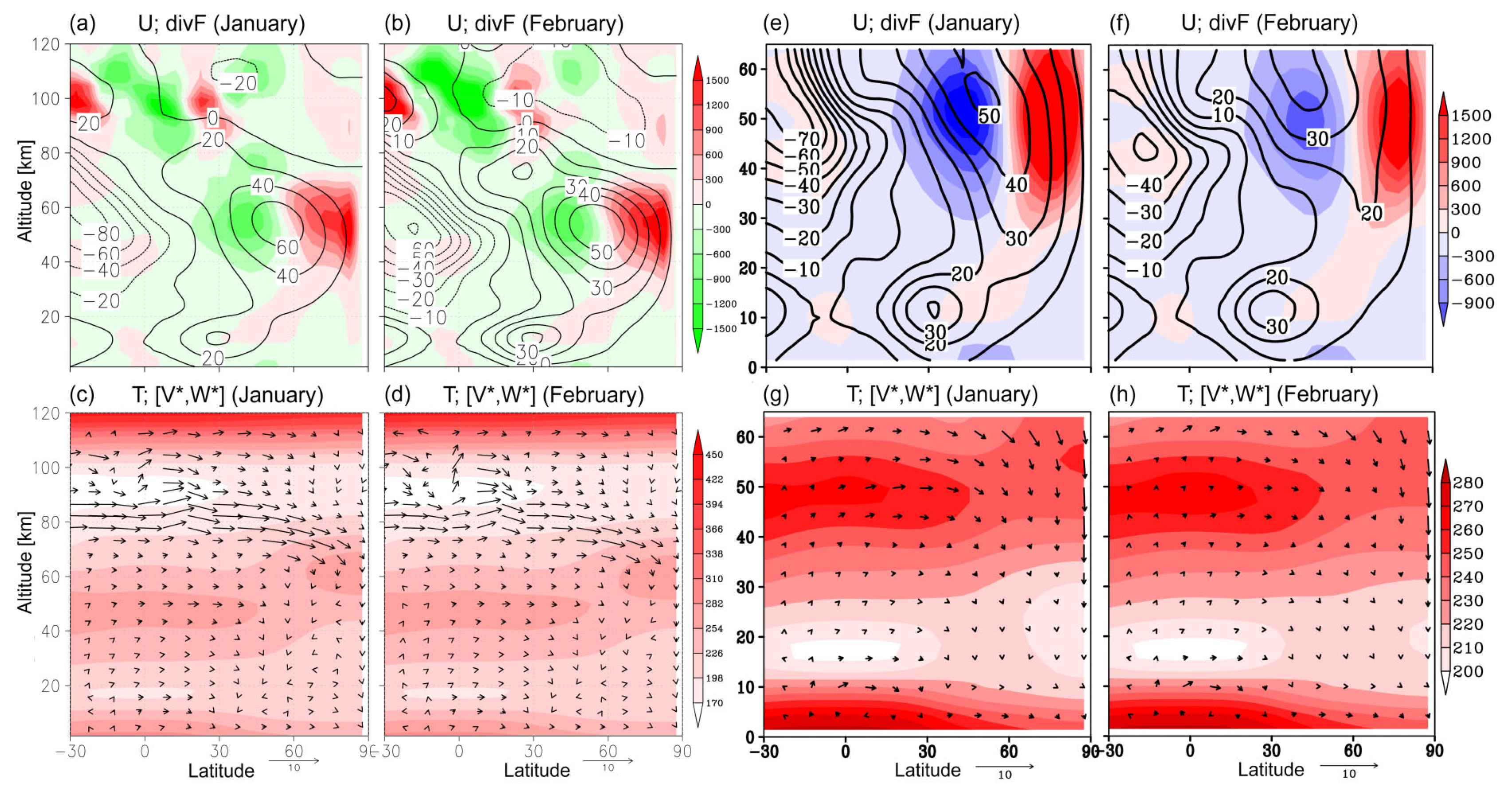
Most recent studies addressing a similar scientific problem—tropical–polar teleconnections that manifest in extratropical processes in the middle and upper atmosphere—have focused on the entire winter season rather than individual months. By contrast, we analyzed thermodynamic characteristics separately for January and February. Figure 1a–d demonstrate the mean zonal wind and EP flux divergence averaged over all four ensembles (i.e., all QBO + ENSO combinations).
In order to control the numerical experiments and the obtained circulation change trends, we compared the obtained zonal wind increments with the MERRA-2 reanalysis data. The available number of years in the reanalysis data was not enough to select years or to build sufficient composites of different combinations of QBO + ENSO for January–February to achieve statistical significance. For example, Ermakova et al. [19] found only three years representing each QBO/ENSO combination in the post-satellite era (after 1980). In this case, the differing amounts and/or strength of SSWs play a more significant role in polar vortex persistence than tropical–polar teleconnections. Hence, nine winters were selected for each phase of the QBO and ENSO separately, without considering their combined influence (see Table 1; the years that fell within the ENSO and QBO phases are shown in bold). This allowed us to trace the general trends of strengthening/weakening of the polar vortex and compare them with those simulated for the corresponding set of combinations. The same approaches that were used for QBO and ENSO phase identification were also utilized for the MUAM simulations (see Section 2).
The average over all the specified years (by analogy with model calculations) is used by us as the average climate value. Figure 1e–h show corresponding distributions, as in Figure 1a–d, but for the climate based on MERRA-2 data.
A stronger stratospheric polar vortex is evident in January (Figure 1a) compared to February (Figure 1b), which corresponds to the MERRA-2 data (Figure 1e,f, respectively). Moreover, on the jet axis, it is noticeable that the MUAM overestimates the wind speed in both months compared to the reanalysis data. This is due, firstly, to the fact that the model reproduced a smaller number of SSWs than the reanalysis data for the years under consideration (see Table 2). Secondly, it is due to a slight underestimation of the dynamic impact of the new parameterization of orographic gravity waves in the model. We conducted a correlation analysis of ensemble-averaged wind and temperature fields with 30-year-averaged MERRA-2 climate data. The analysis showed that implementing the new parameterization increases the correlation (>0.97), but further parameterization adjustments could further improve the agreement. However, in this study, we are primarily interested in relative changes in atmospheric circulation, and this persistent source of discrepancy does not affect the results. In all cases, divergence of the EP flux is observed in the high-latitude stratosphere, accompanying the acceleration of the zonal wind, while at mid-latitudes (20–60°N), convergence, corresponding to deceleration, is observed.
The monthly mean temperature and RMC components are shown in Figure 1b,c for the MUAM results and Figure 1g,h for the reanalysis data. In January and February, analysis of the RMC averaged over all combinations reveals a deep branch of the circulation in the stratosphere at 45–55 km altitude. At 75–90 km, transport from the summer hemisphere to the winter hemisphere prevails. The deep branch contributes to elevated temperatures in the upper stratosphere up to the middle latitudes of the Northern Hemisphere. In the low-latitude stratosphere (40–55 km), another warm pattern exists, associated with the ozone layer and meridional circulation. At the same time, the MUAM successfully reproduces the effect of the expansion of this warm region toward the North Pole in February, as well as the weakening of the meridional transport in this region, as demonstrated by the reanalysis data in Figure 1g,h. The general structure of the simulated fields of zonal wind and temperature, as well as the calculated fields of divergence of the EP flux and the RMC, is in good agreement with the reanalysis data.

3.1. Changes in Zonal Wind

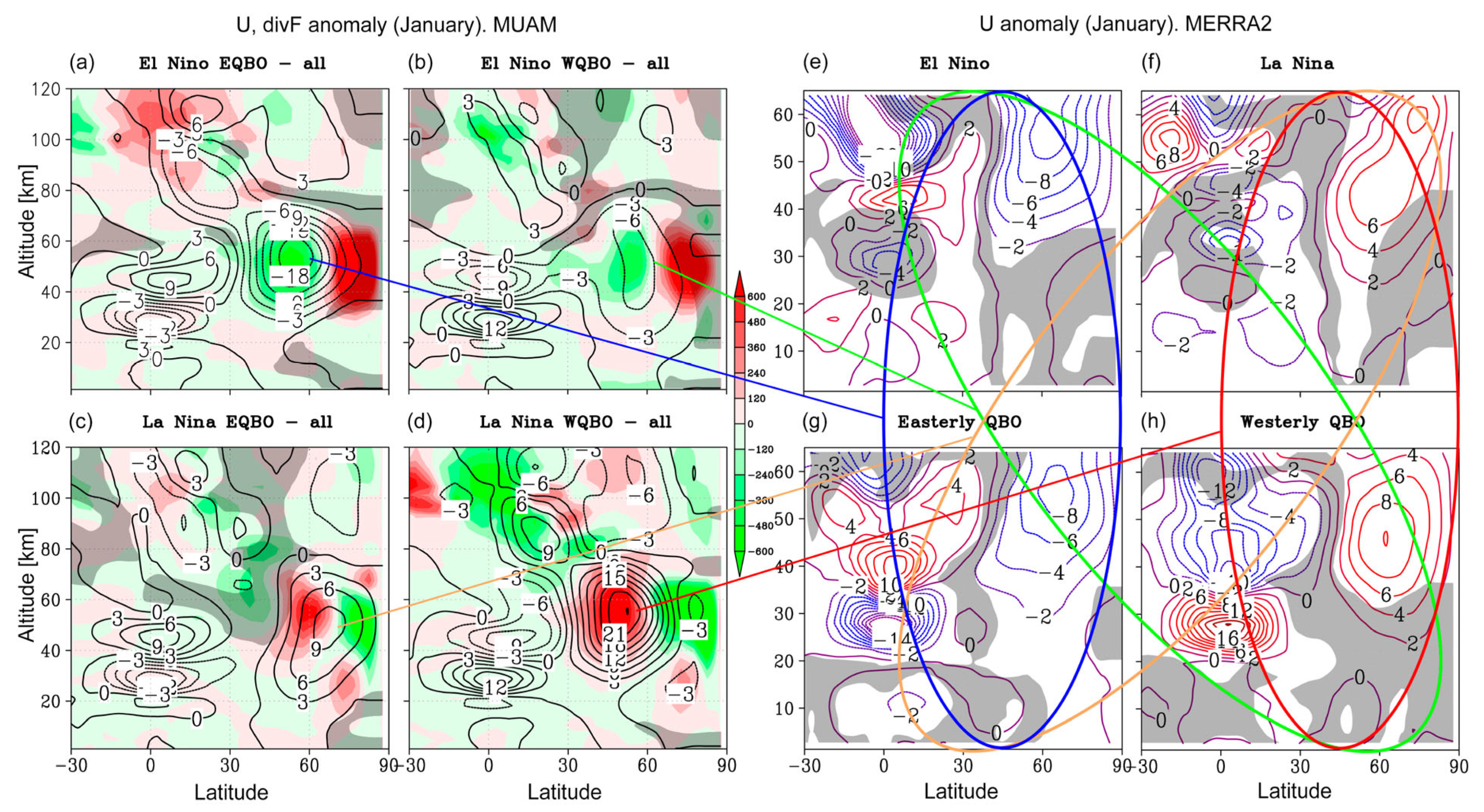
Numerical modeling results illustrating the combined influence of QBO and ENSO on the mean zonal wind in the polar stratosphere during January and February are presented in Figure 2 and Figure 3, respectively. The contours in Figure 2a–d and Figure 3a–d show the increments in zonal wind relative to the average climatic values (averaged over all combinations, 40 runs in total). Panels a–d correspond to combinations of El Niño + eQBO, El Niño + wQBO, La Niña + eQBO and La Niña + wQBO. Color shading shows respective EP flux divergence increments.
Figure 2 shows that in January, the zonal wind component and EP flux divergence are particularly strong during La Niña and wQBO conditions (Figure 2d), with a deviation of +21 m/s from the mean velocity. Strong EP flux divergence is observed in the region of the polar-night jet maximum. This supports the suggestion by Kumar et al. [21] that the effect of QBO is more pronounced during La Niña conditions. Conversely, for the El Niño and eQBO combination (Figure 2a), the deviation from the ensemble average is −18 m/s, with strong EP flux convergence evident at middle latitudes (40–60 km altitudes). The positive ENSO phase generally results in weaker polar-night jet speeds (Figure 2a,b) and shifts the region of positive convergence anomaly to higher latitudes. A pronounced weakening and warming effect of the polar vortex during El Niño and eQBO was observed in the Coupled Model Intercomparison Project Phase (CMIP-5 and CMIP-6) simulations by Wang et al. [23].
The right panels in Figure 2e–h display the zonal mean wind deviations from the “climate” (average over the above-listed years) for different QBO and ENSO phases in January from the MERRA-2 data. As noted above, we were unable to select a sufficient number of years with combined ENSO and QBO combinations, so we treated these effects separately under the assumption that their relationship is close to linear [23]. The ellipses in the graph indicate the combined influence of ENSO and QBO phases, which is reproduced in the MUAM. Further, we discuss modeled polar vortex anomalies in the high-latitude stratosphere and compare them with the reanalysis data.
It is crucial to note that the reanalysis composites are constructed for individual ENSO and QBO phases, in contrast to the model simulations, which apply their combined forces (ENSO × QBO). As a result, a direct one-to-one correspondence is not anticipated, and the findings do not suggest a linear addition of the individual signals. Residual mismatches between the composites and the model may also stem from several inherent sources. Potential factors include differences in sampling, objective phase definitions and the model’s memory of antecedent events—for instance, the impact of a January SSW on the later recovery of the polar vortex. Such discrepancies are an inherent feature of the analytical framework and warrant caution against over-interpretation.
Positive zonal mean wind anomalies (polar vortex strengthening) during La Niña (Figure 2f) and wQBO (Figure 2h) correspond to the maximum wind speeds in the ensemble simulations under La Niña and the wQBO (red ellipse, red arrow in Figure 2). Both the wQBO phase and La Niña conditions contribute to the strengthening of the stratospheric polar vortex. According to the reanalysis data, minor SSWs—characterized by temperature increases without zonal wind reversal—occur more frequently during these phases in January within the selected years, influencing vortex velocity. In the MUAM ensemble (10 runs), this combination (La Niña and wQBO) did not produce any SSWs with a temperature rise greater than 20 K (see Table 2). A similar but opposite-signed phase influence is observed for El Niño and eQBO (Figure 2e and Figure 2g, respectively), which is also reproduced in the MUAM, resulting in the weakest stratospheric polar vortex in the anomaly calculations (blue ellipse and arrow in Figure 2). SSWs of different intensities were recorded in 6 out of 10 model runs for January, with major events being the most frequent. Similarly, the reanalysis data indicated either major or minor SSWs (without wind reversal but with notable vortex weakening) in almost all 16 analyzed Januarys. It should be noted that two years (1987 and 2010) were included in both the El Niño and eQBO phase samples.
El Niño combined with wQBO exhibits the “antiphase” relationship, leading to small negative anomaly values (polar vortex weakening) in model simulations (Figure 2b). Numerical simulations produced eight SSW events, almost all of which were characterized by vortex weakening without zonal wind reversal. Interestingly, when the reanalysis sample is restricted exclusively to simultaneous El Niño and wQBO conditions, SSWs in these winters occur more frequently in February—a result fully consistent with the model output shown in panel Figure 3b. In the broader reanalysis samples, it is impossible to isolate the influence of other QBO phases. Consequently, when averaging over nine El Niño Januarys (independent of QBO), a negative wind anomaly emerges (Figure 2e). This arises from the significant number of major SSWs that occurred in January under various QBO conditions (both westerly and easterly phases, as well as during phase transitions). Conversely, a strong positive wind anomaly under wQBO conditions (Figure 2h) results from the relative absence of SSW events in the selected Januarys for this phase.
The influence of the La Niña with eQBO shows a similar pattern but with opposite-signed polar vortex anomalies. The negative anomaly sign results from the small number of SSWs (in half of the implementations) reproduced by the model under this combination, all of which were minor events. In the reanalysis data, January months selected under La Niña (Figure 2f) conditions frequently occurred during QBO phase transitions (westerly to easterly, or “easterly-shear” as it was shown by Koval et al. [6]) or during established easterly phases, with minor SSWs being more prevalent during these periods. Conversely, January months selected under eQBO conditions (Figure 2g) encompassed various ENSO states (La Niña, El Niño and neutral phases). These months exhibited a substantially higher frequency of major SSW events.
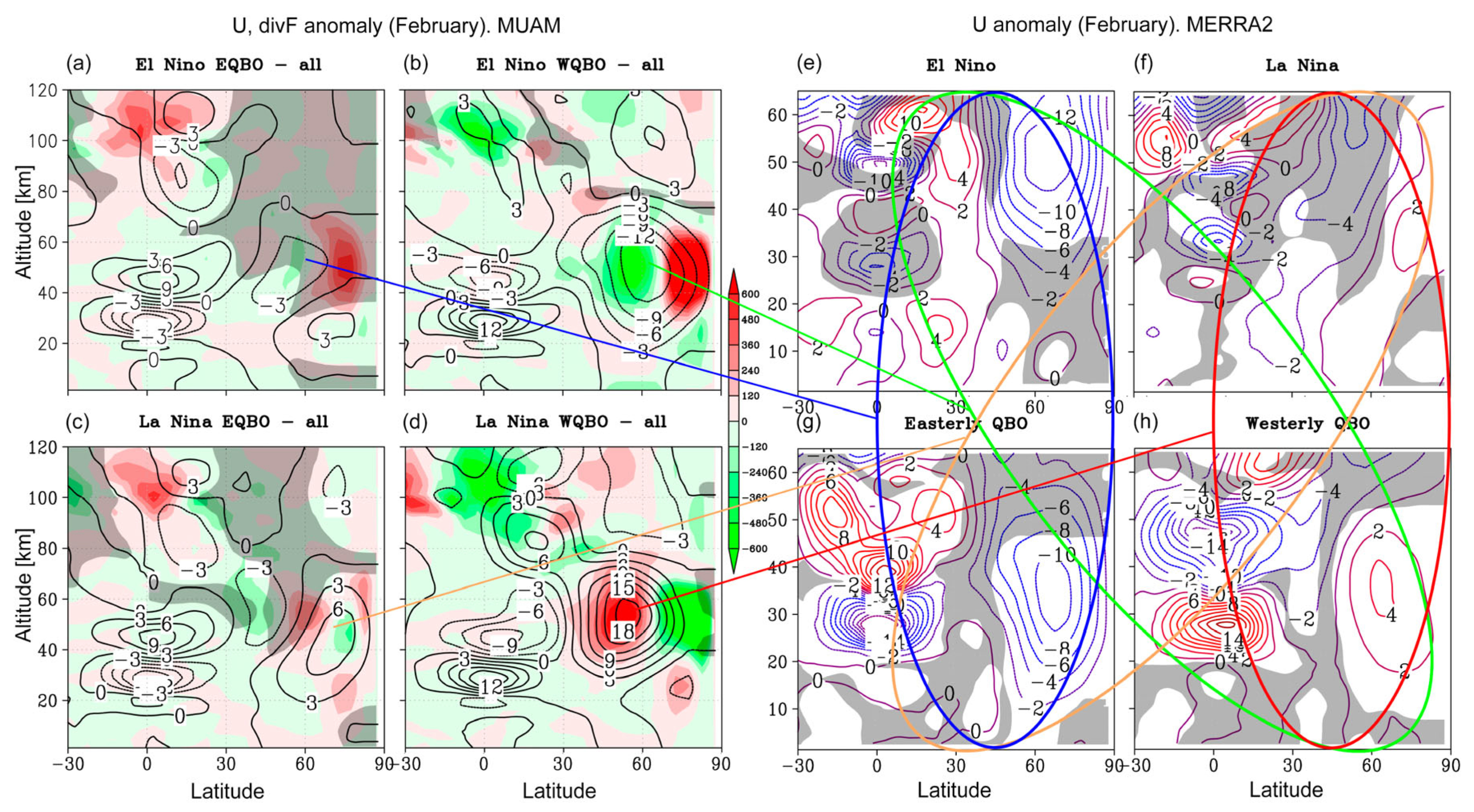
In February, the mean zonal wind component and EP flux divergence show the maximum values for the same combination (La Niña and wQBO, Figure 3d) as was observed in January (Figure 2d), with a wind velocity anomaly in the high-latitude stratosphere reaching approximately 18 m/s relative to the ensemble-mean values. The maximum negative anomaly occurs during El Niño conditions (Figure 3a,b), consistently with the January observations, but is the most pronounced during the wQBO, with a value of −12 m/s (Figure 3b). This combination also exhibits the strongest convergence/divergence zones in the middle- and high-latitude stratosphere, which indicates an increase in the interaction of planetary waves with the mean flow under this combination. Notable EP flux divergence/convergence areas are more spatially limited in February and show reduced magnitudes compared to the same combinations in January. Each combination represents a distinct climatic pattern that reveals teleconnections between the tropical oscillations and polar stratospheric dynamics. The contrasting signs of the studied parameters in the middle- and high-latitude stratosphere during January and February are strongly influenced by the frequency and intensity of SSWs. We conclude that QBO phases under La Niña conditions do not significantly affect SSW probability in either month, whereas QBO phase substantially modulates SSW likelihood during El Niño events.
Analysis of wind anomalies from the reanalysis data in February (Figure 3e–h) reveals consistent patterns for all combinations (except El Niño with eQBO, Figure 3a and blue ellipse). Positive wind anomalies during La Niña and wQBO (Figure 3d) are reproduced in the model as a strengthened stratospheric polar vortex with the maximum zonal-mean velocity in February. This result is due to the fact that, as in January, the model reproduced only one minor SSW for this combination. Reanalysis data for both phases show a positive wind anomaly (red ellipse and arrow in Figure 3), as SSWs are observed less frequently under La Niña conditions, and the westerly QBO favors minor SSWs in February.
The easterly QBO weakens the vortex during La Niña; in the model, this combination produces weak positive velocity anomalies. In half of the runs for this combination, SSWs were obtained, but none of them were accompanied by a reversal of the zonal wind component. In the reanalysis data, these phases produce anomalies of the opposite sign but different strengths (orange ellipse in Figure 3). The strong negative anomaly in February for eQBO (Figure 3g) is caused by low vortex velocities following major SSWs in January. The weak positive anomaly for La Niña (Figure 3e) is associated with the extremely rare SSWs in the selected Februarys.
Opposite tendencies in anomalies occur during El Niño and wQBO (green ellipse in Figure 3). The exception is the El Niño and eQBO combination (Figure 3e–g). While reanalysis data suggest that this should result in the weakest stratospheric polar vortex with maximum negative anomalies, the numerical experiment shows near-average velocities with only slight negative anomalies (Figure 3a). These weak negative anomalies result from the model reproducing several SSW events, all of which were strong and characterized by significant zonal wind reversals. Reanalysis data show pronounced anomalies under both phases, as the vortex in most selected Februarys exhibited below-climatological velocities. This weakening stems from either major SSW occurrences (which are more favored during eQBO) or extended recovery periods following major January SSW events.

3.2. Changes in Temperature and Meridional Flows

Next, to study changes in the polar vortex structure, we analyzed the RMC and temperature fields for different QBO/ENSO combinations. In the case of QBO, it has been repeatedly shown that the Holton–Tan effect is not, generally speaking, the only mechanism influencing the polar vortex. The dynamic effect caused by changes in the meridional circulation also plays an important role [6,11]. Here, we extend this interpretation to the ENSO.
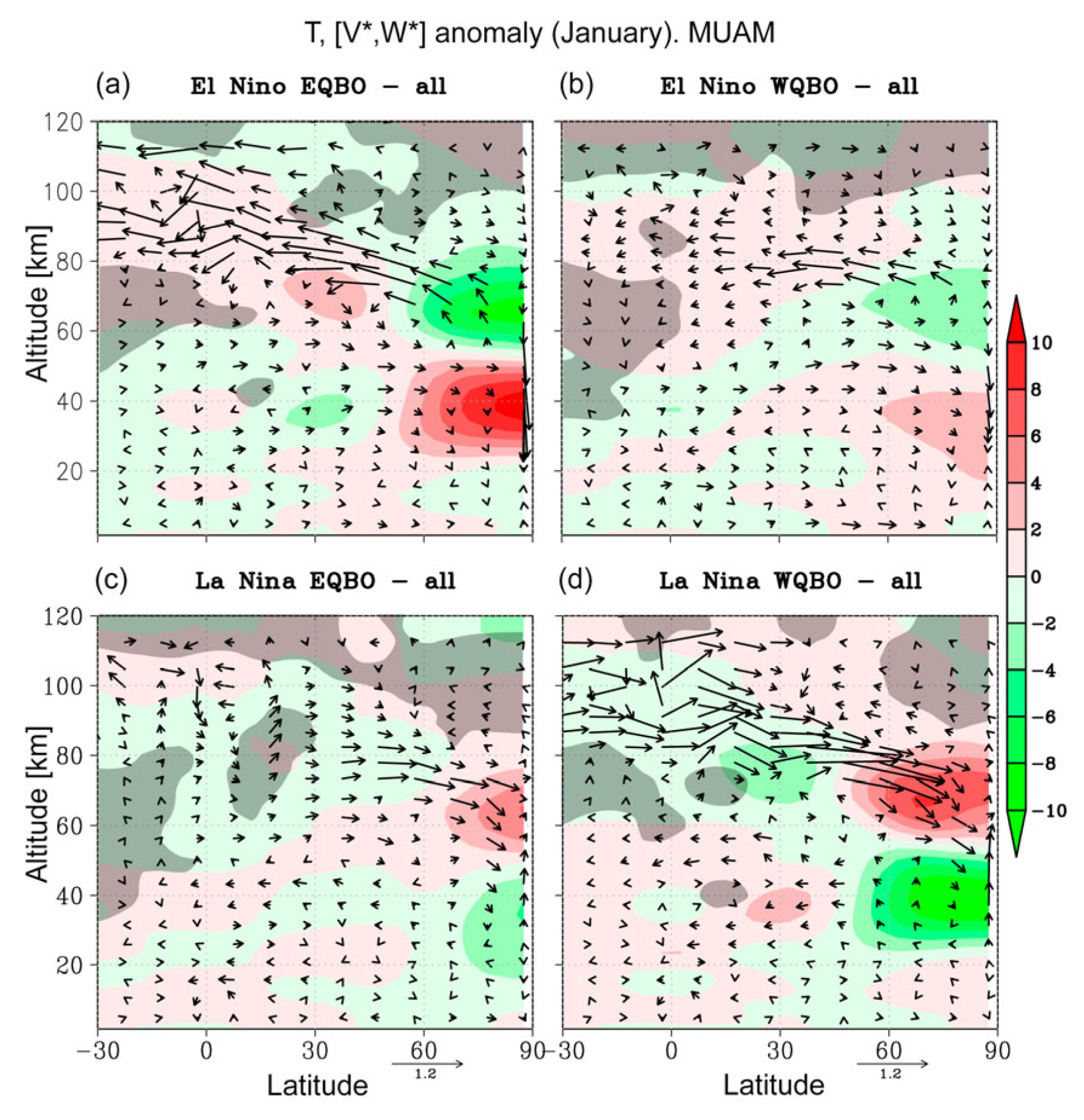
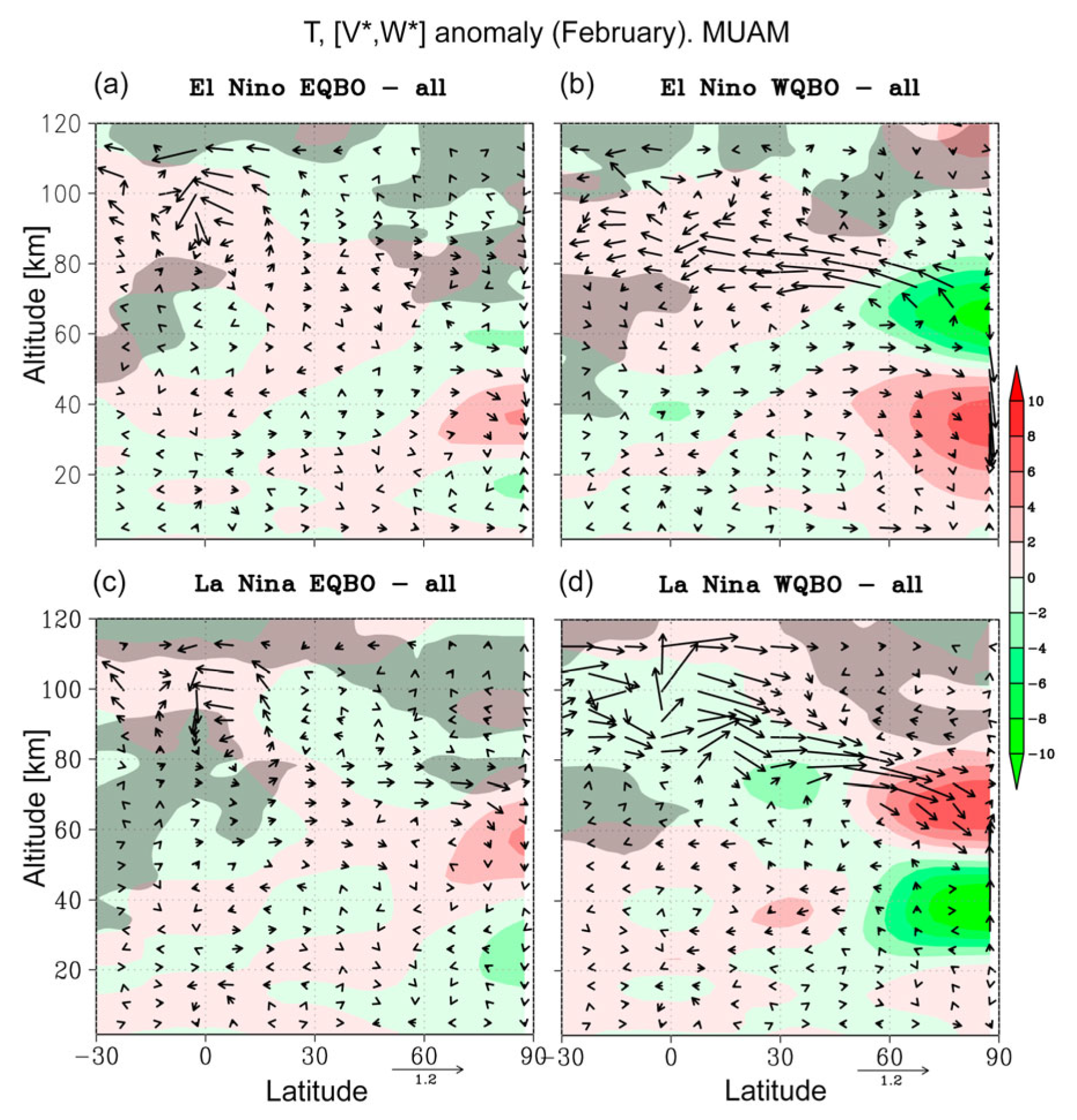
Figure 4 shows temperature and RMC differences for El Niño (Figure 4a,b and Figure 5a,b) and La Niña (Figure 4c,d and Figure 5c,d) conditions, during both eQBO (Figure 4a,c and Figure 5a,c) and wQBO (Figure 4b,d and Figure 5b,d) phases relative to the climate. Figure 4d shows that transport from the summer to winter hemisphere is the strongest in the January MLT area during La Niña and wQBO conditions (Figure 4d), resulting in the largest positive temperature anomaly (up to 10 K) at 60–80 km altitudes between 55 and 90° N. A negative temperature anomaly occurs below in the stratosphere at the same latitudes, which, together with the zonal wind enhancement pattern, suggests a minimal probability of SSW occurrence under this tropical oscillation combination. The weakest transport from the summer to winter pole occurs during El Niño and eQBO (Figure 4a), producing a negative temperature anomaly (up to −6–−8 K) at 60–80 km altitudes in the polar region. Conversely, the maximum positive temperature anomaly (up to 10 K) appears in the polar stratosphere (23–55 km). This structure, along with the weakening of the polar vortex, is a consequence of the large number of SSWs, including major ones, for this combination. This may indicate the highest probability of SSW formation for this combination (El Niño + eQBO).
During El Niño and wQBO conditions (Figure 4b), the southward direction of the arrows at 80 km altitude from 80°N toward the equator indicates reduced RMC. Compared to El Niño and eQBO, a weaker negative temperature anomaly (up to −2–−4 K) is observed in the 58–80 km layer between 60 and 90° N, while a less pronounced positive temperature anomaly (up to 4–6 K) occurs below at the same latitudes in the 20–40 km layer. A similar but opposite-signed pattern is shown in Figure 4c during La Niña and eQBO. Enhanced transport from the summer to winter hemisphere at 78–80 km between 50 and 90° N is apparent, though the transport rates are lower compared to La Niña and wQBO (Figure 4d). The eQBO phase results in a small positive temperature anomaly (not exceeding 6 K) at 60–80 km altitude, with a minor negative anomaly (−2–−4 K) in the polar stratosphere.
The El Niño–eQBO (Figure 4a) and La Niña–wQBO (Figure 4d) combinations represent ‘extreme’ teleconnection patterns that facilitate the formation of temperature anomaly centers with opposite signs in the stratosphere and mesosphere. These anomaly centers can subsequently influence atmospheric trace gas distribution [19]. This pattern is also evident for the La Niña–wQBO teleconnection in February (Figure 5d).
Analysis of tropical oscillation impacts on temperature and RMC in February (Figure 5) reveals that La Niña and wQBO conditions (Figure 5d) produce thermodynamic patterns nearly identical to those observed in January (Figure 4d), favoring the cold and persistent polar vortex formation. Maximum transport from the summer to winter hemisphere and the largest positive temperature anomaly (up to 10 K) are registered in the mesosphere at latitudes higher than 55° N, while a negative temperature anomaly occurs in the stratosphere at 23–55 km altitudes between 55 and 90° N. However, the strengthened flow is narrower at mid-latitudes below 80 km.
The most pronounced attenuation of the RMC in February is evident under El Niño and wQBO conditions (Figure 5b). This attenuation occurs at slightly higher altitudes than in January under the same combination and does not intensify over the equator as observed in January (Figure 4b) but rather under El Niño and eQBO conditions. Polar regions with negative temperature anomalies (up to 8 K) in the mesosphere and positive anomalies in the stratosphere cover substantially larger areas than in January. In February, the RMC closely resembles the climatological mean during eQBO phases, regardless of the ENSO phase (Figure 5a,c) at mid- and high latitudes. The only notable anomalies are observed over the equator at 80–110 km altitudes, where a distinct vertical component is evident, particularly under La Niña conditions.

4. Discussion and Conclusions

This study investigates the influence of tropical oscillations (QBO and ENSO) on the thermodynamics of the middle and upper atmosphere at middle and high latitudes using the nonlinear middle and upper atmosphere model (MUAM). Four 10-member ensemble simulations of the global circulation were conducted, each representing a different combination of ENSO (El Niño/La Niña) and QBO (westerly/easterly) phases, for the January–February period.
The results demonstrate significant variations in temperature anomalies and mean zonal wind. Furthermore, the pattern of residual mean circulation (RMC) strengthening and weakening shifts vertically depending on the specific combination of the ENSO and QBO. The largest temperature increases in the stratosphere with concurrent mesospheric cooling, along with a weakening of the stratospheric polar-night jet in January, occur during El Niño and eQBO conditions. This combination also produces the maximum weakening of meridional transport from the summer to the winter pole at MLT altitudes. The El Niño with wQBO combination produces less pronounced thermodynamic changes in the polar stratosphere and mesosphere, though the observed tendencies are consistent with those for the El Niño and eQBO combination.
In February, greater RMC weakening and the weakest and warmest polar vortex are characteristic of El Niño and wQBO conditions—contrasting with the January patterns. The attenuated RMC mesospheric branch occurs at slightly higher altitudes than in January. The polar mesosphere is colder while the stratosphere is warmer, with anomalies covering substantially larger areas compared to January under the same phase combination.
The opposite pattern is observed during La Niña and wQBO conditions, under which the mean zonal wind reaches its maximum strength in the high-latitude stratosphere, with minimum temperatures above the pole in both January and February compared to other phase combinations. The mesosphere experiences maximum heating, slightly more pronounced in January than in February due to the enhanced mesospheric branch of the RMC. Poleward transport velocity is the greatest particularly in January.
La Niña with eQBO produces thermodynamic characteristics that most closely resemble the climatological conditions in the middle and upper atmosphere during both months. Negligible mesospheric transport changes result in minor positive temperature anomalies not exceeding 4 K in January and even less in February. Zonal wind oscillations vary within 10% relative to the mean value.
These diverse manifestations of tropical oscillations via teleconnections at middle and high latitudes can provide valuable information for predicting the frequency and intensity of sudden stratospheric warmings (SSWs) and subsequent extreme cold wave events in the troposphere. SSWs are the least probable during La Niña and wQBO conditions in both January and February. Although the QBO phase does not distinctly modulate atmospheric patterns under La Niña, it exerts a significant influence on zonal wind, temperature, RMC and EP flux divergence during El Niño events in both months. We conclude that SSW development is more favorable during eQBO in January and wQBO in February under El Niño conditions.
For comparison with the MERRA-2 reanalysis data, nine winters were selected for each tropical oscillation phase. The anomalies derived from the reanalysis data show a particularly good match with the model results in January, likely due to the higher frequency of SSWs during this month. In the model simulations, major SSWs with wind reversals also occur more frequently in January, especially during El Niño and eQBO conditions.
The February pattern is more complex, as both the reanalysis data and model results indicate a lower frequency of minor and major SSWs. Because the vortex recovery period following a major SSW in January often exceeds two weeks, and warming onset can occur in late January, both the reanalysis and model data exhibit negative zonal wind speed anomalies under westerly QBO and El Niño conditions.
The unique thermodynamic pattern in the polar stratosphere promotes cooling and isolates air masses within the polar stratospheric vortex during winter and spring. This leads to ozone depletion—sometimes severe—over the Arctic in spring. Winter and spring ozone levels in this region depend on the frequency and intensity of SSWs, as well as the likelihood of an early breakdown of the stratospheric polar vortex due to major warming events. This underscores the need to analyze the influence of tropical oscillations on a monthly, rather than a seasonal, basis and to specifically investigate their impact on the springtime vortex breakdown. Following the breakdown of the stratospheric polar vortex, the ozone-depleted air over the Arctic mixes with ozone-rich mid-latitude air masses. This mixing results in a long-term decrease in mid-latitude ozone levels in late spring and summer, e.g., [46,47,48]. Using reanalysis data and model simulations, the authors of [19] demonstrated that the transport of ozone from the tropics to the edge of the stratospheric polar vortex is dependent on the phases of both the ENSO and QBO.
In this study, we examined only the general tendencies in the polar vortex velocity and meridional circulation in response to different QBO and ENSO phases, under otherwise constant conditions (ceteris paribus). Based on our results, we can indirectly infer the conditions favorable for SSW formation in January and February; however, a more detailed analysis of the polar vortex structure would require examining potential vorticity gradients, wave activity fluxes and the conditions governing the strengthening and weakening of planetary waves. Such an analysis is beyond the scope of the current study and is planned for future works.

Author Contributions

T.E. designed the research, performed the analysis and formed the draft of the manuscript. A.K. developed software packages for calculating and analyzing the thermodynamic characteristics. K.D. was involved in the design and interpretation of the results. A.S. and A.F. provided valuable suggestions for the manuscript. All authors have read and agreed to the published version of the manuscript.

Funding

This study was supported by the Russian Science Foundation (project No. 24-17-00230).

Institutional Review Board Statement

Not applicable.

Informed Consent Statement

Not applicable.

Data Availability Statement

The MERRA-2 dataset can be obtained from https://disc.gsfc.nasa.gov/datasets accessed on 14 April 2023. All source code for computing RMC, EP flux characteristics, etc., can be received from the corresponding author upon request.

Conflicts of Interest

The authors declare no conflicts of interest.

Abbreviations

The following abbreviations are used in this manuscript:
QBOQuasi-biennial oscillation
ENSOEl Niño–Southern Oscillation
MUAMMiddle and upper atmosphere model
RMCResidual meridional circulation
EPEliassen–Palm flux
SSWSudden stratospheric warming
MLTMesosphere and lower thermosphere
MEIMultivariate ENSO Index
EOFEmpirical Orthogonal Function
JRA-55Japanese 55-year Reanalysis
MERRA-2Modern-Era Retrospective analysis for Research and Applications, Version 2
TEMTransformed Eulerian Mean
CMIPCoupled Model Intercomparison Project, Phases 5/6

References

  1. Wang, L.; Ting, M. Stratosphere-troposphere coupling leading to extended seasonal predictability of summer North Atlantic Oscillation and boreal climate. Geophys. Res. Lett. 2022, 49, e2021GL096362. [Google Scholar] [CrossRef]
  2. Domeisen, D.I.; Butler, A.H.; Charlton-Perez, A.J.; Ayarzagüena, B.; Baldwin, M.P.; Dunn-Sigouin, E.; Furtado, J.; Garfinkel, C.I.; Hitchcock, P.; Karpechko, A.; et al. The role of the stratosphere in subseasonal to seasonal prediction: 2. Predictability arising from stratosphere-troposphere coupling. J. Geophys. Res. Atmos. 2020, 125, e2019JD030923. [Google Scholar] [CrossRef]
  3. Omrani, N.-E.; Keenlyside, N.; Matthes, K.; Boljka, L.; Zanchettin, D.; Jungclaus, J.H.; Lubis, S.W. Coupled stratosphere-troposphere-Atlantic multidecadal oscillation and its importance for near-future climate projection. Npj Clim. Atmos. Sci. 2022, 5, 59. [Google Scholar] [CrossRef]
  4. Baldwin, M.P.; Gray, L.J.; Dunkerton, T.J.; Hamilton, K.; Haynes, P.H.; Randel, W.J.; Holton, J.R.; Alexander, M.J.; Hirota, I.; Horinouchi, T.; et al. The quasi-biennial oscillation. Rev. Geophys. 2001, 39, 179–229. [Google Scholar] [CrossRef]
  5. Koval, A.V.; Gavrilov, N.M.; Kandieva, K.K.; Ermakova, T.S.; Didenko, K.A. Numerical simulation of stratospheric QBO impact on the planetary waves up to the thermosphere. Sci. Rep. 2022, 12, 21701. [Google Scholar] [CrossRef]
  6. Koval, A.V.; Didenko, K.A.; Ermakova, T.S.; Gavrilov, N.M.; Sokolov, A.V. Changes in general circulation of the middle and upper atmosphere associated with main and transitional QBO phases. Adv. Space Res. 2024, 74, 4793–4808. [Google Scholar] [CrossRef]
  7. Holton, J.R.; Tan, H.C. The Influence of the Equatorial Quasi-Biennial Oscillation on the Global Circulation at 50 mb. J. Atmos. Sci. 1980, 37, 2200–2208. [Google Scholar] [CrossRef]
  8. White, I.P.; Lu, H.; Mitchell, N.J.; Phillips, T. Dynamical response to the QBO in the northern winter stratosphere: Signatures in wave forcing and eddy fluxes of potential vorticity. J. Atmos. Sci. 2015, 72, 4487–4507. [Google Scholar] [CrossRef]
  9. Richter, J.H.; Anstey, J.A.; Butchart, N.; Kawatani, Y.; Meehl, G.A.; Osprey, S.; Simpson, I.R. Progress in Simulating the Quasi-Biennial Oscillation in CMIP Models. J. Geophys. Res. Atmos. 2020, 125, e2019JD032362. [Google Scholar] [CrossRef]
  10. Andrews, M.B.; Knight, J.R.; Scaife, A.A.; Lu, Y.; Wu, T.; Gray, L.J.; Schenzinger, V. Observed and Simulated Teleconnections Between the Stratospheric Quasi-Biennial Oscillation and Northern Hemisphere Winter Atmospheric Circulation. J. Geophys. Res. Atmos. 2019, 124, 1219–1232. [Google Scholar] [CrossRef]
  11. Garfinkel, C.I.; Shaw, T.A.; Hartmann, D.L.; Waugh, D.W. Does the Holton-Tan mechanism explain how the quasi-biennial oscillation modulates the arctic polar vortex? J. Atmos. Sci. 2012, 69, 1713–1733. [Google Scholar] [CrossRef]
  12. Liu, H. Thermospheric inter-annual variability and its potential connection to ENSO and stratospheric QBO. Earth Planets Space 2016, 68, 77. [Google Scholar] [CrossRef]
  13. Zhou, T.; DallaSanta, K.J.; Orbe, C.; Rind, D.H.; Jonas, J.A.; Nazarenko, L.; Schmidt, G.A.; Russell, G. Exploring the ENSO modulation of the QBO periods with GISS E2.2 models. Atmos. Chem. Phys. 2024, 24, 509–532. [Google Scholar] [CrossRef]
  14. Christiansen, B.; Yang, S.; Madsen, M.S. Do strong warm ENSO events control the phase of the stratospheric QBO? Geophys. Res. Lett. 2016, 43, 19, 10489–10495. [Google Scholar] [CrossRef]
  15. Kawatani, Y.; Hamilton, K.; Sato, K.; Dunkerton, T.J.; Watanabe, S.; Kikuchi, K. ENSO Modulation of the QBO: Results from MIROC Models with and without Nonorographic Gravity Wave Parameterization. J. Atmos. Sci. 2019, 76, 3893–3917. [Google Scholar] [CrossRef]
  16. van Loon, H.; Zerefos, C.S.; Repapis, C.C. The Southern Oscillation in the Stratosphere. Mon. Weather Rev. 1982, 110, 225–229. [Google Scholar] [CrossRef][Green Version]
  17. Jacobi, C.; Ermakova, T.; Mewes, D.; Pogoreltsev, A.I. El Niño influence on the mesosphere/lower thermosphere circulation at midlatitudes as seen by a VHF meteor radar at Collm (51.3° N, 13° E). Adv. Radio Sci. 2017, 15, 199–206. [Google Scholar] [CrossRef]
  18. Palmeiro, F.M.; García-Serrano, J.; Ruggieri, P.; Batté, L.; Gualdi, S. On the Influence of ENSO on Sudden Stratospheric Warmings. J. Geophys. Res. Atmos. 2023, 128, e2022JD037607. [Google Scholar] [CrossRef]
  19. Ermakova, T.; Koval, A.; Didenko, K.; Aniskina, O.; Okulicheva, A. Influence of Natural Tropical Oscillations on Ozone Content and Meridional Circulation in the Boreal Winter Stratosphere. Atmosphere 2024, 15, 717. [Google Scholar] [CrossRef]
  20. Domeisen, D.I.; Garfinkel, C.I.; Butler, A.H. The teleconnection of El Niño Southern Oscillation to the stratosphere. Rev. Geophys. 2019, 57, 5–47. [Google Scholar] [CrossRef]
  21. Kumar, V.; Yoden, S.; Hitchman, M.H. QBO and ENSO Effects on the Mean Meridional Circulation, Polar Vortex, Subtropical Westerly Jets, and Wave Patterns During Boreal Winter. J. Geophys. Res. Atmos. 2022, 127, e2022JD036691. [Google Scholar] [CrossRef]
  22. Taguchi, M. Observed connection of the stratospheric quasi-biennial oscillation with El Niño–Southern Oscillation in radiosonde data. J. Geophys. Res. 2010, 115, D18120. [Google Scholar] [CrossRef]
  23. Wang, H.; Rao, J.; Guo, D.; Liu, Y.; Lu, Y. A revisit of the linearity in the combined effect of ENSO and QBO on the stratosphere: Model evidence from CMIP5/6. Clim. Dyn. 2024, 62, 9633–9650. [Google Scholar] [CrossRef]
  24. Polvani, L.M.; Sun, L.; Butler, A.H.; Richter, J.H.; Deser, C. Distinguishing stratospheric sudden warmings from ENSO as key drivers of wintertime climate variability over the North Atlantic and Eurasia. J. Clim. 2017, 30, 1959–1969. [Google Scholar] [CrossRef]
  25. Song, K.; Son, S.-W. Revisiting the ENSO–SSW relationship. J. Clim. 2018, 31, 2133–2143. [Google Scholar] [CrossRef]
  26. Tyrrell, N.L.; Koskentausta, J.M.; Karpechko, A.Y. Sudden stratospheric warmings during El Niño and La Niña: Sensitivity to atmospheric model biases. Weather Clim. Dyn. 2022, 3, 45–58. [Google Scholar] [CrossRef]
  27. Naoe, H.; Garcia-Franco, J.L.; Park, C.-H.; Rodrigo, M.; Palmeiro, F.M.; Serva, F.; Taguchi, M.; Yoshida, K.; Anstey, J.A.; Garcia-Serrano, J.; et al. QBOi El Niño Southern Oscillation experiments: Teleconnections of the QBO. Weather Clim. Dyn. 2025, 6, 1419–1442. [Google Scholar] [CrossRef]
  28. Lifar, V.D.; Didenko, K.A.; Koval, A.V.; Ermakova, T.S. Numerical Simulation of QBO and ENSO Phase Effect on the Propagation of Planetary Waves and the Evolvement of Sudden Stratospheric Warming. Atmos. Ocean. Opt. 2024, 37, 415–421. [Google Scholar] [CrossRef]
  29. Li, Y.; Kirchengast, G.; Schwaerz, M.; Yuan, Y. Monitoring sudden stratospheric warmings under climate change since 1980 based on reanalysis data verified by radio occultation. Atmos. Chem. Phys. 2023, 23, 1259–1284. [Google Scholar] [CrossRef]
  30. Zhang, Y.; Yi, Y.; Ren, X.; Liu, Y. Statistical characteristics and long-term variations of major sudden stratospheric warming events. J. Meteor. Res. 2021, 35, 416–427. [Google Scholar] [CrossRef]
  31. Ermakova, T.S.; Aniskina, O.G.; Statnaya, I.A.; Motsakov, M.A.; Pogoreltsev, A.I. Simulation of the ENSO influence on the extra-tropical middle atmosphere. Earth Planets Space 2019, 71, 8. [Google Scholar] [CrossRef]
  32. Medvedeva, I.; Semenov, A.; Pogoreltsev, A.; Tatarnikov, A. Influence of sudden stratospheric warming on the mesosphere/lower thermosphere from the hydroxyl emission observations and numerical simulations. J. Atmos. Sol. Terr. Phys. 2019, 187, 22–32. [Google Scholar] [CrossRef]
  33. Koval, A.V.; Chen, W.; Didenko, K.A.; Ermakova, T.S.; Gavrilov, N.M.; Pogoreltsev, A.I.; Toptunova, O.N.; Wei, K.; Yarusova, A.N.; Zarubin, A.S. Modelling the residual mean meridional circulation at different stages of sudden stratospheric warming events. Ann. Geophys. 2021, 39, 357–368. [Google Scholar] [CrossRef]
  34. Pogoreltsev, A.; Vlasov, A.; Fröhlich, K.; Jacobi, C. Planetary waves in coupling the lower and upper atmosphere. J. Atmos. Sol. Terr. Phys. 2007, 69, 2083–2101. [Google Scholar] [CrossRef]
  35. Koval, A.V.; Gavrilov, N.M.; Pogoreltsev, A.I.; Kandieva, K.K. Dynamical impacts of stratospheric QBO on the global circulation up to the lower thermosphere. J. Geophys. Res. Atmos. 2022, 127, e2021JD036095. [Google Scholar] [CrossRef]
  36. Kobayashi, S.; Ota, Y.; Harada, H.; Ebita, A.; Moriya, M.; Onoda, H.; Onogi, K.; Kamahori, H.; Kobayashi, C.; Endo, H.; et al. The JRA-55 reanalysis: General specifications and basic characteristics. J. Meteorol. Soc. Jpn. 2015, 93, 5–48. [Google Scholar] [CrossRef]
  37. Anstey, J.A.; Shepherd, T.G.; Scinocca, J.F. Influence of the quasibiennial oscillation on the extratropical winter stratosphere in an atmospheric general circulation model and in reanalysis data. J. Atmos. Sci. 2010, 67, 1402–1419. [Google Scholar] [CrossRef]
  38. Solomon, A.; Richter, J.H.; Bacmeister, J.T. An objective analysis of the QBO in ERA-Interim and the Community Atmosphere Model, version 5. Geophys. Res. Lett. 2014, 41, 7791–7798. [Google Scholar] [CrossRef]
  39. Fraedrich, K.; Pawson, S.; Wang, R. An EOF analysis of the vertical time delay structure of the Quasi-Biennial Oscillation. J. Atmos. Sci. 1993, 50, 3357–3365. [Google Scholar] [CrossRef]
  40. Wallace, J.M.; Panetta, R.L.; Estberg, J. Representation of the equatorial stratospheric Quasi-Biennial Oscillation in EOF phase space. J. Atmos. Sci. 1993, 50, 1751–1762. [Google Scholar] [CrossRef]
  41. Gelaro, R.; McCarty, W.; Suárez, M.J.; Todling, R.; Molod, A.; Takacs, L.; Randles, C.A.; Darmenov, A.; Bosilovich, M.G.; Reichle, R.; et al. The modern-era retrospective analysis for research and applications, version 2 (MERRA-2). J. Clim. 2017, 30, 5419–5454. [Google Scholar] [CrossRef] [PubMed]
  42. Reed, R.J.; Recker, E.E. Structure and properties of synoptic-scale wave disturbances in the equatorial western Pacific. J. Atmos. Sci. 1971, 28, 1117–1133. [Google Scholar] [CrossRef]
  43. Andrews, D.G.; McIntyre, M.E. Planetary Waves in Horizontal and Vertical Shear: The Generalized Eliassen-Palm Relation and the Mean Zonal Acceleration. J. Atmos. Sci. 1976, 33, 2031–2048. [Google Scholar] [CrossRef]
  44. Eliassen, A.; Palm, E. On the transfer of energy in stationary mountain waves. Geophys. Norv. 1961, 22, 1–23. [Google Scholar]
  45. Andrews, D.G.; Holton, J.R.; Leovy, C.B. Middle Atmosphere Dynamics; Academic Press: Cambridge, MA, USA, 1987; p. 489. [Google Scholar]
  46. Knudsen, B.M.; Grooß, J. Northern midlatitude stratospheric ozone dilution in spring modeled with simulated mixing. J. Geophys. Res. 2000, 105, 6885–6890. [Google Scholar] [CrossRef]
  47. Ajtić, J.; Connor, B.J.; Lawrence, B.N.; Bodeker, G.E.; Hoppel, K.W.; Rosenfield, J.E.; Heuff, D.N. Dilution of the Antarctic ozone hole into southern midlatitudes, 1998–2000. J. Geophys. Res. 2004, 109, D17107. [Google Scholar] [CrossRef]
  48. Chipperfield, M.P. A three-dimensional model study of long-term mid-high latitude lower stratosphere ozone changes. Atmos. Chem. Phys. 2003, 3, 1253–1265. [Google Scholar] [CrossRef]
Figure 1. Ensemble-averaged mean zonal wind (m/s, contours) and the EP flux divergence (102 m2/s2, color shading)—in January ((a)—MUAM, (e) MERRA-2) and February ((b)—MUAM, (f) MERRA-2); temperature (K, color shading) and residual mean circulation (m/s, arrows) in January ((c)—MUAM, (g) MERRA-2) and February ((d)—MUAM, (h) MERRA-2). V*, W*—the meridional and vertical components of the RMC. Arrows show velocity vectors in meridional plane. The analysis uses MERRA-2 data, limited to the 0.1 hPa level.
Atmosphere 16 01371 g001
Figure 2. Mean zonal wind (m/s, contours) deviations from climate: (ad) different ENSO+QBO combinations according to MUAM simulations for January; (eh) different ENSO or QBO phases according to MERRA-2. Shading in panels (ad) shows EP flux divergence deviations (102 m2/s2). The gray hatched areas indicate statistically insignificant changes (at the 95% level according to the paired Student’s t-test). The analysis uses MERRA-2 data, limited to the 0.1 hPa level.
Atmosphere 16 01371 g002
Figure 3. Mean zonal wind (m/s, contours) deviations from climate: (ad) different ENSO+QBO combinations according to MUAM simulations for February; (eh) different ENSO or QBO phases according to MERRA-2. Shading in panels (ad) shows EP flux divergence deviations (102 m2/s2). The gray hatched areas indicate statistically insignificant changes (at the 95% level according to the paired Student’s t-test). The analysis uses MERRA-2 data, limited to the 0.1 hPa level.
Atmosphere 16 01371 g003
Figure 4. Temperature anomaly (K, color shading) and RMC increments (m/s, arrows), January: (a) El Niño + eQBO, (b) El Niño + wQBO, (c) La Niña + eQBO, (d) La Niña + wQBO. Vertical RMC component is multiplied by 200. The gray hatched areas indicate statistically insignificant changes (at the 95% level). V*, W*—the meridional and vertical components of the RMC. Arrows show velocity vectors in meridional plane.
Atmosphere 16 01371 g004
Figure 5. Temperature anomaly (K, color shading) and RMC increments (m/s, arrows), February: (a) El Niño + eQBO, (b) El Niño + wQBO, (c) La Niña + eQBO, (d) La Niña + wQBO. Vertical RMC component is multiplied by 200. The gray hatched areas indicate statistically insignificant changes (at the 95% level). V*, W*—the meridional and vertical components of the RMC. Arrows show velocity vectors in meridional plane.
Atmosphere 16 01371 g005
Table 1. Winters with QBO and ENSO phases according to MERRA-2 data.
eQBO1982, 1984, 1987, 1994, 2001, 2010, 2012, 2018, 2024
wQBO1983, 1988, 1993, 1995, 2011, 2016, 2017, 2019, 2023
El Niño1983, 1987, 1992, 1993, 1998, 2003, 2010, 2016, 2024
La Niña1989, 1996, 1999, 2000, 2008, 2009, 2011, 2018, 2021
Table 2. SSW dates according to MUAM ensemble runs. Major SSWs with wind reversal are in bold.
El Niño and eQBOEl Niño and wQBOLa Niña and eQBOLa Niña and wQBO
RunTemp riseWind reversalTemp riseWind reversalTemp riseWind reversalTemp riseWind reversal
128 Dec---21 Jan---
11 Feb-
226 Dec3 Jan27 Jan-----
38 Jan---28 Jan---
427 Dec2 Jan29 Jan-29 Dec---
14 Jan1 Feb20 Jan---
9 Feb16 Feb
5--15 Jan-21 Dec---
29 Jan-
610 Jan15 Jan9 Feb17 Feb30 Jan9 Feb--
72 Jan-6 Jan-----
13 Feb23 Feb
819 Jan-2 Feb-----
927 Dec29 Dec27 Jan-3 Feb---
3 Feb-
106 Jan22 Jan25 Jan-----
Disclaimer/Publisher’s Note: The statements, opinions and data contained in all publications are solely those of the individual author(s) and contributor(s) and not of MDPI and/or the editor(s). MDPI and/or the editor(s) disclaim responsibility for any injury to people or property resulting from any ideas, methods, instructions or products referred to in the content.