2.1. Basic Equations
The system of equations describing the dynamics of a disturbed atmosphere without background wind is written as [
18,
19]:
Here is the velocity vector; is the acceleration due to gravity (acceleration of free fall); , , are the disturbances of pressure, air density, and temperature, respectively; is the angular velocity modulus of the Earth’s rotation; is the vertical temperature gradient in a static atmosphere, equal to for a standard atmosphere; , are the air density and temperature in a static atmosphere; is the vertical component of air velocity; is the characteristic scale of atmospheric height. Here we used the approximation , .
Taking the substantial derivative from the last expression, taking into account (2) and (3), we reduce it to the form
Here is the speed of sound square, which is assumed to be equal to 330 m/s in calculations.
That is, in general, the system is described by six variables (
,
,
,
,
,
) and six equations for each variable. In linearized form and without background wind, the system of equations has the following form:
In the Boussinesq approximation [
20], it is assumed that in expression (4) we can set
, then
where
is the thermal expansion coefficient,
. For the atmosphere
.
In the incompressible fluid approximation, the continuity equation splits into two equations. The first equation expresses that the substantial time derivative of air density is equal to zero. The second equation expresses the equality of velocity divergence to zero. In other words, the equation of state of a moving air parcel is assumed to be constancy of its density [
5,
7]. The heat conduction equation is not included in the system of equations describing IIGWs in the incompressible fluid approximation. It is assumed that the Boussinesq relation between density and temperature disturbances is satisfied.
The system of linearized equations for an incompressible fluid in the traditional approximation (
) is expressed in general form in projections on the coordinate axes as follows [
18]:
The coordinate axes are chosen in the standard way: the origin is on the Earth’s surface, the x-axis is directed along a parallel with a positive direction in the direction of the Earth’s rotation, the y-axis is directed along a meridian with a positive direction to the north, and the z-axis is perpendicular to the Earth’s surface with a positive direction upward, away from the Earth’s surface. The reference system rotates with the Earth.
For the distribution of air density with height in a static atmosphere, we obtain
The value , as it appears in expression (18) for the distribution of air density in a static state, is considered to be the characteristic thickness of the stratified atmosphere. Here, is the so-called autoconvection gradient, which coincides with the temperature gradient of an atmosphere with uniform density; is the specific gas constant of dry air. In calculations for a standard atmosphere, the scale height is assumed to be equal to .
Note that in the incompressible fluid approximation, the equations for density disturbance and temperature disturbance ((15) and (16)) are not consistent with Boussinesq’s relation (10). In other words, in the incompressible fluid approximation, the temperature disturbance field, if determined from the heat conduction equation, is not consistent with the density disturbance field, as it should be according to Boussinesq’s relation (10). Therefore, in the incompressible fluid approximation, the temperature disturbance field is found not from the prognostic heat conduction Equation (16), but from the diagnostic relation (10) [
9].
Let us denote the Coriolis parameter as
. For the 45th parallel
. Thus, in the incompressible fluid approximation, the system of equations describing the IIGWs in the traditional approximation has the following form:
Equation (22) expresses the equation of state for an incompressible fluid
: the density of an air parcel does not change during motion. In other words, the change in air density disturbance is opposite to the change in background air density [
21]. Equation (22) is also the equation for buoyancy force
if multiplied on both sides by the acceleration due to gravity.
Now we will take into account that the Coriolis parameter is not a constant value, but varies along the meridian
. Moreover,
where
is the Earth’s radius. For the 45th parallel
.
This approximation is valid for . This distance along the meridian is a constraint for the β-plane.
The system of Equations (19)–(23), taking into account (25), reduces to a single equation. To do this, we exclude the pressure disturbance by cross-differentiating (19) and (20):
where the designation of vorticity is introduced
The divergence of the equation of motion is given by the following equation:
Taking the derivative with respect to
x of the equation for
and taking the derivative with respect to
y of the equation for
, and then summing them, yields another equation
So, we have a system of Equations (26), (28) and (29). Let us exclude the density disturbance from (22). Then, taking into account (25), Equations (28) and (29) can be written as
where
is the buoyancy frequency in the incompressible fluid approximation, for a standard atmosphere
. In real atmospheric conditions, the buoyancy frequency assumes real values, although it formally becomes imaginary at
. Excluding
we obtain
Thus, we have expressed the pressure disturbance through the vertical velocity. This allows us to exclude the pressure disturbance from the equations of motion. To do this, it is sufficient to multiply them by .
So, instead of two horizontal equations of motion, we obtain system (33) and (34). From this, we express
in terms of vertical velocity
Thus, we have expressed the horizontal projections of velocity in terms of vertical velocity.
Let us substitute the resulting equations into the expression for divergence, after taking the operator
. We obtain
where
are the variables determining the state of the system in the incompressible fluid approximation;
is the Laplacian;
is the “horizontal” Laplacian. Thus, Equation (37) describes IIGWs in the approximations of an incompressible fluid and a traditional β-plane.
The solution is sought in the form of plane waves:
where
are the components of the vector
;
is the amplitude of the corresponding quantities included in
. We assume that the wave numbers
,
,
are complex in general.
The presence of the first derivative with respect to the vertical variable
in Equation (37) will lead to the appearance of an imaginary part in the dispersion relation:
The standard procedure for representing the vertical component of the wave vector as the sum of the real and imaginary parts:
,
,
yields the condition under which the oscillation frequency becomes real (see, for example, [
7]):
The dispersion relation is obtained as follows:
here
.
In dimensionless form:
where
,
,
,
,
,
. For the 45th parallel
,
.
From (42) it can be seen that there are two parameters that determine the dispersion relation: , .
2.2. Analysis of the Dispersion Relation
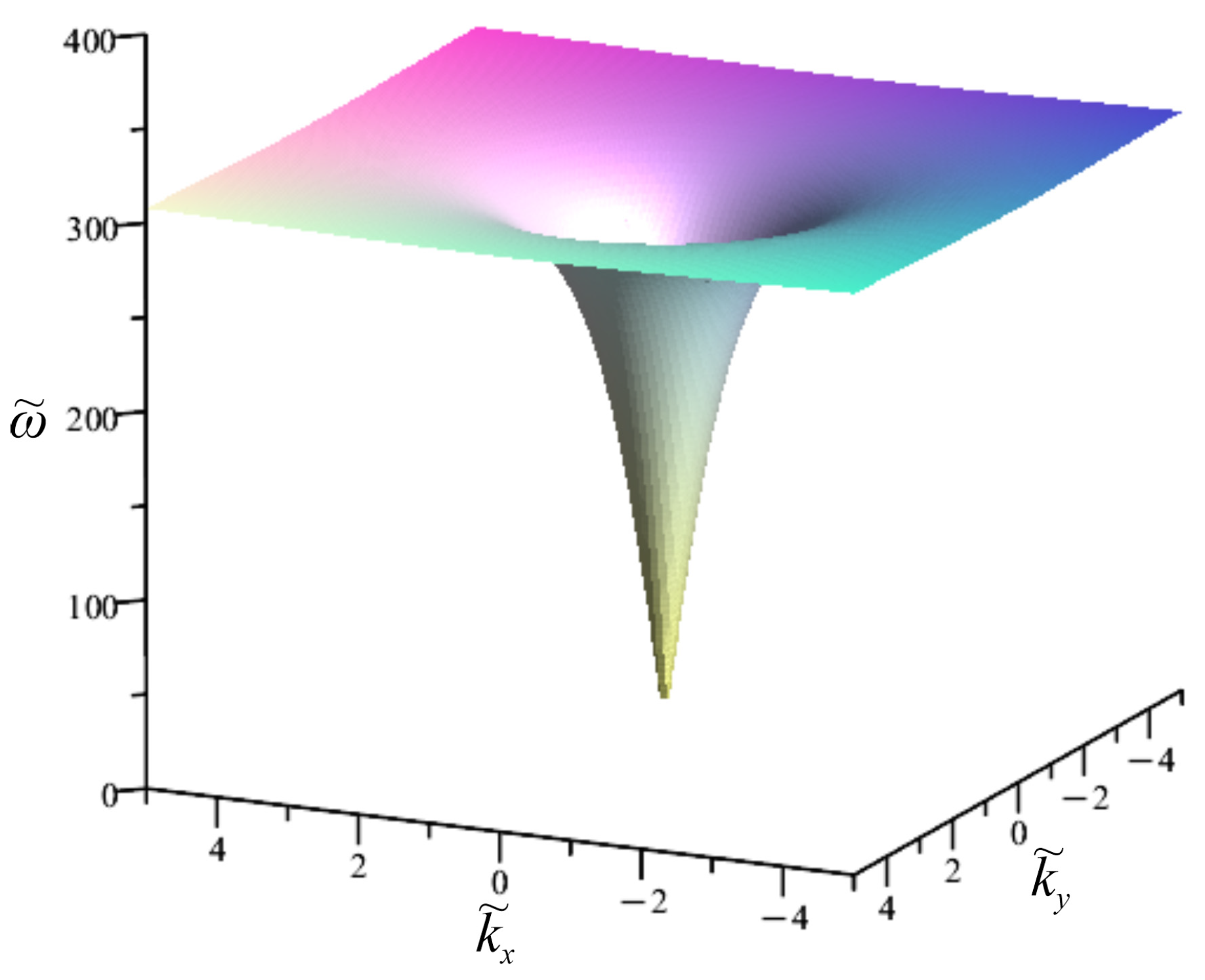
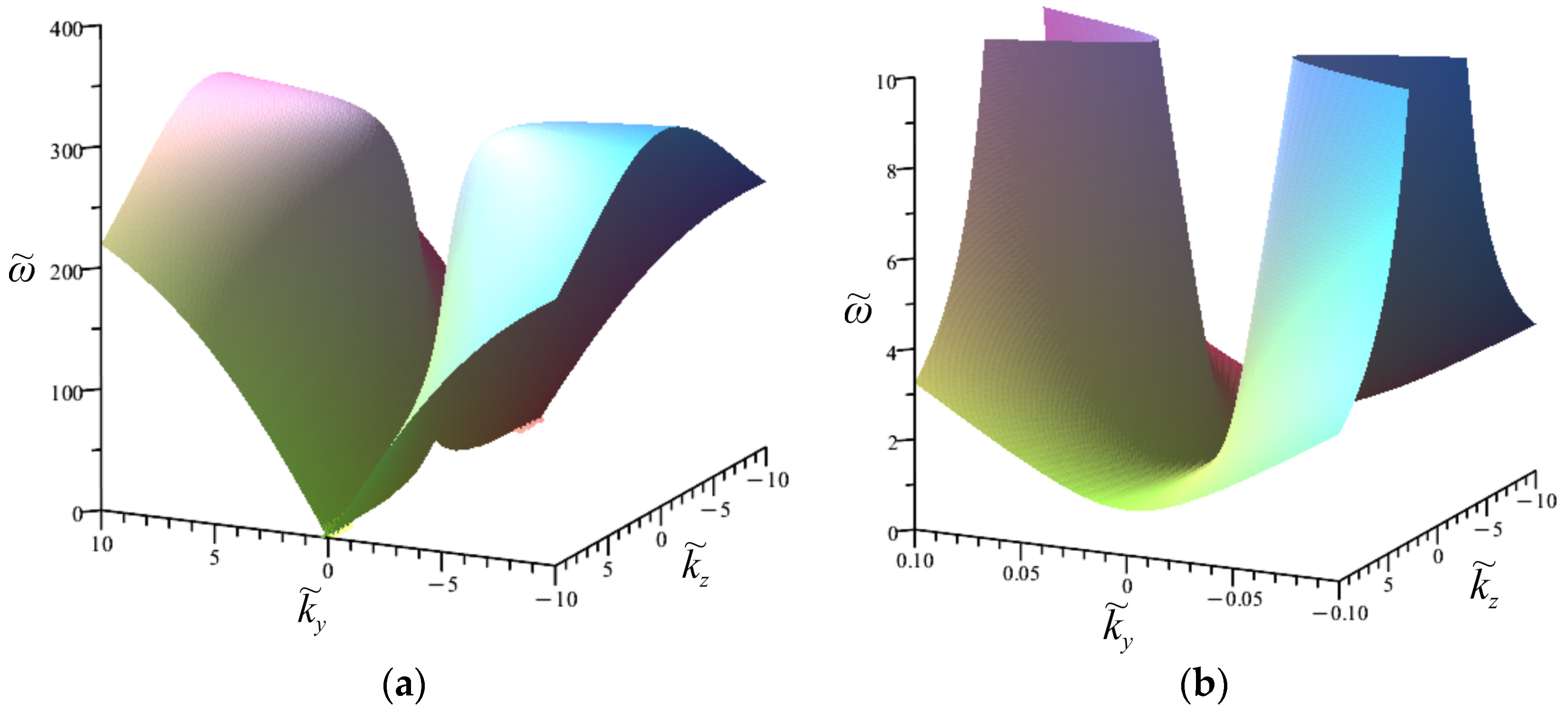
To plot the dispersion relation, assume
and plot the surface
(
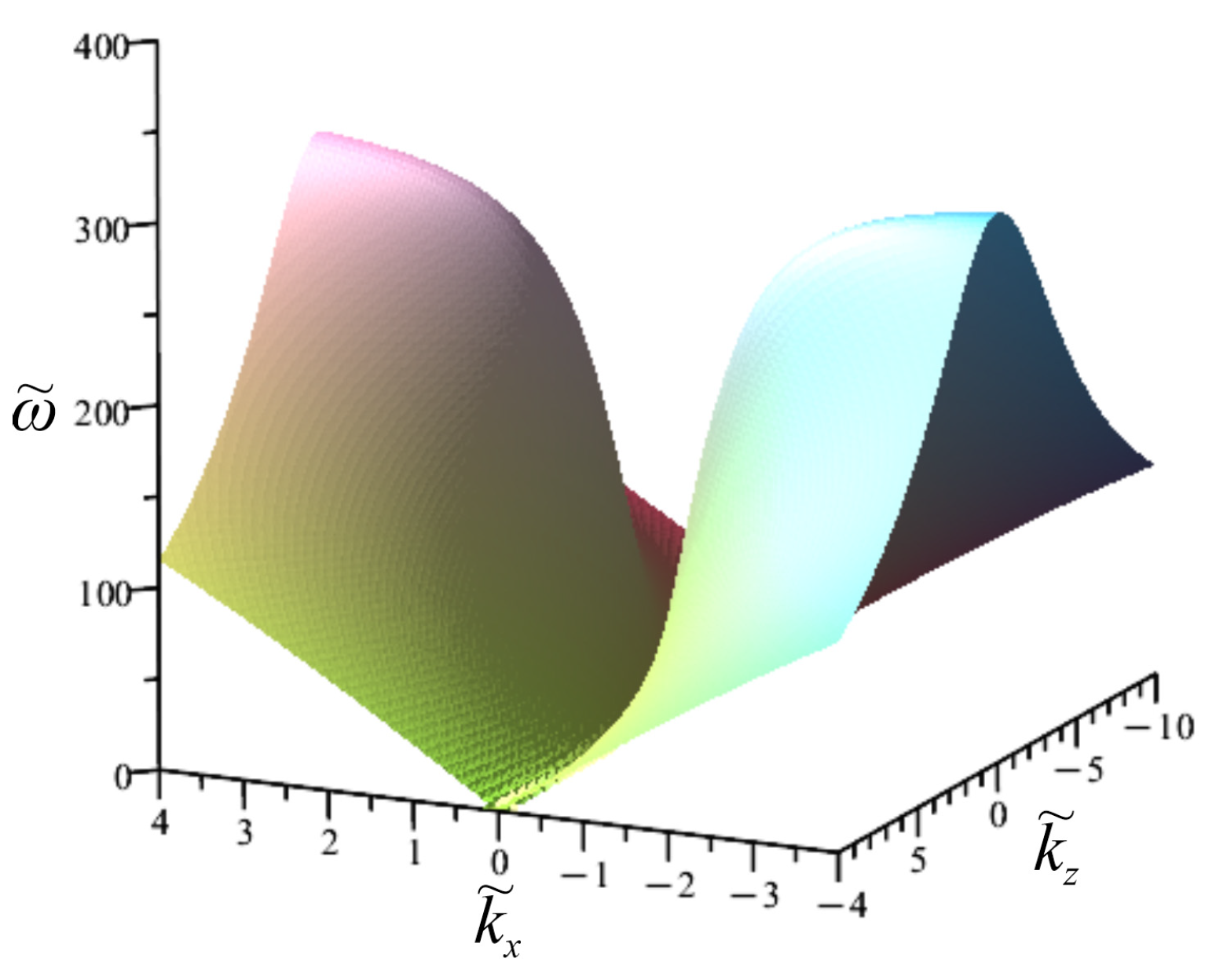
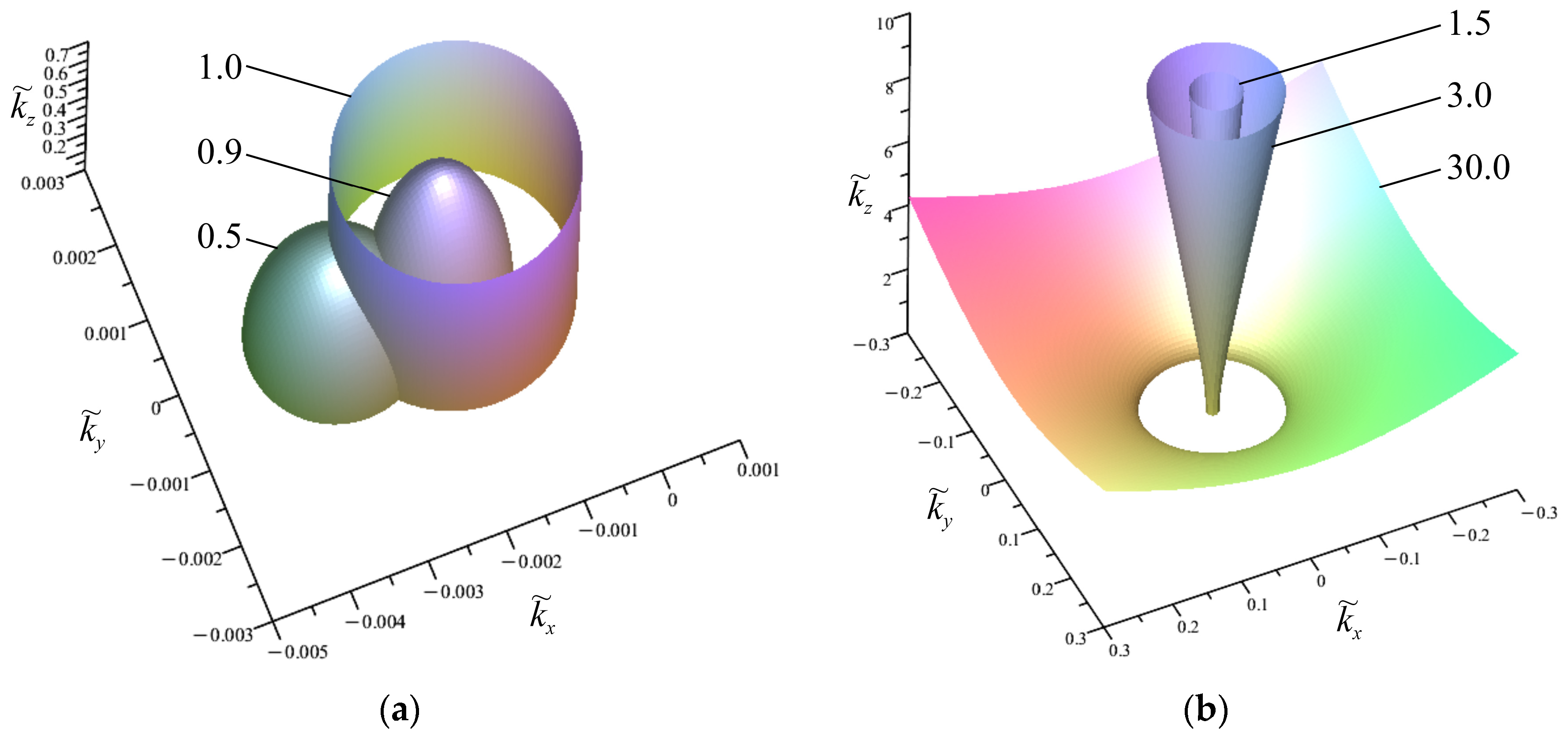
Figure 1). For the purpose of comparison, a similar graph in the
f-plane approximation in the absence of the β-effect (see
Appendix A) is presented in
Figure 2. In the absence of the β-effect, the frequencies are confined between the inertial frequency
and the buoyancy frequency
.
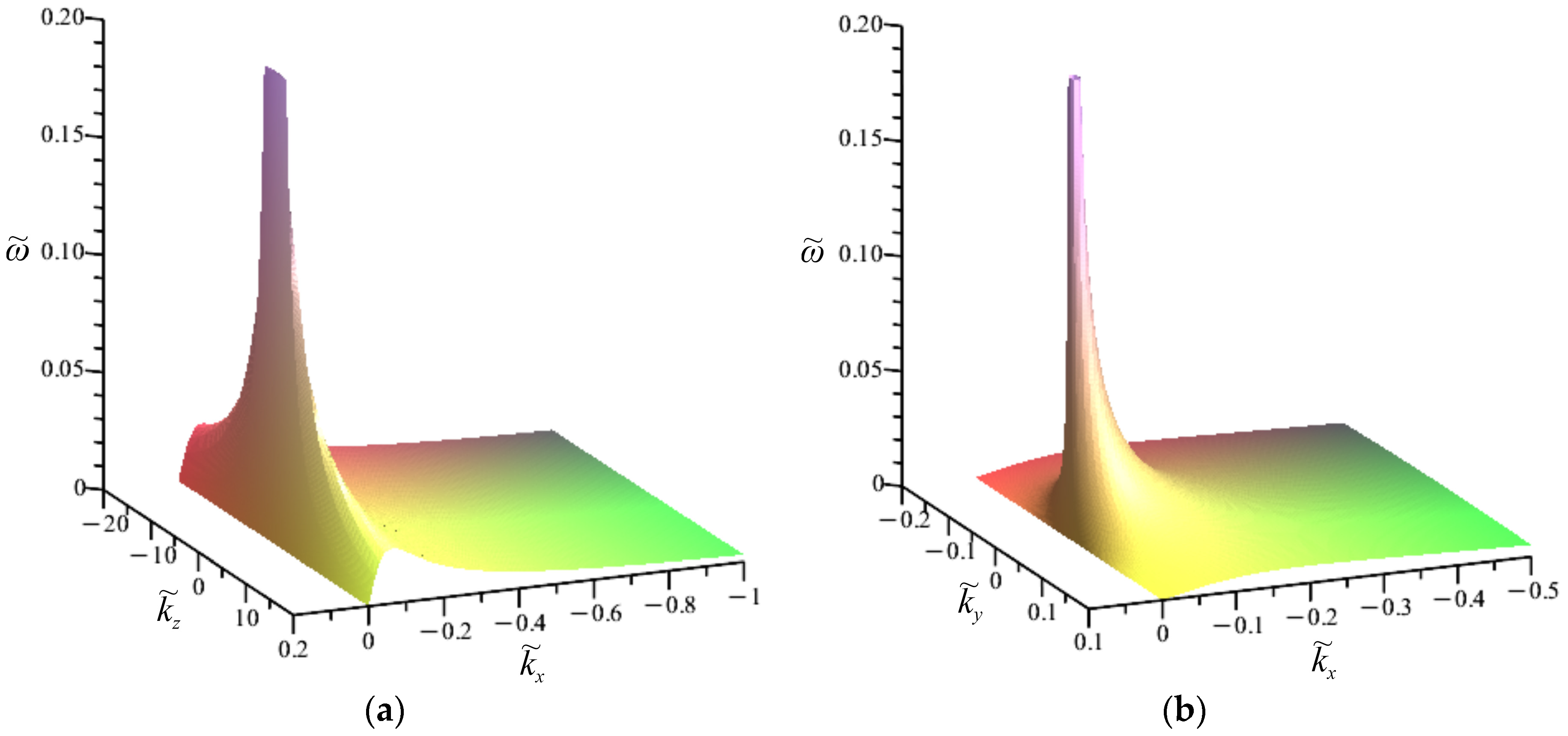
Note that the graphs differ in the low-frequency range (long-wave range). Therefore,
Figure 1b shows the low-frequency range separately. Note that a new frequency range appears in the low-frequency spectrum
, which was not present in the
f-plane approximation. Moreover, as can be seen from
Figure 1b, these waves propagate only in the negative direction of the
x-axis, i.e., against the direction of the Earth’s rotation. We also note that in the “high-frequency” spectrum (upper part of
Figure 1b) there is a region with a minimum frequency
, with which the waves also propagate in the negative direction. To make this clearer, we show this region in a separate
Figure 1c.
The calculations in the figures were performed for the 45th parallel, where
. From Formula (42) and
Figure 1, it follows that when
(short horizontal waves), two regions arise,
and
. When
,
(waves propagate strictly vertically)
.
Using the standard method for finding the extremum of an implicitly defined function, let us find the extremum of the function
. We obtain the following system of equations:
Here, we have denoted by
the partial derivative of function
with respect to variable
. We will write this system as:
From here, we can identify the critical points, which are the points at which the derivative of the function is zero. However, the function does not necessarily have an extremum at every critical point:
At the critical point, the function takes the following values:
Given that
(for standard atmosphere
), let us write (50) as
So, we have obtained two extremum points (points where the function reaches its maximum or minimum value):
Let us show that the first extremum is a minimum and the second is a maximum. To accomplish this, we will determine the following:
It follows (Sylvester’s criterion) that the first extremum is a minimum and the second is a maximum.
Thus, the β-effect causes the spectrum in the low-frequency range to split into two non-intersecting groups of waves: (1) with minimum frequency and (2) with maximum frequency .
Thus, we see that in the low-frequency region there is a range of frequencies at which IIGWs do not propagate in the negative direction. This result is of practical importance in the analysis of large-scale atmospheric circulation. A possible physical manifestation of the beta-effect is the inhibition of zonal flow. However, the presence of the above-mentioned “gap” in the frequency spectrum leads to a range of frequencies at which zonal flow inhibition does not occur.
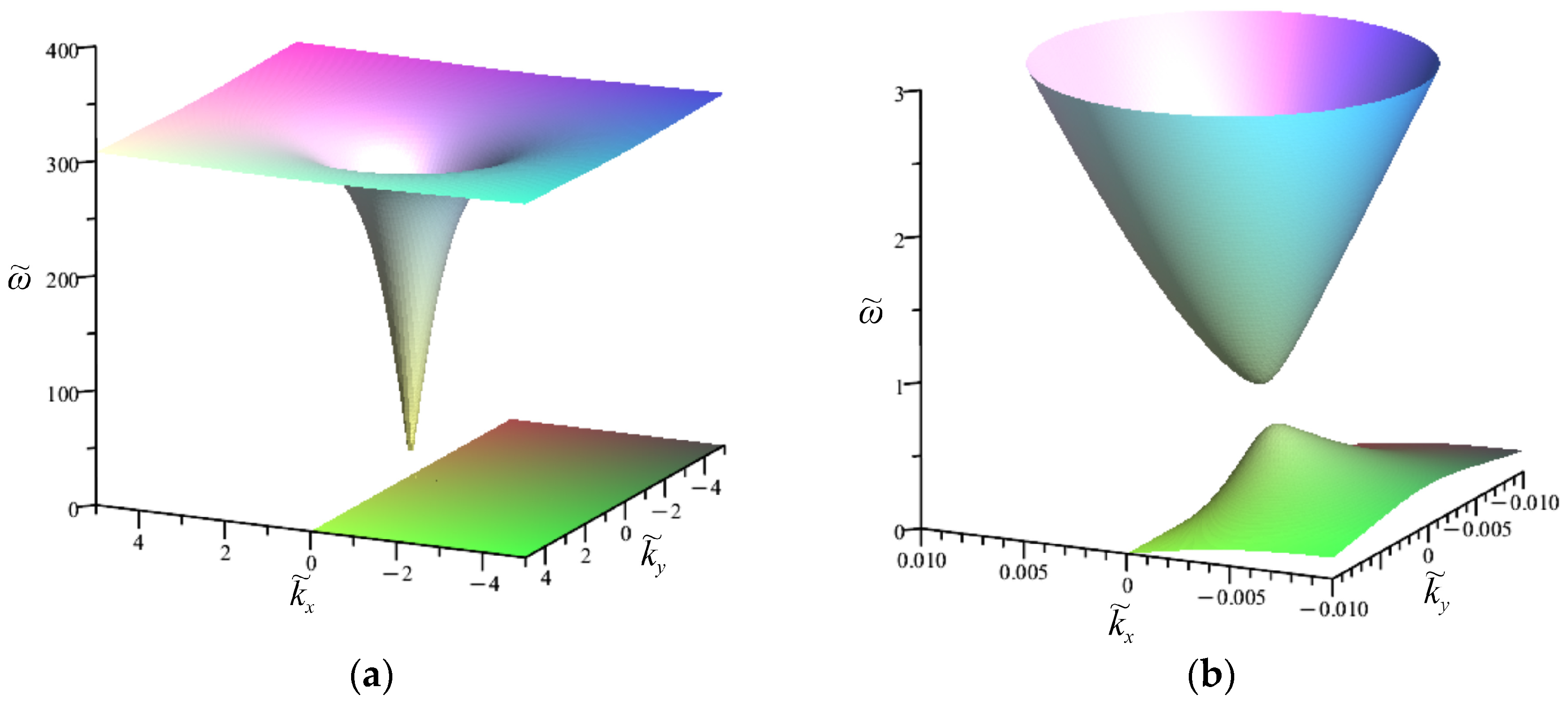
Let us also show the surface graph
(
Figure 3).
A comparison of
Figure 1 and
Figure 3 shows that there is asymmetry in the direction of wave propagation along the
x and
y axes. The β-effect influences wave propagation along the parallel. Separately, we will demonstrate the low-frequency region for the surface
(
Figure 3b). As can be seen from
Figure 3b, for the surface
, the minimum frequency is the inertial frequency
.
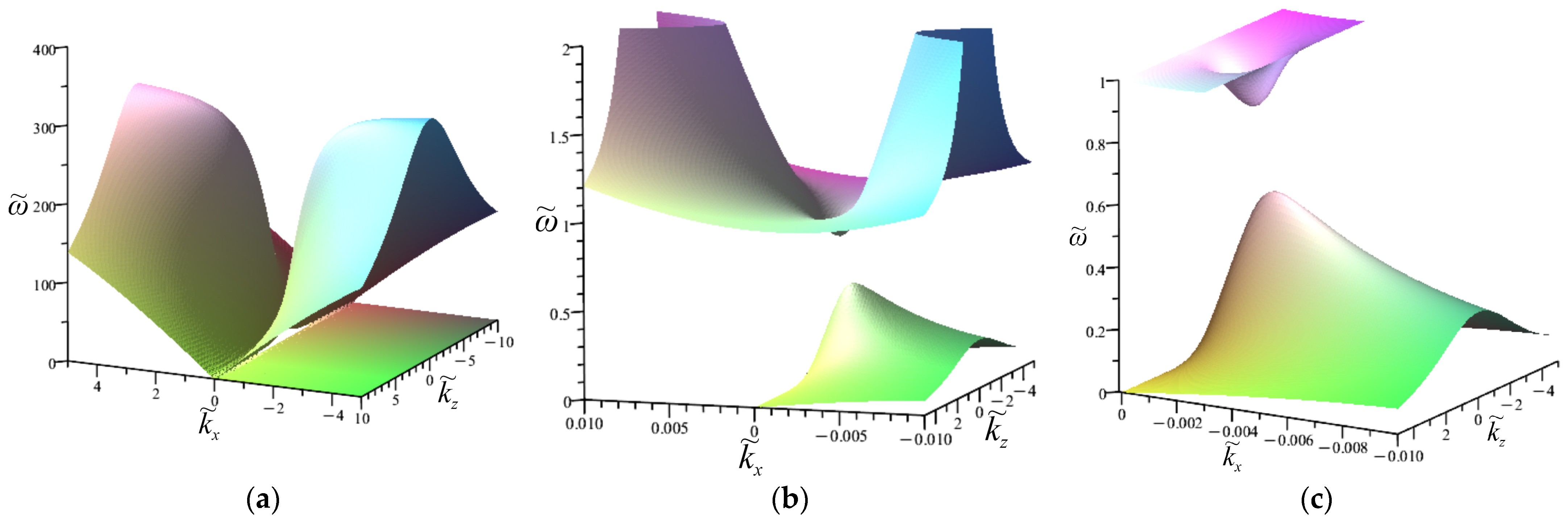
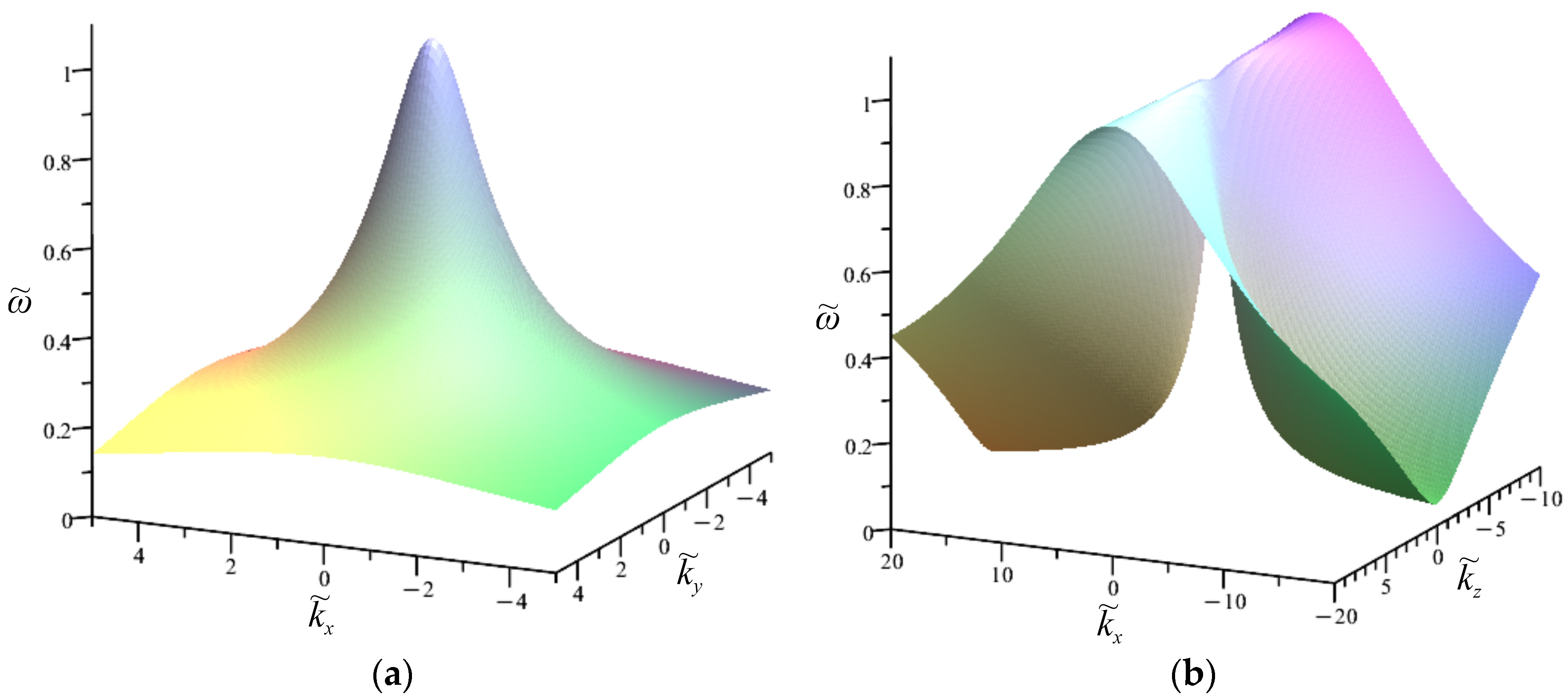
Figure 4 shows the graph of function
. For comparison, let us show a similar graph for the
f-plane approximation (
Figure 5). The
f-plane is defined as the plane tangent to the Earth’s surface on which the Coriolis parameter does not change along the meridian. A comparison of
Figure 4 and
Figure 5 shows that the β-effect manifests itself in the low-frequency range. Therefore, this range is shown separately in
Figure 4b.
Figure 4b shows that the “high-frequency” spectrum (the upper surface in
Figure 4b) begins at the minimum frequency
, while the low-frequency spectrum describes waves propagating in the negative direction of the
x-axis (along the
y-axis waves propagate in both directions) with a maximum frequency less than
.
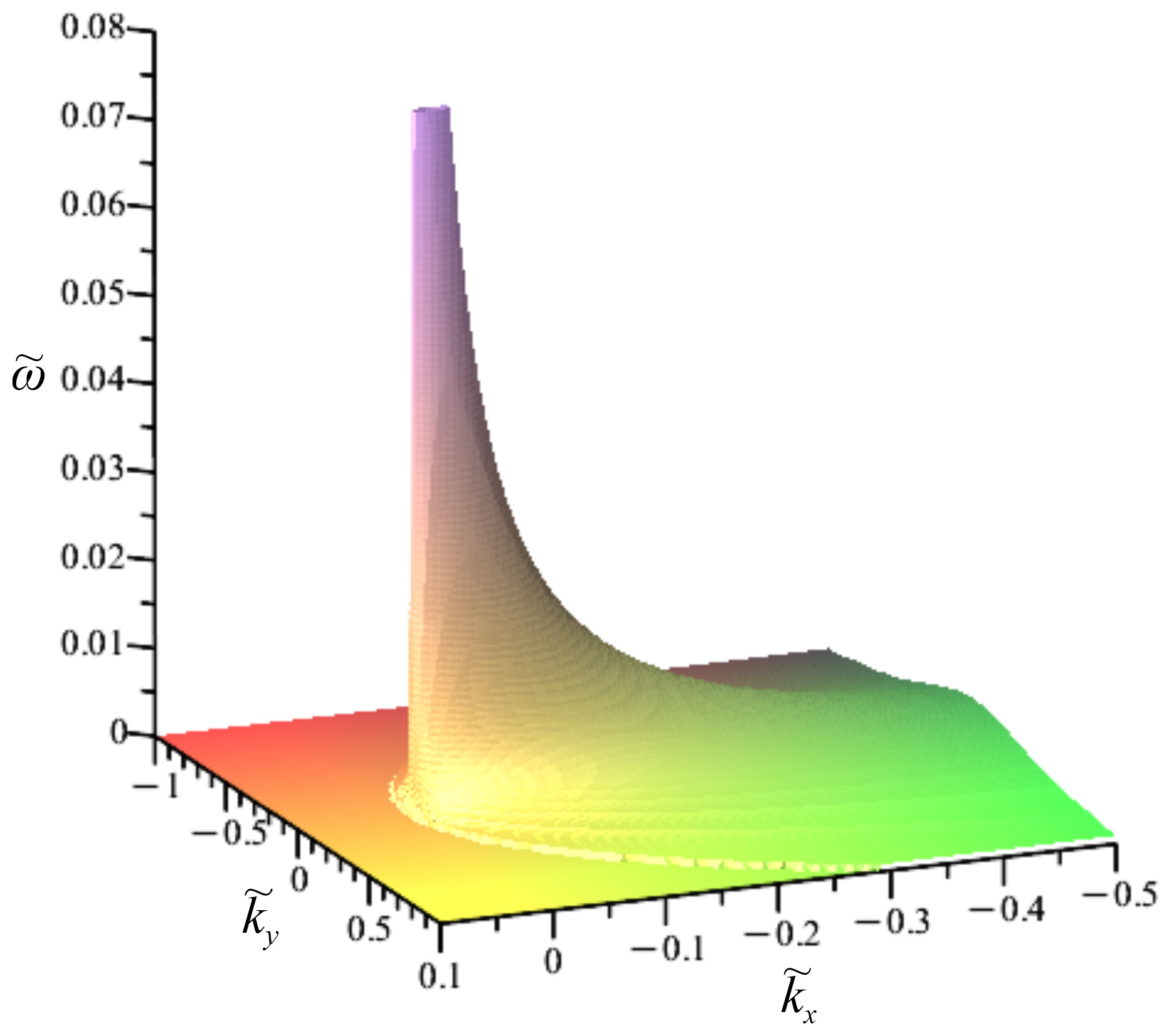
When modeling large-scale atmospheric circulation, buoyancy is sometimes neglected and air density is considered constant. Motion is also considered only in the horizontal plane since buoyancy causes vertical motion. Note that without taking buoyancy into account, the surface
pattern changes significantly (
Figure 6a).
In the absence of buoyancy, there is no asymmetry in the direction of the
x-axis in the
graph. The situation is similar for the
graph (
Figure 6b).
Let us find the extrema of the function
in the general case. Using the standard method, we obtain a system of equations:
Note that Equations (60) and (62) coincide with Equations (43) and (45), respectively, if we make the substitution
. Equations (44) and (61) differ in their numerators. The system (60)–(62) is to be written as follows:
From here, we can find the critical point:
At the critical point, the function takes values coinciding with (50), which can be represented as (51). Condition (53) also holds.
Thus, we have two extremum points:
Similarly to the case of surface , the first extremum will be a minimum, and the second extremum will be a maximum.
The dispersion ratio (42) can be conveniently written as:
Let us bring it to canonical form:
where
To determine the sign of
, let us set the terms with
to zero, and we obtain
In our case
, which means we have three real roots:
Returning to the original variable, we write
This expression includes all three components that determine the dispersion relation. The first term under the square root is due to buoyancy forces and describes oscillations with a buoyancy frequency for an incompressible fluid. The second term under the square root is due to the Coriolis inertia force component and describes inertial oscillations with a frequency . The term outside the square root describes oscillations caused by the β-effect. From the dispersion relation (42), it follows that at , the maximum frequency of the IIGWs is equal to the Coriolis parameter . Dispersion relations (81) and (82) express a peculiarity of the dispersion of the IIGWs, namely that the wave frequency depends not only on the wavelength but also on the direction of propagation. Strictly vertical waves can propagate only at the inertial frequency, and as the angle of inclination to the horizon decreases, the wave frequency increases and, in the horizontal direction, tends to the buoyancy frequency.
The procedure of representing the vertical component of the wave vector as the sum of the real and imaginary parts leads to the wave amplitude increasing with height:
Thus, the incompressible fluid approximation can explain the inhomogeneities observed in the upper atmosphere through wave breaking. The increase in wave amplitude with height, according to [
2], is explained by the fact that the density of air in a static state decreases with height. Recall that in [
2] and subsequent studies, the breaking of the IGWs explains the periodic structures observed in the upper atmosphere (mesosphere, ionosphere, at heights of about 80–100 km) in the form of velocity field disturbances.
Note that when deriving system (19)–(23), no assumption was made about the thickness of the fluid layer in which the waves propagate being small compared to the characteristic atmospheric height scale . Thus, the results obtained are extended to the upper atmosphere. The main assumption of this approximation is that disturbances are small compared to the values in the static state, and that the parameters used (e.g., atmospheric composition and vertical temperature gradient ) are constant. It is also assumed that wave breaking occurs at amplitudes that are still much smaller than those in a static state.
With the additional “assumption of a small vertical wavelength” [
5,
7], the second term with the multiplier
on the right-hand side of (21) can be neglected. This eliminates the fourth term in Equation (37). This means that the imaginary unit does not appear in the dispersion relation, and the wave amplitude does not increase with height. In this case, the term with
disappears from the dispersion relation:
Thus, we see that the increase in wave amplitude with height is not necessarily a consequence of the decrease in air density with height in a static state, as is commonly believed [
2,
8].
In the literature, the β-plane approximation is often considered precisely under the assumption of a small vertical wavelength [
14].
Figure 7 shows the graphs of the surfaces
and
according to Formula (84). The figure shows the manifestation of the beta effect, i.e., the waves propagate only in the negative direction of the
x-axis.
We also present a graph of the surface
assuming a small vertical wavelength and no buoyancy (
Figure 8). A comparison with
Figure 6a suggests that the absence of buoyancy does not necessarily result in the manifestation of the β-effect. The β-effect only manifests itself when both a small vertical wavelength and the absence of buoyancy are assumed. Therefore, in order to study the influence of buoyancy on the manifestation of the β-effect, it is necessary to analyze the complete dispersion relation. Taking buoyancy into account and rejecting the assumption of a small vertical wavelength provides a more comprehensive view of the dispersion relation. Particularly, there are two non-overlapping wave spectra (
Figure 4) propagating in the negative direction of the
x-axis.
Thus, in the approximation of an incompressible fluid without assuming a small vertical wavelength, the dispersion relation has the form (42), the wave amplitude increases with height, and the buoyancy frequency is equal to
(see
Appendix B). Assuming small amplitudes (with short vertical wavelengths), the dispersion relation is given by Formula (84), and the wave amplitude does not increase with height. It also follows from (42) that only inertial waves with frequency
can be strictly vertical.
In the incompressible fluid approximation in the absence of buoyancy forces, the maximum oscillation frequency will be determined by the components of the Coriolis inertia force, i.e., inertial oscillations will occur. However, the presence of buoyancy forces will lead to oscillations with a maximum frequency equal to .
In the considered case, in the incompressible fluid approximation, the heat conduction equation is not included in the system of equations, since it is assumed that the relationship
holds, i.e., the density perturbation is proportional to the temperature perturbation. This relationship is called the Boussinesq approximation, which is understood as the assumption that the pressure disturbance is zero in the equation of state of the disturbed atmosphere, but not zero in the equation of motion. This leads to the fact that in the incompressible fluid approximation, the temperature field is not consistent with the temperature field obtained from the heat conduction equation. Therefore, the following task arises for further research: to propose a mathematical model of IIGWs such that the temperature field is consistent with the heat conduction equation. We proposed such a model in [
9,
11] for non-planetary scale waves and waves in the
f-plane approximation, where it is shown that taking into account the heat conduction equation leads to a quantitatively and qualitatively new dispersion relation in the anelastic gas approximation, while in the incompressible fluid and compressible fluid approximations, the dispersion relations remain unchanged.