Evaluation and Analysis of Next-Generation FY-4A LPW Products over Various Climatic Regions in China

 ,
, 
 and
and 
Abstract
1. Introduction
2. Data and Methods
2.1. FY-4A and ERA5 Data
2.2. Physical Algorithm for Retrieving FY-4A LPW Products
2.3. Surface Pressure Calibration Algorithm for ERA5 LPW Products
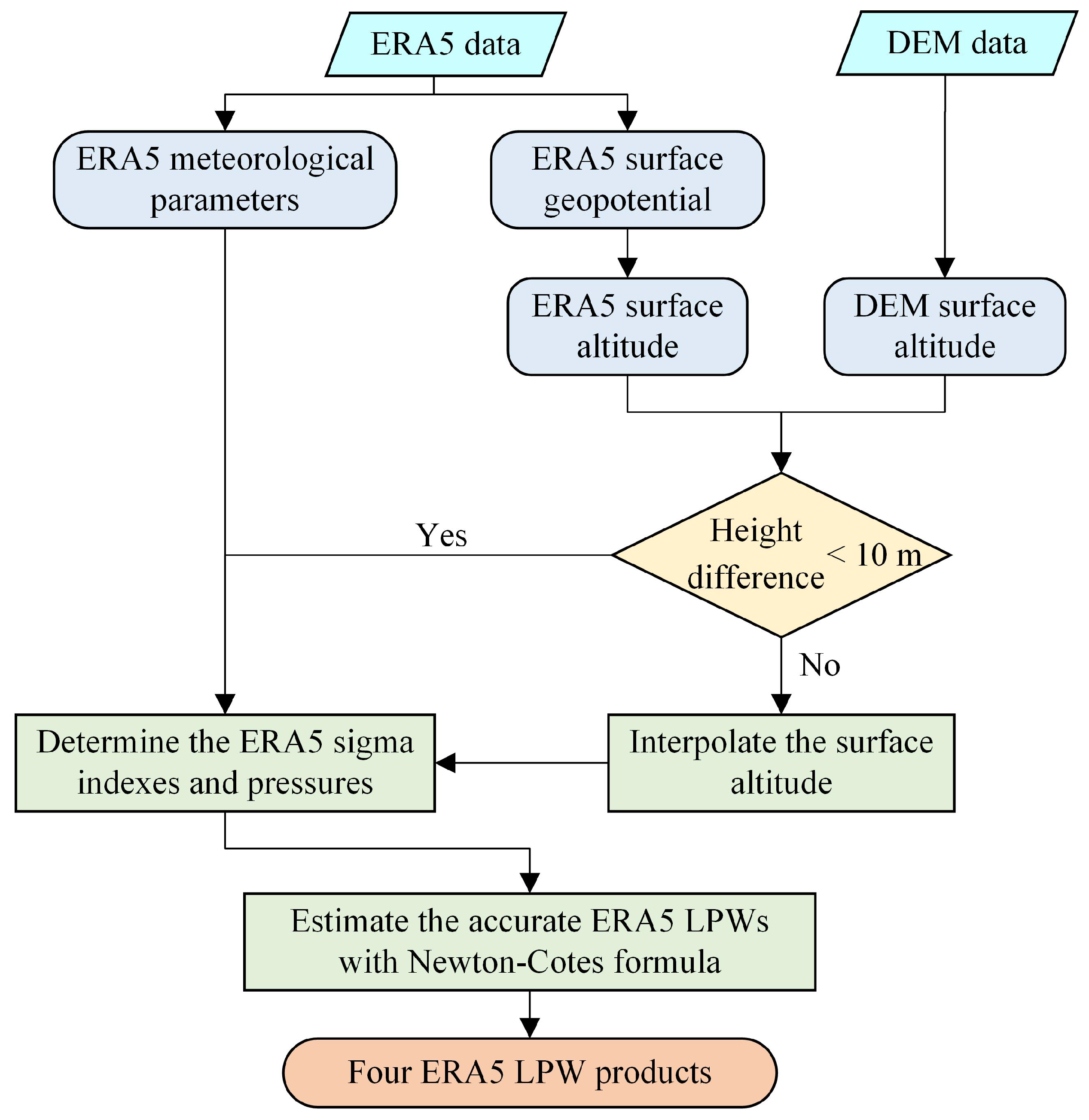
- Judge the difference between the ERA5 surface altitude and DEM value for each grid point. The threshold of difference is set to 10 m since the nominal accuracy of DEM data is 10 m [29], i.e., when the difference is larger than 10 m, the surface pressure of ERA5 data needs to be corrected.
- Calculate the surface pressure based on the surface altitude from DEM using the exponential interpolation method:where is the surface altitude derived from DEM, represents the pressure at DEM surface level. and denote the altitude values of ERA5 upper and lower levels adjacent to the level. and are the corresponding pressures from the ERA5 data. represents the scale height and can be determined with ERA5 data [32].
- Estimate the sigma pressure of ERA5 at four sigma indexes using (1). Subsequently, the specific humidity from the ERA5 data also is interpolated to the sigma pressures with (2). Furthermore, to improve the retrieval accuracy of ERA5 LPWs, we construct the dense ERA5 vertical layer observations with a 10 m interval using the exponential interpolation (5) and apply the Newton–Cotes formula to calculate the integration of (4) [32]:where , , , , and denote the specific humidity of the five interpolation points in the k-th level. represents the pressure interval of the k-th level.
2.4. Data Processing and Statistical Metrics
3. Evaluations and Variations of FY-4A LPW Products in China
4. Comparative Analysis of FY-4A LPWs Over Various Climatic Regions
4.1. Temperate Monsoon Climatic Region
4.2. Temperate Continental Climatic Region
4.3. Plateau Mountain Climatic Region
4.4. Subtropical Monsoon Climatic Region
4.5. Tropical Monsoon Climatic Region
5. Discussion
5.1. Cross Comparison of Five Climate Zones
5.2. Seasonal Variations
6. Conclusions
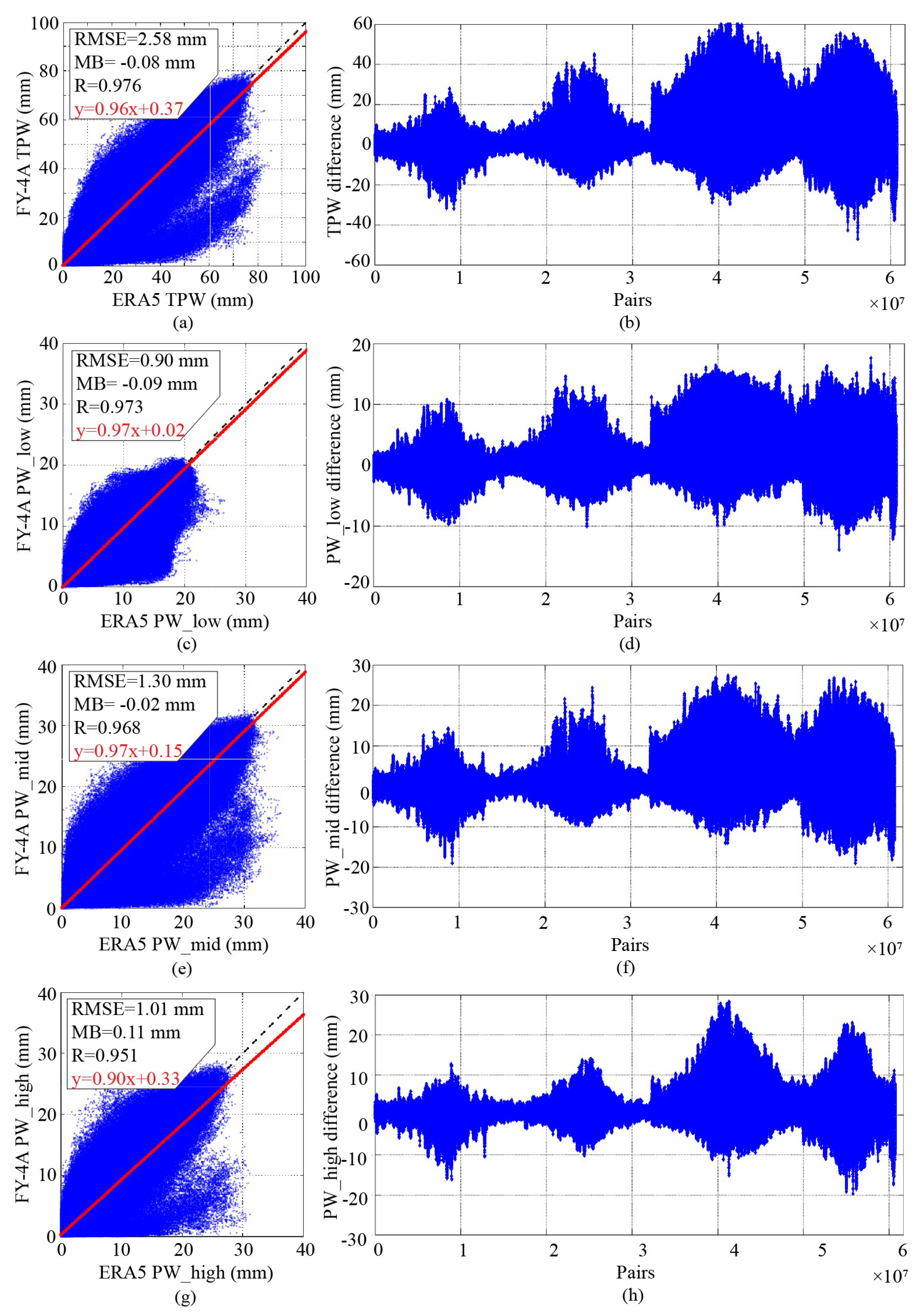
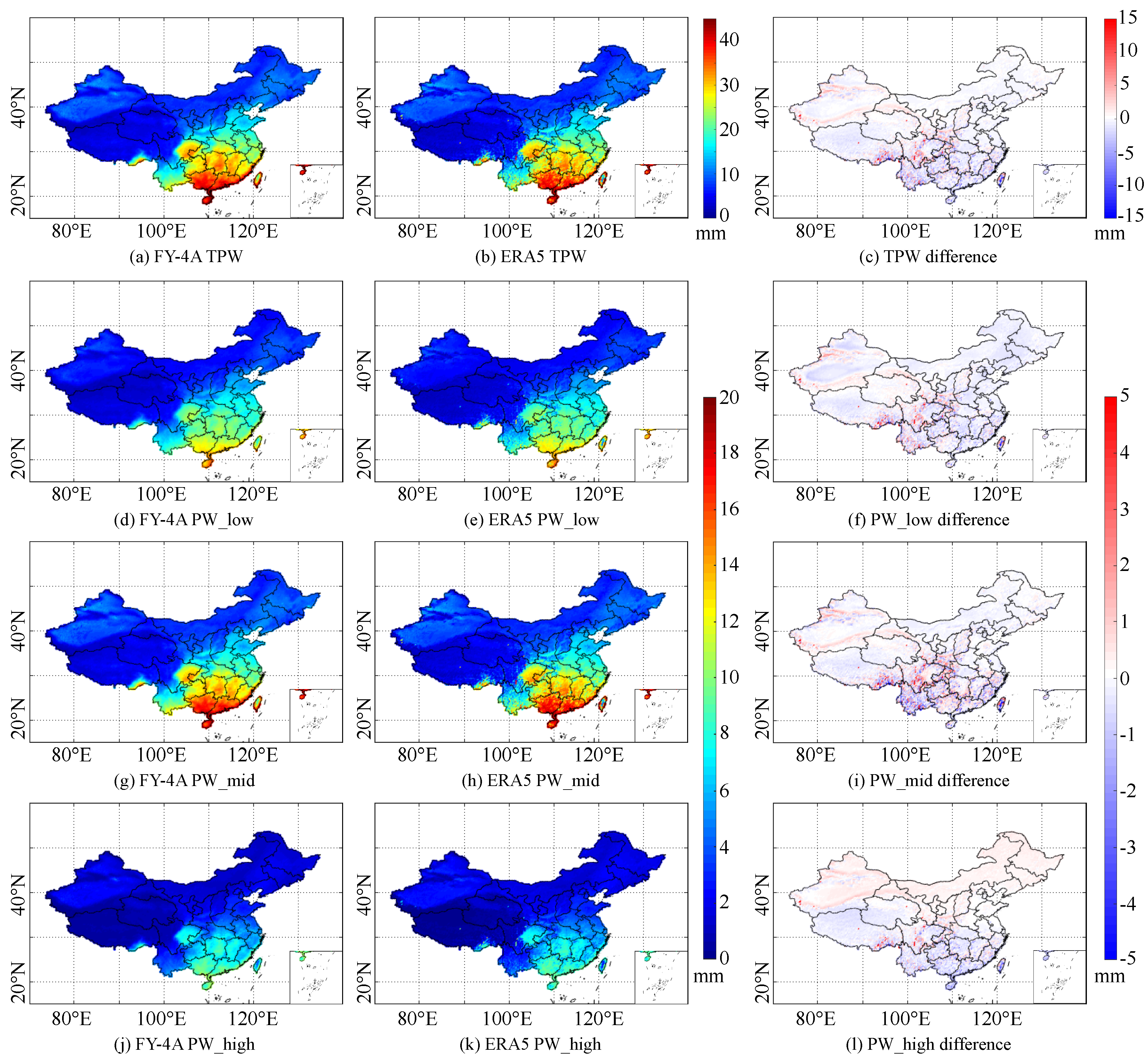
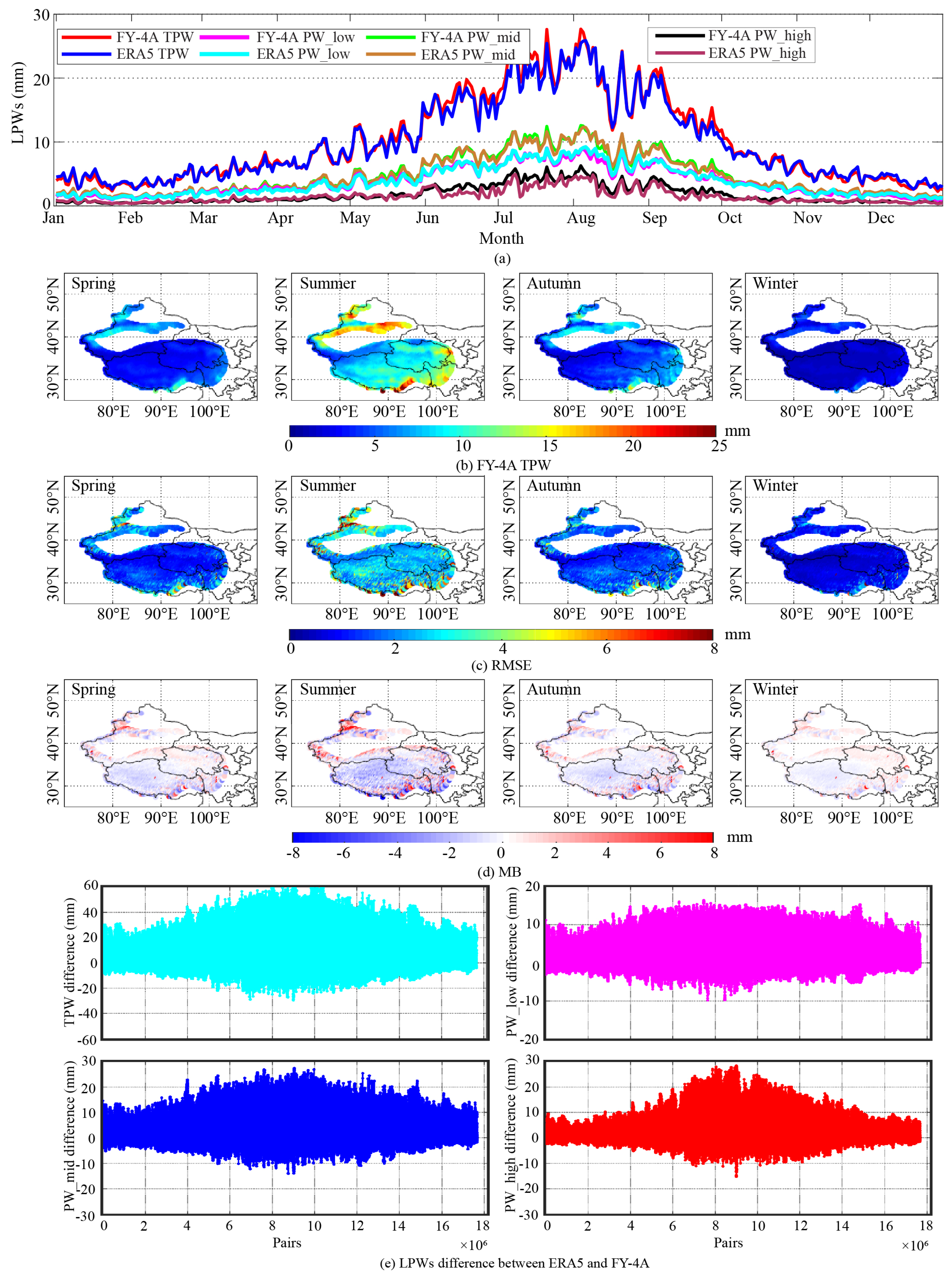
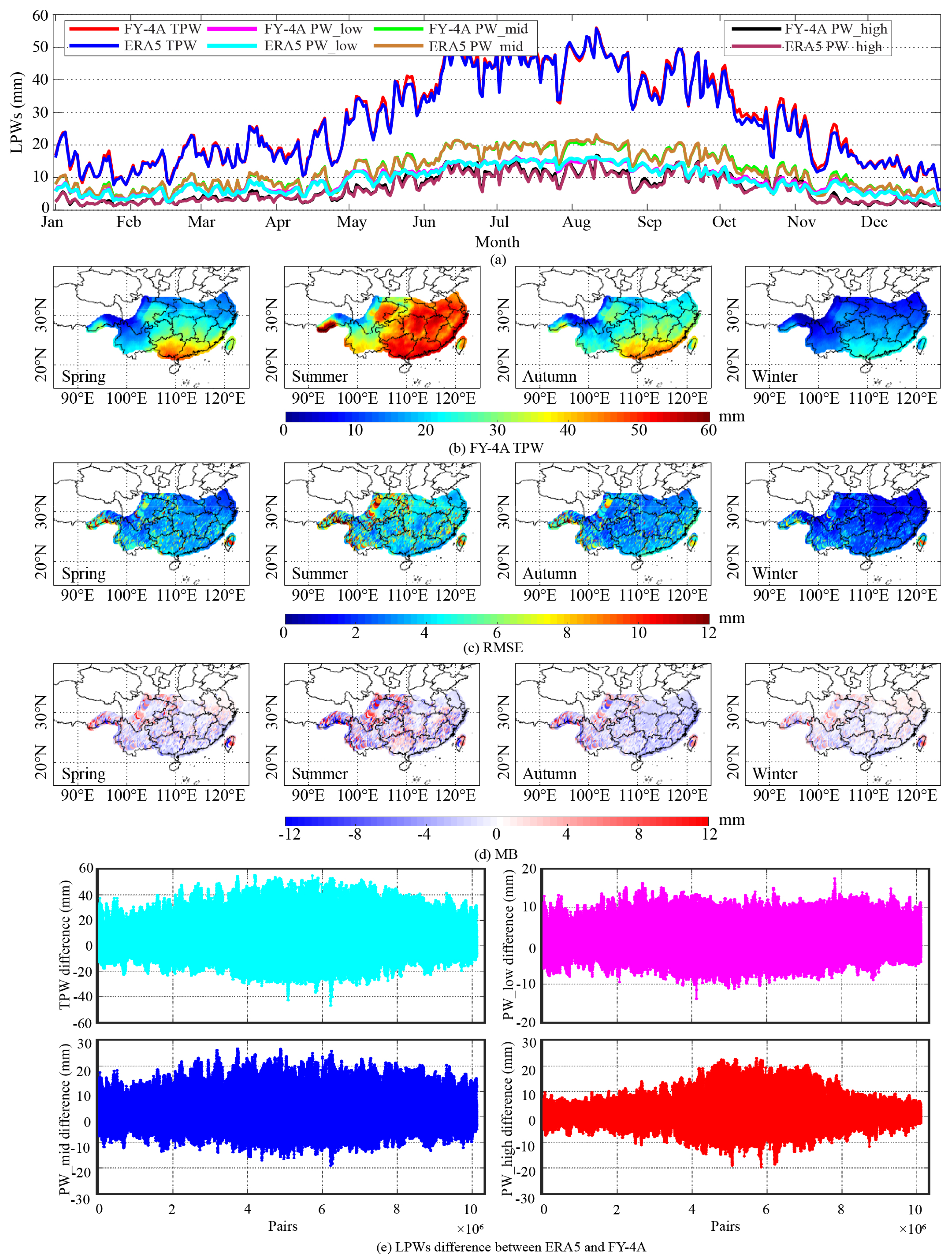
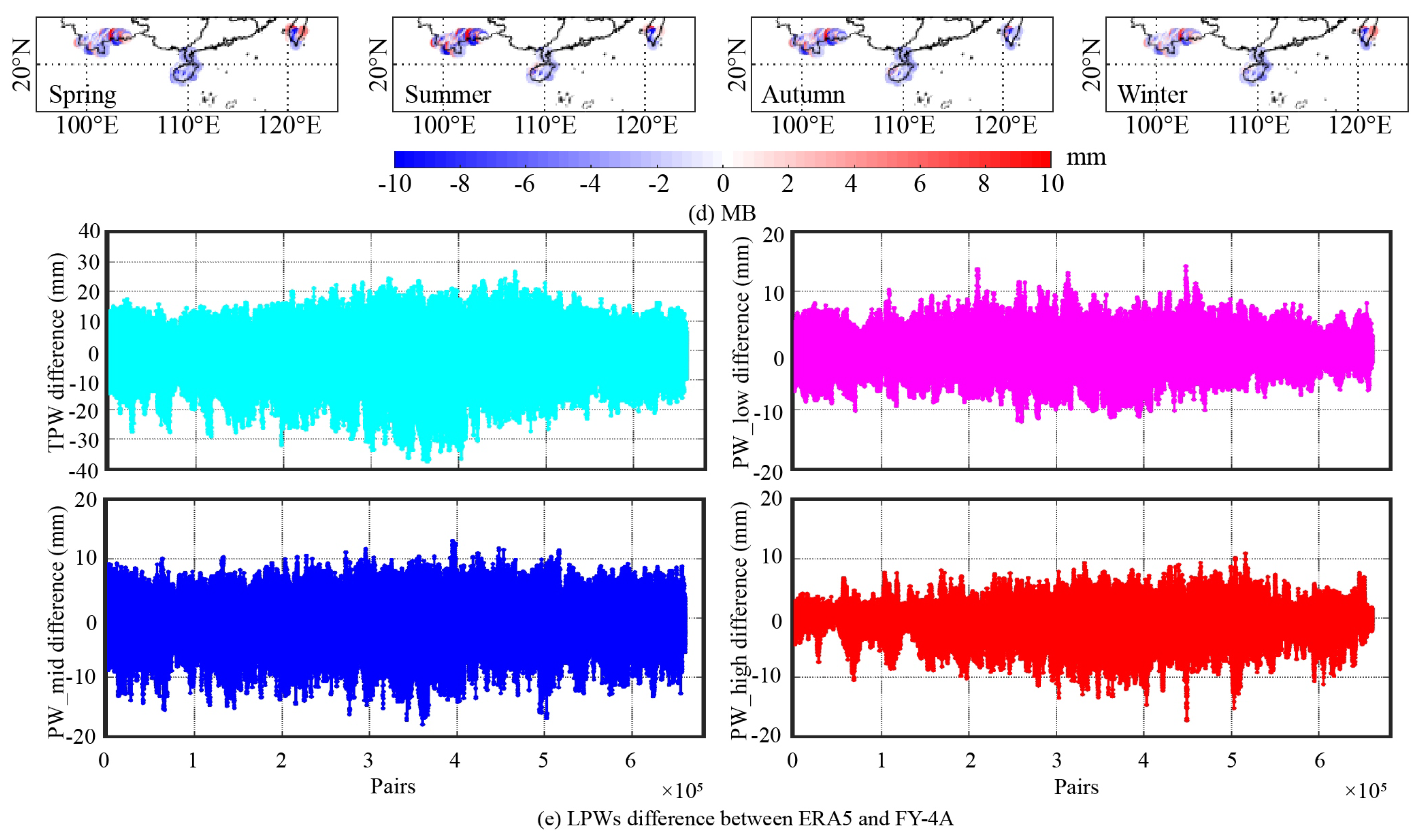
- The accuracy of the four FY-4A LPW products changes significantly throughout the five climatic regions in China. RMSE peaks at a value of 2.96 mm in the tropical monsoon area and reaches a minimum of 1.06 mm in the temperate continental zone. Furthermore, the FY-4A LPW products are overestimated in subtropical and tropical monsoon zones, with MB values of −0.23 and −0.68 mm, respectively, and underestimated in the temperate monsoon region (MB = 0.14 mm). In the other two regions, FY-4A LPWs show a good agreement with the ERA5 data.
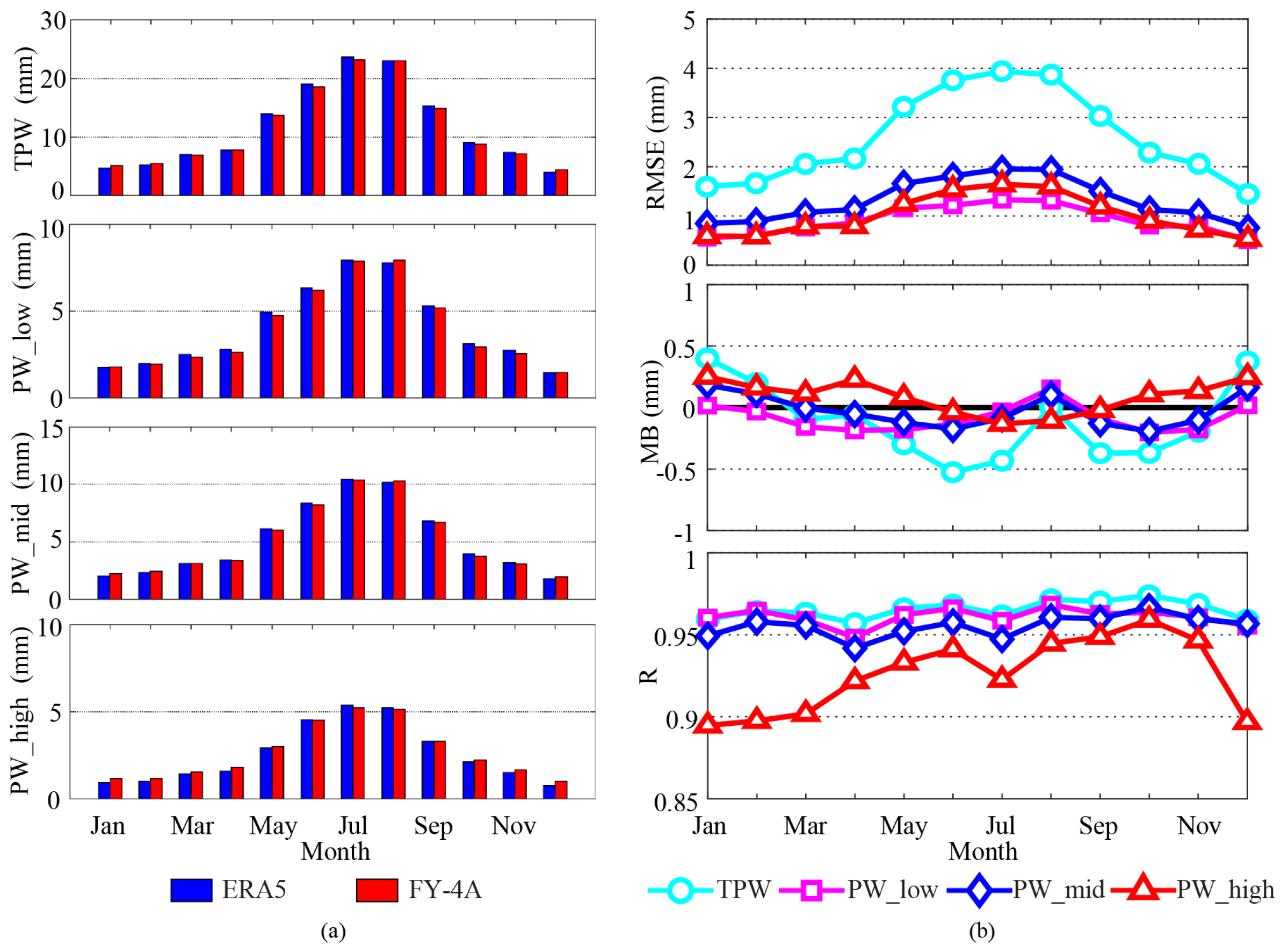
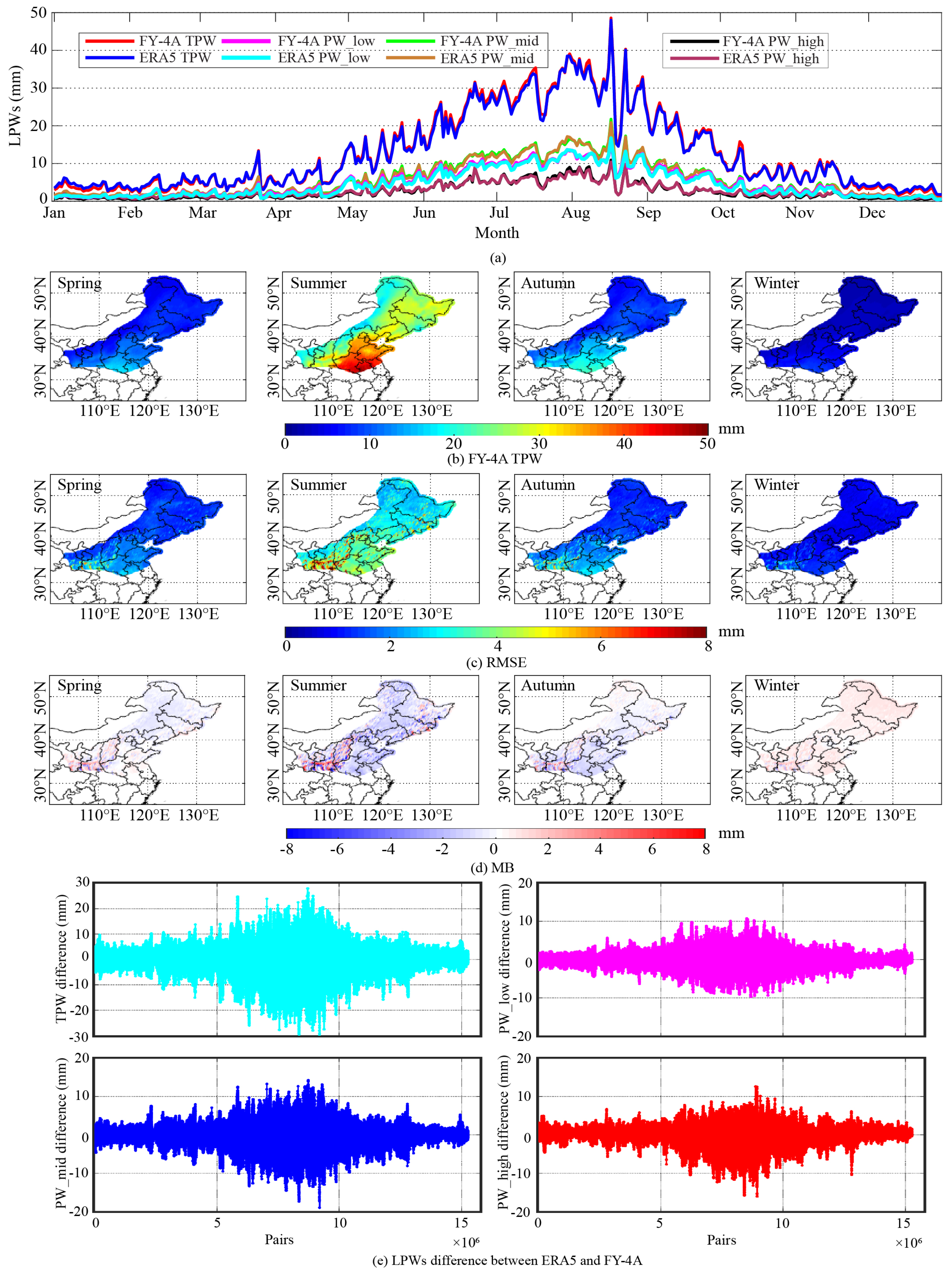
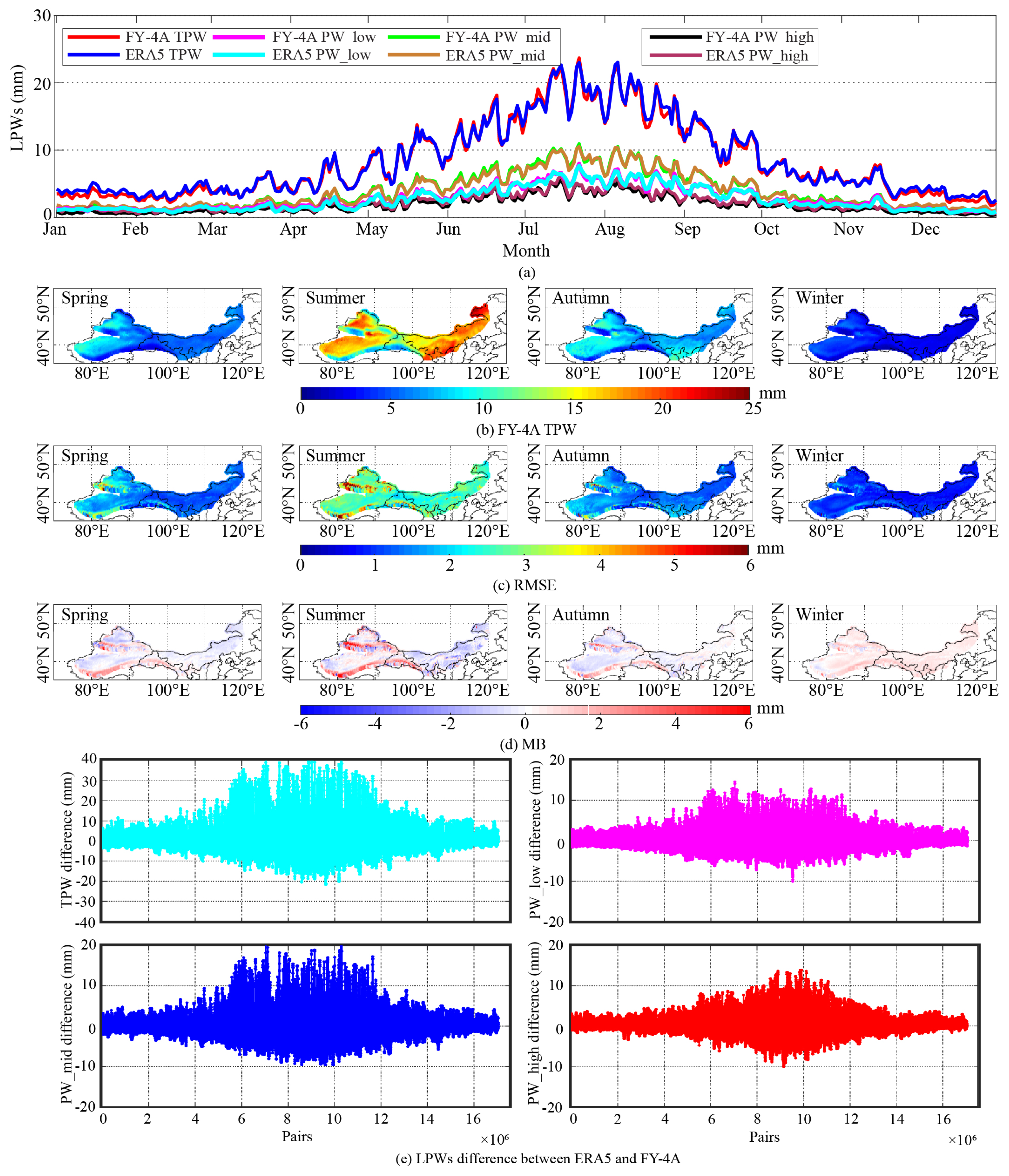
- The four LPWs are characterized by the same seasonal tendency that LPW products gradually increase from spring to the beginning of summer and dramatically reach the peak in the medium of summer and then decrease continuously until winter. Taking TPW products as an example, they have the highest value of 3.95 mm in summer, which is 1.5 times that in spring and autumn (2.76 and 2.69 mm) and twice that in winter (1.82 mm). Among the five climatic regions, the RMSE and MB of FY-4A TPW observations illustrate similar seasonal patterns in the first four regions, while in the tropical monsoon area, the RMSE fluctuates between 4 mm and 5.6 mm during all seasons.
- When FY-4A LPW products are applied to water vapor studies over China, the variations in difference in different climatic areas and seasons should be considered, and a climate- and season-related calibration model is essential for enhancing the performance of FY-4A water vapor products. This has a significant influence on the climate change and other meteorological studies in China.
Author Contributions
Funding
Institutional Review Board Statement
Informed Consent Statement
Data Availability Statement
Acknowledgments
Conflicts of Interest
Abbreviations
| LPW | Layer precipitable water |
| PWV | Precipitable water vapor |
| TPW | Total perceptible water |
| PW_low | Low layer perceptible water |
| PW_mid | Middle layer perceptible water |
| PW_high | High layer perceptible water |
| FY-4A | Fengyun-4A |
| AGRI | Advanced Geosynchronous Radiation Imager |
| ECMWF | European Centre for Medium-Range Weather Forecasts |
| ERA5 | Fifth generation ECMWF atmospheric reanalysis |
| DEM | Digital elevation model |
| RMSE | Root mean square error |
| MB | Mean bias |
| R | Correlation coefficient |
| IDW | Inverse distance weighted |
| QTP | Qinghai–Tibet Plateau |
References
- Sherwood, S.C.; Roca, R.; Weckwerth, T.M.; Andronova, N.G. Tropospheric water vapor, convection, and climate. Rev. Geophys. 2010, 48, 1–29. [Google Scholar] [CrossRef]
- Shi, J.; Xu, C.; Guo, J.; Gao, Y. Real-Time GPS Precise Point Positioning-Based Precipitable Water Vapor Estimation for Rainfall Monitoring and Forecasting. IEEE Trans. Geosci. Remote Sens. 2015, 53, 3452–3459. [Google Scholar]
- Wang, X.; Zhang, K.; Wu, S.; Li, Z.; Cheng, Y.; Li, L.; Yuan, H. The correlation between GNSS-derived precipitable water vapor and sea surface temperature and its responses to El Niño–Southern Oscillation. Remote Sens. Environ. 2018, 216, 1–12. [Google Scholar] [CrossRef]
- Chen, Z.; Li, L.; Wang, B.; Fan, J.; Lu, T.; Lv, K. The impact of global warming on ENSO from the perspective of objective signals. Atmos. Res. 2023, 299, 107176. [Google Scholar] [CrossRef]
- Li, J.; Yang, F.; Yuan, D.; Wang, H.; Song, S.; Tan, J.; Wen, Z. Unraveling the Accuracy Enigma: Investigating ZTD Data Precision in TUW-VMF3 and GFZ-VMF3 Products Using a Comprehensive Global GPS Dataset. IEEE Trans. Geosci. Remote Sens. 2024, 62, 1–10. [Google Scholar] [CrossRef]
- Bevis, M.; Businger, S.; Herring, T.A.; Rocken, C.; Anthes, R.A.; Ware, R.H. GPS meteorology: Remote sensing of atmospheric water vapor using the global positioning system. J. Geophys. Res. Atmos. 1992, 97, 15787–15801. [Google Scholar] [CrossRef]
- Yang, F.; Sun, Y.; Meng, X.; Guo, J.; Gong, X. Assessment of tomographic window and sampling rate effects on GNSS water vapor tomography. Satell. Navig. 2023, 4, 7. [Google Scholar] [CrossRef]
- Ichoku, C.; Levy, R.; Kaufman, Y.J.; Remer, L.A.; Li, R.R.; Martins, V.J.; Holben, B.N.; Abuhassan, N.; Slutsker, I.; Eck, T.F.; et al. Analysis of the performance characteristics of the five-channel Microtops II Sun photometer for measuring aerosol optical thickness and precipitable water vapor. J. Geophys. Res. Atmos. 2002, 107, AAC–5. [Google Scholar] [CrossRef]
- Leontiev, A.; Rostkier-Edelstein, D.; Reuveni, Y. On the potential of improving WRF model forecasts by assimilation of high-resolution GPS-derived water-vapor maps augmented with METEOSAT-11 data. Remote Sens. 2020, 13, 96. [Google Scholar] [CrossRef]
- Zhang, W.; Zhang, S.; Ding, N.; Holden, L.; Wang, X.; Zheng, N. GNSS-RS Tomography: Retrieval of Tropospheric Water Vapor Fields Using GNSS and RS Observations. IEEE Trans. Geosci. Remote Sens. 2022, 60, 1–13. [Google Scholar] [CrossRef]
- Zhao, Q.; Liu, Y.; Ma, X.; Yao, W.; Yao, Y.; Li, X. An improved rainfall forecasting model based on GNSS observations. IEEE Trans. Geosci. Remote Sens. 2020, 58, 4891–4900. [Google Scholar] [CrossRef]
- Saha, J.; Price, C.; Plotnik, T.; Guha, A. Impact of the El Niño–Southern Oscillation on upper-tropospheric water vapor. Atmos. Res. 2022, 280, 106422. [Google Scholar] [CrossRef]
- Schmit, T.J.; Li, J.; Lee, S.J.; Li, Z.; Dworak, R.; Lee, Y.K.; Bowlan, M.; Gerth, J.; Martin, G.D.; Straka, W.; et al. Legacy Atmospheric Profiles and Derived Products From GOES-16: Validation and Applications. Earth Space Sci. 2019, 6, 1730–1748. [Google Scholar] [CrossRef]
- Wang, P.; Li, J.; Lu, B.; Schmit, T.J.; Lu, J.; Lee, Y.K.; Li, J.; Liu, Z. Impact of Moisture Information From Advanced Himawari Imager Measurements on Heavy Precipitation Forecasts in a Regional NWP Model. J. Geophys. Res. Atmos. 2018, 123, 6022–6038. [Google Scholar] [CrossRef]
- Pan, S.; Gao, J.; Jones, T.A.; Wang, Y.; Li, J. The Impact of Assimilating Satellite-Derived Layered Precipitable Water, Cloud Water Path, and Radar Data on Short-Range Thunderstorm Forecasts. Mon. Weather Rev. 2021, 149, 1359–1380. [Google Scholar] [CrossRef]
- Wang, Y.; Liu, H.; Zhang, Y.; Duan, M.; Tang, S.; Deng, X. Validation of FY-4A AGRI layer precipitable water products using radiosonde data. Atmos. Res. 2021, 253, 105502. [Google Scholar] [CrossRef]
- Zhang, Y.; Li, Z.; Li, J. A Preliminary Layer Perceptible Water Vapor Retrieval Algorithm for Fengyun-4 Advanced Geosynchronous Radiation Imager. In Proceedings of the IGARSS 2019—2019 IEEE International Geoscience and Remote Sensing Symposium, Yokohama, Japan, 28 July–2 August 2019; pp. 7564–7566. [Google Scholar]
- Zhai, P.; Eskridge, R.E. Atmospheric water vapor over China. J. Clim. 1997, 10, 2643–2652. [Google Scholar] [CrossRef]
- Yuan, P.; Hunegnaw, A.; Alshawaf, F.; Awange, J.; Klos, A.; Teferle, F.N.; Kutterer, H. Feasibility of ERA5 integrated water vapor trends for climate change analysis in continental Europe: An evaluation with GPS (1994–2019) by considering statistical significance. Remote Sens. Environ. 2021, 260, 112416. [Google Scholar] [CrossRef]
- Zhang, P.; Zhu, L.; Tang, S.; Gao, L.; Chen, L.; Zheng, W.; Han, X.; Chen, J.; Shao, J. General comparison of FY-4A/AGRI with other GEO/LEO instruments and its potential and challenges in non-meteorological applications. Front. Earth Sci. 2019, 6, 224. [Google Scholar] [CrossRef]
- Zhang, J.; Zhiguang, L. Climate of China; John Wiley & Sons: Hoboken, NJ, USA, 1992. [Google Scholar]
- Gao, X.; Shi, Y.; Zhang, D.; Giorgi, F. Climate change in China in the 21st century as simulated by a high resolution regional climate model. Chin. Sci. Bull. 2012, 57, 1188–1195. [Google Scholar]
- Zhang, X.; Yan, X. Temporal change of climate zones in China in the context of climate warming. Theor. Appl. Climatol. 2014, 115, 167–175. [Google Scholar] [CrossRef]
- Administration, C.M. Atlas of Climate of the P.R. of China; SinoMaps Press: Beijing, China, 1979. [Google Scholar]
- Bai, J.; Lou, Y.; Zhang, W.; Zhou, Y.; Zhang, Z.; Shi, C. Assessment and calibration of MODIS precipitable water vapor products based on GPS network over China. Atmos. Res. 2021, 254, 105504. [Google Scholar] [CrossRef]
- Hersbach, H.; Bell, B.; Berrisford, P.; Hirahara, S.; Horányi, A.; Muñoz-Sabater, J.; Nicolas, J.; Peubey, C.; Radu, R.; Schepers, D.; et al. The ERA5 global reanalysis. Q. J. R. Meteorol. Soc. 2020, 146, 1999–2049. [Google Scholar] [CrossRef]
- Zhang, W.; Zhang, H.; Liang, H.; Lou, Y.; Cai, Y.; Cao, Y.; Zhou, Y.; Liu, W. On the suitability of ERA5 in hourly GPS precipitable water vapor retrieval over China. J. Geod. 2019, 93, 1897–1909. [Google Scholar] [CrossRef]
- Yang, J.; Zhang, Z.; Wei, C.; Lu, F.; Guo, Q. Introducing the new generation of Chinese geostationary weather satellites, Fengyun-4. Bull. Am. Meteorol. Soc. 2017, 98, 1637–1658. [Google Scholar] [CrossRef]
- Wessel, B. TanDEM-X Ground Segment—DEM Products Specification Document; German Aerospace Center: Oberpfaffenhofen, Germany, 2018.
- Hobiger, T.; Ichikawa, R.; Koyama, Y.; Kondo, T. Fast and accurate ray-tracing algorithms for real-time space geodetic applications using numerical weather models. J. Geophys. Res. Atmos. 2008, 113. [Google Scholar] [CrossRef]
- Zhang, W.; Zhang, S.; Chang, G.; Ding, N.; Wang, X. A new hybrid observation GNSS tomography method combining the real and virtual inverted signals. J. Geod. 2021, 95, 1–18. [Google Scholar] [CrossRef]
- Möller, G. Reconstruction of 3D Wet Refractivity Fields in the Lower Atmosphere Along Bended GNSS Signal Paths. Ph.D. Thesis, Technische Universität Wien, Vienna, Austria, 2017. [Google Scholar]
- Chang, L.; Xiao, R.; Prasad, A.A.; Gao, G.; Feng, G.; Zhang, Y. Cloud mask-related differential linear adjustment model for MODIS infrared water vapor product. Remote Sens. Environ. 2019, 221, 650–664. [Google Scholar] [CrossRef]
- Zhang, X.; Li, X.; Zhang, H. The control of drift sand on the southern fringe of the Taklamakan Desert—An example from the Cele oasis. In Sustainable Land Use in Deserts; Springer: Berlin/Heidelberg, Germany, 2001; pp. 350–356. [Google Scholar]
- Immerzeel, W.W.; Van Beek, L.P.; Bierkens, M.F. Climate change will affect the Asian water towers. Science 2010, 328, 1382–1385. [Google Scholar] [CrossRef]
- Pritchard, H.D. Asia’s shrinking glaciers protect large populations from drought stress. Nature 2019, 569, 649–654. [Google Scholar] [CrossRef] [PubMed]



| Climatic Area | Season | Spring | Summer | Autumn | Winter | Overall |
|---|---|---|---|---|---|---|
| Temperate monsoon | Mean | 8.27 | 27.36 | 10.44 | 3.56 | 12.41 |
| RMS | 1.58 | 3.30 | 1.66 | 0.96 | 1.88 | |
| MB | −0.13 | −0.80 | −0.27 | 0.58 | −0.16 | |
| Temperate continental | Mean | 6.23 | 16.06 | 7.44 | 3.23 | 8.24 |
| RMS | 1.58 | 2.83 | 1.53 | 0.94 | 1.72 | |
| MB | −0.01 | 0.18 | 0.01 | 0.52 | 0.18 | |
| Plateau mountain | Mean | 3.87 | 9.91 | 4.76 | 1.85 | 5.10 |
| RMS | 1.57 | 2.94 | 1.72 | 0.85 | 1.77 | |
| MB | −0.07 | −0.33 | −0.12 | 0.16 | −0.09 | |
| Subtropical monsoon | Mean | 23.44 | 43.20 | 26.01 | 13.67 | 26.58 |
| RMS | 3.73 | 5.06 | 3.66 | 2.29 | 3.69 | |
| MB | −0.44 | −0.39 | −1.23 | −0.07 | −0.53 | |
| Tropical monsoon | Mean | 33.69 | 46.44 | 36.46 | 21.98 | 34.64 |
| RMS | 5.34 | 5.60 | 4.87 | 4.04 | 4.96 | |
| MB | −1.96 | −1.44 | −1.41 | −1.16 | −1.49 | |
| Overall | Mean | 15.10 | 28.59 | 17.02 | 8.86 | 17.39 |
| RMS | 2.76 | 3.95 | 2.69 | 1.82 | 2.80 | |
| MB | −0.52 | −0.56 | −0.60 | 0.01 | −0.42 |
Disclaimer/Publisher’s Note: The statements, opinions and data contained in all publications are solely those of the individual author(s) and contributor(s) and not of MDPI and/or the editor(s). MDPI and/or the editor(s) disclaim responsibility for any injury to people or property resulting from any ideas, methods, instructions or products referred to in the content. |
© 2024 by the authors. Licensee MDPI, Basel, Switzerland. This article is an open access article distributed under the terms and conditions of the Creative Commons Attribution (CC BY) license (https://creativecommons.org/licenses/by/4.0/).
Share and Cite
Zhang, W.; Xiao, X.; Peng, J.; Zhang, S.; Shehaj, E.; Moeller, G. Evaluation and Analysis of Next-Generation FY-4A LPW Products over Various Climatic Regions in China. Atmosphere 2024, 15, 1545. https://doi.org/10.3390/atmos15121545
Zhang W, Xiao X, Peng J, Zhang S, Shehaj E, Moeller G. Evaluation and Analysis of Next-Generation FY-4A LPW Products over Various Climatic Regions in China. Atmosphere. 2024; 15(12):1545. https://doi.org/10.3390/atmos15121545
Chicago/Turabian StyleZhang, Wenyuan, Xinyu Xiao, Jinsong Peng, Shubi Zhang, Endrit Shehaj, and Gregor Moeller. 2024. "Evaluation and Analysis of Next-Generation FY-4A LPW Products over Various Climatic Regions in China" Atmosphere 15, no. 12: 1545. https://doi.org/10.3390/atmos15121545
APA StyleZhang, W., Xiao, X., Peng, J., Zhang, S., Shehaj, E., & Moeller, G. (2024). Evaluation and Analysis of Next-Generation FY-4A LPW Products over Various Climatic Regions in China. Atmosphere, 15(12), 1545. https://doi.org/10.3390/atmos15121545