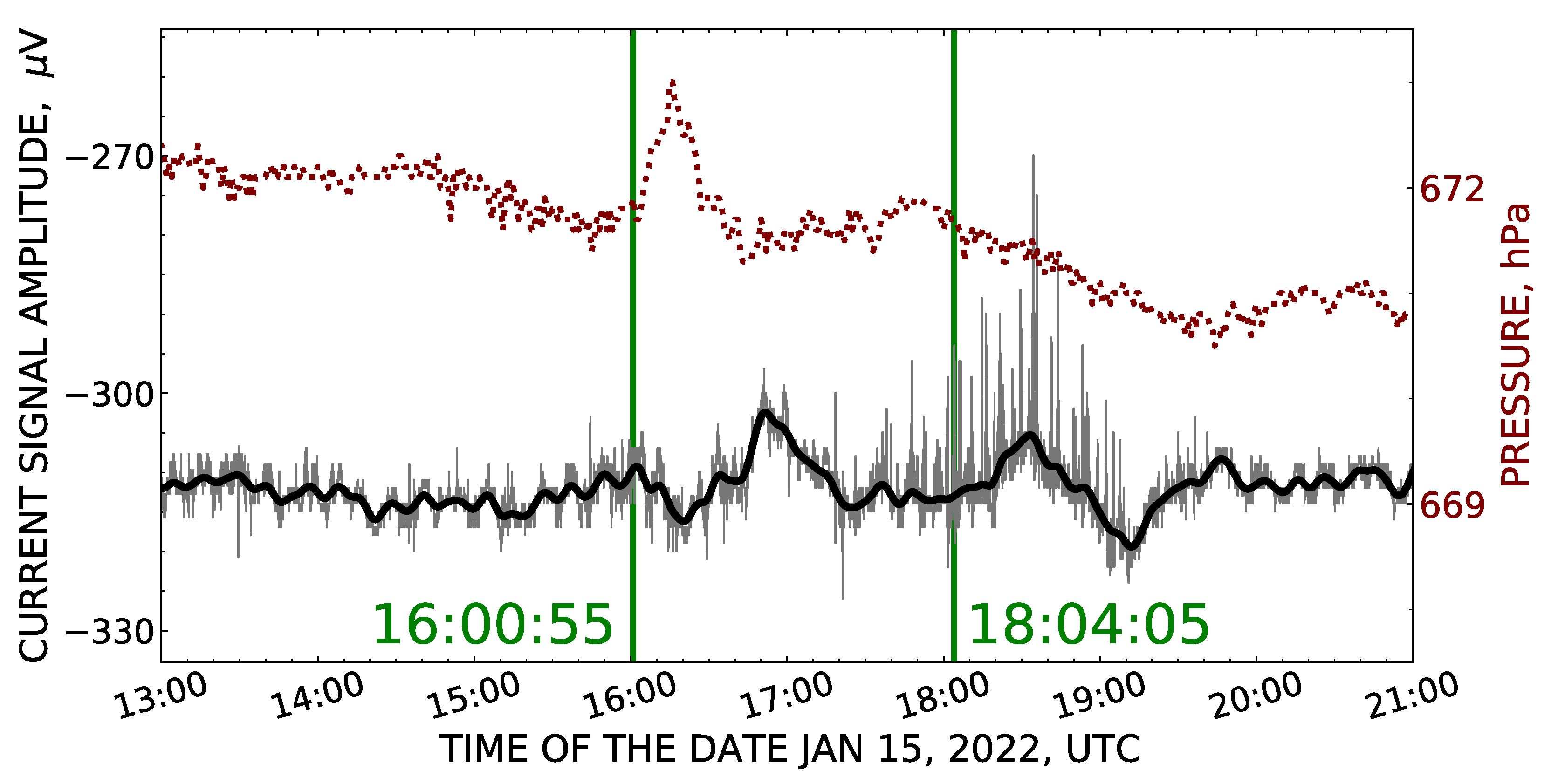
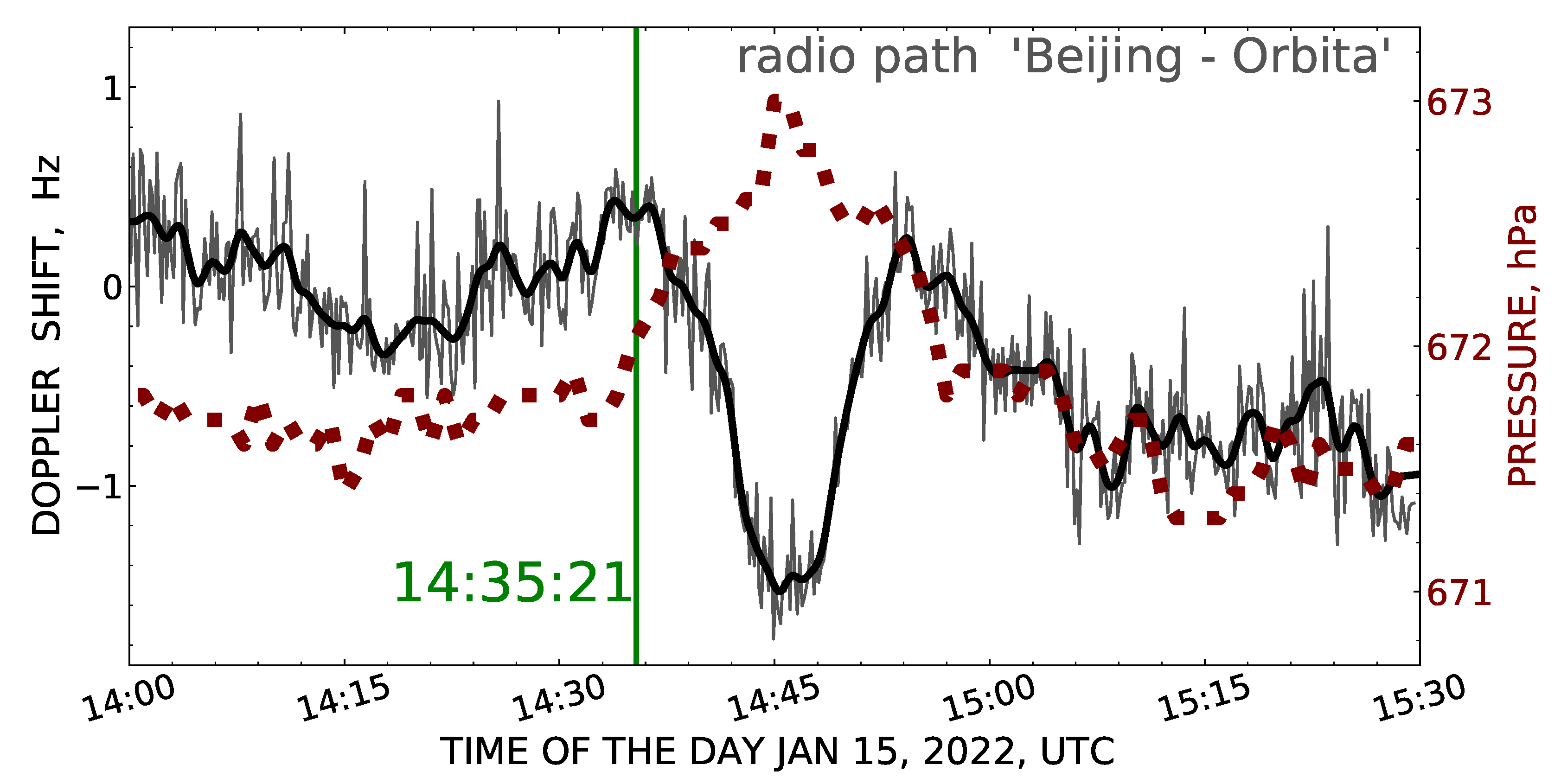
Disturbances of Doppler Frequency Shift of Ionospheric Signal and of Telluric Current Caused by Atmospheric Waves from Explosive Eruption of Hunga Tonga Volcano on January 15, 2022

 , , , , ,
 Abstract
Share and Cite
Salikhov, N.; Shepetov, A.; Pak, G.; Saveliev, V.; Nurakynov, S.; Ryabov, V.; Zhukov, V. Disturbances of Doppler Frequency Shift of Ionospheric Signal and of Telluric Current Caused by Atmospheric Waves from Explosive Eruption of Hunga Tonga Volcano on January 15, 2022. Atmosphere 2023, 14, 245. https://doi.org/10.3390/atmos14020245
Salikhov N, Shepetov A, Pak G, Saveliev V, Nurakynov S, Ryabov V, Zhukov V. Disturbances of Doppler Frequency Shift of Ionospheric Signal and of Telluric Current Caused by Atmospheric Waves from Explosive Eruption of Hunga Tonga Volcano on January 15, 2022. Atmosphere. 2023; 14(2):245. https://doi.org/10.3390/atmos14020245
Chicago/Turabian StyleSalikhov, Nazyf, Alexander Shepetov, Galina Pak, Vladimir Saveliev, Serik Nurakynov, Vladimir Ryabov, and Valery Zhukov. 2023. "Disturbances of Doppler Frequency Shift of Ionospheric Signal and of Telluric Current Caused by Atmospheric Waves from Explosive Eruption of Hunga Tonga Volcano on January 15, 2022" Atmosphere 14, no. 2: 245. https://doi.org/10.3390/atmos14020245
APA StyleSalikhov, N., Shepetov, A., Pak, G., Saveliev, V., Nurakynov, S., Ryabov, V., & Zhukov, V. (2023). Disturbances of Doppler Frequency Shift of Ionospheric Signal and of Telluric Current Caused by Atmospheric Waves from Explosive Eruption of Hunga Tonga Volcano on January 15, 2022. Atmosphere, 14(2), 245. https://doi.org/10.3390/atmos14020245