Article

Transmission Risk Prediction and Evaluation of Mountain-Type Zoonotic Visceral Leishmaniasis in China Based on Climatic and Environmental Variables

1
National Institute of Parasitic Diseases, Chinese Center for Disease Control and Prevention (Chinese Center for Tropical Diseases Research), WHO Collaborating Centre for Tropical Diseases; National Center for International Research on Tropical Diseases, NHC Key Laboratory of Parasite and Vector Biology, Shanghai 200025, China
2
College of Geography and Remote sensing Sciences, Xinjiang University, Urumqi 830046, China
3
Chinese Center for Tropical Diseases Research, School of Global Health, Shanghai Jiao Tong University School of Medicine, Shanghai 200025, China
4
State Key Laboratory of Desert and Oasis Ecology, Xinjiang Institute of Ecology and Geography, Chinese Academy of Sciences, Urumqi 830011, China
*
Authors to whom correspondence should be addressed.
These authors contributed equally to this work.
Atmosphere 2022, 13(6), 964; https://doi.org/10.3390/atmos13060964
Submission received: 27 May 2022 / Revised: 5 June 2022 / Accepted: 13 June 2022 / Published: 14 June 2022
(This article belongs to the Special Issue Advanced Climate Simulation and Observation)

Abstract

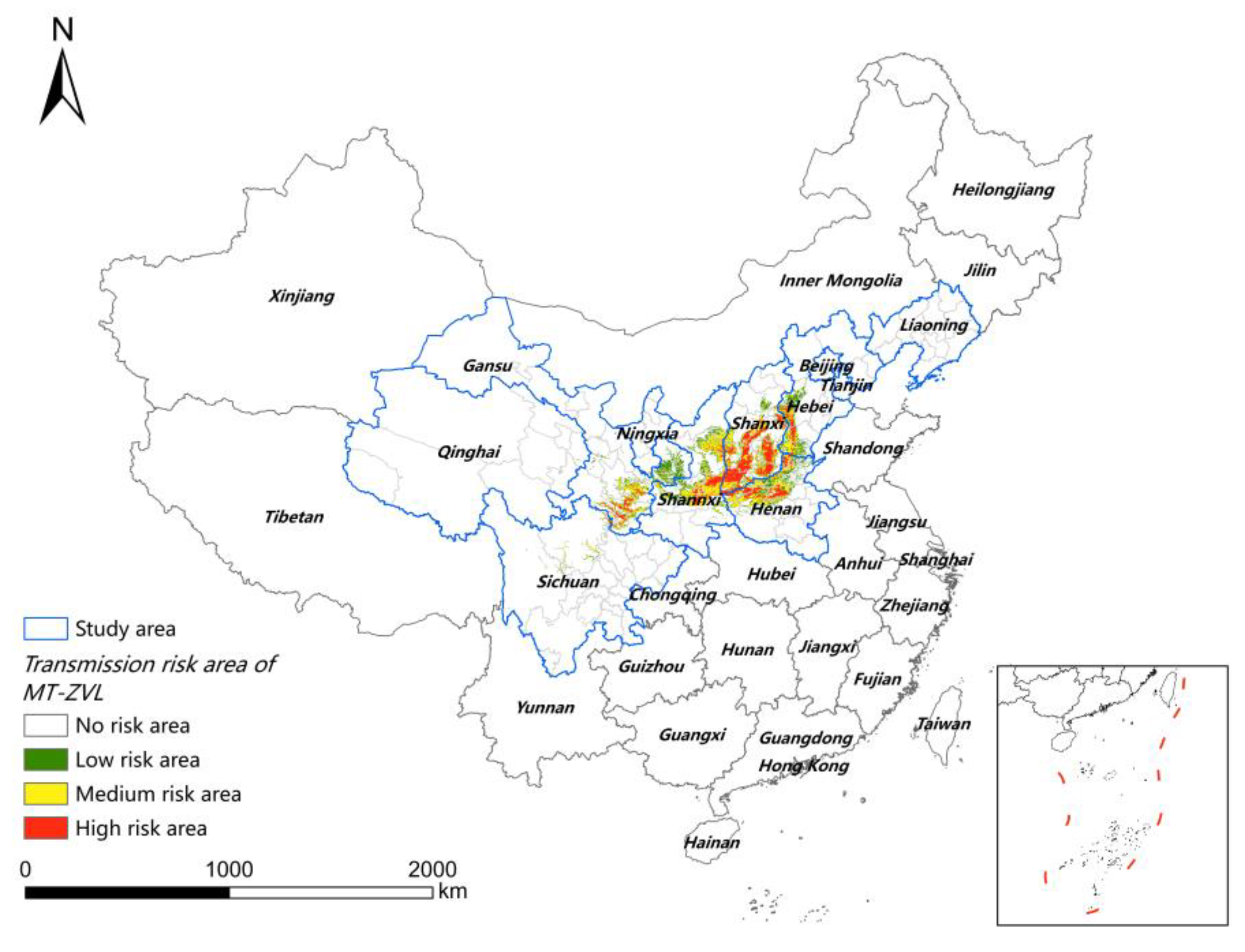
With global warming and socioeconomic developments, there is a tendency toward the emergence and spread of mountain-type zoonotic visceral leishmaniasis (MT-ZVL) in China. Timely identification of the transmission risk and spread of MT-ZVL is, therefore, of great significance for effectively interrupting the spread of MT-ZVL and eliminating the disease. In this study, 26 environmental variables—namely, climatic, geographical, and 2 socioeconomic indicators were collected from regions where MT-ZVL patients were detected during the period from 2019 to 2021, to create 10 ecological niche models. The performance of these ecological niche models was evaluated using the area under the receiver-operating characteristic curve (AUC) and true skill statistic (TSS), and ensemble models were created to predict the transmission risk of MT-ZVL in China. All ten ecological niche models were effective at predicting the transmission risk of MT-ZVL in China, and there were significant differences in the mean AUC (H = 33.311, p < 0.05) and TSS values among these ten models (H = 26.344, p < 0.05). The random forest, maximum entropy, generalized boosted, and multivariate adaptive regression splines showed high performance at predicting the transmission risk of MT-ZVL (AUC > 0.95, TSS > 0.85). Ensemble models predicted a transmission risk of MT-ZVL in the provinces of Shanxi, Shaanxi, Henan, Gansu, Sichuan, and Hebei, which was centered in Shanxi Province and presented high spatial clustering characteristics. Multiple ensemble ecological niche models created based on climatic and environmental variables are effective at predicting the transmission risk of MT-ZVL in China. This risk is centered in Shanxi Province and tends towards gradual radiation dispersion to surrounding regions. Our results provide insights into MT-ZVL surveillance in regions at high risk of MT-ZVL.
Keywords: mountain-type zoonotic visceral leishmaniasis; climate variables; environmental variables; ecological niche model; transmission risk prediction mountain-type zoonotic visceral leishmaniasis; climate variables; environmental variables; ecological niche model; transmission risk prediction