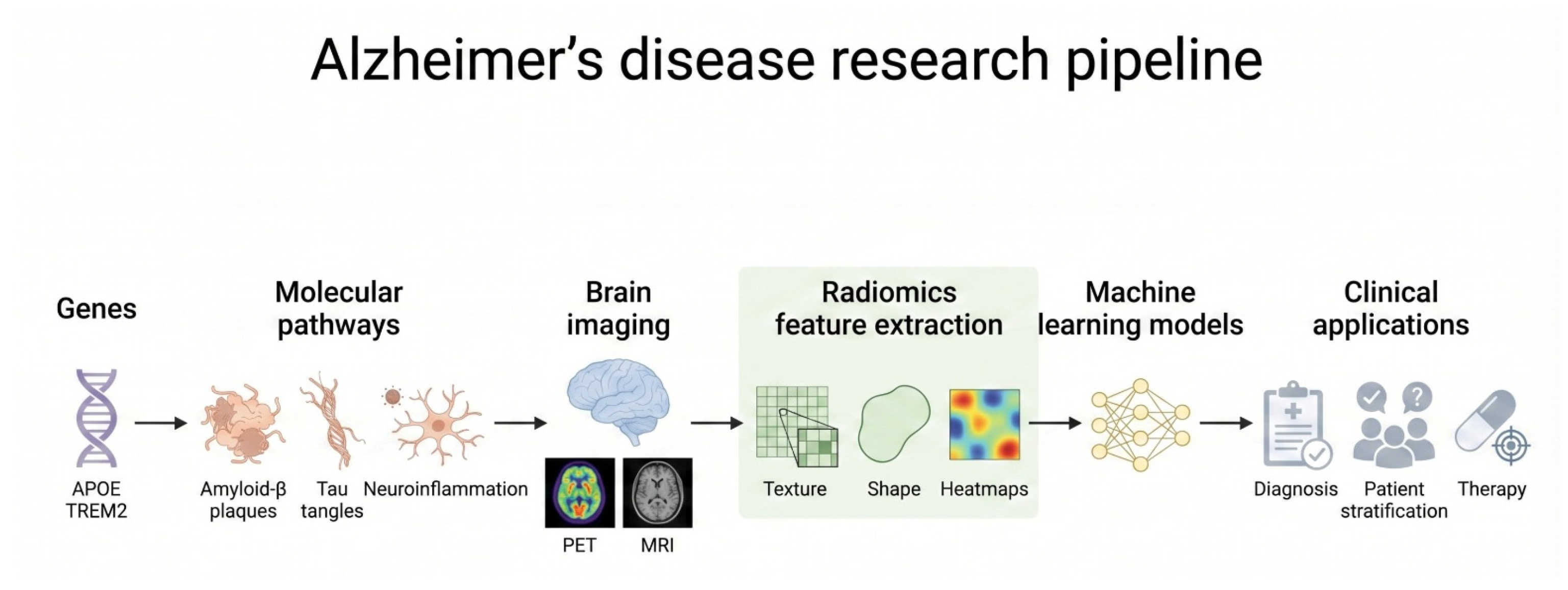
From Genes to Imaging Phenotypes: Radiomics and Machine Learning as Tools to Decode Molecular Pathways in Alzheimer’s Disease


Abstract
1. Introduction
2. Genetic Background of Alzheimer’s Disease
3. Molecular Pathways in Alzheimer’s Disease
3.1. Amyloid Pathway
3.2. Tau Pathology
3.3. Neuroinflammation
3.4. Mitochondrial Dysfunction
3.5. Synaptic Dysfunction
4. Molecular Imaging in Alzheimer’s Disease
4.1. Amyloid PET Imaging
4.2. Tau PET Imaging
4.3. FDG-PET and Functional Imaging
4.4. Structural and Advanced MRI
4.5. Imaging as a Surrogate of Molecular Pathways
5. Radiomics in Neurodegeneration
5.1. Radiomics Workflow
5.2. Types of Radiomic Features
5.3. Applications for Alzheimer’s Disease
5.4. Representative Radiomics Studies in Alzheimer’s Disease
5.5. Radiomics as a Potential Non-Invasive Surrogate of Tissue Heterogeneity
5.6. Reproducibility and Standardization Challenges
6. Machine Learning and Data Integration
6.1. Machine Learning Approaches in Alzheimer’s Disease
6.2. Feature Selection and Dimensionality Reduction
6.3. Integration of Multimodal Data
6.4. Predictive Modeling and Clinical Applications
7. Linking Imaging Phenotypes with Molecular Pathways
7.1. Imaging Phenotypes as Surrogates of Molecular Processes
7.2. Linking Genetic Variability to Imaging Features
7.3. Capturing Pathway-Level Interactions Through Imaging
7.4. Toward Imaging-Based Molecular Phenotyping
7.5. Current Limitations and Research Gaps
8. Clinical and Translational Implications
9. Limitations and Challenges
10. Future Perspectives
Author Contributions
Funding
Institutional Review Board Statement
Informed Consent Statement
Data Availability Statement
Conflicts of Interest
Abbreviations
| AD | Alzheimer’s disease |
| APOE | Apolipoprotein E |
| APP | Amyloid precursor protein |
| Aβ | Amyloid-β |
| CLU | Clusterin |
| CR1 | Complement receptor 1 |
| EOFAD | Early-onset familial Alzheimer’s disease |
| GWAS | Genome-wide association studies |
| IBSI | Image Biomarker Standardization Initiative |
| LOAD | Late-onset Alzheimer’s disease |
| MAPT | Microtubule-associated protein tau |
| ML | Machine learning |
| MRI | Magnetic resonance imaging |
| PET | Positron emission tomography |
| PICALM | Phosphatidylinositol binding clathrin assembly protein |
| PSEN1/PSEN2 | Presenilin 1 or 2 |
| RF | Random forests |
| ROIs | Regions of interest |
| SUVRs | Standardized uptake value ratios |
| SVM | Support vector machines |
| TREM2 | Triggering receptor expressed on myeloid cells 2 |
References
- Karch, C.M.; Goate, A.M. Alzheimer’s Disease Risk Genes and Mechanisms of Disease Pathogenesis. Biol. Psychiatry 2015, 77, 43–51. [Google Scholar] [CrossRef] [PubMed]
- Bellenguez, C.; Küçükali, F.; Jansen, I.E.; Kleineidam, L.; Moreno-Grau, S.; Amin, N.; Naj, A.C.; Campos-Martin, R.; Grenier-Boley, B.; Andrade, V.; et al. New Insights into the Genetic Etiology of Alzheimer’s Disease and Related Dementias. Nat. Genet. 2022, 54, 412–436. [Google Scholar] [CrossRef]
- Jin, S.C.; Benitez, B.A.; Karch, C.M.; Cooper, B.; Skorupa, T.; Carrell, D.; Norton, J.B.; Hsu, S.; Harari, O.; Cai, Y.; et al. Coding Variants in TREM2 Increase Risk for Alzheimer’s Disease. Hum. Mol. Genet. 2014, 23, 5838–5846. [Google Scholar] [CrossRef] [PubMed]
- Long, J.M.; Holtzman, D.M. Alzheimer Disease: An Update on Pathobiology and Treatment Strategies. Cell 2019, 179, 312–339. [Google Scholar] [CrossRef]
- Wilson, D.M.; Cookson, M.R.; Van Den Bosch, L.; Zetterberg, H.; Holtzman, D.M.; Dewachter, I. Hallmarks of Neurodegenerative Diseases. Cell 2023, 186, 693–714. [Google Scholar] [CrossRef]
- Lambert, J.C.; Ibrahim-Verbaas, C.A.; Harold, D.; Naj, A.C.; Sims, R.; Bellenguez, C.; DeStafano, A.L.; Bis, J.C.; Beecham, G.W.; Grenier-Boley, B.; et al. Meta-Analysis of 74,046 Individuals Identifies 11 New Susceptibility Loci for Alzheimer’s Disease. Nat. Genet. 2013, 45, 1452–1458. [Google Scholar] [CrossRef]
- Jay, T.R.; von Saucken, V.E.; Landreth, G.E. TREM2 in Neurodegenerative Diseases. Mol. Neurodegener. 2017, 12, 56. [Google Scholar] [CrossRef] [PubMed]
- Jiang, T.; Yu, J.-T.; Zhu, X.-C.; Tan, L. TREM2 in Alzheimer’s Disease. Mol. Neurobiol. 2013, 48, 180–185. [Google Scholar] [CrossRef]
- Rusek, M.; Smith, J.; El-Khatib, K.; Aikins, K.; Czuczwar, S.J.; Pluta, R. The Role of the JAK/STAT Signaling Pathway in the Pathogenesis of Alzheimer’s Disease: New Potential Treatment Target. Int. J. Mol. Sci. 2023, 24, 864. [Google Scholar] [CrossRef]
- Heneka, M.T.; Carson, M.J.; El Khoury, J.; Landreth, G.E.; Brosseron, F.; Feinstein, D.L.; Jacobs, A.H.; Wyss-Coray, T.; Vitorica, J.; Ransohoff, R.M.; et al. Neuroinflammation in Alzheimer’s Disease. Lancet Neurol. 2015, 14, 388–405. [Google Scholar] [CrossRef]
- Hardy, J.A.; Higgins, G.A. Alzheimer’s Disease: The Amyloid Cascade Hypothesis. Science 1992, 256, 184–185. [Google Scholar] [CrossRef]
- Wang, Y.; Mandelkow, E. Tau in Physiology and Pathology. Nat. Rev. Neurosci. 2016, 17, 22–35. [Google Scholar] [CrossRef] [PubMed]
- McManus, R.M.; Heneka, M.T. Role of Neuroinflammation in Neurodegeneration: New Insights. Alzheimers Res. Ther. 2017, 9, 14. [Google Scholar] [CrossRef] [PubMed]
- Heneka, M.T.; Kummer, M.P.; Latz, E. Innate Immune Activation in Neurodegenerative Disease. Nat. Rev. Immunol. 2014, 14, 463–477. [Google Scholar] [CrossRef]
- Parekh, V.; Jacobs, M.A. Radiomics: A New Application from Established Techniques. Expert Rev. Precis. Med. Drug Dev. 2016, 1, 207–226. [Google Scholar] [CrossRef]
- Gillies, R.J.; Kinahan, P.E.; Hricak, H. Radiomics: Images Are More than Pictures, They Are Data. Radiology 2016, 278, 563–577. [Google Scholar] [CrossRef]
- Lambin, P.; Rios-Velazquez, E.; Leijenaar, R.; Carvalho, S.; van Stiphout, R.G.P.M.; Granton, P.; Zegers, C.M.L.; Gillies, R.; Boellard, R.; Dekker, A.; et al. Radiomics: Extracting More Information from Medical Images Using Advanced Feature Analysis. Eur. J. Cancer 2012, 48, 441–446. [Google Scholar] [CrossRef]
- Liu, Y.; Zhao, S.; Wu, Z.; Liang, H.; Chen, X.; Huang, C.; Lu, H.; Yuan, M.; Xue, X.; Luo, C.; et al. Virtual Biopsy Using CT Radiomics for Evaluation of Disagreement in Pathology between Endoscopic Biopsy and Postoperative Specimens in Patients with Gastric Cancer: A Dual-Energy CT Generalizability Study. Insights Imaging 2023, 14, 118. [Google Scholar] [CrossRef] [PubMed]
- Khalili, N.; Kazerooni, A.F.; Familiar, A.; Haldar, D.; Kraya, A.; Foster, J.; Koptyra, M.; Storm, P.B.; Resnick, A.C.; Nabavizadeh, A. Radiomics for Characterization of the Glioma Immune Microenvironment. npj Precis. Oncol. 2023, 7, 59. [Google Scholar] [CrossRef]
- Riberdy, V.; Guida, A.; Rioux, J.; Brewer, K. Radiomics in Preclinical Imaging Research: Methods, Challenges and Opportunities. npj Imaging 2025, 3, 45. [Google Scholar] [CrossRef]
- McCague, C.; Ramlee, S.; Reinius, M.; Selby, I.; Hulse, D.; Piyatissa, P.; Bura, V.; Crispin-Ortuzar, M.; Sala, E.; Woitek, R. Introduction to Radiomics for a Clinical Audience. Clin. Radiol. 2023, 78, 83–98. [Google Scholar] [CrossRef] [PubMed]
- Mishra, A.K.; Jain, S. Integrative Multiomics Insights into the Genetic and Epigenetic Architecture of Alzheimer’s Disease. ACS Chem. Neurosci. 2026, 17, 316–334. [Google Scholar] [CrossRef]
- Cardillo, M.; Katam, K.; Suravajhala, P. Advancements in Multi-Omics Research to Address Challenges in Alzheimer’s Disease: A Systems Biology Approach Utilizing Molecular Biomarkers and Innovative Strategies. Front. Aging Neurosci. 2025, 17, 1591796. [Google Scholar] [CrossRef]
- Jack, C.R.J.; Bennett, D.A.; Blennow, K.; Carrillo, M.C.; Dunn, B.; Haeberlein, S.B.; Holtzman, D.M.; Jagust, W.; Jessen, F.; Karlawish, J.; et al. NIA-AA Research Framework: Toward a Biological Definition of Alzheimer’s Disease. Alzheimers Dement. 2018, 14, 535–562. [Google Scholar] [CrossRef]
- Villemagne, V.L.; Doré, V.; Burnham, S.C.; Masters, C.L.; Rowe, C.C. Imaging Tau and Amyloid-β Proteinopathies in Alzheimer Disease and Other Conditions. Nat. Rev. Neurol. 2018, 14, 225–236. [Google Scholar] [CrossRef] [PubMed]
- Villemagne, V.L.; Burnham, S.; Bourgeat, P.; Brown, B.; Ellis, K.A.; Salvado, O.; Szoeke, C.; Macaulay, S.L.; Martins, R.; Maruff, P.; et al. Amyloid β Deposition, Neurodegeneration, and Cognitive Decline in Sporadic Alzheimer’s Disease: A Prospective Cohort Study. Lancet Neurol. 2013, 12, 357–367. [Google Scholar] [CrossRef]
- Ren, F.; Wei, J.; Chen, Q.; Hu, M.; Yu, L.; Mi, J.; Zhou, X.; Qin, D.; Wu, J.; Wu, A. Artificial Intelligence-Driven Multi-Omics Approaches in Alzheimer’s Disease: Progress, Challenges, and Future Directions. Acta Pharm. Sin. B 2025, 15, 4327–4385. [Google Scholar] [CrossRef]
- Ułamek-Kozioł, M.; Furmaga-Jabłońska, W.; Januszewski, S.; Brzozowska, J.; Sciślewska, M.; Jabłoński, M.; Pluta, R. Neuronal Autophagy: Self-Eating or Self-Cannibalism in Alzheimer’s Disease. Neurochem. Res. 2013, 38, 1769–1773. [Google Scholar] [CrossRef]
- Ossenkoppele, R.; van der Kant, R.; Hansson, O. Tau Biomarkers in Alzheimer’s Disease: Towards Implementation in Clinical Practice and Trials. Lancet Neurol. 2022, 21, 726–734. [Google Scholar] [CrossRef] [PubMed]
- Tanaka, M.; Saito, S.; Inoue, T.; Satoh-Asahara, N.; Ihara, M. Potential Therapeutic Approaches for Cerebral Amyloid Angiopathy and Alzheimer’s Disease. Int. J. Mol. Sci. 2020, 21, 1992. [Google Scholar] [CrossRef]
- Pluta, R.; Ułamek-Kozioł, M. Tau Protein-Targeted Therapies in Alzheimer’s Disease: Current State and Future Perspectives. In Molecular Biology of Dementia; Huang, X., Ed.; Exon Publications: Brisbane, Australia, 2020; ISBN 978-0-6450017-0-9. [Google Scholar]
- Stoothoff, W.H.; Johnson, G.V.W. Tau Phosphorylation: Physiological and Pathological Consequences. Biochim. Biophys. Acta 2005, 1739, 280–297. [Google Scholar] [CrossRef]
- Mueller, R.L.; Combs, B.; Alhadidy, M.M.; Brady, S.T.; Morfini, G.A.; Kanaan, N.M. Tau: A Signaling Hub Protein. Front. Mol. Neurosci. 2021, 14, 647054. [Google Scholar] [CrossRef]
- Groot, C.; Villeneuve, S.; Smith, R.; Hansson, O.; Ossenkoppele, R. Tau PET Imaging in Neurodegenerative Disorders. J. Nucl. Med. 2022, 63, 20S. [Google Scholar] [CrossRef] [PubMed]
- Rubio-Perez, J.M.; Morillas-Ruiz, J.M. A Review: Inflammatory Process in Alzheimer’s Disease, Role of Cytokines. Sci. World J. 2012, 2012, 756357. [Google Scholar] [CrossRef] [PubMed]
- Clark, L.F.; Kodadek, T. The Immune System and Neuroinflammation as Potential Sources of Blood-Based Biomarkers for Alzheimer’s Disease, Parkinson’s Disease, and Huntington’s Disease. ACS Chem. Neurosci. 2016, 7, 520–527. [Google Scholar] [CrossRef]
- Latta, C.H.; Brothers, H.M.; Wilcock, D.M. Neuroinflammation in Alzheimer’s Disease; a Source of Heterogeneity and Target for Personalized Therapy. Neuroscience 2015, 302, 103–111. [Google Scholar] [CrossRef] [PubMed]
- Jain, M.; Singh, M.K.; Shyam, H.; Mishra, A.; Kumar, S.; Kumar, A.; Kushwaha, J. Role of JAK/STAT in the Neuroinflammation and Its Association with Neurological Disorders. Ann. Neurosci. 2021, 28, 191–200. [Google Scholar] [CrossRef]
- Wang, H.; Shen, Y.; Chuang, H.; Chiu, C.; Ye, Y.; Zhao, L. Neuroinflammation in Alzheimer’s Disease: Microglia, Molecular Participants and Therapeutic Choices. Curr. Alzheimer Res. 2019, 16, 659–674. [Google Scholar] [CrossRef]
- Mondragón-Rodríguez, S.; Perry, G.; Zhu, X.; Moreira, P.I.; Acevedo-Aquino, M.C.; Williams, S. Phosphorylation of Tau Protein as the Link between Oxidative Stress, Mitochondrial Dysfunction, and Connectivity Failure: Implications for Alzheimer’s Disease. Oxid. Med. Cell. Longev. 2013, 2013, 940603. [Google Scholar] [CrossRef]
- Scheff, S.W.; Price, D.A.; Schmitt, F.A.; Scheff, M.A.; Mufson, E.J. Synaptic Loss in the Inferior Temporal Gyrus in Mild Cognitive Impairment and Alzheimer’s Disease. J. Alzheimers Dis. 2011, 24, 547–557. [Google Scholar] [CrossRef]
- Wood, J.I.; Dulewicz, M.; Ge, J.; Stringer, K.; Szadziewska, A.; Desai, S.; Koutarapu, S.; Hajar, H.B.; Fenson, L.; Blennow, K.; et al. Isotope Encoded Spatial Biology Identifies Amyloid Plaque-Age-Dependent Structural Maturation, Synaptic Loss, and Increased Toxicity. Nat. Commun. 2025, 16, 8170. [Google Scholar] [CrossRef]
- Wang, J.; Jin, C.; Zhou, J.; Zhou, R.; Tian, M.; Lee, H.J.; Zhang, H. PET Molecular Imaging for Pathophysiological Visualization in Alzheimer’s Disease. Eur. J. Nucl. Med. Mol. Imaging 2023, 50, 765–783. [Google Scholar] [CrossRef] [PubMed]
- Mueller, A.; Bullich, S.; Barret, O.; Madonia, J.; Berndt, M.; Papin, C.; Perrotin, A.; Koglin, N.; Kroth, H.; Pfeifer, A.; et al. Tau PET Imaging with [18F]PI-2620 in Patients with Alzheimer Disease and Healthy Controls: A First-in-Humans Study. J. Nucl. Med. 2020, 61, 911. [Google Scholar] [CrossRef] [PubMed]
- Frisoni, G.B.; Fox, N.C.; Jack, C.R.; Scheltens, P.; Thompson, P.M. The Clinical Use of Structural MRI in Alzheimer Disease. Nat. Rev. Neurol. 2010, 6, 67–77. [Google Scholar] [CrossRef] [PubMed]
- Rajalakshmi, M.; Karthik, C. A Deep Learning-Based Framework for Alzheimer’s Disease Diagnosis and Progression Prediction from MRI Images. ICTACT J. Image Video Process. 2024, 14, 3251–3257. [Google Scholar] [CrossRef]
- Young, P.N.E.; Estarellas, M.; Coomans, E.; Srikrishna, M.; Beaumont, H.; Maass, A.; Venkataraman, A.V.; Lissaman, R.; Jiménez, D.; Betts, M.J.; et al. Imaging Biomarkers in Neurodegeneration: Current and Future Practices. Alzheimers Res. Ther. 2020, 12, 49. [Google Scholar] [CrossRef]
- DeTure, M.A.; Dickson, D.W. The Neuropathological Diagnosis of Alzheimer’s Disease. Mol. Neurodegener. 2019, 14, 32. [Google Scholar] [CrossRef]
- Banzo, I.; Jiménez-Bonilla, J.; Ortega-Nava, F.; Quirce, R.; Martínez-Rodríguez, I.; de Arcocha-Torres, M.; Rodríguez, E.; Vázquez, J.L.; Sánchez, P.J.; Martínez-Amador, N.; et al. Amyloid Imaging with 11C-PIB PET/CT and Glucose Metabolism with 18F-FDG PET/CT in a Study on Cognitive Impairment in the Clinical Setting. Nucl. Med. Commun. 2014, 35, 238–244. [Google Scholar] [CrossRef]
- Guedj, E.; Varrone, A.; Boellaard, R.; Albert, N.L.; Barthel, H.; van Berckel, B.; Brendel, M.; Cecchin, D.; Ekmekcioglu, O.; Garibotto, V.; et al. EANM Procedure Guidelines for Brain PET Imaging Using [18F]FDG, Version 3. Eur. J. Nucl. Med. Mol. Imaging 2022, 49, 632–651. [Google Scholar] [CrossRef]
- Clark, C.M.; Schneider, J.A.; Bedell, B.J.; Beach, T.G.; Bilker, W.B.; Mintun, M.A.; Pontecorvo, M.J.; Hefti, F.; Carpenter, A.P.; Flitter, M.L.; et al. Use of Florbetapir-PET for Imaging β-Amyloid Pathology. JAMA 2011, 305, 275–283. [Google Scholar] [CrossRef]
- Leuzy, A.; Chiotis, K.; Lemoine, L.; Gillberg, P.-G.; Almkvist, O.; Rodriguez-Vieitez, E.; Nordberg, A. Tau PET Imaging in Neurodegenerative Tauopathies—Still a Challenge. Mol. Psychiatry 2019, 24, 1112–1134. [Google Scholar] [CrossRef]
- Burkett, B.J.; Johnson, D.R.; Lowe, V.J. Evaluation of Neurodegenerative Disorders with Amyloid-β, Tau, and Dopaminergic PET Imaging: Interpretation Pitfalls. J. Nucl. Med. 2024, 65, 829. [Google Scholar] [CrossRef]
- Hall, B.; Mak, E.; Cervenka, S.; Aigbirhio, F.I.; Rowe, J.B.; O’Brien, J.T. In Vivo Tau PET Imaging in Dementia: Pathophysiology, Radiotracer Quantification, and a Systematic Review of Clinical Findings. Ageing Res. Rev. 2017, 36, 50–63. [Google Scholar] [CrossRef]
- Tiepolt, S.; Patt, M.; Aghakhanyan, G.; Meyer, P.M.; Hesse, S.; Barthel, H.; Sabri, O. Current Radiotracers to Image Neurodegenerative Diseases. EJNMMI Radiopharm. Chem. 2019, 4, 17. [Google Scholar] [CrossRef]
- Zhang, S.; Wang, X.; Gao, X.; Chen, X.; Li, L.; Li, G.; Liu, C.; Miao, Y.; Wang, R.; Hu, K. Radiopharmaceuticals and Their Applications in Medicine. Signal Transduct. Target. Ther. 2025, 10, 1. [Google Scholar] [CrossRef]
- Pokrzyk, J.; Kulczyńska-Przybik, A.; Guzik-Makaruk, E.; Winkel, I.; Mroczko, B. Clinical Importance of Amyloid Beta Implication in the Detection and Treatment of Alzheimer’s Disease. Int. J. Mol. Sci. 2025, 26, 1935. [Google Scholar] [CrossRef] [PubMed]
- Fernandez-Alvarez, M.; Atienza, M.; Cantero, J.L. Cortical Amyloid-Beta Burden Is Associated with Changes in Intracortical Myelin in Cognitively Normal Older Adults. Transl. Psychiatry 2023, 13, 115. [Google Scholar] [CrossRef] [PubMed]
- Dhoundiyal, S.; Srivastava, S.; Kumar, S.; Singh, G.; Ashique, S.; Pal, R.; Mishra, N.; Taghizadeh-Hesary, F. Radiopharmaceuticals: Navigating the Frontier of Precision Medicine and Therapeutic Innovation. Eur. J. Med. Res. 2024, 29, 26. [Google Scholar] [CrossRef] [PubMed]
- Chen, P.-H.; Hsu, J.-L. Alzheimer’s Disease Diagnosis: An Update and Review of Biomarkers, Positron Emission Tomography, and Emerging Therapies. J. Formos. Med. Assoc. 2026; in press. [CrossRef]
- D’Anna, L.; Searle, G.; Harvey, K.; Matthews, P.M.; Veltkamp, R. Time Course of Neuroinflammation after Human Stroke—A Pilot Study Using Co-Registered PET and MRI. BMC Neurol. 2023, 23, 193. [Google Scholar] [CrossRef]
- Li, A.; Lian, J.; Vardhanabhuti, V. Multi-Modal Machine Learning Approach for Early Detection of Neurodegenerative Diseases Leveraging Brain MRI and Wearable Sensor Data. PLoS Digit. Health 2025, 4, e0000795. [Google Scholar] [CrossRef]
- Rabinovici, G.D.; Knopman, D.S.; Arbizu, J.; Benzinger, T.L.S.; Donohoe, K.J.; Hansson, O.; Herscovitch, P.; Kuo, P.H.; Lingler, J.H.; Minoshima, S.; et al. Updated Appropriate Use Criteria for Amyloid and Tau PET: A Report from the Alzheimer’s Association and Society for Nuclear Medicine and Molecular Imaging Workgroup. J. Nucl. Med. 2025, 66, S5–S31. [Google Scholar] [CrossRef]
- Phang, K.A.S.; Tan, C.H.; Alzheimer’s Disease Neuroimaging Initiative. Cognitive Variation Reflects Amyloid, Tau, and Neurodegenerative Biomarkers in Alzheimer’s Disease. Geroscience 2025, 47, 4763–4773. [Google Scholar] [CrossRef]
- Zilioli, A.; Mohanty, R.; Rosenberg, A.; Matton, A.; Granberg, T.; Hagman, G.; Spallazzi, M.; Ferreira, D.; Kivipelto, M.; Westman, E. MRI-Based Atrophy Subtypes in a Young Memory Clinic Cohort: Associations with Clinical and Biomarker Profiles. Alzheimers Res. Ther. 2026, 18, 35. [Google Scholar] [CrossRef]
- Fürtjes, A.E.; Foote, I.F.; Xia, C.; Davies, G.; Moodie, J.; Taylor, A.; Liewald, D.C.; Redmond, P.; Corley, J.; McIntosh, A.M.; et al. Measurement Characteristics and Genome-Wide Correlates of Lifetime Brain Atrophy Estimated from a Single MRI. Nat. Commun. 2025, 16, 6725. [Google Scholar] [CrossRef]
- Tsougos, I.; Valotassiou, V.; Tsivaka, D.; Satra, M.; Angelidis, G.; Papatriantafyllou, J.; Panagiotidis, E.; Dardiotis, E.; Hadjigeorgiou, G.; Georgoulias, P. SPECT and PET Imaging of Alzheimer’s Disease Revisited: From Biomarkers to Artificial Intelligence-Based Prediction. Ann. Nucl. Med. 2026, 40, 480–495. [Google Scholar] [CrossRef]
- van Griethuysen, J.J.M.; Fedorov, A.; Parmar, C.; Hosny, A.; Aucoin, N.; Narayan, V.; Beets-Tan, R.G.H.; Fillion-Robin, J.-C.; Pieper, S.; Aerts, H.J.W.L. Computational Radiomics System to Decode the Radiographic Phenotype. Cancer Res. 2017, 77, e104–e107. [Google Scholar] [CrossRef]
- Hao, X.; Li, Y.; Wang, X.; Ma, C.; Liu, R.; Jiao, Y.; Dong, C.; Liu, J. Multimodal Radiomics of Cerebellar Subregions for Machine Learning-Driven Alzheimer’s Disease Diagnosis. Front. Aging Neurosci. 2025, 17, 1679788. [Google Scholar] [CrossRef]
- Mayerhoefer, M.E.; Materka, A.; Langs, G.; Häggström, I.; Szczypiński, P.; Gibbs, P.; Cook, G. Introduction to Radiomics. J. Nucl. Med. 2020, 61, 488. [Google Scholar] [CrossRef]
- Xiao, H.; He, X.; Zhou, W.; Guo, X.; Cai, X.; Li, T. The Application of Radiomics in the Diagnosis and Evaluation of Cognitive Impairment Related to Neurological Diseases. Front. Neurosci. 2025, 19, 1591605. [Google Scholar] [CrossRef]
- Yu, Z.; Mulholland, A.; Huang, T.; Liu, Q. Multimodal AI for Alzheimer Disease Diagnosis: Systematic Review of Datasets, Models, and Modalities. J. Med. Internet Res. 2026, 28, e85414. [Google Scholar] [CrossRef]
- Zarei, O.; Talebi Moghaddam, M.; Moradi Vastegani, S. Machine Learning and Deep Learning in Clinical Practice: Advancing Neurodegenerative Disease Diagnosis with Multimodal Markers. Brain Res. Bull. 2026, 234, 111667. [Google Scholar] [CrossRef]
- Aguirre-Meneses, H.; Stoehr-Muñoz, P.; Molina-Gonzalez, M.; Nuñez-Gaona, M.-A.; Roldan-Valadez, E. Radiomics and the Image Biomarker Standardisation Initiative (IBSI): A Narrative Review Using a Six-Question Map and Implementation Framework for Reproducible Imaging Biomarkers. Cureus 2025, 17, e95335. [Google Scholar] [CrossRef]
- Xu, Y.; Li, Y.; Wang, F.; Zhang, Y.; Huang, D. Addressing the Current Challenges in the Clinical Application of AI-Based Radiomics for Cancer Imaging. Front. Med. 2025, 12, 1674397. [Google Scholar] [CrossRef]
- Amr, Y.; Gad, W.; Leiva, V.; Martin-Barreiro, C.; Abdelkader, T. Comparative Analysis of Supervised and Ensemble Models with Unsupervised Exploration for Alzheimer’s Disease Prediction. Sci. Rep. 2026, 16, 7322. [Google Scholar] [CrossRef]
- Campagner, A.; Marconi, L.; Bianchi, E.; Arosio, B.; Rossi, P.; Annoni, G.; Lucchi, T.A.; Montano, N.; Cabitza, F. Uncovering Hidden Subtypes in Dementia: An Unsupervised Machine Learning Approach to Dementia Diagnosis and Personalization of Care. J. Biomed. Inform. 2025, 165, 104799. [Google Scholar] [CrossRef]
- Trezza, A.; Visibelli, A.; Roncaglia, B.; Spiga, O.; Santucci, A. Unsupervised Learning in Precision Medicine: Unlocking Personalized Healthcare through AI. Appl. Sci. 2024, 14, 9305. [Google Scholar] [CrossRef]
- Hu, T.; Mousavirad, S.J.; Afsharizadeh, M.; O’Nils, M. Deep Learning for MRI-Based Neurological Disease Diagnosis: A Comprehensive Survey of Advances, Challenges, and Benchmarks. Int. J. Comput. Intell. Syst. 2026, 19, 48. [Google Scholar] [CrossRef]
- Mariotti, F.; Agostini, A.; Borgheresi, A.; Marchegiani, M.; Zannotti, A.; Giacomelli, G.; Pierpaoli, L.; Tola, E.; Galiffa, E.; Giovagnoni, A. Insights into Radiomics: A Comprehensive Review for Beginners. Clin. Transl. Oncol. 2025, 27, 4091–4102. [Google Scholar] [CrossRef]
- Avanzo, M.; Soda, P.; Bertolini, M.; Bettinelli, A.; Rancati, T.; Stancanello, J.; Rampado, O.; Pirrone, G.; Drigo, A. Robust Radiomics: A Review of Guidelines for Radiomics in Medical Imaging. Front. Radiol. 2026, 5, 1701110. [Google Scholar] [CrossRef]
- Pudjihartono, N.; Fadason, T.; Kempa-Liehr, A.W.; O’Sullivan, J.M. A Review of Feature Selection Methods for Machine Learning-Based Disease Risk Prediction. Front. Bioinform. 2022, 2, 927312. [Google Scholar] [CrossRef]
- Alemu, R.; Sharew, N.T.; Arsano, Y.Y.; Ahmed, M.; Tekola-Ayele, F.; Mersha, T.B.; Amare, A.T. Multi-Omics Approaches for Understanding Gene-Environment Interactions in Noncommunicable Diseases: Techniques, Translation, and Equity Issues. Hum. Genom. 2025, 19, 8. [Google Scholar] [CrossRef]
- Mahley, R.W.; Weisgraber, K.H.; Huang, Y. Apolipoprotein E4: A Causative Factor and Therapeutic Target in Neuropathology, Including Alzheimer’s Disease. Proc. Natl. Acad. Sci. USA 2006, 103, 5644–5651. [Google Scholar] [CrossRef]
- Neu, S.C.; Pa, J.; Kukull, W.; Beekly, D.; Kuzma, A.; Gangadharan, P.; Wang, L.-S.; Romero, K.; Arneric, S.P.; Redolfi, A.; et al. Apolipoprotein E Genotype and Sex Risk Factors for Alzheimer Disease: A Meta-Analysis. JAMA Neurol. 2017, 74, 1178–1189. [Google Scholar] [CrossRef]
- Mashhour, M.A.; Youssef, I.; Wahed, M.A.; Mabrouk, M.S. The Intersection of Genetics and Neuroimaging: A Systematic Review of Imaging Genetics in Neurological Disease for Personalized Treatment. J. Mol. Neurosci. 2025, 75, 66. [Google Scholar] [CrossRef]
- Reitz, C.; Mayeux, R. Alzheimer Disease: Epidemiology, Diagnostic Criteria, Risk Factors and Biomarkers. Biochem. Pharmacol. 2014, 88, 640–651. [Google Scholar] [CrossRef]
- Burkett, B.J.; Bartlett, D.J.; McGarrah, P.W.; Lewis, A.R.; Johnson, D.R.; Berberoğlu, K.; Pandey, M.K.; Packard, A.T.; Halfdanarson, T.R.; Hruska, C.B.; et al. A Review of Theranostics: Perspectives on Emerging Approaches and Clinical Advancements. Radiol. Imaging Cancer 2023, 5, e220157. [Google Scholar] [CrossRef]
- Sarabia-Vallejo, Á.; López-Alvarado, P.; Menéndez, J.C. Small-Molecule Theranostics in Alzheimer’s Disease. Eur. J. Med. Chem. 2023, 255, 115382. [Google Scholar] [CrossRef]
- Urbain, J.-L.; Scott, A.M.; Lee, S.T.; Buscombe, J.; Weston, C.; Hatazawa, J.; Kinuya, S.; Singh, B.; Haidar, M.; Ross, A.; et al. Theranostic Radiopharmaceuticals: A Universal Challenging Educational Paradigm in Nuclear Medicine. J. Nucl. Med. 2023, 64, 986. [Google Scholar] [CrossRef]


| Study | Imaging Modality | Cohort/Objective | Brain Regions | Representative Features | ML Approach | Main Findings | Major Limitations |
|---|---|---|---|---|---|---|---|
| [69] | MRI radiomics | AD vs. controls | Cerebellar subregions | Texture and intensity features | ML multimodal classification | Improved diagnostic classification performance using cerebellar radiomics | Limited external validation and cohort size |
| [71] | MRI radiomics | Cognitive impairment in neurological diseases | Hippocampus and cortical regions | Texture heterogeneity and shape features | Multiple ML approaches | Radiomics as potential utility in cognitive impairment evaluation | Methodological heterogeneity across included studies |
| [67] | PET/SPECT imaging + AI | AD prediction | Whole-brain PET/SPECT regions | Uptake heterogeneity and texture features | AI-based predictive models | AI-enhanced PET imaging improved prediction of AD-related patterns | Limited standardization and reproducibility |
| [43] | PET molecular imaging | Molecular visualization in AD | Amyloid- and tau-positive cortical regions | Spatial uptake heterogeneity | Quantitative imaging analysis | PET imaging captures pathophysiological heterogeneity in AD | Limited biological specificity of imaging features |
| [62] | Multimodal MRI + wearable data | Early neurodegenerative disease detection | Whole-brain analyses | Combined multimodal imaging features | Multimodal machine learning | Improved diagnostic performance through multimodal integration | Increased dimensionality and overfitting risk |
| [72] | Multimodal AI | Systematic review of AD AI models | Whole-brain multimodal datasets | MRI, PET, and multimodal feature integration | Deep learning and multimodal AI | Multimodal AI approaches generally outperform single-modality models | Lack of harmonization and external validation |
| [46] | MRI deep learning | AD diagnosis and progression prediction | Cortical and hippocampal regions | Automatically learned hierarchical imaging features | Deep learning CNN framework | High classification accuracy for AD detection | Limited interpretability (“black box” issue) |
| [73] | Multimodal ML in neurodegeneration | Neurodegenerative disease diagnosis | MRI/PET multimodal analyses | Integrated imaging biomarkers | ML and deep learning | Multimodal markers improved classification performance | Dataset heterogeneity and reproducibility concerns |
| [2] | Imaging-genetics/GWAS | Genetic susceptibility in AD | Imaging-genetic associations | APOE- and GWAS-associated phenotypes | Integrative computational approaches | Identification of genetic loci associated with disease heterogeneity | Primarily correlational findings |
| [27] | AI-driven multi-omics integration | AD multi-omics integration | Imaging and genomic datasets | Multi-omics-derived imaging signatures | AI-based integrative frameworks | Potential linkage between molecular pathways and imaging phenotypes | Limited longitudinal validation |
Disclaimer/Publisher’s Note: The statements, opinions and data contained in all publications are solely those of the individual author(s) and contributor(s) and not of MDPI and/or the editor(s). MDPI and/or the editor(s) disclaim responsibility for any injury to people or property resulting from any ideas, methods, instructions or products referred to in the content. |
© 2026 by the authors. Licensee MDPI, Basel, Switzerland. This article is an open access article distributed under the terms and conditions of the Creative Commons Attribution (CC BY) license.
Share and Cite
Rusek, M.; Pitucha, M. From Genes to Imaging Phenotypes: Radiomics and Machine Learning as Tools to Decode Molecular Pathways in Alzheimer’s Disease. Genes 2026, 17, 672. https://doi.org/10.3390/genes17060672
Rusek M, Pitucha M. From Genes to Imaging Phenotypes: Radiomics and Machine Learning as Tools to Decode Molecular Pathways in Alzheimer’s Disease. Genes. 2026; 17(6):672. https://doi.org/10.3390/genes17060672
Chicago/Turabian StyleRusek, Marta, and Monika Pitucha. 2026. "From Genes to Imaging Phenotypes: Radiomics and Machine Learning as Tools to Decode Molecular Pathways in Alzheimer’s Disease" Genes 17, no. 6: 672. https://doi.org/10.3390/genes17060672
APA StyleRusek, M., & Pitucha, M. (2026). From Genes to Imaging Phenotypes: Radiomics and Machine Learning as Tools to Decode Molecular Pathways in Alzheimer’s Disease. Genes, 17(6), 672. https://doi.org/10.3390/genes17060672