Article

Comparative Chloroplast Genomics Reveals the Maternal Origin and Evolutionary Relationships of Commercial Pluot Cultivars Within Prunus


1
College of Horticulture, Xinjiang Agricultural University, Urumqi 830052, China
2
Xinjiang Xinnongda Environmental Testing Center Co., Ltd., Urumqi 830052, China
3
College of Computer and Information Engineering, Xinjiang Agricultural University, Urumqi 830052, China
4
Xinjiang Academy of Forestry Sciences, Urumqi 830063, China
5
National Tree Seed Base for Economic Forests, Jiamu Experimental Station, Xinjiang Academy of Forestry Sciences, Aksu 843000, China
6
Engineering Technology Center for Efficient Cultivation and High-Value Utilization of Forest Fruits in Xinjiang, Urumqi 830052, China
*
Author to whom correspondence should be addressed.
Genes 2026, 17(6), 607; https://doi.org/10.3390/genes17060607
Submission received: 28 April 2026 / Revised: 20 May 2026 / Accepted: 21 May 2026 / Published: 27 May 2026
(This article belongs to the Section Plant Genetics and Genomics)

Abstract

Background: The phylogenetic placement and chloroplast-inferred maternal relationships of commercial pluot cultivars remain unclear, largely because plastome-level evidence is limited for assessing their affinities with Prunus salicina and Prunus ussuriensis. Although chloroplast genome structure has been well characterized in angiosperms and in several Prunus species, complete plastome resources and comparative genomic evidence for commercial pluot cultivars remain scarce. Methods: Here, we assembled the complete chloroplast genomes of six commercial pluot cultivars and performed comparative genomic, phylogenomic, and divergence time analyses using representative Prunus species. Results: All genomes exhibited the typical circular quadripartite structure and ranged from 157,865 to 158,138 bp in length. Genome organization, GC content, and gene content were highly conserved, whereas the IR regions showed an elevated GC content of approximately 42.6%, owing to rRNA gene enrichment. IR boundary comparison revealed contraction at the IRb/SSC boundary in P. ussuriensis, while pluot cultivars were structurally more similar to P. salicina. In total, 370 SSR loci and four hypervariable regions, namely rpoB–trnC-GCA, petN–psbM, trnV-UAC–trnM-CAU, and trnP-UGG–psaJ, were identified as candidate molecular markers for Prunus germplasm identification and genetic analysis. Phylogenomic analysis resolved four major clades within Prunus and showed that ‘Flavor King’, ‘Flavor Supreme’, and ‘Flavor Queen’ grouped with P. ussuriensis, whereas ‘Flavorosa’, ‘Dinosaur Egg’, and ‘Flavorich’ grouped with P. salicina. Conclusion: Overall, this study provides the first comparative plastome analysis of six commercial pluot cultivars and offers chloroplast-level evidence for their maternal affinities within Prunus, together with useful marker resources for cultivar identification and germplasm evaluation.

1. Introduction

The commercial pluot cultivars hereafter referred to as pluots belong to the genus Prunus within the Rosaceae family and are perennial tree fruit crops with significant economic value. These cultivars are characterized by distinctive fruit flavor and high tolerance to cold and drought stress. They show excellent ecological adaptability in regions such as North China, Northwest China, and the Tarim Basin area of Xinjiang, where they have become key fruit tree germplasm resources for improving fruit quality and production efficiency in arid and semi-arid areas [1,2]. In modern fruit cultivation, many superior cultivars known as “pluots” are commonly regarded as artificially bred interspecific hybrids between plums and apricots [3]. However, their breeding histories often include complex multi-parent hybridization and backcrossing to introduce specific agronomic traits (e.g., cold tolerance and distinctive flavor), resulting in highly intricate genetic backgrounds [4]. Given the complex reticulate evolution, frequent interspecific hybridization, and common polyploidy within Prunus, relying solely on morphological characteristics is insufficient to clarify the precise maternal genetic background of these commercial cultivars. Chloroplast genomes are typically maternally inherited in angiosperms and generally exhibit limited recombination, making them valuable tools for tracing the maternal ancestry of complex hybrids. Therefore, characterizing the chloroplast genomes of pluots can help clarify their taxonomic position and provide insights into the history of germplasm introgression underlying modern cultivated varieties, thereby providing an important basis for accurate germplasm conservation and genetic improvement.
The chloroplast genome (cpDNA) exhibits predominantly uniparental inheritance, structural conservation, and moderate evolutionary rates. It largely reduces interference from recombination and nuclear paralogous sequences, making it a valuable source of molecular markers for resolving plant phylogenetic relationships, inferring species divergence times, and investigating adaptive evolution [5,6]. In recent years, with the widespread adoption of high-throughput sequencing technologies, comparative chloroplast genomics has emerged as a powerful tool for resolving complex taxonomic issues within the genus Prunus. For instance, Feng et al. used cpDNA evidence to demonstrate significant positive selection on multiple genes, such as atpE and ccsA, within Prunus, and clarified the phylogenetic relationship between Prunus cistena and Prunus jamasakura [7]. Duan et al. clarified the taxonomic positions of Prunus mongolica and Prunus pedunculata based on cpDNA phylogenetic trees [8]. The complete chloroplast genome sequencing of Prunus zhengheensis revealed a conserved genomic structure compared with seven other Prunus species, while also identifying six species-specific genes, including rps18 and matK. Phylogenetic and morphological evidence collectively indicated that it forms a recently diverged sister group to Prunus mume, providing crucial data for studies of Prunus systematics and evolution [9]. Cui et al. reported the first chloroplast genomes of three wild Prunus species, namely Prunus armeniaca, Prunus divaricata, and Prunus tianshanica. They found that sequence variation was primarily concentrated in non-coding regions and identified seven highly variable regions, including petN-psbM and ndhC-trnV. Additionally, their results indicated that P. armeniaca and Prunus mandshurica are more closely related to each other than to P. mume, while P. divaricata and P. tianshanica belong to the subgenera Prunus and subgenus Microcerasus, respectively [10]. These studies demonstrate that chloroplast genomic data are particularly useful for clarifying ambiguous species boundaries among closely related species within Prunus and for elucidating potential hybridization histories.
Although chloroplast genomes of several Prunus species have been reported, systematic studies on the complete chloroplast genomes of commercial pluot cultivars and their evolutionary relationships with closely related species such as P. salicina and P. ussuriensis remain scarce. In particular, plastome-level evidence for tracing the maternal background of commercial pluot cultivars is still limited, despite their complex breeding history involving interspecific hybridization and backcrossing. Therefore, this study aimed to assemble and compare the complete chloroplast genomes of six commercial pluot cultivars and to evaluate their maternal affinities with representative Prunus species. To our knowledge, this study provides the first comparative analysis of complete chloroplast genomes from six commercial pluot cultivars. These data offer new plastome resources for this complex hybrid group, help clarify their maternal affinity, and provide candidate chloroplast markers for germplasm identification and future genetic studies.

2. Materials and Methods

2.1. Plant Materials, DNA Extraction, and Sequencing

This study analyzed a total of 28 chloroplast genomes, including 22 representative species of Prunus L. for which chloroplast genome sequences were downloaded from the NCBI database [11] (Table S1). Additionally, chloroplast genome sequencing and assembly were performed for six commercial pluot cultivars (Figure S1), namely: ‘Flavorosa’, ‘Flavor Queen’, ‘Flavor King’, ‘Flavorich’, ‘Dinosaur Egg’, and ‘Flavor Supreme’. All tested materials were commercially cultivated varieties derived from interspecific hybrids between plum and apricot. These cultivars were selected because they are representative commercial pluot cultivars that are widely cultivated and/or marketed and exhibit distinct differences in fruit appearance, ripening period, and horticultural characteristics. Fresh young leaves were collected from the Jiamu Experimental Station in Wensu County, Aksu, Xinjiang China, affiliated with the Xinjiang Academy of Forestry Sciences. Samples were immediately frozen in liquid nitrogen upon collection and subsequently stored at −80 °C for subsequent total DNA extraction, library construction, and sequencing.
Total DNA was extracted using a plant genomic DNA kit according to the manufacturer’s instructions (Tiangeng Biotech Co., Ltd., Beijing, China). DNA concentration and purity were assessed using a NanoDrop 2000 micro-volume spectrophotometer (Thermo Fisher Scientific, Wilmington, DE, USA) and 1% agarose gel electrophoresis. Qualified DNA was fragmented, end-repaired, and used for library construction (Figure S2). Library construction and subsequent sequencing on the Illumina HiSeq platform (Illumina, Inc., San Diego, CA, USA) were performed by Wuhan Benna Technology Co., Ltd. (Wuhan, China).

2.2. Genome Assembly and Annotation of cpDNA

Using the clean sequencing data, chloroplast genome assembly was performed with GetOrganelle v.1.7.5 software (GetOrganelle development team, Kunming, China) [12] using the following command: get_organelle_from_reads.py -1 forward.fq -2 reverse.fq -o plastome_output -R 15 -k 21,45,65,85,105 -F embplant_pt. Following preliminary assembly, manual correction and sequence joining were performed using the Geneious Prime v.2025.2 software (Biomatters Ltd., Auckland, New Zealand; http://www.geneious.com/; accessed on 17 March 2025) with the pluot cultivar ‘Weiwang’ (GenBank accession No. MW406463.1) as the reference sequence, thereby generating complete chloroplast genome sequences [13]. Genome annotation was performed using the GeSeq v.2.03 online tool (Max Planck Institute of Molecular Plant Physiology, Potsdam-Golm, Germany; accessed on 17 March 2025; https://chlorobox.mpimp-golm.mpg.de/geseq.html) [14], and circular chloroplast genome maps were generated using Chloroplot v.0.2.4 (https://irscope.shinyapps.io/Chloroplot/; accessed on 21 July 2025) [15].

2.3. Comparative Analysis of Cp Genome in Five Prunus Species

2.3.1. Selection of Comparative Genomes

To investigate plastome variation and evolutionary differences among Prunus taxa, this study selected five representative Prunus chloroplast genomes for comparative analysis. Since the six pluot cultivars sequenced and assembled in this study belong to the same hybrid group and showed highly conserved chloroplast genomic sequences, the pluot cultivar ‘Flavor Supreme’ was selected as a representative pluot plastome. It was then compared with four other Prunus species obtained from the NCBI database, namely P. salicina, at, Prunus sibirica, and P. armeniaca.

2.3.2. Method for Codon Usage Analysis

Codon usage bias refers to the unequal use of synonymous codons among genes or genomes and may vary among species or lineages. This characteristic is commonly quantified using relative synonymous codon usage (RSCU) [16]. To evaluate codon usage patterns across the selected plastomes, an online bioinformatics platform (Genepioneer Cloud, online version; Nanjing Genepioneer Biotech Co., Ltd., Nanjing, China; accessed on 21 July 2025; http://112.86.217.82:9929/#/tool/alltool/detail/287) was utilized to calculate RSCU values. RSCU values were interpreted as follows: RSCU = 1 indicates no codon usage bias; RSCU > 1 indicates that a codon is used more frequently than expected; and RSCU < 1 indicates that a codon is used less frequently than expected.

2.3.3. Method for IR Boundary Analysis

The IR region contributes to chloroplast genome stability through homologous recombination, and variation in IR/SC junctions is considered one of the major factors underlying chloroplast genome size differences [17]. This study utilized IRscope v.0.1 (https://irscope.shinyapps.io/irapp/; accessed on 28 July 2025) and R scripts implemented in R v.0.1.R (R Foundation for Statistical Computing, Vienna, Austria) [18] to visualize and compare the expansion and contraction of the IR regions in the cp genomes of five Prunus taxa.

2.3.4. Repeat Sequence Analysis

Simple sequence repeats (SSRs) were detected using the MISA online tool v.2.1 (Leibniz Institute of Plant Genetics and Crop Plant Research, Gatersleben, Germany; https://webblast.ipk-gatersleben.de/misa/; accessed on 28 August 2025) [19]. The minimum numbers of repeat units for mono-, di-, tri-, tetra-, penta-, and hexanucleotide SSRs were set to 10, 5, 4, 3, 3, and 3, respectively; and the maximum interval between two SSRs was set to 50 bp [20]. Long repeat sequences, including forward, reverse, complement, and palindromic repeats, were analyzed using REPuter v.2 (Bielefeld University, Bielefeld, Germany; https://bibiserv.cebitec.uni-bielefeld.de/reputer; accessed on 30 August 2025) [21]. Parameters were set as follows: minimum repeat length (minimum) 30 bp, Hamming distance of 3, and maximum repeat length of 5000 bp [22].

2.3.5. Full-Sequence Alignment and Nucleotide Diversity

The cp genomes of five Prunus taxa were subjected to whole-genome alignment using mVISTA v. 2.0 software (Lawrence Berkeley National Laboratory, Berkeley, CA, USA; https://genome.lbl.gov/vista/mvista/submit.shtml; accessed on 2 September 2025) in Shuffle-LAGAN mode [23]. Multiple sequence alignment was performed with MAFFT v.7.505 (Research Institute for Microbial Diseases, Osaka University, Osaka, Japan) [24], and nucleotide polymorphism (Pi) was calculated using DnaSP v.6.12.03 (University of Barcelona, Barcelona, Spain) [25]. A sliding window size of 600 bp and a step size of 200 bp were set [20] to identify highly variable and conserved regions within the genomes.

2.3.6. Phylogenetic Analysis

To resolve the phylogenetic relationships among Prunus taxa and their closely related groups, phylogenetic trees were constructed using Bayesian inference (BI) and maximum likelihood (ML) methods based on complete chloroplast genome sequences. Sequences were aligned using MAFFT v.7.505 software [24], with Malus prattii and Crataegus pinnatifida used as outgroups. Because chloroplast genomes are generally inherited as a single linked unit with limited recombination, the complete chloroplast genome alignment was treated as a single integrated plastome dataset to infer chloroplast-inferred maternal affinities among the sampled taxa. The ML tree was constructed using IQ-TREE v.2.2.5 software (IQ-TREE Development Team, Vienna, Austria) [26], with the best-fit model TVM + F + R2 selected by ModelFinder [27] and branch support assessed using 1000 bootstrap replicates. The BI tree was constructed using MrBayes v.3.1.2 (MrBayes Development Team, Stockholm, Sweden) [28] under the GTR + G model. The MCMC analysis was run for 1,000,000 generations, with sampling every 100 generations. Convergence was determined when the standard deviation of split frequencies was less than 0.01. The first 25% of samples were discarded as burn-in, and a majority-rule consensus tree was generated from the remaining samples.

2.3.7. Estimation of Divergence Time

Divergence times were estimated using the MCMCTREE program implemented in PAML v.4.9 (University College London, London, UK) [29]. The topology of the maximum likelihood tree was used as the input tree, and the GTR model was applied for molecular dating analysis. Four secondary calibration constraints were obtained from the TimeTree database v.5.0 (Temple University, Philadelphia, PA, USA; http://www.timetree.org/) [30]: the divergence between Prunus padus and C. pinnatifida was constrained to 34.4–67.2 Mya; the divergence between P. armeniaca and Prunus avium was constrained to 7.4–58.2 Mya; the divergence between P. mume and Prunus humilis was constrained to 33.7–61.5 Mya; and the divergence between P. ussuriensis and P. salicina was constrained to 33.7–61.5 Mya.
The MCMC chain length was set to 1,010,000 generations, with sampling every 10 generations. The first 10,000 generations were discarded as burn-in, resulting in 100,000 retained samples. The convergence of the MCMC analysis was assessed by checking the effective sample size and the stability of posterior estimates. The results were visualized using FigTree v.1.4.2 (University of Edinburgh, Edinburgh, UK) [31,32].

3. Results

3.1. Assembly and Annotation of the cp Genome

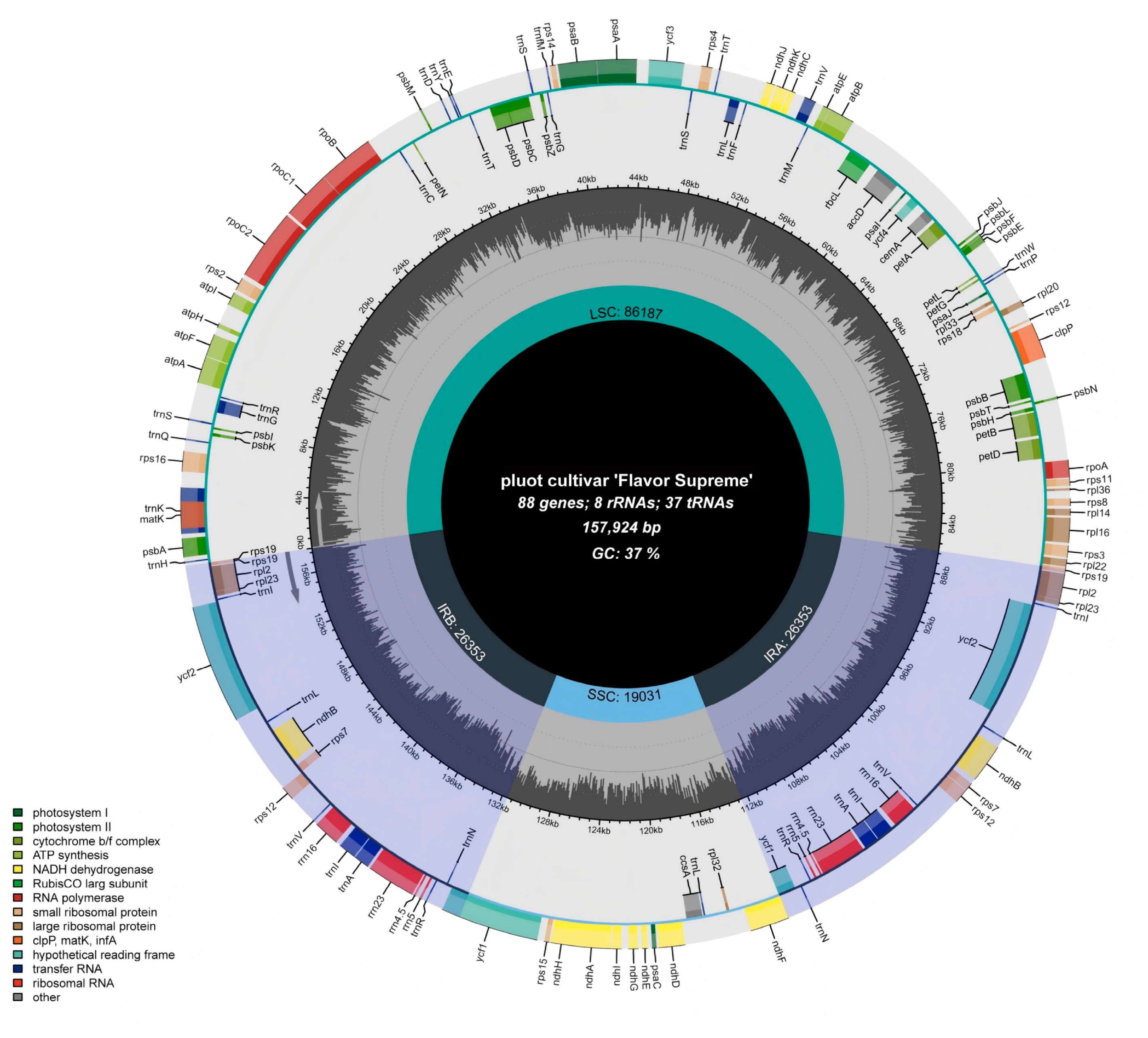
Using Illumina sequencing technology, this study successfully generated clean sequencing data for the chloroplast genomes of six commercial pluot cultivars: ‘Flavor Queen’, ‘Flavorosa’, ‘Dinosaur Egg’, ‘Flavor Supreme’, ‘Flavor King’, and ‘Flavorich’. The assembly results showed that the chloroplast genomes of these six cultivars ranged from 157,916 to 157,924 bp in size, and all exhibited a typical circular quadripartite structure (Figure 1, Figure S1). Among them, ‘Flavor Queen’, ‘Flavor King’, and ‘Flavor Supreme’ shared identical sequence lengths of 157,924 bp, while ‘Flavorosa’, ‘Dinosaur Egg’, and ‘Flavorich’ had the same genome length of 157,916 bp. Each genome consisted of one large single-copy (LSC, 86,123–86,187 bp), one small single-copy (SSC, 19,029–19,031 bp), and two inverted repeat regions (IRs, 26,353–26,382 bp) (Table S2).
In terms of GC content, ‘Flavor Queen’, ‘Flavor King’, and ‘Flavor Supreme’ had an overall GC content of 36.72%, while ‘Flavorosa’, ‘Dinosaur Egg’, and ‘Flavorich’ each showed all overall GC content of 36.75%. The overall GC content was lower than the AT content, consistent with the general characteristic of angiosperm chloroplast genomes being AT-rich. Furthermore, the GC content in the IR region (42.59–42.62%) was significantly higher than that in the LSC region (34.51–34.58%) and SSC region (30.37–30.39%), indicating that the IR regions were more conserved than the single-copy regions [17].
Comparative annotation analysis of the chloroplast genomes of five Prunus taxa (Table 1) revealed that the total number of genes ranged from 131 to 132. The number of protein-coding genes ranged from 85 to 86, with this variation primarily attributed to copy number differences in the rps19 gene. The number of tRNA genes ranged from 37 to 39, mainly due to the presence or absence of the trnS-GGA gene and copy number variations in the trnS-GCU gene. The number of rRNA genes was highly conserved, with eight rRNA genes detected in each chloroplast genome.
Gene deletion and pseudogenization events were also observed: infA and trnR were detected only in P. ussuriensis; rps19 was identified as a pseudogene in P. salicina; ycf1 was a pseudogene in P. sibirica and P. armeniaca. Functional annotation categorized genes into four groups: self-replication, photosynthesis, other functions, and unknown functions. Structural analysis revealed 19 duplicated genes located in the inverted repeat (IR) regions. Intron analysis revealed 15 genes containing one intron (ndhA, ndhB, petB, petD, atpF, rpl16, rpl2, rps16, rpoC1, trnA-UGC, trnG-GCC, trnI-GAU, trnK-UUU, trnL-UAA, trnV-UAC), while three genes contained two introns (rps12, clpP, ycf3) (Table 2).

3.2. Analysis of Codon Preferences

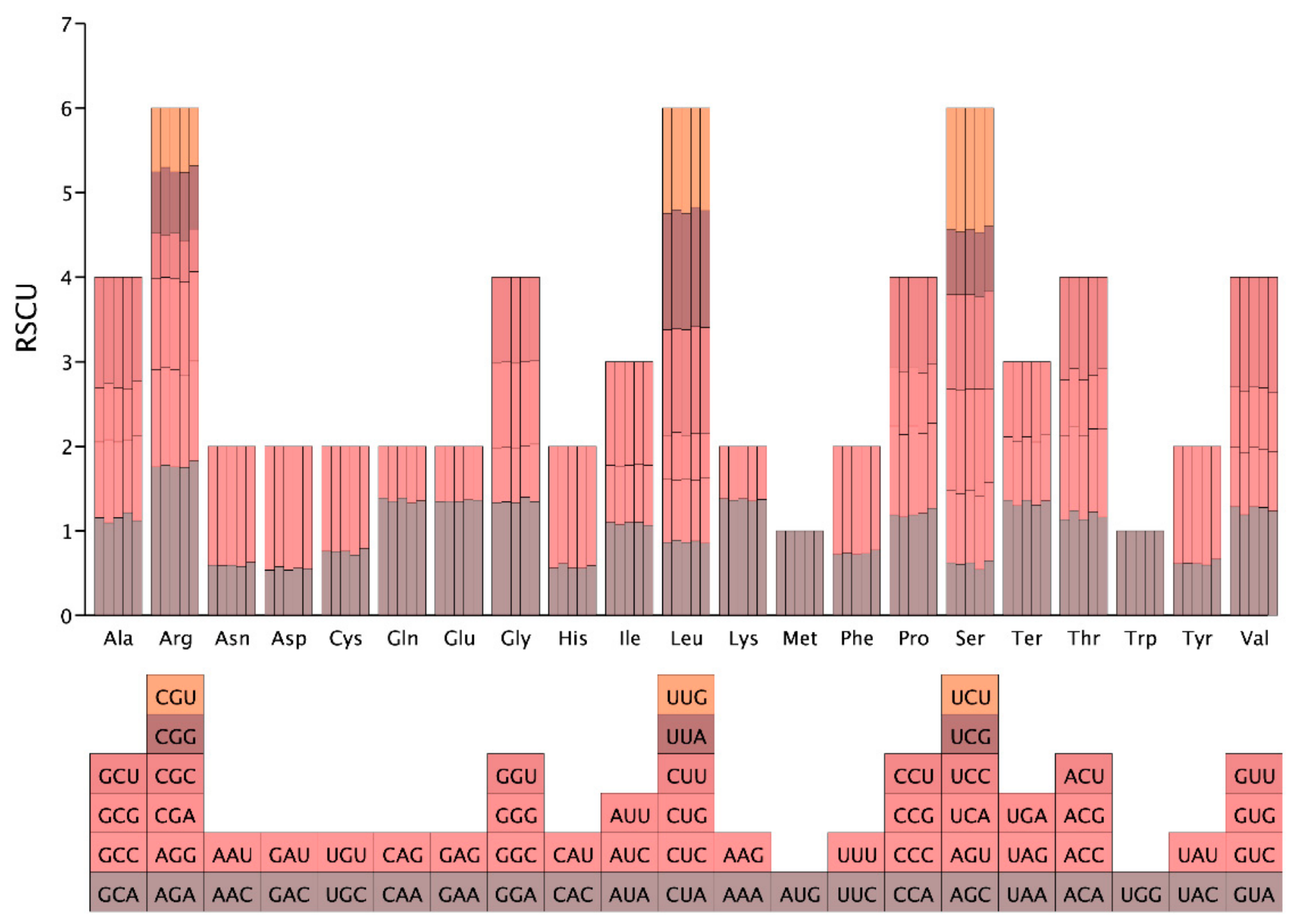
Codon usage bias is influenced by multiple factors including genomic base composition, translational selection pressures, and functional requirements, making it a crucial feature associated with gene expression regulation and evolutionary adaptation [13]. In this study, the analysis showed that the chloroplast genomes of P. sibirica, P. ussuriensis, P. armeniaca, P. salicina, and the pluot cultivar ‘Flavor Supreme’ encode 52,740, 52,639, 52,650, 52,638, and 52,641 codons, respectively. These five Prunus taxa collectively contain 61 sense codons encoding 20 amino acids (Figure 2).
Among these, leucine (Leu) exhibited the highest abundance, with 5243 to 5570 codons, accounting for 9.96% to 10.58% of the total. Serine (Ser) and arginine (Arg), both encoded by six codons, were represented by 4418–4711 codons (8.39–8.95%) and 3159–3315 codons (6.0–6.3%), respectively. Tryptophan (Trp) and methionine (Met) exhibited the lowest usage frequencies, with only 669–745 instances (1.27–1.42%) and 853–860 instances (1.62–1.63%), respectively (Table S3).
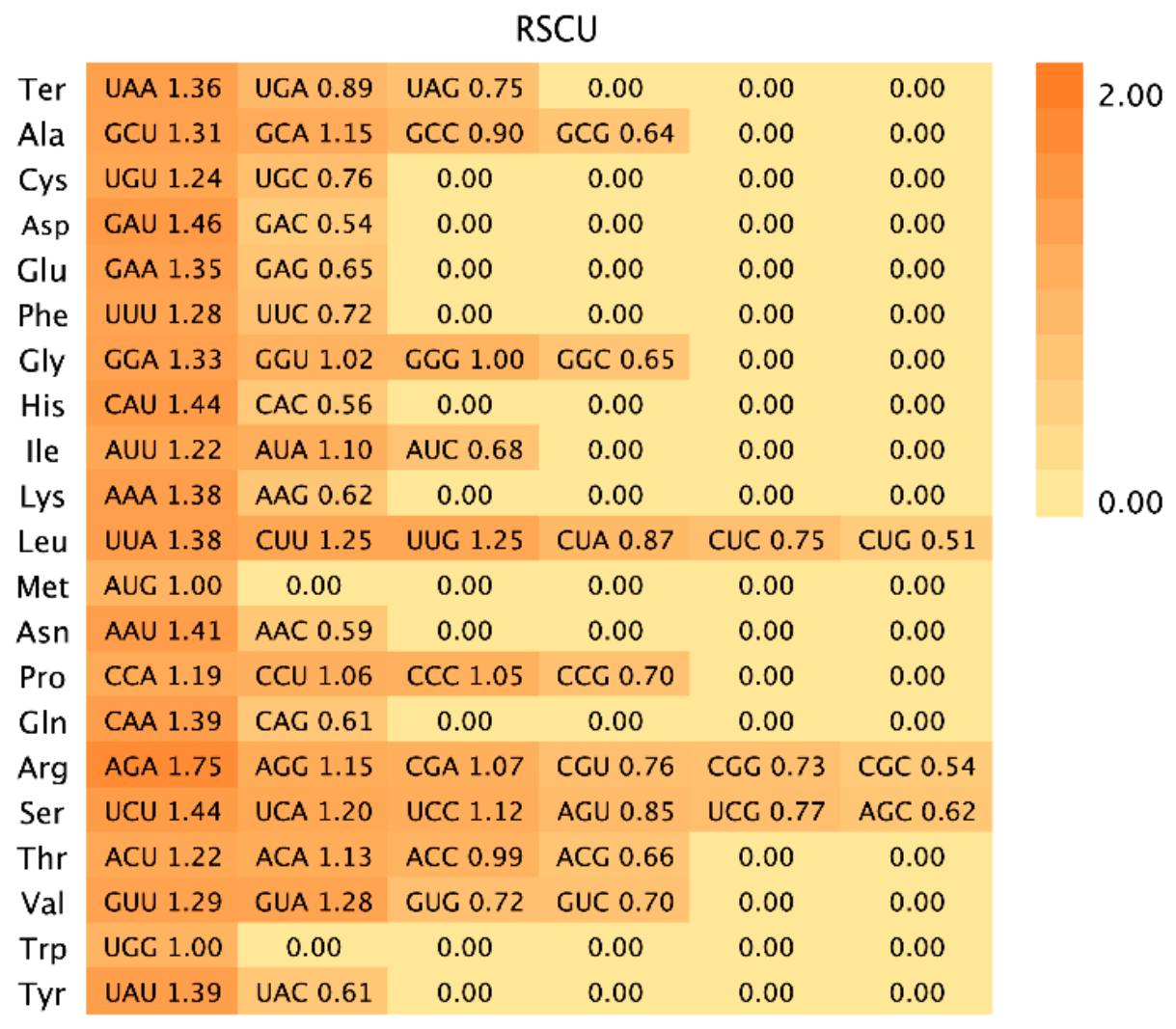
At the individual codon level, AGA exhibited the highest usage frequency, while CUG showed the lowest (Figure 3). RSCU analysis revealed 32 high-frequency codons (RSCU > 1), of which 24 ended with A/U (75%); 29 low-frequency codons (RSCU < 1) were identified, of which 25 ended with G/C (86.2%). These results indicate a significant preference for A/U-terminating codons in the chloroplast genomes of these five Prunus species.

3.3. IR Boundary Analysis

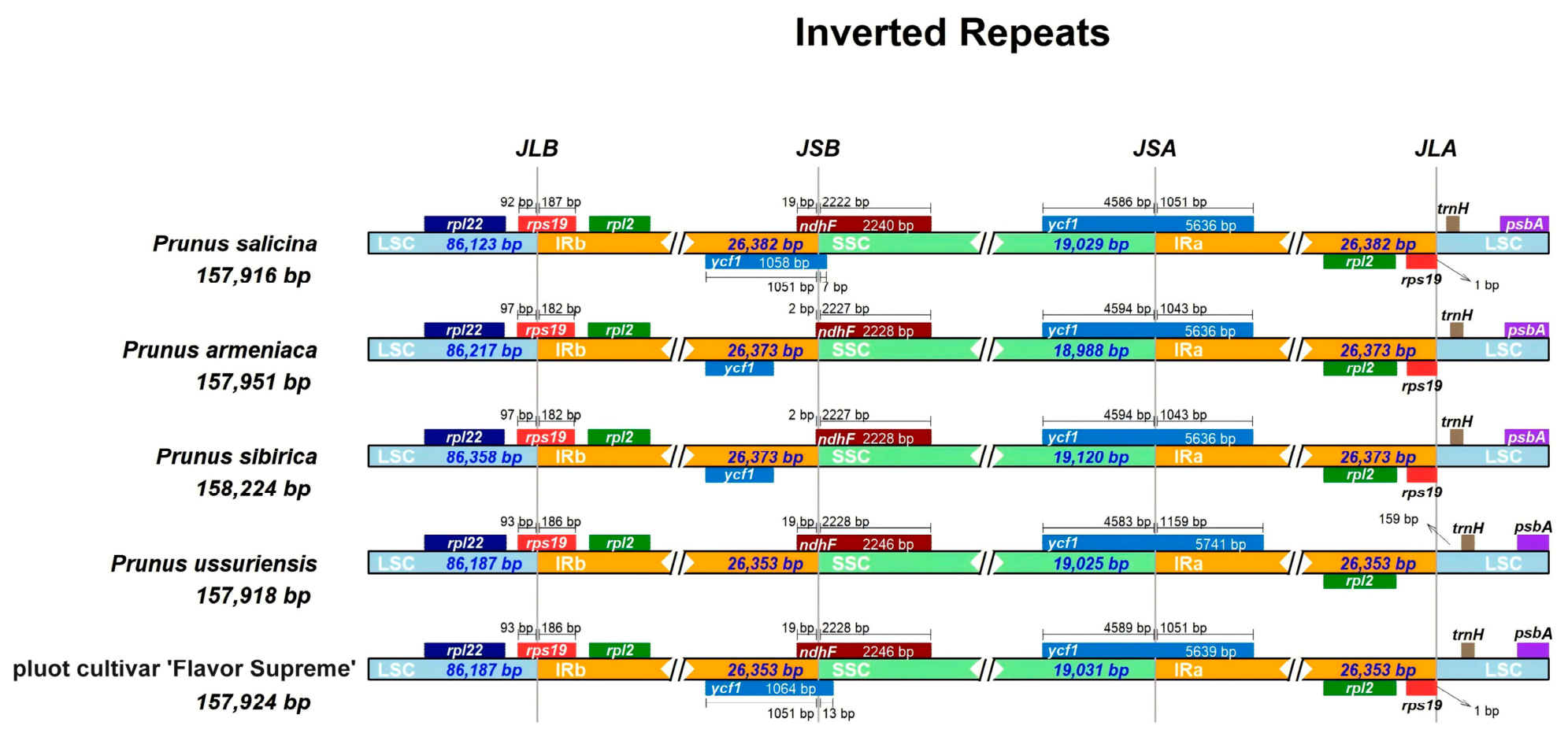
The cp genome sizes of the five Prunus taxa were similar (157,916–158,224 bp), and the gene distribution patterns in the IR boundary regions were largely conserved (Figure 4). Genes such as rpl22, rps19, rpl2, ndhF, ycf1, psbA, and trnH were located at the boundaries of all species, indicating a high level of conservation in the IR boundary regions of Prunus cp genomes.
Despite high conservation in gene types, subtle variations in gene length at the boundaries may reflect evolutionary differentiation among species. Specifically, the IR boundary characteristics of pluot cultivars and P. salicina were highly similar, whereas those of P. armeniaca and P. sibirica also showed remarkable similarity. The primary differences between these two groups occurred at the IRb/SSC boundary, as indicated by varying degrees of expansion in the ycf1 and ndhF genes. Notably, P. ussuriensis differed markedly from the other four taxa: it lacked partial copies of the ycf1 copy at the IRb/SSC boundary and the rps19 copy at the IRa/LSC boundary. Additionally, the ycf1 gene at its SSC/IRa boundary was approximately 100 bp longer than in the other four taxa, suggesting that this species may have experienced unique structural variations in its chloroplast genome.

3.4. Analysis of Repetitive Sequences and SSRs

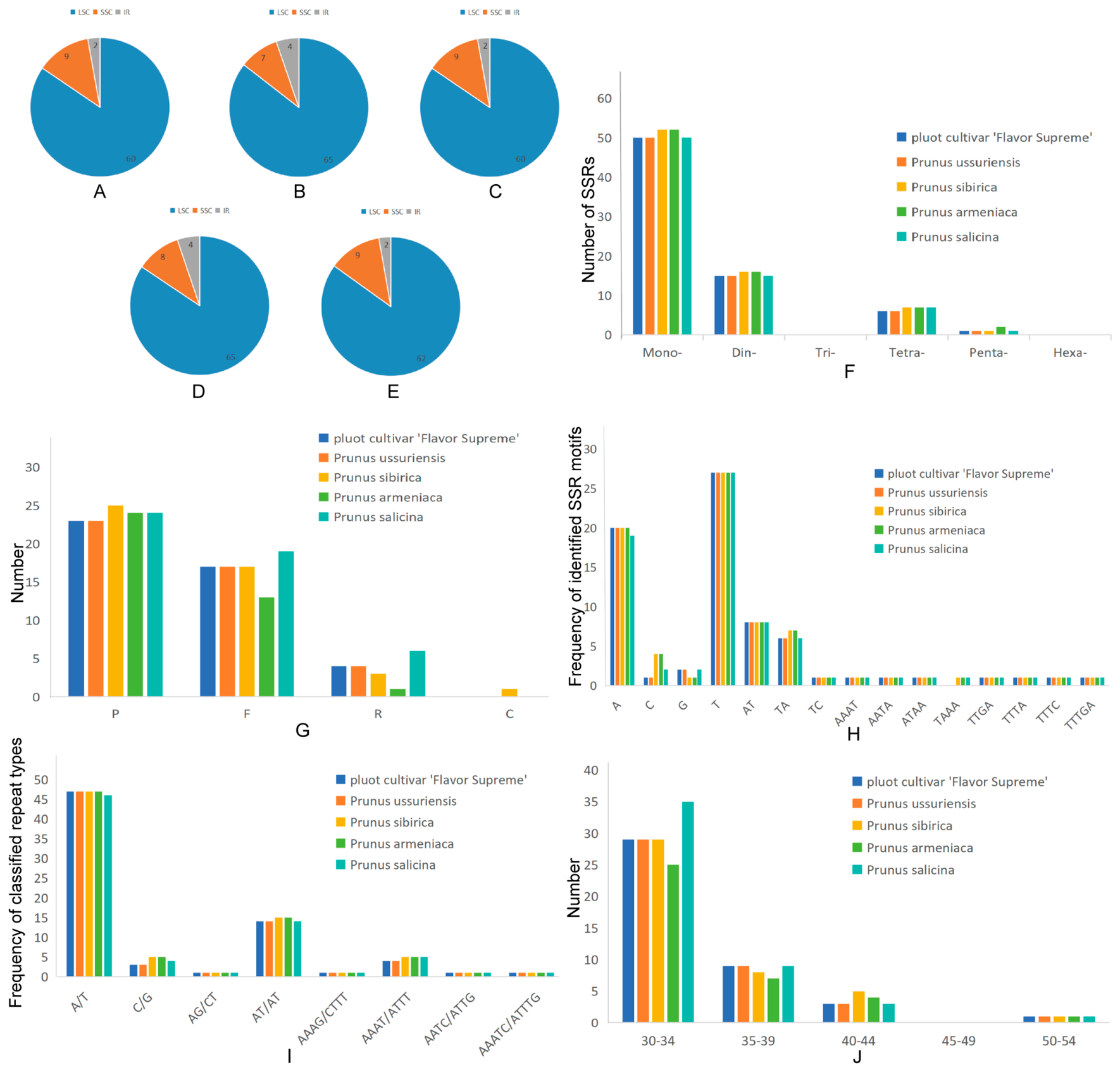
A total of 370 SSR loci were identified across the cp genomes of the five Prunus taxa. Among these, mononucleotide repeats were the most abundant type (254 loci, accounting for 68.65%), followed by dinucleotide repeats (77 loci, 20.81%) and tetranucleotide repeats (33 loci, 8.92%); pentanucleotide repeats were the least abundant (6 loci, 1.62%). Trinucleotide and hexanucleotide repeats were not detected (Figure 5F).
The distribution patterns of SSRs across the four regions—LSC, SSC, IRa, and IRb—were generally consistent among the five taxa: SSRs were predominantly enriched in the LSC region (84.42–85.53%), followed by the SSC region (9.21–12.68%), while the IRa and IRb regions contained relatively fewer SSRs and showed similar distribution patterns (2.82–5.26%) (Figure 5A–E). Overall, SSR sequences predominantly featured A/T nucleotides, with over half of the SSRs consisting of mononucleotide repeats composed of A or T, reflecting the strong AT bias of chloroplast genomes.
Comparisons among taxa revealed that the highest proportion of mononucleotide repeats was observed in the pluot cultivar ‘Flavor Supreme’ and P. ussuriensis (69.44% in both), followed by the P. salicina (68.49%), P. sibirica (68.42%), and P. armeniaca (67.53%). Among the mononucleotide repeats, the T type accounted for the highest proportion; the A type occurred 20 times in four taxa, whereas P. salicina contained 19 occurrences. Additionally, TAAA repeats were not detected in the pluot cultivar ‘Flavor Supreme’ or P. ussuriensis (Figure 5H). Among dinucleotide and longer repeat types, commen repeat motifs, such as A/T, C/G, and AG/CT were shared by all five cp genomes, indicating limited interspecific variation (Figure 5I).
Analysis of long repeated sequences identified a total of 221 repeats, including 119 palindromic repeats, 83 forward repeats, 18 reverse repeats, and 1 complementary repeat (Figure 5G). Among these, palindromic repeats were most abundant in P. sibirica (25 repeats), followed by P. armeniaca and P. salicina (24 repeats each), and ‘Flavor Supreme’ and P. ussuriensis (23 repeats each). Forward repeats were most abundant in P. salicina (19 repeats), while P. armeniaca had the fewest (13 repeats). Complementary repeats were detected only in P. sibirica (1 repeat) and were absent in the other four taxa. Repeat lengths predominantly clustered within the range of 30–34 bp (147 repeats, 66.52%), with no repeats detected in the 45–49 bp range (Figure 5J).

3.5. Comparative Analysis of Cp Genome Sequences and Nucleotide Diversity

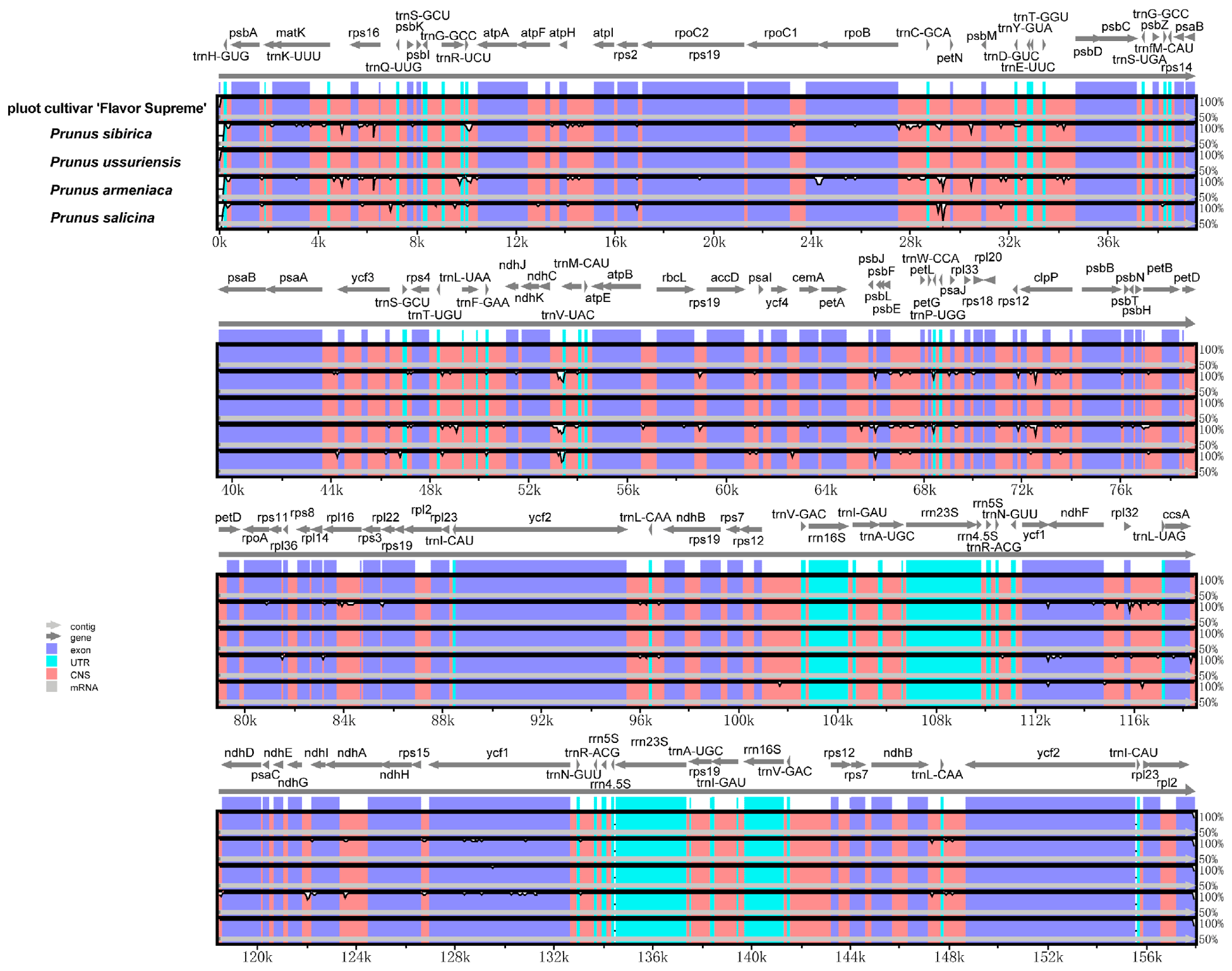
Complete cp genome sequence alignments enable the accurate identification of sequence variation patterns among species. The mVISTA visualization of the alignment results showed that the cp genomes of the five Prunus taxa were highly conserved, with sequence variation predominantly concentrated in non-coding regions (Figure 6).
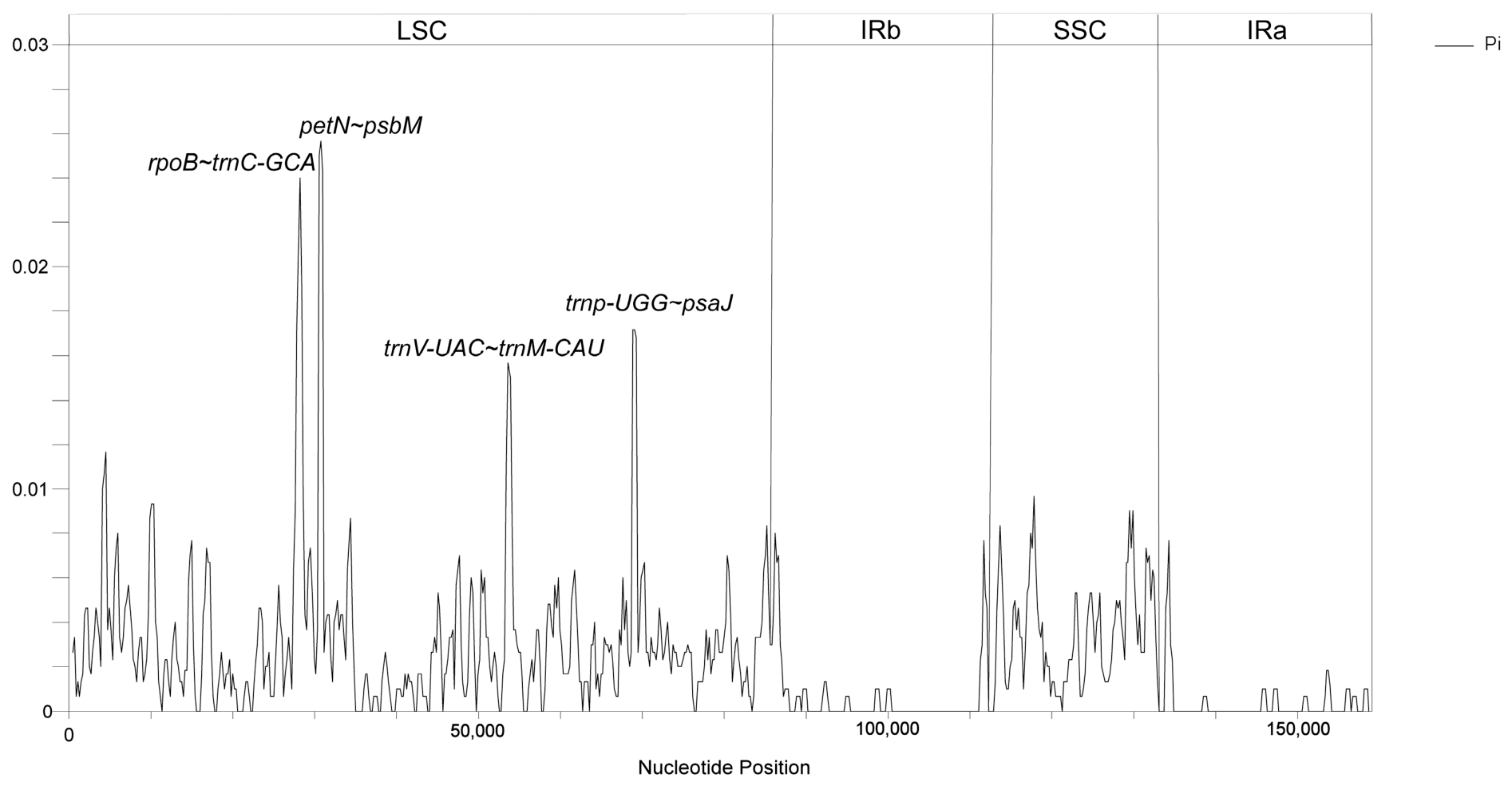
Nucleotide diversity (Pi), calculated using DnaSP v.6, ranged from 0 and 0.028. The levels of variation in the LSC region were significantly higher than those in the IR and SSC regions. Four highly variable regions (Pi > 0.015) were identified within the LSC region: rpoB~trnC-GCA, petN~psbM, trnV-UAC~trnM-CAU, and trnP-UGG~psaJ (Figure 7). These highly variable regions may serve as potential molecular markers, providing valuable references for species identification and phylogenetic studies in Prunus species.

3.6. Phylogenetic Tree Construction

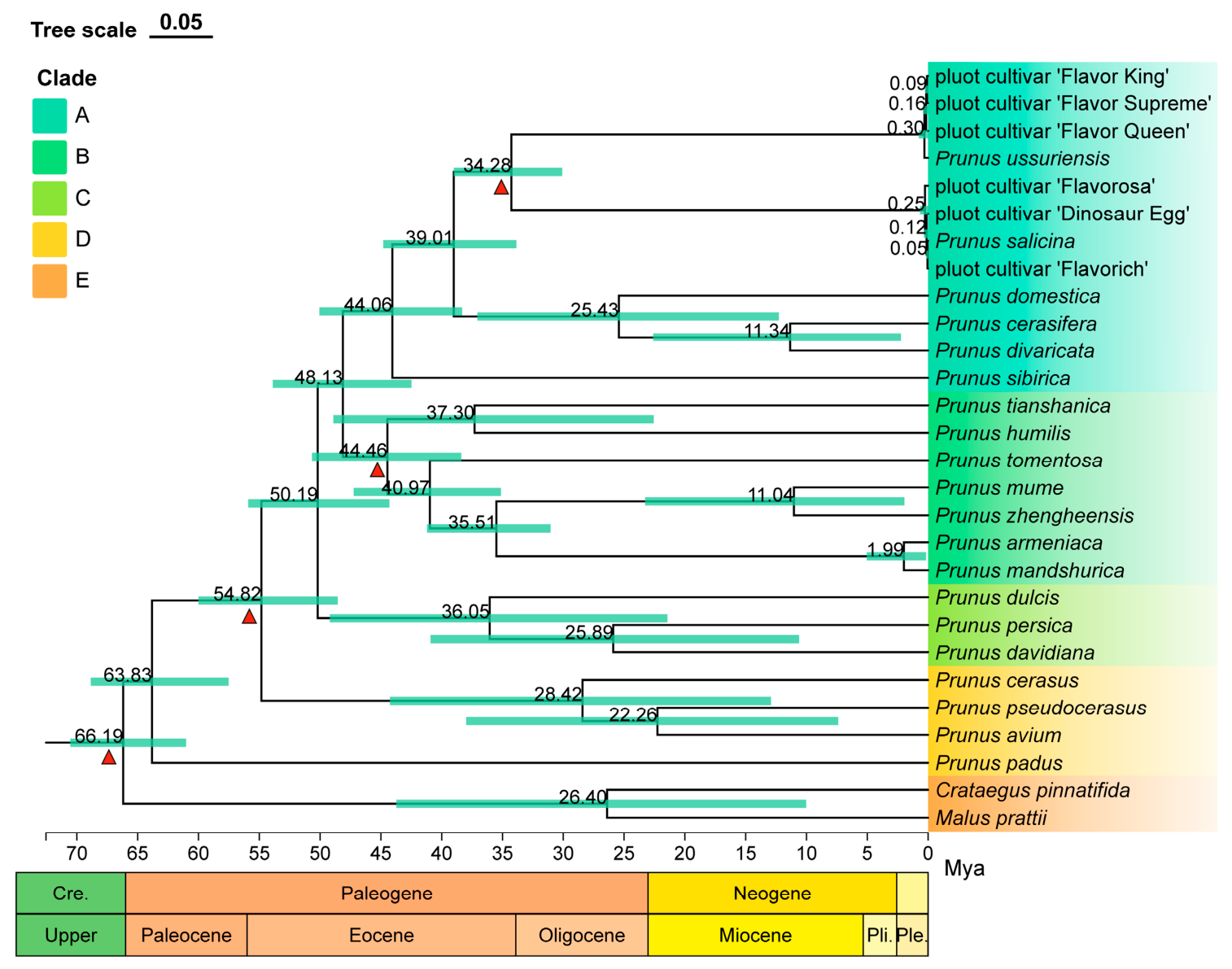
To investigate the phylogenetic position of pluot cultivars, we selected C. pinnatifida and M. prattii as outgroups and constructed a phylogenetic tree based on the chloroplast genomes of 28 Rosaceae species. The phylogenetic trees inferred using Bayesian inference (BI) and maximum likelihood (ML) methods showed identical topologies (Figure 8, Figure S3) with exceptionally high node support, indicating the high robustness of the phylogenetic inference.
Phylogenetic analysis resolved all species into five major clades. Among them, the ‘Flavor Supreme’, ‘Flavor King’, and ‘Flavor Queen’ clustered with P. ussuriensis; while ‘Flavorosa’, ‘Dinosaur Egg’, and ‘Flavorich’ clustered with the P. salicina. P. armeniaca and P. sibirica formed another clade, indicating their relatively distant relationship with the pluot cultivars.
The correspondence between phylogenetic clades and subgenus classification, together with the estimated divergence times, is as follows: Clade A corresponds to subgenus Prunus, with a crown group age of 44.06 Mya (95% HPD: 38.23–50.06 Mya); Clade B corresponds to subgenus Armeniaca, with a crown group age of 44.46 Mya (95% HPD: 38.40–50.67 Mya); Clade C corresponds to subgenus Amygdalus, with a crown group age of 36.05 Mya (95% HPD: 21.44–49.20 Mya); Clade D corresponds to subgenus Cerasus, with a crown group age of 28.42 Mya (95% HPD: 12.92–44.25 Mya); and Clade E represents the outgroup. These time estimates are based on chloroplast genomic data and primarily reflect the evolutionary history of the maternal lineage.

4. Discussion

4.1. Genome Structure and Sequence Conservation

This study assembled the chloroplast genomes of six pluot cultivars and conducted a comparative genomic analysis with four other representative Prunus species. The results showed that the chloroplast genomes of the examined taxa exhibited the typical angiosperm quadripartite structure, with highly consistent genome lengths (157,865–158,131 bp), gene counts (131–132 genes), and total GC content. These characteristics are largely consistent with the previously reported cp genome of the pluot cultivar ‘Flavor King’ [33]. Notably, the GC content in the IR region (42.57–42.62%) was significantly higher than those in the LSC region (34.51–34.58%) and SSC region (30.30–30.50%). This high GC content can primarily be attributed to the enrichment of rRNA genes (rrn16, rrn23, rrn4.5, rrn5) with high GC content in this region [34]. The highly similar genomic structures among the examined taxa further confirm the evolutionary conservation of the cp genome in Prunus species [35].
In addition to GC-content effects, the structural stability and low sequence divergence of the IR regions may also be explained by plastid DNA repair mechanisms. Recent studies have emphasized that homologous recombination is a major pathway for repairing double-strand breaks in plastid genomes, and the two highly similar IR copies can serve as reciprocal homologous templates for accurate repair. This repair-mediated homogenization may contribute to the strong conservation and reduced substitution rates commonly observed in IR regions compared with the LSC and SSC regions. Moreover, the high copy number of plastid genomes within plant cells provides abundant intact templates for homologous recombination, thereby increasing repair efficiency and reducing the probability of mutation accumulation. These mechanisms may help explain why the pluot plastomes examined here are highly conserved at both structural and sequence levels. Compared with plant mitochondrial genomes, which often show more extensive recombination-associated rearrangements and structural dynamism, plastid genomes—especially their IR regions—appear to be subject to stronger repair-mediated stabilization [36,37].

4.2. Codon Preference and IR Boundary Variation

Codon preference reflects adaptive selection for translation efficiency and accuracy during the long-term evolution of species [38]. In this study, the cp genomes of five Prunus taxa encoded 20 amino acids using 61 codons, with leucine being the most frequent and cysteine being the least frequent. RSCU analysis revealed that high-frequency codons (RSCU > 1) predominantly ended with A/U, whereas low-frequency codons were more likely to the end with G/C ending codons. This A/U preference pattern is consistent with findings in Malus [39], Caragana [40], and most dicotyledons [41], indicating that AT richness in the cp genome strongly shapes codon usage.
Boundary variations, including expansion and contraction of the IR regions, are primary drivers of cp genome size differences among angiosperms [42]. This study revealed significant IR boundary variations in P. ussuriensis compared with P. salicina and the pluot cultivar ‘Flavor Supreme’: the IRb/SSC boundary lacked a portion of the ycf1 copy, while the IRa/LSC boundary lacked the rps19 copy. In contrast, the ycf1 gene in P. armeniaca and P. sibirica was entirely located within the SSC region, without any boundary extension. Although the cp genome structure is generally conserved across most land plants, minor boundary shifts between genera or even among closely related species, such as the positional changes in rps19 and ycf1—often provide phylogenetically significant information [43,44].

4.3. Screening of Repeat Sequences and Highly Variable Regions

Simple sequence repeats (SSRs), as highly polymorphic molecular markers characterized by high mutation rates and genetic stability, are widely used in population genetics and phylogenetic studies [45,46]. This study identified 370 SSRs across five Prunus cp genomes, most of which consisted of A/T-rich motifs, with no trinucleotide or hexanucleotide repeats detected. The high similarity in SSR quantity and distribution patterns between the pluot cultivar ‘Flavor Supreme’ and P. ussuriensis suggests an extremely close phylogenetic relationship between them. Furthermore, mVISTA and nucleotide diversity (Pi) analyses indicated that sequence variation was primarily concentrated in the LSC and SSC regions, while the IR region exhibited the highest conservation. This pattern is consistent with the proposed role of IR sequences in homologous recombination-mediated plastid DNA repair, which may constrain mutation accumulation in duplicated IR regions. Using a Pi threshold of >0.015, we identified four highly variable regions within the LSC region: rpoB~trnC-GCA, petN~psbM, trnV-UAC~trnM-CAU, and trnP-UGG~psaJ. These regions represent candidate sites for future DNA barcoding development in Prunus species [47]. Beyond their taxonomic utility, these SSR loci and highly variable regions may also have practical value in breeding programs. In particular, they provide candidate chloroplast markers for maternal lineage verification, cultivar authentication, and germplasm management, especially in cases where pedigree records are incomplete or the maternal origin of breeding materials is uncertain. However, their application in routine breeding practice will require further validation using broader germplasm collections and segregating populations.

4.4. Phylogenetic Relationships and Taxonomic Implications

Although the taxonomic status of most species within the genus Prunus has been relatively well-established, the origin and classification of the apricot–plum hybrid have remained long-standing subjects of debate [48,49,50]. Based on phylogenetic analysis of the chloroplast genome, this study clearly divided Prunus species into four major clades, with high support values at key nodes. The phylogenetic tree revealed that ‘Flavor King’, ‘Flavor Supreme’, ‘Flavor Queen’, and P. ussuriensis form one cluster, while ‘Flavorosa’, ‘Dinosaur Egg’, ‘Flavorich’, and P. salicina cluster together. None of the six pluot cultivars formed closely related branches with P. armeniaca or P. sibirica, suggesting that their maternal lineages are distantly related to the subgenus Armeniaca.
Previous breeding and molecular studies also support the distinct plum-biased genetic background of pluots. Guerrero et al. [51] noted that pluots were primarily developed by backcrossing plumcot hybrids with P. salicina, resulting in a theoretical genetic composition of approximately 75% P. salicina genome and 25% P. armeniaca. SSR marker results revealed that the detected allelic variation in the pluot cultivars ‘Flavorich’ and ‘Flavorosa’ predominantly originated from plum (P. salicina), with fewer shared or apricot-specific components; in population clustering, pluots (‘Flavorich’ and ‘Flavorosa’) did not form an independent branch but were interspersed with plum cultivars, exhibiting significantly smaller genetic distances to plum than to apricot [3]. These findings strongly align with the documented breeding history involving multiple rounds of plum backcrossing. Regarding functional trait-associated loci, Halász et al. [52] identified the S genotype of pluot cultivars represented by ‘Flavor Grenade’ and ‘Flavor King’ as SbSc through PCR amplification, S-RNase intron length detection, and sequence analysis. This places them within the second incompatibility group (Group II) of Prunus, aligning with some major cultivated P. salicina cultivars (e.g., ‘Black Amber’, ‘October Sun’). This indicates that apricot–plums retain typical Prunus genetic characteristics at key self-incompatibility loci, suggesting that interspecific hybridization has not disrupted the core conservation of the Prunus gametophyte self-incompatibility system. Notably, the chloroplast genome primarily reflects maternal genetic history. Therefore, the conclusions of this study should be interpreted as indicating that the aforementioned commercial pluot cultivars are maternally closer to either P. ussuriensis or P. salicina. Their phylogenetic relationships and component proportions at the nuclear genome level require further validation using whole-genome nuclear data. The repeated sentence at the end of this paragraph was removed.
Although the close maternal affinity of pluots to P. salicina and P. ussuriensis is not unexpected given their known breeding history, the present chloroplast genomic evidence provides more than a simple confirmation of previous hybridization records. Commercial pluot cultivars often have complex backcross histories, and their pedigrees may be incomplete, ambiguous, or difficult to verify using morphology alone. Because chloroplast genomes are maternally inherited and largely non-recombining, they provide a stable molecular framework for assigning maternal lineages in such complex breeding materials. This information can complement conventional pedigree records and help distinguish whether similar fruit phenotypes arose from comparable or different maternal backgrounds. The value of plastome phylogenomics for resolving maternal ancestry has also been demonstrated in other complex horticultural crops. For example, a recent chloroplast phylogenomic study of cultivated chrysanthemum, Chrysanthemum × morifolium, successfully identified its maternal ancestry and traced its relationship to wild progenitor lineages, despite the complex hybrid origin of cultivated chrysanthemums [53]. This parallel case supports the broader applicability of complete chloroplast genomes for tracing maternal lineages in horticultural crops with complicated domestication or breeding histories. Together with the present results, it indicates that plastome-scale data can provide an independent and robust framework for maternal-lineage assignment, particularly when nuclear backgrounds have been reshuffled by repeated hybridization, backcrossing, or selection.
From a breeding perspective, the plastome-based grouping of the six cultivars into P. ussuriensis-associated and P. salicina-associated maternal lineages may help refine the use of maternal parents in future cross design. For example, when breeding objectives include cold tolerance, environmental adaptability, or stable performance in arid and semi-arid regions, maternal lines related to P. ussuriensis may warrant further evaluation because of the ecological adaptation of this species. Conversely, P. salicina-related maternal lineages may be useful for maintaining desirable fruit-quality traits associated with cultivated plum backgrounds. Therefore, the main applied value of the chloroplast data lies in converting a broadly expected breeding assumption into a testable maternal-lineage framework that can support parental selection, pedigree verification, and germplasm management.
In addition, this study revealed several inconsistencies with traditional taxonomic treatments: P. sibirica, traditionally placed in subg. Armeniaca, clustered within subg. Prunus in our phylogenetic tree; P. tianshanica and Prunus tomentosa, usually assigned to subg. Cerasus, were nested within the subg. Armeniaca clade. Cui et al. [10] also suggested a close relationship between P. tomentosa and subg. Armeniaca and recommended placing it within subg. Armeniaca. Regarding the taxonomic status of P. padus, our results support its placement in subg. Cerasus within Prunus, rather than recognizing it as a separate genus Padus, consistent with the conclusions of Bortiri et al. [54].

4.5. Time of Differentiation and Evolutionary History

Divergence time estimates indicate that the radiation of Prunus s.l. commenced during the Late Cretaceous, with a divergence time of approximately 63.83 Mya. This finding aligns with the hypothesis that paleoclimate changes drove the radiation of plant lineages [55]. The phylogenetic origin time (stem age) of subgenus Cerasus was estimated at 54.82 Mya in the early Eocene, closely matching the origin time (approximately 54.97 Mya) proposed by Yi et al. [56], and supports the establishment of early phylogenetic structure during the Eocene. Molecular clock analysis based on chloroplast whole genomes indicates that the two major lineages, dominated by P. ussuriensis and P. salicina, diverged around 34.28 Mya (95% HPD: 30.09–39.00 Mya), corresponding to the Late Oligocene. Because this node was directly constrained by a TimeTree-derived secondary calibration in the revised analysis, this estimate should be interpreted as a calibrated plastid lineage age rather than an independent species divergence time. This timing is significantly later than the early radiation event within Prunus (e.g., 44.06 Mya as estimated in this study) but precedes the large-scale climatic fluctuations of the Quaternary glacial period (Pleistocene, 2.6 Mya) [57], suggesting that the foundation for the divergence of the maternal ancestors of P. ussuriensis and P. salicina may have been established prior to the Quaternary. From a geological-climatic perspective, this period aligns with the global cooling trend and intensification of the East Asian monsoon during the Late Miocene [58].
In the phylogenetic topology, the six pluot cultivars studied (‘Flavor King’, ‘Flavor Supreme’, ‘Flavor Queen’, ‘Flavorosa’, ‘Dinosaur Egg’, ‘Flavorich’) are all tightly nested within the core clade formed by P. salicina and P. ussuriensis, without forming a closely related cluster with P. armeniaca. This pattern aligns with the maternal inheritance characteristic of chloroplast genomes: as artificially hybridized cultivars between plum and apricot, pluots can integrate parental components in their nuclear genomes, while chloroplast genomes are primarily inherited from the maternal lineage. Despite marked differences in commercial types and fruit phenotypes among the six cultivars, their genetic differentiation at the chloroplast genomic level is low, with short branch lengths in the phylogenetic tree and divergence times far less than 1 Mya. This result aligns with findings from Kim et al. [59] on the Korean pluot cultivar ‘Harmony’, suggesting that the commercial pluot cultivars studied here likely originate from a relatively closely related Prunus maternal lineage. In summary, this study uses chloroplast molecular clock analysis to reveal the close maternal affinity between commercial pluot cultivars, P. ussuriensis, and P. salicina, providing temporal evidence for the historical differentiation of their maternal lineages.

5. Conclusions

This study completed the whole-genome sequencing and assembly of chloroplast genomes of six commercial pluot cultivars. Comparative genomics and phylogenetic analyses were conducted in combination with other representative Prunus species. The results indicated that the overall structure of Prunus chloroplast genomes was highly conserved, with genome lengths varying only slightly (157,865–158,131 bp), though species-specific variations were observed at the IR boundaries. Based on sequence variation analysis, four highly variable regions (rpoB~trnC-GCA, petN~psbM, trnV-UAC~trnM-CAU, and trnP-UGG~psaJ) and 370 SSRs were identified as candidate chloroplast molecular markers for species identification, cultivar authentication, maternal lineage tracing, and genetic diversity analysis within Prunus. Phylogenetic analysis clearly delineated four subgeneric clades within Prunus, with stable topology and high support values. Among the six pluot cultivars, ‘Flavor King’, ‘Flavor Supreme’, and ‘Flavor Queen’ clustered with P. ussuriensis, while ‘Flavorosa’, ‘Dinosaur Egg’, and ‘Flavorich’ clustered with P. salicina, indicating that their chloroplast maternal lineages are closer to plum lineages within Prunus. Our results provide chloroplast-based insights into maternal lineage relationships in commercial pluot cultivars, but their application in breeding strategies should be further evaluated through broader sampling and integration with nuclear genomic data.

Supplementary Materials

The following supporting information can be downloaded at: https://www.mdpi.com/article/10.3390/genes17060607/s1.

Author Contributions

Conceptualization, W.L. and D.C.; methodology, D.C., Z.G. and J.Z.; validation, D.C., Z.G. and J.Z.; formal analysis, D.C.; investigation, H.H., M.W., B.K. and Y.W.; resources, H.H., M.W., B.K. and Y.W.; DNA extraction and sequencing, D.C., Z.H. and X.W.; genome assembly and annotation, D.C. and Z.G.; data analysis, D.C., J.Z. and Z.H.; writing—original draft, D.C.; writing—review and editing, W.L. and X.W.; visualization, D.C., J.Z. and Z.H.; supervision, W.L.; project administration, W.L.; funding acquisition, W.L. All authors have read and agreed to the published version of the manuscript.

Funding

This work was supported by the “Tianshan Talents” Youth Support Program of the Xinjiang Uygur Autonomous Region Association for Science and Technology (Grant No. 2023TSYCQNTJ0038), the National Natural Science Foundation of China (Grant Nos. 32560058 and 32200183), the Special Training Program for Ethnic Minority Science and Technology Talents in Xinjiang (Grant No. 2025D03024), and the Open Project of the Xinjiang Agricultural Informatization Engineering Technology Research Center (Grant No. XJAIEC2025K012).

Institutional Review Board Statement

Not applicable.

Informed Consent Statement

Not applicable.

Data Availability Statement

No datasets were generated or analyzed during the current study.

Acknowledgments

We sincerely acknowledge the financial support from the Youth Support Program of “Tianshan Talents” of the Association for Science and Technology of the Xinjiang Uygur Autonomous Region (Grant No. 2023TSYCQNTJ0038) and the National Natural Science Foundation of China (Grant Nos. 32560058 and 32200183). We also express our gratitude to the Jiamu Experimental Station in Wensu County, Aksu, of the Xinjiang Academy of Forestry Sciences for providing access to the plant materials used in this study. We further thank the technical staff at Xinjiang Agricultural University, Xinjiang Xinnongda Environmental Testing Center Co., Ltd., and the Xinjiang Academy of Forestry Sciences for their assistance with sample collection, DNA extraction, and sequencing. We are also grateful to the editors and anonymous reviewers for their constructive comments and valuable suggestions, which substantially improved the quality of this manuscript.

Conflicts of Interest

Xuemei Wen is an employee of Xinjiang Xinnongda Environmental Testing Center Co., Ltd. and participated in sample collection and data analysis in this study. The company had no role in the study design, data interpretation, manuscript preparation, or the decision to submit the manuscript for publication. The other authors declare no conflicts of interest.

Abbreviations

The following abbreviations are used in this manuscript:
LSCLarge single-copy
SSCSmall single-copy
IRInverted repeat sequence
GCGuanine-cytosine content
PCGProtein-coding gene
SSRsSimple sequence repeats
BIBayesian Inference
MLMaximum Likelihood
HPDhighest posterior density
Myamillion years ago

References

  1. Chen, Y.L.; Su, Y.X.; Huang, Z.Y.; Xia, L.H.; Chen, L. Current status analysis and development suggestions of pluot industry in China. China Fruits 2021, 3, 98–100. [Google Scholar] [CrossRef]
  2. Li, H.M.; Yi, S.Q.; Chen, J.L. Current Situation and Countermeasure Suggestions for Pluot Industry Development in Kashi Region. Xinjiang Agric. Sci. Technol. 2023, 6, 28–29. [Google Scholar] [CrossRef]
  3. Ahmad, R.; Potter, D.; Southwick, S.M. Identification and characterization of plum and pluot cultivars by microsatellite markers. J. Hortic. Sci. Biotechnol. 2004, 79, 164–169. [Google Scholar] [CrossRef]
  4. Crisosto, C.H.; Crisosto, G.M.; Echeverria, G.; Puy, J. Segregation of plum and pluot cultivars according to their organoleptic characteristics. Postharvest Biol. Technol. 2007, 44, 271–276. [Google Scholar] [CrossRef]
  5. Chen, Z.; Yu, X.; Yang, Y.; Wei, P.; Zhang, W.; Li, X.; Liu, C.; Zhao, S.; Li, X.; Liu, X. Comparative analysis of chloroplast genomes within Saxifraga (Saxifragaceae) takes insights into their genomic evolution and adaption to the high-elevation environment. Genes 2022, 13, 1673. [Google Scholar] [CrossRef]
  6. Dong, W.L.; Wang, R.N.; Zhang, N.Y.; Fan, W.B.; Fang, M.F.; Li, Z.H. Molecular evolution of chloroplast genomes of orchid species: Insights into phylogenetic relationship and adaptive evolution. Int. J. Mol. Sci. 2018, 19, 716. [Google Scholar] [CrossRef] [PubMed]
  7. Feng, L.J.; Zhao, G.P.; An, M.M.; Wang, C.Z.; Yin, Y.L. Complete chloroplast genome sequences of the ornamental plant Prunus cistena and comparative and phylogenetic analyses with its closely related species. BMC Genom. 2023, 24, 739. [Google Scholar] [CrossRef] [PubMed]
  8. Duan, Y.Z.; Shen, Y.H.; Kang, F.R.; Wang, J.W. Characterization of the complete chloroplast genomes of the endangered shrub species Prunus mongolica and Prunus pedunculata (Rosales: Rosaceae). Conserv. Genet. Resour. 2019, 11, 249–252. [Google Scholar] [CrossRef]
  9. Huang, X.; Tan, W.; Li, F.; Liao, R.Y.; Guo, Z.R.; Shi, T.; Gao, Z.H. The chloroplast genome of Prunus zhengheensis: Genome comparative and phylogenetic relationships analysis. Gene 2021, 793, 145751. [Google Scholar] [CrossRef] [PubMed]
  10. Cui, M.; Liu, C.; Yang, X.; Li, M.; Liu, L.; Jia, K.; Li, W. Comparative and phylogenetic analysis of the chloroplast genomes of four wild species of the genus Prunus. Genes 2025, 16, 239. [Google Scholar] [CrossRef]
  11. Fang, J.; Hu, Y.; Hu, Z. Comparative analysis of codon usage patterns in 16 chloroplast genomes of suborder Halimedineae. BMC Genom. 2024, 25, 945. [Google Scholar] [CrossRef] [PubMed]
  12. Jin, J.J.; Yu, W.B.; Yang, J.B.; Song, Y.; dePamphilis, C.W.; Yi, T.S.; Li, D.Z. GetOrganelle: A fast and versatile toolkit for accurate de novo assembly of organelle genomes. Genome Biol. 2020, 21, 241. [Google Scholar] [CrossRef]
  13. Nguyen, H.D.; Vu, N.H.; Do, H.D.K.; Vu, M.T. Comparative chloroplast genomic analysis of Pithecellobium dulce (Roxb.) Benth 1844 and related species within Caesalpinioideae. Genetica 2025, 153, 19. [Google Scholar] [CrossRef]
  14. Tillich, M.; Lehwark, P.; Pellizzer, T.; Ulbricht-Jones, E.S.; Fischer, A.; Bock, R.; Greiner, S. GeSeq: Versatile and accurate annotation of organelle genomes. Nucleic Acids Res. 2017, 45, W6–W11. [Google Scholar] [CrossRef]
  15. Zheng, S.; Poczai, P.; Hyvönen, J.; Tang, J.; Amiryousefi, A. Chloroplot: An online program for the versatile plotting of organelle genomes. Front. Genet. 2020, 11, 576124. [Google Scholar] [CrossRef]
  16. Yang, T.; Aishan, S.; Zhu, J.; Qin, Y.; Liu, J.; Liu, H.; Tie, J.; Wang, J.; Qin, R. Chloroplast genomes and phylogenetic analysis of three Carthamus (Asteraceae) species. Int. J. Mol. Sci. 2023, 24, 15634. [Google Scholar] [CrossRef]
  17. Guo, Y.Y.; Yang, J.X.; Bai, M.Z.; Zhang, G.Q.; Liu, Z.J. The chloroplast genome evolution of Venus slipper (Paphiopedilum): IR expansion, SSC contraction, and highly rearranged SSC regions. BMC Plant Biol. 2021, 21, 248. [Google Scholar] [CrossRef]
  18. Amiryousefi, A.; Hyvönen, J.; Poczai, P. IRscope: An online program to visualize the junction sites of chloroplast genomes. Bioinformatics 2018, 34, 3030–3031. [Google Scholar] [CrossRef] [PubMed]
  19. Beier, S.; Thiel, T.; Münch, T.; Scholz, U.; Mascher, M. MISA-web: A web server for microsatellite prediction. Bioinformatics 2017, 33, 2583–2585. [Google Scholar] [CrossRef]
  20. Xie, H.H.; Zhang, L.; Zhang, C.; Chang, H.; Xi, Z.X.; Xu, X.T. Comparative analysis of the complete chloroplast genomes of six threatened subgenus Gynopodium (Magnolia) species. BMC Genom. 2022, 23, 716. [Google Scholar] [CrossRef] [PubMed]
  21. Kurtz, S.; Choudhuri, J.V.; Ohlebusch, E.; Schleiermacher, C.; Stoye, J.; Giegerich, R. REPuter: The manifold applications of repeat analysis on a genomic scale. Nucleic Acids Res. 2001, 29, 4633–4642. [Google Scholar] [CrossRef] [PubMed]
  22. Feng, S.G.; Zheng, K.X.; Jiao, K.L.; Cai, Y.C.; Chen, C.L.; Mao, Y.Y.; Wang, L.Y.; Zhan, X.R.; Ying, Q.C.; Wang, H.Z. Complete chloroplast genomes of four Physalisspecies (Solanaceae): Lights into genome structure, comparative analysis, and phylogenetic relationships. BMC Plant Biol. 2020, 20, 242. [Google Scholar] [CrossRef]
  23. Frazer, K.A.; Pachter, L.; Poliakov, A.; Rubin, E.M.; Dubchak, I. VISTA: Computational tools for comparative genomics. Nucleic Acids Res. 2004, 32, W273–W279. [Google Scholar] [CrossRef] [PubMed]
  24. Katoh, K.; Standley, D.M. MAFFT multiple sequence alignment software version 7: Improvements in performance and usability. Mol. Biol. Evol. 2013, 30, 772–780. [Google Scholar] [CrossRef]
  25. Rozas, J.; Ferrer-Mata, A.; Sánchez-DelBarrio, J.C.; Guirao-Rico, S.; Librado, P.; Ramos-Onsins, S.E.; Sánchez-Gracia, A. DnaSP 6: DNA sequence polymorphism analysis of large data sets. Mol. Biol. Evol. 2017, 34, 3299–3302. [Google Scholar] [CrossRef]
  26. Minh, B.Q.; Schmidt, H.A.; Chernomor, O.; Schrempf, D.; Woodhams, M.D.; von Haeseler, A.; Lanfear, R. IQ-TREE 2: New models and efficient methods for phylogenetic inference in the genomic era. Mol. Biol. Evol. 2020, 37, 1530–1534. [Google Scholar] [CrossRef]
  27. Kalyaanamoorthy, S.; Minh, B.Q.; Wong, T.K.F.; von Haeseler, A.; Jermiin, L.S. ModelFinder: Fast model selection for accurate phylogenetic estimates. Nat. Methods 2017, 14, 587–589. [Google Scholar] [CrossRef]
  28. Ronquist, F.; Teslenko, M.; van der Mark, P.; Ayres, D.L.; Darling, A.; Höhna, S.; Larget, B.; Liu, L.; Suchard, M.A.; Huelsenbeck, J.P. MrBayes 3.2: Efficient Bayesian phylogenetic inference and model choice across a large model space. Syst. Biol. 2012, 61, 539–542. [Google Scholar] [CrossRef]
  29. Yang, Z. PAML 4: Phylogenetic analysis by maximum likelihood. Mol. Biol. Evol. 2007, 24, 1586–1591. [Google Scholar] [CrossRef] [PubMed]
  30. Kumar, S.; Suleski, M.; Craig, J.M.; Kasprowicz, A.E.; Sanderford, M.; Li, M.; Stecher, G.; Hedges, S.B. TimeTree 5: An expanded resource for species divergence times. Mol. Biol. Evol. 2022, 39, msac174. [Google Scholar] [CrossRef]
  31. Yang, Z.; Wang, G.; Ma, Q.; Ma, W.; Liang, L.; Zhao, T. The complete chloroplast genomes of three Betulaceae species: Implications for molecular phylogeny and historical biogeography. PeerJ 2019, 7, e6320. [Google Scholar] [CrossRef]
  32. Zhang, L.H.; Yi, C.Q.; Xia, X.; Jiang, Z.; Du, L.H.; Yang, S.X.; Yang, X. Solanum aculeatissimum and Solanum torvum chloroplast genome sequences: A comparative analysis with other Solanum chloroplast genomes. BMC Genom. 2024, 25, 412. [Google Scholar] [CrossRef]
  33. Xu, Y.C.; Fang, B.; Yu, J. The complete chloroplast genome sequence of Prunus simoni ‘Weiwang’. Mitochondrial DNA B Resour. 2021, 6, 2353–2354. [Google Scholar] [CrossRef]
  34. Yan, K.; Ran, J.; Bao, S.M.; Li, Y.M.; Islam, R.; Zhang, N.; Zhao, W.; Ma, Y.N.; Sun, C. The complete chloroplast genome sequence of Eupatorium fortunei: Genome organization and comparison with related species. Genes 2022, 14, 64. [Google Scholar] [CrossRef]
  35. Birky, C.W., Jr. Uniparental inheritance of mitochondrial and chloroplast genes: Mechanisms and evolution. Proc. Natl. Acad. Sci. USA 1995, 92, 11331–11338. [Google Scholar] [CrossRef] [PubMed]
  36. Wang, J.; Zou, Y.; Mower, J.P.; Reece, W.; Wu, J. Rethinking the mutation hypotheses of plant organellar DNA. Genom. Commun. 2024, 1, e003. [Google Scholar] [CrossRef]
  37. Zwonitzer, K.D.; Tressel, L.G.; Wu, Z.; Kan, S.; Broz, A.K.; Mower, J.; Ruhlman, T.A.; Jansen, R.K.; Sloan, D.B.; Havird, J.C. Genome copy number predicts extreme evolutionary rate variation in plant mitochondrial DNA. Proc. Natl. Acad. Sci. USA 2024, 121, E2317240121. [Google Scholar] [CrossRef] [PubMed]
  38. Parvathy, S.T.; Udayasuriyan, V.; Bhadana, V. Codon usage bias. Mol. Biol. Rep. 2022, 49, 539–565. [Google Scholar] [CrossRef] [PubMed]
  39. Li, G.; Zhang, L.; Xue, P.; Zhu, M.X. Comparative analysis on the codon usage pattern of the chloroplast genomes in Malus species. Biochem. Genet. 2023, 61, 1050–1064. [Google Scholar] [CrossRef]
  40. Li, X.J.; Liu, L.E.; Ren, Q.D.; Zhang, T.; Hu, N.; Sun, J.; Zhou, W. Analysis of synonymous codon usage bias in the chloroplast genome of five Caragana. BMC Plant Biol. 2025, 25, 322. [Google Scholar] [CrossRef]
  41. Paul, P.; Malakar, A.K.; Chakraborty, S. Codon usage vis-a-vis start and stop codon context analysis of three dicot species. J. Genet. 2018, 97, 97–107. [Google Scholar] [CrossRef]
  42. Gu, X.; Zhu, M.; Su, Y.; Wang, T. A large intergenic spacer leads to the increase in genome size and sequential gene movement around IR/SC boundaries in the chloroplast genome of Adiantum malesianum (Pteridaceae). Int. J. Mol. Sci. 2022, 23, 15616. [Google Scholar] [CrossRef]
  43. Han, C.Y.; Ding, R.; Zong, X.Y.; Zhang, L.J.; Chen, X.H.; Qu, B. Structural characterization of Platanthera ussuriensis chloroplast genome and comparative analyses with other species of Orchidaceae. BMC Genom. 2022, 23, 84. [Google Scholar] [CrossRef]
  44. Niu, Z.T.; Pan, J.J.; Zhu, S.Y.; Li, L.D.; Xue, Q.Y.; Liu, W.; Ding, X.Y. Comparative analysis of the complete plastomes of Apostasia wallichii and Neuwiedia singapureana (Apostasioideae) reveals different evolutionary dynamics of IR/SSC boundary among photosynthetic orchids. Front. Plant Sci. 2017, 8, 1713. [Google Scholar] [CrossRef]
  45. Abdullah; Mehmood, F.; Rahim, A.; Heidari, P.; Ahmed, I.; Poczai, P. Comparative plastome analysis of Blumea, with implications for genome evolution and phylogeny of Asteroideae. Ecol. Evol. 2021, 11, 7810–7826. [Google Scholar] [CrossRef]
  46. Ahmadi, A.J.; Ahmadikhah, A. Occurrence of simple sequence repeats in cDNA sequences of safflower (Carthamus tinctorius) reveals the importance of SSR-containing genes for cell biology and dynamic response to environmental cues. Front. Plant Sci. 2022, 13, 991107. [Google Scholar] [CrossRef]
  47. Li, M.Y.; Wang, F.; Jiang, Q.; Ma, J.; Xiong, A.S. Identification of SSRs and differentially expressed genes in two cultivars of celery (Apium graveolens L.) by deep transcriptome sequencing. Hortic. Res. 2014, 1, 10. [Google Scholar] [CrossRef] [PubMed]
  48. Abdulrahman, S.S.; Daştan, S.D.; Shahbaz, S.E.; Selamoglu, Z. Phylogenetic analysis of Prunus genus using nuclear and chloroplast gene markers as a bioorganic structure profiling. J. Mol. Struct. 2023, 1284, 135300. [Google Scholar] [CrossRef]
  49. Zhang, Q.P.; Wei, X.; Liu, W.S.; Liu, N.; Zhang, Y.P.; Xu, M.; Liu, S.; Zhang, Y.J.; Ma, X.X.; Dong, W.X. The genetic relationship and structure of some natural interspecific hybrids in Prunus subgenus Prunophora, based on nuclear and chloroplast simple sequence repeats. Genet. Resour. Crop Evol. 2018, 65, 625–636. [Google Scholar] [CrossRef]
  50. Wang, J.; Kan, J.H.; Wang, J.; Yan, X.L.; Li, Y.; Soe, T.; Tembrock, L.R.; Xing, G.M.; Li, S.; Wu, Z.Q.; et al. The pan-plastome of Prunus mume: Insights into Prunus diversity, phylogeny, and domestication history. Front. Plant Sci. 2024, 15, 1404071. [Google Scholar] [CrossRef] [PubMed]
  51. Guerrero, B.I.; Guerra, M.E.; Rodrigo, J. Simple sequence repeat (SSR)-based genetic diversity in interspecific plumcot-type (Prunus salicina× Prunus armeniaca) hybrids. Plants 2022, 11, 1241. [Google Scholar] [CrossRef]
  52. Halász, J.; Hegedűs, A.; Szabó, Z.; Nyéki, J.; Pedryc, A. DNA-based S-genotyping of Japanese plum and pluot cultivars to clarify incompatibility relationships. HortScience 2007, 42, 46–50. [Google Scholar] [CrossRef]
  53. Dong, Y.; Cao, Q.; Yu, K.; Wang, Z.; Chen, S.; Chen, F.; Song, A. Chloroplst phylogenomics reveals the matemal ancesty of cutivated chysanthemums. Genom. Commun. 2025, 2, e019. [Google Scholar] [CrossRef]
  54. Bortiri, E.; Oh, S.H.; Jiang, J.G.; Baggett, S.; Granger, A.; Weeks, C.; Buckingham, M.; Potter, D.; Parfitt, D.E. Phylogeny and systematics of Prunus (Rosaceae) as determined by sequence analysis of ITS and the chloroplast trnL-trnF spacer DNA. Syst. Bot. 2001, 26, 797–807. [Google Scholar]
  55. Su, N.; Hodel, R.G.J.; Wang, X.; Wang, J.R.; Xie, S.Y.; Gui, C.X.; Zhang, L.; Chang, Z.Y.; Zhao, L.; Potter, D.; et al. Molecular phylogeny and inflorescence evolution of Prunus (Rosaceae) based on RAD-seq and genome skimming analyses. Plant Divers. 2023, 45, 397–408. [Google Scholar] [CrossRef]
  56. Yi, X.G.; Li, M.; Wang, X.R. A review on the taxonomy study of Prunus subgen. Cerasus (Mill) A. Gray. J. Nanjing For. Univ. (Nat. Sci. Ed.) 2024, 48, 46–57. [Google Scholar] [CrossRef]
  57. Shen, X.; Zong, W.; Li, Y.; Liu, X.; Zhuge, F.; Zhou, Q.; Zhou, S.; Jiang, D. Evolution of cherries (Prunus subgenus Cerasus) based on chloroplast genomes. Int. J. Mol. Sci. 2023, 24, 15612. [Google Scholar] [CrossRef]
  58. Ye, J.W.; Tian, B.; Li, D.Z. Monsoon intensification in East Asia triggered the evolution of its flora. Front. Plant Sci. 2022, 13, 1046538. [Google Scholar] [CrossRef]
  59. Kim, S.H.; Kwon, J.H.; Cho, K.H.; Jun, J.H.; Shin, I.S. The complete chloroplast genome of Korean cultivar ‘Harmony’ (Prunus salicina × Prunus armeniaca). Mitochondrial DNA B Resour. 2022, 7, 1820–1822. [Google Scholar] [CrossRef]
Figure 1. Chloroplast genome atlas of pluot cultivar ‘Flavor Supreme’. Species names and specific information about the genome (length, GC content and number of genes) are shown in the center of the figure. Genes with different functions are indicated by different colors. Dark gray inside corresponds to GC content, light gray to AT content.
Genes 17 00607 g001
Figure 2. Histograms were used for the relative synonymous codons of the five Prunus spp. The upper columns describe the total RSCU values for the 20 amino acids, and each block below represents a different codon encoding an amino acid; the five columns are arranged in the following order: pluot cultivar ‘Flavor Supreme’, P. sibirica, P. ussuriensis, P. armeniaca, P. salicina.
Genes 17 00607 g002
Figure 3. The codon usage rates of the cp genomes of five Prunus spp. The colors in the figure indicate ranges of RSCU values, and the codon usage rates increase as the color changes from light yellow to orange.
Genes 17 00607 g003
Figure 4. Comparison of IR boundaries in the cp genomes of five Prunus species. LSC, SSC, and IR region are shown. The distance between each boundary endpoint and adjacent genes is indicated above the central line in base pairs (bp).
Genes 17 00607 g004
Figure 5. Analysis of repetitive sequences in the chloroplast genomes of five Prunus species. (A) Number of SSRs distributed in different copy regions of the pluot cultivar ‘Flavor Supreme’; (B) number of SSRs distributed in different copy regions of P. sibirica; (C) number of SSRs distributed in different copy regions of P. ussuriensis; (D) number of SSRs distributed in different copy regions of P. armeniaca; (E) number of SSRs distributed in different copy regions of P. salicina; (F) number of the six SSR types; (G) types of long sequence repeats; (H) number of different SSR repeat unit types; (I) frequency of repeat types classified by sequence complementarity; (J) frequency of each type calculated by length.
Genes 17 00607 g005
Figure 6. Sequence identity plots of the cp genome sequences of five Prunus species. Gray arrows indicate gene orientation, red bars indicate non-coding sequences, purple bars indicate exons, and blue bars indicate introns; vertical scales indicate percent identity in the range of 50~100%.
Genes 17 00607 g006
Figure 7. Sliding window analysis pi in the cp genomes of five Prunus species. The x-axis represents the position of the midpoint of each window, and the y-axis represents the nucleotide diversity in each window.
Genes 17 00607 g007
Figure 8. Estimation of differentiation time based on the ML tree of Prunus species. The green line indicates the 95% highest posterior density and the red triangles indicate three calibration points.
Genes 17 00607 g008
Table 1. Summary of the cp genomes features of five Prunus spp.
Items‘Flavor Supreme’P. ussuriensisP. salicinaP. sibiricaP. armeniaca
Total Size (bp) 157,924157,918157,916158,138157,865
LSC (bp) 86,18786,18786,12386,35886,217
SSC (bp) 19,03119,02519,02919,12018,988
IR (bp) 26,35326,35326,38226,37326,373
GC (%)Total (%)36.72%36.72%36.75%36.70%36.74%
LSC (%)34.51%34.51%34.58%34.52%34.55%
SSC (%)30.37%30.37%30.39%30.30%30.50%
IR (%)42.62%42.62%42.59%42.57%42.58%
Gene number 131132131132131
PCG 8685858686
tRNA 3739383837
rRNA 88888
Large single-copy, LSC; small single-copy, SSC; inverted repeat sequence, IR; guanine-cytosine content, GC; protein-coding gene, PCG. Among them, pluot cultivar ‘Flavor Supreme’ specifically refers to the cultivar ‘Weidi’.
Table 2. Genes present in the chloroplast genomes of the five Prunus spp.
CategoryGene GroupGene Name
PhotosynthesisSubunits of photosystem IpsaA, psaB, psaC, psaI, psaJ
Subunits of photosystem IIpsbA, psbB, psbC, psbD, psbE, psbF, psbH,
psbI, psbJ, psbK, psbL, psbM, psbN, psbT, psbZ
Subunits of NADH dehydrogenasendhA *, ndhB *(2), ndhC, ndhD, ndhE, ndhF,
ndhG, ndhH, ndhI, ndhJ, ndhK
Subunits of cytochrome b/f complexpetA, petB *, petD *, petG, petL, petN
Subunits of ATP synthaseatpA, atpB, atpE, atpF *, atpH, atpI
Large subunit of rubiscorbcL
Subunits photochlorophyllide reductase-
Self-replicationProteins of large ribosomal subunitrpl14, rpl16 *, rpl2(2), rpl20, rpl22,
rpl23(2), rpl32, rpl33, rpl36
Proteins of small ribosomal subunitrps11, rps12 **(2), rps14, rps15, rps16 *,
rps18, rps19(2), rps2, rps3, rps4, rps7(2), rps8, #rps19 3
Subunits of RNA polymeraserpoA, rpoB, rpoC1 *, rpoC2
Ribosomal RNAsrrn16S(2), rrn23S(2), rrn4.5S(2), rrn5S(2)
Transfer RNAstrnA-UGC *(2), trnC-GCA, trnD-GUC,
trnE-UUC, trnF-GAA, trnG-GCC, trnG-GCC *, trnH-GUG, trnI-CAU(2), trnI-GAU *(2), trnK-UUU *, (trnS-GGA)
trnL-CAA(2),
trnL-UAA *, trnL-UAG, trnM-CAU,
trnN-GUU(2),
trnP-UGG, trnQ-UUG, trnR-ACG(2), trnR-UCU,
trnS-GCU(2), trnS-UGA, trnT-GGU, trnT-UGU,
trnV-GAC(2), trnV-UAC *, trnW-CCA, trnY-GUA, trnfM-CAU, trnR(2) 2
Other genesMaturasematK
ProteaseclpP **
Envelope membrane proteincemA
Acetyl-CoA carboxylaseaccD
C-type cytochrome synthesis geneccsA
Translation initiation factorinfA  1
other-
Genes of unknown functionConserved hypothetical chloroplast ORFycf1(2), ycf2(2), ycf3 **, ycf4, #ycf1 4
Gene *: Contains one intron; Gene **: Contains two introns; #Gene: Pseudogene; Gene (2): Copy number of multicopy genes. Gene 1 and Gene 2: Specific genes of P. ussuriensis. Gene 3: Pseudogene in P. salicina. Gene 4: Pseudogene in P. sibirica and P. armeniaca.
Disclaimer/Publisher’s Note: The statements, opinions and data contained in all publications are solely those of the individual author(s) and contributor(s) and not of MDPI and/or the editor(s). MDPI and/or the editor(s) disclaim responsibility for any injury to people or property resulting from any ideas, methods, instructions or products referred to in the content.