Article

Early Detection of Pacing-Induced Cardiomyopathy Using MicroRNA-208b-3p and MicroRNA-9: A Prospective Cohort Analysis

by
Onoufrios Malikides
1,2,
Aleksi Sallo
1,
Andria Papazachariou
1,3,
Ioannis Kopidakis
1,
Angeliki Alifragki
1,
Joanna Kontaraki
1,
Konstantinos Fragkiadakis
1,2,
Gregory Chlouverakis
1,
Eleftherios Kallergis
1,2,
Emmanuel Simantirakis
1,2 and
Maria Marketou
1,2,*
1
Medical School, University of Crete, 71003 Heraklion, Greece
2
Department of Cardiology, University General Hospital of Heraklion, 71003 Heraklion, Greece
3
Department of Internal Medicine, University General Hospital of Heraklion, 71003 Heraklion, Greece
*
Author to whom correspondence should be addressed.
Genes 2026, 17(1), 103; https://doi.org/10.3390/genes17010103
Submission received: 25 October 2025 / Revised: 9 December 2025 / Accepted: 1 January 2026 / Published: 19 January 2026

Abstract

Background/Objectives: Pacing-induced cardiomyopathy (PiCM) is a recognized complication of chronic right ventricular pacing (RVP), characterized by left ventricular (LV) dysfunction, adverse remodeling, and progression to heart failure. MicroRNAs (miRs) regulate gene expression and play an important role in ventricular remodeling. This study aimed to observe whether dynamic changes in miRs according to a novel peripheral blood mononuclear cell (PBMC)-based approach could serve as early predictive biomarkers of PiCM. Methods: A prospective, single-center cohort study was conducted in adult patients undergoing pacemaker implantation. Clinical characteristics, echocardiographic parameters and expression levels of miR-208b-3p and miR-9 were assessed immediately and 3 months post-pacemaker implantation. PiCM was defined as a ≥10% reduction in LVEF at one year, with no alternative cause. Statistical analyses included correlation testing, ROC curve analysis, and multivariate regression to identify factors associated with PiCM. Results: Among 126 patients, 11.1% developed PiCM. Compared with the non-PiCM group, those who developed PiCM exhibited more pronounced 3-month changes in miR-208b-3p (median Δ3log miR: +1.3 vs. −0.4, p = 0.013) and miR-9 (median Δ3log miR: −1.7 vs. +0.21, p = 0.011). In multivariate analyses, Δ3LV-GLS, Δ3logmiR-208b-3p, and Δ3logmiR-9 were associated with a higher likelihood of PiCM. Among PiCM patients, Δ3logmiR-208b-3p correlated inversely with Δ3LV-GLS (r = −0.73, p = 0.016), while Δ3logmiR-9 correlated positively (r = 0.88, p < 0.001). ROC analyses demonstrated good predictive ability for Δ3LV-GLS (AUC = 0.924), Δ3log miR-208b-3p (AUC = 0.783), and Δ3log miR-9 (AUC = 0.835), with no significant differences between curves. Conclusions: Early LV-GLS deterioration and dynamic changes in expression of miR-208b-3p and miR-9 in PBMCs precede overt LV systolic dysfunction. These miRs may serve as early predictive biomarkers for PiCM.

1. Introduction

Pacing-induced cardiomyopathy (PiCM) is a well-recognized complication of chronic right ventricular pacing (RVP), characterized by left ventricular (LV) dysfunction, adverse remodeling, and eventual heart failure (HF). Reported incidence rates of PiCM range from 12% to 25%, and it is linked to an increased long-term risk of HF hospitalization, atrial fibrillation (AF) and all-cause mortality [1,2]. Despite the limited evidence available on the risk factors for PiCM, previous studies have identified several clinical and pacing-related parameters associated with its development, such as male sex, baseline LV function, paced QRS duration, AF and a high percentage of RVP [3]. Yet, evidence regarding the pathophysiological mechanisms, risk factors, and early diagnostic markers of PiCM remains scarce [4,5]. Therefore, identifying high-risk individuals and establishing early diagnostic tools before the onset of systolic dysfunction represent major clinical challenges.
Recent research has highlighted the potential of left ventricular global longitudinal strain (LV-GLS) assessment as a more sensitive echocardiographic marker for detecting subtle myocardial dysfunction that precedes a decline in ejection fraction [6,7]. It has been widely applied in various clinical settings, including the evaluation of cardiomyopathies, the assessment of the impact of valvular lesions on myocardial performance, the quantification of mechanical dyssynchrony in patients at risk of ventricular arrhythmias, the diagnosis of myocardial Ischemia, and as a supplementary Index of LV filling pressure [8]. Reduced LV-GLS has also been described as a predictor of PiCM in certain studies [9]. However, the accuracy and reproducibility of LV-GLS measurements can be influenced by technical factors as well as by between-vendor variability. Therefore, the integration of complementary biomarkers, such as microRNA (miR), may provide a more objective and biologically grounded approach for identifying patients at risk of PiCM [10].
MiRs, small, non-coding RNA molecules that regulate gene expression—have been identified as potential prognostic biomarkers in several cardiovascular diseases, since their dysregulation has been implicated in myocardial fibrosis, hypertrophy, and adverse remodeling [11,12]. Among these, miR-208b-3p—a cardiac-specific miR encoded within the β-myosin heavy chain (MYH7) gene and involved in myocardial contractility, fibrosis, and hypertrophy—and miR-9, which modulates key signaling pathways influencing fibroblast activation and extracellular matrix deposition, have the potential to serve as prognostic biomarkers for PiCM [13]. As far as PiCM is concerned, studies investigating changes in miRs expression levels remain extremely limited in the current literature [14]. Nevertheless, recent emerging evidence further highlights the central role of miRs in cardiac remodeling and arrhythmogenesis [15,16].
The assessment of miRs expression in peripheral blood mononuclear cells (PBMCs) compared with circulation, offers additional biological relevance in chronic conditions, as PBMCs represent an active cellular interface between systemic inflammatory responses and myocardial remodeling [17]. Assessing miRs within PBMCs provides a novel and clinically relevant perspective, as recent cardiovascular literature increasingly recognizes PBMC-derived miR signatures as sensitive indicators of chronic inflammation, oxidative stress, and subclinical myocardial remodeling [17,18].
Our aim was to investigate whether dynamic changes in miR-208-3p and miR-9 expression within PBMCs could serve as predictors for the development of PiCM in PM-dependent patients.

2. Materials and Methods

2.1. Study Design and Population

This is a prospective single-center observational study in 126 adults who were sequentially admitted to the Cardiology Department of the University Hospital of Heraklion, Crete, Greece, for PM implantation for advanced heart block from September 2023 until September 2024. Inclusion criteria included patients older than 18 years who underwent PM implantation due to advanced atrioventricular (AV) block and a documented RVP burden > 40%. The exclusion criteria included baseline LVEF < 50%; known coronary artery disease (CAD) or prior myocardial infarction (MI); known cardiomyopathy, history of myocarditis; moderate or severe valvular heart disease (VHD); congenital heart disease (CHD); active malignancy or patients under chemotherapy or immunotherapy; hyperthyroidism; end-stage renal or hepatic disease; and systemic inflammatory or autoimmune diseases.
Data recorded and evaluated included age, gender, cause of PM implantation, past medical history [arterial hypertension (AH), hyperlipidemia, type 2 diabetes (T2D), HF, coronary artery disease (CAD), AF], chronic medication use [anti-hypertensive, hypolipidemic, anti-diabetic, diuretics, anticoagulants, proton pump inhibitors (PPIs)], laboratory examinations [full blood count, renal and liver function, beta-type natriuretic peptide (BNP), C-reactive protein (CRP)], echocardiographic findings [LVEF, LV-GLS, left ventricular end systolic and end diastolic diameter (LVESD and LVEDD, respectively)] and miRs (miR208b-3p and miR-9). The first assessment of all baseline clinical, laboratory, echocardiographic, and miR variables was performed immediately post-PM implantation, ensuring standardized initial measurements for all participants and avoiding the confounding effects of severe pre-implant bradycardia due to AV block on LV function. This approach allowed subsequent changes, particularly in echocardiographic and miR parameters, to reflect chronic-pacing related remodeling rather than the acute hemodynamic correction following restoration of heart rate.
Follow-up assessments were conducted during outpatient visits at 3 months and 1 year. These evaluations included a physical examination, assessment of clinical symptoms, 12-lead electrocardiography and comprehensive echocardiographic examination. RVP burden was assessed through device interrogation performed at the 3-month follow-up visit, which represents the cumulative percentage of right ventricular paced beats recorded from the time of implantation up to the 3-month assessment. In addition, a peripheral venous blood sample was obtained at the 3-month visit for a second miR analysis. All patients were prospectively followed for the development of PiCM after 1 year of follow-up, defined as a ≥10% reduction in LVEF from a baseline >50%, in the absence of alternative explanatory causes, and often accompanied by symptomatic decline [19]. This study was approved by the Ethics Committee of the University General Hospital of Heraklion, and written informed consent was obtained from all participants.

2.2. RNA Isolation and miR Quantification

Blood samples from all patients were collected in EDTA-coated Vacutainer tubes on the day of admission. PBMCs were isolated from 6 mL blood samples by density gradient centrifugation using Lymphoprep (Stem Cell Technologies Inc., Vancouver, BC, Canada) resuspended in TRI-Reagent (Sigma-Aldrich, St. Louis, MO, USA) and stored at −80 °C until analysis. Total RNA was isolated using the TRI-Reagent (Sigma-Aldrich Co. LLC, St. Louis, MO, USA) according to the standard protocol. RNA concentration and purity were determined using a Nanodrop spectrophotometer (Thermo Fisher Scientific™, Waltham, MA, USA). The reverse transcription of 1 μg RNA was performed using the miR-X miR First-Strand Synthesis kit (Clontech, Takara Bio Inc., Otsu, Shiga, Japan). Measurements of miR levels were performed by quantitative real-time polymerase chain reactions (qPCRs) running for 40 cycles, using the Corbett Rotor-Gene 6000 Real time PCR detection system. The KAPA SYBR FAST qPCR Kit (Kapa Biosystems, Woburn, MA, USA) was used for qPCR assays. Primers used were 5′-ATA AGA CGA ACA AAA GGT TTG T-3′ for miR-208b-3p and 5′-TCT TTG GTT ATC TAG CTG TAT GA-3′ for miR-9. The standard curve method was used for absolute quantification of the amplification products and specificity was determined by performing a melting curve analysis. U6 expression was used as a normalization standard as suggested by the miR-X miR First-Strand Synthesis kit (Clontech, Takara Bio Inc., Otsu, Shiga, Japan) using the U6 Forward Primer and the U6 Reverse Primer provided by the kit. Relative quantification of the amplification products was performed using the comparative delta-delta Ct (2-ddCt) method. All samples were run in duplicates and Ct values were averaged for the replicates.

2.3. Statistical Analysis

Patients were divided into two groups according to the development of PiCM during the first year of follow-up. Continuous variables were tested for normality using the Shapiro–Wilk test. Normally distributed data are expressed as mean ± standard deviation (SD) and were compared using the independent-samples t-test, whereas non-normally distributed data are expressed as median (interquartile range, IQR) and were compared using the Mann–Whitney U test. Categorical variables are expressed as counts and percentages and were analyzed using the Chi-square or Fisher’s exact test, as appropriate.
Since MiR expression values exhibited skewed distributions, log-transformation was applied to approximate a normal distribution. The normality of log-transformed values was also confirmed using the Shapiro–Wilk test. The change in expression between baseline and 3-month follow-up (Δ3log miR) was calculated for each miR and analyzed as an independent parameter [LogmiR (3 months post-PM implantation) – LogmiR (immediately post-PM implantation)], which is equivalent to the logarithm of the fold-change log (3 months/baseline). Similarly, changes in echocardiographic parameters, including ΔLVEF [LVEF (immediately post-PM implantation) – LVEF (3 months or 1 year post-PM implantation)] and ΔLV-GLS [LV-GLS (immediately post-PM implantation) – LV-GLS (3 months or 1 year post-PM implantation)], were calculated and used for correlation and regression analyses. Univariate and multivariate logistic regression analysis was conducted to identify prognostic factors for PiCM development. Given the limited number of PiCM events, all multivariable models were intentionally restricted to a maximum of 2–3 possible confounders to avoid overfitting, in accordance with established event-per-variable recommendations. Correlations between Δ3logmiR expression levels and echocardiographic parameters were evaluated using Spearman’s rank correlation coefficients. Receiver operating characteristic (ROC) curves were constructed to assess the discriminative ability of significant Δ3logmiR parameters and ΔLV-GLS for predicting PiCM (area under the curve [AUC] with 95% confidence intervals [Cis]; optimal cut-off values determined by the Youden index). Pairwise comparisons of AUCs were performed using DeLong’s method.
All statistical analyses were performed using IBM SPSS Statistics, version 25 (IBM Corp., Armonk, NY, USA) and MedCalc, version 22 (MedCalc Software Ltd., Ostend, Belgium). A two-tailed p value < 0.05 was considered statistically significant.

3. Results

One hundred twenty-six patients with preserved baseline LVEF (>50%) who underwent PM implantation were included in the analysis and followed for 1 year to assess the development of PiCM. The median age was 79.0 years (IQR 73.0–86.0), and 61.9% were males. Median RVP burden was 90% (IQR 85–95) and the mean baseline LVEF was 60.0 ± 4.7%. The observed incidence of PiCM during one-year follow-up was 11.1% (n = 14).
Baseline and follow-up characteristics stratified by PiCM development are summarized in Table 1. No significant differences were observed between those with and without PiCM development with respect to age, sex or comorbidities. A significantly higher median RVP burden was observed in those who developed PiCM compared with those who did not (97% vs. 90%, p = 0.006). At baseline, patients who developed PiCM had a higher mean LVEF compared with non-PiCM patients (63.4% vs. 58.0%; p < 0.001). No significant difference In Δ3LVEF was observed between the two groups at 3 months (p = 0.654), and no cases of PiCM were identified at that time. However, by 12 months of follow-up, patients who developed PiCM exhibited a significantly greater decline in systolic function (median Δ3LVEF 10.0 vs. 2.0; p < 0.001). The mean 1-year post PM-implantation LVEF had decreased to 52.3% in the PiCM group compared with 55.8% in non-PiCM patients (p = 0.001).
In contrast to LVEF, a significant difference in LV-GLS was already evident at 3 month and remained at 1 year of follow-up. Patients who developed PiCM showed an earlier and more pronounced impairment in longitudinal systolic function, with a median Δ3LV-GLS of −2.0 compared with 0.0 in the non-PiCM group (p < 0.001). At 1-year follow-up, patients who eventually developed PiCM showed a markedly greater deterioration in LV-GLS compared with non- PiCM patients (−3.0 vs. 0.0, p < 0.001). At the molecular level, miR expression levels exhibited distinct and inverse temporal patterns between groups. No statistically significant differences in log (miR) expression levels were observed immediately or 3 months post-PM implantation between patients with and without PiCM. However, the magnitude of change over time was the key differentiating factor, as the PiCM group exhibited a lower median Δ3log miR-9 (−1.7 vs. 0.21, p = 0.011) and a higher mean Δ3log miR-208b (1.3 vs. −0.4, p = 0.013) (Figure 1A,B). In an exploratory sex-stratified analysis within the PiCM subgroup, no significant differences were observed between men and women in Δ3log miR-9 (p = 0.479) or Δ3log miR-208b-3p (p = 0.865).
At baseline, most patients were minimally symptomatic, with the majority classified as NYHA class I. Over the one-year of follow-up, patients who developed PiCM showed a significant deterioration in functional status, with worsening by one NYHA class compared with baseline (p = 0.003). In addition, HF hospitalization occurred more frequently in the PiCM group than in non-PiCM patients (28.6% vs. 6.3%, p < 0.001). Notable, no deaths or major arrhythmic events were observed in either group during the 1-year-follow-up period.
Univariate logistic regression analysis (Table 2) was conducted to identify potential factors associated with the development of PiCM. In this study, conventional demographic parameters such as age (p = 0.790), sex (p = 0.340), and RVP burden (p = 0.663) were not associated with the development of PiCM. In contrast, less negative baseline LV-GLS (OR 0.64, p = 0.023), and greater changes in Δ3LVEF (OR 1.44, p = 0.009) and Δ3LV-GLS (OR 0.04, p = 0.001) were strongly associated with PiCM occurrence. At the molecular level, Δ3log miR-208b-3p (OR 2.88, p = 0.021) was positively associated with the risk of developing PiCM, while Δ3log miR-9 (OR 0.53, p = 0.016) appeared to have a protective effect.
To further evaluate whether Δ3GLS and Δ3logmiR remained independent predictors of PiCM development after adjusting for potential confounders, multivariable logistic regression models were constructed (Table 3). The Δ3GLS was an independent predictor of PiCM development in a multivariable model adjusted for age, sex and baseline LVEF (OR 0.002, p = 0.048). In addition, both Δ3log miR-9 (OR 0.41, p = 0.045) and Δ3log miR-208b-3p (OR 2.321, p = 0.047) emerged as well independent predictors of PiCM in separate multivariable models adjusted for age, sex, and RVP.
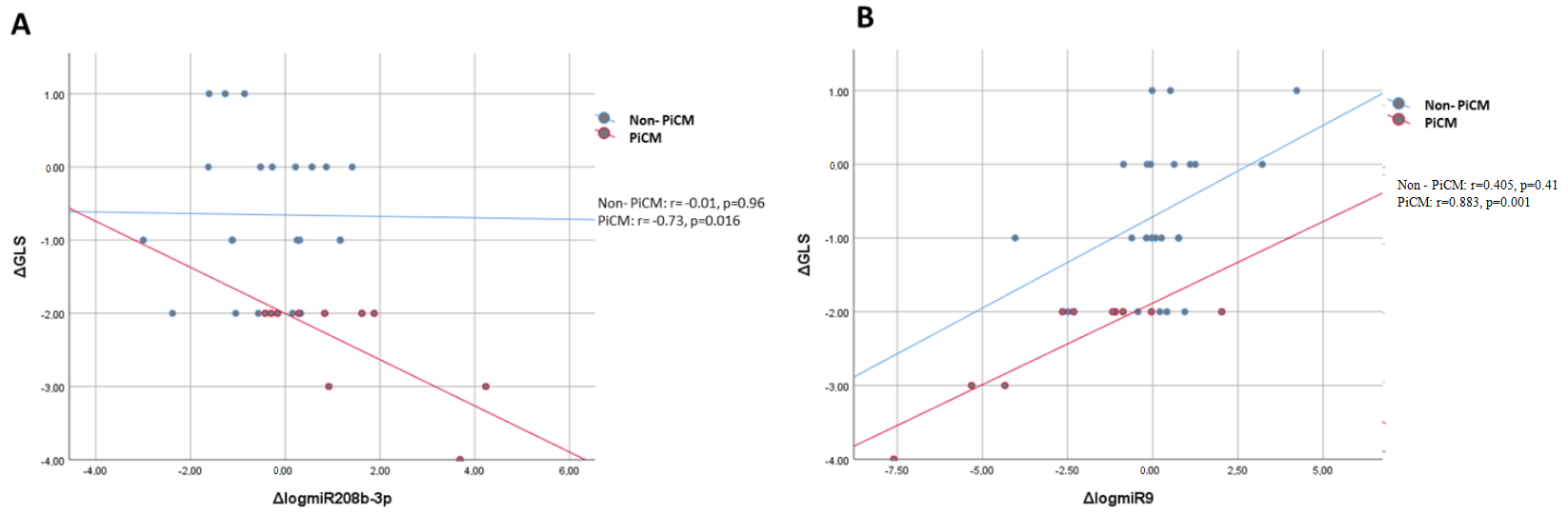
Correlations between Δ3LV-GLS and Δ3log miRs were assessed, as both parameters were significant in multivariate analyses. Among patients who developed PiCM, Δ3log miR-208b-3p correlated strongly and inversely with Δ3LV-GLS (r = −0.73, p = 0.016), indicating that a greater increase in miR-208b-3p expression was associated with more pronounced deterioration in systolic function. Conversely, dynamic changes in miR-9 expression (Δ3miR-9) showed a strong positive correlation with Δ3LV-GLS (r = 0.88, p < 0.001), suggesting that an upregulation of miR-9 over time was linked to better preservation of LV longitudinal function. No significant correlations were observed in non-PiCM patients (r = −0.001, p = 0.96; and r = 0.405, p = 0.41, respectively). These findings are graphically illustrated in Figure 2A,B. No significant correlations were identified between Δ3miR-208b-3p or Δ3miR-9 levels and the Δ3LVEF in either subgroup (all p > 0.26).
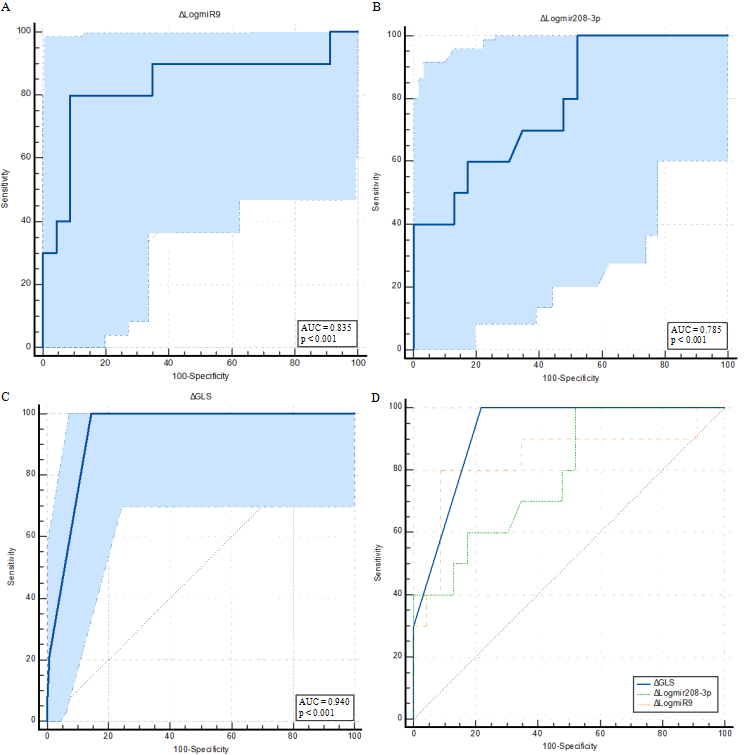
Since both Δ3log miR-208b and Δ3log miR-9 were significantly correlated with Δ3LV-GLS among PiCM patients, ROC curve analyses were subsequently performed to assess their predictive ability for PiCM and to compare them with Δ3LV-GLS as a reference functional marker (Figure 3). The area under the curve (AUC) for Δ3LV-GLS was 0.924 (95% CI 0.776–0.987; p = 0.001). The optimal cut-off value determined by Youden’s J statistic was Δ3LV-GLS = 1.5, yielding a sensitivity of 100% and a specificity of 78.3%. For Δ3log miR-208b-3p, the AUC was 0.783 (95% CI 0.605–0.907; p < 0.001), with an optimal cut-off of 0.698 corresponding to a sensitivity of 60% and specificity of 82.6%. Additionally, the ROC analysis for Δ3log miR-9 demonstrated an AUC of 0.835 (95% CI 0.565–0.970; p = 0.0004), with an optimal cut-off value of −0.88 providing a sensitivity of 80.0% and specificity of 91.3%. Comparative analysis of the ROC curves was performed using DeLong’s test (Figure 3D). In pairwise DeLong comparisons, although Δ3LV-GLS had the higher AUC, none of the pairwise differences were statistically significant (all p > 0.05).

4. Discussion

PiCM represents an increasingly recognized form of acquired cardiomyopathy in patients with chronic RVP, particularly among those who are highly PM-dependent. In clinical practice, early detection of subclinical systolic impairment remains a key challenge, as conventional parameters such as LVEF often decline only after substantial myocardial remodeling has occurred. This study is one of the few to explore the role of miR expression levels in PBMCs as potential predictive biomarkers for the development of PiCM.
Principal findings of our study are: [1] the observed 1-year incidence of PiCM was 11.1% [2]. At 3 months, patients who developed PiCM exhibited a more pronounced decrease in LV-GLS and opposing regulation of miR expression levels—an upregulation of miR-208b-3p and a downregulation of miR-9—compared with non-PiCM patients. In univariate analysis, these factors were found to be associated with the development of PiCM. Multivariable analyses showed that a more negative Δ3GLS (OR = 0.002, p = 0.048), a lower Δ3log miR-9 (OR = 0.410, p = 0.045), and a higher Δ3log miR-208b-3p (OR = 2.321, p = 0.046) were independent predictors of PiCM development [3]. Among PiCM patients, dynamic changes in miR-208b-3p and miR-9 expression correlated inversely and positively, respectively, with changes in LV-GLS, whereas no significant correlations were observed between changes in miR expression and LVEF [4]. In ROC curve analysis, changes in miR expression levels (Δ3logmiR-208b-3p, Δ3logmiR-9) demonstrated predictive performance comparable to Δ3LV-GLS, supporting their role as potential complementary biomarkers for the early identification of PiCM.
The observed finding that early decline in LV-GLS in those who eventually developed PiCM is in line with previous studies [20,21]. Chronic right ventricular apical pacing induces a left bundle branch block (LBBB)-type activation pattern, leading to delayed and asynchronous LV electrical activation and mechanical contraction [22]. This dyssynchrony predominantly affects the subendocardial longitudinal fibers, which are highly dependent on coordinated activation. As a result, a reduction in LV-GLS is observed, reflecting impaired LV systolic performance even before a measurable decline in ejection fraction becomes apparent [23,24]. In addition, both baseline LV-GLS and its subsequent 3-month change were significantly associated with the development of PiCM, with each 1% reduction in baseline LV-GLS corresponding to approximately 36% higher odds of developing PiCM. When Δ3GLS was evaluated in the multivariable models, its association with PiCM remained significant even after adjustment for age, sex, and baseline LVEF. It is noteworthy that a higher baseline LVEF also emerged as an independent predictor. This finding should be interpreted with caution, as all patients entered the study with preserved LVEF by design, resulting in a restricted range and a ceiling effect that may artificially exaggerate the contribution of baseline LVEF. Furthermore, patients with higher baseline LVEF may have had subtle diastolic abnormalities or impaired ventricular compliance that are not captured by LVEF alone and could predispose them to pacing-related functional decline. Nevertheless, despite the inclusion of baseline LVEF, which was expected to compete strongly with Δ3GLS due to its opposite directionality, and the limited number of PiCM events that increases coefficient instability, Δ3GLS remained independently predictive. This supports the interpretation that early impairment in myocardial deformation reflects a genuine susceptibility to pacing-induced dysfunction rather than a secondary artifact of baseline LVEF differences.
To the best of our knowledge, this is the first study to explore the association between dynamic changes in miR-208b-3p and miR-9 expression levels and PiCM in patients with high RVP burden and preserved baseline LVEF. Current literature in molecular cardiology allows us to assert that miRs might represent important regulators of cardiac injury and remodeling, serving as potential early diagnostic or prognostic biomarkers of subclinical myocardial dysfunction [25,26,27]. According to our findings, within three months, patients who subsequently developed PiCM exhibited significant upregulation of miR-208b-3p and downregulation of miR-9 compared to those who did not. After adjusting for age, sex, and RVP burden, greater Δ3logmiR-208b-3p and lower Δ3logmiR-9 remained associated with an increased likelihood of developing PiCM. Although biologically plausible, these findings should be interpreted in light of the small number of events. Among the currently identified miRs, miR-208 is uniquely expressed in myocardial tissue and has been implicated in hypertrophic and fibrotic signaling, as well as conduction remodeling, being elevated in myocardial injury, arrhythmia and HF [28,29,30]. Specifically, miR-208 regulates myosin heavy chain isoform expression—particularly β-MHC—and influences fibrotic signaling cascades such as the TGF-β/Smad pathway [31]. Zhang et al., observed that miR-208b promotes cardiac fibrosis via activation of TGF-β1/Smad3 signaling, highlighting its regulatory role in fibroblast activation and extracellular matrix deposition [32]. Moreover, miR-208 contributes to electrical remodeling by modulating connexins (Cx40/Cx43) and the miR-208/Mef2 axis in hypertrophic myocardium [33]. In experimental models, deletion of miR-208 blunts hypertrophic growth and attenuates fibrosis under pressure overload [34].
Conversely, available data indicate that miR-9 expression is as well altered during cardiac remodeling, reflecting its involvement in distinct pathophysiological mechanisms. One plausible pathophysiological explanation is that MiR-9 exerts anti-fibrotic effects by targeting TGFBR2 and NOX4 and inhibiting fibroblast-to myofibroblast transition [35,36], supporting a protective regulator against pathological cardiac remodeling. According to a study regarding diabetic cardiomyopathy, miR-9 downregulation under hyperglycemia promoted fibroblast activation and collagen accumulation through TGF-β/Smad3 signaling [37]. Experimental overexpression of miR-9 in rat myocardium reduces fibrosis and Smad2/3 phosphorylation [38], while mesenchymal stem cell-derived exosomes enriched in miR-9-5p have been shown to attenuate cardiac fibrosis and improve ventricular performance in injury models [39]. Beyond the heart, miR-9-5p antagonizes TGF-β-driven fibrogenic signaling in pulmonary and hepatic fibroblasts [35]. A second pathophysiological mechanism involves anti-inflammatory actions. MiR-9 suppresses key inflammatory pathways, including NF-κB activation [40,41] and downstream cytokine release (TNF-α, IL-1β, IL-6) [42]. A retrospective cohort study including 41 COVID-19 patients observed that miR-9 levels were higher in individuals with COVID-19, particularly in non-survivors, and were strongly correlated with increased levels of IL-6, IL-1β, and TNF-α [43]. Recently, D’Amato et al., demonstrated that miR-9 also regulates immune signaling by promoting macrophage polarization toward the pro-inflammatory M1 phenotype and modulating local inflammatory pathways—processes that may exacerbate remodeling and progression toward heart failure [44]. Beyond its established anti-inflammatory and anti-fibrotic roles, miR-9 also participates in structural remodeling through a distinct mechanistic axis involving endothelial–fibroblast signaling. In non-diabetic cardiac injury, endothelial and fibroblast miR-9 activity, regulated through interactions with lncRNAs such as ZFAS1, has been linked to extracellular matrix remodeling and fibrotic progression [13]. Another explanation involves its anti-hypertrophic actions, since experimental data demonstrate that it directly suppresses myocardin and NFATc3, two central transcriptional regulators of pathological hypertrophy. Downregulation of miR-9 leads to activation of hypertrophic gene programs (ANP, BNP, β-MHC) and subsequent maladaptive remodeling. In contrast, literature also reports conditions in which miR-9 levels increase in response to cardiac injury. In acute ischemic myocardial infarction models, miR-9-5p is upregulated under hypoxic stress, reduces fibrosis, and limits cardiomyocyte death. This indicates that in the setting of acute ischemia, the miR-9-5p/FSTL1 axis may be maladaptive [45]. However, PiCM arises through a distinct, non-ischemic mechanism driven by chronic pacing-induced dyssynchrony and mechanical overload rather than acute hypoxic injury. Consequently, the decrease in Δ3logmiR-9 observed in our study is more consistent with findings from pressure-overload and other mechanical-stress models, in which miR-9 suppression facilitates hypertrophic, inflammatory, and fibrotic remodeling.
The correlations observed in our study are consistent with the above-mentioned findings and suggest a potential link between molecular and functional remodeling in PiCM. Upregulation of Δ3logmiR-208b-3p expression correlated inversely with the change in Δ3LV-GLS, whereas downregulation of Δ3logmiR-9 showed a positive correlation, indicating that molecular alterations may parallel early deterioration in left ventricular mechanics. It is worth noting that only a few studies, mostly in patients with aortic stenosis or coronary artery disease, have reported associations between LV-GLS and miRs such as miR-21, miR-29, or miR-133, linking them to fibrotic or hypertrophic remodeling processes [46,47,48]. Building upon our observations, ROC curve analysis of the three parameters demonstrated good discriminatory performance, with miR expression levels showing predictive ability comparable to that of ΔLV-GLS. Considering that previous studies have demonstrated early LV-GLS deterioration to be a sensitive marker of subclinical myocardial fibrosis and a reliable predictor of PiCM development [49,50], the comparable predictive ability observed for Δ3logmiR-208b-3p and Δ3logmiR-9 in our study suggests that molecular biomarkers could be used either independently or in conjunction with LV-GLS to enhance early risk stratification. Given this, a combined model incorporating both echocardiographic parameters such as LV-GLS and molecular markers such as miR-208b-3p and miR-9 is conceptually attractive, as these modalities capture complementary aspects of PiCM. However, the present study was not powered to evaluate incremental predictive value, and constructing such a combined model with only 14 PiCM events would yield unstable estimates. Therefore, formal incremental analysis and validation of cutoff values will require larger independent cohorts before clinical implementation is considered.
Mechanistically, pacing-induced dyssynchrony likely initiates cellular stress responses that promote both mechanical strain and biochemical signaling changes in cardiomyocytes and fibroblasts. The selective release of miRs such as miR-208b-3p and miR-9 into circulation may represent a response to mechanical overload or early cellular injury [14,51,52]. Whether these miRs exert paracrine or endocrine effects remains uncertain; however, emerging evidence indicates that miRs expressed within PBMCs can influence cardiac remodeling indirectly through immune-mediated mechanisms [53]. PBMC-derived miRs may modulate cytokine production, inflammatory activation, and fibroblast–immune cell crosstalk, thereby shaping the myocardial microenvironment during early remodeling [54]. Activated PBMCs may also release exosomes and microvesicles enriched with regulatory miRs, which can be taken up by cardiomyocytes, fibroblasts, and endothelial cells [55]. While these intracellular pathways have been described in other cardiovascular contexts, it remains unknown whether the specific miRs identified in our study (miR-208b-3p, miR-9) participate in such signaling in the context of pacing-induced stress or whether their changes primarily reflect PBMC transcriptional responses to early dyssynchrony-related remodeling.
Furthermore, it remains unclear which method is most effective for the reliable detection of cardiac miRs. Measuring miRs in plasma or serum has clear practical advantages for clinical translation, but also greater susceptibility to confounders such as hemolysis, exosome-release variation and dilution from plasma volume changes [56,57]. Even though PBMC isolation is more complex and time-consuming, this method was employed in our study to minimize variability from these sources and to focus on an intracellular compartment likely to reflect mechanistic changes rather than solely circulating signals. According to the existing literature, the choice of biological matrix depends on the underlying pathophysiology. PBMC-derived miRNAs are more commonly used in chronic cardiovascular conditions (CHF, stable CAD, dilated cardiomyopathy) where they appear to reflect sustained inflammatory and fibrotic signaling within immune cells [17,18]. Conversely, circulating miRNAs are typically used in acute myocardial injury (e.g., myocardial infarction, acute myocarditis), where rapid cardiomyocyte release produces strong early plasma signals [12,58,59]. Therefore, although plasma miRNAs are more practical for clinical use, PBMC-derived miRNAs may be better suited for detecting the gradual and subclinical remodeling characteristic of PiCM.
Experimental gain-and loss-of-function models have shown that several cardiac miRs, such as miR-208 and miR-9 can directly participate in hypertrophic, fibrotic and inflammatory signaling pathways, suggesting a potential mechanistic role in adverse remodeling. Nevertheless, human clinical studies have largely positioned circulating and cellular miRs as biomarkers of myocardial stress rather than demonstrated causal mediators [60,61]. Clarifying whether the miRs changes a cause of myocardial remodeling, a consequence of early subclinical dysfunction, or simply biomarkers reflecting parallel processes will require studies with more frequent sampling, mechanistic interventions and integrated omics approaches. In this study, baseline miR levels did not differ between patients who later developed PiCM and those who did not, suggesting that fixed pre-existing molecular predisposition was not detectable. Instead, the dynamic changes may represent an early response to dyssynchrony-related mechanical stress or subclinical myocardial injury, and thus could be effectively utilized as predictive biomarkers.
In our cohort, approximately one in four patients who developed PiCM required hospitalization for HF decompensation within the first year. This is consistent with the observed worsening in functional status, as most affected patients experienced a decline of one NYHA class compared with baseline. The clinical relevance of our findings is supported by prior studies evaluating outcomes in patients who develop PiCM. In a large cohort of 618 patients, those who developed PiCM exhibited a markedly higher rate of adverse events, with an almost threefold increased risk of HF hospitalization compared with individuals without PiCM [62]. Unlike that 5-year follow-up study, which reported an increased risk of all-cause mortality, no deaths occurred during the one-year follow-up in our cohort, an expected difference given the considerable shorter observation period. Similarly, in a study of 170 patients undergoing chronic RVP, a trend toward a higher prevalence of advanced symptoms was observed among individuals who eventually developed PiCM, with NYHA class III–IV occurring more frequently over 12 months [63].
This study has certain limitations. The main limitation is the relatively low number of PiCM events, which restricts statistical power and limits the power of our multivariable analysis. To mitigate the risk of overfitting, adjusted models were restricted to a maximum of three covariates; however, given the event-per-variable ratio, these findings should be interpreted as exploratory. Although Δ3LV-GLS, Δ3log miR-9 and Δ3log miR-208b-3p were associated with PiCM development in adjusted analyses, the limited number of events precludes definitive conclusions regarding their independent predictive value. Another limitation is that we did not obtain plasma samples in parallel and therefore could not directly compare PBMC-derived microRNAs with circulating levels, underscoring the need for future studies to include paired plasma/serum and PBMC sampling to assess concordance and determine which matrix offers the best balance between practicality and biological relevance. In addition, the observational, single-center design may introduce selection bias. The observed incidence reflects our cohort but may not generalize to broader populations. Nevertheless, the University General Hospital of Heraklion serves as a tertiary referral and specialized pacing center, providing care for a large and heterogeneous patient population across Crete and the southern Aegean region. Larger prospective, adequately powered multicenter studies with broader miR profiling and longer follow-up are warranted to validate these findings and further elucidate the diagnostic and prognostic role of miR-208b-3p and miR-9 expression levels in PiCM. Despite these limitations, the study has several strengths. The study population, although modest in size, is representative of the real-world cohort of PM recipients with preserved LVEF, in whom the incidence of PiCM is relatively low. The inclusion of a control group without PiCM enabled direct comparison of molecular and functional parameters, increasing the robustness of the observed associations. Furthermore, the assessment of both echocardiographic and molecular markers at an early time point (3 months and 1 year) provided novel insights into the temporal sequence of PiCM.

5. Conclusions

In conclusion, in our study, patients who ultimately developed PiCM after 1 year of follow-up demonstrated early LV-GLS deterioration, upregulation of miR-208b-3p and downregulation of miR-9 in PBMCs within 3 months post PM-implantation, changes which preceded subsequent reductions in LVEF. In adjusted analyses, Δ3LV-GLS, Δ3logmiR-208b-3p and Δ3logmiR-9 were associated with a higher likelihood of PiCM. However, these results should be interpreted as exploratory given the limited number of PiCM events. Larger prospective, multicenter studies are warranted to confirm whether ΜiRs expression could complement LV-GLS for the timely identification of patients at risk of PiCM and to establish their prognostic utility.

6. Clinical Implications

Several potential implications for clinical practice can be derived from the findings of this study. First, our results show that early dynamic changes in miR-208b-3p and miR-9 expression levels in PBMCs provide predictive information comparable to early deterioration in LV-GLS. This suggests that molecular biomarkers could complement or potentially enhance current echocardiographic surveillance strategies in patients with high RVP. Because conventional parameters such as LVEF typically decline only after extensive myocardial remodeling, the use of miRNAs and LV-GLS may allow clinicians to identify patients at risk of PiCM at an earlier stage, when interventions are more likely to be effective.

7. Future Directions

Further research is needed to validate and extend these observations. First, larger multicenter studies with adequate power are necessary to confirm the predictive performance of miR-208b-3p and miR-9 and to establish optimal cutoff values for clinical use. Second, pairing PBMC-derived miRNA measurements with circulating plasma or serum miRNA levels will help determine which biological matrix offers the best combination of practicality and mechanistic relevance for real-world implementation.
Additionally, expanded molecular profiling—including other fibrosis-, inflammation-, and hypertrophy-related miRNAs—may reveal broader signatures of pacing-induced remodeling. Mechanistic studies are also warranted to clarify whether PBMC-derived miRNAs actively participate in myocardial remodeling through immune–cardiac signaling pathways or simply reflect systemic responses to pacing-induced stress. Finally, longitudinal studies with longer follow-up will be essential to assess whether early biomarker changes translate into meaningful differences in long-term clinical outcomes and whether early intervention strategies based on these markers improve prognosis.

Author Contributions

Conceptualization, O.M. and M.M.; methodology, O.M., M.M. and E.S.; software, resources, O.M., A.P., J.K., A.S., I.K., A.A., G.C., K.F. and E.K.; writing—review and editing, O.M., A.P. and M.M. All authors have read and agreed to the published version of the manuscript.

Funding

This research received no external funding.

Institutional Review Board Statement

The study was conducted in accordance with the Declaration of Helsinki and approved by the Institutional Review Board of the General University Hospital of Heraklion (protocol code: 41656, approval number 339, date of approval: 5 February 2024). Written informed consent was obtained from all subjects involved in the study.

Informed Consent Statement

Informed consent was obtained from all subjects involved in the study.

Data Availability Statement

The data that support the findings of this study are openly available.

Conflicts of Interest

The authors declare no conflicts of interest.

Abbreviations

The following abbreviations are used in this manuscript:
AFAtrial fibrillation
AHArterial hypertension
AUCArea under the curve
AVAtrioventricular
BNPBeta-type natriuretic peptide
CADCoronary artery disease
CHDCongenital heart disease
CRPC-reactive protein
Cx40/Cx43Connexin 40/Connexin 43
HFHeart failure
LBBBLeft bundle branch block
lncRNALong non-coding RNA
LVLeft ventricle / Left ventricular
LVEDDLeft ventricular end-diastolic diameter
LVEFLeft ventricular ejection fraction
LVESDLeft ventricular end-systolic diameter
LV-GLSLeft ventricular global longitudinal strain
M1Macrophage type 1 (pro-inflammatory phenotype)
Mef2Myocyte enhancer factor 2
miR MicroRNA
MIMyocardial infarction
MYH7β-myosin heavy chain gene
NYHANew York Heart Association Functional Classification
PBMCsPeripheral blood mononuclear cells
PiCMPacing-induced cardiomyopathy
PMPacemaker
PPIsProton pump inhibitors
qPCRQuantitative polymerase chain reaction
RNARibonucleic acid
ROCReceiver operating characteristic
RVPRight ventricular pacing
T2DType 2 diabetes
TGF-βTransforming growth factor beta
TGFβRIITransforming growth factor beta receptor II
VHDValvular heart disease

References

  1. Yu, C.; Fang, F.; Luo, X.; Zhang, Q.; Azlan, H.; Razali, O. Long-term Follow-up Results of the Pacing to Avoid Cardiac Enlargement ( PACE ) Trial. Eur. J. Heart Fail. 2014, 16, 1016–1025. [Google Scholar] [CrossRef]
  2. Merchant, F.M. Pacing-Induced Cardiomyopathy: Just the Tip of the Iceberg? Eur. Heart J. 2019, 40, 3649–3650. [Google Scholar] [CrossRef] [PubMed]
  3. Somma, V.; Ha, F.J.; Palmer, S.; Mohamed, U.; Agarwal, S. Pacing-Induced Cardiomyopathy: A Systematic Review and Meta-Analysis of Definition, Prevalence, Risk Factors, and Management. Heart Rhythm. 2023, 20, 282–290. [Google Scholar] [CrossRef] [PubMed]
  4. Malikides, O.; Simantirakis, E.; Zacharis, E.; Fragkiadakis, K.; Kochiadakis, G.; Marketou, M. Cardiac Remodeling and Ventricular Pacing: From Genes to Mechanics. Genes 2024, 15, 671. [Google Scholar] [CrossRef]
  5. Malikides, O.; Marketou, M.; Papazachariou, A.; Kallergis, E.; Chlouverakis, G.; Kontaraki, J.; Simantirakis, E. A Perspective on the Emerging Preventive and Therapeutic Strategies in Pacemaker-Induced Cardiomyopathy: A Systematic Review of the Literature. Hell. J. Cardiol. 2025, S1109966625002313. [Google Scholar] [CrossRef]
  6. Smiseth, O.A.; Rider, O.; Cvijic, M.; Valkovič, L.; Remme, E.W.; Voigt, J.-U. Myocardial Strain Imaging. JACC Cardiovasc. Imaging 2025, 18, 340–381. [Google Scholar] [CrossRef]
  7. Biering-Sørensen, T.; Biering-Sørensen, S.R.; Olsen, F.J.; Sengeløv, M.; Jørgensen, P.G.; Mogelvang, R.; Shah, A.M.; Jensen, J.S. Global Longitudinal Strain by Echocardiography Predicts Long-Term Risk of Cardiovascular Morbidity and Mortality in a Low-Risk General Population: The Copenhagen City Heart Study. Circ. Cardiovasc. Imaging 2017, 10, e005521. [Google Scholar] [CrossRef] [PubMed]
  8. Smiseth, O.A.; Torp, H.; Opdahl, A.; Haugaa, K.H.; Urheim, S. Myocardial Strain Imaging: How Useful Is It in Clinical Decision Making? Eur. Heart J. 2016, 37, 1196–1207. [Google Scholar] [CrossRef]
  9. Eaves, S.; Lipton, J.A. Global Longitudinal Strain as a Risk Factor for Pacing-Induced Cardiomyopathy: Another Step toward Mechanistic Insight and Prevention Strategies. J. Interv. Card. Electrophysiol. 2023, 67, 241–242. [Google Scholar] [CrossRef]
  10. King, A.; Thambyrajah, J.; Leng, E.; Stewart, M.J. Global Longitudinal Strain: A Useful Everyday Measurement? Echo Res. Pract. 2016, 3, 85–93. [Google Scholar] [CrossRef]
  11. Kaneto, C.M.; Nascimento, J.S.; Prado, M.S.J.G.; Mendonça, L.S.O. Circulating miRNAs as Biomarkers in Cardiovascular Diseases. Eur. Rev. Med. Pharmacol. Sci. 2019, 23, 2234–2243. [Google Scholar] [CrossRef]
  12. Corsten, M.F.; Dennert, R.; Jochems, S.; Kuznetsova, T.; Devaux, Y.; Hofstra, L.; Wagner, D.R.; Staessen, J.A.; Heymans, S.; Schroen, B. Circulating MicroRNA-208b and MicroRNA-499 Reflect Myocardial Damage in Cardiovascular Disease. Circ. Cardiovasc. Genet. 2010, 3, 499–506. [Google Scholar] [CrossRef]
  13. Feng, B.; Liu, J.; Wang, E.; Su, Z.; Chakrabarti, S. Endothelial Derived miRNA-9 Mediated Cardiac Fibrosis in Diabetes and Its Regulation by ZFAS1. PLoS ONE 2022, 17, e0276076. [Google Scholar] [CrossRef]
  14. Navarre, B.M.; Clouthier, K.L.; Ji, X.; Taylor, A.; Weldy, C.S.; Dubin, A.M.; Reddy, S. miR Profile of Chronic Right Ventricular Pacing: A Pilot Study in Children with Congenital Complete Atrioventricular Block. J. Cardiovasc. Trans. Res. 2023, 16, 287–299. [Google Scholar] [CrossRef] [PubMed]
  15. Kumar Maji, R.; Fischer, A.; Rogg, E.-M.; Möller, M.; Gasparoni, G.; Simon, M.; Dimmeler, S.; Schulz, M.H. A Cell Type-Specific Expression Atlas of Small and Total RNA in the Heart after Myocardial Infarction. Sci. Data 2025, 12, 816. [Google Scholar] [CrossRef]
  16. Popat, A.; Jnaneswaran, G.; Yerukala Sathipati, S.; Sharma, P.P. MicroRNAs in Cardiac Arrhythmias: Mechanisms, Biomarkers, and Therapeutic Frontiers. Heart Rhythm. 2025, 22, 2971–2982. [Google Scholar] [CrossRef] [PubMed]
  17. Voellenkle, C.; Van Rooij, J.; Cappuzzello, C.; Greco, S.; Arcelli, D.; Di Vito, L.; Melillo, G.; Rigolini, R.; Costa, E.; Crea, F.; et al. MicroRNA Signatures in Peripheral Blood Mononuclear Cells of Chronic Heart Failure Patients. Physiol. Genom. 2010, 42, 420–426. [Google Scholar] [CrossRef] [PubMed]
  18. Gupta, M.K.; Halley, C.; Duan, Z.-H.; Lappe, J.; Viterna, J.; Jana, S.; Augoff, K.; Mohan, M.L.; Vasudevan, N.T.; Na, J.; et al. miRNA-548c: A Specific Signature in Circulating PBMCs from Dilated Cardiomyopathy Patients. J. Mol. Cell. Cardiol. 2013, 62, 131–141. [Google Scholar] [CrossRef]
  19. Chung, M.K.; Patton, K.K.; Lau, C.-P.; Dal Forno, A.R.J.; Al-Khatib, S.M.; Arora, V.; Birgersdotter-Green, U.M.; Cha, Y.-M.; Chung, E.H.; Cronin, E.M.; et al. 2023 HRS/APHRS/LAHRS Guideline on Cardiac Physiologic Pacing for the Avoidance and Mitigation of Heart Failure. Heart Rhythm. 2023, 20, e17–e91. [Google Scholar] [CrossRef]
  20. Kim, S.S.; Park, H.W.; Jeong, H.K. Post-Implant Global Longitudinal Strain as a Predictor of Pacing-Induced Cardiomyopathy in Patients with Preserved Ejection Fraction Undergoing Pacemaker Placement. Rev. Cardiovasc. Med. 2025, 26, 26173. [Google Scholar] [CrossRef]
  21. Ahmed, F.Z.; Motwani, M.; Cunnington, C.; Kwok, C.S.; Fullwood, C.; Oceandy, D.; Fitchet, A.; Goode, G.K.; Luckie, M.; Zaidi, A.M.; et al. One-Month Global Longitudinal Strain Identifies Patients Who Will Develop Pacing-Induced Left Ventricular Dysfunction over Time: The Pacing and Ventricular Dysfunction (PAVD) Study. PLoS ONE 2017, 12, e0162072. [Google Scholar] [CrossRef]
  22. Ghani, A.; Delnoy, P.P.H.M.; Ottervanger, J.P.; Ramdat Misier, A.R.; Smit, J.J.J.; Elvan, A. Assessment of Left Ventricular Dyssynchrony in Pacing-Induced Left Bundle Branch Block Compared with Intrinsic Left Bundle Branch Block. Europace 2011, 13, 1504–1507. [Google Scholar] [CrossRef]
  23. Dawood, M.; Elsharkawy, E.; Abdel-Hay, M.A.; Nawar, M. Effects of Cardiac Pacemakers on Left Ventricular Volumes and Function Assessed by 3D Echocardiography, Doppler Method, and Global Longitudinal Strain. Egypt. Heart J. 2021, 73, 16. [Google Scholar] [CrossRef] [PubMed]
  24. Kim, D.-Y.; Lkhagvasuren, P.; Seo, J.; Cho, I.; Hong, G.-R.; Ha, J.-W.; Shim, C.Y. Left Ventricular Global Longitudinal Strain Is Associated With Cardiovascular Outcomes in Patients Who Underwent Permanent Pacemaker Implantation. Front. Cardiovasc. Med. 2021, 8, 705778. [Google Scholar] [CrossRef]
  25. Vavassori, C.; Cipriani, E.; Colombo, G.I. Circulating MicroRNAs as Novel Biomarkers in Risk Assessment and Prognosis of Coronary Artery Disease. Eur. Cardiol. 2022, 17, e06. [Google Scholar] [CrossRef]
  26. Mir, R.; Elfaki, I.; Khullar, N.; Waza, A.A.; Jha, C.; Mir, M.M.; Nisa, S.; Mohammad, B.; Mir, T.A.; Maqbool, M.; et al. Role of Selected miRNAs as Diagnostic and Prognostic Biomarkers in Cardiovascular Diseases, Including Coronary Artery Disease, Myocardial Infarction and Atherosclerosis. J. Cardiovasc. Dev. Dis. 2021, 8, 22. [Google Scholar] [CrossRef]
  27. Asjad, E.; Dobrzynski, H. MicroRNAs: Midfielders of Cardiac Health, Disease and Treatment. Int. J. Mol. Sci. 2023, 24, 16207. [Google Scholar] [CrossRef]
  28. Zhao, X.; Wang, Y.; Sun, X. The Functions of microRNA-208 in the Heart. Diabetes Res. Clin. Pract. 2020, 160, 108004. [Google Scholar] [CrossRef] [PubMed]
  29. Alavi-Moghaddam, M.; Chehrazi, M.; Alipoor, S.D.; Mohammadi, M.; Baratloo, A.; Mahjoub, M.P.; Movasaghi, M.; Garssen, J.; Adcock, I.M.; Mortaz, E. A Preliminary Study of microRNA-208b after Acute Myocardial Infarction: Impact on 6-Month Survival. Dis. Markers 2018, 2018, 2410451. [Google Scholar] [CrossRef] [PubMed]
  30. Parikh, M.; Pierce, G.N. A Brief Review on the Biology and Effects of Cellular and Circulating microRNAs on Cardiac Remodeling after Infarction. Int. J. Mol. Sci. 2021, 22, 4995. [Google Scholar] [CrossRef]
  31. Fatehi Hassanabad, A.; Zarzycki, A.N.; Patel, V.B.; Fedak, P.W.M. Current Concepts in the Epigenetic Regulation of Cardiac Fibrosis. Cardiovasc. Pathol. 2024, 73, 107673. [Google Scholar] [CrossRef] [PubMed]
  32. Zhang, Y.; Yuan, B.; Xu, Y.; Zhou, N.; Zhang, R.; Lu, L.; Feng, Z. MiR-208b/miR-21 Promotes the Progression of Cardiac Fibrosis Through the Activation of the TGF-Β1/Smad-3 Signaling Pathway: An in Vitro and in Vivo Study. Front. Cardiovasc. Med. 2022, 9, 924629. [Google Scholar] [CrossRef] [PubMed]
  33. Anker, S.D.; Butler, J.; Filippatos, G.; Ferreira, J.P.; Bocchi, E.; Böhm, M.; Brunner–La Rocca, H.-P.; Choi, D.-J.; Chopra, V.; Chuquiure-Valenzuela, E.; et al. Empagliflozin in Heart Failure with a Preserved Ejection Fraction. N. Engl. J. Med. 2021, 385, 1451–1461. [Google Scholar] [CrossRef]
  34. Callis, T.E.; Pandya, K.; Seok, H.Y.; Tang, R.-H.; Tatsuguchi, M.; Huang, Z.-P.; Chen, J.-F.; Deng, Z.; Gunn, B.; Shumate, J.; et al. MicroRNA-208a Is a Regulator of Cardiac Hypertrophy and Conduction in Mice. J. Clin. Investig. 2009, 119, 2772–2786. [Google Scholar] [CrossRef] [PubMed]
  35. Fierro-Fernández, M.; Busnadiego, Ó.; Sandoval, P.; Espinosa-Díez, C.; Blanco-Ruiz, E.; Rodríguez, M.; Pian, H.; Ramos, R.; López-Cabrera, M.; García-Bermejo, M.L.; et al. miR-9-5p Suppresses Pro-fibrogenic Transformation of Fibroblasts and Prevents Organ Fibrosis by Targeting NOX 4 and TGFBR 2. EMBO Rep. 2015, 16, 1358–1377. [Google Scholar] [CrossRef]
  36. Zhao, Y.; Du, D.; Chen, S.; Chen, Z.; Zhao, J. New Insights into the Functions of MicroRNAs in Cardiac Fibrosis: From Mechanisms to Therapeutic Strategies. Genes 2022, 13, 1390. [Google Scholar] [CrossRef]
  37. Wang, H.; Wang, E.Z.R.; Feng, B.; Chakrabarti, S. CircRNA_012164/MicroRNA-9-5p Axis Mediates Cardiac Fibrosis in Diabetic Cardiomyopathy. PLoS ONE 2024, 19, e0302772. [Google Scholar] [CrossRef]
  38. Jin, X.; Yu, L.-L.; Yu, C.-X. Effect of miR-9 on Myocardial Fibrosis in Rats via TGF-Β1/Smads Signaling Pathway. Eur. Rev. Med. Pharmacol. Sci. 2019, 23, 7083–7088. [Google Scholar] [CrossRef]
  39. Zheng, H.; Liang, X.; Liu, B.; Huang, X.; Shen, Y.; Lin, F.; Chen, J.; Gao, X.; He, H.; Li, W.; et al. Exosomal miR-9-5p Derived from iPSC-MSCs Ameliorates Doxorubicin-Induced Cardiomyopathy by Inhibiting Cardiomyocyte Senescence. J. Nanobiotechnol. 2024, 22, 195. [Google Scholar] [CrossRef]
  40. Bazzoni, F.; Rossato, M.; Fabbri, M.; Gaudiosi, D.; Mirolo, M.; Mori, L.; Tamassia, N.; Mantovani, A.; Cassatella, M.A.; Locati, M. Induction and Regulatory Function of miR-9 in Human Monocytes and Neutrophils Exposed to Proinflammatory Signals. Proc. Natl. Acad. Sci. USA 2009, 106, 5282–5287. [Google Scholar] [CrossRef]
  41. Guo, L.; Pu, Y.; Han, Z.; Liu, T.; Li, Y.; Liu, M.; Li, X.; Tang, H. MicroRNA-9 Inhibits Ovarian Cancer Cell Growth through Regulation of NF-κB1. FEBS J. 2009, 276, 5537–5546. [Google Scholar] [CrossRef]
  42. Markopoulos, G.; Roupakia, E.; Tokamani, M.; Alabasi, G.; Sandaltzopoulos, R.; Marcu, K.; Kolettas, E. Roles of NF-κB Signaling in the Regulation of miRNAs Impacting on Inflammation in Cancer. Biomedicines 2018, 6, 40. [Google Scholar] [CrossRef] [PubMed]
  43. Prezioso, C.; Limongi, D.; Checconi, P.; Ciotti, M.; Legramante, J.M.; Petrangeli, C.M.; Leonardis, F.; Giovannelli, A.; Terrinoni, A.; Bernardini, S.; et al. Role of miR-9 in Modulating NF-κB Signaling and Cytokine Expression in COVID-19 Patients. Int. J. Mol. Sci. 2024, 25, 8930. [Google Scholar] [CrossRef]
  44. D’Amato, A.; Prosperi, S.; Severino, P.; Myftari, V.; Correale, M.; Perrone Filardi, P.; Badagliacca, R.; Fedele, F.; Vizza, C.D.; Palazzuoli, A. MicroRNA and Heart Failure: A Novel Promising Diagnostic and Therapeutic Tool. J. Clin. Med. 2024, 13, 7560. [Google Scholar] [CrossRef] [PubMed]
  45. Xiao, Y.; Zhang, Y.; Chen, Y.; Li, J.; Zhang, Z.; Sun, Y.; Shen, H.; Zhao, Z.; Huang, Z.; Zhang, W.; et al. Inhibition of MicroRNA-9-5p Protects Against Cardiac Remodeling Following Myocardial Infarction in Mice. Hum. Gene Ther. 2019, 30, 286–301. [Google Scholar] [CrossRef] [PubMed]
  46. Iacobescu, L.; Ciobanu, A.O.; Macarie, R.; Vadana, M.; Ciortan, L.; Tucureanu, M.M.; Butoi, E.; Simionescu, M.; Vinereanu, D. Diagnostic and Prognostic Role of Circulating microRNAs in Patients with Coronary Artery Disease—Impact on Left Ventricle and Arterial Function. Curr. Issues Mol. Biol. 2024, 46, 8499–8511. [Google Scholar] [CrossRef]
  47. Fabiani, I.; Pugliese, N.R.; Calogero, E.; Conte, L.; Mazzanti, M.C.; Scatena, C.; Scopelliti, C.; Tantillo, E.; Passiatore, M.; Angelillis, M.; et al. MicroRNAs Distribution in Different Phenotypes of Aortic Stenosis. Sci. Rep. 2018, 8, 9953. [Google Scholar] [CrossRef]
  48. Fabiani, I.; Scatena, C.; Mazzanti, C.M.; Conte, L.; Pugliese, N.R.; Franceschi, S.; Lessi, F.; Menicagli, M.; De Martino, A.; Pratali, S.; et al. Micro-RNA-21 (Biomarker) and Global Longitudinal Strain (Functional Marker) in Detection of Myocardial Fibrotic Burden in Severe Aortic Valve Stenosis: A Pilot Study. J. Transl. Med. 2016, 14, 248. [Google Scholar] [CrossRef]
  49. Xu, H.; Li, J.; Bao, Z.; Xu, C.; Zhang, Y.; Liu, H.; Yang, J. Early Change in Global Longitudinal Strain Is an Independent Predictor of Left Ventricular Adverse Remodelling in Patients With Right Ventricular Apical Pacing. Heart Lung Circ. 2019, 28, 1780–1787. [Google Scholar] [CrossRef]
  50. Khurshid, S.; Frankel, D.S. Pacing-Induced Cardiomyopathy. Card. Electrophysiol. Clin. 2021, 13, 741–753. [Google Scholar] [CrossRef]
  51. Marfella, R.; Di Filippo, C.; Potenza, N.; Sardu, C.; Rizzo, M.R.; Siniscalchi, M.; Musacchio, E.; Barbieri, M.; Mauro, C.; Mosca, N.; et al. Circulating microRNA Changes in Heart Failure Patients Treated with Cardiac Resynchronization Therapy: Responders vs. Non-responders. Eur. J. Heart Fail. 2013, 15, 1277–1288. [Google Scholar] [CrossRef]
  52. Small, E.M.; Olson, E.N. Pervasive Roles of microRNAs in Cardiovascular Biology. Nature 2011, 469, 336–342. [Google Scholar] [CrossRef]
  53. Condorelli, G.; Latronico, M.V.G.; Cavarretta, E. microRNAs in Cardiovascular Diseases. J. Am. Coll. Cardiol. 2014, 63, 2177–2187. [Google Scholar] [CrossRef]
  54. Saadatian, Z.; Mansoori, Y.; Nariman-Saleh-Fam, L.; Daraei, A.; Vahed, S.Z.; Navid, S.; Nariman-Saleh-Fam, Z. Peripheral Blood Mononuclear Cells Expression of miR-200c, miR-125b, miR-27b, miR-203, and miR-155 in Patients with Significant or Insignificant Coronary Artery Stenosis. Sci. Rep. 2023, 13, 18438. [Google Scholar] [CrossRef]
  55. Kumar, M.A.; Baba, S.K.; Sadida, H.Q.; Marzooqi, S.A.; Jerobin, J.; Altemani, F.H.; Algehainy, N.; Alanazi, M.A.; Abou-Samra, A.-B.; Kumar, R.; et al. Extracellular Vesicles as Tools and Targets in Therapy for Diseases. Signal Transduct. Target. Ther. 2024, 9, 27. [Google Scholar] [CrossRef] [PubMed]
  56. Siasos, G.; Bletsa, E.; Stampouloglou, P.K.; Oikonomou, E.; Tsigkou, V.; Paschou, S.A.; Vlasis, K.; Marinos, G.; Vavuranakis, M.; Stefanadis, C.; et al. MicroRNAs in Cardiovascular Disease. Hell. J. Cardiol. 2020, 61, 165–173. [Google Scholar] [CrossRef] [PubMed]
  57. Searles, C.D. MicroRNAs and Cardiovascular Disease Risk. Curr. Cardiol. Rep. 2024, 26, 51–60. [Google Scholar] [CrossRef]
  58. Xiao, J.; Shen, B.; Li, J.; Lv, D.; Zhao, Y.; Wang, F.; Xu, J. Serum microRNA-499 and microRNA-208a as Biomarkers of Acute Myocardial Infarction. Int. J. Clin. Exp. Med. 2014, 7, 136–141. [Google Scholar]
  59. Han, Z.; Zhang, L.; Yuan, L.; Liu, X.; Chen, X.; Ye, X.; Yang, C.; Yan, Z. Change of Plasma microRNA-208 Level in Acute Myocardial Infarction Patients and Its Clinical Significance. Ann. Transl. Med. 2015, 3, 307. [Google Scholar] [CrossRef] [PubMed]
  60. Felekkis, K.; Papaneophytou, C. Challenges in Using Circulating Micro-RNAs as Biomarkers for Cardiovascular Diseases. Int. J. Mol. Sci. 2020, 21, 561. [Google Scholar] [CrossRef]
  61. Creemers, E.E.; Tijsen, A.J.; Pinto, Y.M. Circulating MicroRNAs: Novel Biomarkers and Extracellular Communicators in Cardiovascular Disease? Circ. Res. 2012, 110, 483–495. [Google Scholar] [CrossRef] [PubMed]
  62. Cho, S.W.; Gwag, H.B.; Hwang, J.K.; Chun, K.J.; Park, K.; On, Y.K.; Kim, J.S.; Park, S. Clinical Features, Predictors, and Long-term Prognosis of Pacing-induced Cardiomyopathy. Eur. J. Heart Fail. 2019, 21, 643–651. [Google Scholar] [CrossRef] [PubMed]
  63. Safak, E.; Ince, H.; Gkouvatsou, L.; Schultheiss, H.-P.; Ortak, J.; Caglayan, E.; Oener, A.; D’Ancona, G. Pacing-Induced Cardiomyopathy in Chronic Right Ventricular Apical Pacing: A Midterm Follow-up Study. Eur. J. Med. Res. 2019, 24, 23. [Google Scholar] [CrossRef] [PubMed]
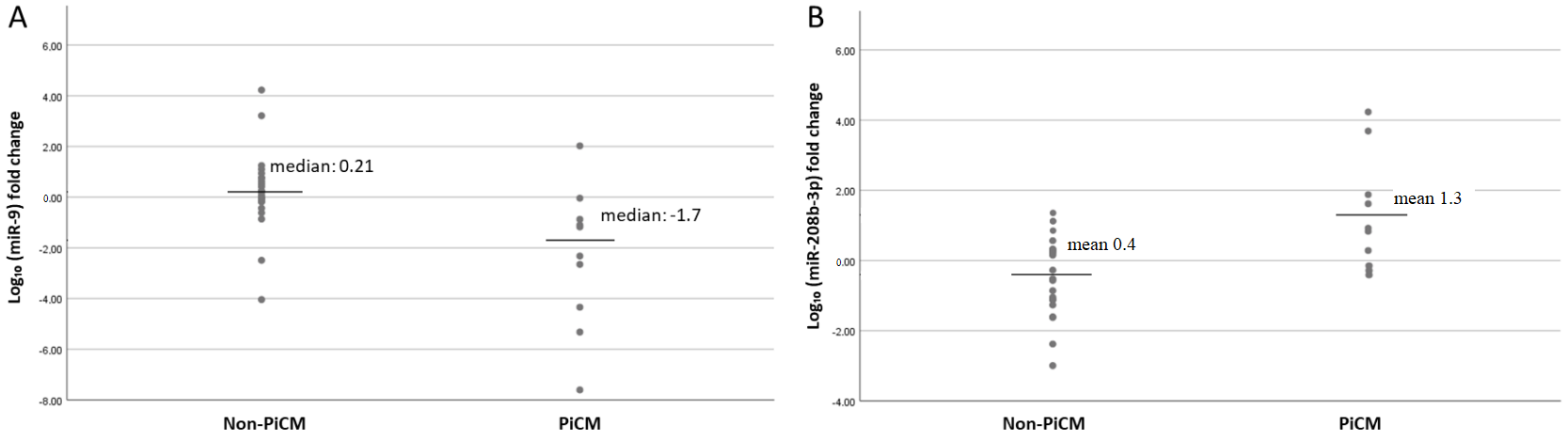
Figure 1. Log10 fold change in miRs expression of (A) miR-9 and (B) miR208b-3p, stratified by PiCM.
Genes 17 00103 g001
Figure 2. Correlation between Δ3LV-GLS and Δ3logmiR expression for (A) Δ3logmiR-208b-3p and (B) Δ3logmiR-9, stratified by PICM.
Genes 17 00103 g002
Figure 3. ROC curves of Δ3log10-miR expression changes and Δ3LV-GLS for predicting PiCM development: (A) Δ3log10(miR-9), (B) Δ3log10(miR-208b-3p), and (C) Δ3LV-GLS. (D) Comparison of ROC curves for Δ3log10(miR-208b-3p), Δ3log10(miR-9), and Δ3LV-GLS in predicting PiCM development.
Genes 17 00103 g003
Table 1. Baseline and follow-up characteristics stratified by PiCM development.
Variables Total Population (n = 126)PiCM (n = 14)Non PiCM (n = 112) p-Value
Age, median (IQR) 79.0 (73.0, 86.0)80.5 (76.8, 82.5)79.0 (72.0, 86.8) 0.849
Males, n (%)78 (61.9)7 (9.0)71 (91.0)0.390
Smoking, n (%)18 (14.3)1 (5.6)17 (94.4)0.690
AH, n (%)84 (66.7)11 (13.1)73 (86.9)0.383
T2D, n (%)61 (48.4)4 (6.6)57 (93.4)0.158
Hyperlipidemia, n (%)70 (55.6)9 (12.9)61 (87.1)0.576
CKD, n (%)61 (48.8)5 (8.2)56 (91.8)0.398
History of HF, n (%)32 (25.4)2 (6.3)30 (93.8)0.516
History of AF, n (%)27 (21.4)6 (22.2)21 (77.8)0.076
History of CAD, n (%)17 (13.5)1 (5.9)16 (94.1)0.691
RVP%, median (IQR)90.0 (85.0, 95.0)97.0 (89.5, 99.0)90.0 (85.0, 95.0)0.006
Baseline BNP, median (IQR)149.0 (66.0, 430.0)131.5 (60.8, 360.0)149.0 (66.0, 436.0) 0.521
Baseline LVESD, mean (SD)35.0 (±3.8)35.1 (±4.5)36.1 (±3.8)0.455
Baseline LVEDD, median (IQR)48.0 (46.0, 50.0)48.5 (46.3, 53.5)48.0 (46.0, 49.8)0.297
Baseline LVEF, mean (SD)60.0 (±4.7)63.4 (±2.4)58.0 (±4.6)<0.001
Δ3LVEF, median (IQR)1.0 (−2.0, 2.5)2.0 (1.0, 3.0)1.0 (−2.0, 2.0)0.065
Δ 1-year LVEF, median (IQR)3.0 (0.5, 5.3)10.0 (10.0, 11.0) 2.0 (−1.0, 5.0)<0.001
1-year LVEF, mean (SD)55.4 (±4.5)52.3 (±2.8)55.8 (±4.5)0.001
Baseline LV-GLS, median (IQR)−16.0 (−17.0, −16.0)−17.0 (−19.0, −16.0)−16.0 (−17.0, −16.0)0.136
Δ3LV-GLS, median (IQR)0.0 (−1.0, 0)−2.0 (−2.25, −2.0)0.0 (−1.0, 0)<0.001
Δ 1-year LV-GLS, median (IQR)0.0 (−1.3, 0)−3.0 (−4.0, −2.0)0.0 (−1.0, 0)<0.001
Δ3log(miR-9), median (IQR)−0.04 (−1.1, 0.7)−1.7 (−4.6, −0.6)0.21 (−0.2, 0.76)0.011
Δ3log(miR-280b-3p), mean (SD)0.22 (±1.5)1.3 (±1.6)−0.4 (±1.2)0.013
Baseline NYHA score, median (IQR)1.0 (1.0, 2.0)1.0 (1.0, 1.0)1.0 (1.0, 2.0)0.290
1-year NYHA score, median (IQR)1.0 (1.0, 2.0)2.0 (1.0, 2.0)1.0 (1.0, 2.0)0.030
1-year Hospitalization, n (%)14 (8.7)4 (28.6)7 (6.3)0.020
AF, atrial fibrillation; AH, hypertension; BNP, B-type natriuretic peptide; CAD, coronary artery disease; CKD, chronic kidney disease; ECG, electrocardiogram; HF, heart failure; LV-GLS, left ventricular global longitudinal strain; LVEF, left ventricular ejection fraction; LVEDD, left ventricular end-diastolic diameter; LVESD, left ventricular end-systolic dimension; NYHA, New York Heart Association Functional Classification; PiCM, pacing-induced cardiomyopathy; RVP, right ventricular pacing; T2D, type 2 diabetes.
Table 2. Univariate analysis of prognostic factors for PiCM development.
Univariate AnalysisExp(B)95% CIp-Value
age 1.0080.951, 1.0680.790
Male sex0.5770.189, 1.7630.340
RVP1.0180.938, 1.1050.663
Baseline LVEF1.5581.215,1.999<0.001
Baseline LV-GLS0.6420.438, 0.9400.023
Δ3LVEF1.4431.095,1.9030.009
Δ3LV-GLS0.0410.006, 0.2810.001
Δ3logmiR-280b-3p2.8821.177, 7.0570.021
Δ3logmiR-90.5270.313, 0.8890.016
LV-GLS, left ventricular global longitudinal strain; LVEF, left ventricular ejection fraction; PiCM, pacing-induced cardiomyopathy; RVP, right ventricular pacing.
Table 3. Multivariate analysis of prognostic factors for PiCM development.
ModelPredictorOR (95% CI)p-Value
Model 1 A
        Β
        C
Δ3LV-GLS0.041 (0.006–0.282)<0.001
Δ3LV-GLS0.040 (0.006–0.274)0.001
Δ3LV-GLS0.002 (0.000–1.468)0.048
Model 2 A
        Β
        C
Δ3log miR-90.605 (0.396–0.924)0.020
Δ3log miR-90.585 (0.356–0.963)0.035
Δ3log miR-90.410 (0.160–1.049)0.045
Model 3 A
        Β
        C
Δ3log miR-208b2.664 (1.125–6.312)0.026
Δ3log miR-208b2.426 (1.020–5.770)0.045
Δ3log miR-208b2.321 (1.016–5.305)0.047
Values are given as odds ratio (OR) and 95% confidence interval. Model 1 [1A: adjusted for age. 1B: adjusted for age and sex. 1C: adjusted for age, sex and baseline LVEF]. Model 2 [2A: adjusted for age. 2B: adjusted for age and sex. 2C: adjusted for age, sex and RVP]. Model 3 [3A: adjusted for age. 3B: adjusted for age and sex. 3C: adjusted for age, sex and RVP].
Disclaimer/Publisher’s Note: The statements, opinions and data contained in all publications are solely those of the individual author(s) and contributor(s) and not of MDPI and/or the editor(s). MDPI and/or the editor(s) disclaim responsibility for any injury to people or property resulting from any ideas, methods, instructions or products referred to in the content.