1. Introduction
Portugal is a country on the Iberian Peninsula that borders Spain in Europe’s Southernmost part. It is known for once having a global empire, built from the power gained from the Maritime Discoveries. Numerous civilisations, including Celts, Moors, Visigoths, and Romans, have occupied Portugal, and the region has a history of repeated invasions that have moulded the current population [
1,
2]. During the Roman invasion of Portugal, extensive mineral exploitation and Mediterranean trade drove economic growth, the construction of infrastructure, and urbanisation. Roman culture, law, and the Latin language spread throughout Western Iberia, gradually assimilating native populations as individuals from other regions of the Empire, including Europe, North Africa, and the Eastern Mediterranean, came [
3]. After the Algarve was conquered by 1249, the Kingdom of Portugal expanded and solidified its borders in the late Middle Ages [
4].
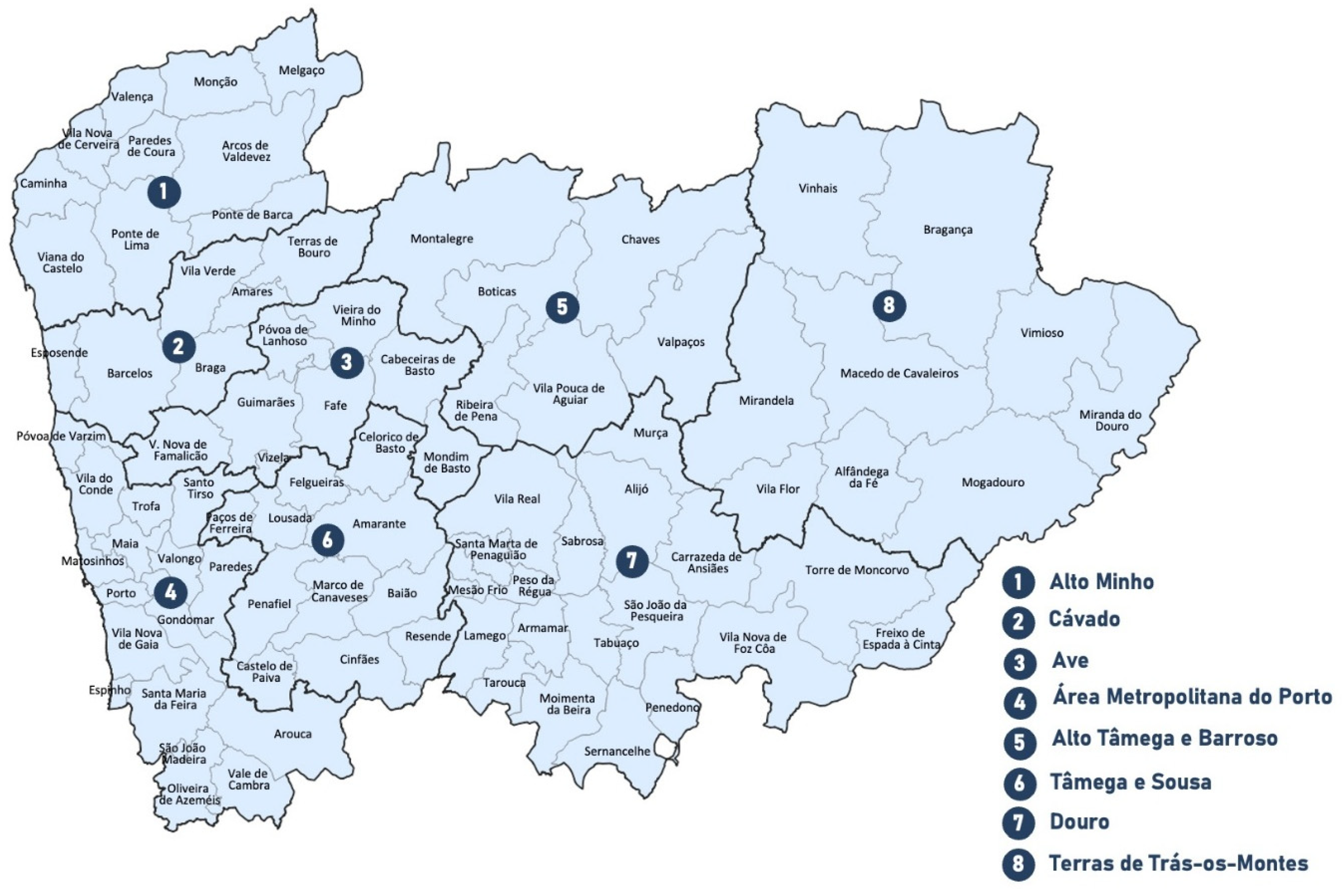
The Northern region of Portugal consists of a total of 86 municipalities, and the population as we know it today was shaped by several successive aforementioned invasions [
1]. The Northern region and it’s municipalities are represented in
Figure 1.
Previous Y-STR studies of Portuguese populations were conducted with early-generation 9- to 17-locus panels and did not include RM-STRs [
5,
6,
7]. No high-resolution 26-STR dataset representing Northern Portugal is currently available in YHRD, as no recent population studies have been conducted focusing on the population of northern Portugal; the present study is essential for understanding its genetic composition and possibly elucidating all of the emigration and immigration that gave rise to the current population. In addition, it can also help to better understand certain events of the past, such as the invasions of all of the different civilisations that contributed to the genetic diversity of said population, as the Y-chromosome is a powerful tool for studying human populations and evolutionary pathways. This is due to the fact that the non-recombining part of the Y keeps track of all of the mutations that have happened in male lineages over the course of evolution [
8]. The lack of representability of Portuguese populations in Y-STR databases can also be addressed by this study, because, much like Sanchéz-Méndez et al., [
9], our population lacks in representability, which can be a challenge in forensic casework such as sexual crimes or individual identification.
Given its paternal inheritance, the Y-chromosome is shared among males of the same paternal lineage, who generally exhibit highly similar Y-STR haplotypes. However, this transmission is not strictly identical across generations, as the Y-chromosome is subject to not only mutational events but also other mechanisms such as recombination within the pseudoautosomal regions (PARs) and gene conversion between palindrome arms. These processes contribute to sequence variation and should be considered when interpreting paternal lineage relationships. These aspects make them suitable for kinship studies, human identification, and even historical genetic genealogy when there is no direct male descendant [
10,
11]. Short tandem repeats (STRs) are highly variable sequences present along the human genome, including the Y-chromosome, and consist of repeated copies of a 1–6 bp motif [
12]. Y-STRs are a common tool in forensic investigations, as they are exclusive to males, and the haplotypes they define are informative [
13].
The primary goals of this study are to perform Y-chromosome DNA typing on individuals from a sample of the Northern Portuguese population, to identify all of the haplotypes, and to use Y-STR analysis to predict the related haplogroups. Lastly, the results will be added to the YHRD database, which will increase the overall number of Portuguese Haplotypes in the database and further diversify the data present [
14].
2. Materials and Methods
2.1. Sample Collection
A total of 252 samples were analysed, including 21 buccal swabs and 231 blood stains, all from male individuals residing in the Northern Region of Portugal, whose parents were born in the same region, as provided by information obtained from mandatory case documentation to ensure paternal ancestry from the Northern region. The samples were collected during paternity investigations carried out at the National Institute of Legal Medicine and Forensic Sciences, Portugal (INMLCF). Factors like age distribution or jobs were not accounted for, as they present no relevance to this study.
This study was approved by the Ethics Committee of the Institute of Legal Medicine and Forensic Sciences, while also being approved by the Department of Information, Training, and Documentation of the Institute (Acceptance number: CE-44/2024). The use of these samples complies with the Portuguese legislation (Decree-Law No. 45/2004 of 19 August; Decree-Law No. 12/2005, of 26 January; Decree-Law No. 849/2010), as well as with the National Institute of Legal Medicine and Forensic Sciences’ regulations, in which it is permitted to use samples stored for more than 2 years after the caseworks are completed, as long as fully anonymized. All samples belonged to cases legally closed and from archived forensic caseworks dating from 1 January 2021, to 20 January 2023. Although such samples do not constitute a randomised population survey, this approach is ethically compatible with the retrospective use of anonymised material. To prevent clustering, only one sample per independent case was included.
2.2. DNA Extraction and Analysis
The 21 samples that were buccal swabs were submitted to DNA extraction before the amplification process. Two separate extractions were performed, both automated, using the PrepFiller Express Forensic DNA Extraction Kit (Qiagen, Hilden, Germany) and the AutoMate Express Forensic DNA Extraction System (Applied Biosystems, Waltham, MA, USA). The same conditions and the manufacturer’s instructions [
15] were followed for both. The extracted samples were kept at −20 °C until they were amplified following the completion of the extractions.
All blood stains were amplified directly according to the manufacturer’s protocol [
16], with the following alterations: the reaction volume was reduced by half, from 25 µL to 12.5 µL, and the number of cycles was reduced to 28, from 30, to facilitate reagent optimisation and prevent overamplification. These alterations were based on an internal validation performed at the National Institute of Legal Medicine and Forensic Sciences, North Branch. Internal validation included sensitivity testing, peak height balance assessment, and replicate concordance analysis. Complete profiles were consistently obtained from DNA inputs, with no systematic allelic drop-out and balanced heterozygous peak height ratios across all loci. Replicate amplifications showed full concordance, supporting the reliability of the modified protocol for forensic and population genetic applications. The kit used in this study was the Investigator Argus Y28 QS (Qiagen, Hilden, Germany), and the STRs analysed were as follows: DYS389-I, DYS391, DYS389-II, DYS533, DYS390, DYS485, DYS393, DYS19, DYS437, DYS460, YGATAH4, DYS448, DYS439, DYS549, DYS438, DYS456, DYS643, DYS635, DYS385 and DYS392, DYS449, DYS481, DYS570, DYS576, DYS518 and DYS627 of which the last 6 STRs are Rapid Mutation STRs (RM-STRs), with DYS3895 being the only multicopy locus.
The cycling protocol used was as follows: pre-denaturing was carried out at 96 °C for 12 min, followed by the denaturing process of 10 s at 96 °C, annealing started with lowering the temperature to 61.5 °C for 1 min and 25 s, and the extension process, which lasts 5 s, had the temperature raised to 72 °C. These three steps are repeated for 28 cycles. This is followed by a final extension, which begins with a 5-min process at 68 °C, followed by a second process with the same duration but at a temperature of 60 °C, with maintenance at 10 °C.
A second amplification, with the goal of obtaining an identifiable genetic profile, was carried out with all samples that did not have satisfactory results, such as possible mutations present, or samples that presented little or no DNA, preventing haplotype determination.
Capillary electrophoresis was used to genotype the PCR results using Applied Biosystems 3500 Genetic Analyser (Applied Biosystems, MA, USA) in accordance with the manufacturer’s instructions. GeneMapper (version 1.6) (Applied Biosystems, MA, USA) was used for genotyping, and allele designations were based on comparisons with the allelic ladder included in the kit.
2.3. Statistical Analysis
Using a direct count method, Office Excel v2508 was utilized to calculate the number of distinct haplotypes, the frequency of unique haplotypes (FUH), discriminatory capacity (DC), match probability (MP) and haplotype diversity (HD). To calculate the haplotype diversity, the formula HD = n(1 − Σpi
2)/(n − 1) was used. In the current formula, pi is the frequency of the i-th haplotype, and n is always the same size. The MP, MP = Σpi
2, where pi is the frequency of the i-th haplotype, was calculated through the addition of the squared relative frequencies of each observed haplotype. The DC was calculated as the ratio of distinct haplotypes to total individuals, and the UHF was calculated as the ratio of unique haplotypes to total individuals [
17].
The forensic parameters, such as allele frequencies at each locus, gene diversity (GD), polymorphism information content (PIC), and power of discrimination (PD), were calculated using STRAF Software (STR Analysis for Forensics) version 2.2.2 [
18]. The R
ST and R
ST p-values between populations were calculated using Arlequin Software 3.5.2.2 [
19], and a Multidimensional Scaling plot (MDS) was computed using R Software 4.5.1 [
20] to visualize the relationships between the populations used, based on the calculated matrix of pairwise genetic distances.
3. Results
3.1. Haplotypes
A total of 252 haplotypes were obtained from the 252 Northern Portuguese samples. Two individuals shared one of the haplotypes discovered, whereas the other two people shared another haplotype; therefore, one sample from each pair was removed from the analysis. This resulted in 250 distinct haplotypes, 248 of which were unique, meaning that the unique haplotype frequency was 0.984. The results showed that the DC was 0.992 and the HD was 0.999. Complete haplotype data for all 26 Y-STR loci is shown in
Table S1 and is in the process of being inserted into the YHRD database.
The distribution of allele frequencies for the 26-STR loci is shown in
Figure S1, and allele frequencies were computed using STRAF Software and displayed in
Table S2. The number of distinct alleles at each locus varies from 3 for DYS437 to 12 for DYS518 and DYS570. Using the same tool, values for Gene Diversity (GD), Polymorphism Information Content (PIC), Match Probability (PM), and Power of Discrimination (PD) were also determined. The results are shown in
Table S3, where loci DYS627 and DYS449 had the highest GD (GD = 0.8148 and 0.8118, respectively), while locus DYS393 had the lowest GD (GD = 0.4858). Eight individuals presented inter-alleles, 7 in locus DYS458 and 1 in DYS448. Four people had duplicated alleles, with values of 10, 12 and 10, 11 in locus DYS439; 28, 29 in locus DYS389II and 14, 15 in locus DYS19. Out of these four samples, 3 belong to Haplogroup R, sub-haplogroup R1b, and it wasn’t possible to predict the Haplogroup for the one with duplicated alleles in locus DYS19. For the bi-allelic locus DYS385a/b, 39 samples (15.47%) were found to be mono-allelic. The results showed no off-ladder alleles or null alleles.
3.2. Haplogroup Prediction and Network Analysis
Haplogroups were predicted using NevGen Y-DNA Haplogroup Predictor (
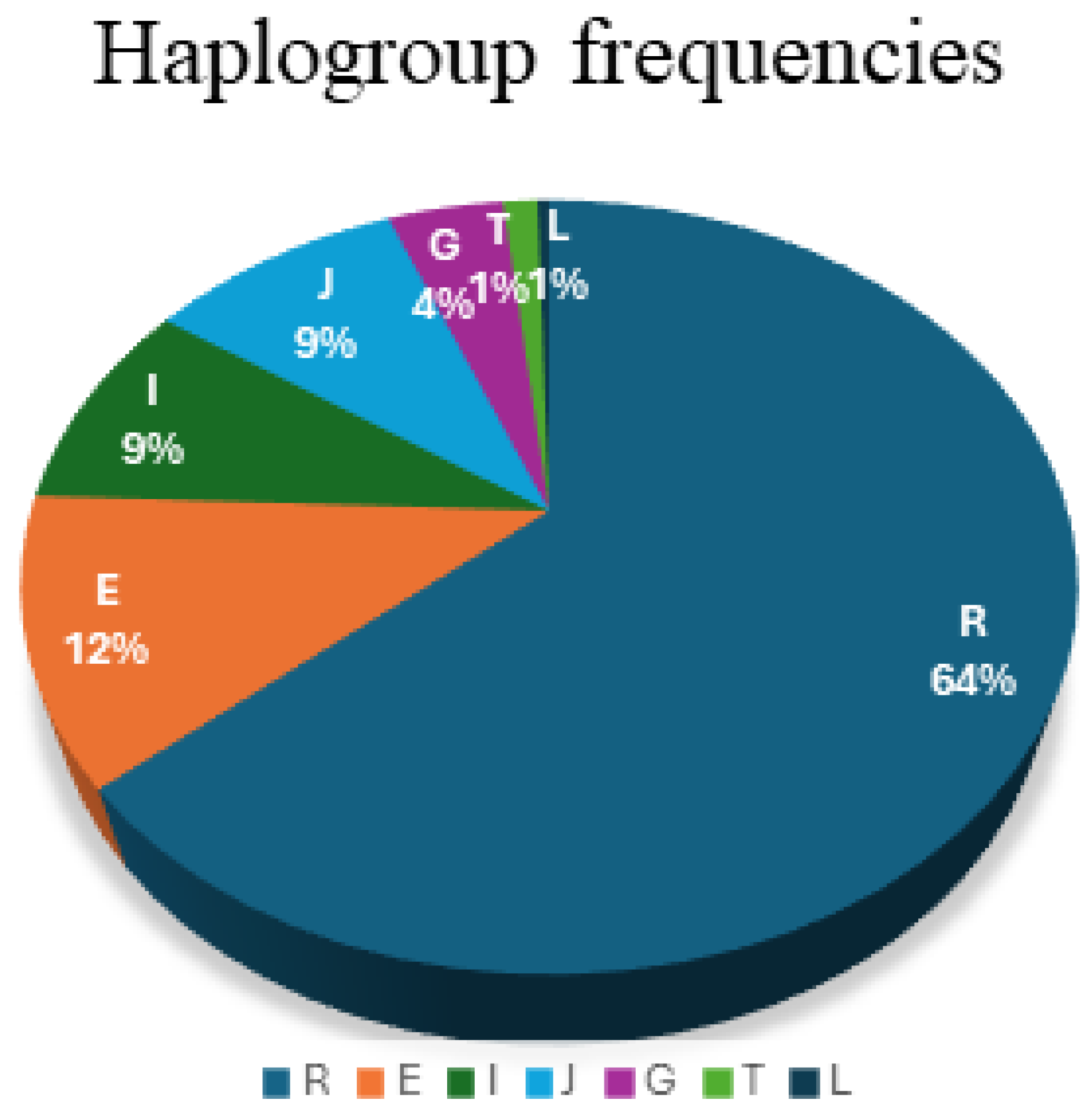
https://www.nevgen.org/#, accessed on 14 June 2025) with a probability greater than 50%. Haplogroups found include R (64%) and E (12%), as well as other less common ones such as I (9%), J (9%), G (4%), L (1%) and T (1%). The most common sub-haplogroups were R1b (64%), E1b1b (12%), J2a1 (6%) and I1 (4%).
Table S4 displays the Haplogroup predictions, while
Figure 2 displays the Haplogroup distributions. The percentages of Haplogroups predicted are shown in
Table 1.
3.3. Population Comparison Using Genetic Distances Based on RST Distances
The Northern Portuguese population’s haplotypes were compared with those of six other populations—Spain, Italy, Greece, Morocco, Angola and Mozambique, retrieved from YHRD databases, and additionally with two distinct populations from earlier Portuguese population studies, one from the Central region and one from the Azores. Both of these comparisons were used to explore the genetic relationships between the Northern Portuguese population and other South European countries, as well as North African countries and other Portuguese populations.
Because there was insufficient information available for the other loci in the populations that were part of the first comparative analysis, only 17 STR loci were taken into consideration. DYS389I, DYS391, DYS389II, DYS390, DYS458, DYS393, DYS19, DYS437, YGATAH4, DYS448, DYS439, DYS438, DYS456, DYS635, DYS385 a/b and DYS392 were the 17 STRs used.
For the second comparative analysis, where the three Portuguese populations were utilised, only 9 STR loci were taken into consideration for the same reason as above, with those 9 being DYS389I, DYS391, DYS389II, DYS390, DYS393, DYS19, DYS385 a/b and DYS392. The population pairwise genetic distances (
RST) between the population under study and the previously published populations were computed, presented in
Tables S5 and S6, and Central Portugal (
RST = −0.00237,
p-value~0.86486), Spain (
RST = −0.00201,
p-value~0.81982) and Italy (
RST = −0.00159,
p-value~0.35135) were the populations with the most genetic similarity with Northern Portugal. The Rst matrix’s
p-values revealed a statistically significant genetic difference between Morocco (
p~0.018), Greece (
p~0.009), Angola (
p~0.027), Mozambique (
p~0.009) and the Azores (
p~0.000), when compared with Northern Portugal.
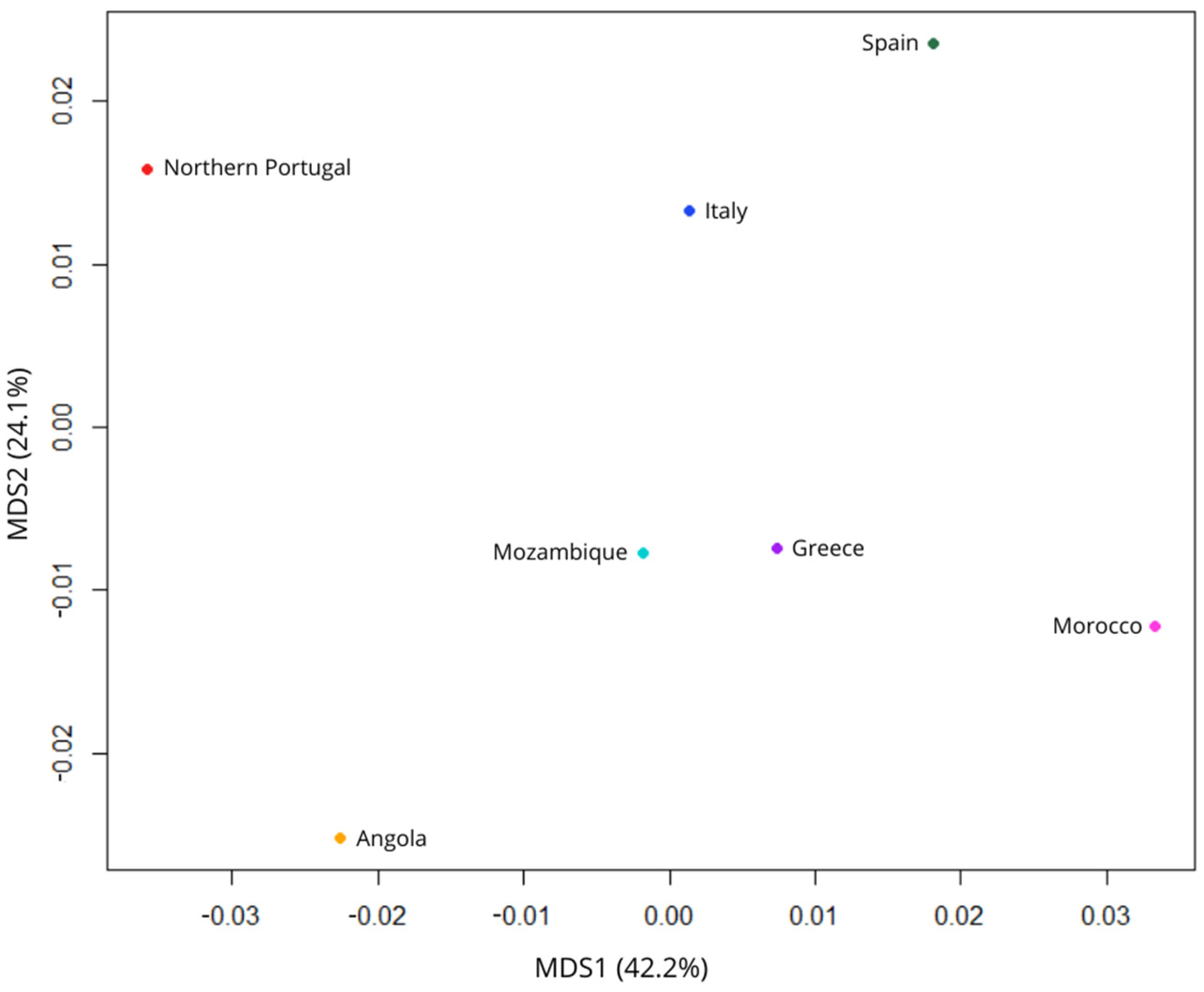
Figure 3 displays the findings of the MDS plot created to compare the 6 populations. The map indicates that while Greece and Morocco are farther distant from Northern Portugal, Spain and Italy, they are not as far away as Angola and Mozambique. For this set of populations, we computed the Proportion of Variance Explained (PVE), which came out to be 0.663. Additionally, we determined the Krustal stress, 0.62.
4. Discussion
High genetic diversity was found in the 252 Northern Portuguese individuals who were analysed. The high level of genetic variety in the sample is reflected in the frequency of unique haplotypes, which is 0.984 of the 252 haplotypes, of which 251 are distinct and 248 are unique. The discriminating capacity (DC) of 0.992 and high haplotype diversity (HD) of 0.999 were also obtained, confirming the set of markers’ ability to differentiate between people. We can conclude that the panel used in the present work has a higher discriminatory power, as evidenced by comparing these results with those of another Portuguese population study [
6]. This may be because there were more Y-STRs present in this study, as we were able to obtain a significantly lower number of shared haplotypes with a very similar number of individuals typed. Whereas Alves et al., 2007 [
6] obtained one shared haplotype between three individuals and seventeen haplotypes shared by two individuals, we only found two haplotypes shared by two individuals each. In line with earlier Iberian research like [
21], DYS393 displayed the lowest gene diversity among the loci examined, while DYS627 and DYS449 displayed the highest gene diversity, indicating their significance for demographic and forensic investigations. The literature has previously reported the presence of inter-alleles in a Portuguese population, primarily at DYS458 [
6]. The Y-chromosome’s mutational processes are also reflected in the detected duplicated alleles, which were previously reported in European populations [
22].
Haplogroups for 234 samples could be inferred, and the results of this analysis revealed that the most prevalent haplogroup in the sample pool was R (65%), which is quite frequent in Western Europe, followed by Eb1b (12%), which is common in Iberia despite originating in Africa [
23]. R1b was the most prevalent subclade (58.73%), and the Portuguese population’s genetic continuity with other Western European populations is supported by this large R1b presence, which was probably influenced by post-Ice Age recolonisation and subsequent Bronze Age expansions [
24]. Previously known as E3b [
25], E1b1b is a sub-clade of the E haplogroup, and migrations from the Eastern Mediterranean and North Africa are usually linked to it [
26]. It is important to note that haplogroup inference in this study is based on Y-STR and the NevGen predictor. STR-based assignments are uncertain and may lead to misclassification. The historical interpretations presented here should be regarded as broad population-level tendencies consistent with prior studies, rather than definitive phylogenetic conclusions, and are presented only in the context of well-established Iberian paternal lineages. While this approach is informative at a broad population level, STR-based inference does not replace SNP-defined haplogroup determination. Future studies incorporating Y-SNP typing will be necessary to refine phylogenetic resolution and strengthen historical inference.
Populations from Spain [
27], Italy [
28], Greece [
29], Morocco [
30], and Angola and Mozambique [
31] were included for the comparative analysis. A mix of historical links, sociocultural ties, and geographical proximity supports this choice. Southern European nations include Portugal, Spain, Italy and Greece. Morocco is Portugal’s neighbour in Africa, and the two countries have long-standing cultural and economic ties. Former Portuguese colonies, Angola and Mozambique, have close linguistic, historical and migratory ties to Portugal. The populations of Northern Portugal, Spain, and Italy had little to no significant genetic divergence, according to the results, which is consistent with their close proximity and long-standing Mediterranean ties. However, statistically significant differences were found with Angola, Mozambique, Greece and Morocco, which all had different migratory histories [
32,
33,
34]. The Krustal stress value (0.62) showed some distortion despite the relatively high PVE (66.3%), which was largely addressed in the 3D MDS representation, better honouring the associated
p-values and R
ST values. Central Portugal [
35] and the Azores [
7] were also compared to Northern Portugal, and while the Azorean population showed significant differentiation from the Northern population, the Northern population showed no statistically significant differences with the Central population. According to Santos et al., 2009 [
36], this could be explained by the founder effects and the archipelago’s geographic isolation.
Our results demonstrate a high haplotype diversity and are largely consistent with previous studies on both regional [
5] and national [
6] Portuguese populations. Minor differences were observed, such as a higher number of rare and duplicated alleles and slightly lower Rst values, which can be explained by the larger sample size and the greater number of Y-STR markers used in this study, confirming the expected genetic variability of the Northern Portugal population. In conclusion, this work reflects the Northern Portuguese male population’s ability to exhibit a high Y-STR haplotype diversity and strong forensic potential. These results also highlight the complex historical influences that shape the region and help to better understand Portugal’s genetic structure.
It is also important to recognize some of the current study’s shortcomings. First, the study’s sample size was limited to 252 males. This figure might not fully reflect the region’s geographic variety. Increasing the amount of sample types could address this, but it might also result in more recurrent haplotypes. Additionally, the frequencies of rare haplotypes, such as T and L, should be taken cautiously because they were based on a very small number of individuals, 3 and 1, respectively. When bigger or other population subgroups are examined, the prevalence of these uncommon lineages may vary significantly. Future research should use larger datasets and supplement Y-STR data with Y-SNP typing, which offers a higher accuracy for haplotype assignment, as we can only predict haplogroups based on Y-STRs and not fully assign them. The limited number of markers used for population comparison should also be addressed, resulting from a lack of information for the reference populations. Including these populations in future studies with a more comprehensive marker set would allow for more accurate and balanced comparisons, thereby reducing potential biases in the results.
5. Conclusions
The present study delivers a comprehensive 26-locus Y-STR reference dataset for the Northern Portuguese population, demonstrating a high haplotype diversity, a large proportion of unique haplotypes, and strong discriminatory power, confirming its suitability for forensic applications such as paternity testing, kinship analysis, and criminal investigations. The Y-STR profiles obtained reflect the genetic continuity expected for Western Iberian populations, while also capturing the subtle contributions of Mediterranean and North African lineages, which are consistent with Portugal’s well-documented demographic history. Although haplogroup predictions based solely on STR must be interpreted cautiously, they nonetheless align with known paternal genetic patterns of the Iberian Peninsula.
By contributing these data to the YHRD database, the present work substantially improves the representation of Portuguese populations in international reference resources, enhancing the accuracy and reliability of comparative forensic analysis. Future efforts should focus on expanding sampling to other regions of mainland Portugal, as well as the archipelagos, and integrating Y-SNP data to achieve refined phylogenetic resolution. Together, these steps will support a more complete reconstruction of Portuguese Paternal genetic structure and further consolidate the forensic value of Y-chromosome markers at both national and international levels.