Review

53BP1: Keeping It under Control, Even at a Distance from DNA Damage

by
Emilie Rass
1,2,*,†,
Simon Willaume
1,2,† and
Pascale Bertrand
1,2
1
Université Paris Cité, INSERM, CEA, Stabilité Génétique Cellules Souches et Radiations, LREV/iRCM/IBFJ, F-92260 Fontenay-aux-Roses, France
2
Université Paris-Saclay, INSERM, CEA, Stabilité Génétique Cellules Souches et Radiations, LREV/iRCM/IBFJ, F-92260 Fontenay-aux-Roses, France
*
Author to whom correspondence should be addressed.
These authors contributed equally to this work.
Genes 2022, 13(12), 2390; https://doi.org/10.3390/genes13122390
Submission received: 7 October 2022 / Revised: 2 December 2022 / Accepted: 7 December 2022 / Published: 16 December 2022
(This article belongs to the Special Issue Dynamics of DNA Double Strand Breaks)

Abstract

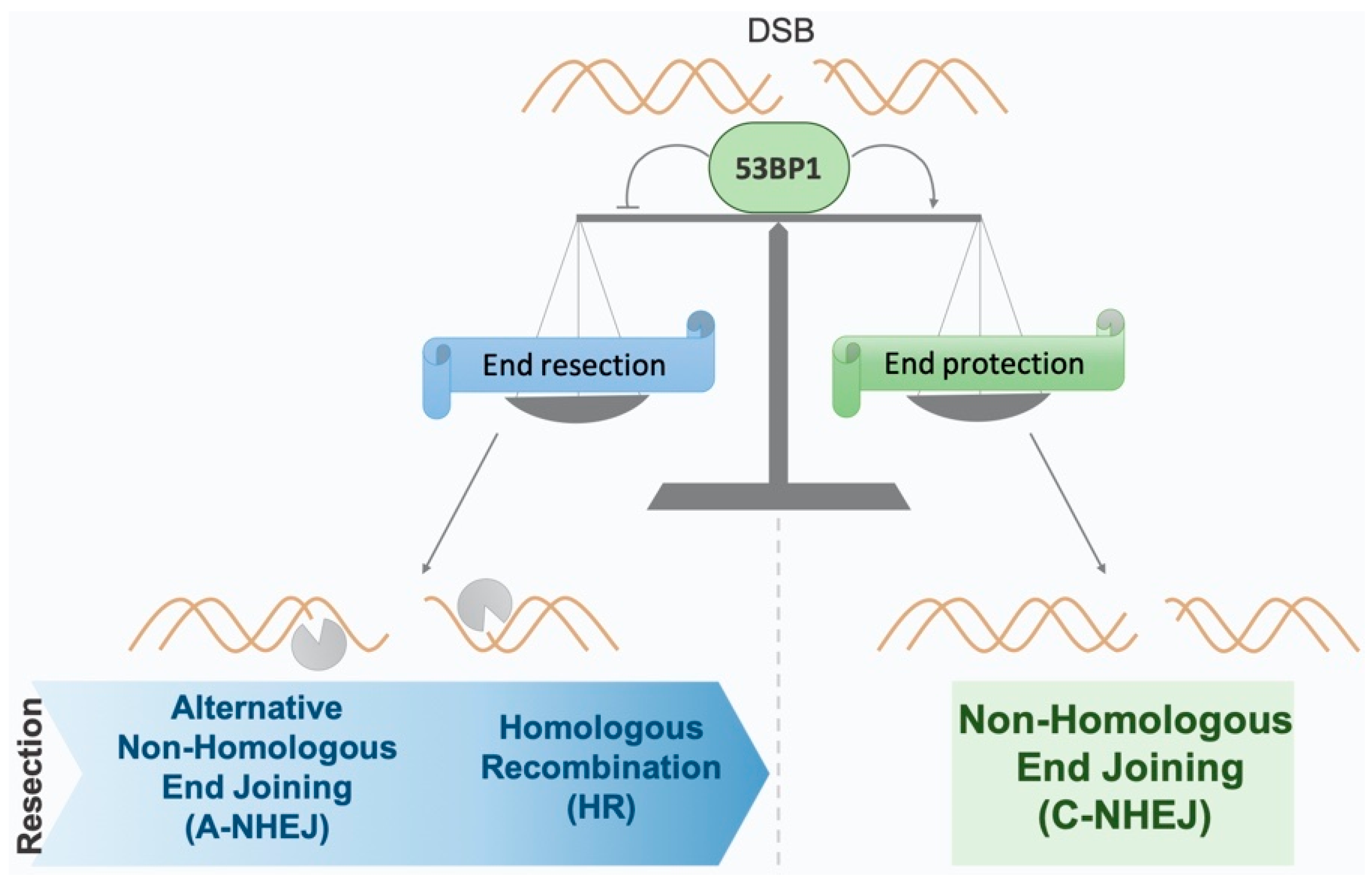
Double-strand breaks (DSBs) are toxic lesions that can be generated by exposure to genotoxic agents or during physiological processes, such as during V(D)J recombination. The repair of these DSBs is crucial to prevent genomic instability and to maintain cellular homeostasis. Two main pathways participate in repairing DSBs, namely, non-homologous end joining (NHEJ) and homologous recombination (HR). The P53-binding protein 1 (53BP1) plays a pivotal role in the choice of DSB repair mechanism, promotes checkpoint activation and preserves genome stability upon DSBs. By preventing DSB end resection, 53BP1 promotes NHEJ over HR. Nonetheless, the balance between DSB repair pathways remains crucial, as unscheduled NHEJ or HR events at different phases of the cell cycle may lead to genomic instability. Therefore, the recruitment of 53BP1 to chromatin is tightly regulated and has been widely studied. However, less is known about the mechanism regulating 53BP1 recruitment at a distance from the DNA damage. The present review focuses on the mechanism of 53BP1 recruitment to damage and on recent studies describing novel mechanisms keeping 53BP1 at a distance from DSBs.
Keywords: 53BP1; homologous recombination; non-homologous end joining; double-strand break repair; lamins; shieldin; PARP inhibitors; BRCA1 53BP1; homologous recombination; non-homologous end joining; double-strand break repair; lamins; shieldin; PARP inhibitors; BRCA1