
Article

Development of Epigenetic Clocks for Key Ruminant Species
1
AgResearch Limited, Invermay Agricultural Centre, Puddle Alley, Mosgiel 9092, New Zealand
2
Department of Biochemistry, University of Otago, Dunedin 9016, New Zealand
3
Livestock Improvement Corporation, Hamilton 3286, New Zealand
4
Department of Human Genetics, David Geffen School of Medicine, University of California Los Angeles, Los Angeles, CA 90095, USA
*
Author to whom correspondence should be addressed.
Genes 2022, 13(1), 96; https://doi.org/10.3390/genes13010096
Submission received: 10 December 2021 / Revised: 20 December 2021 / Accepted: 22 December 2021 / Published: 30 December 2021
(This article belongs to the Special Issue Genetics and Breeding of Small Ruminants)

Abstract

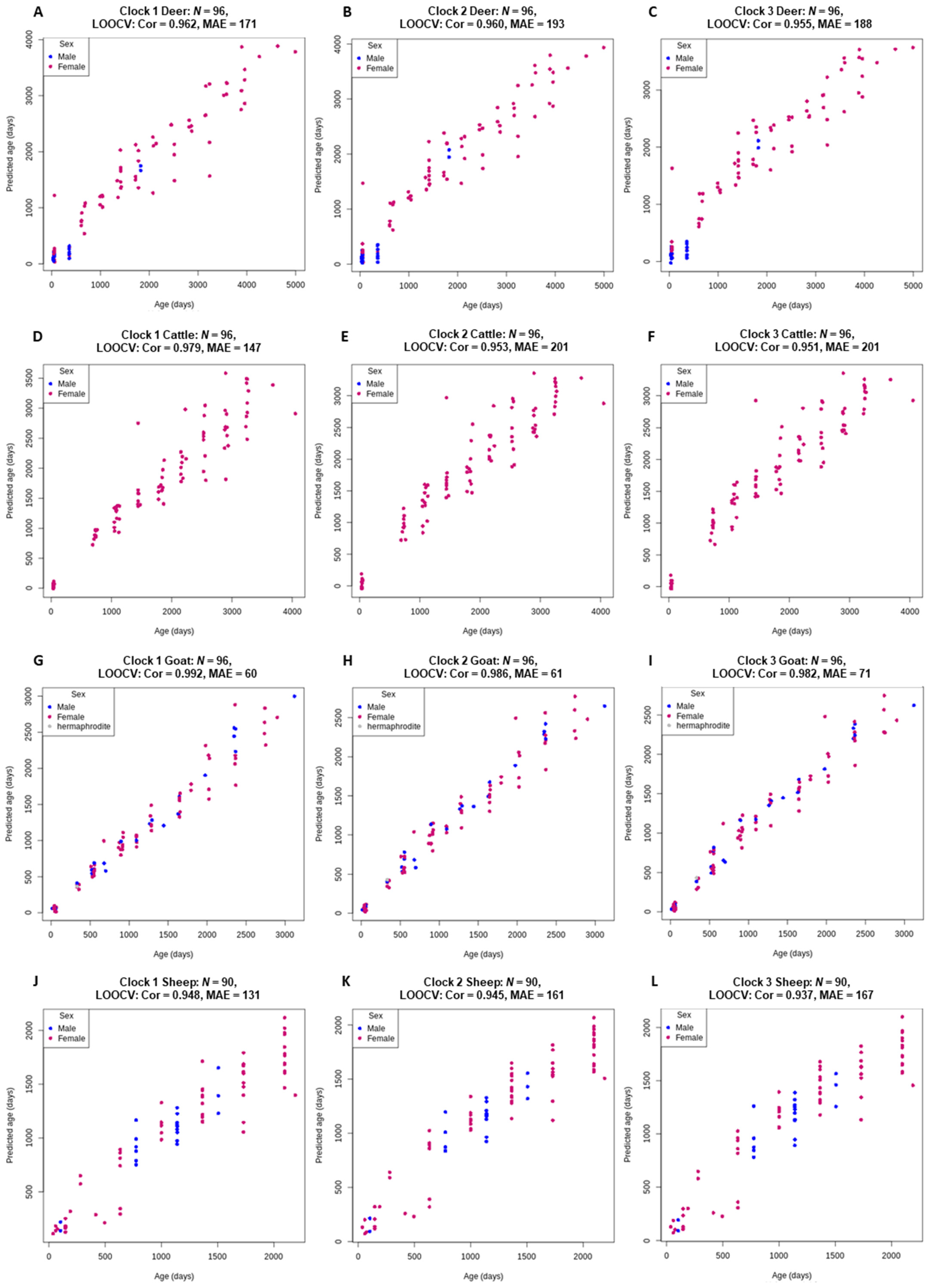
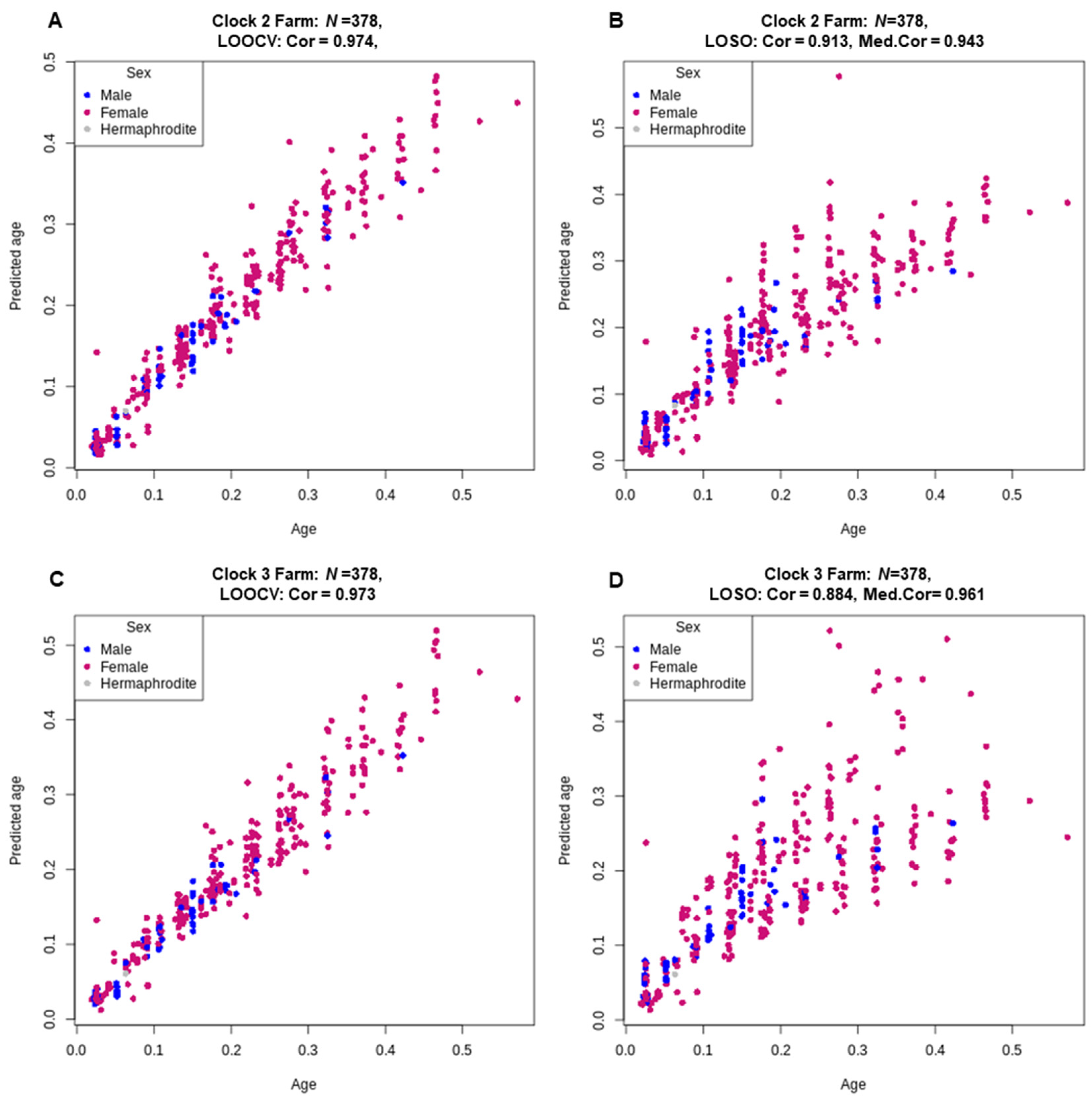
Robust biomarkers of chronological age have been developed in humans and model mammalian species such as rats and mice using DNA methylation data. The concept of these so-called “epigenetic clocks” has emerged from a large body of literature describing the relationship between genome-wide methylation levels and age. Epigenetic clocks exploit this phenomenon and use small panels of differentially methylated cytosine (CpG) sites to make robust predictions of chronological age, independent of tissue type. Here, we present highly accurate livestock epigenetic clocks for which we have used the custom mammalian methylation array “HorvathMammalMethyl40” to construct the first epigenetic clock for domesticated goat (Capra hircus), cattle (Bos taurus), Red (Cervus elaphus) and Wapiti deer (Cervus canadensis) and composite-breed sheep (Ovis aries). Additionally, we have constructed a ‘farm animal clock’ for all species included in the study, which will allow for robust predictions to be extended to various breeds/strains. The farm animal clock shows similarly high accuracy to the individual species’ clocks (r > 0.97), utilizing only 217 CpG sites to estimate age (relative to the maximum lifespan of the species) with a single mathematical model. We hypothesise that the applications of this livestock clock could extend well beyond the scope of chronological age estimates. Many independent studies have demonstrated that a deviation between true age and clock derived molecular age is indicative of past and/or present health (including stress) status. There is, therefore, untapped potential to utilize livestock clocks in breeding programs as a predictor for age-related production traits.
Keywords: epigenetic clock; methylation; livestock; sheep; goat; deer; cattle epigenetic clock; methylation; livestock; sheep; goat; deer; cattle