Article

The Potential of HTS Approaches for Accurate Genotyping in Grapevine (Vitis vinifera L.)


1
Department of Agronomy, Biotechnical Faculty, University of Ljubljana, 1000 Ljubljana, Slovenia
2
Department of Biotechnology, Faculty of Natural Sciences, University of Tirana, Blv Zog I, 25/1, 1001 Tirana, Albania
3
AGAP, Univ Montpellier, CIRAD, INRAE, Montpellier SupAgro, F-34070 Montpellier, France
*
Author to whom correspondence should be addressed.
Genes 2020, 11(8), 917; https://doi.org/10.3390/genes11080917
Submission received: 8 July 2020 / Revised: 3 August 2020 / Accepted: 6 August 2020 / Published: 10 August 2020
(This article belongs to the Special Issue Genetics and Diversity of Grapevine)

Abstract

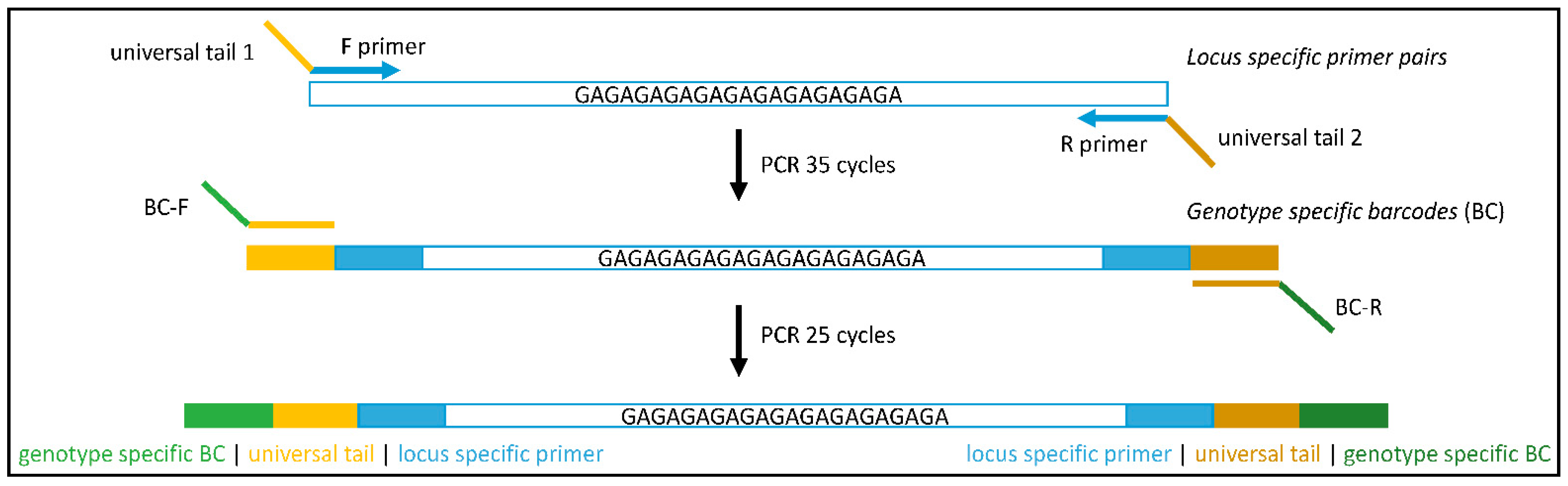
The main challenge associated with genotyping based on conventional length polymorphisms is the cross-laboratory standardization of allele sizes. This step requires the inclusion of standards and manual sizing to avoid false results. Capillary electrophoresis (CE) approaches limit the information to the length polymorphism and do not allow the determination of a complete marker sequence. As an alternative, high-throughput sequencing (HTS) offers complete information regarding marker sequences and their flanking regions. In this work, we investigated the suitability of a semi-quantitative sequencing approach for microsatellite genotyping using Illumina paired-end technology. Twelve microsatellite loci that are well established for grapevine CE typing were analysed on 96 grapevine samples from six different countries. We redesigned primers to the length of the amplicon for short sequencing (~100 bp). The primer pair was flanked with a 10 bp overhang for the introduction of barcodes on both sides of the amplicon to enable high multiplexing. The highest data peaks were determined as simple sequence repeat (SSR) alleles and compared with the CE dataset based on 12 reference samples. The comparison showed that HTS SSR genotyping can successfully replace the CE system in further experiments. We believe that, with next-generation sequencing, genotyping can be improved in terms of its speed, accuracy, and price.
Keywords: Vitis vinifera L.; microsatellites; high-throughput sequencing; SSR markers; genotyping Vitis vinifera L.; microsatellites; high-throughput sequencing; SSR markers; genotyping