From Hydra to Humans: Head Activator in Neurogenesis and Neurorepair

Abstract
1. Introduction
2. Peptidergic Signalling in Hydra
3. Context-Dependent Signalling of Head Activator
4. Signalling Pathways of Head Activator Peptide in Hydra
5. Effects of Synthetic Head Activator Applied to Mammals
6. Is Head Activator Evolutionarily Conserved?
7. Signalling Pathway of Head Activator Peptide in Mammals
8. Potential Role of Head Activator in Regenerative Medicine and Human Neuropathology
9. Conclusions
Author Contributions
Funding
Institutional Review Board Statement
Informed Consent Statement
Data Availability Statement
Conflicts of Interest
References
- Van Iten, H.; Leme, J.M.; Pacheco, M.L.A.F.; Simões, M.G.; Fairchild, T.R.; Rodrigues, F.; Galante, D.; Boggiani, P.C.; Marques, A.C. Origin and Early Diversification of Phylum Cnidaria: Key Macrofossils from the Ediacaran System of North and South America. In The Cnidaria, Past, Present and Future; Springer: Cham, Switzerland, 2014; pp. 677–690. [Google Scholar] [CrossRef]
- Reddy, P.C.; Gungi, A.; Unni, M. Cellular and Molecular Mechanisms of Hydra Regeneration. Results Probl. Cell Differ. 2019, 68, 259–290. [Google Scholar] [CrossRef] [PubMed]
- Yuste, R. Breaking the neural code of a cnidarian: Learning principles of neuroscience from the “vulgar” Hydra. Curr. Opin. Neurobiol. 2024, 86, 102869. [Google Scholar] [CrossRef] [PubMed]
- Tomczyk, S.; Fischer, K.; Austad, S.; Galliot, B. Hydra, a powerful model for aging studies. Invertebr. Reprod. Dev. 2015, 59, 11–16. [Google Scholar] [CrossRef] [PubMed]
- Mattera, L. Functionalization, Bio-Conjugation and Toxicity Studies of Quantum Dots. Ph.D. Thesis, Université Grenoble Alpes, Grenoble, France, 2016. [Google Scholar]
- Buzgariu, W.; Al Haddad, S.; Tomczyk, S.; Wenger, Y.; Galliot, B. Multi-functionality and plasticity characterize epithelial cells in Hydra. Tissue Barriers 2015, 3, e1068908. [Google Scholar] [CrossRef]
- Plachetzki, D.C.; Fong, C.R.; Oakley, T.H. Cnidocyte discharge is regulated by light and opsin-mediated phototransduction. BMC Biol. 2012, 10, 17. [Google Scholar] [CrossRef]
- Bellantuono, A.J.; Bridge, D.; Martínez, D.E. Hydra as a tractable, long-lived model system for senescence. Invertebr. Reprod. Dev. 2015, 59, 39–44. [Google Scholar] [CrossRef]
- Ojimi, M.C.; Isomura, N.; Hidaka, M. Telomerase activity is not related to life history stage in the jellyfish Cassiopea sp. Comp. Biochem. Physiol. A Mol. Integr. Physiol. 2009, 152, 240–244. [Google Scholar] [CrossRef]
- Pascual-Torner, M.; Carrero, D.; Pérez-Silva, J.G.; Álvarez-Puente, D.; Roiz-Valle, D.; Bretones, G.; Rodríguez, D.; Maeso, D.; Mateo-González, E.; Español, Y.; et al. Comparative genomics of mortal and immortal cnidarians unveils novel keys behind rejuvenation. Proc. Natl. Acad. Sci. USA 2022, 119, e2118763119. [Google Scholar] [CrossRef]
- Primack, A.S.; Cazet, J.F.; Little, H.M.; Mühlbauer, S.; Cox, B.D.; David, C.N.; Farrell, J.A.; Juliano, C.E. Differentiation trajectories of the Hydra nervous system reveal transcriptional regulators of neuronal fate. bioRxiv 2023. bioRxiv:2023.03.15.531610. [Google Scholar] [CrossRef]
- Noro, Y.; Shimizu, H.; Mineta, K.; Gojobori, T. A single neuron subset governs a single coactive neuron circuit in Hydra vulgaris, representing a possible ancestral feature of neural evolution. Sci. Rep. 2021, 11, 10828. [Google Scholar] [CrossRef]
- Dupre, C.; Yuste, R. Non-overlapping Neural Networks in Hydra vulgaris. Curr. Biol. 2017, 27, 1085–1097. [Google Scholar] [CrossRef] [PubMed]
- Keramidioti, A.; Schneid, S.; Busse, C.; von Laue, C.C.; Bertulat, B.; Salvenmoser, W.; Heß, M.; Alexandrova, O.; Glauber, K.M.; Steele, R.E.; et al. A new look at the architecture and dynamics of the Hydra nerve net. eLife 2024, 12, RP87330. [Google Scholar] [CrossRef] [PubMed]
- Badhiwala, K.N.; Primack, A.S.; Juliano, C.E.; Robinson, J.T. Multiple neuronal networks coordinate Hydra mechanosensory behavior. eLife 2021, 10, e64108. [Google Scholar] [CrossRef] [PubMed]
- Rentzsch, F.; Layden, M.; Manuel, M. The cellular and molecular basis of cnidarian neurogenesis. Dev. Biol. 2017, 6, e257. [Google Scholar] [CrossRef] [PubMed]
- Hauser, F.; Koch, T.L.; Grimmelikhuijzen, C.J.P. Review: The evolution of peptidergic signaling in Cnidaria and Placozoa, including a comparison with Bilateria. Front. Endocrinol. 2022, 13, 973862. [Google Scholar] [CrossRef]
- Liao, Q.; Feng, Y.; Yang, B.; Lee, S.M.-Y. Cnidarian peptide neurotoxins: A new source of various ion channel modulators or blockers against central nervous systems disease. Drug Discov. Today 2019, 24, 189–197. [Google Scholar] [CrossRef]
- Jayathilake, J.M.N.J.; Gunathilake, K.V.K. Cnidarian toxins: Recent evidences for potential therapeutic uses. Eur. Zool. J. 2020, 87, 708–713. [Google Scholar] [CrossRef]
- Schaller, H.C.; Bodenmüller, H. Structure and Function of the Head Activator in Hydra and in Mammals. In Advances in Metabolic Disorders: Gastrointestinal Hormones; Mutt, V., Ed.; Elsevier: Amsterdam, The Netherlands, 1988; pp. 519–526. ISBN 0065-2903. [Google Scholar]
- Brady, H. Mystery of the Head Activator; Asimov Press: Boston, MA, USA, 2026; Available online: https://www.asimov.press/p/head-activator (accessed on 8 March 2026).
- Hicklin, J.; Hornbruch, A.; Wolpert, L.; Clarke, M. Positional information and pattern regulation in hydra: The formation of boundary regions following axial grafts. Development 1973, 30, 701–725. [Google Scholar] [CrossRef]
- Chica Schaller, H. Neuropeptides in Hydra. Trends Neurosci. 1979, 2, 120–122. [Google Scholar] [CrossRef]
- Takahashi, T.; Muneoka, Y.; Lohmann, J.; Lopez de Haro, M.S.; Solleder, G.; Bosch, T.C.; David, C.N.; Bode, H.R.; Koizumi, O.; Shimizu, H.; et al. Systematic isolation of peptide signal molecules regulating development in hydra: LWamide and PW families. Proc. Natl. Acad. Sci. USA 1997, 94, 1241–1246. [Google Scholar] [CrossRef]
- Fujisawa, T. Hydra peptide project 1993–2007. Dev. Growth Differ. 2008, 50, S257–S268. [Google Scholar] [CrossRef]
- Takahashi, T.; Fujisawa, T. Important roles for epithelial cell peptides in hydra development. BioEssays 2009, 31, 610–619. [Google Scholar] [CrossRef] [PubMed]
- Takahashi, T.; Hayakawa, E.; Koizumi, O.; Fujisawa, T. Neuropeptides and their functions in Hydra. Acta Biol. Hung. 2008, 59, 227–235. [Google Scholar] [CrossRef] [PubMed]
- Schaller, H.C.; Bodenmüller, H. Isolation and amino acid sequence of a morphogenetic peptide from hydra. Proc. Natl. Acad. Sci. USA 1981, 78, 7000–7004. [Google Scholar] [CrossRef]
- Hoffmeister, S.A. Isolation and characterization of two new morphogenetically active peptides from Hydra vulgaris. Development 1996, 122, 1941–1948. [Google Scholar] [CrossRef] [PubMed]
- Schaller, H.C.; Hoffmeister, S.A.; Dübel, S. Role of the neuropeptide head activator for growth and development in hydra and mammals. Development 1989, 107, 99–107. [Google Scholar] [CrossRef]
- Lohmann, J.U.; Bosch, T.C. The novel peptide HEADY specifies apical fate in a simple radially symmetric metazoan. Genes Dev. 2000, 14, 2771–2777. [Google Scholar] [CrossRef]
- Takahashi, T.; Koizumi, O.; Ariura, Y.; Romanovitch, A.; Bosch, T.C.; Kobayakawa, Y.; Mohri, S.; Bode, H.R.; Yum, S.; Hatta, M.; et al. A novel neuropeptide, Hym-355, positively regulates neuron differentiation in Hydra. Development 2000, 127, 997–1005. [Google Scholar] [CrossRef]
- Bodenmüller, H.; Schaller, H.C. Conserved amino acid sequence of a neuropeptide, the head activator, from coelenterates to humans. Nature 1981, 293, 579–580. [Google Scholar] [CrossRef]
- Quach, T.T.; Duchemin, A.M.; Oliver, A.P.; Schrier, B.K.; Wyatt, R.J. Hydra head activator peptide has trophic activity for eukaryotic neurons. Dev. Brain Res. 1992, 68, 97–102. [Google Scholar] [CrossRef]
- Fuentes, E.J.; Pachter, R.; Tsonis, P.A. On the three-dimensional structure of the Hydra head activator neuropeptide. In Vivo 1994, 8, 199–205. [Google Scholar] [PubMed]
- Saffrich, R.; Kalbitzer, H.R.; Bodenmüller, H.; Muhn, P.; Pipkorn, R.; Schaller, H.C. 1H-nuclear magnetic resonance studies of the neuropeptide head activator. Biochim. Biophys. Acta 1989, 997, 144–153. [Google Scholar] [CrossRef] [PubMed]
- Lai, J.R.; Gellman, S.H. Reinvestigation of the proposed folding and self-association of the Neuropeptide Head Activator. Protein Sci. 2003, 12, 560–566. [Google Scholar] [CrossRef]
- Abramson, J.; Adler, J.; Dunger, J.; Evans, R.; Green, T.; Pritzel, A.; Ronneberger, O.; Willmore, L.; Ballard, A.J.; Bambrick, J.; et al. Accurate structure prediction of biomolecular interactions with AlphaFold 3. Nature 2024, 630, 493–500. [Google Scholar] [CrossRef] [PubMed]
- Hoffmeister-Ullerich, S.A. The foot formation stimulating peptide pedibin is also involved in patterning of the head in hydra. Mech. Dev. 2001, 106, 37–45. [Google Scholar] [CrossRef]
- Herrmann, D.; Hatta, M.; Hoffmeister-Ullerich, S.A.H. Thypedin, the multi copy precursor for the hydra peptide pedin, is a beta-thymosin repeat-like domain containing protein. Mech. Dev. 2005, 122, 1183–1193. [Google Scholar] [CrossRef]
- Takahashi, T.; Takeda, N. Insight into the molecular and functional diversity of cnidarian neuropeptides. Int. J. Mol. Sci. 2015, 16, 2610–2625. [Google Scholar] [CrossRef]
- Takahashi, T.; Koizumi, O.; Hayakawa, E.; Minobe, S.; Suetsugu, R.; Kobayakawa, Y.; Bosch, T.C.G.; David, C.N.; Fujisawa, T. Further characterization of the PW peptide family that inhibits neuron differentiation in Hydra. Dev. Genes Evol. 2009, 219, 119–129. [Google Scholar] [CrossRef]
- Morishita, F.; Nitagai, Y.; Furukawa, Y.; Matsushima, O.; Takahashi, T.; Hatta, M.; Fujisawa, T.; Tunamoto, S.; Koizumi, O. Identification of a vasopressin-like immunoreactive substance in Hydra. Peptides 2003, 24, 17–26. [Google Scholar] [CrossRef]
- Schawaller, M.; Schenck, K.; Hoffmeister, S.A.; Schaller, H.; Schaller, H.C. Production and characterization of monoclonal antibodies recognizing head activator in precursor form and immunocytochemical localization of head activator precursor and head activator peptide in the neural cell line NH15-CA2 and in hydra. Differ. Res. Biol. Divers. 1988, 38, 149–160. [Google Scholar] [CrossRef]
- Schaller, H.C. Action of the head activator as a growth hormone in hydra. Cell Differ. 1976, 5, 1–11. [Google Scholar] [CrossRef] [PubMed]
- Schaller, H.C. Action of the head activator on the determination of interstitial cells in hydra. Cell Differ. 1976, 5, 13–25. [Google Scholar] [CrossRef] [PubMed]
- Schaller, H.C.; Hofmann, M.; Javois, L.C. Effect of head activator on proliferation, head-specific determination and differentiation of epithelial cells in hydra. Differentiation 1990, 43, 157–164. [Google Scholar] [CrossRef] [PubMed]
- Hobmayer, B.; Holstein, T.W.; David, C.N. Stimulation of tentacle and bud formation by the neuropeptide head activator in Hydra magnipapillata. Dev. Biol. 1997, 183, 1–8. [Google Scholar] [CrossRef]
- Schaller, H.; Hermans-Borgmeyer, I.; Hoffmeister, S. Neuronal control of development in hydra. Int. J. Dev. Biol. 1996, 40, 339–344. [Google Scholar] [CrossRef]
- Hampe, W.; Hermans-Borgmeyer, I.; Schaller, H.C. Function of the neuropeptide head activator for early neural and neuroendocrine development. Results Probl. Cell Differ. 1999, 26, 323–337. [Google Scholar] [CrossRef]
- Galliot, B.; Welschof, M.; Schuckert, O.; Hoffmeister, S.; Schaller, H.C. The cAMP response element binding protein is involved in hydra regeneration. Development 1995, 121, 1205–1216. [Google Scholar] [CrossRef]
- Neubauer, K.H.; Christians, S.; Hoffmeister, S.A.; Kreger, S.; Schaller, H.C. Characterisation of two types of head activator receptor on hydra cells. Mech. Dev. 1990, 33, 39–47. [Google Scholar] [CrossRef]
- Christians, S.; Neubauer, K.H.; Ulrich, H. Purification and characterization of the head-activator receptor from a multi-headed mutant of Chlorohydra viridissima. FEBS Lett. 1993, 316, 141–146. [Google Scholar] [CrossRef]
- Franke, I.; Buck, F.; Hampe, W. Purification of a head-activator receptor from hydra. Eur. J. Biochem. 1997, 244, 940–945. [Google Scholar] [CrossRef]
- Schaller, H.C.; Druffel-Augustin, S.; Dübel, S. Head activator acts as an autocrine growth factor for NH15-CA2 cells in the G2/mitosis transition. EMBO J. 1989, 8, 3311–3318. [Google Scholar] [CrossRef]
- Fenger, U.; Hofmann, M.; Galliot, B.; Schaller, H.C. The role of the cAMP pathway in mediating the effect of head activator on nerve-cell determination and differentiation in hydra. Mech. Dev. 1994, 47, 115–125. [Google Scholar] [CrossRef] [PubMed]
- Slepushkin, V.D.; Prum, I.A.; Vinogradov, V.A.; Pavlov, V.A.; Titov, M.I.; Vasil’ev, N.V. Effect of hydra peptide morphogen on cyclic nucleotide levels in injured tissues. Bull. Exp. Biol. Med. 1989, 108, 1491–1493. [Google Scholar] [CrossRef]
- Bodenmüller, H.; Schilling, E.; Zachmann, B.; Schaller, H.C. The neuropeptide head activator loses its biological acitivity by dimerization. EMBO J. 1986, 5, 1825–1829. [Google Scholar] [CrossRef] [PubMed]
- Schaller, H.C.; Roberge, M.; Zachmann, B.; Hoffmeister, S.; Schilling, E.; Bodenmüller, H. The head activator is released from regenerating Hydra bound to a carrier molecule. EMBO J. 1986, 5, 1821–1824. [Google Scholar] [CrossRef]
- Hampe, W.; Riedel, I.B.; Lintzel, J.; Bader, C.O.; Franke, I.; Schaller, H.C. Ectodomain shedding, translocation and synthesis of SorLA are stimulated by its ligand head activator. J. Cell Sci. 2000, 113, 4475–4485. [Google Scholar] [CrossRef]
- Hampe, W.; Urny, J.; Franke, I.; Hoffmeister-Ullerich, S.A.; Herrmann, D.; Petersen, C.M.; Lohmann, J.; Schaller, H.C. A head-activator binding protein is present in hydra in a soluble and a membrane-anchored form. Development 1999, 126, 4077–4086. [Google Scholar] [CrossRef]
- Hermans-Borgmeyer, I.; Hampe, W.; Schinke, B.; Methner, A.; Nykjaer, A.; Süsens, U.; Fenger, U.; Herbarth, B.; Schaller, H.C. Unique expression pattern of a novel mosaic receptor in the developing cerebral cortex. Mech. Dev. 1998, 70, 65–76. [Google Scholar] [CrossRef]
- Schmidt, V.; Subkhangulova, A.; Willnow, T.E. Sorting receptor SORLA: Cellular mechanisms and implications for disease. Cell. Mol. Life Sci. 2017, 74, 1475–1483. [Google Scholar] [CrossRef]
- Jacobsen, L.; Madsen, P.; Jacobsen, C.; Nielsen, M.S.; Gliemann, J.; Petersen, C.M. Activation and functional characterization of the mosaic receptor SorLA/LR11. J. Biol. Chem. 2001, 276, 22788–22796. [Google Scholar] [CrossRef]
- Rezgaoui, M.; Süsens, U.; Ignatov, A.; Gelderblom, M.; Glassmeier, G.; Franke, I.; Urny, J.; Imai, Y.; Takahashi, R.; Schaller, H.C. The neuropeptide head activator is a high-affinity ligand for the orphan G-protein-coupled receptor GPR37. J. Cell Sci. 2006, 119, 542–549. [Google Scholar] [CrossRef] [PubMed]
- Rust, M.B.; Khudayberdiev, S.; Pelucchi, S.; Marcello, E. CAPt’n of Actin Dynamics: Recent Advances in the Molecular, Developmental and Physiological Functions of Cyclase-Associated Protein (CAP). Front. Cell Dev. Biol. 2020, 8, 586631. [Google Scholar] [CrossRef] [PubMed]
- Kaloulis, K.; Chera, S.; Hassel, M.; Gauchat, D.; Galliot, B. Reactivation of developmental programs: The cAMP-response element-binding protein pathway is involved in hydra head regeneration. Proc. Natl. Acad. Sci. USA 2004, 101, 2363–2368. [Google Scholar] [CrossRef] [PubMed]
- Niemann, S.; Schaller, H.C. Head-activator and the neuroectodermal differentiation of P19 mouse embryonal carcinoma cells. Neurosci. Lett. 1996, 207, 49–52. [Google Scholar] [CrossRef]
- Ulrich, H.; Tárnok, A.; Schaller, H.C. Head-activator induced mitosis of NH15-CA2 cells requires calcium influx and hyperpolarization. J. Physiol. Paris 1996, 90, 85–94. [Google Scholar] [CrossRef]
- Kayser, S.T.; Ulrich, H.; Schaller, H.C. Involvement of a Gardos-type potassium channel in head activator-induced mitosis of BON cells. Eur. J. Cell Biol. 1998, 76, 119–124. [Google Scholar] [CrossRef]
- Kajiwara, S.; Sato, T. Growth promoting effect of head activator in cultured chick embryo brain cells. Acta Endocrinol. 1986, 113, 604–608. [Google Scholar] [CrossRef]
- Kalenikova, E.I.; Tishchenko, V.A.; Rubina, A.Y.; Sokolov, A.S.; Blidchenko, Y.A.; Kuznetsova, T.V.; Bespalova, Z.D. Distribution of a morphogenic peptide activating the head growth of hydra in rat organs following intravascular administration of3H-labeled peptide. Bull. Exp. Biol. Med. 1994, 118, 1162–1165. [Google Scholar] [CrossRef]
- Khomichuk, A.Y.; Timoshin, S.S. Participation of hydra peptide morphogen in regulation of proliferation of various albino rat tissues. Bull. Exp. Biol. Med. 1991, 112, 1332–1334. [Google Scholar] [CrossRef]
- Timoshin, S.S.; Yakovenko, I.G.; Berezina, G.P.; Obukhova, G.G.; Rubina, A.Y.; Murzina, N.B. Hydra peptide morphogen weakens poststress disturbances in albino rats. Bull. Exp. Biol. Med. 1997, 124, 965–967. [Google Scholar] [CrossRef]
- Lebed’ko, O.A.; Yatsenko, T.V.; Timoshin, S.S.; Rubina, A.Y. Effect of the hydra peptide morphogen on posthypoxic disorders in rats exposed to prenatal hypoxia. Bull. Exp. Biol. Med. 1997, 123, 232–234. [Google Scholar] [CrossRef]
- Lebed’ko, O.A.; Timoshin, S.S.; Rubina, A.Y. Effects of hydra peptide morphogen and its analogue and fragments on DNA synthesis in tracheal epithelium and smooth muscle cells in newborn albino rats. Bull. Exp. Biol. Med. 2000, 129, 550–552. [Google Scholar] [CrossRef]
- Fedoseev, V.A.; Kazimirskii, A.N.; Ionina, I.A.; Lomakina, E.B.; Rubina, A.Y.; Pylaev, A.S. Effect of hydra morphogen peptide on the dynamics of tissue components of the myocardial layers in compensatory hypertrophy of the heart. Bull. Exp. Biol. Med. 1993, 116, 1162–1164. [Google Scholar] [CrossRef]
- Fedoseev, V.A.; Kazimirskii, A.N.; Lomakina, E.B.; Ionina, I.A.; Rubina, A.Y.; Pylaev, A.S. Effect of hydra morphogen peptide on the structure of the tissue components of the myocardium layers in the early development of heart hypertrophy in rats. Bull. Exp. Biol. Med. 1993, 115, 339–341. [Google Scholar] [CrossRef]
- Sazonova, E.N.; Yakovenko, I.G.; Kryzhanovskaya, S.Y.; Budylev, A.A.; Timoshin, S.S. Effects of analogues of hydra peptide morphogen on DNA synthesis in the myocardium of newborn albino rats. Bull. Exp. Biol. Med. 2012, 152, 304–306. [Google Scholar] [CrossRef]
- Gan’cheva, E.A.; Kozlov, V.K.; Timoshin, S.S. Effect of the hydra peptide morphogen on cell proliferation in the thymus of newborn rats exposed to prenatal hypoxia. Bull. Exp. Biol. Med. 1997, 124, 929–931. [Google Scholar] [CrossRef]
- Murzina, N.B.; Khomichuk, A.Y.; Timoshin, S.S.; Obukhova, G.G.; Anosova, O.A.; Berezina, G.P. Effect of hydra peptide morphogen on levels of β-endorphin and certain hormones in albino rat blood and adrenals. Bull. Exp. Biol. Med. 1991, 112, 1510–1512. [Google Scholar] [CrossRef]
- Yarygin, K.N.; Kazimirskii, A.N.; Kositskii, G.I.; Rubina, A.Y.; Vinogradov, V.A.; Pylaev, A.S. Modulation of ornithine decarboxylase activity in the normal and regenerating rat liver by various doses of the peptide morphogen of Hydra. Bull. Exp. Biol. Med. 1986, 101, 755–757. [Google Scholar] [CrossRef]
- Kazimirskii, A.N.; Yarygin, K.N.; Kositskii, G.I.; Rubina, A.Y.; Vinogradova, V.A.; Pylaev, A.S. Effect of low doses of hydra peptide morphogen on protein synthesis in the intact and regenerating rat liver. Bull. Exp. Biol. Med. 1988, 105, 503–506. [Google Scholar] [CrossRef]
- Drozd, Y.V.; Yasnetsov, V.V.; Shashkov, V.S. Vestibuloprotective properties of some regulatory peptides. Bull. Exp. Biol. Med. 1988, 106, 971–973. [Google Scholar] [CrossRef]
- Sazonova, E.N.; Zhivotova, E.Y.; Sazonov, O.A.; Fleishman, M.Y.; Timoshin, S.S. Effects of regulatory peptides on DNA synthesis in duodenal smooth muscle tissues of albino rats during the early postnatal period. Bull. Exp. Biol. Med. 1999, 127, 593–595. [Google Scholar] [CrossRef]
- Feurle, G.E.; Bodenmüller, H.; Baća, I. The neuropeptide head activator stimulates amylase release from rat pancreas in vitro. Neurosci. Lett. 1983, 38, 287–289. [Google Scholar] [CrossRef]
- Khomichuk, A.Y.; Timoshin, S.S.; Orlov, S.N.; Pokudin, N.I.; Kubatiev, A.A. Hydra peptide morphogen activates Na/H exchange in human erythrocytes. Bull. Exp. Biol. Med. 1991, 111, 763–764. [Google Scholar] [CrossRef]
- Sakura, H.; Aoki, S.; Ozawa, T.; Hashimoto, T.; Sakura, N. The neuropeptide, head activator, in human placenta and serum from pregnant women. Acta Endocrinol. 1991, 125, 454–458. [Google Scholar] [CrossRef] [PubMed]
- Kume, H. Role of Airway Smooth Muscle in Inflammation Related to Asthma and COPD. Adv. Exp. Med. Biol. 2021, 1303, 139–172. [Google Scholar] [CrossRef] [PubMed]
- Miyata, S. New aspects in fenestrated capillary and tissue dynamics in the sensory circumventricular organs of adult brains. Front. Neurosci. 2015, 9, 390. [Google Scholar] [CrossRef]
- Zhang, C.; Kaye, J.A.; Cai, Z.; Wang, Y.; Prescott, S.L.; Liberles, S.D. Area Postrema Cell Types that Mediate Nausea-Associated Behaviors. Neuron 2021, 109, 461–472.e5. [Google Scholar] [CrossRef]
- Wang, L.; Wang, N.; Zhang, W.; Cheng, X.; Yan, Z.; Shao, G.; Wang, X.; Wang, R.; Fu, C. Therapeutic peptides: Current applications and future directions. Signal Transduct. Target. Ther. 2022, 7, 48. [Google Scholar] [CrossRef]
- Schaller, H.C. A neurohormone from hydra is also present in the rat brain. J. Neurochem. 1975, 25, 187–188. [Google Scholar] [CrossRef]
- Bodenmüller, H.; Schaller, H.C.; Darai, G. Human hypothalamus and intestine contain a hydra-neuropeptide. Neurosci. Lett. 1980, 16, 71–74. [Google Scholar] [CrossRef]
- Roberge, M.; Escher, E.; Schaller, H.C.; Bodenmüller, H. The hydra head activator in human blood circulation. Degradation of the synthetic peptide by plasma angiotensin-converting enzyme. FEBS Lett. 1984, 173, 307–313. [Google Scholar] [CrossRef] [PubMed]
- Schaller, H.C.; Schilling, E.; Theilmann, L.; Bodenmüller, H.; Sachsenheimer, W. Elevated levels of head activator in human brain tumors and in serum of patients with brain and other neurally derived tumors. J. Neuro-Oncol. 1988, 6, 251–258. [Google Scholar] [CrossRef] [PubMed]
- Winnikes, M.; Schaller, H.C.; Sachsenheimer, W. Head activator as a potential serum marker for brain tumour analysis. Eur. J. Cancer 1992, 28, 421–424. [Google Scholar] [CrossRef] [PubMed]
- Nicosia, A.; Maggio, T.; Costa, S.; Salamone, M.; Tagliavia, M.; Mazzola, S.; Gianguzza, F.; Cuttitta, A. Maintenance of a Protein Structure in the Dynamic Evolution of TIMPs over 600 Million Years. Genome Biol. Evol. 2016, 8, 1056–1071. [Google Scholar] [CrossRef]
- Lintzel, J.; Franke, I.; Riedel, I.B.; Schaller, H.C.; Hampe, W. Characterization of the VPS10 domain of SorLA/LR11 as binding site for the neuropeptide HA. Biol. Chem. 2002, 383, 1727–1733. [Google Scholar] [CrossRef]
- Böhm, C.; Seibel, N.M.; Henkel, B.; Steiner, H.; Haass, C.; Hampe, W. SorLA signaling by regulated intramembrane proteolysis. J. Biol. Chem. 2006, 281, 14547–14553. [Google Scholar] [CrossRef]
- Gandía, J.; Fernández-Dueñas, V.; Morató, X.; Caltabiano, G.; González-Muñiz, R.; Pardo, L.; Stagljar, I.; Ciruela, F. The Parkinson’s disease-associated GPR37 receptor-mediated cytotoxicity is controlled by its intracellular cysteine-rich domain. J. Neurochem. 2013, 125, 362–372. [Google Scholar] [CrossRef]
- Meyer, R.C.; Giddens, M.M.; Schaefer, S.A.; Hall, R.A. GPR37 and GPR37L1 are receptors for the neuroprotective and glioprotective factors prosaptide and prosaposin. Proc. Natl. Acad. Sci. USA 2013, 110, 9529–9534. [Google Scholar] [CrossRef]
- Dunham, J.H.; Meyer, R.C.; Garcia, E.L.; Hall, R.A. GPR37 surface expression enhancement via N-terminal truncation or protein-protein interactions. Biochemistry 2009, 48, 10286–10297. [Google Scholar] [CrossRef]
- Southern, C.; Cook, J.M.; Neetoo-Isseljee, Z.; Taylor, D.L.; Kettleborough, C.A.; Merritt, A.; Bassoni, D.L.; Raab, W.J.; Quinn, E.; Wehrman, T.S.; et al. Screening β-arrestin recruitment for the identification of natural ligands for orphan G-protein-coupled receptors. J. Biomol. Screen. 2013, 18, 599–609. [Google Scholar] [CrossRef]
- Smith, N.J. Drug Discovery Opportunities at the Endothelin B Receptor-Related Orphan G Protein-Coupled Receptors, GPR37 and GPR37L1. Front. Pharmacol. 2015, 6, 275. [Google Scholar] [CrossRef] [PubMed]
- Boels, K.; Glassmeier, G.; Herrmann, D.; Riedel, I.B.; Hampe, W.; Kojima, I.; Schwarz, J.R.; Schaller, H.C. The neuropeptide head activator induces activation and translocation of the growth-factor-regulated Ca(2+)-permeable channel GRC. J. Cell Sci. 2001, 114, 3599–3606. [Google Scholar] [CrossRef] [PubMed]
- Hertz, E.; Terenius, L.; Vukojević, V.; Svenningsson, P. GPR37 and GPR37L1 differently interact with dopamine 2 receptors in live cells. Neuropharmacology 2019, 152, 51–57. [Google Scholar] [CrossRef] [PubMed]
- Kubota, K.; Niinuma, Y.; Kaneko, M.; Okuma, Y.; Sugai, M.; Omura, T.; Uesugi, M.; Uehara, T.; Hosoi, T.; Nomura, Y. Suppressive effects of 4-phenylbutyrate on the aggregation of Pael receptors and endoplasmic reticulum stress. J. Neurochem. 2006, 97, 1259–1268. [Google Scholar] [CrossRef]
- Xiromerisiou, G.; Bourinaris, T.; Houlden, H.; Lewis, P.A.; Senkevich, K.; Hammer, M.; Federoff, M.; Khan, A.; Spanaki, C.; Hadjigeorgiou, G.M.; et al. SORL1 mutation in a Greek family with Parkinson’s disease and dementia. Ann. Clin. Transl. Neurol. 2021, 8, 1961–1969. [Google Scholar] [CrossRef]
- Pietilä, M.; Sahgal, P.; Peuhu, E.; Jäntti, N.Z.; Paatero, I.; Närvä, E.; Al-Akhrass, H.; Lilja, J.; Georgiadou, M.; Andersen, O.M.; et al. SORLA regulates endosomal trafficking and oncogenic fitness of HER2. Nat. Commun. 2019, 10, 2340. [Google Scholar] [CrossRef]
- Al-Akhrass, H.; Pietilä, M.; Lilja, J.; Vesilahti, E.-M.; Anttila, J.M.; Haikala, H.M.; Munne, P.M.; Klefström, J.; Peuhu, E.; Ivaska, J. Sortilin-related receptor is a druggable therapeutic target in breast cancer. Mol. Oncol. 2022, 16, 116–129. [Google Scholar] [CrossRef]
- Jiang, Z.; Bi, F.; Ge, Z.; Mansolf, M.; Hartwich, T.M.P.; Kolesnyk, V.; Yang, K.; Park, W.; Kim, D.; Grechukhina, O.; et al. SORL1-Mediated EGFR and FGFR4 Regulation Enhances Chemoresistance in Ovarian Cancer. Cancers 2025, 17, 244. [Google Scholar] [CrossRef]
- Talbot, H.; Saada, S.; Naves, T.; Gallet, P.-F.; Fauchais, A.-L.; Jauberteau, M.-O. Regulatory Roles of Sortilin and SorLA in Immune-Related Processes. Front. Pharmacol. 2018, 9, 1507. [Google Scholar] [CrossRef]
- Glerup, S.; Lume, M.; Olsen, D.; Nyengaard, J.R.; Vaegter, C.B.; Gustafsen, C.; Christensen, E.I.; Kjolby, M.; Hay-Schmidt, A.; Bender, D.; et al. SorLA controls neurotrophic activity by sorting of GDNF and its receptors GFRα1 and RET. Cell Rep. 2013, 3, 186–199. [Google Scholar] [CrossRef]
- Rovelet-Lecrux, A.; Feuillette, S.; Miguel, L.; Schramm, C.; Pernet, S.; Quenez, O.; Ségalas-Milazzo, I.; Guilhaudis, L.; Rousseau, S.; Riou, G.; et al. Impaired SorLA maturation and trafficking as a new mechanism for SORL1 missense variants in Alzheimer disease. Acta Neuropathol. Commun. 2021, 9, 196. [Google Scholar] [CrossRef] [PubMed]
- Caglayan, S.; Takagi-Niidome, S.; Liao, F.; Carlo, A.-S.; Schmidt, V.; Burgert, T.; Kitago, Y.; Füchtbauer, E.-M.; Füchtbauer, A.; Holtzman, D.M.; et al. Lysosomal sorting of amyloid-β by the SORLA receptor is impaired by a familial Alzheimer’s disease mutation. Sci. Transl. Med. 2014, 6, 223ra20. [Google Scholar] [CrossRef]
- Mehmedbasic, A.; Christensen, S.K.; Nilsson, J.; Rüetschi, U.; Gustafsen, C.; Poulsen, A.S.A.; Rasmussen, R.W.; Fjorback, A.N.; Larson, G.; Andersen, O.M. SorLA complement-type repeat domains protect the amyloid precursor protein against processing. J. Biol. Chem. 2015, 290, 3359–3376. [Google Scholar] [CrossRef] [PubMed]
- Shih, A.Z.L.; Chen, Y.-C.; Speckmann, T.; Søndergaard, E.; Schürmann, A.; Verchere, C.B.; Willnow, T.E. SORLA mediates endocytic uptake of proIAPP and protects against islet amyloid deposition. Mol. Metab. 2022, 65, 101585. [Google Scholar] [CrossRef] [PubMed]
- Bolinger, A.A.; Frazier, A.; La, J.-H.; Allen, J.A.; Zhou, J. Orphan G Protein-Coupled Receptor GPR37 as an Emerging Therapeutic Target. ACS Chem. Neurosci. 2023, 14, 3318–3334. [Google Scholar] [CrossRef]
- Wang, X.; Ju, J.; Xie, Y.; Hang, L. Emerging roles of the G-protein-coupled receptor 37 in neurological diseases and pain. Neuroscience 2024, 559, 199–208. [Google Scholar] [CrossRef]
- Argerich, J.; Garma, L.D.; López-Cano, M.; Álvarez-Montoya, P.; Gómez-Acero, L.; Fernández-Dueñas, V.; Muñoz-Manchado, A.B.; Aso, E.; Boxer, A.; Andres-Benito, P.; et al. GPR37 processing in neurodegeneration: A potential marker for Parkinson’s Disease progression rate. npj Parkinsons Dis. 2024, 10, 172. [Google Scholar] [CrossRef]
- Bian, X.; Wang, Y.; Zhang, W.; Ye, C.; Li, J. GPR37 and its neuroprotective mechanisms: Bridging osteocalcin signaling and brain function. Front. Cell Dev. Biol. 2024, 12, 1510666. [Google Scholar] [CrossRef]
- Yang, H.-J.; Vainshtein, A.; Maik-Rachline, G.; Peles, E. G protein-coupled receptor 37 is a negative regulator of oligodendrocyte differentiation and myelination. Nat. Commun. 2016, 7, 10884. [Google Scholar] [CrossRef]
- Smith, B.M.; Giddens, M.M.; Neil, J.; Owino, S.; Nguyen, T.T.; Duong, D.; Li, F.; Hall, R.A. Mice lacking Gpr37 exhibit decreased expression of the myelin-associated glycoprotein MAG and increased susceptibility to demyelination. Neuroscience 2017, 358, 49–57. [Google Scholar] [CrossRef]
- Ma, Q.; Tian, J.-L.; Lou, Y.; Guo, R.; Ma, X.-R.; Wu, J.-B.; Yang, J.; Tang, B.-J.; Li, S.; Qiu, M.; et al. Oligodendrocytes drive neuroinflammation and neurodegeneration in Parkinson’s disease via the prosaposin-GPR37-IL-6 axis. Cell Rep. 2025, 44, 115266. [Google Scholar] [CrossRef] [PubMed]
- Ekman, R.; Salford, L.; Brun, A.; Larsson, I. Hydra head activator-like immunoreactivity in human brain astrocytomas grade III-IV and the surrounding brain tissue. Peptides 1990, 11, 271–275. [Google Scholar] [CrossRef] [PubMed]



| Peptide | Effect | Reference |
|---|---|---|
| morphogenesis | ||
| pedibin (Hym-346) | foot formation and regeneration head patterning | [29] |
| HEADY | head formation budding | [31] |
| neurogenesis | ||
| Hym-355 | stem cell proliferation stimulation of neuronal differentiation | [32] |
| Hym-33H | inhibition of neuronal differentiation | [24] |
| Hym-35 | ||
| Hym-37 | ||
| Hym-310 | ||
| morphogenesis and neurogenesis | ||
| head activator | head formation and regeneration stem cell proliferation stimulation of neuronal differentiation | [33] |
| pedin (Hym-323) | axial body patterning foot formation and regeneration budding stem cell proliferation stimulation of neuronal differentiation | [29] |
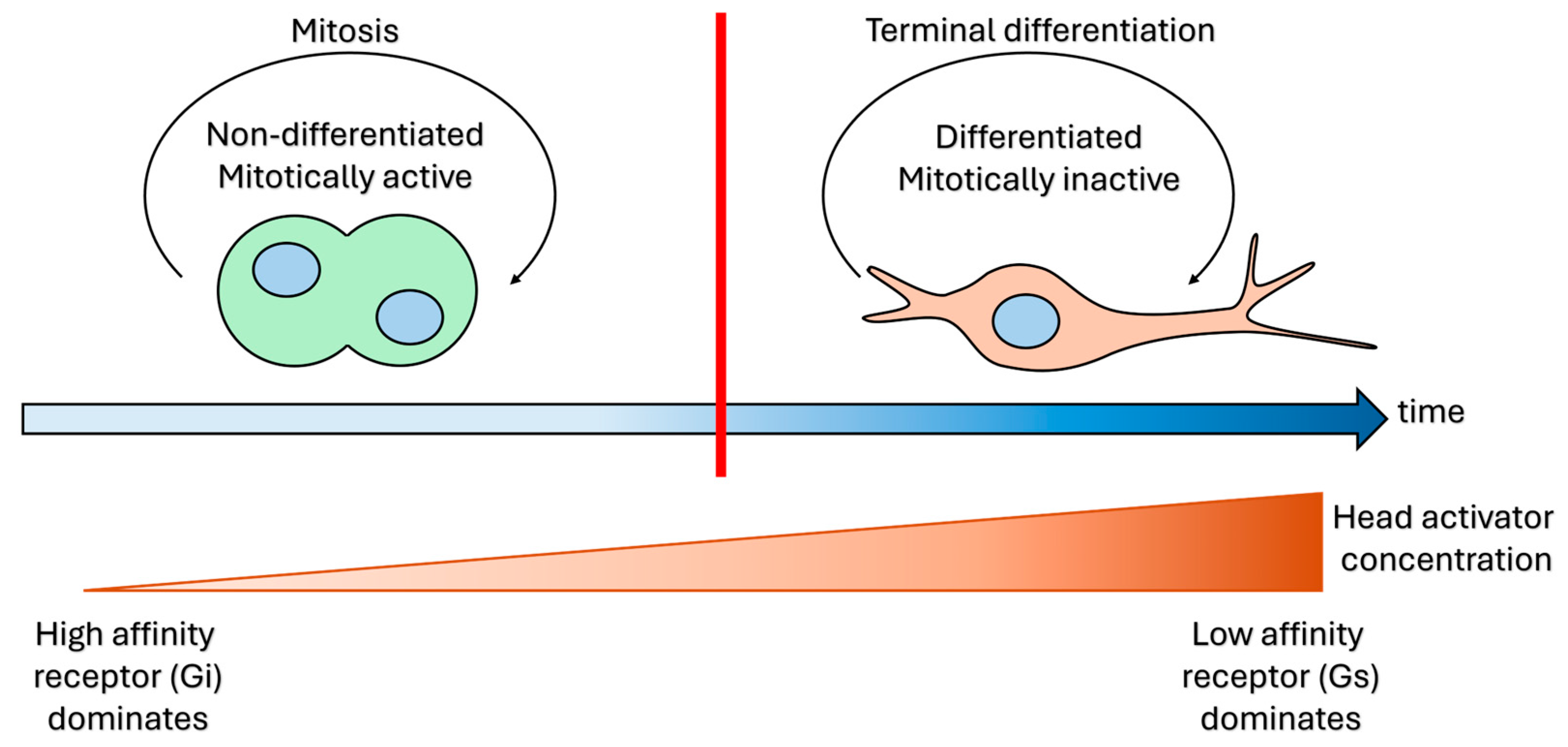
| Condition | Effect | |
|---|---|---|
| cell type | mitotic | mitosis and differentiation |
| post-mitotic | differentiation | |
| time point | early | mitosis |
| late | differentiation | |
| concentration (receptor affinity) | low (high) | mitosis |
| high (low) | differentiation | |
| pathway (AC-cAMP-PKA axis) | AC inhibition | mitosis |
| AC activation | differentiation, neurogenesis | |
| Tissue/Cell Type/Hormone | Effect | Reference |
|---|---|---|
| rat corneal epithelium | proliferation ↑ | [73,74] |
| rat lingual epithelium | proliferation ↑ | |
| rat tracheal epithelium | proliferation ↑ | [75,76] |
| rat tracheal smooth muscle cells | proliferation ↓ | |
| lipid peroxidation system in hypoxic rats | inhibition in lungs | |
| stress response in rats | reduction of lipid peroxidation, corticosterone, normalised thyrotropic hormone, T3, T4, and thymus weight | [74] |
| rat myocardium upon a left ventricular hypertrophy | myocardial remodelling | [77,78] |
| rat myocardium | proliferation ↑ | [79] |
| rats exposed to prenatal hypoxia | normalisation of thymocyte proliferation | [80] |
| rats exposed to prenatal hypoxia | normalisation of hepatocyte and tracheal epithelium proliferation, reduction of pulmonary lipid peroxidation | [75] |
| rat β-endorphine | low dose: ↓ high dose: ↑ | [81] |
| rat corticosterone | low dose: ↑ high dose: ↓ | [81,82,83] |
| rat noradrenaline | low dose: ↑ high dose: ↓ | |
| rat thyroid hormones | low dose: = high dose: Τ3 ↑ | |
| rat insulin | low dose: = high dose: ↑ | |
| liver function in partially hepatectomised rats | ornithine decarboxylase activity in low/medium/high dose: =/↑/↓ protein content: ↑ | |
| cat model of motion sickness | antiemesis | [84] |
| rat duodenal smooth myocytes | proliferation = | [85] |
| injured rat liver | 4 h after injury: cAMP ↑, cGMP = 24 h after injury: cAMP ↓, cGMP ↑ | [57] |
| injured rat striated muscle | cAMP =, cGMP = | |
| rat cultured pancreatic cells | amylase secretion ↑ | [86] |
| human erythrocytes | activation of Na/H exchange | [87] |
Disclaimer/Publisher’s Note: The statements, opinions and data contained in all publications are solely those of the individual author(s) and contributor(s) and not of MDPI and/or the editor(s). MDPI and/or the editor(s) disclaim responsibility for any injury to people or property resulting from any ideas, methods, instructions or products referred to in the content. |
© 2026 by the authors. Licensee MDPI, Basel, Switzerland. This article is an open access article distributed under the terms and conditions of the Creative Commons Attribution (CC BY) license.
Share and Cite
Klymenko, A.; Lutz, D. From Hydra to Humans: Head Activator in Neurogenesis and Neurorepair. Cells 2026, 15, 616. https://doi.org/10.3390/cells15070616
Klymenko A, Lutz D. From Hydra to Humans: Head Activator in Neurogenesis and Neurorepair. Cells. 2026; 15(7):616. https://doi.org/10.3390/cells15070616
Chicago/Turabian StyleKlymenko, Andrii, and David Lutz. 2026. "From Hydra to Humans: Head Activator in Neurogenesis and Neurorepair" Cells 15, no. 7: 616. https://doi.org/10.3390/cells15070616
APA StyleKlymenko, A., & Lutz, D. (2026). From Hydra to Humans: Head Activator in Neurogenesis and Neurorepair. Cells, 15(7), 616. https://doi.org/10.3390/cells15070616