The Crossroads of Neuroinflammation and Biomarkers in Multiple Sclerosis: A Systematic Review

 , , and
Abstract
1. Introduction
2. Materials and Methods
2.1. Eligibility Criteria
2.2. Search Strategy
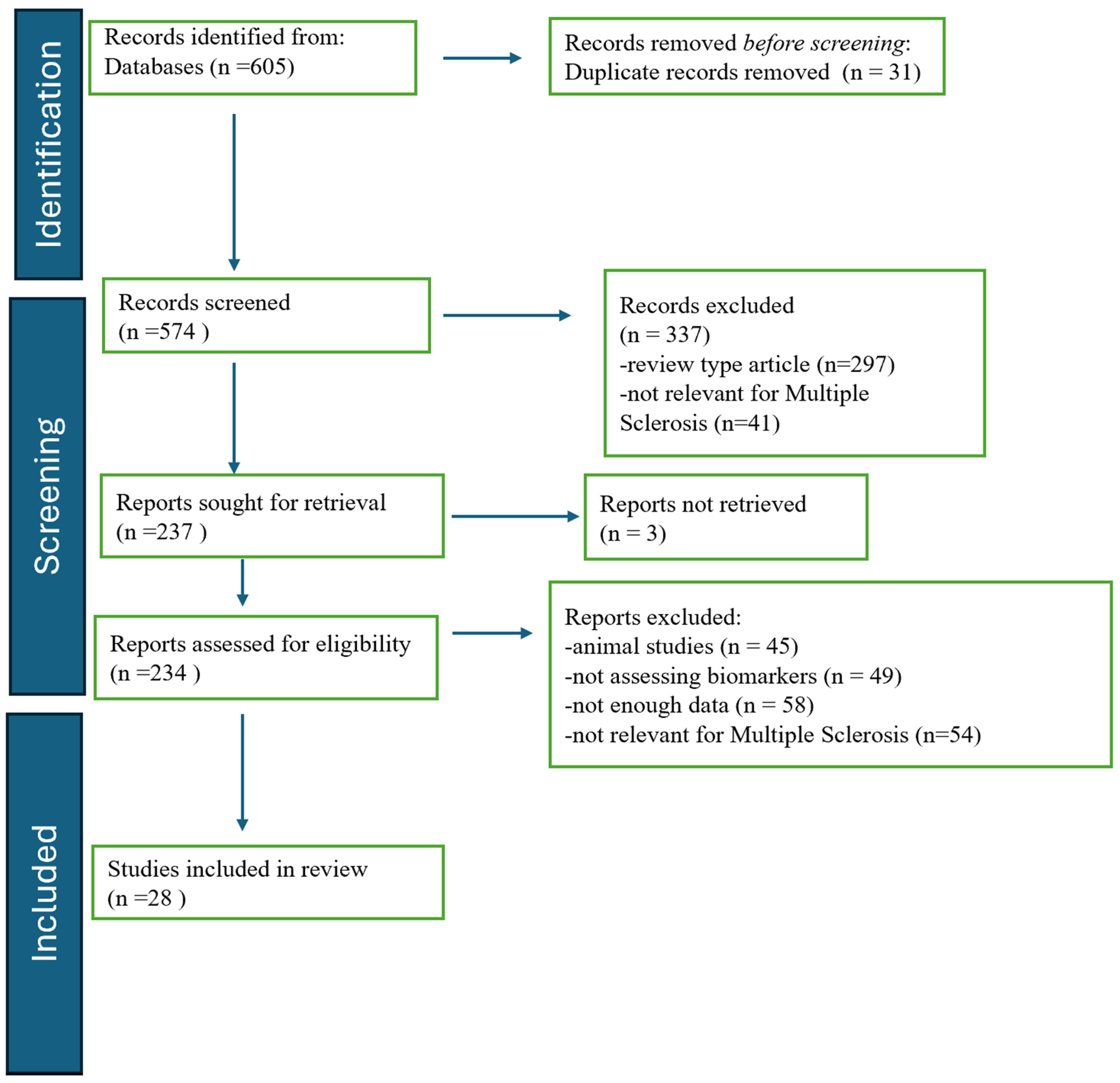
2.3. Document Selection
2.4. Data Collection
3. Results
3.1. Study Characteristics
3.2. Neurofilament Light Chain (NfL): Marker of Acute Neuroaxonal Injury
3.3. Glial Fibrillary Acidic Protein (GFAP): Marker of Astrogliosis
3.4. Immunoglobulins, Complement Factors, Cytokines, and Cellular Subsets
3.5. Oxidative Stress and Additional Emerging Biomarkers
3.6. Clinical and Radiological Correlations: EDSS and MRI
3.6.1. Expanded Disability Status Scale (EDSS)
3.6.2. Associations of Biomarkers with MRI Metrics
3.7. Treatment and Treatment Responses
4. Discussion
Limitations and Future Directions
5. Conclusions
Supplementary Materials
Author Contributions
Funding
Institutional Review Board Statement
Informed Consent Statement
Data Availability Statement
Acknowledgments
Conflicts of Interest
Abbreviations
| AHSCT | Autologous Hematopoietic Stem Cell Transplantation |
| AOPP | Advanced Oxidation Protein Products |
| ARR | Annualized Relapse Rate |
| AUC | Area Under the Curve |
| Ba | Complement Factor Ba |
| Bb | Complement Factor Bb |
| BCR | Brain Central Ratio |
| BPF | Brain Parenchymal Fraction |
| BMI | Body Mass Index |
| CDP | Confirmed Disability Progression |
| CDW | Confirmed Disability Worsening |
| CEL | Contrast-Enhancing Lesions |
| CGM | Cortical Gray Matter |
| CHI3L1 | Chitinase 3-Like 1 |
| CIS | Clinically Isolated Syndrome |
| CNS | Central Nervous System |
| CSF | Cerebrospinal Fluid |
| DTI | Diffusion Tensor Imaging |
| DMT | Disease-Modifying Therapy |
| DNase | Deoxyribonuclease |
| ecDNA | Extracellular DNA |
| EDSS | Expanded Disability Status Scale |
| EDA | Evidence of Disease Activity |
| ELISA | Enzyme-Linked Immunosorbent Assay |
| EV | Extracellular Vesicle |
| FA | Fractional Anisotropy |
| FLAIR | Fluid-Attenuated Inversion Recovery |
| FRAP | Ferric-Reducing Ability of Plasma |
| FSH | Follicle-Stimulating Hormone |
| Gal-9 | Galectin-9 |
| Gas6 | Growth Arrest-Specific 6 |
| GDF-15 | Growth Differentiation Factor 15 |
| GFAP | Glial Fibrillary Acidic Protein |
| GzmB | Granzyme B |
| HR | Hazard Ratio |
| IAW | Inflammatory-Associated Worsening |
| IgG | Immunoglobulin G |
| IL | Interleukin |
| IQR | Interquartile Range |
| K-FLC | Kappa Free Light Chains |
| LS-OCMB | Lipid-Specific IgM Oligoclonal Band |
| MBP | Myelin Basic Protein |
| MD | Mean Diffusivity |
| MRI | Magnetic Resonance Imaging |
| MS | Multiple Sclerosis |
| MST1 | Macrophage-Stimulating 1 |
| mtDNA | Mitochondrial DNA |
| NAWM | Normal-Appearing White Matter |
| NEDA | No Evidence of Disease Activity |
| NfL | Neurofilament Light Chain |
| NMOSD | Neuromyelitis Optica Spectrum Disorder |
| NOx | Nitric Oxide Metabolites |
| NOS | Newcastle–Ottawa Scale |
| OCB | Oligoclonal Band |
| OPN | Osteopontin |
| PBMC | Peripheral Blood Mononuclear Cells |
| PBVC | Percentage Brain Volume Change |
| PDDS | Patient-Determined Disease Steps |
| PIRA | Progression Independent of Relapse Activity |
| PPMS | Primary Progressive Multiple Sclerosis |
| PRDX6 | Peroxiredoxin 6 |
| PRISMA | Preferred Reporting Items for Systematic Reviews and Meta-Analyses |
| RAW | Relapse-Associated Worsening |
| RIS | Radiologically Isolated Syndrome |
| RoB | Risk of Bias |
| ROBINS-I | Risk Of Bias In Non-Randomized Studies of Interventions |
| ROC | Receiver Operating Characteristic |
| RRMS | Relapsing-Remitting Multiple Sclerosis |
| SDMT | Symbol Digit Modalities Test |
| SEL | Slowly Expanding Lesions |
| SEM | Standard Error of the Mean |
| SPMS | Secondary Progressive Multiple Sclerosis |
| sNfL | Serum Neurofilament Light Chain |
| sGFAP | Serum Glial Fibrillary Acidic Protein |
| TBARS | Thiobarbituric Acid Reactive Substances |
| T25FW | Timed 25-Foot Walk |
| T2 | T2-Weighted MRI Sequence |
| TAC | Total Antioxidant Capacity |
| TEM | Effector Memory T Cells |
| TEMRA | Terminally Differentiated Effector Memory T-Cells Re-expressing CD45RA |
| TVW | Third Ventricle Width |
| WBV | Whole-Brain Volume |
| YKL-40 | Chitinase 3-Like Protein |
References
- Compston, A.; Coles, A. Multiple Sclerosis. Lancet 2008, 372, 1502–1517. [Google Scholar] [CrossRef]
- Walton, C.; King, R.; Rechtman, L.; Kaye, W.; Leray, E.; Marrie, R.A.; Robertson, N.; La Rocca, N.; Uitdehaag, B.; Van Der Mei, I.; et al. Rising Prevalence of Multiple Sclerosis Worldwide: Insights from the Atlas of MS, Third Edition. Mult. Scler. 2020, 26, 1816–1821. [Google Scholar] [CrossRef] [PubMed]
- Kingwell, E.; Marriott, J.J.; Jetté, N.; Pringsheim, T.; Makhani, N.; Morrow, S.A.; Fisk, J.D.; Evans, C.; Béland, S.G.; Kulaga, S.; et al. Incidence and Prevalence of Multiple Sclerosis in Europe: A Systematic Review. BMC Neurol. 2013, 13, 128. [Google Scholar] [CrossRef] [PubMed]
- Thompson, A.J.; Baranzini, S.E.; Geurts, J.; Hemmer, B.; Ciccarelli, O. Multiple Sclerosis. Lancet 2018, 391, 1622–1636. [Google Scholar] [CrossRef] [PubMed]
- Lublin, F.D.; Reingold, S.C.; Cohen, J.A.; Cutter, G.R.; Sørensen, P.S.; Thompson, A.J.; Wolinsky, J.S.; Balcer, L.J.; Banwell, B.; Barkhof, F.; et al. Defining the Clinical Course of Multiple Sclerosis: The 2013 Revisions. Neurology 2014, 83, 278–286. [Google Scholar] [CrossRef]
- Bebo, B.; Cintina, I.; LaRocca, N.; Ritter, L.; Talente, B.; Hartung, D.; Ngorsuraches, S.; Wallin, M.; Yang, G. The Economic Burden of Multiple Sclerosis in the United States: Estimate of Direct and Indirect Costs. Neurology 2022, 98, e1810–e1817. [Google Scholar] [CrossRef]
- Safiri, S.; Ghaffari Jolfayi, A.; Mousavi, S.E.; Nejadghaderi, S.A.; Sullman, M.J.M.; Kolahi, A.-A. Global Burden of Multiple Sclerosis and Its Attributable Risk Factors, 1990–2019. Front. Neurol. 2024, 15, 1448377. [Google Scholar] [CrossRef]
- Boutitah-Benyaich, I.; Eixarch, H.; Villacieros-Álvarez, J.; Hervera, A.; Cobo-Calvo, Á.; Montalban, X.; Espejo, C. Multiple sclerosis: Molecular pathogenesis and therapeutic intervention. Signal Transduct. Target. Ther. 2025, 10, 324. [Google Scholar] [CrossRef]
- Giovannoni, G.; Tomic, D.; Bright, J.R.; Havrdová, E. No Evident Disease Activity: The Use of Combined Assessments in the Management of Patients with Multiple Sclerosis. Mult. Scler. 2017, 23, 1179–1187. [Google Scholar] [CrossRef]
- Montalban, X.; Lebrun-Frénay, C.; Oh, J.; Arrambide, G.; Moccia, M.; Pia Amato, M.; Amezcua, L.; Banwell, B.; Bar-Or, A.; Barkhof, F.; et al. Diagnosis of Multiple Sclerosis: 2024 Revisions of the McDonald Criteria. Lancet Neurol. 2025, 24, 850–865. [Google Scholar] [CrossRef]
- Freedman, M.S.; Gnanapavan, S.; Booth, R.A.; Calabresi, P.A.; Khalil, M.; Kuhle, J.; Lycke, J.; Olsson, T. Consortium of Multiple Sclerosis Centers. Guidance for Use of Neurofilament Light Chain as a Cerebrospinal Fluid and Blood Biomarker in Multiple Sclerosis Management. eBioMedicine 2024, 101, 104970. [Google Scholar] [CrossRef]
- Liu, Q.; Xie, F.; Siedlak, S.L.; Nunomura, A.; Honda, K.; Moreira, P.I.; Zhua, X.; Smith, M.A.; Perry, G. Neurofilament Proteins in Neurodegenerative Diseases. Cell. Mol. Life Sci. 2004, 61, 3057–3075. [Google Scholar] [CrossRef] [PubMed]
- Olsson, B.; Portelius, E.; Cullen, N.C.; Sandelius, Å.; Zetterberg, H.; Andreasson, U.; Höglund, K.; Irwin, D.J.; Grossman, M.; Weintraub, D.; et al. Association of Cerebrospinal Fluid Neurofilament Light Protein Levels with Cognition in Patients with Dementia, Motor Neuron Disease, and Movement Disorders. JAMA Neurol. 2019, 76, 318. [Google Scholar] [CrossRef] [PubMed]
- Rosso, M.; Gonzalez, C.T.; Healy, B.C.; Saxena, S.; Paul, A.; Bjornevik, K.; Kuhle, J.; Benkert, P.; Leppert, D.; Guttmann, C.; et al. Temporal Association of sNfL and Gad-enhancing Lesions in Multiple Sclerosis. Ann. Clin. Transl. Neurol. 2020, 7, 945–955. [Google Scholar] [CrossRef] [PubMed]
- Uphaus, T.; Steffen, F.; Muthuraman, M.; Ripfel, N.; Fleischer, V.; Groppa, S.; Ruck, T.; Meuth, S.G.; Pul, R.; Kleinschnitz, C.; et al. NfL Predicts Relapse-Free Progression in a Longitudinal Multiple Sclerosis Cohort Study. eBioMedicine 2021, 72, 103590. [Google Scholar] [CrossRef]
- Shaygannejad, A.; Rafiei, N.; Vaheb, S.; Yazdan Panah, M.; Shaygannejad, V.; Mirmosayyeb, O. The Role of Glial Fibrillary Acidic Protein as a Biomarker in Multiple Sclerosis and Neuromyelitis Optica Spectrum Disorder: A Systematic Review and Meta-Analysis. Medicina 2024, 60, 1050. [Google Scholar] [CrossRef]
- Floro, S.; Carandini, T.; Pietroboni, A.M.; De Riz, M.A.; Scarpini, E.; Galimberti, D. Role of Chitinase 3-like 1 as a Biomarker in Multiple Sclerosis: A Systematic Review and Meta-Analysis. Neurol. Neuroimmunol. Neuroinflamm. 2022, 9, e1164. [Google Scholar] [CrossRef]
- Jiménez-Jiménez, F.J.; Alonso-Navarro, H.; Salgado-Cámara, P.; García-Martín, E.; Agúndez, J.A.G. Oxidative Stress Markers in Multiple Sclerosis. Int. J. Mol. Sci. 2024, 25, 6289. [Google Scholar] [CrossRef]
- Saez-Calveras, N.; Stuve, O. The Role of the Complement System in Multiple Sclerosis: A Review. Front. Immunol. 2022, 13, 970486. [Google Scholar] [CrossRef]
- Page, M.J.; McKenzie, J.E.; Bossuyt, P.M.; Boutron, I.; Hoffmann, T.C.; Mulrow, C.D.; Shamseer, L.; Tetzlaff, J.M.; Akl, E.A.; Brennan, S.E.; et al. The PRISMA 2020 Statement: An Updated Guideline for Reporting Systematic Reviews. BMJ 2021, 372, n71. [Google Scholar] [CrossRef]
- Oechtering, J.; Schaedelin, S.A.; Stein, K.; Maleska Maceski, A.; Melie-Garcia, L.; Benkert, P.; Cagol, A.; Leber, S.; Galbusera, R.; Ruberte, E.; et al. Aberrant Complement Activation Is Associated with Structural Brain Damage in Multiple Sclerosis. Neurol. Neuroimmunol. Neuroinflamm. 2025, 12, e200361. [Google Scholar] [CrossRef] [PubMed]
- Schwerdtfeger, L.A.; Montini, F.; Antonini Cencicchio, M.; Christenson, J.R.; Glanz, B.I.; Falcone, M.; Filippi, M.; Cox, L.M.; Chitnis, T.; Weiner, H.L. Stool Glial Fibrillary Acidic Protein Is Elevated in Progressive Multiple Sclerosis. Neurol. Neuroimmunol. Neuroinflamm. 2025, 12, e200466. [Google Scholar] [CrossRef] [PubMed]
- Zhu, W.; Revu, S.; Chen, C.; Dahl, M.; Ramkumar, A.; Kelly, C.; McGeachy, M.J.; Xia, Z. Aging-Dependent Change in Th17 and Cytokine Response in Multiple Sclerosis. J. Neuroinflamm. 2025, 22, 150. [Google Scholar] [CrossRef] [PubMed]
- Zhang, X.; Hao, H.; Jin, T.; Qiu, W.; Yang, H.; Xue, Q.; Yin, J.; Shi, Z.; Yu, H.; Ji, X.; et al. Cerebrospinal Fluid Oligoclonal Bands in Chinese Patients with Multiple Sclerosis: The Prevalence and Its Association with Clinical Features. Front. Immunol. 2023, 14, 1280020. [Google Scholar] [CrossRef]
- Arroyo Pereiro, P.; Muñoz-Vendrell, A.; León Moreno, I.; Bau, L.; Matas, E.; Romero-Pinel, L.; Martínez Yélamos, A.; Martínez Yélamos, S.; Andrés-Benito, P. Baseline Serum Neurofilament Light Chain Levels Differentiate Aggressive from Benign Forms of Relapsing–Remitting Multiple Sclerosis: A 20-Year Follow-up Cohort. J. Neurol. 2024, 271, 1599–1609. [Google Scholar] [CrossRef]
- Erngren, I.; Lundblad, K.; Pavlovic, I.; Al-Grety, A.; Larsson, A.; Kultima, K.; Burman, J. Biomarkers of Progressive Multiple Sclerosis Decrease Following Autologous Hematopoietic Stem Cell Transplantation. J. Neuroinflamm. 2025, 22, 186. [Google Scholar] [CrossRef]
- Boldrini, V.O.; Marques, A.M.; Quintiliano, R.P.S.; Moraes, A.S.; Stella, C.R.A.V.; Longhini, A.L.F.; Santos, I.; Andrade, M.; Ferrari, B.; Damasceno, A.; et al. Cytotoxic B Cells in Relapsing-Remitting Multiple Sclerosis Patients. Front. Immunol. 2022, 13, 750660. [Google Scholar] [CrossRef]
- Hegen, H.; Berek, K.; Cavalla, P.; Christiansen, M.; Emeršič, A.; Di Filippo, M.; Gaetani, L.; Hassler, M.; Leurs, C.; Milosavljevic, D.; et al. Diagnostic Value of Kappa Free Light Chain Index in Patients with Primary Progressive Multiple Sclerosis—A Multicentre Study. Front. Immunol. 2023, 14, 1327947. [Google Scholar] [CrossRef]
- Monreal, E.; Fernández-Velasco, J.I.; Sainz de la Maza, S.; Espiño, M.; Villarrubia, N.; Roldán-Santiago, E.; Aladro, Y.; Cuello, J.P.; Ayuso-Peralta, L.; Rodero-Romero, A.; et al. Combining CSF and Serum Biomarkers to Differentiate Mechanisms of Disability Worsening in Multiple Sclerosis. Int. J. Mol. Sci. 2025, 26, 6898. [Google Scholar] [CrossRef]
- Shinoda, K.; Li, R.; Rezk, A.; Mexhitaj, I.; Patterson, K.R.; Kakara, M.; Zuroff, L.; Bennett, J.L.; von Büdingen, H.-C.; Carruthers, R.; et al. Differential Effects of Anti-CD20 Therapy on CD4 and CD8 T Cells and Implication of CD20-Expressing CD8 T Cells in MS Disease Activity. Proc. Natl. Acad. Sci. USA 2023, 120, e2207291120. [Google Scholar] [CrossRef]
- Brichette-Mieg, I.; Alonso-Torres, A.; Aliaga-Gaspar, P.; Rodríguez-Bada, J.-L.; Reyes-Garrido, V.; Urbaneja-Romero, P.; Muñoz, C.; Díaz-Sánchez, M.; Martín-Montañez, E.; Cabello-Porras, M.-D.-R.; et al. Discovery and Early Validation of Serum Protein Signatures in Untreated Multiple Sclerosis Patients: Identification of Candidate Biomarkers for Diagnosis and Stratification. Front. Immunol. 2025, 16, 1579045. [Google Scholar] [CrossRef]
- Marček, P.; Kadlic, P.; Adamová, L.-M.; Tóthova, Ľ.; Pastorek, M.; Kovalčíkova, A.G.; Valkovič, P.; Minár, M.; Slezáková, D. Extracellular DNA and Deoxyribonuclease Activity as Potential Biomarkers of Inflammation in Multiple Sclerosis. Mol. Neurobiol. 2025, 62, 10310–10319. [Google Scholar] [CrossRef]
- Lim Falk, V.; Mueller-Wirth, N.; Karathanasis, D.; Evangelopoulos, M.E.; Maleska Maceski, A.; Zadic, A.; Kuhle, J.; Schlup, C.; Marti, S.; Guse, K.; et al. Extracellular Vesicle Marker Changes Associated with Disease Activity in Relapsing-Remitting Multiple Sclerosis. Neurol. Neuroimmunol. Neuroinflamm. 2025, 12, e200404. [Google Scholar] [CrossRef] [PubMed]
- Jiang, X.; Shen, C.; Teunissen, C.E.; Wessels, M.; Zetterberg, H.; Giovannoni, G.; Singh, C.M.; Caba, B.; Elliott, C.; Fisher, E.; et al. Glial Fibrillary Acidic Protein and Multiple Sclerosis Progression Independent of Acute Inflammation. Mult. Scler. 2023, 29, 1070–1079. [Google Scholar] [CrossRef] [PubMed]
- Shi, Z.; Wang, X.; Wang, J.; Chen, H.; Du, Q.; Lang, Y.; Kong, L.; Luo, W.; Qiu, Y.; Zhang, Y.; et al. Granzyme B + CD8 + T Cells with Terminal Differentiated Effector Signature Determine Multiple Sclerosis Progression. J. Neuroinflamm. 2023, 20, 138. [Google Scholar] [CrossRef] [PubMed]
- Harris, S.; Comi, G.; Cree, B.A.C.; Arnold, D.L.; Steinman, L.; Sheffield, J.K.; Maddux, R.; Southworth, H.; Kappos, L.; Cohen, J.A. Glial Fibrillary Acidic Protein as a Marker of Disease in Relapsing Multiple Sclerosis: Post Hoc Analysis of Phase 3 Ozanimod Trials. Eur. J. Neurol. 2025, 32, e70222. [Google Scholar] [CrossRef]
- Sy, M.; Newton, B.L.; Pawling, J.; Hayama, K.L.; Cordon, A.; Yu, Z.; Kuhle, J.; Dennis, J.W.; Brandt, A.U.; Demetriou, M. N-Acetylglucosamine Inhibits Inflammation and Neurodegeneration Markers in Multiple Sclerosis: A Mechanistic Trial. J. Neuroinflamm. 2023, 20, 209. [Google Scholar] [CrossRef]
- Jakimovski, D.; Zivadinov, R.; Qureshi, F.; Ramanathan, M.; Weinstock-Guttman, B.; Tavazzi, E.; Dwyer, M.G.; Bergsland, N. Serum Biomarker Signatures of Choroid Plexus Volume Changes in Multiple Sclerosis. Biomolecules 2024, 14, 824. [Google Scholar] [CrossRef]
- Oset, M.; Domowicz, M.; Wildner, P.; Siger, M.; Karlińska, I.; Stasiołek, M.; Świderek-Matysiak, M. Predictive Value of Brain Atrophy, Serum Biomarkers and Information Processing Speed for Early Disease Progression in Multiple Sclerosis. Front. Neurol. 2023, 14, 1223220. [Google Scholar] [CrossRef]
- Ammitzbøll, C.; Dyrby, T.B.; Börnsen, L.; Schreiber, K.; Ratzer, R.; Romme Christensen, J.; Iversen, P.; Magyari, M.; Lundell, H.; Jensen, P.E.H.; et al. NfL and GFAP in Serum Are Associated with Microstructural Brain Damage in Progressive Multiple Sclerosis. Mult. Scler. Relat. Disord. 2023, 77, 104854. [Google Scholar] [CrossRef]
- Krajnc, N.; Ponleitner, M.; Föttinger, F.; Leutmezer, F.; Macher, S.; Monschein, T.; Rommer, P.; Kornek, B.; Schmied, C.; Zebenholzer, K.; et al. Serum Neurofilament Light Chain and Glial Fibrillary Acidic Protein Levels Are Associated with Inner Retinal Layer Thinning in Multiple Sclerosis. Mult. Scler. 2025, 31, 1175–1186. [Google Scholar] [CrossRef]
- Abdelhak, A.; Antweiler, K.; Kowarik, M.C.; Senel, M.; Havla, J.; Zettl, U.K.; Kleiter, I.; Skripuletz, T.; Haarmann, A.; Stahmann, A.; et al. Serum Glial Fibrillary Acidic Protein and Disability Progression in Progressive Multiple Sclerosis. Ann. Clin. Transl. Neurol. 2024, 11, 477–485. [Google Scholar] [CrossRef] [PubMed]
- Barro, C.; Healy, B.C.; Liu, Y.; Saxena, S.; Paul, A.; Polgar-Turcsanyi, M.; Guttmann, C.R.G.; Bakshi, R.; Kropshofer, H.; Weiner, H.L.; et al. Serum GFAP and NfL Levels Differentiate Subsequent Progression and Disease Activity in Patients with Progressive Multiple Sclerosis. Neurol. Neuroimmunol. Neuroinflamm. 2023, 10, e200052. [Google Scholar] [CrossRef]
- Juutinen, L.; Ahinko, K.; Hagman, S.; Basnyat, P.; Jääskeläinen, O.; Herukka, S.-K.; Sumelahti, M.-L. The Association of Menopausal Hormone Levels with Progression-Related Biomarkers in Multiple Sclerosis. Mult. Scler. Relat. Disord. 2024, 85, 105517. [Google Scholar] [CrossRef] [PubMed]
- Thebault, S.; Fereshtehnejad, S.-M.; Bergman, H.P.; Breville, G.; Abdoli, M.; Booth, R.A.; Fadda, G.; Freedman, M.S.; Bose, G. The Combination of CSF Neurofilament Light Chain and Glial Fibrillary Acidic Protein Improves the Prediction of Long-Term Confirmed Disability Worsening in Multiple Sclerosis. Sci. Rep. 2024, 14, 29135. [Google Scholar] [CrossRef] [PubMed]
- Räuber, S.; Förster, M.; Schüller, J.; Willison, A.; Golombeck, K.S.; Schroeter, C.B.; Oeztuerk, M.; Jansen, R.; Huntemann, N.; Nelke, C.; et al. The Use of Nitrosative Stress Molecules as Potential Diagnostic Biomarkers in Multiple Sclerosis. Int. J. Mol. Sci. 2024, 25, 787. [Google Scholar] [CrossRef]
- Carmona, S.; Aghzadi, J.; Vincent, T.; Labauge, P.; Carra-Dallière, C.; Lehmann, S.; Desplat-Jégo, S.; Ayrignac, X. TWEAK and TNFɑ Pro-Inflammatory Soluble Cytokines and Their Specific Autoantibodies Secretion in Multiple Sclerosis Patients. Inflammation 2024, 48, 2494–2502. [Google Scholar] [CrossRef]
- Rosenstein, I.; Novakova, L.; Kvartsberg, H.; Nordin, A.; Rasch, S.; Rembeza, E.; Sandgren, S.; Malmeström, C.; Fruhwürth, S.; Axelsson, M.; et al. Tyro3 and Gas6 Are Associated with White Matter and Myelin Integrity in Multiple Sclerosis. J. Neuroinflamm. 2024, 21, 320. [Google Scholar] [CrossRef]
- Wells, G.A.; Shea, B.; O’Connell, D.; Peterson, J.; Welch, V.; Losos, M.; Tugwell, P. The Newcastle-Ottawa Scale (NOS) for Assesing the Quality of Nonrandomised Studies in Meta-Analysis; Ottawa Hospital Research Institute: Ottawa, ON, Canada, 2000; Available online: https://ohri.ca/en/who-we-are/core-facilities-and-platforms/ottawa-methods-centre/newcastle-ottawa-scale (accessed on 3 January 2026).
- Aromataris, E.; Lockwood, C.; Porritt, K.; Pilla, B.; Jordan, Z. (Eds.) JBI Manual for Evidence Synthesis, 2024th ed.; JBI: Adelaide, Australia, 2024. [Google Scholar]
- Sterne, J.A.; Savović, J.; Page, M.J.; Elbers, R.G.; Blencowe, N.S.; Boutron, I.; Cates, C.J.; Cheng, H.Y.; Corbett, M.S.; Eldridge, S.M.; et al. RoB 2: A revised tool for assessing risk of bias in randomised trials. BMJ 2019, 366, l4898. [Google Scholar] [CrossRef]
- Sterne, J.A.; Hernán, M.A.; Reeves, B.C.; Savović, J.; Berkman, N.D.; Viswanathan, M.; Henry, D.; Altman, D.G.; Ansari, M.T.; Boutron, I.; et al. ROBINS-I: A Tool for Assessing Risk of Bias in Non-Randomised Studies of Interventions. BMJ 2016, 355, i4919. [Google Scholar] [CrossRef]
- Whiting, P.F.; Rutjes, A.W.S.; Westwood, M.E.; Mallett, S.; Deeks, J.J.; Reitsma, J.B.; Leeflang, M.M.G.; Sterne, J.A.C.; Bossuyt, P.M.M.; the QUADAS-2 Group. QUADAS-2: A Revised Tool for the Quality Assessment of Diagnostic Accuracy Studies. Ann. Intern. Med. 2011, 155, 529–536. [Google Scholar] [CrossRef] [PubMed]
- Kebir, H.; Kreymborg, K.; Ifergan, I.; Dodelet-Devillers, A.; Cayrol, R.; Bernard, M.; Giuliani, F.; Arbour, N.; Becher, B.; Prat, A. Human TH17 Lymphocytes Promote Blood-Brain Barrier Disruption and Central Nervous System Inflammation. Nat. Med. 2007, 13, 1173–1175. [Google Scholar] [CrossRef] [PubMed]
- Sospedra, M.; Martin, R. Immunology of Multiple Sclerosis. Annu. Rev. Immunol. 2005, 23, 683–747. [Google Scholar] [CrossRef] [PubMed]
- Lassmann, H.; Bradl, M. Multiple Sclerosis: Experimental Models and Reality. Acta Neuropathol. 2017, 133, 223–244. [Google Scholar] [CrossRef]
- Hemmer, B.; Kerschensteiner, M.; Korn, T. Role of the Innate and Adaptive Immune Responses in the Course of Multiple Sclerosis. Lancet Neurol. 2015, 14, 406–419. [Google Scholar] [CrossRef]
- Lassmann, H. Pathogenic Mechanisms Associated with Different Clinical Courses of Multiple Sclerosis. Front. Immunol. 2018, 9, 3116. [Google Scholar] [CrossRef]
- Petrova, N.; Carassiti, D.; Altmann, D.R.; Baker, D.; Schmierer, K. Axonal Loss in the Multiple Sclerosis Spinal Cord Revisited. Brain Pathol. 2018, 28, 334–348. [Google Scholar] [CrossRef]
- Sormani, M.P.; Haering, D.A.; Kropshofer, H.; Leppert, D.; Kundu, U.; Barro, C.; Kappos, L.; Tomic, D.; Kuhle, J. Blood Neurofilament Light as a Potential Endpoint in Phase 2 Studies in MS. Ann. Clin. Transl. Neurol. 2019, 6, 1081–1089. [Google Scholar] [CrossRef]
- Piehl, F.; Kockum, I.; Khademi, M.; Blennow, K.; Lycke, J.; Zetterberg, H.; Olsson, T. Plasma Neurofilament Light Chain Levels in Patients with MS Switching from Injectable Therapies to Fingolimod. Mult. Scler. 2018, 24, 1046–1054. [Google Scholar] [CrossRef]
- Chitnis, T.; Gonzalez, C.; Healy, B.C.; Saxena, S.; Rosso, M.; Barro, C.; Michalak, Z.; Paul, A.; Kivisakk, P.; Diaz-Cruz, C.; et al. Neurofilament Light Chain Serum Levels Correlate with 10-Year MRI Outcomes in Multiple Sclerosis. Ann. Clin. Transl. Neurol. 2018, 5, 1478–1491. [Google Scholar] [CrossRef]
- Kapoor, R.; Smith, K.E.; Allegretta, M.; Arnold, D.L.; Carroll, W.; Comabella, M.; Furlan, R.; Harp, C.; Kuhle, J.; Leppert, D.; et al. Serum Neurofilament Light as a Biomarker in Progressive Multiple Sclerosis. Neurology 2020, 95, 436–444. [Google Scholar] [CrossRef]
- Khalil, M.; Teunissen, C.E.; Otto, M.; Piehl, F.; Sormani, M.P.; Gattringer, T.; Barro, C.; Kappos, L.; Comabella, M.; Fazekas, F.; et al. Neurofilaments as Biomarkers in Neurological Disorders. Nat. Rev. Neurol. 2018, 14, 577–589. [Google Scholar] [CrossRef]
- Mahad, D.H.; Trapp, B.D.; Lassmann, H. Pathological Mechanisms in Progressive Multiple Sclerosis. Lancet Neurol. 2015, 14, 183–193. [Google Scholar] [CrossRef] [PubMed]
- Graves, J.S.; Krysko, K.M.; Hua, L.H.; Absinta, M.; Franklin, R.J.M.; Segal, B.M. Ageing and Multiple Sclerosis. Lancet Neurol. 2023, 22, 66–77. [Google Scholar] [CrossRef] [PubMed]
- Lassmann, H.; van Horssen, J.; Mahad, D. Progressive Multiple Sclerosis: Pathology and Pathogenesis. Nat. Rev. Neurol. 2012, 8, 647–656. [Google Scholar] [CrossRef] [PubMed]
- University of California, San Francisco MS-EPIC Team; Cree, B.A.C.; Hollenbach, J.A.; Bove, R.; Kirkish, G.; Sacco, S.; Caverzasi, E.; Bischof, A.; Gundel, T.; Zhu, A.H.; et al. Silent Progression in Disease Activity-Free Relapsing Multiple Sclerosis. Ann. Neurol. 2019, 85, 653–666. [Google Scholar] [CrossRef]
- Kappos, L.; Butzkueven, H.; Wiendl, H.; Spelman, T.; Pellegrini, F.; Chen, Y.; Dong, Q.; Koendgen, H.; Belachew, S.; Trojano, M.; et al. Greater Sensitivity to Multiple Sclerosis Disability Worsening and Progression Events Using a Roving versus a Fixed Reference Value in a Prospective Cohort Study. Mult. Scler. 2018, 24, 963–973. [Google Scholar] [CrossRef]
- Kappos, L.; Wolinsky, J.S.; Giovannoni, G.; Arnold, D.L.; Wang, Q.; Bernasconi, C.; Model, F.; Koendgen, H.; Manfrini, M.; Belachew, S.; et al. Contribution of Relapse-Independent Progression vs Relapse-Associated Worsening to Overall Confirmed Disability Accumulation in Typical Relapsing Multiple Sclerosis in a Pooled Analysis of 2 Randomized Clinical Trials. JAMA Neurol. 2020, 77, 1132–1140. [Google Scholar] [CrossRef]
- Eng, L.F.; Ghirnikar, R.S.; Lee, Y.L. Glial Fibrillary Acidic Protein: GFAP-Thirty-One Years (1969–2000). Neurochem. Res. 2000, 25, 1439–1451. [Google Scholar] [CrossRef]
- Middeldorp, J.; Hol, E.M. GFAP in Health and Disease. Prog. Neurobiol. 2011, 93, 421–443. [Google Scholar] [CrossRef]
- Hol, E.M.; Pekny, M. Glial Fibrillary Acidic Protein (GFAP) and the Astrocyte Intermediate Filament System in Diseases of the Central Nervous System. Curr. Opin. Cell Biol. 2015, 32, 121–130. [Google Scholar] [CrossRef]
- Rosengren, L.E.; Karlsson, J.E.; Karlsson, J.O.; Persson, L.I.; Wikkelsø, C. Patients with Amyotrophic Lateral Sclerosis and Other Neurodegenerative Diseases Have Increased Levels of Neurofilament Protein in CSF. J. Neurochem. 1996, 67, 2013–2018. [Google Scholar] [CrossRef] [PubMed]
- Sofroniew, M.V.; Vinters, H.V. Astrocytes: Biology and Pathology. Acta Neuropathol. 2010, 119, 7–35. [Google Scholar] [CrossRef] [PubMed]
- Pekny, M.; Pekna, M. Astrocyte Reactivity and Reactive Astrogliosis: Costs and Benefits. Physiol. Rev. 2014, 94, 1077–1098. [Google Scholar] [CrossRef] [PubMed]
- Surugiu, R.; Glavan, D.; Popescu, M.; Margaritescu, O.; Eugen, R.; Popa-Wagner, A. Vasculature Remodeling in a Rat Model of Cerebral Ischemia. The Fate of the BrdU-Labeled Cells Prior to Stroke. Front. Neurol. 2018, 9, 1014. [Google Scholar] [CrossRef] [PubMed] [PubMed Central]
- Liddelow, S.A.; Barres, B.A. Reactive Astrocytes: Production, Function, and Therapeutic Potential. Immunity 2017, 46, 957–967. [Google Scholar] [CrossRef]
- Liddelow, S.A.; Guttenplan, K.A.; Clarke, L.E.; Bennett, F.C.; Bohlen, C.J.; Schirmer, L.; Bennett, M.L.; Münch, A.E.; Chung, W.-S.; Peterson, T.C.; et al. Neurotoxic Reactive Astrocytes Are Induced by Activated Microglia. Nature 2017, 541, 481–487. [Google Scholar] [CrossRef]
- Popa-Wagner, A.; Sandu, R.E.; Cristin, C.; Uzoni, A.; Welle, K.A.; Hryhorenko, J.R.; Ghaemmaghami, S. Increased Degradation Rates in the Components of the Mitochondrial Oxidative Phosphorylation Chain in the Cerebellum of Old Mice. Front. Aging Neurosci. 2018, 10, 32. [Google Scholar] [CrossRef]
- Ramaglia, V.; Hughes, T.R.; Donev, R.M.; Ruseva, M.M.; Wu, X.; Huitinga, I.; Baas, F.; Neal, J.W.; Morgan, B.P. C3-Dependent Mechanism of Microglial Priming Relevant to Multiple Sclerosis. Proc. Natl. Acad. Sci. USA 2012, 109, 965–970. [Google Scholar] [CrossRef]
- Ingram, G.; Hakobyan, S.; Hirst, C.L.; Harris, C.L.; Pickersgill, T.P.; Cossburn, M.D.; Loveless, S.; Robertson, N.P.; Morgan, B.P. Complement Regulator Factor H as a Serum Biomarker of Multiple Sclerosis Disease State. Brain 2010, 133, 1602–1611. [Google Scholar] [CrossRef]
- Bonneh-Barkay, D.; Bissel, S.J.; Kofler, J.; Starkey, A.; Wang, G.; Wiley, C.A. Astrocyte and Macrophage Regulation of YKL-40 Expression and Cellular Response in Neuroinflammation. Brain Pathol. 2012, 22, 530–546. [Google Scholar] [CrossRef] [PubMed]
- Bonneh-Barkay, D.; Wang, G.; Starkey, A.; Hamilton, R.L.; Wiley, C.A. In Vivo CHI3L1 (YKL-40) Expression in Astrocytes in Acute and Chronic Neurological Diseases. J. Neuroinflamm. 2010, 7, 34. [Google Scholar] [CrossRef]
- Comabella, M.; Fernández, M.; Martin, R.; Rivera-Vallvé, S.; Borrás, E.; Chiva, C.; Julià, E.; Rovira, A.; Cantó, E.; Alvarez-Cermeño, J.C.; et al. Cerebrospinal Fluid Chitinase 3-like 1 Levels Are Associated with Conversion to Multiple Sclerosis. Brain 2010, 133, 1082–1093. [Google Scholar] [CrossRef] [PubMed]
- Morgan, B.P.; Harris, C.L. Complement, a Target for Therapy in Inflammatory and Degenerative Diseases. Nat. Rev. Drug Discov. 2015, 14, 857–877. [Google Scholar] [CrossRef]
- Johansen, J.S.; Schultz, N.A.; Jensen, B.V. Plasma YKL-40: A Potential New Cancer Biomarker? Future Oncol. 2009, 5, 1065–1082. [Google Scholar] [CrossRef]
- Querol-Vilaseca, M.; Colom-Cadena, M.; Pegueroles, J.; San Martín-Paniello, C.; Clarimon, J.; Belbin, O.; Fortea, J.; Lleó, A. YKL-40 (Chitinase 3-like I) Is Expressed in a Subset of Astrocytes in Alzheimer’s Disease and Other Tauopathies. J. Neuroinflamm. 2017, 14, 118. [Google Scholar] [CrossRef]
- Kurtzke, J.F. Rating Neurologic Impairment in Multiple Sclerosis: An Expanded Disability Status Scale (EDSS). Neurology 1983, 33, 1444–1452. [Google Scholar] [CrossRef]
- Pinoșanu, E.A.; Surugiu, R.; Burada, E.; Pîrșcoveanu, D.; Stănciulescu, C.E.; Sandu, R.E.; Pisoschi, C.; Albu, C.V. Oxidative Stress and Antioxidant Defense Mechanisms in Acute Ischemic Stroke Patients with Concurrent COVID-19 Infection. Int. J. Mol. Sci. 2023, 24, 16790. [Google Scholar] [CrossRef] [PubMed] [PubMed Central]
- Pinoșanu, E.A.; Pîrșcoveanu, D.; Albu, C.V.; Burada, E.; Pîrvu, A.; Surugiu, R.; Sandu, R.E.; Serb, A.F. Rhoa/ROCK, mTOR and Secretome-Based Treatments for Ischemic Stroke: New Perspectives. Curr. Issues Mol. Biol. 2024, 46, 3484–3501. [Google Scholar] [CrossRef] [PubMed] [PubMed Central]
- Lemke, G. Biology of the TAM Receptors. Cold Spring Harb. Perspect. Biol. 2013, 5, a009076. [Google Scholar] [CrossRef]
- Stancu, M.I.; Giubelan, A.; Mitroi, G.; Istrate-Ofiţeru, A.M.; Popescu, G.; Honţaru, S.O.; Badea-Voiculescu, O.; Pîrşcoveanu, D.F.V.; Mogoantă, S.Ş.; Mogoantă, L. Assessment of tumor microenvironment in gastric adenocarcinoma. Rom. J. Morphol. Embryol. 2023, 64, 251–261. [Google Scholar] [CrossRef] [PubMed] [PubMed Central]
- Fruntelată, R.F.; Bakri, A.; Stoica, G.A.; Mogoantă, L.; Ionovici, N.; Popescu, G.; Pîrşcoveanu, D.F.V.; Raicea, A.; Ciurea, M.E. Assessment of tumoral and peritumoral inflammatory reaction in cutaneous malignant melanomas. Rom. J. Morphol. Embryol. 2023, 64, 41–48. [Google Scholar] [CrossRef] [PubMed] [PubMed Central]
- Rothlin, C.V.; Ghosh, S.; Zuniga, E.I.; Oldstone, M.B.A.; Lemke, G. TAM Receptors Are Pleiotropic Inhibitors of the Innate Immune Response. Cell 2007, 131, 1124–1136. [Google Scholar] [CrossRef]
- Cabrera-Pastor, A. Extracellular vesicles as mediators of neuroinflammation in intercellular and inter-organ crosstalk. Int. J. Mol. Sci. 2024, 25, 7041. [Google Scholar] [CrossRef]
- Abuzan, M.; Surugiu, R.; Wang, C.; Mohamud-Yusuf, A.; Tertel, T.; Catalin, B.; Doeppner, T.R.; Giebel, B.; Hermann, D.M.; Popa-Wagner, A. Extracellular Vesicles Obtained from Hypoxic Mesenchymal Stromal Cells Induce Neurological Recovery, Anti-inflammation, and Brain Remodeling After Distal Middle Cerebral Artery Occlusion in Rats. Transl. Stroke Res. 2025, 16, 817–830. [Google Scholar] [CrossRef] [PubMed] [PubMed Central]
- Sandu, R.E.; Uzoni, A.; Coman, C.; Popa-Wagner, A. Cerebral ischemia in the aged. Limited anti-inflammatory efficacy of the indomethacin treatment. Rom. J. Morphol. Embryol. 2015, 56, 1111–1117. [Google Scholar] [PubMed]
- Bărbulescu, A.L.; Sandu, R.E.; Vreju, A.F.; Ciurea, P.L.; Criveanu, C.; Firulescu, S.C.; Chisălău, A.B.; Pârvănescu, C.D.; Ciobanu, D.A.; Radu, M.; et al. Neuroinflammation in systemic lupus erythematosus—A review. Rom. J. Morphol. Embryol. 2019, 60, 781–786. [Google Scholar] [PubMed]
- Sandu, R.E.; Dumbrava, D.; Surugiu, R.; Glavan, D.G.; Gresita, A.; Petcu, E.B. Cellular and Molecular Mechanisms Underlying Non-Pharmaceutical Ischemic Stroke Therapy in Aged Subjects. Int. J. Mol. Sci. 2017, 19, 99. [Google Scholar] [CrossRef] [PubMed]


| No. | References | Country | Sample Size (N) and Phenotypes | EDSS and MRI Examined | Markers Assessed | Main Findings |
|---|---|---|---|---|---|---|
| 1 | [21] | Switzerland | N: 239 Pts CIS, RRMS, SPMS, PPMS | EDSS: yes MRI: Volumetric, T2 | CSF: C1q, C3a, C4a, NfL, GFAP |
|
| 2 | [22] | USA/Italy | N: 130 Pts, 31 Ctrl RRMS, ProgMS | EDSS: yes MRI: no | Stool: GFAP, NfL |
|
| 3 | [23] | USA | N: 669 Pts RRMS, SPMS | EDSS: no MRI: yes | Peripheral blood mononuclear cells (PBMCs): IL-17, IFN-gamma |
|
| 4 | [24] | China | N: 483 Pts, 880 Ctrl MS (all types) | EDSS: yes MRI: yes | CSF: OCB |
|
| 5 | [25] | Spain | N: 50 Pts, 10 Ctrl Benign vs. Aggressive | EDSS: yes MRI: yes | Serum: NfL, GFAP |
|
| 6 | [26] | Sweden | N: 45 Pts, 32 Ctrl RRMS (AHSCT) | EDSS: yes MRI: yes | CSF: Gal-9, GDF-15, YKL-40 |
|
| 7 | [27] | Brazil | N: 104 Pts, 58 Ctrl RRMS | EDSS: yes MRI: no | PBMC: CD19+GzmB+ |
|
| 8 | [28] | Multicenter | N: 174 Pts PPMS | EDSS: no MRI: no | CSF: K-FLC |
|
| 9 | [29] | Spain | N: 535 Pts Relapsing MS | EDSS: yes MRI: yes | Serum: NfL, GFAP |
|
| 10 | [30] | USA | N: 58 Pts RRMS, PPMS | EDSS: yes MRI: yes | PBMC: CD20+T cells |
|
| 11 | [31] | Spain | N: 98 Pts, 27 Ctrl Untreated MS | EDSS: yes MRI: yes | Serum: PRDX6, MST1 |
|
| 12 | [32] | Slovakia | N: 51 Pts, 16 Ctrl Naive RRMS | EDSS: yes MRI: yes | Plasma: ecDNA, DNase |
|
| 13 | [33] | Greece | N: 81 Pts, 15 Ctrl RRMS, NMOSD | EDSS: yes MRI: no | Plasma: EVs, NfL, GFAP |
|
| 14 | [34] | Multicenter | N: 264 Pts SPMS (non-active) | EDSS: yes MRI: yes | Serum: GFAP, NfL |
|
| 15 | [35] | China | N: 50 Pts, 24 Ctrl RRMS, SPMS | EDSS: yes MRI: yes | PBMC: GzmB+ CD8+ |
|
| 16 | [36] | Multicenter | N: 2056 Pts Relapsing MS | EDSS: yes MRI: yes | Plasma: GFAP, NfL |
|
| 17 | [37] | USA | N: 34 Pts MS on Glatiramer | EDSS: yes MRI: no | Serum: GlcNAc, NfL |
|
| 18 | [38] | USA | N: 202 Pts RRMS, PMS | EDSS: yes MRI: yes | Serum: NfL, GFAP |
|
| 19 | [39] | Poland | N: 50 Pts Early RRMS | EDSS: yes MRI: yes | Serum: NfL, GFAP |
|
| 20 | [40] | Denmark | N: 32 Pts, 32 Ctrl Progressive MS | EDSS: yes MRI: yes | Serum: NfL, GFAP |
|
| 21 | [41] | Austria | N: 116 Pts Relapsing MS | EDSS: yes MRI: yes | Serum: NfL, GFAP |
|
| 22 | [42] | Germany | N: 243 Pts SPMS, PPMS | EDSS: yes MRI: yes | Serum: NfL, GFAP |
|
| 23 | [43] | USA | N: 257 Pts Progressive MS | EDSS: yes MRI: yes | Serum: NfL, GFAP |
|
| 24 | [44] | Finland | N: 16 Pts, 15 Ctrl Menopausal MS | EDSS: yes MRI: yes | Serum: NfL, GFAP |
|
| 25 | [45] | Canada | N: 60 Pts MS (Baseline) | EDSS: yes MRI: no | CSF/Serum: NfL/GFAP |
|
| 26 | [46] | Germany | N: 117 Pts RRMS, PPMS | EDSS: yes MRI: yes | Serum/CSF: NOx |
|
| 27 | [47] | France | N: 150 Pts, 186 Ctrl RRMS, PMS | EDSS: yes MRI: no | Serum: TWEAK, NfL, GFAP |
|
| 28 | [48] | Sweden | N: 60 Pts, 25 Ctrl RRMS, PMS | EDSS: yes MRI: yes | CSF: Gas 6, NfL, GFAP |
|
| No. | Study | Selection (Max ****) | Comparability (Max **) | Outcome (Max ***) | Total Score | Risk Level | Justification |
|---|---|---|---|---|---|---|---|
| 1 | [21] | **** | ** | ** | 8/9 | Low | Representative cohort; valid MRI/biomarker methods; minor attrition |
| 2 | [22] | *** | ** | *** | 8/9 | Low | Clear definitions; controlled for age/sex; secure ELISA method |
| 3 | [25] | *** | ** | *** | 8/9 | Low | Clear phenotypes adjusted for age/EDSS; long follow-up |
| 4 | [26] | **** | ** | *** | 9/9 | Low | Well-defined AHSCT cohort; adjusted analysis |
| 5 | [29] | **** | ** | *** | 9/9 | Low | Large prospective cohort; extensive adjustment; rigorous definitions |
| 6 | [30] | *** | ** | *** | 8/9 | Low | Independent validation cohort; longitudinal; standardized MRI |
| 7 | [38] | **** | ** | *** | 9/9 | Low | Large longitudinal cohort; adjusted for age/sex/BMI; blinded analysis |
| 8 | [39] | *** | * | ** | 6/9 | Moderate | Prospective; lack of healthy controls for some metrics; short follow-up |
| 9 | [40] | *** | ** | *** | 8/9 | Low | Recruited from trials; healthy controls included; adjusted for treatment |
| 10 | [41] | **** | ** | *** | 9/9 | Low | Well-defined prospective cohort; multivariate adjustment; blinded analysis |
| 11 | [42] | *** | * | *** | 7/9 | Low | Large prospective PMS cohort; adjusted analysis; no healthy controls in predictive models |
| 12 | [43] | **** | ** | *** | 9/9 | Low | Long-term natural history cohort; extensive adjustment; blinded analysis |
| 13 | [44] | ** | * | ** | 5/9 | High | Small sample; limited adjustment; open-label intervention |
| 14 | [45] | **** | ** | *** | 9/9 | Low | Rigorous biobank selection; >15 y follow-up; adjusted for multiple covariates |
| 15 | [48] | **** | ** | *** | 9/9 | Low | Prospective; matched controls; multivariate adjustment; blinded analysis |
| No. | Article | Study Type | Tool | Score | Qualitative Rating | Key Reasons |
|---|---|---|---|---|---|---|
| 1 | [23] | Analytical cross-sectional | JBI cross-sectional | 5/8 | Moderate | Cross-sectional temporality: relapse definition includes radiology report; limited confounding adjustment |
| 2 | [33] | Analytical cross-sectional biomarker study | JBI cross-sectional | 6/8 | Moderate | Cross-sectional; disease activity inferred without MRI endpoints; residual confounding possible |
| 3 | [36] | Post hoc analysis of Phase 3 RCTs | RoB 2 | NA | Some Concerns | Post hoc exploratory models + nominal p-values; missing baseline biomarker subset |
| 4 | [37] | Open-label single-arm intervention | ROBINS-I | NA | Some Concerns | No control; post hoc/non-blinded EDSS; short duration; imaging not performed |
| 5 | [47] | Retrospective analytical cross-sectional | JBI cross-sectional | 5/8 | Moderate | Cross-sectional; limited confounding control; no longitudinal outcomes; no MRI integration |
| 6 | [34] | Post hoc analysis of Phase 3 RCT (ASCEND subset) | RoB 2 | NA | Some Concerns | Post hoc restriction to MRI-inactive subset; exploratory analyses; atrophy not assessed |
| 7 | [24] | Multicenter cross-sectional | JBI cross-sectional | 5/8 | Moderate | Cross-sectional; MRI limited to lesion location; potential inter-center heterogeneity |
| 8 | [28] | Multicenter diagnostic accuracy | QUADAS-2 | NA | Some Concerns | Retrospective pooling + center heterogeneity; strong lab testing; no MRI correlates |
| 9 | [35] | Single-center cross-sectional (immune profiling) | JBI cross-sectional | 5/8 | Moderate | Cross-sectional; small SPMS subgroup; no quantitative MRI outcomes |
| 10 | [27] | Single-center cross-sectional (immunophenotyping) | JBI cross-sectional | 5/8 | Moderate | Cross-sectional; no longitudinal endpoints; no MRI integration |
| 11 | [31] | Multicenter cross-sectional (discovery + validation) | JBI cross-sectional | 5/8 | Moderate | Strong proteomics + validation; untreated cohort; MRI only descriptive (Gd counts), not analyzed |
| 12 | [32] | Single-center cross-sectional (RRMS; CSF subset) | JBI cross-sectional | 5/8 | Moderate | CSF only in subset might cause selection risk; threshold-based lesion subgroup; volumetry described but not analyzed |
| 13 | [46] | Single-center cross-sectional (diagnostic biomarker) | JBI cross-sectional | 5/8 | Moderate | Cross-sectional; MRI activity binary only; very small PPMS CSF subgroup |
| No. | Article | Cellular Subset (Measure) | Outcome Compared/Correlated | Effect/Statistic |
|---|---|---|---|---|
| 1 | [30] | CD20dim T cells (% Peripheral blood mononuclear cells (PBMCs)) CD20dim CD8+ T cells (% PBMCs) CD20dim CD4+ T cells (% PBMCs) | Baseline gadolinium-enhancing T1 lesions | r = −0.6663, p = 0.0004 r = −0.6332, p = 0.0009 r = −0.3366, p = 0.1077 |
| 2 | [35] | GzmB+CD8+ T-cell proportion GzmB+CD8+TEMRA (classification performance) GzmB+CD8+T (classification performance) GzmB+CD8+TEM (classification performance) Cut-offs (percent positive) | T25W MSWS-12 9-HPT SPMS vs. RRMS (ROC) SPMS vs. RRMS (ROC cut-offs) | r = 0.651, p < 0.001 r = 0.497, p = 0.002 r = 0.553, p = 0.009 AUC 95.3%, p < 0.001 (TEMRA) AUC 94.3%, p < 0.001 (CD8+T) AUC 76.6%, p = 0.003 (TEM) 35.2% (GzmB+CD8+T); 36.2% (GzmB+CD8+TEM); 53.4% (GzmB+CD8+TEMRA) |
| 3 | [27] | CD8+GzmB+ T cells (group comparison) CD19+GzmB+ B cells (group comparison) GzmB concentration in stimulated CD19+ B-cell supernatant | RRMS vs. healthy donors | 34.5 vs. 20.8 (mean; 95% CI), p < 0.0003 13.6 vs. 1.8 (mean; 95% CI), p < 0.0001 368.9 vs. 15.1 (mean; SEM), p = 0.0145 |
| No. | References | Biomarker(s) Analyzed | Finding Regarding EDSS/Disability | |
|---|---|---|---|---|
| Positive correlations | 1 | [21] | CSF C3a, C4a, NfL | Levels correlated with disease severity |
| 2 | [22] | Stool GFAP | Correlated with baseline EDSS and worsening at 2 years | |
| 3 | [25] | Serum NfL | Levels were significantly higher in “aggressive” MS (EDSS > 6) compared to “benign” MS | |
| 4 | [29] | Serum NfL, LS-OCMB | Predicted relapse-associated worsening (RAW) and active progression independent of relapse activity (aPIRA) | |
| 5 | [31] | Serum PRDX6, MST1, APEH | Positively correlated with EDSS scores | |
| 6 | [32] | Plasma extracellular DNA (ecDNA) | Positively correlated with EDSS (r = 0.46) | |
| 7 | [35] | Gzm B+CD8+TEMRA cells | Frequency strongly correlated with EDSS (r = 0.627) | |
| 8 | [36] | Plasma GFAP (baseline) | Positively associated with month 12 EDSS score | |
| 9 | [37] | GlcNAc (supplementation) | Supplementation improved EDSS scores (inverse relationship with severity) | |
| 10 | [38] | Serum NfL, GFAP | Levels significantly higher in progressive MS patients (who had higher EDSS) compared to Relapsing-Remitting patients | |
| 11 | [39] | Serum NfL (baseline) | Predicted higher EDSS progression | |
| 12 | [40] | Serum NfL | Positively correlated with EDSS scores at follow-up (rho = 0.424) | |
| 13 | [42] | Serum GFAP(z-scores) | z-score > 3 predicted disability progression in PPMS | |
| 14 | [43] | Serum GFAP | Predicted 6-month confirmed disability progression (CDP) | |
| 15 | [45] | CSF NfL, CSF GFAP (baseline) | Independently predicted long-term confirmed disability worsening (CDW) | |
| 16 | [46] | CSF NOx | Positively correlated with EDSS (R2 = 0.7494) | |
| Discordant or null findings | 1 | [47] | sTWEAK, sTNF-α | No correlation found with EDSS scores |
| 2 | [48] | Gas6, receptors | Not associated with EDSS at baseline or follow-up | |
| 3 | [24] | CSF-OCB | No significant difference in EDSS between OCB-positive and OCB-negative patients | |
| 4 | [30] | T-cell subsets | No correlation found (EDSS remained stable during the study) | |
| 5 | [34] | Serum GFAP (changes) | Changes in levels did not correlate with EDSS changes in non-active SPMS | |
| 6 | [44] | Estradiol, FSH | Hormone levels did not correlate with EDSS |
| No. | Article | Brain Volume/Atrophy | Lesion Load | Gadolinium Enhancement |
|---|---|---|---|---|
| 1 | [21] | BPF decline (annual): per doubling (CSF) C4a −0.24%/y (95% CI −0.31 to −0.16), p < 1 × 10⁻⁴. Ba −0.22%/y (−0.29 to −0.15), p < 1 × 10⁻⁴. C3a −0.13%/y (−0.21 to −0.06), p = 0.00024. Bb −0.12%/y (−0.17 to −0.07), p < 1 × 10⁻⁴. C5a −0.07%/y (−0.11 to −0.04), p < 1 × 10⁻⁴. s-C5b9 −0.06%/y (−0.09 to −0.03), p < 1 × 10⁻⁴. | Longitudinal T2 lesion volume: per doubling (CSF): C3a ME 2.19 (1.58–3.04), p < 1 × 10⁻⁴; Ba ME 1.97 (1.26–3.08), p = 0.00376; C4a ME 1.79 (1.23–2.60), p = 0.00292; s-C5b9 ME 1.20 (1.04–1.38), p = 0.01415. | CEL presence: Ba OR 3.32 (1.53–7.21), p = 0.00240; C3a OR 2.54 (1.40–4.61), p = 0.00224; C5a OR 1.40 (1.03–1.91), p = 0.03323; C4a ns OR 1.81 (0.97–3.36), p = 0.0623. |
| 2 | [25] | Not assessed (no atrophy metrics; “absence of follow-up radiological data” noted as limitation). | No quantitative lesion load: only baseline “radiological activity” and limited ability to assess new T2 lesions (8/48 had prior MRI comparison. | Baseline MRI activity: 5/48 total; 2 bRRMS vs. 3 aRRMS, p = 0.349 (Fisher). |
| 3 | [29] | Not assessed (no volumetry/atrophy) | Baseline T2 lesion load (categorical) predicts inflammatory worsening (Cox): RAW: 10–50 lesions HR 2.30 (1.08–4.88), p = 0.03; >50 lesions HR 3.98 (1.47–10.7), p = 0.006. aPIRA: 10–50 HR 3.48 (1.04–11.7), p = 0.04; >50 HR 4.98 (1.23–20.2), p = 0.02. No association with naPIRA. | MRI activity (new T2 and/or gadolinium-enhancing lesions within 1 year of PIRA event) used to define aPIRA vs. naPIRA. Baseline: ≥1 gadolinium-enhancing lesions in 56.6%, median 1 (0–45). |
| 4 | [30] | Not assessed. | Not primary; descriptive subgroup: higher baseline T2 lesion number p = 0.011 and T2 lesion volume p = 0.050 in those with later MRI activity. | Baseline gadolinium-enhancing lesions (n = 24): 10/24 (42%) had ≥1. |
| 5 | [36] | WBV: baseline GFAP vs. baseline WBV β = −0.0012 (SE 0.0001), p < 0.0001. Baseline GFAP vs. WBV at Month 12 β = −3.6935 cm3 (SE 0.4924), p < 0.0001. | Baseline GFAP vs. baseline T2 lesions β = 0.1776 (SE 0.0127), p < 0.0001. Baseline GFAP vs. new/enlarging T2 lesions over 12 months β = 0.5688 (SE 0.0823), p < 0.0001. | Baseline GFAP vs. baseline GdE lesions β = 0.1561 (SE 0.0125), p < 0.0001. Baseline GFAP vs. GdE lesions at Month 12 β = 0.9835 (SE 0.1448), p < 0.0001. |
| 6 | [40] | DTI microstructure: NfL ↔ NAWM: FA ρ = −0.487 p = 0.010; MD ρ = 0.547 p = 0.003; GLM log2(NfL) → FA β = −0.006 p = 0.013; log2(NfL) → MD p = 0.004; GFAP ↔ CGM: FA ρ = 0.592 p = 0.001; MD ρ = −0.396 p = 0.041; GLM log2(GFAP) → FA p = 0.009; →MD p = 0.015. PBVC median −1.50% (−0.50%/y). | Lesion volume increased (median +48.38 μL/y), p = 0.024; PASAT worsening correlated with increasing T2 lesion volume (ρ = −0.508 p = 0.0049 cross-sectional; ρ = −0.408 p = 0.031 longitudinal). No significant NfL/GFAP association with new/enlarging lesion counts. | Not assessed. |
| 7 | [39] | Linear atrophy measures: BCR increased 0.125 → 0.138 (Z = 4.66, p < 0.001); TVW 3.95 → 4.00 mm (Z = 2.84, p = 0.005). SDMT correlates: BCR R = −0.32 p = 0.025; TVW R = −0.28 p = 0.049. TVW predicts impaired processing speed β = 0.720 p = 0.030; AUC = 0.764 p = 0.004; cutoff 5.2 mm. | T2 lesion number: no NEDA vs. EDA difference p = 0.138. | Baseline gadolinium-enhancing lesions: no NEDA vs. EDA difference, p = 0.277. |
| 8 | [38] | Choroid plexus (CP) volume: follow-up CP volume assoc. NfL β = 0.373 p = 0.001; OPN β = −0.230 p = 0.020 (R2 9.5% → 19%, p < 0.001). Baseline predictors of 5-y CP % expansion: GFAP β = 0.277 p = 0.004; FLRT2 β = −0.226 p = 0.014; in pwPMS FLRT2 β = −0.462 p = 0.010. | Not assessed. | Not assessed. |
| 9 | [43] | Not assessed. | MRI activity (new/enlarging T2 lesions) associated with higher sNfL: adjusted β = 1.17 (1.01–1.36), p = 0.042. sGFAP ns β = 1.05 (0.93–1.18), p = 0.457. | Gadolinium-enhancing lesions within 30 days of baseline: higher sNfL adjusted β = 1.46 (1.08–1.96), p = 0.014. sGFAP ns β = 0.89 (0.70–1.14), p = 0.357. |
| 10 | [42] | Not assessed (MRI dataset explicitly limited; no atrophy metrics). | T2 lesion count category (>8 lesions) associated with higher GFAP Z (p = 0.002) and higher NfL Z (p = 0.046). | Recent CEL presence associated with higher NfL Z (p = 0.016) but not GFAP Z (p = 0.961). |
| 11 | [44] | Estradiol vs. WBV: r = 0.76 p = 0.003. Low estradiol independently associated with lower WBV: β = 340.8 mL (102.4–579.3), p = 0.01; remained significant adjusting for disease duration p = 0.009. WBV change +1.9% p = 0.084. | Estradiol vs. WM lesion volume: r = −0.69 p = 0.008; not independent after age adjustment p = 0.12. Lesion volume changes +1.0 mL p = 0.16. | Assessed descriptively: no gadolinium-enhancing lesions at 12 months; no association analyses. |
| 12 | [48] | WM volume loss over 60 months: baseline Tyro3 β = 25.5 mL (6.11–44.96), p = 0.012; Gas6 β = 11.4 mL (0.42–22.4), p = 0.042. No association with GM or BPF change. | Quantitative myelin content (MyC) change: Tyro3 β = 7.95 mL (1.84–14.07), p = 0.012; Gas6 β = 4.4 mL (1.04–7.75), p = 0.012. remyelination subgroup had lower baseline Tyro3 p = 0.033 and Gas6 p = 0.014. | Not associated: biomarkers did not associate with contrast-enhancing lesions. |
| 13 | [34] | Not assessed. | Baseline sGFAP associated with baseline T2 lesion volume: pooled p < 0.001; natalizumab p < 0.001. placebo (sNfL) p = 0.002. No association with T2/T1 lesion volume change or SEL volume/change (all p > 0.05). | Not assessed by design: inclusion required no baseline/follow-up Gd+ lesions. |
| 14 | [24] | Not assessed. | Lesion location association only: periventricular lesions more frequent in OCB+ vs. OCB− (93.6% vs. 86.5%, p = 0.017). | Not assessed. |
| 15 | [31] | Not assessed. | Not assessed. | Descriptive only: Gd-enhancing T1 lesions RRMS 9/38; SPMS 1/21; PPMS 5/21. |
| 16 | [32] | Protocol describes atrophy/volumetry availability (icobrainMS + visual scales) but no reported associations linking ecDNA/mtDNA/DNase to atrophy metrics. | High lesion load > 9 T2 lesions: CSF mtDNA 4326.11 GE/mL (IQR 32,643.85) vs. 1103.7 (IQR 1326.54), p = 0.043. Descriptive: T2 lesion load 24.043 ± 16.748; FLAIR lesion volume 4.650 ± 4.680 mL; T1 lesion volume 2.892 ± 3.349 mL. | Gadolinium-enhancing lesions: CSF mtDNA 38,260.01 GE/mL (IQR 112,818.96) vs. 1520.15 (IQR 3370.11), p = 0.041. CSF ecDNA 45.66 ng/mL (IQR 50.08) vs. 8.14 (IQR 5.16), p = 0.031. |
| 17 | [46] | Not assessed. | Not assessed. | Tested but ns: no differences in serum/CSF NOx between RRMS with vs. without contrast-enhancing lesions. |
| 18 | [26] | Not assessed. | Not assessed (MRI event defined but no lesion loads quantified). MRI activity defined as new T2 lesions >3 mm, but lesion load not quantified. | Gadolinium-enhancing lesions used to define active disease/NEDA; no biomarker differences by activity: Gal-9 p = 0.19; GDF-15 p = 0.081; YKL-40 p = 0.41. |
Disclaimer/Publisher’s Note: The statements, opinions and data contained in all publications are solely those of the individual author(s) and contributor(s) and not of MDPI and/or the editor(s). MDPI and/or the editor(s) disclaim responsibility for any injury to people or property resulting from any ideas, methods, instructions or products referred to in the content. |
© 2026 by the authors. Licensee MDPI, Basel, Switzerland. This article is an open access article distributed under the terms and conditions of the Creative Commons Attribution (CC BY) license.
Share and Cite
Gavrilă, M.-G.; Albu, C.V.; Albu, B.C.; Burada, E.; Sandu, R.E.; Surugiu, R. The Crossroads of Neuroinflammation and Biomarkers in Multiple Sclerosis: A Systematic Review. Cells 2026, 15, 610. https://doi.org/10.3390/cells15070610
Gavrilă M-G, Albu CV, Albu BC, Burada E, Sandu RE, Surugiu R. The Crossroads of Neuroinflammation and Biomarkers in Multiple Sclerosis: A Systematic Review. Cells. 2026; 15(7):610. https://doi.org/10.3390/cells15070610
Chicago/Turabian StyleGavrilă, Maria-Georgiana, Carmen Valeria Albu, Bogdan Cristian Albu, Emilia Burada, Raluca Elena Sandu, and Roxana Surugiu. 2026. "The Crossroads of Neuroinflammation and Biomarkers in Multiple Sclerosis: A Systematic Review" Cells 15, no. 7: 610. https://doi.org/10.3390/cells15070610
APA StyleGavrilă, M.-G., Albu, C. V., Albu, B. C., Burada, E., Sandu, R. E., & Surugiu, R. (2026). The Crossroads of Neuroinflammation and Biomarkers in Multiple Sclerosis: A Systematic Review. Cells, 15(7), 610. https://doi.org/10.3390/cells15070610