


When Trauma Crosses Generations: Mechanisms, Clinical Patterns and Therapeutic Implications of Transgenerational Trauma—A Systematic Review


Abstract
1. Introduction
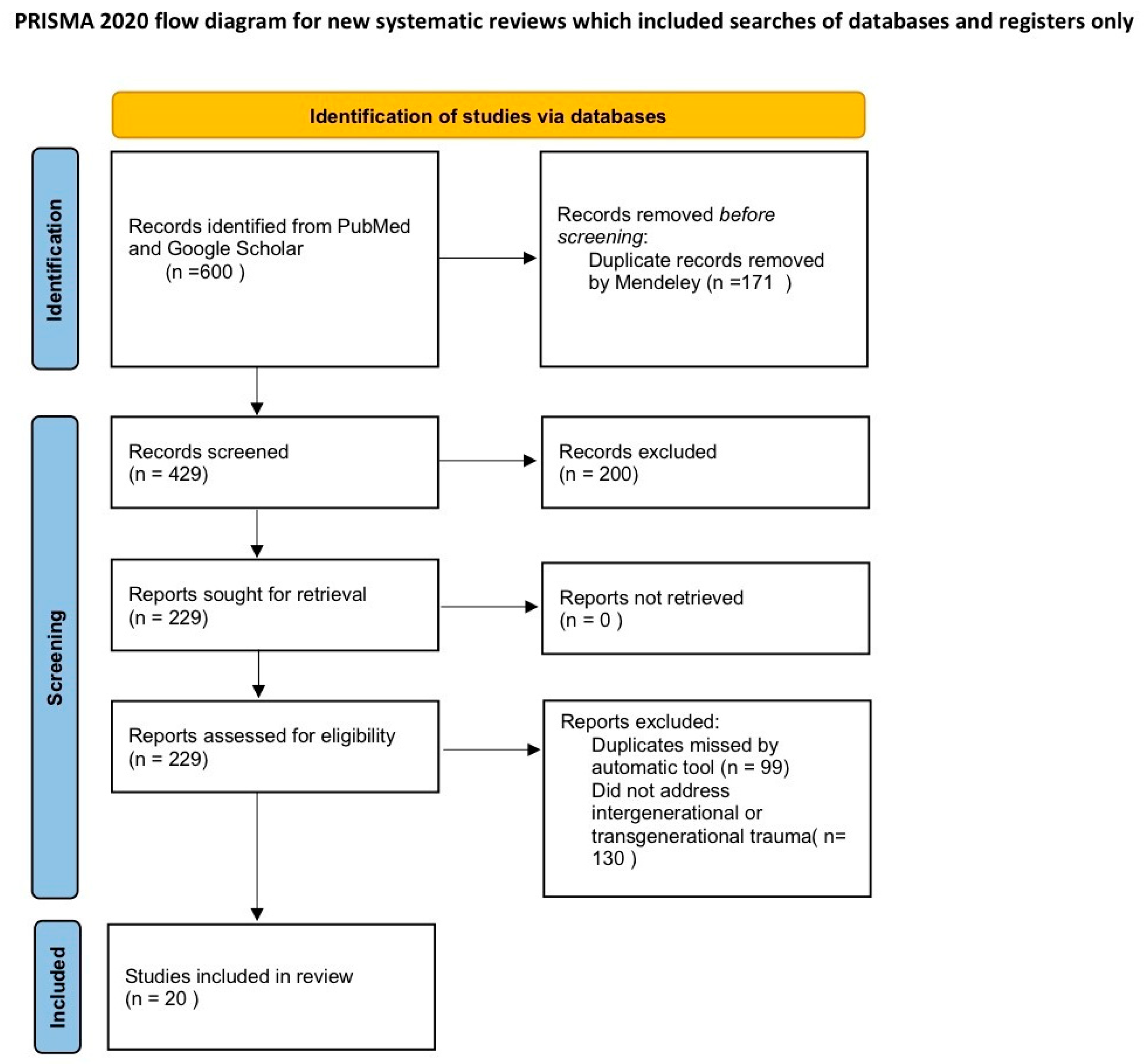
2. Materials and Methods
3. Results
3.1. Biological and Molecular Mechanisms
3.1.1. Trauma in Epigenetics
3.1.2. Endocrinology in Trauma
3.1.3. Metabolomics and Aging
3.2. Relational and Psychological Mechanisms
3.3. Three Generations
Clinical Manifestations Across Three Generations
4. Discussion
5. Conclusions
Supplementary Materials
Author Contributions
Funding
Data Availability Statement
Conflicts of Interest
Abbreviations
| ACEs | Adverse Childhood Experiences |
| BDNF | Brain-Derived Neurotrophic Factor |
| CpG | Cytosine-guanine dinucleotide sites |
| CPTSD | Complex Post-Traumatic Stress Disorder |
| DNAm | DNA Methylation |
| HPA | Hypothalamic–Pituitary–Adrenal |
| HTR | Historical Trauma Response |
| LAC | Acetyl-L-carnitine |
| MDD | Major Depressive Disorder |
| NET | Narrative Exposure Therapy |
| NR3C1 | Nuclear Receptor Subfamily 3 Group C Member 1 (Glucocorticoid receptor gene) |
| PRF | Parental Reflective Functioning |
| PTSD | Post-Traumatic Stress Disorder |
| SLC6A4 | Solute Carrier Family 6 Member 4 (Serotonin transporter gene) |
| TRD | Treatment-Resistant Depression |
| GR | Glucocorticoid Receptor |
| IMH-HV | Infant Mental Health Home Visiting |
| LINE-1 | Long Interspersed Nuclear Element-1 |
| PTSS | Post-Traumatic Stress Symptoms |
| RCT | Randomized Controlled Trial |
References
- Brave Heart, M.Y.H.; Chase, J.; Myers, O.; Elkins, J.; Skipper, B.; Schmitt, C.; Mootz, J.; Waldorf, V.A. Iwankapiya American Indian pilot clinical trial: Historical trauma and group interpersonal psychotherapy. Psychotherapy 2020, 57, 184–196. [Google Scholar] [CrossRef] [PubMed]
- Robjant, K.; Koebach, A.; Schmitt, S.; Chibashimba, A.; Carleial, S.; Elbert, T. The treatment of posttraumatic stress symptoms and aggression in female former child soldiers using adapted Narrative Exposure therapy—A RCT in Eastern Democratic Republic of Congo. Behav. Res. Ther. 2019, 123, 103482. [Google Scholar] [CrossRef] [PubMed]
- World Health Organization. ICD-11 for Mortality and Morbidity Statistics. 2024. Available online: https://icd.who.int/browse11/l-m/en (accessed on 27 February 2026).
- Yehuda, R.; Teicher, M.H.; Seckl, J.R.; Grossman, R.A.; Morris, A.; Bierer, L.M. Parental Posttraumatic Stress Disorder as a Vulnerability Factor for Low Cortisol Trait in Offspring of Holocaust Survivors. Arch. Gen. Psychiatry 2007, 64, 1040–1048. [Google Scholar] [CrossRef]
- Yehuda, R.; Daskalakis, N.P.; Lehrner, A.; Desarnaud, F.; Bader, H.N.; Makotkine, I.; Flory, J.D.; Bierer, L.M.; Meaney, M.J. Influences of maternal and paternal PTSD on epigenetic regulation of the glucocorticoid receptor gene in Holocaust survivor offspring. Am. J. Psychiatry 2014, 171, 872–880. [Google Scholar] [CrossRef] [PubMed]
- Dashorst, P.; Mooren, T.M.; Kleber, R.J.; de Jong, P.J.; Huntjens, R.J.C. Intergenerational consequences of the Holocaust on offspring mental health: A systematic review of associated factors and mechanisms. Eur. J. Psychotraumatol. 2019, 10, 1654065. [Google Scholar] [CrossRef] [PubMed] [PubMed Central]
- Gathier, A.W.; Verhoeven, J.E.; van Oppen, P.C.; Penninx, B.W.J.H.; Merkx, M.J.M.; Dingemanse, P.; Stehouwer, K.M.K.S.; van den Bulck, C.M.M.; Vinkers, C.H. Design and rationale of the REStoring mood after early life trauma with psychotherapy (RESET-psychotherapy) study: A multicenter randomized controlled trial on the efficacy of adjunctive trauma-focused therapy (TFT) versus treatment as usual (TAU) for adult patients with major depressive disorder (MDD) and childhood trauma. BMC Psychiatry 2023, 23, 41. [Google Scholar] [CrossRef] [PubMed] [PubMed Central]
- Petroff, R.L.; Jester, J.; Riggs, J.; Alfafara, E.; Springer, K.; Kerr, N.; Issa, M.; Hall, A.; Rosenblum, K.; Goodrich, J.M.; et al. Longitudinal DNA methylation in parent-infant pairs impacted by intergenerational social adversity: An RCT of the Michigan Model of Infant Mental Health Home Visiting. Brain Behav. 2024, 14, e70035. [Google Scholar] [CrossRef] [PubMed] [PubMed Central]
- Hajal, N.J.; Aralis, H.J.; Kiff, C.J.; Wasserman, M.M.; Paley, B.; Milburn, N.G.; Mogil, C.; Lester, P. Parental Wartime Deployment and Socioemotional Adjustment in Early Childhood: The Critical Role of Military Parents’ Perceived Threat During Deployment. J. Trauma. Stress 2020, 33, 307–317. [Google Scholar] [CrossRef]
- Ryan, J.; Phyo, A.Z.Z.; Krasniqi, S.P.; Carkaxhiu, S.I.; Fransquet, P.; Kaas-Petersen, S.H.; Limani, D.A.; Xhemaili, V.D.; Salihu, M.; Prapashtica, Q.; et al. An epigenome-wide study of a needs-based family intervention for offspring of trauma-exposed mothers in Kosovo. Brain Behav. 2024, 14, e70029. [Google Scholar] [CrossRef] [PubMed] [PubMed Central]
- Ho, S.M.; Johnson, A.; Tarapore, P.; Janakiram, V.; Zhang, X.; Leung, Y.K. Environmental epigenetics and its implication on disease risk and health outcomes. ILAR J. 2012, 53, 289–305, Erratum in ILAR J. 2017, 58, 413. https://doi.org/10.1093/ilar/ilx029. [Google Scholar] [CrossRef] [PubMed] [PubMed Central]
- Kaliman, P.; Cosín-Tomás, M.; Madrid, A.; Roque López, S.; Llanez-Anaya, E.; Papale, L.A.; Alisch, R.S.; Davidson, R.J. Epigenetic impact of a 1-week intensive multimodal group program for adolescents with multiple adverse childhood experiences. Sci. Rep. 2022, 12, 17177. [Google Scholar] [CrossRef] [PubMed] [PubMed Central]
- Nasca, C.; Bigio, B.; Lee, F.S.; Young, S.P.; Kautz, M.M.; Albright, A.; Beasley, J.; Millington, D.S.; Mathé, A.A.; Kocsis, J.H.; et al. Acetyl-l-carnitine deficiency in patients with major depressive disorder. Proc. Natl. Acad. Sci. USA 2018, 115, 8627–8632. [Google Scholar] [CrossRef] [PubMed] [PubMed Central]
- Katrinli, S.; King, A.P.; Duval, E.R.; Smith, A.K.; Rajaram, N.; Liberzon, I.; Rauch, S.A.M. DNA methylation GrimAge acceleration in US military veterans with PTSD. Neuropsychopharmacology 2023, 48, 773–780. [Google Scholar] [CrossRef] [PubMed]
- Zhou, A.; Ryan, J. Biological Embedding of Early-Life Adversity and a Scoping Review of the Evidence for Intergenerational Epigenetic Transmission of Stress and Trauma in Humans. Genes 2023, 14, 1639. [Google Scholar] [CrossRef] [PubMed] [PubMed Central]
- Yahyavi, S.T.; Zarghami, M.; Marwah, U. A review on the evidence of transgenerational transmission of posttraumatic stress disorder vulnerability. Braz. J. Psychiatry 2014, 36, 89–94. [Google Scholar] [CrossRef] [PubMed]
- Bigio, B.; Azam, S.; Mathé, A.A.; Nasca, C. The neuropsychopharmacology of acetyl-L-carnitine (LAC): Basic, translational and therapeutic implications. Discov. Ment. Health 2024, 4, 2. [Google Scholar] [CrossRef] [PubMed] [PubMed Central]
- Burchert, S.; Stammel, N.; Knaevelsrud, C. Transgenerational trauma in a post-conflict setting: Effects on offspring PTSS/PTSD and offspring vulnerability in Cambodian families. Psychiatry Res. 2017, 254, 151–157. [Google Scholar] [CrossRef] [PubMed]
- Seery, C.; Rushiti, F.; Krasniqi, S.P.; Çarkaxhiu, S.I.; Xhemaili, V.D.; Limani, D.A.; Prapashtica, Q.; Turjaka, V.; Zekaj, N.; Salihu, M.; et al. Family Therapy for Kosovar Mothers Who Experienced Conflict-Related Sexual Violence and Their Children in Postwar Times: A Pilot Randomised Waitlist-Controlled Trial. Clin. Psychol. Psychother. 2024, 31, e3039. [Google Scholar] [CrossRef] [PubMed]
- Breton, C.V.; Landon, R.; Kahn, L.G.; Enlow, M.B.; Peterson, A.K.; Bastain, T.; Braun, J.; Comstock, S.S.; Duarte, C.S.; Hipwell, A.; et al. Exploring the evidence for epigenetic regulation of environmental influences on child health across generations. Commun. Biol. 2021, 4, 769. [Google Scholar] [CrossRef] [PubMed] [PubMed Central]
- Hill, A.L.; Zachor, H.; Jones, K.A.; Talis, J.; Zelazny, S.; Miller, E. Trauma-Informed Personalized Scripts to Address Partner Violence and Reproductive Coercion: Preliminary Findings from an Implementation Randomized Controlled Trial. J. Womens Health 2019, 28, 863–873. [Google Scholar] [CrossRef] [PubMed] [PubMed Central]
- Carleial, S.; Nätt, D.; Unternährer, E.; Elbert, T.; Robjant, K.; Wilker, S.; Vukojevic, V.; Kolassa, I.T.; Zeller, A.C.; Koebach, A. DNA methylation changes following narrative exposure therapy in a randomized controlled trial with female former child soldiers. Sci. Rep. 2021, 11, 18493. [Google Scholar] [CrossRef] [PubMed] [PubMed Central]
- Condon, E.M.; Tobon, A.L.; Holland, M.L.; Slade, A.; Mayes, L.; Sadler, L.S. Examining Mothers’ Childhood Maltreatment History, Parental Reflective Functioning, and the Long-Term Effects of the Minding the Baby® Home Visiting Intervention. Child. Maltreat 2022, 27, 378–388. [Google Scholar] [CrossRef] [PubMed]
- Devita, S.; Deforges, C.; Bickle-Graz, M.; Tolsa, J.F.; Sandoz, V.; Horsch, A. Maternal childbirth-related posttraumatic stress symptoms, bonding, and infant development: A prospective study. J. Reprod. Infant. Psychol. 2025, 43, 718–732. [Google Scholar] [CrossRef] [PubMed]
- Herbell, K.; Li, Y.; Bloom, T.; Sharps, P.; Bullock, L.F.C. Keeping it together for the kids: New mothers’ descriptions of the impact of intimate partner violence on parenting. Child. Abuse Negl. 2020, 99, 104268. [Google Scholar] [CrossRef] [PubMed] [PubMed Central]
- Marsh, T.N.; Eshakakogan, C.; Eibl, J.K.; Spence, M.; Morin, K.A.; Gauthier, G.J.; Marsh, D.C. A study protocol for a quasi-experimental community trial evaluating the integration of indigenous healing practices and a harm reduction approach with principles of seeking safety in an indigenous residential treatment program in Northern Ontario. Harm Reduct. J. 2021, 18, 35. [Google Scholar] [CrossRef] [PubMed] [PubMed Central]
- Zayde, A.; Derella, O.J.; Kilbride, A. Safe haven in adolescence: Improving parental reflective functioning and youth attachment and mental health with the Connecting and Reflecting Experience. Infant. Ment. Health J. 2023, 44, 268–283. [Google Scholar] [CrossRef] [PubMed]
- Page, M.J.; McKenzie, J.E.; Bossuyt, P.M.; Boutron, I.; Hoffmann, T.C.; Mulrow, C.D.; Shamseer, L.; Tetzlaff, J.M.; Akl, E.A.; Brennan, S.E.; et al. The PRISMA 2020 statement: An updated guideline for reporting systematic reviews. BMJ 2021, 372, n71. [Google Scholar] [CrossRef]

| Author | Journal | Title | Year of Publication | Group | Main Conclusion |
|---|---|---|---|---|---|
| Brave Heart et al. [1] | Psychotherapy | Iwankapiya American Indian pilot clinical trial: Historical trauma and group interpersonal psychotherapy | 2020 | n = 52 American Indian adults | Healing is transgenerational and nonlinear, linking present experiences with ancestral suffering. Iwankapiya Group Interpersonal Psychotherapy combined with historical trauma and unresolved grief reduces trauma, depression, and grief symptoms. Transgenerational trauma involves accumulated grief, guilt, and low self-esteem rooted in internalized historical oppression. Affected individuals show heightened sensitivity to contemporary stressors. |
| Robjant et al. [2] | Behaviour Research and Therapy | The treatment of posttraumatic stress symptoms and aggression in female former child soldiers using adapted Narrative Exposure therapy—a RCT in Eastern Democratic Republic of Congo | 2019 | n = 92 female former child soldiers | Transgenerational trauma in war-affected families affects dysregulation, with violence used as a coping strategy. Interrupting trauma transmission requires addressing perpetration, guilt, and violent acts. Appetitive aggression sustains post-conflict violence, may protect against PTSD, but reduces motivation for treatment. |
| Gathier et al. [7] | BMC Psychiatry | Design and rationale of the REStoring mood after early life trauma with psychotherapy (RESET-psychotherapy) study: a multicenter randomized controlled trial on the efficacy of adjunctive trauma-focused therapy (TFT) versus treatment as usual (TAU) for adult patients with major depressive disorder (MDD) and childhood trauma | 2023 | n = 158 adults with moderate to severe major depressive disorder | Childhood trauma changes the way the patient responds to severe depression therapy, unconscious trauma influences the symptoms of depression. The therapist treats only the effect and not the traumatic source (from parents), the cycle of suffering remains active—masking the trauma with depression. |
| Petroff et al. [8] | Brain and Behavior | Longitudinal DNA methylation in parent–infant pairs impacted by intergenerational social adversity: An RCT of the Michigan Model of Infant Mental Health Home Visiting | 2024 | n = 146, 73 pairs-mothers and their infants/toddlers between 0 and 24 months | Specifically, higher scores on a mother-report measure of child abuse potential were inversely associated with SLC6A4 methylation. |
| Hajal et al. [9] | Journal of Traumatic Stress | Parental Wartime Deployment and Socioemotional Adjustment in Early Childhood: The Critical Role of Military Parents’ Perceived Threat During Deployment | 2020 | n = 104 of military-connected families | The strong perception of a soldier’s life being threatened is a source of problems for children after returning from war. Secondary trauma, because the parent, who may have died, is constantly under stress, impacting the family atmosphere and the child’s sense of security. If the parent feels threatened, the child will not feel safe. |
| Ryan et al. [10] | Brain and Behavior | An epigenome-wide study of a needs-based family intervention for offspring of trauma-exposed mothers in Kosovo | 2024 | n = 62 women-child dyads | Maternal exposure to trauma is associated with epigenetic alterations in children, indicating intergenerational biological effects. Identified epigenetic changes were enriched in immune-related genes, suggesting a pathway linking transgenerational trauma to somatic disease risk in adulthood. The findings support the concept of biological embedding of experience, whereby maternal trauma is reflected in the DNA methylation patterns of offspring. Psychotherapy functions as a biological intervention, capable of modifying gene methylation in pathways relevant to offspring mental health. |
| Kaliman et al. [12] | Scientific Reports | Epigenetic impact of a 1-week intensive multimodal group program for adolescents with multiple adverse childhood experiences | 2022 | n = 44 | Even a very brief but intense stressful event can trigger measurable epigenetic changes in traumatized youth. DNA methylation changes at 657 CpG sites after just seven days. These changes are crucial for immune response, neural plasticity, and emotion regulation. |
| Burchert et al. [18] | Psychiatry Research | Transgenerational trauma in a post-conflict setting: Effects on offspring PTSS/PTSD and offspring vulnerability in Cambodian families | 2017 | n = 378 mothers and their children | No direct intergenerational transmission of maternal trauma, PTSS, or PTSD to offspring was found. Maternal trauma increases vulnerability, not psychopathology per se, which may manifest only after offspring experience their own stressors. A sex-specific moderating effect was observed. Maternal hyperarousal was the only PTSS symptom associated with offspring PTSS. Closer mother-daughter relationships may increase daughters’ sensitivity to maternal trauma and reduce their ability to cope with their own traumatic experiences. |
| Seery et al. [19] | Clinical Psychology & Psychotherapy | Family Therapy for Kosovar Mothers Who Experienced Conflict-Related Sexual Violence and Their Children in Postwar Times: A Pilot Randomised Waitlist-Controlled Trial | 2024 | n = 64 mothers and their children | The mechanism of trauma transmission is systemic, not individual. The intra-family relationship acts as a moderator that supports child development, inhibiting the intergenerational transmission of anxiety. Children in family therapy showed improved mental health. |
| Hill et al. [21] | Journal of Women’s Health | Trauma-Informed Personalized Scripts to Address Partner Violence and Reproductive Coercion: Preliminary Findings from an Implementation Randomized Controlled Trial | 2019 | n = 240 participants English-speaking females, ages 16–29 | Intimate partner violence and reproductive coercion are critical but often overlooked forms of trauma. Transgenerational trauma may begin with the loss of reproductive autonomy, affecting the next generation from conception onward. Breaking the intergenerational transmission of trauma requires a trauma-informed care system that identifies and intervenes in violent relationship patterns early, before they become normalized for children. |
| Carleial et al. [22] | Scientific Reports volume | DNA methylation changes following narrative exposure therapy in a randomized controlled trial with female former child soldiers | 2021 | n = 84 female former child soldiers from Eastern DR Congo | Effective narrative psychotherapy for Narrative Exposure Therapy leads to measurable changes in DNA methylation. Thirty-three CpG methylation regions were identified, and DNA methylation levels significantly changed after NET compared to the control group. |
| Condon et al. [23] | Child Maltreatment | Examining Mothers’ Childhood Maltreatment History, Parental Reflective Functioning, and the Long-Term Effects of the Minding the Baby® Home Visiting Intervention | 2022 | n = 97 | Childhood maltreatment of women (mothers) is strongly linked to lower levels of parental reflective function, along with a failure to recognize the emotional needs of their own child. A mother who lacks a secure attachment is unable to bond with her child, and the trauma is passed on to the next generation, often developing a disorganized attachment style in the infant. A mother’s anxiety and emotional instability become a permanent feature of the child’s developmental environment. |
| Devita et al. [24] | Journal of Reproductive and Infant Psychology | Maternal childbirth-related posttraumatic stress symptoms, bonding, and infant development: a prospective study | 2025 | n = 55 mother–infant dyads | The severity of PTSD symptoms after childbirth is directly linked to insecure attachment styles with the child after birth—emotional distance, poor interactions with the child, and a lack of positive moments. |
| Herbell et al. [25] | Child Abuse & Neglect | Keeping it together for the kids: New mothers’ descriptions of the impact of intimate partner violence on parenting. | 2020 | n = 11 women | Maternal domestic trauma alters DNA methylation in newborns. Mothers’ hypervigilance—their attention is divided between the child’s needs and monitoring the abuser’s mood. In children, transgenerational trauma begins with growing up in an atmosphere of unspoken tension, where the child senses, for example, their mother’s anxiety, even if they do not witness acts of violence. |
| Author | Title | IF (Year) | Group | Type | Main Conclusion |
|---|---|---|---|---|---|
| Yehuda et al. [4] | Parental posttraumatic stress disorder as a vulnerability factor for low cortisol trait in offspring of holocaust survivors | 10.78 (2007) | 23 Holocaust offspring with parental PTSD and 10 without parental PTSD compared with 16 children of nonexposed parents. n = 49 | Comparative Study | Biological markers of trauma are inherited by offspring, even if they themselves have not experienced direct trauma. Free cortisol levels in children of Holocaust survivors, children of parents with PTSD, have lower cortisol levels compared to the control group. Low cortisol levels in children were directly linked to the presence of PTSD in the parent (especially the mother), not to the mere fact of being a survivor. Living with constant threat results in low cortisol levels, which increases hyperreactivity to external stimuli and an inability to cope with them. |
| Yehuda et al. [5] | Influences of maternal and paternal PTSD on epigenetic regulation of the glucocorticoid receptor gene in Holocaust survivor offspring | 12.2 (2014) | Adult offspring with at least one Holocaust survivor parent (n = 80) and demographically similar participants without parental Holocaust exposure or parental PTSD (n = 15) | Cross-sectional Study | The NR3C1 gene promoter (region 1F) is responsible for regulating stress sensitivity via the glucocorticoid receptor. Children of Holocaust survivors have specific methylation patterns of this gene, depending on the gender of their parent: PTSD in the mother—higher methylation of the gene in children, which indicates lower receptor sensitivity and a greater likelihood of depression, anxiety, and low mood. PTSD in the father was associated with lower methylation in children, which indicates a predisposition to an anxious attachment style and insecurity. |
| Nasca et al. [13] | Acetyl-l-carnitine deficiency in patients with major depressive disorder | 9.58 (2018) | n = 116 | Clinical trial | Patients with major depressive disorder have significantly lower levels of acetyl-l-carnitine (LAC) in their blood compared to healthy individuals, and the lowest levels are found in those who also experienced childhood trauma. LAC is crucial for the epigenetic regulation of brain plasticity. A deficiency can cause trauma to prevent the brain from adapting and regenerating. |
| Marsh et al. [26] | A study protocol for a quasi-experimental community trial evaluating the integration of indigenous healing practices and a harm reduction approach with principles of seeking safety in an indigenous residential treatment program in Northern Ontario | 4.45 (2021) | 2013–2016; n = 343; 2018–2020; n > 300 | pre/post Quasi Experimental Community trial | The mechanism of trauma transmission is dysfunctional ways of regulating emotions (e.g., substance abuse) from parent to child as a learned model of escaping emotions. |
| Zayde et al. [27] | Safe haven in adolescence: Improving parental reflective functioning and youth attachment and mental health with the Connecting and Reflecting Experience | 2.4 (2023) | n = 32 caregiver-adolescent dyads | Clinical Trial | A parent’s trauma often impairs their reflective function. Parents are unable to read their child’s emotions, and the child reacts with anxiety or aggression, which is a primary channel for the transmission of transgenerational trauma. Withdrawal, self-aggression, and anxiety are directly linked to the parent’s lack of response, as they have their own unresolved traumatic experiences. Transgenerational trauma integrates molecular mechanisms (DNA methylation), psychological mechanisms (weakened parental reflective functions), and social mechanisms (history and violence). |
Disclaimer/Publisher’s Note: The statements, opinions and data contained in all publications are solely those of the individual author(s) and contributor(s) and not of MDPI and/or the editor(s). MDPI and/or the editor(s) disclaim responsibility for any injury to people or property resulting from any ideas, methods, instructions or products referred to in the content. |
© 2026 by the authors. Licensee MDPI, Basel, Switzerland. This article is an open access article distributed under the terms and conditions of the Creative Commons Attribution (CC BY) license.
Share and Cite
Froń, O.; Chwesiuk, K.; Jabłonka, D.; Kułak-Bejda, A. When Trauma Crosses Generations: Mechanisms, Clinical Patterns and Therapeutic Implications of Transgenerational Trauma—A Systematic Review. Cells 2026, 15, 609. https://doi.org/10.3390/cells15070609
Froń O, Chwesiuk K, Jabłonka D, Kułak-Bejda A. When Trauma Crosses Generations: Mechanisms, Clinical Patterns and Therapeutic Implications of Transgenerational Trauma—A Systematic Review. Cells. 2026; 15(7):609. https://doi.org/10.3390/cells15070609
Chicago/Turabian StyleFroń, Oliwia, Kamila Chwesiuk, Dominika Jabłonka, and Agnieszka Kułak-Bejda. 2026. "When Trauma Crosses Generations: Mechanisms, Clinical Patterns and Therapeutic Implications of Transgenerational Trauma—A Systematic Review" Cells 15, no. 7: 609. https://doi.org/10.3390/cells15070609
APA StyleFroń, O., Chwesiuk, K., Jabłonka, D., & Kułak-Bejda, A. (2026). When Trauma Crosses Generations: Mechanisms, Clinical Patterns and Therapeutic Implications of Transgenerational Trauma—A Systematic Review. Cells, 15(7), 609. https://doi.org/10.3390/cells15070609

