Review

Βeta-Cells: Stress, Identity, Failure and Diabetes

1
Centre for Diabetes, Obesity and Endocrinology, Westmead Institute for Medical Research, University of Sydney, Westmead, NSW 2145, Australia
2
Faculty of Medicine & Health, University of Sydney, Sydney, NSW 2006, Australia
3
Department of Diabetes and Endocrinology, Westmead Hospital, Westmead, NSW 2145, Australia
*
Author to whom correspondence should be addressed.
Cells 2026, 15(5), 475; https://doi.org/10.3390/cells15050475
Submission received: 6 February 2026 / Revised: 4 March 2026 / Accepted: 5 March 2026 / Published: 6 March 2026
(This article belongs to the Special Issue The Role of Pancreatic Beta-Cells in Obesity and Type 2 Diabetes)

Highlights

What are the main findings?
  • Dysfunctional β-cell populations are linked to reduced insulin production and secretion, thereby affecting glucose homeostasis.
  • β-cell heterogeneity leads to variable stress-response patterns, thereby influencing the risk of progressive diabetes.
What are the implications of the main finding?
  • Avoiding glucotoxicity, lipotoxicity and ER stress will aid diabetes prevention and treatment.
  • Developing alternative therapies, such as β-cell replacement or anti-diabetic agents that re-active insulin secretion, can open new avenues for diabetes treatment.

Abstract

Type 2 diabetes (T2D) is a pressing global health challenge, primarily driven by modern dietary and lifestyle patterns. Central to T2D progression is the dysfunction of insulin-secreting pancreatic β-cells, which critically disrupts glucose homeostasis. The progression to T2D relies on the β-cells’ inability to compensate for increasing insulin resistance. Initially, β-cells enhance the insulin output, but chronic nutrient overload, ER stress and inflammation ultimately compromise their function and survival. This review examines the molecular and cellular drivers of β-cell failure, focusing on endoplasmic reticulum stress, mitochondrial dysfunction and inflammatory pathways amid chronic metabolic stress. We also explore the loss of β-cell identity and altered interactions within the islet microenvironment. Understanding these mechanisms is essential for developing strategies to prevent β-cell dysfunction and slow T2D progression, ultimately supporting better metabolic health outcomes.

1. Introduction

The International Diabetes Federation (IDF) Diabetes Atlas reports that 11.1% of adults, or about 589 million people, have type 2 diabetes (T2D), with 90% of these cases linked to overweight or obesity. Given the rising global prevalence and the substantial costs associated with management and treatment, obesity and T2D together pose significant public health challenges worldwide.
Obesity promotes systemic insulin resistance, consequently increasing the insulin-production burden on pancreatic β-cells [1,2,3]. β-cells compensate for increased insulin requirements by enhancing insulin secretion and expanding the β-cell mass [2,4]. Chronically, metabolic overload and stress can shift compensation toward β-cell dysfunction and failure via multiple mechanisms such as apoptosis and dedifferentiation [5,6,7]. While diabetes is undoubtedly much more common with obesity, a large proportion of people with obesity maintain completely normal glucose tolerance. Therefore, understanding how obesity induces β-cell stress and failure is crucial for clarifying the diabetes pathogenesis and identifying effective therapeutic strategies. This review focuses on mechanisms of β-cell stress, how these mechanisms diminish β-cell function and lead to T2D and highlights emerging molecular targets and treatment approaches to preserve β-cell health.

2. β-Cell Stress and Metabolic Overload

The overall β-cell function is driven by both the β-cell mass and the function of β-cells. It is not currently possible to quantify the β-cell mass in a living person. Examining circulating insulin or C-peptide and insulin sensitivity gives an indication of the functional β-cell mass [8]. Individual β-cells contain approximately 20 pg of insulin, stored within roughly 10,000 insulin granules [9,10]. Under physiological conditions, proinsulin is efficiently processed into mature insulin and C-peptide [11]. Nutrient overload can cause metabolic stress in β-cells. The chronic need for hyperinsulinaemia can eventually lead to β-cell exhaustion [12].
Glucotoxicity, lipotoxicity and gluco-lipotoxicity
Pancreatic β-cells exposed to hyperglycaemia exhibit an increased insulin release in the short term. If hyperglycaemia persists, there can be compensatory hypertrophy, characterised by an increased β-cell size to meet the insulin demand [4,8]. In rodents, β-cells show a remarkable capacity for adaptive proliferation in response to metabolic stress or pregnancy, which declines in efficiency with age [13,14]. However, human β-cells have a limited proliferative capacity after early childhood [14,15].
If β-cell compensation does not normalise glucose, prolonged exposure to elevated glucose levels can cause toxic effects known as glucotoxicity, further worsening β-cell dysfunction [16,17]. Chronic hyperglycaemia activates multiple stress pathways, including oxidative stress, endoplasmic reticulum (ER) stress [18], increased senescence [19,20] and inflammatory signalling [18]. Excessive mitochondrial reactive oxygen species (ROS) production also increases the oxidation of lipids, proteins and DNA [21]. These mechanisms cause β-cell dysfunction and apoptosis.
Hyperglycaemia stimulates the production of pro-inflammatory cytokines, including interleukin-1β (IL-1β), interferon-γ (IFN-γ) and tumour necrosis factor-α (TNF-α), by various cells, including monocytes/macrophages, T cells and β-cells themselves [22,23,24]. A sustained inflammatory response both contributes to impaired β-cell function, by altering the expression of genes needed for insulin biosynthesis and secretion [25,26,27], and promotes systemic insulin resistance. It also disrupts β-cell function. Recent studies have reported that the deleterious effects of glucotoxicity can spread through exosomes released by islets, transmitting injurious signals to nearby cells [28,29].
Studies identify silent information regulator 1 (SIRT1), a member of the SIRT2 (Sir2)-like family, as a regulator of β-cell function and insulin-responsive tissues [30,31]. SIRT1 activation with resveratrol mitigates the lipid-induced decline in β-cell function in a preclinical study [31]. SIRT1 overexpression in muscle significantly reduces insulin resistance in high-glucose conditions, associated with improvements in the mitochondrial function [30]. Thus, SIRT1 activity is a potential therapeutic target for maintaining glucose homeostasis.
Excess saturated free fatty acids (FFA), such as palmitate, disrupt β-cell homeostasis, in part activating ceramide synthases [32,33]. Accumulated ceramides act as a key mediator of palmitate-induced lipotoxicity in β-cells by increasing ER stress, dysregulated unfolded protein response (UPR) signalling [34], mitochondrial damage and inflammatory pathways [27,35].
ER stress and maladaptive UPR signalling pathways will be discussed, alongside the ER’s function in β-cells, in the following section. Unlike long-term exposure to saturated FFA such as palmitate, monounsaturated fatty acids (MUFA), including oleate, can exhibit protective effects in some β-cell models [36,37]. For example, GPR40, also known as FFA receptor 1 (FFAR1), is a G protein-coupled receptor that modulates insulin secretion in response to fatty acids [38,39] and its activation can yield divergent outcomes. The prolonged activation of GPR40 by MUFA may contribute to protective effects by engaging beneficial signalling pathways that support insulin secretion and promote β-cell survival. Conversely, the chronic and excessive activation of GPR40 is linked to adverse outcomes, impaired β-cell function, hypoinsulinaemia and diabetes [40,41]. The combined excess of both glucose and FFA leads to more severe outcomes, known as glucolipotoxicity [26,32].
Next, we will review the mechanisms underlying stress responses in detail, focusing on their occurrence within organelles and on crosstalk via signalling pathways in the intracellular and extracellular environments in pancreatic islets.

3. Mitochondrial Dysfunction in β-Cells

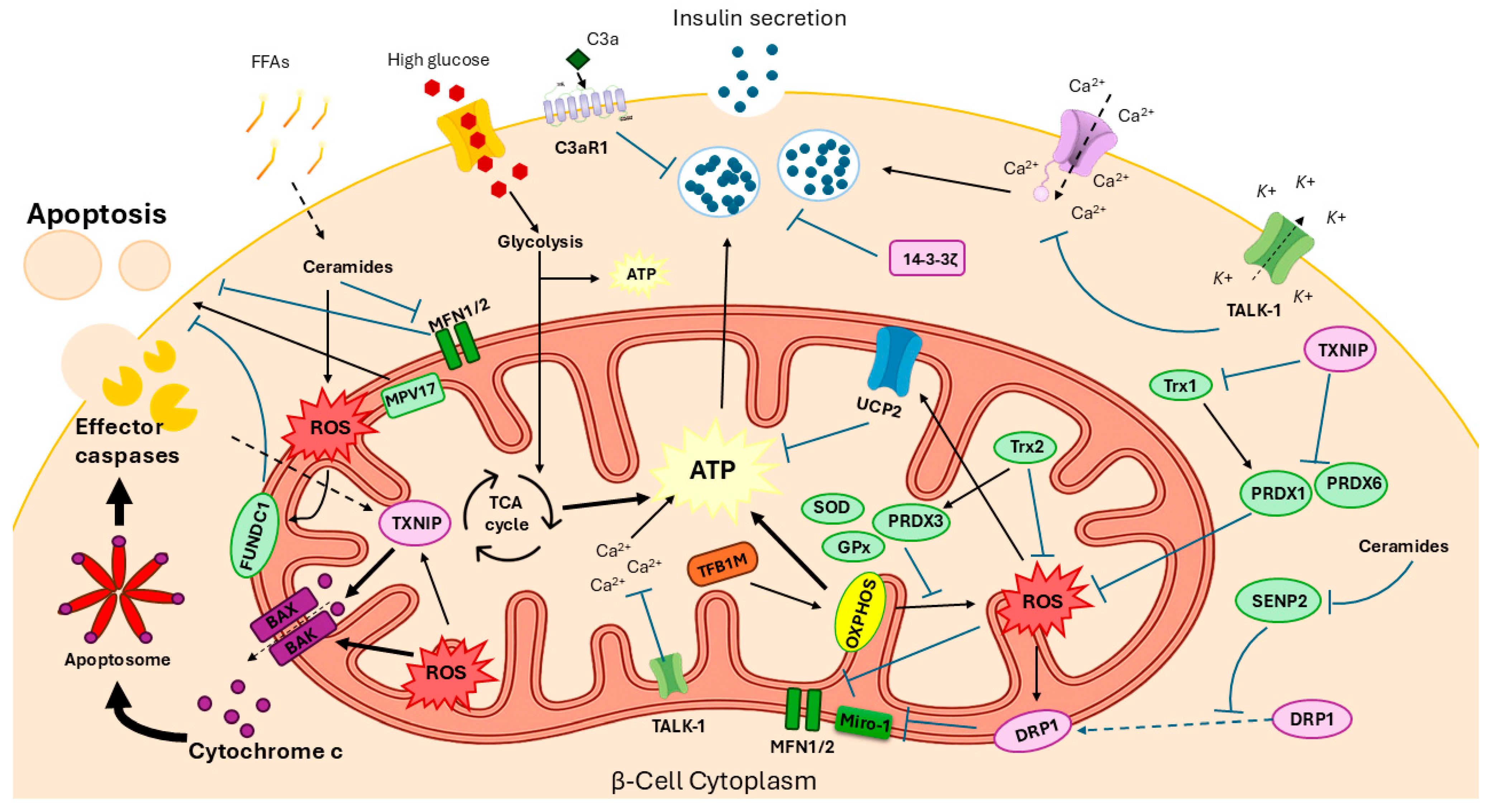
Here, we review β-cell mitochondrial dysfunction, focusing on key molecular factors (Figure 1). Mitochondria are essential organelles for generating cellular energy via the oxidative phosphorylation of glucose and lipids [42]. Their dysfunction is a pivotal contributor to β-cell impairment and is indicative of β-cell stress response mechanisms and viability [6,7,33]. β-cells have a low antioxidant capacity compared to other cell types [21], which may promote metabolic inflexibility, mitochondrial redox imbalances and ROS accumulation. However, they possess a specialised antioxidant system, involving peroxiredoxin, thioredoxin 1 (TXN1) and thioredoxin reductase (TRXR) to reduce ROS as a defence mechanism [43]. Evidence from in vitro and in vivo studies has identified multiple intracellular factors that are essential for mitochondrial integrity, biogenesis and the insulin secretory capacity in β-cells. Table 1 and Figure 1 present additional information on these factors and their interactions in β-cells.
Mitochondrial calcium (Ca2+) homeostasis is critical for β-cell function and disruptions in calcium handling are observed in diabetes. The findings underscore the critical link between the mitochondrial calcium dynamic and β-cell dysfunction in the progression of diabetes. The transcriptome of single islet cells in healthy, pre-diabetic and diabetic mice revealed that Annexin A10 is a candidate pre-diabetic β-cell marker. Under metabolic stress, Annexin 10 is overexpressed, modulating a Ca2+ influx, thereby impairing glucose-simulated insulin secretion (GSIS) and leading to β-cell dysfunction [44]. Reduced circulating levels of Reg3g were observed in patients with new-onset diabetes mellitus (NODM) treated with the immunosuppressive medication tacrolimus after heart transplantation. This treatment significantly increases the risk of NODM in these patients. Tacrolimus-induced mitochondrial impairment, including mitochondrial Ca2+ uptake, was restored by reintroducing Reg3g [45]. Ca2+ channel blockers inhibit short-term insulin release but reduce diabetes risk, mediated in part by their effects on thioredoxin-interacting protein (TXNIP) [46]. Recent research by Graff et al. described a new function of TALK-1, a K+-channel which regulates β-cell Ca2+ homeostasis. β-cell TALK-1-KO islets exhibited increased mitochondrial calcium and impaired GSIS ex vivo, but mice had improved glucose tolerance both on normal chow and on HFD [47]. This finding suggests TALK-1 is a complex regulator of metabolic remodelling in β-cells and may play a role in the dysregulated glycaemia seen in diabetes.
14-3-3 proteins regulate diverse cellular functions, particularly in metabolism and glucose homeostasis, with significant roles in the β-cell biology [48,49]. Mugabo et al. explored the effects of the 14-3-3 ζ isoform (14-3-3 ζ) in β-cell-specific KO mice and found that the loss of 14-3-3 ζ leads to increased insulin secretion and promotes β-cell proliferation [49].
Several microRNAs, including miR-7, miR-132 and miR-184, play roles in the β-cell physiology by regulating insulin secretion, synthesis and cell survival through controlling genes such as PDX1 [50,51,52,53]. Using bioinformatic analysis (TargetScan), Cowan et al. explored 16 miRNAs involved in the β-cell function [54]. The study identified miR-29 as a regulator that enhances mitochondrial metabolism and insulin secretion in the rat insulinoma β-cell line, with miR-29 knockdown resulting in defective insulin secretion [54]. Another study examined the effects of miR-146a overexpression in a stable mouse β-cell line and found that overexpression led to mitochondrial dysfunction and enhanced cell death via pro-inflammatory stress responses, whereas its inhibition restored the mitochondrial function and improved insulin secretion [55].
Under metabolic stress, β-cells eliminate damaged mitochondria via mitophagy, an adaptive process that supports β-cell survival [56]. However, prolonged metabolic stress impairs mitophagy, reducing insulin secretion and mitochondrial function. This indicates that the high energy demands of insulin production challenge β-cells, preventing a full recovery of the mitochondrial network [56]. Miro-1 is important for mitochondrial movement and regulates mitophagy by linking mitochondrial dynamics with autophagy. β-cell-specific Miro-1 deletion in mice fed an HFD led to hyperglycaemia and defective mitophagy [57]. FUNDC1 also acts as a mitophagy receptor, aiding the clearance of damaged mitochondria during hypoxia induced by metabolic stress. Specifically, the overexpression of FUNDC1 decreased FA-induced β-cell damage and reduced harmful metabolic markers associated with an HFD in a mouse model [58]. Similarly, NONP1 is an essential mitochondrial matrix protein that modulates mitochondrial proteostasis by degrading misfolded proteins, thereby promoting cell survival under gluco-lipotoxic conditions [59]. Together, these proteins form a regulatory network via regulating mitophagy that β-cells rely on to maintain mitochondrial health, thereby influencing insulin secretion and metabolic resilience.
Given the vital role of the mitochondrial function in β-cell health, recent research has begun exploring innovative ways to restore mitochondrial integrity in β-cells. Zerun et al. evaluated the therapeutic effects of the mitochondrial-targeted nanomedicine Mito-G in an STZ-induced diabetic mouse model [48]. Mito-G accumulates in mitochondria and inhibits Ucp2 activity. In diabetic mice treated with Mito-G every 4 days for 6 weeks while on an HFD, the mitochondrial function is enhanced, mtDNA release is prevented and the STING-mediated autoinflammatory pathway is suppressed, ultimately restoring mitochondrial homeostasis. Together, these results emphasise the need to prevent mitochondrial damage and its associated molecular mechanisms to preserve and enhance β-cell function.
Table 1. Effects on mitochondrial function in β-cell lines and animal models.
Molecule; TypeRole in β-Cell Mitochondrial FunctionEffects on β-CellsModel(s)
14-3-3 ζ [49]14-3-3 inhibition: ↑ OCR, ↑ ATP
14-3-3 ζ KO: ↑ ATP, ↑ mit respiration and OxPhos expression
↑ GSIS, ↑ β-cell proliferation with either inhibition or KO Mouse islets, β-cells
and β-cell KO
C3aR1
GPCR [60]
C3aR1 KO: ↑ stress markers, ↓ MAPK pathway expression and ↓ mit fn↓ GSIS, ↓ β-cell mass,
↑ cell death with lipotoxicity
β-cell-C3aR1
KO mice
Ceramide [35]↑ Mit membrane permeabilisation and cytochrome C release, ↓ ETC activity↓ GSIS and ↑ β-cell apoptosisRat β-cell lines
CDN1163, SERCA activator [61]SERCA activation: ↑ mit Ca2+ and mit biogenesis.
Preserved Ca2+ regulation and mit function with FFA
↑ GSIS; improved lipotoxic effect Mouse β-cell line and islets
Dimt1 [62]Dimt1 KD: ↓ mit OxPhos expression, ↓ OCR, dissipated mit membrane potential, ↓ ATPImpaired insulin secretionRat, mouse and human β-cell lines
Drp1
Mit fission [63]
Drp1 OE: no changed protein levels of mit respiratory complexes, ↑ fragmented mitochondria ↓ insulin content
↓ GSIS
Mouse β-cell line
Fundc1, Mit membrane [58]Fundc1 KD: ↓ mit fn, ↓ MMP, ↓ ATP, ↑ ROS
Fundc1 OE: ↑ mit fn, ↑ ATP, ↓ ROS in FA-induced stress
↓ GSIS, ↑ β-cell apoptosis in KD
↑ GSIS, ↓ β-cell apoptosis in OE
Mouse β-cell line
LONP1, Mit protease [59]Lonp1 KO: ↓ mit fn, ↓ mit respiration,
↑ misfolded protein and activation UPR
↓ β-cell mass, ↑ β-cell apoptosis, ↓ GSIS, glucose intoleranceβ-cell-KO mice and human islets
Mfn1, Mfn2
Mit fusion [64]
Combined Mfn1/2 KO: ↓ mit respiration, smaller punctate mit structure, ↓ mit DNA content↓ GSIS
↑ glucose intolerance
β-cell-Mfn1/2
KO mice
Miro-1
Mit GTPase [57]
Miro1 KO: ↓ mitophagy, ↑ damaged mit, ↑ ROS and inflammatory responses under HFD stress ↓ insulin signalling via IRS-Akt-FoxO1, ↓ insulin secretion, ↑ glucose intolerance with HFDβ-cell-Miro1
KO mice
miR-146a-5p [55]OE: ↑ mit depolarisation, ↓ mit function markers
KD: ↑ mit fn, DNA copy number, respiration, ATP
OE: ↑ β-cell death
KD: ↑ insulin secretion
Mouse β-cell line
Mpv17, Mit membrane [65]No affected ROS and mit DNA levels, ↓ caspase-3 activation in response to STZ or FA↓ β-cell apoptosis
in response to STZ or FA
Mpv17 KO mice and β-cell line
Pgc-1a [66]Pgc-1a KO: small effects on mit gene expression and β-cell mass, function↓ GSIS
↑ lipid in KO islets
β-cell-Pgc-1a
KO mice
Prdx6, Antioxidant enzyme [67]Prdx6 KD: ↓ ATP, ↓ intracellular Ca2+, ↓ mit volume and mass, ↓ mit potential and OCR ↓ insulin secretion
↑ β-cell apoptosis
Prdx6 KD mouse β-cell line
Reg3g [45]Reg3g stimulation: restored mit function via ↑ MMP, mit Ca2+ uptake, ATP production and OCR↑ GSIS and β-cell regeneration Mouse islets, mouse and human cell lines
Senp2
Protease [68]
Senp2 KO: ↑ mit dysfunction via reduced active form of Drp1, enlarged mit and lower OCR↓ GSIS and
impaired GTT
β-cell-KO mice and β cell line
Talk1, ATP-K+ channel [47]Talk1 KO: ↑ mit Ca2+, ↑ mit ATP production
↓ ATP-linked respiration, ↓ OCR with HFD
Improved GTT, no change in effect on GSIS under HFD stressβ-cell–Talk-1
KO mice
Tfb1m [69]Tfb1m KO: ↓ mit ATP production via perturbed OxPhos. Disrupted mit ultrastructure↑ β-cell death via β-cell apoptosis and necrosis,
↑ inflammation
β-cell-Tfb1m
KO mice
Txnip, Redox
regulator [70]
Inhibition with SRI-37330 restored redox balance and
↓ ROS in response to FA
↑ β-cell fn, ↑ GSIS, ↑ ER redox state and proinsulin traffickingFA-cultured rat β-cell line
Ucp2 [71] Inhibition: ↓ IL-1β activity, ↓ mit DNA and leaking in Ucp2 inhibitor, Mito-G ↑ insulin secretion,
↑ β-cell mass, ↓ β-cell death
Mice, STZ, db/db
β-cell lines
Zfp148 [72]Zfp148 KO: ↑ mit PEP-dependent Ca2+ influx↑ mit PEP-dependent insulin secretionβ-cell–Zfp148
KO mice
Abbreviations: ↑, increase; ↓, decrease; ATP, adenosine triphosphate; C3aR1, Complement C3a Receptor 1; CDN1163, allosteric sarco/endoplasmic reticulum Ca2+-ATPase (SERCA) activator; db/db, genetically diabetic-obese rodents; Dimt1, Dimethyl-adenosine transferase 1; Drp1, Dynamin-Related Protein 1; ER, Endoplasmic Reticulum; ETC, mitochondrial electron transport chain; FA, fatty acids; Fn, function; Fundc1, FUN14 domain-containing protein 1; GTT, glucose-tolerance test; GSIS, glucose-stimulated insulin secretion; HFD, high-fat diet; KD, knockdown; KO, knockout; Lonp1, Lon Peptidase 1; Mfn1, Mitofusin-1; Mfn2, Mitofusin-2; Mit, mitochondrial; Mpv17, Mitochondrial inner membrane protein Mpv17; Miro1, Mitochondrial Rho GTPase 1; MMP, mitochondrial membrane potential; OCR, oxygen consumption rates; OE, overexpression; OxPhos, mitochondrial oxidative phosphorylation; PEP, phosphoenopyruvate; Prdx6, peroxiredoxin 6; Pgc-1a, Peroxisome proliferator-activated receptor-γ coactivator 1-α; Reg3g, Regenerating Islet-derived protein 3 γ; ROS, reactive oxygen species; Senp2, Sentrin-specific protease 2; STZ, streptozotocin; TALK-1, TWIK-related alkaline pH-activated K+ channel 1; Tfb1m, Transcription Factor B1; Txnip, thioredoxin-interacting protein; Ucp2, uncoupling protein 2; Zfp148, zinc finger protein 148.

4. Maladaptive UPR During Chronic ER Stress in Pancreatic β-Cells

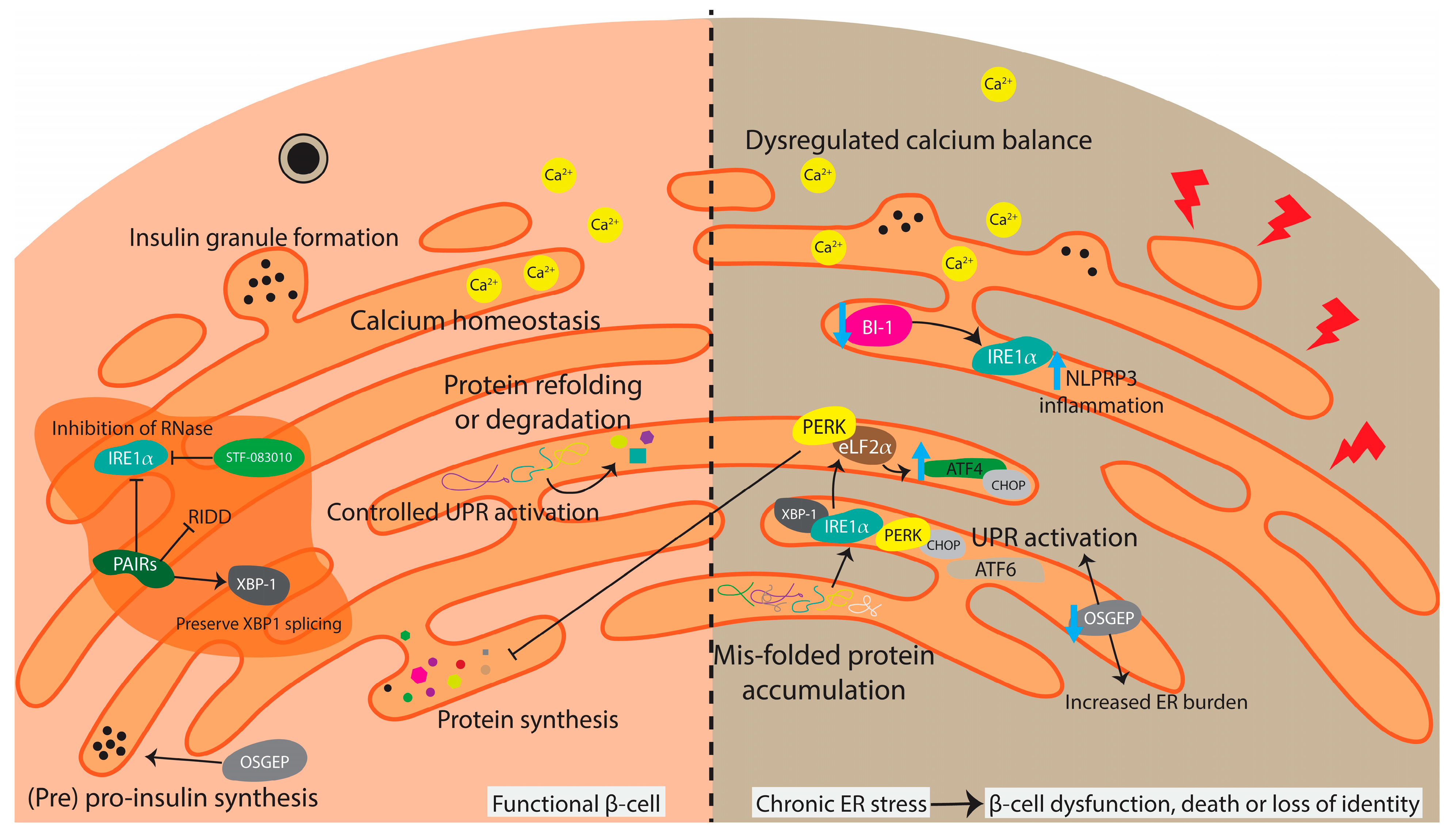
This section aims to describe the mechanisms of the UPR, emphasising recent findings and exploring potential therapeutic strategies derived from these mechanisms, particularly regarding stress responses in the ER within β-cells (Figure 2). In pancreatic β-cells, the requirement for substantial insulin synthesis in the ER places a high demand on the ER function [10]. Proinsulin is translated in the ER, where it undergoes folding, glycosylation and the cleavage of C-peptide to ensure proper insulin protein conformation [73,74]. The ER features a quality control system to identify misfolded proteins for refolding or degradation, vital for cellular health [73,74]. When misfolded or unfolded proteins accumulate in the ER, the UPR is activated.
Stressors such as imbalanced nutrient levels or altered oxygen tension increase misfolded protein accumulation in the ER, triggering the UPR through three signalling pathways mediated by Inositol-Required Enzyme 1 α (IRE1α), PKR-like ER kinase (PERK) and Activating Transcription Factor 6 (ATF6) [76,77]. In β-cells, a high insulin demand can stress-activate the UPR. A ‘successful’ UPR slows protein synthesis to address the build-up of misfolded proteins. Under prolonged ER stress, the UPR shifts from a protective to a maladaptive state, primarily through sustained IRE1α–XBP1 and PERK–CHOP signalling [78,79]. Continued IRE1α activity leads to excessive mRNA degradation, further promoting stress signalling driven by JNK and NF-κB, which mediates inflammatory gene expression [80,81]. Meanwhile, persistent PERK–eIF2α signalling reduces the overall protein translation while increasing ATF4-driven CHOP expression, causing oxidative stress and the dysregulation of the ER–mitochondrial calcium balance, ultimately leading to β-cell death [82,83]. Overwhelming the UPR’s compensatory capacity due to the duration and/or intensity of the stimulus causes β-cell failure and death [84].
A recent study by Yujie et al. explored O-sialoglycoprotein endopeptidase (OSGEP) as an important factor in ER quality control, including proinsulin folding and UPR activation [85]. β-cell-specific OSGEP deletion resulted in abnormal glucose homeostasis and hypoinsulinaemia, particularly under HFD conditions. An OSGEP deficiency impaired proinsulin folding, reducing the insulin translational efficiency. Gene profiling found changes in UPR and apoptosis-related gene expression, indicative of increased ER stress [85]. Exposure to metabolic stressors, such as an HFD or ER stress inducers, further increased UPR signalling molecules, including IRE1α, ATF6 and CHOP (Figure 2). These findings suggest that OSGEP stimulation has potential as a therapeutic target to preserve the β-cell function.
Feldman et al. reported that modulating IRE1α activity using their Partial Antagonists of IRE1α RNase (PAIRs compound) preserved XBP1 splicing while suppressing potentially deleterious mRNA products via Regulated IRE1-Dependent Decay (RIDD) [86]. PAIRs treatment was associated with increased insulin mRNA levels and elevated proinsulin proteins [86]. Managing higher proinsulin production demands significant cellular resources, which may lead to β-cell fatigue and damage. However, despite the higher level of proinsulin, PAIRs treatment reduced apoptosis in β-cells and RNA-Seq profiling revealed the attenuation of pro-apoptotic gene expression with IRE1α overexpression [86].
Bax Inhibitor-1 (BI-1) is also a negative regulator of IRE1α activity, showing positive effects on insulin-producing β-cells and glucose metabolism [87]. Mice lacking BI-1 showed early signs of diabetes with excessive IRE1α RNase activity and ER stress, ultimately leading to β-cell failure on an HFD through the activation of β-cell death signalling and NLRP3-mediated inflammatory responses [87]. After the induction of β-cell dysfunction with an HFD, treatment with STF-083010, an inhibitor of IRE1α RNase activity, reversed the metabolic phenotype, reducing ER stress and restoring the insulin granule content [87].
In compensatory ER stress responses, IRE1α-mediated pathways enhance the function of β-cells [88]. Exogenous ER-degradation-enhancing α-mannosidase-like protein 1 (EDEM1) helps to mitigate excess IRE1α cascades, increasing the insulin levels in diabetic rats and insulinoma β-cells [88]. Given these findings, IRE1α-mediated UPR signalling pathways may present a promising strategy for diabetes treatment.
The analysis of pancreatic tissue from living donors, including normal glucose-tolerant individuals, glucose-intolerant individuals and T2D patients, revealed alterations in the islet gene expression profiles [89]. With an increasing glucose intolerance, there was a progressive increase in the expression of ER stress-related genes, such as PDIA1, XBP1 and GRP78, and a corresponding decrease in functional islet phenotype-related genes, such as MAFA, NKX6.1 and CCT4, in glucose-intolerant and T2D groups, indicating accelerated ER stress, defective insulin synthesis and a loss of β-cell identity in living individuals [89], consistent with preclinical and experimental cellular studies [90]. However, reduced levels of active XBP1 protein (spliced XPB1) were observed in both animal models and T2D patients [91]. These conflicting characteristics in XBP1 mRNA and protein levels may result from an insufficient adaptive response to ER stress during disrupted glucose homeostasis in T2D patients, or from decreased XBP1 protein synthesis and stability, leading to lower active XBP1 protein levels. Several biotechnology tools are developing UPR modulators and have filed patents, but clinical trials assessing their safety and efficacy in diabetic patients are still limited or absent. This gap highlights both the translational potential and the need for further research on UPR-targeted therapies for diabetes.
The ER also synthesises lipids essential for cellular membranes and insulin granules and serves as a crucial calcium reservoir, noting that calcium fluctuations play a key role in insulin exocytosis [83,92]. Calcium re-uptake in the ER is mediated via the SERCA proteins. Given the central role of the ER in calcium homeostasis, protein folding and granule biogenesis, perturbations in ER calcium handling can rapidly induce ER stress and activate the UPR. Importantly, ER stress does not occur in isolation, but is tightly integrated with mitochondrial function through dynamic ER-mitochondrial crosstalk.
UPR/ER/mitochondrial crosstalk
Crosstalk between UPR signalling pathways in the ER and mitochondrial response mechanisms upon stress warrants further investigation. The interaction between the ER and mitochondria regulates the cellular redox balance and apoptotic signalling, but under conditions of stress can amplify oxidative stress and cell death pathways. Mitochondrial dysfunction disrupts the redox cycles of the ER, leading to increased hyper-oxidation within the ER and delays in proinsulin export [70]. This restricts insulin granule formation and negatively affects glucose metabolism. TXNIP suppression via a pharmacological inhibitor, SRI-37330, led to restored ER redox homeostasis and improved insulin secretion in cultured β-cells [70]. These findings offer important insights into how the dysfunction and regulation of both mitochondria and the ER jointly contribute to disturbances in glucose metabolism.
Chronic stress may ultimately culminate in β-cell senescence. Importantly, chronic stress-driven mitochondrial–ER crosstalk induces β-cell senescence, a process well known to involve dysregulated cell-cycle control via p16 and p21 [93]. This, in turn, leads to a senescence-associated secretory phenotype (SASP), which enables the production of pro-inflammatory cytokines and chemokines, causing paracrine inflammation and impairing neighbouring β-cell function [94]. A single-cell transcriptomic study of human islets has also identified senescence-associated gene expression signatures in individuals aged between 4 months and 75 years [95]. Although this study was conducted in non-diabetic humans, these findings emphasise the translational relevance of targeting senescence pathways to preserve β-cell function and suggest therapeutic approaches for diabetes prevention. In this context, senolytics, which target senescent cells and induce apoptosis via SASP-mediated signalling, have been evaluated as therapeutic candidates to remove senescent β-cells and have been examined in preclinical models and early-phase human clinical trials [96]. Senolytic-treated clinical pilot studies in diabetes and other diseases, especially age-related disorders, have indeed revealed the enhanced apoptosis of senescent cells, along with SASP-mediated signalling, including elevated levels of senescence-associated secreted proteins and cytokine–cytokine receptor interactions [97]. This has not been tested in human diabetic islets. Consequently, this can improve the neighbouring β-cell function and overall islet integrity. However, large-scale studies and long-term assessments are required to obtain approval for human clinical trials of the medication, given potential adverse effects such as gastrointestinal discomfort, weakness and impaired wound healing.

5. β-Cell Identity and Dedifferentiation

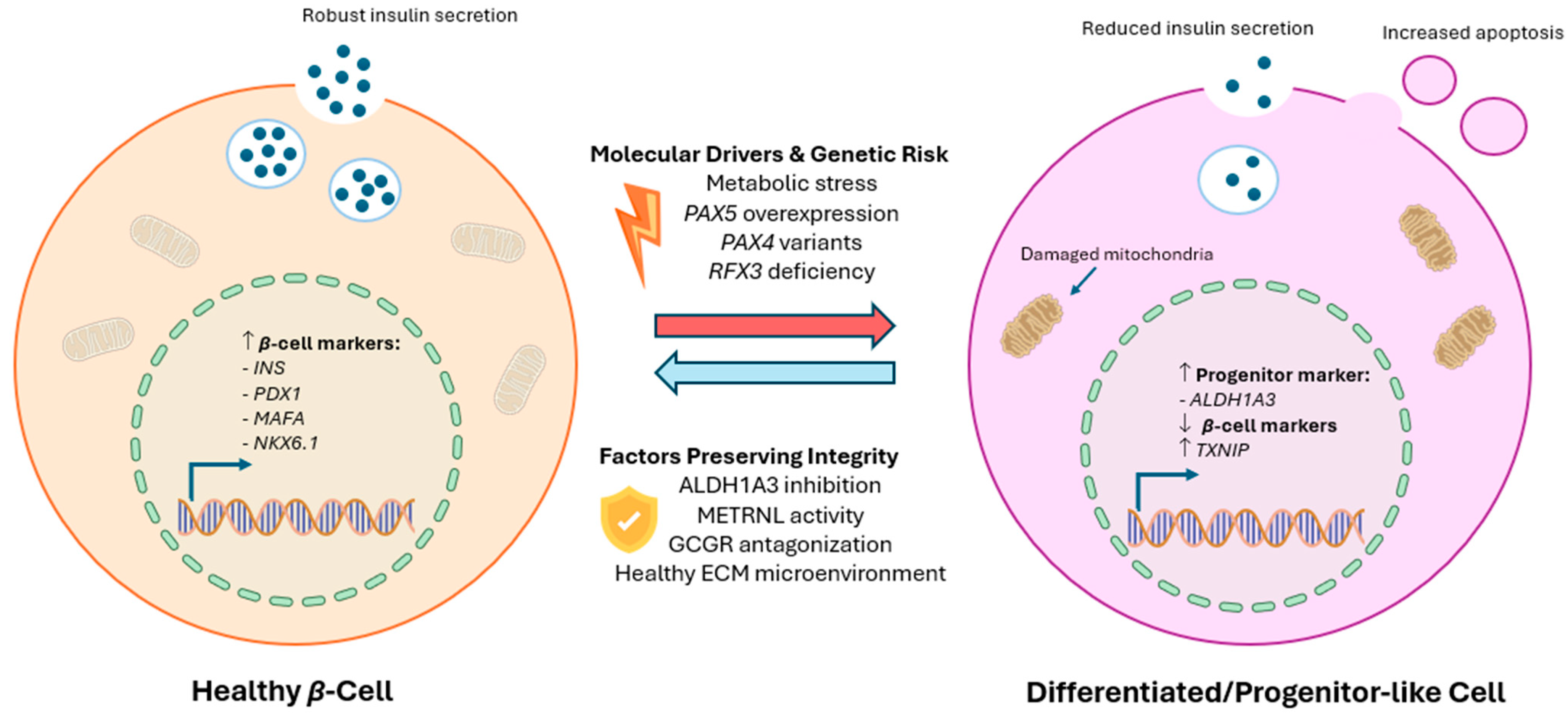
Pancreatic β-cells are dynamic, exhibiting plasticity, functional adaptation and cellular reprogramming in response to metabolic demands. However, chronic metabolic stress can drive β-cells toward functional dedifferentiation, contributing to β-cell failure. This is characterised by reprogramming, with the reduced expression of the key β-cell identity and maturity markers, such as INS, PDX1, MAFA and NKX6.1, alongside the reactivation of progenitor-like or immature transcriptional programs [98,99,100,101,102,103,104,105]. Interestingly, repeated or episodic stress can similarly overwhelm the adaptive capacity and lead to the loss of the β-cell identity [84]. In addition to β-cell identity genes, XBP1 also contributes to the identity of functional β-cells and prevents transdifferentiation into glucagon-expressing α-cells under metabolic stress conditions [90]. Figure 3 summarises β-cell plasticity, dedifferentiation and therapeutic reprograming.
T2D is a polygenic disease influenced by the interplay among multiple genetic variants and environmental factors [106,107,108,109]. Thanks to advanced genetic tools and large-scale cohort studies, including genome-wide association studies (GWAS) [110,111], meta-analyses [112,113] and next-generation sequencing (NGS), researchers have identified genetic risk factors associated with T2D, such as TCF7L2 [114,115], SLC30A8 [116,117] and KCNJ11 [118,119]. These are major risk factors that contribute to dedifferentiation by disrupting the transcriptional system, insulin granule function and GSIS, compromising the β-cell identity and function. Both common and rare variants have been integrated into gene regulatory networks across large populations. Building on this knowledge, this section reviews studies from the past five years focusing on genes involved in β-cell dedifferentiation. We will also discuss emerging strategies to promote β-cell redifferentiation toward an insulin-producing phenotype.
A study by Zhou et al. found that the meteorin-like (METRNL) protein is a regulator of β-cell integrity under metabolic stress, preventing β- to α-cell transdifferentiation [120]. Specifically, βKO-METRNL mice exhibited impaired GSIS, the activation of the C-Jun-mediated stress program and suppression of genes linked to the β-cell identity [120]. Single-cell RNA sequencing analysis revealed that these mice developed non-β-cell transcriptional signatures such as the upregulation of α-cell genes (Gcg, Irx2 and Arx) but downregulation of β-cell genes (Ins1, Ins2 MafA and Pdx1). Another study by Cui et al. in diabetic mouse models showed that antagonising the glucagon receptor (GCGR) with a monoclonal antibody (mAb) promotes the transdifferentiation of pancreatic α-cells into β-cells [121]. Within the islet cells of the pancreas, the GCGR is predominantly expressed in β-cells, while its expression is low in α-cells and negligible in δ-cells [122,123]. Experiments with isolated mouse islets revealed significantly enhanced insulin secretion under GCGR mAb culture conditions, with the upregulation of genes associated with β-cell integrity and regeneration, including Gcg, Pcsk1, Ins1, Pdx1 and Ngn3 [121]. Together, these findings suggest that GCGR inhibition may counteract β-cell dedifferentiation by reinforcing β-cell fate commitment.
RFX3, a member of the regulatory factor X family of transcription factors, serves as a central regulator of developmental gene expression, particularly during primary ciliogenesis and neuroendocrine lineage specification [106,107]. These functions were also observed in a human induced pluripotent stem cell (hiPSC)-based study, which demonstrated that RFX3 is essential for stabilising the islet endocrine cell identity and promoting β-cell differentiation and function [107]. Notably, an RFX3 deficiency led to the upregulation of TXNIP and β-cell failure via apoptosis under stress conditions [107]. Collectively, these findings suggest that RFX3 functions as a transcriptional integrator associated with islet developmental signalling, stress adaptation and β-cell vulnerability.
Using approximately 300 human pancreatic islet samples, gene expression analysis identified candidate genes associated with T2D risk, including PAX5 [108]. The overexpression of PAX5 in β-cells caused severe mitochondrial dysfunction, impacting β-cell function, and regulated T2D-associated genes [108]. Recent research using human β-cells from East Asian populations showed that the Arg192His coding variant of PAX4 is associated with T2D susceptibility [109,110]. The hiPSC-derived β-like cells carrying the Arg192His or Tyr186X variants expressed lower PAX4 along with a reduced insulin content [110]. The CRISPR-based gene correction of the Arg192His or Tyr186X alleles restored the β-cell identity and total insulin content in hiPSC-derived β-like cells [110]. Collectively, these findings highlight PAX4 and PAX5 as important regulators of β-cell identity.
Most research relies on preclinical studies using β-cell-specific gene-edited rodents or in vitro cellular experiments to identify genes linked to β-cell integrity in islets and T2D-associated genetic variants. Human studies usually utilise post-mortem pancreatic islets from individuals with advanced T2D. A recent study applied a multi-omics analysis of pancreatic islets from living metabolically characterised individuals with diabetes [111]. People in the study had a planned pancreatectomy due to chronic pancreatitis (~25%, type 3C diabetes) or pancreatic tumours (type 2 diabetes). It demonstrated that β-cell heterogeneity increases from the prediabetic stage and that β-cell remodelling is non-linear [111]. These results suggest that β-cells do not decline uniformly, but may exist in dynamic states that can be remodelled in response to metabolic stress.
Indeed, human single-cell multi-omics studies have emphasised β-cell heterogeneity and stress dynamics in response to the surrounding environment, revealing reversible state transitions rather than static states. Integrated single-cell RNA-seq, single-nuclei ATAC-seq and 3D genome-wide profiling identify β-cell subpopulations with distinct stress resilience. These findings indicate that β-cell populations are heterogeneous, comprising both immature and mature phenotypes rather than being uniformly damaged. Thus, β-cells show high insulin expression, consistent with a compensatory response, and low insulin expression, which may reflect functional impairment or dedifferentiation. Moreover, a distinct subcluster within β-cell populations shows the activation of inflammatory pathways and ER stress/UPR, along with linked genes, suggesting subtypes that may be particularly vulnerable under chronic metabolic stress—the transcription factors, such as HNF1A, are key drivers of heterogeneity and functional differences [112].
A recent single-cell multi-omics study found that β-cells in T2D show gender-specific transcriptional and epigenomic alterations, with mitochondrial respiration suppression enriched in females and insulin-secretion signatures more prevalent in males [113]. Moreover, T2D-associated genetic variants preferentially localise to sex- and cell-type-specific regulatory chromatin regions, suggesting that β-cell stress vulnerability is differentially modulated by sex [113]. Beyond β-cells, another single-cell multi-omics study utilising imaging mass cytometry (IMC) revealed significant alterations in the pancreatic islet architecture, islet cell subtypes (including α- and β-cell composition) and immune cells (including CD8 T cells and macrophages) compared with healthy individuals and those with T2D [124]. Furthermore, IMC enhances the visualisation of islet heterogeneity, subtype ratios and cell–cell interactions in pancreatic tissue [124]. This approach can help reveal the β-cell stress response and can be utilised as a potential diagnostic indicator of prediabetes and diabetes through integrated single-cell multi-omics analysis.
A recent study identified ALDH1A3 as a factor in both β-cell dysfunction in T2D and β-cell dedifferentiation [125]. Lineage-tracing experiments showed that ALDH1A3-dedifferentiated β-cells can be reconverted into functional, mature β-cells, illustrating that β-cell dedifferentiation can be reversible [125]. The inhibition of ALDH1A3 via genetic or pharmacological tools restored insulin secretion and promoted differentiation and regeneration [125], underscoring the therapeutic potential of targeting β-cell plasticity. Recent studies highlight the potential roles of stem-cell-derived β-cell differentiation and islet organoids containing insulin-producing β-like cells as a novel therapeutic vision for T2D [114]. The microenvironment is important for function in iPSC-derived islet organoids [115]. Using a decellularised amniotic membrane ECM hydrogel with collagen VI, laminin and fibronectin, Zhu et al. created islet organoids and then transplanted them into diabetic mice, resulting in improved glucose tolerance [115]. The results indicate that while encouraging β-cell differentiation is key, supporting the interactions between islets and their environment is also crucial for in vivo glucose control.

6. Inflammation and Stress Responses

Insulin-producing pancreatic β-cells are both initiators and victims of inflammatory responses under stress conditions [116]. In addition to responding to immune cell signals, β-cells shape the inflammatory milieu of the islet microenvironment [117,118]. β-cell inflammatory signalling can dynamically shift from an adaptive, protective response to pathological, self-perpetuating inflammation, leading to the progression of β-cell failure [117,119]. As described above, prolonged stress impairs the β-cell mitochondrial function and increases ROS and mitochondrial DNA damage, which activates inflammatory pathways. This activation can occur independently of immune cell-derived cytokines [126,127].
The activation of the NLRP3 inflammasome is also responsible for the pro-inflammatory responses, leading to the cell death observed in diabetes [128]. In pancreatic β-cells, chronic hyperglycaemia enhances the expression of TXNIP, promoting NLRP3 inflammasome activation. The TXNIP/NLRP3 inflammasome axis leads to caspase-1 activation. Activated caspase-1 cleaves gasdermin D (GSDMD) at its N-terminus. The N-terminal fragment binds to the plasma membrane and builds pores. Through these pores, pro-inflammatory cytokines such as IL-1β and IL18 are rapidly released, resulting in pro-inflammatory-formed cell death (pyroptosis) [128,129]. Modulating inflammatory responses within the islet microenvironment could be beneficial for β-cell integrity. The TXNIP-NLRP3-caspase-1/GSDMD axis is thus a therapeutic target for blocking inflammasome-induced β-cell loss and may slow the progression of diabetes. Improved outcomes with the inhibitor MCC950, targeting the TXNIP/NLRP3 inflammasome axis to treat inflammatory and metabolic disease, were observed in preclinical studies. Notably, the administration of MCC950 improved the glycaemic control in islet-transplanted mice, a finding strongly linked to reduced islet death via IL-1β suppression, especially supporting long-term graft islet survival [130]. Future research is also required to determine whether MCC950 can produce synergistic effects when combined with existing anti-diabetic treatments and whether it can also have positive effects on related complications beyond diabetes.
A study by Grieco et al. highlighted a critical role for miR-184-3p in regulating CREB-regulated transcription coactivator 1 (CRTC1) within β-cell-intrinsic inflammatory signalling [131]. In islets from patients with T2D, miR-184-3p was reduced, resulting in the upregulation of its target CRTC1 [131]. Increased CRTC1 protects β-cells from palmitate- and cytokine-induced apoptosis, indicating an adaptive survival response under stress. Notably, reduced miR-184-3p levels were associated with reductions or the cytoplasmic translocation of the β-cell identity transcription factor NKX6.1. NKX6.1 positively regulates miR-184-3p expression and is linked to the β-cell identity and functional capacity. This study suggests the reduction in miR-184-3p and resulting upregulation of CRTC1 in T2D is followed by the reduction or translocation of transcription factor NKX6.1 seen within dysfunctional or dedifferentiated β-cells in T2D. NKX6.1 is closely linked to β-cell identity loss, functional decline and dedifferentiation. These findings suggest that the miR-184-3p-CRTC1 axis serves a compensatory role, allowing β-cells to evade apoptosis at the cost of β-cell identity and function.
In contrast, the accumulation of human islet amyloid polypeptide (hIAPP) in T2D is closely linked to amyloid deposition, inflammation and a loss of β-cells [132]. A study identified Receptor-Interacting Protein Kinase 3 (RIPK3) as a driver of amyloid production and potential β-cell damage [132]. This study explored RIPK3’s role in amyloid-driven β-cell loss and inflammation in mice transgenic for hIAPP [132]. Macrophages were the main source of RIPK3 in islets; depleting RIPK3 in bone-marrow-derived macrophages (BMDMs) resulted in lower inflammatory gene expression, including Tnfa, Il1b and iNos (inducible nitric oxide synthase) [132]. hIAPP mice fed an HFD had glucose intolerance and a loss of β-cell mass which was ameliorated with RIPK3 knockout [132]. In this context, a study by Chen et al. provided insights into how interactions with microenvironmental components, such as macrophages within the islet, affect insulin secretion in obese diabetic animals [119]. They demonstrated that macrophage-mediated IL-6 signalling is important for GSIS in lean mice, but this pathway is impaired in T2D patients and obese diabetic mice [119]. An impaired FFA receptor 4 (FFAR4)-mediated IL-6 release and reduced downstream signalling were observed in these animals [119]. Exogenous IL-6 treatment restored GSIS [119].
Recent studies have proposed a beneficial anti-inflammatory role for butyrate, which protects β-cells from cytokine-induced stress and functional impairment through IL-1β-signalling pathways. The treatment of mouse islets and a rat insulinoma β-cell line with butyrate significantly reduced the IL-1β-induced expression of Nos2, Cxcl1 and Ptgs2, as well as iNOS production [133]. Butyrate did not affect the nuclear translocation of NF-κB p65, but did promote the acetylation of NF-κB p65 and histone H4, suggesting that the suppression of inflammatory gene transcription may be mediated by histone deacetylase (HDAC) inhibition [133]. A study from the same group used a genome-wide functional analysis of H3K27 acetylation (H3K27ac) to identify an epigenetic mechanism by which butyrate restores IL-1β-reduced H3K27ac levels at loci associated with hormone secretion [134]. This redistribution of H3K27ac allows a transcriptional reprogramming process through which butyrate modifies the β-cell epigenetic landscape [134]. Overall, modulating inflammatory responses in β-cells are likely to maintain β-cell health.

7. Summary and Future Directions

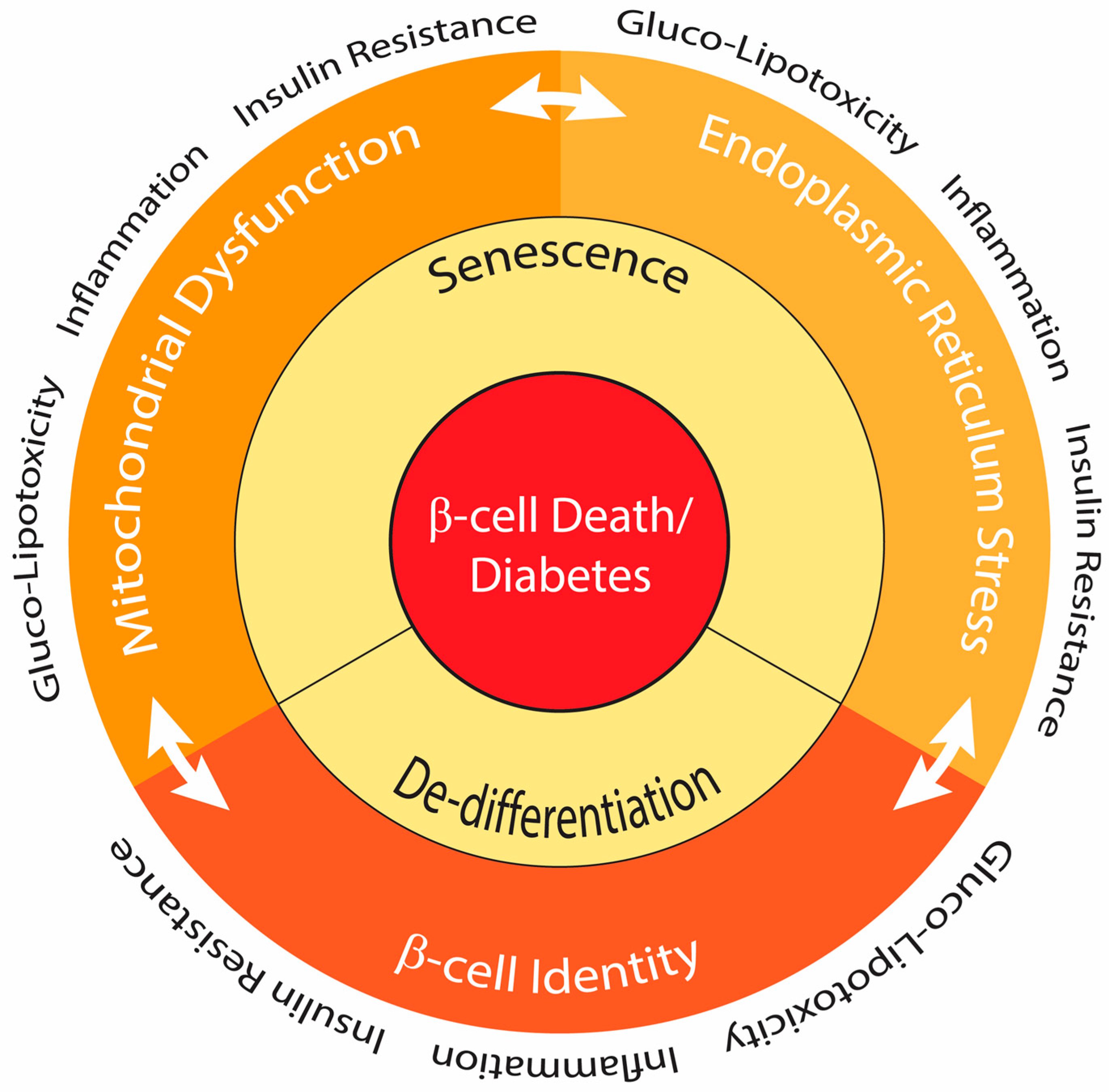
In conclusion, the complex interplay of multifactorial stress pathways affecting insulin-producing β-cells is central to the development of β-cell failure in obesity and T2D. This failure occurs when cumulative stress networks exceed the capacity of adaptive mechanisms (Figure 4).
Preclinical studies have demonstrated improvements in metabolic outcomes by targeting specific signalling pathways in pancreatic β-cells, yet translating this knowledge into clinical practice for diabetes remains challenging. Strategies targeting UPR signalling or chaperone proteins still face multiple barriers. Given the intrinsic heterogeneity of β-cells and the time-dependent transition between adaptive and maladaptive UPR signalling, strategies should prevent the premature or delayed modulation of stress responses. The inappropriate timing of UPR activation or inhibition, through the introduction of UPR modulators, may blunt protective adaptive signalling and promote maladaptive signalling. Therefore, the stage-specific and context-dependent tuning of key UPR regulators in β-cells is essential to preserve their function within islets. However, these approaches can also exert off-target effects in non-β-cell types and other tissues. Additionally, chemical chaperones such as tauroursodeoxycholic acid (TUDCA) or 4-phenylbutyric acid (4-PBA) may ameliorate global ER stress, but their lack of β-cell specificity could limit mechanistic precision and blunt adaptive UPR signalling [135,136].
In contrast, GLP-1 receptor agonists (GLP-1RAs) and SGLT-2 inhibitors, approved by the FDA in 2005 and 2013, respectively, have shown additional health benefits in patients with kidney or cardiovascular diseases [137,138]. GLP-1RAs are well-known incretin-based treatments for diabetes, reducing blood glucose, promoting weight loss and improving overall glucose homeostasis. Notably, as a synergistic effect of improved glucose homeostasis, the dual agonism of the GLP-1/GIP receptors (tirzepatide) [139] could provide greater metabolic benefits, including superior weight loss and glucose lowering. Although multiple GLP-1RAs and tirzepatide have been approved by the FDA for obesity and T2D, the long-term effects of dual GLP-1/GIP receptor agonists on intrinsic β-cell stress signalling and UPR dynamics demand further investigation. For SGLT-2 inhibitors, given the risk of diabetic ketoacidosis [140], understanding the mechanisms by which these agents act, linked to the β-cell stress response, would be valuable for enabling them to serve as a barrier to other medications and protect β-cells. Moreover, DYRK1A inhibitors, which have been shown in preclinical studies to enhance the β-cell function by promoting β-cell proliferation [141], have also recently been suggested as potential new anti-diabetic agents, but these have not yet been tested in humans. However, optimal timing, duration and safety tests are required for the clinical application of these drugs.
Regarding the route of drug administration, research in bioengineering should be considered to improve the delivery efficiency to target tissues/cells while maintaining their inherent persistence. Stem-cell-derived β-cell transplantation aims to replace functional β-cells by modulating β-cell differentiation. Similarly, islet organoid transplantation aims to restore the islet cellular diversity, focusing on islet heterogeneity beyond β-cell replacement, thereby enabling paracrine signalling within islets and improving the neighbouring β-cell function. This would thus be beneficial for modulating the immune response and long-term engraftment.
Ultimately, mechanism-informed interventions should address β-cell heterogeneity, dynamic stress responses and species-specific differences to facilitate the systematic integration of functional islets. Additionally, an in-depth understanding of the integration among neighbouring β-cells within islets should be essential for designing interventions that preserve β-cell integrity and improve health outcomes.

Author Contributions

Y.A., N.N., D.L. and J.E.G. contributed to the writing and visualising the figures. All authors have read and agreed to the published version of the manuscript.

Funding

JEG is funded by NHMRC investigator grant AppID 2033228. NN is funded by the Metabolic Health Initiative, University of Sydney. DL is funded by the Musculoskeletal Health Program at the University of Sydney.

Data Availability Statement

No new data were created or analysed in this study.

Acknowledgments

We would like to dedicate this paper in memory of D. Ross Laybutt and his body of work on β-cell stress and identity.

Conflicts of Interest

The authors declare no conflicts of interest for this article.

Abbreviations

The following abbreviations are used in this manuscript:
4-PBA4-phenylbutyric acid
14-3-3 ζ 14-3-3 ζ isoform
ATF6Activating Transcription Factor 6
BI-1Bax Inhibitor-1
BMDMsBone-marrow-derived macrophages
Ca2+Calcium ion
CRTC1CREB-regulated transcription coactivator 1
EDEM1ER-degradation-enhancing α-mannosidase-like protein 1
EREndoplasmic reticulum
FFAFree fatty acids
FFAR1FFA receptor 1
FFAR4FFA receptor 4
GCGRGlucagon receptor
GLP-1RAsGLP-1 receptor agonists
GSDMDGasdermin D
GSISGlucose-stimulated insulin secretion
GWASGenome-wide association studies
H3K27acH3K27 acetylation
HDACHistone deacetylase
hIAPPHuman islet amyloid polypeptide
hiPSCHuman induced pluripotent stem cell
IDFInternational Diabetes Federation
IFN-γInterferon-γ
IL-1βInterleukin-1β
IMCImaging mass cytometry
IRE1αInositol-Required Enzyme 1 α
mAbMonoclonal antibody
METRNLMeteorin-like protein
MUFAMonounsaturated fatty acids
NGSNext-generation sequencing
NODMNew-onset diabetes mellitus
OSGEPO-sialoglycoprotein endopeptidase
PAIRs compoundPartial Antagonists of IRE1α RNase
PERKPKR-like ER kinase
RIDDRegulated IRE1-Dependent Decay
ROSReactive oxygen species
SASPSenescence-associated secretory phenotype
SIRT1Silent information regulator 1
T2DType 2 diabetes
TNF-αTumour necrosis factor-α
TRXRThioredoxin reductase
TUDCATauroursodeoxycholic acid
TXN1Thioredoxin 1
TXNIPThioredoxin-interacting protein
UPRUnfolded protein response

References

  1. Gupta, D.; Krueger, C.B.; Lastra, G. Over-nutrition, obesity and insulin resistance in the development of β-cell dysfunction. Curr. Diabetes Rev. 2012, 8, 76–83. [Google Scholar] [CrossRef]
  2. Johnson, J.D. On the causal relationships between hyperinsulinaemia, insulin resistance, obesity and dysglycaemia in type 2 diabetes. Diabetologia 2021, 64, 2138–2146. [Google Scholar] [CrossRef]
  3. Lingohr, M.K.; Buettner, R.; Rhodes, C.J. Pancreatic β-cell growth and survival—A role in obesity-linked type 2 diabetes? Trends Mol. Med. 2002, 8, 375–384. [Google Scholar] [CrossRef]
  4. Golson, M.L.; Misfeldt, A.A.; Kopsombut, U.G.; Petersen, C.P.; Gannon, M. High Fat Diet Regulation of β-Cell Proliferation and β-Cell Mass. Open Endocrinol. J. 2010, 4, 66–77. [Google Scholar] [CrossRef]
  5. Mezza, T.; Cinti, F.; Cefalo, C.M.A.; Pontecorvi, A.; Kulkarni, R.N.; Giaccari, A. β-Cell Fate in Human Insulin Resistance and Type 2 Diabetes: A Perspective on Islet Plasticity. Diabetes 2019, 68, 1121–1129. [Google Scholar] [CrossRef]
  6. Benakova, S.; Holendova, B.; Plecita-Hlavata, L. Redox Homeostasis in Pancreatic β-Cells: From Development to Failure. Antioxidants 2021, 10, 526. [Google Scholar] [CrossRef]
  7. Vela-Guajardo, J.E.; Garza-Gonzalez, S.; Garcia, N. Glucolipotoxicity-induced Oxidative Stress is Related to Mitochondrial Dysfunction and Apoptosis of Pancreatic β-cell. Curr. Diabetes Rev. 2021, 17, e031120187541. [Google Scholar] [CrossRef] [PubMed]
  8. Jetton, T.L.; Lausier, J.; LaRock, K.; Trotman, W.E.; Larmie, B.; Habibovic, A.; Peshavaria, M.; Leahy, J.L. Mechanisms of compensatory β-cell growth in insulin-resistant rats: Roles of Akt kinase. Diabetes 2005, 54, 2294–2304. [Google Scholar] [CrossRef] [PubMed]
  9. Rorsman, P.; Ashcroft, F.M. Pancreatic β-Cell Electrical Activity and Insulin Secretion: Of Mice and Men. Physiol. Rev. 2018, 98, 117–214. [Google Scholar] [CrossRef] [PubMed]
  10. Marchetti, P.; Bugliani, M.; De Tata, V.; Suleiman, M.; Marselli, L. Pancreatic β Cell Identity in Humans and the Role of Type 2 Diabetes. Front. Cell Dev. Biol. 2017, 5, 55. [Google Scholar] [CrossRef]
  11. Yosten, G.L.; Maric-Bilkan, C.; Luppi, P.; Wahren, J. Physiological effects and therapeutic potential of proinsulin C-peptide. Am. J. Physiol. Endocrinol. Metab. 2014, 307, E955–E968. [Google Scholar] [CrossRef]
  12. Thomas, D.D.; Corkey, B.E.; Istfan, N.W.; Apovian, C.M. Hyperinsulinemia: An Early Indicator of Metabolic Dysfunction. J. Endocr. Soc. 2019, 3, 1727–1747. [Google Scholar] [CrossRef]
  13. Teta, M.; Long, S.Y.; Wartschow, L.M.; Rankin, M.M.; Kushner, J.A. Very slow turnover of β-cells in aged adult mice. Diabetes 2005, 54, 2557–2567. [Google Scholar] [CrossRef]
  14. Zhong, F.; Jiang, Y. Endogenous Pancreatic β Cell Regeneration: A Potential Strategy for the Recovery of β Cell Deficiency in Diabetes. Front. Endocrinol. 2019, 10, 101. [Google Scholar] [CrossRef]
  15. Georgia, S.; Bhushan, A. β cell replication is the primary mechanism for maintaining postnatal β cell mass. J. Clin. Investig. 2004, 114, 963–968. [Google Scholar] [CrossRef] [PubMed]
  16. Robertson, R.P.; Harmon, J.; Tran, P.O.; Poitout, V. β-cell glucose toxicity, lipotoxicity, and chronic oxidative stress in type 2 diabetes. Diabetes 2004, 53, S119–S124. [Google Scholar] [CrossRef] [PubMed]
  17. Kulkarni, A.; Muralidharan, C.; May, S.C.; Tersey, S.A.; Mirmira, R.G. Inside the β Cell: Molecular Stress Response Pathways in Diabetes Pathogenesis. Endocrinology 2022, 164, bqac184. [Google Scholar] [CrossRef] [PubMed]
  18. Hotamisligil, G.S. Endoplasmic reticulum stress and the inflammatory basis of metabolic disease. Cell 2010, 140, 900–917. [Google Scholar] [CrossRef]
  19. Lee, Y.H.; Jung, H.S.; Kwon, M.J.; Jang, J.E.; Kim, T.N.; Lee, S.H.; Kim, M.K.; Park, J.H. Melatonin protects INS-1 pancreatic β-cells from apoptosis and senescence induced by glucotoxicity and glucolipotoxicity. Islets 2020, 12, 87–98. [Google Scholar] [CrossRef]
  20. Guzman, T.J.; Klopper, N.; Gurrola-Diaz, C.M.; Dufer, M. Inhibition of mTOR prevents glucotoxicity-mediated increase of SA-β-gal, p16(INK4a), and insulin hypersecretion, without restoring electrical features of mouse pancreatic islets. Biogerontology 2024, 25, 819–836. [Google Scholar] [CrossRef]
  21. Gerber, P.A.; Rutter, G.A. The Role of Oxidative Stress and Hypoxia in Pancreatic β-Cell Dysfunction in Diabetes Mellitus. Antioxid. Redox Signal. 2017, 26, 501–518. [Google Scholar] [CrossRef] [PubMed]
  22. Grosick, R.; Alvarado-Vazquez, P.A.; Messersmith, A.R.; Romero-Sandoval, E.A. High glucose induces a priming effect in macrophages and exacerbates the production of pro-inflammatory cytokines after a challenge. J. Pain Res. 2018, 11, 1769–1778. [Google Scholar] [CrossRef] [PubMed]
  23. Lee, H.; Kim, M.J.; Lee, I.K.; Hong, C.W.; Jeon, J.H. Impact of hyperglycemia on immune cell function: A comprehensive review. Diabetol. Int. 2024, 15, 745–760. [Google Scholar] [CrossRef]
  24. Miao, L.; Miao, R.; Yao, Y.; Fang, X.; Guan, H.; Tian, J.; Tong, X. Metabolic reprogramming of pancreatic β cells in type 2 diabetes and its therapeutic strategy. Ageing Res. Rev. 2026, 113, 102938. [Google Scholar] [CrossRef]
  25. Giri, B.; Dey, S.; Das, T.; Sarkar, M.; Banerjee, J.; Dash, S.K. Chronic hyperglycemia mediated physiological alteration and metabolic distortion leads to organ dysfunction, infection, cancer progression and other pathophysiological consequences: An update on glucose toxicity. Biomed. Pharmacother. 2018, 107, 306–328. [Google Scholar] [CrossRef]
  26. Cerf, M.E. Developmental Programming and Glucolipotoxicity: Insights on β Cell Inflammation and Diabetes. Metabolites 2020, 10, 444. [Google Scholar] [CrossRef]
  27. Poitout, V.; Hagman, D.; Stein, R.; Artner, I.; Robertson, R.P.; Harmon, J.S. Regulation of the insulin gene by glucose and fatty acids. J. Nutr. 2006, 136, 873–876. [Google Scholar] [CrossRef]
  28. Gao, Y.; Chen, Q.; Wu, Z.; Yuan, L. Regulation of pancreatic β cells by exosomes from different sources. Diabetes Res. Clin. Pract. 2025, 224, 112222. [Google Scholar] [CrossRef]
  29. Wei, J.; Wang, Z.; Han, T.; Chen, J.; Ou, Y.; Wei, L.; Zhu, X.; Wang, K.; Yan, Z.; Han, Y.P.; et al. Extracellular vesicle-mediated intercellular and interorgan crosstalk of pancreatic islet in health and diabetes. Front. Endocrinol. 2023, 14, 1170237. [Google Scholar] [CrossRef]
  30. Zhang, H.H.; Ma, X.J.; Wu, L.N.; Zhao, Y.Y.; Zhang, P.Y.; Zhang, Y.H.; Shao, M.W.; Liu, F.; Li, F.; Qin, G.J. SIRT1 attenuates high glucose-induced insulin resistance via reducing mitochondrial dysfunction in skeletal muscle cells. Exp. Biol. Med. 2015, 240, 557–565. [Google Scholar] [CrossRef] [PubMed]
  31. Desai, T.; Koulajian, K.; Ivovic, A.; Breen, D.M.; Luu, L.; Tsiani, E.L.; Wheeler, M.B.; Giacca, A. Pharmacologic or genetic activation of SIRT1 attenuates the fat-induced decrease in β-cell function in vivo. Nutr. Diabetes 2019, 9, 11. [Google Scholar] [CrossRef] [PubMed]
  32. Jimenez-Sanchez, C.; Oberhauser, L.; Maechler, P. Role of fatty acids in the pathogenesis of ss-cell failure and Type-2 diabetes. Atherosclerosis 2024, 398, 118623. [Google Scholar] [CrossRef]
  33. Romer, A.; Linn, T.; Petry, S.F. Lipotoxic Impairment of Mitochondrial Function in β-Cells: A Review. Antioxidants 2021, 10, 293. [Google Scholar] [CrossRef] [PubMed]
  34. Chan, J.Y.; Luzuriaga, J.; Bensellam, M.; Biden, T.J.; Laybutt, D.R. Failure of the adaptive unfolded protein response in islets of obese mice is linked with abnormalities in β-cell gene expression and progression to diabetes. Diabetes 2013, 62, 1557–1568. [Google Scholar] [CrossRef]
  35. Veluthakal, R.; Palanivel, R.; Zhao, Y.; McDonald, P.; Gruber, S.; Kowluru, A. Ceramide induces mitochondrial abnormalities in insulin-secreting INS-1 cells: Potential mechanisms underlying ceramide-mediated metabolic dysfunction of the β cell. Apoptosis 2005, 10, 841–850. [Google Scholar] [CrossRef]
  36. Welters, H.J.; Tadayyon, M.; Scarpello, J.H.; Smith, S.A.; Morgan, N.G. Mono-unsaturated fatty acids protect against β-cell apoptosis induced by saturated fatty acids, serum withdrawal or cytokine exposure. FEBS Lett. 2004, 560, 103–108. [Google Scholar] [CrossRef]
  37. Nemecz, M.; Constantin, A.; Dumitrescu, M.; Alexandru, N.; Filippi, A.; Tanko, G.; Georgescu, A. The Distinct Effects of Palmitic and Oleic Acid on Pancreatic β Cell Function: The Elucidation of Associated Mechanisms and Effector Molecules. Front. Pharmacol. 2018, 9, 1554. [Google Scholar] [CrossRef]
  38. Wang, B.; Cai, Z.; Yao, H.; Jiao, S.; Chen, S.; Yang, Z.; Huang, W.; Ren, Q.; Cao, Z.; Chen, Y.; et al. Discovery of a structurally novel, potent, and once-weekly free fatty acid receptor 1 agonist for the treatment of diabetes. Eur. J. Med. Chem. 2023, 245, 114883. [Google Scholar] [CrossRef]
  39. Burant, C.F. Activation of GPR40 as a therapeutic target for the treatment of type 2 diabetes. Diabetes Care 2013, 36, S175–S179. [Google Scholar] [CrossRef]
  40. Kristinsson, H.; Smith, D.M.; Bergsten, P.; Sargsyan, E. FFAR1 is involved in both the acute and chronic effects of palmitate on insulin secretion. Endocrinology 2013, 154, 4078–4088. [Google Scholar] [CrossRef] [PubMed]
  41. Steneberg, P.; Rubins, N.; Bartoov-Shifman, R.; Walker, M.D.; Edlund, H. The FFA receptor GPR40 links hyperinsulinemia, hepatic steatosis, and impaired glucose homeostasis in mouse. Cell Metab. 2005, 1, 245–258. [Google Scholar] [CrossRef] [PubMed]
  42. Liang, X.K. Interplay of mitochondria and diabetes: Unveiling novel therapeutic strategies. Mitochondrion 2024, 75, 101850. [Google Scholar] [CrossRef]
  43. Stancill, J.S.; Corbett, J.A. The Role of Thioredoxin/Peroxiredoxin in the β-Cell Defense Against Oxidative Damage. Front. Endocrinol. 2021, 12, 718235. [Google Scholar] [CrossRef]
  44. Motomura, K.; Matsuzaka, T.; Shichino, S.; Ogawa, T.; Pan, H.; Nakajima, T.; Asano, Y.; Okayama, T.; Takeuchi, T.; Ohno, H.; et al. Single-Cell Transcriptome Profiling of Pancreatic Islets From Early Diabetic Mice Identifies Anxa10 for Ca2+ Allostasis Toward β-Cell Failure. Diabetes 2024, 73, 75–92. [Google Scholar] [CrossRef]
  45. Li, S.; Zhou, H.; Xie, M.; Zhang, Z.; Gou, J.; Yang, J.; Tian, C.; Ma, K.; Wang, C.Y.; Lu, Y.; et al. Regenerating islet-derived protein 3 γ (Reg3g) ameliorates tacrolimus-induced pancreatic β-cell dysfunction in mice by restoring mitochondrial function. Br. J. Pharmacol. 2022, 179, 3078–3095. [Google Scholar] [CrossRef]
  46. Noto, H.; Goto, A.; Tsujimoto, T.; Noda, M. Effect of calcium channel blockers on incidence of diabetes: A meta-analysis. Diabetes Metab. Syndr. Obes. 2013, 6, 257–261. [Google Scholar] [CrossRef]
  47. Graff, S.M.; Nakhe, A.Y.; Dadi, P.K.; Dickerson, M.T.; Dobson, J.R.; Zaborska, K.E.; Ibsen, C.E.; Butterworth, R.B.; Vierra, N.C.; Jacobson, D.A. TALK-1-mediated alterations of β-cell mitochondrial function and insulin secretion impair glucose homeostasis on a diabetogenic diet. Cell Rep. 2024, 43, 113673. [Google Scholar] [CrossRef]
  48. Rial, S.A.; Shishani, R.; Cummings, B.P.; Lim, G.E. Is 14-3-3 the Combination to Unlock New Pathways to Improve Metabolic Homeostasis and β-Cell Function? Diabetes 2023, 72, 1045–1054. [Google Scholar] [CrossRef] [PubMed]
  49. Mugabo, Y.; Zhao, C.; Tan, J.J.; Ghosh, A.; Campbell, S.A.; Fadzeyeva, E.; Pare, F.; Pan, S.S.; Galipeau, M.; Ast, J.; et al. 14-3-3ζ Constrains insulin secretion by regulating mitochondrial function in pancreatic β cells. JCI Insight 2022, 7, e156378. [Google Scholar] [CrossRef] [PubMed]
  50. Chen, Y.; Zhou, Y.; Wei, X.; Yang, Y.; Li, X.; Xu, Y.; Liu, C.; Chen, Z. Analysis of miRNA and mRNA expression in the dysregulation of insulin secretion in MIN6 cells exposed to microcystin-leucine-arginine. Toxicon 2021, 201, 169–176. [Google Scholar] [CrossRef]
  51. Sassi, A.; Bakhtiar, M.T.B.; Khattak, M.; Haron, N.B.; Kaderi, M.A.B.; Rostam, M.A.B.; Jusoh, H.B.M. Biological Roles of Selected microRNAs in Glucose Metabolism as a Candidate Biomarker for Diabetes Mellitus. Mol. Nutr. Food Res. 2025, 69, e70077. [Google Scholar] [CrossRef]
  52. Li, N.; Jiang, D.; He, Q.; He, F.; Li, Y.; Deng, C.; Li, F. microRNA-181c-5p promotes the formation of insulin-producing cells from human induced pluripotent stem cells by targeting smad7 and TGIF2. Cell Death Dis. 2020, 11, 462. [Google Scholar] [CrossRef]
  53. Coskun, E.; Ercin, M.; Gezginci-Oktayoglu, S. The Role of Epigenetic Regulation and Pluripotency-Related MicroRNAs in Differentiation of Pancreatic Stem Cells to β Cells. J. Cell Biochem. 2018, 119, 455–467. [Google Scholar] [CrossRef] [PubMed]
  54. Cowan, E.; Sun, J.; Hamilton, A.; Ruhrmann, S.; Karagiannopoulos, A.; Westholm, E.; Ofori, J.K.; Luan, C.; Zhang, E.; Mulder, H.; et al. MicroRNA 29 modulates β-cell mitochondrial metabolism and insulin secretion via underlying miR-29-OXPHOS complex pathways. Acta Physiol. 2024, 240, e14180. [Google Scholar] [CrossRef] [PubMed]
  55. Krishnan, P.; Branco, R.C.S.; Weaver, S.A.; Chang, G.; Lee, C.C.; Syed, F.; Evans-Molina, C. miR-146a-5p mediates inflammation-induced β cell mitochondrial dysfunction and apoptosis. J. Biol. Chem. 2024, 300, 107827. [Google Scholar] [CrossRef] [PubMed]
  56. Levi-D’Ancona, E.; Stendahl, A.M.; Henry-Kanarek, B.A.; Davidson, R.K.; Walker, E.M.; Soleimanpour, S.A. Mitophagy in the adaptation to pancreatic β cell stress in diabetes. Trends Endocrinol. Metab. 2025, online ahead of print. [Google Scholar] [CrossRef]
  57. Chen, L.; Liu, C.; Gao, J.; Xie, Z.; Chan, L.W.C.; Keating, D.J.; Yang, Y.; Sun, J.; Zhou, F.; Wei, Y.; et al. Inhibition of Miro1 disturbs mitophagy and pancreatic β-cell function interfering insulin release via IRS-Akt-Foxo1 in diabetes. Oncotarget 2017, 8, 90693–90705. [Google Scholar] [CrossRef]
  58. Tong, B.; Zhang, Z.; Li, X.; Liu, J.; Wang, H.; Song, L.; Feng, J.; Dai, Z.; Xu, Y. FUNDC1 modulates mitochondrial defects and pancreatic β-cell dysfunction under lipotoxicity. Biochem. Biophys. Res. Commun. 2023, 672, 54–64. [Google Scholar] [CrossRef]
  59. Li, J.; Deng, Y.; Gasser, M.; Zhu, J.; Walker, E.M.; Sidarala, V.; Reck, E.C.; Hubers, D.L.; Pasmooij, M.B.; Shin, C.S.; et al. LONP1 regulation of mitochondrial protein folding provides insight into β cell failure in type 2 diabetes. Nat. Metab. 2025, 7, 1570–1592. [Google Scholar] [CrossRef]
  60. Pereira de Lima, R.; Li, A.; Gilani, A.; Rubio-Navarro, A.; Warren, C.D.; Kong, I.Y.; Geri, J.B.; Lo, J.C. C3aR1 on β cells enhances β cell function and survival to maintain glucose homeostasis. Mol. Metab. 2025, 96, 102134. [Google Scholar] [CrossRef]
  61. Nguyen, H.T.; Noriega Polo, C.; Wiederkehr, A.; Wollheim, C.B.; Park, K.S. CDN1163, an activator of sarco/endoplasmic reticulum Ca(2+) ATPase, up-regulates mitochondrial functions and protects against lipotoxicity in pancreatic β-cells. Br. J. Pharmacol. 2023, 180, 2762–2776. [Google Scholar] [CrossRef]
  62. Verma, G.; Bowen, A.; Gheibi, S.; Hamilton, A.; Muthukumar, S.; Cataldo, L.R.; Asplund, O.; Esguerra, J.; Karagiannopoulos, A.; Lyons, C.; et al. Ribosomal biogenesis regulator DIMT1 controls β-cell protein synthesis, mitochondrial function, and insulin secretion. J. Biol. Chem. 2022, 298, 101692. [Google Scholar] [CrossRef] [PubMed]
  63. Kabra, U.D.; Moruzzi, N.; Berggren, P.O.; Jastroch, M. Drp1 Overexpression Decreases Insulin Content in Pancreatic MIN6 Cells. Int. J. Mol. Sci. 2022, 23, 12338. [Google Scholar] [CrossRef] [PubMed]
  64. Sidarala, V.; Zhu, J.; Levi-D’Ancona, E.; Pearson, G.L.; Reck, E.C.; Walker, E.M.; Kaufman, B.A.; Soleimanpour, S.A. Mitofusin 1 and 2 regulation of mitochondrial DNA content is a critical determinant of glucose homeostasis. Nat. Commun. 2022, 13, 2340. [Google Scholar] [CrossRef]
  65. Tang, Q.; Shi, W.; Liu, M.; Tang, L.; Ren, W.; Shi, S. Mitochondrial protein MPV17 promotes β-cell apoptosis in diabetogenesis. Clin. Sci. 2023, 137, 1195–1208. [Google Scholar] [CrossRef]
  66. Oropeza, D.; Jouvet, N.; Bouyakdan, K.; Perron, G.; Ringuette, L.J.; Philipson, L.H.; Kiss, R.S.; Poitout, V.; Alquier, T.; Estall, J.L. PGC-1 coactivators in β-cells regulate lipid metabolism and are essential for insulin secretion coupled to fatty acids. Mol. Metab. 2015, 4, 811–822. [Google Scholar] [CrossRef] [PubMed]
  67. Pacifici, F.; Della-Morte, D.; Capuani, B.; Coppola, A.; Scioli, M.G.; Donadel, G.; Andreadi, A.; Ciccosanti, F.; Fimia, G.M.; Bellia, A.; et al. Peroxiredoxin 6 Modulates Insulin Secretion and β Cell Death via a Mitochondrial Dynamic Network. Front. Endocrinol. 2022, 13, 842575. [Google Scholar] [CrossRef]
  68. Nan, J.; Lee, J.S.; Moon, J.H.; Lee, S.A.; Park, Y.J.; Lee, D.S.; Chung, S.S.; Park, K.S. SENP2 regulates mitochondrial function and insulin secretion in pancreatic β cells. Exp. Mol. Med. 2022, 54, 72–80. [Google Scholar] [CrossRef]
  69. Sharoyko, V.V.; Abels, M.; Sun, J.; Nicholas, L.M.; Mollet, I.G.; Stamenkovic, J.A.; Gohring, I.; Malmgren, S.; Storm, P.; Fadista, J.; et al. Loss of TFB1M results in mitochondrial dysfunction that leads to impaired insulin secretion and diabetes. Hum. Mol. Genet. 2014, 23, 5733–5749. [Google Scholar] [CrossRef]
  70. Rohli, K.E.; Stubbe, N.J.; Walker, E.M.; Pearson, G.L.; Soleimanpour, S.A.; Stephens, S.B. A metabolic redox relay supports ER proinsulin export in pancreatic islet β cells. JCI Insight 2024, 9, e178725. [Google Scholar] [CrossRef]
  71. Liu, Z.; Chen, W.; Zhang, J.; Huang, T.; Hong, Y.; Zhao, T.; Liu, M.; Chen, Q.; Yang, Y.; Wang, S.; et al. UCP2 inhibition eliminates pancreatic β cell autoinflammation in T2DM with islet-mitochondrial sequential targeting nanomedicines. Nat. Commun. 2025, 16, 6840. [Google Scholar] [CrossRef]
  72. Emfinger, C.H.; de Klerk, E.; Schueler, K.L.; Rabaglia, M.E.; Stapleton, D.S.; Simonett, S.P.; Mitok, K.A.; Wang, Z.; Liu, X.; Paulo, J.A.; et al. β Cell-specific deletion of Zfp148 improves nutrient-stimulated β cell Ca2+ responses. JCI Insight 2022, 7, e154198. [Google Scholar] [CrossRef]
  73. Rabhi, N.; Salas, E.; Froguel, P.; Annicotte, J.S. Role of the unfolded protein response in β cell compensation and failure during diabetes. J. Diabetes Res. 2014, 2014, 795171. [Google Scholar] [CrossRef] [PubMed]
  74. Sharma, R.B.; Landa-Galvan, H.V.; Alonso, L.C. Living Dangerously: Protective and Harmful ER Stress Responses in Pancreatic β-Cells. Diabetes 2021, 70, 2431–2443. [Google Scholar] [CrossRef]
  75. Chan, J.Y.; Luzuriaga, J.; Maxwell, E.L.; West, P.K.; Bensellam, M.; Laybutt, D.R. The balance between adaptive and apoptotic unfolded protein responses regulates β-cell death under ER stress conditions through XBP1, CHOP and JNK. Mol. Cell Endocrinol. 2015, 413, 189–201. [Google Scholar] [CrossRef]
  76. Brozzi, F.; Eizirik, D.L. ER stress and the decline and fall of pancreatic β cells in type 1 diabetes. Upsala J. Med. Sci. 2016, 121, 133–139. [Google Scholar] [CrossRef]
  77. Shrestha, N.; Reinert, R.B.; Qi, L. Endoplasmic Reticulum Protein Quality Control in β Cells. Semin. Cell Dev. Biol. 2020, 103, 59–67. [Google Scholar] [CrossRef]
  78. Diane, A.; Allouch, A.; Mu, U.M.R.B.A.; Al-Siddiqi, H.H. Endoplasmic reticulum stress in pancreatic β-cell dysfunctionality and diabetes mellitus: A promising target for generation of functional hPSC-derived β-cells in vitro. Front. Endocrinol. 2024, 15, 1386471. [Google Scholar] [CrossRef]
  79. Mbara, K.C.; Fotsing, M.C.D.; Ndinteh, D.T.; Mbeb, C.N.; Nwagwu, C.S.; Khan, R.; Mokhetho, K.C.; Baijnath, H.; Nlooto, M.; Mokhele, S.; et al. Endoplasmic reticulum stress in pancreatic β-cell dysfunction: The potential therapeutic role of dietary flavonoids. Curr. Res. Pharmacol. Drug Discov. 2024, 6, 100184. [Google Scholar] [CrossRef] [PubMed]
  80. Huang, S.; Xing, Y.; Liu, Y. Emerging roles for the ER stress sensor IRE1α in metabolic regulation and disease. J. Biol. Chem. 2019, 294, 18726–18741. [Google Scholar] [CrossRef]
  81. Chan, J.Y.; Biden, T.J.; Laybutt, D.R. Cross-talk between the unfolded protein response and nuclear factor-kappaB signalling pathways regulates cytokine-mediated β cell death in MIN6 cells and isolated mouse islets. Diabetologia 2012, 55, 2999–3009. [Google Scholar] [CrossRef] [PubMed]
  82. Cnop, M.; Toivonen, S.; Igoillo-Esteve, M.; Salpea, P. Endoplasmic reticulum stress and eIF2α phosphorylation: The Achilles heel of pancreatic β cells. Mol. Metab. 2017, 6, 1024–1039. [Google Scholar] [CrossRef] [PubMed]
  83. Daverkausen-Fischer, L.; Prols, F. Regulation of calcium homeostasis and flux between the endoplasmic reticulum and the cytosol. J. Biol. Chem. 2022, 298, 102061. [Google Scholar] [CrossRef] [PubMed]
  84. Chen, C.W.; Guan, B.J.; Alzahrani, M.R.; Gao, Z.; Gao, L.; Bracey, S.; Wu, J.; Mbow, C.A.; Jobava, R.; Haataja, L.; et al. Adaptation to chronic ER stress enforces pancreatic β-cell plasticity. Nat. Commun. 2022, 13, 4621. [Google Scholar] [CrossRef] [PubMed]
  85. Liu, Y.; Yang, X.; Zhou, J.; Yang, H.; Yang, R.; Zhu, P.; Zhou, R.; Wu, T.; Gao, Y.; Ye, Z.; et al. OSGEP regulates islet β-cell function by modulating proinsulin translation and maintaining ER stress homeostasis in mice. Nat. Commun. 2024, 15, 10479. [Google Scholar] [CrossRef]
  86. Feldman, H.C.; Ghosh, R.; Auyeung, V.C.; Mueller, J.L.; Kim, J.H.; Potter, Z.E.; Vidadala, V.N.; Perera, B.G.K.; Olivier, A.; Backes, B.J.; et al. ATP-competitive partial antagonists of the IRE1α RNase segregate outputs of the UPR. Nat. Chem. Biol. 2021, 17, 1148–1156. [Google Scholar] [CrossRef]
  87. Blanc, M.; Habbouche, L.; Xiao, P.; Lebeaupin, C.; Janona, M.; Vaillant, N.; Irondelle, M.; Gilleron, J.; Murcy, F.; Rousseau, D.; et al. Bax Inhibitor-1 preserves pancreatic β-cell proteostasis by limiting proinsulin misfolding and programmed cell death. Cell Death Dis. 2024, 15, 334. [Google Scholar] [CrossRef] [PubMed]
  88. Flintoaca Alexandru, P.R.; Chiritoiu, G.N.; Lixandru, D.; Zurac, S.; Ionescu-Targoviste, C.; Petrescu, S.M. EDEM1 regulates the insulin mRNA level by inhibiting the endoplasmic reticulum stress-induced IRE1/JNK/c-Jun pathway. iScience 2023, 26, 107956. [Google Scholar] [CrossRef]
  89. Brusco, N.; Sebastiani, G.; Di Giuseppe, G.; Licata, G.; Grieco, G.E.; Fignani, D.; Nigi, L.; Formichi, C.; Aiello, E.; Auddino, S.; et al. Intra-islet insulin synthesis defects are associated with endoplasmic reticulum stress and loss of β cell identity in human diabetes. Diabetologia 2023, 66, 354–366. [Google Scholar] [CrossRef]
  90. Lee, K.; Chan, J.Y.; Liang, C.; Ip, C.K.; Shi, Y.C.; Herzog, H.; Hughes, W.E.; Bensellam, M.; Delghingaro-Augusto, V.; Koina, M.E.; et al. XBP1 maintains β cell identity, represses β-to-α cell transdifferentiation and protects against diabetic β cell failure during metabolic stress in mice. Diabetologia 2022, 65, 984–996. [Google Scholar] [CrossRef]
  91. Engin, F.; Nguyen, T.; Yermalovich, A.; Hotamisligil, G.S. Aberrant islet unfolded protein response in type 2 diabetes. Sci. Rep. 2014, 4, 4054. [Google Scholar] [CrossRef]
  92. Zhang, I.X.; Raghavan, M.; Satin, L.S. The Endoplasmic Reticulum and Calcium Homeostasis in Pancreatic β Cells. Endocrinology 2020, 161, bqz028. [Google Scholar] [CrossRef] [PubMed]
  93. Murakami, T.; Inagaki, N.; Kondoh, H. Cellular Senescence in Diabetes Mellitus: Distinct Senotherapeutic Strategies for Adipose Tissue and Pancreatic β Cells. Front. Endocrinol. 2022, 13, 869414. [Google Scholar] [CrossRef]
  94. Midha, A.; Pan, H.; Abarca, C.; Andle, J.; Carapeto, P.; Bonner-Weir, S.; Aguayo-Mazzucato, C. Unique Human and Mouse β-Cell Senescence-Associated Secretory Phenotype (SASP) Reveal Conserved Signaling Pathways and Heterogeneous Factors. Diabetes 2021, 70, 1098–1116. [Google Scholar] [CrossRef]
  95. Patra, M.; Klochendler, A.; Condiotti, R.; Kaffe, B.; Elgavish, S.; Drawshy, Z.; Avrahami, D.; Narita, M.; Hofree, M.; Drier, Y.; et al. Senescence of human pancreatic β cells enhances functional maturation through chromatin reorganization and promotes interferon responsiveness. Nucleic Acids Res. 2024, 52, 6298–6316. [Google Scholar] [CrossRef]
  96. Palmer, A.K.; Tchkonia, T.; Kirkland, J.L. Senolytics: Potential for Alleviating Diabetes and Its Complications. Endocrinology 2021, 162, bqab058. [Google Scholar] [CrossRef] [PubMed]
  97. Alum, E.U.; Izah, S.C.; Uti, D.E.; Ugwu, O.P.; Betiang, P.A.; Basajja, M.; Ejemot-Nwadiaro, R.I. Targeting Cellular Senescence for Healthy Aging: Advances in Senolytics and Senomorphics. Drug Des. Dev. Ther. 2025, 19, 8489–8522. [Google Scholar] [CrossRef]
  98. Aigha, I.I.; Abdelalim, E.M. NKX6.1 transcription factor: A crucial regulator of pancreatic β cell development, identity, and proliferation. Stem Cell Res. Ther. 2020, 11, 459. [Google Scholar] [CrossRef]
  99. Zhu, X.; Oguh, A.; Gingerich, M.A.; Soleimanpour, S.A.; Stoffers, D.A.; Gannon, M. Cell Cycle Regulation of the Pdx1 Transcription Factor in Developing Pancreas and Insulin-Producing β-Cells. Diabetes 2021, 70, 903–916. [Google Scholar] [CrossRef]
  100. Kataoka, K. Multiple mechanisms and functions of maf transcription factors in the regulation of tissue-specific genes. J. Biochem. 2007, 141, 775–781. [Google Scholar] [CrossRef]
  101. Liang, J.; Chirikjian, M.; Pajvani, U.B.; Bartolome, A. MafA Regulation in β-Cells: From Transcriptional to Post-Translational Mechanisms. Biomolecules 2022, 12, 535. [Google Scholar] [CrossRef] [PubMed]
  102. Salinno, C.; Cota, P.; Bastidas-Ponce, A.; Tarquis-Medina, M.; Lickert, H.; Bakhti, M. β-Cell Maturation and Identity in Health and Disease. Int. J. Mol. Sci. 2019, 20, 5417. [Google Scholar] [CrossRef] [PubMed]
  103. Gutierrez, G.D.; Bender, A.S.; Cirulli, V.; Mastracci, T.L.; Kelly, S.M.; Tsirigos, A.; Kaestner, K.H.; Sussel, L. Pancreatic β cell identity requires continual repression of non-β cell programs. J. Clin. Investig. 2017, 127, 244–259. [Google Scholar] [CrossRef] [PubMed]
  104. Swisa, A.; Glaser, B.; Dor, Y. Metabolic Stress and Compromised Identity of Pancreatic β Cells. Front. Genet. 2017, 8, 21. [Google Scholar] [CrossRef] [PubMed]
  105. Bensellam, M.; Jonas, J.C.; Laybutt, D.R. Mechanisms of β-cell dedifferentiation in diabetes: Recent findings and future research directions. J. Endocrinol. 2018, 236, R109–R143. [Google Scholar] [CrossRef]
  106. Zhou, Y.; Hu, L.; Zhuang, R.; Song, L.; Chang, X.; Liu, L.; Huang, Y.; Zhang, M.; Zheng, J.; Xu, X.; et al. METRNL represses β-to-α cell trans-differentiation to maintain β cell function under diabetic metabolic stress in mice. Diabetologia 2025, 68, 1769–1788. [Google Scholar] [CrossRef]
  107. Cui, X.; Feng, J.; Wei, T.; Gu, L.; Wang, D.; Lang, S.; Yang, K.; Yang, J.; Yan, H.; Wei, R.; et al. Pro-α-cell-derived β-cells contribute to β-cell neogenesis induced by antagonistic glucagon receptor antibody in type 2 diabetic mice. iScience 2022, 25, 104567. [Google Scholar] [CrossRef]
  108. Kedees, M.H.; Grigoryan, M.; Guz, Y.; Teitelman, G. Differential expression of glucagon and glucagon-like peptide 1 receptors in mouse pancreatic α and β cells in two models of α cell hyperplasia. Mol. Cell Endocrinol. 2009, 311, 69–76. [Google Scholar] [CrossRef][Green Version]
  109. Bomholt, A.B.; Johansen, C.D.; Christensen, J.B.; Kjeldsen, S.A.S.; Galsgaard, K.D.; Winther-Sorensen, M.; Serizawa, R.; Hornum, M.; Porrini, E.; Pedersen, J.; et al. Evaluation of commercially available glucagon receptor antibodies and glucagon receptor expression. Commun. Biol. 2022, 5, 1278. [Google Scholar] [CrossRef]
  110. Zhu, H.; Wang, G.; Nguyen-Ngoc, K.V.; Kim, D.; Miller, M.; Goss, G.; Kovsky, J.; Harrington, A.R.; Saunders, D.C.; Hopkirk, A.L.; et al. Understanding cell fate acquisition in stem-cell-derived pancreatic islets using single-cell multiome-inferred regulomes. Dev. Cell 2023, 58, 727–743.e11. [Google Scholar] [CrossRef]
  111. Memon, B.; Aldous, N.; Elsayed, A.K.; Ijaz, S.; Hayat, S.; Abdelalim, E.M. RFX3 is essential for the generation of functional human pancreatic islets from stem cells. Diabetologia 2025, 68, 1476–1491. [Google Scholar] [CrossRef]
  112. Bacos, K.; Perfilyev, A.; Karagiannopoulos, A.; Cowan, E.; Ofori, J.K.; Bertonnier-Brouty, L.; Ronn, T.; Lindqvist, A.; Luan, C.; Ruhrmann, S.; et al. Type 2 diabetes candidate genes, including PAX5, cause impaired insulin secretion in human pancreatic islets. J. Clin. Investig. 2023, 133, e163612. [Google Scholar] [CrossRef]
  113. Yoon, K.H.; Lee, J.H.; Kim, J.W.; Cho, J.H.; Choi, Y.H.; Ko, S.H.; Zimmet, P.; Son, H.Y. Epidemic obesity and type 2 diabetes in Asia. Lancet 2006, 368, 1681–1688. [Google Scholar] [CrossRef]
  114. Lau, H.H.; Krentz, N.A.J.; Abaitua, F.; Perez-Alcantara, M.; Chan, J.W.; Ajeian, J.; Ghosh, S.; Lee, Y.; Yang, J.; Thaman, S.; et al. PAX4 loss of function increases diabetes risk by altering human pancreatic endocrine cell development. Nat. Commun. 2023, 14, 6119. [Google Scholar] [CrossRef]
  115. Wigger, L.; Barovic, M.; Brunner, A.D.; Marzetta, F.; Schoniger, E.; Mehl, F.; Kipke, N.; Friedland, D.; Burdet, F.; Kessler, C.; et al. Multi-omics profiling of living human pancreatic islet donors reveals heterogeneous β cell trajectories towards type 2 diabetes. Nat. Metab. 2021, 3, 1017–1031. [Google Scholar] [CrossRef] [PubMed]
  116. Weng, C.; Gu, A.; Zhang, S.; Lu, L.; Ke, L.; Gao, P.; Liu, X.; Wang, Y.; Hu, P.; Plummer, D.; et al. Single cell multiomic analysis reveals diabetes-associated β-cell heterogeneity driven by HNF1A. Nat. Commun. 2023, 14, 5400. [Google Scholar] [CrossRef] [PubMed]
  117. Qadir, M.M.F.; Elgamal, R.M.; Song, K.; Kudtarkar, P.; Sakamuri, S.; Katakam, P.V.; El-Dahr, S.S.; Kolls, J.K.; Gaulton, K.J.; Mauvais-Jarvis, F. Sex-specific regulatory architecture of pancreatic islets from subjects with and without type 2 diabetes. EMBO J. 2024, 43, 6364–6382. [Google Scholar] [CrossRef]
  118. Wu, M.; Lee, M.Y.Y.; Bahl, V.; Traum, D.; Schug, J.; Kusmartseva, I.; Atkinson, M.A.; Fan, G.; Consortium, H.; Kaestner, K.H. Single-cell analysis of the human pancreas in type 2 diabetes using multi-spectral imaging mass cytometry. Cell Rep. 2021, 37, 109919. [Google Scholar] [CrossRef] [PubMed]
  119. Son, J.; Du, W.; Esposito, M.; Shariati, K.; Ding, H.; Kang, Y.; Accili, D. Genetic and pharmacologic inhibition of ALDH1A3 as a treatment of β-cell failure. Nat. Commun. 2023, 14, 558. [Google Scholar] [CrossRef]
  120. Yu, X.; Liu, C.; Kuang, Z.; Song, S.; Tian, L.; Wang, Y. Islet organoids: A new hope for islet transplantation in diabetes. Front. Immunol. 2024, 15, 1540209. [Google Scholar] [CrossRef]
  121. Zhu, D.; Chen, Z.; Guo, K.; Xie, Q.; Zou, Y.; Mou, Q.; Zhou, Z.; Jin, G. Enhanced viability and functional maturity of iPSC-derived islet organoids by collagen-VI-enriched ECM scaffolds. Cell Stem Cell 2025, 32, 547–563.e7. [Google Scholar] [CrossRef]
  122. Sun, X.; Hao, H.; Han, Q.; Song, X.; Liu, J.; Dong, L.; Han, W.; Mu, Y. Human umbilical cord-derived mesenchymal stem cells ameliorate insulin resistance by suppressing NLRP3 inflammasome-mediated inflammation in type 2 diabetes rats. Stem Cell Res. Ther. 2017, 8, 241. [Google Scholar] [CrossRef]
  123. Chen, J.; Fei, S.; Chan, L.W.C.; Gan, X.; Shao, B.; Jiang, H.; Li, S.; Kuang, P.; Liu, X.; Yang, S. Inflammatory signaling pathways in pancreatic β-cell: New insights into type 2 diabetes pathogenesis. Pharmacol. Res. 2025, 216, 107776. [Google Scholar] [CrossRef] [PubMed]
  124. Almaca, J.; Caicedo, A.; Landsman, L. β cell dysfunction in diabetes: The islet microenvironment as an unusual suspect. Diabetologia 2020, 63, 2076–2085. [Google Scholar] [CrossRef]
  125. Chen, X.; Shao, J.; Brandenburger, I.; Qian, W.; Hahnefeld, L.; Bonnavion, R.; Cho, H.; Wang, S.; Hidalgo, J.; Wettschureck, N.; et al. FFAR4-mediated IL-6 release from islet macrophages promotes insulin secretion and is compromised in type-2 diabetes. Nat. Commun. 2025, 16, 3422. [Google Scholar] [CrossRef]
  126. Ardestani, A.; Lupse, B.; Kido, Y.; Leibowitz, G.; Maedler, K. mTORC1 Signaling: A Double-Edged Sword in Diabetic β Cells. Cell Metab. 2018, 27, 314–331. [Google Scholar] [CrossRef]
  127. Moretti, J.; Blander, J.M. Cell-autonomous stress responses in innate immunity. J. Leukoc. Biol. 2017, 101, 77–86. [Google Scholar] [CrossRef]
  128. Szpigel, A.; Hainault, I.; Carlier, A.; Venteclef, N.; Batto, A.F.; Hajduch, E.; Bernard, C.; Ktorza, A.; Gautier, J.F.; Ferre, P.; et al. Lipid environment induces ER stress, TXNIP expression and inflammation in immune cells of individuals with type 2 diabetes. Diabetologia 2018, 61, 399–412. [Google Scholar] [CrossRef]
  129. Chen, W.; Zhao, M.; Zhao, S.; Lu, Q.; Ni, L.; Zou, C.; Lu, L.; Xu, X.; Guan, H.; Zheng, Z.; et al. Activation of the TXNIP/NLRP3 inflammasome pathway contributes to inflammation in diabetic retinopathy: A novel inhibitory effect of minocycline. Inflamm. Res. 2017, 66, 157–166. [Google Scholar] [CrossRef]
  130. Matsuoka, T.; Yoshimatsu, G.; Sakata, N.; Kawakami, R.; Tanaka, T.; Yamada, T.; Yoshida, Y.; Hasegawa, S.; Kodama, S. Inhibition of NLRP3 inflammasome by MCC950 improves the metabolic outcome of islet transplantation by suppressing IL-1β and islet cellular death. Sci. Rep. 2020, 10, 17920. [Google Scholar] [CrossRef]
  131. Grieco, G.E.; Brusco, N.; Fignani, D.; Nigi, L.; Formichi, C.; Licata, G.; Marselli, L.; Marchetti, P.; Salvini, L.; Tinti, L.; et al. Reduced miR-184-3p expression protects pancreatic β-cells from lipotoxic and proinflammatory apoptosis in type 2 diabetes via CRTC1 upregulation. Cell Death Discov. 2022, 8, 340. [Google Scholar] [CrossRef]
  132. Mukherjee, N.; Contreras, C.J.; Lin, L.; Colglazier, K.A.; Mather, E.G.; Kalwat, M.A.; Esser, N.; Kahn, S.E.; Templin, A.T. RIPK3 promotes islet amyloid-induced β-cell loss and glucose intolerance in a humanized mouse model of type 2 diabetes. Mol. Metab. 2024, 80, 101877. [Google Scholar] [CrossRef]
  133. Pedersen, S.S.; Prause, M.; Williams, K.; Barres, R.; Billestrup, N. Butyrate inhibits IL-1β-induced inflammatory gene expression by suppression of NF-kappaB activity in pancreatic β cells. J. Biol. Chem. 2022, 298, 102312. [Google Scholar] [CrossRef]
  134. Pedersen, S.S.; Ingerslev, L.R.; Olsen, M.; Prause, M.; Billestrup, N. Butyrate functions as a histone deacetylase inhibitor to protect pancreatic β cells from IL-1β-induced dysfunction. FEBS J. 2024, 291, 566–583. [Google Scholar] [CrossRef]
  135. Rosa, L.R.O.; Vettorazzi, J.F.; Zangerolamo, L.; Carneiro, E.M.; Barbosa, H.C.L. TUDCA receptors and their role on pancreatic β cells. Prog. Biophys. Mol. Biol. 2021, 167, 26–31. [Google Scholar] [CrossRef]
  136. Zhou, X.; Xu, Y.; Gu, Y.; Sun, M. 4-Phenylbutyric acid protects islet β cell against cellular damage induced by glucocorticoids. Mol. Biol. Rep. 2021, 48, 1659–1665. [Google Scholar] [CrossRef] [PubMed]
  137. Lee, S.; Lee, D.Y. Glucagon-like peptide-1 and glucagon-like peptide-1 receptor agonists in the treatment of type 2 diabetes. Ann. Pediatr. Endocrinol. Metab. 2017, 22, 15–26. [Google Scholar] [CrossRef]
  138. Peene, B.; Benhalima, K. Sodium glucose transporter protein 2 inhibitors: Focusing on the kidney to treat type 2 diabetes. Ther. Adv. Endocrinol. Metab. 2014, 5, 124–136. [Google Scholar] [CrossRef]
  139. Mari, A.; Stefanski, A.; van Raalte, D.H.; Ma, X.; LaBell, E.S.; Fan, L.; Lee, C.J.; Thomas, M.K.; Bunck, M.C.; Ferrannini, E. Tirzepatide Treatment and Associated Changes in β-Cell Function and Insulin Sensitivity in People With Obesity or Overweight With Prediabetes or Normoglycemia: A Post Hoc Analysis From the SURMOUNT-1 Trial. Diabetes Care 2025, 48, 1622–1627. [Google Scholar] [CrossRef]
  140. Asahara, S.I.; Ogawa, W. SGLT2 inhibitors and protection against pancreatic β cell failure. Diabetol. Int. 2019, 10, 1–2. [Google Scholar] [CrossRef]
  141. Bertrand, R.; Tolu, S.; Picot, D.; Tourrel-Cuzin, C.; Ouahab, A.; Dairou, J.; Deau, E.; Lindberg, M.F.; Meijer, L.; Movassat, J.; et al. DYRK1A inhibition restores pancreatic functions and improves glucose metabolism in a preclinical model of type 2 diabetes. Mol. Metab. 2025, 101, 102242. [Google Scholar] [CrossRef]
Figure 1. Mechanisms of stress-induced mitochondrial dysfunction and apoptosis in β-cells. Chronic exposure to high glucose and FFAs drives ROS production through excessive oxidative phosphorylation and ceramide accumulation. While the SOD, GPx and PRDX family initially neutralise these reactive species, persistent metabolic stress leads to inactivation of Trx by TXNIP, collapsing the cell’s redox defense. This oxidative stress activates the uncoupling protein UCP2, which alters the proton gradient and reduces ATP production, thereby impairing glucose-stimulated insulin secretion. Ceramides inhibit the mitophagy receptor FUNDC1 and de-SUMOylase SENP2, preventing the clearance of damaged mitochondria and promoting DRP1 recruitment. This disrupts mitochondrial dynamics due to the degradation of MFN1/2 and Miro-1, compounded by TALK-1-mediated alteration of ionic homeostasis (K+ and Ca2+), which results in a loss of mitochondrial integrity. Collectively, the stress environment triggers BAX/BAK pore formation and cytochrome c release. This initiates the caspase cascade via the apoptosome, ultimately executing β-cell apoptosis.
Cells 15 00475 g001
Figure 2. ER quality control and UPR signalling determine β-cell fate under metabolic stress. Schematic illustrating the balance between adaptive (left) and maladaptive ER responses (right) in β-cells [75]. Under physiological conditions (left), efficient ER quality control, including OSGEP-dependent proinsulin folding, balanced Ca2+ homeostasis and controlled activation of UPR sensors, supports proper insulin synthesis, granule formation and glucose homeostasis. Under ER stress (right), misfolded protein accumulation, Ca2+ dysregulation and loss of ER quality control lead to hyperactivation of UPR.
Cells 15 00475 g002
Figure 3. Mechanisms of β-Cell plasticity, dedifferentiation and potential therapeutic reprogramming. Under chronic metabolic stress, mature β-cells may undergo dedifferentiation, losing their identity and reverting to a progenitor-like or immature state. This process is non-linear and can be reversible. Key genetic factors influence this trajectory, including PAX5 overexpression, RFX3 deficiency drives dysfunction and apoptosis and PAX4 variants (e.g., Arg192His) increase T2D susceptibility by reducing insulin content. Conversely, METRNL maintains β-cell integrity by preventing transdifferentiation. Antagonism of the glucagon receptor and inhibition of ALDH1A3 promote redifferentiation. Additionally, iPSC-derived islet organoids, supported by specialised ECM hydrogels, could restore glucose homeostasis.
Cells 15 00475 g003
Figure 4. Integrated stress networks driving mitochondrial dysfunction, ER stress, β-cell senescence and identity loss in response to metabolic stress associated with diabetes. Metabolic stressors linked to diabetes such as glugo-lipotoxicity, inflammation and insulin resistance interact closely to induced ER stress, mitochondrial dysfunction and β-cell dedifferentiation. These processes reinforce each other, leading to cell senescence and loss of cell identity, ultimately resulting in progressive β-cell failure and diabetes.
Cells 15 00475 g004
Disclaimer/Publisher’s Note: The statements, opinions and data contained in all publications are solely those of the individual author(s) and contributor(s) and not of MDPI and/or the editor(s). MDPI and/or the editor(s) disclaim responsibility for any injury to people or property resulting from any ideas, methods, instructions or products referred to in the content.