Noncoding RNAs in Pediatric Solid Tumors: Advances in Understanding and Critical Knowledge Gaps

 , ,
, ,
Abstract
1. Introduction
2. Materials and Methods
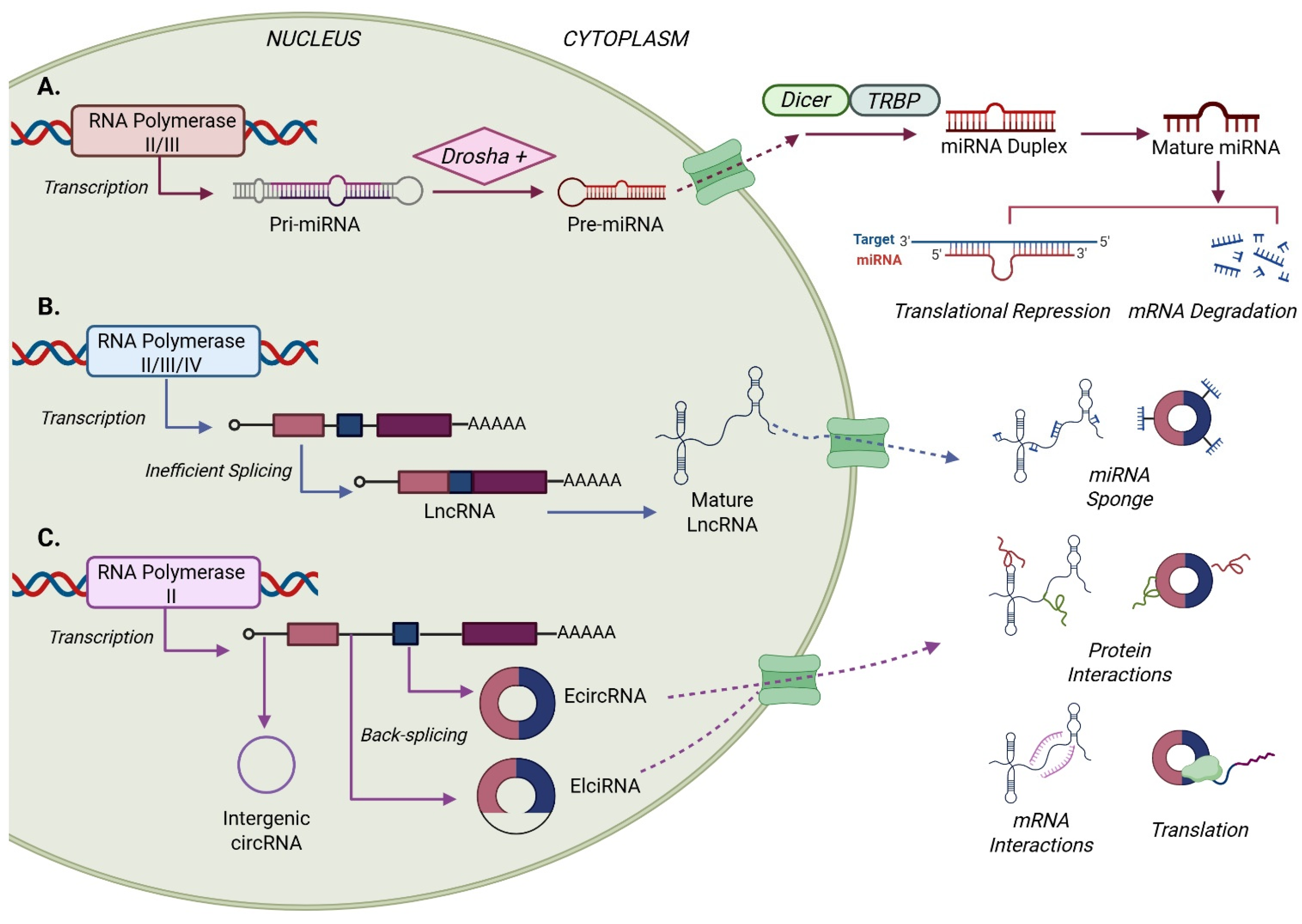
3. Biogenesis of miRNAs, lncRNAs, and circRNAs and Their Roles in Health and Disease
4. ncRNAs in Pediatric Solid Tumors
4.1. Medulloblastoma

| Disease/ Subgroup | Expression | Non-Coding RNA | Validated Target Gene(s) | Functional Role | Reference(s) |
|---|---|---|---|---|---|
| MB (WNT) | Downregulated | miRNAs-206, -183, -133b, -128a/b, -148a, -383 | N/A (Oncogenic targets) | Increases survival, proliferation, and migration | [51,52,53,54,55] |
| MB (SHH) | Downregulated | miRNA-466-3p | NRP2 and VEGFA | Enhances EMT via unchecked modulation | [57] |
| MB (SHH) | Upregulated | miRNA-17-92 cluster (18a, 19a, 20a, 21, 25, 106) | N/A | Promotes proliferation and tumor progression | [58] |
| MB (Group 3) | Upregulated | miRNA cluster 183-96-182 | Cell cycle regulation | Promotes migration; alters cell cycle | [60,61] |
| MB (Group 3) | Downregulated | miRNA-30 family | Autophagy (process) | Reduces cancer cell autophagy | [62,63] |
| MB (Group 4) | Downregulated | miRNA-4521 | FOXM1 | Increases proliferation | [64,65] |
| MB | Upregulated | lncRNA HOTAIR/TP73-AS1 | miRNA Sponges | Promotes tumorigenicity, migration, and viability | [69,70,71] |
| MB (Group 3) | Upregulated | lncMB1, lncMB2, lncMB3 | MYC | Associated with aggressive MYC subgroup | [81] |
| MB (SHH) | Upregulated | lncRNA LOXL1-AS1 | N/A | Linked to poor prognosis | [74,81] |
| MB | Upregulated | lncRNA NEAT1 | N/A | Linked to chemo- and apoptotic resistance | [81] |
| MB | Downregulated | lncRNA Nkx2-2as | N/A | Suppresses proliferation and invasion | [82] |
| MB | Upregulated | circ_SKA3 | CDK6 | Promotes tumor invasion | [83,84] |
| MB (SHH) | Upregulated | circ_DTL, _KDHRBS2, -103128, _63706 | Lipid metabolism | Alters metabolic regulation | [85,86,87] |
4.2. Retinoblastoma
| Disease/ Subgroup | Expression | Non-Coding RNA | Validated Target Gene(s) | Functional Role | Reference(s) |
|---|---|---|---|---|---|
| RB | Upregulated | miRNA-320a | TUSC3 | Promotes proliferation and apoptotic resistance | [109] |
| RB | Upregulated | miRNA-889-3p | JNK/MAPK/ERK pathway | Promotes tumor growth; inhibits apoptosis | [110] |
| RB | Upregulated | miRNA-25-3p | PTEN | Enhances EMT and cell migration | [111] |
| RB | Upregulated | miRNA-141-3p | SUSD2 | Promotes angiogenesis and proliferation | [112] |
| RB | Upregulated | miRNA-222 | VHL | Promotes chemotherapy resistance | [113] |
| RB | Upregulated | miRNA-224-3p/miRNA-492 | LATS2 | Increases cancer invasion | [114,115] |
| RB | Upregulated | miRNA-92a-3p | KLF2 | Enhances tumor-associated angiogenesis | [116] |
| RB | Downregulated | miRNA-34a/34b-5p | NOTCH signaling | Increases chemosensitivity; suppresses invasion | [117,118] |
| RB | Downregulated | miRNA-153-3p | IGFR1/Raf/MEK & PI3K/AKT pathways | Leads to unchecked proliferation/survival | [119] |
| RB | Downregulated | miRNA-361-3p | GLI1/GLI3 | Increases expression of Hedgehog factors | [120] |
| RB | Upregulated | lncRNA-MALAT1 | miRNA-20b-5p (STAT3)/miRNA-124 & 598-3p | Upregulates STAT3; chemoresistance | [123,124] |
| RB | Upregulated | lncRNA-NEAT1 | miRNA-124, -3619-5p, -24-3p, -106a, -148-3p | Promotes tumor growth (sponging) | [125,126] |
| RB | Upregulated | lncRNA-XIST | miRNA-101/miRNA-140-5p & 191-5p | Contributes to EMT, proliferation, and invasion | [127,128] |
| RB (Hypoxic) | Upregulated | lncRNA-ANRIL | miRNA-328 | Contributes to chemotherapeutic resistance | [131] |
| RB | Downregulated | lncRNAs-MT1JP, -MBLN1, -MEG3 | WNT/β-catenin pathway | Tumor suppression | [137,138,139] |
| RB | Upregulated | Circ-DHDDS | miRNA-361-3p | Promotes RB progression | [142,143] |
| RB | Upregulated | circ-FAM158A | XIAP, SMAD2, and LRP6 | Promotes metastasis and optic nerve invasion | [144,145] |
| RB | Upregulated | circ-E2F3 | miRNA-204-5p (ROCK1)/LASP1 | Enhances motility and invasion | [146,147] |
| RB | Upregulated | circ_RNF20 | miRNA-132-3p (PAX6) | Promotes invasion | [148] |
| RB | Downregulated | circ-TET1 | miRNA-492/miRNA-484-3p (WNT/β-catenin) | Targets WNT signaling | [149] |
| RB | Downregulated | circ-SHPRH | AKT and mTOR | Promotes cell apoptosis | [150] |
| RB | Downregulated | circ-MKLN1 | miRNA-425-5p | Curbs cell invasion | [151] |
| RB | Downregulated | circ-CUL2 | E2F2 | Reduces proliferation and migration | [152] |
| RB | Upregulated | miRNA-320a | TUSC3 | Promotes proliferation and apoptotic resistance | [109] |
| RB | Upregulated | miRNA-889-3p | JNK/MAPK/ERK pathway | Promotes tumor growth; inhibits apoptosis | [110] |
| RB | Upregulated | miRNA-25-3p | PTEN | Enhances EMT and cell migration | [111] |
4.3. Rhabdomyosarcoma
| Disease/ Subgroup | Expression | Non-Coding RNA | Validated Target Gene(s) | Functional Role | Reference(s) |
|---|---|---|---|---|---|
| ARMS | Upregulated | miRNA-486-5p/-9-5p | PAX3-FOXO1 induced | Increases proliferation and invasion | [167,168] |
| ARMS | Downregulated | miRNA-27a/-221/-222 | PAX3-FOXO1 repressed | Tumor suppression (loss of) | [169,170] |
| ERMS | Upregulated | miRNA-130a/b | PPARG | Increases proliferation | [172] |
| ERMS | Downregulated | miRNA-181a/-212 | N/A | Reduced myogenic differentiation; increased invasion | [173] |
| RMS (Both) | Downregulated | miRNA-7/-324-5p | ITGA9 | Increases metastasis | [175] |
| RMS (Both) | Upregulated | lncMYCNOS | N/A | Promotes tumor growth | [180] |
| RMS (Both) | Upregulated | lncRNA-H19 | miRNA-675-3p/-375-5p | Promotes myogenic differentiation | [181,182] |
| RMS (Both) | Upregulated | lncRNA-SYISL/ NEAT1 | N/A | Reduces differentiation; accelerates proliferation | [183,184] |
| RMS (Both) | Upregulated | linc-MD1 | miRNA-206/-133b | Decreases differentiation; enhances proliferation | [186] |
| RMS (Both) | Upregulated | circ-AFF1 | Cellular adhesion | Increases cell migration | [187] |
| ARMS | Upregulated | circ-VAMP3/circ-ZNF609 | AKT pathway | Disrupts cell cycle regulation | [188,189] |
4.4. Hepatoblastoma
| Disease/ Subgroup | Expression | Non-Coding RNA | Validated Target Gene(s) | Functional Role | Reference(s) |
|---|---|---|---|---|---|
| HB | Upregulated | miRNA-193b, -760, -23a-5p | WNT pathway | Promotes disease progression | [201,202] |
| HB | Upregulated | miRNA-193a-5p, -495, -206 | PI3K/AKT/mTOR pathway | Promotes oncogenesis | [203,204] |
| HB | Upregulated | lncRNA MIR205HG, NBR2, TUG1, HOXA-AS2, ZFAS1, lnc01124 | MAPK and PI3K/AKT pathways | Modifies stemness; enhances invasion and proliferation | [210,211,212,213] |
| HB | Upregulated | lncRNA OIP5-AS1 | WNT/β-catenin pathway | Promotes invasion | [214] |
| HB | Upregulated | lncRNA HOXA-AS2, ZFAS1, CRNDE | EMT (process) | Increases malignancy and EMT | [215,216] |
| HB | Upregulated | circ_0015756 | N/A | Enhances proliferation and viability | [219] |
| HB | Upregulated | circ_0000594 | miRNA-217 | Promotes malignancy | [220] |
| HB | Upregulated | circHMGCS1 (circ_0072391) | miR-503-5p (IGF/PI3K/Akt) | Activates IGF/PI3K/Akt; alters glutamine metabolism | [221] |
| HB | Upregulated | circRNA_CCT2 | WNT/β-catenin pathway | Pro-tumor properties | [222] |
| HB | Downregulated/Suppressive | circMTO1, circEPB41L2, circDLC1 | N/A | Halts HB progression | [223,224,225] |
| HB | Upregulated | circRNA_SORE | N/A | Linked to increased chemoresistance | [226] |
| HB | Upregulated | miRNA-193b, -760, -23a-5p | WNT pathway | Promotes disease progression | [201,202] |
4.5. Osteosarcoma
| Disease/ Subgroup | Expression | Non-Coding RNA | Validated Target Gene(s) | Functional Role | Reference(s) |
|---|---|---|---|---|---|
| OS | Down-regulated | lncRNA-HIF2PUT | HIF2 | Correlates with poor prognosis | [244,245] |
| OS | Upregulated | lncRNA-MALAT1 | PI3K/Akt/HMGB1 | Increases proliferation and metastasis | [246] |
| OS | Upregulated | lncRNA-HOTAIR | Akt/mTOR/ZEB1/ALP | Promotes pathogenesis; inhibits mineralization | [247,248] |
| OS | Upregulated | lncRNA-DANCR | AXL/MSI2 | Enhances stemness and immune evasion | [249,250] |
| OS | Upregulated | lncRNA-CRNDE | WNT/β-catenin/ABCC12/NOTCH1 | Promotes metastasis, EMT, and proliferation | [251,252,253,254] |
| OS | Upregulated | lncRNA-SNHG12 | N/A | Promotes metastasis; doxorubicin resistance | [255,256] |
| OS | Upregulated | lncRNA-UCA1 | N/A | Increases invasion and tumor growth | [257,258] |
| OS | Upregulated | lncRNA-THOR | Akt/ERK/SOX9 | Promotes tumor growth; stabilizes mRNA | [259,260] |
| OS | Upregulated | circ-FOXM1 (hsa_circ_0025033) | miRNA-320a/b/WNT pathway | Contributes to proliferation and migration | [262] |
| OS | Upregulated | circRAB3IP (hsa_circ_0000419) | miRNA-580-3p/TWIST1 | Promotes invasion | [263] |
| OS | Upregulated | circ_03955 | miRNA-3662/MTDH | Enhances metadherin expression | [264] |
| OS | Upregulated | circ-LRP6 | HDAC4/HMGB1 | Promotes invasion | [265,266] |
| OS | Upregulated | circDOCK1 (hsa_circ_0020378) | IGF-1R/DNMT3A/LEF1 | Apoptotic and chemotherapy resistance | [267,268,269] |
| OS | Upregulated | circ_001422 | FGF2/PI3K/Akt/E2F3 | Promotes activation of growth pathways | [270,271] |
| OS | Upregulated | circPVT1 (hsa_circ_0001821) | Multiple oncogenic pathways | Diagnostic potential | [272,273] |
| OS | Down-regulated | lncRNA-HIF2PUT | HIF2 | Correlates with poor prognosis | [244,245] |
4.6. Ewing Sarcoma
| Disease/ Subgroup | Expression | Non-Coding RNA | Validated Target Gene(s) | Functional Role | Reference(s) |
|---|---|---|---|---|---|
| ES | Upregulated | miRNAs-30d, -125b, -21 | BAX | Prevents cancer cell apoptosis | [284,285,286] |
| ES | Upregulated | miRNA-181c | TNFRSF6 | Promotes tumor growth | [287] |
| ES | Upregulated | miRNA-130b | CDC42 | Cell cycle dysregulation | [288] |
| ES | Downregulated | miRNA-683 | VEGFA | Inhibits angiogenesis | [289] |
| ES | Downregulated | Let-7a | EWSR1 | Inhibits protein production (RISC) | [291] |
| ES | Downregulated | Let-7b | RAS pathway/HIF1α | Inhibits survival; reduces TME hypoxia | [292] |
| ES | Downregulated | miRNA-708-5p | MMP12 | Inhibits pathogenic ECM remodeling | [293] |
| ES | Downregulated | miRNA-27a | IGF-1 | Reduces proliferation and tumor growth | [294] |
| ES | Upregulated | lncRNA PncCCND1_B | CCND1 (Cyclin D1) | Promotes progression (sponging) | [296] |
| ES | Upregulated | lncRNA FOXP4-ASI | TMPO (Thymopoietin) | Promotes progression (sponging) | [297] |
| ES | Upregulated | lncRNA METTL3 | miRNA-124-3p/CDK4 | Promotes cell migration | [300] |
| ES | Polymorphism | lncRNA SENCR | FLI1/IGF2BP3 | Upregulates IGF2BP3 | [301] |
| ES | Upregulated | circZNF609 | miRNA-145-5p/EWS-FLI1 | Promotes metastasis; inhibits apoptosis | [302] |
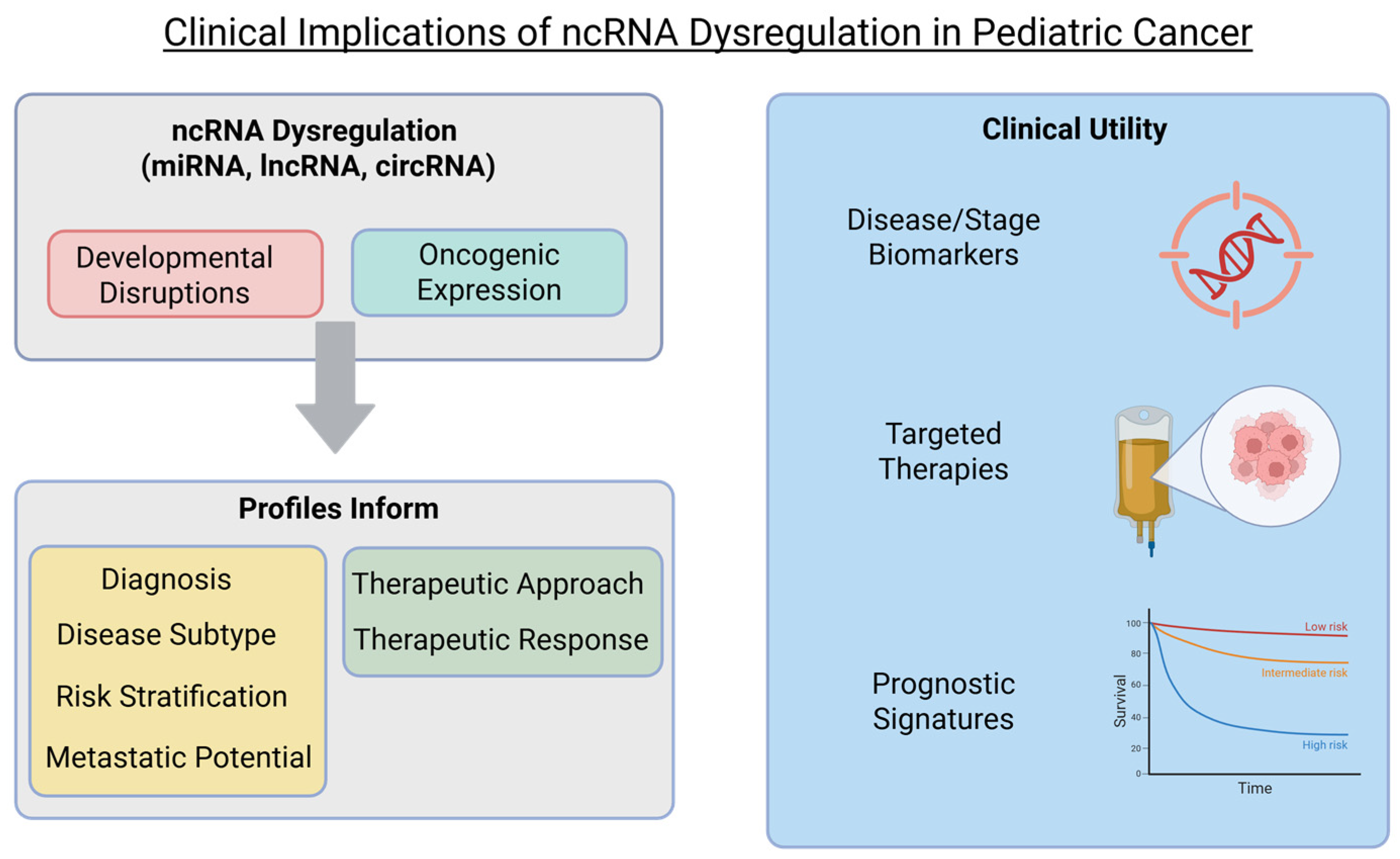
5. Discussion
6. Conclusions
Author Contributions
Funding
Institutional Review Board Statement
Informed Consent Statement
Data Availability Statement
Conflicts of Interest
Abbreviations
| ncRNA | Non-coding RNA |
| miRNA | MicroRNA |
| lncRNA | Long non-coding RNA |
| circRNA | Circular RNA |
| CNS | Central nervous system |
| NGS | Next generation sequencing |
| snoRNA | Small nucleolar RNA |
| piRNA | Piwi-interacting RNA |
| siRNA | Small interfering RNA |
| scRNA | Small cytoplasmic RNA |
| RISC | RNA-induced silencing complex |
| UTR | Untranslated region |
| shRNA | Short-hairpin RNA |
| PolI | RNA polymerase I |
| PolII | RNA polymerase II |
| PolIII | RNA polymerase III |
| TRBP | Transactivation response RNA binding protein |
| EIcircRNA | Exon-Intron circRNA |
| ciRNA | Intron-only circRNA |
| ecircRNA | Exon-only circRNA |
| MB | Medulloblastoma |
| SHH | Sonic-Hedgehog |
| WNT | Wingless-related integration site |
| NRP2 | Neuropilin 2 |
| VEGFA | Vascular endothelial growth factor alpha |
| FOXM1 | Forkhead box M1 |
| RB | Retinoblastoma |
| RB1 | Retinoblastoma 1 gene |
| MYCN | MYCN Proto-oncogene |
| TUSC3 | Tumor suppressor candidate 3 |
| JNK | C-Jun N-terminal kinase |
| MAPK | Mitogen-activated protein kinase (MAPK) |
| ERK | Extracellular signal-related kinase |
| EMT | Epithelial-to-mesenchymal transition |
| SUDS2 | Sushi domain-containing protein 2 |
| VHL | Von Hippel-Lindau |
| KLF2 | Krüppel-like factor 2 |
| NOTCH | Neurogenic locus notch homology protein |
| IGFR1 | Insulin-like growth factor 1 receptor |
| RAS | Rapidly accelerated fibrosarcoma |
| MEK | Mitogen-activated protein kinase kinase 1 |
| PI3K | Phosphoinositide 3-kinase |
| AKT | AKT serine/threonine kinase 1 |
| GLI1 | GLI family zinc finger 1 |
| GLI3 | GLI family zinc finger 3 |
| PIK3CA | Phosphatidylinositol-4,5-bisphosphate 3-kinase catalytic subunit alpha |
| mTOR | Mammalian target of rapamycin |
| AEG-1 | Astrocyte elevated gene 1 |
| PAX6 | Paired box 6 |
| ABCB1 | Multidrug resistance protein 1 |
| XIAP | X-linked inhibitor of apoptosis |
| WIF1 | WNT inhibitory factor 1 |
| TME | Tumor microenvironment |
| SMAD2 | Smad family member 2 |
| LRP6 | Lipoprotein receptor-related protein 6 |
| E2F2 | E2F transcription factor 2 |
| RMS | Rhabdomyosarcoma |
| ARMS | Alveolar rhabdomyosarcoma |
| ERMS | Embryonal rhabdomyosarcoma |
| FOX01 | Forkhead box 01 |
| TP53 | Tumor protein p53 |
| BCOR | BCL6 corepressor |
| NF1 | Neurofibromin |
| PPARG | Peroxisome proliferator-activated receptor gamma |
| ITGA9 | Alpha-9-integrin |
| SNAIL | Snail family transcriptional repressor 1 |
| MyoD | Myoblast determination protein 1 |
| HB | Hepatoblastoma |
| BWS | Beckwith–Wiedemann syndrome |
| FAP | Familial adenomatous polyposis |
| APC | Adenomatous polyposis colic |
| CTNNB1 | Beta-catenin gene |
| NFE2L2 | NFE2 like BZIP transcription factor 2 |
| TERT | Telomerase reverse transcriptase |
| AFP | Alpha fetoprotein |
| OS | Osteosarcoma |
| MAP | Methotrexate, adriamycin (doxorubicin), and platinum therapy |
| CDKN2A | Cyclin-dependent kinase inhibitor 2A |
| HIF2 | Hypoxia inducible factor 2 |
| ZEB1 | Zinc finger E-box bonding homeobox 1 |
| ALP | Alkaline phosphatase |
| MSI2 | Musashi RNA binding protein 2 |
| SOX9 | SRY-box transcription factor 9 |
| TWIST1 | Twist family BHLH transcription factor |
| MTDH | Metadherin |
| HDAC4 | Histone deacetylase 4 |
| HMGB1 | High mobility group box 1 |
| DNMT3A | DNA methyltransferases 3A |
| LEF1 | Lymphoid enhancer binding factor 1 |
| FGF2 | Fibroblast growth factor 2 |
| E2F3 | E2F transcription factor 3 |
| IDH1 | Isocitrate dehydrogenase 1 |
| IDH2 | Isocitrate dehydrogenase 2 |
| TIMP3 | TIMP metallopeptidase 3 |
| FSCN1 | Fascin-1 |
| VEGFC | Vascular endothelial growth C |
| EZH2 | Enhancer of Zeste homolog 2 |
| KLF6 | KLF transcription factor 6 |
| LGG | Low-grade glioma |
| CCND1 | Cyclin D1 |
| IGF2BP3 | Insulin-like growth factor 2 mRNA-binding protein 3 |
| CDC42 | Cell division cycle 42 |
| TNFRSF6 | Tumor necrosis factor receptor super family member-6 |
| FEV | FEV transcription factor |
| E1AF | ETS variant gene 4 |
| FLI1 | Friend leukemia integration 1 |
| ERG | ETS-related gene |
| ETV1 | ETS translocation variant 1 |
| EWSR1 | EWS RNA binding protein 1 |
References
- Bizuayehu, H.M.; Ahmed, K.Y.; Kibret, G.D.; Dadi, A.F.; Belachew, S.A.; Bagade, T.; Tegegne, T.K.; Venchiarutti, R.L.; Kibret, K.T.; Hailegebireal, A.H. Global disparities of cancer and its projected burden in 2050. JAMA Netw. Open 2024, 7, e2443198. [Google Scholar] [CrossRef]
- Miller, K.D.; Nogueira, L.; Devasia, T.; Mariotto, A.B.; Yabroff, K.R.; Jemal, A.; Kramer, J.; Siegel, R.L. Cancer treatment and survivorship statistics, 2022. CA Cancer J. Clin. 2022, 72, 409–436. [Google Scholar]
- Byrne, S.; Boyle, T.; Ahmed, M.; Lee, S.H.; Benyamin, B.; Hyppönen, E. Lifestyle, genetic risk and incidence of cancer: A prospective cohort study of 13 cancer types. Int. J. Epidemiol. 2023, 52, 817–826. [Google Scholar] [CrossRef]
- Novikov, N.M.; Zolotaryova, S.Y.; Gautreau, A.M.; Denisov, E.V. Mutational drivers of cancer cell migration and invasion. Br. J. Cancer 2021, 124, 102–114. [Google Scholar] [CrossRef]
- Derks, L.L.; van Boxtel, R. Stem cell mutations, associated cancer risk, and consequences for regenerative medicine. Cell Stem Cell 2023, 30, 1421–1433. [Google Scholar] [CrossRef] [PubMed]
- LaHaye, S.; Fitch, J.R.; Voytovich, K.J.; Herman, A.C.; Kelly, B.J.; Lammi, G.E.; Arbesfeld, J.A.; Wijeratne, S.; Franklin, S.J.; Schieffer, K.M. Discovery of clinically relevant fusions in pediatric cancer. BMC Genom. 2021, 22, 872. [Google Scholar] [CrossRef] [PubMed]
- Mella, C.; Tsarouhas, P.; Brockwell, M.; Ball, H.C. The Role of Chronic Inflammation in Pediatric Cancer. Cancers 2025, 17, 154. [Google Scholar] [CrossRef] [PubMed]
- Siegel, D.A.; King, J.B.; Lupo, P.J.; Durbin, E.B.; Tai, E.; Mills, K.; Van Dyne, E.; Buchanan Lunsford, N.; Henley, S.J.; Wilson, R.J. Counts, incidence rates, and trends of pediatric cancer in the United States, 2003–2019. JNCI J. Natl. Cancer Inst. 2023, 115, 1337–1354. [Google Scholar]
- Siegel, D.A.; Richardson, L.C.; Henley, S.J.; Wilson, R.J.; Dowling, N.F.; Weir, H.K.; Tai, E.W.; Buchanan Lunsford, N. Pediatric cancer mortality and survival in the United States, 2001–2016. Cancer 2020, 126, 4379–4389. [Google Scholar] [CrossRef]
- Ferrari, A.; Brennan, B.; Casanova, M.; Corradini, N.; Berlanga, P.; Schoot, R.A.; Ramirez-Villar, G.L.; Safwat, A.; Guillen Burrieza, G.; Dall’Igna, P. Pediatric non-rhabdomyosarcoma soft tissue sarcomas: Standard of care and treatment recommendations from the European Paediatric Soft Tissue Sarcoma Study Group (EpSSG). Cancer Manag. Res. 2022, 14, 2885–2902. [Google Scholar] [CrossRef]
- Trubicka, J.; Grajkowska, W.; Dembowska-Bagińska, B. Molecular markers of pediatric solid tumors—Diagnosis, optimizing treatments, and determining susceptibility: Current state and future directions. Cells 2022, 11, 1238. [Google Scholar] [CrossRef]
- Effinger, K.; Haardörfer, R.; Marchak, J.G.; Escoffery, C.; Landier, W.; Kommajosula, A.; Hendershot, E.; Sadak, K.; Eshelman-Kent, D.; Kinahan, K. Current pediatric cancer survivorship practices: A report from the Children’s Oncology Group. J. Cancer Surviv. 2023, 17, 1139–1148. [Google Scholar] [CrossRef] [PubMed]
- Mobley, E.M.; Moke, D.J.; Milam, J.; Ochoa-Dominguez, C.Y.; Stal, J.; Mitchell, H.; Aminzadeh, N.; Bolshakova, M.; Mailhot Vega, R.B.; Dinalo, J. Disparities in pediatric cancer survivorship care: A systematic review. Cancer Med. 2023, 12, 18281–18305. [Google Scholar] [CrossRef]
- Chen, B.; Dragomir, M.P.; Yang, C.; Li, Q.; Horst, D.; Calin, G.A. Targeting non-coding RNAs to overcome cancer therapy resistance. Signal Transduct. Target. Ther. 2022, 7, 121. [Google Scholar]
- Ferrer, J.; Dimitrova, N. Transcription regulation by long non-coding RNAs: Mechanisms and disease relevance. Nat. Rev. Mol. Cell Biol. 2024, 25, 396–415. [Google Scholar] [CrossRef] [PubMed]
- Lin, X.; Lu, Y.; Zhang, C.; Cui, Q.; Tang, Y.-D.; Ji, X.; Cui, C. LncRNADisease v3. 0: An updated database of long non-coding RNA-associated diseases. Nucleic Acids Res. 2024, 52, D1365–D1369. [Google Scholar]
- Statello, L.; Guo, C.-J.; Chen, L.-L.; Huarte, M. Gene regulation by long non-coding RNAs and its biological functions. Nat. Rev. Mol. Cell Biol. 2021, 22, 96–118. [Google Scholar] [CrossRef]
- Mattick, J.S.; Amaral, P.P.; Carninci, P.; Carpenter, S.; Chang, H.Y.; Chen, L.-L.; Chen, R.; Dean, C.; Dinger, M.E.; Fitzgerald, K.A. Long non-coding RNAs: Definitions, functions, challenges and recommendations. Nat. Rev. Mol. Cell Biol. 2023, 24, 430–447. [Google Scholar] [CrossRef]
- Loganathan, T.; Doss C, G.P. Non-coding RNAs in human health and disease: Potential function as biomarkers and therapeutic targets. Funct. Integr. Genom. 2023, 23, 33. [Google Scholar] [CrossRef]
- Kirstein, N.; Dokaneheifard, S.; Cingaram, P.R.; Valencia, M.G.; Beckedorff, F.; Gomes Dos Santos, H.; Blumenthal, E.; Tayari, M.M.; Gaidosh, G.S.; Shiekhattar, R. The Integrator complex regulates microRNA abundance through RISC loading. Sci. Adv. 2023, 9, eadf0597. [Google Scholar] [CrossRef] [PubMed]
- Sarkar, N.; Kumar, A. Paradigm shift: microRNAs interact with target gene promoters to cause transcriptional gene activation or silencing. Exp. Cell Res. 2025, 444, 114372. [Google Scholar]
- Vishnoi, A.; Rani, S. miRNA biogenesis and regulation of diseases: An updated overview. MicroRNA Profiling Methods Protoc. 2022, 2595, 1–12. [Google Scholar]
- Gharehzadehshirazi, A.; Zarejousheghani, M.; Falahi, S.; Joseph, Y.; Rahimi, P. Biomarkers and corresponding biosensors for childhood cancer diagnostics. Sensors 2023, 23, 1482. [Google Scholar] [CrossRef] [PubMed]
- Prieto-Colomina, A.; Fernández, V.; Chinnappa, K.; Borrell, V. MiRNAs in early brain development and pediatric cancer: At the intersection between healthy and diseased embryonic development. Bioessays 2021, 43, 2100073. [Google Scholar] [CrossRef] [PubMed]
- Esperanza-Cebollada, E.; Gómez-González, S.; Perez-Jaume, S.; Vega-García, N.; Vicente-Garcés, C.; Richarte-Franqués, M.; Rives, S.; Català, A.; Torrebadell, M.; Camós, M. A miRNA signature related to stemness identifies high-risk patients in paediatric acute myeloid leukaemia. Br. J. Haematol. 2023, 202, 96–110. [Google Scholar] [CrossRef] [PubMed]
- Iyer, M.K.; Niknafs, Y.S.; Malik, R.; Singhal, U.; Sahu, A.; Hosono, Y.; Barrette, T.R.; Prensner, J.R.; Evans, J.R.; Zhao, S. The landscape of long noncoding RNAs in the human transcriptome. Nat. Genet. 2015, 47, 199–208. [Google Scholar] [CrossRef]
- Bjørklund, S.S.; Aure, M.R.; Häkkinen, J.; Vallon-Christersson, J.; Kumar, S.; Evensen, K.B.; Fleischer, T.; Tost, J.; Sahlberg, K.K. Subtype and cell type specific expression of lncRNAs provide insight into breast cancer. Commun. Biol. 2022, 5, 834. [Google Scholar] [CrossRef]
- Chen, L.-L. Towards higher-resolution and in vivo understanding of lncRNA biogenesis and function. Nat. Methods 2022, 19, 1152–1155. [Google Scholar] [CrossRef]
- Shah, I.M.; Dar, M.A.; Bhat, K.A.; Dar, T.A.; Ahmad, F.; Ahmad, S.M. Long non-coding RNAs: Biogenesis, mechanism of action and role in different biological and pathological processes. In Recent Advances in Noncoding RNAs; IntechOpen: London, UK, 2022. [Google Scholar]
- Illarregi, U.; Lopez-Lopez, E. LncRNA expression and regulatory networks across pediatric cancers. Transl. Pediatr. 2024, 13, 383–386. [Google Scholar] [CrossRef]
- Liu, F.; Xiong, Q.-W.; Wang, J.-H.; Peng, W.-X. Roles of lncRNAs in childhood cancer: Current landscape and future perspectives. Front. Oncol. 2023, 13, 1060107. [Google Scholar] [CrossRef]
- Yi, Q.; Feng, J.; Lan, W.; Shi, H.; Sun, W.; Sun, W. CircRNA and lncRNA-encoded peptide in diseases, an update review. Mol. Cancer 2024, 23, 214. [Google Scholar] [CrossRef]
- Yang, Y.; Zhong, Y.; Chen, L. EIciRNAs in focus: Current understanding and future perspectives. RNA Biol. 2025, 22, 1–12. [Google Scholar] [CrossRef]
- Chen, J.; Gu, J.; Tang, M.; Liao, Z.; Tang, R.; Zhou, L.; Su, M.; Jiang, J.; Hu, Y.; Chen, Y. Regulation of cancer progression by circRNA and functional proteins. J. Cell. Physiol. 2022, 237, 373–388. [Google Scholar] [CrossRef]
- Xu, F.; Xiao, Q.; Du, W.W.; Wang, S.; Yang, B.B. CircRNA: Functions, applications and prospects. Biomolecules 2024, 14, 1503. [Google Scholar] [CrossRef] [PubMed]
- Pisignano, G.; Michael, D.C.; Visal, T.H.; Pirlog, R.; Ladomery, M.; Calin, G.A. Going circular: History, present, and future of circRNAs in cancer. Oncogene 2023, 42, 2783–2800. [Google Scholar] [CrossRef]
- Di Timoteo, G.; Rossi, F.; Bozzoni, I. Circular RNAs in cell differentiation and development. Development 2020, 147, dev182725. [Google Scholar] [CrossRef] [PubMed]
- Alcantara, J.H.; Ornos, E.D.B.; Tantengco, O.A.G. Global trends, gaps, and future agenda in medulloblastoma research: A bibliometric analysis. Child’s Nerv. Syst. 2023, 39, 3185–3194. [Google Scholar] [CrossRef]
- Northcott, P.A.; Buchhalter, I.; Morrissy, A.S.; Hovestadt, V.; Weischenfeldt, J.; Ehrenberger, T.; Gröbner, S.; Segura-Wang, M.; Zichner, T.; Rudneva, V.A. The whole-genome landscape of medulloblastoma subtypes. Nature 2017, 547, 311–317. [Google Scholar] [CrossRef] [PubMed]
- Abeysundara, N.; Rasnitsyn, A.; Fong, V.; Bahcheli, A.; Van Ommeren, R.; Juraschka, K.; Vladoiu, M.; Ong, W.; Livingston, B.; de Antonellis, P. Metastatic medulloblastoma remodels the local leptomeningeal microenvironment to promote further metastatic colonization and growth. Nat. Cell Biol. 2025, 27, 863–874. [Google Scholar] [CrossRef] [PubMed]
- Choi, J.Y. Medulloblastoma: Current perspectives and recent advances. Brain Tumor Res. Treat. 2023, 11, 28–38. [Google Scholar] [CrossRef]
- Cotter, J.A.; Hawkins, C. Medulloblastoma: WHO 2021 and beyond. Pediatr. Dev. Pathol. 2022, 25, 23–33. [Google Scholar] [CrossRef] [PubMed]
- Funakoshi, Y.; Sugihara, Y.; Uneda, A.; Nakashima, T.; Suzuki, H. Recent advances in the molecular understanding of medulloblastoma. Cancer Sci. 2023, 114, 741–749. [Google Scholar] [CrossRef] [PubMed]
- Fang, F.Y.; Rosenblum, J.S.; Ho, W.S.; Heiss, J.D. New developments in the pathogenesis, therapeutic targeting, and treatment of pediatric medulloblastoma. Cancers 2022, 14, 2285. [Google Scholar] [CrossRef]
- Vinchon, M.; Leblond, P. Medulloblastoma: Clinical presentation. Neurochirurgie 2021, 67, 23–27. [Google Scholar] [CrossRef]
- Louis, D.N.; Perry, A.; Reifenberger, G.; Von Deimling, A.; Figarella-Branger, D.; Cavenee, W.K.; Ohgaki, H.; Wiestler, O.D.; Kleihues, P.; Ellison, D.W. The 2016 World Health Organization classification of tumors of the central nervous system: A summary. Acta Neuropathol. 2016, 131, 803–820. [Google Scholar] [CrossRef]
- Seidel, C.; Heider, S.; Hau, P.; Glasow, A.; Dietzsch, S.; Kortmann, R.-D. Radiotherapy in medulloblastoma—Evolution of treatment, current concepts and future perspectives. Cancers 2021, 13, 5945. [Google Scholar] [CrossRef]
- Mani, S.; Chatterjee, A.; Dasgupta, A.; Shirsat, N.; Pawar, A.; Epari, S.; Sahay, A.; Sahu, A.; Moiyadi, A.; Prasad, M. Clinico-RADIOLOGICAL OUTCOMes in WNT-subgroup medulloblastoma. Diagnostics 2024, 14, 358. [Google Scholar] [CrossRef]
- Gwynne, W.D.; Suk, Y.; Custers, S.; Mikolajewicz, N.; Chan, J.K.; Zador, Z.; Chafe, S.C.; Zhai, K.; Escudero, L.; Zhang, C. Cancer-selective metabolic vulnerabilities in MYC-amplified medulloblastoma. Cancer Cell 2022, 40, 1488–1502. e1487. [Google Scholar] [CrossRef]
- Yan, H.; Zabih, V.; Bartels, U.; Das, S.; Nathan, P.; Gupta, S. Prognostic factors related to overall survival in adolescent and young adults with medulloblastoma: A systematic review. Neuro-Oncol. Adv. 2022, 4, vdac016. [Google Scholar] [CrossRef]
- Bevacqua, E.; Farshchi, J.; Niklison-Chirou, M.V.; Tucci, P. Role of MicroRNAs in the development and progression of the four medulloblastoma subgroups. Cancers 2021, 13, 6323. [Google Scholar] [CrossRef] [PubMed]
- Panwalkar, P.; Moiyadi, A.; Goel, A.; Shetty, P.; Goel, N.; Sridhar, E.; Shirsat, N. MiR-206, a cerebellum enriched miRNA is downregulated in all medulloblastoma subgroups and its overexpression is necessary for growth inhibition of medulloblastoma cells. J. Mol. Neurosci. 2015, 56, 673–680. [Google Scholar] [CrossRef] [PubMed]
- Weeraratne, S.D.; Amani, V.; Teider, N.; Pierre-Francois, J.; Winter, D.; Kye, M.J.; Sengupta, S.; Archer, T.; Remke, M.; Bai, A.H. Pleiotropic effects of miR-183~ 96~ 182 converge to regulate cell survival, proliferation and migration in medulloblastoma. Acta Neuropathol. 2012, 123, 539–552. [Google Scholar] [CrossRef]
- Xu, H.; Zhao, G.; Zhang, Y.; Jiang, H.; Wang, W.; Zhao, D.; Hong, J.; Yu, H.; Qi, L. Mesenchymal stem cell-derived exosomal microRNA-133b suppresses glioma progression via Wnt/β-catenin signaling pathway by targeting EZH2. Stem Cell Res. Ther. 2019, 10, 381. [Google Scholar] [CrossRef]
- Yogi, K.; Sridhar, E.; Goel, N.; Jalali, R.; Goel, A.; Moiyadi, A.; Thorat, R.; Panwalkar, P.; Khire, A.; Dasgupta, A. MiR-148a, a microRNA upregulated in the WNT subgroup tumors, inhibits invasion and tumorigenic potential of medulloblastoma cells by targeting Neuropilin 1. Oncoscience 2015, 2, 334–348. [Google Scholar] [CrossRef]
- Besharat, Z.M.; Sabato, C.; Po, A.; Gianno, F.; Abballe, L.; Napolitano, M.; Miele, E.; Giangaspero, F.; Vacca, A.; Catanzaro, G. Low expression of miR-466f-3p sustains epithelial to mesenchymal transition in sonic hedgehog medulloblastoma stem cells through Vegfa-Nrp2 signaling pathway. Front. Pharmacol. 2018, 9, 1281. [Google Scholar] [CrossRef] [PubMed]
- Westphal, M.S.; Lee, E.; Schadt, E.E.; Sholler, G.S.; Zhu, J. Identification of Let-7 miRNA activity as a prognostic biomarker of SHH medulloblastoma. Cancers 2021, 14, 139. [Google Scholar] [CrossRef]
- Murphy, B.L.; Obad, S.; Bihannic, L.; Ayrault, O.; Zindy, F.; Kauppinen, S.; Roussel, M.F. Silencing of the miR-17∼92 cluster family inhibits medulloblastoma progression. Cancer Res. 2013, 73, 7068–7078. [Google Scholar] [CrossRef] [PubMed]
- Northcott, P.A.; Robinson, G.W.; Kratz, C.P.; Mabbott, D.J.; Pomeroy, S.L.; Clifford, S.C.; Rutkowski, S.; Ellison, D.W.; Malkin, D.; Taylor, M.D. Medulloblastoma. Nat. Rev. Dis. Primers 2019, 5, 11. [Google Scholar] [CrossRef]
- Laneve, P.; Caffarelli, E. The non-coding side of medulloblastoma. Front. Cell Dev. Biol. 2020, 8, 275. [Google Scholar] [CrossRef]
- Zhang, Z.; Li, S.; Cheng, S.Y. The miR-183∼96∼182 cluster promotes tumorigenesis in a mouse model of medulloblastoma. J. Biomed. Res. 2013, 27, 486–494. [Google Scholar]
- Paul, R.; Bharambe, H.; Shirsat, N.V. Autophagy inhibition impairs the invasion potential of medulloblastoma cells. Mol. Biol. Rep. 2020, 47, 5673–5680. [Google Scholar] [CrossRef] [PubMed]
- Singh, S.V.; Dakhole, A.N.; Deogharkar, A.; Kazi, S.; Kshirsagar, R.; Goel, A.; Moiyadi, A.; Jalali, R.; Sridhar, E.; Gupta, T. Restoration of miR-30a expression inhibits growth, tumorigenicity of medulloblastoma cells accompanied by autophagy inhibition. Biochem. Biophys. Res. Commun. 2017, 491, 946–952. [Google Scholar] [CrossRef]
- Aneja, K.K. Mining the epigenetic landscape of medulloblastoma. Int. J. Epigenet. 2024, 4, 4. [Google Scholar] [CrossRef]
- Senfter, D.; Samadaei, M.; Mader, R.M.; Gojo, J.; Peyrl, A.; Krupitza, G.; Kool, M.; Sill, M.; Haberler, C.; Ricken, G. High impact of miRNA-4521 on FOXM1 expression in medulloblastoma. Cell Death Dis. 2019, 10, 696. [Google Scholar] [CrossRef] [PubMed]
- Gershanov, S.; Toledano, H.; Michowiz, S.; Barinfeld, O.; Pinhasov, A.; Goldenberg-Cohen, N.; Salmon-Divon, M. MicroRNA–mRNA expression profiles associated with medulloblastoma subgroup 4. Cancer Manag. Res. 2018, 10, 339–352. [Google Scholar] [CrossRef]
- Beylerli, O.; Musaev, E.; Ilyasova, T.; Sufianov, A. lncRNAs and circRNAs: Emerging Players in Pediatric Medulloblastoma Pathology. Curr. Med. Chem. 2025. Online ahead of print. [Google Scholar]
- Nejadi Orang, F.; Abdoli Shadbad, M. CircRNA and lncRNA-associated competing endogenous RNA networks in medulloblastoma: A scoping review. Cancer Cell Int. 2024, 24, 248. [Google Scholar] [CrossRef] [PubMed]
- Li, B.; Shen, M.; Yao, H.; Chen, X.; Xiao, Z. Long noncoding RNA TP73-AS1 modulates medulloblastoma progression in vitro and in vivo by sponging miR-494-3p and targeting EIF5A2. OncoTargets Ther. 2019, 12, 9873–9885. [Google Scholar] [CrossRef]
- Varon, M.; Levy, T.; Mazor, G.; Ben David, H.; Marciano, R.; Krelin, Y.; Prasad, M.; Elkabets, M.; Pauck, D.; Ahmadov, U. The long noncoding RNA TP73-AS1 promotes tumorigenicity of medulloblastoma cells. Int. J. Cancer 2019, 145, 3402–3413. [Google Scholar] [CrossRef]
- Zhang, J.; Li, N.; Fu, J.; Zhou, W. Long noncoding RNA HOTAIR promotes medulloblastoma growth, migration and invasion by sponging miR-1/miR-206 and targeting YY1. Biomed. Pharmacother. 2020, 124, 109887. [Google Scholar] [CrossRef]
- Bartl, J.; Zanini, M.; Bernardi, F.; Forget, A.; Blümel, L.; Talbot, J.; Picard, D.; Qin, N.; Cancila, G.; Gao, Q. The HHIP-AS1 lncRNA promotes tumorigenicity through stabilization of dynein complex 1 in human SHH-driven tumors. Nat. Commun. 2022, 13, 4061. [Google Scholar] [CrossRef]
- Do, A.D.; Wu, K.-S.; Chu, S.-S.; Giang, L.H.; Lin, Y.-L.; Chang, C.-C.; Wong, T.-T.; Hsieh, C.-L.; Sung, S.-Y. LOXL1-AS1 contributes to metastasis in sonic-hedgehog medulloblastoma by promoting cancer stem-like phenotypes. J. Exp. Clin. Cancer Res. 2024, 43, 130. [Google Scholar] [CrossRef]
- Gao, R.; Zhang, R.; Zhang, C.; Zhao, L.; Zhang, Y. Long noncoding RNA CCAT1 promotes cell proliferation and metastasis in human medulloblastoma via MAPK pathway. Tumori J. 2018, 104, 43–50. [Google Scholar] [CrossRef] [PubMed]
- Ghafouri-Fard, S.; Safarzadeh, A.; Hussen, B.M.; Taheri, M.; Mokhtari, M. Contribution of CRNDE lncRNA in the development of cancer and the underlying mechanisms. Pathol.-Res. Pract. 2023, 244, 154387. [Google Scholar] [CrossRef] [PubMed]
- Hosseini, N.F.; Manoochehri, H.; Khoei, S.G.; Sheykhhasan, M. The functional role of long non-coding RNA UCA1 in human multiple cancers: A review study. Curr. Mol. Med. 2021, 21, 96–110. [Google Scholar] [CrossRef]
- Laneve, P.; Po, A.; Favia, A.; Legnini, I.; Alfano, V.; Rea, J.; Di Carlo, V.; Bevilacqua, V.; Miele, E.; Mastronuzzi, A. The long noncoding RNA linc-NeD125 controls the expression of medulloblastoma driver genes by microRNA sponge activity. Oncotarget 2017, 8, 31003–31015. [Google Scholar] [CrossRef]
- Lee, B.; Katsushima, K.; Pokhrel, R.; Yuan, M.; Stapleton, S.; Jallo, G.; Wechsler-Reya, R.J.; Eberhart, C.G.; Ray, A.; Perera, R.J. The long non-coding RNA SPRIGHTLY and its binding partner PTBP1 regulate exon 5 skipping of SMYD3 transcripts in group 4 medulloblastomas. Neuro-Oncol. Adv. 2022, 4, vdac120. [Google Scholar] [CrossRef]
- Mutlu, M.; Tekin, C.; Ak Aksoy, S.; Taskapilioglu, M.O.; Kaya, S.; Balcin, R.N.; Ocak, P.E.; Kocaeli, H.; Bekar, A.; Tolunay, S. Long non-coding RNAs as a predictive markers of group 3 medulloblastomas. Neurol. Res. 2022, 44, 232–241. [Google Scholar] [CrossRef]
- Shi, P.-F.; Ji, H.-L.; Luo, Y.-K.; Mao, T.-M.; Chen, X.; Zhou, K.-Y. Effect of long noncoding RNA SPRY4-IT1 on proliferation and metastasis of medulloblastoma. Zhongguo Ying Yong Sheng Li Xue Za Zhi = Zhongguo Yingyong Shenglixue Zazhi = Chin. J. Appl. Physiol. 2017, 33, 78–82. [Google Scholar]
- Ge, J.; Wang, B.; Zhao, S.; Xu, J. Inhibition of lncRNA NEAT1 sensitizes medulloblastoma cells to cisplatin through modulating the miR-23a-3p-glutaminase (GLS) axis. Bioengineered 2022, 13, 7670–7682. [Google Scholar] [CrossRef]
- Zhang, Y.; Wang, T.; Wang, S.; Xiong, Y.; Zhang, R.; Zhang, X.; Zhao, J.; Yang, A.-G.; Wang, L.; Jia, L. Nkx2-2as suppression contributes to the pathogenesis of sonic hedgehog medulloblastoma. Cancer Res. 2018, 78, 962–973. [Google Scholar] [CrossRef]
- Liu, X.-c.; Wang, F.-C.; Wang, J.-H.; Zhao, J.-Y.; Ye, S.-Y. The circular RNA circSKA3 facilitates the malignant biological behaviors of medulloblastoma via miR-520 h/CDK6 pathway. Mol. Biotechnol. 2022, 64, 1022–1033. [Google Scholar] [CrossRef]
- Wang, X.; Xu, D.; Pei, X.; Zhang, Y.; Zhang, Y.; Gu, Y.; Li, Y. CircSKA3 modulates FOXM1 to facilitate cell proliferation, migration, and invasion while confine apoptosis in medulloblastoma via miR-383-5p. Cancer Manag. Res. 2020, 12, 13415–13426. [Google Scholar] [CrossRef]
- Katsushima, K.; Pokhrel, R.; Mahmud, I.; Yuan, M.; Murad, R.; Baral, P.; Zhou, R.; Chapagain, P.; Garrett, T.; Stapleton, S. The oncogenic circular RNA circ_63706 is a potential therapeutic target in sonic hedgehog-subtype childhood medulloblastomas. Acta Neuropathol. Commun. 2023, 11, 38. [Google Scholar] [CrossRef] [PubMed]
- Pokhrel, R.; Katsushima, K.; Stapleton, S.; Jallo, G.; Raabe, E.; Eberhart, C.G.; Perera, R.J. MEDB-02. The identification and functional characterization of circular RNA Circ_63706 in sonic hedgehog medulloblastomas. Neuro-Oncol. 2022, 24, i103. [Google Scholar] [CrossRef]
- Yin, H.; Zhao, Y.; Han, X.; Li, Q.; Dong, Q.; Liu, Y.; Wang, X.; Yuan, G.; Pan, Y. Circ_103128 is associated with the tumorigenesis of medulloblastoma. J. Cancer Res. Clin. Oncol. 2023, 149, 11339–11349. [Google Scholar] [CrossRef]
- Lv, T.; Miao, Y.F.; Jin, K.; Han, S.; Xu, T.Q.; Qiu, Z.L.; Zhang, X.H. Dysregulated circular RNAs in medulloblastoma regulate proliferation and growth of tumor cells via host genes. Cancer Med. 2018, 7, 6147–6157. [Google Scholar] [CrossRef]
- Feng, Y.; Feng, X.; Lv, Y. Worldwide Burden of Retinoblastoma from 1990 to 2021. Ophthalmic Res. 2024, 67, 672–682. [Google Scholar] [CrossRef]
- Li, N.; Wang, Y.-Z.; Zhang, Y.; Zhang, W.-L.; Huang, D.-S. Characteristics of patients with recurrent retinoblastoma: A survival analysis. BMC Cancer 2024, 24, 287. [Google Scholar] [CrossRef] [PubMed]
- Zhang, S.; Huang, G.; Li, X.; Zhang, Z.; Peng, K.; Zhu, L.; Zhang, C.; Niu, T.-t. Global, regional and national retinoblastoma burden in children under 10 years of age from 1990 to 2021: Trend analysis based on the Global Burden of Disease Study 2021. PLoS ONE 2025, 20, e0327832. [Google Scholar] [CrossRef] [PubMed]
- Fabian, I.D.; Abdallah, E.; Abdullahi, S.U.; Abdulqader, R.A.; Abdulrahaman, A.A.; Abouelnaga, S.; Ademola-Popoola, D.S.; Adio, A.; Afifi, M.A.; Afshar, A.R. The Global Retinoblastoma Outcome Study: A prospective, cluster-based analysis of 4064 patients from 149 countries. Lancet Glob. Health 2022, 10, e1128–e1140. [Google Scholar] [CrossRef]
- Wang, L.; Chen, J.; Shen, Y.; Hooi, G.L.M.; Wu, S.; Xu, F.; Pei, H.; Sheng, J.; Zhu, T.; Ye, J. Incidence, mortality, and global burden of retinoblastoma in 204 countries worldwide from 1990 to 2021: Data and systematic analysis from the Global Burden of Disease Study 2021. Neoplasia 2025, 60, 101107. [Google Scholar] [CrossRef]
- Marković, L.; Bukovac, A.; Varošanec, A.M.; Šlaus, N.; Pećina-Šlaus, N. Genetics in ophthalmology: Molecular blueprints of retinoblastoma. Hum. Genom. 2023, 17, 82. [Google Scholar] [CrossRef]
- Pallavi, R.; Soni, B.L.; Jha, G.K.; Sanyal, S.; Fatima, A.; Kaliki, S. Tumor heterogeneity in retinoblastoma: A literature review. Cancer Metastasis Rev. 2025, 44, 46. [Google Scholar] [CrossRef]
- Faranoush, M.; Naseripour, M.; Faranoush, P.; Davoodi-Moghaddam, Z.; Jahandideh, A.; Sadighnia, N.; Daneshjou, D.; Shams, P.; Sedaghat, A.; Mirshahi, R. Delving Into Retinoblastoma Genetics: Discovery of Novel Mutations and Their Clinical Impact: Retrospective Cohort Study. Cancer Med. 2025, 14, e70922. [Google Scholar] [CrossRef] [PubMed]
- Guo, X.; Wang, L.; Beeraka, N.M.; Liu, C.; Zhao, X.; Zhou, R.; Yu, H.; Fan, R.; Liu, J. Incidence trends, clinicopathologic characteristics, and overall survival prediction in retinoblastoma children: SEER prognostic nomogram analysis. Oncologist 2024, 29, e275–e281. [Google Scholar] [PubMed]
- Mohammad, M.; Mehyar, M.; Halalsheh, H.; Shehada, R.; Al Adawi, O.; Khzouz, J.; Jaradat, I.; Al-Hussaini, M.; Sultan, I.; Alnawaiseh, I. The Impact of Tumor Laterality (Unilateral vs. Bilateral) on Presentation and Management Outcome in Patients with Retinoblastoma. J. Clin. Med. 2024, 13, 2146. [Google Scholar] [CrossRef]
- Chandra, K.; Raval, V.; Reddy P, V.A.; Kaliki, S. Primary macular retinoblastoma: Clinical presentation and treatment outcomes. J. Vitreoretin. Dis. 2022, 6, 367–373. [Google Scholar] [CrossRef]
- Cruz-Gálvez, C.C.; Ordaz-Favila, J.C.; Villar-Calvo, V.M.; Cancino-Marentes, M.E.; Bosch-Canto, V. Retinoblastoma: Review and new insights. Front. Oncol. 2022, 12, 963780. [Google Scholar] [CrossRef]
- Gu, H.; Wang, Y.; Huang, D.; Ji, X.; Zhang, Y.; Ma, J.; Li, M.; Zhang, W.; Hu, H.; Li, J. Clinical characteristics and image manifestations of a rare retinoblastoma with a bone metastasis. Cancer Manag. Res. 2023, 14, 1565–1575. [Google Scholar] [CrossRef] [PubMed]
- Kakarala, C.L.; Raval, V.R.; Mallu, A.; Rao, R.; Gavara, S.; Reddy, V.A.P.; Mishra, D.K.; Jakati, S.; Kaliki, S. Metastatic retinoblastoma at presentation: Clinical presentation, treatment, and outcomes. Oman J. Ophthalmol. 2023, 16, 524–528. [Google Scholar] [CrossRef]
- Kritfuangfoo, T.; Rojanaporn, D. Update on chemotherapy modalities for retinoblastoma: Progress and challenges. Asia-Pac. J. Ophthalmol. 2024, 13, 100061. [Google Scholar] [CrossRef] [PubMed]
- Zhou, M.; Tang, J.; Fan, J.; Wen, X.; Shen, J.; Jia, R.; Chai, P.; Fan, X. Recent progress in retinoblastoma: Pathogenesis, presentation, diagnosis and management. Asia-Pac. J. Ophthalmol. 2024, 13, 100058. [Google Scholar] [CrossRef]
- He, X.; Han, M.; Zhou, M.; Chai, P.; Guo, L.; Fan, J.; Wen, X.; Fan, X. Effect of intra-arterial chemotherapy drug regimens on globe salvage outcomes of retinoblastoma patients. Br. J. Ophthalmol. 2025, 109, 888–893. [Google Scholar] [CrossRef]
- Teixeira, L.F.; Macedo, C.R.; Fonseca, J.R.; Morales, B.; Mangeon, M.K.; Miranda, B.A.; Casaroli-Marano, R.; Sallum, J.M. Intraarterial Chemotherapy for Retinoblastoma, Outcomes Analysis in 357 Eyes: Thirteen Years of Experience in a Referral Center in Brazil. Ophthalmol. Retin. 2025, 9, 798–806. [Google Scholar]
- Fabius, A.W.; van Hoefen Wijsard, M.; van Leeuwen, F.E.; Moll, A.C. Subsequent malignant neoplasms in retinoblastoma survivors. Cancers 2021, 13, 1200. [Google Scholar] [CrossRef]
- Sun, J.; Gu, X.; Wang, L. Incidence of second primary cancers in patients with retinoblastoma: A systematic review and meta-analysis. Front. Oncol. 2024, 14, 1372548. [Google Scholar] [CrossRef]
- Kong, L.; Sun, Y.; Chen, M.; Dai, Y.; Liu, Z. Downregulation of microRNA-320a inhibits proliferation and induces apoptosis of retinoblastoma cells via targeting TUSC3. Exp. Ther. Med. 2020, 20, 9. [Google Scholar] [CrossRef] [PubMed]
- Gao, Y.; Du, P. miR-889-3p targeting BMPR2 promotes the development of retinoblastoma via JNK/MAPK/ERK signaling. Sci. Rep. 2024, 14, 7277. [Google Scholar]
- Wan, W.; Wan, W.; Long, Y.; Li, Q.; Jin, X.; Wan, G.; Zhang, F.; Lv, Y.; Zheng, G.; Li, Z. MiR-25-3p promotes malignant phenotypes of retinoblastoma by regulating PTEN/Akt pathway. Biomed. Pharmacother. 2019, 118, 109111. [Google Scholar]
- Liu, S.; Wen, C. miR-141-3p promotes retinoblastoma progression via inhibiting sushi domain-containing protein 2. Bioengineered 2022, 13, 7409–7423. [Google Scholar] [CrossRef]
- Li, C.; Zhao, J.; Sun, W. microRNA-222-mediated VHL downregulation facilitates retinoblastoma chemoresistance by increasing HIF1α expression. Investig. Ophthalmol. Vis. Sci. 2020, 61, 9. [Google Scholar] [CrossRef]
- Song, L.; Huang, Y.; Zhang, X.; Han, S.; Hou, M.; Li, H. Downregulation of microRNA-224-3p hampers retinoblastoma progression via activation of the hippo-YAP signaling pathway by increasing LATS2. Investig. Ophthalmol. Vis. Sci. 2020, 61, 32. [Google Scholar] [CrossRef]
- Sun, Z.; Zhang, A.; Zhang, L. Inhibition of microRNA-492 attenuates cell proliferation and invasion in retinoblastoma via directly targeting LATS2. Mol. Med. Rep. 2019, 19, 1965–1971. [Google Scholar] [CrossRef]
- Chen, S.; Chen, X.; Luo, Q.; Liu, X.; Wang, X.; Cui, Z.; He, A.; He, S.; Jiang, Z.; Wu, N. Retinoblastoma cell-derived exosomes promote angiogenesis of human vesicle endothelial cells through microRNA-92a-3p. Cell Death Dis. 2021, 12, 695. [Google Scholar]
- Yin, W.; Gao, F.; Zhang, S. MicroRNA-34a inhibits the proliferation and promotes the chemosensitivity of retinoblastoma cells by downregulating Notch1 expression. Mol. Med. Rep. 2020, 22, 1613–1620. [Google Scholar] [CrossRef]
- Zhang, S.; Cui, Z. MicroRNA-34b-5p inhibits proliferation, stemness, migration and invasion of retinoblastoma cells via Notch signaling. Exp. Ther. Med. 2021, 21, 255. [Google Scholar] [CrossRef] [PubMed]
- Guo, L.; Bai, Y.; Ni, T.; Li, Y.; Cao, R.; Ji, S.; Li, S. MicroRNA-153-3p suppresses retinoblastoma cell growth and invasion via targeting the IGF1R/Raf/MEK and IGF1R/PI3K/AKT signaling pathways. Int. J. Oncol. 2021, 59, 47. [Google Scholar] [CrossRef]
- Zhao, D.; Cui, Z. MicroRNA-361-3p regulates retinoblastoma cell proliferation and stemness by targeting hedgehog signaling. Exp. Ther. Med. 2019, 17, 1154–1162. [Google Scholar] [PubMed]
- Hao, F.; Mou, Y.; Zhang, L.; Wang, S.; Yang, Y. LncRNA AFAP1-AS1 is a prognostic biomarker and serves as oncogenic role in retinoblastoma. Biosci. Rep. 2018, 38, BSR20180384. [Google Scholar] [CrossRef] [PubMed]
- Su, S.; Gao, J.; Wang, T.; Wang, J.; Li, H.; Wang, Z. Long non-coding RNA BANCR regulates growth and metastasis and is associated with poor prognosis in retinoblastoma. Tumor Biol. 2015, 36, 7205–7211. [Google Scholar] [CrossRef]
- Lin, X.; Huang, X.; Wang, L.; Liu, W. The long noncoding RNA MALAT1/microRNA-598-3p axis regulates the proliferation and apoptosis of retinoblastoma cells through the PI3K/AKT pathway. Mol. Vis. 2022, 28, 269–279. [Google Scholar]
- Wang, L.; Zhang, Y.; Xin, X. Long non-coding RNA MALAT1 aggravates human retinoblastoma by sponging miR-20b-5p to upregulate STAT3. Pathol.-Res. Pract. 2020, 216, 152977. [Google Scholar]
- Liu, Y.; Xin, Z.; Zhang, K.; Jin, X.; Wang, D. LncRNA NEAT1 promotes angiogenesis of retinoblastoma cells through regulation of the miR-106a/HIF-1α axis. Heliyon 2024, 10, e27653. [Google Scholar] [CrossRef] [PubMed]
- Luan, L.; Hu, Q.; Wang, Y.; Lu, L.; Ling, J. Knockdown of lncRNA NEAT1 expression inhibits cell migration, invasion and EMT by regulating the miR-24-3p/LRG1 axis in retinoblastoma cells. Exp. Ther. Med. 2021, 21, 367. [Google Scholar] [CrossRef] [PubMed]
- Wang, Y.; Sun, D.; Sheng, Y.; Guo, H.; Meng, F.; Song, T. XIST promotes cell proliferation and invasion by regulating miR-140-5p and SOX4 in retinoblastoma. World J. Surg. Oncol. 2020, 18, 49. [Google Scholar] [CrossRef]
- Xu, Y.; Fu, Z.; Gao, X.; Wang, R.; Li, Q. Long non-coding RNA XIST promotes retinoblastoma cell proliferation, migration, and invasion by modulating microRNA-191-5p/brain derived neurotrophic factor. Bioengineered 2021, 12, 1587–1598. [Google Scholar] [CrossRef]
- Peng, X.; Yan, J.; Cheng, F. LncRNA TMPO-AS1 up-regulates the expression of HIF-1α and promotes the malignant phenotypes of retinoblastoma cells via sponging miR-199a-5p. Pathol.-Res. Pract. 2020, 216, 152853. [Google Scholar] [CrossRef]
- Wang, Z.; Liang, X.; Yi, G.; Wu, T.; Sun, Y.; Zhang, Z.; Fu, M. Bioinformatics analysis proposes a possible role for long noncoding RNA MIR17HG in retinoblastoma. Cancer Rep. 2024, 7, e1933. [Google Scholar] [CrossRef] [PubMed]
- Yin, X.; Liao, Y.; Xiong, W.; Zhang, Y.; Zhou, Y.; Yang, Y. Hypoxia-induced lncRNA ANRIL promotes cisplatin resistance in retinoblastoma cells through regulating ABCG2 expression. Clin. Exp. Pharmacol. Physiol. 2020, 47, 1049–1057. [Google Scholar] [CrossRef]
- Fu, K.; Zhang, K.; Zhang, X. LncRNA HOTAIR facilitates proliferation and represses apoptosis of retinoblastoma cells through the miR-20b-5p/RRM2/PI3K/AKT axis. Orphanet J. Rare Dis. 2022, 17, 119. [Google Scholar] [CrossRef]
- Song, J.; Zhang, Z. Long non-coding RNA SNHG20 promotes cell proliferation, migration and invasion in retinoblastoma via the miR-335-5p/E2F3 axis. Mol. Med. Rep. 2021, 24, 543. [Google Scholar] [CrossRef]
- Wang, B.; Cai, R.; Sun, T.; Yang, Z.; Zhang, H. Long non-coding RNA MIMT1 promotes retinoblastoma proliferation via sponging miR-153-5p to upregulate FGF2. Heliyon 2024, 10, e34243. [Google Scholar] [CrossRef] [PubMed]
- Wu, X.-Z.; Cui, H.-P.; Lv, H.-J.; Feng, L. Knockdown of lncRNA PVT1 inhibits retinoblastoma progression by sponging miR-488-3p. Biomed. Pharmacother. 2019, 112, 108627. [Google Scholar] [CrossRef]
- Yan, G.; Su, Y.; Ma, Z.; Yu, L.; Chen, N. Long noncoding RNA LINC00202 promotes tumor progression by sponging miR-3619-5p in retinoblastoma. Cell Struct. Funct. 2019, 44, 51–60. [Google Scholar] [CrossRef]
- Bi, L.-L.; Han, F.; Zhang, X.-M.; Li, Y.-Y. LncRNA MT1JP acts as a tumor inhibitor via reciprocally regulating Wnt/β-Catenin pathway in retinoblastoma. Eur. Rev. Med. Pharmacol. Sci. 2018, 22, 4204–4214. [Google Scholar]
- Gao, Y.; Chen, X.; Zhang, J. LncRNA MEG3 inhibits retinoblastoma invasion and metastasis by inducing β-catenin degradation. Am. J. Cancer Res. 2022, 12, 3111–3127. [Google Scholar]
- Yan, X.; Jia, H.; Zhao, J. LncRNA MEG3 attenuates the malignancy of retinoblastoma cells through inactivating PI3K/Akt/mTOR signaling pathway. Exp. Eye Res. 2023, 226, 109340. [Google Scholar] [CrossRef] [PubMed]
- Gao, Y.-X.; Gao, H.-X.; Xu, X.-Y.; Ding, F.-K. Effects of lncRNA MALAT1 and lncRNA NKILA on proliferation, invasion and apoptosis of retinoblastoma. Eur. Rev. Med. Pharmacol. Sci. 2020, 24, 8296–8307. [Google Scholar] [PubMed]
- Lyu, X.; Ma, Y.; Wu, F.; Wang, L.; Wang, L. LncRNA NKILA inhibits retinoblastoma by downregulating lncRNA XIST. Curr. Eye Res. 2019, 44, 975–979. [Google Scholar] [CrossRef]
- Jiang, Y.; Xiao, F.; Wang, L.; Wang, T.; Chen, L. Circular RNA has_circ_0000034 accelerates retinoblastoma advancement through the miR-361-3p/ADAM19 axis. Mol. Cell. Biochem. 2021, 476, 69–80. [Google Scholar] [CrossRef]
- Wang, H.; Li, M.; Cui, H.; Song, X.; Sha, Q. CircDHDDS/miR-361-3p/WNT3A Axis promotes the development of retinoblastoma by regulating proliferation, cell cycle, migration, and invasion of retinoblastoma cells. Neurochem. Res. 2020, 45, 2691–2702. [Google Scholar] [CrossRef]
- Liang, T.; Fan, M.; Meng, Z.; Sun, B.; Mi, S.; Gao, X. Circ_0000527 drives retinoblastoma progression by regulating miR-1236-3p/SMAD2 pathway. Curr. Eye Res. 2022, 47, 624–633. [Google Scholar] [CrossRef]
- Zhang, L.; Wu, J.; Li, Y.; Jiang, Y.; Wang, L.; Chen, Y.; Lv, Y.; Zou, Y.; Ding, X. Circ_0000527 promotes the progression of retinoblastoma by regulating miR-646/LRP6 axis. Cancer Cell Int. 2020, 20, 301. [Google Scholar] [CrossRef]
- Han, Q.; Ma, L.; Shao, L.; Wang, H.; Feng, M. Circ_0075804 regulates the expression of LASP1 by targeting miR-1287-5p and thus affects the biological process of retinoblastoma. Curr. Eye Res. 2022, 47, 1077–1086. [Google Scholar] [CrossRef] [PubMed]
- Huang, Y.; Xue, B.; Pan, J.; Shen, N. Circ-E2F3 acts as a ceRNA for miR-204-5p to promote proliferation, metastasis and apoptosis inhibition in retinoblastoma by regulating ROCK1 expression. Exp. Mol. Pathol. 2021, 120, 104637. [Google Scholar] [CrossRef] [PubMed]
- An, D.; Yang, J.; Ma, L. circRNF20 aggravates the malignancy of retinoblastoma depending on the regulation of miR-132-3p/PAX6 axis. Open Med. 2022, 17, 955–968. [Google Scholar] [CrossRef]
- Fu, C.; Wang, S.; Jin, L.; Zhang, M.; Li, M. CircTET1 inhibits retinoblastoma progression via targeting miR-492 and miR-494-3p through Wnt/β-catenin signaling pathway. Curr. Eye Res. 2021, 46, 978–987. [Google Scholar] [CrossRef] [PubMed]
- Xing, L.; Zhang, L.; Feng, Y.; Cui, Z.; Ding, L. Downregulation of circular RNA hsa_circ_0001649 indicates poor prognosis for retinoblastoma and regulates cell proliferation and apoptosis via AKT/mTOR signaling pathway. Biomed. Pharmacother. 2018, 105, 326–333. [Google Scholar] [CrossRef]
- Xu, L.; Long, H.; Zhou, B.; Jiang, H.; Cai, M. CircMKLN1 suppresses the progression of human retinoblastoma by modulation of miR-425-5p/PDCD4 axis. Curr. Eye Res. 2021, 46, 1751–1761. [Google Scholar] [CrossRef]
- Zhang, H.; Qiu, X.; Song, Z.; Lan, L.; Ren, X.; Ye, B. CircCUL2 suppresses retinoblastoma cells by regulating miR-214-5p/E2F2 Axis. Anti-Cancer Drugs 2022, 33, e218–e227. [Google Scholar] [CrossRef]
- Parham, D.M.; Barr, F.G. Classification of rhabdomyosarcoma and its molecular basis. Adv. Anat. Pathol. 2013, 20, 387–397. [Google Scholar] [CrossRef] [PubMed]
- Dehner, C.A.; Rudzinski, E.R.; Davis, J.L. Rhabdomyosarcoma: Updates on classification and the necessity of molecular testing beyond immunohistochemistry. Hum. Pathol. 2024, 147, 72–81. [Google Scholar] [CrossRef]
- Skapek, S.X.; Ferrari, A.; Gupta, A.A.; Lupo, P.J.; Butler, E.; Shipley, J.; Barr, F.G.; Hawkins, D.S. Rhabdomyosarcoma. Nat. Rev. Dis. Primers 2019, 5, 1. [Google Scholar] [CrossRef]
- Rudzinski, E.R.; Anderson, J.R.; Hawkins, D.S.; Skapek, S.X.; Parham, D.M.; Teot, L.A. The World Health Organization classification of skeletal muscle tumors in pediatric rhabdomyosarcoma: A report from the Children’s Oncology Group. Arch. Pathol. Lab. Med. 2015, 139, 1281–1287. [Google Scholar] [CrossRef] [PubMed]
- Raze, T.; Lapouble, E.; Lacour, B.; Guissou, S.; Defachelles, A.S.; Gaspar, N.; Delattre, O.; Pierron, G.; Desandes, E. PAX–FOXO1 fusion status in children and adolescents with alveolar rhabdomyosarcoma: Impact on clinical, pathological, and survival features. Pediatr. Blood Cancer 2023, 70, e30228. [Google Scholar] [CrossRef]
- Zarrabi, A.; Perrin, D.; Kavoosi, M.; Sommer, M.; Sezen, S.; Mehrbod, P.; Bhushan, B.; Machaj, F.; Rosik, J.; Kawalec, P. Rhabdomyosarcoma: Current therapy, challenges, and future approaches to treatment strategies. Cancers 2023, 15, 5269. [Google Scholar] [CrossRef]
- Haduong, J.H.; Heske, C.M.; Allen-Rhoades, W.; Xue, W.; Teot, L.A.; Rodeberg, D.A.; Donaldson, S.S.; Weiss, A.; Hawkins, D.S.; Venkatramani, R. An update on rhabdomyosarcoma risk stratification and the rationale for current and future Children’s Oncology Group clinical trials. Pediatr. Blood Cancer 2022, 69, e29511. [Google Scholar] [CrossRef] [PubMed]
- Sumegi, J.; Streblow, R.; Frayer, R.W.; Cin, P.D.; Rosenberg, A.; Meloni-Ehrig, A.; Bridge, J.A. Recurrent t(2;2) and t(2;8) translocations in rhabdomyosarcoma without the canonical PAX-FOXO1 fuse PAX3 to members of the nuclear receptor transcriptional coactivator family. Genes Chromosomes Cancer 2010, 49, 224–236. [Google Scholar] [CrossRef]
- Agaram, N.P.; Huang, S.C.; Tap, W.D.; Wexler, L.H.; Antonescu, C.R. Clinicopathologic and survival correlates of embryonal rhabdomyosarcoma driven by RAS/RAF mutations. Genes Chromosomes Cancer 2022, 61, 131–137. [Google Scholar] [CrossRef]
- Yu, L.; He, L.; Zhang, N. BCOR Mutations Identify a Clinically Aggressive Subset of Pediatric Rhabdomyosarcoma. Fetal Pediatr. Pathol. 2025, 45, 38–43. [Google Scholar] [CrossRef]
- Kaseb, H.; Kuhn, J.; Gasalberti, D.P.; Babiker, H.M. Rhabdomyosarcoma. In StatPearls; StatPearls Publishing: Treasure Island, FL, USA, 2024. [Google Scholar]
- Ognjanovic, S.; Olivier, M.; Bergemann, T.L.; Hainaut, P. Sarcomas in TP53 germline mutation carriers: A review of the IARC TP53 database. Cancer 2012, 118, 1387–1396. [Google Scholar] [CrossRef] [PubMed]
- Plon, S.; Malkin, D. Childhood cancer and heredity. In Principles and Practice of Pediatric Oncology; Lippincott Williams & Wilkins: Philadelphia, PA, USA, 2006. [Google Scholar]
- Cao, L.; Yu, Y.; Bilke, S.; Walker, R.L.; Mayeenuddin, L.H.; Azorsa, D.O.; Yang, F.; Pineda, M.; Helman, L.J.; Meltzer, P.S. Genome-wide identification of PAX3-FKHR binding sites in rhabdomyosarcoma reveals candidate target genes important for development and cancer. Cancer Res. 2010, 70, 6497–6508. [Google Scholar] [CrossRef]
- Hanna, J.A.; Garcia, M.R.; Lardennois, A.; Leavey, P.J.; Maglic, D.; Fagnan, A.; Go, J.C.; Roach, J.; Wang, Y.-D.; Finkelstein, D. PAX3-FOXO1 drives miR-486-5p and represses miR-221 contributing to pathogenesis of alveolar rhabdomyosarcoma. Oncogene 2018, 37, 1991–2007. [Google Scholar] [CrossRef]
- Ramadan, F.; Saab, R.; Hussein, N.; Clézardin, P.; Cohen, P.A.; Ghayad, S.E. Non-coding RNA in rhabdomyosarcoma progression and metastasis. Front. Oncol. 2022, 12, 971174. [Google Scholar] [CrossRef]
- Bharathy, N.; Berlow, N.E.; Wang, E.; Abraham, J.; Settelmeyer, T.P.; Hooper, J.E.; Svalina, M.N.; Ishikawa, Y.; Zientek, K.; Bajwa, Z. The HDAC3–SMARCA4–miR-27a axis promotes expression of the PAX3: FOXO1 fusion oncogene in rhabdomyosarcoma. Sci. Signal. 2018, 11, eaau7632. [Google Scholar] [CrossRef]
- Hanna, J.; Garcia, M.; Go, J.; Finkelstein, D.; Kodali, K.; Pagala, V.; Wang, X.; Peng, J.; Hatley, M. PAX7 is a required target for microRNA-206-induced differentiation of fusion-negative rhabdomyosarcoma. Cell Death Dis. 2016, 7, e2256. [Google Scholar] [CrossRef]
- Di Paolo, V.; Paolini, A.; Galardi, A.; Gasparini, P.; De Cecco, L.; Colletti, M.; Lampis, S.; Raieli, S.; De Stefanis, C.; Miele, E. Plasma-derived extracellular vesicles miR-335–5p as potential diagnostic biomarkers for fusion-positive rhabdomyosarcoma. J. Exp. Clin. Cancer Res. 2024, 43, 282. [Google Scholar] [CrossRef] [PubMed]
- Pan, Y.; Li, J.; Lou, S.; Chen, W.; Lin, Y.; Shen, N.; Li, Y. Down-regulated miR-130a/b attenuates rhabdomyosarcoma proliferation via PPARG. Front. Mol. Biosci. 2022, 8, 766887. [Google Scholar] [CrossRef]
- Pozzo, E.; Giarratana, N.; Sassi, G.; Elmastas, M.; Killian, T.; Wang, C.-c.; Marini, V.; Ronzoni, F.; Yustein, J.; Uyttebroeck, A. Upregulation of miR181a/miR212 improves myogenic commitment in murine fusion-negative rhabdomyosarcoma. Front. Physiol. 2021, 12, 701354. [Google Scholar] [CrossRef] [PubMed]
- Gasparini, P.; Fortunato, O.; De Cecco, L.; Casanova, M.; Iannó, M.F.; Carenzo, A.; Centonze, G.; Milione, M.; Collini, P.; Boeri, M. Age-related alterations in immune contexture are associated with aggressiveness in rhabdomyosarcoma. Cancers 2019, 11, 1380. [Google Scholar] [CrossRef]
- Molist, C.; Navarro, N.; Giralt, I.; Zarzosa, P.; Gallo-Oller, G.; Pons, G.; Magdaleno, A.; Moreno, L.; Guillén, G.; Hladun, R. miRNA-7 and miRNA-324-5p regulate alpha9-Integrin expression and exert anti-oncogenic effects in rhabdomyosarcoma. Cancer Lett. 2020, 477, 49–59. [Google Scholar] [CrossRef]
- Skrzypek, K.; Nieszporek, A.; Badyra, B.; Lasota, M.; Majka, M. Enhancement of myogenic differentiation and inhibition of rhabdomyosarcoma progression by miR-28-3p and miR-193a-5p regulated by SNAIL. Mol. Ther. Nucleic Acids 2021, 24, 888–904. [Google Scholar]
- Casanova, M.; Pontis, F.; Ghidotti, P.; Petraroia, I.; Venturini, L.V.; Bergamaschi, L.; Chiaravalli, S.; De Cecco, L.; Massimino, M.; Sozzi, G. MiR-223 exclusively impairs in vitro tumor growth through IGF1R modulation in rhabdomyosarcoma of adolescents and young adults. Int. J. Mol. Sci. 2022, 23, 13989. [Google Scholar] [CrossRef] [PubMed]
- Wang, Y.; Zhang, L.; Pang, Y.; Song, L.; Shang, H.; Li, Z.; Liu, Q.; Zhang, Y.; Wang, X.; Li, Q. MicroRNA-29 family inhibits rhabdomyosarcoma formation and progression by regulating GEFT function. Am. J. Transl. Res. 2020, 12, 1136–1154. [Google Scholar]
- Tombolan, L.; Millino, C.; Pacchioni, B.; Cattelan, M.; Zin, A.; Bonvini, P.; Bisogno, G. Circulating miR-26a as potential prognostic biomarkers in pediatric rhabdomyosarcoma. Front. Genet. 2020, 11, 606274. [Google Scholar] [CrossRef]
- O’Brien, E.M.; Selfe, J.L.; Martins, A.S.; Walters, Z.S.; Shipley, J.M. The long non-coding RNA MYCNOS-01 regulates MYCN protein levels and affects growth of MYCN-amplified rhabdomyosarcoma and neuroblastoma cells. BMC Cancer 2018, 18, 217. [Google Scholar]
- Dey, B.K.; Pfeifer, K.; Dutta, A. The H19 long noncoding RNA gives rise to microRNAs miR-675-3p and miR-675-5p to promote skeletal muscle differentiation and regeneration. Genes Dev. 2014, 28, 491–501. [Google Scholar] [CrossRef]
- Tarnowski, M.; Tkacz, M.; Czerewaty, M.; Poniewierska-Baran, A.; Grymuła, K.; Ratajczak, M.Z. 5-Azacytidine inhibits human rhabdomyosarcoma cell growth by downregulating insulin-like growth factor 2 expression and reactivating the H19 gene product miR-675, which negatively affects insulin-like growth factors and insulin signaling. Int. J. Oncol. 2015, 46, 2241–2250. [Google Scholar] [CrossRef][Green Version]
- Jin, J.J.; Lv, W.; Xia, P.; Xu, Z.Y.; Zheng, A.D.; Wang, X.J.; Wang, S.S.; Zeng, R.; Luo, H.M.; Li, G.L. Long noncoding RNA SYISL regulates myogenesis by interacting with polycomb repressive complex 2. Proc. Natl. Acad. Sci. USA 2018, 115, E9802–E9811. [Google Scholar] [CrossRef] [PubMed]
- Wang, S.; Zuo, H.; Jin, J.; Lv, W.; Xu, Z.; Fan, Y.; Zhang, J.; Zuo, B. Long noncoding RNA Neat1 modulates myogenesis by recruiting Ezh2. Cell Death Dis. 2019, 10, 505. [Google Scholar] [CrossRef] [PubMed]
- Steiner, A.J.; Zheng, Y.; Tang, Y. Characterization of a rhabdomyosarcoma reveals a critical role for SMG7 in cancer cell viability and tumor growth. Sci. Rep. 2023, 13, 10152. [Google Scholar] [CrossRef]
- Yoon, J.-H.; Abdelmohsen, K.; Gorospe, M. Functional interactions among microRNAs and long noncoding RNAs. Semin. Cell Dev. Biol. 2014, 34, 9–14. [Google Scholar] [CrossRef]
- Centrón-Broco, A.; Rossi, F.; Grelloni, C.; Garraffo, R.; Dattilo, D.; Giuliani, A.; Di Timoteo, G.; Colantoni, A.; Bozzoni, I.; Beltran Nebot, M. CircAFF1 is a circular RNA with a role in alveolar rhabdomyosarcoma cell migration. Biomedicines 2023, 11, 1893. [Google Scholar] [CrossRef]
- Rossi, F.; Centrón-Broco, A.; Dattilo, D.; Di Timoteo, G.; Guarnacci, M.; Colantoni, A.; Beltran Nebot, M.; Bozzoni, I. CircVAMP3: A circRNA with a role in alveolar rhabdomyosarcoma cell cycle progression. Genes 2021, 12, 985. [Google Scholar] [CrossRef]
- Rossi, F.; Legnini, I.; Megiorni, F.; Colantoni, A.; Santini, T.; Morlando, M.; Di Timoteo, G.; Dattilo, D.; Dominici, C.; Bozzoni, I. Circ-ZNF609 regulates G1-S progression in rhabdomyosarcoma. Oncogene 2019, 38, 3843–3854. [Google Scholar] [CrossRef] [PubMed]
- Pio, L.; O’Neill, A.F.; Woodley, H.; Murphy, A.J.; Tiao, G.; Franchi-Abella, S.; Fresneau, B.; Watanabe, K.; Alaggio, R.; Lopez-Terrada, D. Hepatoblastoma. Nat. Rev. Dis. Primers 2025, 11, 36. [Google Scholar] [CrossRef]
- Klein, S.D.; DeMarchis, M.; Linn, R.L.; MacFarland, S.P.; Kalish, J.M. Occurrence of hepatoblastomas in patients with Beckwith–Wiedemann Spectrum (BWSp). Cancers 2023, 15, 2548. [Google Scholar] [CrossRef]
- Zhu, L.-r.; Zheng, W.; Gao, Q.; Chen, T.; Pan, Z.-b.; Cui, W.; Cai, M.; Fang, H. Epigenetics and genetics of hepatoblastoma: Linkage and treatment. Front. Genet. 2022, 13, 1070971. [Google Scholar] [CrossRef] [PubMed]
- Yang, L.; Yu, Z.-Q.; Zhang, Y.-Z.; Deng, Y.-Q.; Chen, X.; Liu, H.-Y.; Bai, X.-Y.; Zhao, H. Global, regional, and national burden of hepatoblastoma, 1990–2021: A systematic analysis of the global burden of disease study 2021. Int. J. Surg. 2025, 111, 3629–3633. [Google Scholar] [CrossRef] [PubMed]
- Hellmann, Z.J.; Rehman, S.; Brown, L.M.; Vasquez, J.C.; Solomon, D.G.; Christison-Lagay, E.R. Relationship Between Total Parenteral Nutrition, Ventilation, and Hepatoblastoma: A Study of 258,929 Neonatal Intensive Care Unit Admissions. Pediatr. Blood Cancer 2025, 72, e31741. [Google Scholar] [CrossRef]
- Fan, L.; Na, J.; Shi, T.; Liao, Y. Hepatoblastoma: From molecular mechanisms to therapeutic strategies. Curr. Oncol. 2025, 32, 149. [Google Scholar] [CrossRef]
- Nagae, G.; Yamamoto, S.; Fujita, M.; Fujita, T.; Nonaka, A.; Umeda, T.; Fukuda, S.; Tatsuno, K.; Maejima, K.; Hayashi, A. Genetic and epigenetic basis of hepatoblastoma diversity. Nat. Commun. 2021, 12, 5423. [Google Scholar] [CrossRef]
- Morgan Auld, F.; Sergi, C.M. Surgical pathology diagnostic pitfalls of hepatoblastoma. Int. J. Surg. Pathol. 2022, 30, 480–491. [Google Scholar] [CrossRef]
- Demir, S.; Hotes, A.; Schmid, T.; Cairo, S.; Indersie, E.; Pisano, C.; Hiyama, E.; Hishiki, T.; Vokuhl, C.; Branchereau, S. Drug prioritization identifies panobinostat as a tailored treatment element for patients with metastatic hepatoblastoma. J. Exp. Clin. Cancer Res. 2024, 43, 299. [Google Scholar] [CrossRef]
- Srinivasan, S.; Prasad, M.; Parambil, B.C.; Shrimal, A.; Gollamudi, V.R.M.; Subramani, V.; Ramadwar, M.; Khanna, N.; Baheti, A.D.; Gala, K. Treatment outcomes and prognostic factors in children with hepatoblastoma using a risk-stratified approach. Pediatr. Blood Cancer 2023, 70, e30302. [Google Scholar] [CrossRef] [PubMed]
- Kahla, J.A.; Siegel, D.A.; Dai, S.; Lupo, P.J.; Foster, J.H.; Scheurer, M.E.; Heczey, A.A. Incidence and 5-year survival of children and adolescents with hepatoblastoma in the United States. Pediatr. Blood Cancer 2022, 69, e29763. [Google Scholar] [PubMed]
- Aghajanzadeh, T.; Tebbi, K.; Talkhabi, M. Identification of potential key genes and miRNAs involved in Hepatoblastoma pathogenesis and prognosis. J. Cell Commun. Signal. 2021, 15, 131–142. [Google Scholar] [CrossRef] [PubMed]
- Feng, S.G.; Bhandari, R.; Ya, L.; Zhixuan, B.; Qiuhui, P.; Jiabei, Z.; Sewi, M.; Ni, Z.; Jing, W.; Fenyong, S.; et al. SNHG9 promotes Hepatoblastoma Tumorigenesis via miR-23a-5p/Wnt3a Axis. J. Cancer 2021, 12, 6031–6049. [Google Scholar] [CrossRef]
- Chen, T.; Chen, J.; Zhao, X.; Zhou, J.; Sheng, Q.; Zhu, L.; Lv, Z. betaKlotho, a direct target of miR-206, contributes to the growth of hepatoblastoma through augmenting PI3K/Akt/mTOR signaling. Am. J. Cancer Res. 2021, 11, 1982–2004. [Google Scholar]
- Cui, X.; Liu, X.; Han, Q.; Zhu, J.; Li, J.; Ren, Z.; Liu, L.; Luo, Y.; Wang, Z.; Zhang, D.; et al. DPEP1 is a direct target of miR-193a-5p and promotes hepatoblastoma progression by PI3K/Akt/mTOR pathway. Cell Death Dis. 2019, 10, 701. [Google Scholar] [CrossRef]
- Ecevit, C.O.; Aktas, S.; Tosun Yildirim, H.; Demirag, B.; Erbay, A.; Karaca, I.; Celik, A.; Demir, A.B.; Ercetin, A.P.; Olgun, N. MicroRNA-17, MicroRNA-19b, MicroRNA-146a, MicroRNA-302d Expressions in Hepatoblastoma and Clinical Importance. J. Pediatr. Hematol. Oncol. 2019, 41, 7–12. [Google Scholar] [CrossRef] [PubMed]
- Gilyazova, I.; Asadullina, D.; Kagirova, E.; Sikka, R.; Mustafin, A.; Ivanova, E.; Bakhtiyarova, K.; Gilyazova, G.; Gupta, S.; Khusnutdinova, E.; et al. MiRNA-146a-A Key Player in Immunity and Diseases. Int. J. Mol. Sci. 2023, 24, 12767. [Google Scholar] [CrossRef]
- Liu, H.T.; Luo, C.P.; Jiang, M.J.; Deng, Z.J.; Teng, Y.X.; Su, J.Y.; Pan, L.X.; Ma, L.; Guo, P.P.; Zhong, J.H. miR-17-5p slows progression of hepatocellular carcinoma by downregulating TGFbetaR2. Clin. Transl. Oncol. 2023, 25, 2960–2971. [Google Scholar] [CrossRef]
- von Frowein, J.; Pagel, P.; Kappler, R.; von Schweinitz, D.; Roscher, A.; Schmid, I. MicroRNA-492 is processed from the keratin 19 gene and up-regulated in metastatic hepatoblastoma. Hepatology 2011, 53, 833–842. [Google Scholar] [CrossRef]
- Zhang, W.; Zhu, J.; Bian, J.; Zhou, C.; Zhang, S.; He, S.; Lu, H.; Wang, Y.; He, J. Association of the pri-miR-34b/c rs4938723 T > C polymorphism with hepatoblastoma susceptibility in Eastern Chinese children: A five-center case-control study. BMC Med. Genom. 2025, 18, 105. [Google Scholar]
- Wu, Z.; Chen, S.; Zuo, T.; Fu, J.; Gong, J.; Liu, D.; Wang, B. Linc01124 promotes hepatoblastoma proliferation through the miR-24-3p/PI3K/AKT pathway. Gene Rep. 2024, 35, 101910. [Google Scholar] [CrossRef]
- Yuan, M.-X.; Ji, C.-Y.; Gao, H.-Q.; Sheng, X.-Y.; Xie, W.-X.; Yin, Q. lncRNA TUG1 regulates angiogenesis via the miR-204-5p/JAK2/STAT3 axis in hepatoblastoma. Mol. Med. Rep. 2021, 24, 553. [Google Scholar] [PubMed]
- Zhang, W.; Liang, F.; Li, Q.; Sun, H.; Li, F.; Jiao, Z.; Lei, J. LncRNA MIR205HG accelerates cell proliferation, migration and invasion in hepatoblastoma through the activation of MAPK signaling pathway and PI3K/AKT signaling pathway. Biol. Direct 2022, 17, 2. [Google Scholar]
- Zhu, C.; He, X.; Chen, K.; Huang, Z.; Yao, A.; Tian, X.; You, Y.; Zeng, M. LncRNA NBR2 aggravates hepatoblastoma cell malignancy and promotes cell proliferation under glucose starvation through the miR-22/TCF7 axis. Cell Cycle 2021, 20, 575–590. [Google Scholar] [CrossRef] [PubMed]
- Jiang, W.; Ou, Z.-L.; Zhu, Q.; Yao, Y.-B.; Zai, H.-Y. LncRNA OIP5-AS1 aggravates the stemness of hepatoblastoma through recruiting PTBP1 to increase the stability of β-catenin. Pathol.-Res. Pract. 2022, 232, 153829. [Google Scholar] [CrossRef]
- Dong, R.; Liu, X.-Q.; Zhang, B.-B.; Liu, B.-H.; Zheng, S.; Dong, K.-R. Long non-coding RNA-CRNDE: A novel regulator of tumor growth and angiogenesis in hepatoblastoma. Oncotarget 2017, 8, 42087. [Google Scholar] [CrossRef]
- Tan, T.; Li, J.; Wen, Y.; Zou, Y.; Yang, J.; Pan, J.; Hu, C.; Yao, Y.; Zhang, J.; Xin, Y. Association between lncRNA-H19 polymorphisms and hepatoblastoma risk in an ethic Chinese population. J. Cell. Mol. Med. 2021, 25, 742–750. [Google Scholar] [CrossRef]
- Galardi, A.; Colletti, M.; Palma, A.; Di Giannatale, A. An update on circular RNA in pediatric cancers. Biomedicines 2022, 11, 36. [Google Scholar] [CrossRef]
- Yu, J.; Yang, L.; Lu, H. The emerging role of circular RNAs in common solid malignant tumors in children. Cancer Cell Int. 2021, 21, 309. [Google Scholar] [CrossRef] [PubMed]
- Song, H.; Bian, Z.-X.; Li, H.-Y.; Zhang, Y.; Ma, J.; Chen, S.-H.; Zhu, J.-B.; Zhang, X.; Wang, J.; Gu, S. Characterization of hsa_circ_0000594 as a new biomarker and therapeutic target for hepatoblastoma. Eur. Rev. Med. Pharmacol. Sci. 2019, 23, 8274–8286. [Google Scholar] [PubMed]
- Zhen, N.; Gu, S.; Ma, J.; Zhu, J.; Yin, M.; Xu, M.; Wang, J.; Huang, N.; Cui, Z.; Bian, Z. CircHMGCS1 promotes hepatoblastoma cell proliferation by regulating the IGF signaling pathway and glutaminolysis. Theranostics 2019, 9, 900–919. [Google Scholar] [CrossRef]
- Zhu, Q.; Hu, Y.; Jiang, W.; Ou, Z.-L.; Yao, Y.-B.; Zai, H.-Y. Circ-CCT2 activates wnt/β-catenin signaling to facilitate hepatoblastoma development by stabilizing PTBP1 mRNA. Cell. Mol. Gastroenterol. Hepatol. 2024, 17, 175–197. [Google Scholar] [CrossRef]
- Chen, F.; He, L.; Qiu, L.; Zhou, Y.; Li, Z.; Chen, G.; Xin, F.; Dong, X.; Xu, H.; Wang, G. Circular RNA CircEPB41L2 functions as tumor suppressor in hepatocellular carcinoma through sponging miR-590-5p. Cancer Manag. Res. 2021, 13, 2969–2981. [Google Scholar] [CrossRef]
- Han, D.; Li, J.; Wang, H.; Su, X.; Hou, J.; Gu, Y.; Qian, C.; Lin, Y.; Liu, X.; Huang, M. Circular RNA circMTO1 acts as the sponge of microRNA-9 to suppress hepatocellular carcinoma progression. Hepatology 2017, 66, 1151–1164. [Google Scholar] [CrossRef] [PubMed]
- Liu, B.-H.; Zhang, B.-B.; Liu, X.-Q.; Zheng, S.; Dong, K.-R.; Dong, R. Expression profiling identifies circular RNA signature in hepatoblastoma. Cell. Physiol. Biochem. 2018, 45, 706–719. [Google Scholar] [CrossRef]
- Xu, J.; Ji, L.; Liang, Y.; Wan, Z.; Zheng, W.; Song, X.; Gorshkov, K.; Sun, Q.; Lin, H.; Zheng, X. CircRNA-SORE mediates sorafenib resistance in hepatocellular carcinoma by stabilizing YBX1. Signal Transduct. Target. Ther. 2020, 5, 298. [Google Scholar] [CrossRef]
- Mirabello, L.; Troisi, R.J.; Savage, S.A. Osteosarcoma incidence and survival rates from 1973 to 2004: Data from the Surveillance, Epidemiology, and End Results Program. Cancer Interdiscip. Int. J. Am. Cancer Soc. 2009, 115, 1531–1543. [Google Scholar] [CrossRef]
- Menendez, N.; Epelman, M.; Shao, L.; Douglas, D.; Meyers, A.B. Pediatric osteosarcoma: Pearls and pitfalls. Semin. Ultrasound CT MRI 2022, 43, 97–114. [Google Scholar] [CrossRef]
- Meltzer, P.S.; Helman, L.J. New horizons in the treatment of osteosarcoma. N. Engl. J. Med. 2021, 385, 2066–2076. [Google Scholar] [CrossRef] [PubMed]
- Taran, S.J.; Taran, R.; Malipatil, N.B. Pediatric osteosarcoma: An updated review. Indian J. Med. Paediatr. Oncol. 2017, 38, 33–43. [Google Scholar] [CrossRef]
- Sharma, A.; Pettee, D.; Mella, C.; Hord, C.; Brockwell, M.; Hardy, S.; Ball, H.C.; Safadi, F.F.; Kuerbitz, S.J. Epigenetic Inactivation of RIPK3-Dependent Necroptosis Augments Cisplatin Chemoresistance in Human Osteosarcoma. Int. J. Mol. Sci. 2025, 26, 3863. [Google Scholar] [CrossRef]
- Tippett, V.L.; Tattersall, L.; Ab Latif, N.B.; Shah, K.M.; Lawson, M.A.; Gartland, A. The strategy and clinical relevance of in vitro models of MAP resistance in osteosarcoma: A systematic review. Oncogene 2023, 42, 259–277. [Google Scholar] [CrossRef] [PubMed]
- Link, M.P.; Goorin, A.M.; Miser, A.W.; Green, A.A.; Pratt, C.B.; Belasco, J.B.; Pritchard, J.; Malpas, J.S.; Baker, A.R.; Kirkpatrick, J.A. The effect of adjuvant chemotherapy on relapse-free survival in patients with osteosarcoma of the extremity. N. Engl. J. Med. 1986, 314, 1600–1606. [Google Scholar] [CrossRef]
- Smrke, A.; Anderson, P.M.; Gulia, A.; Gennatas, S.; Huang, P.H.; Jones, R.L. Future directions in the treatment of osteosarcoma. Cells 2021, 10, 172. [Google Scholar] [CrossRef]
- Beird, H.C.; Bielack, S.S.; Flanagan, A.M.; Gill, J.; Heymann, D.; Janeway, K.A.; Livingston, J.A.; Roberts, R.D.; Strauss, S.J.; Gorlick, R. Osteosarcoma. Nat. Rev. Dis. Primers 2022, 8, 77. [Google Scholar] [CrossRef]
- De Noon, S.; Ijaz, J.; Coorens, T.H.; Amary, F.; Ye, H.; Strobl, A.; Lyskjær, I.; Flanagan, A.M.; Behjati, S. MYC amplifications are common events in childhood osteosarcoma. J. Pathol. Clin. Res. 2021, 7, 425–431. [Google Scholar] [CrossRef]
- Mao, J.; Li, H.-M.; Huang, Z. Comprehensive analysis of the expression and prognosis for cyclin-dependent protein kinase family in osteosarcoma. Nucleosides Nucleotides Nucleic Acids 2024, 44, 1059–1082. [Google Scholar]
- Synoradzki, K.J.; Bartnik, E.; Czarnecka, A.M.; Fiedorowicz, M.; Firlej, W.; Brodziak, A.; Stasinska, A.; Rutkowski, P.; Grieb, P. TP53 in biology and treatment of osteosarcoma. Cancers 2021, 13, 4284. [Google Scholar] [CrossRef]
- Xie, L.; Yang, Y.; Guo, W.; Che, D.; Xu, J.; Sun, X.; Liu, K.; Ren, T.; Liu, X.; Yang, Y. The clinical implications of tumor mutational burden in osteosarcoma. Front. Oncol. 2021, 10, 595527. [Google Scholar] [CrossRef]
- Hu, X.; Yu, A.-X.; Qi, B.-W.; Fu, T.; Wu, G.; Zhou, M.; Luo, J.; Xu, J.-H. The expression and significance of IDH1 and p53 in osteosarcoma. J. Exp. Clin. Cancer Res. 2010, 29, 43. [Google Scholar] [CrossRef]
- Doghish, A.S.; Hegazy, M.; Ismail, A.; El-Mahdy, H.A.; Elsakka, E.G.; Elkhawaga, S.Y.; Elkady, M.A.; Yehia, A.M.; Abdelmaksoud, N.M.; Mokhtar, M.M. A spotlight on the interplay of signaling pathways and the role of miRNAs in osteosarcoma pathogenesis and therapeutic resistance. Pathol.-Res. Pract. 2023, 245, 154442. [Google Scholar] [CrossRef]
- Trivedi, J.; Desai, A.; Saha, P.; Ajgaonkar, S.; Nabar, S.; Momin, M.; Muzumdar, I.; Nair, S. Current insights into signature MicroRNA networks and signal transduction in osteosarcoma. Curr. Pharmacol. Rep. 2024, 10, 159–206. [Google Scholar] [CrossRef]
- Liao, X.; Wei, R.; Zhou, J.; Wu, K.; Li, J. Emerging roles of long non-coding RNAs in osteosarcoma. Front. Mol. Biosci. 2024, 11, 1327459. [Google Scholar] [CrossRef]
- Zhao, D.; Wang, S.; Chu, X.; Han, D. LncRNA HIF2PUT inhibited osteosarcoma stem cells proliferation, migration and invasion by regulating HIF2 expression. Artif. Cells Nanomed. Biotechnol. 2019, 47, 1342–1348. [Google Scholar] [CrossRef] [PubMed]
- Li, W.; He, X.; Xue, R.; Zhang, Y.; Zhang, X.; Lu, J.; Zhang, Z.; Xue, L. Combined over-expression of the hypoxia-inducible factor 2α gene and its long non-coding RNA predicts unfavorable prognosis of patients with osteosarcoma. Pathol.-Res. Pract. 2016, 212, 861–866. [Google Scholar] [PubMed]
- Farzaneh, M.; Najafi, S.; Anbiyaee, O.; Azizidoost, S.; Khoshnam, S.E. LncRNA MALAT1-related signaling pathways in osteosarcoma. Clin. Transl. Oncol. 2023, 25, 21–32. [Google Scholar] [CrossRef]
- Misawa, A.; Orimo, H. lncRNA HOTAIR inhibits mineralization in osteoblastic osteosarcoma cells by epigenetically repressing ALPL. Calcif. Tissue Int. 2018, 103, 422–430. [Google Scholar] [CrossRef]
- Wang, B.; Qu, X.L.; Liu, J.; Lu, J.; Zhou, Z.Y. HOTAIR promotes osteosarcoma development by sponging miR-217 and targeting ZEB1. J. Cell. Physiol. 2019, 234, 6173–6181. [Google Scholar] [CrossRef]
- Jiang, N.; Wang, X.; Xie, X.; Liao, Y.; Liu, N.; Liu, J.; Miao, N.; Shen, J.; Peng, T. lncRNA DANCR promotes tumor progression and cancer stemness features in osteosarcoma by upregulating AXL via miR-33a-5p inhibition. Cancer Lett. 2017, 405, 46–55. [Google Scholar] [PubMed]
- Zhang, W.; Li, J.-Z.; Tai, Q.-Y.; Tang, J.-J.; Huang, Y.-H.; Gao, S.-B. LncRNA DANCR regulates osteosarcoma migration and invasion by targeting miR-149/MSI2 axis. Eur. Rev. Med. Pharmacol. Sci. 2020, 24, 6551–6560. [Google Scholar] [PubMed]
- Ding, Q.; Mo, F.; Cai, X.; Zhang, W.; Wang, J.; Yang, S.; Liu, X. LncRNA CRNDE is activated by SP1 and promotes osteosarcoma proliferation, invasion, and epithelial-mesenchymal transition via Wnt/β-catenin signaling pathway. J. Cell. Biochem. 2020, 121, 3358–3371. [Google Scholar] [CrossRef]
- Ding, X.; Zhang, Y.; Liang, J.; Yin, J.; Akbar, N.; Miguel, V.; Zhou, Y. The long non-coding RNA CRNDE promotes osteosarcoma proliferation and migration by sponging miR-136-5p/MRP9 axis. Ann. Transl. Med. 2022, 10, 835. [Google Scholar] [CrossRef] [PubMed]
- Li, Z.; Tang, Y.; Xing, W.; Dong, W.; Wang, Z. LncRNA, CRNDE promotes osteosarcoma cell proliferation, invasion and migration by regulating Notch1 signaling and epithelial-mesenchymal transition. Exp. Mol. Pathol. 2018, 104, 19–25. [Google Scholar] [CrossRef]
- Gao, Z.; Chen, S.; Ye, W. Cuproptosis related lncRNA signature as a prognostic and therapeutic biomarker in osteosarcoma immunity. Sci. Rep. 2025, 15, 221. [Google Scholar] [CrossRef]
- Ruan, W.; Wang, P.; Feng, S.; Xue, Y.; Li, Y. Long non-coding RNA small nucleolar RNA host gene 12 (SNHG12) promotes cell proliferation and migration by upregulating angiomotin gene expression in human osteosarcoma cells. Tumor Biol. 2016, 37, 4065–4073. [Google Scholar] [CrossRef]
- Zhou, B.; Li, L.; Li, Y.; Sun, H.; Zeng, C. Long noncoding RNA SNHG12 mediates doxorubicin resistance of osteosarcoma via miR-320a/MCL1 axis. Biomed. Pharmacother. 2018, 106, 850–857. [Google Scholar] [CrossRef] [PubMed]
- Guan, J.; He, J.; Liao, S.; Wu, Z.; Lin, X.; Liu, B.; Qin, X.; Tan, J.; Huang, C.; Yuan, Z. LncRNA UCA1 accelerates osteosarcoma progression via miR-145 and Wnt/β-catenin pathway. Am. J. Transl. Res. 2022, 14, 6029–6042. [Google Scholar]
- Zhang, Z.; Wu, X.; Han, Q.; Huang, Z. Downregulation of long non-coding RNA UCA1 represses tumorigenesis and metastasis of osteosarcoma via miR-513b-5p/E2F5 axis. Anti-Cancer Drugs 2021, 32, 602–613. [Google Scholar]
- Zhang, H.-Q.; Li, T.; Li, C.; Hu, H.-T.; Zhu, S.-M.; Lu, J.-Q.; Chen, X.-J.; Huang, H.-F.; Wu, Y.-T. LncRNA THOR promotes endometrial cancer progression through the AKT and ERK signaling pathways. Med. Oncol. 2022, 39, 207. [Google Scholar] [CrossRef] [PubMed]
- Natua, S.; Dhamdhere, S.G.; Mutnuru, S.A.; Shukla, S. Interplay within tumor microenvironment orchestrates neoplastic RNA metabolism and transcriptome diversity. Wiley Interdiscip. Rev. RNA 2022, 13, e1676. [Google Scholar] [CrossRef] [PubMed]
- Zhang, H.; Zhou, Q.; Shen, W. Circ-FOXM1 promotes the proliferation, migration and EMT process of osteosarcoma cells through FOXM1-mediated Wnt pathway activation. J. Orthop. Surg. Res. 2022, 17, 344. [Google Scholar] [CrossRef]
- Tang, G.; Liu, L.; Xiao, Z.; Wen, S.; Chen, L.; Yang, P. CircRAB3IP upregulates twist family BHLH transcription factor (TWIST1) to promote osteosarcoma progression by sponging miR-580-3p. Bioengineered 2021, 12, 3385–3397. [Google Scholar] [CrossRef]
- Wang, Z.; Deng, M.; Chen, L.; Wang, W.; Liu, G.; Liu, D.; Han, Z.; Zhou, Y. Circular RNA Circ-03955 promotes epithelial-mesenchymal transition in osteosarcoma by regulating miR-3662/metadherin pathway. Front. Oncol. 2020, 10, 545460. [Google Scholar] [CrossRef]
- Wang, G.; Wei, X.; Gao, S.; Chen, W.; Geng, Y.; Liu, J.; Guan, H. Circ_LRP6 facilitates osteosarcoma progression via the miR-122-5p/miR-204-5p/HMGB1 axis. Environ. Toxicol. 2023, 38, 2462–2475. [Google Scholar] [CrossRef]
- Yu, Y.; Dong, G.; Li, Z.; Zheng, Y.; Shi, Z.; Wang, G. circ-LRP6 contributes to osteosarcoma progression by regulating the miR-141-3p/HDAC4/HMGB1 axis. Int. J. Oncol. 2022, 60, 38. [Google Scholar] [CrossRef]
- Jin, Z.; Ye, J.; Chen, S.; Ren, Y.; Guo, W. CircDOCK1 regulates miR-186/DNMT3A to promote osteosarcoma progression. Biomedicines 2022, 10, 3013. [Google Scholar] [CrossRef]
- Li, S.; Liu, F.; Zheng, K.; Wang, W.; Qiu, E.; Pei, Y.; Wang, S.; Zhang, J.; Zhang, X. CircDOCK1 promotes the tumorigenesis and cisplatin resistance of osteogenic sarcoma via the miR-339-3p/IGF1R axis. Mol. Cancer 2021, 20, 161. [Google Scholar] [CrossRef]
- Xu, G.; Zhang, H.; Shi, Y.; Yang, F. Circular RNA circDOCK1 contributes to osteosarcoma progression by acting as a ceRNA for miR-936 to regulate LEF1. J. Bone Oncol. 2022, 36, 100453. [Google Scholar] [CrossRef] [PubMed]
- Li, X.; Zhao, X.; Li, J.; Zhang, X. Circ_001422 aggravates osteosarcoma progression through targeting miR-497-5p/E2F3 axis. J. Biochem. Mol. Toxicol. 2023, 37, e23392. [Google Scholar] [CrossRef] [PubMed]
- Yang, B.; Li, L.; Tong, G.; Zeng, Z.; Tan, J.; Su, Z.; Liu, Z.; Lin, J.; Gao, W.; Chen, J. Circular RNA circ_001422 promotes the progression and metastasis of osteosarcoma via the miR-195-5p/FGF2/PI3K/Akt axis. J. Exp. Clin. Cancer Res. 2021, 40, 235. [Google Scholar] [CrossRef] [PubMed]
- Wan, J.; Liu, Y.; Long, F.; Tian, J.; Zhang, C. circPVT1 promotes osteosarcoma glycolysis and metastasis by sponging miR-423-5p to activate Wnt5a/Ror2 signaling. Cancer Sci. 2021, 112, 1707–1722. [Google Scholar] [CrossRef]
- Zhou, C.; Balmer, L.; Song, M.; Wu, K.; Wang, W.; Wang, H. CircPVT1 promotes migration and invasion by regulating miR-490-5p/HAVCR2 axis in osteosarcoma cells. J. Cell. Mol. Med. 2024, 28, e18269. [Google Scholar] [CrossRef]
- Eaton, B.R.; Claude, L.; Indelicato, D.J.; Vatner, R.; Yeh, B.; Schwarz, R.; Laack, N. Ewing sarcoma. Pediatr. Blood Cancer 2021, 68, e28355. [Google Scholar] [CrossRef]
- Sole, A.; Grossetête, S.; Heintzé, M.; Babin, L.; Zaïdi, S.; Revy, P.; Renouf, B.; De Cian, A.; Giovannangeli, C.; Pierre-Eugène, C. Unraveling ewing sarcoma tumorigenesis originating from patient-derived mesenchymal stem cells. Cancer Res. 2021, 81, 4994–5006. [Google Scholar] [CrossRef]
- Jo, V.Y. EWSR1 fusions: Ewing sarcoma and beyond. Cancer Cytopathol. 2020, 128, 229–231. [Google Scholar] [CrossRef]
- Sbaraglia, M.; Righi, A.; Gambarotti, M.; Dei Tos, A.P. Ewing sarcoma and Ewing-like tumors. Virchows Arch. 2020, 476, 109–119. [Google Scholar] [CrossRef]
- Yasir, M.; Park, J.; Chun, W. EWS/FLI1 characterization, activation, repression, target genes and therapeutic opportunities in Ewing sarcoma. Int. J. Mol. Sci. 2023, 24, 15173. [Google Scholar] [CrossRef]
- Zöllner, S.K.; Amatruda, J.F.; Bauer, S.; Collaud, S.; de Álava, E.; DuBois, S.G.; Hardes, J.; Hartmann, W.; Kovar, H.; Metzler, M. Ewing sarcoma—Diagnosis, treatment, clinical challenges and future perspectives. J. Clin. Med. 2021, 10, 1685. [Google Scholar] [CrossRef]
- Abboud, A.; Masrouha, K.; Saliba, M.; Haidar, R.; Saab, R.; Khoury, N.; Tawil, A.; Saghieh, S. Extraskeletal Ewing sarcoma: Diagnosis, management and prognosis. Oncol. Lett. 2021, 21, 354. [Google Scholar] [CrossRef] [PubMed]
- Gupta, A.; Riedel, R.F.; Shah, C.; Borinstein, S.C.; Isakoff, M.S.; Chugh, R.; Rosenblum, J.M.; Murphy, E.S.; Campbell, S.R.; Albert, C.M. Consensus recommendations in the management of Ewing sarcoma from the National Ewing Sarcoma Tumor Board. Cancer 2023, 129, 3363–3371. [Google Scholar] [CrossRef] [PubMed]
- Heesen, P.; Ranft, A.; Bhadri, V.; Brichard, B.; Collaud, S.; Cyprova, S.; Eich, H.; Ek, T.; Gelderblom, H.; Hardes, J. Association between local treatment modalities and event-free survival, overall survival, and local recurrence in patients with localised Ewing Sarcoma. Report from the Ewing 2008 trial. Eur. J. Cancer 2023, 192, 113260. [Google Scholar] [CrossRef]
- Stachelek, G.C.; Ligon, J.A.; Vogel, J.; Levin, A.S.; Llosa, N.J.; Ladle, B.H.; Meyer, C.F.; Terezakis, S.A.; Morris, C.D.; Ladra, M.M. Predictors of recurrence and patterns of initial failure in localized Ewing sarcoma: A contemporary 20-year experience. Sarcoma 2021, 2021, 6681741. [Google Scholar] [CrossRef]
- Palmini, G.; Brandi, M.L. microRNAs and bone tumours: Role of tiny molecules in the development and progression of chondrosarcoma, of giant cell tumour of bone and of Ewing’s sarcoma. Bone 2021, 149, 115968. [Google Scholar] [CrossRef] [PubMed]
- Buscaglia, L.E.B.; Li, Y. Apoptosis and the target genes of microRNA-21. Chin. J. Cancer 2011, 30, 371–380. [Google Scholar] [CrossRef]
- Scuderi, S.A.; Calabrese, G.; Paterniti, I.; Campolo, M.; Lanza, M.; Capra, A.P.; Pantaleo, L.; Munaò, S.; Colarossi, L.; Forte, S. The biological function of MicroRNAs in bone tumors. Int. J. Mol. Sci. 2022, 23, 2348. [Google Scholar] [CrossRef]
- Ye, C.; Yu, X.; Liu, X.; Dai, M.; Zhang, B. miR-30d inhibits cell biological progression of Ewing’s sarcoma by suppressing the MEK/ERK and PI3K/Akt pathways in vitro. Oncol. Lett. 2018, 15, 4390–4396. [Google Scholar] [CrossRef]
- Kawano, M.; Tanaka, K.; Itonaga, I.; Iwasaki, T.; Tsumura, H. MicroRNA-181c prevents apoptosis by targeting of FAS receptor in Ewing’s sarcoma cells. Cancer Cell Int. 2018, 18, 37. [Google Scholar] [CrossRef]
- Satterfield, L.; Shuck, R.; Kurenbekova, L.; Allen-Rhoades, W.; Edwards, D.; Huang, S.; Rajapakshe, K.; Coarfa, C.; Donehower, L.A.; Yustein, J.T. miR-130b directly targets ARHGAP1 to drive activation of a metastatic CDC42-PAK1-AP1 positive feedback loop in Ewing sarcoma. Int. J. Cancer 2017, 141, 2062–2075. [Google Scholar] [CrossRef]
- Zhou, X.; Chen, J.; Xiao, Q.; Wang, T.; Yu, Y.; Li, B.; Shao, G.; Li, Y.; Zhang, Z. MicroRNA-638 inhibits cell growth and tubule formation by suppressing VEGFA expression in human Ewing sarcoma cells. Biosci. Rep. 2018, 38, BSR20171017. [Google Scholar] [CrossRef]
- Hassan, M.; Shahzadi, S.; Malik, A.; Din, S.u.; Yasir, M.; Chun, W.; Kloczkowski, A. Oncomeric profiles of microRNAs as new therapeutic targets for treatment of Ewing’s sarcoma: A composite review. Genes 2023, 14, 1849. [Google Scholar] [CrossRef] [PubMed]
- Hassan, M.; Malik, A.; Shahzadi, S.; Kloczkowski, A. Unveiling Let-7a’s Therapeutic Role in Ewing Sarcoma Through Molecular Docking and Deformation Energy Analysis. Curr. Issues Mol. Biol. 2025, 47, 948. [Google Scholar] [CrossRef] [PubMed]
- Hameiri-Grossman, M.; Porat-Klein, A.; Yaniv, I.; Ash, S.; Cohen, I.J.; Kodman, Y.; Haklai, R.; Elad-Sfadia, G.; Kloog, Y.; Chepurko, E. The association between let-7, RAS and HIF-1α in Ewing Sarcoma tumor growth. Oncotarget 2015, 6, 33834–33848. [Google Scholar] [CrossRef] [PubMed]
- McKinsey, E.; Parrish, J.; Irwin, A.; Niemeyer, B.; Kern, H.; Birks, D.; Jedlicka, P. A novel oncogenic mechanism in Ewing sarcoma involving IGF pathway targeting by EWS/Fli1-regulated microRNAs. Oncogene 2011, 30, 4910–4920. [Google Scholar] [CrossRef]
- Roberto, G.M.; Vieira, G.M.; Delsin, L.E.A.; de Oliveira Silva, M.; Hakime, R.G.; Engel, E.E.; Scrideli, C.A.; Tone, L.G.; Brassesco, M.S. MiR-708-5p is inversely associated with EWS/FLI1 Ewing sarcoma but does not represent a prognostic predictor. Cancer Genet. 2019, 230, 21–27. [Google Scholar] [CrossRef]
- Chen, Z.; Wang, X.; Wang, G.; Xiao, B.; Ma, Z.; Huo, H.; Li, W. A seven-lncRNA signature for predicting Ewing’s sarcoma. PeerJ 2021, 9, e11599. [Google Scholar] [CrossRef]
- Palombo, R.; Frisone, P.; Fidaleo, M.; Mercatelli, N.; Sette, C.; Paronetto, M.P. The promoter-associated noncoding RNA PNCCCND1_B assembles a protein–RNA complex to regulate cyclin D1 transcription in Ewing sarcoma. Cancer Res. 2019, 79, 3570–3582. [Google Scholar] [CrossRef]
- Xiong, J.; Wu, L.; Huang, L.; Wu, C.; Liu, Z.; Deng, W.; Ma, S.; Zhou, Z.; Yu, H.; Cao, K. LncRNA FOXP4-AS1 promotes progression of ewing sarcoma and is associated with immune infiltrates. Front. Oncol. 2021, 11, 718876. [Google Scholar] [CrossRef]
- Hu, L.; Huang, F.; Xu-Qiang, L.; Hu-Cheng, L.; Min, D.; Jin, Z. LncRNA TUG1 promotes Ewing’s sarcoma cell proliferation, migration, and invasion via the miR-199a-3p-MSI2 signaling pathway. Neoplasma 2021, 68, 590–601. [Google Scholar]
- Siddiqui, H.; Selich-Taylor, J.; Felgenhauer, J.; Otsuru, S.; Horwitz, E.; Shah, N. Abstract A48: The lncRNA HOTAIR is overexpressed in Ewing sarcoma and promotes malignant transformation through interactions with histone-modifying complexes. Cancer Res. 2016, 76, A48. [Google Scholar] [CrossRef]
- He, F.; Ren, T.; Tang, X. METTL3-modified lncRNA-MALAT1 regulates the molecular axis of miR-124-3p/CDK4 involved in Ewing’s sarcoma. Cell. Mol. Biol. 2023, 69, 193–197. [Google Scholar] [PubMed]
- Martinelli, M.; Mancarella, C.; Scapoli, L.; Palmieri, A.; De Sanctis, P.; Ferrari, C.; Pasello, M.; Zucchini, C.; Scotlandi, K. Polymorphic variants of IGF2BP3 and SENCR have an impact on predisposition and/or progression of Ewing sarcoma. Front. Oncol. 2022, 12, 968884. [Google Scholar] [CrossRef]
- Koppula, A.; Abdelgawad, A.; Romero, B.; Beringer, V.; Parashar, V.; Batish, M. Circuitous Ways of EWS::FLI1 Using Circular RNA ZNF609 to Evade Translational Repression by miR-145 in Ewing’s Sarcoma. Biomedicines 2026, 14, 129. [Google Scholar] [CrossRef]
- Nawar, N.; Bukhari, S.; Adile, A.A.; Suk, Y.; Manaswiyoungkul, P.; Toutah, K.; Olaoye, O.O.; Raouf, Y.S.; Sedighi, A.; Garcha, H.K. Discovery of HDAC6-selective inhibitor NN-390 with in vitro efficacy in group 3 medulloblastoma. J. Med. Chem. 2022, 65, 3193–3217. [Google Scholar] [CrossRef] [PubMed]
- Good, D.J. Non-coding RNAs in human health and diseases. Genes 2023, 14, 1429. [Google Scholar] [CrossRef]
- Gouda, M.A.; Subbiah, V. Expanding the benefit: Dabrafenib/trametinib as tissue-agnostic therapy for BRAF V600E–positive adult and pediatric solid tumors. Am. Soc. Clin. Oncol. Educ. Book 2023, 43, e404770. [Google Scholar] [CrossRef] [PubMed]
- Manoharan, N.; Liu, K.X.; Mueller, S.; Haas-Kogan, D.A.; Bandopadhayay, P. Pediatric low-grade glioma: Targeted therapeutics and clinical trials in the molecular era. Neoplasia 2023, 36, 100857. [Google Scholar] [CrossRef]


Disclaimer/Publisher’s Note: The statements, opinions and data contained in all publications are solely those of the individual author(s) and contributor(s) and not of MDPI and/or the editor(s). MDPI and/or the editor(s) disclaim responsibility for any injury to people or property resulting from any ideas, methods, instructions or products referred to in the content. |
© 2026 by the authors. Licensee MDPI, Basel, Switzerland. This article is an open access article distributed under the terms and conditions of the Creative Commons Attribution (CC BY) license.
Share and Cite
Duff, G.; Mella, C.; Amato-Loudon, A.; Farrell, M.; Aldridge, R.; Ball, H.C. Noncoding RNAs in Pediatric Solid Tumors: Advances in Understanding and Critical Knowledge Gaps. Cells 2026, 15, 465. https://doi.org/10.3390/cells15050465
Duff G, Mella C, Amato-Loudon A, Farrell M, Aldridge R, Ball HC. Noncoding RNAs in Pediatric Solid Tumors: Advances in Understanding and Critical Knowledge Gaps. Cells. 2026; 15(5):465. https://doi.org/10.3390/cells15050465
Chicago/Turabian StyleDuff, Graham, Christine Mella, Alexa Amato-Loudon, Meredith Farrell, Rachael Aldridge, and Hope C. Ball. 2026. "Noncoding RNAs in Pediatric Solid Tumors: Advances in Understanding and Critical Knowledge Gaps" Cells 15, no. 5: 465. https://doi.org/10.3390/cells15050465
APA StyleDuff, G., Mella, C., Amato-Loudon, A., Farrell, M., Aldridge, R., & Ball, H. C. (2026). Noncoding RNAs in Pediatric Solid Tumors: Advances in Understanding and Critical Knowledge Gaps. Cells, 15(5), 465. https://doi.org/10.3390/cells15050465