Claudins in Retinal Disease: Beyond Barrier Integrity to Signaling and Therapy


Highlights
- Claudin family members exhibit compartment-specific expression and regulation across the inner and outer blood–retinal barriers.
- Disruption of Claudin-mediated tight junctions is a recurring feature across developmental, metabolic, inflammatory, and degenerative retinal conditions.
- Claudins provide a unifying molecular framework linking retinal barrier dysfunction to disease progression.
- Understanding claudin-specific regulation may inform future strategies to monitor or stabilize blood–retinal barrier integrity in retinal diseases.
Abstract
1. Introduction
2. Cldns: Overview and Classification
2.1. Structural Features of Cldn Family of Proteins
2.2. Functional Classification of Cldns
2.3. Tissue-Specific Distribution of Cldn Isoforms
2.4. Physiological and Pathophysiological Implications of Cldns
3. Retinal Expression of Cldns
3.1. Cldns in the Retinal Pigment Epithelium
3.2. Cldns in the Endothelial Cells of the iBRB
3.3. Cldns in Müller Cells and Other Retinal Cell Types
3.4. Developmental Regulation of Cldns in the Retina
3.4.1. Postnatal Cldn Expression Dynamics
3.4.2. Cldns in Neurovascular Signaling and Barrier Formation
3.4.3. Cldns in Stress Responses and Compensatory Regulation
4. Cldns in Retinal Diseases
4.1. Diabetic Retinopathy
4.1.1. Early BRB Dysfunction and Cldn Mislocalization
4.1.2. Hyperglycemia, AGEs, and Post-Translational Regulation of Cldn-5
4.1.3. Inflammatory Cytokine–Mediated Cldn Dysregulation in BRB Breakdown
4.1.4. Hypoxia and VEGF Regulation of Cldns and Junctional Integrity
4.1.5. Extracellular Vesicle–Mediated Cldn Dysregulation in Barrier Dysfunction
4.1.6. oBRB Dysfunction and RPE Cldns
4.1.7. Less-Studied Cldn Isoforms and Future Directions
4.2. Age-Related Macular Degeneration
4.2.1. Cldn Dysregulation and oBRB Failure
4.2.2. Cldn Dysregulation: Secondary Amplifiers of AMD
4.3. Retinal Detachment and Traumas
4.3.1. Classification of Retinal Detachment
4.3.2. TJ Disruption and Cldn Modulation in RD

| Disease State | Cldn Subtype | Alteration Type | Pathological Outcome/Effect | References |
|---|---|---|---|---|
| Diabetic Retinopathy | Cldn-5 | Loss, mislocalization, or paradoxical upregulation. | Compromised endothelial integrity, increased vascular leakage, and BRB disruption. | [21,106,107,108] |
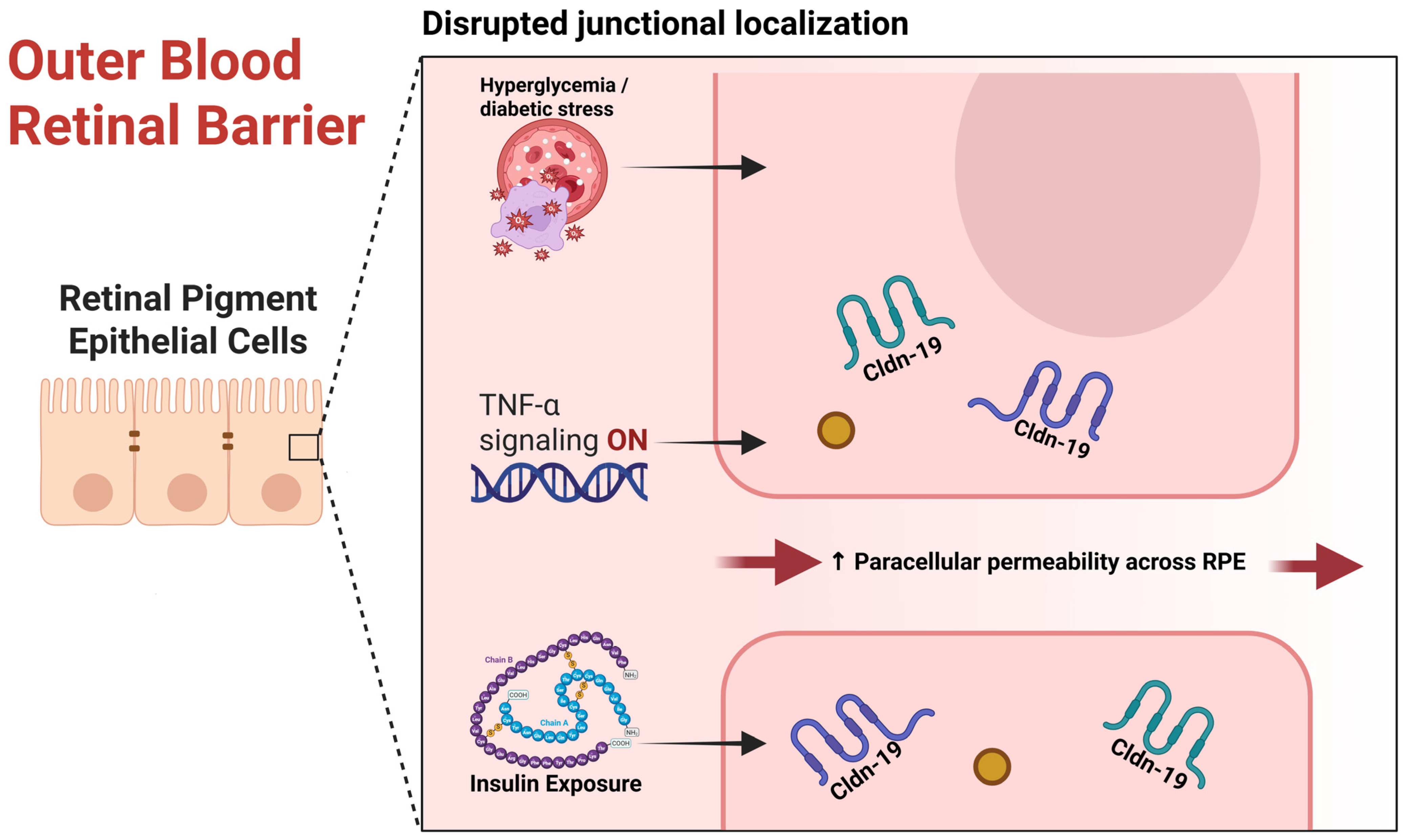
| Cldn-19 | Expression significantly plummeted and localization disrupted. | Breakdown of the outer BRB (oBRB) in diabetic settings. | [130] | |
| Cldn-19 | Insulin-induced junctional breakdown and mislocalization (zebrafish RPE65) | TEER reduction, impaired RPE barrier integrity, and oBRB leakage | [132] | |
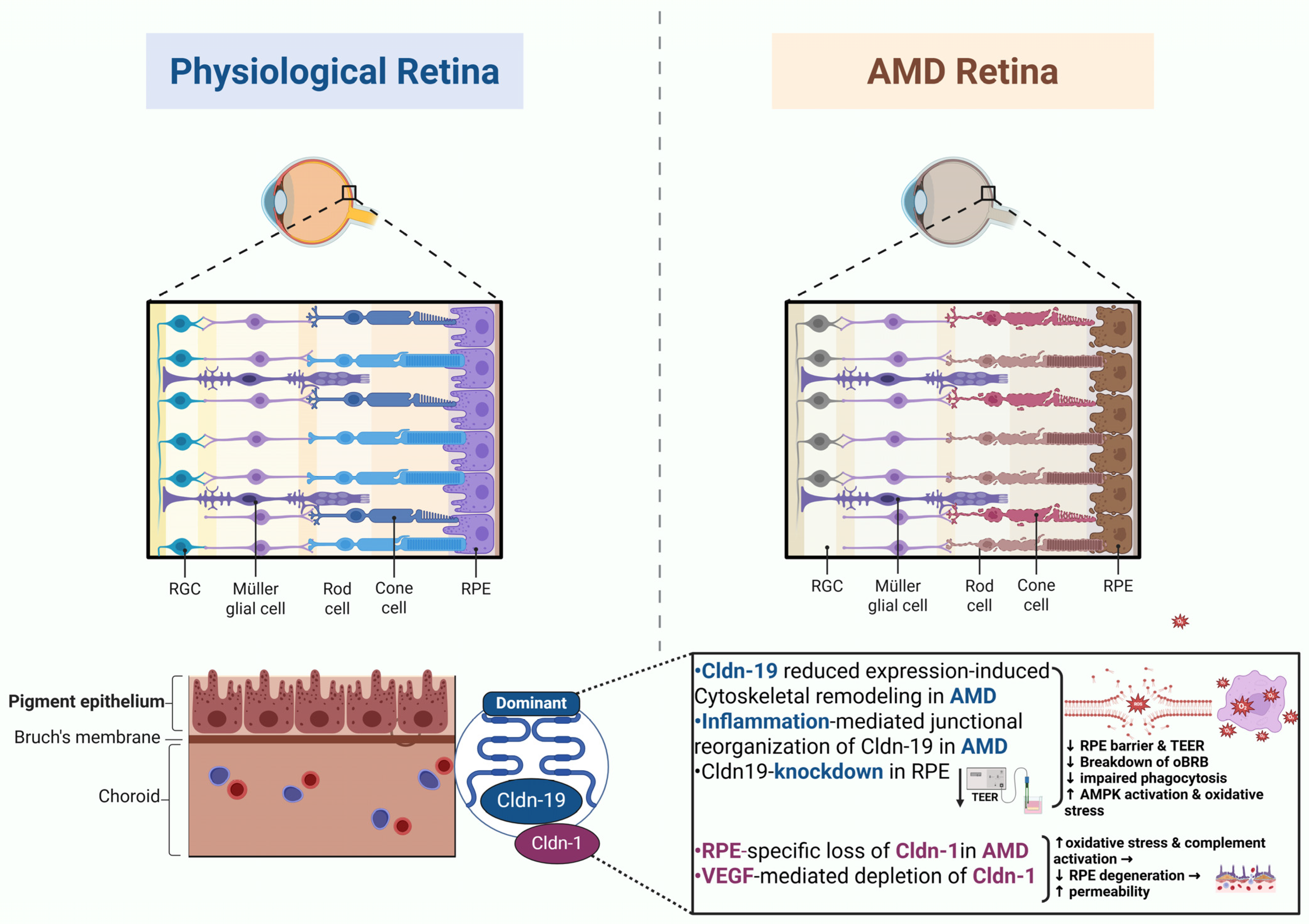
| Age-related Macular Degeneration | Cldn-1 | RPE-specific loss/ deficiency. | Disrupted TJ integrity, oxidative stress, complement activation, leading to RPE degeneration. | [67] |
| Cldn-5 | Chronic suppression/ knockdown. | Pronounced RPE atrophy and degeneration (oBRB instability). | [86] | |
| Cldn-19 | Junctional reorganization/ cytoskeletal remodeling due to inflammatory cytokines. | Reduced RPE barrier resistance (a hallmark of AMD). | [138,140,143] | |
| Retinal Detachment | Cldn-3, Cldn-19 | Discontinuous or mislocalized to the cytoplasm after RD. | Decreased RPE monolayer resistance (TEER) and increased paracellular leakage (oBRB breakdown). | [154] |
| Ischemic Injury/ROP | Cldn-5 | Overexpression but aberrant localization (cytosolic). | Increased vascular permeability and macular edema (iBRB failure). | [57,95,124] |
| Cldn-17 | Loss or deficiency. | Exacerbated vasoobliteration, neovascularization, and permeability. | [72] |
4.4. Glaucoma and Optic Neuropathies
4.4.1. BRB Breakdown and Cldn-5 Dysregulation
4.4.2. Cldns in Optic Nerve Vulnerability and Metabolic Stress
4.4.3. Cldns as Neuroprotective Targets
4.5. Retinitis Pigmentosa and Other Inherited Retinal Degenerations
5. Regulation of Cldn Function in the Retina
5.1. WNT/β-Catenin Signaling and Norrin
5.2. Non-Coding RNAs and Epigenetic Regulation
5.3. Post-Translational Modifications of Cldns
5.4. Cldn Isoform-Specific Roles
6. Cldns as Therapeutic Targets in the Retina
6.1. Pharmacological Modulation of Cldn-5
6.2. Modulation of RPE Claudins: Cldn-3 and Cldn-19
6.3. Gene-Based Therapeutic Strategies
6.4. Delivery Challenges and Emerging Solutions
7. Conclusions and Future Perspectives
Author Contributions
Funding
Institutional Review Board Statement
Informed Consent Statement
Data Availability Statement
Acknowledgments
Conflicts of Interest
Abbreviations
| Abbreviation | Definition |
| AAV | Adeno-associated virus |
| ACG | Angle-closure glaucoma |
| AGE | Advanced glycation end-product |
| AMD | Age-related macular degeneration |
| AMPK | AMP-activated protein kinase |
| BBB | Blood–brain barrier |
| bEND.3 | Brain endothelial cell line clone 3 |
| BRB | Blood–retinal barrier |
| BREC | Bovine retinal endothelial cell |
| Cldn | Claudin |
| CNV | Choroidal neovascularization |
| COH | Chronic ocular hypertension |
| CTRP3 | C1q/tumor necrosis factor-related protein 3 |
| DVL-1 | Disheveled-1 |
| DR | Diabetic retinopathy |
| EC | Endothelial cell |
| ECL1/2 | Extracellular loop 1/2 |
| ER | Endoplasmic reticulum |
| ERD | Exudative retinal detachment |
| EV | Extracellular vesicle |
| FHHNC | Familial hypomagnesemia with hypercalciuria and nephrocalcinosis |
| FZD4 | Frizzled-4 receptor |
| H&E | Hematoxylin and eosin |
| HG | Hyperglycemia/High glucose |
| HREC | Human retinal endothelial cell |
| ICAM-1 | Intercellular adhesion molecule-1 |
| IFN-γ | Interferon-gamma |
| IL | Interleukin |
| ILM | Inner limiting membrane |
| INL | Inner nuclear layer |
| IOP | Intraocular pressure |
| IR | Ischemic retinopathy |
| IRD | Inherited retinal degeneration |
| iBRB | Inner blood–retinal barrier |
| iBREC | Immortalized bovine retinal endothelial cell |
| JAM | Junctional adhesion molecule |
| LNP | Lipid nanoparticle |
| LPS | Lipopolysaccharide |
| LRP5/6 | Low-density lipoprotein receptor-related protein 5/6 |
| MAPK | Mitogen-activated protein kinase |
| miRNA | MicroRNA |
| NF-κB | Nuclear factor kappa-light-chain-enhancer of activated B cells |
| NO | Nitric oxide |
| NPDR | Non-proliferative diabetic retinopathy |
| NVU | Neurovascular unit |
| OAG | Open-angle glaucoma |
| OIR | Oxygen-induced retinopathy |
| OLM | Outer limiting membrane |
| ONL | Outer nuclear layer |
| oBRB | Outer blood–retinal barrier |
| PDR | Proliferative diabetic retinopathy |
| PDZ | Postsynaptic density protein domain |
| PKC | Protein kinase C |
| POS | Photoreceptor outer segment |
| PTM | Post-translational modification |
| PVR | Proliferative vitreoretinopathy |
| RD | Retinal detachment |
| RGC | Retinal ganglion cell |
| RhoA | Ras homolog family member A |
| RNA-seq | RNA sequencing |
| ROCK | Rho-associated kinase |
| ROP | Retinopathy of prematurity |
| RP | Retinitis pigmentosa |
| RPE | Retinal pigment epithelium |
| RT-qPCR | Reverse transcription quantitative polymerase chain reaction |
| S1P | Sphingosine-1-phosphate |
| S1PR | Sphingosine-1-phosphate receptor |
| siRNA | Small interfering RNA |
| SQSTM1 (p62) | Sequestosome 1 |
| STZ | Streptozotocin |
| TEER | Trans-epithelial/-endothelial electrical resistance |
| TGF-β | Transforming growth factor-beta |
| TJ | Tight junction |
| TNF-α | Tumor necrosis factor-alpha |
| TRD | Tractional retinal detachment |
| VE-cadherin | Vascular endothelial cadherin |
| VEGF | Vascular endothelial growth factor |
| Wnt | Wingless-related integration site |
| W/D | Wet-to-dry ratio |
| ZO-1/ZO-2/ZO-3 | Zonula occludens-1/-2/-3 |
References
- Runkle, E.A.; Antonetti, D.A. The blood-retinal barrier: Structure and functional significance. Methods Mol. Biol. 2011, 686, 133–148. [Google Scholar] [CrossRef] [Scilit]
- Masland, R.H. The neuronal organization of the retina. Neuron 2012, 76, 266–280. [Google Scholar] [CrossRef] [Scilit]
- Bringmann, A.; Pannicke, T.; Grosche, J.; Francke, M.; Wiedemann, P.; Skatchkov, S.N.; Osborne, N.N.; Reichenbach, A. Muller cells in the healthy and diseased retina. Prog. Retin. Eye Res. 2006, 25, 397–424. [Google Scholar] [CrossRef] [Scilit]
- Rudraraju, M.; Narayanan, S.P.; Somanath, P.R. Regulation of blood-retinal barrier cell-junctions in diabetic retinopathy. Pharmacol. Res. 2020, 161, 105115. [Google Scholar] [CrossRef] [Scilit]
- Campbell, M.; Humphries, P. The blood-retina barrier: Tight junctions and barrier modulation. Adv. Exp. Med. Biol. 2012, 763, 70–84. [Google Scholar]
- Adil, M.S.; Narayanan, S.P.; Somanath, P.R. Cell-cell junctions: Structure and regulation in physiology and pathology. Tissue Barriers 2021, 9, 1848212. [Google Scholar] [CrossRef] [Scilit]
- Selim, M.S.; Matani, B.R.; Henry-Ojo, H.O.; Narayanan, S.P.; Somanath, P.R. Claudin 5 Across the Vascular Landscape: From Blood-Tissue Barrier Regulation to Disease Mechanisms. Cells 2025, 14, 1346. [Google Scholar] [CrossRef] [Scilit]
- Tsukita, S.; Furuse, M.; Itoh, M. Multifunctional strands in tight junctions. Nat. Rev. Mol. Cell. Biol. 2001, 2, 285–293. [Google Scholar] [CrossRef] [Scilit] [PubMed]
- Krause, G.; Winkler, L.; Mueller, S.L.; Haseloff, R.F.; Piontek, J.; Blasig, I.E. Structure and function of claudins. Biochim. Biophys. Acta 2008, 1778, 631–645. [Google Scholar] [CrossRef] [Scilit] [PubMed]
- Tsukita, S.; Tanaka, H.; Tamura, A. The Claudins: From Tight Junctions to Biological Systems. Trends Biochem. Sci. 2019, 44, 141–152. [Google Scholar] [CrossRef] [Scilit] [PubMed]
- Ma, J.; Wang, P.; Liu, Y.; Zhao, L.; Li, Z.; Xue, Y. Kruppel-like factor 4 regulates blood-tumor barrier permeability via ZO-1, occludin and claudin-5. J. Cell. Physiol. 2014, 229, 916–926. [Google Scholar] [CrossRef] [Scilit]
- Mitchell, L.A.; Overgaard, C.E.; Ward, C.; Margulies, S.S.; Koval, M. Differential effects of claudin-3 and claudin-4 on alveolar epithelial barrier function. Am. J. Physiol. Lung Cell. Mol. Physiol. 2011, 301, L40–L49. [Google Scholar] [CrossRef] [Scilit] [PubMed]
- Overgaard, C.E.; Mitchell, L.A.; Koval, M. Roles for claudins in alveolar epithelial barrier function. Ann. N. Y. Acad. Sci. 2012, 1257, 167–174. [Google Scholar] [CrossRef] [Scilit] [PubMed]
- Schlingmann, B.; Molina, S.A.; Koval, M. Claudins: Gatekeepers of lung epithelial function. Semin. Cell Dev. Biol. 2015, 42, 47–57. [Google Scholar] [CrossRef] [Scilit]
- Artham, S.; Gao, F.; Verma, A.; Alwhaibi, A.; Sabbineni, H.; Hafez, S.; Ergul, A.; Somanath, P.R. Endothelial stromelysin1 regulation by the forkhead box-O transcription factors is crucial in the exudative phase of acute lung injury. Pharmacol. Res. 2019, 141, 249–263. [Google Scholar] [CrossRef] [Scilit]
- Gao, F.; Alwhaibi, A.; Artham, S.; Verma, A.; Somanath, P.R. Endothelial Akt1 loss promotes prostate cancer metastasis via beta-catenin-regulated tight-junction protein turnover. Br. J. Cancer 2018, 118, 1464–1475. [Google Scholar] [CrossRef] [Scilit] [PubMed]
- Gao, F.; Artham, S.; Sabbineni, H.; Al-Azayzih, A.; Peng, X.D.; Hay, N.; Adams, R.H.; Byzova, T.V.; Somanath, P.R. Akt1 promotes stimuli-induced endothelial-barrier protection through FoxO-mediated tight-junction protein turnover. Cell. Mol. Life Sci. CMLS 2016, 73, 3917–3933. [Google Scholar] [CrossRef] [Scilit]
- Gao, F.; Sabbineni, H.; Artham, S.; Somanath, P.R. Modulation of long-term endothelial-barrier integrity is conditional to the cross-talk between Akt and Src signaling. J. Cell. Physiol. 2017, 232, 2599–2609. [Google Scholar] [CrossRef] [Scilit]
- Taddei, A.; Giampietro, C.; Conti, A.; Orsenigo, F.; Breviario, F.; Pirazzoli, V.; Potente, M.; Daly, C.; Dimmeler, S.; Dejana, E. Endothelial adherens junctions control tight junctions by VE-cadherin-mediated upregulation of claudin-5. Nat. Cell Biol. 2008, 10, 923–934. [Google Scholar] [CrossRef] [Scilit]
- Rudraraju, M.; Shan, S.; Liu, F.; Tyler, J.; Caldwell, R.B.; Somanath, P.R.; Narayanan, S.P. Pharmacological Modulation of beta-Catenin Preserves Endothelial Barrier Integrity and Mitigates Retinal Vascular Permeability and Inflammation. J. Clin. Med. 2023, 12, 7145. [Google Scholar] [CrossRef] [Scilit]
- Rudraraju, M.; Narayanan, S.P.; Somanath, P.R. Distinct Mechanisms of Human Retinal Endothelial Barrier Modulation In Vitro by Mediators of Diabetes and Uveitis. Life 2021, 12, 33. [Google Scholar] [CrossRef] [Scilit]
- Shan, S.; Liu, F.; Ford, E.; Caldwell, R.B.; Narayanan, S.P.; Somanath, P.R. Triciribine attenuates pathological neovascularization and vascular permeability in a mouse model of proliferative retinopathy. Biomed. Pharmacother. 2023, 162, 114714. [Google Scholar] [CrossRef] [Scilit]
- Argaw, A.T.; Gurfein, B.T.; Zhang, Y.; Zameer, A.; John, G.R. VEGF-mediated disruption of endothelial CLN-5 promotes blood-brain barrier breakdown. Proc. Natl. Acad. Sci. USA 2009, 106, 1977–1982. [Google Scholar] [CrossRef] [Scilit]
- Zhou, L.; Xu, Z.; Lu, H.; Cho, H.; Xie, Y.; Lee, G.; Ri, K.; Duh, E.J. Suppression of inner blood-retinal barrier breakdown and pathogenic Muller glia activation in ischemia retinopathy by myeloid cell depletion. J. Neuroinflamm. 2024, 21, 210. [Google Scholar] [CrossRef] [Scilit]
- Jakel, L.; Claassen, K.; De Kort, A.M.; Jolink, W.M.T.; Vermeiren, Y.; Schreuder, F.; Kusters, B.; Klijn, C.J.M.; Kuiperij, H.B.; Verbeek, M.M. Decreased microvascular claudin-5 levels in cerebral amyloid angiopathy associated with intracerebral haemorrhage. Brain Pathol. 2024, 34, e13270. [Google Scholar] [CrossRef] [Scilit]
- Gunzel, D.; Yu, A.S. Claudins and the modulation of tight junction permeability. Physiol. Rev. 2013, 93, 525–569. [Google Scholar] [CrossRef] [Scilit] [PubMed]
- Suzuki, H.; Nishizawa, T.; Tani, K.; Yamazaki, Y.; Tamura, A.; Ishitani, R.; Dohmae, N.; Tsukita, S.; Nureki, O.; Fujiyoshi, Y. Crystal structure of a claudin provides insight into the architecture of tight junctions. Science 2014, 344, 304–307. [Google Scholar] [CrossRef] [Scilit] [PubMed]
- Lal-Nag, M.; Morin, P.J. The claudins. Genome Biol. 2009, 10, 235. [Google Scholar] [CrossRef] [Scilit] [PubMed]
- Baltzegar, D.A.; Reading, B.J.; Brune, E.S.; Borski, R.J. Phylogenetic revision of the claudin gene family. Mar. Genom. 2013, 11, 17–26. [Google Scholar] [CrossRef] [Scilit]
- Bao, L.; Yang, S.; Zhao, W.; Zuo, Y. Exploring claudin proteins: From sequence motifs to their impact on tight junction-mediated signaling pathways. Amino Acids 2025, 57, 48. [Google Scholar] [CrossRef] [Scilit]
- Van Itallie, C.M.; Anderson, J.M. Architecture of tight junctions and principles of molecular composition. Semin. Cell Dev. Biol. 2014, 36, 157–165. [Google Scholar] [CrossRef] [Scilit] [PubMed]
- Piontek, J.; Winkler, L.; Wolburg, H.; Muller, S.L.; Zuleger, N.; Piehl, C.; Wiesner, B.; Krause, G.; Blasig, I.E. Formation of tight junction: Determinants of homophilic interaction between classic claudins. FASEB J. 2008, 22, 146–158. [Google Scholar] [CrossRef] [Scilit]
- Hamazaki, Y.; Itoh, M.; Sasaki, H.; Furuse, M.; Tsukita, S. Multi-PDZ domain protein 1 (MUPP1) is concentrated at tight junctions through its possible interaction with claudin-1 and junctional adhesion molecule. J. Biol. Chem. 2002, 277, 455–461. [Google Scholar] [CrossRef] [Scilit] [PubMed]
- Wen, H.; Watry, D.D.; Marcondes, M.C.; Fox, H.S. Selective decrease in paracellular conductance of tight junctions: Role of the first extracellular domain of claudin-5. Mol. Cell. Biol. 2004, 24, 8408–8417. [Google Scholar] [CrossRef] [Scilit] [PubMed]
- Hou, J.; Paul, D.L.; Goodenough, D.A. Paracellin-1 and the modulation of ion selectivity of tight junctions. J. Cell Sci. 2005, 118, 5109–5118. [Google Scholar] [CrossRef] [Scilit]
- Shen, L.; Weber, C.R.; Raleigh, D.R.; Yu, D.; Turner, J.R. Tight junction pore and leak pathways: A dynamic duo. Annu. Rev. Physiol. 2011, 73, 283–309. [Google Scholar] [CrossRef] [Scilit]
- Anderson, J.M.; Van Itallie, C.M. Physiology and function of the tight junction. Cold Spring Harb. Perspect. Biol. 2009, 1, a002584. [Google Scholar] [CrossRef] [Scilit]
- Schneeberger, E.E.; Lynch, R.D. The tight junction: A multifunctional complex. Am. J. Physiol. Cell Physiol. 2004, 286, C1213–C1228. [Google Scholar] [CrossRef] [Scilit]
- Fujibe, M.; Chiba, H.; Kojima, T.; Soma, T.; Wada, T.; Yamashita, T.; Sawada, N. Thr203 of claudin-1, a putative phosphorylation site for MAP kinase, is required to promote the barrier function of tight junctions. Exp. Cell Res. 2004, 295, 36–47. [Google Scholar] [CrossRef] [Scilit]
- Van Itallie, C.M.; Gambling, T.M.; Carson, J.L.; Anderson, J.M. Palmitoylation of claudins is required for efficient tight-junction localization. J. Cell Sci. 2005, 118, 1427–1436. [Google Scholar] [CrossRef] [Scilit]
- Miwa, N.; Furuse, M.; Tsukita, S.; Niikawa, N.; Nakamura, Y.; Furukawa, Y. Involvement of claudin-1 in the beta-catenin/Tcf signaling pathway and its frequent upregulation in human colorectal cancers. Oncol. Res. 2001, 12, 469–476. [Google Scholar] [CrossRef] [Scilit]
- Furuse, M.; Hata, M.; Furuse, K.; Yoshida, Y.; Haratake, A.; Sugitani, Y.; Noda, T.; Kubo, A.; Tsukita, S. Claudin-based tight junctions are crucial for the mammalian epidermal barrier: A lesson from claudin-1-deficient mice. J. Cell Biol. 2002, 156, 1099–1111. [Google Scholar] [CrossRef] [Scilit] [PubMed]
- Coyne, C.B.; Gambling, T.M.; Boucher, R.C.; Carson, J.L.; Johnson, L.G. Role of claudin interactions in airway tight junctional permeability. Am. J. Physiol. Lung Cell. Mol. Physiol. 2003, 285, L1166–L1178. [Google Scholar] [CrossRef] [Scilit] [PubMed]
- Niimi, T.; Nagashima, K.; Ward, J.M.; Minoo, P.; Zimonjic, D.B.; Popescu, N.C.; Kimura, S. claudin-18, a novel downstream target gene for the T/EBP/NKX2.1 homeodomain transcription factor, encodes lung- and stomach-specific isoforms through alternative splicing. Mol. Cell. Biol. 2001, 21, 7380–7390. [Google Scholar] [CrossRef] [Scilit] [PubMed]
- Konrad, M.; Schaller, A.; Seelow, D.; Pandey, A.V.; Waldegger, S.; Lesslauer, A.; Vitzthum, H.; Suzuki, Y.; Luk, J.M.; Becker, C.; et al. Mutations in the tight-junction gene claudin 19 (CLDN19) are associated with renal magnesium wasting, renal failure, and severe ocular involvement. Am. J. Hum. Genet. 2006, 79, 949–957. [Google Scholar] [CrossRef] [Scilit]
- Rosenthal, R.; Gunzel, D.; Krug, S.M.; Schulzke, J.D.; Fromm, M.; Yu, A.S. Claudin-2-mediated cation and water transport share a common pore. Acta Physiol. 2017, 219, 521–536. [Google Scholar] [CrossRef] [Scilit]
- Gunzel, D.; Haisch, L.; Pfaffenbach, S.; Krug, S.M.; Milatz, S.; Amasheh, S.; Hunziker, W.; Muller, D. Claudin function in the thick ascending limb of Henle’s loop. Ann. N. Y. Acad. Sci. 2009, 1165, 152–162. [Google Scholar] [CrossRef] [Scilit]
- Hou, J. The yin and yang of claudin-14 function in human diseases. Ann. N. Y. Acad. Sci. 2012, 1258, 185–190. [Google Scholar] [CrossRef] [Scilit]
- Wattenhofer, M.; Reymond, A.; Falciola, V.; Charollais, A.; Caille, D.; Borel, C.; Lyle, R.; Estivill, X.; Petersen, M.B.; Meda, P.; et al. Different mechanisms preclude mutant CLDN14 proteins from forming tight junctions In Vitro. Hum. Mutat. 2005, 25, 543–549. [Google Scholar] [CrossRef] [Scilit]
- Ben-Yosef, T.; Belyantseva, I.A.; Saunders, T.L.; Hughes, E.D.; Kawamoto, K.; Van Itallie, C.M.; Beyer, L.A.; Halsey, K.; Gardner, D.J.; Wilcox, E.R.; et al. Claudin 14 knockout mice, a model for autosomal recessive deafness DFNB29, are deaf due to cochlear hair cell degeneration. Hum. Mol. Genet. 2003, 12, 2049–2061. [Google Scholar] [CrossRef] [Scilit]
- Lee, K.; Ansar, M.; Andrade, P.B.; Khan, B.; Santos-Cortez, R.L.; Ahmad, W.; Leal, S.M. Novel CLDN14 mutations in Pakistani families with autosomal recessive non-syndromic hearing loss. Am. J. Med. Genet. A 2012, 158A, 315–321. [Google Scholar] [CrossRef] [Scilit]
- Nitta, T.; Hata, M.; Gotoh, S.; Seo, Y.; Sasaki, H.; Hashimoto, N.; Furuse, M.; Tsukita, S. Size-selective loosening of the blood-brain barrier in claudin-5-deficient mice. J. Cell Biol. 2003, 161, 653–660. [Google Scholar] [CrossRef] [Scilit]
- Ohnishi, M.; Ochiai, H.; Matsuoka, K.; Akagi, M.; Nakayama, Y.; Shima, A.; Uda, A.; Matsuoka, H.; Kamishikiryo, J.; Michihara, A.; et al. Claudin domain containing 1 contributing to endothelial cell adhesion decreases in presence of cerebellar hemorrhage. J. Neurosci. Res. 2017, 95, 2051–2058. [Google Scholar] [CrossRef] [Scilit]
- Maheras, K.J.; Peppi, M.; Ghoddoussi, F.; Galloway, M.P.; Perrine, S.A.; Gow, A. Absence of Claudin 11 in CNS Myelin Perturbs Behavior and Neurotransmitter Levels in Mice. Sci. Rep. 2018, 8, 3798. [Google Scholar] [CrossRef] [Scilit]
- Adil, M.S.; Parvathagiri, V.; Verma, A.; Liu, F.; Rudraraju, M.; Narayanan, S.P.; Somanath, P.R. Claudin-17 Deficiency in Mice Results in Kidney Injury Due to Electrolyte Imbalance and Oxidative Stress. Cells 2022, 11, 1782. [Google Scholar] [CrossRef] [Scilit] [PubMed]
- Adil, M.S.; Parvathagiri, V.; Alanazi, A.H.; Khulood, D.; Narayanan, S.P.; Somanath, P.R. Claudin-17 Deficiency Drives Vascular Permeability and Inflammation Causing Lung Injury. Int. J. Mol. Sci. 2025, 26, 3612. [Google Scholar] [CrossRef] [Scilit] [PubMed]
- Luo, Y.; Xiao, W.; Zhu, X.; Mao, Y.; Liu, X.; Chen, X.; Huang, J.; Tang, S.; Rizzolo, L.J. Differential expression of claudins in retinas during normal development and the angiogenesis of oxygen-induced retinopathy. Investig. Ophthalmol. Vis. Sci. 2011, 52, 7556–7564. [Google Scholar] [CrossRef] [Scilit]
- Daneman, R.; Zhou, L.; Agalliu, D.; Cahoy, J.D.; Kaushal, A.; Barres, B.A. The mouse blood-brain barrier transcriptome: A new resource for understanding the development and function of brain endothelial cells. PLoS ONE 2010, 5, e13741. [Google Scholar] [CrossRef] [Scilit]
- Wang, S.B.; Xu, T.; Peng, S.; Singh, D.; Ghiassi-Nejad, M.; Adelman, R.A.; Rizzolo, L.J. Disease-associated mutations of claudin-19 disrupt retinal neurogenesis and visual function. Commun. Biol. 2019, 2, 113. [Google Scholar] [CrossRef] [Scilit]
- Wang, S.; Li, W.; Chen, M.; Cao, Y.; Lu, W.; Li, X. The retinal pigment epithelium: Functions and roles in ocular diseases. Fundam. Res. 2024, 4, 1710–1718. [Google Scholar] [CrossRef] [Scilit]
- Peng, S.; Rahner, C.; Rizzolo, L.J. Apical and basal regulation of the permeability of the retinal pigment epithelium. Investig. Ophthalmol. Vis. Sci. 2003, 44, 808–817. [Google Scholar] [CrossRef] [Scilit]
- Lakkaraju, A.; Umapathy, A.; Tan, L.X.; Daniele, L.; Philp, N.J.; Boesze-Battaglia, K.; Williams, D.S. The cell biology of the retinal pigment epithelium. Prog. Retin. Eye Res. 2020, 78, 100846. [Google Scholar] [CrossRef] [Scilit]
- Esteve-Rudd, J.; Hazim, R.A.; Diemer, T.; Paniagua, A.E.; Volland, S.; Umapathy, A.; Williams, D.S. Defective phagosome motility and degradation in cell nonautonomous RPE pathogenesis of a dominant macular degeneration. Proc. Natl. Acad. Sci. USA 2018, 115, 5468–5473. [Google Scholar] [CrossRef] [Scilit]
- Liu, F.; Peng, S.; Adelman, R.A.; Rizzolo, L.J. Knockdown of Claudin-19 in the Retinal Pigment Epithelium Is Accompanied by Slowed Phagocytosis and Increased Expression of SQSTM1. Investig. Ophthalmol. Vis. Sci. 2021, 62, 14. [Google Scholar] [CrossRef] [Scilit]
- Liu, F.; Xu, T.; Peng, S.; Adelman, R.A.; Rizzolo, L.J. Claudins regulate gene and protein expression of the retinal pigment epithelium independent of their association with tight junctions. Exp. Eye Res. 2020, 198, 108157. [Google Scholar] [CrossRef] [Scilit] [PubMed]
- Naylor, A.; Hopkins, A.; Hudson, N.; Campbell, M. Tight Junctions of the Outer Blood Retina Barrier. Int. J. Mol. Sci. 2019, 21, 211. [Google Scholar] [CrossRef] [Scilit] [PubMed]
- Nakai, A.; Lee, D.; Zhang, Y.; Shoda, C.; Imanishi, T.; Jeong, H.; Ikeda, S.-i.; Negishi, K.; Nakashizuka, H.; Yamagami, S.; et al. Tight junction component protein claudin-1 deficiency in retinal pigment epithelium leads to early and intermediate age-related macular degeneration phenotypes in mice. bioRxiv 2023. [Google Scholar] [CrossRef] [Scilit]
- Peng, S.; Rao, V.S.; Adelman, R.A.; Rizzolo, L.J. Claudin-19 and the barrier properties of the human retinal pigment epithelium. Investig. Ophthalmol. Vis. Sci. 2011, 52, 1392–1403. [Google Scholar] [CrossRef] [Scilit]
- Deissler, H.L.; Deissler, H.; Lang, G.K.; Lang, G.E. VEGF but not PlGF disturbs the barrier of retinal endothelial cells. Exp. Eye Res. 2013, 115, 162–171. [Google Scholar] [CrossRef] [Scilit] [PubMed]
- Hudson, N.; Campbell, M. Tight Junctions of the Neurovascular Unit. Front. Mol. Neurosci. 2021, 14, 752781. [Google Scholar] [CrossRef] [Scilit]
- Abbott, N.J.; Ronnback, L.; Hansson, E. Astrocyte-endothelial interactions at the blood-brain barrier. Nat. Rev. Neurosci. 2006, 7, 41–53. [Google Scholar] [CrossRef] [Scilit]
- Shenoy, S.; Liu, F.; Shan, S.; Alanazi, A.; Narayanan, S.P. Claudin-17 loss Compromises Blood-Retinal Barrier Integrity: Implications for Ischemic Retinopathies. Investig. Ophthalmol. Vis. Sci. 2024, 65, 305. [Google Scholar]
- Medina-Arellano, A.E.; Albert-Garay, J.S.; Medina-Sanchez, T.; Fonseca, K.H.; Ruiz-Cruz, M.; Ochoa-de la Paz, L. Muller cells and retinal angiogenesis: Critical regulators in health and disease. Front. Cell. Neurosci. 2024, 18, 1513686. [Google Scholar] [CrossRef] [Scilit]
- Garcia-Pradas, L.; Gleiser, C.; Wizenmann, A.; Wolburg, H.; Mack, A.F. Glial Cells in the Fish Retinal Nerve Fiber Layer Form Tight Junctions, Separating and Surrounding Axons. Front. Mol. Neurosci. 2018, 11, 367. [Google Scholar] [CrossRef] [Scilit]
- Tian, R.; Luo, Y.; Liu, Q.; Cai, M.; Li, J.; Sun, W.; Wang, J.; He, C.; Liu, Y.; Liu, X. The effect of claudin-5 overexpression on the interactions of claudin-1 and -2 and barrier function in retinal cells. Curr. Mol. Med. 2014, 14, 1226–1237. [Google Scholar] [CrossRef] [Scilit]
- Subirada, P.V.; Paz, M.C.; Ridano, M.E.; Lorenc, V.E.; Vaglienti, M.V.; Barcelona, P.F.; Luna, J.D.; Sanchez, M.C. A journey into the retina: Muller glia commanding survival and death. Eur. J. Neurosci. 2018, 47, 1429–1443. [Google Scholar] [CrossRef] [Scilit]
- Omri, S.; Omri, B.; Savoldelli, M.; Jonet, L.; Thillaye-Goldenberg, B.; Thuret, G.; Gain, P.; Jeanny, J.C.; Crisanti, P.; Behar-Cohen, F. The outer limiting membrane (OLM) revisited: Clinical implications. Clin. Ophthalmol. 2010, 4, 183–195. [Google Scholar] [CrossRef] [Scilit]
- Diaz-Coranguez, M.; Ramos, C.; Antonetti, D.A. The inner blood-retinal barrier: Cellular basis and development. Vis. Res. 2017, 139, 123–137. [Google Scholar] [CrossRef] [Scilit] [PubMed]
- Goncalves, A.; Ambrosio, A.F.; Fernandes, R. Regulation of claudins in blood-tissue barriers under physiological and pathological states. Tissue Barriers 2013, 1, e24782. [Google Scholar] [CrossRef] [Scilit] [PubMed]
- Zhang, J.; Wang, J.; Zhou, Q.; Chen, Z.; Zhuang, J.; Zhao, X.; Gan, Z.; Wang, Y.; Wang, C.; Molday, R.S.; et al. Spatiotemporally resolved transcriptomics reveals the cellular dynamics of human retinal development. Nat. Commun. 2025, 16, 2307. [Google Scholar] [CrossRef] [Scilit] [PubMed]
- Leung, Y.F.; Ma, P.; Dowling, J.E. Gene expression profiling of zebrafish embryonic retinal pigment epithelium In Vivo. Investig. Ophthalmol. Vis. Sci. 2007, 48, 881–890. [Google Scholar] [CrossRef] [Scilit]
- Zhou, Y.; Wang, Y.; Tischfield, M.; Williams, J.; Smallwood, P.M.; Rattner, A.; Taketo, M.M.; Nathans, J. Canonical WNT signaling components in vascular development and barrier formation. J. Clin. Investig. 2014, 124, 3825–3846. [Google Scholar] [CrossRef] [Scilit] [PubMed]
- Robitaille, J.; MacDonald, M.L.; Kaykas, A.; Sheldahl, L.C.; Zeisler, J.; Dube, M.P.; Zhang, L.H.; Singaraja, R.R.; Guernsey, D.L.; Zheng, B.; et al. Mutant frizzled-4 disrupts retinal angiogenesis in familial exudative vitreoretinopathy. Nat. Genet. 2002, 32, 326–330. [Google Scholar] [CrossRef] [Scilit] [PubMed]
- Ye, X.; Wang, Y.; Nathans, J. The Norrin/Frizzled4 signaling pathway in retinal vascular development and disease. Trends Mol. Med. 2010, 16, 417–425. [Google Scholar] [CrossRef] [Scilit] [PubMed]
- Wang, Y.; Rattner, A.; Zhou, Y.; Williams, J.; Smallwood, P.M.; Nathans, J. Norrin/Frizzled4 signaling in retinal vascular development and blood brain barrier plasticity. Cell 2012, 151, 1332–1344. [Google Scholar] [CrossRef] [Scilit]
- Hudson, N.; Celkova, L.; Hopkins, A.; Greene, C.; Storti, F.; Ozaki, E.; Fahey, E.; Theodoropoulou, S.; Kenna, P.F.; Humphries, M.M.; et al. Dysregulated claudin-5 cycling in the inner retina causes retinal pigment epithelial cell atrophy. JCI Insight 2019, 4, e130273. [Google Scholar] [CrossRef] [Scilit]
- Adachi, T.; Yasuda, H.; Nakamura, S.; Kamiya, T.; Hara, H.; Hara, H.; Ikeda, T. Endoplasmic reticulum stress induces retinal endothelial permeability of extracellular-superoxide dismutase. Free Radic. Res. 2011, 45, 1083–1092. [Google Scholar] [CrossRef] [Scilit]
- Yoshikawa, T.; Ogata, N.; Izuta, H.; Shimazawa, M.; Hara, H.; Takahashi, K. Increased expression of tight junctions in ARPE-19 cells under endoplasmic reticulum stress. Curr. Eye Res. 2011, 36, 1153–1163. [Google Scholar] [CrossRef] [Scilit]
- Wang, W.; Lo, A.C.Y. Diabetic Retinopathy: Pathophysiology and Treatments. Int. J. Mol. Sci. 2018, 19, 1816. [Google Scholar] [CrossRef] [Scilit]
- Sun, H.; Saeedi, P.; Karuranga, S.; Pinkepank, M.; Ogurtsova, K.; Duncan, B.B.; Stein, C.; Basit, A.; Chan, J.C.N.; Mbanya, J.C.; et al. IDF Diabetes Atlas: Global, regional and country-level diabetes prevalence estimates for 2021 and projections for 2045. Diabetes Res. Clin. Pr. 2022, 183, 109119. [Google Scholar] [CrossRef] [Scilit]
- Teo, Z.L.; Tham, Y.C.; Yu, M.; Chee, M.L.; Rim, T.H.; Cheung, N.; Bikbov, M.M.; Wang, Y.X.; Tang, Y.; Lu, Y.; et al. Global Prevalence of Diabetic Retinopathy and Projection of Burden through 2045: Systematic Review and Meta-analysis. Ophthalmology 2021, 128, 1580–1591. [Google Scholar] [CrossRef] [Scilit]
- Shaukat, N.; Amin, J.; Sharif, M.I.; Sharif, M.I.; Kadry, S.; Sevcik, L. Classification and Segmentation of Diabetic Retinopathy: A Systemic Review. Appl. Sci. 2023, 13, 3108. [Google Scholar] [CrossRef] [Scilit]
- Barber, A.J. A new view of diabetic retinopathy: A neurodegenerative disease of the eye. Prog. Neuropsychopharmacol. Biol. Psychiatry 2003, 27, 283–290. [Google Scholar] [CrossRef] [Scilit]
- Antonetti, D.A.; Barber, A.J.; Khin, S.; Lieth, E.; Tarbell, J.M.; Gardner, T.W. Vascular permeability in experimental diabetes is associated with reduced endothelial occludin content: Vascular endothelial growth factor decreases occludin in retinal endothelial cells. Penn State Retina Research Group. Diabetes 1998, 47, 1953–1959. [Google Scholar] [CrossRef] [Scilit]
- Klaassen, I.; Van Noorden, C.J.; Schlingemann, R.O. Molecular basis of the inner blood-retinal barrier and its breakdown in diabetic macular edema and other pathological conditions. Prog. Retin. Eye Res. 2013, 34, 19–48. [Google Scholar] [CrossRef] [Scilit]
- Early Treatment Diabetic Retinopathy Study Research Group. Early Treatment Diabetic Retinopathy Study design and baseline patient characteristics. Ophthalmology 1991, 98, 741–756. [Google Scholar] [CrossRef] [Scilit]
- Brown, D.M.; Nguyen, Q.D.; Marcus, D.M.; Boyer, D.S.; Patel, S.; Feiner, L.; Schlottmann, P.G.; Rundle, A.C.; Zhang, J.; Rubio, R.G.; et al. Long-term outcomes of ranibizumab therapy for diabetic macular edema: The 36-month results from two phase III trials: RISE and RIDE. Ophthalmology 2013, 120, 2013–2022. [Google Scholar] [CrossRef] [Scilit] [PubMed]
- Diabetic Retinopathy Clinical Research Network. A randomized trial comparing intravitreal triamcinolone acetonide and focal/grid photocoagulation for diabetic macular edema. Ophthalmology 2008, 115, 1447–1459.e10. [Google Scholar] [CrossRef] [Scilit] [PubMed]
- DRUS Research Group. Early vitrectomy for severe vitreous hemorrhage in diabetic retinopathy. Four-year results of a randomized trial: Diabetic Retinopathy Vitrectomy Study Report 5. Arch. Ophthalmol. 1990, 108, 958–964. [Google Scholar] [CrossRef] [Scilit]
- Campbell, M.; Nguyen, A.T.; Kiang, A.S.; Tam, L.; Kenna, P.F.; Dhubhghaill, S.N.; Humphries, M.; Farrar, G.J.; Humphries, P. Reversible and size-selective opening of the inner Blood-Retina barrier: A novel therapeutic strategy. Adv. Exp. Med. Biol. 2010, 664, 301–308. [Google Scholar] [CrossRef] [Scilit]
- Roudnicky, F.; Zhang, J.D.; Kim, B.K.; Pandya, N.J.; Lan, Y.; Sach-Peltason, L.; Ragelle, H.; Strassburger, P.; Gruener, S.; Lazendic, M.; et al. Inducers of the endothelial cell barrier identified through chemogenomic screening in genome-edited hPSC-endothelial cells. Proc. Natl. Acad. Sci. USA 2020, 117, 19854–19865. [Google Scholar] [CrossRef] [Scilit]
- Tachibana, K.; Hashimoto, Y.; Shirakura, K.; Okada, Y.; Hirayama, R.; Iwashita, Y.; Nishino, I.; Ago, Y.; Takeda, H.; Kuniyasu, H.; et al. Safety and efficacy of an anti-claudin-5 monoclonal antibody to increase blood-brain barrier permeability for drug delivery to the brain in a non-human primate. J. Control Release 2021, 336, 105–111. [Google Scholar] [CrossRef] [Scilit]
- Fan, L.; Yan, H. FTY720 Attenuates Retinal Inflammation and Protects Blood-Retinal Barrier in Diabetic Rats. Investig. Ophthalmol. Vis. Sci. 2016, 57, 1254–1263. [Google Scholar] [CrossRef] [Scilit] [PubMed]
- Alanazi, A.H.; Selim, M.S.; Yendamuri, M.R.; Zhang, D.; Narayanan, S.P.; Somanath, P.R. The impact of diabetes mellitus on blood-tissue barrier regulation and vascular complications: Is the lung different from other organs? Tissue Barriers 2025, 13, 2386183. [Google Scholar] [CrossRef] [Scilit] [PubMed]
- Safi, S.Z.; Qvist, R.; Kumar, S.; Batumalaie, K.; Ismail, I.S. Molecular mechanisms of diabetic retinopathy, general preventive strategies, and novel therapeutic targets. BioMed Res. Int. 2014, 2014, 801269. [Google Scholar] [CrossRef] [Scilit]
- Brownlee, M. The pathobiology of diabetic complications: A unifying mechanism. Diabetes 2005, 54, 1615–1625. [Google Scholar] [CrossRef] [Scilit] [PubMed]
- Saker, S.; Stewart, E.A.; Browning, A.C.; Allen, C.L.; Amoaku, W.M. The effect of hyperglycaemia on permeability and the expression of junctional complex molecules in human retinal and choroidal endothelial cells. Exp. Eye Res. 2014, 121, 161–167. [Google Scholar] [CrossRef] [Scilit]
- Klaassen, I.; Hughes, J.M.; Vogels, I.M.; Schalkwijk, C.G.; Van Noorden, C.J.; Schlingemann, R.O. Altered expression of genes related to blood-retina barrier disruption in streptozotocin-induced diabetes. Exp. Eye Res. 2009, 89, 4–15. [Google Scholar] [CrossRef] [Scilit]
- Kopp, A.; Bala, M.; Buechler, C.; Falk, W.; Gross, P.; Neumeier, M.; Scholmerich, J.; Schaffler, A. C1q/TNF-related protein-3 represents a novel and endogenous lipopolysaccharide antagonist of the adipose tissue. Endocrinology 2010, 151, 5267–5278. [Google Scholar] [CrossRef] [Scilit]
- Yan, Z.; Zhao, J.; Gan, L.; Zhang, Y.; Guo, R.; Cao, X.; Lau, W.B.; Ma, X.; Wang, Y. CTRP3 is a novel biomarker for diabetic retinopathy and inhibits HGHL-induced VCAM-1 expression in an AMPK-dependent manner. PLoS ONE 2017, 12, e0178253. [Google Scholar] [CrossRef] [Scilit]
- Yan, Z.; Wang, C.; Meng, Z.; Gan, L.; Guo, R.; Liu, J.; Bond Lau, W.; Xie, D.; Zhao, J.; Lopez, B.L.; et al. C1q/TNF-Related Protein 3 Prevents Diabetic Retinopathy via AMPK-Dependent Stabilization of Blood-Retinal Barrier Tight Junctions. Cells 2022, 11, 779. [Google Scholar] [CrossRef] [Scilit]
- Glenn, J.V.; Stitt, A.W. The role of advanced glycation end products in retinal ageing and disease. Biochim. Biophys. Acta 2009, 1790, 1109–1116. [Google Scholar] [CrossRef] [Scilit]
- Stitt, A.; Gardiner, T.A.; Alderson, N.L.; Canning, P.; Frizzell, N.; Duffy, N.; Boyle, C.; Januszewski, A.S.; Chachich, M.; Baynes, J.W.; et al. The AGE inhibitor pyridoxamine inhibits development of retinopathy in experimental diabetes. Diabetes 2002, 51, 2826–2832. [Google Scholar] [CrossRef] [Scilit]
- Hammes, H.P.; Martin, S.; Federlin, K.; Geisen, K.; Brownlee, M. Aminoguanidine treatment inhibits the development of experimental diabetic retinopathy. Proc. Natl. Acad. Sci. USA 1991, 88, 11555–11558. [Google Scholar] [CrossRef] [Scilit]
- Bolton, W.K.; Cattran, D.C.; Williams, M.E.; Adler, S.G.; Appel, G.B.; Cartwright, K.; Foiles, P.G.; Freedman, B.I.; Raskin, P.; Ratner, R.E.; et al. Randomized trial of an inhibitor of formation of advanced glycation end products in diabetic nephropathy. Am. J. Nephrol. 2004, 24, 32–40. [Google Scholar] [CrossRef] [Scilit]
- Shirasawa, M.; Sonoda, S.; Terasaki, H.; Arimura, N.; Otsuka, H.; Yamashita, T.; Uchino, E.; Hisatomi, T.; Ishibashi, T.; Sakamoto, T. TNF-alpha disrupts morphologic and functional barrier properties of polarized retinal pigment epithelium. Exp. Eye Res. 2013, 110, 59–69. [Google Scholar] [CrossRef] [Scilit]
- Valle, M.L.; Dworshak, J.; Sharma, A.; Ibrahim, A.S.; Al-Shabrawey, M.; Sharma, S. Inhibition of interleukin-6 trans-signaling prevents inflammation and endothelial barrier disruption in retinal endothelial cells. Exp. Eye Res. 2019, 178, 27–36. [Google Scholar] [CrossRef] [Scilit] [PubMed]
- D’Amore, P.A. Mechanisms of retinal and choroidal neovascularization. Investig. Ophthalmol. Vis. Sci. 1994, 35, 3974–3979. [Google Scholar]
- Koto, T.; Takubo, K.; Ishida, S.; Shinoda, H.; Inoue, M.; Tsubota, K.; Okada, Y.; Ikeda, E. Hypoxia disrupts the barrier function of neural blood vessels through changes in the expression of claudin-5 in endothelial cells. Am. J. Pathol. 2007, 170, 1389–1397. [Google Scholar] [CrossRef] [Scilit] [PubMed]
- Xue, Y.; Wang, X.; Wan, B.; Wang, D.; Li, M.; Cheng, K.; Luo, Q.; Wang, D.; Lu, Y.; Zhu, L. Caveolin-1 accelerates hypoxia-induced endothelial dysfunction in high-altitude cerebral edema. Cell Commun. Signal 2022, 20, 160. [Google Scholar] [CrossRef] [Scilit]
- Aiello, L.P.; Avery, R.L.; Arrigg, P.G.; Keyt, B.A.; Jampel, H.D.; Shah, S.T.; Pasquale, L.R.; Thieme, H.; Iwamoto, M.A.; Park, J.E.; et al. Vascular endothelial growth factor in ocular fluid of patients with diabetic retinopathy and other retinal disorders. N. Engl. J. Med. 1994, 331, 1480–1487. [Google Scholar] [CrossRef] [Scilit]
- Deissler, H.L.; Rehak, M.; Wolf, A. Impairment of the Retinal Endothelial Cell Barrier Induced by Long-Term Treatment with VEGF-A(165) No Longer Depends on the Growth Factor’s Presence. Biomolecules 2022, 12, 734. [Google Scholar] [CrossRef] [Scilit]
- Al-Latayfeh, M.; Silva, P.S.; Sun, J.K.; Aiello, L.P. Antiangiogenic therapy for ischemic retinopathies. Cold Spring Harb. Perspect. Med. 2012, 2, a006411. [Google Scholar] [CrossRef] [Scilit] [PubMed]
- Alhumaid, A.; Liu, F.; Shan, S.; Jafari, E.; Nourin, N.; Somanath, P.R.; Narayanan, S.P. Spermine oxidase inhibitor, MDL 72527, reduced neovascularization, vascular permeability, and acrolein-conjugated proteins in a mouse model of ischemic retinopathy. Tissue Barriers 2025, 13, 2347070. [Google Scholar] [CrossRef] [Scilit]
- Zhu, J.; Huang, J.; Sun, Y.; Xu, W.; Qian, H. Emerging role of extracellular vesicles in diabetic retinopathy. Theranostics 2024, 14, 1631–1646. [Google Scholar] [CrossRef] [Scilit] [PubMed]
- Van Niel, G.; D’Angelo, G.; Raposo, G. Shedding light on the cell biology of extracellular vesicles. Nat. Rev. Mol. Cell. Biol. 2018, 19, 213–228. [Google Scholar] [CrossRef] [Scilit]
- Shan, S.; Alanazi, A.H.; Han, Y.; Zhang, D.; Liu, Y.; Narayanan, S.P.; Somanath, P.R. Pro-Inflammatory Characteristics of Extracellular Vesicles in the Vitreous of Type 2 Diabetic Patients. Biomedicines 2024, 12, 2053. [Google Scholar] [CrossRef] [Scilit] [PubMed]
- Huang, C.; Fisher, K.P.; Hammer, S.S.; Navitskaya, S.; Blanchard, G.J.; Busik, J.V. Plasma Exosomes Contribute to Microvascular Damage in Diabetic Retinopathy by Activating the Classical Complement Pathway. Diabetes 2018, 67, 1639–1649. [Google Scholar] [CrossRef] [Scilit]
- Xu, H.Z.; Song, Z.; Fu, S.; Zhu, M.; Le, Y.Z. RPE barrier breakdown in diabetic retinopathy: Seeing is believing. J. Ocul. Biol. Dis. Infor 2011, 4, 83–92. [Google Scholar] [CrossRef] [Scilit]
- Hernandez, K.; Anand-Apte, B. Role of Claudin 19 in the Breakdown of the Outer Blood Retinal Barrier in Diabetic Retinopathy. Investig. Ophthalmol. Vis. Sci. 2023, 64, 1836. [Google Scholar]
- Xu, H.Z.; Le, Y.Z. Significance of outer blood-retina barrier breakdown in diabetes and ischemia. Investig. Ophthalmol. Vis. Sci. 2011, 52, 2160–2164. [Google Scholar] [CrossRef] [Scilit] [PubMed]
- Hernandez, K.; Anand-Apte, B. Insulin-induced early worsening in diabetic retinopathy is mediated via disruption of claudin-19 tight junctions in the RPE. Investig. Ophthalmol. Vis. Sci. 2024, 65, 875. [Google Scholar]
- Chen, Y.H.; Chou, H.C.; Lin, S.T.; Chen, Y.W.; Lo, Y.W.; Chan, H.L. Effect of high glucose on secreted proteome in cultured retinal pigmented epithelium cells: Its possible relevance to clinical diabetic retinopathy. J. Proteom. 2012, 77, 111–128. [Google Scholar] [CrossRef] [Scilit]
- Krug, S.M.; Schulzke, J.D.; Fromm, M. Tight junction, selective permeability, and related diseases. Semin. Cell Dev. Biol. 2014, 36, 166–176. [Google Scholar] [CrossRef] [Scilit]
- Fleckenstein, M.; Schmitz-Valckenberg, S.; Chakravarthy, U. Age-Related Macular Degeneration: A Review. JAMA 2024, 331, 147–157. [Google Scholar] [CrossRef] [Scilit]
- Thomas, C.J.; Mirza, R.G.; Gill, M.K. Age-Related Macular Degeneration. Med. Clin. N. Am. 2021, 105, 473–491. [Google Scholar] [CrossRef] [Scilit]
- Nguyen, D.D.; Luo, L.J.; Yang, C.J.; Lai, J.Y. Highly Retina-Permeating and Long-Acting Resveratrol/Metformin Nanotherapeutics for Enhanced Treatment of Macular Degeneration. ACS Nano 2023, 17, 168–183. [Google Scholar] [CrossRef] [Scilit]
- Tisi, A.; Feligioni, M.; Passacantando, M.; Ciancaglini, M.; Maccarone, R. The Impact of Oxidative Stress on Blood-Retinal Barrier Physiology in Age-Related Macular Degeneration. Cells 2021, 10, 64. [Google Scholar] [CrossRef] [Scilit]
- Shu, D.Y.; Butcher, E.; Saint-Geniez, M. EMT and EndMT: Emerging Roles in Age-Related Macular Degeneration. Int. J. Mol. Sci. 2020, 21, 4271. [Google Scholar] [CrossRef] [Scilit]
- Sparrow, J.R.; Hicks, D.; Hamel, C.P. The retinal pigment epithelium in health and disease. Curr. Mol. Med. 2010, 10, 802–823. [Google Scholar] [CrossRef] [Scilit] [PubMed]
- Radeke, M.J.; Radeke, C.M.; Shih, Y.H.; Hu, J.; Bok, D.; Johnson, L.V.; Coffey, P.J. Restoration of mesenchymal retinal pigmented epithelial cells by TGFbeta pathway inhibitors: Implications for age-related macular degeneration. Genome Med. 2015, 7, 58. [Google Scholar] [CrossRef] [Scilit]
- Fleckenstein, M.; Mitchell, P.; Freund, K.B.; Sadda, S.; Holz, F.G.; Brittain, C.; Henry, E.C.; Ferrara, D. The Progression of Geographic Atrophy Secondary to Age-Related Macular Degeneration. Ophthalmology 2018, 125, 369–390. [Google Scholar] [CrossRef] [Scilit]
- Peng, S.; Gan, G.; Rao, V.S.; Adelman, R.A.; Rizzolo, L.J. Effects of proinflammatory cytokines on the claudin-19 rich tight junctions of human retinal pigment epithelium. Investig. Ophthalmol. Vis. Sci. 2012, 53, 5016–5028. [Google Scholar] [CrossRef] [Scilit]
- Steel, D. Retinal detachment. BMJ Clin. Evid. 2014, 2014, 0710. [Google Scholar] [PubMed]
- Joondeph, B.C. Blunt ocular trauma. Emerg. Med. Clin. N. Am. 1988, 6, 147–167. [Google Scholar] [CrossRef] [Scilit]
- Kaur, C.; Foulds, W.S.; Ling, E.A. Blood-retinal barrier in hypoxic ischaemic conditions: Basic concepts, clinical features and management. Prog. Retin. Eye Res. 2008, 27, 622–647. [Google Scholar] [CrossRef] [Scilit] [PubMed]
- Blair, K.; Czyz, C.N. Retinal Detachment. In StatPearls; StatPearls Publishing LLC.: Treasure Island, FL, USA, 2025. [Google Scholar]
- Lee, J.; Seo, E.J.; Yoon, Y.H. Rhegmatogenous retinal detachment induces more severe macular capillary changes than central serous chorioretinopathy. Sci. Rep. 2022, 12, 7018. [Google Scholar] [CrossRef] [Scilit]
- Tatsumi, T.; Baba, T.; Yokouchi, H.; Yamamoto, S. Nonperfused Peripheral Retinal Area in Eyes with Chronic Rhegmatogenous Retinal Detachment. Case Rep. Ophthalmol. 2020, 11, 385–390. [Google Scholar] [CrossRef] [Scilit]
- Okunuki, Y.; Mukai, R.; Nakao, T.; Tabor, S.J.; Butovsky, O.; Dana, R.; Ksander, B.R.; Connor, K.M. Retinal microglia initiate neuroinflammation in ocular autoimmunity. Proc. Natl. Acad. Sci. USA 2019, 116, 9989–9998. [Google Scholar] [CrossRef] [Scilit]
- Kroll, A.J.; Machemer, R. Experimental Retinal Detachment in the Owl Monkey: V. Electron Microscopy of the Reattached Retina. Am. J. Ophthalmol. 1969, 67, 117–130. [Google Scholar] [CrossRef] [Scilit]
- Lewis, G.P.; Charteris, D.G.; Sethi, C.S.; Fisher, S.K. Animal models of retinal detachment and reattachment: Identifying cellular events that may affect visual recovery. Eye 2002, 16, 375–387. [Google Scholar] [CrossRef] [Scilit]
- Lin, J.B.; Wu, F.; Kim, L.A. Proliferative Vitreoretinopathy: Pathophysiology and Therapeutic Approaches. Int. Ophthalmol. Clin. 2024, 64, 125–135. [Google Scholar] [CrossRef] [Scilit]
- Rizzolo, L.J.; Peng, S.; Luo, Y.; Xiao, W. Integration of tight junctions and claudins with the barrier functions of the retinal pigment epithelium. Prog. Retin. Eye Res. 2011, 30, 296–323. [Google Scholar] [CrossRef] [Scilit]
- Delyfer, M.N.; Raffelsberger, W.; Mercier, D.; Korobelnik, J.F.; Gaudric, A.; Charteris, D.G.; Tadayoni, R.; Metge, F.; Caputo, G.; Barale, P.O.; et al. Transcriptomic analysis of human retinal detachment reveals both inflammatory response and photoreceptor death. PLoS ONE 2011, 6, e28791. [Google Scholar] [CrossRef] [Scilit]
- Quigley, H.A.; Broman, A.T. The number of people with glaucoma worldwide in 2010 and 2020. Br. J. Ophthalmol. 2006, 90, 262–267. [Google Scholar] [CrossRef] [Scilit]
- De Lott, L.B. Optic Neuropathies. Continuum 2025, 31, 381–406. [Google Scholar] [CrossRef] [Scilit]
- Tham, Y.C.; Li, X.; Wong, T.Y.; Quigley, H.A.; Aung, T.; Cheng, C.Y. Global prevalence of glaucoma and projections of glaucoma burden through 2040: A systematic review and meta-analysis. Ophthalmology 2014, 121, 2081–2090. [Google Scholar] [CrossRef] [Scilit] [PubMed]
- Weinreb, R.N.; Aung, T.; Medeiros, F.A. The pathophysiology and treatment of glaucoma: A review. JAMA 2014, 311, 1901–1911. [Google Scholar] [CrossRef] [Scilit] [PubMed]
- Morrison, J.C.; Moore, C.G.; Deppmeier, L.M.; Gold, B.G.; Meshul, C.K.; Johnson, E.C. A rat model of chronic pressure-induced optic nerve damage. Exp. Eye Res. 1997, 64, 85–96. [Google Scholar] [CrossRef] [Scilit] [PubMed]
- Zhang, C.; Simón, M.; Lim, H.; Tolman, N.G.; Horbal, L.; Juarez, F.A.; Bhandari, A.; Montgomery, C.; John, S.W.M. IOP-induced blood-retinal barrier compromise contributes to RGC death in glaucoma. bioRxiv 2024. [Google Scholar] [CrossRef] [Scilit]
- Vidal Paredes, I.A.; Cueva Vargas, J.L.; Belforte, N.; Shiga, Y.; Dotigny, F.; Quintero, H.; Di Polo, A. Restoration of Blood-Retinal Barrier Integrity Prevents Neurodegeneration in Glaucoma. Investig. Ophthalmol. Vis. Sci. 2024, 65, 393. [Google Scholar]
- Brockhaus, K.; Melkonyan, H.; Prokosch-Willing, V.; Liu, H.; Thanos, S. Alterations in Tight- and Adherens-Junction Proteins Related to Glaucoma Mimicked in the Organotypically Cultivated Mouse Retina Under Elevated Pressure. Investig. Ophthalmol. Vis. Sci. 2020, 61, 46. [Google Scholar] [CrossRef] [Scilit]
- Jin, D.; Wang, F.; Qu, L.; Li, Z.; Jin, L.; Liu, P.; Xu, X.; Cui, H. The distribution and expression of claudin-5 and occludin at the rat blood-optic nerve barrier after borneol treatment. Mol. Biol. Rep. 2011, 38, 913–920. [Google Scholar] [CrossRef] [Scilit]
- Gow, A.; Southwood, C.M.; Li, J.S.; Pariali, M.; Riordan, G.P.; Brodie, S.E.; Danias, J.; Bronstein, J.M.; Kachar, B.; Lazzarini, R.A. CNS myelin and sertoli cell tight junction strands are absent in Osp/claudin-11 null mice. Cell 1999, 99, 649–659. [Google Scholar] [CrossRef] [Scilit] [PubMed]
- O’Neal, T.B.; Tripathy, K.; Luther, E.E. Retinitis Pigmentosa. In StatPearls; StatPearls Publishing: Treasure Island, FL, USA, 2025. [Google Scholar]
- Cuenca, N.; Fernandez-Sanchez, L.; Campello, L.; Maneu, V.; De la Villa, P.; Lax, P.; Pinilla, I. Cellular responses following retinal injuries and therapeutic approaches for neurodegenerative diseases. Prog. Retin. Eye Res. 2014, 43, 17–75. [Google Scholar] [CrossRef] [Scilit] [PubMed]
- Milam, A.H.; Li, Z.Y.; Fariss, R.N. Histopathology of the human retina in retinitis pigmentosa. Prog. Retin. Eye Res. 1998, 17, 175–205. [Google Scholar] [CrossRef] [Scilit]
- Elner, V.M.; Scales, W.; Elner, S.G.; Danforth, J.; Kunkel, S.L.; Strieter, R.M. Interleukin-6 (IL-6) gene expression and secretion by cytokine-stimulated human retinal pigment epithelial cells. Exp. Eye Res. 1992, 54, 361–368. [Google Scholar] [CrossRef] [Scilit]
- Ivanova, E.; Alam, N.M.; Prusky, G.T.; Sagdullaev, B.T. Blood-retina barrier failure and vision loss in neuron-specific degeneration. JCI Insight 2019, 5, e126747. [Google Scholar] [CrossRef] [Scilit]
- Wolf, S.; Postgens, H.; Bertram, B.; Schulte, K.; Teping, C.; Reim, M. Hemodynamic findings in patients with retinitis pigmentosa. Klin. Monbl Augenheilkd. 1991, 199, 325–329. [Google Scholar] [CrossRef] [Scilit]
- Nakagawa, S.; Oishi, A.; Ogino, K.; Makiyama, Y.; Kurimoto, M.; Yoshimura, N. Association of retinal vessel attenuation with visual function in eyes with retinitis pigmentosa. Clin. Ophthalmol. 2014, 8, 1487–1493. [Google Scholar] [CrossRef] [Scilit] [PubMed]
- Choi, M.Y.; Yu, Y.S.; Kim, S.K.; Kim, Y.J.; Seo, J.S. The effect of oxygen on retinal degeneration in wild-type and hsp70.1 knockout neonatal retinal degeneration mice. Korean J. Ophthalmol. 2001, 15, 1–7. [Google Scholar] [CrossRef] [Scilit] [PubMed]
- Valter, K.; Maslim, J.; Bowers, F.; Stone, J. Photoreceptor dystrophy in the RCS rat: Roles of oxygen, debris, and bFGF. Investig. Ophthalmol. Vis. Sci. 1998, 39, 2427–2442. [Google Scholar]
- Vingolo, E.M.; Rocco, M.; Grenga, P.; Salvatore, S.; Pelaia, P. Slowing the degenerative process, long lasting effect of hyperbaric oxygen therapy in retinitis pigmentosa. Graefes Arch. Clin. Exp. Ophthalmol. 2008, 246, 93–98. [Google Scholar] [CrossRef] [Scilit]
- Kato, M.; Patel, M.S.; Levasseur, R.; Lobov, I.; Chang, B.H.; Glass, D.A., 2nd; Hartmann, C.; Li, L.; Hwang, T.H.; Brayton, C.F.; et al. Cbfa1-independent decrease in osteoblast proliferation, osteopenia, and persistent embryonic eye vascularization in mice deficient in Lrp5, a Wnt coreceptor. J. Cell Biol. 2002, 157, 303–314. [Google Scholar] [CrossRef] [Scilit]
- Paes, K.T.; Wang, E.; Henze, K.; Vogel, P.; Read, R.; Suwanichkul, A.; Kirkpatrick, L.L.; Potter, D.; Newhouse, M.M.; Rice, D.S. Frizzled 4 is required for retinal angiogenesis and maintenance of the blood-retina barrier. Investig. Ophthalmol. Vis. Sci. 2011, 52, 6452–6461. [Google Scholar] [CrossRef] [Scilit] [PubMed]
- Zhao, X.; Zeng, H.; Lei, L.; Tong, X.; Yang, L.; Yang, Y.; Li, S.; Zhou, Y.; Luo, L.; Huang, J.; et al. Tight junctions and their regulation by non-coding RNAs. Int. J. Biol. Sci. 2021, 17, 712–727. [Google Scholar] [CrossRef] [Scilit]
- Kujawa, M.; O’Meara, M.; Li, H.; Xu, L.; Meda Venkata, S.P.; Nguyen, H.; Minjares, M.; Zhang, K.; Wang, J.M. MicroRNA-466 and microRNA-200 increase endothelial permeability in hyperglycemia by targeting Claudin-5. Mol. Ther. Nucleic Acids 2022, 29, 259–271. [Google Scholar] [CrossRef] [Scilit]
- Starr, C.R.; Gorbatyuk, M.S. Posttranslational modifications of proteins in diseased retina. Front. Cell. Neurosci. 2023, 17, 1150220. [Google Scholar] [CrossRef] [Scilit]
- Jain, S.; Suzuki, T.; Seth, A.; Samak, G.; Rao, R. Protein kinase Czeta phosphorylates occludin and promotes assembly of epithelial tight junctions. Biochem. J. 2011, 437, 289–299. [Google Scholar] [CrossRef] [Scilit]
- Xia, L.; Wang, H.; Munk, S.; Kwan, J.; Goldberg, H.J.; Fantus, I.G.; Whiteside, C.I. High glucose activates PKC-zeta and NADPH oxidase through autocrine TGF-beta1 signaling in mesangial cells. Am. J. Physiol. Ren. Physiol. 2008, 295, F1705–F1714. [Google Scholar] [CrossRef] [Scilit]
- Aveleira, C.A.; Lin, C.M.; Abcouwer, S.F.; Ambrosio, A.F.; Antonetti, D.A. TNF-alpha signals through PKCzeta/NF-kappaB to alter the tight junction complex and increase retinal endothelial cell permeability. Diabetes 2010, 59, 2872–2882. [Google Scholar] [CrossRef] [Scilit]
- Letterio, J.J.; Roberts, A.B. Regulation of immune responses by TGF-beta. Annu. Rev. Immunol. 1998, 16, 137–161. [Google Scholar] [CrossRef] [Scilit]
- Shen, W.; Li, S.; Chung, S.H.; Zhu, L.; Stayt, J.; Su, T.; Couraud, P.O.; Romero, I.A.; Weksler, B.; Gillies, M.C. Tyrosine phosphorylation of VE-cadherin and claudin-5 is associated with TGF-beta1-induced permeability of centrally derived vascular endothelium. Eur. J. Cell Biol. 2011, 90, 323–332. [Google Scholar] [CrossRef] [Scilit]
- Greene, C.; Hanley, N.; Campbell, M. Claudin-5: Gatekeeper of neurological function. Fluids Barriers CNS 2019, 16, 3. [Google Scholar] [CrossRef] [Scilit] [PubMed]
- Arima, M.; Nakao, S.; Yamaguchi, M.; Feng, H.; Fujii, Y.; Shibata, K.; Wada, I.; Kaizu, Y.; Ahmadieh, H.; Ishibashi, T.; et al. Claudin-5 Redistribution Induced by Inflammation Leads to Anti-VEGF-Resistant Diabetic Macular Edema. Diabetes 2020, 69, 981–999. [Google Scholar] [CrossRef] [Scilit]
- Campbell, M.; Cassidy, P.S.; O’Callaghan, J.; Crosbie, D.E.; Humphries, P. Manipulating ocular endothelial tight junctions: Applications in treatment of retinal disease pathology and ocular hypertension. Prog. Retin. Eye Res. 2018, 62, 120–133. [Google Scholar] [CrossRef] [Scilit]
- Zuercher, J.; Fritzsche, M.; Feil, S.; Mohn, L.; Berger, W. Norrin stimulates cell proliferation in the superficial retinal vascular plexus and is pivotal for the recruitment of mural cells. Hum. Mol. Genet. 2012, 21, 2619–2630. [Google Scholar] [CrossRef] [Scilit]
- Diaz-Coranguez, M.; Gonzalez-Gonzalez, L.; Wang, A.; Liu, X.; Antonetti, D.A. Disheveled-1 Interacts with Claudin-5 and Contributes to Norrin-Induced Endothelial Barrier Restoration. Cells 2023, 12, 2402. [Google Scholar] [CrossRef] [Scilit]
- Agrawal, S.M.; Yong, V.W. The many faces of EMMPRIN—Roles in neuroinflammation. Biochim. Biophys. Acta 2011, 1812, 213–219. [Google Scholar] [CrossRef] [Scilit] [PubMed]
- Arima, M.; Cui, D.; Kimura, T.; Sonoda, K.H.; Ishibashi, T.; Matsuda, S.; Ikeda, E. Basigin can be a therapeutic target to restore the retinal vascular barrier function in the mouse model of diabetic retinopathy. Sci. Rep. 2016, 6, 38445. [Google Scholar] [CrossRef] [Scilit] [PubMed]
- Peng, S.; Wang, S.B.; Singh, D.; Zhao, P.Y.; Davis, K.; Chen, B.; Adelman, R.A.; Rizzolo, L.J. Claudin-3 and claudin-19 partially restore native phenotype to ARPE-19 cells via effects on tight junctions and gene expression. Exp. Eye Res. 2016, 151, 179–189. [Google Scholar] [CrossRef] [Scilit]
- Russell, S.; Bennett, J.; Wellman, J.A.; Chung, D.C.; Yu, Z.F.; Tillman, A.; Wittes, J.; Pappas, J.; Elci, O.; McCague, S.; et al. Efficacy and safety of voretigene neparvovec (AAV2-hRPE65v2) in patients with RPE65-mediated inherited retinal dystrophy: A randomised, controlled, open-label, phase 3 trial. Lancet 2017, 390, 849–860. [Google Scholar] [CrossRef] [Scilit]
- Sundaresan, Y.; Yacoub, S.; Kodati, B.; Amankwa, C.E.; Raola, A.; Zode, G. Therapeutic applications of CRISPR/Cas9 gene editing technology for the treatment of ocular diseases. FEBS J. 2023, 290, 5248–5269. [Google Scholar] [CrossRef] [Scilit] [PubMed]
- Hou, X.; Zaks, T.; Langer, R.; Dong, Y. Lipid nanoparticles for mRNA delivery. Nat. Rev. Mater. 2021, 6, 1078–1094. [Google Scholar] [CrossRef] [Scilit] [PubMed]
- Wan, C.; Allen, T.M.; Cullis, P.R. Lipid nanoparticle delivery systems for siRNA-based therapeutics. Drug Deliv. Transl. Res. 2014, 4, 74–83. [Google Scholar] [CrossRef] [Scilit]
- Hu, M.; Han, Y.; Zhang, X.; Tian, S.; Shang, Z.; Yuan, Z.; He, L. Extracellular vesicles for targeted drug delivery: Advances in surface modification strategies and therapeutic applications. J. Transl. Med. 2025, 23, 1028. [Google Scholar] [CrossRef] [Scilit] [PubMed]
- Tawfik, M.; Chen, F.; Goldberg, J.L.; Sabel, B.A. Nanomedicine and drug delivery to the retina: Current status and implications for gene therapy. Naunyn Schmiedebergs Arch. Pharmacol. 2022, 395, 1477–1507. [Google Scholar] [CrossRef] [Scilit]


| Retinal Layer/Cell Type | Cldn Subtype(s) Expressed | Role/Function | References |
|---|---|---|---|
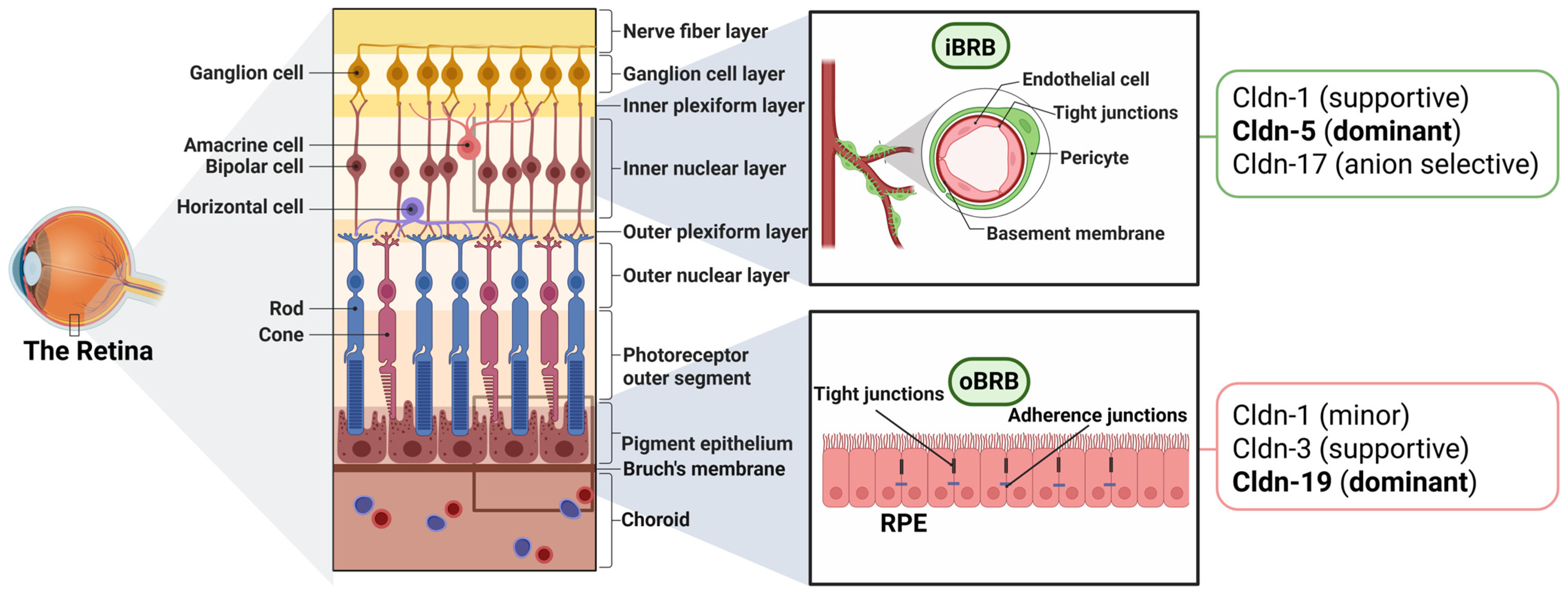
| oBRB RPE Cells | Cldn-1, Cldn-3 | Contribute to the structural integrity of the oBRB and regulate RPE gene and protein expression independently of barrier function. | [65,66,67] |
| Cldn-10 | Expressed at low levels and may play supportive or region-specific roles. | [66] | |
| Cldn-19 | Principal structural and functional Cldn of the oBRB and integral to RPE barrier robustness and phagocytic capacity. | [45,64,68] | |
| iBRB Endothelial Cells | Cldn-1 | An essential component of functional tight junctions in retinal endothelial cells. | [69] |
| Cldn-5 | Predominant structural component and molecular gatekeeper of the iBRB, essential for selective permeability. | [4,52,70,71] | |
| Cldn-17 | Emerging role as a critical regulatory factor in iBRB integrity (anion-selective TJ protein). | [72] | |
| Müller Glia | Cldn-1, -3, -19 | Generally absent mammalian retina, though reported in teleost fish endfeet. | [73,74] |
| Pathological Condition/ Stress Factor | Cldn Target | Regulatory Mechanism/ Pathway Involved | Outcome on Barrier Function | References |
|---|---|---|---|---|
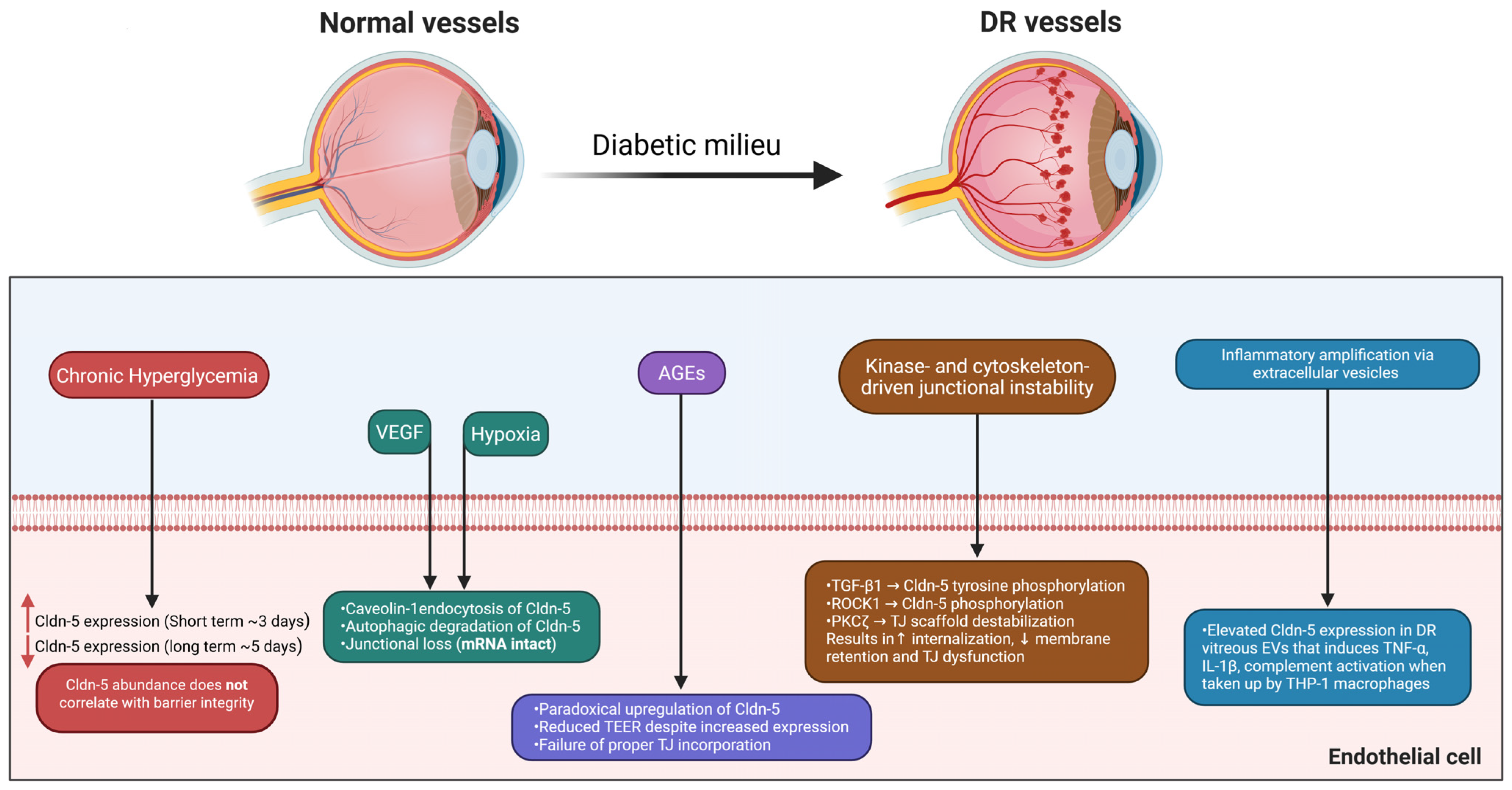
| Diabetic Stress/Hyperglycemia | Cldn-5 | AMPK signaling activation (by CTRP3) and AGEs effects. | AMPK activation, increased expression, and reduced leakage. High glucose and AGEs upregulate expression but compromise barrier integrity by mis-localization. | [21,111,112] |
| Ischemia/ Hypoxia | Cldn-5 | Caveolin-1 (Cav-1)-mediated endocytosis and autophagic degradation. | Reduced Cldn-5 protein, loss of junctional localization, and increased permeability (iBRB failure). | [119,120] |
| Angiogenesis/Sustained VEGF | Cldn-1 | Prolonged VEGF exposure. | Markedly depleted from the plasma membrane, strongly correlating with increased permeability. | [69] |
| Cldn-5 | Sustained VEGF exposure (via mechanisms independent of continued VEGF signaling). | Increased Cldn-5 expression but marked reduction in membrane localization (disrupted assembly), leading to persistent barrier dysfunction. | [122] | |
| Inflammation/cytokines | Cldn-19 | TNF-α, IL-1β, and IFN-γ acting through junctional and cytoskeletal reorganization. | Significantly reduced RPE barrier resistance. | [143] |
| TJ proteins (in general) | IL-6 trans-signaling drives permeability through STAT3 phosphorylation and NF-κB activation. | TJ disassembly and BRB leakage. | [155,170] | |
| Cellular Stress (Pathologic) | Cldn-1, Occludin | Endoplasmic Reticulum (ER) stress (in RPE cells). | Enhanced mRNA and protein expression, epithelial barrier resistance (compensatory tightening). | [88] |
| Cldn-5 | Endoplasmic Reticulum (ER) stress (in endothelial cells). | Downregulated expression and vascular impairment (iBRB failure). | [87] | |
| Cldn-19 | Knockdown/Disruption. | Triggers the activation of AMPK and oxidative stress responses. | [64] |
Disclaimer/Publisher’s Note: The statements, opinions and data contained in all publications are solely those of the individual author(s) and contributor(s) and not of MDPI and/or the editor(s). MDPI and/or the editor(s) disclaim responsibility for any injury to people or property resulting from any ideas, methods, instructions or products referred to in the content. |
© 2026 by the authors. Licensee MDPI, Basel, Switzerland. This article is an open access article distributed under the terms and conditions of the Creative Commons Attribution (CC BY) license.
Share and Cite
Selim, M.S.; Narayanan, S.P.; Somanath, P.R. Claudins in Retinal Disease: Beyond Barrier Integrity to Signaling and Therapy. Cells 2026, 15, 417. https://doi.org/10.3390/cells15050417
Selim MS, Narayanan SP, Somanath PR. Claudins in Retinal Disease: Beyond Barrier Integrity to Signaling and Therapy. Cells. 2026; 15(5):417. https://doi.org/10.3390/cells15050417
Chicago/Turabian StyleSelim, Mohamed S., S. Priya Narayanan, and Payaningal R. Somanath. 2026. "Claudins in Retinal Disease: Beyond Barrier Integrity to Signaling and Therapy" Cells 15, no. 5: 417. https://doi.org/10.3390/cells15050417
APA StyleSelim, M. S., Narayanan, S. P., & Somanath, P. R. (2026). Claudins in Retinal Disease: Beyond Barrier Integrity to Signaling and Therapy. Cells, 15(5), 417. https://doi.org/10.3390/cells15050417