CD57-Expressing Lymphocytes: From Chronic Viral Response to Age-Related Inflammation


 , , ,
, , ,  and
and 
Highlights
- CD57 marks advanced differentiation across T and NK cells, but CD57+ CD4+ and CD57+ CD8+ T cells show distinct developmental trajectories and functional programs rather than a uniform senescent state.
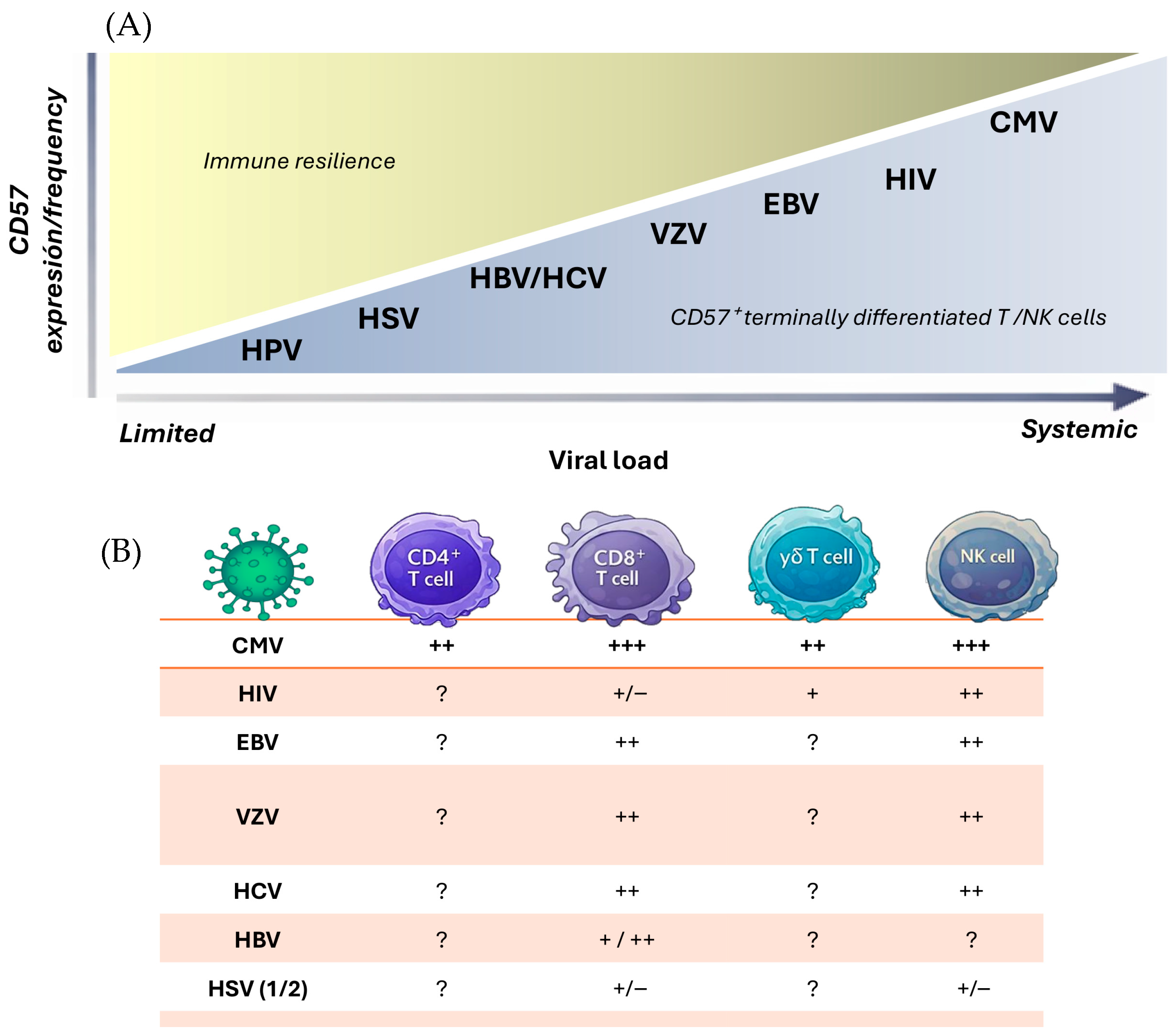
- CMV-driven chronic stimulation is the dominant force shaping CD57+ lymphocyte expansion, linking viral persistence with cytotoxic specialization and immune remodelling.
- CD57 should be interpreted as a context-dependent differentiation and immune-history marker—not a direct therapeutic target—and CD57+ CD4+ and CD57+ CD8+ subsets must be analyzed separately.
- Proper interpretation of CD57+ subsets, with CMV stratification, improves immune profiling in aging, chronic infection, cardiovascular and autoimmune disease, cancer, and vaccine-response studies.
Abstract
1. Introduction
Literature Search Strategy
2. Biology of CD57 Marker
3. CD57 in αβ T Cells
3.1. CD8+ T Cells
3.2. CD4+ T Cells
4. Are CD57+ T Cells Truly Senescent?

| Concept | Core Definition | Primary Driver | Proliferative Capacity | Effector Function | Typical Markers/Features | Reversibility |
|---|---|---|---|---|---|---|
| Cellular senescence | Stable cell-cycle arrest with senescence-associated molecular programme | Replicative stress, DNA damage, telomere attrition | Severely reduced or absent | Variable; often dysregulated secretory phenotype | p16INK4a ↑, p21 ↑, SA-β-gal+, DNA damage signals, telomere shortening | Generally irreversible |
| T-cell exhaustion | Functional hyporesponsiveness due to chronic antigen stimulation | Persistent antigen exposure (chronic infection, cancer) | Reduced | Decreased cytokine production and cytotoxicity | PD-1 ↑, TIM-3 ↑, LAG-3 ↑, TOX signature | Partially reversible (e.g., checkpoint blockade) |
| Terminal differentiation | Late-stage antigen-driven effector maturation | Repeated antigenic stimulation | Limited but not absent | Preserved or enhanced cytotoxicity | CD57+, CD28null, KLRG1+, high perforin/granzymes | Partially constrained but not fixed |
| Immunological age | Cumulative immune remodelling reflecting antigenic history rather than chronological age | Lifelong antigen exposure (especially CMV) | Subset-dependent | Often effector-skewed | Expansion of CD57+ and late-differentiated subsets, repertoire narrowing | Dynamic at system level |
5. CD57 in CD4+CD8+ T Cells
6. CD57 in γδ T Cells
7. CD57 in NK Cells
8. CD57+ Lymphocyte Expansion and Chronic Stimulation
8.1. Major Chronic Viral Infections
8.2. Cardiovascular Diseases
8.3. Autoimmune Diseases
8.4. Cancer
9. Clinical Implications and Therapeutic Perspectives
10. Conclusions and Future Directions
Author Contributions
Funding
Data Availability Statement
Conflicts of Interest
References
- Pawelec, G. Age and immunity: What is “immunosenescence”? Exp. Gerontol. 2018, 105, 4–9. [Google Scholar] [CrossRef] [Scilit]
- Liu, Z.; Liang, Q.; Ren, Y.; Guo, C.; Ge, X.; Wang, L.; Cheng, Q.; Luo, P.; Zhang, Y.; Han, X. Immunosenescence: Molecular mechanisms and diseases. Signal. Transduct. Target. Ther. 2023, 8, 200. [Google Scholar] [CrossRef] [Scilit]
- Olsson, J.; Wikby, A.; Johansson, B.; Löfgren, S.; Nilsson, B.O.; Ferguson, F. Age-related change in peripheral blood T-lymphocyte subpopulations and cytomegalovirus infection in the very old: The Swedish longitudinal OCTO immune study. Mech. Ageing Dev. 2000, 121, 187–201. [Google Scholar] [CrossRef] [Scilit]
- Wikby, A.; Johansson, B.; Olsson, J.; Löfgren, S.; Nilsson, B.O.; Ferguson, F. Expansions of peripheral blood CD8 T-lymphocyte sub-populations and an association with cytomegalovirus seropositivity in the elderly: The Swedish NONA immune study. Exp. Gerontol. 2002, 37, 445–453. [Google Scholar] [CrossRef] [Scilit]
- Wikby, A.; Ferguson, F.; Forsey, R.; Thompson, J.; Strindhall, J.; Löfgren, S.; Nilsson, B.O.; Ernerudh, J.; Pawelec, G.; Johansson, B. An immune risk phenotype, cognitive impairment, and survival in very late life: Impact of allostatic load in Swedish octogenarian and nonagenarian humans. J. Gerontol. A Biol. Sci. Med. Sci. 2005, 60, 556–565. [Google Scholar] [CrossRef] [Scilit] [PubMed]
- Thomas, R.; Wang, W.; Su, D.M. Contributions of age-related thymic involution to immunosenescence and inflammaging. Immun. Ageing 2020, 17, 2. [Google Scholar] [CrossRef] [Scilit] [PubMed]
- Looney, R.J.; Falsey, A.; Campbell, D.; Torres, A.; Kolassa, J.; Brower, C.; McCann, R.; Menegus, M.; McCormick, K.; Frampton, M.; et al. Role of cytomegalovirus in the T cell changes seen in elderly individuals. Clin. Immunol. 1999, 90, 213–219. [Google Scholar] [CrossRef] [Scilit]
- Pawelec, G.; Akbar, A.; Beverley, P.; Caruso, C.; Derhovanessian, E.; Fülöp, T.; Griffiths, P.; Grubeck-Loebenstein, B.; Hamprecht, K.; Jahn, G.; et al. Immunosenescence and cytomegalovirus: Where do we stand after a decade? Immun. Ageing 2010, 7, 13. [Google Scholar] [CrossRef] [Scilit]
- Cannon, M.J.; Schmid, D.S.; Hyde, T.B. Review of cytomegalovirus seroprevalence and demographic characteristics associated with infection. Rev. Med. Virol. 2010, 20, 202–213. [Google Scholar] [CrossRef] [Scilit]
- Fowler, K.; Mucha, J.; Neumann, M.; Lewandowski, W.; Kaczanowska, M.; Grys, M.; Schmidt, E.; Natenshon, A.; Talarico, C.; Buck, P.O.; et al. A systematic literature review of the global seroprevalence of cytomegalovirus: Possible implications for treatment, screening, and vaccine development. BMC Public Health 2022, 22, 1659. [Google Scholar] [CrossRef] [Scilit] [PubMed]
- Álvarez-Heredia, P.; Reina-Alfonso, I.; Domínguez-Del-Castillo, J.J.; Gutiérrez-González, C.; Hassouneh, F.; Batista-Duharte, A.; Pérez, A.B.; Tarazona, R.; Solana, R.; Pera, A. Accelerated T-cell immunosenescence in cytomegalovirus-seropositive individuals after severe acute respiratory syndrome coronavirus 2 infection. J. Infect. Dis. 2023, 228, 576–585. [Google Scholar]
- Al Mana, H.; Yassine, H.M.; Younes, N.N.; Al-Mohannadi, A.; Al-Sadeq, D.W.; Alhababi, D.; Nasser, E.A.; Nasrallah, G.K. The current status of cytomegalovirus (CMV) prevalence in the MENA region: A systematic review. Pathogens 2019, 8, 213. [Google Scholar] [CrossRef] [Scilit]
- Pera, A.; Campos, C.; Corona, A.; Sanchez-Correa, B.; Tarazona, R.; Larbi, A.; Solana, R. CMV latent infection improves CD8+ T response to SEB due to expansion of polyfunctional CD57+ cells in young individuals. PLoS ONE 2014, 9, e88538. [Google Scholar]
- Schmaltz, H.N.; Fried, L.P.; Xue, Q.L.; Walston, J.; Leng, S.X.; Semba, R.D. Chronic cytomegalovirus infection and inflammation are associated with prevalent frailty in community-dwelling older women. J. Am. Geriatr. Soc. 2005, 53, 747–754. [Google Scholar]
- Youn, J.C.; Jung, M.K.; Yu, H.T.; Kwon, J.S.; Kwak, J.E.; Park, S.H.; Kim, I.C.; Park, M.S.; Lee, S.K.; Choi, S.W.; et al. Increased frequency of CD4+CD57+ senescent T cells in patients with newly diagnosed acute heart failure: Exploring new pathogenic mechanisms with clinical relevance. Sci. Rep. 2019, 9, 12887. [Google Scholar]
- Sornkayasit, K.; Leelayuwat, C.; Jumnainsong, A.; Tippayawat, P.; Wongfieng, W.; Praja, R.K.; Phanabamrung, S.; Raknarong, L.T.; Salao, K.; Nithichanon, A.; et al. Predominant expression of the immunosenescent biomarker CD57 on CD4+ T cells and their subsets in older people associating with cardiovascular disease risk factors. J. Leukoc. Biol. 2025, 117, qiaf124. [Google Scholar] [PubMed]
- Yu, H.T.; Youn, J.C.; Kim, J.H.; Seong, Y.J.; Park, S.H.; Kim, H.C.; Lee, W.W.; Park, S.; Shin, E.C. Arterial stiffness is associated with cytomegalovirus-specific senescent CD8+ T cells. J. Am. Heart Assoc. 2017, 6, e006535. [Google Scholar]
- Nielsen, C.M.; White, M.J.; Goodier, M.R.; Riley, E.M. Functional significance of CD57 expression on human NK cells and relevance to disease. Front. Immunol. 2013, 4, 422. [Google Scholar] [CrossRef] [Scilit] [PubMed]
- Alsulami, K.; Dupuy, F.P.; Gilbert, L.; Messier-Peet, M.; Durand, M.; Tremblay, C.; Routy, J.P.; Bruneau, J.; Baril, J.G.; Trottier, B.; et al. The frequency and function of NKG2C+CD57+ adaptive NK cells in cytomegalovirus co-infected people living with HIV decline with duration of antiretroviral therapy. Viruses 2023, 15, 323. [Google Scholar]
- Vanheusden, M.; Broux, B.; Welten, S.P.M.; Peeters, L.M.; Panagioti, E.; Van Wijmeersch, B.; Somers, V.; Stinissen, P.; Arens, R.; Hellings, N. Cytomegalovirus infection exacerbates autoimmune mediated neuroinflammation. Sci. Rep. 2017, 7, 663. [Google Scholar] [CrossRef] [Scilit]
- Abo, T.; Balch, C.M. A differentiation antigen of human NK and K cells identified by a monoclonal antibody (HNK-1). J. Immunol. 1981, 127, 1024–1029. [Google Scholar]
- Yabuno, K.; Morise, J.; Kizuka, Y.; Hashii, N.; Kawasaki, N.; Takahashi, S.; Miyata, S.; Izumikawa, T.; Kitagawa, H.; Takematsu, H.; et al. A sulfated glycosaminoglycan linkage region is a novel type of human natural killer-1 (HNK-1) epitope expressed on aggrecan in perineuronal nets. PLoS ONE 2015, 10, e0144560. [Google Scholar] [CrossRef] [Scilit]
- Mitsumoto, Y.; Oka, S.; Sakuma, H.; Inazawa, J.; Kawasaki, T. Cloning and chromosomal mapping of human glucuronyltransferase involved in biosynthesis of the HNK-1 carbohydrate epitope. Genomics 2000, 65, 166–173. [Google Scholar] [CrossRef] [Scilit]
- Huang, Y.F.; Aoki, K.; Akase, S.; Ishihara, M.; Liu, Y.S.; Yang, G.; Kizuka, Y.; Mizumoto, S.; Tiemeyer, M.; Gao, X.D.; et al. Global mapping of glycosylation pathways in human-derived cells. Dev. Cell 2021, 56, 1195–1209.e7. [Google Scholar] [CrossRef] [Scilit]
- Morise, J.; Takematsu, H.; Oka, S. The role of human natural killer-1 (HNK-1) carbohydrate in neuronal plasticity and disease. Biochim. Biophys. Acta Gen. Subj. 2017, 1861, 2455–2461. [Google Scholar]
- Kizuka, Y.; Oka, S. Regulated expression and neural functions of human natural killer-1 (HNK-1) carbohydrate. Cell. Mol. Life Sci. 2012, 69, 4135–4147. [Google Scholar] [CrossRef] [Scilit]
- Tokoro, Y.; Kizuka, Y. A neural glycan HNK-1 is transferred to recipient cells via small extracellular vesicles. J. Biol. Chem. 2026, 302, 111144. [Google Scholar] [CrossRef] [Scilit] [PubMed]
- McGarry, R.C.; Helfand, S.L.; Quarles, R.H.; Roder, J.C. Recognition of myelin-associated glycoprotein by the monoclonal antibody HNK-1. Nature 1983, 306, 376–378. [Google Scholar] [CrossRef] [Scilit] [PubMed]
- Chou, D.K.; Ilyas, A.A.; Evans, J.E.; Costello, C.; Quarles, R.H.; Jungalwala, F.B. Structure of sulfated glucuronyl glycolipids in the nervous system reacting with HNK-1 antibody and some IgM paraproteins in neuropathy. J. Biol. Chem. 1986, 261, 11717–11725. [Google Scholar] [CrossRef] [Scilit]
- Hammer, J.A.; O’Shannessy, D.J.; De Leon, M.; Gould, R.; Zand, D.; Daune, G.; Quarles, R.H. Immunoreactivity of PMP-22, P0, and other 19 to 28 kDa glycoproteins in peripheral nerve myelin of mammals and fish with HNK1 and related antibodies. J. Neurosci. Res. 1993, 35, 546–558. [Google Scholar] [PubMed]
- Martini, R. Antibodies to the mammalian adhesion molecule J1/Tenascin and its carbohydrate epitope L2/HNK-1 label the receptor lymph cavities of insect sensilla. Tissue Cell 1989, 21, 639–645. [Google Scholar] [CrossRef] [Scilit]
- Künemund, V.; Jungalwala, F.B.; Fischer, G.; Chou, D.K.; Keilhauer, G.; Schachner, M. The L2/HNK-1 carbohydrate of neural cell adhesion molecules is involved in cell interactions. J. Cell Biol. 1988, 106, 213–223. [Google Scholar] [CrossRef] [Scilit] [PubMed]
- Hall, H.; Liu, L.; Schachner, M.; Schmitz, B. The L2/HNK-1 carbohydrate mediates adhesion of neural cells to laminin. Eur. J. Neurosci. 1993, 5, 34–42. [Google Scholar]
- Kared, H.; Martelli, S.; Ng, T.P.; Pender, S.L.; Larbi, A. CD57 in human natural killer cells and T-lymphocytes. Cancer Immunol. Immunother. 2016, 65, 441–452. [Google Scholar] [CrossRef] [Scilit] [PubMed]
- Formentini, M.; Navas, A.; Hassouneh, F.; Lopez-Sejas, N.; Alonso, C.; Tarazona, R.; Solana, R.; Pera, A. Impact of cytomegalovirus and age on T-cell subsets defined by CD161, CD300a, and/or CD57 expression in healthy Andalusians. J. Gerontol. A Biol. Sci. Med. Sci. 2021, 76, 1946–1953. [Google Scholar]
- Autaa, G.; Korenkov, D.; van Beek, J.; Pellegrin, I.; Parfait, B.; van Baarle, D.; Launay, O.; Tartour, E.; Appay, V. Re-evaluating CD57 as a marker of T cell senescence: Implications for immune ageing and differentiation. Immun. Ageing 2025, 22, 47. [Google Scholar] [CrossRef] [Scilit] [PubMed]
- Lopez-Vergès, S.; Milush, J.M.; Pandey, S.; York, V.A.; Arakawa-Hoyt, J.; Pircher, H.; Norris, P.J.; Nixon, D.F.; Lanier, L.L. CD57 defines a functionally distinct population of mature NK cells in the human CD56dimCD16+ NK-cell subset. Blood 2010, 116, 3865–3874. [Google Scholar]
- Guan, Y.; Cao, M.; Wu, X.; Yan, J.; Hao, Y.; Zhang, C. CD28null T cells in aging and diseases: From biology to assessment and intervention. Int. Immunopharmacol. 2024, 131, 111807. [Google Scholar] [CrossRef] [Scilit]
- Türk, L.; Filippov, I.; Arnold, C.; Zaugg, J.; Tserel, L.; Kisand, K.; Peterson, P. Cytotoxic CD8+ Temra cells show loss of chromatin accessibility at genes associated with T cell activation. Front. Immunol. 2024, 15, 1285798. [Google Scholar]
- Porciello, N.; Tuosto, L. CD28 costimulatory signals in T lymphocyte activation: Emerging functions beyond a qualitative and quantitative support to TCR signalling. Cytokine Growth Factor Rev. 2016, 28, 11–19. [Google Scholar] [CrossRef] [Scilit]
- Effros, R.B.; Boucher, N.; Porter, V.; Zhu, X.; Spaulding, C.; Walford, R.L.; Kronenberg, M.; Cohen, D.; Schächter, F. Decline in CD28+ T cells in centenarians and in long-term T cell cultures: A possible cause for both in vivo and in vitro immunosenescence. Exp. Gerontol. 1994, 29, 601–609. [Google Scholar]
- Weng, N.P.; Akbar, A.N.; Goronzy, J. CD28(-) T cells: Their role in the age-associated decline of immune function. Trends Immunol. 2009, 30, 306–312. [Google Scholar] [CrossRef] [Scilit] [PubMed]
- Pangrazzi, L.; Reidla, J.; Carmona Arana, J.A.; Naismith, E.; Miggitsch, C.; Meryk, A.; Keller, M.; Krause, A.A.N.; Melzer, F.L.; Trieb, K.; et al. CD28 and CD57 define four populations with distinct phenotypic properties within human CD8+ T cells. Eur. J. Immunol. 2020, 50, 363–379. [Google Scholar]
- Brenchley, J.M.; Karandikar, N.J.; Betts, M.R.; Ambrozak, D.R.; Hill, B.J.; Crotty, L.E.; Casazza, J.P.; Kuruppu, J.; Migueles, S.A.; Connors, M.; et al. Expression of CD57 defines replicative senescence and antigen-induced apoptotic death of CD8+ T cells. Blood 2003, 101, 2711–2720. [Google Scholar] [CrossRef] [Scilit] [PubMed]
- Strioga, M.; Pasukoniene, V.; Characiejus, D. CD8+ CD28− and CD8+ CD57+ T cells and their role in health and disease. Immunology 2011, 134, 17–32. [Google Scholar] [CrossRef] [Scilit]
- Onyema, O.O.; Njemini, R.; Forti, L.N.; Bautmans, I.; Aerts, J.L.; De Waele, M.; Mets, T. Aging-associated subpopulations of human CD8+ T-lymphocytes identified by their CD28 and CD57 phenotypes. Arch. Gerontol. Geriatr. 2015, 61, 494–502. [Google Scholar] [PubMed]
- Romero, P.; Zippelius, A.; Kurth, I.; Pittet, M.J.; Touvrey, C.; Iancu, E.M.; Corthesy, P.; Devevre, E.; Speiser, D.E.; Rufer, N. Four functionally distinct populations of human effector-memory CD8+ T lymphocytes. J. Immunol. 2007, 178, 4112–4119. [Google Scholar]
- Focosi, D.; Bestagno, M.; Burrone, O.; Petrini, M. CD57+ T lymphocytes and functional immune deficiency. J. Leukoc. Biol. 2010, 87, 107–116. [Google Scholar] [CrossRef] [Scilit]
- Huff, W.X.; Kwon, J.H.; Henriquez, M.; Fetcko, K.; Dey, M. The evolving role of CD8+CD28− immunosenescent T cells in cancer immunology. Int. J. Mol. Sci. 2019, 20, 2810. [Google Scholar]
- Morris, S.R.; Chen, B.; Mudd, J.C.; Panigrahi, S.; Shive, C.L.; Sieg, S.F.; Cameron, C.M.; Zidar, D.A.; Funderburg, N.T.; Younes, S.A.; et al. Inflammescent CX3CR1+CD57+ CD8+ T cells are generated and expanded by IL-15. JCI Insight 2020, 5, e132963. [Google Scholar]
- Gunturi, A.; Berg, R.E.; Forman, J. Preferential survival of CD8 T and NK cells expressing high levels of CD94. J. Immunol. 2003, 170, 1737–1745. [Google Scholar] [CrossRef] [Scilit]
- Rapaport, A.S.; Schriewer, J.; Gilfillan, S.; Hembrador, E.; Crump, R.; Plougastel, B.F.; Wang, Y.; Le Friec, G.; Gao, J.; Cella, M.; et al. The inhibitory receptor NKG2A sustains virus-specific CD8+ T cells in response to a lethal poxvirus infection. Immunity 2015, 43, 1112–1124. [Google Scholar] [PubMed]
- Koh, J.Y.; Kim, D.U.; Moon, B.H.; Shin, E.C. Human CD8+ T-cell populations that express natural killer receptors. Immune Netw. 2023, 23, e8. [Google Scholar] [PubMed]
- Chong, L.K.; Aicheler, R.J.; Llewellyn-Lacey, S.; Tomasec, P.; Brennan, P.; Wang, E.C. Proliferation and interleukin 5 production by CD8hi CD57+ T cells. Eur. J. Immunol. 2008, 38, 995–1000. [Google Scholar]
- Pera, A.; Vasudev, A.; Tan, C.; Kared, H.; Solana, R.; Larbi, A. CMV induces expansion of highly polyfunctional CD4+ T cell subset coexpressing CD57 and CD154. J. Leukoc. Biol. 2017, 101, 555–566. [Google Scholar]
- Pandya, J.M.; Venalis, P.; Al-Khalili, L.; Hossain, M.S.; Stache, V.; Lundberg, I.E.; Malmström, V.; Fasth, A.E. CD4+ and CD8+ CD28(null) T cells are cytotoxic to autologous muscle cells in patients with polymyositis. Arthritis Rheumatol. 2016, 68, 2016–2026. [Google Scholar] [PubMed]
- Huang, B.; Liu, R.; Wang, P.; Yuan, Z.; Yang, J.; Xiong, H.; Zhang, N.; Huang, Q.; Fu, X.; Sun, W.; et al. CD8+CD57+ T cells exhibit distinct features in human non-small cell lung cancer. J. Immunother. Cancer 2020, 8, e000639. [Google Scholar]
- Setoguchi, R. IL-15 boosts the function and migration of human terminally differentiated CD8+ T cells by inducing a unique gene signature. Int. Immunol. 2016, 28, 293–305. [Google Scholar]
- Bullenkamp, J.; Mengoni, V.; Kaur, S.; Chhetri, I.; Dimou, P.; Astroulakis, Z.M.J.; Kaski, J.C.; Dumitriu, I.E. Interleukin-7 and interleukin-15 drive CD4+CD28null T lymphocyte expansion and function in patients with acute coronary syndrome. Cardiovasc. Res. 2021, 117, 1935–1948. [Google Scholar]
- Bryl, E.; Vallejo, A.N.; Weyand, C.M.; Goronzy, J.J. Down-regulation of CD28 expression by TNF-alpha. J. Immunol. 2001, 167, 3231–3238. [Google Scholar]
- Vuddamalay, Y.; van Meerwijk, J.P. CD28- and CD28lowCD8+ regulatory T cells: Of mice and men. Front. Immunol. 2017, 8, 31. [Google Scholar]
- Liston, A.; Aloulou, M. A fresh look at a neglected regulatory lineage: CD8+Foxp3+ regulatory T cells. Immunol. Lett. 2022, 247, 22–26. [Google Scholar]
- Fenoglio, D.; Ferrera, F.; Fravega, M.; Balestra, P.; Battaglia, F.; Proietti, M.; Andrei, C.; Olive, D.; Antonio, L.C.; Indiveri, F.; et al. Advancements on phenotypic and functional characterization of non-antigen-specific CD8+CD28- regulatory T cells. Hum. Immunol. 2008, 69, 745–750. [Google Scholar]
- Shin, M.S.; Yim, K.; Moon, K.; Park, H.J.; Mohanty, S.; Kim, J.W.; Montgomery, R.R.; Shaw, A.C.; Krishnaswamy, S.; Kang, I. Dissecting alterations in human CD8+ T cells with aging by high-dimensional single cell mass cytometry. Clin. Immunol. 2019, 200, 24–30. [Google Scholar] [PubMed]
- Mogilenko, D.A.; Shpynov, O.; Andhey, P.S.; Arthur, L.; Swain, A.; Esaulova, E.; Brioschi, S.; Shchukina, I.; Kerndl, M.; Bambouskova, M.; et al. Comprehensive profiling of an aging immune system reveals clonal GZMK+CD8+ T cells as conserved hallmark of inflammaging. Immunity 2021, 54, 99–115.e12. [Google Scholar]
- Soto-Heredero, G.; Gómez de Las Heras, M.M.; Escrig-Larena, J.I.; Mittelbrunn, M. Extremely differentiated T cell subsets contribute to tissue deterioration during aging. Annu. Rev. Immunol. 2023, 41, 181–205. [Google Scholar] [CrossRef] [Scilit] [PubMed]
- Fan, J.N.; Ho, H.; Chiang, B.L. Characterization of novel CD8+ regulatory T cells and their modulatory effects in murine model of inflammatory bowel disease. Cell. Mol. Life Sci. 2024, 81, 327. [Google Scholar] [CrossRef] [Scilit]
- Akagi, J.; Baba, H.; Sekine, T.; Ogawa, K. Terminally differentiated CD8+ T cells and CD57-FOXP3+CD8+ T cells are highly associated with the efficacy of immunotherapy using activated autologous lymphocytes. Oncol. Lett. 2018, 15, 9529–9536. [Google Scholar] [PubMed]
- Tarazona, R.; DelaRosa, O.; Alonso, C.; Ostos, B.; Espejo, J.; Peña, J.; Solana, R. Increased expression of NK cell markers on T lymphocytes in aging and chronic activation of the immune system reflects the accumulation of effector/senescent T cells. Mech. Ageing Dev. 2000, 121, 77–88. [Google Scholar] [PubMed]
- Peralbo, E.; Alonso, C.; Solana, R. Invariant NKT and NKT-like lymphocytes: Two different T cell subsets that are differentially affected by ageing. Exp. Gerontol. 2007, 42, 703–708. [Google Scholar] [CrossRef] [Scilit]
- Hassouneh, F.; Campos, C.; López-Sejas, N.; Alonso, C.; Tarazona, R.; Solana, R.; Pera, A. Effect of age and latent CMV infection on CD8+CD56+ T cells (NKT-like) frequency and functionality. Mech. Ageing Dev. 2016, 158, 38–45. [Google Scholar]
- Legac, E.; Autran, B.; Merle-Beral, H.; Katlama, C.; Debre, P. CD4+CD7−CD57+ T cells: A new T-lymphocyte subset expanded during human immunodeficiency virus infection. Blood 1992, 79, 1746–1753. [Google Scholar]
- Ramello, M.C.; Núñez, N.G.; Tosello Boari, J.; Bossio, S.N.; Canale, F.P.; Abrate, C.; Ponce, N.; Del Castillo, A.; Ledesma, M.; Viel, S.; et al. Polyfunctional KLRG-1+CD57+ senescent CD4+ T cells infiltrate tumors and are expanded in peripheral blood from breast cancer patients. Front. Immunol. 2021, 12, 713132. [Google Scholar]
- Fasth, A.E.; Björkström, N.K.; Anthoni, M.; Malmberg, K.J.; Malmström, V. Activating NK-cell receptors co-stimulate CD4(+)CD28(−) T cells in patients with rheumatoid arthritis. Eur. J. Immunol. 2010, 40, 378–387. [Google Scholar] [CrossRef] [Scilit]
- Hassouneh, F.; Goldeck, D.; Pera, A.; van Heemst, D.; Slagboom, P.E.; Pawelec, G.; Solana, R. Functional changes of T-cell subsets with age and CMV infection. Int. J. Mol. Sci. 2021, 22, 9973. [Google Scholar] [CrossRef] [Scilit]
- Hassouneh, F.; Lopez-Sejas, N.; Campos, C.; Sanchez-Correa, B.; Tarazona, R.; Solana, R.; Pera, A. Differential effect of cytomegalovirus infection with age on the expression of CD57, CD300a, and CD161 on T-cell subpopulations. Front. Immunol. 2017, 8, 649. [Google Scholar] [CrossRef] [Scilit] [PubMed]
- Akbar, A.N.; Henson, S.M. Are senescence and exhaustion intertwined or unrelated processes that compromise immunity? Nat. Rev. Immunol. 2011, 11, 289–295. [Google Scholar] [CrossRef] [Scilit] [PubMed]
- Verma, K.; Ogonek, J.; Varanasi, P.R.; Luther, S.; Bünting, I.; Thomay, K.; Behrens, Y.L.; Mischak-Weissinger, E.; Hambach, L. Human CD8+ CD57− TEMRA cells: Too young to be called “old”. PLoS ONE 2017, 12, e0177405. [Google Scholar]
- López-Otín, C.; Blasco, M.A.; Partridge, L.; Serrano, M.; Kroemer, G. Hallmarks of aging: An expanding universe. Cell 2023, 186, 243–278. [Google Scholar] [CrossRef] [Scilit] [PubMed]
- Wiley, C.D.; Campisi, J. The metabolic roots of senescence: Mechanisms and opportunities for intervention. Nat. Metab. 2021, 3, 1290–1301. [Google Scholar] [CrossRef] [Scilit]
- Kinney, B.L.C.; Brammer, B.; Kansal, V.; Parrish, C.J.; Kissick, H.T.; Liu, Y.; Saba, N.F.; Buchwald, Z.S.; El-Deiry, M.W.; Patel, M.R.; et al. CD28−CD57+ T cells from head and neck cancer patients produce high levels of cytotoxic granules and type II interferon but are not senescent. Oncoimmunology 2024, 13, 2367777. [Google Scholar] [CrossRef] [Scilit]
- Ahmed, R.; Miners, K.L.; Lahoz-Beneytez, J.; Jones, R.E.; Roger, L.; Baboonian, C.; Zhang, Y.; Wang, E.C.Y.; Hellerstein, M.K.; McCune, J.M.; et al. CD57+ memory T cells proliferate in vivo. Cell Rep. 2020, 33, 108501. [Google Scholar] [CrossRef] [Scilit]
- Song, K.; Coleman, R.A.; Alber, C.; Ballas, Z.K.; Waldschmidt, T.J.; Mortari, F.; LaBrecque, D.R.; Cook, R.T. TH1 cytokine response of CD57+ T-cell subsets in healthy controls and patients with alcoholic liver disease. Alcohol 2001, 24, 155–167. [Google Scholar] [CrossRef] [Scilit] [PubMed]
- García-Muñoz, R.; Rodríguez-Otero, P.; Galar, A.; Merino, J.; Beunza, J.J.; Páramo, J.A.; Lecumberri, R. Expansion of CD8+CD57+ T cells in an immunocompetent patient with acute toxoplasmosis. Adv. Hematol. 2009, 2009, 173439. [Google Scholar] [PubMed]
- Tong, Z.; Yan, X.; Chen, T.; Song, W.; Su, D.; Wang, N.; Zhang, Y.; Kong, Y.; Wang, D.; Wang, P.; et al. Single-Cell Multi-Omics Identifies Specialized Cytotoxic and Migratory CD8+ Effector T Cells in Acute Myocarditis. Circulation 2025, 152, 1003–1022. [Google Scholar]
- Gloger, E.M.; Judge, S.T.; Reed, R.G.; Presnell, S.R.; Al-Attar, A.; Lutz, C.T.; Segerstrom, S.C. The role of late-differentiated T cells, a proxy for IFN-γ-production, in older adults’ social networks. Brain Behav. Immun. Health 2022, 25, 100512. [Google Scholar]
- Clénet, M.; Gagnon, F.; Moratalla, A.C.; Viel, E.C. Peripheral human CD4+CD8+ T lymphocytes exhibit a memory phenotype and enhanced responses. Sci. Rep. 2017, 7, 11926. [Google Scholar]
- Hagen, M.; Pangrazzi, L.; Rocamora-Reverte, L.; Weinberger, B. Legend or truth: Mature CD4+CD8+ double-positive T cells in the periphery in health and disease. Biomedicines 2023, 11, 2702. [Google Scholar] [CrossRef] [Scilit] [PubMed]
- Ortolani, C.; Forti, E.; Radin, E.; Cibin, R.; Cossarizza, A. Cytofluorimetric identification of two populations of double positive (CD4+,CD8+) T lymphocytes in human peripheral blood. Biochem. Biophys. Res. Commun. 1993, 191, 601–609. [Google Scholar]
- Nascimbeni, M.; Shin, E.C.; Chiriboga, L.; Kleiner, D.E.; Rehermann, B. Peripheral CD4(+)CD8(+) T cells are differentiated effector memory cells with antiviral functions. Blood 2004, 104, 478–486. [Google Scholar] [CrossRef] [Scilit]
- Vasudev, A.; Ying, C.T.; Ayyadhury, S.; Puan, K.J.; Andiappan, A.K.; Nyunt, M.S.; Shadan, N.B.; Mustafa, S.; Low, I.; Rotzschke, O.; et al. γ/δ T cell subsets in human aging using the classical α/β T cell model. J. Leukoc. Biol. 2014, 96, 647–655. [Google Scholar]
- Xu, W.; Monaco, G.; Wong, E.H.; Tan, W.L.W.; Kared, H.; Simoni, Y.; Tan, S.W.; How, W.Z.Y.; Tan, C.T.Y.; Lee, B.T.K.; et al. Mapping of γ/δ T cells reveals Vδ2+ T cells resistance to senescence. EBioMedicine 2019, 39, 44–58. [Google Scholar] [PubMed]
- Alejenef, A.; Pachnio, A.; Halawi, M.; Christmas, S.E.; Moss, P.A.; Khan, N. Cytomegalovirus drives Vδ2neg γδ T cell inflation in many healthy virus carriers with increasing age. Clin. Exp. Immunol. 2014, 176, 418–428. [Google Scholar] [CrossRef] [Scilit] [PubMed]
- Wistuba-Hamprecht, K.; Frasca, D.; Blomberg, B.; Pawelec, G.; Derhovanessian, E. Age-associated alterations in gammadelta T-cells are present predominantly in individuals infected with cytomegalovirus. Immun. Ageing 2013, 10, 26. [Google Scholar] [CrossRef] [Scilit]
- Tan, C.; Wistuba-Hamprecht, K.; Xu, W.; Nyunt, M.S.Z.; Vasudev, A.; Lee, B.T.K.; Pawelec, G.; Puan, K.J.; Rotzschke, O.; Ng, T.P.; et al. Vδ2+ and α/β T cells show divergent trajectories during human aging. Oncotarget 2016, 7, 44906–44918. [Google Scholar]
- Ryan, P.L.; Sumaria, N.; Holland, C.J.; Bradford, C.M.; Izotova, N.; Grandjean, C.L.; Jawad, A.S.; Bergmeier, L.A.; Pennington, D.J. Heterogeneous yet stable Vδ2(+) T-cell profiles define distinct cytotoxic effector potentials in healthy human individuals. Proc. Natl. Acad. Sci. USA 2016, 113, 14378–14383. [Google Scholar] [CrossRef] [Scilit]
- Eberl, M.; Engel, R.; Aberle, S.; Fisch, P.; Jomaa, H. Human Vγ9/Vδ2 effector memory T cells express the killer cell lectin-like receptor G1 (KLRG1). J. Leukoc. Biol. 2005, 77, 16–19. [Google Scholar] [CrossRef] [Scilit]
- Xu, W.; Larbi, A. Markers of T cell senescence in humans. Int. J. Mol. Sci. 2017, 18, 1742. [Google Scholar] [CrossRef] [Scilit]
- Müller-Durovic, B.; Grählert, J.; Devine, O.P.; Akbar, A.N.; Hess, C. CD56-negative NK cells with impaired effector function expand in CMV and EBV co-infected healthy donors with age. Aging 2019, 11, 724–740. [Google Scholar]
- Strauss-Albee, D.M.; Horowitz, A.; Parham, P.; Blish, C.A. Coordinated regulation of NK receptor expression in the maturing human immune system. J. Immunol. 2014, 193, 4871–4879. [Google Scholar] [CrossRef] [Scilit] [PubMed]
- Ahmad, F.; Hong, H.S.; Jäckel, M.; Jablonka, A.; Lu, I.N.; Bhatnagar, N.; Eberhard, J.M.; Bollmann, B.A.; Ballmaier, M.; Zielinska-Skowronek, M.; et al. High frequencies of polyfunctional CD8+ NK cells in chronic HIV-1 infection are associated with slower disease progression. J. Virol. 2014, 88, 12397–12408. [Google Scholar] [CrossRef] [Scilit]
- Lopez-Vergès, S.; Milush, J.M.; Schwartz, B.S.; Pando, M.J.; Jarjoura, J.; York, V.A.; Houchins, J.P.; Miller, S.; Kang, S.M.; Norris, P.J.; et al. Expansion of a unique CD57+NKG2Chi natural killer cell subset during acute human cytomegalovirus infection. Proc. Natl. Acad. Sci. USA 2011, 108, 14725–14732. [Google Scholar]
- Foley, B.; Cooley, S.; Verneris, M.R.; Curtsinger, J.; Luo, X.; Waller, E.K.; Anasetti, C.; Weisdorf, D.; Miller, J.S. Human cytomegalovirus (CMV)-induced memory-like NKG2C(+) NK cells are transplantable and expand in vivo in response to recipient CMV antigen. J. Immunol. 2012, 189, 5082–5088. [Google Scholar] [CrossRef] [Scilit] [PubMed]
- Goodier, M.R.; White, M.J.; Darboe, A.; Nielsen, C.M.; Goncalves, A.; Bottomley, C.; Moore, S.E.; Riley, E.M. Rapid NK cell differentiation in a population with near-universal human cytomegalovirus infection is attenuated by NKG2C deletions. Blood 2014, 124, 2213–2222. [Google Scholar] [CrossRef] [Scilit] [PubMed]
- Carrega, P.; Ferlazzo, G. Natural killer cell distribution and trafficking in human tissues. Front. Immunol. 2012, 3, 347. [Google Scholar] [CrossRef] [Scilit] [PubMed]
- Qiu, Z.; Li, Z.; Zhang, C.; Zhao, Q.; Liu, Z.; Cheng, Q.; Zhang, J.; Lin, A.; Luo, P. NK cell senescence in cancer: From molecular mechanisms to therapeutic opportunities. Aging Dis. 2025, 17, 1002–1033. [Google Scholar] [CrossRef] [Scilit]
- Campos, C.; Pera, A.; Sanchez-Correa, B.; Alonso, C.; Lopez-Fernandez, I.; Morgado, S.; Tarazona, R.; Solana, R. Effect of age and CMV on NK cell subpopulations. Exp. Gerontol. 2014, 54, 130–137. [Google Scholar] [CrossRef] [Scilit]
- Nielsen, C.M.; White, M.J.; Bottomley, C.; Lusa, C.; Rodríguez-Galán, A.; Turner, S.E.; Goodier, M.R.; Riley, E.M. Impaired NK cell responses to pertussis and H1N1 influenza vaccine antigens in human cytomegalovirus-infected individuals. J. Immunol. 2015, 194, 4657–4667. [Google Scholar]
- Ishiyama, K.; Arakawa-Hoyt, J.; Aguilar, O.A.; Damm, I.; Towfighi, P.; Sigdel, T.; Tamaki, S.; Babdor, J.; Spitzer, M.H.; Reed, E.F.; et al. Mass cytometry reveals single-cell kinetics of cytotoxic lymphocyte evolution in CMV-infected renal transplant patients. Proc. Natl. Acad. Sci. USA 2022, 119, e2116588119. [Google Scholar] [CrossRef] [Scilit]
- Herrera, L.; Martin-Inaraja, M.; Santos, S.; Inglés-Ferrándiz, M.; Azkarate, A.; Perez-Vaquero, M.A.; Vesga, M.A.; Vicario, J.L.; Soria, B.; Solano, C.; et al. Identifying SARS-CoV-2 “memory” NK cells from COVID-19 convalescent donors for adoptive cell therapy. Immunology 2022, 165, 234–249. [Google Scholar]
- Petitdemange, C.; Becquart, P.; Wauquier, N.; Béziat, V.; Debré, P.; Leroy, E.M.; Vieillard, V. Unconventional repertoire profile is imprinted during acute chikungunya infection for natural killer cells polarization toward cytotoxicity. PLoS Pathog. 2011, 7, e1002268. [Google Scholar]
- Björkström, N.K.; Lindgren, T.; Stoltz, M.; Fauriat, C.; Braun, M.; Evander, M.; Michaëlsson, J.; Malmberg, K.J.; Klingström, J.; Ahlm, C.; et al. Rapid expansion and long-term persistence of elevated NK cell numbers in humans infected with hantavirus. J. Exp. Med. 2011, 208, 13–21. [Google Scholar] [PubMed]
- Gumá, M.; Cabrera, C.; Erkizia, I.; Bofill, M.; Clotet, B.; Ruiz, L.; López-Botet, M. Human cytomegalovirus infection is associated with increased proportions of NK cells that express the CD94/NKG2C receptor in aviremic HIV-1–positive patients. J. Infect. Dis. 2006, 194, 38–41. [Google Scholar] [CrossRef] [Scilit] [PubMed]
- Béziat, V.; Dalgard, O.; Asselah, T.; Halfon, P.; Bedossa, P.; Boudifa, A.; Hervier, B.; Theodorou, I.; Martinot, M.; Debré, P.; et al. CMV drives clonal expansion of NKG2C+ NK cells expressing self-specific KIRs in chronic hepatitis patients. Eur. J. Immunol. 2012, 42, 447–457. [Google Scholar] [CrossRef] [Scilit]
- Solana, R.; Campos, C.; Pera, A.; Tarazona, R. Shaping of NK cell subsets by aging. Curr. Opin. Immunol. 2014, 29, 56–61. [Google Scholar] [CrossRef] [Scilit]
- Lopez-Sejas, N.; Campos, C.; Hassouneh, F.; Sanchez-Correa, B.; Tarazona, R.; Pera, A.; Solana, R. Effect of CMV and aging on the differential expression of CD300a, CD161, T-bet, and Eomes on NK cell subsets. Front. Immunol. 2016, 7, 476. [Google Scholar]
- Meijers, R.W.; Litjens, N.H.; Hesselink, D.A.; Langerak, A.W.; Baan, C.C.; Betjes, M.G. Primary cytomegalovirus infection significantly impacts circulating T cells in kidney transplant recipients. Am. J. Transplant. 2015, 15, 3143–3156. [Google Scholar] [CrossRef] [Scilit] [PubMed]
- Roesner, L.M.; Bošnjak, B.; Traidl, S.; Huehn, J.; Förster, R.; Werfel, T. Different CMV-specific effector T cell subtypes are associated with age, CMV serostatus, and increased systolic blood pressure. Immun. Ageing 2025, 22, 27. [Google Scholar] [CrossRef] [Scilit]
- Le Priol, Y.; Puthier, D.; Lécureuil, C.; Combadière, C.; Debré, P.; Nguyen, C.; Combadière, B. High cytotoxic and specific migratory potencies of senescent CD8+CD57+ cells in HIV-infected and uninfected individuals. J. Immunol. 2006, 177, 5145–5154. [Google Scholar]
- Vivar, N.; Thang, P.H.; Atlas, A.; Chiodi, F.; Rethi, B. Potential role of CD8+ CD28− T lymphocytes in immune activation during HIV-1 infection. AIDS 2008, 22, 1083–1086. [Google Scholar] [CrossRef] [Scilit] [PubMed]
- Palmer, C.D.; Romero-Tejeda, M.; Scully, E.P.; Lockhart, A.; Seaman, M.S.; Goldenthal, A.; Piechocka-Trocha, A.; Walker, B.D.; Chibnik, L.B.; Jost, S.; et al. Increased frequencies of CD8+CD57+ T cells are associated with antibody neutralization breadth against HIV in viraemic controllers. J. Int. AIDS Soc. 2016, 19, 21136. [Google Scholar]
- Griffith, G.L.; Machmach, K.; Jian, N.; Kim, D.; Costanzo, M.C.; Creegan, M.; Swafford, I.; Kundu, G.; Yum, L.; Bolton, J.S.; et al. CD16 and CD57 expressing gamma delta T cells in acute HIV-1 infection are associated with the development of neutralization breadth. PLoS Pathog. 2025, 21, e1012916. [Google Scholar] [CrossRef] [Scilit]
- Labalette, M.; Salez, F.; Pruvot, F.R.; Noel, C.; Dessaint, J.P. CD8 lymphocytosis in primary cytomegalovirus (CMV) infection of allograft recipients: Expansion of an uncommon CD8+CD57− subset and its progressive replacement by CD8+CD57+ T cells. Clin. Exp. Immunol. 1994, 95, 465–471. [Google Scholar] [CrossRef] [Scilit] [PubMed]
- Petrova, M.; Muhtarova, M.; Nikolova, M.; Magaev, S.; Taskov, H.; Nikolovska, D.; Krastev, Z. Chronic Epstein–Barr virus-related hepatitis in immunocompetent patients. World J. Gastroenterol. 2006, 12, 5711–5716. [Google Scholar] [CrossRef] [Scilit]
- Hu, L.; Zhu, T.; Long, J.; Luo, Q.; Lyu, X. From infection to immune exhaustion: The Epstein–Barr virus and its contribution to immunosenescence. Biochim. Biophys. Acta Rev. Cancer 2025, 1880, 189421. [Google Scholar] [CrossRef] [Scilit] [PubMed]
- Manfras, B.J.; Weidenbach, H.; Beckh, K.H.; Kern, P.; Möller, P.; Adler, G.; Mertens, T.; Boehm, B.O. Oligoclonal CD8+ T-cell expansion in patients with chronic hepatitis C is associated with liver pathology and poor response to interferon-alpha therapy. J. Clin. Immunol. 2004, 24, 258–271. [Google Scholar] [CrossRef] [Scilit] [PubMed]
- Boisvert, J.; Kunkel, E.J.; Campbell, J.J.; Keeffe, E.B.; Butcher, E.C.; Greenberg, H.B. Liver-infiltrating lymphocytes in end-stage hepatitis C virus: Subsets, activation status, and chemokine receptor phenotypes. J. Hepatol. 2003, 38, 67–75. [Google Scholar] [CrossRef] [Scilit] [PubMed]
- Papagno, L.; Spina, C.A.; Marchant, A.; Salio, M.; Rufer, N.; Little, S.; Dong, T.; Chesney, G.; Waters, A.; Easterbrook, P.; et al. Immune activation and CD8+ T-cell differentiation towards senescence in HIV-1 infection. PLoS Biol. 2004, 2, e20. [Google Scholar] [CrossRef] [Scilit]
- Mangmee, S.; Kardkarnklai, S.; Phuphanitcharoenkun, S.; Suthisawat, S.; Li-Khit, O.; Kamchompoo, N.; Coad, R.A.; Wongprompitak, P.; Soongsathitanon, J.; Dharakul, T.; et al. Characterization of neutralizing versus binding antibody and T cell responses to varicella-zoster virus in the elderly. Sci. Rep. 2025, 15, 13776. [Google Scholar] [CrossRef] [Scilit]
- Unemori, P.; Hunt, P.; Leslie, K.; Sinclair, E.; Deeks, S.; Martin, J.; Maurer, T. CD57+, a global marker of immunosenescence, is elevated in an atypical cohort of patients with Kaposi sarcoma and well-controlled HIV. Infect. Agent. Cancer 2009, 4, P43. [Google Scholar]
- Isa, A.; Kasprowicz, V.; Norbeck, O.; Loughry, A.; Jeffery, K.; Broliden, K.; Klenerman, P.; Tolfvenstam, T.; Bowness, P. Prolonged activation of virus-specific CD8+ T cells after acute B19 infection. PLoS Med. 2005, 2, e343. [Google Scholar]
- Lynne, J.E.; Schmid, I.; Matud, J.L.; Hirji, K.; Buessow, S.; Shlian, D.M.; Giorgi, J.V. Major expansions of select CD8+ subsets in acute Epstein–Barr virus infection: Comparison with chronic human immunodeficiency virus disease. J. Infect. Dis. 1998, 177, 1083–1087. [Google Scholar] [PubMed]
- Fuhrmann, S.; Reus, B.; Frey, O.; Pera, A.; Picker, L.J.; Kern, F. Marked skewing of entire T-cell memory compartment occurs only in a minority of CMV-infected individuals and is unrelated to the degree of memory subset skewing among CMV-specific T-cells. Front. Immunol. 2023, 14, 1258339. [Google Scholar]
- Dolstra, H.; Preijers, F.; Van de Wiel-van Kemenade, E.; Schattenberg, A.; Galama, J.; de Witte, T. Expansion of CD8+CD57+ T cells after allogeneic BMT is related with a low incidence of relapse and with cytomegalovirus infection. Br. J. Haematol. 1995, 90, 300–307. [Google Scholar] [CrossRef] [Scilit]
- Eylar, E.H.; Lefranc, C.E.; Yamamura, Y.; Báez, I.; Colón-Martinez, S.L.; Rodriguez, N.; Breithaupt, T.B. HIV infection and aging: Enhanced interferon-γ and tumor necrosis factor-alpha production by the CD8+CD28− T subset. BMC Immunol. 2001, 2, 10. [Google Scholar] [CrossRef] [Scilit]
- Mendes, A.V.; Kallas, E.G.; Benard, G.; Pannuti, C.S.; Menezes, R.; Dulley, F.L.; Evans, T.G.; Salomão, R.; Machado, C.M. Impact of cytomegalovirus and grafts versus host disease on the dynamics of CD57+CD28−CD8+ T cells after bone marrow transplant. Clinics 2008, 63, 667–676. [Google Scholar]
- Reiser, J.; Banerjee, A. Effector, memory, and dysfunctional CD8(+) T cell fates in the antitumor immune response. J. Immunol. Res. 2016, 2016, 8941260. [Google Scholar] [PubMed]
- Naigeon, M.; Roulleaux Dugage, M.; Danlos, F.X.; Boselli, L.; Jouniaux, J.M.; de Oliveira, C.; Ferrara, R.; Duchemann, B.; Berthot, C.; Girard, L.; et al. Human virome profiling identified CMV as the major viral driver of a high accumulation of senescent CD8+ T cells in patients with advanced NSCLC. Sci. Adv. 2023, 9, eadh0708. [Google Scholar] [CrossRef] [Scilit] [PubMed]
- Broadley, I.; Pera, A.; Morrow, G.; Davies, K.A.; Kern, F. Expansions of cytotoxic CD4+CD28− T cells drive excess cardiovascular mortality in rheumatoid arthritis and other chronic inflammatory conditions and are triggered by CMV infection. Front. Immunol. 2017, 8, 195. [Google Scholar] [CrossRef] [Scilit]
- Pera, A.; Caserta, S.; Albanese, F.; Blowers, P.; Morrow, G.; Terrazzini, N.; Smith, H.E.; Rajkumar, C.; Reus, B.; Msonda, J.R.; et al. CD28null pro-atherogenic CD4 T-cells explain the link between CMV infection and an increased risk of cardiovascular death. Theranostics 2018, 8, 4509–4519. [Google Scholar] [CrossRef] [Scilit]
- Booiman, T.; Wit, F.W.; Girigorie, A.F.; Maurer, I.; De Francesco, D.; Sabin, C.A.; Harskamp, A.M.; Prins, M.; Franceschi, C.; Deeks, S.G.; et al. Terminal differentiation of T cells is strongly associated with CMV infection and increased in HIV-positive individuals on ART and lifestyle matched controls. PLoS ONE 2017, 12, e0183357. [Google Scholar] [CrossRef] [Scilit]
- Pollmann, J.; Rölle, A.; Hofmann, M.; Cerwenka, A. Hepatitis C virus and human cytomegalovirus—Natural killer cell subsets in persistent viral infections. Front. Immunol. 2017, 8, 566. [Google Scholar] [CrossRef] [Scilit]
- Woods, E.; Zaiatz-Bittencourt, V.; Bannan, C.; Bergin, C.; Finlay, D.K.; Hoffmann, M.; Brown, A.; Turner, B.; Makvandi-Nejad, S.; Vassilev, V.; et al. Specific human cytomegalovirus signature detected in NK cell metabolic changes post vaccination. NPJ Vaccines 2021, 6, 117. [Google Scholar] [PubMed]
- Lam, J.K.P.; Azzi, T.; Hui, K.F.; Wong, A.M.G.; McHugh, D.; Caduff, N.; Chan, K.H.; Münz, C.; Chiang, A.K.S. Co-infection of cytomegalovirus and Epstein–Barr virus diminishes the frequency of CD56dimNKG2A+KIR− NK cells and contributes to suboptimal control of EBV in immunosuppressed children with post-transplant lymphoproliferative disorder. Front. Immunol. 2020, 11, 1231. [Google Scholar] [CrossRef] [Scilit] [PubMed]
- Jonasson, L.; Tompa, A.; Wikby, A. Expansion of peripheral CD8+ T cells in patients with coronary artery disease: Relation to cytomegalovirus infection. J. Intern. Med. 2003, 254, 472–478. [Google Scholar]
- Tae Yu, H.; Youn, J.C.; Lee, J.; Park, S.; Chi, H.S.; Lee, J.; Choi, C.; Park, S.; Choi, D.; Ha, J.W.; et al. Characterization of CD8(+)CD57(+) T cells in patients with acute myocardial infarction. Cell. Mol. Immunol. 2015, 12, 466–473. [Google Scholar]
- Lu, S.; Yu, Y.; Zhu, Z.; Wang, M.; Liu, R.; Liu, J. Causal relationship between immune cells and heart failure: A Mendelian randomization study. Medicine 2025, 104, e41247. [Google Scholar] [CrossRef] [Scilit] [PubMed]
- Liuzzo, G.; Kopecky, S.L.; Frye, R.L.; O’Fallon, W.M.; Maseri, A.; Goronzy, J.J.; Weyand, C.M. Perturbation of the T-cell repertoire in patients with unstable angina. Circulation 1999, 100, 2135–2139. [Google Scholar] [CrossRef] [Scilit]
- Téo, F.H.; de Oliveira, R.T.; Mamoni, R.L.; Ferreira, M.C.; Nadruz, W., Jr.; Coelho, O.R.; Fernandes, J.L.; Blotta, M.H. Characterization of CD4+CD28null T cells in patients with coronary artery disease and individuals with risk factors for atherosclerosis. Cell. Immunol. 2013, 281, 11–19. [Google Scholar]
- Sulzgruber, P.; Thaler, B.; Koller, L.; Baumgartner, J.; Pilz, A.; Steininger, M.; Schnaubelt, S.; Fleck, T.; Laufer, G.; Steinlechner, B.; et al. CD4+CD28null T lymphocytes are associated with the development of atrial fibrillation after elective cardiac surgery. Sci. Rep. 2018, 8, 9624. [Google Scholar] [CrossRef] [Scilit]
- Domínguez-Del-Castillo, J.J.; Álvarez-Heredia, P.; Reina-Alfonso, I.; Vallejo-Bermúdez, M.I.; López-Romero, R.; Moreno-Moreno, J.A.; Bilbao-Carrasco, L.; Moya-Gonzalez, J.; Muñoz-Calero, M.; Tarazona, R.; et al. Divergent immune pathways in coronary artery disease and aortic stenosis: The role of chronic inflammation and senescence. Int. J. Mol. Sci. 2025, 26, 5248. [Google Scholar] [CrossRef] [Scilit] [PubMed]
- Moro-García, M.A.; López-Iglesias, F.; Marcos-Fernández, R.; Bueno-García, E.; Díaz-Molina, B.; Lambert, J.L.; Suárez-García, F.M.; Morís de la Tassa, C.; Alonso-Arias, R. More intensive CMV-infection in chronic heart failure patients contributes to higher T-lymphocyte differentiation degree. Clin. Immunol. 2018, 192, 20–29. [Google Scholar] [CrossRef] [Scilit]
- Wang, E.C.; Lawson, T.M.; Vedhara, K.; Moss, P.A.; Lehner, P.J.; Borysiewicz, L.K. CD8high+ (CD57+) T cells in patients with rheumatoid arthritis. Arthritis Rheum. 1997, 40, 237–248. [Google Scholar] [CrossRef] [Scilit] [PubMed]
- Dupuy d’Angeac, A.; Monier, S.; Jorgensen, C.; Gao, Q.; Travaglio-Encinoza, A.; Bologna, C.; Combe, B.; Sany, J.; Rème, T. Increased percentage of CD3+, CD57+ lymphocytes in patients with rheumatoid arthritis. Correlation with duration of disease. Arthritis Rheum. 1993, 36, 608–612. [Google Scholar] [PubMed]
- Arai, K.; Yamamura, S.; Seki, S.; Hanyu, T.; Takahashi, H.E.; Abo, T. Increase of CD57+ T cells in knee joints and adjacent bone marrow of rheumatoid arthritis (RA) patients: Implication for an anti-inflammatory role. Clin. Exp. Immunol. 1998, 111, 345–352. [Google Scholar]
- Maeda, T.; Yamada, H.; Nagamine, R.; Shuto, T.; Nakashima, Y.; Hirata, G.; Iwamoto, Y. Involvement of CD4+,CD57+ T cells in the disease activity of rheumatoid arthritis. Arthritis Rheum. 2002, 46, 379–384. [Google Scholar] [CrossRef] [Scilit]
- Yamada, H.; Kaibara, N.; Okano, S.; Maeda, T.; Shuto, T.; Nakashima, Y.; Okazaki, K.; Iwamoto, Y. Interleukin-15 selectively expands CD57+CD28−CD4+ T cells, which are increased in active rheumatoid arthritis. Clin. Immunol. 2007, 124, 328–335. [Google Scholar] [CrossRef] [Scilit]
- Cencioni, M.T.; Magliozzi, R.; Nicholas, R.; Ali, R.; Malik, O.; Reynolds, R.; Borsellino, G.; Battistini, L.; Muraro, P.A. Programmed death 1 is highly expressed on CD8+CD57+ T cells in patients with stable multiple sclerosis and inhibits their cytotoxic response to Epstein–Barr virus. Immunology 2017, 152, 660–676. [Google Scholar] [CrossRef] [Scilit]
- Sasaki, T.; Cao, Y.; Sowerby, J.M.; Higashioka, K.; Marks, K.E.; Elahee, M.; Kamiya, M.; Dellaripa, P.F.; Ainsworth, R.I.; Taylor, K.E.; et al. A CD57+ cytotoxic CD8 T cell subset associated with fibrotic lung disease in systemic sclerosis. J. Clin. Investig. 2026, 17, e194288. [Google Scholar] [CrossRef] [Scilit]
- Chiarolla, C.M.; Schulz, A.R.; Meir, M.; Ferrara, S.; Xiao, Y.; Reu-Hofer, S.; Romero-Olmedo, A.J.; Falcone, V.; Hoffmann, K.; Büttner-Herold, M.; et al. Pro-inflammatory NK-like T cells are expanded in the blood and inflamed intestine in Crohn’s disease. Mucosal Immunol. 2025, 18, 162–175. [Google Scholar]
- Cetin, E.D.; Savk, E.; Uslu, M.; Eskin, M.; Karul, A. Investigation of the inflammatory mechanisms in alopecia areata. Am. J. Dermatopathol. 2009, 31, 53–60. [Google Scholar] [CrossRef] [Scilit] [PubMed]
- Gay-Mimbrera, J.; Gómez-Arias, P.J.; Álvarez-Heredia, P.; Batista-Duharte, A.; Rivera-Ruiz, I.; Aguilar-Luque, M.; Juan-Cencerrado, M.; Mochón-Jiménez, C.; Cebrián-García, Á.; Andújar-Pulido, E.; et al. Integrated single-cell chromatin and transcriptomic analyses of peripheral immune cells in patients with alopecia areata. Front. Immunol. 2025, 16, 1565241. [Google Scholar] [CrossRef] [Scilit]
- Yeo, L.; Woodwyk, A.; Sood, S.; Lorenc, A.; Eichmann, M.; Pujol-Autonell, I.; Melchiotti, R.; Skowera, A.; Fidanis, E.; Dolton, G.M.; et al. Autoreactive T effector memory differentiation mirrors β cell function in type 1 diabetes. J. Clin. Investig. 2018, 128, 3460–3474. [Google Scholar] [CrossRef] [Scilit]
- Jansen, M.A.E.; van den Heuvel, D.; Jaddoe, V.W.V.; van Zelm, M.C.; Moll, H.A. Abnormalities in CD57+ cytotoxic T cells and Vδ1+ γδT cells in subclinical celiac disease in childhood are affected by cytomegalovirus. Clin. Immunol. 2017, 183, 233–239. [Google Scholar] [CrossRef] [Scilit] [PubMed]
- Chochi, K.; Ichikura, T.; Majima, T.; Kawabata, T.; Matsumoto, A.; Sugasawa, H.; Kawarabayashi, N.; Takayama, E.; Hiraide, H.; Seki, S.; et al. The increase of CD57+ T cells in the peripheral blood and their impaired immune functions in patients with advanced gastric cancer. Oncol. Rep. 2003, 10, 1443–1448. [Google Scholar] [CrossRef] [Scilit]
- Characiejus, D.; Pasukoniene, V.; Jonusauskaite, R.; Azlauskaite, N.; Aleknavicius, E.; Mauricas, M.; Otter, W.D. Peripheral blood CD8highCD57+ lymphocyte levels may predict outcome in melanoma patients treated with adjuvant interferon-alpha. Anticancer. Res. 2008, 28, 1139–1142. [Google Scholar] [PubMed]
- Dobrovolskienė, N.T.; Cicėnas, S.; Kazlauskaitė, N.; Mišeikytė-Kaubrienė, E.; Krasko, J.A.; Ostapenko, V.; Pašukonienė, V.; Strioga, M.M. CD8(high)CD57(+) T-cell population as an independent predictor of response to chemoradiation therapy in extensive-stage small cell lung cancer. Lung Cancer 2015, 90, 326–333. [Google Scholar] [CrossRef] [Scilit]
- Nakanishi, H.; Miyata, Y.; Mochizuki, Y.; Yasuda, T.; Nakamura, Y.; Araki, K.; Sagara, Y.; Matsuo, T.; Ohba, K.; Sakai, H. Pathological significance and prognostic roles of densities of CD57+ cells, CD68+ cells, and mast cells, and their ratios in clear cell renal cell carcinoma. Hum. Pathol. 2018, 79, 102–108. [Google Scholar] [CrossRef] [Scilit]
- Plaumann, J.; Engelhardt, M.; Awwad, M.H.S.; Echchannaoui, H.; Amman, E.; Raab, M.S.; Hillengass, J.; Halama, N.; Neuber, B.; Müller-Tidow, C.; et al. IL-10 inducible CD8+ regulatory T-cells are enriched in patients with multiple myeloma and impact the generation of antigen-specific T-cells. Cancer Immunol. Immunother. 2018, 67, 1695–1707. [Google Scholar] [CrossRef] [Scilit]
- Yang, Z.Z.; Kim, H.J.; Wu, H.; Tang, X.; Yu, Y.; Krull, J.; Larson, D.P.; Moore, R.M.; Maurer, M.J.; Pavelko, K.D.; et al. T-cell phenotype including CD57+ T follicular helper cells in the tumor microenvironment correlate with a poor outcome in follicular lymphoma. Blood Cancer J. 2023, 13, 124. [Google Scholar] [CrossRef] [Scilit]
- Fornara, O.; Odeberg, J.; Wolmer Solberg, N.; Tammik, C.; Skarman, P.; Peredo, I.; Stragliotto, G.; Rahbar, A.; Söderberg-Nauclér, C. Poor survival in glioblastoma patients is associated with early signs of immunosenescence in the CD4 T-cell compartment after surgery. Oncoimmunology 2015, 4, e1036211. [Google Scholar] [CrossRef] [Scilit]
- El Baba, R.; Herbein, G. Immune landscape of CMV infection in cancer patients: From “canonical” diseases toward virus-elicited oncomodulation. Front. Immunol. 2021, 12, 730765. [Google Scholar] [CrossRef] [Scilit] [PubMed]
- Derhovanessian, E.; Maier, A.B.; Hähnel, K.; Beck, R.; de Craen, A.J.M.; Slagboom, E.P.; Westendorp, R.G.J.; Pawelec, G. Infection with cytomegalovirus but not herpes simplex virus induces the accumulation of late-differentiated CD4+ and CD8+ T-cells in humans. J. Gen. Virol. 2011, 92, 2746–2756. [Google Scholar] [CrossRef] [Scilit] [PubMed]
- Borghans, J.A.M.; van Beek, J.; van Baarle, D.; de Wit, J. Latent CMV infection is associated with lower influenza virus-specific memory T-cell frequencies, but not with an impaired T-cell response to acute influenza virus infection. Front. Immunol. 2021, 12, 663664. [Google Scholar]
- Espinar-García, M.; Vallejo-Bermúdez, I.M.; Onieva-García, M.Á.; Reina-Alfonso, I.; Llapa-Chino, L.; Álvarez-Heredia, P.; Salcedo, I.; Solana, R.; Pera, A.; Batista-Duharte, A. Epitope variation in hemagglutinin and antibody responses to successive A/Victoria A(H1N1) strains in young and older adults following seasonal influenza vaccination: A pilot study. Vaccines 2025, 13, 774. [Google Scholar]
- Collins, D.R.; Urbach, J.M.; Racenet, Z.J.; Arshad, U.; Power, K.A.; Newman, R.M.; Mylvaganam, G.H.; Ly, N.L.; Lian, X.; Rull, A.; et al. Functional impairment of HIV-specific CD8+ T cells precedes aborted spontaneous control of viremia. Immunity 2021, 54, 2372–2384.e7. [Google Scholar] [CrossRef] [Scilit]
- Mueller, M.C.; Kern, W.V.; Usadel, S.; Pauly, M.C.; Cathomen, T.; Salzer, U. Assessing the differential impact of chronic CMV and treated HIV infection on CD8+ T-cell differentiation in a matched cohort study: Is CMV the key? AIDS Res. Ther. 2021, 18, 37. [Google Scholar] [CrossRef] [Scilit]
- Kaplan, R.C.; Sinclair, E.; Landay, A.L.; Lurain, N.; Sharrett, A.R.; Gange, S.J.; Xue, X.; Hunt, P.; Karim, R.; Kern, D.M.; et al. T cell activation and senescence predict subclinical carotid artery disease in HIV-infected women. J. Infect. Dis. 2011, 203, 452–463. [Google Scholar] [CrossRef] [Scilit]
- Palmer, B.E.; Blyveis, N.; Fontenot, A.P.; Wilson, C.C. Functional and phenotypic characterization of CD57+ CD4+ T cells and their association with HIV-1-induced T cell dysfunction. J. Immunol. 2005, 175, 8415–8423. [Google Scholar]
- Fernandez, S.; French, M.A.; Price, P. Immunosenescent CD57+ CD4+ T-cells accumulate and contribute to interferon-γ responses in HIV patients responding stably to ART. Dis. Markers 2011, 31, 337–342. [Google Scholar]
- Phetsouphanh, C.; Aldridge, D.; Marchi, E.; Munier, C.M.L.; Meyerowitz, J.; Murray, L.; Van Vuuren, C.; Goedhals, D.; Fidler, S.; Kelleher, A.; et al. Maintenance of functional CD57+ cytolytic CD4+ T cells in HIV+ elite controllers. Front. Immunol. 2019, 10, 1844. [Google Scholar]
- Chen, B.; Morris, S.R.; Panigrahi, S.; Michaelson, G.M.; Wyrick, J.M.; Komissarov, A.A.; Potashnikova, D.; Lebedeva, A.; Younes, S.A.; Harth, K.; et al. Cytomegalovirus coinfection is associated with increased vascular-homing CD57+ CD4 T cells in HIV infection. J. Immunol. 2020, 204, 2722–2733. [Google Scholar]
- Flórez-Álvarez, L.; Blanquiceth, Y.; Ramírez, K.; Ossa-Giraldo, A.C.; Velilla, P.A.; Hernandez, J.C.; Zapata, W. NK cell activity and CD57+/NKG2Chigh phenotype are increased in men who have sex with men at high risk for HIV. Front. Immunol. 2020, 11, 537044. [Google Scholar]
- Peppa, D.; Pedroza-Pacheco, I.; Pellegrino, P.; Williams, I.; Maini, M.K.; Borrow, P. Adaptive reconfiguration of natural killer cells in HIV-1 infection. Front. Immunol. 2018, 9, 474. [Google Scholar] [CrossRef] [Scilit]
- Desimio, M.G.; Covino, D.A.; Rivalta, B.; Cancrini, C.; Doria, M. The role of NK cells in EBV infection and related diseases: Current understanding and hints for novel therapies. Cancers 2023, 15, 1914. [Google Scholar] [CrossRef] [Scilit]
- Hendricks, D.W.; Balfour, H.H., Jr.; Dunmire, S.K.; Schmeling, D.O.; Hogquist, K.A.; Lanier, L.L. Cutting edge: NKG2C(hi)CD57+ NK cells respond specifically to acute infection with cytomegalovirus and not Epstein–Barr virus. J. Immunol. 2014, 192, 4492–4496. [Google Scholar] [PubMed]
- Golden-Mason, L.; Rosen, H.R. Natural killer cells: Multifaceted players with key roles in hepatitis C immunity. Immunol. Rev. 2013, 255, 68–81. [Google Scholar] [CrossRef] [Scilit] [PubMed]
- Cachem, F.C.O.F.; Dias, A.S.; Monteiro, C.; Fernandes, G.; Delphim, L.; Tavares, F.; Maciel, A.M.A.; Amendola-Pires, M.M.; Brandão-Mello, C.E.; Andrade, R.M.; et al. Different core-specific T cell subsets are expanded in chronic hepatitis C with advanced liver disease. Cytokine 2019, 124, 154456. [Google Scholar] [CrossRef] [Scilit]
- Lee, J.; Suh, W.I.; Shin, E.C. T-cell dysfunction and inhibitory receptors in hepatitis C virus infection. Immune Netw. 2010, 10, 120–125. [Google Scholar] [CrossRef] [Scilit] [PubMed]
- Barathan, M.; Mohamed, R.; Vadivelu, J.; Chang, L.Y.; Saeidi, A.; Yong, Y.K.; Ram, M.R.; Gopal, K.; Velu, V.; Larsson, M.; et al. Peripheral loss of CD8(+)CD161(++)TCRVα7.2(+) mucosal-associated invariant T cells in chronic hepatitis C virus-infected patients. Eur. J. Clin. Investig. 2016, 46, 170–180. [Google Scholar]
- Strunz, B.; Hengst, J.; Deterding, K.; Manns, M.P.; Cornberg, M.; Ljunggren, H.G.; Wedemeyer, H.; Björkström, N.K. Chronic hepatitis C virus infection irreversibly impacts human natural killer cell repertoire diversity. Nat. Commun. 2018, 9, 2275. [Google Scholar] [CrossRef] [Scilit]
- Serti, E.; Chepa-Lotrea, X.; Kim, Y.J.; Keane, M.; Fryzek, N.; Liang, T.J.; Ghany, M.; Rehermann, B. Successful interferon-free therapy of chronic hepatitis C virus infection normalizes natural killer cell function. Gastroenterology 2015, 149, 190–200.e2. [Google Scholar] [CrossRef] [Scilit]
- Mele, D.; Oliviero, B.; Mantovani, S.; Ludovisi, S.; Lombardi, A.; Genco, F.; Gulminetti, R.; Novati, S.; Mondelli, M.U.; Varchetta, S. Adaptive natural killer cell functional recovery in hepatitis C virus cured patients. Hepatology 2021, 73, 79–90. [Google Scholar] [CrossRef] [Scilit]
- Varchetta, S.; Mele, D.; Mantovani, S.; Oliviero, B.; Cremonesi, E.; Ludovisi, S.; Michelone, G.; Alessiani, M.; Rosati, R.; Montorsi, M.; et al. Impaired intrahepatic natural killer cell cytotoxic function in chronic hepatitis C virus infection. Hepatology 2012, 56, 841–849. [Google Scholar] [CrossRef] [Scilit]
- Shiraki, T.; Takayama, E.; Magari, H.; Nakata, T.; Maekita, T.; Enomoto, S.; Mori, Y.; Shingaki, N.; Moribata, K.; Deguchi, H.; et al. Altered cytokine levels and increased CD4+CD57+ T cells in the peripheral blood of hepatitis C virus-related hepatocellular carcinoma patients. Oncol. Rep. 2011, 26, 201–208. [Google Scholar] [PubMed]
- Verjans, G.M.; Hintzen, R.Q.; van Dun, J.M.; Poot, A.; Milikan, J.C.; Laman, J.D.; Langerak, A.W.; Kinchington, P.R.; Osterhaus, A.D. Selective retention of herpes simplex virus-specific T cells in latently infected human trigeminal ganglia. Proc. Natl. Acad. Sci. USA 2007, 104, 3496–3501. [Google Scholar] [PubMed]
- Liu, T.; Khanna, K.M.; Chen, X.; Fink, D.J.; Hendricks, R.L. CD8(+) T cells can block herpes simplex virus type 1 reactivation from latency in sensory neurons. J. Exp. Med. 2000, 191, 1459–1466. [Google Scholar]
- Chentoufi, A.A.; Kritzer, E.; Tran, M.V.; Dasgupta, G.; Lim, C.H.; Yu, D.C.; Afifi, R.E.; Jiang, X.; Carpenter, D.; Osorio, N.; et al. The herpes simplex virus 1 latency-associated transcript promotes functional exhaustion of virus-specific CD8+ T cells in latently infected trigeminal ganglia. J. Virol. 2011, 85, 9127–9138. [Google Scholar] [CrossRef] [Scilit] [PubMed]
- Chentoufi, A.A.; Khan, A.A.; Srivastava, R.; Karan, S.; Lekbach, Y.; Vahed, H.; BenMohamed, L. Dysfunctional senescent herpes simplex virus-specific CD57+ CD8+ T cells are associated with symptomatic recurrent ocular herpes in humans. Viruses 2025, 17, 606. [Google Scholar]
- Dai, H.S.; Caligiuri, M.A. Molecular basis for the recognition of herpes simplex virus type 1 infection by human natural killer cells. Front. Immunol. 2018, 9, 183. [Google Scholar] [CrossRef] [Scilit]
- Della Chiesa, M.; De Maria, A.; Muccio, L.; Bozzano, F.; Sivori, S.; Moretta, L. Human NK cells and herpesviruses: Mechanisms of recognition, response and adaptation. Front. Microbiol. 2019, 10, 2297. [Google Scholar] [CrossRef] [Scilit] [PubMed]
- Moraru, M.; Black, L.E.; Muntasell, A.; Portero, F.; López-Botet, M.; Reyburn, H.T.; Pandey, J.P.; Vilches, C. NK cell and Ig interplay in defense against herpes simplex virus type 1. J. Immunol. 2015, 195, 1676–1684. [Google Scholar] [CrossRef] [Scilit] [PubMed]
- Björkström, N.K.; Svensson, A.; Malmberg, K.J.; Eriksson, K.; Ljunggren, H.G. Characterization of natural killer cell phenotype and function during recurrent human HSV-2 infection. PLoS ONE 2011, 6, e27664. [Google Scholar]
- Freer, G.; Pistello, M. Varicella-zoster virus infection: Natural history, clinical manifestations, immunity and current and future vaccination strategies. New Microbiol. 2018, 41, 95–105. [Google Scholar]
- Weinberg, A.; Canniff, J.; Rouphael, N.; Mehta, A.; Mulligan, M.; Whitaker, J.A.; Levin, M.J. Varicella-zoster virus-specific cellular immune responses to the live attenuated zoster vaccine in young and older adults. J. Immunol. 2017, 199, 604–612. [Google Scholar]
- Vukmanovic-Stejic, M.; Sandhu, D.; Seidel, J.A.; Patel, N.; Sobande, T.O.; Agius, E.; Jackson, S.E.; Fuentes-Duculan, J.; Suárez-Fariñas, M.; Mabbott, N.A.; et al. The characterization of varicella zoster virus-specific T cells in skin and blood during aging. J. Investig. Dermatol. 2015, 135, 1752–1762. [Google Scholar]
- Laing, K.J.; Ouwendijk, W.J.D.; Campbell, V.L.; McClurkan, C.L.; Mortazavi, S.; Elder Waters, M.; Krist, M.P.; Tu, R.; Nguyen, N.; Basu, K.; et al. Selective retention of virus-specific tissue-resident T cells in healed skin after recovery from herpes zoster. Nat. Commun. 2022, 13, 6957. [Google Scholar]
- Campbell, T.M.; McSharry, B.P.; Steain, M.; Ashhurst, T.M.; Slobedman, B.; Abendroth, A. Varicella zoster virus productively infects human natural killer cells and manipulates phenotype. PLoS Pathog. 2018, 14, e1006999. [Google Scholar]
- van Gent, M.; Ouwendijk, W.J.D.; Campbell, V.L.; Laing, K.J.; Verjans, G.M.G.M.; Koelle, D.M. Varicella-zoster virus proteome-wide T-cell screening demonstrates low prevalence of virus-specific CD8 T-cells in latently infected human trigeminal ganglia. J. Neuroinflamm. 2023, 20, 141. [Google Scholar]
- Jiang, J.; Yang, M.; Zhu, H.; Long, D.; He, Z.; Liu, J.; He, L.; Tan, Y.; Akbar, A.N.; Reddy, V.; et al. CD4+CD57+ senescent T cells as promoters of systemic lupus erythematosus pathogenesis and the therapeutic potential of senolytic BCL-2 inhibitor. Eur. J. Immunol. 2024, 54, e2350603. [Google Scholar] [PubMed]
- Batista, M.D.; Tincati, C.; Milush, J.M.; Ho, E.L.; Ndhlovu, L.C.; York, V.A.; Kallas, E.G.; Kalil, J.; Keating, S.M.; Norris, P.J.; et al. CD57 expression and cytokine production by T cells in lesional and unaffected skin from patients with psoriasis. PLoS ONE 2013, 8, e52144. [Google Scholar] [CrossRef] [Scilit] [PubMed]

| Marker Group | Typical Change | CD28null/CD57+ CD4+ T Cells | CD28null/CD57+ CD8+ T Cells |
|---|---|---|---|
| Costimulatory receptors | Loss | CD28 ↓ | CD28 ↓ |
| Terminal differentiation | Increase | CD57 ↑ | CD57 ↑ |
| Cell cycle/senescence | Increase | p16, p21, p53 ↑ | p16, p21, p53 ↑ |
| Survival/apoptosis | Altered | Bcl-2 ↓/variable, CD95 ↑ | Bcl-2 ↓/variable, CD95 ↑ |
| Homing receptors | Decrease | CCR7 ↓, CD62L ↓ | CCR7 ↓, CD62L ↓ |
| Inflammatory trafficking | Increase | CCR5 ↑, CX3CR1 ↑ | CCR5 ↑, CX3CR1 ↑ |
| Differentiation state | Shift | Effector/cytotoxic CD4 | TEMRA/effector |
| NK-like receptors | Increase | KLRG1, KIR, NKG2D ↑ | KLRG1, KIR, NKG2D ↑ |
| NK-associated markers | Subset increase | CD16±, CD56± | CD16+, CD56+ subsets |
| Adhesion molecules | Increase | LFA-1 ↑, VLA-4 ↑ | LFA-1 ↑, VLA-4 ↑ |
| Checkpoint receptors | Variable ↑ | PD-1, CTLA-4± | PD-1, CTLA-4± |
| Regulatory markers | Subset | CD39±, FOXP3 rare | CD39± |
| Cytokines | Increase | IFN-γ ↑, TNF-α ↑ | IFN-γ ↑, TNF-α ↑ |
| Cytotoxic mediators | Increase | Granzyme B ↑, Perforin ↑ | Granzyme B ↑, Perforin ↑ |
| Degranulation | Increase | CD107a ↑ | CD107a ↑ |
| Infections | Role of CD57 in Immune Response | CMV | Refs. |
|---|---|---|---|
| HIV | CD57 marks antigen-driven T-cell differentiation and immune ageing under chronic stimulation and ART. | No | [44] |
| CD57+ CD8+ T cells: high cytotoxicity with impaired proliferation and replicative senescence. | No | [44] | |
| CD8+ dysfunction can develop independently of CD57 or classical exhaustion markers. | No | [176] | |
| CD57+ CD8+ patterns strongly shaped by CMV; treated HIV shows CD28nullCD57− skewing. | Yes | [177] | |
| CD28nullCD57+ CD8+ T cells associate with subclinical cardiovascular disease. | No | [178] | |
| CD8+CD57+ T cells correlate with broader HIV neutralization in viremic controllers. | No | [121,179] | |
| CD28nullCD57bright CD4+ T cells retain IFN-γ effector activity and contribute to persistent activation. | Yes | [180] | |
| CD57 marks cytotoxic CD4+ T cells enriched in granzyme/perforin and T-bet/Eomes programmes. | No | [181] | |
| CMV drives CD57+CX3CR1+ cytotoxic CD4+ T cells with vascular-homing phenotype. | Yes | [182] | |
| CD57+/NKG2C+ adaptive NK expansion is enriched in CMV+ individuals. | Yes | [183,184] | |
| CD57+ γδ T cells show a differentiated phenotype; Vδ2+ CD57 associates with later neutralizing breadth. | No | [122] | |
| EBV | CD57 marks differentiated NK and CD8+ T cells supporting long-term cytotoxic immune surveillance. | No | [185] |
| Acute EBV expands differentiated NK cells, including CD57+ subsets that persist into latency. | No | [186] | |
| EBV-specific CD8+ T cells acquire CD57 with repeated antigen exposure and retain cytotoxic function | No | [158] | |
| HCV | Chronic HCV drives CD57+ late differentiation across T and NK compartments. | No | [187] |
| CD28nullCD57+ HCV core–specific T cells correlate with fibrosis severity. | No | [188] | |
| CD57 enrichment reflects reduced proliferative reserve with preserved cytotoxicity. | No | [189] | |
| MAIT cells show CD57 enrichment with depletion and exhaustion phenotype. | No | [190] | |
| NK repertoire remodelling persists after DAA clearance. | Yes | [191] | |
| DAA partially restores NK function but not full differentiation structure. | No | [192,193] | |
| NK receptor/effector imbalance contributes to chronic inflammation. | No | [194] | |
| Altered CD57+ CD4+ T-cell frequencies reported in HCV-associated HCC. | No | [195] | |
| HSV | CD57 marks late-differentiated HSV-specific CD8+ T cells shaped by repeated reactivation. | No | [196,197] |
| CD57+ HSV-specific CD8+ T cells enriched in symptomatic disease with exhaustion-like phenotype. | No | [198,199] | |
| NK ADCC pathways and host Fc genetics influence HSV control. | No | [200,201,202] | |
| Recurrent HSV-2 does not drive systemic expansion of CD57+ differentiated NK subsets. CMV serostatus is a major determinant of NK CD57 patterns in HSV studies. | Yes | [18,203] | |
| VZV | CD57 marks late-differentiated cytotoxic T cells associated with age-related decline in VZV cellular immunity. | No | [204] |
| In older adults, CD57+PD-1+ VZV-specific T cells associate with poor vaccine expansion and recall responses | No | [205] | |
| VZV-specific T cells are enriched in skin with durable tissue-resident imprinting after zoster. | No | [206,207] | |
| VZV can infect NK cells and induce CD57 acquisition with reduced CD16 and altered homing phenotype. | No | [208] | |
| Ganglia show relatively low VZV-specific CD8+ T-cell prevalence vs. HSV, suggesting limited CD8+ ganglionic control. | No | [209] |
| Disease | Findings on Cd57+ T Cells | CMV | Ref. |
|---|---|---|---|
| Rheumatoid arthritis (RA) | RA patients show expanded CD57+ CD8+ T cells with restricted TCR Vβ5+/Vβ13+ repertoires, consistent with antigen-driven clonal expansion and a potential pathogenic role | YES | [153] |
| Expanded, activated CD57+CD3+ lymphocytes in RA synovial fluid contribute to local inflammation. | NO | [154] | |
| Expanded CD57+ CD8+ T cells in blood and joint compartments associate with disease duration. | NO | [155] | |
| CD57+ CD4+ T cells in RA are associated with disease severity and high IFN-γ output. | NO | [156] | |
| Interleukin-15 selectively expands CD28nullCD57+ CD4+ T cells, which are increased in active RA | NO | [157] | |
| Multiple sclerosis | CD57+ CD8+ T-cell enrichment in meningeal infiltrates associates with MS pathology | NO | [158] |
| Systemic lupus erythematosus | CD57+ CD4+ senescent T cells were key contributors to the immunopathogenesis of LES | NO | [210] |
| Systemic sclerosis | CD57+ cytotoxic CD8+ T cells play a central role in lung injury in fibrotic lung disease in systemic sclerosis. | NO | [159] |
| Psoriasis | CD57+ CD4+ and CD8+ T cells are enriched in unaffected vs. lesional psoriatic skin | NO | [211] |
| Type 1 diabetes | Memory CD57+ CD8+ T-cell subsets associate with C-peptide measures in young children. | YES | [163] |
| Alopecia Areata | Lesional skin is enriched in CD57+CD3+CD8+ lymphocytes driving cytotoxic inflammation | NO | [161] |
| Multiple CD56bright NK cell subsets, including CD8+, CD57+, and CD38+ phenotypes, are expanded in AA | NO | [162] | |
| Inflammatory bowel disease | NK-like cytotoxic CD57+ CD8+ TEMRA cells are enriched in inflamed Crohn’s tissue | NO | [160] |
| Celiac disease (CD) | Subclinical celiac disease shows CD57+ T-cell expansion independent of CMV, with reduced Vδ1+ T cells and stable NK/NKT subsets. | Yes | [164] |
Disclaimer/Publisher’s Note: The statements, opinions and data contained in all publications are solely those of the individual author(s) and contributor(s) and not of MDPI and/or the editor(s). MDPI and/or the editor(s) disclaim responsibility for any injury to people or property resulting from any ideas, methods, instructions or products referred to in the content. |
© 2026 by the authors. Licensee MDPI, Basel, Switzerland. This article is an open access article distributed under the terms and conditions of the Creative Commons Attribution (CC BY) license.
Share and Cite
Vallejo-Bermúdez, I.M.; Miranda-Echagüe, M.R.; Fernández-Álvarez, S.; Reina-Alfonso, I.; Blanca-Pariente, L.; Batista-Duharte, A.; Pera, A. CD57-Expressing Lymphocytes: From Chronic Viral Response to Age-Related Inflammation. Cells 2026, 15, 403. https://doi.org/10.3390/cells15050403
Vallejo-Bermúdez IM, Miranda-Echagüe MR, Fernández-Álvarez S, Reina-Alfonso I, Blanca-Pariente L, Batista-Duharte A, Pera A. CD57-Expressing Lymphocytes: From Chronic Viral Response to Age-Related Inflammation. Cells. 2026; 15(5):403. https://doi.org/10.3390/cells15050403
Chicago/Turabian StyleVallejo-Bermúdez, Isabel María, Mabel Rocio Miranda-Echagüe, Silvia Fernández-Álvarez, Irene Reina-Alfonso, Laura Blanca-Pariente, Alexander Batista-Duharte, and Alejandra Pera. 2026. "CD57-Expressing Lymphocytes: From Chronic Viral Response to Age-Related Inflammation" Cells 15, no. 5: 403. https://doi.org/10.3390/cells15050403
APA StyleVallejo-Bermúdez, I. M., Miranda-Echagüe, M. R., Fernández-Álvarez, S., Reina-Alfonso, I., Blanca-Pariente, L., Batista-Duharte, A., & Pera, A. (2026). CD57-Expressing Lymphocytes: From Chronic Viral Response to Age-Related Inflammation. Cells, 15(5), 403. https://doi.org/10.3390/cells15050403