Review

Molecular and Cellular Mechanisms of Cardioplegic Protection in Surgical Myocardial Revascularization


by
Dejan M. Lazović
1,2,*,†,
Milica Karadžić Kočica
2,3,
Dragan Ivanišević
1,2,
Vojkan Aleksić
1,
Mladen J. Kočica
1,
Danko Grujić
1,
Jovana M. Mihajlović
2,
Dragan Cvetković
1,2 and
Stefan A. Juričić
4,*,†
1
Clinic for Cardiac Surgery, University Clinical Center of Serbia, 8th Kosta Todorović St., 11000 Belgrade, Serbia
2
Faculty of Medicine, University of Belgrade, 11000 Belgrade, Serbia
3
Center for Anesthesiology, Reanimatology and Intensive Care Medicine, University Clinical Center of Serbia, 8th Kosta Todorović St., 11000 Belgrade, Serbia
4
Clinic for Cardiology, University Clinical Center of Serbia, 8th Kosta Todorović St., 11000 Belgrade, Serbia
*
Authors to whom correspondence should be addressed.
These authors contributed equally to this work.
Cells 2026, 15(2), 173; https://doi.org/10.3390/cells15020173
Submission received: 16 December 2025 / Revised: 4 January 2026 / Accepted: 9 January 2026 / Published: 18 January 2026

Abstract

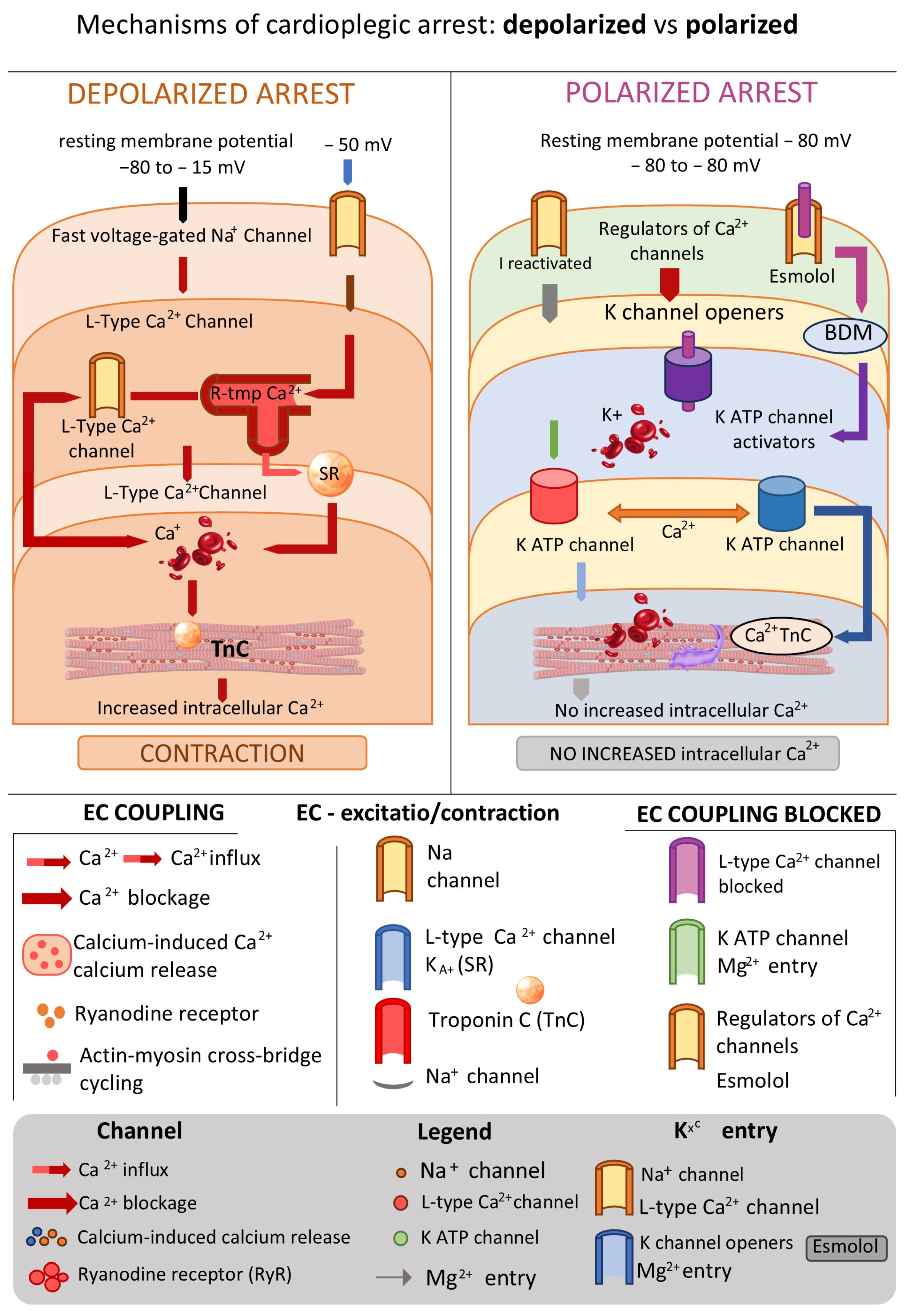
Coronary artery bypass grafting (CABG) remains the gold standard for patients with advanced multivessel coronary artery disease. Optimal myocardial protection versus ischemia during reversible and controlled cardiac arrest is a cornerstone of successful outcomes. Myocardial ischemia represents a state of reduced coronary perfusion with oxygenated blood, insufficient to meet the metabolic demands of the myocardium. Conventional cardioplegic solutions offer controlled and reversible cardiac arrest while actively modulating the molecular and cellular mechanisms that mediate ischemia–reperfusion injury. Cardioplegia dramatically elongates the reversible period of ischemic injury and restricts cardiomyocyte death by shutting down electromechanical activity, lowering metabolic demand, stabilizing ionic homeostasis, protecting mitochondrial integrity, and slowing oxidative stress and inflammatory signaling. During ischemia, cardiomyocytes shift from aerobic to anaerobic metabolism, resulting in adenosine triphosphate (ATP) depletion, loss of ionic homeostasis and calcium overload that activate proteases, phospholipases and membrane damage. Reperfusion restores oxygen supply and prevents irreversible necrosis but paradoxically initiates additional injury in marginally viable myocardium. The reoxygenation phase induces excessive production of reactive oxygen species (ROS), endothelial dysfunction and a strong inflammatory response mediated by neutrophils, platelets and cytokines. Mitochondrial dysfunction and opening of the mitochondrial permeability transition pore (mPTP) further amplify oxidative stress and inflammation, and trigger apoptosis and necroptosis. Understanding these intertwined cellular and molecular mechanisms remains essential for identifying novel therapeutic targets aimed at reducing reperfusion injury and improving myocardial recovery after ischemic events, particularly in coronary surgery.
Keywords: myocardial ischemia; ischemia–reperfusion injury; oxidative stress; mitochondrial dysfunction; apoptosis; cardioplegia; CABG myocardial ischemia; ischemia–reperfusion injury; oxidative stress; mitochondrial dysfunction; apoptosis; cardioplegia; CABG