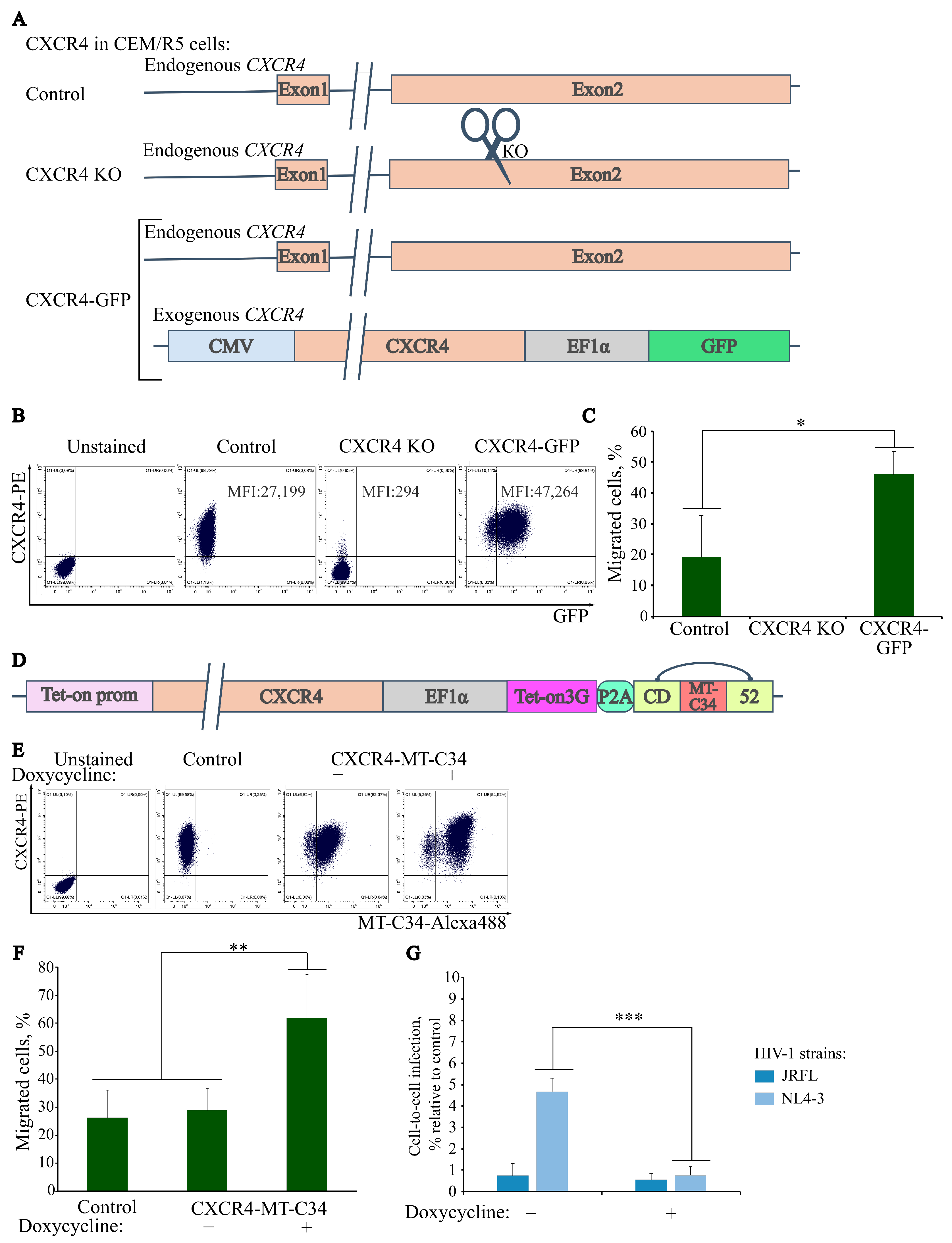
Bicistronic Lentiviral Architecture Increases Surface Density of Membrane-Associated HIV Entry Inhibitors and Confers Tropism-Independent Protection to Modified Cells
 , , , and
 Abstract
Share and Cite
Chervyakova, Y.V.; Smirnova, A.V.; Siniavin, A.; Soldatova, V.E.; Gamzik, D.D.; Tvorogova, A.V.; Nakastoev, I.M.; Filatov, A.V.; Kruglova, N.A.; Maslennikova, A.K.Y. Bicistronic Lentiviral Architecture Increases Surface Density of Membrane-Associated HIV Entry Inhibitors and Confers Tropism-Independent Protection to Modified Cells. Cells 2026, 15, 1704. https://doi.org/10.3390/cells15181704
Chervyakova YV, Smirnova AV, Siniavin A, Soldatova VE, Gamzik DD, Tvorogova AV, Nakastoev IM, Filatov AV, Kruglova NA, Maslennikova AKY. Bicistronic Lentiviral Architecture Increases Surface Density of Membrane-Associated HIV Entry Inhibitors and Confers Tropism-Independent Protection to Modified Cells. Cells. 2026; 15(18):1704. https://doi.org/10.3390/cells15181704
Chicago/Turabian StyleChervyakova, Yaroslava V., Alena V. Smirnova, Andrei Siniavin, Vasilisa E. Soldatova, Diana D. Gamzik, Anna V. Tvorogova, Islam M. Nakastoev, Alexander V. Filatov, Natalia A. Kruglova, and Alexandra Konstantia Y. Maslennikova. 2026. "Bicistronic Lentiviral Architecture Increases Surface Density of Membrane-Associated HIV Entry Inhibitors and Confers Tropism-Independent Protection to Modified Cells" Cells 15, no. 18: 1704. https://doi.org/10.3390/cells15181704
APA StyleChervyakova, Y. V., Smirnova, A. V., Siniavin, A., Soldatova, V. E., Gamzik, D. D., Tvorogova, A. V., Nakastoev, I. M., Filatov, A. V., Kruglova, N. A., & Maslennikova, A. K. Y. (2026). Bicistronic Lentiviral Architecture Increases Surface Density of Membrane-Associated HIV Entry Inhibitors and Confers Tropism-Independent Protection to Modified Cells. Cells, 15(18), 1704. https://doi.org/10.3390/cells15181704