MAFA: A Master Regulator of β-Cell Maturation and Function


Abstract
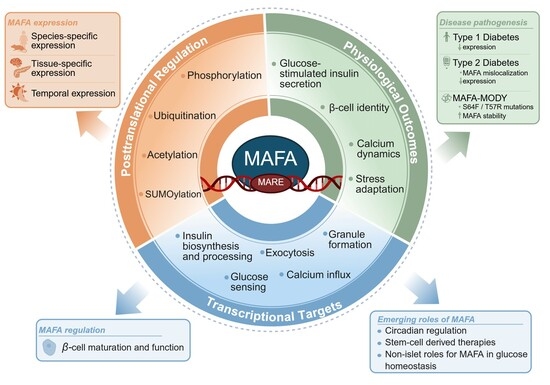
1. Introduction
2. Protein Structure and Functional Domains of MAFA
2.1. Transactivation Domain (TAD)
2.2. DNA-Binding Domains
2.3. Leucine-Zipper Domain
2.4. C-Terminal Tail

3. Islet MAFA Expression During Development and Adulthood
3.1. Rodent Models
3.2. Human Models
4. Regulation of MAFA Activity via Post-Translational Modifications
4.1. Phosphorylation
4.2. Ubiquitination
4.3. Acetylation
4.4. SUMOylation
5. Transcriptional Regulation of β-Cell Function by MAFA
6. MAFA in Diabetes Pathogenesis
6.1. Type 1 Diabetes (T1D)
6.2. Type 2 Diabetes (T2D)
6.3. Maturity-Onset Diabetes of the Young (MODY)
7. Emerging Roles and Novel Studies
7.1. Roles of MAFA in Glucose Homeostasis Beyond the Pancreatic β-Cell
7.2. Circadian Regulation of MAFA
7.3. Stem Cell (SC)-Derived Therapies
8. Conclusions
Author Contributions
Funding
Data Availability Statement
Acknowledgments
Conflicts of Interest
References
- International Diabetes Federation. IDF Diabetes Atlas 2025, 11th ed.; International Diabetes Federation: Brussels, Belgium, 2025; Available online: https://diabetesatlas.org (accessed on 23 April 2026).
- Kotsiri, I.; Xanthi, M.; Domazinaki, C.-M.; Magiorkinis, E. The Role of Viral Infections in the Immunopathogenesis of Type 1 Diabetes Mellitus: A Narrative Review. Biology 2025, 14, 981. [Google Scholar] [CrossRef] [Scilit] [PubMed]
- Nekoua, M.P.; Bertin, A.; Sane, F.; Alidjinou, E.K.; Lobert, D.; Trauet, J.; Hober, C.; Engelmann, I.; Moutairou, K.; Yessoufou, A.; et al. Pancreatic beta cells persistently infected with coxsackievirus B4 are targets of NK cell-mediated cytolytic activity. Cell. Mol. Life Sci. 2019, 77, 179–194. [Google Scholar] [CrossRef] [Scilit] [PubMed]
- Kaestner, K.H. β Cell transplantation and immunosuppression: Can’t live with it, can’t live without it. J. Clin. Investig. 2007, 117, 2380–2382. [Google Scholar] [CrossRef] [Scilit] [PubMed]
- Zhang, C.; Moriguchi, T.; Kajihara, M.; Esaki, R.; Harada, A.; Shimohata, H.; Oishi, H.; Hamada, M.; Morito, N.; Hasegawa, K.; et al. MafA Is a Key Regulator of Glucose-Stimulated Insulin Secretion. Mol. Cell. Biol. 2005, 25, 4969–4976. [Google Scholar] [CrossRef] [Scilit] [PubMed]
- Matsuoka, T.; Artner, I.; Henderson, E.; Means, A.; Sander, M.; Stein, R. The MafA transcription factor appears to be responsible for tissue-specific expression of insulin. Proc. Natl. Acad. Sci. USA 2004, 101, 2930–2933. [Google Scholar] [CrossRef] [Scilit] [PubMed]
- Nishimura, W.; Iwasa, H.; Tumurkhuu, M. Role of the Transcription Factor MAFA in the Maintenance of Pancreatic β-Cells. Int. J. Mol. Sci. 2022, 23, 4478. [Google Scholar] [CrossRef] [Scilit] [PubMed]
- Liang, J.; Chirikjian, M.; Pajvani, U.B.; Bartolomé, A. MafA Regulation in β-Cells: From Transcriptional to Post-Translational Mechanisms. Biomolecules 2022, 12, 535. [Google Scholar] [CrossRef] [Scilit] [PubMed]
- Hang, Y.; Stein, R. MafA and MafB activity in pancreatic β cells. Trends Endocrinol. Metab. 2011, 22, 364–373. [Google Scholar] [CrossRef] [Scilit] [PubMed]
- Aramata, S.; Han, S.-I.; Kataoka, K. Roles and regulation of transcription factor MafA in islet beta-cells. Endocr. J. 2007, 54, 659–666. [Google Scholar] [CrossRef] [Scilit] [PubMed]
- El Khattabi, I.; Sharma, A. Proper activation of MafA is required for optimal differentiation and maturation of pancreatic β-cells. Best Pract. Res. Clin. Endocrinol. Metab. 2015, 29, 821–831. [Google Scholar] [CrossRef] [Scilit] [PubMed]
- Nishizawa, M.; Kataoka, K.; Goto, N.; Fujiwara, K.T.; Kawai, S. v-maf, a viral oncogene that encodes a “leucine zipper” motif. Proc. Natl. Acad. Sci. USA 1989, 86, 7711–7715. [Google Scholar] [CrossRef] [Scilit] [PubMed]
- Kataoka, K.; Nishizawa, M.; Kawai, S. Structure-function analysis of the maf oncogene product, a member of the b-Zip protein family. J. Virol. 1993, 67, 2133–2141. [Google Scholar] [CrossRef] [Scilit] [PubMed]
- Kannan, M.B.; Solovieva, V.; Blank, V. The small MAF transcription factors MAFF, MAFG and MAFK: Current knowledge and perspectives. Biochim. Biophys. Acta Mol. Cell Res. 2012, 1823, 1841–1846. [Google Scholar] [CrossRef] [Scilit] [PubMed]
- Fujino, M.; Ojima, M.; Takahashi, S. Exploring Large MAF Transcription Factors: Functions, Pathology, and Mouse Models with Point Mutations. Genes 2023, 14, 1883. [Google Scholar] [CrossRef] [Scilit] [PubMed]
- Ogino, H.; Yasuda, K. Induction of Lens Differentiation by Activation of a bZIP Transcription Factor, L-Maf. Science 1998, 280, 115–118. [Google Scholar] [CrossRef] [Scilit] [PubMed]
- Reza, H.M.; Ogino, H.; Yasuda, K. L-Maf, a downstream target of Pax6, is essential for chick lens development. Mech. Dev. 2002, 116, 61–73. [Google Scholar] [CrossRef] [Scilit] [PubMed]
- Matsuoka, T.; Zhao, L.; Artner, I.; Jarrett, H.W.; Friedman, D.; Means, A.; Stein, R. Members of the large Maf transcription family regulate insulin gene transcription in islet beta cells. Mol. Cell. Biol. 2003, 23, 6049–6062. [Google Scholar] [CrossRef] [Scilit] [PubMed]
- Cha, J.; Tong, X.; Coate, K.C.; Guo, M.; Liu, J.; Reynolds, G.; Walker, E.M.; Stein, R.A.; Mchaourab, H.; Stein, R. Defining unique structural features in the MAFA and MAFB transcription factors that control Insulin gene activity. J. Biol. Chem. 2024, 300, 107938. [Google Scholar] [CrossRef] [Scilit] [PubMed]
- Guo, S.; Vanderford, N.L.; Stein, R. Phosphorylation within the MafA N Terminus Regulates C-terminal Dimerization and DNA Binding. J. Biol. Chem. 2010, 285, 12655–12661. [Google Scholar] [CrossRef] [Scilit] [PubMed]
- Scoville, D.W.; Cyphert, H.A.; Liao, L.; Xu, J.; Reynolds, A.; Guo, S.; Stein, R. MLL3 and MLL4 Methyltransferases Bind to the MAFA and MAFB Transcription Factors to Regulate Islet β-Cell Function. Diabetes 2015, 64, 3772–3783. [Google Scholar] [CrossRef] [Scilit] [PubMed]
- Lu, X.; Guanga, G.P.; Wan, C.; Rose, R.B. A Novel DNA Binding Mechanism for maf Basic Region-Leucine Zipper Factors Inferred from a MafA–DNA Complex Structure and Binding Specificities. Biochemistry 2012, 51, 9706–9717. [Google Scholar] [CrossRef] [Scilit] [PubMed]
- Kerppola, T.K.; Curran, T. A conserved region adjacent to the basic domain is required for recognition of an extended DNA binding site by Maf/Nrl family proteins. Oncogene 1994, 9, 3149–3158. [Google Scholar] [PubMed]
- Kataoka, K.; Noda, M.; Nishizawa, M. Maf nuclear oncoprotein recognizes sequences related to an AP-1 site and forms heterodimers with both Fos and Jun. Mol. Cell. Biol. 1994, 14, 700–712. [Google Scholar] [CrossRef] [Scilit] [PubMed]
- Kurokawa, H.; Motohashi, H.; Sueno, S.; Kimura, M.; Takagawa, H.; Kanno, Y.; Yamamoto, M.; Tanaka, T. Structural Basis of Alternative DNA Recognition by Maf Transcription Factors. Mol. Cell. Biol. 2009, 29, 6232–6244. [Google Scholar] [CrossRef] [Scilit] [PubMed]
- Zhao, L.; Cissell, M.A.; Henderson, E.; Colbran, R.; Stein, R. The RIPE3b1 Activator of the Insulin Gene Is Composed of a Protein(s) of Approximately 43 kDa, Whose DNA Binding Activity Is Inhibited by Protein Phosphatase Treatment. J. Biol. Chem. 2000, 275, 10532–10537. [Google Scholar] [CrossRef] [Scilit] [PubMed]
- Ellenberger, T.E.; Brandl, C.J.; Struhl, K.; Harrison, S.C. The GCN4 basic region leucine zipper binds DNA as a dimer of uninterrupted alpha helices: Crystal structure of the protein-DNA complex. Cell 1992, 71, 1223–1237. [Google Scholar] [CrossRef] [Scilit] [PubMed]
- Umadevi, P.; Senthilkumar, L. Influence of metal ions (Zn2+, Cu2+, Ca2+, Mg2+ and Na+) on the water coordinated neutral and zwitterionic L-histidine dimer. RSC Adv. 2014, 4, 49040–49052. [Google Scholar] [CrossRef] [Scilit]
- Chen, S.-H.; Chen, L.; Russell, D.H. Metal-Induced Conformational Changes of Human Metallothionein-2A: A Combined Theoretical and Experimental Study of Metal-Free and Partially Metalated Intermediates. J. Am. Chem. Soc. 2014, 136, 9499–9508. [Google Scholar] [CrossRef] [Scilit] [PubMed]
- Paul, N.K.; Baksh, K.A.; Arias, J.F.; Zamble, D.B. The impact of a His-tag on DNA binding by RNA polymerase alpha-C-terminal domain from Helicobacter pylori. Protein Expr. Purif. 2020, 167, 105541. [Google Scholar] [CrossRef] [Scilit] [PubMed]
- Hecel, A.; Wątły, J.; Rowińska-Żyrek, M.; Świątek-Kozłowska, J.; Kozłowski, H. Histidine tracts in human transcription factors: Insight into metal ion coordination ability. J. Biol. Inorg. Chem. 2018, 23, 81–90. [Google Scholar] [CrossRef] [Scilit] [PubMed]
- Muto, A.; Hoshino, H.; Madisen, L.; Yanai, N.; Obinata, M.; Karasuyama, H.; Hayashi, N.; Nakauchi, H.; Yamamoto, M.; Groudine, M.; et al. Identification of Bach2 as a B-cell-specific partner for small Maf proteins that negatively regulate the immunoglobulin heavy chain gene 3′ enhancer. EMBO J. 1998, 17, 5734–5743. [Google Scholar] [CrossRef] [Scilit] [PubMed]
- Motohashi, H.; Katsuoka, F.; Engel, J.D.; Yamamoto, M. Small Maf proteins serve as transcriptional cofactors for keratinocyte differentiation in the Keap1–Nrf2 regulatory pathway. Proc. Natl. Acad. Sci. USA 2004, 101, 6379–6384. [Google Scholar] [CrossRef] [Scilit] [PubMed]
- Kataoka, K.; Fujiwara, K.T.; Noda, M.; Nishizawa, M. MafB, a New Maf Family Transcription Activator That Can Associate with Maf and Fos but Not with Jun. Mol. Cell. Biol. 1994, 14, 7581–7591. [Google Scholar] [CrossRef] [Scilit] [PubMed]
- Patel, L.; Abate, C.; Curran, T. Altered protein conformation on DNA binding by Fos and Jun. Nature 1990, 347, 572–575. [Google Scholar] [CrossRef] [Scilit] [PubMed]
- Zhao, L.; Guo, M.; Matsuoka, T.-A.; Hagman, D.K.; Parazzoli, S.D.; Poitout, V.; Stein, R. The islet beta cell-enriched MafA activator is a key regulator of insulin gene transcription. J. Biol. Chem. 2005, 280, 11887–11894. [Google Scholar] [CrossRef] [Scilit] [PubMed]
- Dlakić, M.; Grinberg, A.V.; Leonard, D.A.; Kerppola, T.K. DNA sequence-dependent folding determines the divergence in binding specificities between Maf and other bZIP proteins. EMBO J. 2001, 20, 828–840. [Google Scholar] [CrossRef] [Scilit] [PubMed]
- Benkhelifa, S.; Provot, S.; Nabais, E.; Eychène, A.; Calothy, G.; Felder-Schmittbuhl, M.-P. Phosphorylation of MafA Is Essential for Its Transcriptional and Biological Properties. Mol. Cell. Biol. 2001, 21, 4441–4452. [Google Scholar] [CrossRef] [Scilit] [PubMed]
- Textor, L.C.; Wilmanns, M.; Holton, S.J. Expression, purification, crystallization and preliminary crystallographic analysis of the mouse transcription factor MafB in complex with its DNA-recognition motif Cmare. Acta Crystallogr. Sect. F Struct. Biol. Cryst. Commun. 2007, 63, 657–661. [Google Scholar] [CrossRef] [Scilit] [PubMed]
- Gao, T.; McKenna, B.; Li, C.; Reichert, M.; Nguyen, J.; Singh, T.; Yang, C.; Pannikar, A.; Doliba, N.; Zhang, T.; et al. Pdx1 Maintains β Cell Identity and Function by Repressing an α Cell Program. Cell Metab. 2014, 19, 259–271. [Google Scholar] [CrossRef] [Scilit] [PubMed]
- Gannon, M.; Tweedie Ables, E.; Crawford, L.; Lowe, D.; Offield, M.F.; Magnuson, M.A.; Wright, C.V.E. pdx-1 function is specifically required in embryonic β cells to generate appropriate numbers of endocrine cell types and maintain glucose homeostasis. Dev. Biol. 2008, 314, 406–417. [Google Scholar] [CrossRef] [Scilit] [PubMed]
- Romer, A.I.; Singer, R.A.; Sui, L.; Egli, D.; Sussel, L. Murine Perinatal β-Cell Proliferation and the Differentiation of Human Stem Cell–Derived Insulin-Expressing Cells Require NEUROD1. Diabetes 2019, 68, 2259–2271. [Google Scholar] [CrossRef] [Scilit] [PubMed]
- Bohuslavova, R.; Smolik, O.; Malfatti, J.; Berkova, Z.; Novakova, Z.; Saudek, F.; Pavlinkova, G. NEUROD1 Is Required for the Early α and β Endocrine Differentiation in the Pancreas. Int. J. Mol. Sci. 2021, 22, 6713. [Google Scholar] [CrossRef] [Scilit] [PubMed]
- Nishimura, W.; Kondo, T.; Salameh, T.; El Khattabi, I.; Dodge, R.; Bonner-Weir, S.; Sharma, A. A switch from MafB to MafA expression accompanies differentiation to pancreatic β-cells. Dev. Biol. 2006, 293, 526–539. [Google Scholar] [CrossRef] [Scilit] [PubMed]
- Artner, I.; Hang, Y.; Mazur, M.; Yamamoto, T.; Guo, M.; Lindner, J.; Magnuson, M.A.; Stein, R. MafA and MafB Regulate Genes Critical to β-Cells in a Unique Temporal Manner. Diabetes 2010, 59, 2530–2539. [Google Scholar] [CrossRef] [Scilit] [PubMed]
- Jeon, J.; Correa-Medina, M.; Ricordi, C.; Edlund, H.; Diez, J.A. Endocrine cell clustering during human pancreas development. J. Histochem. Cytochem. Off. J. Histochem. Soc. 2009, 57, 811–824. [Google Scholar] [CrossRef] [Scilit] [PubMed]
- Arda, H.E.; Li, L.; Tsai, J.; Torre, E.A.; Rosli, Y.; Peiris, H.; Spitale, R.C.; Dai, C.; Gu, X.; Qu, K.; et al. Age-Dependent Pancreatic Gene Regulation Reveals Mechanisms Governing Human β Cell Function. Cell Metab. 2016, 23, 909–920. [Google Scholar] [CrossRef] [Scilit] [PubMed]
- Cyphert, H.A.; Walker, E.M.; Hang, Y.; Dhawan, S.; Haliyur, R.; Bonatakis, L.; Avrahami, D.; Brissova, M.; Kaestner, K.H.; Bhushan, A.; et al. Examining How the MAFB Transcription Factor Affects Islet β-Cell Function Postnatally. Diabetes 2019, 68, 337–348. [Google Scholar] [CrossRef] [Scilit] [PubMed]
- Hang, Y.; Yamamoto, T.; Benninger, R.K.P.; Brissova, M.; Guo, M.; Bush, W.; Piston, D.W.; Powers, A.C.; Magnuson, M.; Thurmond, D.C.; et al. The MafA Transcription Factor Becomes Essential to Islet β-Cells Soon After Birth. Diabetes 2014, 63, 1994–2005. [Google Scholar] [CrossRef] [Scilit] [PubMed]
- Kim, S.K.; Hebrok, M. Intercellular signals regulating pancreas development and function. Genes Dev. 2001, 15, 111–127. [Google Scholar] [CrossRef] [Scilit] [PubMed]
- Shrestha, S.; Saunders, D.C.; Walker, J.T.; Camunas-Soler, J.; Dai, X.-Q.; Haliyur, R.; Aramandla, R.; Poffenberger, G.; Prasad, N.; Bottino, R.; et al. Combinatorial transcription factor profiles predict mature and functional human islet α and β cells. JCI Insight 2021, 6, e151621. [Google Scholar] [CrossRef] [Scilit] [PubMed]
- Guo, S.; Dai, C.; Guo, M.; Taylor, B.; Harmon, J.S.; Sander, M.; Robertson, R.P.; Powers, A.C.; Stein, R. Inactivation of specific β cell transcription factors in type 2 diabetes. J. Clin. Investig. 2013, 123, 3305–3316. [Google Scholar] [CrossRef] [Scilit] [PubMed]
- Butler, A.E.; Robertson, R.P.; Hernandez, R.; Matveyenko, A.V.; Gurlo, T.; Butler, P.C. Beta cell nuclear musculoaponeurotic fibrosarcoma oncogene family A (MafA) is deficient in type 2 diabetes. Diabetologia 2012, 55, 2985–2988. [Google Scholar] [CrossRef] [Scilit] [PubMed]
- Iacovazzo, D.; Flanagan, S.E.; Walker, E.; Quezado, R.; de Sousa Barros, F.A.; Caswell, R.; Johnson, M.B.; Wakeling, M.; Brändle, M.; Guo, M.; et al. MAFA missense mutation causes familial insulinomatosis and diabetes mellitus. Proc. Natl. Acad. Sci. USA 2018, 115, 1027–1032. [Google Scholar] [CrossRef] [Scilit] [PubMed]
- Walker, E.M.; Cha, J.; Tong, X.; Guo, M.; Liu, J.-H.; Yu, S.; Iacovazzo, D.; Mauvais-Jarvis, F.; Flanagan, S.E.; Korbonits, M.; et al. Sex-biased islet β cell dysfunction is caused by the MODY MAFA S64F variant by inducing premature aging and senescence in males. Cell Rep. 2021, 37, 109813. [Google Scholar] [CrossRef] [Scilit] [PubMed]
- Kim, S.K.; Melton, D.A. Pancreas development is promoted by cyclopamine, a Hedgehog signaling inhibitor. Proc. Natl. Acad. Sci. USA 1998, 95, 13036–13041. [Google Scholar] [CrossRef] [Scilit] [PubMed]
- Herrera, P.-L.; Huarte, J.; Sanvito, F.; Meda, P.; Orci, L.; Vassalli, J.-D. Embryogenesis of the murine endocrine pancreas; early expression of pancreatic polypeptide gene. Development 1991, 113, 1257–1265. [Google Scholar] [CrossRef] [Scilit] [PubMed]
- Teitelman, G.; Alpert, S.; Polak, J.M.; Martinez, A.; Hanahan, D. Precursor cells of mouse endocrine pancreas coexpress insulin, glucagon and the neuronal proteins tyrosine hydroxylase and neuropeptide Y, but not pancreatic polypeptide. Dev. Camb. Engl. 1993, 118, 1031–1039. [Google Scholar] [CrossRef] [Scilit] [PubMed]
- Pang, K.; Mukonoweshuro, C.; Wong, G.G. Beta cells arise from glucose transporter type 2 (Glut2)-expressing epithelial cells of the developing rat pancreas. Proc. Natl. Acad. Sci. USA 1994, 91, 9559–9563. [Google Scholar] [CrossRef] [Scilit] [PubMed]
- Kemp, J.D.; Walther, B.T.; Rutter, W.J. Protein Synthesis during the Secondary Developmental Transition of the Embryonic Rat Pancreas. J. Biol. Chem. 1972, 247, 3941–3952. [Google Scholar] [CrossRef] [Scilit]
- Nishimura, W.; Takahashi, S.; Yasuda, K. MafA is critical for maintenance of the mature beta cell phenotype in mice. Diabetologia 2015, 58, 566–574. [Google Scholar] [CrossRef] [Scilit] [PubMed]
- Aguayo-Mazzucato, C.; Koh, A.; El Khattabi, I.; Li, W.-C.; Toschi, E.; Jermendy, A.; Juhl, K.; Mao, K.; Weir, G.C.; Sharma, A.; et al. Mafa expression enhances glucose-responsive insulin secretion in neonatal rat beta cells. Diabetologia 2011, 54, 583–593. [Google Scholar] [CrossRef] [Scilit] [PubMed]
- Campbell-Thompson, M.; Wasserfall, C.; Kaddis, J.; Albanese-O’Neill, A.; Staeva, T.; Nierras, C.; Moraski, J.; Rowe, P.; Gianani, R.; Eisenbarth, G.; et al. Network for Pancreatic Organ Donors with Diabetes (nPOD): Developing a Tissue Biobank for Type 1 Diabetes. Diabetes Metab. Res. Rev. 2012, 28, 608–617. [Google Scholar] [CrossRef] [Scilit] [PubMed]
- Kaestner, K.H.; Powers, A.C.; Naji, A.; Atkinson, M.A. NIH Initiative to Improve Understanding of the Pancreas, Islet, and Autoimmunity in Type 1 Diabetes: The Human Pancreas Analysis Program (HPAP). Diabetes 2019, 68, 1394–1402. [Google Scholar] [CrossRef] [Scilit] [PubMed]
- Shapira, S.N.; Naji, A.; Atkinson, M.A.; Powers, A.C.; Kaestner, K.H. Understanding islet dysfunction in type 2 diabetes through multidimensional pancreatic phenotyping: The Human Pancreas Analysis Program—Type 2 Diabetes (HPAP-T2D). Cell Metab. 2022, 34, 1906–1913. [Google Scholar] [CrossRef] [Scilit] [PubMed]
- Cataldo, L.R.; Singh, T.; Achanta, K.; Bsharat, S.; Prasad, R.B.; Luan, C.; Renström, E.; Eliasson, L.; Artner, I. MAFA and MAFB regulate exocytosis-related genes in human β-cells. Acta Physiol. 2022, 234, e13761. [Google Scholar] [CrossRef] [Scilit] [PubMed]
- Cha, J.; Tong, X.; Walker, E.M.; Dahan, T.; Cochrane, V.A.; Ashe, S.; Russell, R.; Osipovich, A.B.; Mawla, A.M.; Guo, M.; et al. Species-specific roles for the MAFA and MAFB transcription factors in regulating islet β cell identity. JCI Insight 2023, 8, e166386. [Google Scholar] [CrossRef] [Scilit] [PubMed]
- Knofczynski, K.R.; Law, E.W.; Lewis-Brinkman, S.; Khashim, Z.; Schornack, A.M.R.; Shrestha, S.; Jennings, L.T.; Peterson, Q.P. Disruption of Cell-Adhesion Signaling Resolves Unwanted Progenitor Specification in Stem Cell-Derived α and β Cell Grafts. Cells 2026, 15, 314. [Google Scholar] [CrossRef] [Scilit] [PubMed]
- D’Amour, K.A.; Bang, A.G.; Eliazer, S.; Kelly, O.G.; Agulnick, A.D.; Smart, N.G.; Moorman, M.A.; Kroon, E.; Carpenter, M.K.; Baetge, E.E. Production of pancreatic hormone–expressing endocrine cells from human embryonic stem cells. Nat. Biotechnol. 2006, 24, 1392–1401. [Google Scholar] [CrossRef] [Scilit] [PubMed]
- Hogrebe, N.J.; Maxwell, K.G.; Augsornworawat, P.; Millman, J.R. Generation of insulin-producing pancreatic β cells from multiple human stem cell lines. Nat. Protoc. 2021, 16, 4109–4143. [Google Scholar] [CrossRef] [Scilit] [PubMed]
- Cheng, X.; Ying, L.; Lu, L.; Galvão, A.M.; Mills, J.A.; Lin, H.C.; Kotton, D.N.; Shen, S.S.; Nostro, M.C.; Choi, J.K.; et al. Self-Renewing Endodermal Progenitor Lines Generated from Human Pluripotent Stem Cells. Cell Stem Cell 2012, 10, 371–384. [Google Scholar] [CrossRef] [Scilit] [PubMed]
- Kao, D.-I.; Chen, S. Pluripotent Stem Cell-Derived Pancreatic β-Cells: Potential for Regenerative Medicine in Diabetes. Regen. Med. 2012, 7, 583–593. [Google Scholar] [CrossRef] [Scilit] [PubMed]
- Melton, D. The promise of stem cell-derived islet replacement therapy. Diabetologia 2021, 64, 1030–1036. [Google Scholar] [CrossRef] [Scilit] [PubMed]
- Russell, R.; Carnese, P.P.; Hennings, T.G.; Walker, E.M.; Russ, H.A.; Liu, J.S.; Giacometti, S.; Stein, R.; Hebrok, M. Loss of the transcription factor MAFB limits β-cell derivation from human PSCs. Nat. Commun. 2020, 11, 2742. [Google Scholar] [CrossRef] [Scilit] [PubMed]
- Preza, S.; Zheng, B.; Gao, Z.; Biju, A.; Liu, M.; Cheng, Z.; Choi, M.; Alvarez-Dominguez, J.R. DEC1 regulates human β cell functional maturation and circadian rhythm. Cell Rep. 2025, 44, 116666. [Google Scholar] [CrossRef] [Scilit] [PubMed]
- Shilleh, A.H.; Russ, H.A. Cell Replacement Therapy for Type 1 Diabetes Patients: Potential Mechanisms Leading to Stem-Cell-Derived Pancreatic β-Cell Loss upon Transplant. Cells 2023, 12, 698. [Google Scholar] [CrossRef] [Scilit] [PubMed]
- Hrvatin, S.; O’Donnell, C.W.; Deng, F.; Millman, J.R.; Pagliuca, F.W.; DiIorio, P.; Rezania, A.; Gifford, D.K.; Melton, D.A. Differentiated human stem cells resemble fetal, not adult, β cells. Proc. Natl. Acad. Sci. USA 2014, 111, 3038–3043. [Google Scholar] [CrossRef] [Scilit] [PubMed]
- Kroon, E.; Martinson, L.A.; Kadoya, K.; Bang, A.G.; Kelly, O.G.; Eliazer, S.; Young, H.; Richardson, M.; Smart, N.G.; Cunningham, J.; et al. Pancreatic endoderm derived from human embryonic stem cells generates glucose-responsive insulin-secreting cells in vivo. Nat. Biotechnol. 2008, 26, 443–452. [Google Scholar] [CrossRef] [Scilit] [PubMed]
- Han, S.; Tsunekage, Y.; Kataoka, K. Phosphorylation of MafA enhances interaction with Beta2/NeuroD1. Acta Diabetol. 2016, 53, 651–660. [Google Scholar] [CrossRef] [Scilit] [PubMed]
- Guo, S.; Burnette, R.; Zhao, L.; Vanderford, N.L.; Poitout, V.; Hagman, D.K.; Henderson, E.; Özcan, S.; Wadzinski, B.E.; Stein, R. The Stability and Transactivation Potential of the Mammalian MafA Transcription Factor Are Regulated by Serine 65 Phosphorylation. J. Biol. Chem. 2009, 284, 759–765. [Google Scholar] [CrossRef] [Scilit] [PubMed]
- Rocques, N.; Zeid, N.A.; Sii-Felice, K.; Lecoin, L.; Felder-Schmittbuhl, M.-P.; Eychène, A.; Pouponnot, C. GSK-3-Mediated Phosphorylation Enhances Maf-Transforming Activity. Mol. Cell 2007, 28, 584–597. [Google Scholar] [CrossRef] [Scilit] [PubMed]
- Han, S.; Aramata, S.; Yasuda, K.; Kataoka, K. MafA Stability in Pancreatic β Cells Is Regulated by Glucose and Is Dependent on Its Constitutive Phosphorylation at Multiple Sites by Glycogen Synthase Kinase 3. Mol. Cell. Biol. 2007, 27, 6593–6605. [Google Scholar] [CrossRef] [Scilit] [PubMed]
- Kerscher, O.; Felberbaum, R.; Hochstrasser, M. Modification of Proteins by Ubiquitin and Ubiquitin-Like Proteins. Annu. Rev. Cell Dev. Biol. 2006, 22, 159–180. [Google Scholar] [CrossRef] [Scilit] [PubMed]
- Wu, T.; Zhang, S.; Xu, J.; Zhang, Y.; Sun, T.; Shao, Y.; Wang, J.; Tang, W.; Chen, F.; Han, X. HRD1, an Important Player in Pancreatic β-Cell Failure and Therapeutic Target for Type 2 Diabetic Mice. Diabetes 2020, 69, 940–953. [Google Scholar] [CrossRef] [Scilit] [PubMed]
- Rabhi, N.; Denechaud, P.-D.; Gromada, X.; Hannou, S.A.; Zhang, H.; Rashid, T.; Salas, E.; Durand, E.; Sand, O.; Bonnefond, A.; et al. KAT2B Is Required for Pancreatic Beta Cell Adaptation to Metabolic Stress by Controlling the Unfolded Protein Response. Cell Rep. 2016, 15, 1051–1061. [Google Scholar] [CrossRef] [Scilit] [PubMed]
- Bartolome, A.; Zhu, C.; Sussel, L.; Pajvani, U.B. Notch signaling dynamically regulates adult β cell proliferation and maturity. J. Clin. Investig. 2019, 129, 268–280. [Google Scholar] [CrossRef] [Scilit] [PubMed]
- Shao, C.; Cobb, M.H. Sumoylation Regulates the Transcriptional Activity of MafA in Pancreatic β Cells. J. Biol. Chem. 2009, 284, 3117–3124. [Google Scholar] [CrossRef] [Scilit] [PubMed]
- Gill, G. Something about SUMO inhibits transcription. Curr. Opin. Genet. Dev. 2005, 15, 536–541. [Google Scholar] [CrossRef] [Scilit] [PubMed]
- Kaneto, H.; Miyatsuka, T.; Kawamori, D.; Yamamoto, K.; Kato, K.; Shiraiwa, T.; Katakami, N.; Yamasaki, Y.; Matsuhisa, M.; Matsuoka, T. PDX-1 and MafA Play a Crucial Role in Pancreatic β-Cell Differentiation and Maintenance of Mature β-Cell Function. Endocr. J. 2008, 55, 235–252. [Google Scholar] [CrossRef] [Scilit] [PubMed]
- Kaestner, K.H.; Campbell–Thompson, M.; Dor, Y.; Gill, R.G.; Glaser, B.; Kim, S.K.; Sander, M.; Stabler, C.; Stewart, A.F.; Powers, A.C. What is a β cell?—Chapter I in the Human Islet Research Network (HIRN) review series. Mol. Metab. 2021, 53, 101323. [Google Scholar] [CrossRef] [Scilit] [PubMed]
- Barsby, T.; Otonkoski, T. Maturation of beta cells: Lessons from in vivo and in vitro models. Diabetologia 2022, 65, 917–930. [Google Scholar] [CrossRef] [Scilit] [PubMed]
- Cinti, F.; Bouchi, R.; Kim-Muller, J.Y.; Ohmura, Y.; Sandoval, P.R.; Masini, M.; Marselli, L.; Suleiman, M.; Ratner, L.E.; Marchetti, P.; et al. Evidence of β-Cell Dedifferentiation in Human Type 2 Diabetes. J. Clin. Endocrinol. Metab. 2016, 101, 1044–1054. [Google Scholar] [CrossRef] [Scilit] [PubMed]
- Harrington, R.H.; Sharma, A. Transcription Factors Recognizing Overlapping C1-A2 Binding Sites Positively Regulate Insulin Gene Expression. J. Biol. Chem. 2001, 276, 104–113. [Google Scholar] [CrossRef] [Scilit] [PubMed]
- Olbrot, M.; Rud, J.; Moss, L.G.; Sharma, A. Identification of β-cell-specific insulin gene transcription factor RIPE3b1 as mammalian MafA. Proc. Natl. Acad. Sci. USA 2002, 99, 6737–6742. [Google Scholar] [CrossRef] [Scilit] [PubMed]
- Wang, H.; Brun, T.; Kataoka, K.; Sharma, A.J.; Wollheim, C.B. MAFA controls genes implicated in insulin biosynthesis and secretion. Diabetologia 2007, 50, 348–358. [Google Scholar] [CrossRef] [Scilit] [PubMed]
- Martin, C.C.; Flemming, B.P.; Wang, Y.; Oeser, J.K.; O’Brien, R.M. Foxa2 and MafA Regulate Islet-specific Glucose-6-Phosphatase Catalytic Subunit-Related Protein (IGRP/G6PC2) Gene Expression. J. Mol. Endocrinol. 2008, 41, 315–328. [Google Scholar] [CrossRef] [Scilit] [PubMed]
- Kajihara, M.; Sone, H.; Amemiya, M.; Katoh, Y.; Isogai, M.; Shimano, H.; Yamada, N.; Takahashi, S. Mouse MafA, homologue of zebrafish somite Maf 1, contributes to the specific transcriptional activity through the insulin promoter. Biochem. Biophys. Res. Commun. 2003, 312, 831–842. [Google Scholar] [CrossRef] [Scilit] [PubMed]
- Kataoka, K.; Han, S.; Shioda, S.; Hirai, M.; Nishizawa, M.; Handa, H. MafA Is a Glucose-regulated and Pancreatic β-Cell-specific Transcriptional Activator for the Insulin Gene. J. Biol. Chem. 2002, 277, 49903–49910. [Google Scholar] [CrossRef] [Scilit] [PubMed]
- Wang, H.; Ishizaki, R.; Kobayashi, E.; Fujiwara, T.; Akagawa, K.; Izumi, T. Loss of granuphilin and loss of syntaxin-1A cause differential effects on insulin granule docking and fusion. J. Biol. Chem. 2011, 286, 32244–32250. [Google Scholar] [CrossRef] [Scilit] [PubMed]
- Luan, C.; Ye, Y.; Singh, T.; Barghouth, M.; Eliasson, L.; Artner, I.; Zhang, E.; Renström, E. The calcium channel subunit gamma-4 is regulated by MafA and necessary for pancreatic beta-cell specification. Commun. Biol. 2019, 2, 106. [Google Scholar] [CrossRef] [Scilit] [PubMed]
- Lai, C.; Chen, Y.; Han, X.; Fu, Y.; Chen, J.; Tan, D.; Shan, X.; Jiang, H. Transcription factor MAFA regulates muscle growth via calcium ion channels and receptor tyrosine kinase activation. Int. J. Biol. Macromol. 2025, 321, 146518. [Google Scholar] [CrossRef] [Scilit] [PubMed]
- Eto, K.; Nishimura, W.; Oishi, H.; Udagawa, H.; Kawaguchi, M.; Hiramoto, M.; Fujiwara, T.; Takahashi, S.; Yasuda, K. MafA Is Required for Postnatal Proliferation of Pancreatic β-Cells. PLoS ONE 2014, 9, e104184, Correction in PLoS ONE 2014, 9, e113892. https://doi.org/10.1371/journal.pone.0113892. [Google Scholar] [CrossRef] [Scilit] [PubMed]
- Vanhoose, A.M.; Samaras, S.; Artner, I.; Henderson, E.; Hang, Y.; Stein, R. MafA and MafB Regulate Pdx1 Transcription through the Area II Control Region in Pancreatic β Cells. J. Biol. Chem. 2008, 283, 22612–22619. [Google Scholar] [CrossRef] [Scilit] [PubMed]
- Cataldo, L.R.; Vishnu, N.; Singh, T.; Bertonnier-Brouty, L.; Bsharat, S.; Luan, C.; Renström, E.; Prasad, R.B.; Fex, M.; Mulder, H.; et al. The MafA-target gene PPP1R1A regulates GLP1R-mediated amplification of glucose-stimulated insulin secretion in β-cells. Metab.—Clin. Exp. 2021, 118, 154734. [Google Scholar] [CrossRef] [Scilit] [PubMed]
- Ganic, E.; Singh, T.; Luan, C.; Fadista, J.; Johansson, J.K.; Cyphert, H.A.; Bennet, H.; Storm, P.; Prost, G.; Ahlenius, H.; et al. MafA-Controlled Nicotinic Receptor Expression Is Essential for Insulin Secretion and Is Impaired in Patients with Type 2 Diabetes. Cell Rep. 2016, 14, 1991–2002. [Google Scholar] [CrossRef] [Scilit] [PubMed]
- Ganic, E.; Johansson, J.K.; Bennet, H.; Fex, M.; Artner, I. Islet-specific monoamine oxidase A and B expression depends on MafA transcriptional activity and is compromised in type 2 diabetes. Biochem. Biophys. Res. Commun. 2015, 468, 629–635. [Google Scholar] [CrossRef] [Scilit] [PubMed]
- Loyd, Z.; Lee, D.; Maurer, M.; Buzzelli, L.; Liu, J.-H.; Reynolds, G.; Keller, M.P.; Cartailler, J.-P.; Magnuson, M.A.; Stein, R.; et al. Genetic background influences MAFAS64F-mediated diabetes penetrance in male mice. bioRxiv 2025. [Google Scholar] [CrossRef] [Scilit] [PubMed]
- Ebrahim, N.; Shakirova, K.; Dashinimaev, E. PDX1 is the cornerstone of pancreatic β-cell functions and identity. Front. Mol. Biosci. 2022, 9, 1091757. [Google Scholar] [CrossRef] [Scilit] [PubMed]
- Azzarelli, R.; Hurley, C.; Sznurkowska, M.K.; Rulands, S.; Hardwick, L.; Gamper, I.; Ali, F.; McCracken, L.; Hindley, C.; McDuff, F.; et al. Multi-site Neurogenin3 Phosphorylation Controls Pancreatic Endocrine Differentiation. Dev. Cell 2017, 41, 274–286.e5. [Google Scholar] [CrossRef] [Scilit] [PubMed]
- Aramata, S.; Han, S.i.; Yasuda, K.; Kataoka, K. Synergistic activation of the insulin gene promoter by the β-cell enriched transcription factors MafA, Beta2, and Pdx1. Biochim. Biophys. Acta Gene Struct. Expr. 2005, 1730, 41–46. [Google Scholar] [CrossRef] [Scilit] [PubMed]
- Chen, Q.; Dowhan, D.H.; Liang, D.; Moore, D.D.; Overbeek, P.A. CREB-binding Protein/p300 Co-activation of Crystallin Gene Expression. J. Biol. Chem. 2002, 277, 24081–24089. [Google Scholar] [CrossRef] [Scilit] [PubMed]
- Sampley, M.L.; Ozcan, S. Regulation of insulin gene transcription by multiple histone acetyltransferases. DNA Cell Biol. 2012, 31, 8–14. [Google Scholar] [CrossRef] [Scilit] [PubMed]
- Kent, S.C.; Chen, Y.; Bregoli, L.; Clemmings, S.M.; Kenyon, N.S.; Ricordi, C.; Hering, B.J.; Hafler, D.A. Expanded T cells from pancreatic lymph nodes of type 1 diabetic subjects recognize an insulin epitope. Nature 2005, 435, 224–228. [Google Scholar] [CrossRef] [Scilit] [PubMed]
- Fan, Y.; Rudert, W.A.; Grupillo, M.; He, J.; Sisino, G.; Trucco, M. Thymus-specific deletion of insulin induces autoimmune diabetes. EMBO J. 2009, 28, 2812–2824. [Google Scholar] [CrossRef] [Scilit] [PubMed]
- Smith, J.A.; Yuen, B.T.K.; Purtha, W.; Balolong, J.M.; Phipps, J.D.; Crawford, F.; Bluestone, J.A.; Kappler, J.W.; Anderson, M.S. Aire mediates tolerance to insulin through thymic trimming of high-affinity T cell clones. Proc. Natl. Acad. Sci. USA 2024, 121, e2320268121. [Google Scholar] [CrossRef] [Scilit] [PubMed]
- Brimnes, M.K.; Jensen, T.; Jørgensen, T.N.; Michelsen, B.K.; Troelsen, J.; Werdelin, O. Low Expression of Insulin in the Thymus of Non-obese Diabetic Mice. J. Autoimmun. 2002, 19, 203–213. [Google Scholar] [CrossRef] [Scilit] [PubMed]
- Noso, S.; Kataoka, K.; Kawabata, Y.; Babaya, N.; Hiromine, Y.; Yamaji, K.; Fujisawa, T.; Aramata, S.; Kudo, T.; Takahashi, S.; et al. Insulin transactivator MafA regulates intrathymic expression of insulin and affects susceptibility to type 1 diabetes. Diabetes 2010, 59, 2579–2587. [Google Scholar] [CrossRef] [Scilit] [PubMed]
- Noso, S. Association Study of MAFA and MAFB Genes Related to Organ-Specific Autoimmunity, with Susceptibility to Type-1 Diabetes in Japanese and Caucasian Populations. J. Genet. Syndr. Gene Ther. 2013, 4, 204. [Google Scholar] [CrossRef]
- Singh, T.; Sarmiento, L.; Luan, C.; Prasad, R.B.; Johansson, J.; Cataldo, L.R.; Renström, E.; Soneji, S.; Cilio, C.; Artner, I. MafA Expression Preserves Immune Homeostasis in Human and Mouse Islets. Genes 2018, 9, 644. [Google Scholar] [CrossRef] [Scilit] [PubMed]
- Singh, T.; Colberg, J.K.; Sarmiento, L.; Chaves, P.; Hansen, L.; Bsharat, S.; Cataldo, L.R.; Dudenhöffer-Pfeifer, M.; Fex, M.; Bryder, D.; et al. Loss of MafA and MafB expression promotes islet inflammation. Sci. Rep. 2019, 9, 9074. [Google Scholar] [CrossRef] [Scilit] [PubMed]
- Matsuoka, T.; Kaneto, H.; Miyatsuka, T.; Yamamoto, T.; Yamamoto, K.; Kato, K.; Shimomura, I.; Stein, R.; Matsuhisa, M. Regulation of MafA Expression in Pancreatic β-Cells in db/db Mice with Diabetes. Diabetes 2010, 59, 1709–1720. [Google Scholar] [CrossRef] [Scilit] [PubMed]
- Matsuoka, T.; Kaneto, H.; Kawashima, S.; Miyatsuka, T.; Tochino, Y.; Yoshikawa, A.; Imagawa, A.; Miyazaki, J.; Gannon, M.; Stein, R.; et al. Preserving Mafa expression in diabetic islet β-cells improves glycemic control in vivo. J. Biol. Chem. 2015, 290, 7647–7657. [Google Scholar] [CrossRef] [Scilit] [PubMed]
- Harmon, J.S.; Stein, R.; Robertson, R.P. Oxidative Stress-mediated, Post-translational Loss of MafA Protein as a Contributing Mechanism to Loss of Insulin Gene Expression in Glucotoxic Beta Cells. J. Biol. Chem. 2005, 280, 11107–11113. [Google Scholar] [CrossRef] [Scilit] [PubMed]
- Harmon, J.S.; Bogdani, M.; Parazzoli, S.D.; Mak, S.S.M.; Oseid, E.A.; Berghmans, M.; Leboeuf, R.C.; Robertson, R.P. beta-Cell-specific overexpression of glutathione peroxidase preserves intranuclear MafA and reverses diabetes in db/db mice. Endocrinology 2009, 150, 4855–4862. [Google Scholar] [CrossRef] [Scilit]
- Poitout, V.; Olson, L.K.; Robertson, R.P. Chronic exposure of betaTC-6 cells to supraphysiologic concentrations of glucose decreases binding of the RIPE3b1 insulin gene transcription activator. J. Clin. Investig. 1996, 97, 1041–1046. [Google Scholar] [CrossRef] [Scilit] [PubMed]
- Akinci, E.; Banga, A.; Greder, L.V.; Dutton, J.R.; Slack, J.M.W. Reprogramming of pancreatic exocrine cells towards a beta (β) cell character using Pdx1, Ngn3 and MafA. Biochem. J. 2012, 442, 539–550. [Google Scholar] [CrossRef] [Scilit] [PubMed]
- Chen, Y.-J.; Finkbeiner, S.R.; Weinblatt, D.; Emmett, M.J.; Tameire, F.; Yousefi, M.; Yang, C.; Maehr, R.; Zhou, Q.; Shemer, R.; et al. De novo formation of insulin-producing “neo-β cell islets” from intestinal crypts. Cell Rep. 2014, 6, 1046–1058. [Google Scholar] [CrossRef] [Scilit] [PubMed]
- Zhou, Q.; Brown, J.; Kanarek, A.; Rajagopal, J.; Melton, D.A. In vivo reprogramming of adult pancreatic exocrine cells to beta-cells. Nature 2008, 455, 627–632. [Google Scholar] [CrossRef] [Scilit] [PubMed]
- Dayer, D.; Tabandeh, M.R.; Moghimipour, E.; Hashemi Tabar, M.; Ghadiri, A.; Allah Bakhshi, E.; Orazizadeh, M.; Ghafari, M.A. MafA Overexpression: A New Efficient Protocol for In Vitro Differentiation of Adipose-Derived Mesenchymal Stem Cells into Functional Insulin-Producing Cells. Cell J. 2019, 21, 169–178. [Google Scholar] [CrossRef] [Scilit] [PubMed]
- Raum, J.C.; Hunter, C.S.; Artner, I.; Henderson, E.; Guo, M.; Elghazi, L.; Sosa-Pineda, B.; Ogihara, T.; Mirmira, R.G.; Sussel, L.; et al. Islet β-Cell-Specific MafA Transcription Requires the 5′-Flanking Conserved Region 3 Control Domain. Mol. Cell. Biol. 2010, 30, 4234–4244. [Google Scholar] [CrossRef] [Scilit] [PubMed]
- Fottner, C.; Sollfrank, S.; Ghiasi, M.; Adenaeuer, A.; Musholt, T.; Schad, A.; Miederer, M.; Schadmand-Fischer, S.; Weber, M.M.; Lackner, K.J.; et al. Second MAFA Variant Causing a Phosphorylation Defect in the Transactivation Domain and Familial Insulinomatosis. Cancers 2022, 14, 1798. [Google Scholar] [CrossRef] [Scilit] [PubMed]
- Bonnefond, A.; Unnikrishnan, R.; Doria, A.; Vaxillaire, M.; Kulkarni, R.N.; Mohan, V.; Trischitta, V.; Froguel, P. Monogenic diabetes. Nat. Rev. Dis. Primer 2023, 9, 12. [Google Scholar] [CrossRef] [Scilit] [PubMed]
- Gardner, D.S.; Tai, E.S. Clinical features and treatment of maturity onset diabetes of the young (MODY). Diabetes Metab. Syndr. Obes. Targets Ther. 2012, 5, 101–108. [Google Scholar] [CrossRef] [Scilit] [PubMed]
- The Human Protein Atlas. Available online: https://www.proteinatlas.org/ (accessed on 26 April 2026).
- Uhlén, M.; Fagerberg, L.; Hallström, B.M.; Lindskog, C.; Oksvold, P.; Mardinoglu, A.; Sivertsson, Å.; Kampf, C.; Sjöstedt, E.; Asplund, A.; et al. Tissue-based map of the human proteome. Science 2015, 347, 1260419. [Google Scholar] [CrossRef] [Scilit] [PubMed]
- Kanzaki, M. Insulin Receptor Signals Regulating GLUT4 Translocation and Actin Dynamics. Endocr. J. 2006, 53, 267–293. [Google Scholar] [CrossRef] [Scilit] [PubMed]
- Lloyd, E.M.; Pinniger, G.J.; Murphy, R.M.; Grounds, M.D. Slow or fast: Implications of myofibre type and associated differences for manifestation of neuromuscular disorders. Acta Physiol. 2023, 238, e14012. [Google Scholar] [CrossRef] [Scilit] [PubMed]
- Dos Santos, M.; Shah, A.M.; Zhang, Y.; Bezprozvannaya, S.; Chen, K.; Xu, L.; Lin, W.; McAnally, J.R.; Bassel-Duby, R.; Liu, N.; et al. Opposing gene regulatory programs governing myofiber development and maturation revealed at single nucleus resolution. Nat. Commun. 2023, 14, 4333. [Google Scholar] [CrossRef] [Scilit] [PubMed]
- Sadaki, S.; Fujita, R.; Hayashi, T.; Nakamura, A.; Okamura, Y.; Fuseya, S.; Hamada, M.; Warabi, E.; Kuno, A.; Ishii, A.; et al. Large Maf transcription factor family is a major regulator of fast type IIb myofiber determination. Cell Rep. 2023, 42, 112289. [Google Scholar] [CrossRef] [Scilit] [PubMed]
- Patti, M.E.; Butte, A.J.; Crunkhorn, S.; Cusi, K.; Berria, R.; Kashyap, S.; Miyazaki, Y.; Kohane, I.; Costello, M.; Saccone, R.; et al. Coordinated reduction of genes of oxidative metabolism in humans with insulin resistance and diabetes: Potential role of PGC1 and NRF1. Proc. Natl. Acad. Sci. USA 2003, 100, 8466–8471. [Google Scholar] [CrossRef] [Scilit] [PubMed]
- Tsuchiya, M.; Maeda, A.; Suzuki, A.; Yasuda, K.; Yoshida, T.; Nitta, K.; Tsuchiya, K. Suppression of MafA mRNA with siRNA prevents adipose cell differentiation in 3T3-L1 cells. Int. J. Mol. Med. 2009, 23, 725–732. [Google Scholar] [CrossRef] [Scilit] [PubMed]
- Tsuchiya, M.; Tsuchiya, K.; Yasuda, K.; Fujita, M.; Takinishi, A.; Furukawa, M.; Nitta, K.; Maeda, A. MafA is a Key Molecule in Glucose and Energy Balance in the Central Nervous System and Peripheral Organs. Int. J. Biomed. Sci. 2011, 7, 19–26. [Google Scholar] [CrossRef] [Scilit] [PubMed]
- Xu, W.; Morford, J.; Mauvais-Jarvis, F. Emerging role of testosterone in pancreatic β–cell function and insulin secretion. J. Endocrinol. 2019, 240, R97–R105. [Google Scholar] [CrossRef] [Scilit] [PubMed]
- Gannon, M.; Kulkarni, R.N.; Tse, H.M.; Mauvais-Jarvis, F. Sex differences underlying pancreatic islet biology and its dysfunction. Mol. Metab. 2018, 15, 82–91. [Google Scholar] [CrossRef] [Scilit] [PubMed]
- Allen Institute for Brain Science. Allen Human Brain Atlas. Allen Institute. Available online: https://alleninstitute.org/ (accessed on 26 April 2026).
- Rigas, A.N.; Bittles, A.H.; Hadden, D.R.; Montgomery, D.A.D. Circadian Variation of Glucose, Insulin, and Free Fatty Acids During Long-term Use of Oral Hypoglycaemic Agents in Diabetes Mellitus. Br. Med. J. 1968, 4, 25–28. [Google Scholar] [CrossRef] [Scilit] [PubMed]
- Malherbe, C.; de Gasparo, M.; de Hertogh, R.; Hoem, J.J. Circadian variations of blood sugar and plasma insulin levels in man. Diabetologia 1969, 5, 397–404. [Google Scholar] [CrossRef] [Scilit] [PubMed]
- Barter, P.J.; Carroll, K.F.; Nestel, P.J. Diurnal fluctuations in triglyceride, free fatty acids, and insulin during sucrose consumption and insulin infusion in man. J. Clin. Investig. 1971, 50, 583–591. [Google Scholar] [CrossRef] [Scilit] [PubMed]
- Pan, A.; Schernhammer, E.S.; Sun, Q.; Hu, F.B. Rotating Night Shift Work and Risk of Type 2 Diabetes: Two Prospective Cohort Studies in Women. PLoS Med. 2011, 8, e1001141. [Google Scholar] [CrossRef] [Scilit] [PubMed]
- Kivimäki, M.; Batty, G.D.; Hublin, C. Shift Work as a Risk Factor for Future Type 2 Diabetes: Evidence, Mechanisms, Implications, and Future Research Directions. PLoS Med. 2011, 8, e1001138. [Google Scholar] [CrossRef] [Scilit] [PubMed]
- Polonsky, K.S.; Given, B.D.; Hirsch, L.J.; Tillil, H.; Shapiro, E.T.; Beebe, C.; Frank, B.H.; Galloway, J.A.; Cauter, E.V. Abnormal Patterns of Insulin Secretion in Non-Insulin-Dependent Diabetes Mellitus. N. Engl. J. Med. 1988, 318, 1231–1239. [Google Scholar] [CrossRef] [Scilit] [PubMed]
- Perelis, M.; Marcheva, B.; Ramsey, K.M.; Schipma, M.J.; Hutchison, A.L.; Taguchi, A.; Peek, C.B.; Hong, H.; Huang, W.; Omura, C.; et al. Pancreatic β-cell Enhancers Regulate Rhythmic Transcription of Genes Controlling Insulin Secretion. Science 2015, 350, aac4250. [Google Scholar] [CrossRef] [Scilit] [PubMed]
- Ko, C.H.; Takahashi, J.S. Molecular components of the mammalian circadian clock. Hum. Mol. Genet. 2006, 15, R271–R277. [Google Scholar] [CrossRef] [Scilit] [PubMed]
- Seshadri, N.; Doucette, C.A. Circadian Regulation of the Pancreatic Beta Cell. Endocrinology 2021, 162, bqab089. [Google Scholar] [CrossRef] [Scilit] [PubMed]
- Ding, M.; Zhou, H.; Li, Y.-M.; Zheng, Y.-W.; Ding, M.; Zhou, H.; Li, Y.-M.; Zheng, Y.-W. Molecular Pathways Regulating Circadian Rhythm and Associated Diseases. Front. Biosci.-Landmark 2024, 29, 206. [Google Scholar] [CrossRef] [Scilit] [PubMed]
- Rakshit, K.; Qian, J.; Gaonkar, K.S.; Dhawan, S.; Colwell, C.S.; Matveyenko, A.V. Postnatal Ontogenesis of the Islet Circadian Clock Plays a Contributory Role in β-Cell Maturation Process. Diabetes 2018, 67, 911–922. [Google Scholar] [CrossRef] [Scilit] [PubMed]
- Alvarez-Dominguez, J.R.; Donaghey, J.; Rasouli, N.; Kenty, J.H.R.; Helman, A.; Charlton, J.; Straubhaar, J.R.; Meissner, A.; Melton, D.A. Circadian Entrainment Triggers Maturation of Human In Vitro Islets. Cell Stem Cell 2020, 26, 108–122.e10. [Google Scholar] [CrossRef] [Scilit] [PubMed]
- Weidemann, B.J.; Marcheva, B.; Kobayashi, M.; Omura, C.; Newman, M.V.; Kobayashi, Y.; Waldeck, N.J.; Perelis, M.; Lantier, L.; McGuinness, O.P.; et al. Repression of Latent NF-κB Enhancers by PDX1 Regulates β-cell Functional Heterogeneity. Cell Metab. 2024, 36, 90–102.e7. [Google Scholar] [CrossRef] [Scilit] [PubMed]
- Petrenko, V.; Saini, C.; Giovannoni, L.; Gobet, C.; Sage, D.; Unser, M.; Heddad Masson, M.; Gu, G.; Bosco, D.; Gachon, F.; et al. Pancreatic α- and β-cellular clocks have distinct molecular properties and impact on islet hormone secretion and gene expression. Genes Dev. 2017, 31, 383–398. [Google Scholar] [CrossRef] [Scilit] [PubMed]
- Tsuyama, T.; Sato, Y.; Yoshizawa, T.; Matsuoka, T.; Yamagata, K. Hypoxia causes pancreatic β-cell dysfunction and impairs insulin secretion by activating the transcriptional repressor BHLHE40. EMBO Rep. 2023, 24, e56227. [Google Scholar] [CrossRef] [Scilit] [PubMed]
- Langlois, A.; Pinget, M.; Kessler, L.; Bouzakri, K. Islet Transplantation: Current Limitations and Challenges for Successful Outcomes. Cells 2024, 13, 1783. [Google Scholar] [CrossRef] [Scilit] [PubMed]
- Reichman, T.W.; Markmann, J.F.; Odorico, J.; Witkowski, P.; Fung, J.J.; Wijkstrom, M.; Kandeel, F.; de Koning, E.J.P.; Peters, A.L.; Mathieu, C.; et al. Stem Cell–Derived, Fully Differentiated Islets for Type 1 Diabetes. N. Engl. J. Med. 2025, 393, 858–868. [Google Scholar] [CrossRef] [Scilit] [PubMed]
- Usama, M.; Deng, Y.; Chen, Y.; Milland, T.; Malleshaiah, M.; Aghazadeh, Y. Navigating challenges in human pluripotent stem cell-derived islet therapy for type 1 diabetes. Front. Immunol. 2025, 16, 1625439. [Google Scholar] [CrossRef] [Scilit] [PubMed]
- Aguayo-Mazzucato, C.; DiIenno, A.; Hollister-Lock, J.; Cahill, C.; Sharma, A.; Weir, G.; Colton, C.; Bonner-Weir, S. MAFA and T3 Drive Maturation of Both Fetal Human Islets and Insulin-Producing Cells Differentiated From hESC. J. Clin. Endocrinol. Metab. 2015, 100, 3651–3659. [Google Scholar] [CrossRef] [Scilit] [PubMed]
- Hota, S.K.; Bruneau, B.G. ATP-dependent chromatin remodeling during mammalian development. Dev. Camb. Engl. 2016, 143, 2882–2897. [Google Scholar] [CrossRef] [Scilit] [PubMed]
- Xie, R.; Everett, L.J.; Lim, H.-W.; Patel, N.A.; Schug, J.; Kroon, E.; Kelly, O.G.; Wang, A.; D’Amour, K.A.; Robins, A.J.; et al. Dynamic Chromatin Remodeling Mediated by Polycomb Proteins Orchestrates Pancreatic Differentiation of Human Embryonic Stem Cells. Cell Stem Cell 2013, 12, 224–237. [Google Scholar] [CrossRef] [Scilit] [PubMed]
- Davidson, R.K.; Wu, W.; Kanojia, S.; George, R.M.; Huter, K.; Sandoval, K.; Osmulski, M.; Casey, N.; Spaeth, J.M. The SWI/SNF chromatin remodelling complex regulates pancreatic endocrine cell expansion and differentiation in mice in vivo. Diabetologia 2024, 67, 2275–2288. [Google Scholar] [CrossRef] [Scilit] [PubMed]



| Feature | Rodent | Human | Implications for Disease Modeling |
|---|---|---|---|
| Developmental MAFA expression | First detected in the secondary transition of pancreatic development (E12.5–E13.5) and is restricted to insulin-producing cells [6,44,45] | Transcript not detected until second trimester and are lowly expressed throughout development [46,47,48], albeit no protein detected | Human MAFA expression is induced later than in rodents, suggesting species-specific developmental timing |
| Postnatal MAFA expression | Dominant Maf in β-cells postnatally and is highly expressed throughout adulthood [9,45,49] | MAFA is rarely detected in juvenile β-cells and increases later in childhood; robust expression is typically observed at ~10 years of age [48,50] | Human β-cells have at least two postnatal, glucose-responsive β-cell populations that differ by MAFA status |
| Relationship to β-cell maturation | Associated with acquisition and maintenance of β-cell identity and glucose-responsive insulin secretion [7] | Associated with mature β-cell identity and functional competence [51] | Suggests a conserved role for MAFA in β-cell maturation |
| MAF family expression in mature β-cells | Primarily MafA; MafB is expressed embryonically and restricted to α-cells postnatally [45] | Human β-cells can express MAFA, MAFB, or coexpress MAFA/B postnatally [51] | Human β-cells utilize distinct transcriptional networks not fully recapitulated in rodent models |
| MAFA in diabetes | Reduced in diabetic mouse models [9] | Reduced in donor islets and pathogenic variants cause MAFA-MODY [52,53,54,55] | Suggests a conserved role for MAFA dysfunction in diabetes pathogenesis |
| Pathway | Gene Name | Gene Function | Model Validated In | Reference |
|---|---|---|---|---|
| Glucose sensing | Gck | Catalyzes glucose to glucose-6-phosphate and regulates the rate of glycolysis and subsequent insulin secretion | Rodent | [95] |
| Slc2a2 | Encodes GLUT2, a glucose transporter essential for glucose uptake | Rodent | [95] | |
| G6pc2 | Encodes an endoplasmic reticulum-resident glucose-6-phosphatase (G6Pase) subunit | Rodent | [96] | |
| Insulin biosynthesis and processing | Pcsk1 | Encodes Proprotein convertase subtilisin/Kexin1, converts proinsulin into active insulin | Rodent | [95] |
| Ins1, Ins2 | Insulin 1 (Ins1) and Insulin 2 (Ins2) are the two genes encoding insulin in mice | Rodent | [5,18,94,97,98] | |
| INS | Encodes human insulin peptide | Human | [5,18,94,97,98] | |
| Granule formation | Granuphilin | Effector found on the membrane of insulin granules, aids in docking and fusion in exocytosis | Rodent | [49,99] |
| ZnT8 | Zinc transporter on insulin granules that influxes zinc from the cytoplasm | Rodent | [45] | |
| Calcium dynamics | CACNG4 | Encodes the calcium channel subunit gamma-4 (CaVγ4), an integral voltage-gated Ca2+ channel | Rodent and Human | [100] |
| Stim1 | Endoplasmic reticulum calcium sensor, helps to maintain Ca2+ homeostasis | Sheep | [101] | |
| Ppp2ca | Encodes the catalytic subunit or protein phosphatase 2A (PP2A), regulated by Ca2+ levels and is involved in a wide variety of processes | Sheep | [101] | |
| Atp2a2 | Encodes the Sarco/endoplasmic reticulum Ca2+- ATPase (SERCA2) pump, which transfers Ca2+ from the cytosol into the ER lumen to maintain intracellular Ca2+ homeostasis | Rodent | [49] | |
| Oxidative Phosphorylation | Pc | Encodes pyruvate carboxylase, plays a role in pyruvate metabolism, insulin secretion, and proliferation | Rodent | [95] |
| Proliferation | Prlr | Encodes prolactin receptor, essential for postnatal β-cell proliferation and adaptation to stress | Rodent | [102] |
| Exocytosis | Stxbp1 | Encodes Syntaxin binding protein 1, regulates vesicle fusion | Rodent | [49,66] |
| STX1A | Encodes a t-SNARE protein essential for granule docking, priming, and fusion | Rodent and Human | [66] | |
| Essential identity genes | Nkx6-1 | Plays a role in β-cell development, identity, and proliferation | Rodent | [95] |
| Pdx1 | Regulator of pancreatic development, β-cell maturation, and preservation of identity | Rodent | [95,103] | |
| Neurod1 | Essential to the development and maintenance of the mature phenotype | Rodent | [95] | |
| Ucn3 | Biomarker of functional and mature β-cells | Rodent | [7] | |
| Other stimulant signaling | Glp1r | Encodes the glucagon-like-peptide (GLP-1) receptor and promotes proliferation and insulin biosynthesis | Rodent | [95] |
| PPP1R1A | Encodes a subunit of protein phosphatase 1, involved in glycogen metabolism and other cellular signaling | Rodent and Human | [104] | |
| ChrnB2, ChrnB4 | Encodes subunits of neuronal nicotinic acetylcholine receptors that regulate ion flow | Rodent | [105] | |
| Adra2A | Encodes A2A-adrenergic receptor, inhibits insulin secretion | Rodent | [105] | |
| MaoB | Encodes monoamine oxidase B and regulates intracellular monoamine levels needed for proper insulin secretion | Rodent | [106] | |
| Circadian regulation | Cry2 | Encodes Cryptochrome Circadian Regulator 2, a core transcriptional repressor of the circadian clock, regulates cyclic β-cell insulin secretion | Rodent | [107] |
| Per1, Per2 | Encodes Period Circadian Regulator 1/2, transcriptional repressors of the circadian clock, essential for postnatal proliferation and maturation | Rodent | [107] | |
| Bhlhe40 | Encodes DEC1, a transcriptional modifier of the circadian clock and a regulator of β-cell maturation | Rodent | [107] |
Disclaimer/Publisher’s Note: The statements, opinions and data contained in all publications are solely those of the individual author(s) and contributor(s) and not of MDPI and/or the editor(s). MDPI and/or the editor(s) disclaim responsibility for any injury to people or property resulting from any ideas, methods, instructions or products referred to in the content. |
© 2026 by the authors. Licensee MDPI, Basel, Switzerland. This article is an open access article distributed under the terms and conditions of the Creative Commons Attribution (CC BY) license.
Share and Cite
Johnson, L.; Maurer, M.A.; Cha, J. MAFA: A Master Regulator of β-Cell Maturation and Function. Cells 2026, 15, 1199. https://doi.org/10.3390/cells15131199
Johnson L, Maurer MA, Cha J. MAFA: A Master Regulator of β-Cell Maturation and Function. Cells. 2026; 15(13):1199. https://doi.org/10.3390/cells15131199
Chicago/Turabian StyleJohnson, Lizabeth, Mallory A. Maurer, and Jeeyeon Cha. 2026. "MAFA: A Master Regulator of β-Cell Maturation and Function" Cells 15, no. 13: 1199. https://doi.org/10.3390/cells15131199
APA StyleJohnson, L., Maurer, M. A., & Cha, J. (2026). MAFA: A Master Regulator of β-Cell Maturation and Function. Cells, 15(13), 1199. https://doi.org/10.3390/cells15131199