

Spatial-Niche Perspective on the Heterogeneity and Functional Reprogramming of Tumor-Associated Macrophages in Digestive System Tumors

 ,
,
Highlights
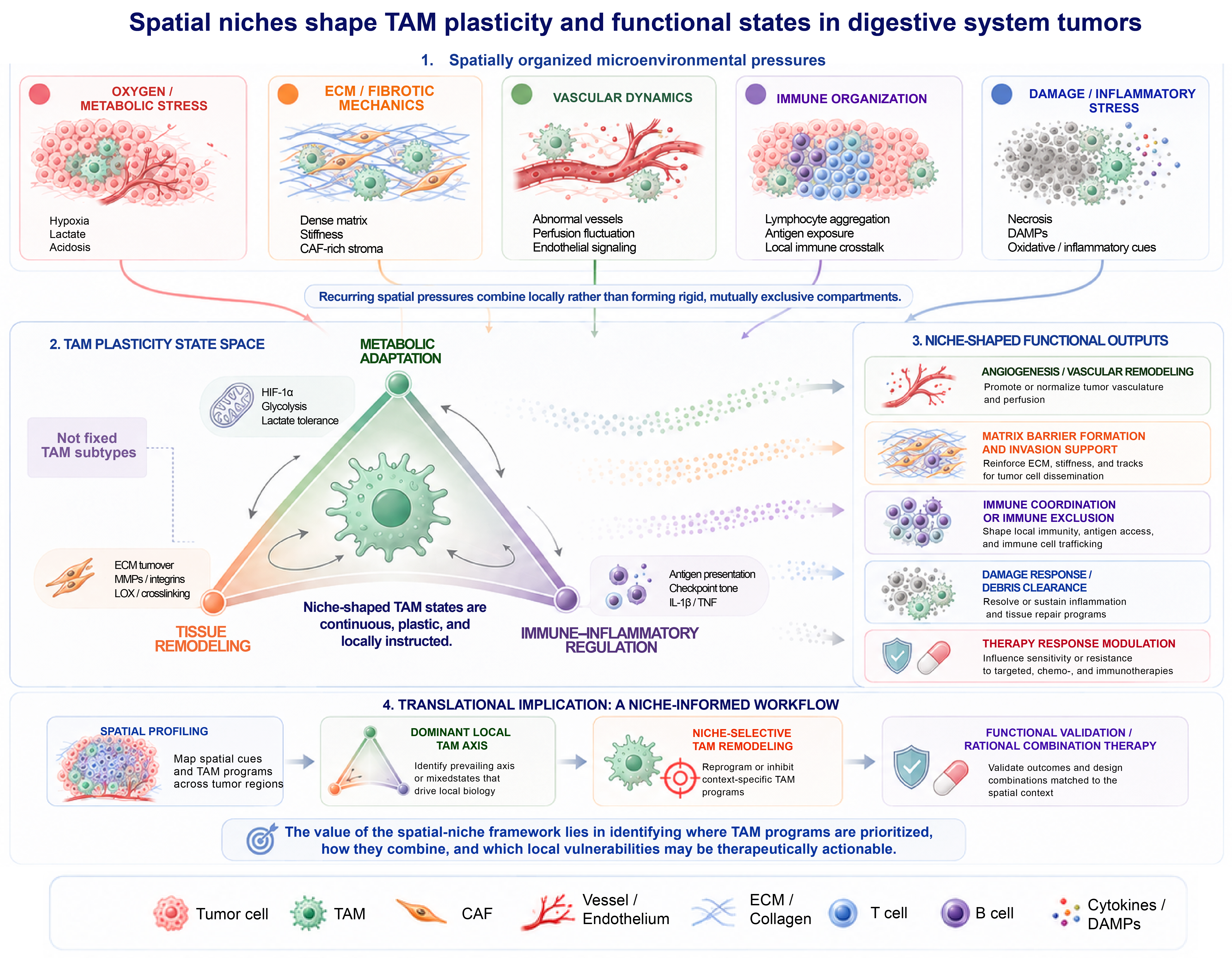
- A spatial niche-based framework is proposed to interpret tumor-associated macrophage heterogeneity in digestive system tumors.
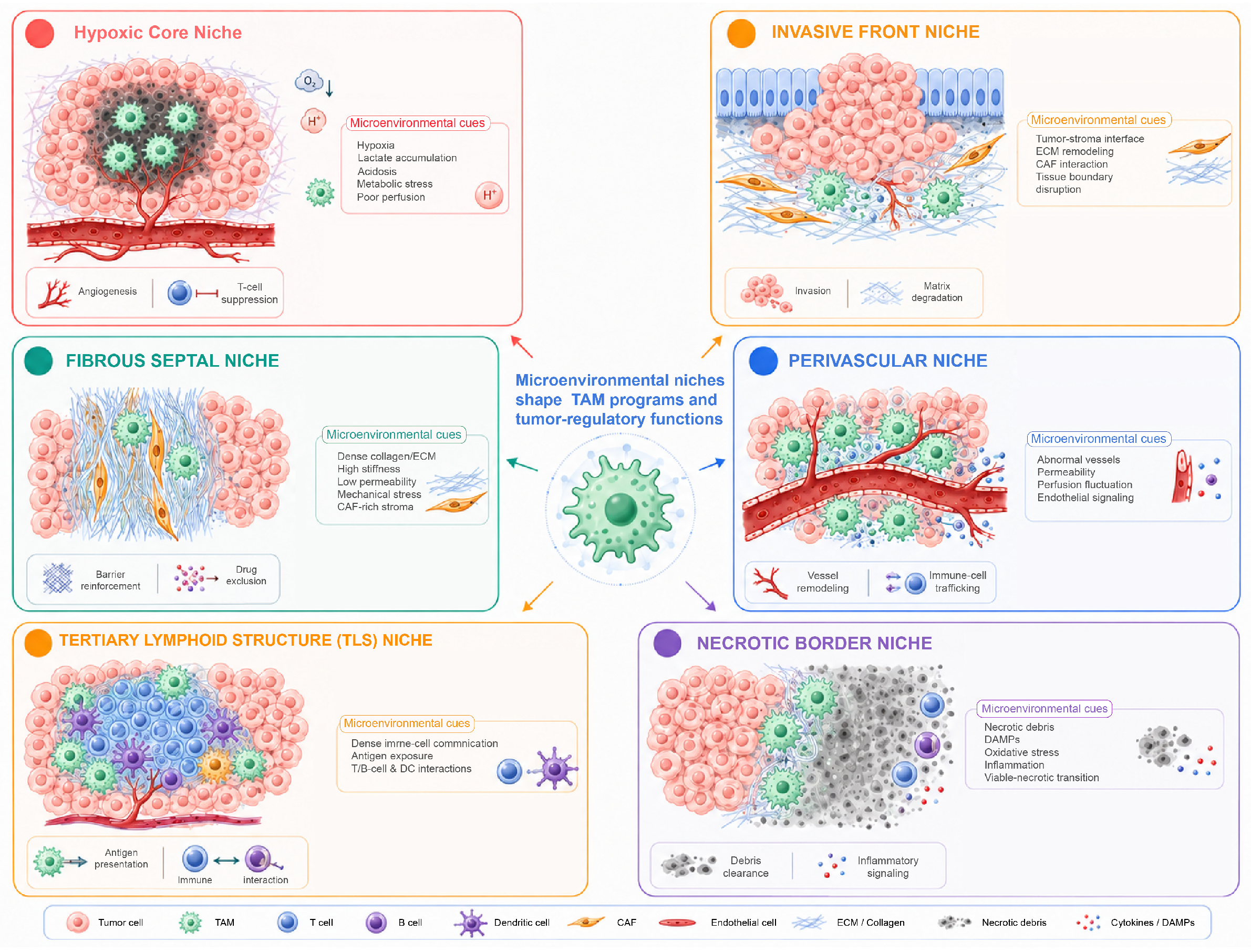
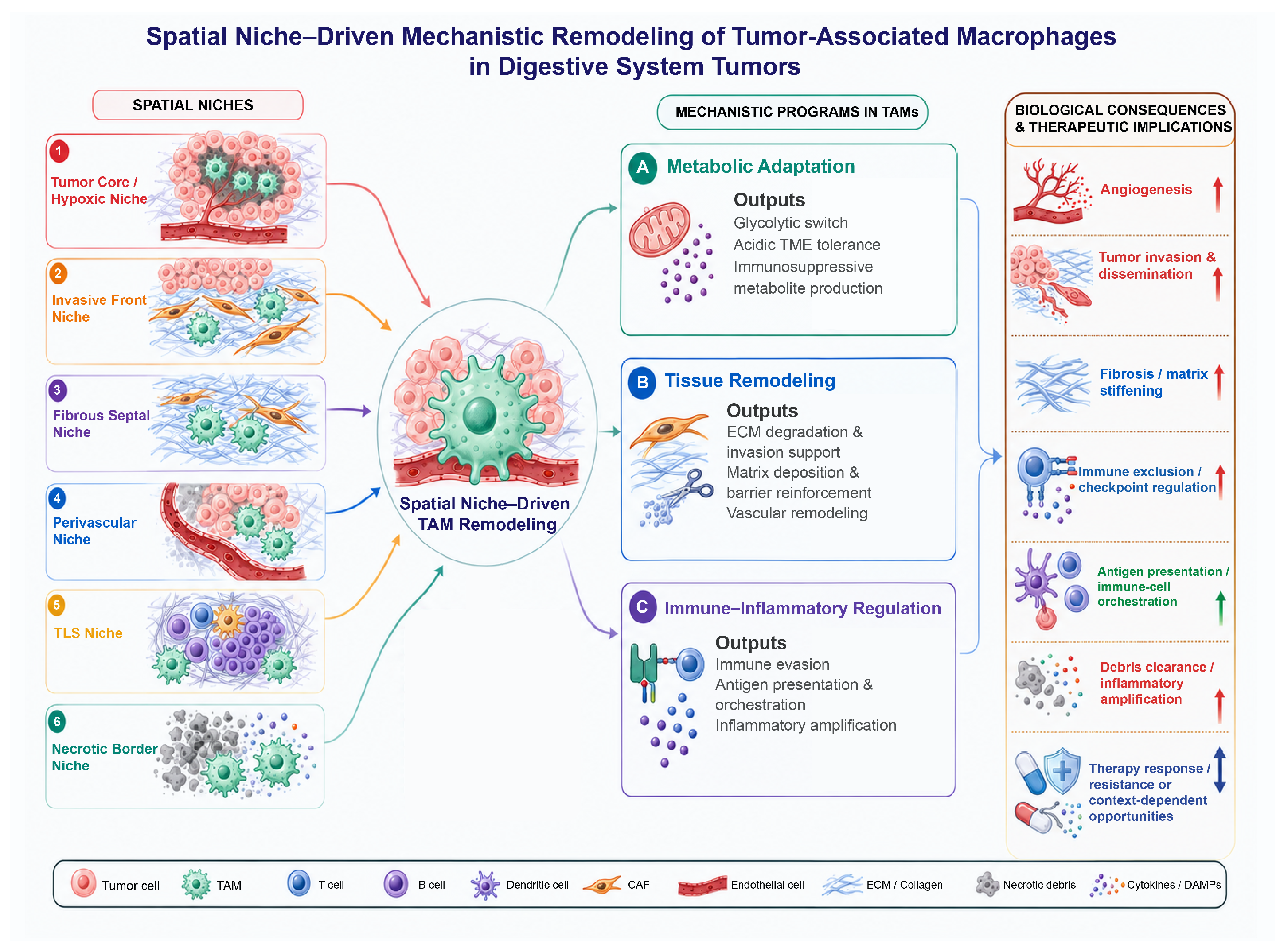
- Six recurrent spatial niches are integrated with functional axes linking microenvironmental cues to TAM programs and outputs.
- Spatial context provides a refined perspective beyond conventional TAM subtype classification.
- Niche-specific TAM programs offer potential targets for spatially guided immunotherapy.
Abstract
1. Introduction
2. Major Spatial Niches in Digestive System Tumors
2.1. Hypoxic Core
2.2. Invasive Front
2.3. Fibrotic Septa
2.4. Perivascular Regions
2.5. TLS-Adjacent Regions
2.6. Necrotic Borders
2.7. Summary
3. TAM Features and Functions Across Spatial Niches
3.1. TAM Features and Functions in the Hypoxic Core
3.2. TAM Features and Functions at the Invasive Front
3.3. TAM Features and Functions in Fibrotic Septa
3.4. TAM Features and Functions in Perivascular Regions
3.5. TAM Features and Functions in TLS-Adjacent Regions
3.6. TAM Features and Functions at Necrotic Borders
4. Cross-Niche Comparison: Major Functional Axes of TAM Spatial Heterogeneity
4.1. Basic Nature of Cross-Niche Heterogeneity
4.2. Three Functional Axes of Cross-Niche TAM Heterogeneity
5. Therapeutic Implications and Perspectives
5.1. Niche-Informed Intervention Directions
5.2. From “TAM Depletion” to “TAM Reprogramming”
5.3. Future Directions for Spatial Omics and Functional Validation
6. Conclusions
Author Contributions
Funding
Institutional Review Board Statement
Informed Consent Statement
Data Availability Statement
Acknowledgments
Conflicts of Interest
References
- Bray, F.; Laversanne, M.; Sung, H.; Ferlay, J.; Siegel, R.L.; Soerjomataram, I.; Jemal, A. Global cancer statistics 2022: GLOBOCAN estimates of incidence and mortality worldwide for 36 cancers in 185 countries. CA A Cancer J. Clin. 2024, 74, 229–263. [Google Scholar] [CrossRef] [PubMed]
- Danpanichkul, P.; Suparan, K.; Tothanarungroj, P.; Dejvajara, D.; Rakwong, K.; Pang, Y.; Barba, R.; Thongpiya, J.; Fallon, M.B.; Harnois, D.; et al. Epidemiology of gastrointestinal cancers: A systematic analysis from the Global Burden of Disease Study 2021. Gut 2024, 74, 26–34. [Google Scholar] [CrossRef] [PubMed]
- Bejarano, L.; Jordāo, M.J.C.; Joyce, J.A. Therapeutic Targeting of the Tumor Microenvironment. Cancer Discov. 2021, 11, 933–959. [Google Scholar] [CrossRef] [PubMed]
- Chen, D.; Zhang, X.; Li, Z.; Zhu, B. Metabolic regulatory crosstalk between tumor microenvironment and tumor-associated macrophages. Theranostics 2021, 11, 1016–1030. [Google Scholar] [CrossRef] [PubMed]
- Tiwari, A.; Trivedi, R.; Lin, S.Y. Tumor microenvironment: Barrier or opportunity towards effective cancer therapy. J. Biomed. Sci. 2022, 29, 83. [Google Scholar] [CrossRef] [PubMed]
- Kay, E.J.; Zanivan, S. The tumor microenvironment is an ecosystem sustained by metabolic interactions. Cell Rep. 2025, 44, 115432. [Google Scholar] [CrossRef] [PubMed]
- Jin, M.Z.; Jin, W.L. The updated landscape of tumor microenvironment and drug repurposing. Signal Transduct. Target. Ther. 2020, 5, 166. [Google Scholar] [CrossRef] [PubMed]
- Tang, T.; Huang, X.; Zhang, G.; Hong, Z.; Bai, X.; Liang, T. Advantages of targeting the tumor immune microenvironment over blocking immune checkpoint in cancer immunotherapy. Signal Transduct. Target. Ther. 2021, 6, 72. [Google Scholar] [CrossRef] [PubMed]
- Bareham, B.; Dibble, M.; Parsons, M. Defining and modeling dynamic spatial heterogeneity within tumor microenvironments. Curr. Opin. Cell Biol. 2024, 90, 102422. [Google Scholar] [CrossRef] [PubMed]
- Chai, X.; Tao, Q.; Li, L. Spatiotemporal Heterogeneity of Tumor Glucose Metabolism Reprogramming: From Single-Cell Mechanisms to Precision Interventions. Int. J. Mol. Sci. 2025, 26, 6901. [Google Scholar] [CrossRef] [PubMed]
- Liao, L.; Jin, Y.; Mao, W.; Zhu, J.; Chen, Q. Molecular mechanisms of TAM-regulated tumorigenesis and progression in various types of radiotherapy and future prospects of radiation-immunotherapy combinations. Biochim. Biophys. Acta Rev. Cancer 2025, 1880, 189434. [Google Scholar] [CrossRef] [PubMed]
- Wang, K.; Zhang, X.; Li, A.; Qiao, X.; Xu, Y. The mechanism of action and therapeutic potential of tumor-associated macrophages in tumor immune evasion. Front. Immunol. 2025, 16, 1545928. [Google Scholar] [CrossRef] [PubMed]
- Xiang, X.; Wang, J.; Lu, D.; Xu, X. Targeting tumor-associated macrophages to synergize tumor immunotherapy. Signal Transduct. Target. Ther. 2021, 6, 75. [Google Scholar] [CrossRef] [PubMed]
- Shi, X.; Wang, X.; Yao, W.; Shi, D.; Shao, X.; Lu, Z.; Chai, Y.; Song, J.; Tang, W.; Wang, X. Mechanism insights and therapeutic intervention of tumor metastasis: Latest developments and perspectives. Signal Transduct. Target. Ther. 2024, 9, 192. [Google Scholar] [CrossRef] [PubMed]
- Tang, W.; Wang, X.; Han, B.; Jiang, S.H.; Cao, H. Tumor-associated macrophages in cancer: From mechanisms to application. Mol. Biomed. 2025, 6, 145. [Google Scholar] [CrossRef] [PubMed]
- Díaz-Bulnes, P.; Saiz, M.L.; López-Larrea, C.; Rodríguez, R.M. Crosstalk Between Hypoxia and ER Stress Response: A Key Regulator of Macrophage Polarization. Front. Immunol. 2019, 10, 2951. [Google Scholar] [CrossRef] [PubMed]
- Guan, F.; Wang, R.; Yi, Z.; Luo, P.; Liu, W.; Xie, Y.; Liu, Z.; Xia, Z.; Zhang, H.; Cheng, Q. Tissue macrophages: Origin, heterogenity, biological functions, diseases and therapeutic targets. Signal Transduct. Target. Ther. 2025, 10, 93. [Google Scholar] [CrossRef] [PubMed]
- Russell, D.G.; Huang, L.; VanderVen, B.C. Immunometabolism at the interface between macrophages and pathogens. Nat. Rev. Immunol. 2019, 19, 291–304. [Google Scholar] [CrossRef] [PubMed]
- Qian, Y.; Yin, Y.; Zheng, X.; Liu, Z.; Wang, X. Metabolic regulation of tumor-associated macrophage heterogeneity: Insights into the tumor microenvironment and immunotherapeutic opportunities. Biomark. Res. 2024, 12, 1. [Google Scholar] [CrossRef] [PubMed]
- Yang, L.; Shao, Y.; Zhang, Z.; Li, Y.; Wang, F.; Yu, H. Metabolic insights into TAMs and the tumor immune microenvironment: Regulatory mechanisms and therapeutic interventions. Biochim. Biophys. Acta Rev. Cancer 2025, 1880, 189411. [Google Scholar] [CrossRef] [PubMed]
- Jiang, T.; Wang, B.; Wang, T.; Zhang, L.; Chen, X.; Zhao, X. TAM-Hijacked Immunoreaction Rescued by Hypoxia-Pathway-Intervened Strategy for Enhanced Metastatic Cancer Immunotherapy. Small 2024, 20, e2305728. [Google Scholar] [CrossRef] [PubMed]
- Kzhyshkowska, J.; Shen, J.; Larionova, I. Targeting of TAMs: Can we be more clever than cancer cells? Cell Mol. Immunol. 2024, 21, 1376–1409. [Google Scholar] [CrossRef] [PubMed]
- Karimova, A.F.; Khalitova, A.R.; Suezov, R.; Markov, N.; Mukhamedshina, Y.; Rizvanov, A.A.; Huber, M.; Simon, H.U.; Brichkina, A. Immunometabolism of tumor-associated macrophages: A therapeutic perspective. Eur. J. Cancer 2025, 220, 115332. [Google Scholar] [CrossRef] [PubMed]
- Xu, J.; Ding, L.; Mei, J.; Hu, Y.; Kong, X.; Dai, S.; Bu, T.; Xiao, Q.; Ding, K. Dual roles and therapeutic targeting of tumor-associated macrophages in tumor microenvironments. Signal Transduct. Target. Ther. 2025, 10, 268. [Google Scholar] [CrossRef] [PubMed]
- Neurath, M.F.; Artis, D.; Becker, C. The intestinal barrier: A pivotal role in health, inflammation, and cancer. Lancet Gastroenterol. Hepatol. 2025, 10, 573–592. [Google Scholar] [CrossRef] [PubMed]
- Wong, C.C.; Yu, J. Gut microbiota in colorectal cancer development and therapy. Nat. Rev. Clin. Oncol. 2023, 20, 429–452. [Google Scholar] [CrossRef] [PubMed]
- Pabst, O.; Hornef, M.W.; Schaap, F.G.; Cerovic, V.; Clavel, T.; Bruns, T. Gut-liver axis: Barriers and functional circuits. Nat. Rev. Gastroenterol. Hepatol. 2023, 20, 447–461. [Google Scholar] [CrossRef] [PubMed]
- Albillos, A.; de Gottardi, A.; Rescigno, M. The gut-liver axis in liver disease: Pathophysiological basis for therapy. J. Hepatol. 2020, 72, 558–577. [Google Scholar] [CrossRef] [PubMed]
- Heymann, F.; Tacke, F. Immunology in the liver--from homeostasis to disease. Nat. Rev. Gastroenterol. Hepatol. 2016, 13, 88–110. [Google Scholar] [CrossRef] [PubMed]
- Kung, H.C.; Zheng, K.W.; Zimmerman, J.W.; Zheng, L. The tumour microenvironment in pancreatic cancer—New clinical challenges, but more opportunities. Nat. Rev. Clin. Oncol. 2025, 22, 969–995. [Google Scholar] [CrossRef] [PubMed]
- Sun, C.; Wang, A.; Zhou, Y.; Chen, P.; Wang, X.; Huang, J.; Gao, J.; Wang, X.; Shu, L.; Lu, J.; et al. Spatially resolved multi-omics highlights cell-specific metabolic remodeling and interactions in gastric cancer. Nat. Commun. 2023, 14, 2692. [Google Scholar] [CrossRef] [PubMed]
- Ma, H.; Srivastava, S.; Ho, S.W.T.; Xu, C.; Lian, B.S.X.; Ong, X.; Tay, S.T.; Sheng, T.; Lum, H.Y.J.; Abdul Ghani, S.A.B.; et al. Spatially Resolved Tumor Ecosystems and Cell States in Gastric Adenocarcinoma Progression and Evolution. Cancer Discov. 2025, 15, 767–792. [Google Scholar] [CrossRef] [PubMed]
- Gulati, G.S.; D’Silva, J.P.; Liu, Y.; Wang, L.; Newman, A.M. Profiling cell identity and tissue architecture with single-cell and spatial transcriptomics. Nat. Rev. Mol. Cell Biol. 2025, 26, 11–31. [Google Scholar] [CrossRef] [PubMed]
- Longo, S.K.; Guo, M.G.; Ji, A.L.; Khavari, P.A. Integrating single-cell and spatial transcriptomics to elucidate intercellular tissue dynamics. Nat. Rev. Genet. 2021, 22, 627–644. [Google Scholar] [CrossRef] [PubMed]
- Chu, X.; Tian, Y.; Lv, C. Decoding the spatiotemporal heterogeneity of tumor-associated macrophages. Mol. Cancer 2024, 23, 150. [Google Scholar] [CrossRef] [PubMed]
- Matusiak, M.; Hickey, J.W.; van IJzendoorn, D.G.P.; Lu, G.; Kidziński, L.; Zhu, S.; Colburg, D.R.C.; Luca, B.; Phillips, D.J.; Brubaker, S.W.; et al. Spatially Segregated Macrophage Populations Predict Distinct Outcomes in Colon Cancer. Cancer Discov. 2024, 14, 1418–1439. [Google Scholar] [CrossRef] [PubMed]
- Wang, M.; Qin, Z.; Bian, X.W.; Shi, Y. Harnessing chimeric antigen receptor macrophages against solid tumors. Cancer Commun. 2025, 45, 1344–1366. [Google Scholar] [CrossRef] [PubMed]
- Schürch, C.M.; Bhate, S.S.; Barlow, G.L.; Phillips, D.J.; Noti, L.; Zlobec, I.; Chu, P.; Black, S.; Demeter, J.; McIlwain, D.R.; et al. Coordinated Cellular Neighborhoods Orchestrate Antitumoral Immunity at the Colorectal Cancer Invasive Front. Cell 2020, 182, 1341–1359.e19. [Google Scholar] [CrossRef] [PubMed]
- Suo, Y.; Thimme, R.; Bengsch, B. Spatial single-cell omics: New insights into liver diseases. Gut 2025, 75, 1248–1263. [Google Scholar] [CrossRef] [PubMed]
- Liao, S.; Zhou, X.; Liu, C.; Liu, C.; Hao, S.; Luo, H.; Hou, H.; Liu, Q.; Zhang, Z.; Xiao, L.; et al. Stereo-cell: Spatial enhanced-resolution single-cell sequencing with high-density DNA nanoball-patterned arrays. Science 2025, 389, eadr0475. [Google Scholar] [CrossRef] [PubMed]
- Ji, A.L.; Rubin, A.J.; Thrane, K.; Jiang, S.; Reynolds, D.L.; Meyers, R.M.; Guo, M.G.; George, B.M.; Mollbrink, A.; Bergenstråhle, J.; et al. Multimodal Analysis of Composition and Spatial Architecture in Human Squamous Cell Carcinoma. Cell 2020, 182, 497–514.e422. [Google Scholar] [CrossRef] [PubMed]
- Williams, H.L.; Dias Costa, A.; Zhang, J.; Raghavan, S.; Winter, P.S.; Kapner, K.S.; Ginebaugh, S.P.; Väyrynen, S.A.; Väyrynen, J.P.; Yuan, C.; et al. Spatially Resolved Single-Cell Assessment of Pancreatic Cancer Expression Subtypes Reveals Co-expressor Phenotypes and Extensive Intratumoral Heterogeneity. Cancer Res. 2023, 83, 441–455. [Google Scholar] [CrossRef] [PubMed]
- Ye, J.; Lin, Y.; Liao, Z.; Gao, X.; Lu, C.; Lu, L.; Huang, J.; Huang, X.; Huang, S.; Yu, H.; et al. Single cell-spatial transcriptomics and bulk multi-omics analysis of heterogeneity and ecosystems in hepatocellular carcinoma. npj Precis. Oncol. 2024, 8, 262. [Google Scholar] [CrossRef] [PubMed]
- Khaliq, A.M.; Rajamohan, M.; Saeed, O.; Mansouri, K.; Adil, A.; Zhang, C.; Turk, A.; Carstens, J.L.; House, M.; Hayat, S.; et al. Spatial transcriptomic analysis of primary and metastatic pancreatic cancers highlights tumor microenvironmental heterogeneity. Nat. Genet. 2024, 56, 2455–2465. [Google Scholar] [CrossRef] [PubMed]
- Zhao, X.; Ren, T.; Li, S.; Wang, X.; Hou, R.; Guan, Z.; Liu, D.; Zheng, J.; Shi, M. A new perspective on the therapeutic potential of tumor metastasis: Targeting the metabolic interactions between TAMs and tumor cells. Int. J. Biol. Sci. 2024, 20, 5109–5126. [Google Scholar] [CrossRef] [PubMed]
- Zhang, J.; Fan, J.; Zeng, X.; Nie, M.; Luan, J.; Wang, Y.; Ju, D.; Yin, K. Hedgehog signaling in gastrointestinal carcinogenesis and the gastrointestinal tumor microenvironment. Acta Pharm. Sin. B 2021, 11, 609–620. [Google Scholar] [CrossRef] [PubMed]
- Chen, S.; Xu, Y.; Zhuo, W.; Zhang, L. The emerging role of lactate in tumor microenvironment and its clinical relevance. Cancer Lett. 2024, 590, 216837. [Google Scholar] [CrossRef] [PubMed]
- Sun, K.; Shen, Y.; Xiao, X.; Xu, H.; Zhang, Q.; Li, M. Crosstalk between lactate and tumor-associated immune cells: Clinical relevance and insight. Front. Oncol. 2024, 14, 1506849. [Google Scholar] [CrossRef] [PubMed]
- Wang, Y.; Jia, J.; Wang, F.; Fang, Y.; Yang, Y.; Zhou, Q.; Yuan, W.; Gu, X.; Hu, J.; Yang, S. Pre-metastatic niche: Formation, characteristics and therapeutic implication. Signal Transduct. Target. Ther. 2024, 9, 236. [Google Scholar] [CrossRef] [PubMed]
- Bakleh, M.Z.; Al Haj Zen, A. The Distinct Role of HIF-1α and HIF-2α in Hypoxia and Angiogenesis. Cells 2025, 14, 673. [Google Scholar] [CrossRef] [PubMed]
- Pavlova, N.N.; Thompson, C.B. The Emerging Hallmarks of Cancer Metabolism. Cell Metab. 2016, 23, 27–47. [Google Scholar] [CrossRef] [PubMed]
- Guo, X.; Zhang, H.; He, C.; Qin, K.; Lai, Q.; Fang, Y.; Chen, Q.; Li, W.; Wang, Y.; Wang, X.; et al. RUNX1 promotes angiogenesis in colorectal cancer by regulating the crosstalk between tumor cells and tumor associated macrophages. Biomark. Res. 2024, 12, 29. [Google Scholar] [CrossRef] [PubMed]
- Li, N.; Zhu, Q.; Tian, Y.; Ahn, K.J.; Wang, X.; Cramer, Z.; Jou, J.; Folkert, I.W.; Yu, P.; Adams-Tzivelekidis, S.; et al. Mapping and modeling human colorectal carcinoma interactions with the tumor microenvironment. Nat. Commun. 2023, 14, 7915. [Google Scholar] [CrossRef] [PubMed]
- Li, K.; Zhang, R.; Wen, F.; Zhao, Y.; Meng, F.; Li, Q.; Hao, A.; Yang, B.; Lu, Z.; Cui, Y.; et al. Single-cell dissection of the multicellular ecosystem and molecular features underlying microvascular invasion in HCC. Hepatology 2024, 79, 1293–1309. [Google Scholar] [CrossRef] [PubMed]
- Sattiraju, A.; Kang, S.; Giotti, B.; Chen, Z.; Marallano, V.J.; Brusco, C.; Ramakrishnan, A.; Shen, L.; Tsankov, A.M.; Hambardzumyan, D.; et al. Hypoxic niches attract and sequester tumor-associated macrophages and cytotoxic T cells and reprogram them for immunosuppression. Immunity 2023, 56, 1825–1843.e1826. [Google Scholar] [CrossRef] [PubMed]
- Henze, A.T.; Mazzone, M. The impact of hypoxia on tumor-associated macrophages. J. Clin. Investig. 2016, 126, 3672–3679. [Google Scholar] [CrossRef] [PubMed]
- Chen, K.; Feng, H.; Zhang, Y.; Pei, J.; Xu, Y.; Wei, X.; Chen, Z.; Feng, Z.; Cai, L.; Li, Y.; et al. Tumor-derived CCL16 Normalizes Tumor Vasculature through Macrophage ICAM-1 Receptor and Enhances Immunotherapy Efficacy in Hepatocellular Carcinoma. Cancer Res. 2025, 85, 3633–3650. [Google Scholar] [CrossRef] [PubMed]
- Long, F.; Zhong, W.; Zhao, F.; Xu, Y.; Hu, X.; Jia, G.; Huang, L.; Yi, K.; Wang, N.; Si, H.; et al. DAB2 (+) macrophages support FAP (+) fibroblasts in shaping tumor barrier and inducing poor clinical outcomes in liver cancer. Theranostics 2024, 14, 4822–4843. [Google Scholar] [CrossRef] [PubMed]
- Zhou, X.; Zhang, C.; Yang, S.; Yang, L.; Luo, W.; Zhang, W.; Zhang, X.; Chao, J. Macrophage-derived MMP12 promotes fibrosis through sustained damage to endothelial cells. J. Hazard. Mater. 2024, 461, 132733. [Google Scholar] [CrossRef] [PubMed]
- Zhan, T.; Zou, Y.; Han, Z.; Tian, X.; Chen, M.; Liu, J.; Yang, X.; Zhu, Q.; Liu, M.; Chen, W.; et al. Single-cell sequencing combined with spatial transcriptomics reveals that the IRF7 gene in M1 macrophages inhibits the occurrence of pancreatic cancer by regulating lipid metabolism-related mechanisms. Clin. Transl. Med. 2024, 14, e1799. [Google Scholar] [CrossRef] [PubMed]
- Feng, Y.; Ma, W.; Zang, Y.; Guo, Y.; Li, Y.; Zhang, Y.; Dong, X.; Liu, Y.; Zhan, X.; Pan, Z.; et al. Spatially organized tumor-stroma boundary determines the efficacy of immunotherapy in colorectal cancer patients. Nat. Commun. 2024, 15, 10259. [Google Scholar] [CrossRef] [PubMed]
- Zhou, P.Y.; Zhou, C.; Gan, W.; Tang, Z.; Sun, B.Y.; Huang, J.L.; Liu, G.; Liu, W.R.; Tian, M.X.; Jiang, X.F.; et al. Single-cell and spatial architecture of primary liver cancer. Commun. Biol. 2023, 6, 1181. [Google Scholar] [CrossRef] [PubMed]
- Tan, Y.; Yang, Y.G.; Zhang, X.; Zhao, L.; Wang, X.; Liu, W. Tumor cell-derived osteopontin promotes tumor fibrosis indirectly via tumor-associated macrophages. J. Transl. Med. 2025, 23, 432. [Google Scholar] [CrossRef] [PubMed]
- Conte, E. Targeting monocytes/macrophages in fibrosis and cancer diseases: Therapeutic approaches. Pharmacol. Ther. 2022, 234, 108031. [Google Scholar] [CrossRef] [PubMed]
- Qiu, X.; Zhou, T.; Li, S.; Wu, J.; Tang, J.; Ma, G.; Yang, S.; Hu, J.; Wang, K.; Shen, S.; et al. Spatial single-cell protein landscape reveals vimentin(high) macrophages as immune-suppressive in the microenvironment of hepatocellular carcinoma. Nat. Cancer 2024, 5, 1557–1578. [Google Scholar] [CrossRef] [PubMed]
- Lemaitre, L.; Adeniji, N.; Suresh, A.; Reguram, R.; Zhang, J.; Park, J.; Reddy, A.; Trevino, A.E.; Mayer, A.T.; Deutzmann, A.; et al. Spatial analysis reveals targetable macrophage-mediated mechanisms of immune evasion in hepatocellular carcinoma minimal residual disease. Nat. Cancer 2024, 5, 1534–1556. [Google Scholar] [CrossRef] [PubMed]
- Neesse, A.; Michl, P.; Frese, K.K.; Feig, C.; Cook, N.; Jacobetz, M.A.; Lolkema, M.P.; Buchholz, M.; Olive, K.P.; Gress, T.M.; et al. Stromal biology and therapy in pancreatic cancer. Gut 2011, 60, 861–868. [Google Scholar] [CrossRef] [PubMed]
- Heinrich, M.A.; Uboldi, I.; Kuninty, P.R.; Ankone, M.J.K.; van Baarlen, J.; Zhang, Y.S.; Jain, K.; Prakash, J. Microarchitectural mimicking of stroma-induced vasculature compression in pancreatic tumors using a 3D engineered model. Bioact. Mater. 2023, 22, 18–33. [Google Scholar] [CrossRef] [PubMed]
- Zhang, Y.; Fu, Q.; Sun, W.; Yue, Q.; He, P.; Niu, D.; Zhang, M. Mechanical forces in the tumor microenvironment: Roles, pathways, and therapeutic approaches. J. Transl. Med. 2025, 23, 313. [Google Scholar] [CrossRef] [PubMed]
- Lewis, C.E.; Harney, A.S.; Pollard, J.W. The Multifaceted Role of Perivascular Macrophages in Tumors. Cancer Cell 2016, 30, 18–25. [Google Scholar] [CrossRef] [PubMed]
- Harney, A.S.; Arwert, E.N.; Entenberg, D.; Wang, Y.; Guo, P.; Qian, B.Z.; Oktay, M.H.; Pollard, J.W.; Jones, J.G.; Condeelis, J.S. Real-Time Imaging Reveals Local, Transient Vascular Permeability, and Tumor Cell Intravasation Stimulated by TIE2hi Macrophage-Derived VEGFA. Cancer Discov. 2015, 5, 932–943. [Google Scholar] [CrossRef] [PubMed]
- Kabir, A.U.; Subramanian, M.; Kwon, Y.; Choi, K. Linking tumour angiogenesis and tumour immunity. Nat. Rev. Immunol. 2025, 26, 35–51. [Google Scholar] [CrossRef] [PubMed]
- Sussman, J.H.; Kim, N.; Kemp, S.B.; Traum, D.; Katsuda, T.; Kahn, B.M.; Xu, J.; Kim, I.K.; Eskandarian, C.; Delman, D.; et al. Multiplexed Imaging Mass Cytometry Analysis Characterizes the Vascular Niche in Pancreatic Cancer. Cancer Res. 2024, 84, 2364–2376. [Google Scholar] [CrossRef] [PubMed]
- DuFort, C.C.; DelGiorno, K.E.; Carlson, M.A.; Osgood, R.J.; Zhao, C.; Huang, Z.; Thompson, C.B.; Connor, R.J.; Thanos, C.D.; Scott Brockenbrough, J.; et al. Interstitial Pressure in Pancreatic Ductal Adenocarcinoma Is Dominated by a Gel-Fluid Phase. Biophys. J. 2016, 110, 2106–2119. [Google Scholar] [CrossRef] [PubMed]
- Tsuzuki, Y.; Mouta Carreira, C.; Bockhorn, M.; Xu, L.; Jain, R.K.; Fukumura, D. Pancreas microenvironment promotes VEGF expression and tumor growth: Novel window models for pancreatic tumor angiogenesis and microcirculation. Lab. Investig. 2001, 81, 1439–1451. [Google Scholar] [CrossRef] [PubMed]
- Joyce, J.A.; Fearon, D.T. T cell exclusion, immune privilege, and the tumor microenvironment. Science 2015, 348, 74–80. [Google Scholar] [CrossRef] [PubMed]
- Niu, L.; Chen, T.; Yang, A.; Yan, X.; Jin, F.; Zheng, A.; Song, X. Macrophages and tertiary lymphoid structures as indicators of prognosis and therapeutic response in cancer patients. Biochim. Biophys. Acta Rev. Cancer 2024, 1879, 189125. [Google Scholar] [CrossRef] [PubMed]
- Li, X.; Chu, X.; Xu, W.; Yang, Y.; Wei, T.; Bo, Y.; Miao, Y.; Zhang, Y.; Wang, J.; Wang, T.; et al. Integrated spatial transcriptomic profiling to dissect the cellular characteristics of tumor-associated tertiary lymphoid structures. Cell Rep. 2025, 44, 116250. [Google Scholar] [CrossRef] [PubMed]
- Sawada, J.; Kikuchi, Y.; Duah, M.; Herrera, J.L.; Kanamori, F.; Csomos, K.; Stansel, T.; Hiraoka, N.; Yoshida, M.; Walter, J.; et al. Simultaneous STING and lymphotoxin-β receptor activation induces B cell responses in tertiary lymphoid structures to potentiate antitumor immunity. Nat. Immunol. 2025, 26, 1766–1780. [Google Scholar] [CrossRef] [PubMed]
- Petitprez, F.; de Reyniès, A.; Keung, E.Z.; Chen, T.W.; Sun, C.M.; Calderaro, J.; Jeng, Y.M.; Hsiao, L.P.; Lacroix, L.; Bougoüin, A.; et al. B cells are associated with survival and immunotherapy response in sarcoma. Nature 2020, 577, 556–560. [Google Scholar] [CrossRef] [PubMed]
- Milardi, G.; Franceschini, B.; Camisaschi, C.; Puccio, S.; Costa, G.; Soldani, C.; Uva, P.; Cangelosi, D.; Carriero, R.; Lambroia, L.; et al. Immunosuppressive contribution of tumour-infiltrating B cells in human intrahepatic cholangiocarcinoma and their role in chemoimmunotherapy outcome. Gut 2025, 75, 1097–1109. [Google Scholar] [CrossRef] [PubMed]
- Xie, Y.; Peng, H.; Hu, Y.; Jia, K.; Yuan, J.; Liu, D.; Li, Y.; Feng, X.; Li, J.; Zhang, X.; et al. Immune microenvironment spatial landscapes of tertiary lymphoid structures in gastric cancer. BMC Med. 2025, 23, 59. [Google Scholar] [CrossRef] [PubMed]
- Groen-van Schooten, T.S.; Franco Fernandez, R.; van Grieken, N.C.T.; Bos, E.N.; Seidel, J.; Saris, J.; Martínez-Ciarpaglini, C.; Fleitas, T.C.; Thommen, D.S.; de Gruijl, T.D.; et al. Mapping the complexity and diversity of tertiary lymphoid structures in primary and peritoneal metastatic gastric cancer. J. Immunother. Cancer 2024, 12, e009243. [Google Scholar] [CrossRef] [PubMed]
- Low, J.T.; Ho, P.C.; Matsushita, M. TAM-tastic: From resistance to resilience in cancer. Trends Pharmacol. Sci. 2024, 45, 953–954. [Google Scholar] [CrossRef] [PubMed]
- Shu, D.H.; Ho, W.J.; Kagohara, L.T.; Girgis, A.; Shin, S.M.; Danilova, L.; Lee, J.W.; Sidiropoulos, D.N.; Mitchell, S.; Munjal, K.; et al. Immunotherapy response induces divergent tertiary lymphoid structure morphologies in hepatocellular carcinoma. Nat. Immunol. 2024, 25, 2110–2123. [Google Scholar] [CrossRef] [PubMed]
- Wang, Q.; Zhong, W.; Shen, X.; Hao, Z.; Wan, M.; Yang, X.; An, R.; Zhu, H.; Cai, H.; Li, T.; et al. Tertiary lymphoid structures predict survival and response to neoadjuvant therapy in locally advanced rectal cancer. NPJ Precis. Oncol. 2024, 8, 61. [Google Scholar] [CrossRef] [PubMed]
- Bruchard, M.; Mignot, G.; Derangère, V.; Chalmin, F.; Chevriaux, A.; Végran, F.; Boireau, W.; Simon, B.; Ryffel, B.; Connat, J.L.; et al. Chemotherapy-triggered cathepsin B release in myeloid-derived suppressor cells activates the Nlrp3 inflammasome and promotes tumor growth. Nat. Med. 2013, 19, 57–64. [Google Scholar] [CrossRef] [PubMed]
- Yang, N.; Li, X.; Huang, W.; Ji, G.; Luo, W.; Jiang, F.; Zeng, H.; Chen, Y.; Chen, Y.; Qiao, L.; et al. MLKL PARylation in the endothelial niche triggers angiocrine necroptosis to evade cancer immunosurveillance and chemotherapy. Nat. Cell Biol. 2025, 27, 1526–1542. [Google Scholar] [CrossRef] [PubMed]
- Bai, X.; Guo, Y.R.; Zhao, Z.M.; Li, X.Y.; Dai, D.Q.; Zhang, J.K.; Li, Y.S.; Zhang, C.D. Macrophage polarization in cancer and beyond: From inflammatory signaling pathways to potential therapeutic strategies. Cancer Lett. 2025, 625, 217772. [Google Scholar] [CrossRef] [PubMed]
- Aktay-Cetin, Ö.; Pullamsetti, S.S.; Herold, S.; Savai, R. Lung tumor immunity: Redirecting macrophages through infection-induced inflammation. Trends Immunol. 2025, 46, 471–484. [Google Scholar] [CrossRef] [PubMed]
- Zhang, S.; Yu, B.; Sheng, C.; Yao, C.; Liu, Y.; Wang, J.; Zeng, Q.; Mao, Y.; Bei, J.; Zhu, B.; et al. SHISA3 Reprograms Tumor-Associated Macrophages Toward an Antitumoral Phenotype and Enhances Cancer Immunotherapy. Adv. Sci. 2024, 11, e2403019. [Google Scholar] [CrossRef] [PubMed]
- Songjang, W.; Paiyabhroma, N.; Srisuwan, C.; Promchai, S.; Nensat, C.; Pankhong, P.; Kumphune, S.; Jiraviriyakul, A. Chemotherapy-derived DAMPs drive reprogramming of tumor-associated macrophages toward a pro-inflammatory phenotype in hepatocellular carcinoma. Sci. Rep. 2026, 16, 17440. [Google Scholar] [CrossRef] [PubMed]
- Hänggi, K.; Li, J.; Gangadharan, A.; Liu, X.; Celias, D.P.; Osunmakinde, O.; Keske, A.; Davis, J.; Ahmad, F.; Giron, A.; et al. Interleukin-1α release during necrotic-like cell death generates myeloid-driven immunosuppression that restricts anti-tumor immunity. Cancer Cell 2024, 42, 2015–2031.e2011. [Google Scholar] [CrossRef] [PubMed]
- Ji, Y.; Jiang, J.; Hu, L.; Lin, P.; Zhou, M.; Hu, S.; Wang, M.; Ji, Y.; Liu, X.; Yan, D.; et al. Targeting necrotic lipid release in tumors enhances immunosurveillance and cancer immunotherapy of glioblastoma. Cell Res. 2025, 35, 859–875. [Google Scholar] [CrossRef] [PubMed]
- Fan, G.; Xie, T.; Li, L.; Tang, L.; Han, X.; Shi, Y. Single-cell and spatial analyses revealed the co-location of cancer stem cells and SPP1+ macrophage in hypoxic region that determines the poor prognosis in hepatocellular carcinoma. NPJ Precis. Oncol. 2024, 8, 75. [Google Scholar] [CrossRef] [PubMed]
- Caronni, N.; La Terza, F.; Vittoria, F.M.; Barbiera, G.; Mezzanzanica, L.; Cuzzola, V.; Barresi, S.; Pellegatta, M.; Canevazzi, P.; Dunsmore, G.; et al. IL-1β(+) macrophages fuel pathogenic inflammation in pancreatic cancer. Nature 2023, 623, 415–422. [Google Scholar] [CrossRef] [PubMed]
- Mosser, D.M.; Edwards, J.P. Exploring the full spectrum of macrophage activation. Nat. Rev. Immunol. 2008, 8, 958–969. [Google Scholar] [CrossRef] [PubMed]
- Nahrendorf, M.; Swirski, F.K. Abandoning M1/M2 for a Network Model of Macrophage Function. Circ. Res. 2016, 119, 414–417. [Google Scholar] [CrossRef] [PubMed]
- Li, S.; Yu, J.; Huber, A.; Kryczek, I.; Wang, Z.; Jiang, L.; Li, X.; Du, W.; Li, G.; Wei, S.; et al. Metabolism drives macrophage heterogeneity in the tumor microenvironment. Cell Rep. 2022, 39, 110609. [Google Scholar] [CrossRef] [PubMed]
- Paolini, L.; Adam, C.; Beauvillain, C.; Preisser, L.; Blanchard, S.; Pignon, P.; Seegers, V.; Chevalier, L.M.; Campone, M.; Wernert, R.; et al. Lactic Acidosis Together with GM-CSF and M-CSF Induces Human Macrophages toward an Inflammatory Protumor Phenotype. Cancer Immunol. Res. 2020, 8, 383–395. [Google Scholar] [CrossRef] [PubMed]
- Zhang, L.; Li, S. Lactic acid promotes macrophage polarization through MCT-HIF1α signaling in gastric cancer. Exp. Cell Res. 2020, 388, 111846. [Google Scholar] [CrossRef] [PubMed]
- Lin, Z.; Hua, H.; Huang, Y.; Li, X.; Liang, Y.; Yi, T.; Jin, H.; Wu, J.; Wan, Y.; Li, G. Hypoxia drives ANGPTL4 expression in tumor-associated macrophages and promotes intrahepatic cholangiocarcinoma intrahepatic metastasis. Cancer Lett. 2026, 656, 218614. [Google Scholar] [CrossRef] [PubMed]
- Zhou, J.; Shi, G.; Dai, S.; Wu, S.; Qian, F.; Wu, Z.; Zhang, J.; Yang, Y.; Xiao, B.; Lu, Z.; et al. Single-cell spatial transcriptional profiling of pancreatic ductal adenocarcinoma uncovers key immune-modulating and pro-metastatic mechanisms. Cancer Lett. 2026, 655, 218613. [Google Scholar] [CrossRef] [PubMed]
- Casazza, A.; Laoui, D.; Wenes, M.; Rizzolio, S.; Bassani, N.; Mambretti, M.; Deschoemaeker, S.; Van Ginderachter, J.A.; Tamagnone, L.; Mazzone, M. Impeding macrophage entry into hypoxic tumor areas by Sema3A/Nrp1 signaling blockade inhibits angiogenesis and restores antitumor immunity. Cancer Cell 2013, 24, 695–709. [Google Scholar] [CrossRef] [PubMed]
- Hannifin, S.; Mello, A.M.; Ngodup, T.; Kim, N.H.; Pasca di Magliano, M.; Lee, K.E. Hypoxia-Induced Fibroblast IL-6 Promotes Immunosuppressive Macrophage Phenotypes in Pancreatic Cancer. Cells 2026, 15, 683. [Google Scholar] [CrossRef] [PubMed]
- Colegio, O.R.; Chu, N.Q.; Szabo, A.L.; Chu, T.; Rhebergen, A.M.; Jairam, V.; Cyrus, N.; Brokowski, C.E.; Eisenbarth, S.C.; Phillips, G.M.; et al. Functional polarization of tumour-associated macrophages by tumour-derived lactic acid. Nature 2014, 513, 559–563. [Google Scholar] [CrossRef] [PubMed]
- Sun, K.; Zhang, X.; Shi, J.; Huang, J.; Wang, S.; Li, X.; Lin, H.; Zhao, D.; Ye, M.; Zhang, S.; et al. Elevated protein lactylation promotes immunosuppressive microenvironment and therapeutic resistance in pancreatic ductal adenocarcinoma. J. Clin. Investig. 2025, 135, e187024. [Google Scholar] [CrossRef] [PubMed]
- Provenzano, P.P.; Cuevas, C.; Chang, A.E.; Goel, V.K.; Von Hoff, D.D.; Hingorani, S.R. Enzymatic targeting of the stroma ablates physical barriers to treatment of pancreatic ductal adenocarcinoma. Cancer Cell 2012, 21, 418–429. [Google Scholar] [CrossRef] [PubMed]
- Minamide, T.; Minakata, N.; Yamashita, R.; Sakashita, S.; Yoda, Y.; Ohashi, A.; Aoshima, M.; Kobayashi, S.; Yano, T. Oxygen saturation imaging elucidates tumor heterogeneity in gastric cancer. DEN Open 2025, 5, e70077. [Google Scholar] [CrossRef] [PubMed]
- Wu, L.; Yan, J.; Bai, Y.; Chen, F.; Zou, X.; Xu, J.; Huang, A.; Hou, L.; Zhong, Y.; Jing, Z.; et al. An invasive zone in human liver cancer identified by Stereo-seq promotes hepatocyte-tumor cell crosstalk, local immunosuppression and tumor progression. Cell Res. 2023, 33, 585–603. [Google Scholar] [CrossRef] [PubMed]
- Qiu, L.; Zhao, X.; Yao, S.; Fei, Y.; Gong, Y.; Zhou, Z.; Jiao, S.; Xu, J. Multi-omics analyses reveal interactions between GREM1+ fibroblasts and SPP1+ macrophages in gastric cancer. NPJ Precis. Oncol. 2025, 9, 164. [Google Scholar] [CrossRef] [PubMed]
- Yu, J.; Xu, Z.; Guo, J.; Yang, K.; Zheng, J.; Sun, X. Tumor-associated macrophages (TAMs) depend on MMP1 for their cancer-promoting role. Cell Death Discov. 2021, 7, 343. [Google Scholar] [CrossRef] [PubMed]
- Ma, G.; Liu, X.; Jiang, Q.; Li, S.; Wu, Q.; Liang, B.; Sun, F.; Gu, C.; Liao, W.; Zhang, Z.; et al. Identification of a stromal immunosuppressive barrier orchestrated by SPP1(+)/C1QC(+) macrophages and CD8(+) exhausted T cells driving gastric cancer immunotherapy resistance. Front. Immunol. 2025, 16, 1618591. [Google Scholar] [CrossRef] [PubMed]
- Ozato, Y.; Kojima, Y.; Kobayashi, Y.; Hisamatsu, Y.; Toshima, T.; Yonemura, Y.; Masuda, T.; Kagawa, K.; Goto, Y.; Utou, M.; et al. Spatial and single-cell transcriptomics decipher the cellular environment containing HLA-G+ cancer cells and SPP1+ macrophages in colorectal cancer. Cell Rep. 2023, 42, 111929. [Google Scholar] [CrossRef] [PubMed]
- Cardoso, A.P.; Pinto, M.L.; Pinto, A.T.; Oliveira, M.I.; Pinto, M.T.; Gonçalves, R.; Relvas, J.B.; Figueiredo, C.; Seruca, R.; Mantovani, A.; et al. Macrophages stimulate gastric and colorectal cancer invasion through EGFR Y(1086), c-Src, Erk1/2 and Akt phosphorylation and smallGTPase activity. Oncogene 2014, 33, 2123–2133. [Google Scholar] [CrossRef] [PubMed]
- Pelka, K.; Hofree, M.; Chen, J.H.; Sarkizova, S.; Pirl, J.D.; Jorgji, V.; Bejnood, A.; Dionne, D.; Ge, W.H.; Xu, K.H.; et al. Spatially organized multicellular immune hubs in human colorectal cancer. Cell 2021, 184, 4734–4752.e20. [Google Scholar] [CrossRef] [PubMed]
- Weng, Y.; Wang, L.; Wang, Y.; Xu, J.; Fan, X.; Luo, S.; Hua, Q.; Xu, J.; Liu, G.; Zhao, K.B.; et al. Spatial Organization of Macrophages in CTL-Rich Hepatocellular Carcinoma Influences CTL Antitumor Activity. Cancer Immunol. Res. 2025, 13, 310–322. [Google Scholar] [CrossRef] [PubMed]
- Jacobetz, M.A.; Chan, D.S.; Neesse, A.; Bapiro, T.E.; Cook, N.; Frese, K.K.; Feig, C.; Nakagawa, T.; Caldwell, M.E.; Zecchini, H.I.; et al. Hyaluronan impairs vascular function and drug delivery in a mouse model of pancreatic cancer. Gut 2013, 62, 112–120. [Google Scholar] [CrossRef] [PubMed]
- Netti, P.A.; Berk, D.A.; Swartz, M.A.; Grodzinsky, A.J.; Jain, R.K. Role of extracellular matrix assembly in interstitial transport in solid tumors. Cancer Res. 2000, 60, 2497–2503. [Google Scholar] [PubMed]
- Raskov, H.; Orhan, A.; Gaggar, S.; Gögenur, I. Cancer-Associated Fibroblasts and Tumor-Associated Macrophages in Cancer and Cancer Immunotherapy. Front. Oncol. 2021, 11, 668731. [Google Scholar] [CrossRef] [PubMed]
- Li, E.; Cheung, H.C.Z.; Ma, S. CTHRC1(+) fibroblasts and SPP1(+) macrophages synergistically contribute to pro-tumorigenic tumor microenvironment in pancreatic ductal adenocarcinoma. Sci. Rep. 2024, 14, 17412. [Google Scholar] [CrossRef] [PubMed]
- Wang, Y.; Yue, B.; Ni, H.; Chen, J.; Shi, R.; Wang, Z.; Dai, X.; Sheng, M. POSTN+ cancer-associated fibroblast-CCL3+ macrophage crosstalk defines the immune-excluded tumor microenvironment in clear cell renal cell carcinoma. Transl. Oncol. 2026, 65, 102682. [Google Scholar] [CrossRef] [PubMed]
- Raymant, M.; Astuti, Y.; Alvaro-Espinosa, L.; Green, D.; Quaranta, V.; Bellomo, G.; Glenn, M.; Chandran-Gorner, V.; Palmer, D.H.; Halloran, C.; et al. Macrophage-fibroblast JAK/STAT dependent crosstalk promotes liver metastatic outgrowth in pancreatic cancer. Nat. Commun. 2024, 15, 3593. [Google Scholar] [CrossRef] [PubMed]
- DuFort, C.C.; Paszek, M.J.; Weaver, V.M. Balancing forces: Architectural control of mechanotransduction. Nat. Rev. Mol. Cell Biol. 2011, 12, 308–319. [Google Scholar] [CrossRef] [PubMed]
- Totaro, A.; Panciera, T.; Piccolo, S. YAP/TAZ upstream signals and downstream responses. Nat. Cell Biol. 2018, 20, 888–899. [Google Scholar] [CrossRef] [PubMed]
- Gong, L.; Zhang, Y.; Yang, Y.; Yan, Q.; Ren, J.; Luo, J.; Tiu, Y.C.; Fang, X.; Liu, B.; Lam, R.H.W.; et al. Inhibition of lysyl oxidase-like 2 overcomes adhesion-dependent drug resistance in the collagen-enriched liver cancer microenvironment. Hepatol. Commun. 2022, 6, 3194–3211. [Google Scholar] [CrossRef] [PubMed]
- Yang, Y.; Sun, H.; Yu, H.; Wang, L.; Gao, C.; Mei, H.; Jiang, X.; Ji, M. Tumor-associated-fibrosis and active collagen-CD44 axis characterize a poor-prognosis subtype of gastric cancer and contribute to tumor immunosuppression. J. Transl. Med. 2025, 23, 123. [Google Scholar] [CrossRef] [PubMed]
- Wang, R.; Song, S.; Qin, J.; Yoshimura, K.; Peng, F.; Chu, Y.; Li, Y.; Fan, Y.; Jin, J.; Dang, M.; et al. Evolution of immune and stromal cell states and ecotypes during gastric adenocarcinoma progression. Cancer Cell 2023, 41, 1407–1426.e1409. [Google Scholar] [CrossRef] [PubMed]
- Meli, V.S.; Atcha, H.; Veerasubramanian, P.K.; Nagalla, R.R.; Luu, T.U.; Chen, E.Y.; Guerrero-Juarez, C.F.; Yamaga, K.; Pandori, W.; Hsieh, J.Y.; et al. YAP-mediated mechanotransduction tunes the macrophage inflammatory response. Sci. Adv. 2020, 6, eabb8471. [Google Scholar] [CrossRef] [PubMed]
- Mei, F.; Guo, Y.; Wang, Y.; Zhou, Y.; Heng, B.C.; Xie, M.; Huang, X.; Zhang, S.; Ding, S.; Liu, F.; et al. Matrix stiffness regulates macrophage polarisation via the Piezo1-YAP signalling axis. Cell Prolif. 2024, 57, e13640. [Google Scholar] [CrossRef] [PubMed]
- Mia, M.M.; Ghani, S.; Cibi, D.M.; Bogireddi, H.; Nilanthi, U.; Selvan, A.; Wong, W.S.F.; Singh, M.K. YAP/TAZ are crucial regulators of macrophage-mediated pulmonary inflammation and fibrosis after bleomycin-induced injury. Eur. Respir. J. 2025, 65, 2301544. [Google Scholar] [CrossRef] [PubMed]
- Atcha, H.; Jairaman, A.; Holt, J.R.; Meli, V.S.; Nagalla, R.R.; Veerasubramanian, P.K.; Brumm, K.T.; Lim, H.E.; Othy, S.; Cahalan, M.D.; et al. Mechanically activated ion channel Piezo1 modulates macrophage polarization and stiffness sensing. Nat. Commun. 2021, 12, 3256. [Google Scholar] [CrossRef] [PubMed]
- Das, S.; Shapiro, B.; Vucic, E.A.; Vogt, S.; Bar-Sagi, D. Tumor Cell-Derived IL1β Promotes Desmoplasia and Immune Suppression in Pancreatic Cancer. Cancer Res. 2020, 80, 1088–1101. [Google Scholar] [CrossRef] [PubMed]
- Yang, Y.; Guo, Z.; Chen, W.; Wang, X.; Cao, M.; Han, X.; Zhang, K.; Teng, B.; Cao, J.; Wu, W.; et al. M2 Macrophage-Derived Exosomes Promote Angiogenesis and Growth of Pancreatic Ductal Adenocarcinoma by Targeting E2F2. Mol. Ther. 2021, 29, 1226–1238. [Google Scholar] [CrossRef] [PubMed]
- Qiao, T.; Yang, W.; He, X.; Song, P.; Chen, X.; Liu, R.; Xiao, J.; Yang, X.; Li, M.; Gao, Y.; et al. Dynamic differentiation of F4/80+ tumor-associated macrophage and its role in tumor vascularization in a syngeneic mouse model of colorectal liver metastasis. Cell Death Dis. 2023, 14, 117. [Google Scholar] [CrossRef] [PubMed]
- Pan, X.; Liao, B.; Hu, Z.; Xiong, Y. Single-Cell Transcriptomic Profiling Reveals That Macrophage-Induced Angiogenesis Contributes to Immunotherapy Resistance in Hepatocellular Carcinoma. Biology 2026, 15, 95. [Google Scholar] [CrossRef] [PubMed]
- Arwert, E.N.; Harney, A.S.; Entenberg, D.; Wang, Y.; Sahai, E.; Pollard, J.W.; Condeelis, J.S. A Unidirectional Transition from Migratory to Perivascular Macrophage Is Required for Tumor Cell Intravasation. Cell Rep. 2018, 23, 1239–1248. [Google Scholar] [CrossRef] [PubMed]
- Zhang, L.; Li, Z.; Skrzypczynska, K.M.; Fang, Q.; Zhang, W.; O’Brien, S.A.; He, Y.; Wang, L.; Zhang, Q.; Kim, A.; et al. Single-Cell Analyses Inform Mechanisms of Myeloid-Targeted Therapies in Colon Cancer. Cell 2020, 181, 442–459.e429. [Google Scholar] [CrossRef] [PubMed]
- Hensley, C.T.; Faubert, B.; Yuan, Q.; Lev-Cohain, N.; Jin, E.; Kim, J.; Jiang, L.; Ko, B.; Skelton, R.; Loudat, L.; et al. Metabolic Heterogeneity in Human Lung Tumors. Cell 2016, 164, 681–694. [Google Scholar] [CrossRef] [PubMed]
- Nalio Ramos, R.; Missolo-Koussou, Y.; Gerber-Ferder, Y.; Bromley, C.P.; Bugatti, M.; Núñez, N.G.; Tosello Boari, J.; Richer, W.; Menger, L.; Denizeau, J.; et al. Tissue-resident FOLR2(+) macrophages associate with CD8(+) T cell infiltration in human breast cancer. Cell 2022, 185, 1189–1207.e25. [Google Scholar] [CrossRef] [PubMed]
- Lu, Y.; Liu, Y.; Zuo, X.; Li, G.; Wang, J.; Liu, J.; Wang, X.; Wang, S.; Zhang, W.; Zhang, K.; et al. CXCL12(+) tumor-associated endothelial cells promote immune resistance in hepatocellular carcinoma. J. Hepatol. 2025, 82, 634–648. [Google Scholar] [CrossRef] [PubMed]
- Katsuta, E.; Qi, Q.; Peng, X.; Hochwald, S.N.; Yan, L.; Takabe, K. Pancreatic adenocarcinomas with mature blood vessels have better overall survival. Sci. Rep. 2019, 9, 1310. [Google Scholar] [CrossRef] [PubMed]
- Wang, Y.; Zhang, G.; Zhang, X.; Liu, G.; Zhang, L.; Chen, L.; Sang, S.; Yao, S.; Fei, Y.; Tian, Z.; et al. Single-cell and spatial transcriptomics implicate a prognostic function of tertiary lymphoid structures in gastric cancer. Nat. Commun. 2025, 16, 10435. [Google Scholar] [CrossRef] [PubMed]
- Zhang, Y.; Liu, G.; Zeng, Q.; Wu, W.; Lei, K.; Zhang, C.; Tang, M.; Zhang, Y.; Xiang, X.; Tan, L.; et al. CCL19-producing fibroblasts promote tertiary lymphoid structure formation enhancing anti-tumor IgG response in colorectal cancer liver metastasis. Cancer Cell 2024, 42, 1370–1385.e1379. [Google Scholar] [CrossRef] [PubMed]
- Xing, R.; Mei, J.; Zuo, Z.; Zou, H.; Yu, X.; Xu, J.; Guo, R.; Wei, W.; Zheng, L. Enhanced formation of tertiary lymphoid structures shapes the anti-tumor microenvironment in hepatocellular carcinoma after FOLFOX-HAIC therapy. Cell Rep. Med. 2025, 6, 102298. [Google Scholar] [CrossRef] [PubMed]
- Zhou, L.; Li, X.; Wu, J.; Zheng, T.; Lin, M.; Ou, Y.; Zhou, H.; Mo, S.; Han, X.; Xiang, J.; et al. Macrophages in tertiary lymphoid structures promote apoptosis of ATF4-positive gastric cancer cells via IL18. J. Transl. Med. 2025, 24, 159. [Google Scholar] [CrossRef] [PubMed]
- Li, H.; Zhang, M.J.; Zhang, B.; Lin, W.P.; Li, S.J.; Xiong, D.; Wang, Q.; Wang, W.D.; Yang, Q.C.; Huang, C.F.; et al. Mature tertiary lymphoid structures evoke intra-tumoral T and B cell responses via progenitor exhausted CD4(+) T cells in head and neck cancer. Nat. Commun. 2025, 16, 4228. [Google Scholar] [CrossRef] [PubMed]
- Tian, N.; Wang, Q.; Lv, Y.; Zhong, W.; Li, W.; Cai, H.; An, R.; Zhu, H.; Sun, L.; Yuan, Q.; et al. Mature tertiary lymphoid structures support B cell-mediated antitumour immunity and are disrupted by neoadjuvant therapy in rectal cancer: A multicentre, retrospective study. EBioMedicine 2025, 122, 106030. [Google Scholar] [CrossRef] [PubMed]
- Chen, J.; Lu, W.; Lou, Y.; Liu, J.; Liao, X.; Bai, Y.; Cheng, G.; Zhu, G.; Feng, J.; Liu, J.; et al. Integrating single cell- and spatial- resolved transcriptomics unravels the inter-tumor heterogeneity and immunosuppressive landscape in HBV- and Clonorchis sinensis-associated hepatocellular carcinoma. Mol. Cancer 2026, 25, 3. [Google Scholar] [CrossRef] [PubMed]
- Scaffidi, P.; Misteli, T.; Bianchi, M.E. Release of chromatin protein HMGB1 by necrotic cells triggers inflammation. Nature 2002, 418, 191–195. [Google Scholar] [CrossRef] [PubMed]
- Matusiak, M.; Hickey, J.W.; Luca, B.; Lu, G.; Kidziński, L.; Zhu, S.; Colburg, D.R.C.; Phillips, D.J.; Brubaker, S.W.; Charville, G.W.; et al. A spatial map of human macrophage niches reveals context-dependent macrophage functions in colon and breast cancer. Res. Sq. 2023, rs.3.rs-2393443. [Google Scholar] [CrossRef] [PubMed]
- Kastinen, M.; Sirniö, P.; Elomaa, H.; Ahtiainen, M.; Väyrynen, S.A.; Herzig, K.H.; Meriläinen, S.; Aro, R.; Häivälä, R.; Rautio, T.; et al. Immunological and prognostic significance of tumour necrosis in colorectal cancer. Br. J. Cancer 2023, 128, 2218–2226. [Google Scholar] [CrossRef] [PubMed]
- Jiang, J.; Wang, R.; Song, P.; Peng, Q.; Jin, X.; Li, B.; Ni, J.; Shen, J.; Bao, J.; Wu, Z.; et al. Lactate Facilitates Pancreatic Repair Following Acute Pancreatitis by Promoting Reparative Macrophage Polarization. Cell. Mol. Gastroenterol. Hepatol. 2025, 19, 101535. [Google Scholar] [CrossRef] [PubMed]
- Ho, D.W.; Tsui, Y.M.; Chan, L.K.; Sze, K.M.; Zhang, X.; Cheu, J.W.; Chiu, Y.T.; Lee, J.M.; Chan, A.C.; Cheung, E.T.; et al. Single-cell RNA sequencing shows the immunosuppressive landscape and tumor heterogeneity of HBV-associated hepatocellular carcinoma. Nat. Commun. 2021, 12, 3684. [Google Scholar] [CrossRef] [PubMed]
- Liu, X.; Zhou, J.; Wu, H.; Chen, S.; Zhang, L.; Tang, W.; Duan, L.; Wang, Y.; McCabe, E.; Hu, M.; et al. Fibrotic immune microenvironment remodeling mediates superior anti-tumor efficacy of a nano-PD-L1 trap in hepatocellular carcinoma. Mol. Ther. 2023, 31, 119–133. [Google Scholar] [CrossRef] [PubMed]
- Dunsmore, G.; Guo, W.; Li, Z.; Bejarano, D.A.; Pai, R.; Yang, K.; Kwok, I.; Tan, L.; Ng, M.; De La Calle Fabregat, C.; et al. Timing and location dictate monocyte fate and their transition to tumor-associated macrophages. Sci. Immunol. 2024, 9, eadk3981. [Google Scholar] [CrossRef] [PubMed]
- Gosselin, D.; Link, V.M.; Romanoski, C.E.; Fonseca, G.J.; Eichenfield, D.Z.; Spann, N.J.; Stender, J.D.; Chun, H.B.; Garner, H.; Geissmann, F.; et al. Environment drives selection and function of enhancers controlling tissue-specific macrophage identities. Cell 2014, 159, 1327–1340. [Google Scholar] [CrossRef] [PubMed]
- Cassetta, L.; Fragkogianni, S.; Sims, A.H.; Swierczak, A.; Forrester, L.M.; Zhang, H.; Soong, D.Y.H.; Cotechini, T.; Anur, P.; Lin, E.Y.; et al. Human Tumor-Associated Macrophage and Monocyte Transcriptional Landscapes Reveal Cancer-Specific Reprogramming, Biomarkers, and Therapeutic Targets. Cancer Cell 2019, 35, 588–602.e510. [Google Scholar] [CrossRef] [PubMed]
- Xiao, Z.; Todd, L.; Huang, L.; Noguera-Ortega, E.; Lu, Z.; Huang, L.; Kopp, M.; Li, Y.; Pattada, N.; Zhong, W.; et al. Desmoplastic stroma restricts T cell extravasation and mediates immune exclusion and immunosuppression in solid tumors. Nat. Commun. 2023, 14, 5110. [Google Scholar] [CrossRef] [PubMed]
- Pauli, J.; Garger, D.; Peymani, F.; Wettich, J.; Sachs, N.; Wirth, J.; Steiger, K.; Hillig, C.; Zhang, H.; Tabas, I.; et al. Single cell spatial transcriptomics integration deciphers the morphological heterogeneity of atherosclerotic carotid arteries. Nat. Commun. 2025, 16, 11282. [Google Scholar] [CrossRef] [PubMed]
- Qi, J.; Sun, H.; Zhang, Y.; Wang, Z.; Xun, Z.; Li, Z.; Ding, X.; Bao, R.; Hong, L.; Jia, W.; et al. Single-cell and spatial analysis reveal interaction of FAP(+) fibroblasts and SPP1(+) macrophages in colorectal cancer. Nat. Commun. 2022, 13, 1742. [Google Scholar] [CrossRef] [PubMed]
- Doedens, A.L.; Stockmann, C.; Rubinstein, M.P.; Liao, D.; Zhang, N.; DeNardo, D.G.; Coussens, L.M.; Karin, M.; Goldrath, A.W.; Johnson, R.S. Macrophage expression of hypoxia-inducible factor-1 alpha suppresses T-cell function and promotes tumor progression. Cancer Res. 2010, 70, 7465–7475. [Google Scholar] [CrossRef] [PubMed]
- Qian, Y.; Galan-Cobo, A.; Guijarro, I.; Dang, M.; Molkentine, D.; Poteete, A.; Zhang, F.; Wang, Q.; Wang, J.; Parra, E.; et al. MCT4-dependent lactate secretion suppresses antitumor immunity in LKB1-deficient lung adenocarcinoma. Cancer Cell 2023, 41, 1363–1380.e67. [Google Scholar] [CrossRef] [PubMed]
- Cox, T.R.; Bird, D.; Baker, A.M.; Barker, H.E.; Ho, M.W.; Lang, G.; Erler, J.T. LOX-mediated collagen crosslinking is responsible for fibrosis-enhanced metastasis. Cancer Res. 2013, 73, 1721–1732. [Google Scholar] [CrossRef] [PubMed]
- Bai, S.; Chen, M.; Wang, X.; Lan, N.; Meng, R.; Yan, Y.; Liu, W.; Li, W.; Wu, F.; Zhang, X.; et al. GPR4 promotes immune exclusion in colon cancer through LOXL2-mediated extracellular matrix remodeling. Nat. Commun. 2025, 17, 1196. [Google Scholar] [CrossRef] [PubMed]
- Cetin, M.; Saatci, O.; Rezaeian, A.H.; Rao, C.N.; Beneker, C.; Sreenivas, K.; Taylor, H.; Pederson, B.; Chatzistamou, I.; Buckley, B.; et al. A highly potent bi-thiazole inhibitor of LOX rewires collagen architecture and enhances chemoresponse in triple-negative breast cancer. Cell Chem. Biol. 2024, 31, 1926–1941.e1911. [Google Scholar] [CrossRef] [PubMed]
- Poh, A.R.; Love, C.G.; Chisanga, D.; Steer, J.H.; Baloyan, D.; Chopin, M.; Nutt, S.; Rautela, J.; Huntington, N.D.; Etemadi, N.; et al. Therapeutic inhibition of the SRC-kinase HCK facilitates T cell tumor infiltration and improves response to immunotherapy. Sci. Adv. 2022, 8, eabl7882. [Google Scholar] [CrossRef] [PubMed]
- Coulton, A.; Murai, J.; Qian, D.; Thakkar, K.; Lewis, C.E.; Litchfield, K. Using a pan-cancer atlas to investigate tumour associated macrophages as regulators of immunotherapy response. Nat. Commun. 2024, 15, 5665. [Google Scholar] [CrossRef] [PubMed]
- Nasir, I.; McGuinness, C.; Poh, A.R.; Ernst, M.; Darcy, P.K.; Britt, K.L. Tumor macrophage functional heterogeneity can inform the development of novel cancer therapies. Trends Immunol. 2023, 44, 971–985. [Google Scholar] [CrossRef] [PubMed]
- Mantovani, A.; Sica, A.; Sozzani, S.; Allavena, P.; Vecchi, A.; Locati, M. The chemokine system in diverse forms of macrophage activation and polarization. Trends Immunol. 2004, 25, 677–686. [Google Scholar] [CrossRef] [PubMed]
- Cassetta, L.; Kitamura, T. Targeting Tumor-Associated Macrophages as a Potential Strategy to Enhance the Response to Immune Checkpoint Inhibitors. Front. Cell Dev. Biol. 2018, 6, 38. [Google Scholar] [CrossRef] [PubMed]
- Duval, F.; Lourenco, J.; Hicham, M.; Boivin, G.; Guichard, A.; Wyser-Rmili, C.; Fournier, N.; Mansouri, N.; De Palma, M. Trajectories of macrophage ontogeny and reprogramming in cancer. iScience 2025, 28, 112498. [Google Scholar] [CrossRef] [PubMed]
- Walker, C.; Angelo, M. Toward clinical applications of spatial-omics in cancer research. Nat. Cancer 2024, 5, 1771–1773. [Google Scholar] [CrossRef] [PubMed]
- Gong, D.; Arbesfeld-Qiu, J.M.; Perrault, E.; Bae, J.W.; Hwang, W.L. Spatial oncology: Translating contextual biology to the clinic. Cancer Cell 2024, 42, 1653–1675. [Google Scholar] [CrossRef] [PubMed]
- Boelaars, K.; Rodriguez, E.; Huinen, Z.R.; Liu, C.; Wang, D.; Springer, B.O.; Olesek, K.; Goossens-Kruijssen, L.; van Ee, T.; Lindijer, D.; et al. Pancreatic cancer-associated fibroblasts modulate macrophage differentiation via sialic acid-Siglec interactions. Commun. Biol. 2024, 7, 430. [Google Scholar] [CrossRef] [PubMed]
- Li, J.; Wang, X.; Tong, L.; Feng, B.; Shih, L.K.; Markwell, S.M.; Nuszen, H.; Gruchala, T.; Lam, N.G.; Basakis, P.; et al. The Peri-necrotic Niche of Glioblastoma Drives Tumor-associated Macrophage Polarization and Immunosuppression via Podoplanin-mediated CLEC5A Activation. J. Clin. Investig. 2026, e199228. [Google Scholar] [CrossRef] [PubMed]


| Spatial Niche | Defining Spatial Features | Dominant Local Pressures | Representative Digestive System Tumor Contexts |
|---|---|---|---|
| Hypoxic core | Viable deep intratumoral regions distant from effective perfusion, with restricted oxygen and nutrient exchange but without overt necrotic breakdown as the defining feature. | Persistent hypoxia; lactate accumulation; acidosis; nutrient deprivation; impaired perfusion; metabolic adaptation. | Pancreatic cancer; liver cancer; subsets of gastric cancer. |
| Invasive front | Dynamic tumor–stroma interface where tumor cells extend into surrounding tissue and remodel epithelial or stromal boundaries. | ECM remodeling; CAF activation; boundary disruption; invasive expansion. | Gastric cancer; colorectal cancer; liver cancer. |
| Fibrotic septa | Dense fibrotic bands or septa that compartmentalize tumor regions and restrict cellular and molecular transport. | Collagen deposition; matrix crosslinking; high stiffness; low permeability. | Pancreatic cancer; liver cancer; subsets of gastric cancer. |
| Perivascular regions | Regions surrounding abnormal tumor vasculature and endothelial interfaces that mediate exchange between circulation and tumor tissue. | Endothelial proximity; vascular permeability; perfusion fluctuations; vascular remodeling. | Liver cancer; pancreatic cancer; colorectal cancer. |
| TLS-adjacent regions | Regions around tertiary lymphoid structures enriched in T cells, B cells, dendritic cells, and antigen-presentation interactions. | Antigen presentation; lymphocyte communication; immune checkpoint signaling. | Colorectal cancer; gastric cancer; liver cancer. |
| Necrotic borders | Transition zones at the interface between necrotic foci and adjacent viable tumor tissue, enriched for necrotic debris and injury-response signals. | DAMP release; necrotic debris; phagocytic clearance; oxidative stress; inflammatory mediators; viable–necrotic interface. | Liver cancer; pancreatic cancer; advanced gastric or colorectal cancer. |
| Functional Axis * | Niche Contexts Where Prominent | Cross-Niche Interpretation |
|---|---|---|
| Metabolic adaptation | Hypoxic core; perivascular regions; fibrotic septa; necrotic borders. | Adaptation to oxygen, perfusion, metabolic, and tissue-exchange constraints. |
| Tissue remodeling | Invasive front; fibrotic septa; perivascular regions; necrotic borders; hypoxic core. | Remodeling of matrix, tissue interfaces, vasculature, and injured structures. |
| Immune-inflammatory regulation | TLS-adjacent regions; necrotic borders; hypoxic core; invasive front; fibrotic septa. | Regulation of antigen presentation, immune communication, restriction, inflammation, and injury response. |
| Spatial Niche * | Representative TAM-Associated Molecules and Programs | Dominant Biological Role | Evidence Source |
|---|---|---|---|
| Hypoxic core | Hypoxia/metabolism: HIF1A, SLC2A1, LDHA [95,102,103]; angiogenesis/recruitment: VEGFA, CXCR4 [95,102,103]; immunosuppression: ARG1, CD163, MRC1 [101,105,106]; lactate-MCT-HIF signaling [101,106]. | Metabolic adaptation; angiogenesis; immunosuppression. | Digestive-tumor evidence: Refs. [95,102,103,105]. |
| Invasive front | ECM degradation/remodeling: MMP9, MMP14, CTSB, CTSD [111,112]; stromal signaling: TGFB1, SPP1 [111,113,114]; adhesion/matrix interaction: FN1, integrins [111,112]. | Matrix degradation; interface remodeling; possible invasion support; possible local immune restriction. | Digestive-tumor evidence: Refs. [111,112,113,114]. |
| Fibrotic septa | Matrix remodeling/stiffness-associated features: LOX, LOXL2 [126,127,128]; integrin-associated matrix interaction: ITGB1 [126,127]; FAK-related signaling [126,129,130]. | Stromal barrier maintenance; matrix stiffening; immune exclusion; reduced drug penetration. | Digestive-tumor evidence: Refs. [121,126,127,128,175]; non-cancer/experimental evidence: Refs. [129,130]. |
| Perivascular regions | Angiogenesis/vascular remodeling: VEGFA, ANGPT2, MMP9 [134,135,136]; recruitment/positioning: CXCR4 [137]; endothelial-TAM signaling [134,135,136,137]. | Angiogenesis; vascular remodeling; perfusion adaptation; immune cell entry regulation. | Digestive-tumor evidence: Refs. [134,135,136,137]. |
| TLS-adjacent regions | Antigen presentation: HLA-DRA, HLA-DRB1, CD74 [85,143,144]; checkpoint-associated regulation: CD274/PD-L1, VSIR/VISTA [85,143,145]; antigen-presentation and immune-checkpoint programs [85,143,144,145]. | Antigen presentation; immune communication; checkpoint-linked regulation. | Digestive-tumor evidence: Refs. [85,143,144,145]. |
| Necrotic borders | Inflammation/inflammasome: IL1B, TNF, NLRP3 [87,96]; damage-associated myeloid program: S100A8, S100A9 [36,151]; debris processing: CTSB [36,152]; DAMP-inflammasome signaling [87]. | Damage response; debris clearance; inflammatory amplification; tissue remodeling; possible immune suppression. | Digestive-tumor evidence: Refs. [36,151,152]. Broader tumor evidence: Ref. [176]. |
Disclaimer/Publisher’s Note: The statements, opinions and data contained in all publications are solely those of the individual author(s) and contributor(s) and not of MDPI and/or the editor(s). MDPI and/or the editor(s) disclaim responsibility for any injury to people or property resulting from any ideas, methods, instructions or products referred to in the content. |
© 2026 by the authors. Licensee MDPI, Basel, Switzerland. This article is an open access article distributed under the terms and conditions of the Creative Commons Attribution (CC BY) license.
Share and Cite
Zhang, J.; Huang, Y.; Zhang, M.; Lou, J.; Zhang, S.; Zhao, S.; Song, Z.; Zhang, K.; Jiang, T.; Zhang, G. Spatial-Niche Perspective on the Heterogeneity and Functional Reprogramming of Tumor-Associated Macrophages in Digestive System Tumors. Cells 2026, 15, 1198. https://doi.org/10.3390/cells15131198
Zhang J, Huang Y, Zhang M, Lou J, Zhang S, Zhao S, Song Z, Zhang K, Jiang T, Zhang G. Spatial-Niche Perspective on the Heterogeneity and Functional Reprogramming of Tumor-Associated Macrophages in Digestive System Tumors. Cells. 2026; 15(13):1198. https://doi.org/10.3390/cells15131198
Chicago/Turabian StyleZhang, Jingcheng, Yi Huang, Mingsi Zhang, Jiaheng Lou, Shuo Zhang, Sicheng Zhao, Zhiyuan Song, Kaiyuan Zhang, Tao Jiang, and Guangji Zhang. 2026. "Spatial-Niche Perspective on the Heterogeneity and Functional Reprogramming of Tumor-Associated Macrophages in Digestive System Tumors" Cells 15, no. 13: 1198. https://doi.org/10.3390/cells15131198
APA StyleZhang, J., Huang, Y., Zhang, M., Lou, J., Zhang, S., Zhao, S., Song, Z., Zhang, K., Jiang, T., & Zhang, G. (2026). Spatial-Niche Perspective on the Heterogeneity and Functional Reprogramming of Tumor-Associated Macrophages in Digestive System Tumors. Cells, 15(13), 1198. https://doi.org/10.3390/cells15131198