Cell Death by Holocrine Secretion: The Final Step of Epithelial Differentiation in Sebaceous Glands


Abstract
1. Introduction: Cell Death in the Skin
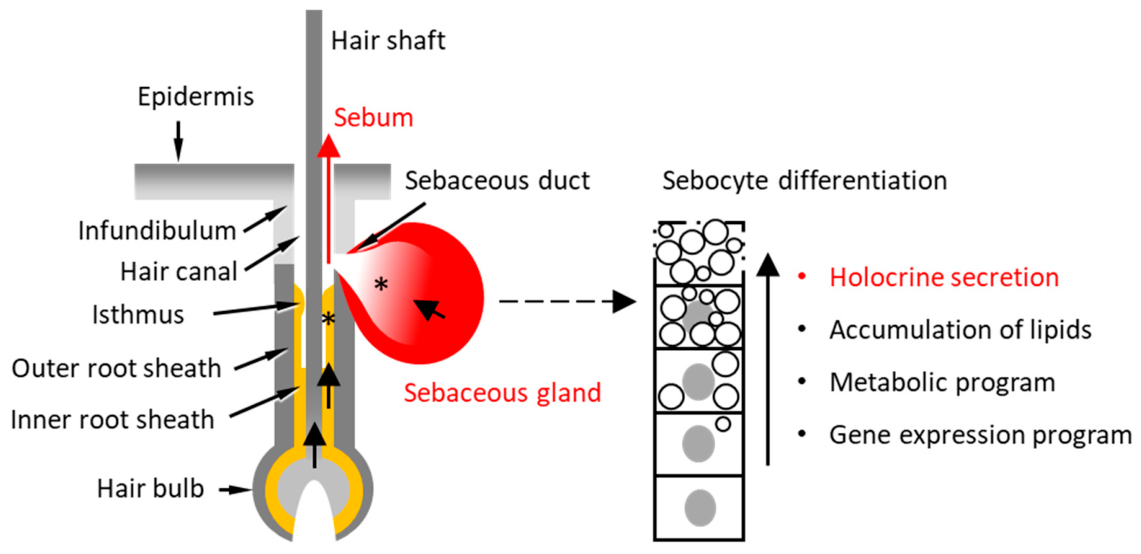
2. Sebaceous Glands: Structure and Functions
3. Differentiation of Sebocytes
4. Holocrine Secretion: Mechanism and Regulation
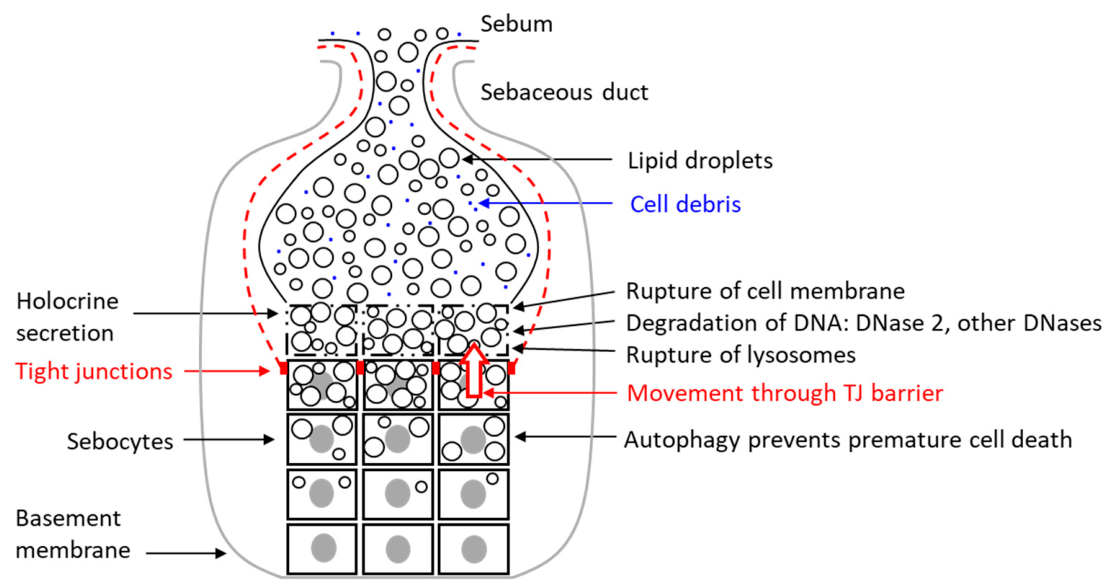
4.1. Spatial Control of Holocrine Secretion
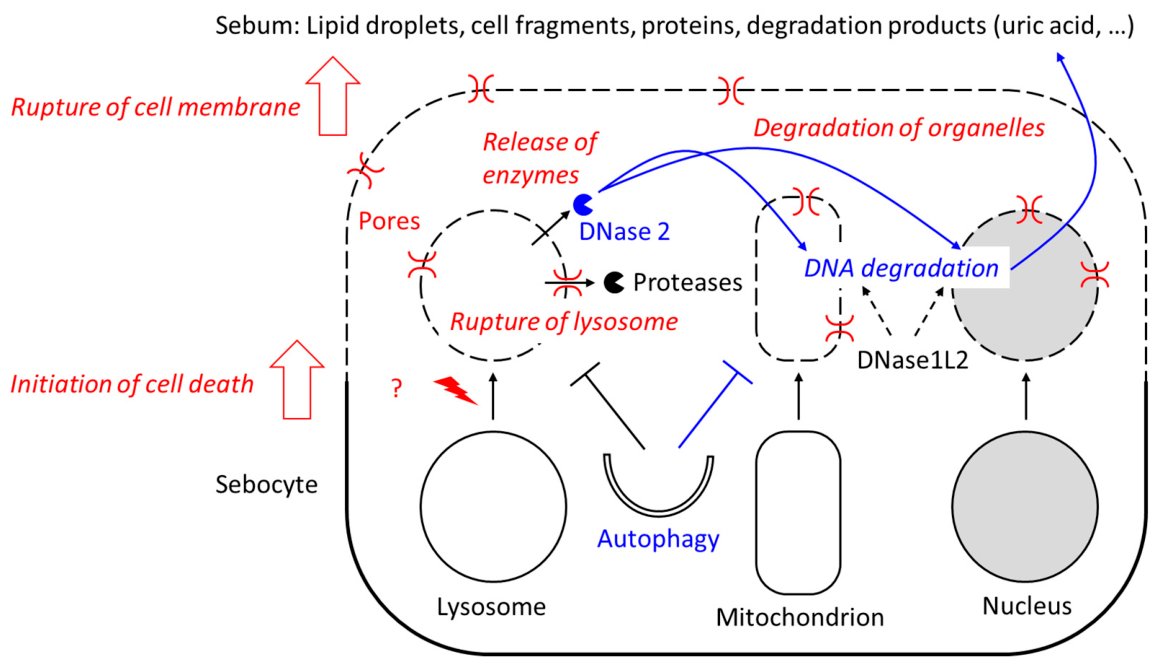
4.2. Intracellular Initiation of Holocrine Secretion: Roles of Lysosomes
4.3. Breakdown of Mitochondria and Other Cytoplasmic Organelles
4.4. Breakdown of the Nucleus and Degradation of DNA During Holocrine Secretion
4.5. Rupture of Membranes During Holocrine Secretion
4.6. Roles of Autophagy in Sebocyte Differentiation and the Control of Holocrine Secretion
5. Differentiation-Associated Cell Death in the Inner Root Sheath: Impact on Sebum Composition
6. Holocrine Cell Death in Normal and Diseased Skin: Potential Dermatological Implications
7. Conclusions and Perspectives
Author Contributions
Funding
Institutional Review Board Statement
Informed Consent Statement
Data Availability Statement
Acknowledgments
Conflicts of Interest
References
- Liu, Y.; Butovich, I.A.; Garreis, F.; Zahn, I.; Scholz, M.; Gaffling, S.; Jabari, S.; Dietrich, J.; Paulsen, F. Comparative Characterization of Human Meibomian Glands, Free Sebaceous Glands, and Hair-Associated Sebaceous Glands Based on Biomarkers, Analysis of Secretion Composition, and Gland Morphology. Int. J. Mol. Sci. 2024, 25, 3109. [Google Scholar] [CrossRef]
- Niemann, C.; Horsley, V. Development and homeostasis of the sebaceous gland. Semin. Cell Dev. Biol. 2012, 23, 928–936. [Google Scholar] [CrossRef]
- Ford, N.C.; Benedeck, R.E.; Mattoon, M.T.; Peterson, J.K.; Mesler, A.L.; Veniaminova, N.A.; Gardon, D.J.; Tsai, S.Y.; Uchida, Y.; Wong, S.Y. Hair follicles modulate skin barrier function. Cell Rep. 2024, 43, 114347. [Google Scholar] [CrossRef]
- Elias, P.M.; Wakefield, J. The sebaceous gland revisited: Friend and adversary. SKINdeep 2025, 1, e166714. [Google Scholar] [CrossRef]
- Li, D.; Zhou, Z.; Yang, X.; Zhang, Q.; Xu, J.; Zouboulis, C.C.; Xiang, Q.; Zhang, S. A Comprehensive Review: The Bidirectional Role of Sebum in Skin Health. Bioengineering 2025, 12, 1333. [Google Scholar] [CrossRef]
- Pfannkuche, H.; Maus, J.; Engel, K.M.; Schiller, J.; Schneider, M.R. Decoding sebaceous gland functions and diseases: Insights from domestic animals. Vet. Res. Commun. 2026, 50, 197. [Google Scholar] [CrossRef] [PubMed]
- Takeda, H.; Lyle, S.; Lazar, A.J.; Zouboulis, C.C.; Smyth, I.; Watt, F.M. Human sebaceous tumors harbor inactivating mutations in LEF1. Nat. Med. 2006, 12, 395–397. [Google Scholar] [CrossRef] [PubMed]
- North, J.P.; Golovato, J.; Vaske, C.J.; Sanborn, J.Z.; Nguyen, A.; Wu, W.; Goode, B.; Stevers, M.; McMullen, K.; Perez White, B.E.; et al. Cell of origin and mutation pattern define three clinically distinct classes of sebaceous carcinoma. Nat. Commun. 2018, 9, 1894. [Google Scholar] [CrossRef]
- Oulès, B.; Rognoni, E.; Hoste, E.; Goss, G.; Fiehler, R.; Natsuga, K.; Quist, S.; Mentink, R.; Donati, G.; Watt, F.M. Mutant Lef1 controls Gata6 in sebaceous gland development and cancer. EMBO J. 2019, 38, e100526. [Google Scholar] [CrossRef]
- Owen, J.L.; Kibbi, N.; Worley, B.; Kelm, R.C.; Wang, J.V.; Barker, C.A.; Behshad, R.; Bichakjian, C.K.; Bolotin, D.; Bordeaux, J.S.; et al. Sebaceous carcinoma: Evidence-based clinical practice guidelines. Lancet Oncol. 2019, 20, e699–e714. [Google Scholar] [CrossRef]
- Williams, H.C.; Dellavalle, R.P.; Garner, S. Acne vulgaris. Lancet 2012, 379, 361–372. [Google Scholar] [CrossRef]
- Clayton, R.W.; Göbel, K.; Niessen, C.M.; Paus, R.; van Steensel, M.A.M.; Lim, X. Homeostasis of the sebaceous gland and mechanisms of acne pathogenesis. Br. J. Dermatol. 2019, 181, 677–690. [Google Scholar] [CrossRef]
- Mosca, S.; Ottaviani, M.; Briganti, S.; Di Nardo, A.; Flori, E. The Sebaceous Gland: A Key Player in the Balance Between Homeostasis and Inflammatory Skin Diseases. Cells 2025, 14, 747. [Google Scholar] [CrossRef]
- Durgin, J.S.; Veniaminova, N.A.; Huyge, T.J.; Tsai, S.Y.; Fox, J.; Cai, Y.; Sarkar, M.K.; Tsoi, L.C.; Gudjonsson, J.E.; Wong, S.Y. Spatial transcriptomics identifies differentiation, lipid metabolism, and retinoid pathway alterations in acne vulgaris. JCI Insight 2026, 11, e198021. [Google Scholar] [CrossRef]
- Shi, V.Y.; Leo, M.; Hassoun, L.; Chahal, D.S.; Maibach, H.I.; Sivamani, R.K. Role of sebaceous glands in inflammatory dermatoses. J. Am. Acad. Dermatol. 2015, 73, 856–863. [Google Scholar] [CrossRef] [PubMed]
- Yin, H.; Qiu, Z.; Zhu, R.; Wang, S.; Gu, C.; Yao, X.; Li, W. Dysregulated lipidome of sebum in patients with atopic dermatitis. Allergy 2023, 78, 1524–1537. [Google Scholar] [CrossRef] [PubMed]
- Siqueira, R.A.G.B.; Hradkova, I.; Leite-Silva, V.R.; Andréo-Filho, N.; Lopes, P.S. Skin Lipids and Their Influence on Skin Microbiome and Skin Care. ACS Omega 2025, 10, 28534–28546. [Google Scholar] [CrossRef]
- Lippens, S.; Denecker, G.; Ovaere, P.; Vandenabeele, P.; Declercq, W. Death penalty for keratinocytes: Apoptosis versus cornification. Cell Death Differ. 2005, 12, 1497–1508. [Google Scholar] [CrossRef]
- Eckhart, L.; Lippens, S.; Tschachler, E.; Declercq, W. Cell death by cornification. Biochim. Biophys. Acta 2013, 1833, 3471–3480. [Google Scholar] [CrossRef] [PubMed]
- Matsui, T. Epidermal barrier development via corneoptosis: A unique form of cell death in stratum granulosum cells. J. Dev. Biol. 2023, 11, 43. [Google Scholar] [CrossRef]
- Jones, L.A.; Harland, D.P.; Jarrold, B.B.; Connolly, J.E.; Davis, M.G. The walking dead: Sequential nuclear and organelle destruction during hair development. Br. J. Dermatol. 2018, 178, 1341–1352. [Google Scholar] [CrossRef]
- Schneider, M.R.; Paus, R. Sebocytes, multifaceted epithelial cells: Lipid production and holocrine secretion. Int. J. Biochem. Cell Biol. 2010, 42, 181–185. [Google Scholar] [CrossRef]
- Sukseree, S.; Bergmann, S.; Pajdzik, K.; Sipos, W.; Gruber, F.; Tschachler, E.; Eckhart, L. Suppression of epithelial autophagy compromises the homeostasis of sweat glands during aging. J. Investig. Dermatol. 2018, 138, 2061–2063. [Google Scholar] [CrossRef]
- Lee, Y.; Overholtzer, M. After-Death Functions of Cell Death. Yale J. Biol. Med. 2019, 92, 687–694. [Google Scholar] [PubMed]
- Schneider, M.R. Rethinking Holocrine Secretion: Functional Logic in Lipid-Producing Epithelia. Am. J. Physiol. Cell Physiol. 2026, 330, C1647–C1650. [Google Scholar] [CrossRef] [PubMed]
- Galluzzi, L.; Vitale, I.; Aaronson, S.A.; Abrams, J.M.; Adam, D.; Agostinis, P.; Alnemri, E.S.; Altucci, L.; Amelio, I.; Andrews, D.W.; et al. Molecular mechanisms of cell death: Recommendations of the Nomenclature Committee on Cell Death 2018. Cell Death Differ. 2018, 25, 486–541. [Google Scholar] [CrossRef]
- Montagna, W. An introduction to sebaceous glands. J. Investig. Dermatol. 1974, 62, 120–123. [Google Scholar] [CrossRef] [PubMed]
- Niemann, C. Differentiation of the sebaceous gland. Dermato-Endocrinology 2009, 1, 64–67. [Google Scholar] [CrossRef]
- Geueke, A.; Niemann, C. Stem and progenitor cells in sebaceous gland development, homeostasis and pathologies. Exp. Dermatol. 2021, 30, 588–597. [Google Scholar] [CrossRef]
- Jang, Y.H.; Kim, S.L.; Lee, J.S.; Kwon, K.Y.; Lee, S.J.; Kim, D.W.; Lee, W.J. Possible existence of melanocytes or melanoblasts in human sebaceous glands. Ann. Dermatol. 2014, 26, 469–473. [Google Scholar] [CrossRef]
- Haid, B.; Schlögl, D.E.; Hermann, M.; Tripp, C.H.; Stoitzner, P.; Romani, N.; Flacher, V. Langerhans cells in the sebaceous gland of the murine skin. Exp. Dermatol. 2015, 24, 899–901. [Google Scholar] [CrossRef]
- Mattii, M.; Lovászi, M.; Garzorz, N.; Atenhan, A.; Quaranta, M.; Lauffer, F.; Konstantinow, A.; Küpper, M.; Zouboulis, C.C.; Kemeny, L.; et al. Sebocytes contribute to skin inflammation by promoting the differentiation of T helper 17 cells. Br. J. Dermatol. 2018, 178, 722–730. [Google Scholar] [CrossRef]
- Kobayashi, T.; Voisin, B.; Kim, D.Y.; Kennedy, E.A.; Jo, J.H.; Shih, H.Y.; Truong, A.; Doebel, T.; Sakamoto, K.; Cui, C.Y.; et al. Homeostatic Control of Sebaceous Glands by Innate Lymphoid Cells Regulates Commensal Bacteria Equilibrium. Cell 2019, 176, 982–997.e16. [Google Scholar] [CrossRef] [PubMed]
- Clayton, R.W.; Langan, E.A.; Ansell, D.M.; de Vos, I.J.H.M.; Göbel, K.; Schneider, M.R.; Picardo, M.; Lim, X.; van Steensel, M.A.M.; Paus, R. Neuroendocrinology and neurobiology of sebaceous glands. Biol. Rev. Camb. Philos. Soc. 2020, 95, 592–624. [Google Scholar] [CrossRef]
- Steele, L.; Foster, A.R.; Roberts, K.; Admane, C.; Birk, S.; Mazin, P.V.; Akbarnejad, A.; Tudor, C.; Rumney, B.; Chan, H.M.; et al. Hidden immune memory niches in inflammatory skin diseases. bioRxiv 2026. [Google Scholar] [CrossRef]
- Donati, G.; Rognoni, E.; Hiratsuka, T.; Liakath-Ali, K.; Hoste, E.; Kar, G.; Kayikci, M.; Russell, R.; Kretzschmar, K.; Mulder, K.W.; et al. Wounding induces dedifferentiation of epidermal Gata6+ cells and acquisition of stem cell properties. Nat. Cell Biol. 2017, 19, 603–613. [Google Scholar] [CrossRef]
- Swanson, J.B.; Vagnozzi, A.N.; Veniaminova, N.A.; Wong, S.Y. Loss of Gata6 causes dilation of the hair follicle canal and sebaceous duct. Exp. Dermatol. 2019, 28, 345–349. [Google Scholar] [CrossRef]
- Bernabé-Rubio, M.; Ali, S.; Bhosale, P.G.; Goss, G.; Mobasseri, S.A.; Tapia-Rojo, R.; Zhu, T.; Hiratsuka, T.; Battilocchi, M.; Tomás, I.M.; et al. Myc-dependent dedifferentiation of Gata6+ epidermal cells resembles reversal of terminal differentiation. Nat. Cell Biol. 2023, 25, 1426–1438. [Google Scholar] [CrossRef] [PubMed]
- Klas, K.; Copic, D.; Direder, M.; Laggner, M.; Prucksamas, P.S.; Gruber, F.; Ankersmit, H.J.; Mildner, M. Transcriptional Differences in Lipid-Metabolizing Enzymes in Murine Sebocytes Derived from Sebaceous Glands of the Skin and Preputial Glands. Int. J. Mol. Sci. 2021, 22, 11631. [Google Scholar] [CrossRef]
- Gardon, D.J.; Liu, C.J.; Veniaminova, N.A.; Kaartinen, V.; Wong, S.Y. A mouse model of meibomian gland hyperkeratinization-induced dry eye. Dev. Biol. 2026, 534, 209–214. [Google Scholar] [CrossRef] [PubMed]
- Eckhart, L.; Gruber, F.; Sukseree, S. Autophagy-Mediated Cellular Remodeling during Terminal Differentiation of Keratinocytes in the Epidermis and Skin Appendages. Cells 2024, 13, 1675. [Google Scholar] [CrossRef] [PubMed]
- Vanderwolf, K.; Kyle, C.; Davy, C. A review of sebum in mammals in relation to skin diseases, skin function, and the skin microbiome. PeerJ 2023, 11, e16680. [Google Scholar] [CrossRef]
- Lopes-Marques, M.; Machado, A.M.; Alves, L.Q.; Fonseca, M.M.; Barbosa, S.; Sinding, M.S.; Rasmussen, M.H.; Iversen, M.R.; Frost Bertelsen, M.; Campos, P.F.; et al. Complete Inactivation of Sebum-Producing Genes Parallels the Loss of Sebaceous Glands in Cetacea. Mol. Biol. Evol. 2019, 36, 1270–1280. [Google Scholar] [CrossRef]
- Springer, M.S.; Gatesy, J. Evolution of the MC5R gene in placental mammals with evidence for its inactivation in multiple lineages that lack sebaceous glands. Mol. Phylogenet. Evol. 2018, 120, 364–374. [Google Scholar] [CrossRef]
- Smith, K.R.; Thiboutot, D.M. Thematic review series: Skin lipids. Sebaceous gland lipids: Friend or foe? J. Lipid Res. 2008, 49, 271–281. [Google Scholar] [CrossRef]
- Dahlhoff, M.; Camera, E.; Schäfer, M.; Emrich, D.; Riethmacher, D.; Foster, A.; Paus, R.; Schneider, M.R. Sebaceous lipids are essential for water repulsion, protection against UVB-induced apoptosis and ocular integrity in mice. Development 2016, 143, 1823–1831. [Google Scholar] [CrossRef]
- Lovászi, M.; Szegedi, A.; Zouboulis, C.C.; Törőcsik, D. Sebaceous-immunobiology is orchestrated by sebum lipids. Dermato-Endocrinology 2017, 9, e1375636. [Google Scholar] [CrossRef]
- Nakatsuji, T.; Kao, M.C.; Fang, J.Y.; Zouboulis, C.C.; Zhang, L.; Gallo, R.L.; Huang, C.M. Antimicrobial property of lauric acid against Propionibacterium acnes: Its therapeutic potential for inflammatory acne vulgaris. J. Investig. Dermatol. 2009, 129, 2480–2488. [Google Scholar] [CrossRef] [PubMed]
- Nakatsuji, T.; Kao, M.C.; Zhang, L.; Zouboulis, C.C.; Gallo, R.L.; Huang, C.M. Sebum free fatty acids enhance the innate immune defense of human sebocytes by upregulating beta-defensin-2 expression. J. Investig. Dermatol. 2010, 130, 985–994. [Google Scholar] [CrossRef] [PubMed]
- Lee, D.Y.; Yamasaki, K.; Rudsil, J.; Zouboulis, C.C.; Park, G.T.; Yang, J.M.; Gallo, R.L. Sebocytes express functional cathelicidin antimicrobial peptides and can act to kill Propionibacterium acnes. J. Investig. Dermatol. 2008, 128, 1863–1866. [Google Scholar] [CrossRef]
- Inoue, T.; Kuwano, T.; Uehara, Y.; Yano, M.; Oya, N.; Takada, N.; Tanaka, S.; Ueda, Y.; Hachiya, A.; Takahashi, Y.; et al. Non-invasive human skin transcriptome analysis using mRNA in skin surface lipids. Commun. Biol. 2022, 5, 215. [Google Scholar] [CrossRef] [PubMed]
- Lee, D.Y.; Huang, C.M.; Nakatsuji, T.; Thiboutot, D.; Kang, S.A.; Monestier, M.; Gallo, R.L. Histone H4 is a major component of the antimicrobial action of human sebocytes. J. Investig. Dermatol. 2009, 129, 2489–2496. [Google Scholar] [CrossRef] [PubMed]
- Li, X.; Ye, Y.; Peng, K.; Zeng, Z.; Chen, L.; Zeng, Y. Histones: The critical players in innate immunity. Front. Immunol. 2022, 13, 1030610. [Google Scholar] [CrossRef]
- Anand, P.; Cermelli, S.; Li, Z.; Kassan, A.; Bosch, M.; Sigua, R.; Huang, L.; Ouellette, A.J.; Pol, A.; Welte, M.A.; et al. A novel role for lipid droplets in the organismal antibacterial response. Elife 2012, 1, e00003. [Google Scholar] [CrossRef]
- Ehrmann, C.; Schneider, M.R. Genetically modified laboratory mice with sebaceous glands abnormalities. Cell. Mol. Life Sci. 2016, 73, 4623–4642. [Google Scholar] [CrossRef]
- Fischer, H.; Fumicz, J.; Rossiter, H.; Napirei, M.; Buchberger, M.; Tschachler, E.; Eckhart, L. Holocrine secretion of sebum is a unique DNase2-dependent mode of programmed cell death. J. Investig. Dermatol. 2017, 137, 587–594. [Google Scholar] [CrossRef]
- Veniaminova, N.A.; Grachtchouk, M.; Doane, O.J.; Peterson, J.K.; Quigley, D.A.; Lull, M.V.; Pyrozhenko, D.V.; Nair, R.R.; Patrick, M.T.; Balmain, A.; et al. Niche-Specific Factors Dynamically Regulate Sebaceous Gland Stem Cells in the Skin. Dev. Cell 2019, 51, 326–340.e4. [Google Scholar] [CrossRef] [PubMed]
- Hinde, E.; Haslam, I.S.; Schneider, M.R.; Langan, E.A.; Kloepper, J.E.; Schramm, C.; Zouboulis, C.C.; Paus, R. A practical guide for the study of human and murine sebaceous glands in situ. Exp. Dermatol. 2013, 22, 631–637. [Google Scholar] [CrossRef]
- Zouboulis, C.C.; Seltmann, H.; Neitzel, H.; Orfanos, C.E. Establishment and characterization of an immortalized human sebaceous gland cell line (SZ95). J. Investig. Dermatol. 1999, 113, 1011–1020. [Google Scholar] [CrossRef]
- Magne, B.; Cattier, B.; Lemire-Rondeau, M.; Morissette, A.; Larouche, D.; Philippe, É.; Germain, L. De novo formation of human sebaceous glands using self-assembled skin substitutes. J. Investig. Dermatol. 2026. [Google Scholar] [CrossRef]
- de Bengy, A.F.; Forraz, N.; Danoux, L.; Berthelemy, N.; Cadau, S.; Degoul, O.; Andre, V.; Pain, S.; McGuckin, C. Development of new 3D human ex vivo models to study sebaceous gland lipid metabolism and modulations. Cell Prolif. 2019, 52, e12524. [Google Scholar] [CrossRef]
- Phan, M.A.T.; Madigan, M.C.; Stapleton, F.; Willcox, M.; Golebiowski, B. Human meibomian gland epithelial cell culture models: Current progress, challenges, and future directions. Ocul. Surf. 2022, 23, 96–113. [Google Scholar] [CrossRef]
- Feldman, A.; Mukha, D.; Maor, I.I.; Sedov, E.; Koren, E.; Yosefzon, Y.; Shlomi, T.; Fuchs, Y. Blimp1+ cells generate functional mouse sebaceous gland organoids in vitro. Nat. Commun. 2019, 10, 2348. [Google Scholar] [CrossRef] [PubMed]
- Frances, D.; Niemann, C. Stem cell dynamics in sebaceous gland morphogenesis in mouse skin. Dev. Biol. 2012, 363, 138–146. [Google Scholar] [CrossRef]
- Cottle, D.L.; Kretzschmar, K.; Schweiger, P.J.; Quist, S.R.; Gollnick, H.P.; Natsuga, K.; Aoyagi, S.; Watt, F.M. c-MYC-induced sebaceous gland differentiation is controlled by an androgen receptor/p53 axis. Cell Rep. 2013, 3, 427–441. [Google Scholar] [CrossRef] [PubMed]
- Singh, K.; Camera, E.; Krug, L.; Basu, A.; Pandey, R.K.; Munir, S.; Wlaschek, M.; Kochanek, S.; Schorpp-Kistner, M.; Picardo, M.; et al. JunB defines functional and structural integrity of the epidermo-pilosebaceous unit in the skin. Nat. Commun. 2018, 9, 3425. [Google Scholar] [CrossRef] [PubMed]
- Sipilä, K.; Rognoni, E.; Jokinen, J.; Tewary, M.; Vietri Rudan, M.; Talvi, S.; Jokinen, V.; Dahlström, K.M.; Liakath-Ali, K.; Mobasseri, A.; et al. Embigin is a fibronectin receptor that affects sebaceous gland differentiation and metabolism. Dev. Cell 2022, 57, 1453–1465.e7. [Google Scholar] [CrossRef]
- Abidi, S.N.F.; Chan, S.; Seidel, K.; Lafkas, D.; Vermeulen, L.; Peale, F.; Siebel, C.W. The Jag2/Notch1 signaling axis promotes sebaceous gland differentiation and controls progenitor proliferation. Elife 2024, 13, RP98747. [Google Scholar] [CrossRef]
- Hommel, T.; Schneider, M.R.; Dahlhoff, M. Regulation of sebaceous gland homeostasis and sebum secretion by the ERBB receptor family. iScience 2026, 29, 114834. [Google Scholar] [CrossRef]
- Dahlhoff, M.; Camera, E.; Picardo, M.; Zouboulis, C.C.; Chan, L.; Chang, B.H.; Schneider, M.R. PLIN2, the major perilipin regulated during sebocyte differentiation, controls sebaceous lipid accumulation in vitro and sebaceous gland size in vivo. Biochim. Biophys. Acta 2013, 1830, 4642–4649. [Google Scholar] [CrossRef]
- Boecker, W.; Reusch, M.; Mielke, V.; Reusch, U.; Loening, T.; Tiemann, M.; Buchwalow, I. Spatial analysis of p63, K5 and K7 defines two groups of progenitor cells that differentially contribute to the maintenance of normal sebaceous glands, extraocular sebaceous carcinoma and benign sebaceous tumors. J. Dermatol. 2019, 46, 249–258. [Google Scholar] [CrossRef]
- Schmidt, M.; Hansmann, F.; Loeffler-Wirth, H.; Zouboulis, C.C.; Binder, H.; Schneider, M.R. A spatial portrait of the human sebaceous gland transcriptional program. J. Biol. Chem. 2024, 300, 107442. [Google Scholar] [CrossRef] [PubMed]
- Schmidt, M.; Binder, H.; Schneider, M.R. The metabolic underpinnings of sebaceous lipogenesis. Commun. Biol. 2025, 8, 670. [Google Scholar] [CrossRef] [PubMed]
- Düz, T.; Torocsik, D.; Simmering, A.; Wolf, P.; Gallinat, S.; Baumbach, J.; Holzscheck, N. High-Resolution Spatial Map of the Human Facial Sebaceous Gland Reveals Marker Genes and Decodes Sebocyte Differentiation. J. Investig. Dermatol. 2026, 146, 40–54.e14. [Google Scholar] [CrossRef]
- Schneider, M.R.; Meier, M. Bringing High-Resolution Spatial Order to Sebaceous Glands. J. Investig. Dermatol. 2026, 146, 7–8. [Google Scholar] [CrossRef]
- Veniaminova, N.A.; Vagnozzi, A.N.; Kopinke, D.; Do, T.T.; Murtaugh, L.C.; Maillard, I.; Dlugosz, A.A.; Reiter, J.F.; Wong, S.Y. Keratin 79 identifies a novel population of migratory epithelial cells that initiates hair canal morphogenesis and regeneration. Development 2013, 140, 4870–4880. [Google Scholar] [CrossRef]
- Yaba, A.; Thalheim, T.; Schneider, M.R. The role of cell-cell and cell-matrix junctional complexes in sebaceous gland homeostasis and differentiation. Cell Commun. Signal. 2024, 22, 445. [Google Scholar] [CrossRef]
- Kitson, N.; Van Lennep, E.W.; Young, J.A. Gap junctions in human sebaceous glands. Cell Tissue Res. 1978, 190, 115–121. [Google Scholar] [CrossRef]
- Rötzer, V.; Egu, D.; Waschke, J. Meibomian gland cells display a differentiation-dependent composition of desmosomes. Histochem. Cell Biol. 2016, 146, 685–694. [Google Scholar] [CrossRef]
- Atsugi, T.; Yokouchi, M.; Hirano, T.; Hirabayashi, A.; Nagai, T.; Ohyama, M.; Abe, T.; Kaneko, M.; Zouboulis, C.C.; Amagai, M.; et al. Holocrine secretion occurs outside the tight junction barrier in multicellular glands: Lessons from claudin-1-deficient mice. J. Investig. Dermatol. 2020, 140, 298–308.e5. [Google Scholar] [CrossRef] [PubMed]
- Yokouchi, M.; Kubo, A.; Kawasaki, H.; Yoshida, K.; Ishii, K.; Furuse, M.; Amagai, M. Epidermal tight junction barrier function is altered by skin inflammation, but not by filaggrin-deficient stratum corneum. J. Dermatol. Sci. 2015, 77, 28–36. [Google Scholar] [CrossRef]
- Rashad, H.S.; Nada, H.A.; Ismail, N.A.; Abd El-Fadeal, N.M.; Hosny, N.; Atwa, M.A. Claudin-1 expression in acne and its correlation with disease severity: Clinical and in silico validation. Arch. Dermatol. Res. 2025, 317, 651. [Google Scholar] [CrossRef] [PubMed]
- Tamada, Y.; Takama, H.; Kitamura, T.; Yokochi, K.; Nitta, Y.; Ikeya, T.; Matsumoto, Y. Identification of programmed cell death in normal human skin tissues by using specific labelling of fragmented DNA. Br. J. Dermatol. 1994, 131, 521–524. [Google Scholar] [CrossRef]
- Tanaka, T.; Narisawa, Y.; Misago, N.; Hashimoto, K. The innermost cells of the outer root sheath in human anagen hair follicles undergo specialized keratinization mediated by apoptosis. J. Cutan. Pathol. 1998, 25, 316–321. [Google Scholar] [CrossRef]
- Hathaway, T.R.; Kuechle, M.K. Apoptosis and cutaneous biology. Adv. Dermatol. 2002, 18, 287–311. [Google Scholar]
- Wróbel, A.; Seltmann, H.; Fimmel, S.; Müller-Decker, K.; Tsukada, M.; Bogdanoff, B.; Mandt, N.; Blume-Peytavi, U.; Orfanos, C.E.; Zouboulis, C.C. Differentiation and apoptosis in human immortalized sebocytes. J. Investig. Dermatol. 2003, 120, 175–181. [Google Scholar] [CrossRef]
- Sorg, O.; Nocera, T.; Fontao, F.; Castex-Rizzi, N.; Garidou, L.; Lauze, C.; Le Digabel, J.; Josse, G.; Saurat, J.H. Lipid Droplet Proteins in Acne Skin: A Sound Target for the Maintenance of Low Comedogenic Sebum and Acne-Prone Skin Health. JID Innov. 2021, 1, 100057. [Google Scholar] [CrossRef] [PubMed]
- Zhang, S.; Shui, G.; Wang, G.; Wang, C.; Sun, S.; Zouboulis, C.C.; Xiao, R.; Ye, J.; Li, W.; Li, P. Cidea control of lipid storage and secretion in mouse and human sebaceous glands. Mol. Cell. Biol. 2014, 34, 1827–1838. [Google Scholar] [CrossRef] [PubMed]
- Yosefzon, Y.; Soteriou, D.; Feldman, A.; Kostic, L.; Koren, E.; Brown, S.; Ankawa, R.; Sedov, E.; Glaser, F.; Fuchs, Y. Caspase-3 Regulates YAP-Dependent Cell Proliferation and Organ Size. Mol. Cell 2018, 70, 573–587.e4. [Google Scholar] [CrossRef]
- Eckhart, L.; Ban, J.; Fischer, H.; Tschachler, E. Caspase-14: Analysis of gene structure and mRNA expression during keratinocyte differentiation. Biochem. Biophys. Res. Commun. 2000, 277, 655–659. [Google Scholar] [CrossRef] [PubMed]
- Lippens, S.; VandenBroecke, C.; Van Damme, E.; Tschachler, E.; Vandenabeele, P.; Declercq, W. Caspase-14 is expressed in the epidermis, the choroid plexus, the retinal pigment epithelium and thymic Hassall’s bodies. Cell Death Differ. 2003, 10, 257–259. [Google Scholar] [CrossRef]
- Zhu, H.; She, Q.; Li, H.; Zhang, N.; Huang, W.; Xu, Y.; Liu, Z.; Liang, Y. EGFR-TKIs induce acneiform rash and xerosis via Caspase-3/GSDME-mediated pyroptosis of keratinocytes and sebocytes. Toxicology 2025, 511, 154018. [Google Scholar] [CrossRef]
- Papakonstantinou, E.; Aletras, A.J.; Glass, E.; Tsogas, P.; Dionyssopoulos, A.; Adjaye, J.; Fimmel, S.; Gouvousis, P.; Herwig, R.; Lehrach, H.; et al. Matrix metalloproteinases of epithelial origin in facial sebum of patients with acne and their regulation by isotretinoin. J. Investig. Dermatol. 2005, 125, 673–684. [Google Scholar] [CrossRef]
- Argüeso, P. Proteolytic activity in the meibomian gland: Implications to health and disease. Exp. Eye Res. 2017, 163, 53–57. [Google Scholar] [CrossRef] [PubMed]
- Zeeuwen, P.L.; Cheng, T.; Schalkwijk, J. The biology of cystatin M/E and its cognate target proteases. J. Investig. Dermatol. 2009, 129, 1327–1338. [Google Scholar] [CrossRef] [PubMed]
- Lazarus, G.S.; Hatcher, V.B.; Levine, N. Lysosomes and the skin. J. Investig. Dermatol. 1975, 65, 259–271. [Google Scholar] [CrossRef]
- Monteleon, C.L.; Agnihotri, T.; Dahal, A.; Liu, M.; Rebecca, V.W.; Beatty, G.L.; Amaravadi, R.K.; Ridky, T.W. Lysosomes support the degradation, signaling, and mitochondrial metabolism necessary for human epidermal differentiation. J. Investig. Dermatol. 2018, 138, 1945–1954. [Google Scholar] [CrossRef]
- Brandes, D.; Bertini, F. Role of lysosomes in cellular lytic processes. II: Cell death during holocrine secretion in sebaceous glands. Exp. Mol. Pathol. 1965, 4, 245–265. [Google Scholar] [CrossRef]
- Rupec, M.; Braun-Falco, O. Zur Frage lysosomaler Aktivität in normalen menschlichen Talgdrüsen [On the problem of lysosomal activity in normal human sebaceous glands]. Arch. Klin. Exp. Dermatol. 1968, 232, 312–324. [Google Scholar] [CrossRef]
- Bell, M. A comparative study of the ultrastructure of the sebaceous glands of man and other primates. J. Investig. Dermatol. 1974, 62, 132–143. [Google Scholar] [CrossRef] [PubMed]
- Bell, M. A comparative study of sebaceous gland ultrastructure in subhuman primates. II. Macaques: Crystalline inclusions in the sebaceous cells of Macaca mulatta, M. nemestrina, M. speciosa, M. fascicularis. J. Cell Biol. 1971, 49, 932–936. [Google Scholar] [CrossRef]
- Koenig, U.; Robenek, H.; Barresi, C.; Brandstetter, M.; Resch, G.P.; Gröger, M.; Pap, T.; Hartmann, C. Cell death induced autophagy contributes to terminal differentiation of skin and skin appendages. Autophagy 2020, 16, 932–945. [Google Scholar] [CrossRef]
- Akinduro, O.; Sully, K.; Patel, A.; Robinson, D.J.; Chikh, A.; McPhail, G.; Braun, K.M.; Philpott, M.P.; Harwood, C.A.; Byrne, C.; et al. Constitutive autophagy and nucleophagy during epidermal differentiation. J. Investig. Dermatol. 2016, 136, 1460–1470. [Google Scholar] [CrossRef]
- Gorgas, K.; Völkl, A. Peroxisomes in sebaceous glands. IV Aggregates of tubular peroxisomes in the mouse Meibomian gland. Histochem. J. 1984, 16, 1079–1098. [Google Scholar] [CrossRef] [PubMed]
- Holt, W.V.; Jones, R.C. The ultrastructure and histochemistry of the chin gland of the cuis, Galea musteloides. J. Anat. 1973, 114, 221–233. [Google Scholar]
- Lachner, J.; Mlitz, V.; Tschachler, E.; Eckhart, L. Epidermal cornification is preceded by the expression of a keratinocyte-specific set of pyroptosis-related genes. Sci. Rep. 2017, 7, 17446. [Google Scholar] [CrossRef] [PubMed]
- Kondolf, H.C.; D’Orlando, D.A.; Dubyak, G.R.; Abbott, D.W. Protein engineering reveals that gasdermin A preferentially targets mitochondrial membranes over the plasma membrane during pyroptosis. J. Biol. Chem. 2023, 299, 102908. [Google Scholar] [CrossRef] [PubMed]
- Ahmed, N.S.; Foote, J.B.; Singh, K.K. Impaired Mitochondria Promote Aging-Associated Sebaceous Gland Dysfunction and Pathology. Am. J. Pathol. 2022, 192, 1546–1558. [Google Scholar] [CrossRef]
- Fischer, H.; Scherz, J.; Szabo, S.; Mildner, M.; Benarafa, C.; Torriglia, A.; Tschachler, E.; Eckhart, L. DNase 2 is the main DNA-degrading enzyme of the stratum corneum. PLoS ONE 2011, 6, e17581. [Google Scholar] [CrossRef]
- Fischer, H.; Buchberger, M.; Napirei, M.; Tschachler, E.; Eckhart, L. Inactivation of DNase1L2 and DNase2 in keratinocytes suppresses DNA degradation during epidermal cornification and results in constitutive parakeratosis. Sci. Rep. 2017, 7, 6433. [Google Scholar] [CrossRef]
- Vandenabeele, P.; Conrad, M.; Wahida, A. For Better or Worse: The Impact of Necrotic Cell Death Modalities. Adv. Exp. Med. Biol. 2025, 1481, 241–292. [Google Scholar] [CrossRef]
- Lawlor, K.E.; Murphy, J.M.; Vince, J.E. Gasdermin and MLKL necrotic cell death effectors: Signaling and diseases. Immunity 2024, 57, 429–445. [Google Scholar] [CrossRef]
- Kayagaki, N.; Kornfeld, O.S.; Lee, B.L.; Stowe, I.B.; O’Rourke, K.; Li, Q.; Sandoval, W.; Yan, D.; Kang, J.; Xu, M.; et al. NINJ1 mediates plasma membrane rupture during lytic cell death. Nature 2021, 591, 131–136. [Google Scholar] [CrossRef]
- Degen, M.; Santos, J.C.; Pluhackova, K.; Cebrero, G.; Ramos, S.; Jankevicius, G.; Hartenian, E.; Guillerm, U.; Mari, S.A.; Kohl, B.; et al. Structural basis of NINJ1-mediated plasma membrane rupture in cell death. Nature 2023, 618, 1065–1071. [Google Scholar] [CrossRef] [PubMed]
- Dondelinger, Y.; Priem, D.; Huyghe, J.; Delanghe, T.; Vandenabeele, P.; Bertrand, M.J.M. NINJ1 is activated by cell swelling to regulate plasma membrane permeabilization during regulated necrosis. Cell Death Dis. 2023, 14, 755. [Google Scholar] [CrossRef] [PubMed]
- Zhu, Y.; Xiao, F.; Wang, Y.; Wang, Y.; Li, J.; Zhong, D.; Huang, Z.; Yu, M.; Wang, Z.; Barbara, J.; et al. NINJ1 regulates plasma membrane fragility under mechanical strain. Nature 2025, 644, 1088–1096. [Google Scholar] [CrossRef]
- Rogers, C.; Erkes, D.A.; Nardone, A.; Aplin, A.E.; Fernandes-Alnemri, T.; Alnemri, E.S. Gasdermin pores permeabilize mitochondria to augment caspase-3 activation during apoptosis and inflammasome activation. Nat. Commun. 2019, 10, 1689. [Google Scholar] [CrossRef] [PubMed]
- Claude-Taupin, A.; Jia, J.; Bhujabal, Z.; Garfa-Traoré, M.; Kumar, S.; da Silva, G.P.D.; Javed, R.; Gu, Y.; Allers, L.; Peters, R.; et al. ATG9A protects the plasma membrane from programmed and incidental permeabilization. Nat. Cell Biol. 2021, 23, 846–858. [Google Scholar] [CrossRef]
- LaRock, D.L.; Johnson, A.F.; Wilde, S.; Sands, J.S.; Monteiro, M.P.; LaRock, C.N. Group A Streptococcus induces GSDMA-dependent pyroptosis in keratinocytes. Nature 2022, 605, 527–531. [Google Scholar] [CrossRef]
- Deng, W.; Bai, Y.; Deng, F.; Pan, Y.; Mei, S.; Zheng, Z.; Min, R.; Wu, Z.; Li, W.; Miao, R.; et al. Streptococcal pyrogenic exotoxin B cleaves GSDMA and triggers pyroptosis. Nature 2022, 602, 496–502. [Google Scholar] [CrossRef]
- Lunny, D.P.; Weed, E.; Nolan, P.M.; Marquardt, A.; Augustin, M.; Porter, R.M. Mutations in gasdermin 3 cause aberrant differentiation of the hair follicle and sebaceous gland. J. Investig. Dermatol. 2005, 124, 615–621. [Google Scholar] [CrossRef] [PubMed]
- Li, J.; Zhou, Y.; Yang, T.; Wang, N.; Lian, X.; Yang, L. Gsdma3 is required for hair follicle differentiation in mice. Biochem. Biophys. Res. Commun. 2010, 403, 18–23. [Google Scholar] [CrossRef]
- Li, S.T.; Suen, W.J.; Kao, C.H.; Yang, M.K.; Yang, L.T. Gasdermin A3-Mediated Cell Death Causes Niche Collapse and Precocious Activation of Hair Follicle Stem Cells. J. Investig. Dermatol. 2020, 140, 2117–2128. [Google Scholar] [CrossRef] [PubMed]
- Li, L.; Kovacs, S.B.; Jørgensen, I.; Larson, H.N.; Lazear, H.M.; Miao, E.A. Role of Caspases and Gasdermin A during HSV-1 Infection in Mice. Viruses 2022, 14, 2034. [Google Scholar] [CrossRef]
- Ekanayake, P.; Ahn, M.; Kim, J.; Choi, Y.; Shin, T. Immunohistochemical localization of nerve injury-induced protein-1 in mouse tissues. Anat. Cell Biol. 2019, 52, 455–461. [Google Scholar] [CrossRef]
- Koike, M.; Ninomiya, Y.; Koike, A. Characterization of Ninjurin and TSC22 induction after X-irradiation of normal human skin cells. J. Dermatol. 2008, 35, 6–17. [Google Scholar] [CrossRef]
- Kroemer, G.; Jäättelä, M. Lysosomes and autophagy in cell death control. Nat. Rev. Cancer 2005, 5, 886–897. [Google Scholar] [CrossRef]
- Sukseree, S.; Rossiter, H.; Mildner, M.; Pammer, J.; Buchberger, M.; Gruber, F.; Watanapokasin, R.; Tschachler, E.; Eckhart, L. Targeted deletion of Atg5 reveals differential roles of autophagy in keratin K5-expressing epithelia. Biochem. Biophys. Res. Commun. 2013, 430, 689–694. [Google Scholar] [CrossRef]
- Rossiter, H.; Stübiger, G.; Gröger, M.; König, U.; Gruber, F.; Sukseree, S.; Mlitz, V.; Buchberger, M.; Oskolkova, O.; Bochkov, V.; et al. Inactivation of autophagy leads to changes in sebaceous gland morphology and function. Exp. Dermatol. 2018, 27, 1142–1151. [Google Scholar] [CrossRef]
- Rossiter, H.; Copic, D.; Direder, M.; Gruber, F.; Zoratto, S.; Marchetti-Deschmann, M.; Kremslehner, C.; Sochorová, M.; Nagelreiter, I.M.; Mlitz, V.; et al. Autophagy protects murine preputial glands against premature aging, and controls their sebum phospholipid and pheromone profile. Autophagy 2022, 18, 1005–1019. [Google Scholar] [CrossRef] [PubMed]
- Maejima, I.; Takahashi, A.; Omori, H.; Kimura, T.; Takabatake, Y.; Saitoh, T.; Yamamoto, A.; Hamasaki, M.; Noda, T.; Isaka, Y.; et al. Autophagy sequesters damaged lysosomes to control lysosomal biogenesis and kidney injury. EMBO J. 2013, 32, 2336–2347. [Google Scholar] [CrossRef]
- Meyer, H.; Kravic, B. The endo-lysosomal damage response. Annu. Rev. Biochem. 2024, 93, 367–387. [Google Scholar] [CrossRef]
- Figueras-Novoa, C.; Timimi, L.; Marcassa, E.; Ulferts, R.; Beale, R. Conjugation of ATG8s to single membranes at a glance. J. Cell Sci. 2024, 137, jcs261031. [Google Scholar] [CrossRef]
- Goul, C.S.; Jain, A.; Yitiz, S.; Soltani, Z.E.; Yang, S.; Rapp, S.; Spacci, M.; Federman, S.; Sacco, J.; Li, H.; et al. LASER couples damage sensing to ESCRT assembly for lysosome repair. Nature 2026. Online ahead of print. [Google Scholar] [CrossRef] [PubMed]
- De Tito, S.; Almacellas, E.; Dai Yu, D.; Millard, E.; Zhang, W.; de Heus, C.; Queval, C.; Hervás, J.H.; Pellegrino, E.; Panagi, I.; et al. ATG9A and ARFIP2 cooperate to control PI4P levels for lysosomal repair. Dev. Cell 2025, 60, 2744–2760.e9. [Google Scholar] [CrossRef]
- Javed, R.; Mari, M.; Trosdal, E.; Duque, T.; Paddar, M.A.; Allers, L.; Mudd, M.H.; Claude-Taupin, A.; Akepati, P.R.; Hendrix, E.; et al. ATG9A facilitates the closure of mammalian autophagosomes. J. Cell Biol. 2025, 224, e202404047. [Google Scholar] [CrossRef]
- Mailler, E.; Guardia, C.M.; Bai, X.; Jarnik, M.; Williamson, C.D.; Li, Y.; Maio, N.; Golden, A.; Bonifacino, J.S. The autophagy protein ATG9A enables lipid mobilization from lipid droplets. Nat. Commun. 2021, 12, 6750. [Google Scholar] [CrossRef]
- Langbein, L.; Schweizer, J. Keratins of the human hair follicle. Int. Rev. Cytol. 2005, 243, 1–78. [Google Scholar] [CrossRef]
- Eckhart, L.; Holthaus, K.B.; Sachslehner, A.P. Cell differentiation in the embryonic periderm and in scaffolding epithelia of skin appendages. Dev. Biol. 2024, 515, 60–66. [Google Scholar] [CrossRef] [PubMed]
- Winter, H.; Langbein, L.; Praetzel, S.; Jacobs, M.; Rogers, M.A.; Leigh, I.M.; Tidman, N.; Schweizer, J. A novel human type II cytokeratin, K6hf, specifically expressed in the companion layer of the hair follicle. J. Investig. Dermatol. 1998, 111, 955–962. [Google Scholar] [CrossRef] [PubMed]
- Pinkus, H.; Iwasaki, T.; Mishima, Y. Outer root sheath keratinization in anagen and catagen of the mammalian hair follicle. A seventh distinct type of keratinization in the hair follicle: Trichilemmal keratinization. J. Anat. 1981, 133, 19–35. [Google Scholar]
- Ito, M. The innermost cell layer of the outer root sheath in anagen hair follicle: Light and electron microscopic study. Arch. Dermatol. Res. 1986, 279, 112–119. [Google Scholar] [CrossRef] [PubMed]
- Sennett, M.L.; Feehan, R.P.; Wallace, T.E.; Gettle, S.L.; Longenecker, A.L.; Zaenglein, A.L.; Thiboutot, D.M.; Nelson, A.M. Connectivity mapping with isotretinoin’s transcriptomic signature identifies alternative therapeutics for severe acne. J. Investig. Dermatol. 2025. Online ahead of print. [Google Scholar] [CrossRef]
- Qiu, X.; Feng, Y.; Mo, X.; Ju, Q. Multi-Omics Analysis Identifies Genetic Mechanisms and Therapeutic Targets for Acne Vulgaris. J. Investig. Dermatol. 2025, 145, 3037–3050. [Google Scholar] [CrossRef]
- Kopfnagel, V.; Dreyer, S.; Zeitvogel, J.; Pieper, D.H.; Buch, A.; Sodeik, B.; Rademacher, F.; Harder, J.; Werfel, T. Free human DNA attenuates the activity of antimicrobial peptides in atopic dermatitis. Allergy 2021, 76, 3145–3154. [Google Scholar] [CrossRef]
- Fischer, H.; Eckhart, L.; Mildner, M.; Jaeger, K.; Buchberger, M.; Ghannadan, M.; Tschachler, E. DNase1L2 degrades nuclear DNA during corneocyte formation. J. Investig. Dermatol. 2007, 127, 24–30. [Google Scholar] [CrossRef]
- Eckhart, L.; Fischer, H.; Barken, K.B.; Tolker-Nielsen, T.; Tschachler, E. DNase1L2 suppresses biofilm formation by Pseudomonas aeruginosa and Staphylococcus aureus. Br. J. Dermatol. 2007, 156, 1342–1345. [Google Scholar] [CrossRef]
- Coenye, T.; Spittaels, K.J.; Achermann, Y. The role of biofilm formation in the pathogenesis and antimicrobial susceptibility of Cutibacterium acnes. Biofilm 2021, 4, 100063. [Google Scholar] [CrossRef] [PubMed]
- Ashida, H.; Mimuro, H.; Ogawa, M.; Kobayashi, T.; Sanada, T.; Kim, M.; Sasakawa, C. Cell death and infection: A double-edged sword for host and pathogen survival. J. Cell Biol. 2011, 195, 931–942. [Google Scholar] [CrossRef] [PubMed]
- Cai, K.Q.; Shellhamer, C.; Akiyama, T.; Jensen, L.E. Pellino1 Restricts Herpes Simplex Virus Infections in the Epidermis and Dissemination to Sebaceous Glands. J. Investig. Dermatol. 2023, 143, 639–647.e2. [Google Scholar] [CrossRef]
- Wiedemeyer, K.; Al-Shamma, Z.; Köbel, M.; Ferreira, I.; Harms, P.W.; Brenn, T. Human papilloma virus infection and mismatch repair protein expression in sebaceous neoplasms of the genital area. Histopathology 2026, 88, 1221–1228. [Google Scholar] [CrossRef]
- Ames, B.N.; Cathcart, R.; Schwiers, E.; Hochstein, P. Uric acid provides an antioxidant defense in humans against oxidant- and radical-caused aging and cancer: A hypothesis. Proc. Natl. Acad. Sci. USA 1981, 78, 6858–6862. [Google Scholar] [CrossRef]
- Weber, S.U.; Thiele, J.J.; Cross, C.E.; Packer, L. Vitamin C, uric acid, and glutathione gradients in murine stratum corneum and their susceptibility to ozone exposure. J. Investig. Dermatol. 1999, 113, 1128–1132. [Google Scholar] [CrossRef]
- Surbek, M.; Sukseree, S.; Eckhart, L. Iron Metabolism of the Skin: Recycling versus Release. Metabolites 2023, 13, 1005. [Google Scholar] [CrossRef] [PubMed]
- Hossini, A.M.; Hou, X.; Exner, T.; Fauler, B.; Eberle, J.; Rabien, A.; Makrantonaki, E.; Zouboulis, C.C. Free Fatty Acids Induce Lipid Accumulation, Autophagy, and Apoptosis in Human Sebocytes. Skin. Pharmacol. Physiol. 2023, 36, 1–15. [Google Scholar] [CrossRef] [PubMed]
- Seo, S.H.; Jung, J.Y.; Park, K.; Hossini, A.M.; Zouboulis, C.C.; Lee, S.E. Autophagy regulates lipid production and contributes to the sebosuppressive effect of retinoic acid in human SZ95 sebocytes. J. Dermatol. Sci. 2020, 98, 128–136. [Google Scholar] [CrossRef] [PubMed]
- Zouboulis, C.C. Endocrinology and immunology of acne: Two sides of the same coin. Exp. Dermatol. 2020, 29, 840–859. [Google Scholar] [CrossRef]
- Essner, E.; Novikoff, A.B. Localization of acid phosphatase activity in hepatic lysosomes by means of electron microscopy. J. Biophys. Biochem. Cytol. 1961, 9, 773–784. [Google Scholar] [CrossRef]


Disclaimer/Publisher’s Note: The statements, opinions and data contained in all publications are solely those of the individual author(s) and contributor(s) and not of MDPI and/or the editor(s). MDPI and/or the editor(s) disclaim responsibility for any injury to people or property resulting from any ideas, methods, instructions or products referred to in the content. |
© 2026 by the authors. Licensee MDPI, Basel, Switzerland. This article is an open access article distributed under the terms and conditions of the Creative Commons Attribution (CC BY) license.
Share and Cite
Eckhart, L.; Sukseree, S.; Fischer, H. Cell Death by Holocrine Secretion: The Final Step of Epithelial Differentiation in Sebaceous Glands. Cells 2026, 15, 1058. https://doi.org/10.3390/cells15121058
Eckhart L, Sukseree S, Fischer H. Cell Death by Holocrine Secretion: The Final Step of Epithelial Differentiation in Sebaceous Glands. Cells. 2026; 15(12):1058. https://doi.org/10.3390/cells15121058
Chicago/Turabian StyleEckhart, Leopold, Supawadee Sukseree, and Heinz Fischer. 2026. "Cell Death by Holocrine Secretion: The Final Step of Epithelial Differentiation in Sebaceous Glands" Cells 15, no. 12: 1058. https://doi.org/10.3390/cells15121058
APA StyleEckhart, L., Sukseree, S., & Fischer, H. (2026). Cell Death by Holocrine Secretion: The Final Step of Epithelial Differentiation in Sebaceous Glands. Cells, 15(12), 1058. https://doi.org/10.3390/cells15121058