


Serum from Fibromyalgia Patients Activates Satellite Glial Cells in Mouse Peripheral Ganglia



Highlights
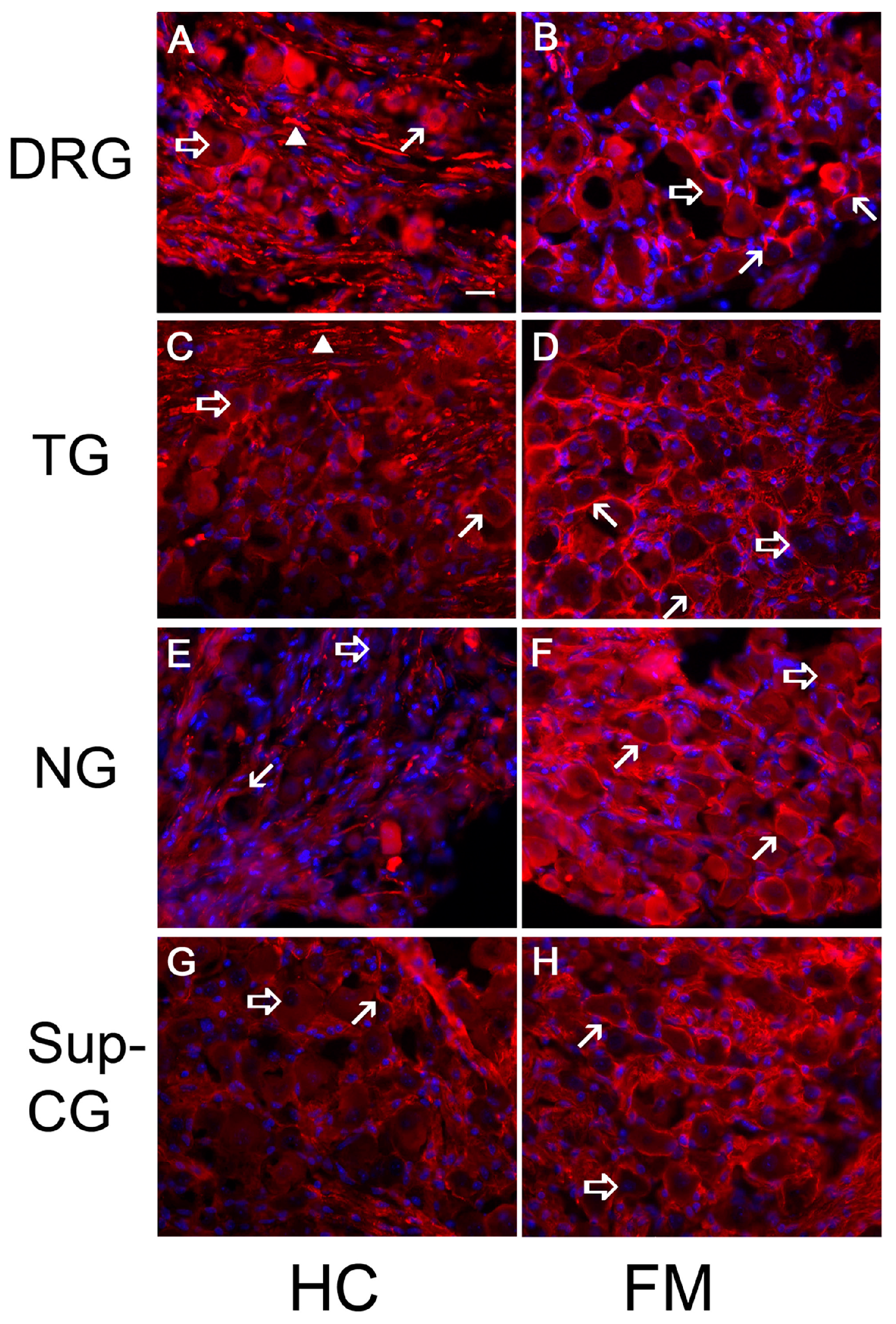
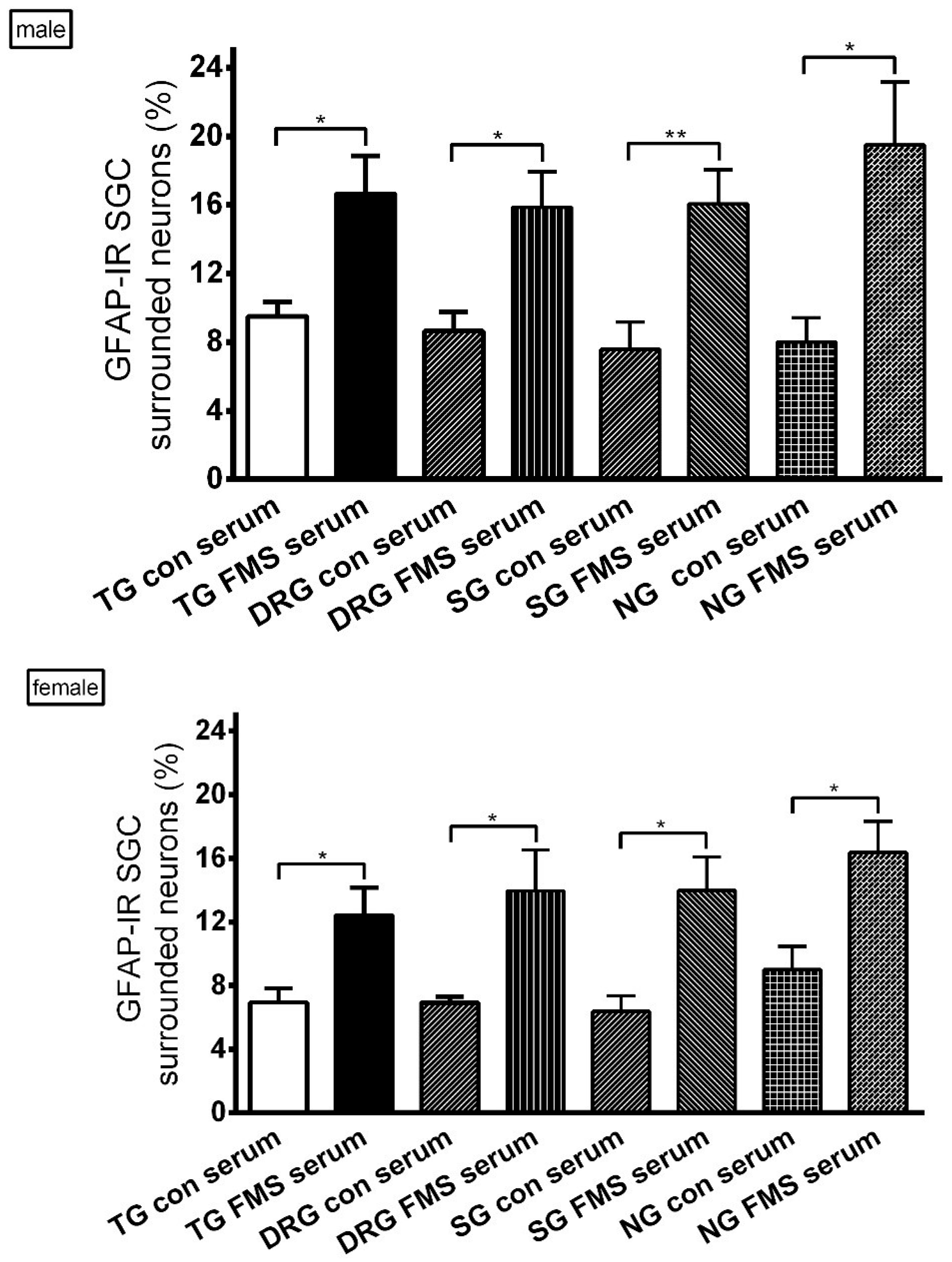
- We found that serum from patients with fibromyalgia activated satellite glial cells in mouse dorsal root, trigeminal and nodose ganglia, as well as the sympathetic superior cervical ganglia.
- These results suggest that serum factors can activate a variety of sensory and autonomic pathways, which may contribute to the symptoms in this disease.
Abstract
1. Introduction
2. Materials and Methods
2.1. Patient Selection
2.2. Immunohistochemistry
2.3. Statistics
3. Results
4. Discussion
5. Conclusions
Author Contributions
Funding
Institutional Review Board Statement
Informed Consent Statement
Data Availability Statement
Acknowledgments
Conflicts of Interest
Abbreviations
| ANS | Autonomic nervous system |
| CNS | Central nervous system |
| DAPI | 4,6-diamidino-2-phenylindole dihydrochloride |
| DRG | Dorsal root ganglion |
| GFAP | Glial fibrillary acidic protein |
| FM | Fibromyalgia |
| HC | Healthy controls |
| IgG | Immunoglobulin G |
| NG | Nodose ganglion |
| PBS | Phosphate-buffered saline |
| PSD | Polysymptomatic distress |
| SGC | Satellite glial cell |
| Sup-CG | Superior cervical sympathetic ganglion |
| SNS | Sympathetic nervous system |
References
- Conversano, C.; Ciacchini, R.; Orrù, G.; Bazzichi, M.L.; Gemignani, A.; Miniati, M. Gender differences on psychological factors in fibromyalgia: A systematic review on the male experience. Clin. Exp. Rheumatol. 2021, 39, 174–185. [Google Scholar] [CrossRef]
- Branco, C.; Bannwarth, B.; Failde, I.; Carbonell, J.A.; Spaeth, M.; Saraiva, F.; Nacci, F.; Thomas, E.; Caubere, J.P.; Le Lay, K.; et al. Prevalence of fibromyalgia: A survey in five European countries. Semin. Arthritis Rheum. 2010, 39, 448–453. [Google Scholar] [CrossRef]
- Jones, G.T.; Atzeni, F.; Beasley, M.; Flüß, E.; Sarzi-Puttini, P.; Macfarlane, G.J. The prevalence of fibromyalgia in the general population: A comparison of the American College of Rheumatology 1990, 2010, and modified 2010 classification criteria. Arthritis Rheumatol. 2015, 67, 568–575. [Google Scholar] [CrossRef]
- Geisser, E.; Donnell, C.S.; Petzke, F.; Gracely, R.H.; Clauw, D.J.; Williams, D.A. Comorbid somatic symptoms and functional status in patients with fibromyalgia and chronic fatigue syndrome: Sensory amplification as a common mechanism. Psychosomatics 2008, 49, 235–242. [Google Scholar] [CrossRef]
- Meeus, M.; Nijs, J. Central sensitization: A biopsychosocial explanation for chronic widespread pain in patients with fibromyalgia and chronic fatigue syndrome. Clin. Rheumatol. 2007, 26, 465–473. [Google Scholar] [CrossRef]
- Geisser, M.E.; Glass, J.M.; Rajcevska, L.D.; Clauw, D.J.; Williams, D.A.; Kileny, P.R.; Gracely, R.H. A psychophysical study of auditory and pressure sensitivity in patients with fibromyalgia and healthy controls. J. Pain 2008, 9, 417–422. [Google Scholar] [CrossRef] [PubMed]
- Clauw, D.J. From fibrositis to fibromyalgia to nociplastic pain: How rheumatology helped get us here and where do we go from here? Ann. Rheum. Dis. 2024, 83, 1421–1427. [Google Scholar] [CrossRef] [PubMed]
- Marinkovic, K.; Woodruff, D.; White, D.R.; Caudle, M.M.; Cronan, T. Neural indices of multimodal sensory and autonomic hyperexcitability in fibromyalgia. Neurobiol. Pain 2023, 14, 100140. [Google Scholar] [CrossRef]
- Martínez-Lavín, M.; Hermosillo, A.G. Autonomic nervous system dysfunction may explain the multisystem features of fibromyalgia. Semin. Arthritis Rheum. 2000, 29, 197–199. [Google Scholar] [CrossRef] [PubMed]
- Sarzi-Puttini, P.; Giorgi, V.; Marotto, D.; Atzeni, F. Fibromyalgia: An update on clinical characteristics, aetiopathogenesis and treatment. Nat. Rev. Rheumatol. 2020, 16, 645–660. [Google Scholar] [CrossRef]
- Ablin, J.N. Fibromyalgia 2019: Myths and Realities. Isr. Med. Assoc. J. 2019, 21, 426–428. [Google Scholar] [PubMed]
- Coskun Benlidayi, I.; Ornek, C.; Deniz, V.; Sariyildiz, A. Reevaluating fibromyalgia diagnosis: A proposal to integrate deep tendon reflex responses into current criteria. Rheumatol. Int. 2025, 45, 84. [Google Scholar] [CrossRef]
- Magen, E.; Tolkin, L.; Aamar, S.; Magen, I.; Merzon, E.; Green, I.; Golan-Cohen, A.; Vinker, S.; Israel, A. Endocrine Comorbidities in Fibromyalgia. Clin. Endocrinol. 2026, 104, 386–393. [Google Scholar] [CrossRef] [PubMed]
- Bonomi, S.; Oltra, E.; Alberio, T. In Search of Molecular Correlates of Fibromyalgia: The Quest for Objective Diagnosis and Effective Treatments. Int. J. Mol. Sci. 2025, 26, 9762. [Google Scholar] [CrossRef]
- Galosi, E.; Truini, A.; Di Stefano, G. A Systematic Review and Meta-Analysis of the Prevalence of Small Fibre Impairment in Patients with Fibromyalgia. Diagnostics 2022, 12, 1135. [Google Scholar] [CrossRef] [PubMed]
- Marshall, A.; Rapteas, L.; Burgess, J.; Riley, D.; Anson, M.; Matsumoto, K.; Bennett, A.; Kaye, S.; Marshall, A.; Dunham, J.; et al. Small fibre pathology, small fibre symptoms and pain in fibromyalgia syndrome. Sci. Rep. 2024, 14, 3947. [Google Scholar] [CrossRef]
- Sommer, C.; Üçeyler, N. Small fiber pathology in fibromyalgia syndrome. Pain Rep. 2024, 9, e1220. [Google Scholar] [CrossRef]
- Serra, J.; Collado, A.; Solà, R.; Antonelli, F.; Torres, X.; Salgueiro, M.; Quiles, C.; Bostock, H. Hyperexcitable C nociceptors in fibromyalgia. Ann. Neurol. 2014, 75, 196–208. [Google Scholar] [CrossRef]
- Caxaria, S.; Bharde, S.; Fuller, A.M.; Evans, R.; Thomas, B.; Celik, P.; Dell’Accio, F.; Yona, S.; Gilroy, D.; Voisin, M.B.; et al. Neutrophils infiltrate sensory ganglia and mediate chronic widespread pain in fibromyalgia. Proc. Natl. Acad. Sci. USA 2023, 120, e2211631120. [Google Scholar] [CrossRef]
- Cai, W.; Haddad, M.; Haddad, R.; Kesten, I.; Hoffman, T.; Laan, R.; Westfall, S.; Defaye, M.; Abdullah, N.S.; Wong, C.; et al. The gut microbiota promotes pain in fibromyalgia. Neuron 2025, 113, 2161–2175. [Google Scholar] [CrossRef]
- Goebel, A.; Krock, E.; Gentry, C.; Israel, M.R.; Jurczak, A.; Urbina, C.M.; Sandor, K.; Vastani, N.; Maurer, M.; Cuhadar, U.; et al. Passive transfer of fibromyalgia symptoms from patients to mice. J. Clin. Investig. 2021, 131, e144201. [Google Scholar] [CrossRef]
- Finnerup, N.B.; Kuner, R.; Jensen, T.S. Neuropathic Pain: From Mechanisms to Treatment. Physiol. Rev. 2021, 101, 259–301. [Google Scholar] [CrossRef]
- Raja, S.N.; Ringkamp, M.; Guan, Y.; Campbell, J.N. John J. Bonica Award Lecture: Peripheral neuronal hyperexcitability: The “low-hanging” target for safe therapeutic strategies in neuropathic pain. Pain 2020, 161, S14–S26. [Google Scholar] [CrossRef]
- Hanani, M.; Spray, D.C. Emerging importance of satellite glia in nervous system function and dysfunction. Nat. Rev. Neurosci. 2020, 21, 485–498. [Google Scholar] [CrossRef]
- Meriau, P.; Kuruvilla, R.; Cavalli, V. Satellite glial cells: Shaping peripheral input into the brain-body axis? Neuron 2025, 113, 3333–3351. [Google Scholar] [CrossRef]
- Krock, E.; Morado-Urbina, C.E.; Menezes, J.; Hunt, M.A.; Sandström, A.; Kadetoff, D.; Tour, J.; Verma, V.; Kultima, K.; Haglund, L.; et al. Fibromyalgia patients with elevated levels of anti-satellite glia cell immunoglobulin G antibodies present with more severe symptoms. Pain 2023, 164, 1828–1840. [Google Scholar] [CrossRef]
- Martinez-Lavin, M. Fibromyalgia as a sympathetically maintained pain syndrome. Curr. Pain Headache Rep. 2004, 8, 385–389. [Google Scholar] [CrossRef]
- Meeus, M.; Goubert, D.; De Backer, F.; Struyf, F.; Hermans, L.; Coppieters, I.; De Wandele, I.; Da Silva, H.; Calders, P. Heart rate variability in patients with fibromyalgia and patients with chronic fatigue syndrome: A systematic review. Semin. Arthritis Rheum. 2013, 43, 279–287. [Google Scholar] [CrossRef]
- Best, C.; Sayegh, A.L.; Mueck, A.; Emde, J.; Thieme, K.; Krämer, H.H. Association between altered baroreflex control and pain intensity in fibromyalgia. BMC Neurol. 2025, 25, 498. [Google Scholar] [CrossRef]
- Hanani, M. Satellite glial cells in sympathetic and parasympathetic ganglia: In search of function. Brain Res. Rev. 2010, 64, 304–327. [Google Scholar] [CrossRef]
- Xie, A.X.; Lee, J.J.; McCarthy, K.D. Ganglionic GFAP+ glial Gq-GPCR signaling enhances heart functions in vivo. JCI Insight 2017, 2, e90565. [Google Scholar] [CrossRef]
- Wolfe, F.; Clauw, D.J.; Fitzcharles, M.A.; Goldenberg, D.L.; Hauser, W.; Katz, R.L.; Mease, P.J.; Russell, A.S.; Russe, I.J.; Walitt, B. 2016 Revisions to the 2010/2011 fibromyalgia diagnostic criteria. Semin. Arthritis Rheum. 2016, 46, 319–329. [Google Scholar] [CrossRef]
- Wolfe, F.; Walitt, B.T.; Rasker, J.J.; Katz, R.S.; Häuser, W. The Use of Polysymptomatic Distress Categories in the Evaluation of Fibromyalgia (FM) and FM Severity. J. Rheumatol. 2015, 42, 1494–1501. [Google Scholar] [CrossRef]
- Feldman-Goriachnik, R.; Hanani, M. How do neurons in sensory ganglia communicate with satellite glial cells? Brain Res. 2021, 1760, 147384. [Google Scholar] [CrossRef]
- Tse, K.H.; Chow, K.B.; Leung, W.K.; Wong, Y.H.; Wise, H. Lipopolysaccharide differentially modulates expression of cytokines and cyclooxygenases in dorsal root ganglion cells via Toll-like receptor-4 dependent pathways. Neuroscience 2014, 267, 241–251. [Google Scholar] [CrossRef]
- Konnova, E.A.; Deftu, A.F.; Chu Sin Chung, P.; Pertin, M.; Kirschmann, G.; Decosterd, I.; Suter, M.R. Characterisation of GFAP-Expressing Glial Cells in the Dorsal Root Ganglion after Spared Nerve Injury. Int. J. Mol. Sci. 2023, 24, 15559. [Google Scholar] [CrossRef]
- Mercado, F.; Almanza, A.; Segura-Chama, P.; Galindo-Avendaño, V.; Martínez-Martínez, L.A.; Martínez-Lavín, M. Acute activation of rat dorsal root ganglion neurons and their satellite glial cells by the serum of patients suffering from fibromyalgia. Clin. Exp. Rheumatol. 2026, Online ahead of print. [Google Scholar] [CrossRef]
- Seefried, S.; Barcic, A.; Grijalva Yepez, M.F.; Reinhardt, L.; Appeltshauser, L.; Doppler, K.; Üçeyler, N.; Sommer, C. Autoantibodies in patients with fibromyalgia syndrome. Pain 2025, 166, 1922–1933. [Google Scholar] [CrossRef]
- Costa, Y.M.; Conti, P.C.; de Faria, F.A.; Bonjardim, L.R. Temporomandibular disorders and painful comorbidities: Clinical association and underlying mechanisms. Oral. Surg. Oral. Med. Oral. Pathol. Oral. Radiol. 2017, 123, 288–297. [Google Scholar] [CrossRef]
- Rhodus, N.L.; Fricton, J.; Carlson, P.; Messner, R. Oral symptoms associated with fibromyalgia syndrome. J. Rheumatol. 2003, 30, 1841–1845. [Google Scholar]
- Tracey, K.J. From human to mouse and back offers hope for patients with fibromyalgia. J. Clin. Investig. 2021, 131, e150382. [Google Scholar] [CrossRef]
- Pavlov, V.A.; Tracey, K.J. The vagus nerve and the inflammatory reflex—Linking immunity and metabolism. Nat. Rev. Endocrinol. 2012, 8, 743–754. [Google Scholar] [CrossRef]
- Martins, D.F.; Viseux, F.J.F.; Salm, D.C.; Ribeiro, A.C.A.; da Silva, H.K.L.; Seim, L.A.; Bittencourt, E.B.; Bianco, G.; Moré, A.O.O.; Reed, W.R.; et al. The role of the vagus nerve in fibromyalgia syndrome. Neurosci. Biobehav. Rev. 2021, 131, 1136–1149. [Google Scholar] [CrossRef]
- Cairns, B.E. The contribution of autonomic mechanisms to pain in temporomandibular disorders: A narrative review. J. Oral Rehabil. 2022, 49, 1115–1126. [Google Scholar] [CrossRef]
- Chuang, K.S.; Liu, W.C.; Liou, N.H.; Liu, J.C. Horseradish peroxidase localization of sympathetic postganglionic and parasympathetic preganglionic neurons innervating the monkey heart. Chin. J. Physiol. 2004, 47, 95–99. [Google Scholar]
- Chen, H.S.; van Roon, L.; Ge, Y.; van Gils, J.M.; Schoones, J.W.; DeRuiter, M.C.; Zeppenfeld, K.; Jongbloed, M.R.M. The relevance of the superior cervical ganglion for cardiac autonomic innervation in health and disease: A systematic review. Clin. Auton. Res. 2024, 34, 45–77. [Google Scholar] [CrossRef]
- Cardinali, D.P.; Vacas, M.I. Cellular and molecular mechanisms controlling melatonin release by mammalian pineal glands. Cell. Mol. Neurobiol. 1987, 7, 323–337. [Google Scholar] [CrossRef]
- Korszun, A.; Sackett-Lundeen, L.; Papadopoulos, E.; Brucksch, C.; Masterson, L.; Engelberg, N.C.; Haus, E.; Demitrack, M.A.; Crofford, L. Melatonin levels in women with fibromyalgia and chronic fatigue syndrome. J. Rheumatol. 1999, 26, 2675–2680. [Google Scholar]
- Ekenstam, K.A.; Menezes, J.; Jakobsson, J.E.; Silverstein, H.; Krock, E.; Tour, J.; Sandor, K.; Kuliszkiewicz, A.; Hunt, M.; Kultima, K.; et al. Searching for blood biomarkers and treatment targets in Women with fibromyalgia—Protein interaction patterns and anti-satellite glia cell IgG antibodies as promising candidates. Brain Behav. Immun. 2026, 132, 106185. [Google Scholar] [CrossRef]
Disclaimer/Publisher’s Note: The statements, opinions and data contained in all publications are solely those of the individual author(s) and contributor(s) and not of MDPI and/or the editor(s). MDPI and/or the editor(s) disclaim responsibility for any injury to people or property resulting from any ideas, methods, instructions or products referred to in the content. |
© 2026 by the authors. Licensee MDPI, Basel, Switzerland. This article is an open access article distributed under the terms and conditions of the Creative Commons Attribution (CC BY) license.
Share and Cite
Hanani, M.; Feldman-Goriachnik, R.; Aamar, S. Serum from Fibromyalgia Patients Activates Satellite Glial Cells in Mouse Peripheral Ganglia. Cells 2026, 15, 974. https://doi.org/10.3390/cells15110974
Hanani M, Feldman-Goriachnik R, Aamar S. Serum from Fibromyalgia Patients Activates Satellite Glial Cells in Mouse Peripheral Ganglia. Cells. 2026; 15(11):974. https://doi.org/10.3390/cells15110974
Chicago/Turabian StyleHanani, Menachem, Rachel Feldman-Goriachnik, and Suhail Aamar. 2026. "Serum from Fibromyalgia Patients Activates Satellite Glial Cells in Mouse Peripheral Ganglia" Cells 15, no. 11: 974. https://doi.org/10.3390/cells15110974
APA StyleHanani, M., Feldman-Goriachnik, R., & Aamar, S. (2026). Serum from Fibromyalgia Patients Activates Satellite Glial Cells in Mouse Peripheral Ganglia. Cells, 15(11), 974. https://doi.org/10.3390/cells15110974

