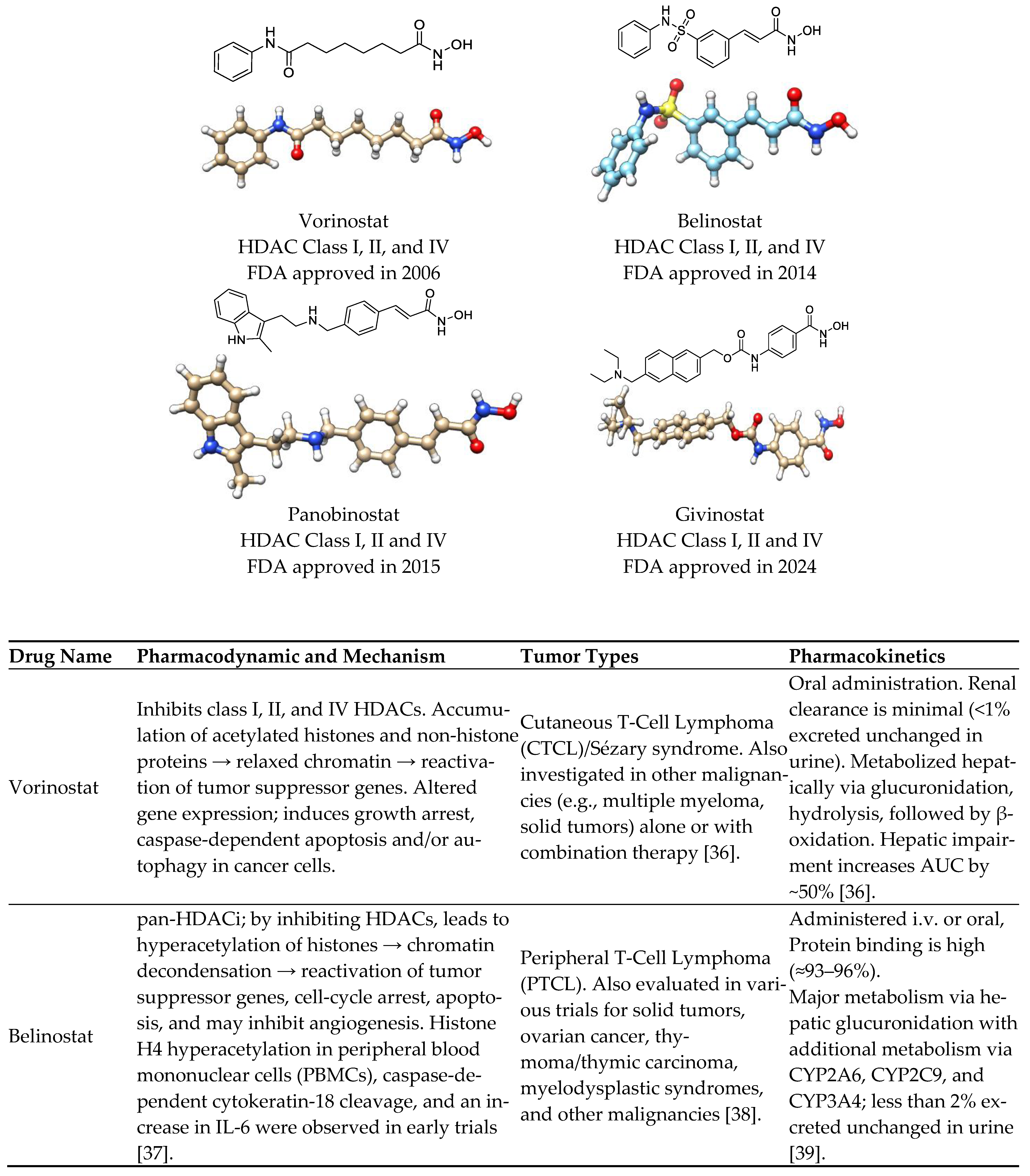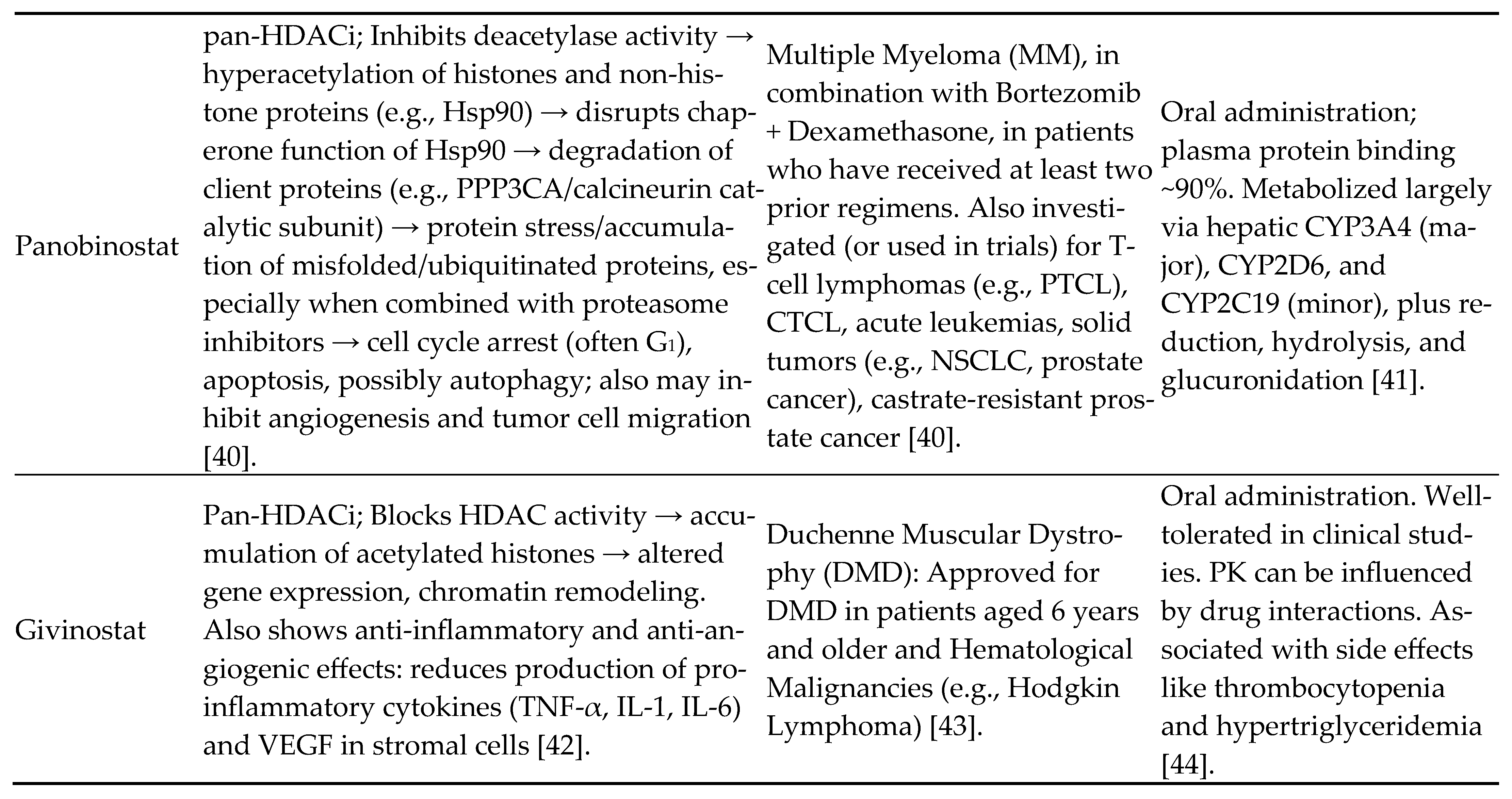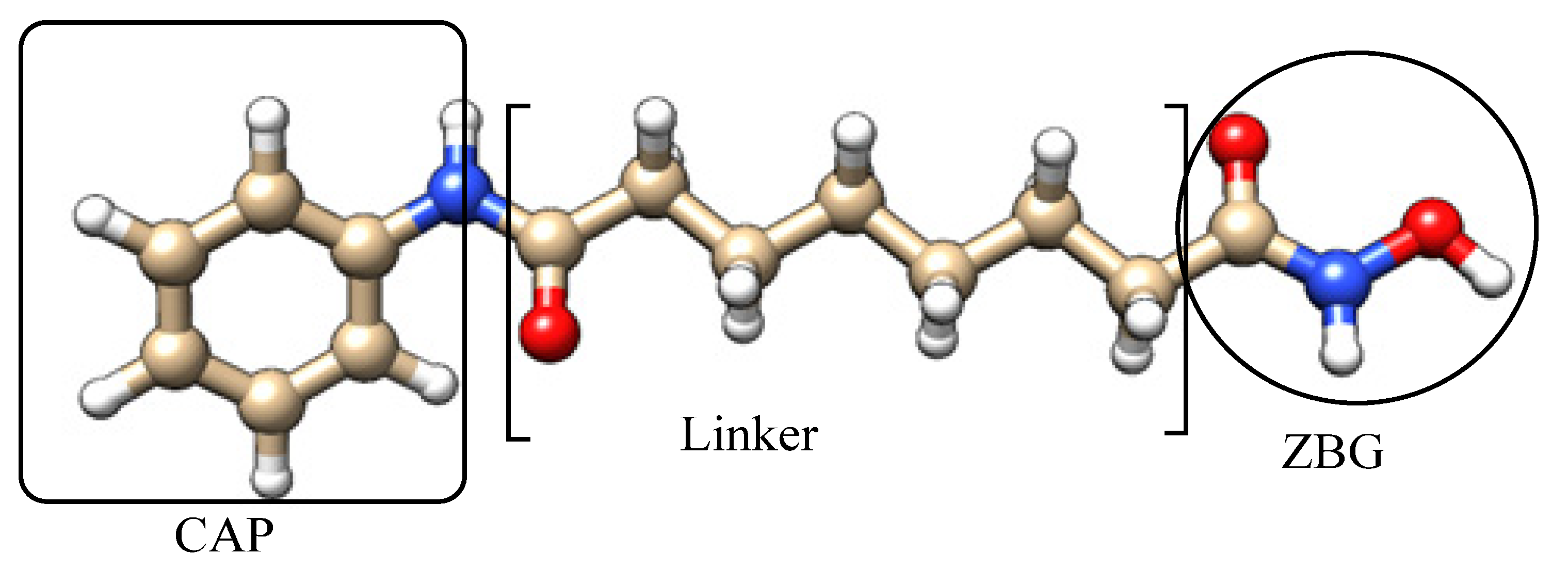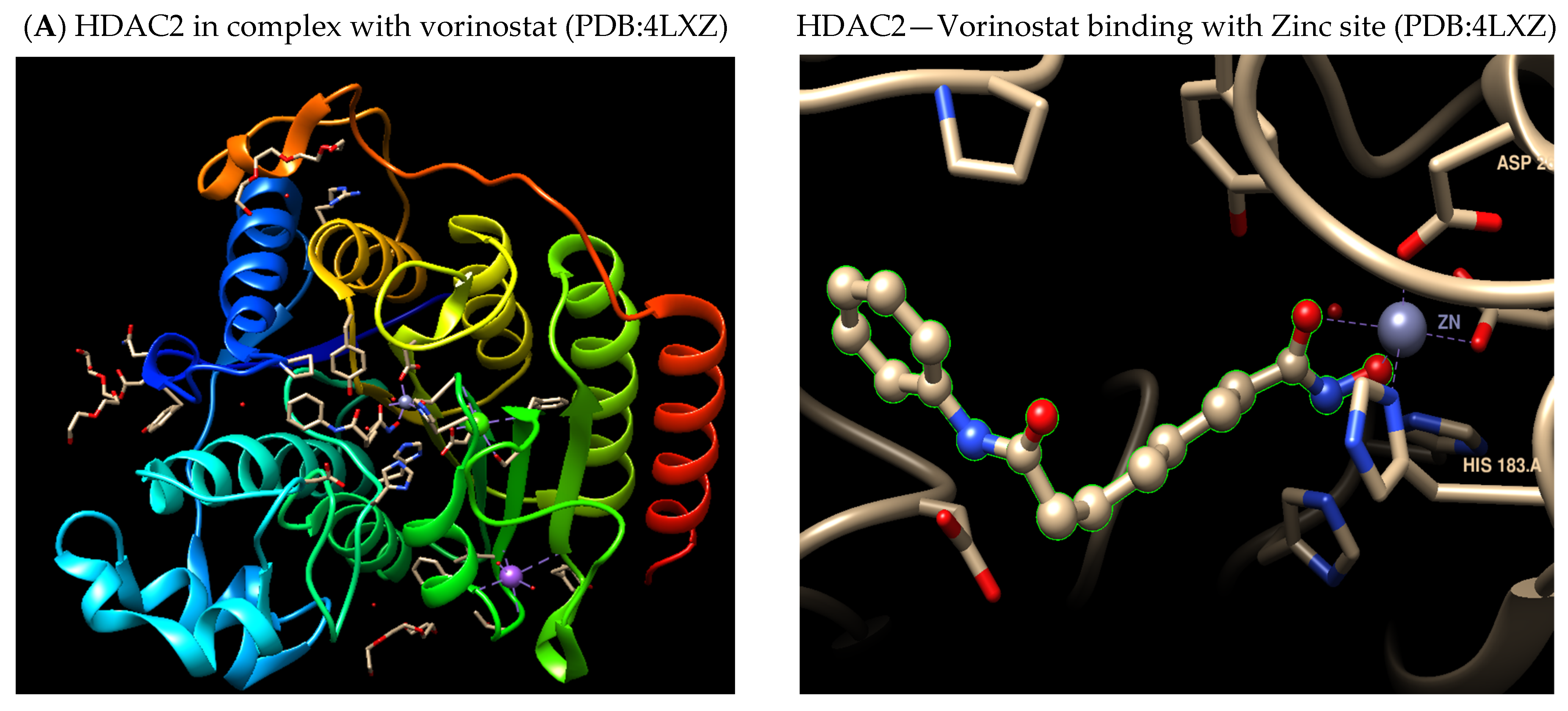
Next-Generation HDAC Inhibitors: Advancing Zinc-Binding Group Design for Enhanced Cancer Therapy

Highlights
- This review systematically analyzes recently developed HDAC inhibitors in recent years, emphasizing structural evolution across CAP, linker, and zinc-binding groups (ZBGs).
- It highlights the emergence of hydroxamate and non-hydroxamate ZBGs.
- Understanding SAR trends across diverse scaffolds provides a rational foundation for designing next-generation HDAC inhibitors with improved isoform selectivity, potency, and therapeutic tolerance.
- The integration of structural insights with updated clinical trial data supports more informed medicinal-chemistry strategies aimed at accelerating the development of clinically viable HDAC-targeted anticancer agents.
Abstract
1. Introduction
2. FDA-Approved and Clinically Approved HDACi
3. Zinc Chelation Mechanism Across Diverse HDAC Isoforms
4. Hydroxamate-Based HDACi

| Name and Structure | Company | Clinical Trial (ClinicalTrials ID) | Cancer Type | HDAC Class | Ref. |
|---|---|---|---|---|---|
Resminostat | 4SC AG | Phase II completed (NCT02953301) | Mycosis Fungoides, Sézary Syndrome, lymphoma | I & II | [63,64] |
Pracinostat a | Helsinn Healthcare SA | Phase II/III; Ongoing/Completed (NCT03151408) | Acute Myeloid Leukemia | I, II,& IV | [62,65,66] |
Abexinostat | Xynomic Pharmaceuticals | Phase I/II; Completed/Ongoing (NCT04024696) | non-Hodgkin lymphoma | I & II | [35] |
Bisthianostat | Shanghai Theorion Pharmaceutical | Phase I completed (NCT03618602) | Myeloma | pan-HDAC | [67,68] |
Quisinostat | Janssen Research & Development | Phase Ib-IVa Completed (NCT01486277) | Cutaneous T-cell Lymphoma | I & II | [71,72,73] |
Ivaltinostat b | CrystalGenomics | Phase I/II Completed/Ongoing (NCT05249101) | Pancreatic Adenocarcinoma | pan-HDAC | [69,70] |
CUDC-101 | Curis, Inc. | Phase I completed (NCT01384799) | Head & Neck Cancer | I & II | [77,78,79] |
CUDC-907 | Curis, Inc. | Phase I completed (NCT01742988) | Lymphoma | I & II | [74,75,76] |
CHR 3996 | Chroma Therapeutics | Phase I completed (NCT00697879) | Solid tumors | I | [80,81] |
MPT0E028 | Taipei Medical University | Phase I completed (NCT02350868) | colorectal cancer and B-cell lymphoma | HDAC I, 2 & 6 | [82,83] |
REC-2282 (AR-42) | Recursion Pharmaceuticals | Phase II & III completed (NCT02350868) | Neurofibromatosis Type 2 | HDAC I and IIb | [84,85] |
R-306465 | Johnson & Johnson Pharmaceutical | Phase I completed (NCT00677001) | Advanced Solid tumors | HDAC I | [86,87] |
5. Non-Hydroxamate-Based HDAC Inhibitors
6. HDAC-Based Dual-Target Inhibitors
| Code | Structures | Evaluated Cancer/Normal Cell Lines | Evaluated Target | Ref. | ||
|---|---|---|---|---|---|---|
| Cell Lines | IC50/%V | HDAC | IC50 | |||
| St.29 |  | MCF-7 HepG2 HCT116 A549 | 0.621 µM 0.536 µM 1.206 µM 0.797 µM | HDAC1 HDAC2 HDAC4 HDAC6 HDAC8 EGFR | 0.148 µM 0.168 µM 5.852 µM 0.060 µM 2.257 µM 63 nM | [137] |
| St.30 |  | EPC | 1.0 µM | HDAC6 EPCs | 166 nM 1.0 µM | [138] |
| St.31 |  | MDA-MB-436 MDA-MB-231 MCF-7 | 0.30 µM 2.70 µM 2.41 µM | HDAC1 PARP-1 | 31 nM <0.2 nM | [139] |
| St.32 |  | HeLa | 65.94 nM | HDAC1 HDAC6 PIM-1 | 63.65 nM 62.39 nM 343.87 nM | [140] |
| St.33 |  | PC-3 | 16 nM | HDAC2 Tubulin | 0.43 µM 4.82 µM | [141] |
| St.34 |  | HepG2 | 0.58 µM | HDAC1 HDAC6 | 13.37 nM 42.74 nM | [143] |
| St.35 |  | SiHa HepG2 MCF-7 Cal27 | 16.43 µM >100 µM >100 µM 50.98 µM | HDACs RR | 10.80 µM 9.34 µM | [144] |
| St.36 |  | SU-DHL-6 | 1.20 µM | HDAC1 HDAC4 HDAC6 HDAC11 EZH2wt | 0.19 µM >10 µM 0.03 µM >10 µM 0.59 nM | [145] |
| St.37 |  | HCT-116 SW480 MDA-MB-231 MCF-7 HK2 | 16.42 µM 23.43 µM 43.74 µM 36.46 µM >80 µM | HDAC1 HDAC6 IDO1 | 1.078 µM 58.23 nM 86 nM | [146] |
| St.38 |  | MDA-MB-231 HeLa HepG2 | 2.47 µM 1.51 µM 4.52 µM | HDAC1 HDAC2 HDAC3 CDK9 | 1.73 µM >50 µM 1.11 µM 0.17 µM | [147] |
| St.39 |  | JEKO-1 | 0.9 µM | HDAC1 HDAC2 HDAC3 PI3K α PI3K β | 75.5 nM 70.9 nM 1.9 nM 2.5 nM 10.0 nM | [148] |
7. Conclusions
Funding
Data Availability Statement
Acknowledgments
Conflicts of Interest
Abbreviations
| HDACs | Histone deacetylases |
| HDACi | Histone deacetylase inhibitors |
| FDA | The Food and Drug Administration of the United States |
| ZBG | zinc-binding group |
| SAR | structure–activity relationships |
| CDK | cyclin-dependent kinase |
| PI3K | Phosphoinositide 3-kinase |
| EGFR | Multidisciplinary Digital Publishing Institute |
| DNA | Deoxyribonucleic Acid |
| DMD | Duchenne muscular dystrophy |
| HCC | hepatocellular carcinoma |
| EMT | Epithelial-to-mesenchymal transition |
| PDB | Protein Data Bank |
| HL | Hodgkin Lymphoma |
| HepG2 | Liver Cancer cell lines |
| MCF-7 | Breast Cancer cell lines |
| HCT116 | Colon Cancer cell lines |
| A549 | Lung cancer cell lines |
| St. | Structure |
| IC50 | inhibitory concentration |
| GI50 | half-maximum growth inhibition |
| µM | Micro molar |
| nM | Nano molar |
| SK-MEL-2 | Male malignant melanoma |
| HS-5 | Fibroblast morphology Cell |
| NA | Not applicable |
| MDA-MB-436 | Human breast adenocarcinoma Cells |
| MDA-MB-231 | Human breast adenocarcinoma Cells |
| PC3 | Prostate Cancer Cell line |
| PDXO | Patient-Derived Xenograft Organoids |
| UM | Uveal Melanoma |
| PC9 | human pulmonary adenocarcinoma cell lines |
| J774A | Sarcoma Cell lines |
| 4T1 | metastatic mouse mammary carcinoma cell line |
| LX-2 | Human Hepatic Stellate Cell Line |
| HeLa | Cervical Cancer cell lines |
| EPC | Endothelial Progenitor Cells |
| HT-29 | Colon cancer cell lines |
| PIM-1 | Proto-oncogene, serine/threonine kinase |
| VEGFR | vascular endothelial growth factor receptor |
| IDO1 | Indoleamine 2,3-dioxygenase |
| SH-SY5Y | Neuroblastoma cell line |
| EZH2wt | wild-type of the Enhancer of Zeste Homolog 2 protein |
References
- Sharma, S.; Kumar, C.; Kushwaha, H.; Jha, S.K.; Chawla, S.; Sharma, A.; Midha, T.; Huddar, V. Advancing anticancer drug development: Overcoming challenges and exploring new therapeutic strategies. Ayush J. Integr. Oncol. 2025, 2, 8–27. [Google Scholar] [CrossRef] [Scilit]
- Zafar, A.; Khatoon, S.; Khan, M.J.; Abu, J.; Naeem, A. Advancements and limitations in traditional anti-cancer therapies: A comprehensive review of surgery, chemotherapy, radiation therapy, and hormonal therapy. Discov. Oncol. 2025, 16, 607. [Google Scholar] [CrossRef] [Scilit] [PubMed]
- Abavisani, M.; Khoshrou, A.; Eshaghian, S.; Karav, S.; Sahebkar, A. Overcoming antibiotic resistance: The potential and pitfalls of drug repurposing. J. Drug Target. 2025, 33, 341–367. [Google Scholar] [CrossRef] [Scilit]
- Khan, N.; Raza, U.; Zaidi, S.A.A.; Nuer, M.; Abudurousuli, K.; Paerhati, Y.; Aikebaier, A.; Zhou, W. Drugging the ‘undruggable’KRAS: Breakthroughs, challenges, and opportunities in pancreatic cancer. Cancer Biol. Med. 2025, 22, 762–788. [Google Scholar]
- Patrick, G.L. An Introduction to Medicinal Chemistry, 7th ed.; Oxford University Press: Oxford, UK, 2023. [Google Scholar]
- Tran, C.; Hamze, A. Recent Advancements in the Development of HDAC/Tubulin Dual-Targeting Inhibitors. Pharmaceuticals 2025, 18, 341. [Google Scholar] [CrossRef] [Scilit]
- Hawash, M. Highlights on Specific Biological Targets; Cyclin-Dependent Kinases, Epidermal Growth Factor Receptors, Ras Protein, and Cancer Stem Cells in Anticancer Drug Development. Drug Res. 2019, 69, 471–478. [Google Scholar] [CrossRef] [Scilit] [PubMed]
- Cheshmazar, N.; Hamzeh-Mivehroud, M.; Charoudeh, H.N.; Hemmati, S.; Melesina, J.; Dastmalchi, S. Current trends in development of HDAC-based chemotherapeutics. Life Sci. 2022, 308, 120946. [Google Scholar] [CrossRef] [Scilit] [PubMed]
- Talom, A.; Barhoi, A.; Jirpu, T.; Dawn, B.; Ghosh, A. Clinical progress and functional modalities of HDAC inhibitor-based combination therapies in cancer treatment. Clin. Transl. Oncol. 2025, 1–15. [Google Scholar] [CrossRef] [Scilit]
- Shirbhate, E.; Singh, V.; Kore, R.; Koch, B.; Veerasamy, R.; Tiwari, A.K.; Rajak, H. Synergistic strategies: Histone deacetylase inhibitors and platinum-based drugs in cancer therapy. Expert Rev. Anticancer Ther. 2025, 25, 121–141. [Google Scholar] [CrossRef] [Scilit]
- Márquez-Cantudo, L.; Ramos, A.; Coderch, C.; de Pascual-Teresa, B. Proteasomal degradation of Zn-dependent Hdacs: The E3-ligases implicated and the designed protacs that enable degradation. Molecules 2021, 26, 5606. [Google Scholar] [CrossRef] [Scilit]
- Peterson, J.J.; Lewis, C.A.; Burgos, S.D.; Manickam, A.; Xu, Y.; Rowley, A.A.; Clutton, G.; Richardson, B.; Zou, F.; Simon, J.M. A histone deacetylase network regulates epigenetic reprogramming and viral silencing in HIV-infected cells. Cell Chem. Biol. 2023, 30, 1617–1633.E9. [Google Scholar] [CrossRef] [Scilit]
- Mohite, R.; Doshi, G. Elucidation of the role of the epigenetic regulatory mechanisms of PI3K/Akt/mTOR signaling pathway in human malignancies. Curr. Cancer Drug Targets 2024, 24, 231–244. [Google Scholar] [CrossRef] [Scilit]
- Tokarz, P.; Kaarniranta, K.; Blasiak, J. Role of the cell cycle re-initiation in DNA damage response of post-mitotic cells and its implication in the pathogenesis of neurodegenerative diseases. Rejuvenation Res. 2016, 19, 131–139. [Google Scholar] [CrossRef] [Scilit]
- Pu, J. The Role of Histone Deacetylase (HDAC) Inhibitors and Cytokine-Induced Killer Cell (CIK) in Multiple Myeloma. Ph.D. Thesis, Universitäts-und Landesbibliothek Bonn, Bonn, Germany, 2025. [Google Scholar]
- Su, M.; Gong, X.; Liu, F. An update on the emerging approaches for histone deacetylase (HDAC) inhibitor drug discovery and future perspectives. Expert Opin. Drug Discov. 2021, 16, 745–761. [Google Scholar] [CrossRef] [Scilit] [PubMed]
- Theodoropoulou, M.A.; Mantzourani, C.; Kokotos, G. Histone Deacetylase (HDAC) Inhibitors as a Novel Therapeutic Option Against Fibrotic and Inflammatory Diseases. Biomolecules 2024, 14, 1605. [Google Scholar] [CrossRef] [Scilit]
- Tarawneh, A.H.; Al-Trawneh, S.A.; Yesiloglu, T.Z.; Zessin, M.; Robaa, D.; Barinka, C.; Schutkowski, M.; Sippl, W.; Ross, S.A. Novel selective indole based histone deacetylase 10 inhibitors as anticancer therapeutics. Sci. Rep. 2025, 15, 33307. [Google Scholar] [CrossRef] [Scilit]
- Reichert, N.; Choukrallah, M.-A.; Matthias, P. Multiple roles of class I HDACs in proliferation, differentiation, and development. Cell. Mol. Life Sci. 2012, 69, 2173–2187. [Google Scholar] [CrossRef] [Scilit]
- Zhang, Y.; Wang, H.; Zhan, Z.; Gan, L.; Bai, O. Mechanisms of HDACs in cancer development. Front. Immunol. 2025, 16, 1529239. [Google Scholar] [CrossRef] [Scilit] [PubMed]
- Cappellacci, L.; Perinelli, D.R.; Maggi, F.; Grifantini, M.; Petrelli, R. Recent progress in histone deacetylase inhibitors as anticancer agents. Curr. Med. Chem. 2020, 27, 2449–2493. [Google Scholar] [CrossRef] [Scilit] [PubMed]
- Bakrim, S.; Atifi, F.; Omari, N.E.; Zaid, Y.; Aanniz, T.; Lee, L.H.; Zengin, G.; Bouyahya, A. Clinical Applications of HDAC Inhibitors as Anticancer Agents in Prostate, Breast, Ovarian, and Cervical Cancers. ChemistrySelect 2025, 10, e202405484. [Google Scholar] [CrossRef] [Scilit]
- Ruzic, D.; Djoković, N.; Srdić-Rajić, T.; Echeverria, C.; Nikolic, K.; Santibanez, J.F. Targeting histone deacetylases: Opportunities for cancer treatment and chemoprevention. Pharmaceutics 2022, 14, 209. [Google Scholar] [CrossRef] [Scilit] [PubMed]
- Abdelsalam, M.; Zmyslia, M.; Schmidtkunz, K.; Vecchio, A.; Hilscher, S.; Ibrahim, H.S.; Schutkowski, M.; Jung, M.; Jessen-Trefzer, C.; Sippl, W. Design and synthesis of bioreductive prodrugs of class I histone deacetylase inhibitors and their biological evaluation in virally transfected acute myeloid leukemia cells. Arch. Pharm. 2024, 357, 2300536. [Google Scholar] [CrossRef] [Scilit]
- Abdelraheem, A.M.; Aly, O.M.; Mohassab, A.M.; Mohamed, M.F. HDAC as a cancer target: Various scaffolds based on HDAC inhibitors and an overview of their advances. Octahedron Drug Res. 2024, 5, 22–50. [Google Scholar] [CrossRef] [Scilit]
- Raucci, A.; Zwergel, C.; Valente, S.; Mai, A. Advancements in Hydrazide-Based HDAC Inhibitors: A Review of Recent Developments and Therapeutic Potential. J. Med. Chem. 2025, 68, 14171–14194. [Google Scholar] [CrossRef] [Scilit]
- Zhao, C.; Chai, Q.; Zhang, Y. Recent progress of small molecular HDAC modulators for cancer therapy and beyond. Pharmacol. Discov. 2025, 5, 8. [Google Scholar] [CrossRef] [Scilit]
- Zhang, L.; Yang, Y.; Li, Y.; Wang, C.; Bian, C.; Wang, H.; Wang, F. Epigenetic regulation of histone modifications in glioblastoma: Recent advances and therapeutic insights. Biomark. Res. 2025, 13, 80. [Google Scholar] [CrossRef] [Scilit]
- Morales-Herrejón, G.; García-Vázquez, J.B.; Fernández-Pomares, C.; Bakalara, N.; Correa-Basurto, J.; Mendoza-Figueroa, H.L. Computationally Guided Design, Synthesis, and Evaluation of Novel Non-Hydroxamic Histone Deacetylase Inhibitors, Based on N-Trifluoroacetamide as a Zinc-Binding Group, Against Breast Cancer. Pharmaceuticals 2025, 18, 351. [Google Scholar] [CrossRef] [Scilit]
- Geurs, S.; Clarisse, D.; De Bosscher, K.; D’hooghe, M. The zinc-binding group effect: Lessons from non-hydroxamic acid vorinostat analogs. J. Med. Chem. 2023, 66, 7698–7729. [Google Scholar] [CrossRef] [Scilit]
- Li, Y.; Wang, F.; Chen, X.; Wang, J.; Zhao, Y.; Li, Y.; He, B. Zinc-dependent deacetylase (HDAC) inhibitors with different zinc binding groups. Curr. Top. Med. Chem. 2019, 19, 223–241. [Google Scholar] [CrossRef] [Scilit] [PubMed]
- Begum, R.; Parsons, J.L.; Jones, A.M. Adverse drug reaction profiles of histone deacetylase inhibitors. Sci. Rep. 2025, 15, 35880. [Google Scholar] [CrossRef] [Scilit] [PubMed]
- Zhang, L.; Zhang, J.; Jiang, Q.; Zhang, L.; Song, W. Zinc binding groups for histone deacetylase inhibitors. J. Enzym. Inhib. Med. Chem. 2018, 33, 714–721. [Google Scholar] [CrossRef] [Scilit]
- Inoue, Y.; Yasunaga, J.-I. Impact of Novel Agents on Allogeneic Hematopoietic Cell Transplantation in Patients with T-Cell Lymphomas. Cells 2025, 14, 1306. [Google Scholar] [CrossRef] [Scilit] [PubMed]
- Gui, L.; Xie, Z.; Qin, Y.; Liu, P.; Yang, J.; Chen, X.; Li, Z.; Tao, R.; Shi, Y. Safety, pharmacokinetics, and efficacy of abexinostat, an novel histone deacetylase inhibitor, in Chinese patients with relapsed/refractory B cell non-Hodgkin lymphoma: A Phase 1 study. BMC Cancer 2025, 25, 967. [Google Scholar] [CrossRef] [Scilit] [PubMed]
- Afifi, S.; Michael, A.; Azimi, M.; Rodriguez, M.; Lendvai, N.; Landgren, O. Role of Histone Deacetylase Inhibitors in Relapsed Refractory Multiple Myeloma: A Focus on Vorinostat and Panobinostat. Pharmacotherapy 2015, 35, 1173–1188. [Google Scholar] [CrossRef] [Scilit] [PubMed]
- Piper, W.L.; Waddell, J.A.; Solimando, D.A., Jr. Drug monographs: Belinostat and idelalisib. Hosp. Pharm. 2014, 49, 1009–1013. [Google Scholar] [CrossRef] [Scilit] [PubMed]
- Yadav, R.; Mishra, P.; Yadav, D. Histone deacetylase inhibitors: A prospect in drug discovery. Turk. J. Pharm. Sci. 2018, 16, 101. [Google Scholar] [CrossRef] [Scilit]
- Calvo, E.; Reddy, G.; Boni, V.; García-Cañamaque, L.; Song, T.; Tjornelund, J.; Choi, M.R.; Allen, L.F. Pharmacokinetics, metabolism, and excretion of 14C-labeled belinostat in patients with recurrent or progressive malignancies. Investig. New Drugs 2016, 34, 193–201. [Google Scholar] [CrossRef] [Scilit]
- Imai, Y.; Maru, Y.; Tanaka, J. Action mechanisms of histone deacetylase inhibitors in the treatment of hematological malignancies. Cancer Sci. 2016, 107, 1543–1549. [Google Scholar] [CrossRef] [Scilit]
- Van Veggel, M.; Westerman, E.; Hamberg, P. Clinical Pharmacokinetics and Pharmacodynamics of Panobinostat. Clin. Pharmacokinet. 2018, 57, 21–29. [Google Scholar] [CrossRef] [Scilit]
- Aartsma-Rus, A. Histone deacetylase inhibition with givinostat: A multi-targeted mode of action with the potential to halt the pathological cascade of Duchenne muscular dystrophy. Front. Cell Dev. Biol. 2025, 12, 1514898. [Google Scholar] [CrossRef] [Scilit]
- Lamb, Y.N. Givinostat: First approval. Drugs 2024, 84, 849–856. [Google Scholar] [CrossRef] [Scilit]
- Fiorentini, F.; Germani, M.; Del Bene, F.; Pellizzoni, C.; Cazzaniga, S.; Rocchetti, M.; Bettica, P. Population pharmacokinetic–pharmacodynamic analysis of givinostat. Expert Opin. Drug Metab. Toxicol. 2023, 19, 229–238. [Google Scholar] [CrossRef] [Scilit]
- Anjum, A.F.; Anjum, M.B.; ur Rehman, R. Unleashing the Potential of Givinostat: A Novel Therapy for Duchenne Muscular Dystrophy. Curr. Ther. Res. 2025, 102, 100787. [Google Scholar] [CrossRef] [Scilit]
- Kumar, D.; Kumar, R.; Singh, H.R.; Tanwar, R.; Gupta, V. Duvyzat (Givinostat) in Duchenne Muscular Dystrophy: Mechanisms, Clinical Impact, and Future Directions. Curr. Pharm. Res. 2025, 1, 308–322. [Google Scholar] [CrossRef] [Scilit]
- Galluzzi, L.; Spada, S. Epigenetic Regulation of Cancer-Part D; Academic Press: Cambridge, MA, USA, 2025; Volume 390. [Google Scholar]
- Hao, W.; Zhang, Q.; Ma, Y.; Ding, Y.; Zhao, C.; Tian, C. Mechanism and application of HDAC inhibitors in the treatment of hepatocellular carcinoma. J. Mol. Med. 2025, 103, 469–484. [Google Scholar] [CrossRef] [Scilit]
- Pires, G.S.; Tolomeu, H.V.; Rodrigues, D.A.; Lima, L.M.; Fraga, C.A.M.; Pinheiro, P.d.S.M. Drug Discovery for Histone Deacetylase Inhibition: Past, Present and Future of Zinc-Binding Groups. Pharmaceuticals 2025, 18, 577. [Google Scholar] [CrossRef] [Scilit]
- Shukla, Y.K.; Vandana; Mandal, V.; Asati, V.; Keservani, R.K.; Bharti, S.K. An updated patent review on rational combinations of HDAC inhibitors for cancer chemotherapy (2020–present): Part 2-patent published. Expert Opin. Ther. Pat. 2025, 35, 875–900. [Google Scholar] [CrossRef] [Scilit] [PubMed]
- Rizwan, A.; Aqeel, A.; Farooqi, H. Decoding HDACs and its inhibitors-artificial intelligence assisted smart software based super computational modelling technology in targeting cancer and neurological disorders of the brain. Netw. Model. Anal. Health Inform. Bioinform. 2025, 14, 104. [Google Scholar] [CrossRef] [Scilit]
- Al Rahim, N.A.A.; Mahmood, A.A.R.; Tahtamouni, L.H.; Bawadi, R.M.; Almasri, A.Y.; Hamad, M.A.; Hussein, N.A.; Yasin, S.R.; Saleh, A.M. Synthesis, In Silico, and Biological Evaluation of Non-Hydroxamate Benzoic Acid–Based Derivatives as Potential Histone Deacetylase Inhibitors (HDACi). Chem. Biodivers. 2025, e01492. [Google Scholar] [CrossRef] [Scilit]
- Baselious, F.; Hilscher, S.; Handke, L.; Barinka, C.; Schutkowski, M.; Sippl, W. In silico screening of a designed focused chemical space identifies novel alkyl hydrazides as potent HDAC11 inhibitors. Comput. Biol. Med. 2025, 196, 110695. [Google Scholar] [CrossRef] [Scilit] [PubMed]
- Olaoye, O.O.; Erdogan, F.; Gracia-Hernandez, M.; Garcha, H.K.; Sedighi, A.; Ashraf, Q.F.; Nawar, N.; Geletu, M.; Seo, H.-S.; Abdallah, D.I. Improved Pharmacokinetic Profiles of HDAC6 Inhibitors via Cap Group Modifications. J. Med. Chem. 2025, 68, 18216–18229. [Google Scholar] [CrossRef] [Scilit]
- Ganesan, A. Targeting the zinc-dependent histone deacetylases (HDACs) for drug discovery. In Chemical Epigenetics; Springer: Cham, Switzerland, 2020; pp. 1–27. [Google Scholar]
- Spallotta, F.; Illi, B. The role of HDAC6 in glioblastoma multiforme: A new avenue to therapeutic interventions? Biomedicines 2024, 12, 2631. [Google Scholar] [CrossRef] [Scilit] [PubMed]
- Liu, L.; Dong, L.; Bourguet, E.; Fairlie, D.P. Targeting class IIa HDACs: Insights from phenotypes and inhibitors. Curr. Med. Chem. 2021, 28, 8628–8672. [Google Scholar] [CrossRef] [Scilit]
- Yousefian, M.; Hashemi, M.; Eskandarpour, V.; Zarghi, A.; Hadizadeh, F.; Ghodsi, R. New indolin-2-ones, possessing sunitinib scaffold as HDAC inhibitors and anti-cancer agents with potential VEGFR inhibition activity; design, synthesis and biological evaluation. Bioorg. Chem. 2025, 156, 108231. [Google Scholar] [CrossRef] [Scilit]
- Barone, S.; Bello, I.; Guadagni, A.; Cerchia, C.; Filocamo, G.; Cassese, E.; Alfano, A.I.; Esposito, C.; Morel, Á.J.F.; Brunetti, M. Challenging triple negative breast cancer through HDAC6 selective inhibition: Novel cap-group identification, structure-activity relationships, computational and biological studies. Eur. J. Med. Chem. 2025, 292, 117634. [Google Scholar] [CrossRef] [Scilit]
- Patel, V.K.; Shirbhate, E.; Tiwari, P.; Kore, R.; Veerasamy, R.; Mishra, A.; Rajak, H. Multi-targeted HDAC inhibitors as anticancer agents: Current status and future prospective. Curr. Med. Chem. 2023, 30, 2762–2795. [Google Scholar] [CrossRef] [Scilit]
- Mensah, A.A.; Spriano, F.; Sartori, G.; Priebe, V.; Cascione, L.; Gaudio, E.; Tarantelli, C.; Civanelli, E.; Aresu, L.; Rinaldi, A. Study of the antilymphoma activity of pracinostat reveals different sensitivities of DLBCL cells to HDAC inhibitors. Blood Adv. 2021, 5, 2467–2480. [Google Scholar] [CrossRef] [Scilit] [PubMed]
- Garcia-Manero, G.; Kazmierczak, M.; Wierzbowska, A.; Fong, C.Y.; Keng, M.K.; Ballinari, G.; Scarci, F.; Adès, L. Pracinostat combined with azacitidine in newly diagnosed adult acute myeloid leukemia (AML) patients unfit for standard induction chemotherapy: PRIMULA phase III study. Leuk. Res. 2024, 140, 107480. [Google Scholar] [CrossRef] [Scilit] [PubMed]
- Brunetto, A.T.; Ang, J.E.; Lal, R.; Olmos, D.; Molife, L.R.; Kristeleit, R.; Parker, A.; Casamayor, I.; Olaleye, M.; Mais, A. First-in-human, pharmacokinetic and pharmacodynamic phase I study of Resminostat, an oral histone deacetylase inhibitor, in patients with advanced solid tumors. Clin. Cancer Res. 2013, 19, 5494–5504. [Google Scholar] [CrossRef] [Scilit]
- Clinicaltrials.gov. NCT02953301. Available online: https://clinicaltrials.gov/study/NCT02953301#publications (accessed on 26 November 2025).
- Hou, K.; Dong, X.; Niu, W. Novel small-molecule therapies for myelodysplastic syndromes with IPSS-R ≥ 3.5 in patients aged 60 or older: Current landscape and challenges. Ther. Adv. Hematol. 2025, 16, 20406207251371298. [Google Scholar] [CrossRef] [Scilit]
- Clinicaltrials.gov. NCT03151408. Available online: https://clinicaltrials.gov/study/NCT03151408?intr=pracinostat&term=NCT03151408&rank=1 (accessed on 26 November 2025).
- Tian, J.; Han, M.; Song, F.; Liu, Y.; Shen, Y.; Zhong, J. Advances of HDAC inhibitors in tumor therapy: Potential applications through immune modulation. Front. Oncol. 2025, 15, 1576781. [Google Scholar] [CrossRef] [Scilit]
- Clinicaltrials.gov. NCT03618602. Available online: https://clinicaltrials.gov/study/NCT03618602?intr=Bisthianostat&rank=1 (accessed on 28 November 2025).
- Kim, B.; Huh, K.Y.; Yu, K.S.; Lee, S. Pharmacokinetics, pharmacodynamics and safety of oral formulation (CG-750) of ivaltinostat, a histone deacetylase inhibitor, compared to IV formulation (CG-745). Br. J. Clin. Pharmacol. 2024, 90, 1103–1114. [Google Scholar] [CrossRef] [Scilit] [PubMed]
- Clinicaltrials.gov. NCT05249101. Available online: https://clinicaltrials.gov/study/NCT05249101?intr=Ivaltinostat&rank=1 (accessed on 28 November 2025).
- Venugopal, B.; Baird, R.; Kristeleit, R.S.; Plummer, R.; Cowan, R.; Stewart, A.; Fourneau, N.; Hellemans, P.; Elsayed, Y.; Mcclue, S.; et al. A phase I study of quisinostat (JNJ-26481585), an oral hydroxamate histone deacetylase inhibitor with evidence of target modulation and antitumor activity, in patients with advanced solid tumors. Clin. Cancer Res. 2013, 19, 4262–4272. [Google Scholar] [CrossRef] [Scilit]
- Asad, M. Exploiting Epigenetic Pathway to Target Colorectal Cancer Stemness. Ph.D. Thesis, Oklahoma State University, Stillwater, OK, USA, 2025. [Google Scholar]
- Clinicaltrials.gov. NCT01486277. Available online: https://clinicaltrials.gov/study/NCT01486277?intr=Quisinostat&term=NCT01486277&rank=1 (accessed on 27 November 2025).
- Gou, P.; Fang, C.; Xu, M.; Zhang, D.; Wu, X.; Zhang, L.; Li, X.; Li, M.; Gan, L.; Luo, J. The dual HDAC/PI3K inhibitor CUDC-907 inhibits the growth and proliferation of MYC-driven Group 3 medulloblastoma. Cell Death Discov. 2025, 11, 172. [Google Scholar] [CrossRef] [Scilit]
- Yang, C.; Ren, X.; Cui, Y.; Jiang, H.; Li, M.; Yu, K.; Shen, S.; Li, M.; Zhang, X.; Zhao, X. New hopes and challenges in targeted therapy and immunotherapy for primary central nervous system lymphoma. Front. Immunol. 2025, 16, 1438001. [Google Scholar] [CrossRef] [Scilit]
- Clinicaltrials.gov. NCT01742988. Available online: https://clinicaltrials.gov/study/NCT01742988?intr=CUDC-907&term=NCT01742988&rank=1 (accessed on 27 November 2025).
- Ravikumar, B.; Cichońska, A.; Sahni, N.; Aittokallio, T.; Rahman, R. Advancements in Rational Multi-Targeted Drug Discovery: Improving the Efficacy-Safety Balance of Small Molecule Cancer Therapeutics. In Polypharmacology: Strategies for Multi-Target Drug Discovery; John Wiley & Sons Inc.: Hoboken, NJ, USA, 2025; pp. 109–125. [Google Scholar]
- Gonçalves, M.T.; Lavareze, L.; Egal, E.S.A.; Altemani, A.; Mariano, F.V. Cell culture in salivary gland tumor research: Molecular insights of pathogenic targets and personalized medicine. Cytotechnology 2025, 77, 70. [Google Scholar] [CrossRef] [Scilit]
- Clinicaltrials.gov. NCT01384799. Available online: https://clinicaltrials.gov/study/NCT01384799?intr=cudc%20101&rank=4 (accessed on 27 November 2025).
- Guha, S.; Jagadeesan, Y.; Pandey, M.M.; Mittal, A.; Chitkara, D. Targeting the epigenome with advanced delivery strategies for epigenetic modulators. Bioeng. Transl. Med. 2025, 10, e10710. [Google Scholar] [CrossRef] [Scilit] [PubMed]
- Clinicaltrials.gov. NCT00697879. Available online: https://clinicaltrials.gov/study/NCT00697879?intr=CHR%203996&rank=2 (accessed on 27 November 2025).
- Rembiałkowska, N.; Rekiel, K.; Urbanowicz, P.; Mamala, M.; Marczuk, K.; Wojtaszek, M.; Żywica, M.; Radzevičiūtė-Valčiukė, E.; Novickij, V.; Kulbacka, J. Epigenetic dysregulation in cancer: Implications for gene expression and DNA repair-associated pathways. Int. J. Mol. Sci. 2025, 26, 6531. [Google Scholar] [CrossRef] [Scilit] [PubMed]
- Lin, C.-C.; Chen, T.W.-W.; Shiah, H.-S.; Tan, K.T.; Lin, C.-T.; Hsu, T.-A.; Lin, M.-C.; Liou, J.-P.; Pan, S.-L.; Huang, H.-L. Phase I first-in-human trial of ABT-301, an oral pan-HDAC inhibitor, in patients with advanced solid tumors. Am. Soc. Clin. Oncol. 2023, 41, e15137. [Google Scholar] [CrossRef] [Scilit]
- Harris, A.W.; Scott, R.C.; Butchbach, M.E. The effect of coadministration of D156844 and AR42 (REC-2282) on the survival and motor phenotype of mice with spinal muscular atrophy. Sci. Rep. 2025, 15, 28866. [Google Scholar] [CrossRef] [Scilit] [PubMed]
- Clinicaltrials.gov. NCT05130866. Available online: https://clinicaltrials.gov/study/NCT05130866?intr=REC-2282%20&rank=1 (accessed on 27 November 2025).
- Banerjee, S.; Adhikari, N.; Amin, S.A.; Jha, T. Histone deacetylase 8 (HDAC8) and its inhibitors with selectivity to other isoforms: An overview. Eur. J. Med. Chem. 2019, 164, 214–240. [Google Scholar] [CrossRef] [Scilit]
- Clinicaltrials.gov. NCT00677001. Available online: https://clinicaltrials.gov/study/NCT00677001?intr=R-306465&rank=1 (accessed on 28 November 2025).
- Mak, J.Y.; Wu, K.-C.; Gupta, P.K.; Barbero, S.; McLaughlin, M.G.; Lucke, A.J.; Tng, J.; Lim, J.; Loh, Z.; Sweet, M.J. HDAC7 inhibition by phenacetyl and phenylbenzoyl hydroxamates. J. Med. Chem. 2021, 64, 2186–2204. [Google Scholar] [CrossRef] [Scilit]
- Borrello, M.T.; Ruzic, D.; Paish, H.; Graham, E.; Collins, A.L.; Scott, R.; Higginbotham, S.; Radovic, B.; Nelson, G.; Bulmer, D. Pharmacological manipulation of liver fibrosis progression using novel HDAC 6 inhibitors. FEBS J. 2025, 292, 3397–3411. [Google Scholar] [CrossRef] [Scilit]
- Ali, K.H.; Sharma, C.; Oh, Y.J.; Yu, J.H.; Kim, S.-H.; Lee, H.; Seo, Y.H. Design and evaluation of highly selective HDAC6 inhibitors derived from the natural product tryptoline. Mol. Pharmacol. 2025, 107, 100062. [Google Scholar] [CrossRef] [Scilit]
- Cursaro, I.; Frattaruolo, L.; Scalvini, L.; Contri, C.; Bichicchi, A.; Tardiolo, N.; Tudino, V.; Rossi, S.; Manti, E.N.; Cappello, M.; et al. New Vanillyl-capped HDAC inhibitors exhibit anti-tumor efficacy in neuroblastoma and glioblastoma cells. Bioorg. Chem. 2025, 166, 109085. [Google Scholar] [CrossRef] [Scilit] [PubMed]
- Shi, J.; Wang, J.; Wang, X.; Qu, C.; Ye, C.; Li, X.; Chen, X.; Xu, Z. Design, synthesis and antiproliferative evaluation of tetrahydro-β-carboline histone deacetylase inhibitors bearing an aliphatic chain linker. RSC Adv. 2024, 14, 12762–12771. [Google Scholar] [CrossRef] [Scilit]
- Saul, J.G.; Huckleby, A.E.; Gugello, M.C.; Urbanczyk, J.; Desmarais, S.; Shin, H.; Bokka, A.; Jeon, J.; Tripathy, J.N.; Kim, S.-K. Inhibitory Effect of Novel Dihydroxamate Derivatives for Histone Deacetylase 1. Front. Biosci. Sch. 2025, 17, 38998. [Google Scholar] [CrossRef] [Scilit]
- Onuscakova, M.; Kauerova, T.; Fialova, E.; Pizova, H.; Garaj, V.; Kemka, M.; Frecer, V.; Kollar, P.; Bobal, P. New potent N-hydroxycinnamamide-based histone deacetylase inhibitors suppress proliferation and trigger apoptosis in THP-1 leukaemia cells. Arch. Pharm. 2025, 358, e2400889. [Google Scholar] [CrossRef] [Scilit] [PubMed]
- Bao, Y.; Li, J.; Ni, Y.; Bi, M.; Chen, J. The novel selective HDAC1 inhibitor ZJH-1 exhibits potent antitumor activity in castration-resistant prostate cancer, potentially involving HSP90AA1. Chem.-Biol. Interact. 2025, 421, 111777. [Google Scholar] [CrossRef] [Scilit] [PubMed]
- Nencetti, S.; Cuffaro, D.; Nuti, E.; Ciccone, L.; Rossello, A.; Fabbi, M.; Ballante, F.; Ortore, G.; Carbotti, G.; Campelli, F. Identification of histone deacetylase inhibitors with (arylidene) aminoxy scaffold active in uveal melanoma cell lines. J. Enzym. Inhib. Med. Chem. 2021, 36, 34–47. [Google Scholar] [CrossRef] [Scilit]
- Li, Z.; Qiu, H.; Lu, W.; Duan, N.; Fan, S.; Zhou, R.; Li, X.; Zhang, H.; Liu, N.; Yang, F. Design and synthesis of thiazole-based hydroxamate histone deacetylase inhibitors with potent antitumor efficacy by inducing apoptosis, pyroptosis and cell cycle arrest. Sci. Rep. 2025, 15, 24589. [Google Scholar] [CrossRef] [Scilit]
- Fan, S.; Wan, Z.; Qu, Y.; Lu, W.; Li, X.; Yang, F.; Zhang, H. Design and optimization of novel Tetrahydro-β-carboline-based HDAC inhibitors with potent activities against tumor cell growth and metastasis. Bioorg. Med. Chem. Lett. 2024, 114, 129986. [Google Scholar] [CrossRef] [Scilit]
- Ni, D.-X.; Wang, Q.; Li, Y.-M.; Cui, Y.-M.; Shen, T.-Z.; Li, X.-L.; Sun, H.-D.; Zhang, X.-J.; Zhang, R.; Xiao, W.-L. Synthesis of nigranoic acid and manwuweizic acid derivatives as HDAC inhibitors and anti-inflammatory agents. Bioorg. Chem. 2021, 109, 104728. [Google Scholar] [CrossRef] [Scilit]
- Zhu, S.; Zhu, W.; Zhao, K.; Yu, J.; Lu, W.; Zhou, R.; Fan, S.; Kong, W.; Yang, F.; Shan, P. Discovery of a novel hybrid coumarin-hydroxamate conjugate targeting the HDAC1-Sp1-FOSL2 signaling axis for breast cancer therapy. Cell Commun. Signal. 2024, 22, 361. [Google Scholar] [CrossRef] [Scilit]
- Mehndiratta, S.; Chen, M.C.; Chao, Y.H.; Lee, C.H.; Liou, J.P.; Lai, M.J.; Lee, H.Y. Effect of 3-subsitution of quinolinehydroxamic acids on selectivity of histone deacetylase isoforms. J. Enzym. Inhib. Med. Chem. 2021, 36, 74–84. [Google Scholar] [CrossRef] [Scilit]
- Jamshidi, Z.; Abnous, K.; Ghodsi, R.; Taghdisi, S.M.; Hadizadeh, F. Novel imidazolyl-hydroxamic acid Schiff base scaffold derivatives as histone deacetylase inhibitors: Design, synthesis, and biological assessment. Bioorg. Chem. 2025, 164, 108879. [Google Scholar] [CrossRef] [Scilit] [PubMed]
- Zhou, H.; Qi, Z.; Liu, D.; Xue, X.; Wang, C. Design, Synthesis, and Biological Evaluation of New Urushiol Derivatives as Potent Class I Histone Deacetylase Inhibitors. Chembiochem A Eur. J. Chem. Biol. 2023, 24, e202300238. [Google Scholar] [CrossRef] [Scilit] [PubMed]
- Shirbhate, E.; Koch, B.; Singh, V.; Dubey, A.; Yasin, H.K.A.; Rajak, H. Heteroaryl-Capped Hydroxamic Acid Derivatives with Varied Linkers: Synthesis and Anticancer Evaluation with Various Apoptosis Analyses in Breast Cancer Cells, Including Docking, Simulation, DFT, and ADMET Studies. Pharmaceuticals 2025, 18, 1148. [Google Scholar] [CrossRef] [Scilit] [PubMed]
- Toutah, K.; Nawar, N.; Timonen, S.; Sorger, H.; Raouf, Y.S.; Bukhari, S.; von Jan, J.; Ianevski, A.; Gawel, J.M.; Olaoye, O.O.; et al. Development of HDAC Inhibitors Exhibiting Therapeutic Potential in T-Cell Prolymphocytic Leukemia. J. Med. Chem. 2021, 64, 8486–8509. [Google Scholar] [CrossRef] [Scilit] [PubMed]
- Chen, X.; Wang, J.; Zhao, P.; Dang, B.; Liang, T.; Steimbach, R.R.; Miller, A.K.; Liu, J.; Wang, X.; Zhang, T.; et al. Tetrahydro-β-carboline derivatives as potent histone deacetylase 6 inhibitors with broad-spectrum antiproliferative activity. Eur. J. Med. Chem. 2023, 260, 115776. [Google Scholar] [CrossRef] [Scilit]
- Chen, H.; Li, Y.; Liang, Z.; Zhong, Z.; Huang, Y.; Liu, Z.; Gu, Y.; Jiang, L.; Gan, B.; Gan, C. Design, synthesis, and biological evaluation of estratriene-based hydroxamic acid derivatives as histone deacetylase inhibitors. J. Steroid Biochem. Mol. Biol. 2025, 255, 106867. [Google Scholar] [CrossRef] [Scilit] [PubMed]
- Neganova, M.; Aleksandrova, Y.; Suslov, E.; Mozhaitsev, E.; Munkuev, A.; Tsypyshev, D.; Chicheva, M.; Rogachev, A.; Sukocheva, O.; Volcho, K.; et al. Novel Multitarget Hydroxamic Acids with a Natural Origin CAP Group against Alzheimer’s Disease: Synthesis, Docking and Biological Evaluation. Pharmaceutics 2021, 13, 1893. [Google Scholar] [CrossRef] [Scilit] [PubMed]
- Bülbül, E.F.; Melesina, J.; Ibrahim, H.S.; Abdelsalam, M.; Vecchio, A.; Robaa, D.; Zessin, M.; Schutkowski, M.; Sippl, W. Docking, Binding Free Energy Calculations and In Vitro Characterization of Pyrazine Linked 2-Aminobenzamides as Novel Class I Histone Deacetylase (HDAC) Inhibitors. Molecules 2022, 27, 2526. [Google Scholar] [CrossRef] [Scilit]
- Jiang, X.; Jiang, Y.; Li, Q.; Li, L.; Wang, D. Synthesis, Molecular Docking, Dynamics Analysis Studies, and Cytotoxicityactivity Evaluation of Novel Berberine Derivative Bearing Oxadiazole and O-Diaminobenzene Moieties. Química Nova 2025, 48, e-20250121. [Google Scholar] [CrossRef] [Scilit]
- Ghosh, R.; Biswas, S.; Bagchi, A.; Chattopadhyay, S.K. Synthesis and Evaluation of 9-epi-Koshidacin B as Selective Inhibitor of Histone Deacetylase 1. J. Nat. Prod. 2024, 87, 2757–2767. [Google Scholar] [CrossRef] [Scilit]
- Hosseinzadeh, P.; Watson, P.R.; Craven, T.W.; Li, X.; Rettie, S.; Pardo-Avila, F.; Bera, A.K.; Mulligan, V.K.; Lu, P.; Ford, A.S.; et al. Anchor extension: A structure-guided approach to design cyclic peptides targeting enzyme active sites. Nat. Commun. 2021, 12, 3384. [Google Scholar] [CrossRef] [Scilit]
- Patra, A.; Ghosh, S.S.; Saini, G.K. Exploring potential molecular targets and therapeutic efficacy of beauvericin in triple-negative breast cancer cells. Comput. Biol. Chem. 2024, 112, 108154. [Google Scholar] [CrossRef] [Scilit]
- Sarkar, K.; Debnath, S.; Sen, D.; Kar, S.; Sil, S.K. Crucial Structural Understanding for Selective HDAC8 Inhibition: Common Pharmacophores, Molecular Docking, Molecular Dynamics, and Zinc Binder Analysis of Selective HDAC8 Inhibitors. Med. Chem. 2025, 21, 597–618. [Google Scholar] [CrossRef] [Scilit]
- Alibeg, A.A.A.; Mohammed, M.H. Molecular docking, synthesis, characteristics and preliminary cytotoxic study of new coumarin-sulfonamide derivatives as histone deacetylase inhibitors. Pol. Med. Bibliogr. 2024, 77, 514–525. [Google Scholar] [CrossRef] [Scilit]
- Carreiras, M.d.C.; Marco-Contelles, J. Hydrazides as inhibitors of histone deacetylases. J. Med. Chem. 2024, 67, 13512–13533. [Google Scholar] [CrossRef] [Scilit] [PubMed]
- Alwash, A.H.; Yaseen, Y.S.; Najumuldeen, Z.; Ibrahim, N.K. In Silico Profiling of New 1,2,3,4-Tetrahydropyrimidine Derivatives Linked to Hydroxamate Moiety by Various Aromatic Linkers as HDACs Inhibitors. Adv. J. Chem. Sect. A 2025, 8, 1201–1223. [Google Scholar]
- Tao, L.; Zhou, Y.; Luo, Y.; Qiu, J.; Xiao, Y.; Zou, J.; Zhang, Y.; Liu, X.; Yang, X.; Gou, K. Epigenetic regulation in cancer therapy: From mechanisms to clinical advances. MedComm–Oncology 2024, 3, e59. [Google Scholar] [CrossRef] [Scilit]
- Tahghighi, A.; Seyedhashemi, E.; Mohammadi, J.; Moradi, A.; Esmaeili, A.; Pornour, M.; Jafarifar, K.; Ganji, S.M. Epigenetic marvels: Exploring the landscape of colorectal cancer treatment through cutting-edge epigenetic-based drug strategies. Clin. Epigenetics 2025, 17, 34. [Google Scholar] [CrossRef] [Scilit]
- Villegas-Vazquez, E.Y.; Marín-Carrasco, F.P.; Reyes-Hernández, O.D.; Báez-González, A.S.; Bustamante-Montes, L.P.; Padilla-Benavides, T.; Quintas-Granados, L.I.; Figueroa-González, G. Revolutionizing ovarian cancer therapy by drug repositioning for accelerated and cost-effective treatments. Front. Oncol. 2025, 14, 1514120. [Google Scholar] [CrossRef] [Scilit]
- Wu, C.; Chen, S.; Wu, Z.; Xue, J.; Zhang, W.; Wang, S.; Zhao, X.; Wu, S. Chidamide and orelabrutinib synergistically induce cell cycle arrest and apoptosis in diffuse large B-cell lymphoma by regulating the PI3K/AKT/mTOR pathway. J. Cancer Res. Clin. Oncol. 2024, 150, 98. [Google Scholar] [CrossRef] [Scilit] [PubMed]
- Li, L.; Yang, W.; Pan, Y.; Ye, R.; Wang, Y.; Li, S.; Jiang, H.; Zhang, Q.; Wang, X.; Yan, J. Chidamide enhances T-cell-mediated anti-tumor immune function by inhibiting NOTCH1/NFATC1 signaling pathway in ABC-type diffuse large B-cell lymphoma. Leuk. Lymphoma 2024, 65, 895–910. [Google Scholar] [CrossRef] [Scilit] [PubMed]
- Kawakubo, K.; Castillo, C.F.-d.; Liss, A.S. Epigenetic regulation of pancreatic adenocarcinoma in the era of cancer immunotherapy. J. Gastroenterol. 2022, 57, 819–826. [Google Scholar] [CrossRef] [Scilit]
- Suraweera, A.; O’Byrne, K.J.; Richard, D.J. Epigenetic drugs in cancer therapy. Cancer Metastasis Rev. 2025, 44, 37. [Google Scholar] [CrossRef] [Scilit]
- Ho, T.; Coleman, C.; Shah, P.; Yazbeck, V. Advances in Hodgkin’s lymphoma pharmacotherapy: A focus on histone deacetylase inhibitors. Expert Opin. Pharmacother. 2023, 24, 1427–1438. [Google Scholar] [CrossRef] [Scilit] [PubMed]
- Liu, G.; Barczak, W.; Lee, L.N.; Shrestha, A.; Provine, N.M.; Albayrak, G.; Zhu, H.; Hutchings, C.; Klenerman, P.; La Thangue, N.B. The HDAC inhibitor zabadinostat is a systemic regulator of adaptive immunity. Commun. Biol. 2023, 6, 102. [Google Scholar] [CrossRef] [Scilit]
- Clinicaltrials.gov. NCT01977638. Available online: https://clinicaltrials.gov/study/NCT01977638?intr=CXD101&rank=1#publications (accessed on 28 November 2025).
- Ibrahim, H.S.; Abdelsalam, M.; Zeyn, Y.; Zessin, M.; Mustafa, A.M.; Fischer, M.A.; Zeyen, P.; Sun, P.; Bülbül, E.F.; Vecchio, A.; et al. Synthesis, Molecular Docking and Biological Characterization of Pyrazine Linked 2-Aminobenzamides as New Class I Selective Histone Deacetylase (HDAC) Inhibitors with Anti-Leukemic Activity. Int. J. Mol. Sci. 2021, 23, 369. [Google Scholar] [CrossRef] [Scilit] [PubMed]
- Namballa, H.K.; Anchi, P.; Lakshmi Manasa, K.; Soni, J.P.; Godugu, C.; Shankaraiah, N.; Kamal, A. β-Carboline tethered cinnamoyl 2-aminobenzamides as class I selective HDAC inhibitors: Design, synthesis, biological activities and modelling studies. Bioorg. Chem. 2021, 117, 105461. [Google Scholar] [CrossRef] [Scilit]
- Himaja, A.; Routholla, G.; Patel, T.; Banerjee, S.; Begum, D.; Regula, S.; Pulya, S.; Biswas, S.; Adhikari, N.; Ghosh, B. Design and synthesis of pyridine-based benzamides as potent HDAC3 inhibitors as an armament against breast cancer with in vivo validation. Eur. J. Med. Chem. 2025, 291, 117636. [Google Scholar] [CrossRef] [Scilit]
- Guo, Z.; Zhang, Y.; Bao, Y.; Huang, Z.; Gu, X.; Wang, G.; Li, J. Synthesis and structure-activity relationship of thiol-based histone deacetylase 6 inhibitors. Chem. Biol. Drug Des. 2022, 100, 90–107. [Google Scholar] [CrossRef] [Scilit]
- Song, X.; Wang, H.; Gao, Y.; Zhang, W.; Lei, X. Synthesis and biological evaluation of the Fluoro analog of Romidepsin with improved selectivity for class I histone deacetylases (HDACs). Bioorg. Chem. 2025, 159, 108348. [Google Scholar] [CrossRef] [Scilit]
- Kamloon, T.; Senawong, T.; Senawong, G.; Namwan, N.; Kumboonma, P.; Somsakeesit, L.-O.; Ritchumpon, P.; Nontakitticharoen, M.; Nasomjai, P.; Phaosiri, C. Exploring putative histone deacetylase inhibitors with antiproliferative activity of chrysin derivatives. Med. Chem. Res. 2025, 34, 1308–1320. [Google Scholar] [CrossRef] [Scilit]
- Cho, H.; Lee, E.; Kim, J.; Shin, S.; Kim, Y.-J.; Lee, H.; Yu, J.H.; Jeon, Y.H.; Lee, S.W.; Lee, S.Y. Discovery of organosulfur-based selective HDAC8 inhibitors with anti-neuroblastoma activity. Eur. J. Pharm. Sci. 2024, 203, 106921. [Google Scholar] [CrossRef] [Scilit]
- Roy, R.; Ria, T.; RoyMahaPatra, D.; Sk, U.H. Single inhibitors versus dual inhibitors: Role of HDAC in cancer. ACS Omega 2023, 8, 16532–16544. [Google Scholar] [CrossRef] [Scilit] [PubMed]
- Huang, Y.-H.; Huang, Y.-M.; Huang, W.-J.; Yu, M.-C.; Chuang, C.-H.; Hsu, Y.-F.; Chen, H.-C.; Chen, L.-C.; Huang, S.-W.; Hsu, M.-J. The hydroxamate based HDAC inhibitor WMJ-J-09 induces colorectal cancer cell death by targeting tubulin and downregulating survivin. Sci. Rep. 2025, 15, 19590. [Google Scholar] [CrossRef] [Scilit]
- Ibrahim, T.S.; Malebari, A.M.; Mohamed, M.F. Design, synthesis, in vitro anticancer evaluation and molecular modelling studies of 3, 4, 5-trimethoxyphenyl-based derivatives as dual EGFR/HDAC hybrid inhibitors. Pharmaceuticals 2021, 14, 1177. [Google Scholar] [CrossRef] [Scilit] [PubMed]
- Lee, S.; Wang, S.W.; Yu, C.L.; Tai, H.C.; Yen, J.Y.; Tuan, Y.L.; Wang, H.H.; Liu, Y.T.; Chen, S.S.; Lee, H.Y. Effect of phenylurea hydroxamic acids on histone deacetylase and VEGFR-2. Bioorg. Med. Chem. 2021, 50, 116454. [Google Scholar] [CrossRef] [Scilit]
- Wu, J.; Wang, X.; Yao, Y.; Du, N.; Duan, L.; Gong, P. Design, synthesis and antitumor activities of phthalazinone derivatives as PARP-1 inhibitors and PARP-1/HDAC-1 inhibitors. Bioorg. Chem. 2024, 151, 107556. [Google Scholar] [CrossRef] [Scilit]
- Bass, A.K.A.; Nageeb, E.M.; El-Zoghbi, M.S.; Mohamed, M.F.A.; Badr, M.; Abuo-Rahma, G.E.A. Utilization of cyanopyridine in design and synthesis of first-in-class anticancer dual acting PIM-1 kinase/HDAC inhibitors. Bioorg. Chem. 2022, 119, 105564. [Google Scholar] [CrossRef] [Scilit]
- Xie, S.; Leng, J.; Zhao, S.; Zhu, L.; Zhang, M.; Ning, M.; Zhao, B.; Kong, L.; Yin, Y. Design and biological evaluation of dual tubulin/HDAC inhibitors based on millepachine for treatment of prostate cancer. Eur. J. Med. Chem. 2024, 268, 116301. [Google Scholar] [CrossRef] [Scilit] [PubMed]
- Abdulwahab, H.G.; Mansour, R.E.-S.; Farghaly, T.A.; El-Sehrawi, H.M. Discovery of novel benzimidazole derivatives as potent HDACs inhibitors against leukemia with (Thio) Hydantoin as zinc-binding moiety: Design, synthesis, enzyme inhibition, and cellular mechanistic study. Bioorg. Chem. 2024, 146, 107284. [Google Scholar] [CrossRef] [Scilit]
- Liu, Q.; Zhang, B.; Wang, Y.; Wang, X.; Gou, S. Discovery of phthalazino[1,2-b]-quinazolinone derivatives as multi-target HDAC inhibitors for the treatment of hepatocellular carcinoma via activating the p53 signal pathway. Eur. J. Med. Chem. 2022, 229, 114058. [Google Scholar] [CrossRef] [Scilit]
- Shetty, M.G.; Pai, P.; Dey, B.; Satyamoorthy, K.; Shil, S.; Nayak, U.Y.; T, A.; Sundara, B.K. Evaluation of 1,10-phenanthroline-based hydroxamate derivative as dual histone deacetylases/ribonucleotide reductase inhibitor with antitumor activities. Daru J. Pharm. 2024, 32, 263–278. [Google Scholar] [CrossRef] [Scilit]
- Zhang, J.; Yang, M.; Liu, Q.; Xue, X.; Tian, S.; Hu, X.; Li, M.; Li, J.; Chai, Q.; Liu, F. Discovery of epigenetic modulators targeting HDACs and EZH2 simultaneously for the treatment of hematological malignancies. Bioorg. Chem. 2024, 153, 107964. [Google Scholar] [CrossRef] [Scilit] [PubMed]
- Zhang, S.; Wang, Y.F.; Lu, H.R.; Yang, X.Q.; Zhang, Y.; Ma, X.L.; Huang, R.Z. Discovery of Novel Imidazothiazole-Based Hydroxamic Acid Derivatives as Potent Indoleamine 2,3-Dioxygenase 1 and Histone Deacetylase 6 Dual Inhibitors. Molecules 2025, 30, 2508. [Google Scholar] [CrossRef] [Scilit]
- Chen, X.; Li, R.; Qiu, Y.; Lin, F.; Chen, S.; Li, X.; Sun, H.; Jiang, G.; Fang, H.; Qin, J. Design, synthesis, and biological evaluation of N-(2-amino-phenyl)-5-(4-aryl-pyrimidin-2-yl) amino)-1H-indole-2-carboxamide derivatives as novel inhibitors of CDK9 and class I HDACs for cancer treatment. Bioorg. Chem. 2025, 162, 108577. [Google Scholar] [CrossRef] [Scilit] [PubMed]
- Hou, B.; Jia, G.; Li, Z.; Jiang, Y.; Chen, Y.; Li, X. Discovery of hydrazide-based PI3K/HDAC dual inhibitors with enhanced pro-apoptotic activity in lymphoma cells. Eur. J. Med. Chem. 2025, 292, 117658. [Google Scholar] [CrossRef] [Scilit] [PubMed]
- Kim, B.; Kang, W.; Neerasa, J.; Chung, H. Design and synthesis of novel cyclin-dependent kinase 4/6 (CDK4/6) and histone deacetylase (HDAC) dual inhibitors: In vitro and in vivo anticancer activity. Eur. J. Med. Chem. 2025, 301, 118192. [Google Scholar] [CrossRef] [Scilit] [PubMed]


| Code | Structures | Evaluated Cancer/Normal Cell Lines | Evaluated Target | Ref. | ||
|---|---|---|---|---|---|---|
| Cell Lines | IC50/%V | HDAC | IC50 | |||
| St.1 |  | U87-MG T98G U251-MG | 51.31 µM 42.60 µM 2.37 µM | HDAC1 HDAC2 HDAC3 HDAC5 HDAC6 HDAC10 | 403 nM 537 nM 1.278 µM 4.455 µM 4.5 nM 202 nM | [91] |
| St.2 |  | HCT116 SK-MEL-2 HS-5 | 1.54 µM 0.48 µM >50 µM | HDAC1 HDAC2 HDAC3 HDAC6 | 8.73 nM 23.5 nM 32.1 nM >50 nM | [92] |
| St.3 |  | NA | NA | HDAC1 | 2.96 µM | [93] |
| St.4 |  | THP-1 | 1.60 µM | HDAC I/II | 157.0 nM | [94] |
| St.5 |  | PC3 PDXO | 65 nM 345 nM | HDAC1 | increased histone H3 acetylation | [95] |
| St.6 |  | UM | NA | HDAC1 HDAC3 HDAC6 HDAC8 | 0.137 µM 0.040 µM 0.010 µM 9.29 µM | [96] |
| St.7 |  | HepG2 PC9 HCT116 MCF-7 | 0.19 µM 0.46 µM 1.19 µM 3.31 µM | HDAC1 HDAC6 | 0.8 nM 2.5 nM | [97] |
| St.8 |  | A549 | 1.09 µM | HDAC1 | 4.5 nM | [98] |
| St.9 |  | J774A (A) LDH (B) IL-1β | 9.98 µM 5.50 µM | HDAC1 HDAC2 HDAC4 HDAC6 HDAC8 | 1.14 µM 10.56 µM 19.39 µM 2.23 µM >50 µM | [99] |
| St.10 |  | 4T1 MDAMB231 | 21.4% 25.4% | HDAC1 | 0.99 µM | [100] |
| St.11 |  | LX-2 | NA | HDAC1 HDAC6 | 5.9 nM 78.1 nM | [89] |
| St.12 |  | LX-2 | NA | HDAC1 HDAC6 | 8.8 nM 50.8 nM | |
| St.13 |  | A549 HCT116 | 1.29 µM 1.61 µM | HDAC1 HDAC2 HDAC6 HDAC8 | 2.62 µM 1.31 µM 4.75 nM 1.80 µM | [101] |
| St.14 |  | A2780 | 8.10 µM | Pan-HDAC | 12.58 µM | [102] |
| St.15 |  | HT-29 MDA-MB-231 | 4.02 µM 2.31 µM | HDAC8 | 16.11 nM | [103] |
| St.16 |  | A549 MCF-7 | <10 µg/ml | HDAC1 HDAC6 | 3.06 µM 4.08 µM | [104] |
| St.17 |  | MV4-11 MRC-9 | 0.42 µM >20 µM | HDAC6 HDAC8 | 8.50 nM 0.334 µM | [105] |
| St.18 |  | NA | NA | HDAC6 | 2.68 nM | [106] |
| St.19 |  | HeLa | 6.74 µM | HDAC | 6.23 µM | [107] |
| St.20 |  | NA | NA | HDAC6 | 0.96 µM | [108] |
| Name or Code | Structure | Clinical Trial | Cancer Type | HDAC Class | Ref. |
|---|---|---|---|---|---|
| Entinostat |  | I, II & III | Solid tumors, Chronic Myeloid Leukemia, & Acute Myeloid Leukemia | I | [119,120] |
| Chidamide |  | Ib/II/III | T-cell Lymphoma, Angioimmunoblastic T-cell Lymphoma, lymphoma & Breast cancer | HDAC 1,2,3,10 | [121,122] |
| Tacedinaline |  | II/III | Advanced pancreatic cancer & Multiple Myeloma | I | [123,124] |
| Mocetinostat |  | II | classical Hodgkin Lymphoma & Relapsed/Refractory Lymphoma | I & IV | [125] |
| Zabadinostat (CXD-101) |  | I | solid tumours, lymphoma, and myeloma | I | [126,127] |
| Code | Structures | Evaluated Cancer/Normal Cell Lines | Evaluated Target | Ref. | ||
|---|---|---|---|---|---|---|
| Cell Lines | IC50 | HDAC | IC50 | |||
| St.21 |  | MV4-11 MOLM-13 | 194 nM 318 nM | HDAC1 HDAC2 HDAC3 | 0.13 µM 0.28 µM 0.31 µM | [128] |
| St.22 |  | HCT-15 HT-29 L-132 | 0.70 µM 0.94 µM 14.50 µM | HDAC I | 0.97 µM | [129] |
| St.23 |  | MDA-MB-231 | 34.3 µM | HDAC3 | 0.69 µM | [130] |
| St.24 |  | NA | NA | HDAC1 HDAC6 | 2.124 µM 73 nM | [131] |
| St.25 |  | NA | NA | HDAC1 HDAC6 | 13.0 nM 4.0 nM | [131] |
| St.26 |  | HT-29 | <150 nM | HDAC1 HDAC2 HDAC3 HDAC8 HDAC6 | 0.948 nM 0.856 nM 1.06 nM 4.24 nM >1000 nM | [132] |
| St.27 |  | HCT-116 | 13.04 µM | HDAC8 | 75.37 µM | [133] |
| St.28 |  | BE(2)-C IMR-32 SH-SY5Y | 2.52 µM 1.50 µM 1.72 µM | HDAC6 HDAC8 | 10.78 µM 0.81 µM | [134] |
Disclaimer/Publisher’s Note: The statements, opinions and data contained in all publications are solely those of the individual author(s) and contributor(s) and not of MDPI and/or the editor(s). MDPI and/or the editor(s) disclaim responsibility for any injury to people or property resulting from any ideas, methods, instructions or products referred to in the content. |
© 2025 by the author. Licensee MDPI, Basel, Switzerland. This article is an open access article distributed under the terms and conditions of the Creative Commons Attribution (CC BY) license (https://creativecommons.org/licenses/by/4.0/).
Share and Cite
Hawash, M. Next-Generation HDAC Inhibitors: Advancing Zinc-Binding Group Design for Enhanced Cancer Therapy. Cells 2025, 14, 1997. https://doi.org/10.3390/cells14241997
Hawash M. Next-Generation HDAC Inhibitors: Advancing Zinc-Binding Group Design for Enhanced Cancer Therapy. Cells. 2025; 14(24):1997. https://doi.org/10.3390/cells14241997
Chicago/Turabian StyleHawash, Mohammed. 2025. "Next-Generation HDAC Inhibitors: Advancing Zinc-Binding Group Design for Enhanced Cancer Therapy" Cells 14, no. 24: 1997. https://doi.org/10.3390/cells14241997
APA StyleHawash, M. (2025). Next-Generation HDAC Inhibitors: Advancing Zinc-Binding Group Design for Enhanced Cancer Therapy. Cells, 14(24), 1997. https://doi.org/10.3390/cells14241997