Targeting Cancer Cell Energy Metabolism in Colorectal Cancer: Opportunities and Challenges from Drug Repositioning
 , ,
, ,  and
and 
Highlights
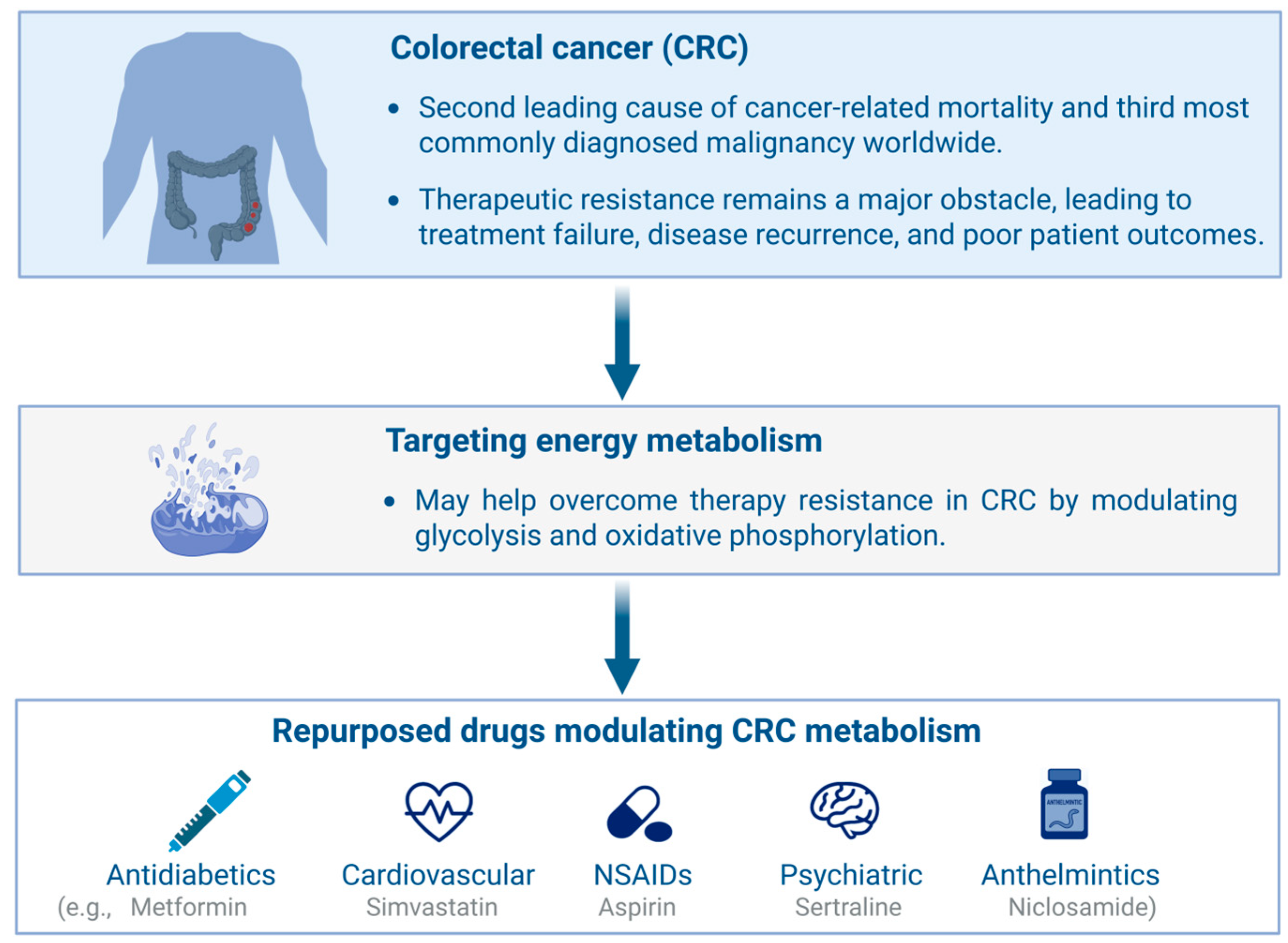
- Multiple repurposed drugs act on metabolic vulnerabilities of colorectal cancer (CRC), revealing untapped therapeutic potential beyond their original indications.
- These agents target key metabolic and signaling pathways (e.g., AMPK/mTOR, glycolysis) to suppress CRC growth and improve response to standard therapies.
- Repositioning existing drugs provides a time- and cost-efficient route to accelerate therapeutic innovation in CRC.
- Modulating CRC metabolism through repurposed compounds supports precision medicine paradigms and the rational design of combination therapies.
Abstract
1. Introduction
2. Cancer Energy Metabolism in CRC
3. Drug Repositioning to Target CRC Energy Metabolism
3.1. Methodology
3.2. Anti-Diabetic Drugs
3.3. Cardiovascular Drugs
3.4. Nonsteroidal Anti-Inflammatory Drugs (NSAIDs)
3.5. Antidepressants
3.6. Anthelmintic Drugs
4. Clinical Implications
5. Discussion and Conclusions
Author Contributions
Funding
Institutional Review Board Statement
Informed Consent Statement
Data Availability Statement
Acknowledgments
Conflicts of Interest
References
- Bray, F.; Laversanne, M.; Sung, H.; Ferlay, J.; Siegel, R.L.; Soerjomataram, I.; Jemal, A. Global cancer statistics 2022: GLOBOCAN estimates of incidence and mortality worldwide for 36 cancers in 185 countries. CA Cancer J. Clin. 2024, 74, 229–263. [Google Scholar] [CrossRef]
- Schreuders, E.H.; Ruco, A.; Rabeneck, L.; Schoen, R.E.; Sung, J.J.Y.; Young, G.P.; Kuipers, E.J. Colorectal cancer screening: A global overview of existing programmes. Gut 2015, 64, 1637–1649. [Google Scholar] [CrossRef] [PubMed]
- Robert, C. A decade of immune-checkpoint inhibitors in cancer therapy. Nat. Commun. 2020, 11, 3801. [Google Scholar] [CrossRef]
- Emambux, S.; Tachon, G.; Junca, A.; Tougeron, D. Results and challenges of immune checkpoint inhibitors in colorectal cancer. Expert Opin. Biol. Ther. 2018, 18, 561–573. [Google Scholar] [CrossRef]
- Giannakis, M.; Mu, X.J.; Shukla, S.A.; Qian, Z.R.; Cohen, O.; Nishihara, R.; Bahl, S.; Cao, Y.; Amin-Mansour, A.; Yamauchi, M.; et al. Genomic Correlates of Immune-Cell Infiltrates in Colorectal Carcinoma. Cell Rep. 2016, 15, 857–865. [Google Scholar] [CrossRef]
- Llosa, N.J.; Cruise, M.; Tam, A.; Wicks, E.C.; Hechenbleikner, E.M.; Taube, J.M.; Blosser, R.L.; Fan, H.; Wang, H.; Luber, B.S.; et al. The Vigorous Immune Microenvironment of Microsatellite Instable Colon Cancer Is Balanced by Multiple Counter-Inhibitory Checkpoints. Cancer Discov. 2015, 5, 43–51. [Google Scholar] [CrossRef] [PubMed]
- Missiaglia, E.; Jacobs, B.; D’Ario, G.; Di Narzo, A.F.; Soneson, C.; Budinska, E.; Popovici, V.; Vecchione, L.; Gerster, S.; Yan, P.; et al. Distal and proximal colon cancers differ in terms of molecular, pathological, and clinical features. Ann. Oncol. 2014, 25, 1995–2001. [Google Scholar] [CrossRef] [PubMed]
- Guinney, J.; Dienstmann, R.; Wang, X.; de Reyniès, A.; Schlicker, A.; Soneson, C.; Marisa, L.; Roepman, P.; Nyamundanda, G.; Angelino, P.; et al. The consensus molecular subtypes of colorectal cancer. Nat. Med. 2015, 21, 1350–1356. [Google Scholar] [CrossRef]
- Dienstmann, R.; Vermeulen, L.; Guinney, J.; Kopetz, S.; Tejpar, S.; Tabernero, J. Consensus molecular subtypes and the evolution of precision medicine in colorectal cancer. Nat. Rev. Cancer 2017, 17, 79–92. [Google Scholar] [CrossRef]
- Cancer Genome Atlas Network. Comprehensive molecular characterization of human colon and rectal cancer. Nature 2012, 487, 330–337. [Google Scholar] [CrossRef]
- Jang, M.; Kim, S.S.; Lee, J. Cancer cell metabolism: Implications for therapeutic targets. Exp. Mol. Med. 2013, 45, e45. [Google Scholar] [CrossRef]
- Pavlova, N.N.; Thompson, C.B. The Emerging Hallmarks of Cancer Metabolism. Cell Metab. 2016, 23, 27–47. [Google Scholar] [CrossRef] [PubMed]
- Zhong, X.; He, X.; Wang, Y.; Hu, Z.; Huang, H.; Zhao, S.; Wei, P.; Li, D. Warburg effect in colorectal cancer: The emerging roles in tumor microenvironment and therapeutic implications. J. Hematol. Oncol. 2022, 15, 160. [Google Scholar] [CrossRef] [PubMed]
- Warburg, O. On the Origin of Cancer Cells. Science (1979) 1956, 123, 309–314. [Google Scholar] [CrossRef]
- Tufail, M.; Jiang, C.-H.; Li, N. Altered metabolism in cancer: Insights into energy pathways and therapeutic targets. Mol. Cancer 2024, 23, 203. [Google Scholar] [CrossRef]
- Vander Heiden, M.G.; DeBerardinis, R.J. Understanding the Intersections between Metabolism and Cancer Biology. Cell 2017, 168, 657–669. [Google Scholar] [CrossRef]
- Martínez-Reyes, I.; Chandel, N.S. Mitochondrial TCA cycle metabolites control physiology and disease. Nat. Commun. 2020, 11, 102. [Google Scholar] [CrossRef]
- Wallace, D.C. Mitochondria and cancer. Nat. Rev. Cancer 2012, 12, 685–698. [Google Scholar] [CrossRef]
- Vodicka, P.; Vodenkova, S.; Danesova, N.; Vodickova, L.; Zobalova, R.; Tomasova, K.; Boukalova, S.; Berridge, M.V.; Neuzil, J. Mitochondrial DNA damage, repair, and replacement in cancer. Trends Cancer 2025, 11, 62–73. [Google Scholar] [CrossRef]
- Smith, A.L.M.; Whitehall, J.C.; Greaves, L.C. Mitochondrial DNA mutations in ageing and cancer. Mol. Oncol. 2022, 16, 3276–3294. [Google Scholar] [CrossRef] [PubMed]
- Sciacovelli, M.; Frezza, C. Oncometabolites: Unconventional triggers of oncogenic signalling cascades. Free Radic. Biol. Med. 2016, 100, 175–181. [Google Scholar] [CrossRef] [PubMed]
- Isono, T.; Chano, T.; Yonese, J.; Yuasa, T. Therapeutic inhibition of mitochondrial function induces cell death in starvation-resistant renal cell carcinomas. Sci. Rep. 2016, 6, 25669. [Google Scholar] [CrossRef] [PubMed]
- Vasan, K.; Werner, M.; Chandel, N.S. Mitochondrial Metabolism as a Target for Cancer Therapy. Cell Metab. 2020, 32, 341–352. [Google Scholar] [CrossRef]
- Du, H.; Xu, T.; Yu, S.; Wu, S.; Zhang, J. Mitochondrial metabolism and cancer therapeutic innovation. Signal Transduct. Target. Ther. 2025, 10, 245. [Google Scholar] [CrossRef]
- Czechowicz, P.; Więch-Walów, A.; Sławski, J.; Collawn, J.F.; Bartoszewski, R. Old drugs, new challenges: Reassigning drugs for cancer therapies. Cell Mol. Biol. Lett. 2025, 30, 27. [Google Scholar] [CrossRef]
- Pushpakom, S.; Iorio, F.; Eyers, P.A.; Escott, K.J.; Hopper, S.; Wells, A.; Doig, A.; Guilliams, T.; Latimer, J.; McName, C.; et al. Drug repurposing: Progress, challenges and recommendations. Nat. Rev. Drug Discov. 2019, 18, 41–58. [Google Scholar] [CrossRef]
- DiMasi, J.A.; Feldman, L.; Seckler, A.; Wilson, A. Trends in Risks Associated With New Drug Development: Success Rates for Investigational Drugs. Clin. Pharmacol. Ther. 2010, 87, 272–277. [Google Scholar] [CrossRef]
- Pillai, U.J.; Ray, A.; Maan, M.; Dutta, M. Repurposing drugs targeting metabolic diseases for cancer therapeutics. Drug Discov. Today 2023, 28, 103684. [Google Scholar] [CrossRef]
- Misirkic Marjanovic, M.S.; Vucicevic, L.M.; Despotovic, A.R.; Stamenkovic, M.M.; Janjetovic, K.D. Dual anticancer role of metformin: An old drug regulating AMPK dependent/independent pathways in metabolic, oncogenic/tumorsuppresing and immunity context. Am. J. Cancer Res. 2021, 11, 5625–5643. [Google Scholar]
- Rocha, G.Z.; Dias, M.M.; Ropelle, E.R.; Osório-Costa, F.; Rossato, F.A.; Vercesi, A.E.; Saad, M.J.A.; Carvalheira, J.B.C. Metformin Amplifies Chemotherapy-Induced AMPK Activation and Antitumoral Growth. Clin. Cancer Res. 2011, 17, 3993–4005. [Google Scholar] [CrossRef] [PubMed]
- Mogavero, A.; Maiorana, M.V.; Zanutto, S.; Varinelli, L.; Bozzi, F.; Belfiore, A.; Volpi, C.C.; Gloghini, A.; Pierotti, M.A.; Gariboldi, M. Metformin transiently inhibits colorectal cancer cell proliferation as a result of either AMPK activation or increased ROS production. Sci. Rep. 2017, 7, 15992. [Google Scholar] [CrossRef]
- Hirsch, H.A.; Iliopoulos, D.; Struhl, K. Metformin inhibits the inflammatory response associated with cellular transformation and cancer stem cell growth. Proc. Natl. Acad. Sci. USA 2013, 110, 972–977. [Google Scholar] [CrossRef]
- Orang, A.; Marri, S.; McKinnon, R.A.; Petersen, J.; Michael, M.Z. Restricting Colorectal Cancer Cell Metabolism with Metformin: An Integrated Transcriptomics Study. Cancers 2024, 16, 2055. [Google Scholar] [CrossRef] [PubMed]
- Orang, A.; Ali, S.R.; Petersen, J.; McKinnon, R.A.; Aloia, A.L.; Michael, M.Z. A functional screen with metformin identifies microRNAs that regulate metabolism in colorectal cancer cells. Sci. Rep. 2022, 12, 2889. [Google Scholar] [CrossRef]
- Nittayaboon, K.; Leetanaporn, K.; Sangkhathat, S.; Roytrakul, S.; Navakanitworakul, R. Cytotoxic effect of metformin on butyrate-resistant PMF-K014 colorectal cancer spheroid cells. Biomed. Pharmacother. 2022, 151, 113214. [Google Scholar] [CrossRef]
- Tomimoto, A.; Endo, H.; Sugiyama, M.; Fujisawa, T.; Hosono, K.; Takahashi, H.; Nakajima, N.; Nagashim, Y.; Wada, K.; Nakagama, H.; et al. Metformin suppresses intestinal polyp growth in Apc Min/+ mice. Cancer Sci. 2008, 99, 2136–2141. [Google Scholar] [CrossRef]
- Hosono, K.; Endo, H.; Takahashi, H.; Sugiyama, M.; Uchiyama, T.; Suzuki, K.; Nozaki, Y.; Yoneda, K.; Fujita, K.; Yoneda, M.; et al. Metformin suppresses azoxymethane-induced colorectal aberrant crypt foci by activating AMP-activated protein kinase. Mol. Carcinog. 2010, 49, 662–671. [Google Scholar] [CrossRef]
- Saito, A.; Koinuma, K.; Kawashima, R.; Miyato, H.; Ohzawa, H.; Horie, H.; Yamaguchi, H.; Kawahira, H.; Mimura, T.; Kitayama, J.; et al. Metformin may improve the outcome of patients with colorectal cancer and type 2 diabetes mellitus partly through effects on neutrophil extracellular traps. BJC Rep. 2023, 1, 20. [Google Scholar] [CrossRef] [PubMed]
- Nasiri, A.R.; Rodrigues, M.R.; Li, Z.; Leitner, B.P.; Perry, R.J. SGLT2 inhibition slows tumor growth in mice by reversing hyperinsulinemia. Cancer Metab. 2019, 7, 10. [Google Scholar] [CrossRef]
- Saito, T.; Okada, S.; Yamada, E.; Shimoda, Y.; Osaki, A.; Tagaya, Y.; Okada, J.; Yamada, M. Effect of dapagliflozin on colon cancer cell [Rapid Communication]. Endocr. J. 2015, 62, 1133–1137. [Google Scholar] [CrossRef] [PubMed]
- Varela-Calviño, R.; Rodríguez-Quiroga, M.; Dias Carvalho, P.; Martins, F.; Serra-Roma, A.; Vázquez-Iglesias, L.; de la Cadena, M.P.; Velho, S.; Cordero, O.J. The mechanism of sitagliptin inhibition of colorectal cancer cell lines’ metastatic functionalities. IUBMB Life 2021, 73, 761–773. [Google Scholar] [CrossRef]
- Shih, J.-W.; Wu, A.T.H.; Mokgautsi, N.; Wei, P.-L.; Huang, Y.-J. Preclinical Repurposing of Sitagliptin as a Drug Candidate for Colorectal Cancer by Targeting CD24/CTNNB1/SOX4-Centered Signaling Hub. Int. J. Mol. Sci. 2024, 25, 609. [Google Scholar] [CrossRef]
- Eisa, A.; Hanafy, S.M.; Khalil, H.; Elshal, M.F. Sitagliptin synergizes 5-fluorouracil efficacy in colon cancer cells through MDR1-mediated flux impairment and down regulation of NFκB2 and p-AKT survival proteins. J. Biochem. Mol. Toxicol. 2024, 38, e23796. [Google Scholar] [CrossRef] [PubMed]
- Agarwal, B.; Bhendwal, S.; Halmos, B.; Moss, S.F.; Ramey, W.G.; Holt, P.R. Lovastatin augments apoptosis induced by chemotherapeutic agents in colon cancer cells. Clin. Cancer Res. 1999, 5, 2223–2229. [Google Scholar]
- Huang, X.; Liang, N.; Zhang, F.; Lin, W.; Ma, W. Lovastatin-Induced Mitochondrial Oxidative Stress Leads to the Release of mtDNA to Promote Apoptosis by Activating cGAS-STING Pathway in Human Colorectal Cancer Cells. Antioxidants 2024, 13, 679. [Google Scholar] [CrossRef]
- Yasuda, Y.; Shimizu, M.; Shirakami, Y.; Sakai, H.; Kubota, M.; Hata, K.; Hirose, Y.; Tsurumi, H.; Tanaka, T.; Moriwaki, H. Pitavastatin inhibits azoxymethane-induced colonic preneoplastic lesions in C57BL/KsJ- db/db obese mice. Cancer Sci. 2010, 101, 1701–1707. [Google Scholar] [CrossRef]
- Cheng, W.-M.; Li, P.-C.; Nguyen, M.T.-B.; Lin, Y.-T.; Huang, Y.-T.; Cheng, T.-S.; Nguyen, T.-H.; Tran, T.-H.; Huang, T.-Y.; Hoang, T.-H.; et al. Repurposing pitavastatin and atorvastatin to overcome chemoresistance of metastatic colorectal cancer under high glucose conditions. Cancer Cell Int. 2025, 25, 79. [Google Scholar] [CrossRef]
- Jang, H.J.; Hong, E.M.; Park, S.W.; Byun, H.W.; Koh, D.H.; Choi, M.H.; Kae, S.H.; Lee, J. Statin induces apoptosis of human colon cancer cells and downregulation of insulin-like growth factor 1 receptor via proapoptotic ERK activation. Oncol. Lett. 2016, 12, 250–256. [Google Scholar] [CrossRef] [PubMed]
- Pan, L.; Zhang, Y.; Zhao, W.; Zhou, X.; Wang, C.; Deng, F. The cardiac glycoside oleandrin induces apoptosis in human colon cancer cells via the mitochondrial pathway. Cancer Chemother. Pharmacol. 2017, 80, 91–100. [Google Scholar] [CrossRef] [PubMed]
- Yang, P.; Cartwright, C.; Efuet, E.; Hamilton, S.R.; Wistuba, I.I.; Menter, D.; Addington, C.; Shureiqi, I.; Newman, R.A. Cellular location and expression of Na +, K + -ATPase α subunits affect the anti-proliferative activity of oleandrin. Mol. Carcinog. 2014, 53, 253–263. [Google Scholar] [CrossRef]
- Shi, C.-S.; Kuan, F.-C.; Chin, C.-C.; Li, J.-M. Modulation of mitochondrial apoptosis by β2-adrenergic receptor blockage in colorectal cancer after radiotherapy: An in-vivo and in-vitro study. Am. J. Cancer Res. 2023, 13, 3741–3752. [Google Scholar]
- Barathova, M.; Grossmannova, K.; Belvoncikova, P.; Kubasova, V.; Simko, V.; Skubla, R.; Csaderova, L.; Pastorek, J. Impairment of Hypoxia-Induced CA IX by Beta-Blocker Propranolol—Impact on Progression and Metastatic Potential of Colorectal Cancer Cells. Int. J. Mol. Sci. 2020, 21, 8760. [Google Scholar] [CrossRef] [PubMed]
- Holt, A.K.; Najumudeen, A.K.; Collard, T.J.; Li, H.; Millett, L.M.; Hoskin, A.J.; Legge, D.N.; Mortensson, E.M.H.; Flanagan, D.J.; Jones, N.; et al. Aspirin reprogrammes colorectal cancer cell metabolism and sensitises to glutaminase inhibition. Cancer Metab. 2023, 11, 18. [Google Scholar] [CrossRef]
- Ai, G.; Dachineni, R.; Kumar, D.R.; Alfonso, L.F.; Marimuthu, S.; Bhat, G.J. Aspirin inhibits glucose-6-phosphate dehydrogenase activity in HCT 116 cells through acetylation: Identification of aspirin-acetylated sites. Mol. Med. Rep. 2016, 14, 1726–1732. [Google Scholar] [CrossRef]
- Marimuthu, S.; Chivukula, R.S.V.; Alfonso, L.F.; Moridani, M.; Hagen, F.K.; Bhat, G.J. Aspirin acetylates multiple cellular proteins in HCT-116 colon cancer cells: Identification of novel targets. Int. J. Oncol. 2011, 39, 1273–1283. [Google Scholar] [CrossRef][Green Version]
- Din, F.V.N.; Valanciute, A.; Houde, V.P.; Zibrova, D.; Green, K.A.; Sakamoto, K.; Alessi, D.R.; Dunlop, M.G. Aspirin Inhibits mTOR Signaling, Activates AMP-Activated Protein Kinase, and Induces Autophagy in Colorectal Cancer Cells. Gastroenterology 2012, 142, 1504–1515.e3. [Google Scholar] [CrossRef] [PubMed]
- Barry, E.L.; Fedirko, V.; Uppal, K.; Ma, C.; Liu, K.; Mott, L.A.; Peacock, J.L.; Passarelli, M.N.; Baron, J.A.; Jones, D.P. Metabolomics Analysis of Aspirin’s Effects in Human Colon Tissue and Associations with Adenoma Risk. Cancer Prev. Res. 2020, 13, 863–876. [Google Scholar] [CrossRef] [PubMed]
- Barry, E.L.; Fedirko, V.; Jin, Y.; Liu, K.; Mott, L.A.; Peacock, J.L.; Passarelli, M.N.; Baron, J.A.; Jones, D.P. Plasma Metabolomics Analysis of Aspirin Treatment and Risk of Colorectal Adenomas. Cancer Prev. Res. 2022, 15, 521–531. [Google Scholar] [CrossRef]
- Schwab, M.; Dezfouli, A.B.; Khosravi, M.; Alkotub, B.; Bauer, L.; Birgani, M.J.T.; Multhoff, G. The radiation- and chemo-sensitizing capacity of diclofenac can be predicted by a decreased lactate metabolism and stress response. Radiat. Oncol. 2024, 19, 7. [Google Scholar] [CrossRef]
- Han, Y.; Chen, P.; Zhang, Y.; Lu, W.; Ding, W.; Luo, Y.; Wen, S.; Xu, R.; Liu, P.; Huang, P. Synergy between Auranofin and Celecoxib against Colon Cancer In Vitro and In Vivo through a Novel Redox-Mediated Mechanism. Cancers 2019, 11, 931. [Google Scholar] [CrossRef]
- Marcinkute, M.; Afshinjavid, S.; Fatokun, A.A.; Javid, F.A. Fluoxetine selectively induces p53-independent apoptosis in human colorectal cancer cells. Eur. J. Pharmacol. 2019, 857, 172441. [Google Scholar] [CrossRef]
- Kannen, V.; Hintzsche, H.; Zanette, D.L.; Silva, W.A.; Garcia, S.B.; Waaga-Gasser, A.M.; Stopper, H. Antiproliferative Effects of Fluoxetine on Colon Cancer Cells and in a Colonic Carcinogen Mouse Model. PLoS ONE 2012, 7, e50043. [Google Scholar] [CrossRef]
- Kannen, V.; Garcia, S.B.; Silva, W.A.; Gasser, M.; Mönch, R.; Alho, E.J.L.; Heinsen, H.; Scholz, C.-J.; Friedrich, M.; Heinze, K.G.; et al. Oncostatic effects of fluoxetine in experimental colon cancer models. Cell. Signal. 2015, 27, 1781–1788. [Google Scholar] [CrossRef]
- He, L.; Tian, Y.; Liu, Q.; Bao, J.; Ding, R.-B. Antidepressant Sertraline Synergistically Enhances Paclitaxel Efficacy by Inducing Autophagy in Colorectal Cancer Cells. Molecules 2024, 29, 3733. [Google Scholar] [CrossRef]
- Gil-Ad, I.; Zolokov, A.; Lomnitski, L.; Taler, M.; Bar, M.; Luria, D.; Ram, E.; Weizman, A. Evaluation of the potential anti-cancer activity of the antidepressant sertraline in human colon cancer cell lines and in colorectal cancer-xenografted mice. Int. J. Oncol. 2008, 33, 277–286. [Google Scholar] [CrossRef]
- Beton-Mysur, K.; Brożek-Płuska, B. Exploring the Impact of Citalopram on Human Colon Cells: Insights into Antidepressant Action Beyond the Brain. Spectrochim. Acta A Mol. Biomol. Spectrosc. 2025, 343, 126464. [Google Scholar] [CrossRef] [PubMed]
- Liu, Y.-X.; Wan, S.; Yang, X.-Q.; Wang, Y.; Gan, W.-J.; Ye, W.-L.; He, X.-S.; Chen, J.-J.; Yang, Y.; Yang, X.-M.; et al. TRIM21 is a druggable target for the treatment of metastatic colorectal cancer through ubiquitination and activation of MST2. Cell Chem. Biol. 2023, 30, 709–725.e6. [Google Scholar] [CrossRef] [PubMed]
- Ye, W.-L.; Huang, L.; Yang, X.-Q.; Wan, S.; Gan, W.-J.; Yang, Y.; He, X.-S.; Liu, F.; Guo, X.; Liu, Y.-X.; et al. TRIM21 induces selective autophagic degradation of c-Myc and sensitizes regorafenib therapy in colorectal cancer. Proc. Natl. Acad. Sci. USA 2024, 121, e2406936121. [Google Scholar] [CrossRef] [PubMed]
- Chen, W.; Mook, R.A.; Premont, R.T.; Wang, J. Niclosamide: Beyond an antihelminthic drug. Cell. Signal. 2018, 41, 89–96. [Google Scholar] [CrossRef]
- Wang, J.; Ren, X.; Piao, H.; Zhao, S.; Osada, T.; Premont, R.T.; Mook, R.A., Jr.; Morse, M.A.; Lyerly, H.K.; Chen, W. Niclosamide-induced Wnt signaling inhibition in colorectal cancer is mediated by autophagy. Biochem. J. 2019, 476, 535–546. [Google Scholar] [CrossRef]
- Alasadi, A.; Chen, M.; Swapna, G.V.T.; Tao, H.; Guo, J.; Collantes, J.; Fadhil, N.; Montelione, G.T.; Jin, S. Effect of mitochondrial uncouplers niclosamide ethanolamine (NEN) and oxyclozanide on hepatic metastasis of colon cancer. Cell Death Dis. 2018, 9, 215. [Google Scholar] [CrossRef] [PubMed]
- Ek, F.; Blom, K.; Selvin, T.; Rudfeldt, J.; Andersson, C.; Senkowski, W.; Brechot, C.; Nygren, P.; Larsson, R.; Jarvius, M.; et al. Sorafenib and nitazoxanide disrupt mitochondrial function and inhibit regrowth capacity in three-dimensional models of hepatocellular and colorectal carcinoma. Sci. Rep. 2022, 12, 8943. [Google Scholar] [CrossRef] [PubMed]
- Lin, S.; Yang, L.; Yao, Y.; Xu, L.; Xiang, Y.; Zhao, H.; Wang, L.; Zuo, Z.; Huang, X.; Zhao, C. Flubendazole demonstrates valid antitumor effects by inhibiting STAT3 and activating autophagy. J. Exp. Clin. Cancer Res. 2019, 38, 293. [Google Scholar] [CrossRef]
- Xing, X.; Zhou, Z.; Peng, H.; Cheng, S. Anticancer role of flubendazole: Effects and molecular mechanisms (Review). Oncol. Lett. 2024, 28, 558. [Google Scholar] [CrossRef]
- Zheng, W.; Hu, J.; Lv, Y.; Bai, B.; Shan, L.; Chen, K.; Dai, S.; Zhu, H. Pyrvinium pamoate inhibits cell proliferation through ROS-mediated AKT-dependent signaling pathway in colorectal cancer. Med. Oncol. 2021, 38, 21. [Google Scholar] [CrossRef] [PubMed]
- Schultz, C.W.; McCarthy, G.A.; Nerwal, T.; Nevler, A.; DuHadaway, J.B.; McCoy, M.D.; Jiang, W.; Brown, S.Z.; Goetz, A.; Jain, A.; et al. The FDA-Approved Anthelmintic Pyrvinium Pamoate Inhibits Pancreatic Cancer Cells in Nutrient-Depleted Conditions by Targeting the Mitochondria. Mol. Cancer Ther. 2021, 20, 2166–2176. [Google Scholar] [CrossRef]
- Lin, N.-Y.; Tsai, K.-Y.; Huang, Y.-L.; Jong, B.-K.; Yu, Z.-H.; Cheng, C.-C.; Huang, S.-H.; You, J.-F.; Lai, I.-L. Metformin’s impact on tumor regression grade in diabetic patients with rectal cancer undergoing neoadjuvant chemoradiotherapy. Sci. Rep. 2025, 15, 25759. [Google Scholar] [CrossRef]
- Kim, Y.; Kim, T.W.; Han, S.W.; Ahn, J.B.; Kim, S.T.; Lee, J.; Park, J.O.; Park, Y.S.; Lim, H.Y.; Kang, W.K. A Single Arm, Phase II Study of Simvastatin Plus XELOX and Bevacizumab as First-Line Chemotherapy in Metastatic Colorectal Cancer Patients. Cancer Res. Treat. 2019, 51, 1128–1134. [Google Scholar] [CrossRef]
- Baas, J.M.; Krens, L.L.; ten Tije, A.J.; Erdkamp, F.; van Wezel, T.; Morreau, H.; Gelderblom, H.; Guchelaar, H.J. Safety and efficacy of the addition of simvastatin to cetuximab in previously treated KRAS mutant metastatic colorectal cancer patients. Investig. New Drugs 2015, 33, 1242–1247. [Google Scholar] [CrossRef]
- Lee, J.; Jung, K.H.; Park, Y.S.; Ahn, J.B.; Shin, S.J.; Im, S.-A.; Oh, D.Y.; Shin, D.B.; Kim, T.W.; Lee, N.; et al. Simvastatin plus irinotecan, 5-fluorouracil, and leucovorin (FOLFIRI) as first-line chemotherapy in metastatic colorectal patients: A multicenter phase II study. Cancer Chemother. Pharmacol. 2009, 64, 657–663. [Google Scholar] [CrossRef]
- Borg, C.; Klajer, E.; El Kaddissi, A.; Ghiringhelli, F.; Kim, S.; Vernerey, D.; Henriques, J.; Nguyen, T.; Meurisse, A.; Fratte, S.; et al. P-281 Safety analysis and preliminary clinical results of REPROGRAM-01 phase II study evaluating regorafenib in combination with a multimodal metronomic chemotherapy in patients with metastatic colorectal cancer. Ann. Oncol. 2023, 34, S115. [Google Scholar] [CrossRef]
- Souza, J.C.E.S.O.D.; Araujo, R.; Valadão, M.; Carrara, C.; Barbosa, M.Á.; Guimarães, R.; Carvalho, J.; Kovaleski, G.; Small, I.; Marins, A.; et al. Induction chemotherapy plus chemoradiotherapy with or without aspirin in high risk rectal cancer (ICAR). Ann. Oncol. 2018, 29, viii200. [Google Scholar] [CrossRef]
- Nenkov, M.; Ma, Y.; Gaßler, N.; Chen, Y. Metabolic Reprogramming of Colorectal Cancer Cells and the Microenvironment: Implication for Therapy. Int. J. Mol. Sci. 2021, 22, 6262. [Google Scholar] [CrossRef]
- Cao, Q.; Yang, M.; Chen, M. Metabolic interactions: How gut microbial metabolites influence colorectal cancer. Front. Microbiol. 2025, 16, 1611698. [Google Scholar] [CrossRef] [PubMed]


| Drug Class | Representative Drugs | Main Mechanisms of Action | CRC Models | Refs |
|---|---|---|---|---|
| Anti-diabetic drugs | Metformin | ↑ AMPK and ↓ mTOR Modulates inflammatory responses and apoptosis in CSCs Regulates miRNAs involved in glycolysis and mitochondrial respiration | In vitro (HCT116, PMF-K014 spheroids) In vivo (Apcmin/+ mice, sporadic CRC mice) Clinical samples. | [29,30,31,32,33,34,35,36,37,38] |
| Dapagliflozin | ↓ Glycolysis ↑ ERK phosphorylation | In vitro (HCT116) In vivo (MC38 graft model) | [39,40] | |
| Sitagliptin | ↓ CD26+ cell growth ↓ CD24/CTNNB1/SOX4 axis ↓ MDR1 mRNA, p-AKT, NFκB2 sensitizes to 5-FU | In vitro (CRC stem cells) | [41,42,43] | |
| Cardiovascular drugs | Statins (lovastatin, pitavastatin, atorvastatin, simvastatin) | ↑ Mitochondrial dysfunction ↑ AMPK, autophagy and apoptosis ↓ Proinflammatory cytokines ↑ ER stress and autophagy ↓ IGF-1R | In vitro (HCT116, SW480, HT-29) In vivo (obese and Apcmin/+ mice) | [44,45,46,47,48] |
| Cardiac glycosides (Oleandrin) | ↓ Mitochondrial activity ↑ Apoptosis (↑ caspase-3/9, cytochrome c, BAX ↓ Bcl-2, GSH) ↑ Autophagy | In vitro (SW480, HCT116, RKO, CaCO-2); human tissues (Na+/K+-ATPase α3 distribution) | [49,50] | |
| Beta-blockers (Propranolol, ICI-118,551) | ↑ Mitochondrial dysfunction, cytochrome c release; ↓ Hypoxia adaptation ↓ EGFR-Akt-ERK 1/2 | In vitro (HT-29) | [51,52] | |
| NSAIDs | Aspirin | ↓ Glutaminolysis Acetylates G6PD and glycolytic enzymes; ↑ AMPK/NRF2/miR-34 ↓ mTOR ↓ Pyrimidine and arachidonic acid metabolisms; Carnitine shuttle; Modulation of linoleate and glycerophospholipid metabolism | In vitro (HCT116); in vivo (Apcfl/fl mice, clinical biopsies, plasma samples) | [53,54,55,56,57,58] |
| Diclofenac | ↓ c-Myc; ↓ LDH activity; ↓ HSF1, Hsp70/Hsp27; Sensitizes to 5-FU and ionizing radiations | In vitro (LS174T, LoVo), in vivo (xenografts) | [59] | |
| Celecoxib | ↓ HK activity, ATP ↑ oxidative stress | In vitro (DLD1, HCT116, HT-29) In vivo (graft model) | [60] | |
| Antidepressants | Fluoxetine | Induces p53-independent apoptosis (mitochondrial depolarization, calcium overload, ATP depletion); ↓ OxPhos and glycolysis ↓ Xenograft growth, angiogenesis, ↓ mitochondrial complex III and IV | In vitro (CRC cells); in vivo (xenografts) | [61,62,63] |
| Sertraline | ↑ Autophagy (↑ LC3-II/LC3-I, ↓ p62); ↑ ROS; G0/G1 arrest; Sensitizes to 5-FU | In vitro (MC38, CT26, HT-29, LS1034) | [64,65] | |
| Citalopram | Alters CRC metabolism ↓ Proliferation ↑ Apoptosis | In vitro (CaCO-2) | [66,67,68] | |
| Vilazodone | ↑ Regorafenib sensitivity via TRIM21-mediated autophagic c-Myc degradation ↓ ENO2, glycolysis, KRAS reprogramming | In vitro (HCT116, SW480) Orthotopic metastatic model Clinical biopsies | [67,68] | |
| Anthelmintics | Niclosamide Oxyclozanide | Mitochondrial uncoupler ↓ ATP; ↑ ROS Autophagic Wnt/β-catenin degradation | In vitro (HCT116, DLD1, CRC240) In vivo (Apcmin/+, metastatic CRC model) | [69,70,71] |
| Nitazoxanide | ↑ AMPK ↓ AKT/mTOR and Wnt/β-catenin | In vitro (HCT116) | [72] | |
| Flubendazole | ↓ mTOR, P62, STAT3, Bcl-2 ↑ Beclin-1, LC3 I/II | In vitro (HCT116, RKO, SW480) In vivo (graft model) | [73,74] | |
| Pyrvinium pamoate | ↑ ROS ↓ Akt, p-mTOR, GSK3b | In vitro/in vivo CRC models | [75,76] |
| Drug | NCT Number | Study Status | Brief Summary | Study Outcome | Cancer Type/Condition | Phase |
|---|---|---|---|---|---|---|
| Metformin | NCT04033107 | UNKNOWN | High-dose vitamin C combined with metformin in the treatment of malignant tumors. | NO | HCC, PC, GC, CRC | PHASE2 |
| NCT03800602 | COMPLETED | Nivolumab and metformin work in treating CRC patients with MSS stage IV. | YES | Colorectal Adenocarcinoma|Metastatic MSS Colorectal Carcinoma | PHASE2 | |
| NCT03359681 | COMPLETED | Metformin in non-diabetic patients with colon cancer on cell growth, immunological and metabolic changes. | NO | Colon Cancer | PHASE2 | |
| NCT03047837 | TERMINATED | Low-dose ASA and Metformin in Stage I-III CRC Patients | NO | Tertiary Prevention in Colon Cancer | PHASE2 | |
| NCT02614339 | UNKNOWN | The effect of adjunctive metformin on recurrence of non-DM Stage II High-risk/III colorectal cancer. | NO | Non-DM Stage II High-risk CRC|Non-DM Stage III CRC | PHASE3 | |
| NCT02473094 | TERMINATED | Metformin in association to chemotherapy with capecitabine and radiation in the neoadjuvant treatment of locally advanced (T3-4N0M0 or TxN1-2M0) rectal carcinomas. | NO | Rectal Neoplasms|Adenocarcinoma|Carcinoma | PHASE2 | |
| NCT02437656 | COMPLETED | Metformin in combination with neoadjuvant radiochemotherapy in the treatment of locally advanced rectal cancer. | NO | Rectal Cancer | PHASE2 | |
| NCT01941953 | COMPLETED | Metformin and Fluorouracil in patients with metastatic CRC who have progressed after Oxaliplatin- and Irinotecan-based chemotherapy. | NO | Metastatic CRC | PHASE2 | |
| NCT01930864 | UNKNOWN | Metformin combined to irinotecan. | NO | Colorectal Neoplasms|Adenocarcinoma | PHASE2 | |
| NCT01926769 | TERMINATED | Second-line treatment with Metformin and Chemotherapy (FOLFOX6 or FOFIRI) in the second-line treatment of advanced CRC. | NO | Previously Treated Advanced CRC | PHASE2 | |
| NCT01632020 | TERMINATED | Effects of short-term oral Metformin therapy on biomarkers for tumor growth in subjects with newly diagnosed colon or rectal adenocarcinoma. | YES | Colorectal Neoplasms | PHASE2 | |
| Simvastatin | NCT02161822 | UNKNOWN | Simvastatin combined with capecitabine and radiotherapy in locally advanced rectal cancer patients. | NO | Adenocarcinoma of Rectum | PHASE2 |
| NCT02026583 | COMPLETED | Simvastatin plus XELOX and bevacizumab as first-line chemotherapy in metastatic CRC patients. | NO | CRC | PHASE2 | |
| NCT01238094 | UNKNOWN | Second-line XELIRI/FOLFIRI plus simvastatin compared to XELIRI/FOLFIRI plus placebo. | NO | CRC | PHASE3 | |
| NCT01190462 | UNKNOWN | Cetuximab together with simvastatin in treating patients with advanced or metastatic CRC. | NO | CRC | PHASE2 | |
| NCT01110785 | UNKNOWN | Simvastatin plus panitumumab in patients with advanced or metastatic CRC. | NO | CRC | PHASE2 | |
| NCT00313859 | COMPLETED | Simvastatin plus FOLFIRI (irinotecan, 5-FU, leucovorin) in metastatic CRC patients. | NO | Metastatic CRC | PHASE2 | |
| Aspirin | NCT05462613 | RECRUITING | Regorafenib plus metronomic chemotherapies and low-dose aspirin as a two-month induction therapy before chemotherapy initiation in the second-line metastatic colorectal carcinoma. | NO | Metastatic CRC | PHASE2|PHASE3 |
| NCT04534218 | COMPLETED | Association of regorafenib with metronomic chemotherapy combining capecitabine, cyclophosphamide and low-dose aspirin, for the treatment of patients with metastatic CRC. | NO | CRC, Metastatic CRC | PHASE2 | |
| NCT03326791 | ACTIVE_NOT_RECRUITING | Adjuvant treatment with low-dose ASA in patients treated with resection for CRC liver metastases. | NO | CRC Liver metastasis | PHASE2|PHASE3 | |
| NCT03170115 | TERMINATED | Efficacy and feasibility of aspirin use during chemoradiotherapy for high-risk rectal cancer. | NO | Rectal Cancer, Adenocarcinoma|Locally Advanced Malignant Neoplasm|Chemoradiation | PHASE2 | |
| NCT02647099 | ACTIVE_NOT_RECRUITING | Adjuvant treatment with low dose aspirin in patients with CRC. | NO | CRC | PHASE3 | |
| Celecoxib | NCT06903858 | RECRUITING | Neoadjuvant toripalimab plus celecoxib for dMMR/MSI-H locally advanced CRC. | NO | CRC | PHASE2 |
| NCT05933980 | RECRUITING | Toripalimab, celecoxib and regorafenib in the treatment of refractory advanced CRC. | NO | CRC Liver metastasis | PHASE2 | |
| NCT05731726 | RECRUITING | Chemotherapy and cyclooxygenase inhibitors combined with anti-PD-1 monoclonal antibody in resectable CRC patient with the pMMR/MSS phenotype. | NO | PMMR|MSS|MSI-L|Locally Advanced Rectal Carcinoma | PHASE2 | |
| NCT05281276 | TERMINATED | Chidamide in combination with celecoxib in patients with advanced metastatic CRC. | NO | Metastatic CRC | PHASE1 | |
| NCT03645187 | RECRUITING | Celecoxib as an adjuvant therapy to chemotherapy in patients with metastatic CRC. | NO | Colon Cancer Stage | PHASE4 | |
| NCT03403634 | COMPLETED | Celecoxib, recombinant interferon alfa-2b, and rintatolimod in patients with CRC and liver metastasis. | YES | Metastatic Carcinoma in the Liver|Recurrent Colorectal Carcinoma|Stage IV CRC | PHASE2 | |
| NCT00608595 | TERMINATED | Celecoxib in patients with early-stage rectal cancer. | NO | CRC | NA | |
| Niclosamide | NCT02687009 | TERMINATED | Niclosamide in patients with colon cancer that are undergoing primary resection of their tumor. | NO | Colon Cancer | ALL |
| NCT02519582 | UNKNOWN | Niclosamide in patients with metachronous or synchronous metastases of CRC. | NO | CRC | ALL | |
| Nitazoxanide | NCT06049901 | RECRUITING | Nitazoxanide in patients with metastatic CRC. | NO | Metastatic CRC | PHASE3 |
Disclaimer/Publisher’s Note: The statements, opinions and data contained in all publications are solely those of the individual author(s) and contributor(s) and not of MDPI and/or the editor(s). MDPI and/or the editor(s) disclaim responsibility for any injury to people or property resulting from any ideas, methods, instructions or products referred to in the content. |
© 2025 by the authors. Licensee MDPI, Basel, Switzerland. This article is an open access article distributed under the terms and conditions of the Creative Commons Attribution (CC BY) license (https://creativecommons.org/licenses/by/4.0/).
Share and Cite
Tomassini, L.; Pacifico, T.; Monteleone, G.; Stolfi, C.; Laudisi, F. Targeting Cancer Cell Energy Metabolism in Colorectal Cancer: Opportunities and Challenges from Drug Repositioning. Cells 2025, 14, 1968. https://doi.org/10.3390/cells14241968
Tomassini L, Pacifico T, Monteleone G, Stolfi C, Laudisi F. Targeting Cancer Cell Energy Metabolism in Colorectal Cancer: Opportunities and Challenges from Drug Repositioning. Cells. 2025; 14(24):1968. https://doi.org/10.3390/cells14241968
Chicago/Turabian StyleTomassini, Lorenzo, Teresa Pacifico, Giovanni Monteleone, Carmine Stolfi, and Federica Laudisi. 2025. "Targeting Cancer Cell Energy Metabolism in Colorectal Cancer: Opportunities and Challenges from Drug Repositioning" Cells 14, no. 24: 1968. https://doi.org/10.3390/cells14241968
APA StyleTomassini, L., Pacifico, T., Monteleone, G., Stolfi, C., & Laudisi, F. (2025). Targeting Cancer Cell Energy Metabolism in Colorectal Cancer: Opportunities and Challenges from Drug Repositioning. Cells, 14(24), 1968. https://doi.org/10.3390/cells14241968