Integrin αvβ3 as a Non-Genomic Estrogen Receptor in Breast Cancer for Signaling Pathways and Crosstalk


 ,
,  and
and
Highlights
- Integrin αvβ3 functions as a crucial non-genomic receptor for estrogen, initiating rapid activation of FAK, ERK1/2, and PI3K signaling pathways.
- This non-genomic estrogen signaling is shown to critically modulate integrin αvβ3 activity, subsequently driving cancer proliferation, migration, and metastasis
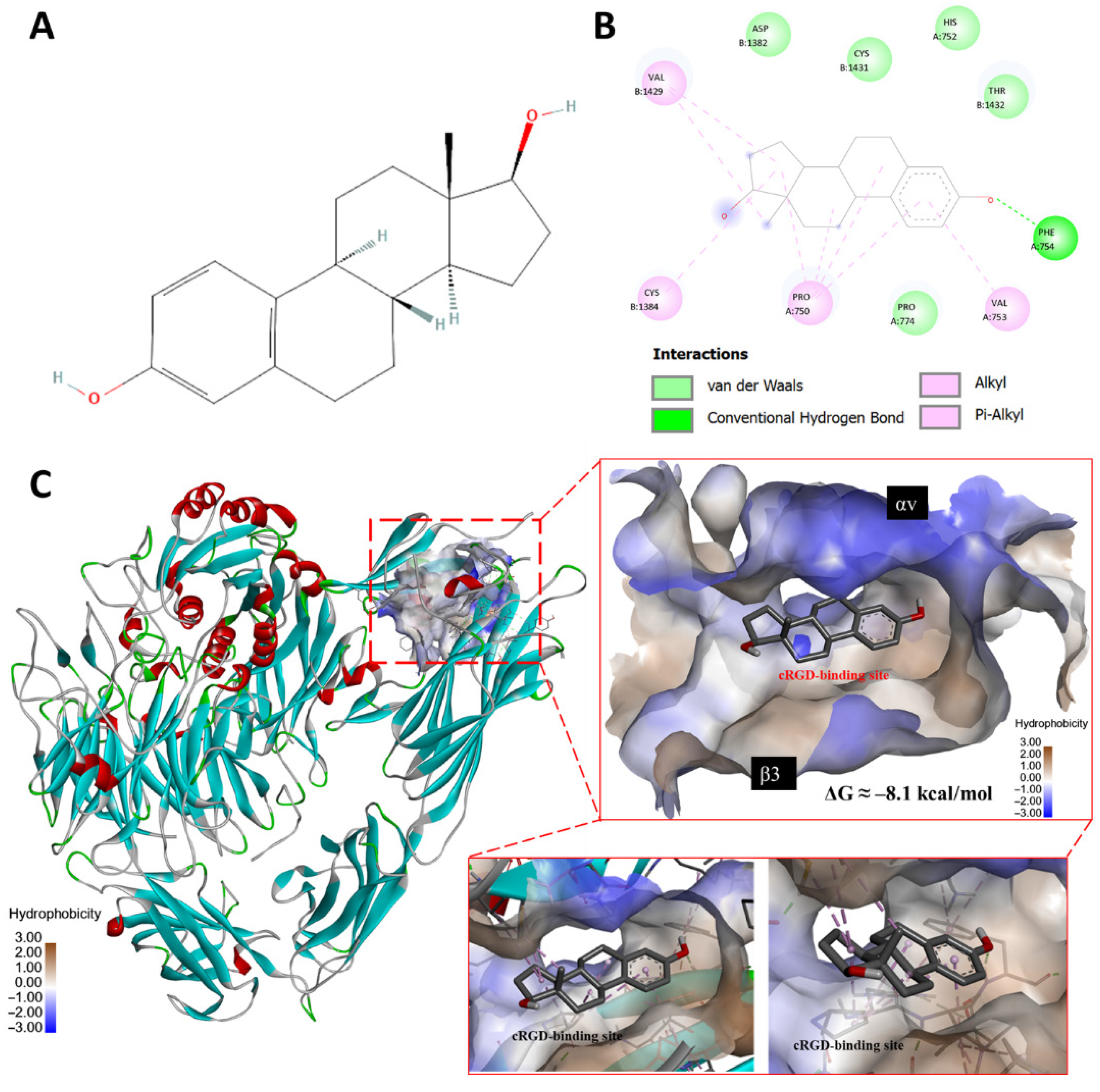
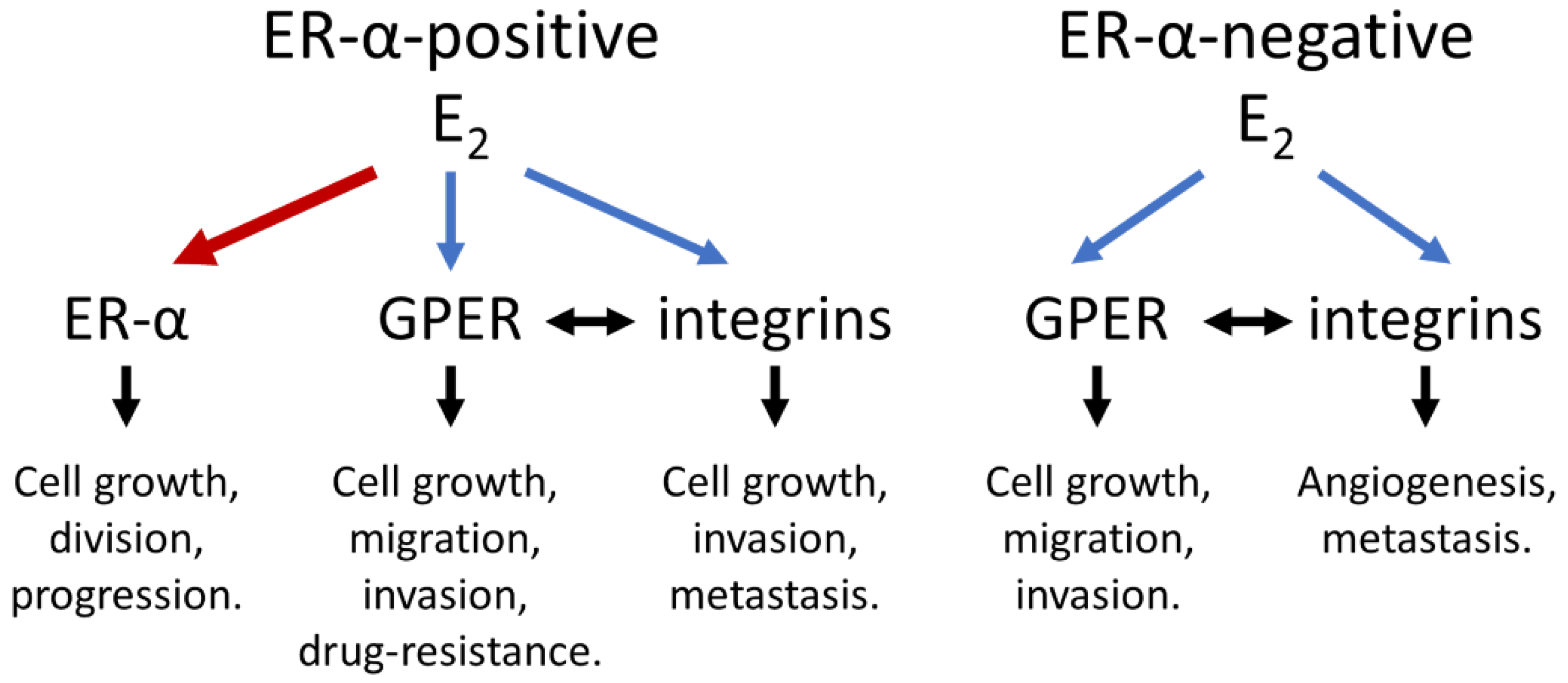
- Crosstalk among estrogen, integrin αvβ3, and GPER generates diverse cellular effects relevant to breast cancer biology.
- Targeting the Integrin αvβ3 non-genomic axis is proposed as a therapeutic strategy to overcome resistance observed in cancers.
Abstract
1. Introduction
2. Integrin αv- and β3-Related Integrins in Breast Cancers

| Integrin | Cancer Type/Source | Cellular Functions |
|---|---|---|
| Integrin αv | Invasive breast carcinomas/patient samples and clinical data. | Expressed and localized in tumor cells; stimulates breast cancer invasion [36]. |
| Integrin β3 | Bone-metastatic breast cancer/mouse mammary tumor line | Essential for early spontaneous dissemination [18]. |
| Breast cancer cells/patient samples. | Interacts with IL-32/p38-MAPK to promote EMT and invasion [37]. | |
| Integrin αvβ1 | Metastatic breast cancer cells/human breast cancer MCF10CA1a (CA1a) cells and mouse breast cancer 4T1 and 4TO7 cells. | Enriched in extracellular vesicles of metastatic breast cancer cells [38]. A mechanism mediated by galectin-3 |
| Integrin αvβ3 | ER-α-negative MDA-MB-231/cell line. | Regulates cell proliferation [7]. |
| ER-α-negative MDA-MB-231/cell line. | Stimulates the proliferation of ER-negative breast cancer cells [8]. | |
| ER-α-negative MDA-MB-231/cell line. | Integrin αvβ3 is essential in doxycycline-induced antiproliferation in breast cancer cells [20]. | |
| ER-α-negative breast cancer/cell line. | Regulates tumor cell migration [36]. | |
| ER-α-negative MDA-MB-435/cell line. | Vitronectin/mTOR; IL-8/PI3K/Akt/NF-κB promotes tumor metastasis [39]. | |
| ER-α-positive MCF-7/cell line. | CCN1/CYR61 binds to the integrin αvβ3 receptor, stimulate tumor growth, chemoresistance, and angiogenesis [40]. | |
| HER2-positive breast cancer/murine brain metastatic TBCP-1 cells and human non-metastatic BT474 and SKBR3 cells. | Integrin αvβ3 is a master regulator of resistance to tyrosine kinase inhibitors (TKIs)-induced ferroptosis [41]. | |
| Integrin αvβ5 | Breast cancer-exo/cell line. | S100 promotes the formation of a pre-metastasis niche [42]. |
| Integrin αvβ6 | Triple-negative breast cancer/human and murine TNBCs. | SOX4 transcription factor is an essential resistance mechanism against T cell-mediated cytotoxicity in triple-negative breast cancer cells (TNBC) [43]. Promotes an osteolytic program in cancer cells by upregulating matrix metalloproteinase 2 (MMP2). Induces cell adhesion and migration |
3. Exploring a Novel Interaction Between Estrogen and Integrin αvβ3
4. GPER-Dependent Effects of Estrogen
5. Integrin αvβ3-Dependent Effects of Estrogen
- (1)
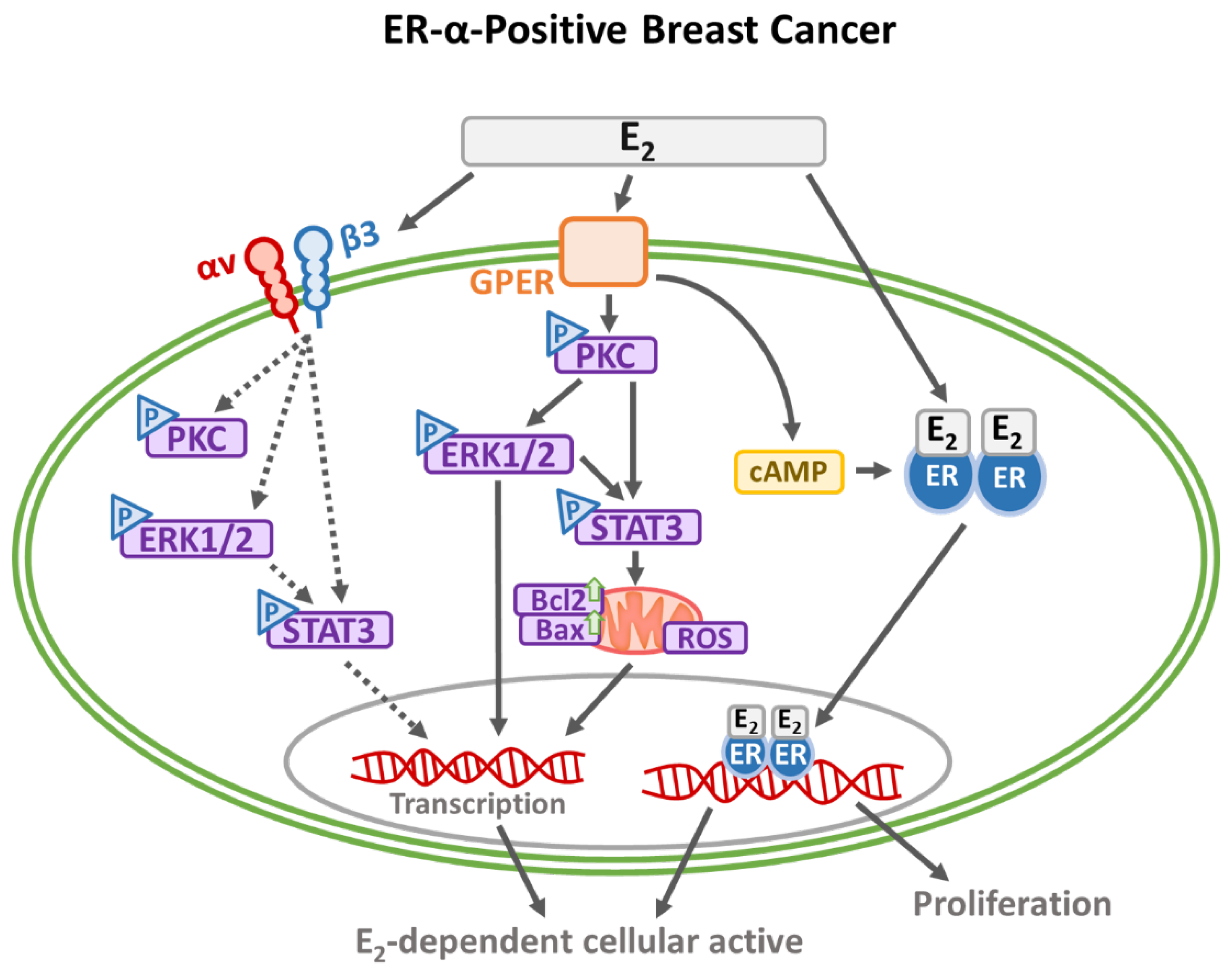
- ERα-positive, genomic signaling
- (2)
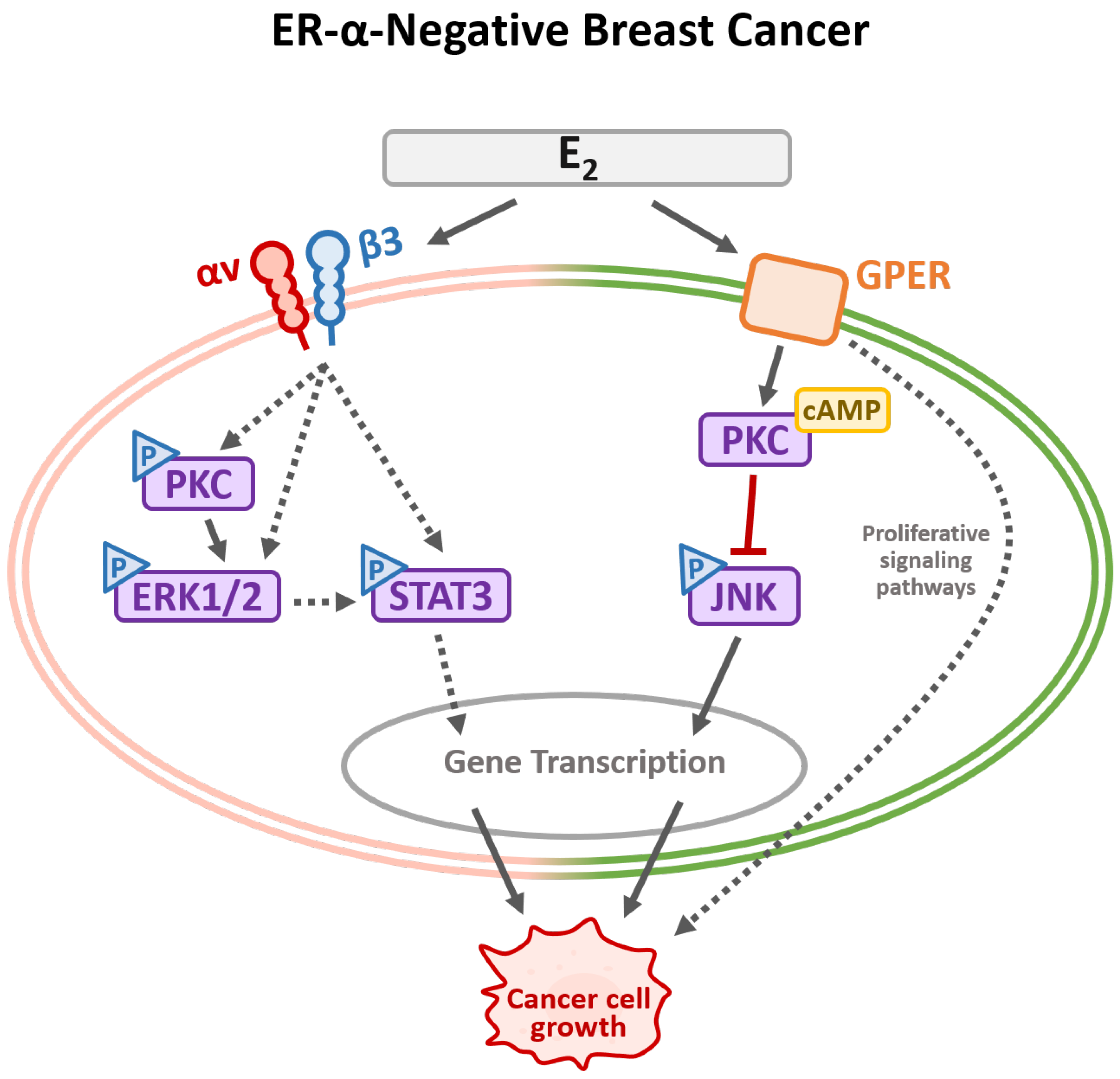
- ERα-positive/negative, non-genomic signaling via GPER
- (3)
- Integrin αvβ3–linked, non-genomic signaling (FAK/ERK/PI3K, STAT3, YAP)
6. Conclusions
Author Contributions
Funding
Data Availability Statement
Acknowledgments
Conflicts of Interest
Abbreviations
| BPA | Bisphenol A |
| CCN | Cellular communication network |
| Cdc42 | Cell division control protein 42 |
| cRGD | Cyclic RGD |
| CTGF | Connective tissue growth factor |
| E2 | Estradiol (17β-Estradiol) |
| ECM | Extracellular matrix |
| ER | Estrogen receptor |
| ERK1/2 | Extracellular signal-regulated kinase 1/2 |
| FAK | Focal adhesion kinase |
| Glut3 | Glucose transporter 3 |
| GPER | G protein-coupled estrogen receptor |
| IL | Interleukin1 |
| JAK | Janus kinase |
| MAPK | Mitogen-activated protein kinase |
| NF-κB | Nuclear factor kappa-light-chain-enhancer of activated B cells |
| N-WASP | Neuronal Wiskott–Aldrich syndrome protein |
| PI3K | Phosphatidylinositol 3-kinase |
| Rac1 | Ras-related C3 botulinum toxin substrate 1 |
| Ras | Rat sarcoma |
| RhoA | Ras homolog family member A |
| RGD | Arg-Gly-Asp |
| RNF31 | RING finger protein 31 |
| Shc | Src homology and collagen |
| TEAD | TEA domain transcription factor |
| TGF-β | Transforming growth factor-β |
| TH | Thyroid hormone |
| TAK1 | Activated kinase 1 |
| VEGF | Vascular endothelial growth factor |
| UTMD | Ultrasonic targeted microbubble destruction |
| YAP | Yes-associated protein YB-1: Y-box binding protein 1 |
References
- Shen, M.; Shi, H. Sex Hormones and Their Receptors Regulate Liver Energy Homeostasis. Int. J. Endocrinol. 2015, 2015, 294278. [Google Scholar] [CrossRef]
- McEwen, B.S.; Milner, T.A. Understanding the broad influence of sex hormones and sex differences in the brain. J. Neurosci. Res. 2017, 95, 24–39. [Google Scholar] [CrossRef]
- Quatrini, L.; Ricci, B.; Ciancaglini, C.; Tumino, N.; Moretta, L. Regulation of the Immune System Development by Glucocorticoids and Sex Hormones. Front. Immunol. 2021, 12, 672853. [Google Scholar] [CrossRef]
- Monroe, D.G.; Getz, B.J.; Johnsen, S.A.; Riggs, B.L.; Khosla, S.; Spelsberg, T.C. Estrogen receptor isoform-specific regulation of endogenous gene expression in human osteoblastic cell lines expressing either ERalpha or ERbeta. J. Cell Biochem. 2003, 90, 315–326. [Google Scholar] [CrossRef] [PubMed]
- McInerney, E.M.; Weis, K.E.; Sun, J.; Mosselman, S.; Katzenellenbogen, B.S. Transcription activation by the human estrogen receptor subtype beta (ER beta) studied with ER beta and ER alpha receptor chimeras. Endocrinology 1998, 139, 4513–4522. [Google Scholar] [CrossRef][Green Version]
- Piperigkou, Z.; Bouris, P.; Onisto, M.; Franchi, M.; Kletsas, D.; Theocharis, A.D.; Karamanos, N.K. Estrogen receptor beta modulates breast cancer cells functional properties, signaling and expression of matrix molecules. Matrix Biol. 2016, 56, 4–23. [Google Scholar] [CrossRef] [PubMed]
- Lin, H.Y.; Sun, M.; Lin, C.; Tang, H.Y.; London, D.; Shih, A.; Davis, F.B.; Davis, P.J. Androgen-induced human breast cancer cell proliferation is mediated by discrete mechanisms in estrogen receptor-alpha-positive and -negative breast cancer cells. J. Steroid Biochem. Mol. Biol. 2009, 113, 182–188. [Google Scholar] [CrossRef]
- Chin, Y.T.; Yang, S.H.; Chang, T.C.; Changou, C.A.; Lai, H.Y.; Fu, E.; HuangFu, W.C.; Davis, P.J.; Lin, H.Y.; Liu, L.F. Mechanisms of dihydrotestosterone action on resveratrol-induced anti-proliferation in breast cancer cells with different ERα status. Oncotarget 2015, 6, 35866–35879. [Google Scholar] [CrossRef]
- Tsai, C.C.; Yang, Y.S.H.; Chen, Y.F.; Huang, L.Y.; Yang, Y.N.; Lee, S.Y.; Wang, W.L.; Lee, H.L.; Whang-Peng, J.; Lin, H.Y.; et al. Integrins and Actions of Androgen in Breast Cancer. Cells 2023, 12, 2126. [Google Scholar] [CrossRef] [PubMed]
- Tsai, C.C.; Yang, Y.N.; Wang, K.; Chen, Y.E.; Chen, Y.F.; Yang, J.C.; Li, Z.L.; Huang, H.M.; Pedersen, J.Z.; Incerpi, S.; et al. Progesterone modulates cell growth via integrin αvβ3-dependent pathway in progesterone receptor-negative MDA-MB-231 cells. Heliyon 2024, 10, e34006. [Google Scholar] [CrossRef]
- Georgoulis, A.; Havaki, S.; Drosos, Y.; Goutas, N.; Vlachodimitropoulos, D.; Aleporou-Marinou, V.; Kittas, C.; Marinos, E.; Kouloukoussa, M. RGD binding to integrin alphavbeta3 affects cell motility and adhesion in primary human breast cancer cultures. Ultrastruct. Pathol. 2012, 36, 387–399. [Google Scholar] [CrossRef]
- Chen, C.; Chen, R.; Gu, J.; Yang, F.; Wen, L.; Liu, Z.; Yang, C.; Geng, B.; Xia, Y. Integrin αVβ3 mediates estrogen to enhance osteoblast proliferation, differentiation, and alleviate OVX-induced postmenopausal osteoporosis. J. Steroid Biochem. Mol. Biol. 2025, 252, 106800. [Google Scholar] [CrossRef]
- Danilucci, T.M.; Santos, P.K.; Pachane, B.C.; Pisani, G.F.D.; Lino, R.L.B.; Casali, B.C.; Altei, W.F.; Selistre-de-Araujo, H.S. Recombinant RGD-disintegrin DisBa-01 blocks integrin α(v)β(3) and impairs VEGF signaling in endothelial cells. Cell Commun. Signal. 2019, 17, 27. [Google Scholar] [CrossRef] [PubMed]
- Yang, Y.S.H.; Ko, P.J.; Pan, Y.S.; Lin, H.Y.; Whang-Peng, J.; Davis, P.J.; Wang, K. Role of thyroid hormone-integrin αvβ3-signal and therapeutic strategies in colorectal cancers. J. Biomed. Sci. 2021, 28, 24. [Google Scholar] [CrossRef]
- Taherian, A.; Li, X.; Liu, Y.; Haas, T.A. Differences in integrin expression and signaling within human breast cancer cells. BMC Cancer 2011, 11, 293. [Google Scholar] [CrossRef]
- Singh, C.; Shyanti, R.K.; Singh, V.; Kale, R.K.; Mishra, J.P.N.; Singh, R.P. Integrin expression and glycosylation patterns regulate cell-matrix adhesion and alter with breast cancer progression. Biochem. Biophys. Res. Commun. 2018, 499, 374–380. [Google Scholar] [CrossRef]
- Ricci, E.; Fava, M.; Rizza, P.; Pellegrino, M.; Bonofiglio, D.; Casaburi, I.; Lanzino, M.; Giordano, C.; Bruno, R.; Sirianni, R.; et al. FoxO3a Inhibits Tamoxifen-Resistant Breast Cancer Progression by Inducing Integrin α5 Expression. Cancers 2022, 14, 214. [Google Scholar] [CrossRef] [PubMed]
- Carter, R.Z.; Micocci, K.C.; Natoli, A.; Redvers, R.P.; Paquet-Fifield, S.; Martin, A.C.; Denoyer, D.; Ling, X.; Kim, S.H.; Tomasin, R.; et al. Tumour but not stromal expression of β3 integrin is essential, and is required early, for spontaneous dissemination of bone-metastatic breast cancer. J. Pathol. 2015, 235, 760–772. [Google Scholar] [CrossRef] [PubMed]
- Li, Y.; Drabsch, Y.; Pujuguet, P.; Ren, J.; van Laar, T.; Zhang, L.; van Dam, H.; Clément-Lacroix, P.; Ten Dijke, P. Genetic depletion and pharmacological targeting of αv integrin in breast cancer cells impairs metastasis in zebrafish and mouse xenograft models. Breast Cancer Res. 2015, 17, 28. [Google Scholar] [CrossRef]
- Chen, Y.F.; Yang, Y.N.; Chu, H.R.; Huang, T.Y.; Wang, S.H.; Chen, H.Y.; Li, Z.L.; Yang, Y.S.H.; Lin, H.Y.; Hercbergs, A.; et al. Role of Integrin αvβ3 in Doxycycline-Induced Anti-Proliferation in Breast Cancer Cells. Front. Cell Dev. Biol. 2022, 10, 829788. [Google Scholar] [CrossRef]
- Ho, Y.; Li, Z.L.; Shih, Y.J.; Chen, Y.R.; Wang, K.; Whang-Peng, J.; Lin, H.Y.; Davis, P.J. Integrin αvβ3 in the Mediating Effects of Dihydrotestosterone and Resveratrol on Breast Cancer Cell Proliferation. Int. J. Mol. Sci. 2020, 21, 2906. [Google Scholar] [CrossRef]
- Sampayo, R.G.; Toscani, A.M.; Rubashkin, M.G.; Thi, K.; Masullo, L.A.; Violi, I.L.; Lakins, J.N.; Cáceres, A.; Hines, W.C.; Coluccio Leskow, F.; et al. Fibronectin rescues estrogen receptor α from lysosomal degradation in breast cancer cells. J. Cell Biol. 2018, 217, 2777–2798. [Google Scholar] [CrossRef] [PubMed]
- Espinoza, I.; Kurapaty, C.; Park, C.H.; Vander Steen, T.; Kleer, C.G.; Wiley, E.; Rademaker, A.; Cuyàs, E.; Verdura, S.; Buxó, M.; et al. Depletion of CCN1/CYR61 reduces triple-negative/basal-like breast cancer aggressiveness. Am. J. Cancer Res. 2022, 12, 839–851. [Google Scholar] [PubMed]
- Kim, H.; Son, S.; Ko, Y.; Shin, I. CTGF regulates cell proliferation, migration, and glucose metabolism through activation of FAK signaling in triple-negative breast cancer. Oncogene 2021, 40, 2667–2681. [Google Scholar] [CrossRef] [PubMed]
- Liu, C.; Wang, J.; Zheng, Y.; Zhu, Y.; Zhou, Z.; Liu, Z.; Lin, C.; Wan, Y.; Wen, Y.; Liu, C.; et al. Autocrine pro-legumain promotes breast cancer metastasis via binding to integrin αvβ3. Oncogene 2022, 41, 4091–4103. [Google Scholar] [CrossRef]
- Mitra, S.K.; Hanson, D.A.; Schlaepfer, D.D. Focal adhesion kinase: In command and control of cell motility. Nat. Rev. Mol. Cell Biol. 2005, 6, 56–68. [Google Scholar] [CrossRef]
- Rigiracciolo, D.C.; Santolla, M.F.; Lappano, R.; Vivacqua, A.; Cirillo, F.; Galli, G.R.; Talia, M.; Muglia, L.; Pellegrino, M.; Nohata, N.; et al. Focal adhesion kinase (FAK) activation by estrogens involves GPER in triple-negative breast cancer cells. J. Exp. Clin. Cancer Res. 2019, 38, 58. [Google Scholar] [CrossRef]
- Sleeboom, J.J.F.; van Tienderen, G.S.; Schenke-Layland, K.; van der Laan, L.J.W.; Khalil, A.A.; Verstegen, M.M.A. The extracellular matrix as hallmark of cancer and metastasis: From biomechanics to therapeutic targets. Sci. Transl. Med. 2024, 16, eadg3840. [Google Scholar] [CrossRef]
- Stojanović, N.; Dekanić, A.; Paradžik, M.; Majhen, D.; Ferenčak, K.; Ruščić, J.; Bardak, I.; Supina, C.; Tomicic, M.T.; Christmann, M.; et al. Differential Effects of Integrin αv Knockdown and Cilengitide on Sensitization of Triple-Negative Breast Cancer and Melanoma Cells to Microtubule Poisons. Mol. Pharmacol. 2018, 94, 1334–1351. [Google Scholar] [CrossRef]
- Lin, H.Y.; Hsieh, M.T.; Cheng, G.Y.; Lai, H.Y.; Chin, Y.T.; Shih, Y.J.; Nana, A.W.; Lin, S.Y.; Yang, Y.S.H.; Tang, H.Y.; et al. Mechanisms of action of nonpeptide hormones on resveratrol-induced antiproliferation of cancer cells. Ann. N. Y. Acad. Sci. 2017, 1403, 92–100. [Google Scholar] [CrossRef]
- Wang, K.; Chen, Y.F.; Yang, Y.S.H.; Huang, H.M.; Lee, S.Y.; Shih, Y.J.; Li, Z.L.; Whang-Peng, J.; Lin, H.Y.; Davis, P.J. The power of heteronemin in cancers. J. Biomed. Sci. 2022, 29, 41. [Google Scholar] [CrossRef]
- Lu, R.; Serrero, G. Resveratrol, a natural product derived from grape, exhibits antiestrogenic activity and inhibits the growth of human breast cancer cells. J. Cell Physiol. 1999, 179, 297–304. [Google Scholar] [CrossRef]
- Koshman, Y.E.; Piano, M.R.; Russell, B.; Schwertz, D.W. Signaling responses after exposure to 5 alpha-dihydrotestosterone or 17 beta-estradiol in norepinephrine-induced hypertrophy of neonatal rat ventricular myocytes. J. Appl. Physiol. 2010, 108, 686–696. [Google Scholar] [CrossRef][Green Version]
- Kallergi, G.; Mavroudis, D.; Georgoulias, V.; Stournaras, C. Phosphorylation of FAK, PI-3K, and impaired actin organization in CK-positive micrometastatic breast cancer cells. Mol. Med. 2007, 13, 79–88. [Google Scholar] [CrossRef]
- Hecker, T.P.; Grammer, J.R.; Gillespie, G.Y.; Stewart, J., Jr.; Gladson, C.L. Focal adhesion kinase enhances signaling through the Shc/extracellular signal-regulated kinase pathway in anaplastic astrocytoma tumor biopsy samples. Cancer Res. 2002, 62, 2699–2707. [Google Scholar]
- Cerqueira, O.L.D.; Botelho, M.C.S.; Fiore, A.; Osório, C.; Tomasin, R.; Morais, M.C.C.; López, R.V.M.; Cardoso, E.C.; Vilella-Arias, S.A.; Reis, E.M.; et al. Prognostic value of integrin αV expression and localization pattern in invasive breast carcinomas. Neoplasia 2022, 30, 100803. [Google Scholar] [CrossRef]
- Wen, S.; Hou, Y.; Fu, L.; Xi, L.; Yang, D.; Zhao, M.; Qin, Y.; Sun, K.; Teng, Y.; Liu, M. Cancer-associated fibroblast (CAF)-derived IL32 promotes breast cancer cell invasion and metastasis via integrin β3-p38 MAPK signalling. Cancer Lett. 2019, 442, 320–332. [Google Scholar] [CrossRef] [PubMed]
- Zhang, D.X.; Dang, X.T.T.; Vu, L.T.; Lim, C.M.H.; Yeo, E.Y.M.; Lam, B.W.S.; Leong, S.M.; Omar, N.; Putti, T.C.; Yeh, Y.C.; et al. αvβ1 integrin is enriched in extracellular vesicles of metastatic breast cancer cells: A mechanism mediated by galectin-3. J. Extracell. Vesicles 2022, 11, e12234. [Google Scholar] [CrossRef]
- Pola, C.; Formenti, S.C.; Schneider, R.J. Vitronectin-αvβ3 integrin engagement directs hypoxia-resistant mTOR activity and sustained protein synthesis linked to invasion by breast cancer cells. Cancer Res. 2013, 73, 4571–4578. [Google Scholar] [CrossRef] [PubMed]
- Espinoza, I.; Menendez, J.A.; Kvp, C.M.; Lupu, R. CCN1 promotes vascular endothelial growth factor secretion through αvβ3 integrin receptors in breast cancer. J. Cell Commun. Signal. 2014, 8, 23–27. [Google Scholar] [CrossRef] [PubMed]
- Nagpal, A.; Needham, K.; Lane, D.J.R.; Ayton, S.; Redvers, R.P.; John, M.; Selistre-de-Araujo, H.S.; Denoyer, D.; Pouliot, N. Integrin αvβ3 Is a Master Regulator of Resistance to TKI-Induced Ferroptosis in HER2-Positive Breast Cancer. Cancers 2023, 15, 1216. [Google Scholar] [CrossRef]
- Hoshino, A.; Costa-Silva, B.; Shen, T.L.; Rodrigues, G.; Hashimoto, A.; Tesic Mark, M.; Molina, H.; Kohsaka, S.; Di Giannatale, A.; Ceder, S.; et al. Tumour exosome integrins determine organotropic metastasis. Nature 2015, 527, 329–335. [Google Scholar] [CrossRef]
- Bagati, A.; Kumar, S.; Jiang, P.; Pyrdol, J.; Zou, A.E.; Godicelj, A.; Mathewson, N.D.; Cartwright, A.N.R.; Cejas, P.; Brown, M.; et al. Integrin αvβ6-TGFβ-SOX4 Pathway Drives Immune Evasion in Triple-Negative Breast Cancer. Cancer Cell 2021, 39, 54–67.e59. [Google Scholar] [CrossRef]
- Debreli Coskun, M.; Sudha, T.; Bharali, D.J.; Celikler, S.; Davis, P.J.; Mousa, S.A. αvβ3 Integrin Antagonists Enhance Chemotherapy Response in an Orthotopic Pancreatic Cancer Model. Front. Pharmacol. 2020, 11, 95. [Google Scholar] [CrossRef] [PubMed]
- Bai, M.; Dong, Y.; Huang, H.; Fu, H.; Duan, Y.; Wang, Q.; Du, L. Tumour targeted contrast enhanced ultrasound imaging dual-modal microbubbles for diagnosis and treatment of triple negative breast cancer. RSC Adv. 2019, 9, 5682–5691. [Google Scholar] [CrossRef] [PubMed]
- Zhong, P.; Gu, X.; Cheng, R.; Deng, C.; Meng, F.; Zhong, Z. α(v)β(3) integrin-targeted micellar mertansine prodrug effectively inhibits triple-negative breast cancer in vivo. Int. J. Nanomed. 2017, 12, 7913–7921. [Google Scholar] [CrossRef]
- Xiong, J.P.; Stehle, T.; Zhang, R.; Joachimiak, A.; Frech, M.; Goodman, S.L.; Arnaout, M.A. Crystal structure of the extracellular segment of integrin alpha Vbeta3 in complex with an Arg-Gly-Asp ligand. Science 2002, 296, 151–155. [Google Scholar] [CrossRef]
- Trott, O.; Olson, A.J. AutoDock Vina: Improving the speed and accuracy of docking with a new scoring function, efficient optimization, and multithreading. J. Comput. Chem. 2010, 31, 455–461. [Google Scholar] [CrossRef]
- Lapensee, E.W.; Tuttle, T.R.; Fox, S.R.; Ben-Jonathan, N. Bisphenol A at low nanomolar doses confers chemoresistance in estrogen receptor-alpha-positive and -negative breast cancer cells. Environ. Health Perspect. 2009, 117, 175–180. [Google Scholar] [CrossRef] [PubMed]
- LaPensee, E.W.; LaPensee, C.R.; Fox, S.; Schwemberger, S.; Afton, S.; Ben-Jonathan, N. Bisphenol A and estradiol are equipotent in antagonizing cisplatin-induced cytotoxicity in breast cancer cells. Cancer Lett. 2010, 290, 167–173. [Google Scholar] [CrossRef]
- Pupo, M.; Maggiolini, M.; Musti, A.M. GPER Mediates Non-Genomic Effects of Estrogen. Methods Mol. Biol. 2016, 1366, 471–488. [Google Scholar] [CrossRef]
- Zhang, D.; Chen, H.; Wang, J.; Ji, J.; Imam, M.; Zhang, Z.; Yan, S. Current progress and prospects for G protein-coupled estrogen receptor in triple-negative breast cancer. Front. Cell Dev. Biol. 2024, 12, 1338448. [Google Scholar] [CrossRef]
- Shortrede, J.E.; Uzair, I.D.; Neira, F.J.; Flamini, M.I.; Sanchez, A.M. Paxillin, a novel controller in the signaling of estrogen to FAK/N-WASP/Arp2/3 complex in breast cancer cells. Mol. Cell. Endocrinol. 2016, 430, 56–67. [Google Scholar] [CrossRef] [PubMed]
- Yin, H.; Zhu, Q.; Liu, M.; Tu, G.; Li, Q.; Yuan, J.; Wen, S.; Yang, G. GPER promotes tamoxifen-resistance in ER+ breast cancer cells by reduced Bim proteins through MAPK/Erk-TRIM2 signaling axis. Int. J. Oncol. 2017, 51, 1191–1198. [Google Scholar] [CrossRef]
- Talia, M.; Cirillo, F.; Scordamaglia, D.; Di Dio, M.; Zicarelli, A.; De Rosis, S.; Miglietta, A.M.; Capalbo, C.; De Francesco, E.M.; Belfiore, A.; et al. The G Protein Estrogen Receptor (GPER) is involved in the resistance to the CDK4/6 inhibitor palbociclib in breast cancer. J. Exp. Clin. Cancer Res. 2024, 43, 171. [Google Scholar] [CrossRef] [PubMed]
- Ariazi, E.A.; Brailoiu, E.; Yerrum, S.; Shupp, H.A.; Slifker, M.J.; Cunliffe, H.E.; Black, M.A.; Donato, A.L.; Arterburn, J.B.; Oprea, T.I.; et al. The G protein-coupled receptor GPR30 inhibits proliferation of estrogen receptor-positive breast cancer cells. Cancer Res. 2010, 70, 1184–1194. [Google Scholar] [CrossRef] [PubMed]
- Xu, T.; Ma, D.; Chen, S.; Tang, R.; Yang, J.; Meng, C.; Feng, Y.; Liu, L.; Wang, J.; Luo, H.; et al. High GPER expression in triple-negative breast cancer is linked to pro-metastatic pathways and predicts poor patient outcomes. NPJ Breast Cancer 2022, 8, 100. [Google Scholar] [CrossRef]
- Yu, T.; Liu, M.; Luo, H.; Wu, C.; Tang, X.; Tang, S.; Hu, P.; Yan, Y.; Wang, Z.; Tu, G. GPER mediates enhanced cell viability and motility via non-genomic signaling induced by 17β-estradiol in triple-negative breast cancer cells. J. Steroid Biochem. Mol. Biol. 2014, 143, 392–403. [Google Scholar] [CrossRef]
- Tao, S.; He, H.; Chen, Q. Estradiol induces HOTAIR levels via GPER-mediated miR-148a inhibition in breast cancer. J. Transl. Med. 2015, 13, 131. [Google Scholar] [CrossRef]
- Yang, X.; Belosay, A.; Du, M.; Fan, T.M.; Turner, R.T.; Iwaniec, U.T.; Helferich, W.G. Estradiol increases ER-negative breast cancer metastasis in an experimental model. Clin. Exp. Metastasis 2013, 30, 711–721. [Google Scholar] [CrossRef]
- Yang, Y.S.H.; Li, Z.L.; Huang, T.Y.; Su, K.W.; Lin, C.Y.; Huang, C.H.; Chen, H.Y.; Lu, M.C.; Huang, H.M.; Lee, S.Y.; et al. Effect of Estrogen on Heteronemin-Induced Anti-proliferative Effect in Breast Cancer Cells With Different Estrogen Receptor Status. Front. Cell Dev. Biol. 2021, 9, 688607. [Google Scholar] [CrossRef] [PubMed]
- Chen, Q.; Manning, C.D.; Millar, H.; McCabe, F.L.; Ferrante, C.; Sharp, C.; Shahied-Arruda, L.; Doshi, P.; Nakada, M.T.; Anderson, G.M. CNTO 95, a fully human anti alphav integrin antibody, inhibits cell signaling, migration, invasion, and spontaneous metastasis of human breast cancer cells. Clin. Exp. Metastasis 2008, 25, 139–148. [Google Scholar] [CrossRef]
- Turner, C.E. Paxillin. Int. J. Biochem. Cell Biol. 1998, 30, 955–959. [Google Scholar] [CrossRef]
- Batool, R.; Rasul, A.; Hussain, G.; Shah, M.A.; Nageen, B.; Sarfraz, I.; Zahoor, M.K.; Riaz, A.; Ajaz, A.; Adem, Ş. Furanodiene: A Novel, Potent, and Multitarget Cancer-fighting Terpenoid. Curr. Pharm. Des. 2021, 27, 2628–2634. [Google Scholar] [CrossRef]
- Zhong, Z.F.; Tan, W.; Tian, K.; Yu, H.; Qiang, W.A.; Wang, Y.T. Combined effects of furanodiene and doxorubicin on the migration and invasion of MDA-MB-231 breast cancer cells in vitro. Oncol. Rep. 2017, 37, 2016–2024. [Google Scholar] [CrossRef]
- Vellon, L.; Menendez, J.A.; Khandekar, J.D.; Lupu, R. 17-β-Estradiol (E2) downregulates αVβ3 integrin expression in breast cancer cells. Cancer Res. 2005, 65, 511. [Google Scholar]
- Atlas, E.; Cardillo, M.; Mehmi, I.; Zahedkargaran, H.; Tang, C.; Lupu, R. Heregulin is sufficient for the promotion of tumorigenicity and metastasis of breast cancer cells in vivo. Mol. Cancer Res. 2003, 1, 165–175. [Google Scholar]
- Geoghegan, I.P.; Hoey, D.A.; McNamara, L.M. Estrogen deficiency impairs integrin α(v)β(3)-mediated mechanosensation by osteocytes and alters osteoclastogenic paracrine signalling. Sci. Rep. 2019, 9, 4654. [Google Scholar] [CrossRef]
- Sheng, Z.; Wang, C.; Ren, F.; Liu, Y.; Zhu, B. Molecular mechanism of endocrine-disruptive effects induced by Bisphenol A: The role of transmembrane G-protein estrogen receptor 1 and integrin αvβ3. J. Environ. Sci. 2019, 75, 1–13. [Google Scholar] [CrossRef] [PubMed]
- Chen, P.S.; Wang, M.Y.; Wu, S.N.; Su, J.L.; Hong, C.C.; Chuang, S.E.; Chen, M.W.; Hua, K.T.; Wu, Y.L.; Cha, S.T.; et al. CTGF enhances the motility of breast cancer cells via an integrin-alphavbeta3-ERK1/2-dependent S100A4-upregulated pathway. J. Cell Sci. 2007, 120, 2053–2065. [Google Scholar] [CrossRef] [PubMed]
- Pandey, D.P.; Lappano, R.; Albanito, L.; Madeo, A.; Maggiolini, M.; Picard, D. Estrogenic GPR30 signalling induces proliferation and migration of breast cancer cells through CTGF. Embo J. 2009, 28, 523–532. [Google Scholar] [CrossRef] [PubMed]
- Cirillo, F.; Talia, M.; Santolla, M.F.; Pellegrino, M.; Scordamaglia, D.; Spinelli, A.; De Rosis, S.; Giordano, F.; Muglia, L.; Zicarelli, A.; et al. GPER deletion triggers inhibitory effects in triple negative breast cancer (TNBC) cells through the JNK/c-Jun/p53/Noxa transduction pathway. Cell Death Discov. 2023, 9, 353. [Google Scholar] [CrossRef]
- Quinn, J.A.; Graeber, C.T.; Frackelton, A.R., Jr.; Kim, M.; Schwarzbauer, J.E.; Filardo, E.J. Coordinate regulation of estrogen-mediated fibronectin matrix assembly and epidermal growth factor receptor transactivation by the G protein-coupled receptor, GPR30. Mol. Endocrinol. 2009, 23, 1052–1064. [Google Scholar] [CrossRef]
- Ly, D.P.; Corbett, S.A. The integrin alpha5beta1 regulates alphavbeta3-mediated extracellular signal-regulated kinase activation. J. Surg. Res. 2005, 123, 200–205. [Google Scholar] [CrossRef]
- Yuan, J.; Liu, M.; Yang, L.; Tu, G.; Zhu, Q.; Chen, M.; Cheng, H.; Luo, H.; Fu, W.; Li, Z.; et al. Acquisition of epithelial-mesenchymal transition phenotype in the tamoxifen-resistant breast cancer cell: A new role for G protein-coupled estrogen receptor in mediating tamoxifen resistance through cancer-associated fibroblast-derived fibronectin and β1-integrin signaling pathway in tumor cells. Breast Cancer Res. 2015, 17, 69. [Google Scholar] [CrossRef]
- Broselid, S.; Cheng, B.; Sjöström, M.; Lövgren, K.; Klug-De Santiago, H.L.; Belting, M.; Jirström, K.; Malmström, P.; Olde, B.; Bendahl, P.O.; et al. G protein-coupled estrogen receptor is apoptotic and correlates with increased distant disease-free survival of estrogen receptor-positive breast cancer patients. Clin. Cancer Res. 2013, 19, 1681–1692. [Google Scholar] [CrossRef]
- Hinton, C.V.; Avraham, S.; Avraham, H.K. Contributions of integrin-linked kinase to breast cancer metastasis and tumourigenesis. J. Cell. Mol. Med. 2008, 12, 1517–1526. [Google Scholar] [CrossRef] [PubMed]
- Arterburn, J.B.; Prossnitz, E.R. G Protein-Coupled Estrogen Receptor GPER: Molecular Pharmacology and Therapeutic Applications. Annu. Rev. Pharmacol. Toxicol. 2023, 63, 295–320. [Google Scholar] [CrossRef] [PubMed]
- Smart, E.; Semina, S.E.; Alejo, L.H.; Kansara, N.S.; Frasor, J. Estrogen Receptor-Regulated Gene Signatures in Invasive Breast Cancer Cells and Aggressive Breast Tumors. Cancers 2022, 14, 2848. [Google Scholar] [CrossRef]
- Silva, E.; Kabil, A.; Kortenkamp, A. Cross-talk between non-genomic and genomic signalling pathways--distinct effect profiles of environmental estrogens. Toxicol. Appl. Pharmacol. 2010, 245, 160–170. [Google Scholar] [CrossRef]
- Filardo, E.J. Epidermal growth factor receptor (EGFR) transactivation by estrogen via the G-protein-coupled receptor, GPR30: A novel signaling pathway with potential significance for breast cancer. J. Steroid Biochem. Mol. Biol. 2002, 80, 231–238. [Google Scholar] [CrossRef]
- Pisano, A.; Santolla, M.F.; De Francesco, E.M.; De Marco, P.; Rigiracciolo, D.C.; Perri, M.G.; Vivacqua, A.; Abonante, S.; Cappello, A.R.; Dolce, V.; et al. GPER, IGF-IR, and EGFR transduction signaling are involved in stimulatory effects of zinc in breast cancer cells and cancer-associated fibroblasts. Mol. Carcinog. 2017, 56, 580–593. [Google Scholar] [CrossRef] [PubMed]
- Lino, R.L.B.; Dos Santos, P.K.; Pisani, G.F.D.; Altei, W.F.; Cominetti, M.R.; Selistre-de-Araújo, H.S. Alphavbeta3 integrin blocking inhibits apoptosis and induces autophagy in murine breast tumor cells. Biochim. Biophys. Acta Mol. Cell Res. 2019, 1866, 118536. [Google Scholar] [CrossRef]
- Sethi, A.; Mishra, S.; Upadhyay, V.; Dubey, P.; Siddiqui, S.; Singh, A.K.; Chowdhury, S.; Srivastava, S.; Srivastava, P.; Sahoo, P.; et al. USP10 deubiquitinates and stabilizes CD44 leading to enhanced breast cancer cell proliferation, stemness and metastasis. Biochem. J. 2024, 481, 1877–1900. [Google Scholar] [CrossRef] [PubMed]
- Gillespie, S.R.; Tedesco, L.J.; Wang, L.; Bernstein, A.M. The deubiquitylase USP10 regulates integrin β1 and β5 and fibrotic wound healing. J. Cell Sci. 2017, 130, 3481–3495. [Google Scholar] [CrossRef] [PubMed]
- Yang, J.R.; Lu, Y.B.; Su, H.X.; Xiao, Y.; Pan, Q.; Su, F.; Zhang, X.B.; Zhu, K.L.; Guan, Q.L.; Ling, X.L. USP10 promotes the progression of triple-negative breast cancer by enhancing the stability of TCF4 protein. Biochem. Pharmacol. 2023, 218, 115864. [Google Scholar] [CrossRef]
- Qadir, J.; Riaz, S.K.; Taj, K.; Sattar, N.; Sahar, N.E.; Khan, J.S.; Kayani, M.A.; Haq, F.; Arshad Malik, M.F. Increased YAP1 expression is significantly associated with breast cancer progression, metastasis and poor survival. Future Oncol. 2021, 17, 2725–2734. [Google Scholar] [CrossRef]
- Zhu, C.; Li, L.; Zhang, Z.; Bi, M.; Wang, H.; Su, W.; Hernandez, K.; Liu, P.; Chen, J.; Chen, M.; et al. A Non-canonical Role of YAP/TEAD Is Required for Activation of Estrogen-Regulated Enhancers in Breast Cancer. Mol. Cell 2019, 75, 791–806.e798. [Google Scholar] [CrossRef]
- Muhammad, J.S.; Guimei, M.; Jayakumar, M.N.; Shafarin, J.; Janeeh, A.S.; AbuJabal, R.; Eladl, M.A.; Ranade, A.V.; Ali, A.; Hamad, M. Estrogen-induced hypomethylation and overexpression of YAP1 facilitate breast cancer cell growth and survival. Neoplasia 2021, 23, 68–79. [Google Scholar] [CrossRef]
- Li, X.; Zhuo, S.; Zhuang, T.; Cho, Y.S.; Wu, G.; Liu, Y.; Mu, K.; Zhang, K.; Su, P.; Yang, Y.; et al. YAP inhibits ERα and ER(+) breast cancer growth by disrupting a TEAD-ERα signaling axis. Nat. Commun. 2022, 13, 3075. [Google Scholar] [CrossRef]
- Ma, S.; Wu, Z.; Yang, F.; Zhang, J.; Johnson, R.L.; Rosenfeld, M.G.; Guan, K.L. Hippo signalling maintains ER expression and ER(+) breast cancer growth. Nature 2021, 591, E1–E10. [Google Scholar] [CrossRef]
- Peng, Y.; Qu, R.; Yang, Y.; Fan, T.; Sun, B.; Khan, A.U.; Wu, S.; Liu, W.; Zhu, J.; Chen, J.; et al. Regulation of the integrin αVβ3- actin filaments axis in early osteogenic differentiation of human mesenchymal stem cells under cyclic tensile stress. Cell Commun. Signal. 2023, 21, 308. [Google Scholar] [CrossRef] [PubMed]
- Valdembri, D.; Serini, G. The roles of integrins in cancer. Fac. Rev. 2021, 10, 45. [Google Scholar] [CrossRef]
- Yang, H.; Xue, M.; Su, P.; Zhou, Y.; Li, X.; Li, Z.; Xia, Y.; Zhang, C.; Fu, M.; Zheng, X.; et al. RNF31 represses cell progression and immune evasion via YAP/PD-L1 suppression in triple negative breast Cancer. J. Exp. Clin. Cancer Res. 2022, 41, 364. [Google Scholar] [CrossRef] [PubMed]
- Knight, J.F.; Sung, V.Y.C.; Kuzmin, E.; Couzens, A.L.; de Verteuil, D.A.; Ratcliffe, C.D.H.; Coelho, P.P.; Johnson, R.M.; Samavarchi-Tehrani, P.; Gruosso, T.; et al. KIBRA (WWC1) Is a Metastasis Suppressor Gene Affected by Chromosome 5q Loss in Triple-Negative Breast Cancer. Cell Rep. 2018, 22, 3191–3205. [Google Scholar] [CrossRef] [PubMed]
- Liu, J.; Ye, L.; Li, Q.; Wu, X.; Wang, B.; Ouyang, Y.; Yuan, Z.; Li, J.; Lin, C. Synaptopodin-2 suppresses metastasis of triple-negative breast cancer via inhibition of YAP/TAZ activity. J. Pathol. 2018, 244, 71–83. [Google Scholar] [CrossRef]
- Zanconato, F.; Forcato, M.; Battilana, G.; Azzolin, L.; Quaranta, E.; Bodega, B.; Rosato, A.; Bicciato, S.; Cordenonsi, M.; Piccolo, S. Genome-wide association between YAP/TAZ/TEAD and AP-1 at enhancers drives oncogenic growth. Nat. Cell Biol. 2015, 17, 1218–1227. [Google Scholar] [CrossRef]
- Kim, H.; Son, S.; Ko, Y.; Lee, J.E.; Kim, S.; Shin, I. YAP, CTGF and Cyr61 are overexpressed in tamoxifen-resistant breast cancer and induce transcriptional repression of ERα. J. Cell Sci. 2021, 134, jcs256503. [Google Scholar] [CrossRef]
- Lehmann, W.; Mossmann, D.; Kleemann, J.; Mock, K.; Meisinger, C.; Brummer, T.; Herr, R.; Brabletz, S.; Stemmler, M.P.; Brabletz, T. ZEB1 turns into a transcriptional activator by interacting with YAP1 in aggressive cancer types. Nat. Commun. 2016, 7, 10498. [Google Scholar] [CrossRef]
- Andrade, D.; Mehta, M.; Griffith, J.; Panneerselvam, J.; Srivastava, A.; Kim, T.D.; Janknecht, R.; Herman, T.; Ramesh, R.; Munshi, A. YAP1 inhibition radiosensitizes triple negative breast cancer cells by targeting the DNA damage response and cell survival pathways. Oncotarget 2017, 8, 98495–98508. [Google Scholar] [CrossRef]
- Huang, X.; Zhang, M.; Pearce, A.D.; Gibbons, M.D.; Jin, D.; Li, L.; Hu, D.; Liu, R.; Yu, M.; Tan, M.; et al. Epithelial-Mesenchymal Transition Activates YAP to Drive Malignant Progression and Immune Evasion. Cancers 2025, 17, 2767. [Google Scholar] [CrossRef] [PubMed]
- Raab-Westphal, S.; Marshall, J.F.; Goodman, S.L. Integrins as Therapeutic Targets: Successes and Cancers. Cancers 2017, 9, 110. [Google Scholar] [CrossRef]
- Bergonzini, C.; Kroese, K.; Zweemer, A.J.M.; Danen, E.H.J. Targeting Integrins for Cancer Therapy—Disappointments and Opportunities. Front. Cell Dev. Biol. 2022, 10, 863850. [Google Scholar] [CrossRef] [PubMed]
- Kossatz, S.; Beer, A.J.; Notni, J. It’s Time to Shift the Paradigm: Translation and Clinical Application of Non-αvβ3 Integrin Targeting Radiopharmaceuticals. Cancers 2021, 13, 5958. [Google Scholar] [CrossRef] [PubMed]


| ER-α-Positive Cells | ER-α-Negative Cells | |
|---|---|---|
| Receptor | ||
| Primary ERs | Nuclear ER-α and ER-β; minor role for membrane ERs. | |
| Membrane GPER | Membrane GPER | Membrane GPER |
| Role of E2 | Genomic (regulating gene expression) and non-genomic (rapid signaling from membrane ERs). | Non-genomic, mediated by GPER activation. |
| Functions of Membrane GPER | To promote tumor progression by stimulating cell growth, migration, and invasion [51]. To link to tamoxifen resistance [54] or palbociclib resistance [55]. To activate apoptosis [76] | To stimulate cancer growth, migration, and invasion via highly expressed GPER non-genomic signaling [27,58]. It is associated with pro-metastatic pathways and predictive of poor patient outcomes [57]. |
| Integrin specificity | E2 proposed to bind to integrin αvβ3 directly based on molecular docking modeling, although its binding to integrin αvβ3 has been experimentally demonstrated in other cell types. [12]. Membrane-bound ER-α crosstalks with kinases and integrin signaling complexes [77]. | E2 proposed to bind to integrin αvβ3 directly based on molecular docking modeling, although its binding to integrin αvβ3 has been experimentally demonstrated in other cell types [12]. GPER activation leads to integrin activation (e.g., α5β1) through Gβγ subunits. The subsequent RTK-integrin crosstalk influences a variety of adhesion molecules [78]. |
| Interaction with integrins | E2/ER-α signaling regulates integrin expression genomically [79] or activates non-genomic activities through crosstalk with pathways such as SRC/MAPK [80]. | E2/GPER activation transactivates RTKs like EGFR, which signal through integrins and associated complexes [81,82]. GPER can also directly activate integrins [75]. E2 directly binds with integrin αvβ3 to activate signals. |
| Signaling transduction | The context-dependent integration of multiple ER-α pathways modulates integrin expression, clustering, and cytoskeletal interactions. ER-α promotes proliferation. | GPER establishes an RTK-integrin signaling axis that drives proliferation and survival in a manner distinct from the classical nuclear ER pathway. |
| Aspect | ER-α-Positive Breast Cancer | ER-α-Negative Breast Cancer |
|---|---|---|
| Primary Function | YAP/TAZ is required for estrogen-induced transcription for breast cancer growth [88]. | Reduced metastasis suppressor, KIBRA, promotes the oncogenic function of YAP/TAZ in growth [95]. |
| YAP/TAZ is required for the transcriptional repression of ESR1 (ER-α) [91]. | Tumor suppressor SYNPO2 inhibits YAP/TAZ activity to suppress metastasis in triple-negative breast cancer [96]. | |
| YAP disrupts a TEAD-ER-α signaling axis to inhibit ERα and ER-α-positive breast cancer growth [90]. | YAP/TAZ/TEAD associated with AP-1 at enhancers drives oncogenic growth of breast cancer [97]. | |
| Overexpression of YAP, CTGF, and CYR61 induces transcriptional repression of ER-α and tamoxifen resistance in breast cancer [98]. | Interaction of ZEB1 and YAP/TEAD stimulates the breast cancer cell aggressiveness [99]. | |
| Clinical Association | High YAP is associated with a better prognosis and a more favorable response to tamoxifen. | High YAP correlates with poor prognosis, increased metastasis, and therapy resistance. |
| Regulation by Estrogen | Estrogen and ER-α upregulate YAP1 expression by decreasing DNMT3B and causing promoter hypomethylation [89]. | E2 treatment stimulates YAP1 expression in MDA-MB231 and SKBR3 ER-α-negative breast cancer cells [94]. Other pathways, such as cell density changes, loss of cell contact, or mutations, often drive YAP activation. [100,101]. |
Disclaimer/Publisher’s Note: The statements, opinions and data contained in all publications are solely those of the individual author(s) and contributor(s) and not of MDPI and/or the editor(s). MDPI and/or the editor(s) disclaim responsibility for any injury to people or property resulting from any ideas, methods, instructions or products referred to in the content. |
© 2025 by the authors. Licensee MDPI, Basel, Switzerland. This article is an open access article distributed under the terms and conditions of the Creative Commons Attribution (CC BY) license (https://creativecommons.org/licenses/by/4.0/).
Share and Cite
Wang, K.; Li, Z.-L.; Huang, L.-Y.; Yao, C.-J.; Crawford, D.R.; Wang, C.-Y.; Mo, J.-K.; Shih, Y.-J.; Lin, H.-Y.; Whang-Peng, J. Integrin αvβ3 as a Non-Genomic Estrogen Receptor in Breast Cancer for Signaling Pathways and Crosstalk. Cells 2025, 14, 1832. https://doi.org/10.3390/cells14221832
Wang K, Li Z-L, Huang L-Y, Yao C-J, Crawford DR, Wang C-Y, Mo J-K, Shih Y-J, Lin H-Y, Whang-Peng J. Integrin αvβ3 as a Non-Genomic Estrogen Receptor in Breast Cancer for Signaling Pathways and Crosstalk. Cells. 2025; 14(22):1832. https://doi.org/10.3390/cells14221832
Chicago/Turabian StyleWang, Kuan, Zi-Lin Li, Lin-Yi Huang, Chih-Jung Yao, Dana R. Crawford, Chih-Yang Wang, Ju-Ku Mo, Ya-Jung Shih, Hung-Yun Lin, and Jacqueline Whang-Peng. 2025. "Integrin αvβ3 as a Non-Genomic Estrogen Receptor in Breast Cancer for Signaling Pathways and Crosstalk" Cells 14, no. 22: 1832. https://doi.org/10.3390/cells14221832
APA StyleWang, K., Li, Z.-L., Huang, L.-Y., Yao, C.-J., Crawford, D. R., Wang, C.-Y., Mo, J.-K., Shih, Y.-J., Lin, H.-Y., & Whang-Peng, J. (2025). Integrin αvβ3 as a Non-Genomic Estrogen Receptor in Breast Cancer for Signaling Pathways and Crosstalk. Cells, 14(22), 1832. https://doi.org/10.3390/cells14221832