


Review

Hereditary Ataxias: From Bench to Clinic, Where Do We Stand?

by
Federica Pilotto
,
Andrea Del Bondio
and
Hélène Puccio
*
Institut Neuromyogène, Pathophysiology and Genetics of Neuron and Muscle, Inserm U1315, CNRS-Université Claude Bernard Lyon 1 UMR5261, 69008 Lyon, France
*
Author to whom correspondence should be addressed.
These authors contributed equally to this work.
Cells 2024, 13(4), 319; https://doi.org/10.3390/cells13040319
Submission received: 1 December 2023 / Revised: 30 January 2024 / Accepted: 1 February 2024 / Published: 9 February 2024
(This article belongs to the Special Issue Emerging Therapies for Hereditary Ataxia)

Abstract

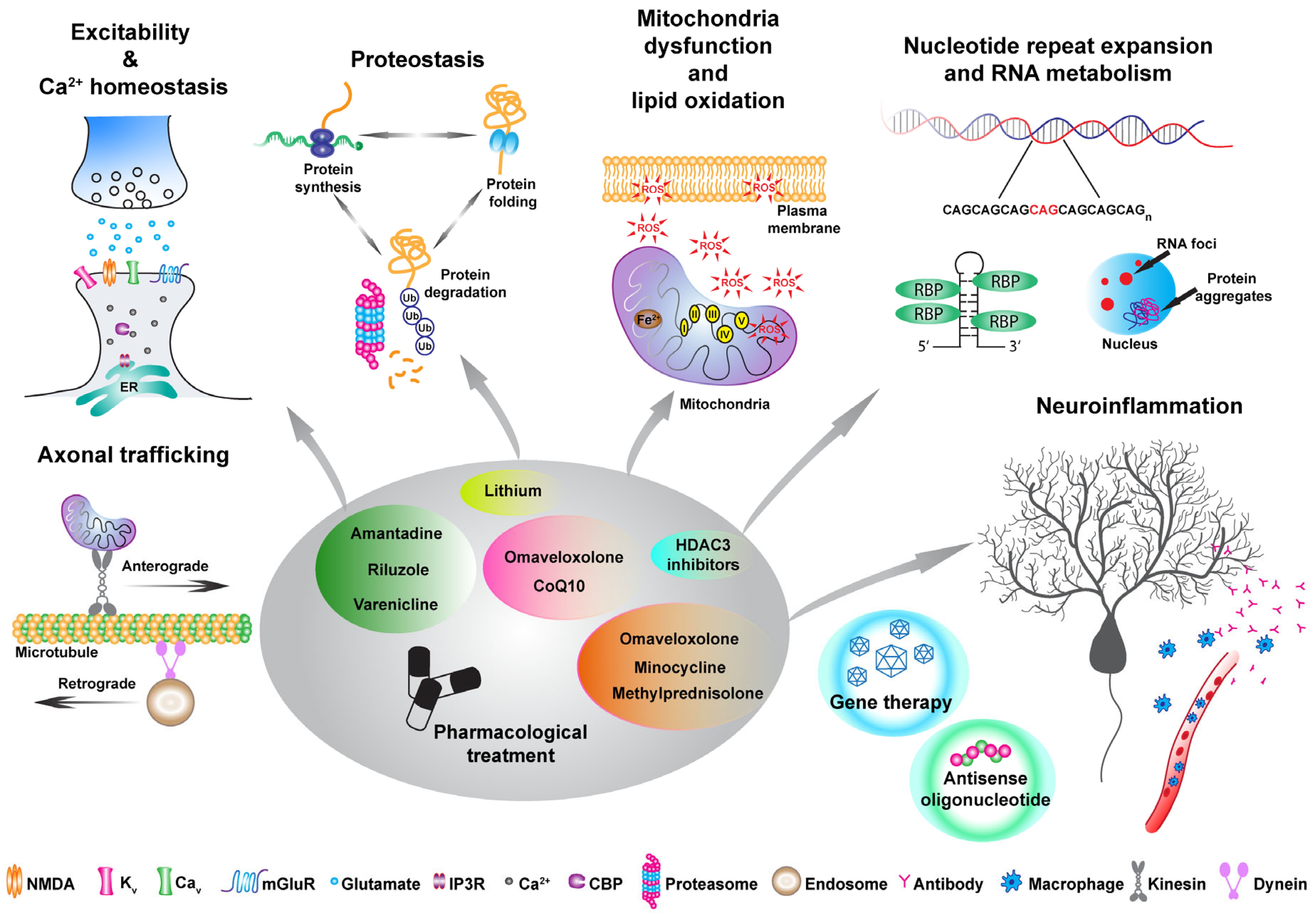
Cerebellar ataxias are a wide heterogeneous group of movement disorders. Within this broad umbrella of diseases, there are both genetics and sporadic forms. The clinical presentation of these conditions can exhibit a diverse range of symptoms across different age groups, spanning from pure cerebellar manifestations to sensory ataxia and multisystemic diseases. Over the last few decades, advancements in our understanding of genetics and molecular pathophysiology related to both dominant and recessive ataxias have propelled the field forward, paving the way for innovative therapeutic strategies aimed at preventing and arresting the progression of these diseases. Nevertheless, the rarity of certain forms of ataxia continues to pose challenges, leading to limited insights into the etiology of the disease and the identification of target pathways. Additionally, the lack of suitable models hampers efforts to comprehensively understand the molecular foundations of disease’s pathophysiology and test novel therapeutic interventions. In the following review, we describe the epidemiology, symptomatology, and pathological progression of hereditary ataxia, including both the prevalent and less common forms of these diseases. Furthermore, we illustrate the diverse molecular pathways and therapeutic approaches currently undergoing investigation in both pre-clinical studies and clinical trials. Finally, we address the existing and anticipated challenges within this field, encompassing both basic research and clinical endeavors.
Keywords: ataxia; cerebellum; therapy ataxia; cerebellum; therapy

