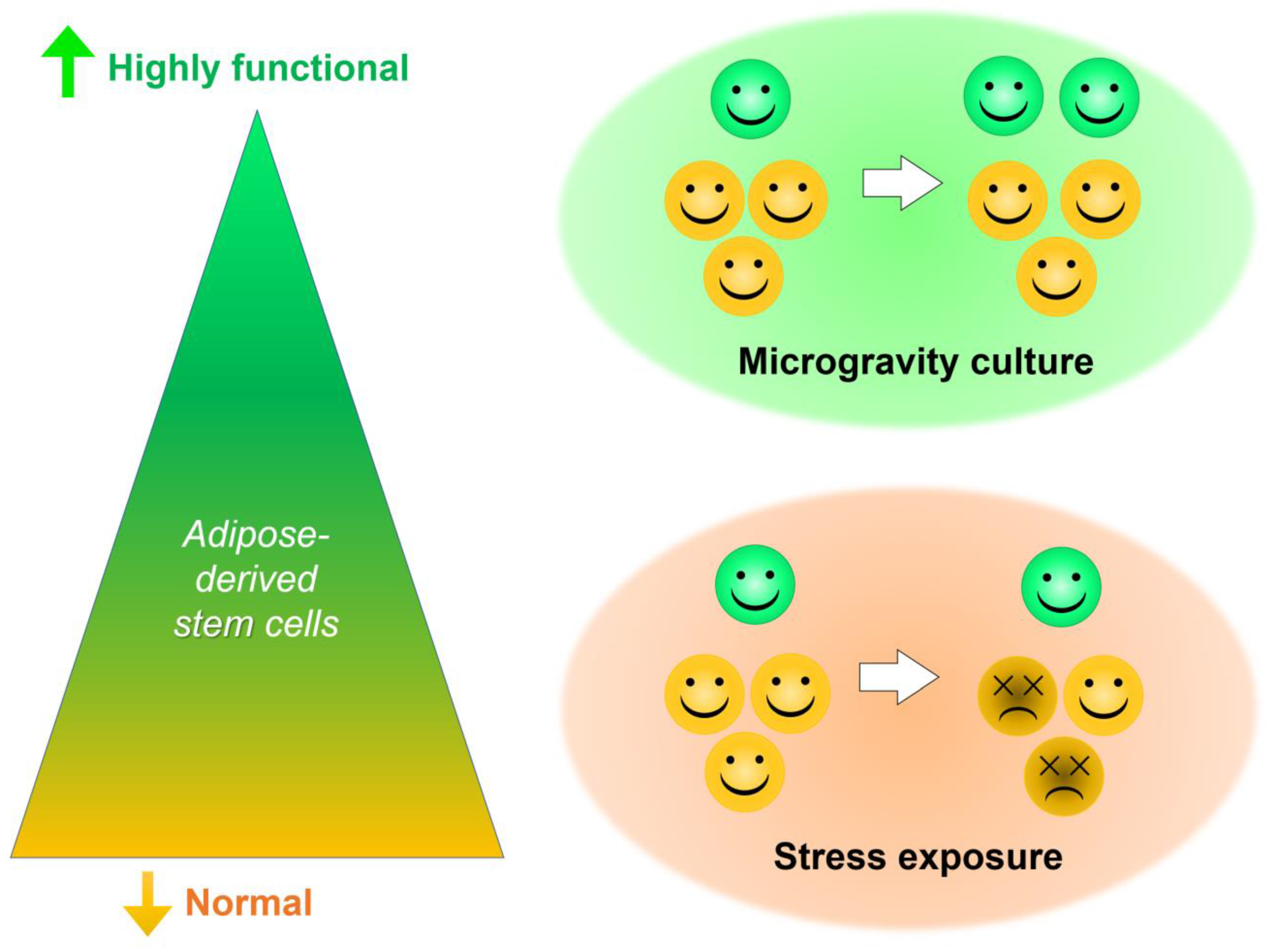
Selective Proliferation of Highly Functional Adipose-Derived Stem Cells in Microgravity Culture with Stirred Microspheres
 ,
, Abstract
Share and Cite
Mashiko, T.; Kanayama, K.; Saito, N.; Shirado, T.; Asahi, R.; Mori, M.; Yoshimura, K. Selective Proliferation of Highly Functional Adipose-Derived Stem Cells in Microgravity Culture with Stirred Microspheres. Cells 2021, 10, 560. https://doi.org/10.3390/cells10030560
Mashiko T, Kanayama K, Saito N, Shirado T, Asahi R, Mori M, Yoshimura K. Selective Proliferation of Highly Functional Adipose-Derived Stem Cells in Microgravity Culture with Stirred Microspheres. Cells. 2021; 10(3):560. https://doi.org/10.3390/cells10030560
Chicago/Turabian StyleMashiko, Takanobu, Koji Kanayama, Natsumi Saito, Takako Shirado, Rintaro Asahi, Masanori Mori, and Kotaro Yoshimura. 2021. "Selective Proliferation of Highly Functional Adipose-Derived Stem Cells in Microgravity Culture with Stirred Microspheres" Cells 10, no. 3: 560. https://doi.org/10.3390/cells10030560
APA StyleMashiko, T., Kanayama, K., Saito, N., Shirado, T., Asahi, R., Mori, M., & Yoshimura, K. (2021). Selective Proliferation of Highly Functional Adipose-Derived Stem Cells in Microgravity Culture with Stirred Microspheres. Cells, 10(3), 560. https://doi.org/10.3390/cells10030560