Article

Combination of Microbial Agent and Bamboo Biochar Decreased the Content of Cd and Changed the Rhizosphere Microbiome in Oryza sativa L.


1
School of Biological Science and Engineering, North Minzu University, Yinchuan 750021, China
2
School of Ecological Environment, Ningxia University, Yinchuan 750021, China
*
Authors to whom correspondence should be addressed.
These authors have contributed equally to this work and share first authorship.
Agronomy 2026, 16(9), 938; https://doi.org/10.3390/agronomy16090938
Submission received: 31 March 2026 / Revised: 29 April 2026 / Accepted: 1 May 2026 / Published: 6 May 2026
(This article belongs to the Section Farming Sustainability)

Abstract

Cadmium (Cd) contamination in rice paddies poses serious threats to food safety. This study investigated the effects of bamboo biochar, a microbial agent, and their combination on Cd accumulation, soil properties, and rhizosphere microbial communities in the rice cultivar ‘Ning 47’ (Oryza sativa L.) under Cd stress (20 mg·kg−1). Cd stress significantly reduced plant height, root length, and yield. However, combined treatment with biochar and microbial agent (CdMB) effectively mitigated these effects, reducing Cd content in grains, stems, and roots by 85.98%, 88.66%, and 73.89%, respectively, compared to Cd treatment alone. The CdMB treatment also significantly increased soil organic matter and total nitrogen content while decreasing soil Cd levels by 88.38%. Network analysis identified Flavisolibacter as a keystone taxon under CdMB treatment, indicating enhanced microbial network stability. This also provides a theoretical reference for the management of heavy metal contamination in agricultural soils. By reducing grain Cd contamination and enhancing soil health, this integrated approach addresses key targets of the United Nations Sustainable Development Goals, including SDG 2 (Zero Hunger), SDG 3 (Good Health and Well-being), and SDG 15 (Life on Land).

1. Introduction

Cadmium (Cd) is a highly toxic heavy metal pollutant commonly found in soils, posing a serious threat to global food safety and agricultural production [1]. In recent years, untreated wastewater irrigation and poor management practices (e.g., excessive application of pesticides and fertilizers) have increased the risk of Cd accumulation in agricultural soils and disrupted soil ecosystem functions [2,3]. Both natural and anthropogenic sources contribute to soil Cd. Naturally, Cd can exceed 0.38 mg·kg−1 in karst regions due to bedrock weathering [4,5]. However, anthropogenic activities have substantially elevated Cd levels in Ningxia’s agricultural soils. Recent surveys report a mean Cd concentration of 0.16 mg·kg−1 in farmland soils, with values up to 4.15 mg·kg−1 in industrial-adjacent areas [6,7].
Rice (Oryza sativa L.), a major staple crop in China, is particularly vulnerable because Cd is highly mobile in paddy field conditions [8,9,10]. This mobility increases Cd uptake by rice roots and its transfer to grains, potentially endangering human health through the food chain [11,12,13]. At the physiological level, Cd enters rice roots primarily by hijacking transport systems for essential divalent metals such as manganese (Mn) and iron (Fe), with OsNRAMP5 serving as the major influx transporter [14,15]. Once absorbed, Cd is rapidly translocated from roots to shoots via the xylem and subsequently redirected to grains through phloem-mediated transport; notably, over 91% of Cd accumulated in grains derives from phloem transport [14,15,16]. In several Asian countries, rice consumption contributes to more than 34% of total dietary Cd intake, posing serious health risks including kidney dysfunction, bone demineralization, and increased cancer risk [15,17,18]. Therefore, there is an urgent need for eco-friendly, sustainable, and low-cost measures to mitigate and minimize Cd-related hazards.
Biochar (BC) is an environmentally friendly soil amendment that can effectively immobilize heavy metals through mechanisms such as electrostatic attraction, complexation, and ion exchange [19]. Studies have shown that adding 5% biochar to contaminated soil can immobilize up to 400 mg·kg−1 of Cd, leading to significant remediation [20]. In a field study, Ma et al. [21] reported that biochar application effectively reduced soil Cd levels, with the 5.0% treatment being the most effective; after a 120-day incubation, available Cd in the 5.0% biochar-treated soil decreased by 0.32 mg·kg−1 compared to the control. Biochar contains a large amount of minerals and trace elements, which not only provide essential elements for plant growth but also improve soil health [22]. Among the diverse feedstocks, bamboo biochar (BBC) has attracted particular attention owing to the rapid growth, high biomass yield, and strong regeneration capacity of bamboo, making it a low-cost and renewable carbon source [23]. Bamboo biochar typically exhibits a high carbon content (68.6–88.3%) and a well-developed porosity [24], along with abundant oxygen-containing functional groups (e.g., carboxyl and hydroxyl) that confer a high cation exchange capacity [23]. In terms of Cd remediation, BBC has demonstrated strong immobilization efficiency: Mohamed et al. (2015) successfully restored an acidic Cd-contaminated soil with BBC [25], and Wang et al. (2010) reported a Cd (II) adsorption capacity of 18 mg·g−1 by bamboo charcoal [26]. Due to its low cost and wide range of sources, biochar is an effective strategy for the remediation of soil heavy metal pollution [27,28].
Furthermore, microbial remediation is a cost-effective and environmentally benign approach for treating metal-contaminated soils. This process typically involves introducing beneficial microorganisms that promote host plant growth, stimulate microbial activity, and contribute to soil remediation [29,30]. Studies have shown that combining microbial agents with biochar can effectively immobilize heavy metals in soil, thereby improving soil health and ecosystem function [31]. Qi et al. [1] reported that applying a combination of microbial fungi and corn stover biochar decreased soil Cd content and increased soil organic matter accumulation. Ma et al. [32] found that microbial agents and biochar remediation techniques increased the relative abundance of Bacillus spp. in soil samples while reducing the relative abundance of Fusarium spp. and Alternaria Nees spp. This shift in microbial community composition may help reduce disease incidence in crops [1].
In this study, we investigated the physiological and biochemical responses of rice to cadmium stress, as well as the effects of microbial agent and biochar amendments on the root zone microhabitat. Addressing Cd contamination in rice paddies aligns with multiple Sustainable Development Goals (SDGs) of the UN’s 2030 Agenda, particularly SDG 2 (Zero Hunger) by ensuring food safety, SDG 3 (Good Health and Well-being) by reducing heavy metal exposure, and SDG 15 (Life on Land) by restoring soil health and ecosystem functions. While previous studies have examined biochar or microbial agents separately for Cd remediation, few have systematically compared their individual and combined effects on both plant Cd accumulation and rhizosphere microbial community structure in rice paddies. Moreover, the mechanisms underlying the superior performance of combined treatments remain poorly understood, particularly regarding microbial network dynamics and keystone taxa. In controlled indoor experiments, we treated the predominant rice cultivar grown in Ningxia, ‘Ning 47’ (N-47), with biochar, a microbial agent, or a combination of both. The following scientific questions were addressed: (1) Can biochar combined with a microbial agent effectively reduce Cd accumulation in rice and lower its transport coefficient? (2) What are the effects of combined remediation on rice rhizosphere microhabitats?

2. Materials and Methods

2.1. Study Area

The control indoor pot experiment was conducted at the experimental base of the School of Biological Science and Engineering, North Minzu University, Yinchuan, Ningxia Hui Autonomous Region, China (38°29′56″ N, 106°07′00″ E). The elevation is 1110 m above sea level. This area has a mid-temperate continental arid climate, with a mean annual temperature of 8.5 °C, a mean annual precipitation of approximately 200 mm concentrated from July to September, and a frost-free period of 150–170 days.

2.2. Experimental Materials and Design

The rice (Oryza sativa L.) cultivar used in this study was Ningjing 47 (N-47; Approval No. Ningshendao 2014001), a japonica conventional variety. The seeds were provided by the Crop Research Institute, Ningxia Academy of Agricultural and Forestry Sciences (Yinchuan, Ningxia, China). In this study, nutrient soil was mixed with vermiculite (1:1) and CdCl2 to achieve a final Cd concentration of 20 mg·kg−1. The mixture was wrapped in plastic film and incubated for 60 days, with soil moisture maintained at 60% of field capacity using deionized water. After incubation, the soil was divided into 15 L plastic planting boxes [33]. Rice seeds with full grains and uniform size were selected, surface-sterilized in 10% sodium hypochlorite for 10 min, rinsed with deionized water, and vernalized at 4 °C for 12 h. They were then placed on Petri dishes lined with filter paper moistened with sterile water and germinated at 25 °C in the dark. Germinated seedlings were transplanted into the planting boxes, with three seedlings per box. After 30 days of growth, remediation treatments were applied. The bamboo-derived biochar was pyrolyzed at 700 °C and had the following physicochemical properties: pH 8.2, carbon content 59.35%, ash content 7.62%, moisture content 8.32%, nitrate nitrogen 30.74 mg·kg−1, and ammonium nitrogen 0.81 mg·kg−1. It was purchased from Henan Lize Environmental Protection Technology Co., Ltd. (Henan, China). The microbial agent was a powder formulation primarily composed of Bacillus species (e.g., Bacillus subtilis), and was purchased from Zhongnong Lvkang (Beijing) Biotechnology Co., Ltd. (Beijing, China). The treatments included: Cd (20 mg·kg−1 Cd only), CdM (20 mg·kg−1 Cd + Microbial agent), CdB (20 mg·kg−1 Cd + Biochar), and CdMB (20 mg·kg−1 Cd + Microbial agent + Biochar). Biochar and microbial agent were each added at 20 g per box. The control (CK) group received no Cd, biochar, or microbial agent. Each treatment had 8 replicates.

2.3. Plant and Soil Sampling

After rice maturation, seeds and aboveground tissues were harvested. Subsequently, any residual biochar and microbial agent on the soil surface were removed, and whole rice roots were extracted. Loose soil attached to the roots was shaken off and collected for analysis of physicochemical properties. The remaining roots with tightly adhering rhizosphere soil were placed into 50 mL sterile centrifuge tubes containing PBS and stored in an ice box. The tubes were centrifuged to separate the rhizosphere soil; during this process, the supernatant and root tissue were discarded. The resulting rhizosphere soil samples were retained, and the separated root tissues were stored for further experiments. In total, 40 samples were obtained for rhizosphere microbial and soil physicochemical analyses, comprising eight samples per treatment group (CK, Cd, CdM, CdB, and CdMB).

2.4. Determination of Cd Content in Plants and Soil Physicochemical Properties

Dried samples of aboveground tissues, roots, seeds, and rhizosphere soil were crushed and digested with HNO3-HClO4. The Cd content was determined using an atomic absorption spectrophotometer. Air-dried soil (20 g) was mixed with 50 mL distilled water, and the pH (LeiCi PHS-3E, Shanghai, China) and electrical conductivity (EC) (LEICI DDS-307A, Shanghai, China) were then measured. Soil total organic carbon (SOC) content was determined using the sulfuric acid–potassium dichromate oxidation method [34] (Shimadzu TOC-VCPH, Kyoto, Japan). Total nitrogen (TN) content was determined by sulfuric acid digestion–hydrochloric acid titration, and total phosphorus (TP) content was determined using alkali fusion-Mo-Sb anti-spectrophotometry.

2.5. DNA Extraction, High Throughput Sequencing, and Data Processing

DNA was extracted from fresh soil (1 g) using the cetyltrimethylammonium bromide (CTAB) method. For 40 eligible samples, the V3–V4 regions of the 16S rRNA gene were amplified using the primers 341F (5′-CCTAYGGGRBGCASCAG-3′) and 806R (5′-GGACTACNNGGGTATCTAAT-3′). Simultaneously, the ITS1 region was amplified from the same 40 samples using the primers ITS1 (5′-CTTGGTCATTTAGAGGAAGTAA-3′) and ITS2 (5′-GCTGCGTTCTTCATCGATGC-3′) [35].
Following PCR amplification, sequencing was performed using the Illumina NovaSeq 6000 platform (Illumina, San Diego, CA, USA). FLASH (V1.2.11) and Usearch were used to splice the raw data and filter the chimeras to obtain valid data [36]. The valid data were denoised using the DADA2 module in QIIME 2 to obtain amplicon sequence variants (ASVs). Representative sequences of each ASV were then annotated to the species level using the classify-sklearn algorithm in QIIME 2. The raw bacterial and fungal sequencing data have been deposited in the NCBI database under the accession numbers PRJNA1188448 and PRJNA1188538. Samples were rarefied to the minimum sequencing depth: 35,502 reads for bacteria and 68,169 reads for fungi. The rarefied data were used for subsequent analyses [37].

2.6. Statistical Analysis and Visualization

The transfer coefficient (TF) and bioaccumulation factor (BCF) were calculated [38,39] using the following equations:
TF Stem / Root   =   Cd   concentration   in   stem Cd   concentration   in   root
  TF Grain / Root = Cd   concentration   in   grain Cd   concentration   in   root
TF Grain / Stem = Cd   concentration   in   grain Cd   concentration   in   stem
BCF = Cd   concentration   in   Grain   or   Stem   or   Root Soil   Cd   concentration
One-way ANOVA was used to analyze Cd content, TF, BCF, and soil properties. Microbial alpha diversity indices, including observed ASV richness, ACE (Abundance-based Coverage Estimator), and Shannon index, were calculated using the “agricolae” package in R (v 4.4.1) [40]. To clarify the effects of different treatments on soil microbial communities, we used the “ggalluvial” package to determine the phyla (top 10 in relative abundance). For ASVs with a detection rate greater than 75%, correlations were calculated using the corr.test() function in the “psych” package, retaining only the links with p < 0.05 and |r| > 0.85 (in this process, p-values were corrected using the FDR method [41]). Network parameters including edge-to-node ratio, average path length, graph density, and average degree were calculated to assess network complexity [42]. The resulting networks were visualized using Gephi software (v 0.9.6) [43]. The keystone taxa were identified based on within-module connectivity (Zi) and among-module connectivity (Pi) using the “igraph” package (v 2.1.4) [44], and classified into four categories: peripherals, connectors, module hubs, and network hubs. Linear discriminant analysis effect size (LEfSe) was performed using the microeco package in R [45], with an LDA score threshold of 3 for bacteria and 1.5 for fungi to identify biomarkers that differed significantly between treatments [46].

3. Results

3.1. Effects of Different Treatments on the Cd Content of Rice

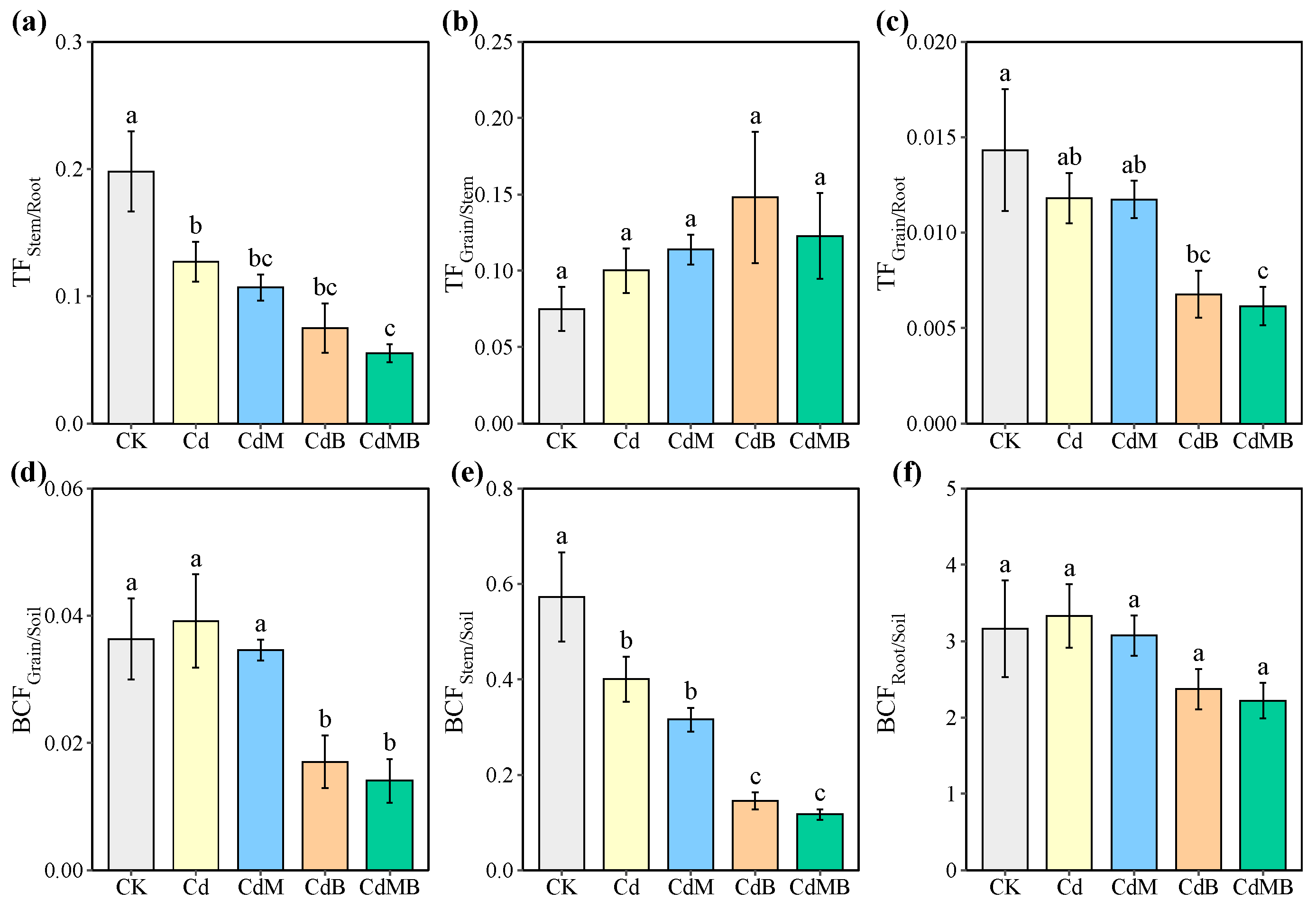
Cadmium stress led to significant Cd accumulation in rice plants. However, treatment with biochar, microbial agent, or their combination reduced Cd content in plant tissues. Under CdMB treatment, Cd levels in grains, stems, and roots decreased by 85.98%, 88.66%, and 73.89%, respectively, compared to the Cd control. Across all treatments, Cd accumulation was consistently highest in roots, followed by stems and grains (Figure 1). We also calculated the translocation factor (TF) and bioconcentration factor (BCF). TFStem/Root and TFGrain/Root were significantly lower under CdMB treatment than under Cd treatment, while TFGrain/Stem showed no significant differences among treatments (Figure 2a–c). For BCF, values in grains and stems were lower under CdB and CdMB treatments than under CK, Cd, and CdM treatments (p < 0.05), whereas root BCF did not differ significantly across treatment groups. Root BCF was consistently higher than that of stems and grains, consistent with the Cd accumulation pattern in rice tissues (Figure 1 and Figure 2d–f).

3.2. Effects of Different Treatments on the Soil Properties of Rice Rhizosphere Soil

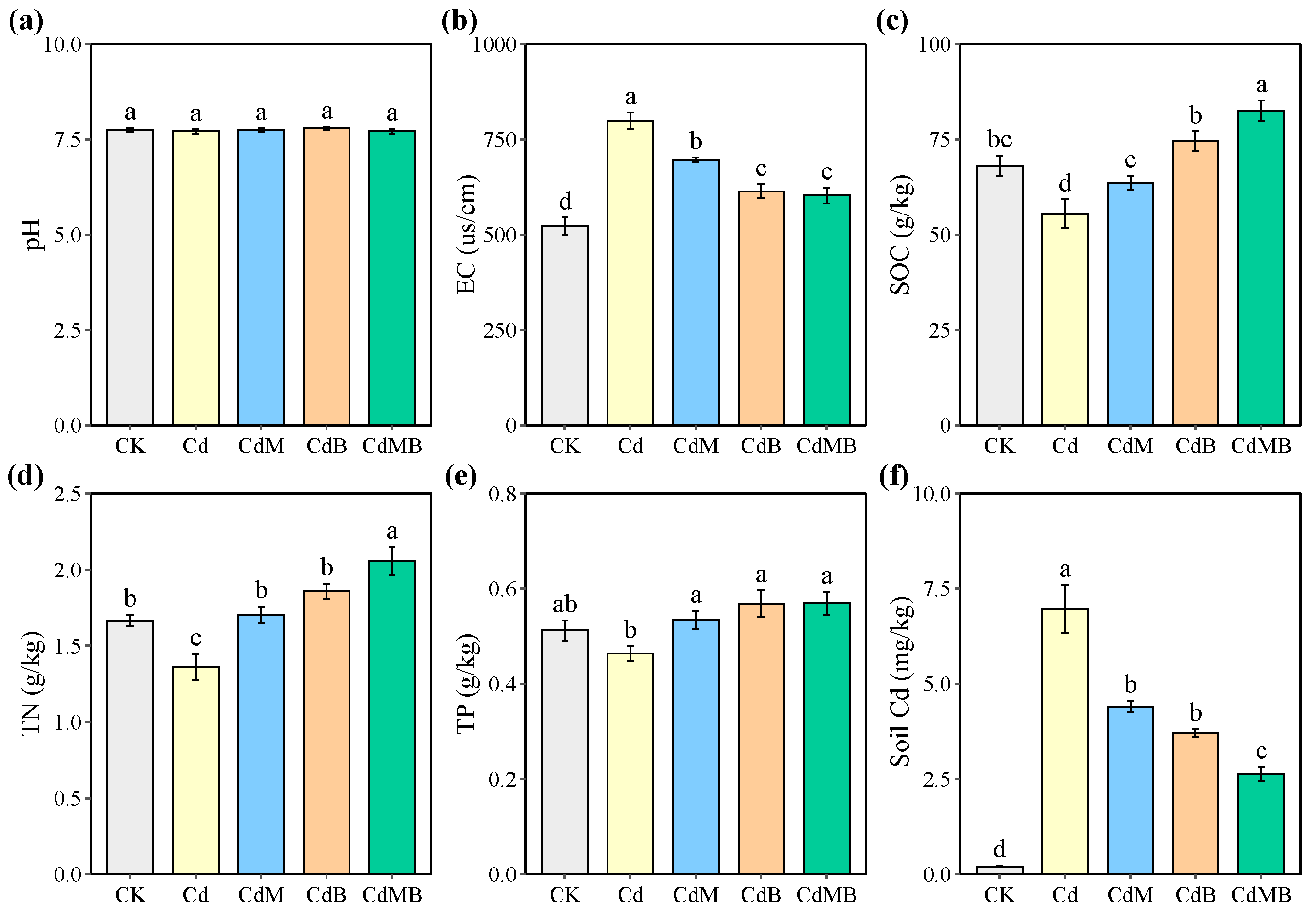
No significant changes were seen in soil pH among treatments (Figure 3a). Compared with that of the CK, soil EC significantly increased after Cd treatment. However, application of microbial agents and biochar effectively reduced EC, with CdB and CdMB treatments being the most effective (Figure 3b). Cd treatment also decreased soil organic carbon (SOC), total nitrogen (TN), and total phosphorus (TP). In contrast, both microbial agents and biochar increased SOC, TN, and TP while reducing soil Cd content, with biochar showing a stronger effect than the microbial agent alone. The reduction in soil Cd content was greatest under CdMB treatment, followed by CdB and CdM (Figure 3c–f). Overall, the best results were obtained from the combined application of microbial agents and biochar.

3.3. Changes in Microbial Alpha Diversity and Community Structure

Analysis of bacterial and fungal diversity revealed 18,478 and 11,276 ASVs, respectively. The alpha diversity of the rhizosphere microbial community was also analyzed. Bacterial ASV numbers decreased under Cd treatment but increased after CdM or CdB treatment, with the highest increase observed under CdMB treatment (p < 0.05) (Figure S1a). The ACE index followed a similar trend to the ASV numbers (Figure S1c). Likewise, application of microbial agents and biochar increased the bacterial Shannon index (Figure S1b). In contrast, none of the treatments significantly affected fungal alpha diversity (Figure S1d–f).
At the phylum level, the top 10 bacterial phyla accounted for over 90% of the community, dominated by Proteobacteria, Bacteroidetes, and Firmicutes (Figure S2a). For fungi, the top 10 phyla represented only 13.26–18.38% of the community, with Ascomycota, Chytridiomycota, and Rozellomycota being the most abundant (Figure S2c). At the genus level, the relative abundance of the top 20 bacterial genera ranged from 25.51% to 30.98%, with Hydrogenophaga, Flavobacterium, and Devosia as the dominant genera (Figure S2b). The top 20 fungal genera each accounted for 8% or less of the community, with Byssochlamys, Paranamyces, and Humicola being the most prevalent (Figure S2d).

3.4. Microbial Network Complexity and Biomarkers

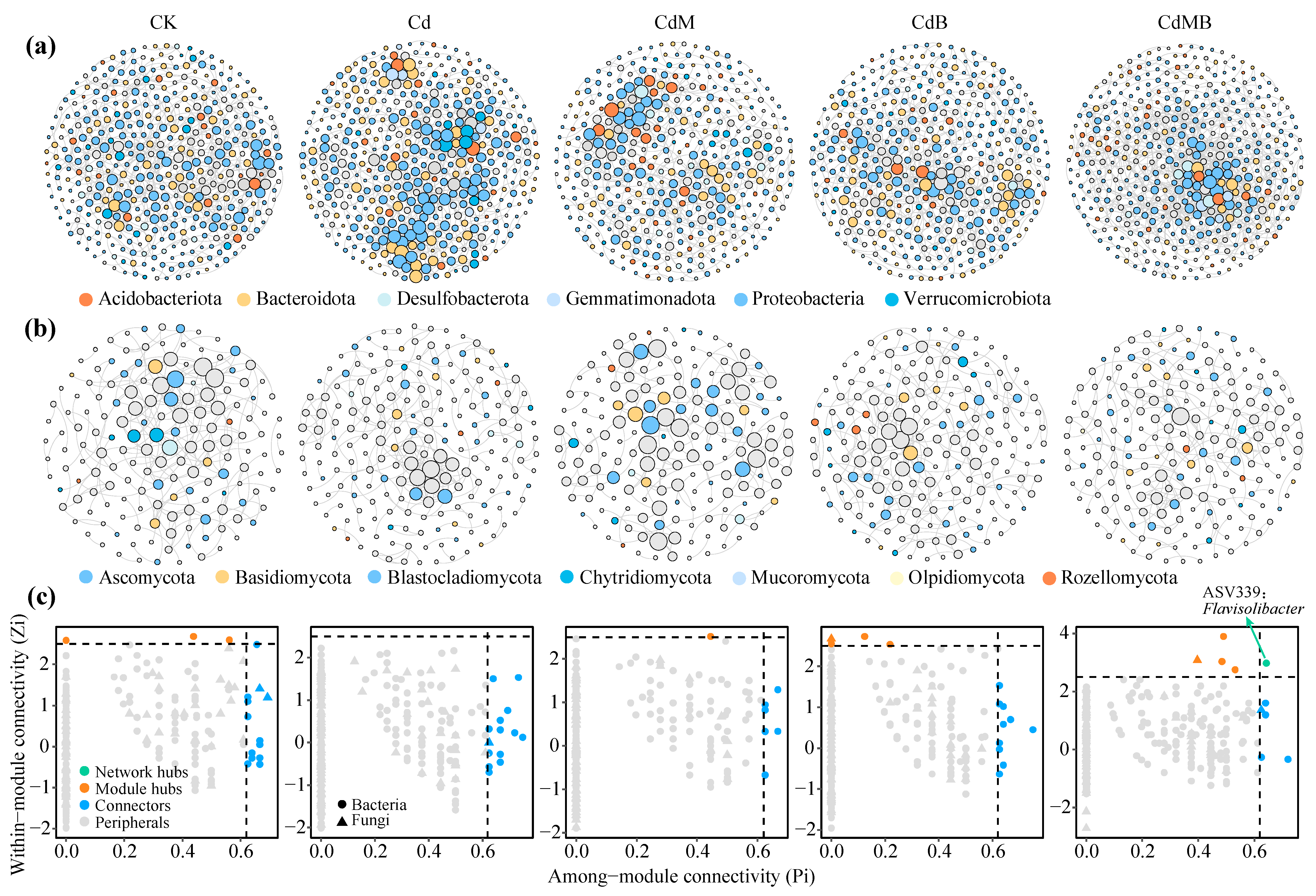
To further explore microbial interactions in the rice rhizosphere under different treatments, bacterial and fungal correlation networks were constructed. A single application of microbial agent or biochar did not increase network complexity, whereas their combination effectively enhanced the complexity of the bacterial network, as reflected by edge-to-node ratio, graph density, and average degree (Figure 4a,b, Table S1). Keystone taxa were predominantly bacterial. Among these, ASV339, a particularly significant keystone taxon, was identified in the CdMB-treated group and belonged to the genus Flavisolibacter (Figure 4c, Table S2).
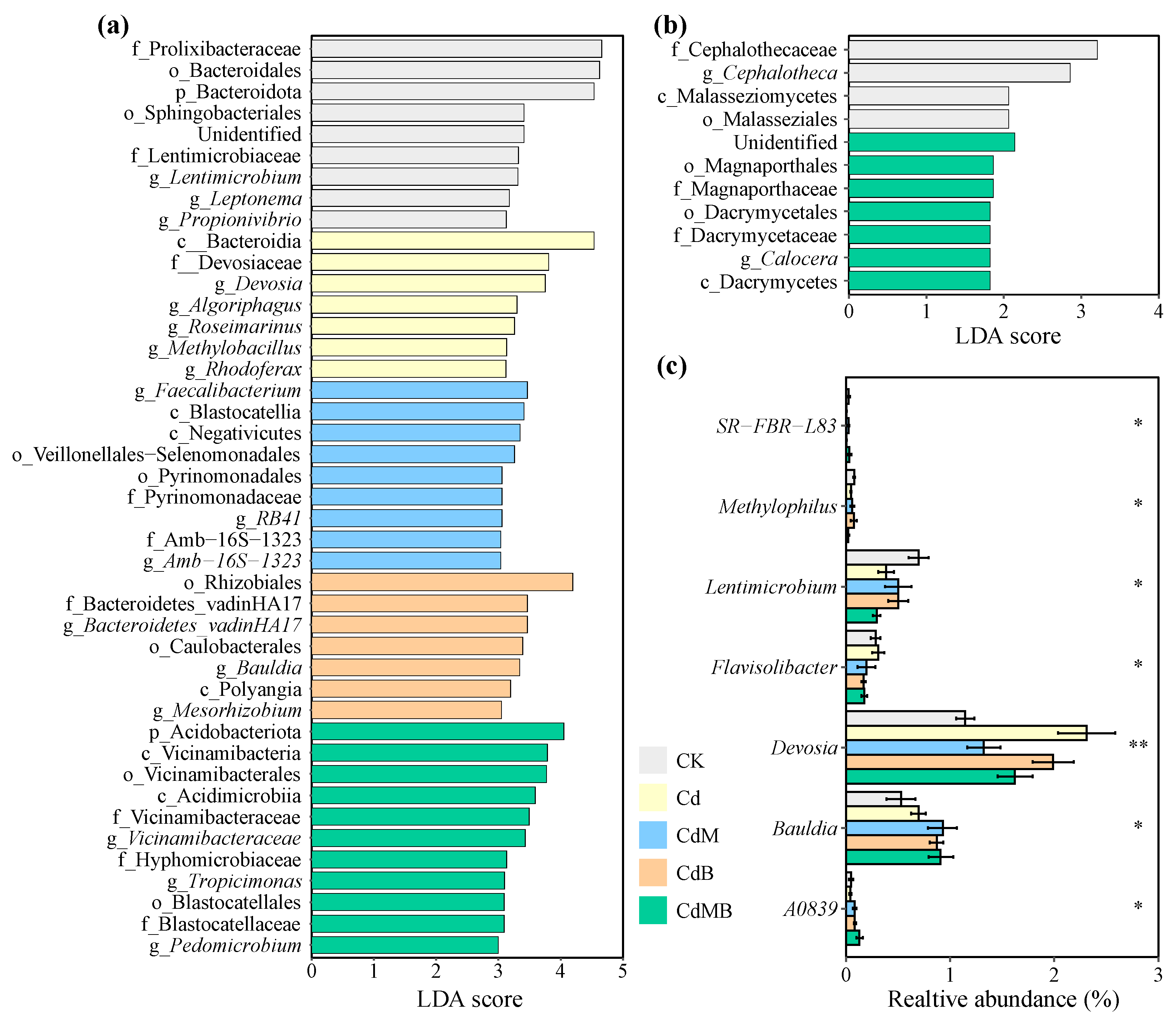
Furthermore, 224 bacterial and 11 fungal biomarkers were identified by the LEfSe analysis. Among these, 56 bacterial and four fungal biomarkers were detected in the CK group, whereas 51 bacterial and seven fungal biomarkers were observed in the CdMB treatment group (Figure 5). Finally, by comparing the genus-level distribution of keystone ASVs within the network with the biomarkers identified via the LEfSe analysis, we found that seven bacterial genera were shared between the two sets: A0839, Bauldia, Devosia, Flavisolibacter, Lentimicrobium, Methylophilus, and SR-FBR-L83 (Tables S3 and S4). The bacterial genera Bauldia, Devosia, and Flavisolibacter were identified as the keystone taxa in the CdMB group. Together, the results of the network and LEfSe analyses indicate that Flavisolibacter played a vital role in maintaining microbial network stability (Figure 4c).

4. Discussion

4.1. Microbial Agents and Biochar Remediation Decreased Cd Content in Rice

The accumulation of Cd in soil has been shown to exert a deleterious impact on plant growth. The results of this study demonstrated that Cd stress significantly inhibited the growth of ‘N-47’ rice, with plant height reduced by 39.98% compared to the CK group. Similar findings have been reported in related studies, e.g., Hussain et al. (2021) [47]. Moreover, Cd stress reduced the root development of ‘N-47’ rice. Under 20 mg·L−1 Cd stress, root length decreased by 47.99% compared with that of the CK group, and root volume decreased by 76.19%, findings consistent with previous studies [48,49]. In addition, Cd stress reduced the fresh and dry weights of ‘N-47’ plants by 79.01% and 79.13%, respectively, and the fresh and dry weights of grains by 78.45% and 88.79%, respectively, further demonstrating the negative effects of Cd accumulation on rice yield [50]. Cd2+ in soil is primarily taken up by rice roots and subsequently translocated to aboveground tissues [21,51]. In this study, microbial agents and biochar remediation effectively reduced the root-to-seed translocation factors by 33.36% and 64.11%, respectively, compared with those in the Cd stress group. The findings of the aforementioned studies indicated that microbial agents and biochar remediation demonstrated superior efficacy in reducing the Cd transport coefficient within the rice plant and limiting the accumulation of Cd in rice seeds compared to the use of a single remediation method [52].
Both microbial agent and biochar remediation reduced Cd2+ accumulation in rice tissues to varying degrees, with reductions of 1.29 mg·kg−1, 8.378 mg·kg−1, and 0.098 mg·kg−1 in roots, stems, and seeds, respectively, compared with those in the control. This finding is consistent with Xu et al. (2023) [53]. Additionally, Wang et al. (2023) [54] showed that microbial agents could reduce the Cd content of rice effectively, further proving that microbial agents have good remediation effects on heavy metal pollution. In addition, biochar application alone significantly reduced Cd content by 2.124 mg·kg−1, 13.082 mg·kg−1, and 0.189 mg·kg−1 in roots, stems, and seeds, respectively, compared with those in the control, which aligns with the findings of Ma et al. (2021) [21]. Similarly, Zhang et al. (2014) [55] found that biochar remediation substantially reduced Cd enrichment in rice plants. In this study, microbial agent and biochar remediation significantly reduced Cd2+ accumulation in rice tissues, with decreases of 2.368 mg·kg−1, 16.033 mg·kg−1, and 0.215 mg·kg−1 in roots, stems, and seeds, respectively.
Under all treatments, Cd accumulation followed roots > stems > grains, and TF and BCF were <1, confirming ‘Ning 47’ as a non-hyperaccumulator cultivar. Non-hyperaccumulator rice retains Cd in roots via cell wall binding, vacuolar sequestration, and apoplastic barriers [56]. Compared with Cd treatment alone, CdMB treatment significantly reduced TFStem/Root and TFGrain/Root (p < 0.05), indicating enhanced root barrier function, which is consistent with the findings of Wang et al. (2024) that biochar reduces soil-available Cd and down-regulates the expression of OsNRAMP5 and OsHMA2 [57]. Root BCF did not differ among treatments, suggesting root Cd uptake was proportional to the available Cd pool. However, the grain and stem BCF were significantly lower under CdB and CdMB (p < 0.05), indicating biochar-containing treatments reduced root-to-shoot Cd translocation via adsorption and complexation [58]. TFGrain/Stem showed no significant differences, implying that the reduced grain Cd was due to enhanced root retention rather than stem-to-grain barriers.

4.2. Microbial Agents and Biochar Remediation Reduced Cd Content in Soil

Studies have shown that the decrease in Cd content in plants is attributed to the reduction in Cd in soil following the application of microbial agents and biochar [21,54]. This was further supported by our findings: the application of microbial agents or biochar reduced soil Cd content by 58.41% and 88.38%, respectively. Comparatively, the CdMB treatment reduced soil Cd content by 1.65 times that of the control group. Different remediation methods can reduce the Cd content in soils while affecting the physicochemical properties of the soil to different extents. For example, the application of biochar or microbial agents to Cd-contaminated soils can change not only the electrical conductivity but also the pH. In this study, biochar and microbial agent application decreased soil EC, consistent with earlier reports [59].
Remediation with biochar or microbial agents also increases SOC, TN, and TP levels [60,61]. The bamboo biochar used in this study (pH 8.2, carbon content 59.35%) contributed to these improvements through Cd adsorption and nutrient supply [62]. In our study, Cd addition significantly decreased soil SOC, TN, and TP contents; however, after applying biochar or microbial agent remediation, these indicators increased accordingly. In particular, synergistic remediation with biochar and microbial agents significantly increased soil SOC and TN. The addition of microbial agents increases soil SOC complexity, which is further assimilated to drive biogeochemical cycling, thereby increasing soil SOC and TN [63]. Furthermore, the stimulatory effect of biochar contributes to the increase in SOC by altering the soil environment and protecting native SOC from decomposition through physical protection, including the formation of soil aggregates [64].

4.3. Microbial Agents and Biochar Remediation Changed the Rhizosphere Soil Microbial Community Structure

Maintenance of soil ecosystem functions is largely dependent on soil microorganisms, which play key roles in facilitating material cycling, energy flow, nutrient conversion, organic matter decomposition, and other biochemical processes [65]. In this study, Cd stress decreased the ACE index of the bacterial community, and previous studies have shown that heavy metal pollution reduces soil bacterial richness [66,67]. This study found that synergistic remediation with biochar and microbial agents led to higher bacterial richness and diversity in soil compared with single treatments. The application of biochar significantly increases both the Shannon and ACE indexes of the bacterial community [68,69]. Furthermore, Qi et al. (2022) [1] found that combined remediation with biochar and microbial agents led to a significant increase in the Shannon index of the soil bacterial community compared with Cd treatment alone. Our findings are consistent with these reports. Therefore, increasing soil microbial community diversity is important for improving farmland productivity [70]. Our results further indicate that the combined use of microbial agents and biochar offers significant ecological benefits for remediating Cd-contaminated paddy fields.
In this study, Proteobacteria, Bacteroidota, Firmicutes, Acidobacteriota, and Verrucomicrobiota were the dominant taxa in the rhizosphere soil of rice, which is consistent with the findings of most studies on rice rhizosphere microorganisms [71,72]. Actinobacteria are known to exhibit strong tolerance to Cd contamination [73,74]. In this study, the abundance of Actinobacteria was not significantly affected by Cd stress. Conversely, its relative abundance increased following biochar application, likely due to the important role of Actinobacteria in carbon cycling and their dominance in carbon-rich environments [74]. Additionally, biochar application increased the relative abundance of Proteobacteria, possibly as a result of enhanced nutrient availability in the soil, as previously reported [73,75].
Improvements in soil ecological functioning often lead to greater stability and complexity in microbial co-occurrence networks [76]. In the present study, the peripheral and module hubs of the soil microbial network under combined remediation with microbial agents and biochar were higher than those in the control and Cd-only treatments. Given the pivotal role of keystone taxa in microbial networks, this study identified Flavisolibacter as a keystone taxon in the CdMB treatment group. Flavisolibacter is known to promote plant growth through auxin production [77]. Several studies have confirmed its importance in remediating heavy metal pollution [78,79]. Moreover, the relative abundance of Devosia increased significantly under Cd stress, which may be attributed to its high tolerance in Cd2+-contaminated soils, making it a potential candidate for bioremediation of heavy metal-polluted soils [80].
While our study focused on microbial-mediated Cd immobilization, it is important to note that plant genotypic tolerance also plays a crucial role in Cd stress mitigation. Recent studies have shown that stress-responsive genes, such as dehydrins (RAB21, RAB16D, RAB16B), are upregulated under Cd stress and contribute to enhanced tolerance [81]. The synergistic effects of selecting tolerant cultivars and applying microbial agents with biochar warrant further investigation for optimizing Cd remediation strategies in rice paddies. From a broader perspective, the combined application of microbial agents and biochar addresses multiple Sustainable Development Goals. By reducing Cd accumulation in rice grains, this approach enhances food safety and contributes to SDG 2 (Zero Hunger) and SDG 3 (Good Health and Well-being). The improvement in soil health (increased SOC and TN) and microbial diversity supports SDG 15 (Life on Land) by restoring degraded agricultural ecosystems. Furthermore, the use of bamboo biochar—a renewable, carbon-negative material—aligns with SDG 13 (Climate Action) by sequestering carbon in soil. These findings demonstrate that integrated remediation strategies can simultaneously address environmental contamination and advance global sustainability targets.

5. Conclusions

Overall, the combined application of microbial agents and biochar reduced Cd accumulation in soil and lowered the Cd translocation coefficient in rice plants. Notably, the CdMB treatment outperformed both biochar alone (CdB) and microbial agent alone (CdM) across nearly all indicators: it achieved the greatest reduction in seed Cd content (85.98%) and soil Cd levels, and uniquely enhanced bacterial network complexity (edge-to-node ratio, graph density, average degree), whereas no significant network complexity increase was observed under either single amendment. The CdMB treatment significantly reduced Cd content in seeds, increased soil SOC and TN levels, and altered root microhabitats. These results provide insights into the dynamics of the rhizosphere soil microbial community and its relationship with environmental factors, as well as a theoretical reference for the management of heavy metal contamination in agricultural soils.

Supplementary Materials

The following supporting information can be downloaded at: https://www.mdpi.com/article/10.3390/agronomy16090938/s1, Figure S1: Effects of biochar, microbial agents and their combination on the (a–c) bacterial and (d–f) fungal alpha diversity. Different letters in the figures indicated significant differences among different treatments (p < 0.05, Duncan test); Figure S2: Relative abundance of (a,b) bacteria and (c,d) fungi at (a–c) phylum and (b–d) genus levels under different treatments; Table S1: Bacterial and fungal correlation network attribute characterization; Table S2: Classification of ASVs to identify keystone taxa in bacterial and fungal correlation networks; Table S3: The distribution of bacterial fungal keystone taxa at the genus level under different treatments; Table S4: Kruskal–Wallis test and linear discriminant analysis for bacteria and fungi to identify intergroup biomarkers.

Author Contributions

Conceptualization, P.K. and X.D.; methodology, A.G., J.H. and Y.Z.; software, A.G. and J.H.; validation, C.Z., X.Q. and Y.Z.; formal analysis, J.H.; investigation, A.G., J.H. and Y.Z.; resources, H.Z. and K.M.; data curation, P.K.; writing—original draft, P.K., A.G. and J.H.; writing—review and editing, P.K. and X.D.; visualization, J.H.; supervision, P.K.; project administration, K.M. and X.Y.; funding acquisition, K.M. and X.Y. All authors have read and agreed to the published version of the manuscript.

Funding

This research was funded by the Agricultural Resources and Environmental Monitoring and Protection Project of Ningxia province (2130135); the Graduate Student Innovation Program of North Minzu University (YCX24407); the Collaborative Heavy Metal Detection Project in Soil of Producing Area and Agricultural Products (2021–87); and the High-level Talent Project of Northern Minzu University (2025BG293).

Data Availability Statement

The datasets presented in this study can be found in online repositories. The names of the repository/repositories and accession numbers can be found at: https://www.ncbi.nlm.nih.gov/bioproject/PRJNA1188448 and https://www.ncbi.nlm.nih.gov/bioproject/PRJNA1188538 (accessed on 31 March 2026).

Acknowledgments

We thank Lin Yang, Xiaoqian Mu, and Qiubo Ji for their work in soil sample collection and experimental processing.

Conflicts of Interest

The authors declare no conflicts of interest.

References

  1. Qi, X.; Xiao, S.Q.; Chen, X.M.; Ali, I.; Gou, J.L.; Wang, D.; Zhu, B.; Zhu, W.K.; Shang, R.; Han, M.W. Biochar-based microbial agent reduces U and Cd accumulation in vegetables and improves rhizosphere microecology. J. Hazard. Mater. 2022, 436, 129147. [Google Scholar] [CrossRef]
  2. Wang, P.; Chen, H.; Kopittke, P.M.; Zhao, F.J. Cadmium contamination in agricultural soils of China and the impact on food safety. Environ. Pollut. 2019, 249, 1038–1048. [Google Scholar] [CrossRef]
  3. Yang, Q.Q.; Li, Z.Y.; Lu, X.N.; Duan, Q.N.; Huang, L.; Bi, J. A review of soil heavy metal pollution from industrial and agricultural regions in China: Pollution and risk assessment. Sci. Total Environ. 2018, 642, 690–700. [Google Scholar] [CrossRef]
  4. Li, J.; Huang, C.Y.; Huang, Z.W.; Wang, X.Y.; Luo, J.; Feng, S.Y.; Yang, Z.L. Exploring the geochemical characteristics, sources, influencing factors, and potential remediation strategies of Cd in a typical karst region. Environ. Earth Sci. 2024, 83, 514. [Google Scholar] [CrossRef]
  5. Wei, N.; Gu, X.Y.; Wen, Y.B.; Guo, C.; Ji, J.F. Geochemical speciation and activation risks of Cd, Ni, and Zn in soils with naturally high background in karst regions of southwestern China. J. Hazard. Mater. 2025, 486, 137100. [Google Scholar] [CrossRef]
  6. Chen, L.; Ma, K. Spatial and Temporal Distribution and Source Analysis of Heavy Metals in Agricultural Soils of Ningxia, Northwest of China. Sustainability 2023, 15, 15360. [Google Scholar] [CrossRef]
  7. Bai, Y.R.; Zhang, Y.H.; Liu, X.; Wang, Y.Q. The spatial distribution and source apportionment of heavy metals in soil of Shizuishan, China. Environ. Earth Sci. 2023, 82, 494. [Google Scholar] [CrossRef]
  8. Liu, R.L.; Wang, Y.; Hong, Y.; Wang, F.; Mao, X.P.; Yi, J. Controlled-release urea application and optimized nitrogen applied strategy reduced nitrogen leaching and maintained grain yield of paddy fields in Northwest China. Front. Plant Sci. 2023, 14, 1033506. [Google Scholar] [CrossRef]
  9. Li, R.N.; Yu, Y.L. Impacts of green production behaviors on the income effect of rice farmers from the perspective of outsourcing services: Evidence from the rice region in Northwest China. Agriculture 2022, 12, 1682. [Google Scholar] [CrossRef]
  10. Song, W.E.; Chen, S.B.; Liu, J.F.; Chen, L.; Song, N.N.; Li, N.; Liu, B. Variation of Cd concentration in various rice cultivars and derivation of cadmium toxicity thresholds for paddy soil by species-sensitivity distribution. J. Integr. Agric. 2015, 14, 1845–1854. [Google Scholar] [CrossRef]
  11. Chen, B.; Stein, A.F.; Castell, N.; Gonzalez-Castanedo, Y.; Sanchez De La Campa, A.M.; De La Rosa, J.D. Modeling and evaluation of urban pollution events of atmospheric heavy metals from a large Cu-smelter. Sci. Total Environ. 2016, 539, 17–25. [Google Scholar] [CrossRef] [PubMed]
  12. Wang, L.M.; Liao, J.C.; Tang, Y. Effect of intercropping of solanum nigrum L., tomato and eggplant on phosphorus uptake under cadmium stress. IOP Conf. Ser. Earth Environ. Sci. 2019, 233, 042023. [Google Scholar] [CrossRef]
  13. Yang, X.; Liu, J.J.; Mcgrouther, K.; Huang, H.G.; Lu, K.P.; Guo, X.; He, L.Z.; Lin, X.M.; Che, L.; Ye, Z.Q.; et al. Effect of biochar on the extractability of heavy metals (Cd, Cu, Pb, and Zn) and enzyme activity in soil. Environ. Sci. Pollut. Res. 2016, 23, 974–984. [Google Scholar] [CrossRef]
  14. Uraguchi, S.; Fujiwara, T. Cadmium transport and tolerance in rice: Perspectives for reducing grain cadmium accumulation. Rice 2012, 5, 5. [Google Scholar] [CrossRef]
  15. Yue, J.T.; Zhang, N.; Wu, D.Z.; Gao, F. Molecular insights into cadmium transport and micronutrient crosstalk in rice: Towards minimizing grain Cd. J. Integr. Plant Biol. 2025, 1, 1–18. [Google Scholar] [CrossRef]
  16. Tanaka, K.; Fujimaki, S.; Fujiwara, T.; Yoneyama, T.; Hayashi, H. Quantitative estimation of the contribution of the phloem in cadmium transport to grains in rice plants (Oryza sativa L.). J. Soil Sci. Plant Nutr. 2007, 53, 72–77. [Google Scholar] [CrossRef]
  17. Clemens, S.; Aarts, M.G.M.; Thomine, S.; Verbruggen, N. Plant science: The key to preventing slow cadmium poisoning. Trends Plant Sci. 2013, 18, 92–99. [Google Scholar] [CrossRef] [PubMed]
  18. Bolan, N.S.; Makino, T.; Kunhikrishnan, A.; Kim, P.-J.; Ishikawa, S.; Murakami, M.; Naidu, R.; Kirkham, M.B. Chapter Four—Cadmium Contamination and Its Risk Management in Rice Ecosystems. Adv. Agron. 2013, 119, 183–273. [Google Scholar]
  19. Xia, Y.; Luo, H.N.; Li, D.; Chen, Z.L.; Yang, S.S.; Liu, Z.G.; Yang, T.X.; Gai, C. Efficient immobilization of toxic heavy metals in multi-contaminated agricultural soils by amino-functionalized hydrochar: Performance, plant responses and immobilization mechanisms. Environ. Pollut. 2020, 261, 114217. [Google Scholar] [CrossRef]
  20. Cheng, Y.X.; Qiu, L.Z.; Shen, P.K.; Wang, Y.Q.; Li, J.L.; Dai, Z.Y.; Qi, M.F.; Zhou, Y.; Zou, Z.K. Transcriptome studies on cadmium tolerance and biochar mitigating cadmium stress in muskmelon. Plant Physiol. Biochem. 2023, 197, 107661. [Google Scholar] [CrossRef] [PubMed]
  21. Ma, J.Y.; Ni, X.; Huang, Q.Y.; Liu, D.; Ye, Z. Effect of bamboo biochar on reducing grain cadmium content in two contrasting wheat genotypes. Environ. Sci. Pollut. Res. 2021, 28, 17405–17416. [Google Scholar] [CrossRef]
  22. El-Naggar, A.; Lee, S.S.; Rinklebe, J.; Farooq, M.; Song, H.; Sarmah, A.K.; Zimmerman, A.R.; Ahmad, M.; Shaheen, S.M.; Ok, Y.S. Biochar application to low fertility soils: A review of current status, and future prospects. Geoderma 2019, 337, 536–554. [Google Scholar] [CrossRef]
  23. Alfei, S.; Pandoli, O.G. Bamboo-Based Biochar: A Still Too Little-Studied Black Gold and Its Current Applications. J. Xenobiot. 2024, 14, 416–451. [Google Scholar] [CrossRef] [PubMed]
  24. Chen, D.Y.; Liu, D.; Zhang, H.R.; Chen, Y.; Li, Q. Bamboo pyrolysis using TG–FTIR and a lab-scale reactor: Analysis of pyrolysis behavior, product properties, and carbon and energy yields. Fuel 2015, 148, 79–86. [Google Scholar] [CrossRef]
  25. Mohamed, I.; Zhang, G.S.; Li, Z.G.; Liu, Y.; Chen, F.; Dai, K. Ecological restoration of an acidic Cd contaminated soil using bamboo biochar application. Ecol. Eng. 2015, 84, 67–76. [Google Scholar] [CrossRef]
  26. Wang, F.Y.; Wang, H.; Ma, J.W. Adsorption of cadmium (II) ions from aqueous solution by a new low-cost adsorbent—Bamboo charcoal. J. Hazard. Mater. 2010, 177, 300–306. [Google Scholar] [CrossRef]
  27. Kashif Irshad, M.; Chen, C.; Noman, A.; Ibrahim, M.; Adeel, M.; Shang, J.Y. Goethite-modified biochar restricts the mobility and transfer of cadmium in soil-rice system. Chemosphere 2020, 242, 125152. [Google Scholar] [CrossRef]
  28. Yang, T.T.; Xu, Y.M.; Huang, Q.Q.; Sun, Y.B.; Liang, X.F.; Wang, L.; Qin, X.; Zhao, L.J. An efficient biochar synthesized by iron-zinc modified corn straw for simultaneously immobilization Cd in acidic and alkaline soils. Environ. Pollut. 2021, 291, 118129. [Google Scholar] [CrossRef]
  29. Baez-Rogelio, A.; Morales-García, Y.E.; Quintero-Hernández, V.; Muñoz-Rojas, J. Next generation of microbial inoculants for agriculture and bioremediation. Microb. Biotechnol. 2017, 10, 19–21. [Google Scholar] [CrossRef]
  30. Trabelsi, D.; Mhamdi, R. Microbial inoculants and their impact on soil microbial communities: A review. Biomed. Res. Int. 2013, 2013, 863240. [Google Scholar] [CrossRef]
  31. Zheng, X.M.; Xu, W.H.; Dong, J.; Yang, T.; Shangguan, Z.; Qu, J.; Li, X.; Tan, X. The effects of biochar and its applications in the microbial remediation of contaminated soil: A review. J. Hazard. Mater. 2022, 438, 129557. [Google Scholar] [CrossRef]
  32. Ma, H.; Wei, M.Y.; Wang, Z.R.; Hou, S.Y.; Li, X.D.; Xu, H. Bioremediation of cadmium polluted soil using a novel cadmium immobilizing plant growth promotion strain Bacillus sp. TZ5 loaded on biochar. J. Hazard. Mater. 2020, 388, 122065. [Google Scholar] [CrossRef]
  33. Wu, B.; Hou, S.; Peng, D.; Wang, Y.; Wang, C.; Xu, F.; Xu, H. Response of soil micro-ecology to different levels of cadmium in alkaline soil. Ecotoxicol. Environ. Saf. 2018, 166, 116–122. [Google Scholar] [CrossRef] [PubMed]
  34. Bao, S.D. Soil and Agricultural Chemistry Analysis; China Agriculture Press: Beijing, China, 2000. [Google Scholar]
  35. Pan, Y.Q.; Kang, P.; Tan, M.; Hu, J.P.; Zhang, Y.Q.; Zhang, J.L.; Song, N.P.; Li, X.R. Root exudates and rhizosphere soil bacterial relationships of Nitraria tangutorum are linked to k-strategists bacterial community under salt stress. Front. Plant Sci. 2022, 13, 997292. [Google Scholar] [CrossRef] [PubMed]
  36. Hu, J.P.; He, Y.Y.; Li, J.H.; Lü, Z.L.; Zhang, Y.W.; Li, Y.H.; Li, J.L.; Zhang, M.X.; Cao, Y.H.; Zhang, J.L. Planting halophytes increases the rhizosphere ecosystem multifunctionality via reducing soil salinity. Environ. Res. 2024, 261, 119707. [Google Scholar] [CrossRef] [PubMed]
  37. Hu, J.P.; Zhang, M.X.; Lü, Z.L.; He, Y.Y.; Yang, X.X.; Khan, A.; Xiong, Y.C.; Fang, X.L.; Dong, Q.M.; Zhang, J.L. Grazing practices affect phyllosphere and rhizosphere bacterial communities of Kobresia humilis by altering their network stability. Sci. Total Environ. 2023, 900, 165814. [Google Scholar] [CrossRef] [PubMed]
  38. Chen, H.; Zhao, H.Q.; Zhao, B. Exploring the remediation potential of Hydrangea macrophylla (Thunb.) Ser. in cadmium-contaminated soil by comparing cultivars and seedling age. Environ. Technol. Innov. 2024, 33, 103474. [Google Scholar] [CrossRef]
  39. Li, N.; Yang, L.; Chen, K.; Kang, Y.; Cao, Y.; Du, H.; Mou, H.; Sun, H.; Ao, T.; Chen, W. Selenium improves the medicinal safety and quality of Bletilla striata by promoting the fixation of cadmium in root: Pot and field experiments. J. Hazard. Mater. 2023, 459, 132275. [Google Scholar] [CrossRef]
  40. Kang, P.; Pan, Y.Q.; Yang, P.; Hu, J.P.; Zhao, T.L.; Zhang, Y.Q.; Ding, X.D.; Yan, X.F. A comparison of microbial composition under three tree ecosystems using the stochastic process and network complexity approaches. Front. Microbiol. 2022, 13, 1018077. [Google Scholar] [CrossRef]
  41. Benjamini, Y.; Hochberg, Y. Controlling the False Discovery Rate: A Practical and Powerful Approach to Multiple Testing. J. R. Stat. Soc. B 1995, 57, 289–300. [Google Scholar] [CrossRef]
  42. Barberán, A.; Bates, S.T.; Casamayor, E.O.; Fierer, N. Using network analysis to explore co-occurrence patterns in soil microbial communities. ISME J. 2012, 6, 343–351. [Google Scholar] [CrossRef]
  43. Bastian, M.; Heymann, S.; Jacomy, M. Gephi: An open source software for exploring and manipulating networks. Proc. Int. AAAI Conf. Web Soc. Media 2009, 3, 361–362. [Google Scholar] [CrossRef]
  44. Olesen, J.M.; Bascompte, J.; Dupont, Y.L.; Jordano, P. The modularity of pollination networks. Proc. Natl. Acad. Sci. USA 2007, 104, 19891–19896. [Google Scholar] [PubMed]
  45. Liu, C.; Cui, Y.M.; Li, X.Z.; Yao, M.J. microeco: An R package for data mining in microbial community ecology. FEMS Microbiol. Ecol. 2021, 97, fiaa255. [Google Scholar] [CrossRef] [PubMed]
  46. Duan, Y.; Awasthi, M.K.; Yang, J.; Tian, Y.; Li, H.; Cao, S.; Syed, A.; Verma, M.; Ravindran, B. Bacterial community dynamics and co-occurrence network patterns during different stages of biochar-driven composting. Bioresour. Technol. 2023, 384, 129358. [Google Scholar] [CrossRef] [PubMed]
  47. Hussain, B.; Ashraf, M.N.; Shafeeq Ur, R.; Abbas, A.; Li, J.; Farooq, M. Cadmium stress in paddy fields: Effects of soil conditions and remediation strategies. Sci. Total Environ. 2021, 754, 142188. [Google Scholar] [CrossRef]
  48. Yang, X.; Lin, R.K.; Zhang, W.Y.; Xu, Y.K.; Wei, X.; Zhuo, C.; Qin, J.H.; Li, H.S. Comparison of Cd subcellular distribution and Cd detoxification between low/high Cd-accumulative rice cultivars and sea rice. Ecotoxicol. Environ. Saf. 2019, 185, 109698. [Google Scholar] [CrossRef]
  49. Jan, M.; Shah, G.; Masood, S.; Shinwari, K.; Hameed, R.; Rha, E.; Jamil, M. Bacillus cereus enhanced phytoremediation ability of rice seedlings under cadmium toxicity. Biomed. Res. Int. 2019, 2019, 8134651. [Google Scholar] [CrossRef]
  50. Singh, P.; Singh, I.; Shah, K. Alterations in antioxidative machinery and growth parameters upon application of nitric oxide donor that reduces detrimental effects of cadmium in rice seedlings with increasing days of growth. S. Afr. J. Bot. 2020, 131, 283–294. [Google Scholar] [CrossRef]
  51. Clemens, S.; Ma, J.F. Toxic heavy metal and metalloid accumulation in crop plants and foods. Annu. Rev. Plant Biol. 2016, 67, 489–512. [Google Scholar] [CrossRef]
  52. Liu, L.; Li, J.W.; Yue, F.X.; Yan, X.W.; Wang, F.Y.; Bloszies, S.; Wang, Y.F. Effects of arbuscular mycorrhizal inoculation and biochar amendment on maize growth, cadmium uptake and soil cadmium speciation in Cd-contaminated soil. Chemosphere 2018, 194, 495–503. [Google Scholar] [CrossRef]
  53. Xu, T.Q.; Xi, J.; Ke, J.H.; Wang, Y.F.; Chen, X.T.; Zhang, Z.Q.; Lin, Y.B. Deciphering soil amendments and actinomycetes for remediation of cadmium (Cd) contaminated farmland. Ecotoxicol. Environ. Saf. 2023, 249, 114388. [Google Scholar] [CrossRef] [PubMed]
  54. Wang, X.; Xu, Q.; Hu, K.; Wang, G.; Shi, K. A coculture of enterobacter and comamonas species reduces cadmium accumulation in rice. Mol. Plant-Microbe Interact. 2023, 36, 95–108. [Google Scholar] [CrossRef]
  55. Zhang, Z.Y.; Meng, J.; Dang, S.; Chen, W.F. Effect of biochar on relieving cadmium stress and reducing accumulation in super japonica rice. J. Integr. Agric. 2014, 13, 547–553. [Google Scholar] [CrossRef]
  56. Jing, H.N.; Yang, W.T.; Chen, Y.L.; Yang, L.Y.; Zhou, H.; Yang, Y.; Zhao, Z.J.; Wu, P.; Zia-Ur-Rehman, M. Exploring the mechanism of Cd uptake and translocation in rice: Future perspectives of rice safety. Sci. Total Environ. 2023, 897, 165369. [Google Scholar] [CrossRef]
  57. Wang, H.; Huang, Q.; Zhang, Y.; Shao, G.S.; Hu, Y.J.; Xiang, X.Y. Biochar Decreases Soil Cadmium (Cd) Availability and Regulates Expression Levels of Cd Uptake/Transport-Related Genes to Reduce Cd Translocation in Rice. Rice Sci. 2024, 31, 494–498. [Google Scholar]
  58. Xu, M.Z.; Luo, F.; Tu, F.; Rukh, G.; Ye, Z.Q.; Ruan, Z.Q.; Liu, D. Effects of stabilizing materials on soil Cd bioavailability, uptake, transport, and rice growth. Front. Environ. Sci. 2022, 10, 1035960. [Google Scholar] [CrossRef]
  59. Zhang, A.; Bian, R.J.; Pan, G.X.; Cui, L.Q.; Hussain, Q.; Li, L.Q.; Zheng, J.W.; Zheng, J.F.; Zhang, X.H.; Han, X.J.; et al. Effects of biochar amendment on soil quality, crop yield and greenhouse gas emission in a Chinese rice paddy: A field study of 2 consecutive rice growing cycles. Field Crops Res. 2012, 127, 153–160. [Google Scholar] [CrossRef]
  60. Liu, M.B.; Wang, S.L.; Yang, M.; Wu, Y.N.; Nan, Z.R. Combined treatment of heavy metals in water and soil by biochar and manganese-oxidizing bacteria. J. Soils Sediments 2023, 23, 145–155. [Google Scholar] [CrossRef]
  61. Tu, C.; Wei, J.; Guan, F.; Liu, Y.; Sun, Y.H.; Luo, Y.M. Biochar and bacteria inoculated biochar enhanced Cd and Cu immobilization and enzymatic activity in a polluted soil. Environ. Int. 2020, 137, 105576. [Google Scholar] [CrossRef]
  62. Wang, J.L.; Wang, S.Z. Preparation, modification and environmental application of biochar: A review. J. Clean. Prod. 2019, 227, 1002–1022. [Google Scholar] [CrossRef]
  63. Li, Q.; Chang, J.J.; Li, L.F.; Lin, X.Y.; Li, Y.C. Soil amendments alter cadmium distribution and bacterial community structure in paddy soils. Sci. Total Environ. 2024, 924, 171399. [Google Scholar] [CrossRef] [PubMed]
  64. Rasul, M.; Cho, J.; Shin, H.-S.; Hur, J. Biochar-induced priming effects in soil via modifying the status of soil organic matter and microflora: A review. Sci. Total Environ. 2022, 805, 150304. [Google Scholar] [CrossRef]
  65. Fall, D.; Diouf, D.; Zoubeirou, A.M.; Bakhoum, N.; Faye, A.; Sall, S.N. Effect of distance and depth on microbial biomass and mineral nitrogen content under Acacia senegal (L.) Willd. trees. J. Environ. Manag. 2012, 95, S260–S264. [Google Scholar] [CrossRef]
  66. Ben-Dov, E.; Kramarsky-Winter, E.; Kushmaro, A. An in situ method for cultivating microorganisms using a double encapsulation technique. FEMS Microbiol. Ecol. 2009, 68, 363–371. [Google Scholar] [CrossRef]
  67. Ranjard, L.; Lignier, L.; Chaussod, R. Cumulative effects of short-term polymetal contamination on soil bacterial community structure. Appl. Environ. Microbiol. 2006, 72, 1684–1687. [Google Scholar] [CrossRef] [PubMed]
  68. Chen, J.H.; Liu, X.Y.; Zheng, J.W.; Zhang, B.; Lu, H.F.; Chi, Z.Z.; Pan, G.X.; Li, L.Q.; Zheng, J.F.; Zhang, X.H.; et al. Biochar soil amendment increased bacterial but decreased fungal gene abundance with shifts in community structure in a slightly acid rice paddy from Southwest China. Appl. Soil Ecol. 2013, 71, 33–44. [Google Scholar] [CrossRef]
  69. Moore, F.; González, M.-E.; Khan, N.; Curaqueo, G.; Sanchez-Monedero, M.; Rilling, J.; Morales, E.; Panichini, M.; Mutis, A.; Jorquera, M.; et al. Copper immobilization by biochar and microbial community abundance in metal-contaminated soils. Sci. Total Environ. 2018, 616–617, 960–969. [Google Scholar] [CrossRef]
  70. Miransari, M. Soil microbes and the availability of soil nutrients. Acta Physiol. Plant. 2013, 35, 3075–3084. [Google Scholar] [CrossRef]
  71. Luo, L.Y.; Xie, L.L.; Jin, D.C.; Mi, B.B.; Wang, D.H.; Li, X.F.; Dai, X.Z.; Zou, X.X.; Zhang, Z.; Ma, Y.Q.; et al. Bacterial community response to cadmium contamination of agricultural paddy soil. Appl. Soil Ecol. 2019, 139, 100–106. [Google Scholar] [CrossRef]
  72. Seang-On, L.; Meeinkuirt, W.; Koedrith, P. Alleviation of cadmium toxicity in thai rice cultivar (PSL2) using biofertilizer containing indigenous cadmium-resistant microbial consortia. Plants 2023, 12, 3651. [Google Scholar] [CrossRef]
  73. Wu, C.; Shi, L.Z.; Xue, S.G.; Li, W.; Jiang, X.X.; Rajendran, M.; Qian, Z.Y. Effect of sulfur-iron modified biochar on the available cadmium and bacterial community structure in contaminated soils. Sci. Total Environ. 2019, 647, 1158–1168. [Google Scholar] [CrossRef] [PubMed]
  74. Zheng, J.F.; Chen, J.H.; Pan, G.X.; Liu, X.Y.; Zhang, X.H.; Li, L.Q.; Bian, R.J.; Cheng, K.; Zheng, J.W. Biochar decreased microbial metabolic quotient and shifted community composition four years after a single incorporation in a slightly acid rice paddy from southwest China. Sci. Total Environ. 2016, 571, 206–217. [Google Scholar] [CrossRef]
  75. Xu, N.; Tan, G.C.; Wang, H.Y.; Gai, X.P. Effect of biochar additions to soil on nitrogen leaching, microbial biomass and bacterial community structure. Eur. J. Soil Biol. 2016, 74, 1–8. [Google Scholar] [CrossRef]
  76. Qiao, Y.Z.; Wang, T.T.; Huang, Q.W.; Guo, H.Y.; Zhang, H.; Xu, Q.C.; Shen, Q.R.; Ling, N. Core species impact plant health by enhancing soil microbial cooperation and network complexity during community coalescence. Soil Biol. Biochem. 2024, 188, 109231. [Google Scholar] [CrossRef]
  77. Xu, F.Y.; Liao, H.P.; Yang, J.Y.; Zhang, Y.J.; Yu, P.; Cao, Y.Y.; Fang, J.; Chen, S.; Li, L.; Sun, L.Y.; et al. Auxin-producing bacteria promote barley rhizosheath formation. Nat. Commun. 2023, 14, 5800. [Google Scholar] [CrossRef] [PubMed]
  78. Zhou, X.; Zhang, X.H.; Ma, C.L.; Wu, F.Z.; Jin, X.; Dini-Andreote, F.; Wei, Z. Biochar amendment reduces cadmium uptake by stimulating cadmium-resistant PGPR in tomato rhizosphere. Chemosphere 2022, 307, 136138. [Google Scholar] [CrossRef]
  79. Liu, C.J.; Lin, H.; Li, B.; Dong, Y.B.; Yin, T.T. Responses of microbial communities and metabolic activities in the rhizosphere during phytoremediation of Cd-contaminated soil. Ecotoxicol. Environ. Saf. 2020, 202, 110958. [Google Scholar] [CrossRef] [PubMed]
  80. Boros-Lajszner, E.; Wyszkowska, J.; Borowik, A.; Kucharski, J. Energetic Value of Elymus elongatus L. and Zea mays L. Grown on Soil Polluted with Ni2+, Co2+, Cd2+, and Sensitivity of Rhizospheric Bacteria to Heavy Metals. Energies 2021, 14, 4903. [Google Scholar] [CrossRef]
  81. Khan, A.; Ali, Q.; Ali, A.; Han, M.; Khan, N.Z.; Ali, W.; Alrefaei, A.F.; Almutairi, M.H.; Khalil, A.a.K.; Ali, S. Cadmium absorption and dehydrin gene expression revealed tolerance to cadmium stress in the rice genotypes. Cereal Res. Commun. 2026, 54, 193–207. [Google Scholar] [CrossRef]
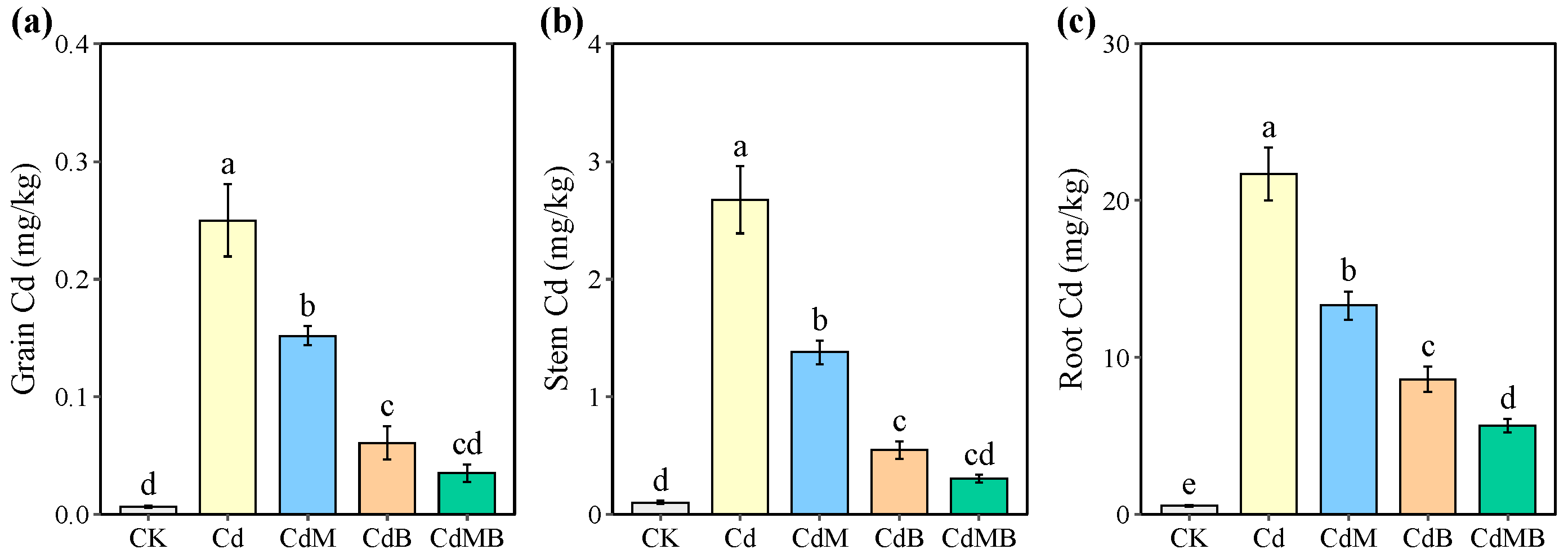
Figure 1. Effects of biochar, microbial agent, and their combination on the Cd content of rice (a) grain, (b) stem, and (c) root. Different letters in the figures indicate significant differences between treatments (p < 0.05, Duncan test).
Agronomy 16 00938 g001
Figure 2. Effects of biochar, microbial agent, and their combination on the (ac) transfer coefficient and (df) bioaccumulation factor. Different letters in the figures indicate significant differences between treatments (p < 0.05, Duncan test). TF: transfer coefficient; BCF: bioaccumulation factor.
Agronomy 16 00938 g002
Figure 3. Effects of biochar, microbial agent and their combination on (a) pH, (b) EC, (c) SOC, (d) TN, (e) TP, and (f) soil Cd content of Cd-contaminated soil. Different letters in the figures indicate significant differences between treatments.
Agronomy 16 00938 g003
Figure 4. (a) Bacterial and (b) fungal correlation networks and (c) keystone taxa of the network under different treatments. Nodes represent ASVs and are colored by phylum, with gray indicating phyla grouped as “Others”. The scatter diagrams display ASV distribution based on their Zi and Pi for identifying keystone ASVs in networks.
Agronomy 16 00938 g004
Figure 5. Linear discriminant analysis effect size (LEfSe) analysis of (a) bacterial and (b) fungal taxa with significant differences in relative abundance between treatments and (c) analysis of relative abundance differences at genus level between treatments. * p < 0.05, ** p < 0.01.
Agronomy 16 00938 g005
Disclaimer/Publisher’s Note: The statements, opinions and data contained in all publications are solely those of the individual author(s) and contributor(s) and not of MDPI and/or the editor(s). MDPI and/or the editor(s) disclaim responsibility for any injury to people or property resulting from any ideas, methods, instructions or products referred to in the content.