Article

Source-Dependent Effects of Organic Fertilizer Substitution on Rice Yield, Grain Quality, and Soil Properties in a Paddy System

1
Agricultural Resources and Environmental Research Institute, Guangxi Academy of Agricultural Sciences, Nanning 530007, China
2
Guangxi Key Laboratory of Arable Land Conservation, Nanning 530007, China
*
Authors to whom correspondence should be addressed.
Agronomy 2026, 16(9), 909; https://doi.org/10.3390/agronomy16090909
Submission received: 29 March 2026 / Revised: 23 April 2026 / Accepted: 28 April 2026 / Published: 30 April 2026

Abstract

Organic fertilizer substitution is increasingly used to reduce chemical nitrogen input in rice production, but the agronomic effects may vary with fertilizer source. This study compared chemical fertilizer alone with seven organic substitution treatments based on rapeseed cake, peanut bran, mushroom residue fertilizer, cattle manure, chicken manure, goat manure, and pig manure under the same nitrogen substitution ratio. Rice yield, grain quality, post-harvest soil physicochemical properties, and integrated performance were evaluated in the 2025 final-year dataset after two consecutive years of continuous fertilization. Responses differed clearly among fertilizer sources. Chicken manure and cattle manure produced the highest grain yields, mainly through stronger effects on grains per panicle, seed-setting rate, and grain filling. Grain quality showed more selective responses: mushroom residue fertilizer resulted in the highest head rice rate, peanut bran increased chalkiness-related traits, and mushroom residue fertilizer and goat manure were associated with higher grain protein content. In contrast to the yield pattern, plant-derived fertilizers, especially rapeseed cake and mushroom residue fertilizer, showed stronger advantages in post-harvest soil improvement. Rapeseed cake produced the highest soil quality index, whereas mushroom residue fertilizer showed the most balanced overall performance across yield, grain quality, and soil variables. These results indicate that the effects of organic fertilizer substitution in rice are strongly source-dependent. Animal-derived fertilizers were more favorable for short-term yield improvement, rapeseed cake was more effective for soil fertility enhancement, and mushroom residue fertilizer provided the best overall balance among productivity, grain quality, and soil improvement.

1. Introduction

Rice is one of the most important staple crops worldwide, and maintaining high and stable rice production is essential for regional and global food security. In intensive rice-based systems, mineral fertilizers, especially nitrogen fertilizers, have played a central role in sustaining productivity. However, long-term dependence on synthetic fertilizer inputs has also generated increasing concern because excessive nitrogen use can reduce nutrient-use efficiency, intensify environmental losses, and weaken the long-term sustainability of crop production systems [1,2,3,4]. In rice-growing regions, chronic N overuse has been linked to soil acidification, soil biological imbalance, and broader deterioration of soil ecological functions, making fertilizer optimization a central issue for sustainable rice production [3,4].
To address these problems, partial substitution of chemical fertilizers with organic fertilizers has been widely proposed as a practical strategy to coordinate crop production and soil health. Compared with sole mineral fertilization, organic amendments can improve soil organic matter status, stimulate microbial diversity and functionality, and promote crop productivity [2,4,5,6]. In rice-based cropping systems, long-term combined application of organic and inorganic fertilizers can also strengthen the positive relationship between soil organic carbon storage and crop yield, indicating that soil improvement and productivity enhancement may be achieved simultaneously under suitable fertilization regimes [4,5,7,8].
In paddy fields, the agronomic value of organic fertilizer substitution is particularly important but also more complex than in upland systems. Because paddy soils differ markedly in redox status, nutrient transformation, and carbon turnover, the effects of organic substitution are often expressed not only in yield but also in grain quality, nutrient dynamics, microbial regulation, and environmental outcomes [1,4,8,9]. Recent studies have shown that partial substitution with organic fertilizers in rice systems can improve grain yield, nutrient use efficiency, and in some cases quality-related traits, while also altering greenhouse gas emission patterns and soil microbial processes [1,8,9,10]. Therefore, the effects of organic substitution in paddy soils should be evaluated within an integrated framework that considers crop performance and soil fertility together, rather than focusing on yield alone.
Another issue is that organic fertilizers are often treated as a single management category, even though the source materials differ substantially in nutrient composition, decomposition characteristics, carbon quality, and biological effects. Animal-derived and plant-derived organic fertilizers may therefore produce distinct agronomic and ecological outcomes. Recent evidence suggests that animal-sourced organic materials can produce stronger improvements in some soil health indicators than plant-sourced materials under optimized substitution conditions, whereas plant-derived inputs may contribute more strongly to certain aspects of nutrient accumulation, microbial restructuring, and organic matter build-up [4,6,11,12]. In addition, substitution intensity interacts with source type, meaning that the same organic material may generate different crop responses depending on the proportion used to replace mineral fertilizer [4,12].
Among plant-derived organic materials, mushroom residue has attracted increasing attention because it is both a recyclable agricultural by-product and a potentially effective soil amendment. Recent work has shown that mushroom residue can improve soil physicochemical properties, reshape microbial communities, and increase rice yield, suggesting that it may function differently from more conventional plant-derived materials such as oilseed cakes or bran-based fertilizers [13]. Similar observations that residue-derived organic inputs can support simultaneous gains in rice productivity and soil biological functioning have been reported in recent paddy studies with optimized organic fertilization regimes [8,10]. Nevertheless, comparative field studies that simultaneously evaluate mushroom residue together with multiple animal-derived and plant-derived fertilizers under the same nitrogen-substitution framework remain limited.
Despite growing interest in organic fertilizer substitution, several knowledge gaps remain in rice production research. First, many previous studies have focused on comparisons between organic and inorganic fertilization, whereas fewer studies have directly compared multiple organic fertilizer sources within a unified substitution system [5,8]. Second, most reports emphasize either yield or soil properties, but much less attention has been given to the coordinated responses of yield formation, grain quality, and soil fertility [14,15]. Third, evidence from paddy systems remains less integrated than that from upland cropping systems, even though the biogeochemical behavior of paddy soils differs substantially from that of aerobic soils and frequently involves trade-offs among productivity, quality, and environmental outcomes [1,4,9,10].
Therefore, a field experiment was maintained over two consecutive years in Guangxi, China, to evaluate the effects of seven organic fertilizers representing animal-derived and plant-derived sources under a uniform regime of 30% nitrogen substitution relative to conventional chemical fertilization. The objectives of this study were to compare the effects of different organic fertilizer sources on rice yield and yield components, assess their influence on grain quality traits, and determine their effects on soil physicochemical properties in the 2025 final-year dataset after two consecutive years of continuous application. We hypothesized that the agronomic effects of organic fertilizer substitution in paddy rice would be strongly source-dependent, with animal-derived fertilizers providing greater benefits for grain yield and plant-derived fertilizers contributing more strongly to post-harvest soil improvement. We further hypothesized that mushroom residue fertilizer would show a relatively balanced performance across yield, grain quality, and soil properties.

2. Materials and Methods

2.1. Experimental Site and Initial Soil Properties

The field experiment was conducted over two consecutive years, 2024 and 2025, with one rice-growing season per year, in Longyan Village, Quanzhou County, Guilin, Guangxi, China (111.0631° E, 25.9834° N; 174.2 m above sea level). The study area has a subtropical monsoon climate, with a mean annual temperature of approximately 18.5 °C, an annual accumulated temperature above 10 °C of approximately 5100 °C·d, annual precipitation of 1560–1620 mm, and a frost-free period of 266–310 days.
Before the experiment was initiated in April 2024, topsoil (0–20 cm) samples were collected to determine the initial soil physicochemical properties. The soil contained 3.64 g kg−1 total nitrogen (TN), 0.694 g kg−1 total phosphorus (TP), 12.43 g kg−1 total potassium (TK), 226.67 mg kg−1 alkali-hydrolyzable nitrogen (AN), 20.32 mg kg−1 available phosphorus (AP), 131.11 mg kg−1 available potassium (AK), 26.41 g kg−1 organic matter (OM), and had a pH of 7.75.

2.2. Experimental Design and Fertilizer Management

The experiment was arranged in a randomized complete block design with eight fertilization treatments and four replicates. Each plot measured 40 m2. The hybrid rice cultivar ‘Wantaiyoumeizhan’ was used. Seedlings were sown in early April, transplanted in early May, and harvested in mid-August in each experimental year. Seedlings were transplanted at a spacing of 20 cm × 25 cm with three seedlings per hill. Other field management practices, including irrigation, weed control, and pest management, followed local high-yield cultivation standards and were kept consistent across all treatments throughout the experiment.
The conventional treatment received a compound fertilizer (N–P2O5–K2O = 24–10–14) at 1800 kg ha−1. Eight fertilization treatments were established: chemical fertilizer alone (CK), chicken manure, goat manure, cattle manure, pig manure, rapeseed cake, mushroom residue fertilizer, and peanut bran. The treatment-wise fertilizer inputs are summarized in Table 1.
In the organic substitution treatments, 30% of the total N input (129.6 kg N ha−1) was supplied by the respective organic fertilizer, and the remaining 70% was supplied by 1260 kg ha−1 of compound fertilizer. To compensate for the reduction in mineral P and K caused by lowering the compound-fertilizer rate, all organic-substitution treatments uniformly received 450 kg ha−1 calcium superphosphate and 126 kg ha−1 KCl. The application rate of each organic fertilizer was calculated according to its measured total N content.
All fertilizers were applied once as basal fertilizer one day before transplanting and were incorporated into the soil by rotary tillage. The same treatment arrangement and fertilization strategy were maintained in both 2024 and 2025. All yield, grain-quality, and post-harvest soil data reported in this study were collected in 2025 after two consecutive years of continuous fertilization.

2.3. Sampling and Measurements

2.3.1. Grain Yield and Yield Components

At maturity, rice plants were harvested from a 6 m2 area in the center of each plot to determine grain yield, with border rows excluded to avoid edge effects. Yield-component traits were measured following standard rice evaluation procedures [16]. Panicles were manually threshed, air-dried, and cleaned to remove impurities and unfilled grains. Grain yield was then adjusted to a standard moisture content of 14%.
Yield components were determined from 10 randomly selected hills in each plot. The measured traits included panicles per hill, panicle length (cm), grains per panicle, 1000-grain weight (g), and seed-setting rate (%). Panicle length was measured from the panicle base to the tip using a ruler. Grains per panicle were counted after manual threshing. The 1000-grain weight was determined from filled grains and expressed at 14% moisture content. Seed-setting rate was calculated as the percentage of filled grains relative to the total number of spikelets per panicle.

2.3.2. Grain Quality Analysis

Grain quality was evaluated according to the Chinese agricultural industry standard Quality of Edible Rice Varieties [17]. After harvest, grains from each plot were naturally air-dried and stored at room temperature for three months before analysis. Brown rice percentage, milled rice percentage, and head rice percentage were determined using a laboratory rice huller and milling system (TM05C, Satake Corporation, Hiroshima, Japan). Chalky grain rate and chalkiness degree were measured using a rice appearance quality analyzer (SC-E, Wanshen, Hangzhou, China). Gel consistency was determined using standard procedures for rice quality evaluation. Protein content and amylose content were measured using a near-infrared grain quality analyzer (Infratec 1241, FOSS, Hillerød, Denmark). Each sample was measured in triplicate, and the mean value was used for statistical analysis.

2.3.3. Soil Sampling and Physicochemical Analysis

After rice harvest in 2025, one composite soil sample was collected from each plot from the 0–20 cm soil layer using a five-point S-shaped sampling method. Soil samples were air-dried, gently crushed, sieved, and used for physicochemical analysis. following standard soil monitoring and analytical procedures widely adopted in China [18,19,20]. Soil total nitrogen (TN) was determined by the modified Kjeldahl method [21]. Soil total phosphorus (TP) was determined by alkali fusion followed by molybdenum antimony spectrophotometry [22]. Alkali-hydrolyzable nitrogen (AN) was measured by the alkali diffusion method [19,20]. Ammonium nitrogen (NH4+–N) and nitrate nitrogen (NO3–N) were extracted with 2 mol L−1 KCl and quantified using a continuous flow analyzer following the KCl extraction principle specified in HJ 634-2012 [23]. Available phosphorus (AP) was measured by sodium bicarbonate extraction followed by molybdenum antimony colorimetry [24]. Available potassium (AK) was determined by neutral ammonium acetate extraction followed by flame photometry [25]. Total potassium (TK) was determined after digestion by flame photometry [19,20]. Soil organic matter (OM) was determined by the potassium dichromate oxidation method [26]. Soil pH was measured potentiometrically in a 1:2.5 soil-to-water suspension [27].
In the 2025 post-harvest dataset, NO3-N was below the detection limit in all treatments. It was therefore retained in the raw dataset as a measured variable but excluded from subsequent statistical analyses and interpretation.

2.4. Statistical and Integrated Data Analyses

All agronomic, grain-quality, and soil physicochemical data analyzed in this study were collected in 2025 after two consecutive years of continuous fertilization. Treatment effects were tested by one-way analysis of variance (ANOVA), and means were separated using Tukey’s honestly significant difference (Tukey HSD) test at p < 0.05 after checking normality and homogeneity of variance.
Pearson correlation analysis was used to examine relationships among grain yield, yield components, grain-quality traits, and soil physicochemical variables. Pearson correlation coefficients and multiple linear regression coefficients were calculated using plot-level observations pooled across all 32 plots (eight treatments × four replicates; n = 32). Multiple linear regression was performed with grain yield as the dependent variable and yield-component traits as explanatory variables to identify the major predictors of yield variation.
Principal component analysis (PCA) was performed after Z-score standardization. Grain-quality PCA included brown rice percentage, milled rice percentage, head rice percentage, chalky grain rate, chalkiness degree, protein content, amylose content, and gel consistency. Soil PCA included total N (TN), total P (TP), total K (TK), alkali-hydrolyzable N (AN), NH4+-N, available P (AP), available K (AK), and organic matter (OM). Principal components with eigenvalues >1 were retained, and the first two components were used for visualization.
A standardized heatmap was generated using Z-score-transformed values of grain yield, yield components, grain-quality traits, and soil physicochemical properties. A soil quality index (SQI) was calculated from TN, TP, TK, AN, NH4+-N, AP, AK, and OM after normalization. All indicators were treated as positive indicators, and their weights were assigned according to PCA contribution rates. The SQI was calculated as the weighted sum of normalized indicator values.
A simplified piecewise structural equation model (SEM) was constructed at the treatment-mean level to evaluate the relationships among fertilizer source category, SQI, yield-formation traits, and grain yield. Standardized path coefficients and R2 values were used for interpretation. Because the analysis was based on treatment means, the SEM was used for exploratory interpretation rather than strict mechanistic inference.
Trade-off analysis integrated three standardized dimensions: yield benefit, grain-quality benefit, and soil benefit, represented by grain yield, a composite grain-quality index, and SQI, respectively. A TOPSIS-based evaluation was further used to rank treatments under three weighting scenarios: balanced (yield 0.33, quality 0.33, soil 0.34), production-oriented (yield 0.50, quality 0.20, soil 0.30), and sustainability-oriented (yield 0.20, quality 0.20, soil 0.60). All statistical analyses were conducted using SPSS Statistics 20.0 (IBM Corp., Armonk, NY, USA), and integrated analyses and figure preparation were completed using standard statistical and graphical procedures.

3. Results

3.1. Effects of Organic Fertilizer Substitution on Rice Yield and Yield Components

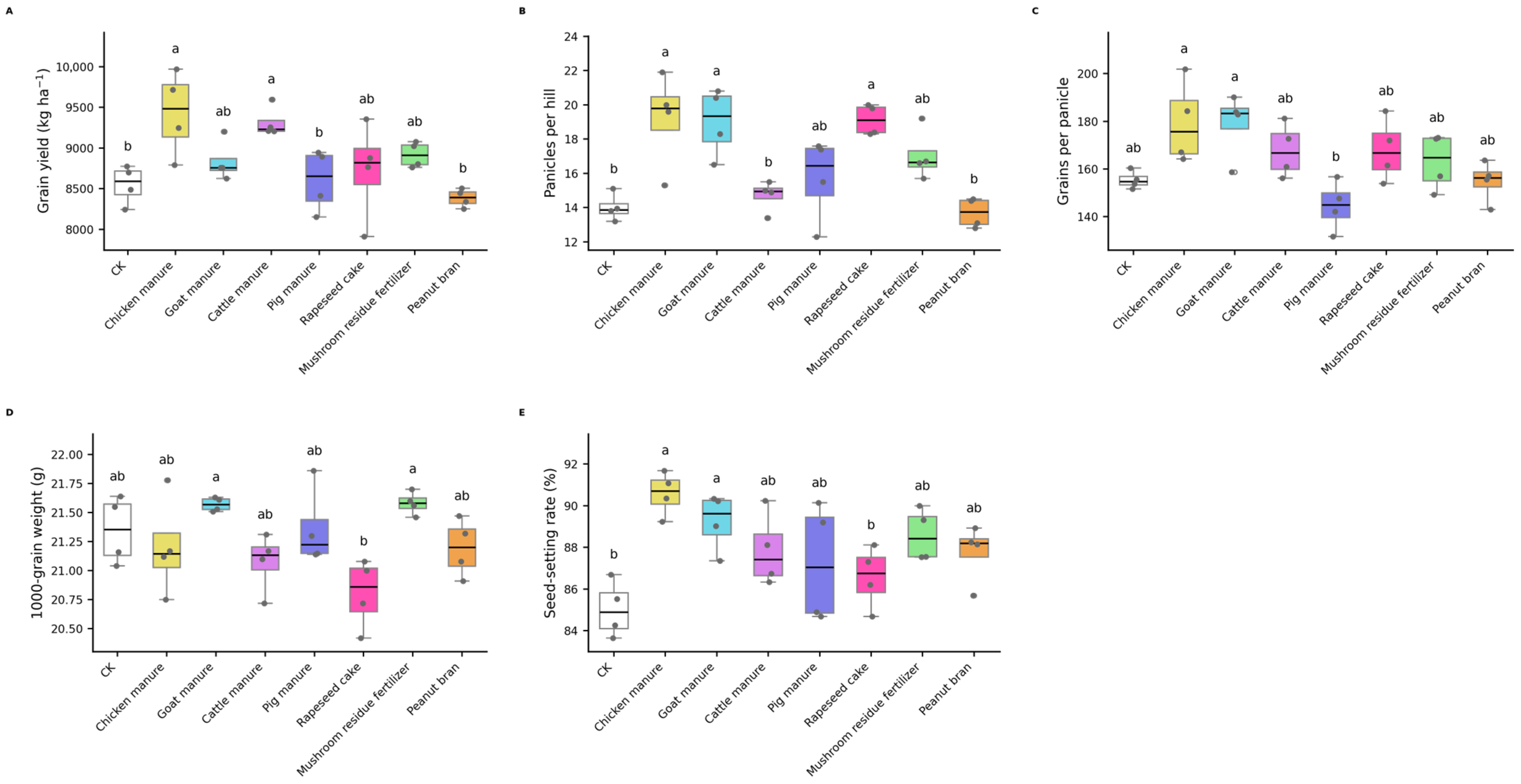
Organic fertilizer substitution significantly affected grain yield and several yield components (Figure 1). Grain yield ranged from 8384.36 to 9432.95 kg ha−1. Chicken manure showed the highest mean grain yield, followed by cattle manure, whereas peanut bran showed the lowest value. Relative to the chemical fertilizer control, mean grain yield was 10.31% higher under chicken manure and 8.96% higher under cattle manure, whereas peanut bran was 1.96% lower than the control. Significant treatment effects were also observed for panicles per hill, grains per panicle, 1000-grain weight, and seed-setting rate, whereas panicle length did not differ significantly among treatments.
Among the yield components, grains per panicle and seed-setting rate showed more pronounced responses to fertilization than panicles per hill and 1000-grain weight (Figure 1). Chicken manure combined relatively high grains per panicle with a high seed-setting rate, whereas goat manure maintained comparatively high panicle number. By contrast, panicle length did not differ significantly among treatments. These patterns suggest that treatment differences in grain yield were associated mainly with variation in sink size and reproductive success rather than with panicle elongation alone.
At the source-group level, seed-setting rate was significantly higher in the animal-derived fertilizer group than in the chemical fertilizer control, whereas grouped mean grain yield and panicle length did not differ significantly among the chemical fertilizer, animal-derived, and plant-derived groups (Figure S1). Although the animal-derived fertilizer group showed the highest mean grain yield, this advantage was expressed more clearly in seed-setting rate than in grouped mean yield at the source-category level.

3.2. Effects of Organic Fertilizer Substitution on Grain Quality

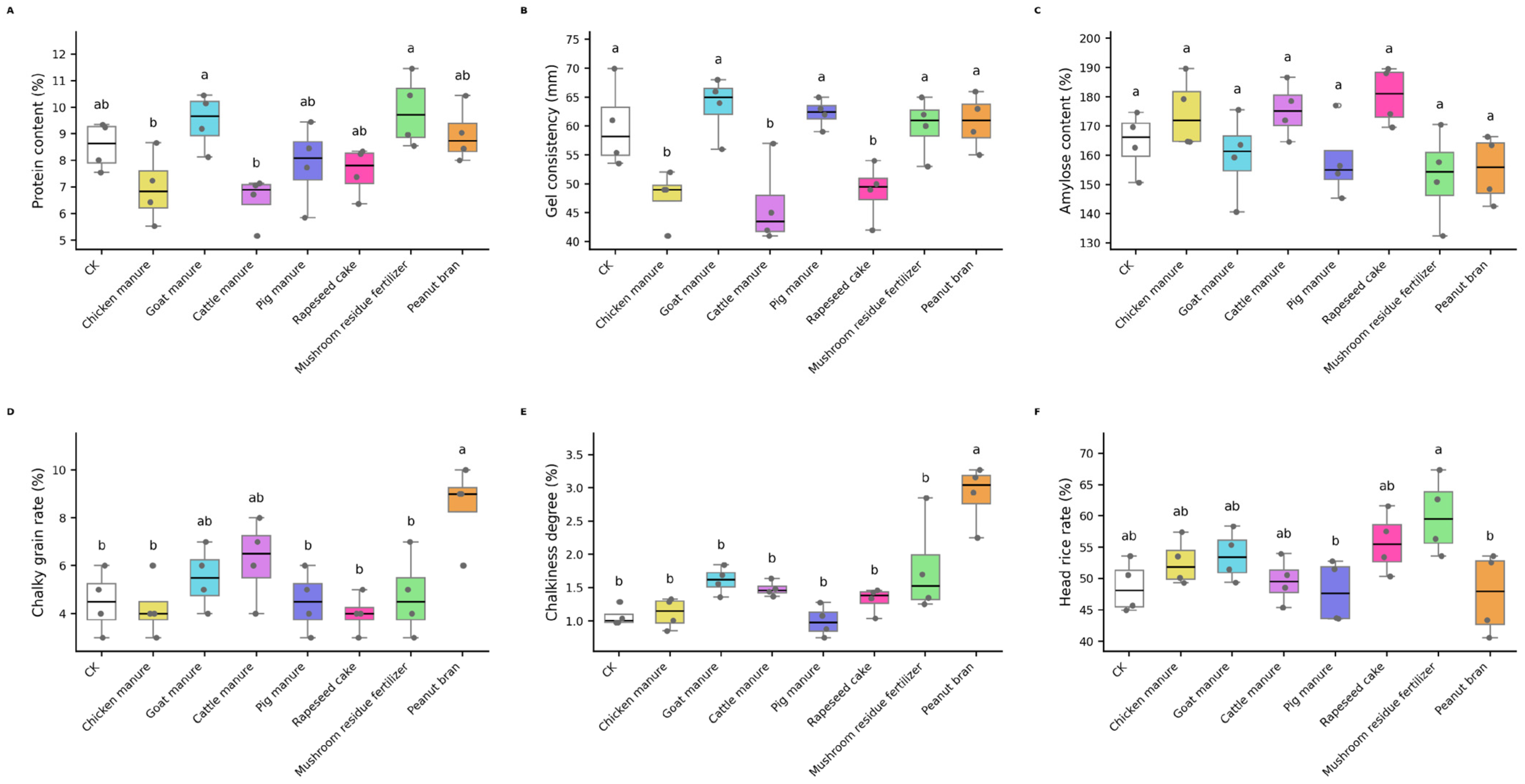
Grain quality traits responded differentially to fertilizer source (Figure 2). Brown rice percentage, milled rice percentage, and amylose content were not significantly affected by treatment, whereas head rice percentage, chalky grain rate, chalkiness degree, gel consistency, and protein content differed among treatments. Mushroom residue fertilizer showed the highest mean head rice percentage and was significantly higher than pig manure and peanut bran under Tukey’s HSD.
Treatment-level comparisons revealed clear source-specific patterns. Mushroom residue fertilizer showed the highest head rice percentage, followed by rapeseed cake, indicating a relative advantage in processing quality. In contrast, peanut bran resulted in the highest chalkiness degree and chalky grain rate, reflecting poorer appearance quality. Chicken manure and rapeseed cake maintained relatively favorable quality profiles, with lower chalkiness and acceptable head rice recovery. By comparison, amylose content remained relatively stable across treatments, suggesting that starch composition was less sensitive to fertilization strategy than appearance and processing traits.
At the source-group level, brown rice percentage and milled rice percentage showed no significant differences among fertilizer categories, whereas plant-derived fertilizers tended to exhibit higher head rice percentage but also higher chalkiness degree than the other groups (Figure S2). These results suggest that plant-derived fertilizers may confer both benefits and penalties within different grain-quality dimensions.

3.3. Soil Physicochemical Properties Were Strongly Reshaped by Fertilizer Source

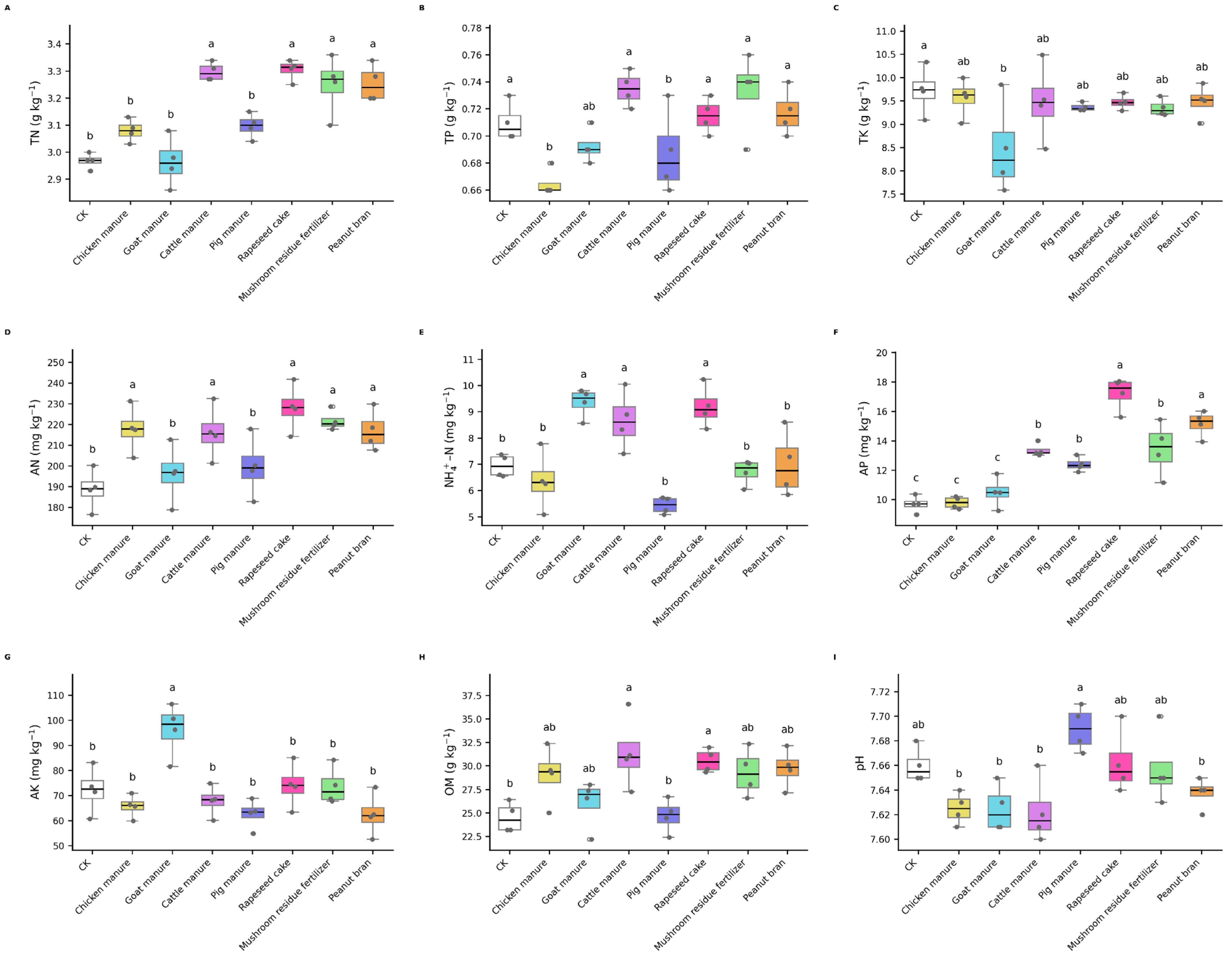
Most soil physicochemical properties were significantly influenced by fertilization treatments after two years (Figure 3). Several organic fertilizer treatments increased TN, AN, AP, and OM relative to the chemical fertilizer control, but the magnitude of response varied with fertilizer source. Rapeseed cake showed the highest mean AN and AP, whereas mushroom residue fertilizer showed relatively balanced performance across multiple soil variables.
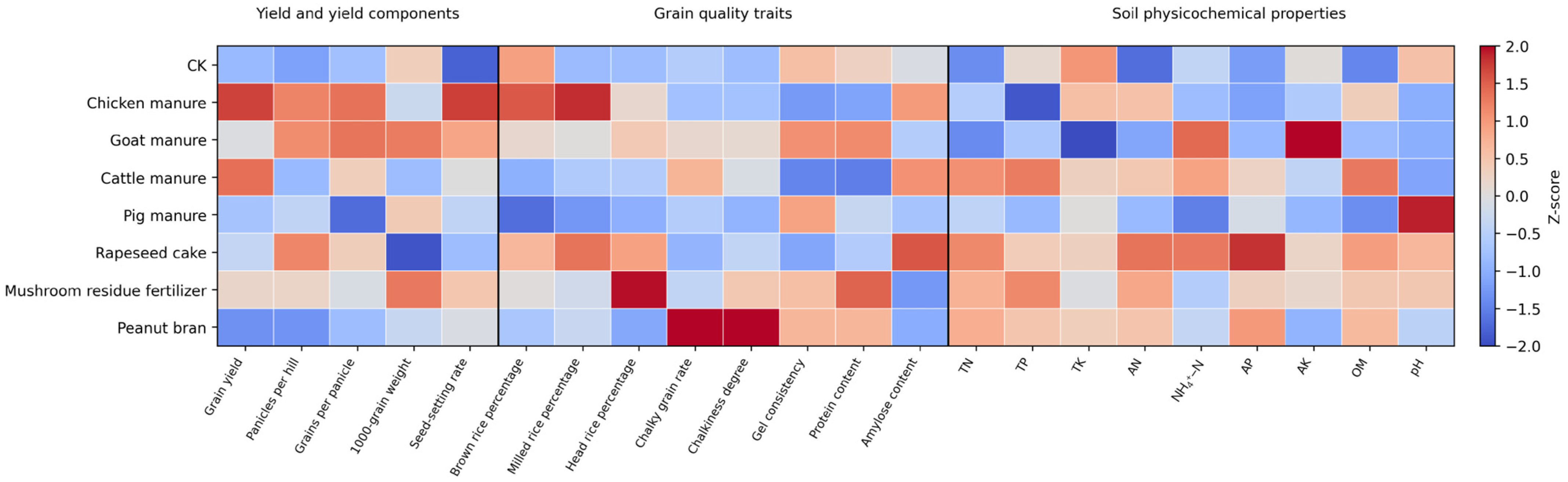
Compared with CK, organic fertilizer application generally increased TN and OM. Rapeseed cake showed the strongest increases in AN and AP, whereas goat manure had the highest AK. Mushroom residue fertilizer maintained relatively high values for TN, TP, AN, AP, AK, and OM, indicating a comparatively balanced soil improvement profile across multiple variables. These results indicate that treatment effects on soil fertility were not confined to a single nutrient dimension but involved broader changes in post-harvest soil status (Figure 4).
Grouped analysis further showed that plant-derived fertilizers had higher average TN, AN, and AP than both the control and the animal-derived group. TP was higher in the plant-derived group than in the animal-derived group, whereas OM was higher in the plant-derived group than in the control but did not differ significantly from the animal-derived group.

3.4. Relationships Among Yield, Quality, and Soil Properties

Correlation analysis revealed clear linkages among yield formation, grain quality, and soil properties (Table S1; Figure S4). Grain yield was positively correlated with grains per panicle, panicles per hill, seed-setting rate, and organic matter, highlighting the combined importance of plant traits and soil fertility. In contrast, grain yield showed negative correlations with pH, gel consistency, and protein content, suggesting trade-offs between yield and certain quality attributes.
Multiple regression analysis further showed that grains per panicle was the only significant independent predictor of grain yield among the measured yield-component traits (Table S2; Figure S4). This result indicates that yield variation under organic fertilizer substitution was driven more directly by yield-component formation than by direct soil effects, while soil improvements likely contributed indirectly through their influence on plant growth processes.

3.5. Integrated Evaluation of Soil Quality and Yield Formation Pathways

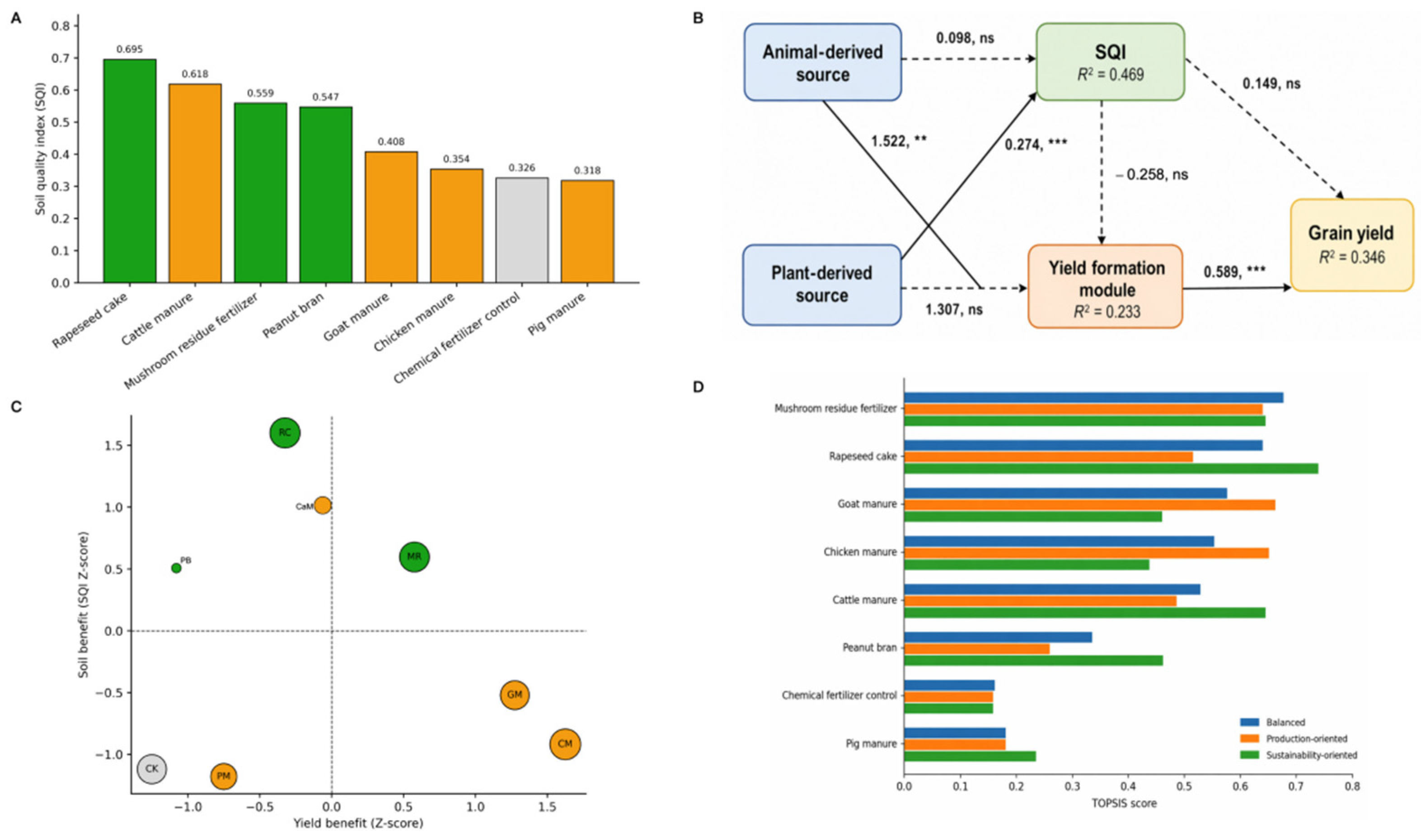
To further summarize the coordinated responses of soil quality, yield formation, and overall agronomic performance, integrated analyses including soil quality index (SQI), simplified piecewise structural equation modeling (SEM), trade-off analysis, and TOPSIS-based comprehensive ranking were performed (Figure 5; Tables S3–S5). The SQI analysis showed clear treatment differences in overall soil improvement. Rapeseed cake had the highest SQI, followed by cattle manure and mushroom residue fertilizer, whereas CK and some animal-derived fertilizers ranked lower (Figure 5A; Table S3). This pattern indicates that the soil-quality benefit of organic fertilizer substitution was strongly source-dependent and particularly pronounced for selected plant-derived materials.
The simplified piecewise SEM further clarified the response pathways among fertilizer source, soil quality, yield formation, and grain yield (Figure 5B; Table S4). Fertilizer source significantly affected both SQI and the yield-formation module. Yield formation had a strong positive effect on grain yield, whereas the direct effect of SQI on grain yield was not significant. These results suggest that soil improvement contributed to rice production mainly through indirect pathways mediated by yield-component formation rather than through a direct effect on final grain yield.
Trade-off analysis further showed that the tested fertilizers differed markedly in their balance among yield, soil, and grain-quality benefits (Figure 5C; Table S5). Some treatments achieved relatively high grain yield but only moderate soil improvement, whereas others showed stronger soil-quality enhancement but smaller yield gains. This pattern was consistent with the source-dependent differentiation observed in the preceding sections.
The TOPSIS-based comprehensive evaluation supported this interpretation and showed that the optimal fertilization strategy depended on management objectives (Figure 5D; Table S5). Under the balanced scenario, mushroom residue fertilizer ranked highest, whereas goat manure and rapeseed cake were favored under the production-oriented and sustainability-oriented scenarios, respectively. Overall, these integrated analyses indicate that the agronomic value of organic fertilizer substitution cannot be judged by yield alone, because different fertilizer sources provide distinct advantages in soil improvement, yield formation, and multi-target performance.

4. Discussion

4.1. Organic Fertilizer Source Shaped Rice Yield Mainly Through Differences in Short-Term Nutrient Supply, Sink Formation, and Grain Filling

Although all organic fertilizers were applied at the same nitrogen substitution rate, their effects on grain yield were clearly differentiated by source. Chicken manure and cattle manure produced the highest yields, whereas peanut bran showed the weakest yield performance. A likely explanation is that animal-derived fertilizers generally provide a larger readily mineralizable nutrient fraction and thus stronger short-term nutrient availability, which may better support panicle differentiation, seed setting, and final sink realization during the critical period of yield formation [4,7,28]. In the present study, the higher yield under chicken manure was accompanied by higher grains per panicle and seed-setting rate, supporting the interpretation that treatment effects were expressed mainly through sink formation and reproductive success rather than through panicle length alone.
This interpretation is consistent with previous findings from rice systems. Long-term organic fertilizer substitution has been shown to increase rice yield through concurrent improvements in soil properties and bacterial regulation [5]. A meta-analysis of Chinese paddy fields further showed that manure substitution generally increased rice yield together with soil labile nitrogen pools, highlighting the importance of biologically available N in determining crop response under flooded rice conditions [7]. In addition, reduced inorganic fertilizer combined with plant-based organic fertilizer has been reported to sustain rice production in tropical rice systems, although the agronomic effect depends on the characteristics of the organic material and the synchrony between nutrient release and crop demand [28]. Recent paddy studies have further shown that optimized organic fertilization can increase rice yield, soil quality index, and ecological multifunctionality by strengthening soil microbial diversity and carbon–nitrogen cycling [8,10]. Global synthesis also indicates that organic substitution improves crop productivity but may simultaneously involve trade-offs in soil C and N loss pathways, underscoring the importance of source selection and substitution intensity [4]. Therefore, the superior yield performance of chicken manure and cattle manure in the present study was likely associated with a more favorable short-term nutrient supply pattern during reproductive growth.
By contrast, plant-derived materials often contain a greater proportion of structurally complex organic compounds and may therefore release nutrients more slowly under field conditions. Under such circumstances, stronger post-harvest nutrient accumulation in soil does not necessarily indicate a stronger contribution to current-season grain production, but may instead reflect weaker temporal matching between nutrient release and crop uptake [4,10]. This helps explain why some plant-derived fertilizers showed clearer benefits in post-harvest soil improvement than in immediate yield promotion. Because plant height, chlorophyll status, biomass accumulation, and plant nutrient uptake were not measured in the present study, these mechanisms are discussed as literature-supported interpretations rather than directly demonstrated processes.

4.2. Grain Quality Responded More Selectively than Yield, Revealing Source-Specific Trade-Offs Among Milling, Appearance, and Nutritional Traits

Compared with grain yield, rice quality traits showed a more selective and less uniform response to fertilization source. Mushroom residue fertilizer was associated with the highest head rice percentage, whereas peanut bran increased chalkiness-related traits and reduced appearance quality. In contrast, protein content was highest under mushroom residue fertilizer and goat manure, indicating that improvements in nutritional quality did not necessarily coincide with improvements in milling or appearance quality. These patterns suggest that grain quality should not be treated as a single integrated endpoint, because different quality dimensions may respond differently to nutrient supply and grain-filling conditions [15,29,30].
Milling quality appeared to benefit more from treatments that maintained more stable grain filling and grain integrity, whereas appearance quality was more sensitive to imbalances that may have affected endosperm development. Previous studies have shown that nitrogen management can markedly influence rice chalkiness, storage-product accumulation, and grain-filling behavior, indicating that quality responses under fertilization are closely related to assimilate deposition and source–sink balance during grain filling [14,29,30,31]. Under the present conditions, the poor chalkiness performance under peanut bran may therefore reflect less synchronized nutrient release during grain filling, whereas the higher head rice percentage under mushroom residue fertilizer suggests a more favorable grain-filling process and better structural uniformity of milled grains. Recent work has also shown that appropriate nutrient management can simultaneously improve head rice recovery, reduce chalkiness, and increase nitrogen-use efficiency, although the specific responses depend on timing, nutrient form, and the physiological status of the crop during grain filling [14,15].
The relatively balanced quality performance under mushroom residue fertilizer is also consistent with previous evidence that mushroom residue returned to rice systems can improve soil physicochemical properties and support rice productivity [13]. Moreover, recent studies have shown that fertilizer-driven changes in nitrogen uptake, protein accumulation, and grain-filling environment can shift milling quality, appearance quality, and nutritional quality in different directions, reinforcing the need to evaluate rice quality as a multidimensional trait rather than a single endpoint [15,31,32]. From a practical perspective, these results indicate that the choice of organic fertilizer source should depend on the production objective. If the priority is grain yield, animal-derived fertilizers may be more advantageous, whereas mushroom residue fertilizer or goat manure may be preferable when higher grain protein is targeted.

4.3. Post-Harvest Soil Improvement Depended More Strongly on Fertilizer Origin than on Current-Season Yield Response

Unlike the yield results, post-harvest soil properties showed clearer advantages under selected plant-derived fertilizers, especially rapeseed cake and mushroom residue fertilizer. These treatments generally maintained higher values for total N, total P, alkali-hydrolyzable N, available P, organic matter, and soil quality index than the chemical fertilizer control and some animal-derived treatments. This contrast between yield response and post-harvest soil nutrient status suggests that immediate crop performance and residual soil fertility did not necessarily move in parallel across fertilizer sources, a pattern also observed in recent field and meta-analytical assessments of organic substitution [4,11,12].
One likely explanation is that some plant-derived fertilizers released nutrients more gradually and contributed more strongly to nutrient retention and residual soil fertility than to immediate crop uptake within the same season. Under this pattern, higher post-harvest nutrient levels may partly indicate that nutrient release was not fully synchronized with crop demand during the period most critical for yield formation. In contrast, the stronger yield performance of chicken manure and cattle manure suggests that a greater proportion of their nutrients became available during active growth and grain filling, thereby contributing more effectively to current-season production. This interpretation is consistent with evidence that organic substitution alters soil labile N pools, improves soil quality indices, and modifies microbial pathways linked to nutrient turnover and crop productivity [4,5,6,7,8].
The mushroom residue treatment deserves particular attention. Previous work on Auricularia auricula residue in rice systems showed that mushroom residue return improved soil physicochemical properties, reshaped microbial communities, and increased rice yield [13]. This is consistent with the relatively balanced performance observed here, where mushroom residue fertilizer did not always rank first for individual variables but performed relatively well across yield, grain quality, and soil indicators. Similar results from recent paddy studies indicate that recycling-based organic inputs can simultaneously strengthen soil biological functioning, nutrient cycling, and agronomic performance when the substitution regime is appropriately designed [8,10]. Therefore, the agronomic value of this treatment may lie less in maximizing a single target trait and more in providing a comparatively balanced outcome across production and soil improvement.
Taken together, these results indicate that higher residual soil nutrient levels under plant-derived fertilizers should not be interpreted simply as stronger agronomic effectiveness for current-season yield. Rather, they may reflect source-dependent differences in decomposition rate, nutrient mineralization, and the temporal coupling between nutrient release and crop uptake [4,11,12]. This distinction helps explain why some plant-derived fertilizers improved post-harvest soil status more strongly than grain yield under the present experimental conditions.

4.4. Agronomic Choice Should Be Based on Target-Oriented Trade-Offs Rather than a Simple Plant-Versus-Animal Dichotomy

Taken together, the results do not support ranking all organic fertilizers along a single better-to-worse gradient. Instead, they point to a target-dependent pattern of agronomic performance. Chicken manure and cattle manure were more favorable for maximizing grain yield, rapeseed cake was more effective for strengthening post-harvest soil fertility, and mushroom residue fertilizer showed the most balanced overall performance when yield, quality, and soil indicators were considered together. Such multi-target divergence is consistent with recent syntheses showing that organic substitution can improve crop productivity and soil biofertility while still involving trade-offs among nutrient retention, greenhouse-gas emissions, and different components of crop quality [1,4].
This integrated pattern is more informative than a simple comparison between plant-derived and animal-derived groups. Source category explained part of the variation, but individual fertilizer types still differed substantially within each category. For example, rapeseed cake and peanut bran are both plant-derived fertilizers, yet they produced markedly different responses in grain quality and soil indicators. Likewise, chicken manure and goat manure did not perform identically, even though both belong to the animal-derived group. These within-group differences indicate that the agronomic value of an organic fertilizer depends on its specific material properties and nutrient-release behavior, not only on its broad origin. This interpretation is consistent with previous studies showing that the effects of organic substitution depend strongly on material type, mineralization pattern, substitution intensity, and the balance between immediate nutrient supply and cumulative soil improvement, rather than on the simple fact of being organic instead of chemical fertilizer [6,7,20].
From a management perspective, the present results support a more differentiated substitution strategy in paddy systems. When the goal is short-term yield improvement, animal-derived fertilizers may be preferred. When the goal is soil fertility enhancement and long-term field sustainability, plant-derived fertilizers—especially rapeseed cake—may be more suitable. When multiple goals must be balanced simultaneously, mushroom residue fertilizer appears to be the most practical compromise under the conditions of this study. At the same time, these conclusions should be interpreted within the scope of the experiment. The results were obtained under one substitution ratio, one site, and one final evaluation season after two consecutive years of fertilization. Broader validation across environments, substitution rates, and longer experimental durations will be necessary before extending these source-specific recommendations to other rice-growing systems [4,8,10].

5. Conclusions

After two consecutive years of continuous fertilization, partial substitution of mineral nitrogen with different organic fertilizers significantly altered rice yield, grain quality, and post-harvest soil physicochemical properties. The responses varied with fertilizer source. Chicken manure showed the highest mean grain yield, whereas rapeseed cake and mushroom residue fertilizer contributed more strongly to post-harvest soil improvement. Grain-quality traits responded less uniformly than yield and soil variables, indicating source-specific trade-offs among production, quality, and soil fertility. Mushroom residue fertilizer showed relatively balanced overall performance. Fertilizer source should therefore be considered an important factor when evaluating organic fertilizer substitution strategies in paddy rice.

Supplementary Materials

The following supporting information can be downloaded at: https://www.mdpi.com/article/10.3390/agronomy16090909/s1, Figure S1: Source-group comparison of grain yield and yield components among chemical fertilizer, animal-derived fertilizers, and plant-derived fertilizers. Figure S2: Source-group comparison of grain quality traits among chemical fertilizer, animal-derived fertilizers, and plant-derived fertilizers. Figure S3: Grouped comparison of soil physicochemical properties among chemical fertilizer, animal-derived fertilizers, and plant-derived fertilizers after two years of application. Figure S4: Correlation and multiple regression analyses of grain yield, yield components, grain quality traits, and soil physicochemical properties under different fertilization treatments. Table S1: Correlation coefficients among grain yield, yield components, grain quality traits, and soil physicochemical properties; Table S2: Multiple regression analysis of grain yield against yield-component traits; Table S3: Soil quality index construction, indicator weights, and treatment-level soil quality index values; Table S4: Standardized path coefficients and model statistics of the simplified piecewise structural equation model; Table S5: Key statistics for trade-off analysis and TOPSIS-based comprehensive ranking under different weighting scenarios.

Author Contributions

C.Z. contributed to conceptualization, investigation, data curation, formal analysis, visualization, and writing of the original draft. J.C. contributed to investigation, methodology, and data curation. J.H. contributed to investigation and resources. F.L. contributed to investigation and data curation. Q.L. contributed to investigation and validation. T.S. contributed to investigation and resources. L.S. contributed to investigation and resources. H.O. contributed to supervision, methodology, writing—review and editing, and funding acquisition. T.H. contributed to conceptualization, supervision, project administration, writing—review and editing, and funding acquisition. All authors have read and agreed to the published version of the manuscript.

Funding

This work was supported by the National Key Research and Development Program of China (2023YFD1902805), the Guangxi Key R&D Program (guikenong AB2509520001), the earmarked fund for China Agriculture Research System Guangxi Innovation Team (nycytxgxcxtd-2026-01), the Science and Technology Vanguard Team Program (guinongkemeng 202513), and the Basic Research Business Special Program of Guangxi Academy of Agricultural Sciences (guinongke 2026YT146).

Data Availability Statement

The original contributions presented in this study are included in the article/Supplementary Material. Further inquiries can be directed to the corresponding authors.

Acknowledgments

The authors thank the staff of the experimental field for assistance with field management and sampling, and all colleagues who contributed to grain quality determination and soil analysis.

Conflicts of Interest

The authors declare that they have no known competing financial interests or personal relation-ships that could have appeared to influence the work reported in this paper.

References

  1. Peng, L.; Deng, S.; Yi, W.; Wu, Y.; Zhang, Y.; Yao, X.; Xing, P.; Cui, B.; Tang, X. Partial organic fertilizer substitution and water-saving irrigation can reduce greenhouse gas emissions in aromatic rice paddy by regulating soil microorganisms while increasing yield and aroma. J. Integr. Agric. 2026, 25, 273–289. [Google Scholar] [CrossRef]
  2. Shu, X.; He, J.; Zhou, Z.; Xia, L.; Hu, Y.; Zhang, Y.; Zhang, Y.; Luo, Y.; Chu, H.; Liu, W.; et al. Organic amendments enhance soil microbial diversity, microbial functionality and crop yields: A meta-analysis. Sci. Total Environ. 2022, 829, 154627. [Google Scholar] [CrossRef] [PubMed]
  3. Zhang, L.; Zhao, Z.; Jiang, B.; Baoyin, B.; Cui, Z.; Wang, H.; Li, Q.; Cui, J. Effects of long-term application of nitrogen fertilizer on soil acidification and biological properties in China: A meta-analysis. Microorganisms 2024, 12, 1683. [Google Scholar] [CrossRef] [PubMed]
  4. Wang, S.; Sun, N.; Zhang, S.; Longdoz, B.; Wellens, J.; Meersmans, J.; Colinet, G.; Wu, L.; Xu, M. Soil organic carbon storage impacts on crop yields in rice-based cropping systems under different long-term fertilisation. Eur. J. Agron. 2024, 160, 127357. [Google Scholar] [CrossRef]
  5. Liu, J.; Shu, A.; Song, W.; Shi, W.; Li, M.; Zhang, W.; Li, Z.; Liu, G.; Yuan, F.; Zhang, S.; et al. Long-term organic fertilizer substitution increases rice yield by improving soil properties and regulating soil bacteria. Geoderma 2021, 404, 115287. [Google Scholar] [CrossRef]
  6. Yuan, M.; Xing, W.; Ning, Q.; Yang, S.; Guo, A.; Wang, Q.; Lou, Y. Impacts of organic fertilizer substitution on soil microbiota: A meta-analysis. Soil Ecol. Lett. 2026, 8, 260394. [Google Scholar] [CrossRef]
  7. Hou, Q.; Ni, Y.; Huang, S.; Zuo, T.; Wang, J.; Ni, W. Effects of substituting chemical fertilizers with manure on rice yield and soil labile nitrogen in paddy fields of China: A meta-analysis. Pedosphere 2023, 33, 172–184. [Google Scholar] [CrossRef]
  8. Cao, X.; Liu, L.; Ma, Q.; Lu, R.; Kong, H.; Kong, Y.; Zhu, L.; Zhu, C.; Tian, W.; Jin, Q.; et al. Optimum organic fertilization enhances rice productivity and ecological multifunctionality via regulating soil microbial diversity in a double rice cropping system. Field Crops Res. 2024, 318, 109569. [Google Scholar] [CrossRef]
  9. Meng, X.; Liu, S.; Zou, J.; Osborne, B. The effect of substituting inorganic fertilizer with manure on soil N2O and CH4 emissions and crop yields: A global meta-analysis. Field Crops Res. 2025, 329, 109831. [Google Scholar] [CrossRef]
  10. Xia, Y.; Gao, P.; Lei, W.; Gao, J.; Luo, Y.; Peng, F.; Mou, T.; Zhao, Z.; Zhang, K.; Guggenberger, G.; et al. Covering green manure increases rice yields via improving nitrogen cycling between soil and crops in paddy fields. Agric. Ecosyst. Environ. 2025, 383, 109517. [Google Scholar] [CrossRef]
  11. Shi, C.; Zhang, Q.; Yu, B. Higher improvement in soil health by animal-sourced than plant-sourced organic materials through optimized substitution. Agric. Ecosyst. Environ. 2024, 363, 108875. [Google Scholar] [CrossRef]
  12. Zhou, C.; Zhang, R.; Zhu, C.; Li, X.; Wang, C.; Yu, H.; Zhang, J. Manure substitution for chemical nitrogen enhances soil quality without compromising maize yield: A short-term field experiment in Northeast China. Front. Plant Sci. 2025, 16, 1694608. [Google Scholar] [CrossRef] [PubMed]
  13. Yuan, W.; Zong, T.; Yu, B.; Xin, Y.; Lu, J.; Qiu, Q.; Ma, L.; Song, J. Effects of Auricularia auricula residue on soil physicochemical properties, microbial community composition, diversity, and rice yield. Agronomy 2025, 15, 2313. [Google Scholar] [CrossRef]
  14. Zhang, H.; Mi, K.; Chen, J.; Cui, P.; Lu, H.; Zhang, H.; Yang, Y. Enhancing rice yield, quality and nitrogen utilization through side-deep placement of nitrogen and zinc fertilizers. Field Crops Res. 2025, 333, 110096. [Google Scholar] [CrossRef]
  15. Liu, X.; Yang, Y.; Wu, B.; Lv, C.; Wei, H.; Gao, P.; Zhang, H.; Dai, Q.; Chen, Y. Effects of nitrogen application on crop production and nitrogen use in rice–wheat rotation. Agronomy 2025, 15, 1047. [Google Scholar] [CrossRef]
  16. IRRI (International Rice Research Institute). Standard Evaluation System for Rice, 5th ed.; IRRI: Los Baños, Philippines, 2013. [Google Scholar]
  17. NY/T 593-2021; Quality of Edible Rice Varieties. Ministry of Agriculture and Rural Affairs of the People’s Republic of China: Beijing, China, 2021. (In Chinese)
  18. HJ/T 166-2004; Technical Specification for Soil Environmental Monitoring. Ministry of Ecology and Environment of the People’s Republic of China: Beijing, China, 2004.
  19. Bao, S.D. Soil and Agricultural Chemistry Analysis, 3rd ed.; China Agriculture Press: Beijing, China, 2000. (In Chinese) [Google Scholar]
  20. Lu, R.K. Analytical Methods of Soil and Agro-Chemistry; China Agricultural Science and Technology Press: Beijing, China, 2000. (In Chinese) [Google Scholar]
  21. HJ 717-2014; Soil Quality—Determination of Total Nitrogen—Modified Kjeldahl Method. Ministry of Ecology and Environment of the People’s Republic of China: Beijing, China, 2014. (In Chinese)
  22. HJ 632-2011; Soil—Determination of Total Phosphorus by Alkali Fusion–Mo-Sb Anti Spectrophotometric Method. Ministry of Ecology and Environment of the People’s Republic of China: Beijing, China, 2011. (In Chinese)
  23. HJ 634-2012; Soil—Determination of Ammonium, Nitrite and Nitrate by Extraction with Potassium Chloride Solution—Spectrophotometric Methods. Ministry of Ecology and Environment of the People’s Republic of China: Beijing, China, 2012. (In Chinese)
  24. HJ 704-2014; Soil Quality—Determination of Available Phosphorus—Sodium Hydrogen Carbonate Solution–Mo-Sb Anti Spectrophotometric Method. Ministry of Ecology and Environment of the People’s Republic of China: Beijing, China, 2014. (In Chinese)
  25. NY/T 889-2004; Determination of Available and Slowly Available Potassium in Soil. Ministry of Agriculture and Rural Affairs of the People’s Republic of China: Beijing, China, 2004. (In Chinese)
  26. NY/T 1121.6-2006; Soil Testing—Part 6: Determination of Soil Organic Matter. Ministry of Agriculture and Rural Affairs of the People’s Republic of China: Beijing, China, 2006. (In Chinese)
  27. NY/T 1377-2007; Determination of pH in Soil. Ministry of Agriculture and Rural Affairs of the People’s Republic of China: Beijing, China, 2007. (In Chinese)
  28. Zhao, T.; He, A.; Khan, M.N.; Yin, Q.; Song, S.; Nie, L. Coupling of reduced inorganic fertilizer with plant-based organic fertilizer as a promising fertilizer management strategy for colored rice in tropical regions. J. Integr. Agric. 2024, 23, 93–107. [Google Scholar] [CrossRef]
  29. Gu, J.; Chen, J.; Chen, L.; Wang, Z.; Zhang, H.; Yang, J. Grain quality changes and responses to nitrogen fertilizer of japonica rice cultivars released in the Yangtze River Basin from the 1950s to 2000s. Crop J. 2015, 3, 285–297. [Google Scholar] [CrossRef]
  30. Guo, C.; Zhu, X.; Liu, X.; Tian, S.; Yao, D.; Wang, H.; Tang, Q.; Zhang, Y.; Liu, Y.; Wang, H. Grain chalkiness is decreased by balancing the synthesis of protein and starch in rice under nitrogen fertilization. Foods 2024, 13, 855. [Google Scholar] [CrossRef] [PubMed]
  31. Nishida, K.; Matsumoto, Y.; Tsukaguchi, T.; Iwasaki, S.; Yoshida, S. Water management during the grain-filling period affects rice grain quality due to changes in both the temperature and nitrogen content of paddy water. Field Crops Res. 2025, 333, 110038. [Google Scholar] [CrossRef]
  32. Huang, S.; Wang, H.; Tan, X.; Jiang, H.; Pan, X.; Zeng, Y.; Huang, G. Physiological mechanisms for increased grain protein content under experimental warming conditions in double rice cropping system. Crop Environ. 2025, 4, 217–229. [Google Scholar] [CrossRef]
Figure 1. Effects of different organic fertilizer treatments on rice yield and yield-related traits. Panels show (A) grain yield, (B) panicles per hill, (C) grains per panicle, (D) 1000-grain weight, and (E) seed-setting rate under different fertilization treatments. Boxes indicate the interquartile range, the horizontal line within each box indicates the median, whiskers indicate the data range, and circles indicate individual observations. Different lowercase letters above the boxes indicate significant differences among treatments according to Tukey’s HSD test at p < 0.05. CK indicates the chemical fertilizer control.
Agronomy 16 00909 g001
Figure 2. Effects of different organic fertilizer treatments on rice grain quality traits. Panels show (A) protein content, (B) gel consistency, (C) amylose content, (D) chalky grain rate, (E) chalkiness degree, and (F) head rice rate under different fertilization treatments. Boxes indicate the interquartile range, the horizontal line within each box indicates the median, whiskers indicate the data range, and circles indicate individual observations. Different lowercase letters above the boxes indicate significant differences among treatments according to Tukey’s HSD test at p < 0.05. CK indicates the chemical fertilizer control.
Agronomy 16 00909 g002
Figure 3. Effects of different organic fertilizer treatments on soil physicochemical properties. (A) total N (TN), (B) total P (TP), (C) total K (TK), (D) alkali-hydrolyzable N (AN), (E) NH4+–N, (F) available P (AP), (G) available K (AK), (H) organic matter (OM), and (I) pH under different fertilization treatments. Boxes indicate the interquartile range, the horizontal line within each box indicates the median, whiskers indicate the data range, and circles indicate individual observations. Different lowercase letters above the boxes indicate significant differences among treatments according to Tukey’s HSD test at p < 0.05. CK, chemical fertilizer control.
Agronomy 16 00909 g003
Figure 4. Integrated heatmap of rice yield, yield components, grain quality traits, and soil physicochemical properties under different fertilization treatments. Values were standardized using Z-scores based on treatment means before visualization. The variables included grain yield, panicles per hill, grains per panicle, 1000-grain weight, seed-setting rate, brown rice percentage, milled rice percentage, head rice percentage, chalky grain rate, chalkiness degree, gel consistency, protein content, amylose content, TN (total nitrogen), TP (total phosphorus), TK (total potassium), AN (alkali-hydrolyzable nitrogen), NH4+–N (ammonium nitrogen), AP (available phosphorus), AK (available potassium), OM (organic matter), and pH. CK indicates the chemical fertilizer control.
Agronomy 16 00909 g004
Figure 5. Integrated evaluation of different fertilization treatments based on soil quality, response patterns, trade-off relationships, and comprehensive ranking. (A) Soil quality index (SQI) calculated from major soil physicochemical variables, including TN, TP, TK, AN, NH4+–N, AP, AK, and OM. (B) Simplified piecewise structural equation model showing the relationships among fertilizer source category, SQI, yield-formation module, and grain yield; standardized path coefficients are shown along the arrows, solid arrows indicate significant paths, dashed arrows indicate non-significant paths, and R2 values are shown for endogenous variables. (C) Trade-off analysis of fertilization treatments across yield, grain quality, and soil dimensions, in which the horizontal axis represents the standardized yield benefit, the vertical axis represents the standardized soil benefit based on SQI, and bubble size represents the standardized grain-quality benefit. (D) TOPSIS-based comprehensive ranking of different fertilization treatments under balanced, production-oriented, and sustainability-oriented scenarios. CK indicates the chemical fertilizer control. In panels A and C, green, orange, and gray indicate plant-derived fertilizers, animal-derived fertilizers, and the chemical fertilizer control, respectively. In panel C, RC, MR, GM, CaM, CM, PM, PB, and CK denote rapeseed cake, mushroom residue fertilizer, goat manure, cattle manure, chicken manure, pig manure, peanut bran, and the chemical fertilizer control, respectively. ** and ***, indicate statistical significance at p < 0.01 and p < 0.001, respectively, whereas ‘ns’ indicates no significant effect.
Agronomy 16 00909 g005
Table 1. Nutrient contents and actual application rates of different organic fertilizers under 30% nitrogen substitution.
TreatmentOrganic SourceOrganic N (%)Organic Fertilizer Rate (kg ha−1)Compound Fertilizer 24-10-14 (kg ha−1)Calcium Superphosphate (kg ha−1)KCl (kg ha−1)Total N Input (kg ha−1)
CKChemical fertilizer control01800.0000432.00
T1Chicken manure1.767363.641260.00450.00126.00432.00
T2Goat manure1.1910,890.761260.00450.00126.00432.00
T3Cattle manure1.847043.481260.00450.00126.00432.00
T4Pig manure1.677760.481260.00450.00126.00432.00
T5Rapeseed cake2.515163.351260.00450.00126.00432.00
T6Mushroom residue fertilizer1.757405.711260.00450.00126.00432.00
T7Peanut bran2.156027.911260.00450.00126.00432.00
Notes: In T1–T7, 70% of the compound-fertilizer rate (1260 kg ha−1) supplied 302.4 kg N ha−1, and the remaining 129.6 kg N ha−1 was supplied by the respective organic fertilizer. To compensate for the reduction in mineral P and K caused by decreasing the compound-fertilizer rate from 1800 to 1260 kg ha−1, all organic-substitution treatments uniformly received 450 kg ha−1 calcium superphosphate and 126 kg ha−1 KCl. Phosphorus and potassium contributed by the organic fertilizers themselves were not normalized across treatments and therefore remained part of the source-dependent nutrient-input differences among treatments.
Disclaimer/Publisher’s Note: The statements, opinions and data contained in all publications are solely those of the individual author(s) and contributor(s) and not of MDPI and/or the editor(s). MDPI and/or the editor(s) disclaim responsibility for any injury to people or property resulting from any ideas, methods, instructions or products referred to in the content.