Article

Geochemical and Ecological Assessment of Heavy Metal Contamination in a High-Cd Agricultural Ecosystem of Guangxi Karst Regions, China: Emphasis on Cd-Zn and Cd-Se Interactions


1
College of Agriculture and Food Engineering, Baise University, Baise 533000, China
2
College of Environment & Safety Engineering, Fuzhou University, Fuzhou 350108, China
3
School of Science and Technology, Hong Kong Metropolitan University, Hong Kong 999077, China
4
Department of Chemistry, City University of Hong Kong, Hong Kong 999077, China
5
State Key of Marine Environment Health, City University of Hong Kong, Hong Kong 999077, China
6
Shenzhen Research Institute, Hong Kong Metropolitan University, Shenzhen 518031, China
*
Authors to whom correspondence should be addressed.
These authors contributed equally to this work.
Agronomy 2026, 16(9), 908; https://doi.org/10.3390/agronomy16090908
Submission received: 1 April 2026 / Revised: 23 April 2026 / Accepted: 28 April 2026 / Published: 30 April 2026
(This article belongs to the Special Issue Heavy Metal Pollution and Prevention in Agricultural Soils)

Abstract

Severe heavy metal contamination affects the karst landscapes of Guangxi Zhuang Autonomous Region, China, which are highly polluted and complex. However, integrated assessments of heavy metal sources, distribution, ecological risks, and speciation in karst agricultural soils remain limited. Additionally, there is a gap regarding the interactions between cadmium (Cd), zinc (Zn), and selenium (Se) in natural rice fields. This study employed the pollution load index (PLI), ecological risk index (RI), and Positive Matrix Factorization (PMF) models to evaluate the sources and characteristics of heavy metal contamination in farmland soils. The results showed significant pollution in agricultural soils of Guangxi karst due to Cd, chromium (Cr), copper (Cu), and nickel (Ni). Among these, Cd poses the highest ecological risk. Heavy metal accumulation in the surface soil far exceeds that in deeper layers, and the main sources of Cd were contributed from soil parent material and agricultural activities. Speciation analysis revealed the high bioavailability of Cd, while Zn and Se existed in more stable forms. Despite elevated soil Cd levels, rice grains remained within the safety limits. Using transmission electron microscopy (TEM), Cd was primarily detected in the cell walls of rice stems and husks, which was attributed to Zn’s competitive uptake, reducing Cd absorption and Se forming complexes with Cd to enhance its fixation. Statistical correlations revealed positive associations between Cd in soil and rice. Cd also demonstrated a positive correlation with Se, but a negative correlation with Zn, suggesting a synergistic mechanism between Zn and Se that acts to mitigate the absorption of Cd. This study provides practical guidance for managing farmland soil heavy metal contamination and protecting agricultural soil resources in the karst areas.

1. Introduction

Over the last 30 years, inadequate environmental protection with rapid industrialization in China has caused serious problems regarding the contamination of soil by heavy metals (HMs) and metalloids [1]. Agricultural ecosystems are considered a critical part in the production of essential goods [2], while their productivity is adversely impacted by soil’s HM contamination [3,4]. The over-accumulation of HMs in soil could lead to a decline in soil quality and environmental degradation while negatively impacting crop yield, thereby posing food security risks. As reported in the 2014 “Soil Pollution Survey Bulletin”, the overall exceedance rate of soil pollutant across China has reached 16.10%, with as high as 19.4% specified in arable land. When HM contaminants are taken up by plants, they can endanger human health through the food chain via crop and vegetable consumption [5,6]. While some HMs, for example, Zn and Cu, play vital roles in physiological processes, excessive accumulation can make them harmful within the food chain [7]. In contrast, other non-essential HMs including Cd, lead (Pb), and mercury (Hg) are highly toxic due to their ability to penetrate plant tissue and pose threats to living organisms [8,9]. Therefore, HMs pollution presents an important challenge to soil health and agricultural sustainability.
Cd is one of the most toxic and mobile HMs, widely present in nature and introduced as an inorganic contaminant from industrial, agricultural, and other sources [10,11,12]. Cd occurs naturally in soil, water, and minerals such as carbonates, sulfides, sulfates, chlorides, and hydroxide salts [13,14], which enables its easy entry into the food web [15]. Unlike other numerous toxic elements, Cd tends to accumulate in the edible parts of crops even at low levels of soil contamination. That poses a threat to human health [16]. The transport of Cd from soil into plants is a complex process with multiple stages involving various pathways, starting with uptake by the roots, translocation via the vascular system, and, ultimately, distribution and accumulation in aerial parts of the plant [17,18]. Recent studies have demonstrated the ability of Zn and Se, both essential micronutrients, to mitigate Cd toxicity during the processes of plant growth and metabolism. Zn and Cd share similar physicochemical properties with overlapping transport routes, leading to competitive effects that limit Cd uptake by plants [19]. The extra application of Zn also mitigates Cd toxicity by modulating the plant’s antioxidant defense system and promoting Cd chelation within cell walls, thereby collectively reducing the phytotoxic effects of Cd while enhancing plant tolerance [20,21]. Compared with Zn, Se counteracts Cd toxicity through multiple pathways. Se enhances the fixation in cell walls, forms chelates with Cd, and lowers the concentration of bioavailable Cd [22,23]. Additionally, it negatively affects photosynthesis and the plant’s antioxidant defense system, promotes the production of phytochelatins, increases glutathione production, and elevates antioxidant enzyme activity, all of which reduce the oxidative stress induced on plants by Cd [24,25,26]. Furthermore, Se regulates nutrient absorption in plants and suppresses the expression of proteins associated with Cd transport, thereby reducing Cd accumulation [24]. The environmental impact of HMs depends on both their total levels and, more importantly, on their chemical form. Different chemical forms exhibit distinctly different environmental behavior, toxicological characteristics, and bioavailability [27]. Soluble, ion-exchangeable, and carbonate-bound forms of HMs are more bioavailable, while iron manganese-bound and strongly organic-bound forms have low bioavailability, and residual forms are difficult to utilize by organisms [28,29]. Therefore, investigating the available form and bioavailability of Cd, Zn, and Se in soils can provide a better understanding of their interactions.
HM pollution primarily originates from natural geological processes and human activities, including agriculture, industry, and mining [7,30]. Research has shown that in soils with elevated geological backgrounds, the influence of the parent rock has an important shaping effect on the spatial distribution of HMs, highlighting the natural HM pollution process caused by geological factors [7,31]. In karst environments, carbonate bedrock and related geological characteristics are often associated with elevated HM concentrations in surface soils [32]. The karst landscape in Guangxi, China, accounts for 41.57% of the region’s total area [33], with carbonate-rich substrates contributing to the enrichment of these metals. In such landscapes, HMs like Cd and Zn tend to accumulate to abnormal levels [34]. Soil pH in karst regions varies with parent material and pedogenic conditions, which may influence the mobility of water-soluble and exchangeable HMs, thereby affecting their uptake by plants [35]. Moreover, karst soils can facilitate heavy metal migration and localized accumulation due to their high permeability and distinct hydrological conditions [31,32]. Studying how karst topography influences the transformation and migration of HMs is essential for understanding soil pollution mechanisms and providing theoretical foundations for pollution remediation.
The previous research has primarily focused on specific HMs, including Cd within karst systems [32,36], but comprehensive evaluations addressing multiple HMs remain scarce. Broader investigations into karst soils should integrate source identification, geochemical behavior, and ecological risk assessments. At the same time, the role of the speciation of HMs is crucial in determining their bioavailability and environmental pollution potentials [37], yet this aspect has received little attention in prior studies. Although Zn and Se have shown significant effects in alleviating Cd toxicity, the existing research has mainly been conducted in laboratory simulated environments [38,39]; comprehensive field-based investigations into their mutual interactions remain limited. In particular, whether there is a synergistic effect between Zn and Se in reducing the Cd toxicity to rice in contaminated soils, under different speciation conditions, has not been fully validated. Therefore, an in-depth exploration of the interactions among Zn, Se, and Cd, especially their potential in managing soil Cd pollution, holds significant theoretical and practical importance for enhancing the sustainability of agricultural ecosystems and effectively addressing soil contamination issues.
This study focuses on the soil and rice in the typical high-Cd karst landscape area of Guangxi, China, with the aim of comprehensively reflecting the dynamic changes in soil HM form and their impact on rice absorption and accumulation in real agricultural field environments. The specific objectives include: (1) quantifying the HM pollution level and elemental distribution in the farmland soil of Guangxi karst regions; (2) evaluating the sources of soil HMs and their potential risks; and (3) investigating Cd, Zn, and Se levels in rice plants from Cd-elevated soils, along with the dynamics among Zn, Se, and Cd. We hypothesize that in this study area, soil HM pollution may be influenced by local geological factors as well as human activities such as agriculture. This influence results in higher levels of HM accumulation in the soil surface, with more severe ecological risks, while contamination in deeper layers is relatively lower. The chemical forms of Cd, Zn, and Se within soils substantially affect Cd’s phytotoxicity toward rice crops, while soil Zn and Se potentially exhibit mitigating effects. This study aims to provide insights into the likelihood of harm from elevated Cd concentrations and the rational use of Zn and beneficial elements like Se, aiming to ensure soil and agricultural product safety.

2. Materials and Methods

2.1. Sample Collection and Analysis

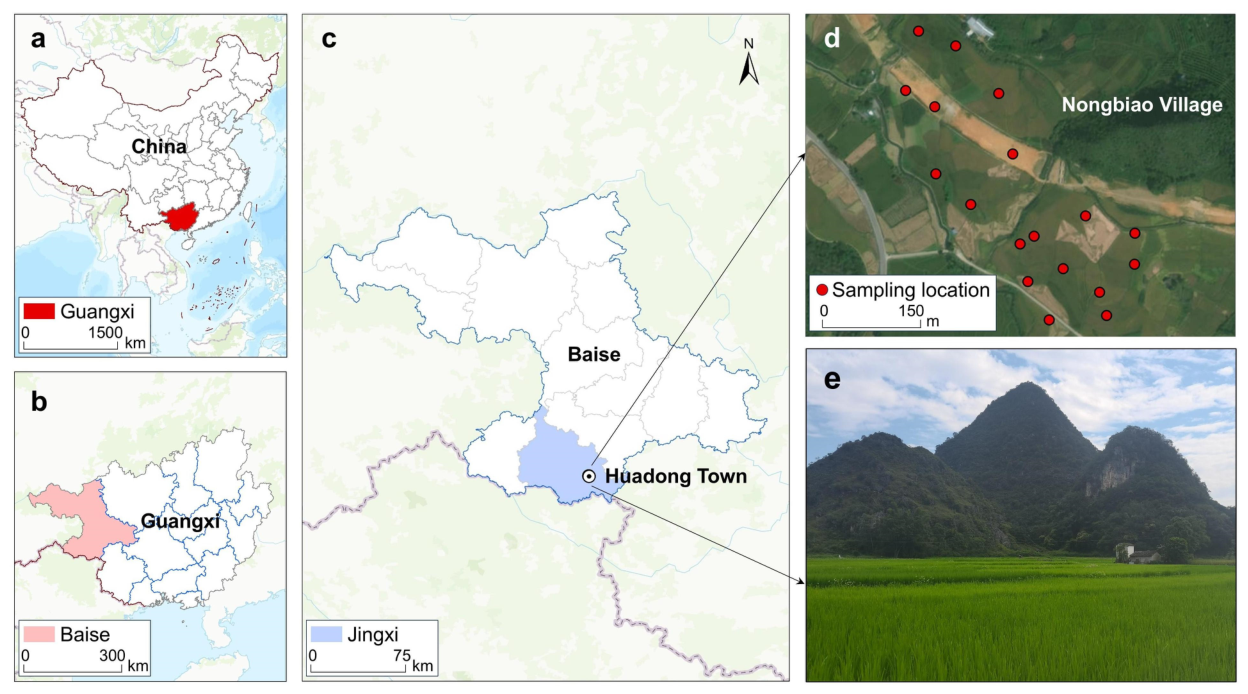
The research site is situated in Nongbiao Village, Baise City, in the southwestern part of Guangxi near southern border of China. Its geographical coordinates are 106°02′05″ E and 23°13′33″ N, with most of the area situated south of the Tropic of Cancer. It is an emblematic karst mountainous region. The local terrain is dominated by low hills and karst peak cluster valleys, comprising four geomorphological types: isolated plains, peak forest valleys, peak cluster depressions, and non-karst regions. The region’s climate is subtropical monsoonal, typified by mild seasons and copious rainfall, and featuring a mean yearly temperature of 20.5 °C and a typical annual rainfall amount of 1799 mm (Figure 1).
The selection of sampling sites was based on preliminary geological surveys and environmental assessments, which indicated that these locations are situated in a typical high-cadmium geological background area in Baise, Guangxi, and therefore possess strong geochemical representativeness. Based on field conditions, a total of 18 sampling sites were established across the study area to cover a range of environmental settings, and surface soil samples (0–20 cm) were collected simultaneously at each site. A GPS (Guangzhou South Surveying & Mapping Instrument Co., Ltd., Guangzhou, China) device was used to precisely locate and record the coordinates of all sampling sites (Figure 1d). These sites were also designated as long-term observation plots to ensure the representativeness, consistency, and comparability of the collected data.
In addition, one representative site (106°29′15″ E, 23°03′30″ N) was selected for soil profile sampling. The soil profile was sampled to a depth of 100 cm at 10 cm intervals, yielding ten layers in total. Approximately 500 g of soil was collected from each layer and placed into clean, pre-labeled sample bags for storage. After natural air-drying, the samples were cleared of stones and plant debris, thoroughly ground, and sieved. A representative subsample of approximately 10 g was then obtained using the quartering method for subsequent physicochemical analyses.
Rice samples were collected from the paddy fields corresponding to the 18 surface-soil sampling sites shown in Figure 1d at the grain maturation stage on 29 October 2023. After harvesting, the rice samples were separated into grain husks, kernels, and the remaining inflorescence tissues (including pedicels and peduncles). Additional rice materials were placed in sterile mesh bags and labeled for transmission electron microscopy (TEM; Talos F200X, Thermo Fisher Scientific, Waltham, MA, USA) analysis. All samples were transported to the laboratory within approximately 2 h after collection while being maintained at ambient outdoor temperature (ca. 26 °C) during transit.

2.2. Soil Elemental Speciation Experiment

The contents of target elements in soil were determined using a differentiated analytical approach. First, air-dried and ground soil samples were pressed into borate-backed pellets. Manganese (Mn) was directly measured using X-ray fluorescence spectroscopy (XRF, Quantax EDS 200-Z10 system, Bruker Nano GmbH, Berlin, Germany). Due to its relatively high concentration, analysis without pretreatment was possible. Separate aliquots of the soil samples were subjected to microwave digestion to prepare for analysis of other heavy metals. Trace elements such as cadmium (Cd), selenium (Se), and zinc (Zn) were measured by inductively coupled plasma mass spectrometry (ICP-MS, Thermo Scientific iCAP TQ, Thermo Fisher Scientific, Bremen, Germany) to ensure sufficient sensitivity for low-concentration elements. Copper (Cu), nickel (Ni), and chromium (Cr), which occur at relatively higher concentrations but still within the trace range, were analyzed using inductively coupled plasma atomic emission spectroscopy (ICP-AES, Avio 220, PerkinElmer, Shelton, CT, USA), enabling accurate multi-element quantification. To ensure data quality, each batch of analyses included procedural blanks, parallel samples and national standard soil materials.
The element speciation experiment was performed at the National Key Laboratory of Environmental Geochemistry, following the soil environmental testing technical standards (HJ/T 166-2004) [40], and using the five-step extraction method [41]. The extraction included exchangeable (ion exchange), carbonate-associated, Fe-Mn oxide-linked, organic-linked, and residual forms. In the continuous extraction experiment, the recovery rates for Cd, Mn, Zn, and Se were 90.26–108.98%, 99.47–108.05%, 97.04–106.19%, and 98.68–108.40%, respectively [42]. The samples were tested using the control variable method, with three replicates for each experiment, and the analytical error was maintained at 5–10%.
Plant sample testing was conducted by the Zhejiang Institute of Geological Exploration, General Administration of Geology (Hangzhou, China) and Mines of Sinochem and ALS Chemex Guangzhou Co., Ltd. (Guangzhou, China). For digestion, rice samples were treated with an aqua regia for about 8 h, followed by transfer to a graphite furnace. The digestion process involved heating at 85 °C for 15 min, then increasing the temperature to 115 °C for an additional 2 h. After cooling, samples were diluted with hydrochloric acid (HCl) to a predetermined volume. The concentrations of Cd, Zn, and Se were quantified via ICP-MS. To ensure precision and control samples, ultrapure water was used during the analytical process, and all sample analyses were performed in triplicate included the subsampling. The average value was taken, with the precision controlled to have a relative deviation of less than 10%, and accuracy was verified using certified reference materials, with the relative error controlled within 10%.

2.3. Determination of Metal Concentrations in Various Rice Plant Tissues

Stem and husk tissues were excised into approximately 1 mm × 1 mm pieces. The samples were first fixed in 3% glutaraldehyde (in 0.1 M phosphate buffer, pH 7.2) at 4 °C for over 2 h, followed by rinsing four times (15 min each) with the same buffer. The tissue blocks were then post-fixed in 1% osmium tetroxide for 1–2 h and rinsed four times (15 min each) with double-distilled water. Subsequently, the samples were stained overnight at 4 °C with 0.25% uranyl acetate (in Mels 1% solution) and thoroughly rinsed with double-distilled water.
Following staining, dehydration was carried out using a graded ethanol series (30%, 50%, 70%, 80%, 90%, 95%, and two changes of 100% ethanol), followed by a 15 min transition with acetone. The samples were then infiltrated stepwise with resin–acetone mixtures (volume ratios of 1:3, 1:1, and 3:1) for 2–12 h each at room temperature, followed by infiltration in pure resin for 12–24 h, and finally embedded in resin for polymerization. All reagents used for TEM sample preparation were purchased from Shanghai Macklin Biochemical Co., Ltd. (Shanghai, China).
Ultra-thin sections (70–100 nm thick) were obtained from the embedded blocks using an ultramicrotome (EM UC7/FC7, Leica Microsystems, Wetzlar, Germany) and mounted on 3 mm copper grids. The sections were double-stained with uranyl acetate and lead citrate and then observed under aTEM. Based on the obtained stained images, the relative fluorescence intensity of Cd, Zn, and selenium (Se) in the cell wall and cytoplasm was semi-quantitatively analyzed using Image-Pro Plus software (Version 6.0, Media Cybernetics, Rockville, MD, USA) [43].

2.4. Heavy Metal Pollution and Ecological Risk

To illustrate the contamination extent for specific HM components within the investigated region, the commonly used evaluation method was the single-factor pollution index (PI) [44]. The pollution load index (PLI) approach is used to gauge the comprehensive pollution status across various HM pollutants in the investigated region. The calculation formulae are as follows:
P I = C i C b
P L I = P I 1 × P I 2 × P I 3 × × P I n n
The expression C i and C b represent the measured concentration and background content of HM element i, respectively, in mg·kg−1, with n indicating the total count of such HMs. In this context, the reference baseline derives from Guangxi’s soil standard levels (detailed in Table S1).
The potential ecological risk index (RI) reflects the sensitivity of biological communities to heavy metal pollutants and indicates the overall level of potential ecological risk [45]. In this study, RI from HMs (Cd, Cr, Cu, Mn, Ni, and Zn) present in the research site’s soil were evaluated via the approach introduced by Hakanson [44], which is widely applied in evaluating the ecological threats posed by HMs in farmland soils. This method considers both the concentration of HMs and their corresponding toxicity indicators. The calculation formulae are as follows:
R I = i = 1 n E r i = T r i × C i C n i
Within the equation, E r i represent the potential ecological risk coefficient of specific HM elements i; T r i represent the toxicity coefficient of HM element i (see Table S1); C i refers to the measured concentration of HM element i within samples; and C n i serve as the reference benchmark for HM element i, here drawn from Guangxi’s soil baseline levels.

2.5. Analysis of HM Sources

Created by the U.S. Environmental Protection Agency (USEPA), the Positive Matrix Factorization (PMF) framework functions as a computational tool for pinpointing key origins of particulate matter (PM) and quantifying their contribution rates [46]. The principle of this model is based on the least squares iterative algorithm, which decomposes the original matrix ( X i j j ) into a source contribution matrix ( G i k ), a source profile matrix ( F j k ), and a residual matrix ( E i j ). The model finds broad use in investigations tracing HM origins in soils. The calculation formula is as follows [47]:
X i j = k = 1 p G i k F j k + E i j
Let X i j be the concentration of element i in sample j, G i k the content of element i in source k, F j k as the contribution rate of source k to sample j for element i, E i j denotes the residual matrix, and p represents the number of factors.
In Equation (5), E i j is derived by minimizing the objective function Q. The formula is given as follows:
Q = i 1 n j 1 m E i j u i j
where Q is the objective function, and u i j represent the uncertainty of element i in sample j. The uncertainty is determined as follows:
For concentrations ≤ the method detection limit (MDL), uncertainty is determined by
U n c = 5 6 M D L
For concentrations > MDL, uncertainty is determined by
U n c = δ × C i 2 + 0.5 × M D L 2
where δ is the relative deviation (10% in this study), C i is the measured concentration of HM element i, and MDL denotes the method detection limit.

2.6. Statistical Analysis

All statistical analyses were conducted using the R Statistical Software 4.1.0 (http://www.r-project.org, accessed on 20 September 2025). Normality tests were first taken for all data. One-way analysis of variance (ANOVA) followed by an LSD test was utilized to determine any significant differences (p < 0.05) in the concentrations of Cd, Zn, and Se between various parts of the rice. A heatmap plot was generated to illustrate the relationships among various metal elements (Cr, Cu, Mn, Ni, Zn, and Se) in the soil and different parts (rice spike, husk, and flour) of rice using the ‘corrplot’ package.

3. Results

3.1. Characteristics and Risk Evaluation of Elemental Content in Farmland Soils

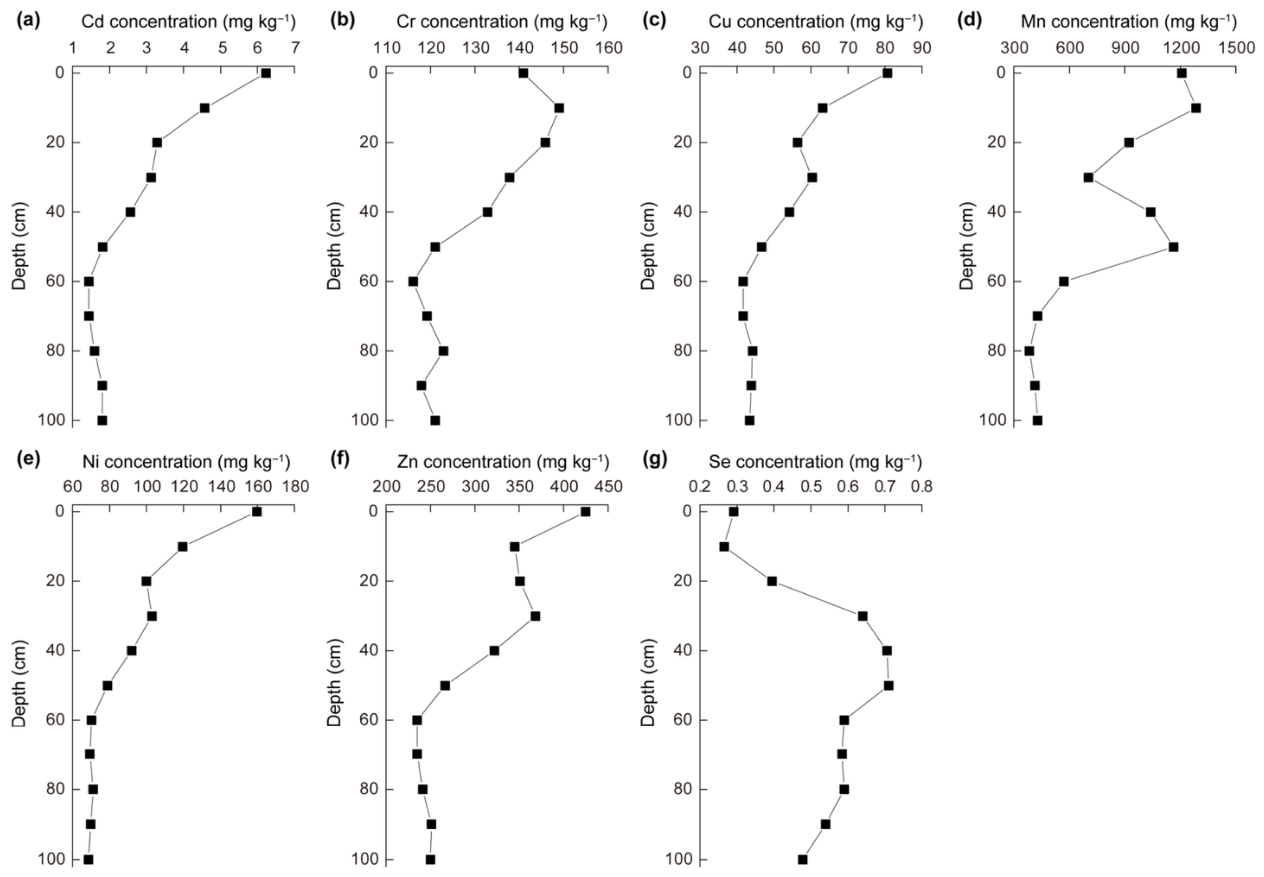
The concentrations of the seven elements involved in this study varied significantly with depth in the agricultural soil. HMs, for instance, Cd, Cr, Cu, Mn, Ni, and Zn, had higher concentrations in the layer of 0–60 cm, with a significant decrease in concentrations found below 60 cm. In contrast, the non-metal element Se had lower concentrations at the 0–20 cm depth, but its concentration increased at depths greater than 20 cm (Figure 2). The mean concentrations of Cd, Cr, Cu, Mn, Ni, Zn, and Se across the different profile horizons were 2.70, 129.56, 52.39, 777.26, 91.12, 299.10, and 0.53 mg kg−1, respectively. The contents of Cd, Cr, Cu, Ni, and Zn in Guangxi soil exceeded the background levels (Table S1), being 12.48, 1.96, 1.53, 2.53, and 2.91 times higher, respectively.

3.2. Pollution and Risk Assessment

PI indicated the degree of accumulation of each element in the soil. Cd consistently exhibited a high PI value, with the highest PI value observed in the surface layer (0 cm) at 23.07. The PI values for the other six metal elements gradually decreased with increasing depth, indicating that the degree of soil pollution decreased with depth (Table 1). PLI ranged from 0 to 5, representing levels from “no pollution” to “extremely heavy pollution” (Table S2). The result showed that the PLI of Cd was 8.86, indicating that Cd contamination in the research region was at an extremely heavy pollution level. Cr (2.08), Cu (1.84), Mn (1.57), Ni (3.30), and Zn (3.87) were classified as heavy pollution. The overall PLI decreased from 4.90 at the surface to 2.35 at 100 cm depth, indicating that the pollution degree decreased with increasing depth (Table 1). According to the potential ecological risk classification standards (Table S3), Cd had the highest potential risk value at the surface (0 cm) at 692.10, followed by Ni with a potential risk value of 30 (Table 2). The overall potential risk index (RI) was the highest at the surface, with a value of 749.47, where Cd was the dominant contributor to this high ecological risk. As the depth increased, the overall RI decreased from 749.47 at the surface to 200.10 at 100 cm depth (Table 2). This trend corresponded with the changes in metal concentrations and pollution load.
The study results indicated that the 0–20 cm soil was most severely polluted, particularly by Cd, which posed the greatest environmental risk. However, as the depth increased, the pollution load and potential risk decreased, indicating that the pollution risk in deeper soils was lower.

3.3. Source Analysis of Soil HMs

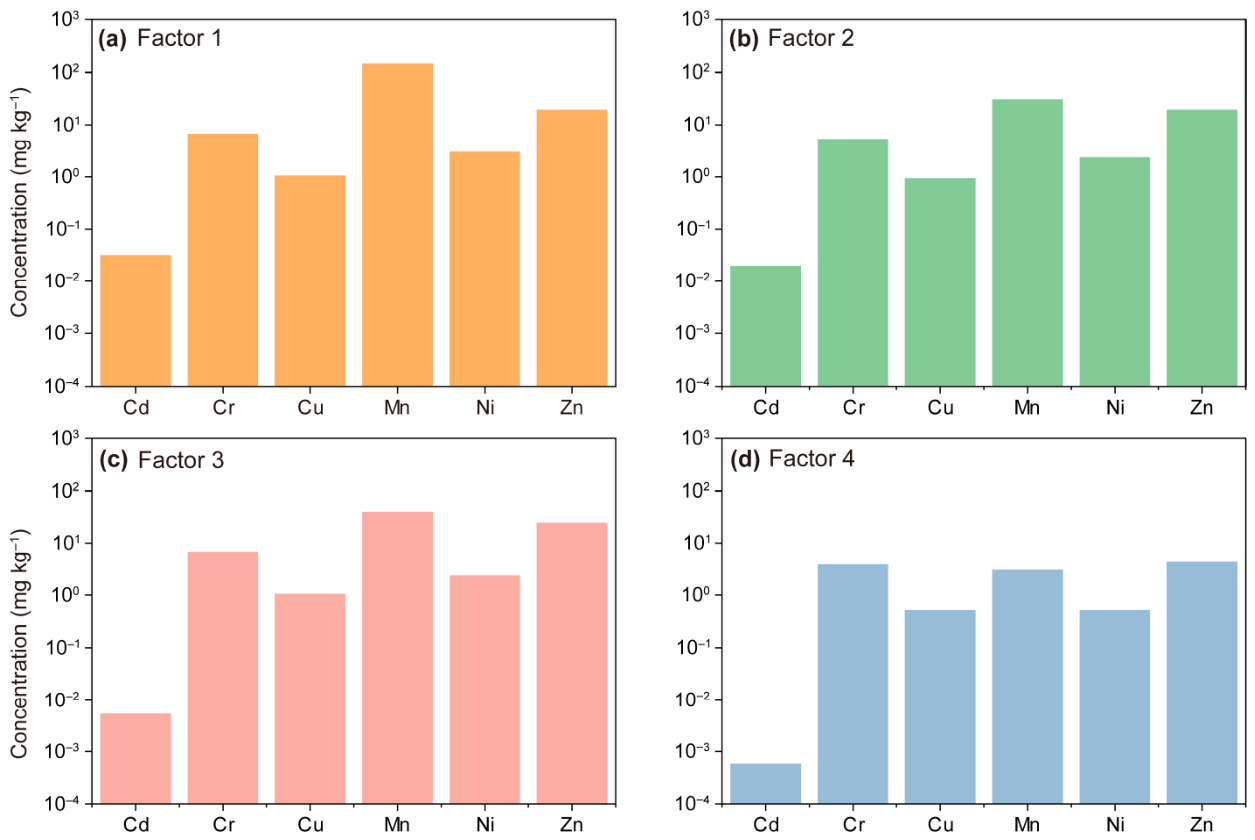
The pollution source categories shown in Figure 3 were identified based on the PMF model results. Specifically, the PMF model decomposed the measured heavy metal concentration data into four latent factors according to the characteristic loadings of each metal, and the loading patterns of different elements exhibited significant differences among these factors. Mn showed markedly higher loadings than other elements across all four factors, with a clear decreasing trend of Factor 1 > Factor 2 > Factor 3 > Factor 4, indicating that Mn is primarily controlled by Factor 1, with additional contributions from Factors 2 and 3. Cd exhibited the lowest loadings among all elements; it showed comparable contributions in Factor 1 and Factor 2 (with Factor 1 slightly higher), while contributions from Factors 3 and 4 were negligible, suggesting that Cd is mainly controlled by Factors 1 and 2. Cr, Cu, Ni, and Zn all exhibited mixed-source characteristics, with relatively high loadings in Factors 1–3 and consistently low contributions from Factor 4. Specifically, Cr and Cu displayed similar patterns (Factor 1 ≈ Factor 3 > Factor 2 > Factor 4), Ni followed the pattern Factor 1 > Factor 2 ≈ Factor 3 > Factor 4, and Zn showed Factor 1 ≈ Factor 2 ≈ Factor 3 > Factor 4. Overall, Factors 1–3 made important contributions to these four metals, whereas Factor 4 played a relatively minor role.
In summary, the sources of the six heavy metals in the study area can be classified into three categories: Mn is mainly dominated by Factor 1, Cd is jointly controlled by Factors 1 and 2, and Cr, Cu, Ni, and Zn exhibit mixed multi-source inputs, indicating complex composite pollution characteristics.

3.4. Elemental Forms in Soil Profiles

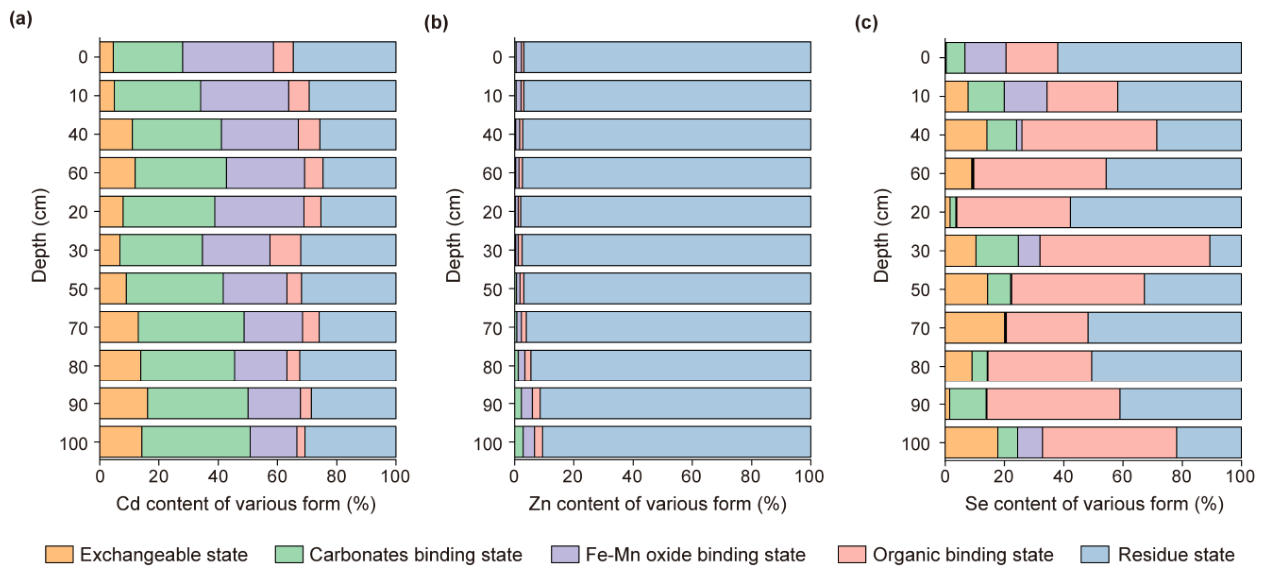
The occurrence states of Cd, Zn, and Se in the soil profiles were presented in Figure 4. In the 0–100 cm soil profile, Cd occurrence was predominantly found in the following forms: carbonate-bound (23–37%) > residual (25–35%) > iron manganese oxide-bound (16–31%) > exchangeable (4–16%) > organic-bound (3–10%). From the vertical distribution of the soil profile, higher proportions of exchangeable and carbonate-bound Cd were observed in the surface soil (0–30 cm), while the proportions of residual and Fe–Mn oxide-bound forms generally increased with depth. This indicated that Cd had high bioavailability and posed a high ecological risk. The forms of Zn occurrence were as follows: residual (91–98%) > iron manganese oxide-bound (1–4%) > carbonate-bound (0–3%) = organic-bound (1–3%) > exchangeable (0%). Zn predominantly existed in the residual form, indicating that it remained relatively stable in the soil. The proportions of different Zn forms showed little variation among soil depths, with no obvious vertical differentiation in the profile. The forms of Se occurrence were as follows: residual (11–62%) > organic-bound (17–57%) > carbonate-bound (0–14%) > exchangeable (0–20%) > iron manganese oxide-bound (0–14%). Se was mainly in the residual form, with lower levels of carbonate-bound and exchangeable forms. Vertically, higher proportions of organic-bound Se were observed in surface soils, whereas the proportion of residual Se increased with increasing depth.
This suggested that Se had low bioavailability and exhibited a strong affinity for organic matter, showing a greater tendency to bind organically.

3.5. Content and Distribution of Cd, Zn, and Se in Rice

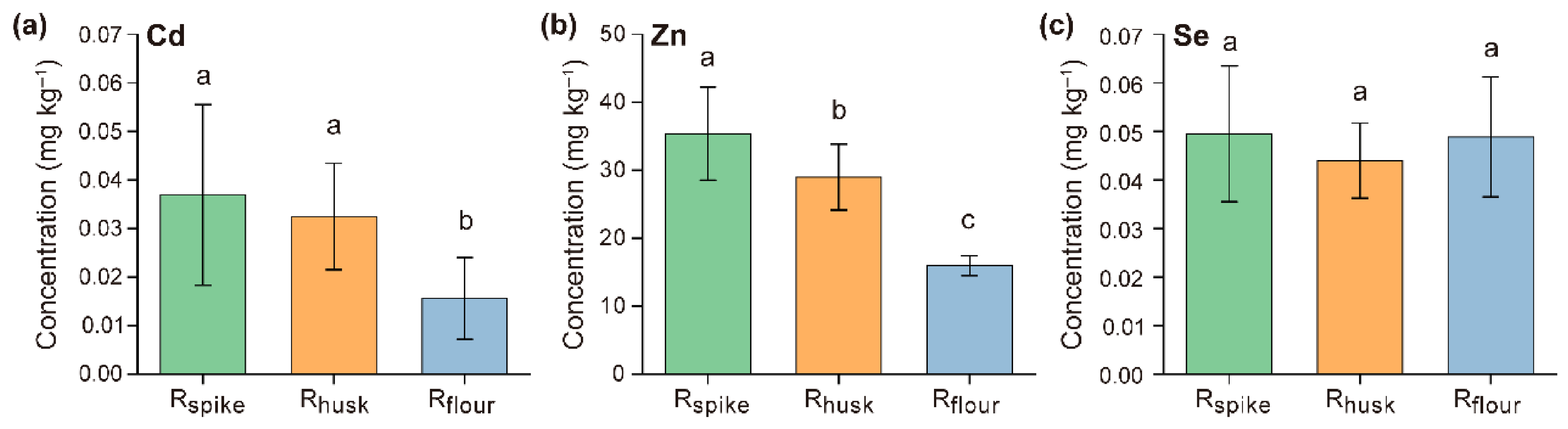
Based on the 18 rice samples analyzed, Cd levels in rice differed depending on the part: the grain averaged 0.02, the husk 0.03, and the spike 0.04 mg kg−1. The Cd concentrations ranged from 0.01 to 0.03 mg kg−1 in the grain, from 0.02 to 0.06 mg kg−1 in the husk, and from 0.02 to 0.07 mg kg−1 in the spike. Zn, on the other hand, showed higher concentrations across these components, with the grain averaging 15.95, the husk at 28.97, and the spike peaking at 35.39 mg kg−1. The Zn concentrations ranged from 14.40 to 17.70 mg kg−1 in the grain, from 21.80 to 32.90 mg kg−1 in the husk, and from 28.00 to 44.20 mg kg−1 in the spike. When it came to Se, the values remained fairly stable—recorded at 0.05 mg kg−1 in both the grain and spike, while dipping to 0.04 mg kg−1 in the husk (Figure 5). The Se concentrations ranged from 0.04 to 0.08 mg kg−1 in the grain, from 0.04 to 0.05 mg kg−1 in the husk, and from 0.04 to 0.05 mg kg−1 in the spike. According to Chinese food safety standards of NY 861-2004 and GB 2762-2017, the standard limits for these elements in brown rice are set as 0.2 mg kg−1 for Cd, 50 mg kg−1 for Zn, and 0.3 mg kg−1 for Se. Compared with these standard limits, the Cd, Se, and Zn level in the rice grain, husk, and spike were all below the food safety standards.
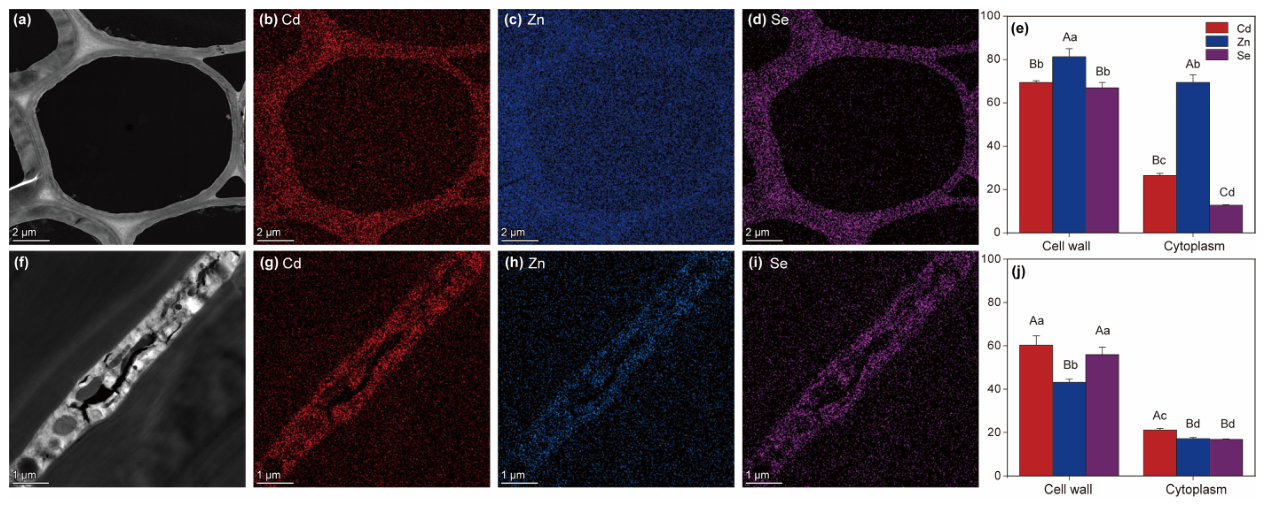
Figure 6 showed the transmission electron microscopy results of rice stems, with Figure 6a displaying the observed cell walls of the rice stem. Transmission electron microscopy observations of the rice stem cell walls revealed a significantly higher Cd content within this part. The distribution of Cd in rice stem cell walls showed that Cd primarily accumulated inside the cell walls, with much less accumulation on the outside (Figure 6b). The distribution of Zn in the rice stem showed that the Zn content inside and outside the cell walls was nearly identical (Figure 6c). Similarly to Cd, Se primarily accumulated inside the cell walls (Figure 6d). In the stem’s cell walls, the fluorescence intensities of Cd, Zn, and Se were 69.40, 81.26, and 66.95, respectively, whereas in the cytoplasm, the fluorescence intensity of Zn was 69.45, which was similar to that in the cell walls, while Cd and Se had fluorescence intensities of 26.49 and 12.77, significantly lower than in the cell walls (Figure 6e). Figure 6f showed the observed area of the cell walls in the rice husk. The allocation of Cd (Figure 6g), Zn (Figure 6h), and Se (Figure 6i) in rice husks in the study area showed that these elements were primarily concentrated in the cell walls, with a significant difference in distribution compared to the content outside the cell walls. In the husk’s cell walls, the fluorescence intensities of Cd, Zn, and Se were 60.31, 43.17, and 55.95, respectively; in the cytoplasm, the fluorescence intensities were significantly lower than those in the cell walls, with values of 21.11, 17.16, and 16.83 (Figure 6j).

3.6. Correlation Analysis of Elemental Content Between Surface Soil and Rice

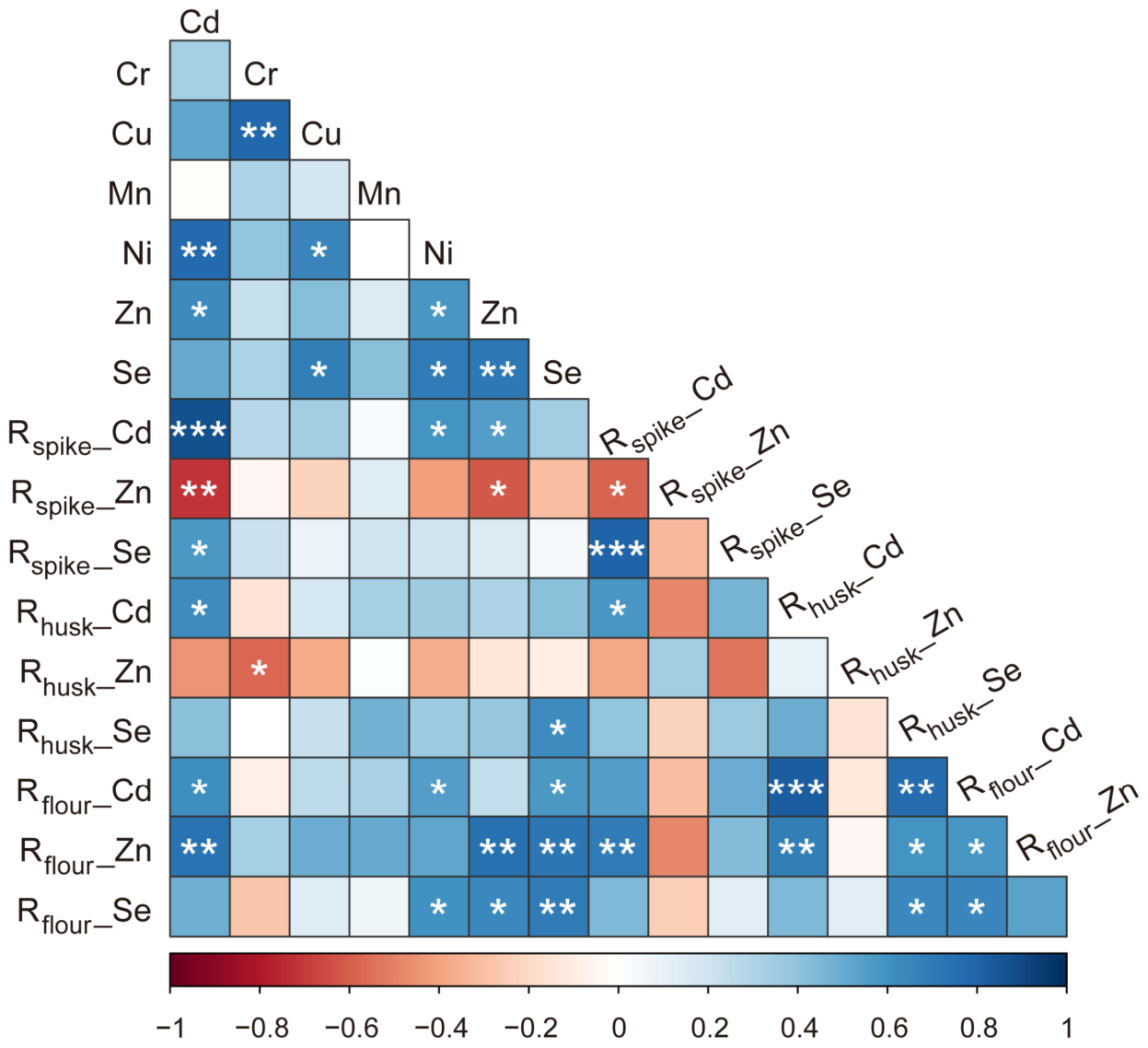
Figure 7 shows the correlations between Cd, Zn, and Se concentrations in different rice parts (spikelets, husks, and rice flour) and the corresponding element concentrations in the 18 paired surface soil samples (0–20 cm) collected from the sampling sites shown in Figure 1d. Cd in the rice spike was highly positively affected with Cd in the surface soil (p < 0.01), and Cd levels in the rice spike exhibited significant positive associations with Zn and Ni in the surface soil (p < 0.05). Additionally, Cd in the rice spike exhibited strong positive relationship with Se in the rice spike (p < 0.01), but a significant negative affected with Zn in the rice spike (p < 0.05). Cd accumulation in the rice husk was related to Cd concentrations in the surface soil (p < 0.05). The levels of Cd in the flour positively correlated with Cd, Ni, and Se in the surface soil (p < 0.05). Additionally, Cd in flour demonstrated significant positive relationships with Se and Zn within the flour itself (p < 0.05).

4. Discussion

4.1. Severe HM Contamination in Farmland Soils of Guangxi Karst Region with High Ecological Risk

This study provided a comprehensive analysis and investigation of HMs contamination in the agricultural soil of Guangxi karst region, revealing the distribution characteristics of HM elements in those soils and their potential ecological risks. The study results demonstrated that the concentrations of metals such as Cd, Zn, Ni, and Cu in the surface soil (0–60 cm) exceed the deeper soil (Figure 2), a trend consistent with studies in other regions with similar geological characteristics [48,49,50]. The metal content in the deep soil followed the “high background, low mobility” characteristics described in previous studies, with stable metal concentrations in the natural geological background [51,52]. Guangxi exhibits a subtropical climate, characterized mainly by high temperatures and abundant rainfall, which leads to the leaching of soluble ions while exacerbating soil acidification [48]. Meanwhile, the activity of crop roots and microorganisms may also contribute to soil acidification. In addition to fertilizer application, the accumulation of HMs in surface soils was probably related to regional climatic conditions, root activity, and microbial processes. These factors could lower soil pH and thereby enhance the mobility of metal elements, especially Cd [49,53]. Notably, the high concentration of Cd in the surface farmland soil (0–20 cm) was of particular concern, as Cd is a highly toxic element that poses severe threats to the living health. The PLI indicated that the pollution level of Cd had reached an “extremely heavy pollution” level, with a PLI value of 8.86 (Table 1). Other HMs such as Mn, Cu, Cr, Ni, and Zn had lower pollution levels but were still considered heavily polluted. The RI further supports this, showing that Cd accounted for the largest proportion of total ecological risk, especially in surface soil, with a potential risk value as high as 692 (Table 2). This highlighted the serious pollution issue of the surface soil in the region. Therefore, reducing the concentration of HMs, particularly Cd, in agricultural soils was important to safeguarding food production and quality in the region.

4.2. Agricultural Practices and Pedogenic Sources Dominate Cd Pollution in Karst Region Soil

The PMF model results indicated that heavy metal (HM) pollution in the study area can be resolved into four factors (Figure 3). Among them, Cd exhibited the highest contamination risk, with its accumulation primarily controlled by Factor 1 and Factor 2. Factor 1 was dominated by Mn loading, with additional contributions from Co, Ni, Zn, and Cr. These elements generally showed low contamination levels, low variability, and distributions consistent with regional background values, indicating that this factor is mainly controlled by parent material and can be attributed to a geochemical background source [54,55]. Factor 2 showed relatively high loadings of Ni, Cu, and Zn. In addition, significant positive correlations were observed among Cd, Ni, and Cu, and these elements also exhibited relatively high enrichment levels. Considering that Cd, Cu, and Zn in agricultural soils are commonly associated with fertilizer application, pesticide use, and organic amendments, this factor was interpreted as an agricultural input source [56,57]. Based on the overall loading patterns, source characteristics, and evidence from previous studies, Factor 3 and Factor 4 were further identified as human activities and atmospheric sedimentation sources, respectively [54,55,56,57]. This result is consistent with previous studies indicating that Cd in the high geochemical background areas of the southwestern karst region is mainly influenced by both geogenic background and agricultural activities [58,59,60].
Studies indicated that Cd accumulation in carbonate-based surface soils was caused by both secondary enrichment and parental rock inheritance [59]. In addition, pesticides and fertilizers used in agricultural activities have further contributed to increased Cd levels in the soil [61,62]. It was important to note that certain pesticides contained elements, for instance Cu, Zn, and Ni [63]. Therefore, the spraying of pesticides on crops and the frequent use of pesticides could be the main causes of the accumulation of these HMs in the soil, which was primarily linked to agricultural activities. As for Cr, its sources were likely more complex. In addition to the potential impact of impurities in agricultural fertilizers, human activities such as industrial manufacturing, traffic emissions, and atmospheric deposition may also be significant contributors to Cr pollution. Activities like electroplating, leather tanning, and chromite ore processing could lead to Cr contamination in soil, posing significant risks to human health [64,65]. In contrast, Mn in farmland soil primarily came from the weathering products of the parent material, particularly carbonate rocks [53,65]. As a relatively inert element, Mn was not prone to significant secondary migration and accumulation during the weathering-pedogenesis process, and its content and distribution were mainly influenced by the original composition and the degree of weathering of the parent rock [53,65]. However, it should be noted that, due to limitations in sampling conditions during the field investigation, the underlying carbonate bedrock was not collected in this study. Therefore, the present source interpretation is mainly based on the soil’s geochemical characteristics, spatial distribution patterns, and previous studies in karst regions. Future research should include analyses of Cd content and speciation in the underlying bedrock to better distinguish between geogenic and anthropogenic sources.

4.3. The Antagonistic Interactions Among Cd, Zn, and Se Ensure Cd Safety in Rice Grains

The average Cd levels in grains, husks, and panicles of rice in the study area were 0.015, 0.032, and 0.037 mg kg−1 (Figure 5), respectively. Although the risk level of Cd in the study region soil was extremely high, the Cd levels of contamination in diverse parts of the rice plants were relatively low and complied with Chinese food safety standards (GB 2762-2017) [66,67]. This result was consistent with findings from other agricultural studies. For instance, Li et al. (2021) [68] reported that the Cd level in rice from strictly protected and regulated paddy fields in the karst region was below the national food safety limits, while some of the rice samples still exceeded the standard values in distinct key protected fields from non-karst regions. The higher Cd concentrations in husks and panicles than in grains may be related to transpiration-driven transport. Cd can be transported upward with the transpiration stream, while husks and panicles undergo stronger transpiration and greater water loss during development, which may lead to Cd enrichment in these tissues. In contrast, grains experience relatively limited transpiration and therefore tend to accumulate less Cd [69,70]. The inconsistency between the levels of Cd accumulated in soil and rice may be possibly attributed to the presence of Zn and Se in the farmland. Previous research found that Zn and Se could effectively alleviate Cd absorption by plants [20,21,22,23]. The cell walls of the rice stem played a central role in the absorption and translocation of Cd. In this study, transmission electron microscopy (TEM) was used to observe the rice stem cell walls, revealing that Cd was primarily concentrated within the cell walls, with less accumulation on the outer side of the cell wall (Figure 6b). This distribution pattern suggests that Cd, although initially absorbed in relatively mobile ionic forms, was gradually transformed into a less mobile cell wall-bound form in rice tissues [71]. The distribution analysis of Zn in the rice stem showed higher levels on the outer side of the cell walls (Figure 6c). Studies suggested that extracellular Zn levels may influence Cd fixation in cell walls, while metal-binding sites present on cell walls may restrict Cd movement within cells. Ma et al. [69] reported that the application of Zn could fix Cd towards the cell walls of plant tissues and inhibit its intercellular transport, as Zn induced the coprecipitation of [Si-hemicellulose-Zn] complexes with Cd in the cell walls. Notably, Se exhibited a similar accumulation pattern to Cd, mainly localized within the cell wall (Figure 6d). Studies have also shown that the administration of Se further promotes Cd fixation in the cell wall [72]. Once Se entered the plant, it bound Cd to the pectin components of the cell walls and upregulated the expression of genes associated with lignin synthesis (OsPAL, OsCoMT, and Os4CL3), thereby increasing lignin content, thickening the cell walls, increasing the number of Cd-binding sites and enhancing its ability to chelate Cd, and reducing the efficiency of Cd transport [25,38,39]. Therefore, both Zn and Se could promote the transformation of Cd from mobile forms into relatively stable cell wall-bound forms, thereby reducing its translocation into rice grains.
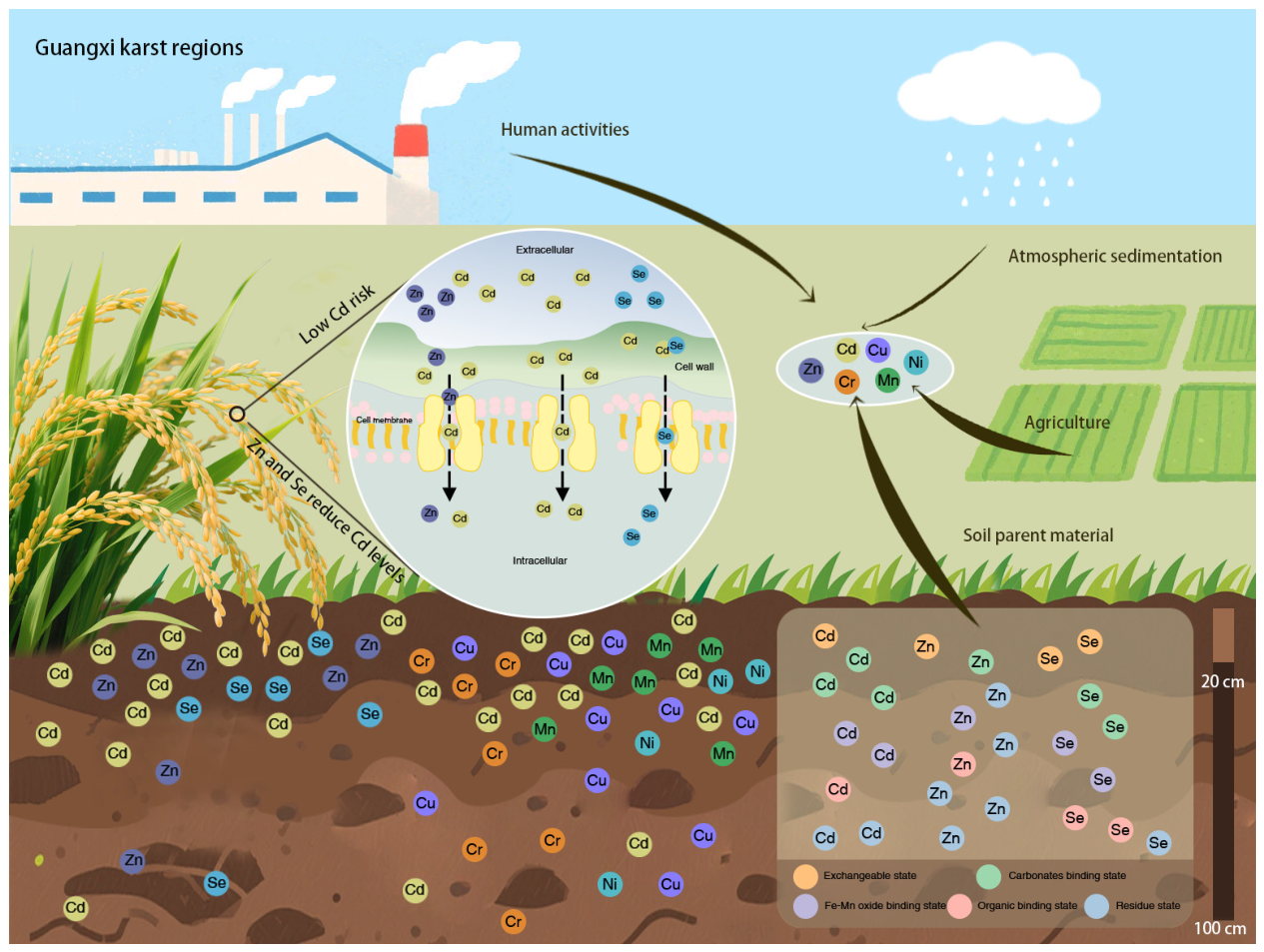
The physicochemical properties of Zn and Cd were similar, which led to competitive interactions in their transport pathways; when Zn was abundant, it could reduce the absorption of Cd [19]. Soil metal speciation analysis showed that Cd primarily existed in carbonate-bound (23–37%) and exchangeable forms (4–16%), indicating relatively high bioavailability and ecological risk (Figure 4). Although Zn primarily existed in the residual form in the soil (Figure 4), its large baseline concentration allowed plants to enhance its mobility and bioavailability. Through root-induced acidification, Zn was released from carbonate-bound and iron manganese oxide-bound forms, which increased its mobility and bioavailability, potentially leading to competition for transport with Cd [28,29]. These soil forms directly influenced the content of the above HMs in rice. Correlation analysis showed a strong positive effect between the concentration of Cd in rice and soil (Figure 7), highlighting the crucial role of soil Cd bioavailability in plant accumulation. Additionally, the levels of Cd in rice grains had a substantial negative effect on Zn concentration (Figure 7), suggesting Zn may compete with Cd for absorption sites, thus inhibiting Cd uptake [72,73]. Meanwhile, the positive correlation between Cd and Se in rice grain (Figure 7) may suggest that Se participates in Cd regulation through a coordinated interaction with Zn, further restricting Cd mobility and grain translocation. Furthermore, the Zn and Ni contents in the soil had a significant positive impact on the Cd content within rice grains (Figure 7), possibly due to the shared transport pathways of these elements. These findings emphasized the pivotal role played by soil metal speciation in the Cd absorption and transport mechanisms of rice. Figure 8 presents a conceptual model summarizing the ecological risks and sources of HMs, occurrence states of Cd, Zn, and Se, and the mechanisms by which Zn and Se reduce Cd content in rice grains in Guangxi karst regions. The interactions among Cd, Zn, and Se were crucial in rice growth. Therefore, to reduce Cd accumulation in rice in the natural environment, increasing soil Zn levels or applying Se fertilizers can raise their competitive interaction on Cd absorption.

5. Conclusions

This study revealed an extremely high potential risk of Cd contamination form the surface soil of farmland soils in the karst region of Guangxi, with soil parent material and agricultural activities identified as the primary sources. The elevated concentration and bioavailability of Cd in the soil (carbonate-bound and exchangeable fractions) promoted its accumulation within rice plants. Nevertheless, due to the mitigating effects of Zn and Se, Cd levels in rice grains remained within safe limits. Zn reduced Cd absorption through competitive uptake, while Se reduced its toxicity by promoting Cd fixation in the cell walls and forming complexes. These findings emphasized the importance of soil metal speciation and plant physiological mechanisms in HM management. In this situation, we recommend applying Zn and Se fertilizers to reduce Cd bioavailability, ensuring food safety and agricultural sustainability. Future research should further explore the interactions between Zn, Se, and Cd under different soil conditions to optimize agricultural strategies.

Supplementary Materials

The following supporting information can be downloaded at: https://www.mdpi.com/article/10.3390/agronomy16090908/s1. Table S1: Toxicity coefficients of heavy metals and their soil background values in Guangxi karst regions; Table S2: Classification standards for pollution load indexes; Table S3: Classification standards for potential ecological risk.

Author Contributions

Conceptualization, X.T., X.K., Z.Y., Y.Z., M.L., N.F.-Y.T., F.W.-F.L., S.J.-L.X., M.P., T.W.N., Y.T.S., T.L. and Z.Z.; methodology, X.T.; software, X.K.; formal analysis, Z.Y.; data curation, Z.Y.; writing—original draft preparation, X.T.; writing—review and editing, T.L. and Z.Z.; project administration, Z.Z.; and funding acquisition, T.L. and Z.Z. All authors have read and agreed to the published version of the manuscript.

Funding

This research was funded by the Scientific Research Base and Distinguished Talents in Guangxi (Guike AD22035015), the Guangxi Youth Talent Support Program to Zhu Zhengjie, Scientific Research Startup Fund of Baise University (No. 2025GCCKY005), the Hong Kong Metropolitan University Seed Funding (SZSF/2025/1.11), and the National Natural Science Foundation of China (32101367).

Data Availability Statement

The original contributions presented in this study are included in the article/Supplementary Materials. Further inquiries can be directed to the corresponding authors.

Acknowledgments

The authors have reviewed and edited the output and take full responsibility for the content of this publication.

Conflicts of Interest

The authors declare no conflicts of interest.

References

  1. Mee, C.; Mnr, C. The Report on the National Soil Contamination Survey; Ministry of Environmental Protection (MEP) & Ministry of Land and Resources (MLR): Beijing, China, 2014.
  2. Li, R.; Wang, J.; Zhou, Y.; Zhang, W.; Feng, D.; Su, X. Heavy metal contamination in Shanghai agricultural soil. Heliyon 2023, 9, 12. [Google Scholar] [CrossRef] [PubMed]
  3. Hu, Y.; Wang, J.; Yang, Y.; Li, S.; Wu, Q.; Nepovimova, E.; Zhang, X.; Kuca, K. Revolutionizing soil heavy metal remediation: Cutting-edge innovations in plant disposal technology. Sci. Total Environ. 2024, 918, 170577. [Google Scholar] [CrossRef]
  4. Liu, B.; Ai, S.; Zhang, W.; Huang, D.; Zhang, Y. Assessment of the bioavailability, bioaccessibility and transfer of heavy metals in the soil-grain-human systems near a mining and smelting area in NW China. Sci. Total Environ. 2017, 609, 822–829. [Google Scholar] [CrossRef]
  5. Boim, A.G.F.; Melo, L.C.A.; Moreno, F.N.; Alleoni, L.R.F. Bioconcentration factors and the risk concentrations of potentially toxic elements in garden soils. J. Environ. Manag. 2016, 170, 21–27. [Google Scholar] [CrossRef] [PubMed]
  6. Hou, D.; Jia, X.; Wang, L.; McGrath, S.P.; Zhu, Y.-G.; Hu, Q.; Zhao, F.J.; Bank, M.S.; O’Connor, D.; Nriagu, J. Global soil pollution by toxic metals threatens agriculture and human health. Science 2025, 388, 316–321. [Google Scholar] [CrossRef]
  7. Duce, J.A.; Bush, A.I. Biological metals and Alzheimer’s disease: Implications for therapeutics and diagnostics. Prog. Neurobiol. 2010, 92, 1–18. [Google Scholar] [CrossRef]
  8. Atobatele, O.E.; Olutona, G.O. Distribution of three non-essential trace metals (Cadmium, Mercury and Lead) in the organs of fish from Aiba Reservoir, Iwo, Nigeria. Toxicol. Rep. 2015, 2, 896–903. [Google Scholar] [CrossRef]
  9. Alloway, B.J.; Jackson, A.P. The behaviour of heavy metals in sewage sludge-amended soils. Sci. Total Environ. 1991, 100, 151–176. [Google Scholar] [CrossRef] [PubMed]
  10. Nies, D.H. Efflux-mediated heavy metal resistance in prokaryotes. FEMS Microbiol. Rev. 2003, 27, 313–339. [Google Scholar] [CrossRef]
  11. Zhang, H.; Reynolds, M. Cadmium exposure in living organisms: A short review. Sci. Total Environ. 2019, 678, 761–767. [Google Scholar] [CrossRef]
  12. Balali-Mood, M.; Naseri, K.; Tahergorabi, Z.; Khazdair, M.R.; Sadeghi, M. Toxic mechanisms of five heavy metals: Mercury, lead, chromium, cadmium, and arsenic. Front. Pharmacol. 2021, 12, 643972. [Google Scholar] [CrossRef]
  13. Qing, Y.; Yang, J.; Zhu, Y.; Li, Y.; Zheng, W.; Wu, M.; He, G. Dose–response evaluation of urinary cadmium and kidney injury biomarkers in Chinese residents and dietary limit standards. Environ. Health 2021, 20, 75. [Google Scholar] [CrossRef]
  14. Clemens, S.; Aarts, M.G.; Thomine, S.; Verbruggen, N. Plant science: The key to preventing slow cadmium poisoning. Trends Plant. Sci. 2013, 18, 92–99. [Google Scholar] [CrossRef] [PubMed]
  15. Wang, P.; Chen, H.; Kopittke, P.M.; Zhao, F.J. Cadmium contamination in agricultural soils of China and the impact on food safety. Environ. Pollut. 2019, 249, 1038–1048. [Google Scholar] [CrossRef] [PubMed]
  16. Huang, S.; Wang, P.; Yamaji, N.; Ma, J.F. Plant nutrition for human nutrition: Hints from rice research and future perspectives. Mol. Plant 2020, 13, 825–835. [Google Scholar] [CrossRef]
  17. Shahzad, M.; Bibi, A.; Khan, A.; Shahzad, A.; Xu, Z.; Maruza, T.M.; Zhang, G. Utilization of antagonistic interactions between micronutrients and Cadmium (Cd) to alleviate Cd toxicity and accumulation in crops. Plants 2025, 14, 707. [Google Scholar] [CrossRef]
  18. Chang, J.D.; Huang, S.; Wiseno, I.; Sui, F.-Q.; Feng, F.; Zheng, L.; Ma, J.F.; Zhao, F.J. Dissecting the promotional effect of zinc on cadmium translocation from roots to shoots in rice. J. Exp. Bot. 2023, 74, 6790–6803. [Google Scholar] [CrossRef]
  19. Ali, S.; Mfarrej, M.F.B.; Hussain, A.; Akram, N.A.; Rizwan, M.; Wang, X.; Maqbool, A.; Nafees, M.; Ali, B. Zinc fortification and alleviation of cadmium stress by application of lysine chelated zinc on different varieties of wheat and rice in cadmium stressed soil. Chemosphere 2022, 295, 133829. [Google Scholar] [CrossRef]
  20. Zhen, S.; Shuai, H.; Xu, C.; Lv, G.; Zhu, X.; Zhang, Q.; Zhu, Q.; Núñez-Delgado, A.; Conde-Cid, M.; Zhou, Y. Foliar application of Zn reduces Cd accumulation in grains of late rice by regulating the antioxidant system, enhancing Cd chelation onto cell wall of leaves, and inhibiting Cd translocation in rice. Sci. Total Environ. 2021, 770, 145302. [Google Scholar] [CrossRef] [PubMed]
  21. Khan, M.I.R.; Nazir, F.; Asgher, M.; Per, T.S.; Khan, N.A. Selenium and sulfur influence ethylene formation and alleviate cadmium-induced oxidative stress by improving proline and glutathione production in wheat. J. Plant Physiol. 2015, 173, 9–18. [Google Scholar] [CrossRef]
  22. Kong, L.; Liu, Y.; Qian, X.; Liu, J.; Wang, Q.; Li, H.; Wan, Y. Interactions between zinc and selenium with foliar spraying and their effects on cadmium accumulation in wheat grains. Plant Soil 2025, 515, 1315–1331. [Google Scholar] [CrossRef]
  23. Alves, L.R.; Dos Reis, A.R.; Prado, E.R.; Lavres, J.; Pompeu, G.B.; Azevedo, R.A.; Gratao, P.L. New insights into cadmium stressful-conditions: Role of ethylene on selenium-mediated antioxidant enzymes. Ecotoxicol. Environ. Saf. 2018, 186, 109747. [Google Scholar] [CrossRef] [PubMed]
  24. Cui, J.; Liu, T.; Li, Y.; Li, F. Selenium reduces cadmium uptake into rice suspension cells by regulating the expression of lignin synthesis and cadmium-related genes. Sci. Total Environ. 2018, 644, 602–610. [Google Scholar] [CrossRef]
  25. Qin, X.; Nie, Z.; Liu, H.; Zhao, P.; Qin, S.; Shi, Z. Influence of selenium on root morphology and photosynthetic characteristics of winter wheat under cadmium stress. Environ. Exp. Bot. 2018, 150, 232–239. [Google Scholar] [CrossRef]
  26. Khanam, R.; Kumar, A.; Nayak, A.; Shahid, M.; Tripathi, R.; Vijayakumar, S.; Bhaduri, D.; Kumar, U.; Mohanty, S.; Panneerselvam, P. Metal (loid) s (As, Hg, Se, Pb and Cd) in paddy soil: Bioavailability and potential risk to human health. Sci. Total Environ. 2020, 699, 134330. [Google Scholar] [CrossRef]
  27. Yang, Z.; Wang, M.; Hou, J.; Xiong, J.; Chen, C.; Liu, Z.; Tan, W. Prediction of cadmium bioavailability in the rice-soil system on a county scale based on the multi-surface speciation model. J. Hazard. Mater. 2023, 449, 130963. [Google Scholar] [CrossRef] [PubMed]
  28. Ma, P.; Tian, T.; Dai, Z.; Shao, T.; Zhang, W.; Liu, M. Assessment of Cd bioavailability using chemical extraction methods, DGT, and biological indicators in soils with different aging times. Chemosphere 2022, 296, 133931. [Google Scholar] [CrossRef]
  29. Meharg, A.A.; Meharg, C. The pedosphere as a sink, source, and record of anthropogenic and natural arsenic atmospheric deposition. Environ. Sci. Technol. 2021, 55, 7757–7769. [Google Scholar] [CrossRef]
  30. Cai, Z.; Ren, B.; Xie, Q.; Deng, X.; Yin, W.; Chen, L. Toxic element characterization against a typical high geology background: Pollution enrichment, source tracking, spatial distribution, and ecological risk assessment. Environ. Res. 2024, 255, 119146. [Google Scholar] [CrossRef]
  31. Li, J.; Huang, C.; Huang, Z.; Wang, X.; Luo, J.; Feng, S.; Yang, Z. Exploring the geochemical characteristics, sources, influencing factors, and potential remediation strategies of Cd in a typical karst region. Environ. Earth Sci. 2024, 83, 514. [Google Scholar] [CrossRef]
  32. Jia, Z.; Wang, J.; Zhou, X.; Zhou, Y.; Li, Y.; Li, B.; Zhou, S. Identification of the sources and influencing factors of potentially toxic elements accumulation in the soil from a typical karst region in Guangxi, Southwest China. Environ. Pollut. 2020, 256, 113505. [Google Scholar] [CrossRef]
  33. Chen, H.; Teng, Y.; Lu, S.; Wang, Y.; Wang, J. Contamination features and health risk of soil heavy metals in China. Sci. Total Environ. 2015, 512, 143–153. [Google Scholar] [CrossRef]
  34. Yao, J.; Qian, J.; Ji, D. Machine learning-based analysis of heavy metal migration under acid rain: Insights from the RF and SVM algorithms. Minerals 2025, 15, 663. [Google Scholar] [CrossRef]
  35. Wang, Y.H.; Wen, X.; Zhong, C.; Zhu, B.L.; Su, D.N.; Wang, C. Distribution characteristics and bioavailability of cadmium in soil profile from Karst high geological background and mining activities superimposed pollution area of northwest Guangxi, China. J. Earth Sci. Environ. 2024, 46, 81–95. [Google Scholar]
  36. Reeder, R.J.; Schoonen, M.A.; Lanzirotti, A. Metal speciation and its role in bioaccessibility and bioavailability. Rev. Mineral. Geochem. 2006, 64, 59–113. [Google Scholar] [CrossRef]
  37. Qi, W.Y.; Li, Q.; Chen, H.; Liu, J.; Xing, S.F.; Xu, M.; Yan, Z.; Song, C.; Wang, S.G. Selenium nanoparticles ameliorate Brassica napus L. cadmium toxicity by inhibiting the respiratory burst and scavenging reactive oxygen species. J. Hazard. Mater. 2021, 417, 125900. [Google Scholar] [CrossRef]
  38. Zheng, S.; Xu, C.; Zhu, H.; Huang, D.; Wang, H.; Zhang, Q.; Li, X.; Zhu, Q. Foliar application of zinc and selenium regulates cell wall fixation, physiological and gene expression to reduce cadmium accumulation in rice grains. J. Hazard. Mater. 2024, 480, 136302. [Google Scholar] [CrossRef] [PubMed]
  39. Zerizghi, T.; Guo, Q.; Tian, L.; Wei, R.; Zhao, C. An integrated approach to quantify ecological and human health risks of soil heavy metal contamination around coal mining area. Sci. Total Environ. 2022, 814, 152653. [Google Scholar] [CrossRef] [PubMed]
  40. HJ/T 166-2004; Technical Specification for Soil Environmental Monitoring. State Environmental Protection Administration of China: Beijing, China, 2004.
  41. Liu, X.; Ding, C.; Qin, H.; Zhang, Y.; Jiang, Y.; Li, Z.; Wu, J.; Cheng, H. Pollution characteristics, distribution and risk level of heavy metals in sediments of the Yangtze River estuary. Heliyon 2024, 10, e28796. [Google Scholar] [CrossRef]
  42. Commonwealth of Australia. National Assessment Guidelines for Dredging; Commonwealth of Australia: Canberra, Australia, 2009.
  43. He, D.; Wu, L.; Li, X.; Liu, X.; Ma, P.; Juang, Y. Ecotropic virus integration-1 and calreticulin as novel prognostic markers in triple-negative breast cancer: A retrospective cohort study. Oncol. Lett. 2019, 18, 1847–1855. [Google Scholar] [CrossRef]
  44. Hakanson, L. An ecological risk index for aquatic pollution control. A sedimentological approach. Water Res. 1980, 14, 975–1001. [Google Scholar] [CrossRef]
  45. Li, J.; Teng, Y.; Wu, J.; Chen, H.; Jiang, J. Uncertainty analysis of soil heavy metal source apportionment by PMF model. China Environ. Sci. 2020, 40, 716–725. [Google Scholar]
  46. Reff, A.; Eberly, S.I.; Bhave, P.V. Receptor modeling of ambient particulate matter data using positive matrix factorization: Review of existing methods. J. Air Waste Manag. Assoc. 2017, 57, 146–154. [Google Scholar] [CrossRef] [PubMed]
  47. Wei, N.; Gu, X.; Wen, Y.; Guo, C.; Ji, J. Geochemical speciation and activation risks of Cd, Ni, and Zn in soils with naturally high background in karst regions of southwestern China. J. Hazard. Mater. 2025, 486, 137100. [Google Scholar] [CrossRef]
  48. Ma, Y.; Ning, J.; Yang, H.; Zhang, L.; Xu, C.; Huang, C.; Liang, J. Distribution characteristics, risk assessment, and source analysis of heavy metals in farmland soil of a karst area in Southwest China. Land 2024, 13, 979. [Google Scholar] [CrossRef]
  49. Ji, H.; Zhang, J.; Zhao, Y.; Huang, H.; Ma, Y.; Liang, D.; Chen, F.; Huo, H.; Wang, S.; Xie, T. Heavy metal pollution migration and its ecological impact on microbial communities in the karst region of Guangxi. Sci. Rep. 2025, 15, 14750. [Google Scholar] [CrossRef]
  50. Guo, C.; Wen, Y.; Yang, Z.; Li, W.; Guan, D.; Ji, J. Factors controlling the bioavailability of soil cadmium in typical karst areas with high geogenic background. J. Nanjing Univ. Nat. Sci. 2019, 55, 678–687. [Google Scholar]
  51. Liu, Y.; Xiao, T.; Zhu, Z.; Ma, L.; Li, H.; Ning, Z. Geogenic pollution, fractionation and potential risks of Cd and Zn in soils from a mountainous region underlain by black shale. Sci. Total Environ. 2021, 760, 143426. [Google Scholar] [CrossRef]
  52. Huang, F.; Wei, X.; Zhu, T.; Luo, Z.; Cao, J. Insights into distribution of soil available heavy metals in karst area and its influencing factors in Guilin, southwest China. Forests 2021, 12, 609. [Google Scholar] [CrossRef]
  53. Yu, E.; Liu, H.; Dinis, F.; Zhang, Q.; Jing, P.; Liu, F.; Ju, X. Contamination evaluation and source analysis of heavy metals in karst soil using UNMIX model and Pb-Cd isotopes. Int. J. Environ. Res. Public Health 2022, 19, 12478. [Google Scholar] [CrossRef] [PubMed]
  54. Wan, Y.; Liu, J.; Zhuang, Z.; Wang, Q.; Li, H. Heavy metals in agricultural soils: Sources, influencing factors, and remediation strategies. Toxics 2024, 12, 63. [Google Scholar] [CrossRef]
  55. Peng, H.; Guo, J. Comparisons of heavy metal input inventory in agricultural soils in North and South China: A review. Sci. Total Environ. 2019, 660, 776–786. [Google Scholar] [CrossRef]
  56. Norris, G.; Duvall, R.; Brown, S.; Bai, S. EPA Positive Matrix Factorization (PMF) 5.0 Fundamentals and User Guide; U.S. Environmental Protection Agency: Washington, DC, USA, 2014.
  57. Comero, S.; Capitani, L.; Gawlik, B.M. Positive Matrix Factorisation (PMF): An Introduction to the Chemometric Evaluation of Environmental Monitoring Data Using PMF; European Commission, Joint Research Centre: Ispra, Italy, 2009. [Google Scholar]
  58. Yang, Q.; Yang, Z.; Filippelli, G.M.; Ji, J.; Ji, W.; Liu, X.; Wang, L.; Yu, T.; Wu, T.; Zhuo, X. Distribution and secondary enrichment of heavy metal elements in karstic soils with high geochemical background in Guangxi, China. Chem. Geol. 2021, 567, 120081. [Google Scholar] [CrossRef]
  59. Shi, J.; Zhao, D.; Ren, F.; Huang, L. Spatiotemporal variation of soil heavy metals in China: The pollution status and risk assessment. Sci. Total Environ. 2023, 871, 161768. [Google Scholar] [CrossRef]
  60. Zhang, Z.; Wu, X.; Tu, C.; Huang, X.; Zhang, J.; Fang, H.; Huo, H.; Lin, C. Relationships between soil properties and the accumulation of heavy metals in different Brassica campestris L. growth stages in a Karst mountainous area. Ecotoxicol. Environ. Saf. 2020, 206, 111150. [Google Scholar] [CrossRef] [PubMed]
  61. Yang, Q.; Li, Z.; Lu, X.; Duan, Q.; Huang, L.; Bi, J. A review of soil heavy metal pollution from industrial and agricultural regions in China: Pollution and risk assessment. Sci. Total Environ. 2018, 642, 690–700. [Google Scholar] [CrossRef]
  62. Qin, Y.; Zhang, F.; Xue, S.; Ma, T.; Yu, L. Heavy metal pollution and source contributions in agricultural soils developed from karst landform in the southwestern region of China. Toxics 2022, 10, 568. [Google Scholar] [CrossRef]
  63. Johnson, J.; Schewel, L.; Graedel, T. The contemporary anthropogenic chromium cycle. Environ. Sci. Technol. 2006, 40, 7060–7069. [Google Scholar] [CrossRef] [PubMed]
  64. Dong, W.; Liu, C.; Lin, G.B.; Zhang, Y.C.; Li, H.B.; Juhasz, A.L.; Liu, C.; Ma, L.Q. Chromium oral bioavailability in 16 contaminated soils from different sources: Mouse model development and Cr speciation in soil and mouse tissues. Environ. Sci. Technol. 2025, 59, 4318–4329. [Google Scholar] [CrossRef] [PubMed]
  65. Ji, W.; Lu, Y.; Zhao, C.; Zhang, X.; Wang, H.; Hu, Z.; Yu, T.; Wen, Y.; Ying, R.; Yang, Z. Mineral composition and environmental importance of Fe–Mn nodules in soils in Karst areas of Guangxi, China. Sustainability 2022, 14, 12457. [Google Scholar] [CrossRef]
  66. NY 861-2004; Limits of Eight Elements in Cereals, Legume, Tubes and Its Products. China Agriculture Press: Beijing, China, 2015.
  67. GB 2762-2017; Foodstuff Safety National Criteria-Maximum Levels for Contaminants in Foodstuff. China Standards Press: Beijing, China, 2017.
  68. Li, C.; Yang, Z.; Yu, T.; Hou, Q.; Liu, X.; Wang, J.; Zhang, Q.; Wu, T. Study on safe usage of agricultural land in karst and non-karst areas based on soil Cd and prediction of Cd in rice: A case study of Heng County, Guangxi. Ecotoxicol. Environ. Saf. 2021, 208, 11505. [Google Scholar] [CrossRef]
  69. Ma, J.; Zhang, X.; Wang, L. Synergistic effects between [Si-hemicellulose matrix] ligands and Zn ions in inhibiting Cd ion uptake in rice (Oryza sativa) cells. Planta 2017, 245, 965–976. [Google Scholar] [CrossRef]
  70. Luo, Q.; Bai, B.; Xie, Y.; Yao, D.; Zhang, D.; Chen, Z.; Zhuang, W.; Deng, Q.; Xiao, Y.; Wu, J. Effects of Cd uptake, translocation and redistribution in different hybrid rice varieties on grain Cd concentration. Ecotoxicol. Environ. Saf. 2022, 240, 113683. [Google Scholar] [CrossRef] [PubMed]
  71. Riaz, M.; Kamran, M.; Rizwan, M.; Ali, S.; Parveen, A.; Malik, Z.; Wang, X. Cadmium uptake and translocation: Selenium and silicon roles in Cd detoxification for the production of low Cd crops: A critical review. Chemosphere 2021, 273, 129690. [Google Scholar] [CrossRef] [PubMed]
  72. Afzal, M.; Yu, M.; Tang, C.; Zhang, L.; Muhammad, N.; Zhao, H.; Feng, J.; Yu, L.; Xu, J. The negative impact of cadmium on nitrogen transformation processes in a paddy soil is greater under non-flooding than flooding conditions. Environ. Int. 2019, 129, 451–460. [Google Scholar] [CrossRef] [PubMed]
  73. Adil, M.F.; Sehar, S.; Chen, G.; Chen, Z.-H.; Jilani, G.; Chaudhry, A.N.; Shamsi, I.H. Cadmium-zinc cross-talk delineates toxicity tolerance in rice via differential genes expression and physiological/ultrastructural adjustments. Ecotoxicol. Environ. Saf. 2020, 190, 110076. [Google Scholar] [CrossRef]
Figure 1. The overview of the study area and the location of sampling points. (a) The location of Guangxi Zhuang Autonomous Region in China, (b) the location of Baise City in Guangxi Zhuang Autonomous Region, (c) the location of Nongbiao Village in Baise City, (d) the locations of the 18 surface-soil and rice sampling sites in Nongbiao Village, and (e) the field overview of the sampling location.
Agronomy 16 00908 g001
Figure 2. Soil profile in the study area showing the distribution of element concentrations for (a) Cd, (b) Cr, (c) Cu, (d) Mn, (e) Ni, (f) Zn, and (g) Se.
Agronomy 16 00908 g002
Figure 3. Source analysis of heavy metals in the surface soil (0–20 cm) of the study area. (a) Factor 1, (b) Factor 2, (c) Factor 3, and (d) Factor 4.
Agronomy 16 00908 g003
Figure 4. The occurrence states of (a) Cd, (b) Zn, and (c) Se elements in the soil of the study area.
Agronomy 16 00908 g004
Figure 5. Concentrations of (a) Cd, (b) Zn, and (c) Se in different parts of rice, different lowercase letters a–c indicate significant differences among rice tissues at p < 0.05.
Agronomy 16 00908 g005
Figure 6. TEM images of the distribution of (a,b) Cd, (c) Zn, and (d) Se in the cell walls of rice stems in the study area; TEM images of the distribution of (f,g) Cd, (h) Zn, and (i) Se in rice husk cells in the study area; and content distribution of Cd, Zn, and Se in (e) rice stem cell walls and (j) rice husk cells in the study area. Different uppercase letters indicate significant differences among Cd, Zn, and Se within the same subcellular fraction at p < 0.05; different lowercase letters indicate significant differences between subcellular fractions for the same element at p < 0.05.
Agronomy 16 00908 g006
Figure 7. Correlation analysis between element concentrations in the 18 surface soil samples (0–20 cm) and different rice parts, asterisks indicate the significance levels of correlations: * p < 0.05, ** p < 0.01, and *** p < 0.001.
Agronomy 16 00908 g007
Figure 8. The conceptual model summarizing the distributions, types, ecological risks, and sources of heavy metals, occurrence states of Cd, Zn, and Se, and the interaction mechanisms of Zn and Se with Cd in rice grains of Guangxi karst regions. The arrow thickness indicates the relative contribution strength of different influencing factors.
Agronomy 16 00908 g008
Table 1. Heavy metal pollution load index in the soil profile of the study area.
Soil Depth (cm)PIPLI
CdCrCuMnNiZn
023.072.272.902.716.005.624.90
1016.932.402.272.884.494.564.19
2012.192.352.032.073.764.643.58
3011.592.222.171.583.874.873.44
409.482.141.952.333.464.263.33
506.741.951.682.612.973.532.91
605.331.871.501.282.643.112.32
705.331.921.500.962.613.112.22
805.931.981.590.862.683.192.27
906.671.901.580.932.623.322.33
1006.671.951.560.962.583.312.35
PLI8.862.081.841.573.303.87
Table 2. Potential ecological risks of heavy metal pollution in the soil profile of the study area.
Soil Depth (cm) E r i RI
CdCrCuMnNiZn
0692.104.5414.502.7130.005.62749.47
10507.904.8011.352.8822.454.56553.94
20365.704.7010.152.0718.804.64406.06
30347.704.4410.851.5819.354.87388.79
40284.404.289.752.3317.304.26322.32
50202.203.908.402.6114.853.53235.49
60159.903.747.501.2813.203.11188.73
70159.903.847.500.9613.053.11188.36
80177.903.967.950.8613.403.19207.26
90200.103.807.900.9313.103.32229.15
100200.103.907.800.9612.903.31228.97
Disclaimer/Publisher’s Note: The statements, opinions and data contained in all publications are solely those of the individual author(s) and contributor(s) and not of MDPI and/or the editor(s). MDPI and/or the editor(s) disclaim responsibility for any injury to people or property resulting from any ideas, methods, instructions or products referred to in the content.