Article

Effects of Cover Crops and Tillage on Soil Biological and Physicochemical Properties in an Olive Grove Under Contrasting Rainfall Years

by
Javier González-Canales
1,2,*,
Juan Pedro Martín-Sanz
1,
Blanca Sastre
1,
Rubén Ramos
1,
Raquel Martín-Jiménez
1 and
Mariela Navas
3
1
Madrid Institute for Rural, Agricultural and Food Research and Development (IMIDRA), Finca El Encín, Carretera A-2, km 38.2, 28805 Alcalá de Henares, Madrid, Spain
2
Doctorate School, University of Alcalá (UAH), 28801 Alcalá de Henares, Madrid, Spain
3
Pharmaceutical Chemistry Department, Pharmacy Faculty, Complutense University of Madrid, Pza. Ramón y Cajal S/N, 28040 Madrid, Spain
*
Author to whom correspondence should be addressed.
Agronomy 2026, 16(9), 906; https://doi.org/10.3390/agronomy16090906
Submission received: 26 March 2026 / Revised: 24 April 2026 / Accepted: 27 April 2026 / Published: 30 April 2026
(This article belongs to the Section Innovative Cropping Systems)

Abstract

Cover crops in woody crops as a sustainable land management alternative to conventional tillage induce changes in soil properties that improve ecosystem functioning. Soil is highly dynamic, and disturbances in environmental conditions affect soil microorganisms, particularly in gypsiferous soils, where microbiological activity remains poorly understood. This study evaluated the effects of three cover crop systems: spontaneous permanent vegetation cover (SVE), annual legume cover (VIC), and permanent grass cover (BRA), compared with conventional tillage (TIL), on soil physicochemical and biological properties in an olive grove over two crop seasons. Overall, cover crops promoted higher microbial activity and carbon storage than tillage, with responses being more pronounced during the wetter year. Conventional tillage consistently exhibited the lowest levels of enzyme activities and carbon stocks, whereas permanent covers showed stronger positive effects on soil functioning. These findings indicate that the benefits of cover crops on soil processes are reinforced under favorable moisture conditions but also remain under drier years, highlighting their stabilizing role. The improvement of soil health induced by cover crops contributes to enhancing soil ecosystem services, including soil fertility, in olive groves, supporting their adoption as a sustainable management strategy in Mediterranean agroecosystems, even under lower rainfall conditions.

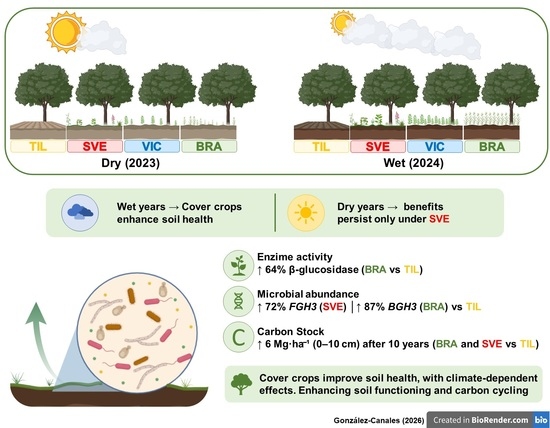
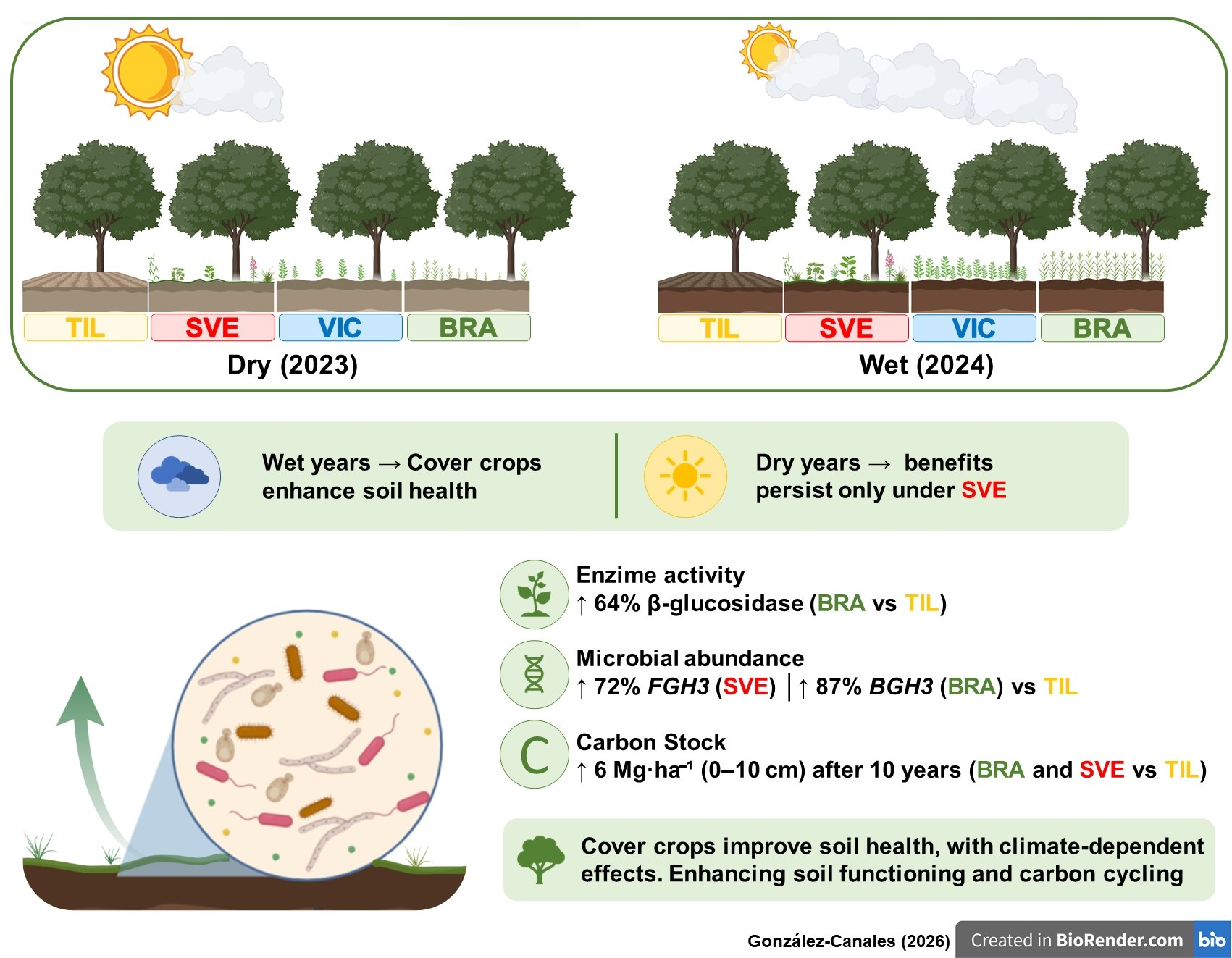
Graphical Abstract

1. Introduction

Olive (Olea europaea L.) is a historical crop with deep roots in the culture, food, and economy of the Mediterranean region [1]. In Spain, olive cultivation is a key component of the national agricultural system, covering 2.83 million hectares and continuing to increase every year [2]. Spain heads European olive oil production, contributing approximately 70% of the total, and accounts for 45% of global production [3]. The Madrid Region has 201,437 ha of useful agricultural area, approximately 15% of which (29,959 ha) are devoted to olive cultivation [2]. Olive groves have traditionally been established on poor soils and sloping lands that are difficult to use for other crops [4]. They are therefore prone to erosion and soil degradation, especially considering that tillage remains the predominant management practice employed on 63% of olive groves in the Madrid Region (40% in Spain) [2]. Soil degradation has become a major environmental concern at the European scale, and the Directive (EU) 2025/2360 (Soil Monitoring Law) [5], has been adopted to address this issue. This Directive establishes a European framework to assess, protect, and restore soil health across Member States.
Several works have shown that the use of cover crops in woody crops, as an alternative to conventional tillage, improves soil properties by reducing erosion and runoff [6,7], while improving soil organic matter, aggregate stability, and soil structure [8,9]. In addition, cover crops promote soil microbial biodiversity through nutrient recirculation and increased nutrient bioavailability [10,11]. However, the success of cover crops in olive groves relies on proper species selection and appropriate mowing timing, to minimize competition for water and nutrients with the main crop [12,13]. This issue becomes particularly relevant under Mediterranean climate conditions and in the context of climate change, where rainfall patterns are expected to become increasingly erratic over time [14].
Soil is a highly dynamic environment where variations in environmental conditions directly affect soil microorganisms, which play a key role in soil functioning and soil fertility by sustaining biogeochemical cycles and nutrient retention [15,16,17]. Climate change-related disturbances affect soil microorganisms [18], with these responses being modulated by soil physical and chemical properties, governed by factors such as parent material, climate, agricultural practices, and land use [19]. These effects on microbial communities are greater in soils with low organic matter content [20], as occurs in gypsum soils. Gypsum soils, typically found in arid and semi-arid regions, tend to be shallow, poor in organic carbon, and therefore highly vulnerable to degradation [21]. Few studies have explored the microbial communities and their activities in gypsiferous soils, suggesting an important role of water availability in their regulation, while soil microbial populations and their role in nutrient cycling remain largely unknown [22].
The use of alternative practices to conventional tillage, such as cover crops, is particularly recommended for gypsiferous soils [23]. Although the effects of cover crops on soil properties have been widely studied from the perspective of erosion control and carbon sequestration [23,24,25,26,27], information on their influence on soil enzymatic activity and microbial abundance remains limited, especially in gypsiferous soils. Modern molecular biology techniques, such as specific functional genes, enable understanding of soil microbial community structure and its functional diversity [28]. These approaches facilitate linking microbial communities with soil biogeochemical processes and their role in soil fertility. It is hypothesized that cover crop management practices enhance soil ecosystem services through increases in soil microbial abundance, soil functioning, and carbon storage, with these effects being stronger under permanent cover management, and more pronounced in wetter years than in dry years. To test this hypothesis, the aim of this study was to evaluate soil biological functioning and carbon stocks under different cover crop systems (spontaneous permanent vegetation, permanent grass cover, and annual legume cover) relative to conventional tillage over two growing seasons with contrasting rainfall conditions. Specifically, soil microbial abundance and activity, along with soil physicochemical properties, were assessed in a gypsiferous soil under olive cultivation in a Mediterranean climate, to elucidate the functional response of the soil microbiome to changes in soil management.

2. Materials and Methods

2.1. Site Description and Climatic Parameters

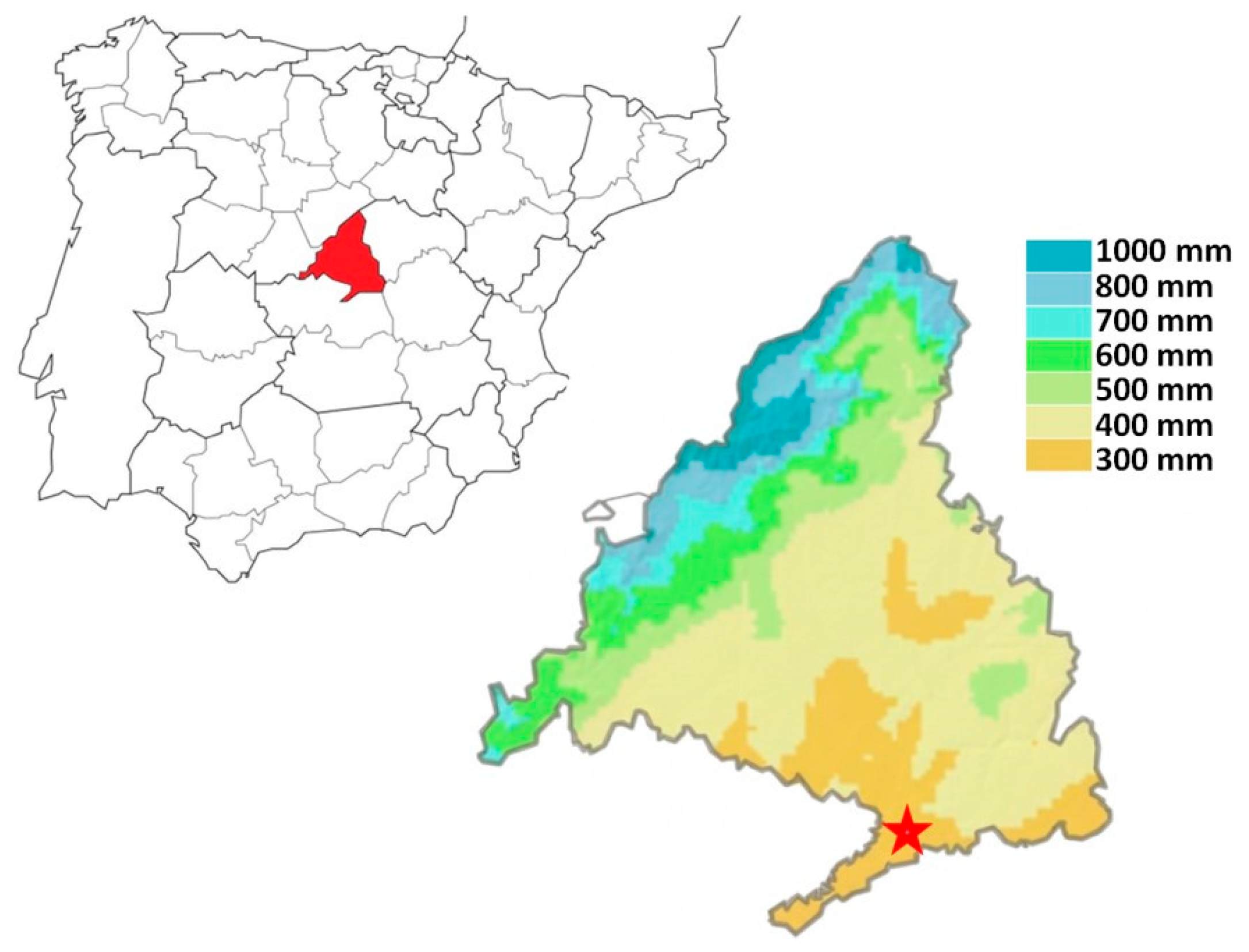
This trial was carried out in an experimental olive grove (Olea europaea L.) located at the experimental farm “La Chimenea”, owned by IMIDRA (Figure 1), in the southern Madrid Region, Central Spain (UTM 30N, ETRS89: X = 455,374; Y = 4,435,754). The olive grove was established in 2004 under an intensive framework spacing of 238 trees·ha−1 (6 × 7 m). The cultivar used was Cornicabra, the most widely grown olive cultivar in Central Spain. This cultivar is well adapted to the region and shows high tolerance to both drought and low temperatures [29]. Soils in the study plot developed from Miocene evaporitic parent materials, mainly composed of saccharoidal gypsum and gypsiferous marls [30]. The soil is classified as a Haplic Gypsisol [31], with a xeric moisture regime and a sandy-clay loam texture. The mean particle-size distribution consisted of 29.1% sand (2000–200 µm), 18.9% fine sand (200–50 µm), 12.0% silt (50–20 µm), and 40.0% fine silt (20–2 µm) and clay (<2 µm); the high gypsum content prevented the separation of clay from fine silt [30].
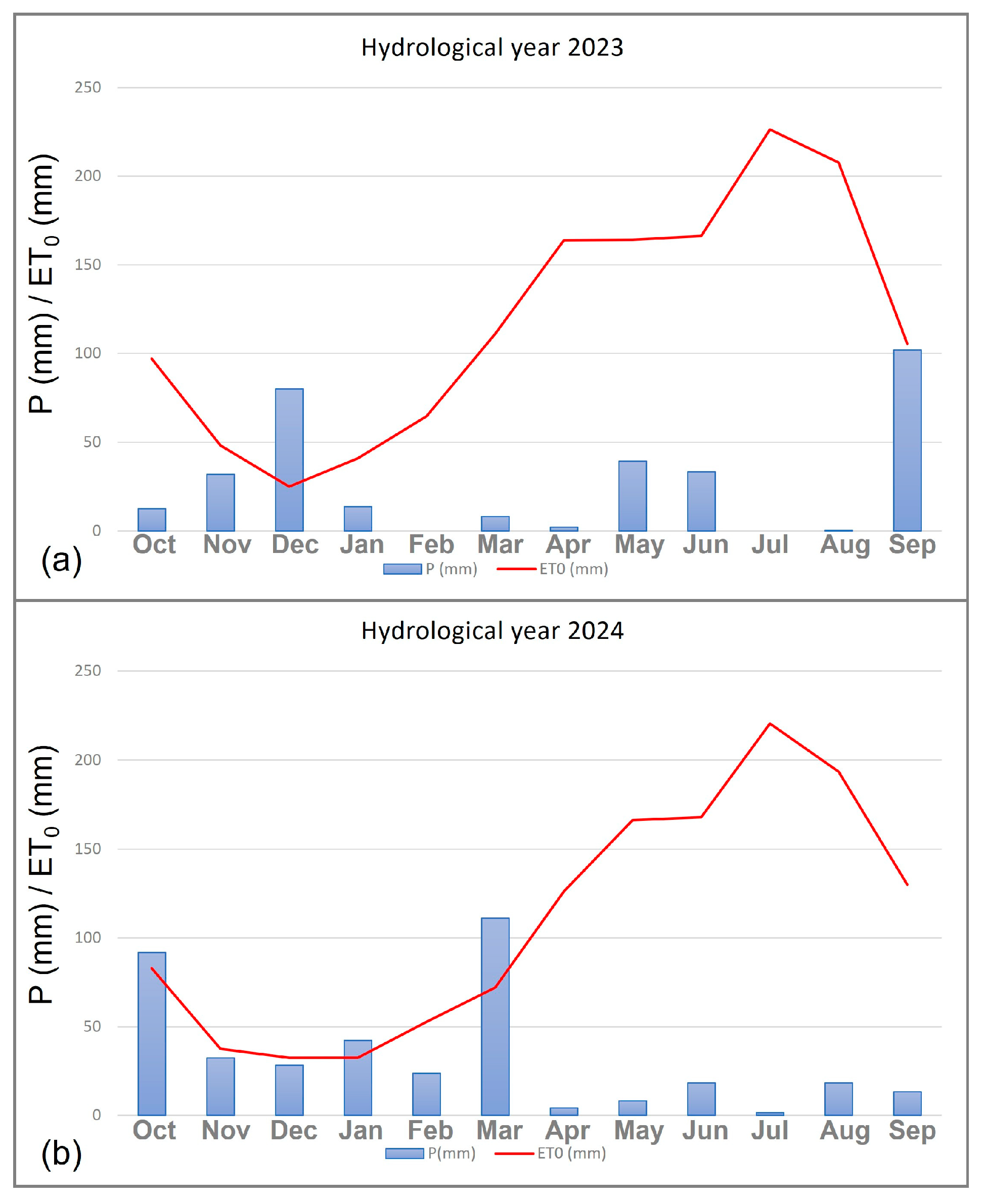
The climate is semi-arid Mediterranean (BSk, Köppen classification), characterized by hot summers and cold winters. The mean annual temperature is close to 16 °C, with seasonal variations typical of the semi-arid Mediterranean climate. The study plot has an on-site weather station (Davis Instruments® Vantage Pro2 Plus; Davis Instruments Corporation, Hayward, CA, USA), which records precipitation (P) and evapotranspiration (ET0), calculated according to the Penman–Monteith method every 5 min. During the study period, P was 324 mm in the 2023 hydrological year (from 1 October 2022 to 30 September 2023; Figure 2a), with a drier period between December 2022 and September 2023. In contrast, P reached 394 mm in the 2024 hydrological year (from 1 October 2023 to 30 September 2024, Figure 2b), with a drier gap between April and September 2024. This represents a 22% increase in P in the 2024 hydrological year compared with the previous year. Although there was a decrease in ET0 of 8% in 2024 compared to 2023 (1314 mm and 1421 mm, respectively), the differences between P and ET0 were lower between January and April 2023 than during the same period in 2024. Therefore, 2024 was wetter and showed greater water availability than the previous hydrological year, especially during the colder months.

2.2. Experimental Design

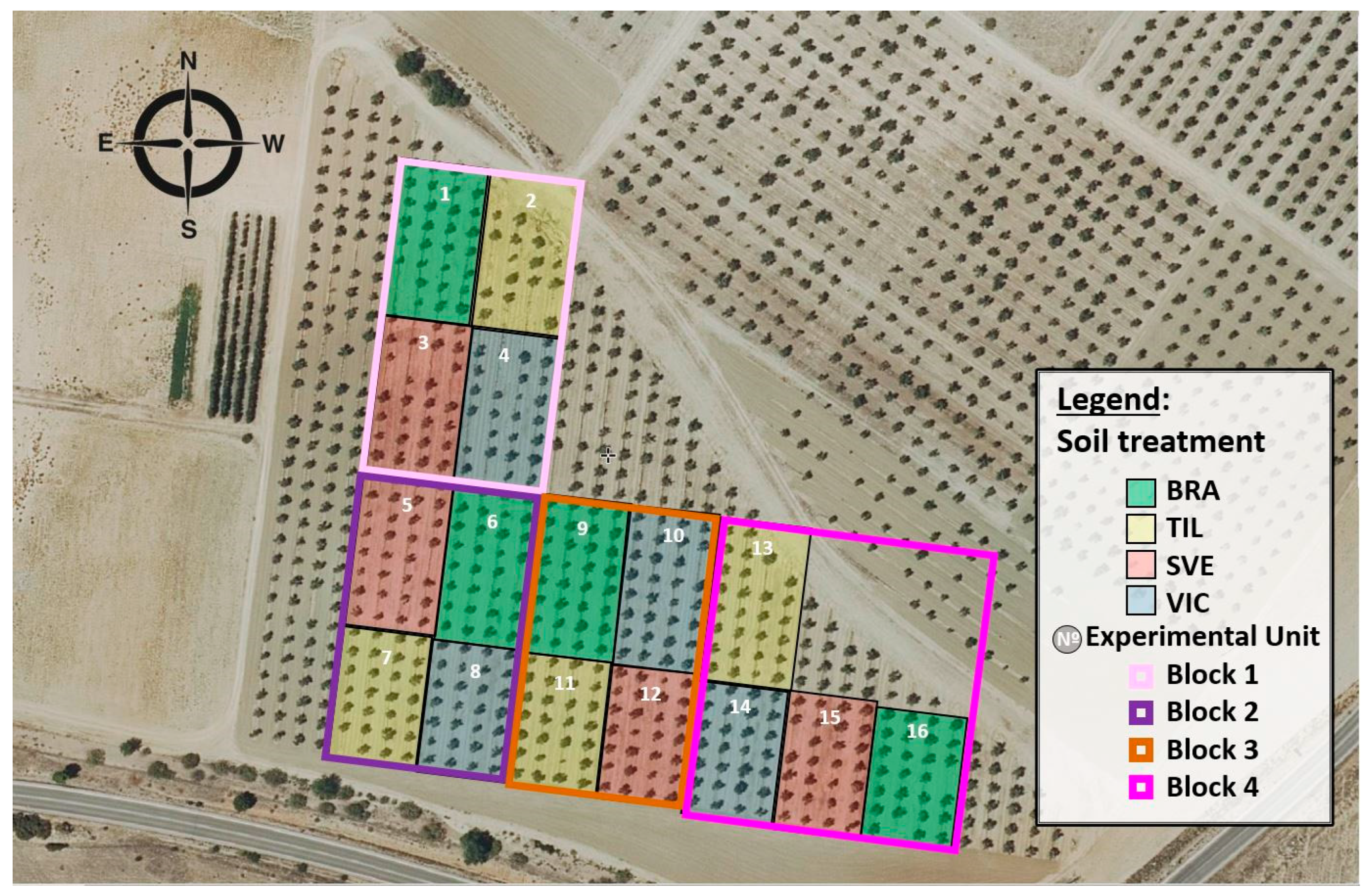
An experimental design was established, considering soil management as the study factor. Four treatments were established: (I) tillage (TIL), consisting of two annual passes in spring and autumn to a depth of 20 cm using a chisel plough; (II) spontaneous permanent vegetation cover (SVE), consisting of permanent natural vegetation, mowed in spring with a brush cutter; (III) annual legume cover, with bitter vetch, Vicia ervilia (L.) Willd. (VIC), sown annually in autumn with a seed dose of 90 kg · ha−1, mowed in spring; and (IV) permanent grass cover of Brachypodium distachyon (L.) P. Beauv. (BRA), sown once in autumn at the beginning of the trial with a seed dose of 40 kg · ha−1 and not requiring mowing. Plant debris was left on the soil surface after mowing. Cover crops were either sown or allowed to grow spontaneously between olive tree rows, with a width of 6 m, and were established in 2014. However, the BRA cover was reseeded in 2022. The experimental plot (Figure 3), with a total area of 3 ha, was divided into four blocks. Within each block, the four treatments were randomly assigned, resulting in a total of 16 experimental units, each with an area of approximately 1200 m2.

2.3. Soil Sampling

Soil sampling was conducted in spring 2023 (May) and spring 2024 (April), when cover crops were fully developed and soil moisture conditions were optimal. In each experimental unit, a composite sample from three points was taken at two depths (0–5 cm and 5–10 cm), as topsoil layers show the greatest microbial activity [33]. The samples were kept cold until they arrived at the laboratory and were divided into three subsamples. After the samples were sieved at 2 mm, an aliquot was kept frozen at −20 °C for microbiological determinations, while another aliquot was refrigerated at 4 °C for the enzyme activity analyses. The rest of the soil sample was air-dried, then sieved at 2 mm. The fraction smaller than 2 mm was saved for physico-chemical analyses. A subsample of the dried sample was used to determine the percentage of gravel larger than 2 mm by weight difference.
Simultaneously, undisturbed soil cores were collected for the determination of soil porosity and bulk density. Penetration resistance (PR) was also measured employing an Eijkelkamp® hand penetrometer (Eijkelkamp, Giiesebeek, The Netherlands) every 5 cm depths (from 2.5 cm and 5 cm to 45 cm) at three random points per experimental unit.

2.4. Plant Cover

The percentage of vegetation cover was determined through a zenithal photograph from a 25 × 25 cm2 quadrat at three points per experimental unit. The resulting vegetation cover percentage was calculated as the mean of estimates made by six trained observers based on three replicates. The vegetation from each quadrat was harvested and dried at 70 °C to determine the amount of dry biomass per surface (g·m−2).

2.5. Soil Physical Analysis

Soil porosity was determined from undisturbed soil cores collected in each experimental unit at two depths (0–5 cm and 5–10 cm) using Eijkelkamp® cylinders (100 cm3, 53 mm ∅). The cylinders were placed in a sandbox and saturated by capillarity, and were subsequently drained using the suction method, in an Eijkelkamp® sandbox, to determine pF between 0 and 1.8 (0.1 to 10 kPa, respectively) by gravimetric measurement. Subsequently, water retention between 1.8 and 4.2 pF (30 to 1500 kPa, respectively) was determined using a pressure plate extractor [34], by progressive drying of soil core samples. Finally, samples were oven-dried overnight at 105 °C to remove all water content, equivalent to pF 7 [35]. The dry weight of undisturbed core samples was also used to calculate bulk density by the cylinder method [36].
According to Taboada et al. [37] and Bienes et al. [38], the relationship between water-holding capacity and pore size is defined as: macropores, spaces larger than 60 µm, correspond to pF values between 0 and 1.8; mesopores correspond to spaces between 60 µm and 10 µm, associated with pF values from 1.8 to 2.54; and micropores are pores smaller than 10 µm, corresponding to pF values above 2.54. The water contained in the pores up to pF 2.54 is defined as field capacity, and the difference in water retained between pF 2.54 and 4.2 as available water content. Finally, the wilting point is defined as the water volume retained between pF 4.2 and the oven-dried sample.

2.6. Soil Chemical Analysis

Soil chemical properties were measured in triplicate using the <2 mm sieved and air-dried samples. Electrical conductivity (EC) and pH were determined in a 1:5 and 1:2.5 (w:v) soil-to-water suspension, respectively.
Soluble NH4+ was extracted from a 1:10 (w:v) soil:potassium chloride (KCl 2 M) ratio according to Keeney et al. [39]. The amount of NH4+ was quantified colorimetrically after reaction with salicylate and cyanurate reagents in a UV–visible spectrophotometer at a wavelength of 650 nm.
Assimilable phosphorus (POL) was assessed following Olsen et al. [40] and quantified in a UV–visible spectrophotometer at a wavelength of 882 nm. Both determinations were measured using a Tecan® Infinite 200 PRO MNano multi-well plate reader.
Soil organic carbon (SOC) was determined by the wet oxidation method described by Walkley and Black [41]. The C stock values calculated to a specific thickness were obtained as described by [42]:
C   s t o c k = [ SOC ] × BD × d × ( 1 δ 2   mm ) × 10 2 ,
where [SOC] is the concentration of soil organic carbon (%); BD is bulk density (Mg · ha −1); d is the thickness of the soil layer (m); and δ2 mm is the percentage of gravel larger than 2 mm (%).

2.7. Soil Microorganisms and Soil Functioning Analysis

DNA was extracted from soil samples using the DNeasy PowerSoil Pro (QIAGEN®, Hilden, Germany) extraction kit following the manufacturer’s instructions. To quantify the abundance of the main groups of the soil microbial community by quantitative polymerase chain reaction (qPCR), genetic markers targeting conserved regions were used. Fungal abundance was determined using the internal transcribed spacer (ITS) region, while the 16S rRNA gene region was used for total bacteria and archaea, with group-specific primers. Additionally, molecular markers targeting functional genes associated with soil biogeochemical cycles were employed. For the carbon cycle, and specifically to evaluate β-glucosidase activity, the BGH3 (bacteria) and FGH3 (fungi) markers were used from the bgl3 gene. With respect to the nitrogen cycle, genes involved in nitrification were quantified, particularly the ammonia monooxygenase gene (amoA) for ammonia-oxidizing bacteria (AOB) and ammonia-oxidizing archaea (AOA). In addition, the ureC gene associated with bacterial urease activity was analyzed. Finally, for the phosphorus cycle, the phoD marker was used, which is related to phosphatase activity involved in the transformation of organic phosphorus into inorganic forms. Standard curves for each molecular marker were generated from serial dilutions of plasmid DNA. Primers for each target gene and qPCR conditions, which varied depending on the molecular marker, followed the protocols described in the references listed in Table 1. All qPCR reactions were performed in duplicate, including a negative control without a sample on the same plate. qPCR reactions were carried out using the enzyme KAPA SYBR FAST qPCR Master Mix (2X) kit (Biosystems, Roche®) on a QuantStudio 3 Real-Time PCR System (Thermo Fisher Scientific®, Waltham, MA, USA) thermocycler.
One representative hydrolase soil enzyme was selected from each major biogeochemical soil nutrient cycle: β-glucosidase (B-glu) involved in the carbon cycle; urease (Ure) involved in the nitrogen cycle; phosphatase (Phos), involved in the phosphorus cycle; and arylsulphatase (Aryls), involved in the sulfur cycle.
Soil enzyme activities were assessed in triplicate, following the ISO 20130 standard [52]. The substrates, incubation conditions, and reaction products are summarized in Table 2. Enzyme activities were quantified colorimetrically at 405 nm for p-nitrophenol (PNP) and 650 nm for ammonium chloride (NH4Cl) using a Tecan® Infinite 200 PRO MNano multi-well plate reader UV–visible spectrophotometer.

2.8. Statistical Analysis

A General Linear Model (GLM) was applied with year, soil management, and depth as factors. Main effects and interactions were evaluated using ANOVA, and the LSD test was applied for a p-value < 0.05, conducted using Statgraphics Centurion 19 (Statgraphics Technologies, Inc., The Plains, VA, USA). Normality, homoscedasticity, and kurtosis of the data were verified, applying logarithmic (log10) or Box–Cox transformations when necessary. In addition, analyses were performed separately for each depth and year, considering management as a factor, a one-way ANOVA with Fisher’s LSD test was applied for a p-value < 0.05.
A multivariate analysis was performed employing R software [53] (version 4.3.0; R Foundation for Statistical Computing, Vienna, Austria), using the variables that showed significant differences in the ANOVA analysis and selecting those with the highest absolute Pearson correlation coefficients (|r|). A principal component analysis (PCA) was conducted using the prcomp function from the stats package [53]. Only complete observations were included, and variables were standardized to avoid the influence of different measurement units. The factoextra and ggplot2 packages [54,55] were used to generate and visualize graphs. The results were represented using biplots with 95% confidence ellipses, grouping the samples according to the study factors (management, year, and depth).

3. Results

3.1. Plant Cover and Biomass

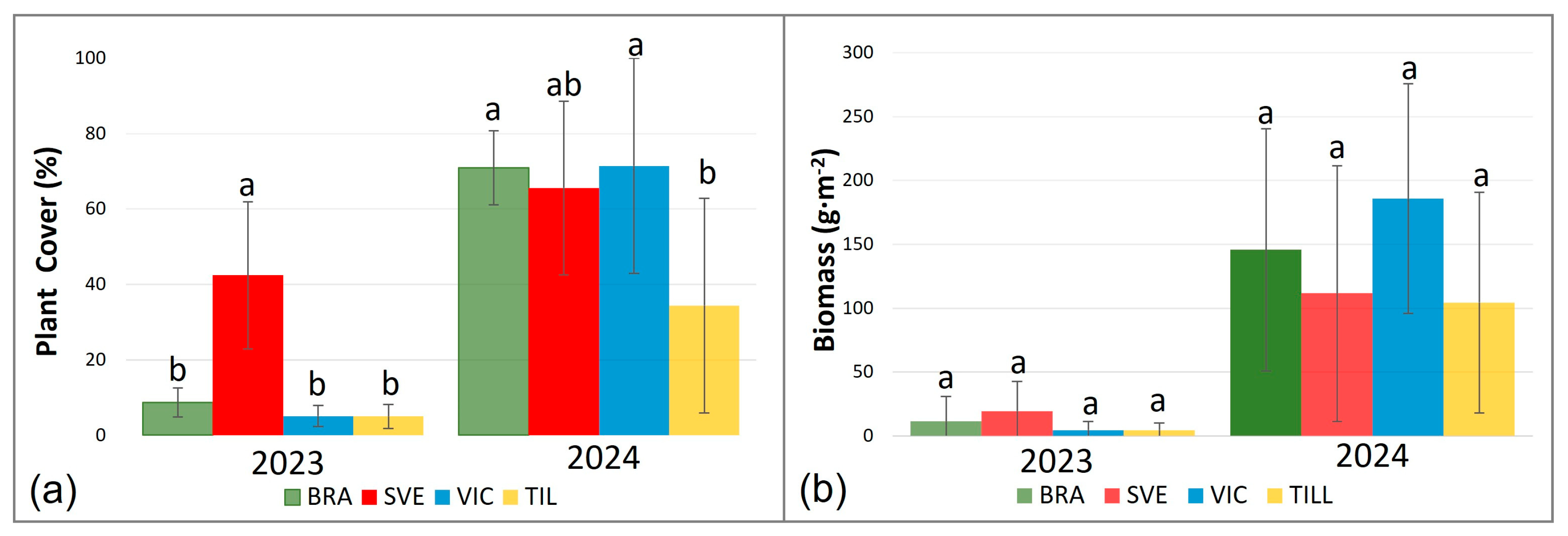
Plant cover and biomass harvested were significantly higher in 2024 than in 2023, increasing by approximately four and fourteen times, respectively. Significant differences in plant cover were also detected among soil management practices, with TIL showing the lowest values (19%) compared with the cover crop managements (Figure 4a).
When analyzed separately by year, in 2023, significant differences were observed among treatments, with more than 40% of plant cover in SVE compared to less than 10% in the other soil managements. In 2024, significant differences were still found between BRA and VIC (71% and 72%, respectively) compared with TIL (32%). No differences were found in the amount of biomass among the soil managements (Figure 4b).

3.2. Soil Physics

3.2.1. Soil Porosity

Soil porosity analysis showed significant differences by year in macroporosity and total porosity, with higher mean values in 2024 than in 2023 (22% and 6%, respectively). No differences were found in porosity among soil management practices (Table 3). However, significant differences were found by depth, with higher values of macroporosity and total porosity in the surface layer. No significant treatment effects were found for field capacity, wilting point, or available water content (Table S1).

3.2.2. Bulk Density

Bulk density (BD) recorded significantly higher mean values in 2023 (1.40 g·cm−3) compared with 2024 (1.31 g·cm−3). Among soil management practices, TIL showed the lowest BD, with 1.28 g·cm−3. Differences between depths were also observed, with higher BD in the 5–10 cm layer (1.41 g·cm−3) compared with the surface layer (1.30 g·cm−3) as shown in Table 3.

3.2.3. Penetration Resistance

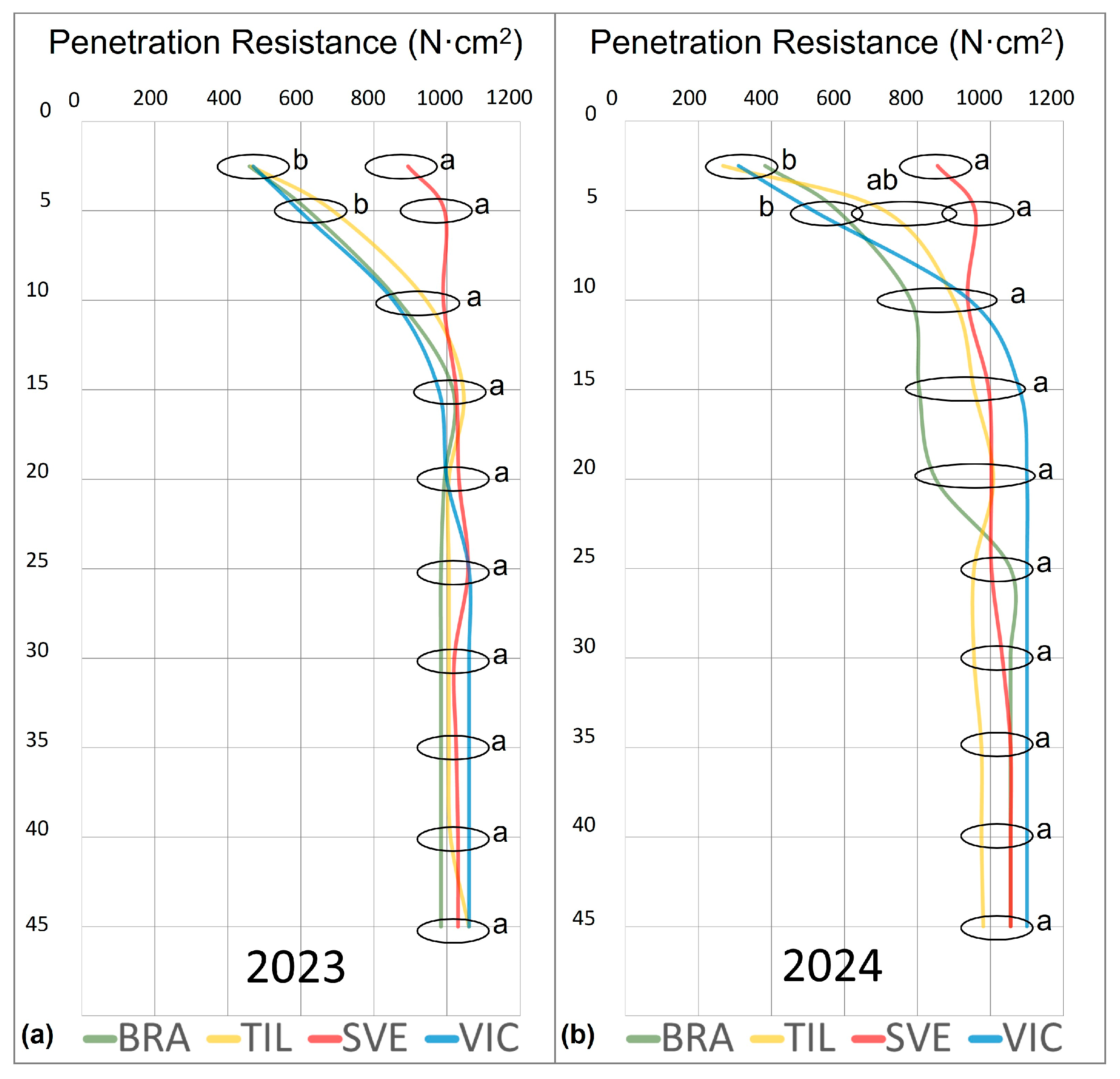
The mean values of penetration resistance (PR) showed significant differences in both years only in the most superficial depths (2.5 cm and 5 cm), where SVE exhibited higher compaction than the other soil management practices. No differences were found in the remaining depths (Figure 5).

3.3. Soil Chemistry

3.3.1. Soil pH and Electrical Conductivity

Statistically significant differences in soil pH and EC were found between the two study years, with higher values in 2023 in both cases. Differences in pH were also found among soil management practices and depths. No significant differences in EC were detected among the treatments or depths. As shown in Table 3, small but significant differences among treatments were observed, with the lowest pH values observed in SVE and VIC (7.62 and 7.63, respectively). TIL showed the most basic pH (7.75), and BRA showed intermediate values of 7.68, significantly differentiated from both groups.

3.3.2. NH4+ and P Availability

Soil NH4+ availability showed significant differences among soil management practices. TIL showed the lowest values of 74.34 mg·kg−1, as shown in Table 3. A significant increase of 5% was observed in SVE and VIC, compared with TIL. Although no differences were found with soil depth for NH4+, it was affected by year (p < 0.1), with greater values in 2024 than in 2023. In 2024, particularly at the second depth, VIC showed an 11% increase in NH4+ levels compared with TIL (Table S2). No significant differences were found in soil available P (POL) (Table S2).

3.3.3. Carbon Storage

The SOC and C stock analyses exhibited a similar pattern, with no significant differences between the two years of study. However, significant differences were found among soil management practices and depths. As shown in Table 3, SOC showed significantly higher values in BRA and SVE, with 12.84 g·kg−1 and 12.48 g·kg−1, respectively, and the significantly lowest SOC concentration was found in TIL, with 8.83 g·kg−1. In the same way, the lowest C stock values were recorded under TIL, which differed significantly from the rest of the soil management practices (Table 3). Intermediate values were observed in the annual VIC cover, showing a significant 22% increase in C stock compared with TIL. The highest C stock values were recorded under the permanent covers, BRA and SVE, with significant increases of 61% and 51% of C stock, respectively, compared with TIL.
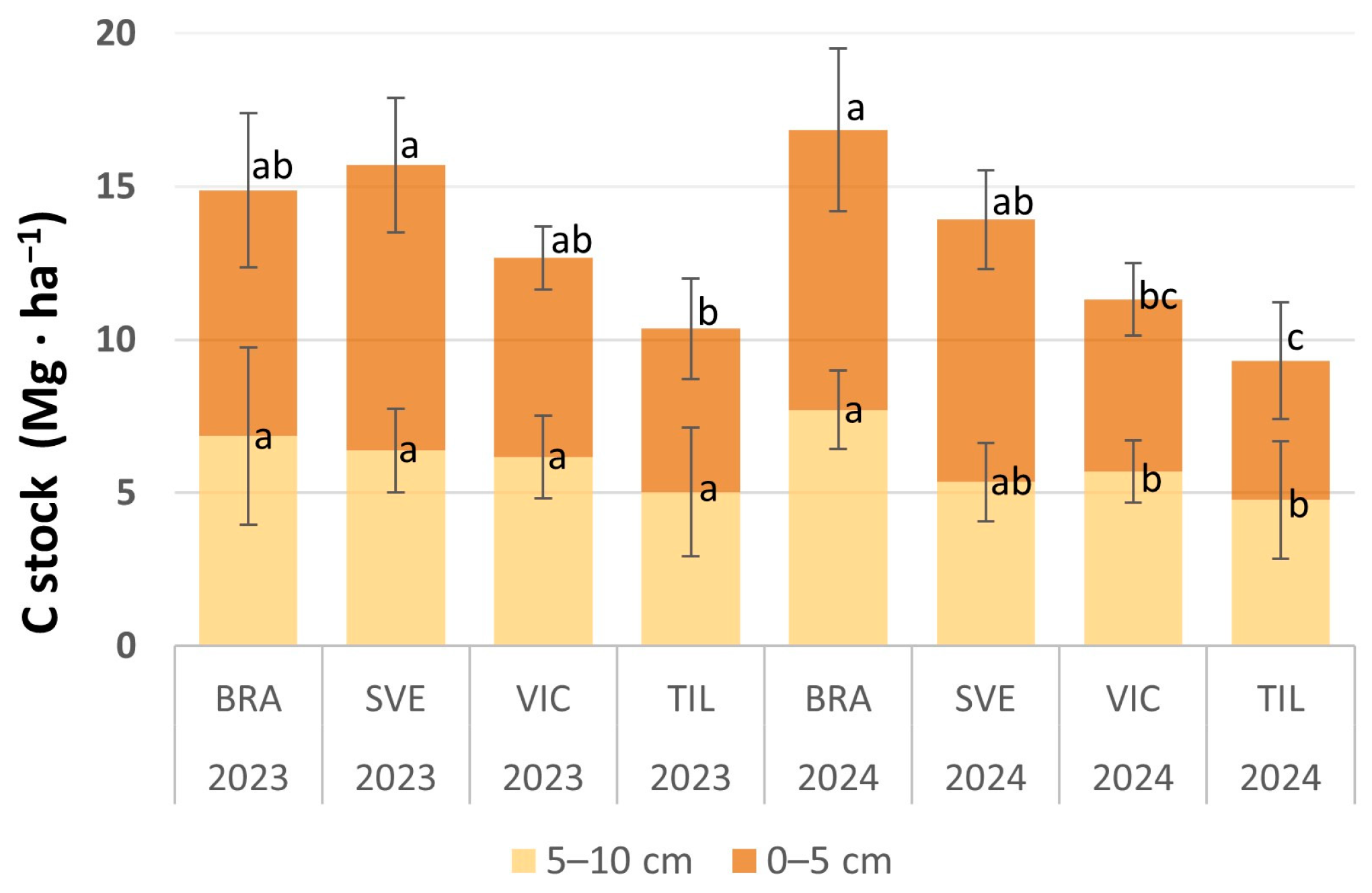
The analysis within each year and depth (Figure 6) indicates significantly higher C stock in 2024 than in 2023. In 2023, significantly higher values of C stock were recorded in SVE (9.32 Mg·ha−1) and lower values under TIL (5.33 Mg·ha−1) at a 0–5 cm depth, and no significant differences were found at 5–10 cm. In the whole soil profile (0–10 cm) the largest increase was observed under BRA and SVE, with increases of 5 Mg·ha−1 compared with TIL. In 2024, significant differences were detected between BRA and SVE (9.13 and 8.57 Mg·ha−1, respectively) compared with TIL (4.54 Mg·ha−1) in the topsoil layer. In the second layer, BRA showed higher C stock content with significant differences compared with TIL and SVE. In the whole soil profile (0–10 cm), the largest increase was observed under BRA and SVE, with increases of 8 Mg·ha−1 and 5 Mg·ha−1, respectively, compared with TIL.

3.4. Soil Microorganisms and Soil Functioning

3.4.1. Enzyme Activity

The analysis of soil enzyme activity showed distinct performance across years, soil management, and depths. As shown in Table 4, B-glu and Aryls, showed similar patterns, with a significant increase of 24% and 15%, respectively, in 2024 compared with 2023. In both enzyme activities, TIL was the management with the significantly lowest values, with an increase in enzyme activity with cover crop management for B-glu (BRA 62%, SVE 52% and VIC 53%) and Aryls (BRA 61%, SVE 65% and VIC 45%). However, no significant differences were detected among the cover crop managements. Differences with depth were also observed, with higher values of B-glu and Aryls at the surface (approximately 40% in both cases) than in the 5–10 cm layer. Regarding Ure activity, no significant differences were found between years. TIL showed significantly lower Ure activity compared with the cover crop management, with increases of 15%, 27% and 21% under BRA, SVE, and VIC, respectively, although no differences were detected among covers. In addition, a significant decrease of 30% in Ure activity was observed in the second depth layer. Phos activity showed a significant increase of 53% in 2024 compared with 2023. No significant differences were found in Phos activity among soil management or depths (Table S3).

3.4.2. Microorganism Abundance

Different patterns in microbial abundance (fungi, bacteria, and archaea) were observed across years, soil management, and depths. Total fungal abundance showed no significant differences between years, soil management practices, or depths, as shown for ITS in Table 4. However, when each year was analyzed separately, ITS abundance in 2024 was significantly higher under TIL than under permanent cover BRA, where ITS decreased by 58% in the number of copies·g−1, in the topsoil layer (Table S4) compared with TIL. No significant differences were detected at the 5–10 cm depth, or in any soil management in 2023. Total bacterial abundance, measured as 16S rRNA gene copies·g−1 (Table 4), showed significant differences between years, with an increase of nearly 120% in 2024, the wet year, compared with the dry year (2023). In contrast, total archaeal abundance (Table 4) was significantly higher in 2023 than in 2024, declining by half in the wet year.
Regarding functional genes, the FGH3 and BGH3 genes (both involved in the C cycle) showed significant differences between years and among soil management practices (Table 4). In contrast, they followed different trends between years, with FGH3 showing an almost twofold increase in 2024, whereas BGH3 decreased by one-third in 2024 compared with 2023. For the soil management practices, both FGH3 and BGH3 showed significantly lower values in TIL, with 6.87 × 10⁴ and 2.33 × 10⁵ number of copies·g−1, respectively. However, FGH3 showed the significantly highest values in SVE, with an increase of 72% compared with TIL. There were no differences in BGH3 among the other soil management practices. The phoD gene, associated with the phosphorus cycle, showed significant differences between years, with a decrease of 98% in 2024 compared with 2023. Differences were also found among soil management practices (p < 0.1), with SVE showing a 90% increase in the number of copies·g−1 compared with TIL. The genes related to the N cycle, AOB, AOA, and ureC, followed a similar pattern, with significant differences between years, declining to half of the number of copies·g−1 in 2024. No differences were found among soil management practices or depths for AOB and ureC (Table S5). However, differences between depths were detected for AOA.

3.5. Multivariate Analysis

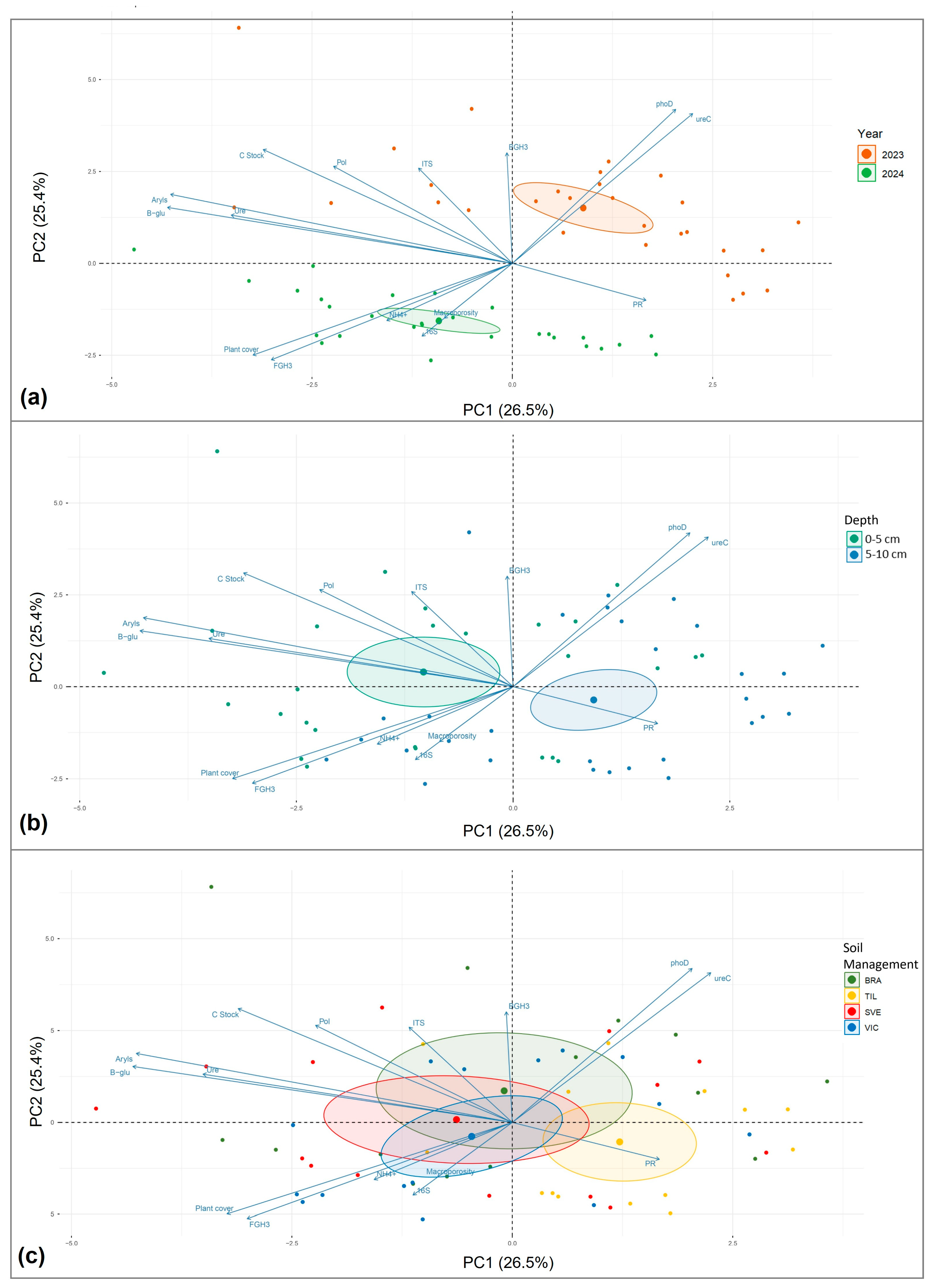
Principal component analysis (PCA) was conducted using 15 physico-chemical and biological soil variables that had significant differences in at least two factors in the GLM analysis, ensuring the representation of all groups of microorganisms and all the nutrient cycles. Those variables were: enzyme activities (B-glu, Aryls, Ure), functional genes (ITS, 16S, FGH3, BGH3, ureC, and phoD), C stock, NH4+, and POL, macroporosity, plant cover, and PR. The analysis (Figure 7) explained 51.9% of the total variance. The first principal component (PC1), with 26.5% of the variance explained, showed a strong positive correlation between soil enzyme activities (B-glu, Aryls, and Ure), FGH3, C stock, and plant cover percentage, and a negative correlation with the functional genes phoD and ureC and with penetration resistance. The second component (PC2), with 25.4% of the variance explained, was negatively correlated with the functional genes phoD, ureC, BGH3, C stock, POL, and fungal abundance, and showed a strong positive correlation with macroporosity, plant cover percentage, FGH3, and bacterial abundance.
Based on the PCA analysis (Figure 7a), a sample ordination was identified according to the year. In 2023, functional genes (phoD and ureC), PR, and fungal abundance had a greater influence on sample ordination compared with 2024, which was characterized by a stronger effect of plant cover percentage, NH4+, macroporosity, FGH3, and bacterial abundance. As shown in Figure 7b, samples were also ordinated across soil depth. In the topsoil layer (0–5 cm), biological variables (enzyme activity, fungal abundance) and C stock were most influential, while in the second layer (5–10 cm), PR and the absence of biological variables played a more important role. From the soil management perspective (Figure 7c), no clear separation was observed between the ellipses.
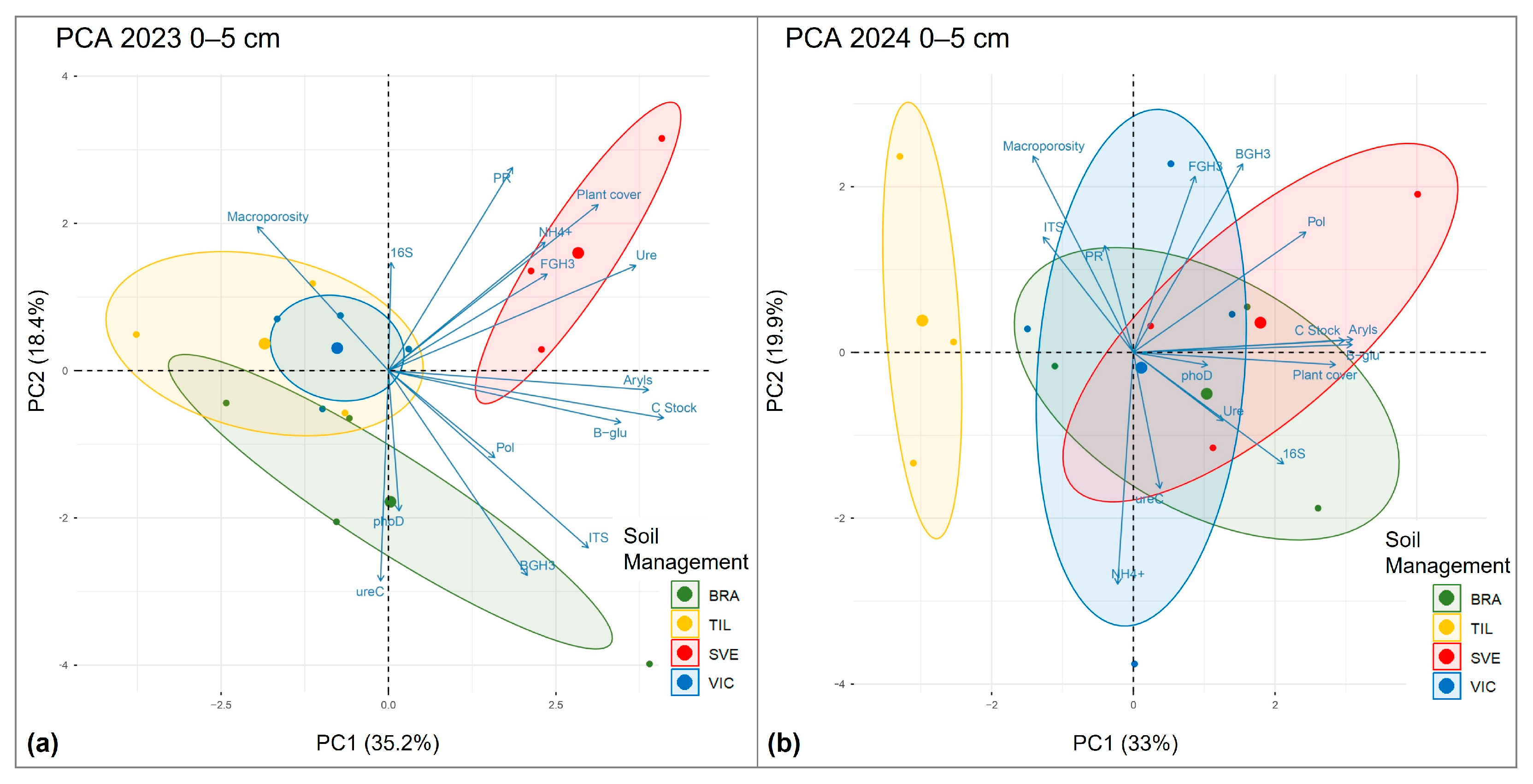
When data were analyzed separately for each year and depth, differences among the soil management practices were observed at the 0–5 cm layer (Figure 8). Considering the first depth, in 2023 (Figure 8a), PCA explained 53.6% of the variance by the first two principal components (PC1 35.2% and PC2 18.4%). PC1 revealed a clear differentiation in sample positioning between SVE and the other soil management practices. SVE exhibited a greater influence from C stock, vegetation cover, penetration resistance (PR), enzyme activity, NH4+, and the FGH3 gene. BRA was influenced by ITS abundance and the functional genes BGH3, ureC, and phoD, as well as POL availability. TIL and VIC were largely overlapping, mainly influenced by soil macroporosity. In 2024 (Figure 8b), PCA explained 52.9% of the variance by the first two principal components (PC1 33% and PC2 19.9%). A strong overlap was observed among the vegetation cover managements (BRA, SVE, and VIC), which were more influenced by the soil biological properties, such as bacterial abundance, enzyme activity, and C stock. A clear distinction was observed between vegetation cover managements and TIL samples, which was primarily associated with fungal abundance, macroporosity, and PR. These trends were observed at the 5–10 cm depth in both years. However, all soil management practices overlapped at this depth, and no differences among soil management practices were detected (Figure S1).

4. Discussion

Significant differences between years (Figure 7a) are attributed to interannual meteorological variability, which affects soil environmental conditions and, consequently, soil microorganisms. The magnitude and timing of precipitation are key drivers of plant growth and survival in semiarid climates [56]. Changes in rainfall patterns strongly control plant development by influencing plant physiology and resource allocation, as well as soil and vegetation processes [57]. According to Borowik and Wyszkowska [58], soil moisture modifies the conditions for soil microorganisms; both excessive moisture and drought can negatively affect the microbial populations and their activity. In this study, the effect of fluctuating moisture between years was evident, with the influence of plant cover being more pronounced in the wetter year (2024; P: 394 mm) than in the drier year (2023; P: 324 mm). These changes in the aboveground vegetation communities affect soil microorganisms, as well as litter inputs and root exudates into the soil [9,59,60]. Moreover, there was a greater bacterial abundance in 2024, in contrast to a higher fungal abundance in 2023. This could be explained by the greater adaptive capacity of bacteria to environmental shifts, while fungi exhibit higher resistance to drought due to their hyphal network [15,60]. Soil biological properties (strongly correlated among them) B-glu, Aryls, and Ure activity, C stock, fungi abundance, and POL had a greater influence on sample ordination in the 0–5 cm soil layer. However, this effect is reduced with increasing soil depth, as has been observed by other authors [61,62,63]. In the 5–10 cm depth, there is a greater influence of soil physical properties such as PR and macroporosity, which are closely related to compaction processes [9]. This effect is associated with changes in soil physical properties, as well as in the quantity and quality of soil organic carbon and soil microbial community composition [61]. Unlike 2023, the improvements observed in 2024 extend beyond the surface soil layer (0–5 cm), suggesting a deeper influence associated with higher root growth and exudate deposition. Overall, this allowed microorganisms to fully express their role in the nutrient cycle during the wet year.
Due to the strong influence of year and soil depth on all variables, performing the analysis separately by year and depth sharpened the contrast among the different management practices in the first 5 cm of soil (Figure 8). Consistent with these results, more favorable environmental conditions, together with the successful establishment of cover crops, resulted in a substantial increase in soil microorganisms. In both years, TIL and SVE were the most contrasting management practices, with a greater influence of soil biological properties in SVE and a stronger influence of soil physical properties under TIL. However, in 2024, these differences became more pronounced due to favorable meteorological conditions that enhanced cover crop establishment. In line with these results, tillage has been shown to reduce bulk density and penetration resistance, although these effects are usually limited to the upper soil layer [6,64]. Similarly, higher macroporosity has been observed in tilled soils as a consequence of soil structure loss, which exposes carbon and facilitates its loss [65,66]. In line with this, tillage affects soil health by reducing soil organic carbon stocks and affecting soil microorganism populations and their activity [67]. Manici et al. [68] reported that changes in soil physical properties, such as macroporosity, are correlated with fungal abundance, which is consistent with the results observed in the present study.
Despite higher fungal abundance under TIL, the lower C stock resulted in lower FGH3 and BGH3 abundances under TIL compared with SVE, affecting soil microorganisms that play a key role in carbon mineralization [69]. This points to a lower soil capacity to transform carbon under tillage, due to the depletion of the more labile carbon sources, leaving more recalcitrant compounds available for fungal degradation, suggesting a shift in the microbial population from bacteria to fungi [70]. In addition, lower values of SOC under tillage influenced soil moisture, and therefore soil microorganisms and soil functioning [71]. The use of cover crops has been shown to improve soil functioning by increasing soil enzyme activities, bacterial abundance, and altering microbial community structure [72,73]. This response could be used as an indicator of the potential of soil under cover crop management to decompose organic matter and enhance nutrient availability across the agroecosystem [74]. The most notable differences among managements were observed in carbon stock and B-glucosidase activity for permanent cover management (BRA and SVE) compared with TIL, with a mean increase of 6 Mg·ha−1 in the 0–10 cm soil layer after ten years of the cover crops management in the study plot. In agreement with these results, some authors found a higher carbon storage and a wider availability of C sources, enhancing microbial abundance and enzyme activity when using sustainable soil management practices [75,76].
A higher bacterial abundance was observed in SVE. This increase had a marked influence on the nitrogen and phosphorus cycles. These results are consistent with reports indicating that N cycling is largely mediated by bacteria in olive groves with sustainable management, where N is often a limiting resource [77]. In the same way, the nitrogen cycle is strongly influenced by tillage, which can reduce nitrogen availability because it limits the incorporation of organic residues, thereby compromising microbial activity and nitrogen mineralization [78]. According to Oram et al. [60], under conditions of high-intensity drought, shifts occur in the nitrifying microbial community, leading to a higher abundance of AOA and lower AOB levels. In agreement with this, TIL exhibited lower AOB levels compared with permanent cover managements, associated with less favorable conditions. This reduction in microbial functioning under TIL was reflected in significantly lower urease activity levels. The higher urease levels observed under cover crop management resulted mainly from fungal or archaeal urease activity, which would not be detected by the bacterial ureC gene [79]. This, in turn, resulted in higher NH4+ contents under cover crops, mainly in VIC management, likely associated with the nitrogen-fixing role of legumes. This generalized decrease indicates a direct impact of tillage on soil functioning, affecting both carbon and nitrogen cycles.
As delineated in Directive (EU) 2025/2360 (Soil Monitoring Law) [5], soil compaction, the loss of soil organic carbon, and soil biodiversity are key descriptors of soil health. In this study, these aspects are evaluated in relation to cover crop management, showing that the use of cover crops enhances soil biological functioning compared with tillage. These findings underline the importance of short-term environmental fluctuations in the selection of soil management practices within semi-arid Mediterranean agroecosystems, mainly driven by climatic factors. Although the most notable differences occur in years with higher rainfall, when biomass was more developed, the positive effects of cover crops can also be seen in years with lower rainfall. However, once vegetation is established, permanent cover systems seem to provide greater benefits, sustaining microbial activity, promoting nutrient cycling, improving carbon storage, and enhancing soil health. Based on these variables, robust soil health indicators could be developed to provide rapid information on the condition of agricultural soils. However, further research is needed to assess the seasonal behavior of these parameters under different environmental conditions and management practices, ensuring long-term temporal stability.

5. Conclusions

This work studied the effects of different cover crop systems (spontaneous permanent vegetation, SVE; permanent grass cover, BRA; and annual legume cover, VIC) relative to conventional tillage (TIL) in a semi-arid Mediterranean olive grove over two growing seasons with contrasting rainfall conditions. Increased annual precipitation promoted greater plant cover and biomass, which in turn enhanced soil enzyme activity, bacterial abundance, and soil porosity. Soil under cover crops exhibited markedly higher enzyme activity. Genes involved in the carbon cycle (FGH3 and BGH3) showed substantially higher abundance under the permanent covers (SVE and BRA) and a lower increase under VIC compared with TIL, indicating an enhanced potential for organic carbon turnover under cover crops. These results indicate a coordinated improvement in carbon cycling processes, translated into a substantial increase in soil carbon stocks under permanent cover crops compared with TIL. Sown cover crops (BRA and VIC) showed intermediate effects, improving soil enzyme activity and microbial abundance compared with tillage, although BRA produced a stronger response than VIC. Overall, cover crops enhanced soil health in a semi-arid Mediterranean olive grove compared with tillage, with effects strongly modulated by interannual rainfall variability. Spontaneous vegetation covers proved particularly effective in maintaining soil functioning even under lower rainfall conditions.

Supplementary Materials

The following supporting information can be downloaded at: https://www.mdpi.com/article/10.3390/agronomy16090906/s1, Table S1: Mean values of soil physical properties; Table S2: Mean values of soil chemical properties; Table S3: Mean values of soil enzyme activities; Table S4: Mean values of soil microorganism abundance; Table S5: Mean values of soil functional genes; Figure S1: Principal Component Analysis 5–10 cm (PCA).

Author Contributions

Conceptualization, B.S.; methodology, J.P.M.-S. and M.N.; software, J.G.-C. and R.R.; validation, J.G.-C., M.N. and R.M.-J.; formal analysis, J.P.M.-S. and J.G.-C.; investigation, J.G.-C., J.P.M.-S., R.R. and R.M.-J.; resources, B.S.; data curation, J.G.-C. and M.N.; writing—original draft preparation, J.G.-C.; writing—review and editing, B.S., M.N. and J.P.M.-S.; visualization, R.R. and R.M.-J.; supervision, B.S., J.P.M.-S. and M.N.; project administration, B.S.; funding acquisition, B.S. All authors have read and agreed to the published version of the manuscript.

Funding

This research was funded by IMIDRA under projects: FP22-RIEFOLI and FP24-RIEFOLI-2. Javier González-Canales contract is financially supported under grant PRE2021-097966, funded by MCIN/AEI/10.13039/501100011033 and by ESF Investing in your future.

Data Availability Statement

The data presented in this study are available on request from the corresponding author, due to the dataset forming part of an ongoing PhD thesis and a larger research project that is currently generating additional publications. To avoid interference with these ongoing processes, the data cannot yet be made publicly available; however, they can be provided by the authors upon reasonable request.

Acknowledgments

We are grateful to A. Pato, J. Sevillano and D. Rodríguez for their laboratory work; to the internship students who contributed to the RIEFOLI project; and to R. Saiz-Saiz, T. Diaz-Riquelme and their team from “La Chimenea” experimental farm for their technical support. During the preparation of this manuscript/study, the authors used Microsoft Copilot (Microsoft Corporation, Redmond, WA, USA) for the purposes of grammar and language refinement. The authors have reviewed and edited the output and take full responsibility for the content of this publication.

Conflicts of Interest

The authors declare no conflicts of interest.

Abbreviations

The following abbreviations are used in this manuscript:
BRAPermanent grass cover of Brachypodium distachyon
C StockCarbon stock
ET0Evapotranspiration
PPrecipitation
PCAPrincipal component analysis
POLAssimilable phosphorous
PRPenetration resistance
TILConventional tillage
SOC Soil organic carbon
SVESpontaneous permanent vegetation cover
VICAnnual cover with legumes, Vicia ervilia

References

  1. Diez, C.M.; Trujillo, I.; Martinez-Urdiroz, N.; Barranco, D.; Rallo, L.; Marfil, P.; Gaut, B.S. Olive domestication and diversification in the Mediterranean Basin. New Phytol. 2015, 206, 436–447. [Google Scholar] [CrossRef] [PubMed]
  2. MAPA Encuestas Sobre Superficies y Rendimientos de Cultivos. Resultados Nacionales y Autonómicos (ESYRCE) 2024. Madrid. 2025. Available online: https://www.mapa.gob.es/dam/mapa/contenido/estadisticas/temas/estadisticas-agrarias/2.agricultura/1.-encuesta-sobre-superficies-y-rendimientos-de-cultivos--esyrce/2024/avanceresultados2024/boletin20231.pdf (accessed on 24 October 2025).
  3. MAPA. Aceite de Oliva y Aceituna de Mesa. Available online: https://www.Mapa.Gob.Es/Es/Agricultura/Temas/Producciones-Agricolas/Aceite-Oliva-y-Aceituna-Mesa/Aceite (accessed on 10 October 2025).
  4. Bombino, G.; Denisi, P.; Gómez, J.A.; Zema, D.A. Water infiltration and surface runoff in steep clayey soils of olive groves under different management practices. Water 2019, 11, 240. [Google Scholar] [CrossRef]
  5. European Parliament and of the Council. Directive (UE) 2025/2360 of the European Parliament and of the Council of 12 November 2025 on soil monitoring and resilience (Soil Monitoring Law). In Official Journal of the European Union; EU: Brussels, Belgium, 2025; Available online: https://eur-lex.europa.eu/eli/dir/2025/2360/oj/eng (accessed on 16 December 2025).
  6. Sastre, B.; Marques, M.J.; García-Díaz, A.; Bienes, R. Three years of management with cover crops protecting sloping olive groves soils, carbon and water effects on gypsiferous soil. Catena 2018, 171, 115–124. [Google Scholar] [CrossRef]
  7. Montanaro, G.; Tuzio, A.C.; Xylogiannis, E.; Kolimenakis, A.; Dichio, B. Carbon budget in a Mediterranean peach orchard under different management practices. Agric. Ecosyst. Environ. 2017, 238, 104–113. [Google Scholar] [CrossRef]
  8. Sastre, B.; Antón-Iruela, O.; Moreno-Delafuente, A.; Navas, M.J.; Marques, M.J.; González-Canales, J.; Martín-Sanz, J.P.; Ramos, R.; García-Díaz, A.; Bienes, R. Groundcovers Improve Soil Properties in Woody Crops Under Semiarid Climate. Agriculture 2024, 14, 2288. [Google Scholar] [CrossRef]
  9. Koudahe, K.; Allen, S.C.; Djaman, K. Critical review of the impact of cover crops on soil properties. Int. Soil Water Conserv. Res. 2022, 10, 343–354. [Google Scholar] [CrossRef]
  10. Hartmann, M.; Six, J. Soil structure and microbiome functions in agroecosystems. Nat. Rev. Earth Environ. 2023, 4, 4–18. [Google Scholar] [CrossRef]
  11. Dijkstra, F.A.; Zhu, B.; Cheng, W. Root effects on soil organic carbon: A double-edged sword. New Phytol. 2021, 230, 60–65. [Google Scholar] [CrossRef] [PubMed]
  12. Alcántara, C.; Pujadas, A.; Saavedra, M. Management of cruciferous cover crops by mowing for soil and water conservation in southern Spain. Agric. Water Manag. 2011, 98, 1071–1080. [Google Scholar] [CrossRef]
  13. Novara, A.; Cerda, A.; Barone, E.; Gristina, L. Cover crop management and water conservation in vineyard and olive orchards. Soil Tillage Res. 2021, 208, 104896. [Google Scholar] [CrossRef]
  14. Intergovernmental Panel on Climate Change (IPCC). Climate Change 2022—Impacts, Adaptation and Vulnerability; Cambridge University Press: Cambridge, UK, 2023. [Google Scholar] [CrossRef]
  15. de Vries, F.T.; Griffiths, R.I.; Bailey, M.; Craig, H.; Girlanda, M.; Gweon, H.S.; Hallin, S.; Kaisermann, A.; Keith, A.M.; Kretzschmar, M.; et al. Soil bacterial networks are less stable under drought than fungal networks. Nat. Commun. 2018, 9, 3033. [Google Scholar] [CrossRef] [PubMed]
  16. Chen, Q.; Song, Y.; An, Y.; Lu, Y.; Zhong, G. Soil Microorganisms: Their Role in Enhancing Crop Nutrition and Health. Diversity 2024, 16, 734. [Google Scholar] [CrossRef]
  17. Engelhardt, I.C.; Welty, A.; Blazewicz, S.J.; Bru, D.; Rouard, N.; Breuil, M.C.; Gessler, A.; Galiano, L.; Miranda, J.C.; Spor, A.; et al. Depth matters: Effects of precipitation regime on soil microbial activity upon rewetting of a plant-soil system. ISME J. 2018, 12, 1061–1071. [Google Scholar] [CrossRef]
  18. Jansson, J.K.; Hofmockel, K.S. Soil microbiomes and climate change. Nat. Rev. Microbiol. 2020, 18, 35–46. [Google Scholar] [CrossRef]
  19. Rahman, N.S.N.A.; Hamid, N.W.A.; Nadarajah, K. Effects of abiotic stress on soil microbiome. Int. J. Mol. Sci. 2021, 22, 9036. [Google Scholar] [CrossRef] [PubMed]
  20. Bogati, K.; Walczak, M. The Impact of Drought Stress on Soil Microbial Community, Enzyme Activities and Plants. Agronomy 2022, 12, 189. [Google Scholar] [CrossRef]
  21. Marques, M.J.; Álvarez, A.M.; Carral, P.; Esparza, I.; Sastre, B.; Bienes, R. Estimating soil organic carbon in agricultural gypsiferous soils by diffuse reflectance spectroscopy. Water 2020, 12, 261. [Google Scholar] [CrossRef]
  22. Díaz-Pereira, E.; Asencio, A.D.; Marín-Sanleandro, P. Rhizospheric Cyanoprokaryota Influence Nutrient Availability and Gypsophyte Adaptation in Semiarid Gypsiferous Soils. Sustainability 2026, 18, 3384. [Google Scholar] [CrossRef]
  23. Sastre, B.; Barbero-Sierra, C.; Bienes, R.; Marques, M.J.; García-Díaz, A. Soil loss in an olive grove in Central Spain under cover crops and tillage treatments, and farmer perceptions. J. Soils Sediments 2017, 17, 873–888. [Google Scholar] [CrossRef]
  24. Liebhard, G.; Guzmán, G.; Gómez, J.A.; Winter, S.; Zaller, J.G.; Bauer, T.; Nicolai, A.; Cluzeau, D.; Popescu, D.; Bunea, C.; et al. Vineyard cover crop management strategies and their effect on soil properties across Europe. Eur. J. Soil Sci. 2024, 75, e13573. [Google Scholar] [CrossRef]
  25. López-Vicente, M.; Gómez, J.A.; Guzmán, G.; Calero, J.; García-Ruiz, R. The role of cover crops in the loss of protected and non-protected soil organic carbon fractions due to water erosion in a Mediterranean olive grove. Soil Tillage Res. 2021, 213, 105119. [Google Scholar] [CrossRef]
  26. Gómez, J.A.; Guzmán, G.; Vanwalleghem, T.; Vanderlinden, K. Spatial variability of soil organic carbon stock in an olive orchard at catchment scale in Southern Spain. Int. Soil Water Conserv. Res. 2023, 11, 311–326. [Google Scholar] [CrossRef]
  27. Guzmán, G.; Cabezas, J.M.; Sánchez-Cuesta, R.; Lora Bauer, T.; Strauss, P.; Winter, S.; Zaller, J.; Gómez, J. A field evaluation of the impact of temporary cover crops on soil properties and vegetation communities in southern Spain vineyards. Agric. Ecosyst. Environ. 2019, 272, 135–145. [Google Scholar] [CrossRef]
  28. Semenov, M.V.; Zhelezova, A.D.; Ksenofontova, N.A.; Ivanova, E.A.; Nikitin, D.A.; Semenov, V.M. Microbiological Indicators for Assessing the Effects of Agricultural Practices on Soil Health: A Review. Agronomy 2025, 15, 335. [Google Scholar] [CrossRef]
  29. Barranco, D. Capítulo 3: Variedades y patrones. In El Cultivo del Olivo, 7ath ed.; Barranco, D., Fernandez-Escobar, R., Rallo, L., Eds.; Ediciones Mundi-Prensa: Madrid, Spain, 2017; pp. 65–95. [Google Scholar]
  30. Almorox, J.; Bienes, R.; Gajate, J.; Espejo, R.; Garcia-Díaz, A.; Hontoria, C.; Mariscal-Sancho, I.; Moliner Aramendía, A.; Pérez Arias, J. ITINERARIO 2: Suelos agrícolas de la comarca de Las Vegas. In Proceedings of the Guía de Campo: XXXI Reunión Nacional de Suelos (RENS 2017); Cruz Caravaca, M.T., Hontoria, C., Mariscal-Sancho, I., Marques, M., Eds.; Universidad Politécnica de Madrid: Madrid, Spain, 2017. [Google Scholar]
  31. IUSS Working Group. W.R.B. World Reference Base for Soil Resources 2014, Update 2015 International Soil Classification System for Naming Soils and Creating Legends for Soil Maps; World Soil Resources Reports; FAO: Rome, Italy, 2015; Available online: https://openknowledge.fao.org/server/api/core/bitstreams/bcdecec7-f45f-4dc5-beb1-97022d29fab4/content (accessed on 8 April 2026).
  32. AEMET Valores Climatológicos Normales. Available online: https://www.aemet.es/es/serviciosclimaticos/datosclimatologicos/valoresclimatologicos (accessed on 10 November 2025).
  33. Jones, D.L.; Magthab, E.A.; Gleeson, D.B.; Hill, P.W.; Sánchez-Rodríguez, A.R.; Roberts, P.; Ge, T.; Murphy, D. Microbial competition for nitrogen and carbon is as intense in the subsoil as in the topsoil. Soil Biol. Biochem. 2018, 117, 72–82. [Google Scholar] [CrossRef]
  34. Richards, L.A. A pressure-membrane extraction apparatus for soil solution. Soil Sci. 1941, 51, 377–386. [Google Scholar]
  35. Pansu, M.; Gautheyrou, J. Handbook of Soil Analysis, Mineralogical, Organic and Inorganic Methods; Springer Science & Business Media: Berlin/Heidelberg, Germany, 2006. [Google Scholar] [CrossRef]
  36. FAO. Standard Operating Procedure for Soil Bulk Density, Cylinder Method; FAO: Rome, Italy, 2023. [Google Scholar] [CrossRef]
  37. Taboada, M.A.; Barbosa, O.A.; Rodríguez, M.B.; Cosentino, D.J. Mechanisms of aggregation in a silty loam under different simulated management regimes. Geoderma 2004, 123, 233–244. [Google Scholar] [CrossRef]
  38. Bienes, R.; Marques, M.J.; Sastre, B.; García-Díaz, A.; Ruiz-Colmenero, M. Eleven years after shrub revegetation in semiarid eroded soils. Influence in soil properties. Geoderma 2016, 273, 106–114. [Google Scholar] [CrossRef]
  39. Keeney, D.R.; Nelson, D.W. 33 Nitrogen-Inorganic Forms. In Methods of Soil Analysis, Part 2—Chemical and Microbiological Properties; Page, A.L., Miller, R.H., Keeney, D.R., Eds.; American Society of Agronomy & Soil Science Society of America: Madison, WI, USA, 1982; pp. 643–698. [Google Scholar]
  40. Olsen, S.R.; Sommers, L.E. 24 Phosphorus. In Chemical and Microbiological Properties Microbiological and BioChemical Properties; Page, A.L., Miller, R.H., Keeney, D.R., Eds.; American Society of Agronomy: Madison, WI, USA, 1982. [Google Scholar]
  41. Walkley, A.; Black, I.A. An examination of the Degtjareff method for determining soil organic matter, and a proposed modification of the chromic acid titration method. Soil Sci. 1934, 37, 29–38. [Google Scholar] [CrossRef]
  42. FAO. Measuring and Modelling Soil Carbon Stocks and Stock Changes in Livestock Production Systems: Guidelines for Assessment (Version 1). In Livestock Environmental Assessment and Performance (LEAP) Partnership; FAO: Rome, Italy, 2019; Available online: http://www.fao.org/partnerships/leap/publications/en/ (accessed on 1 November 2025).
  43. White, T. Analysis of phylogenetic relationships by amplification and direct sequencing of ribosomal RNA genes. In PCR Protocols: A Guide to Methods and Applications; Academic Press: San Diego, CA, USA, 1990; pp. 315–322. [Google Scholar]
  44. López-Gutiérrez, J.C.; Henry, S.; Hallet, S.; Martin-Laurent, F.; Catroux, G.; Philippot, L. Quantification of a novel group of nitrate-reducing bacteria in the environment by real-time PCR. J. Microbiol. Methods 2004, 57, 399–407. [Google Scholar] [CrossRef] [PubMed]
  45. Ochsenreiter, T.; Selezi, D.; Quaiser, A.; Bonch-Osmolovskaya, L.; Schleper, C. Diversity and abundance of Crenarchaeota in terrestrial habitats studied by 16S RNA surveys and real time PCR. Environ. Microbiol. 2003, 5, 787–797. [Google Scholar] [CrossRef] [PubMed]
  46. Pathan, S.I.; Žifčáková, L.; Ceccherini, M.T.; Pantani, O.L.; Větrovský, T.; Baldrian, P. Seasonal variation and distribution of total and active microbial community of β-glucosidase encoding genes in coniferous forest soil. Soil Biol. Biochem. 2017, 105, 71–80. [Google Scholar] [CrossRef]
  47. Li, H.; Xu, X.; Chen, H.; Zhang, Y.; Xu, J.; Wang, J.; Lu, X. Molecular analyses of the functional microbial community in composting by PCR-DGGE targeting the genes of the β-glucosidase. Bioresour. Technol. 2013, 134, 51–58. [Google Scholar] [CrossRef]
  48. Francis, C.A.; Roberts, K.J.; Beman, J.M.; Santoro, A.E.; Oakley, B.B. Ubiquity and Diversity of ammonia-Oxidizing Archaea in Water Columns and Sediments of the Ocean. Proc. Natl. Acad. Sci. USA 2005, 102, 14683–14688. [Google Scholar] [CrossRef]
  49. Rotthauwe, J.H.; Witzel, K.P.; Liesack, W. The ammonia monooxygenase structural gene amoA as a functional marker: Molecular fine-scale analysis of natural ammonia-oxidizing populations. Appl. Environ. Microbiol. 1997, 63, 4704–4712. [Google Scholar]
  50. Collier, J.L.; Brahamsha, B.; Palenik, B. The marine cyanobacterium Synechococcus sp. WH7805 requires urease (urea amidohydrolase, EC 3.5.1.5) to utilize urea as a nitrogen source: Molecular-genetic and biochemical analysis of the enzyme. Microbiology 1999, 145, 447–459. [Google Scholar] [CrossRef] [PubMed]
  51. Fraser, T.D.; Lynch, D.H.; Gaiero, J.; Khosla, K.; Dunfield, K.E. Quantification of bacterial non-specific acid (phoC) and alkaline (phoD) phosphatase genes in bulk and rhizosphere soil from organically managed soybean fields. Appl. Soil Ecol. 2017, 111, 48–56. [Google Scholar] [CrossRef]
  52. ISO 20130; Soil Quality—Measurement of Enzyme Activity Patterns in Soil Samples Using Colorimetric Substrates in Micro-Well Plates. ISO: Geneva, Switzerland, 2018.
  53. R Core Team. R: A Language and Environment for Statistical Computing; R Core Team: Vienna, Austria, 2023; Available online: https://www.R-project.org/ (accessed on 15 October 2025).
  54. Kassambara, A.; Mundt, F. factoextra: Extract and Visualize the Results of Multivariate Data Analyses. 2020. Available online: https://CRAN.R-project.org/package=factoextra (accessed on 15 October 2025).
  55. Wickham, H. ggplot2: Elegant Graphics for Data Analysis; Springer: New York, NY, USA, 2016; Available online: https://ggplot2.tidyverse.org (accessed on 15 October 2025).
  56. Zhu, Y.; Yu, K.; Wu, Q.; Cheng, X.; Li, Z.; Wang, Z.; Zhao, M.; Wilkes, A.; Bisselling, T.; Han, G.; et al. Seasonal precipitation and soil microbial community influence plant growth response to warming and N addition in a desert steppe. Plant Soil 2023, 482, 245–259. [Google Scholar] [CrossRef]
  57. Zhang, C.; Xi, N. Precipitation Changes Regulate Plant and Soil Microbial Biomass Via Plasticity in Plant Biomass Allocation in Grasslands: A Meta-Analysis. Front. Plant Sci. 2021, 12, 614968. [Google Scholar] [CrossRef] [PubMed]
  58. Borowik, A.; Wyszkowska, J. Soil moisture as a factor affecting the microbiological and biochemical activity of soil. Plant Soil Environ. 2016, 62, 250–255. [Google Scholar] [CrossRef]
  59. Sanaullah, M.; Blagodatskaya, E.; Chabbi, A.; Rumpel, C.; Kuzyakov, Y. Drought effects on microbial biomass and enzyme activities in the rhizosphere of grasses depend on plant community composition. Appl. Soil Ecol. 2011, 48, 38–44. [Google Scholar] [CrossRef]
  60. Oram, N.J.; Praeg, N.; Bardgett, R.D.; Brennan, F.; Caruso, T.; Illmer, P.; Ingrisch, J.; Bahn, M. Drought Intensity Shapes Soil Legacy Effects on Grassland Plant and Soil Microbial Communities and Their Responses to Future Drought. Glob. Change Biol. 2025, 31, e70495. [Google Scholar] [CrossRef] [PubMed]
  61. Piotrowska-Długosz, A.; Długosz, J.; Frąc, M.; Gryta, A.; Breza-Boruta, B. Enzymatic activity and functional diversity of soil microorganisms along the soil profile—A matter of soil depth and soil-forming processes. Geoderma 2022, 416, 115779. [Google Scholar] [CrossRef]
  62. Naylor, D.; McClure, R.; Jansson, J. Trends in Microbial Community Composition and Function by Soil Depth. Microorganisms 2022, 10, 540. [Google Scholar] [CrossRef]
  63. Parras-Alcántara, L.; Díaz-Jaimes, L.; Lozano-García, B. Organic Farming Affects C and N in Soils Under Olive Groves in Mediterranean Areas. Land Degrad. Dev. 2015, 26, 800–806. [Google Scholar] [CrossRef]
  64. Tian, M.; Qin, S.; Whalley, W.R.; Zhou, H.; Ren, T.; Gao, W. Changes of soil structure under different tillage management assessed by bulk density, penetrometer resistance, water retention curve, least limiting water range and X-ray computed tomography. Soil Tillage Res. 2022, 221, 105420. [Google Scholar] [CrossRef]
  65. Vignozzi, N.; Agnelli, A.E.; Brandi, G.; Gagnarli, E.; Goggioli, D.; Lagomarsino, A.; Pellegrini, S.; Simoncini, S.; Simoni, S.; Valboa, G.; et al. Soil ecosystem functions in a high-density olive orchard managed by different soil conservation practices. Appl. Soil Ecol. 2019, 134, 64–76. [Google Scholar] [CrossRef]
  66. Gucci, R.; Caruso, G.; Bertolla, C.; Urbani, S.; Taticchi, A.; Esposto, S.; Servili, M.; Sifola, M.I.; Pellegrini, S.; Pagliai, M.; et al. Changes of soil properties and tree performance induced by soil management in a high-density olive orchard. Eur. J. Agron. 2012, 41, 18–27. [Google Scholar] [CrossRef]
  67. Haddaway, N.R.; Hedlund, K.; Jackson, L.E.; Kätterer, T.; Lugato, E.; Thomsen, I.K.; Jørgensen, H.B.; Isberg, P.-E. How does tillage intensity affect soil organic carbon? A systematic review. Environ. Evid. 2017, 6, 30. [Google Scholar] [CrossRef]
  68. Manici, L.M.; Castellini, M.; Caputo, F. Soil-inhabiting fungi can integrate soil physical indicators in multivariate analysis of Mediterranean agroecosystem dominated by old olive groves. Ecol. Indic. 2019, 106, 105490. [Google Scholar] [CrossRef]
  69. Kavvadias, V.; Koubouris, G. 8 Sustainable Soil Management Practices in Olive Groves. In Soil Fertility Management for Sustainable Development; Panpatte, D.G., Jhala, Y.K., Eds.; Springer: Singapore, 2019. [Google Scholar] [CrossRef]
  70. Wang, C.; Kuzyakov, Y. Mechanisms and implications of bacterial-fungal competition for soil resources. ISME J. 2024, 18, wrae073. [Google Scholar] [CrossRef] [PubMed]
  71. López-Vicente, M.; Álvarez, S. Stability and patterns of topsoil water content in rainfed vineyards, olive groves, and cereal fields under different soil and tillage conditions. Agric. Water Manag. 2018, 201, 167–176. [Google Scholar] [CrossRef]
  72. Haruna, S.I.; Anderson, S.H.; Udawatta, R.P.; Gantzer, C.J.; Phillips, N.C.; Cui, S.; Gao, Y. Improving soil physical properties through the use of cover crops: A review. Agrosystems Geosci. Environ. 2020, 3, e20105. [Google Scholar] [CrossRef]
  73. Thapa, V.R.; Ghimire, R.; Acosta-Martínez, V.; Marsalis, M.A.; Schipanski, M.E. Cover crop biomass and species composition affect soil microbial community structure and enzyme activities in semiarid cropping systems. Appl. Soil Ecol. 2021, 157, 103735. [Google Scholar] [CrossRef]
  74. Chavarría, D.N.; Verdenelli, R.A.; Serri, D.L.; Restovich, S.B.; Andriulo, A.E.; Meriles, J.M.; Vargas-Gil, S. Effect of cover crops on microbial community structure and related enzyme activities and macronutrient availability. Eur. J. Soil Biol. 2016, 76, 74–82. [Google Scholar] [CrossRef]
  75. Farmaha, B.S.; Sekaran, U.; Franzluebbers, A.J. Cover cropping and conservation tillage improve soil health in the southeastern United States. Agron. J. 2022, 114, 296–316. [Google Scholar] [CrossRef]
  76. González-Rosado, M.; Parras-Alcántara, L.; Aguilera-Huertas, J.; Lozano-García, B. Soil productivity degradation in a long-term eroded olive orchard under semiarid mediterranean conditions. Agronomy 2021, 11, 812. [Google Scholar] [CrossRef]
  77. Sofo, A.; Ricciuti, P.; Fausto, C.; Mininni, A.N.; Crecchio, C.; Scagliola, M.; Malerba, A.D.; Xiloyannis, C.; Dichio, B. The metabolic and genetic diversity of soil bacterial communities depends on the soil management system and C/N dynamics: The case of sustainable and conventional olive groves. Appl. Soil Ecol. 2019, 137, 21–28. [Google Scholar] [CrossRef]
  78. Li, G.; Ye, H.; Li, M.; Zhao, Z.; Chen, F.; Meng, Y.; Yu, C.; Xie, H.; Ren, Z.; Li, T.; et al. A global meta-analysis of soil nitrogen-cycling variables under no-tillage as compared to conventional tillage. Plant Soil 2025, 516, 1121–1135. [Google Scholar] [CrossRef]
  79. Fisher, K.A.; Yarwood, S.A.; James, B.R. Soil urease activity and bacterial ureC gene copy numbers: Effect of pH. Geoderma 2017, 285, 1–8. [Google Scholar] [CrossRef]
Figure 1. Location of the study area. The red star indicates the location of the experimental farm ‘La Chimenea’, in the southern Madrid Region, including annual precipitation data from [32], in central Spain.
Agronomy 16 00906 g001
Figure 2. Climograph from the weather station at “La Chimenea” experimental farm for the hydrological years 2023 (a) and 2024 (b). Blue bars represent precipitation (P) and lines represent evapotranspiration (ET0) according to Penman–Monteith.
Agronomy 16 00906 g002
Figure 3. Experimental plot, located at the Olive Growing Centre, “La Chimenea” experimental farm, Madrid Region, Spain. BRA: Permanent grass cover of Brachypodium distachyon; TIL: tillage; SVE: permanent spontaneous vegetation cover, and VIC: annual legume cover with Vicia ervilia.
Agronomy 16 00906 g003
Figure 4. Mean values of plant cover percentage (a) and biomass harvested (b) for the two study years. Error bars indicate standard deviation. BRA: permanent cover of Brachypodium distachyon; SVE: permanent spontaneous vegetation cover; VIC: annual legume cover with Vicia ervilia, and TIL: tillage. Different letters indicate significant differences in soil management according to a one-way ANOVA with Fisher’s LSD test for a p-value < 0.05.
Agronomy 16 00906 g004
Figure 5. (a,b) Mean penetration resistance (PR) for the two study years. BRA: permanent cover of Brachypodium distachyon; SVE: permanent spontaneous vegetation cover; VIC: annual legume covers with Vicia ervilia, and TIL: tillage. Different letters indicate significant differences in soil management according to a one-way ANOVA with Fisher’s LSD test for a p-value < 0.05.
Agronomy 16 00906 g005
Figure 6. Mean values of carbon stock (C stock) for the two study years. Error bars indicate standard deviation. BRA: permanent cover of Brachypodium distachyon; SVE: permanent spontaneous vegetation cover; VIC: annual legume cover with Vicia ervilia, and TIL: tillage. Different letters indicate significant differences in soil management according to a one-way ANOVA with Fisher’s LSD test for a p-value < 0.05.
Agronomy 16 00906 g006
Figure 7. Principal component analysis (PCA). β-glucosidase (B-glu); arylsulfatase (Aryls); urease (Ure); total fungi (ITS); total bacteria (16S); functional genes involved in carbon (FGH3 and BGH3), phosphorus (phoD), and nitrogen (ureC) cycles; carbon stock (C Stock); macroporosity; available NH4+ (NH4+); available P (POL); plant cover (Plant cover); biomass; and penetration resistance (PR); BRA: permanent cover of Brachypodium distachyon; SVE: permanent spontaneous vegetation cover; VIC: annual legume cover with Vicia ervilia, and TIL: tillage. Ellipses represent different study factors: years (a), depth (b) and soil management (c). Ellipses represent a 95% confidence interval.
Agronomy 16 00906 g007
Figure 8. Principal component analysis (PCA) at 0–5 cm depth: (a) year 2023, (b) year 2024. β -glucosidase (B-glu); arylsulfatase (Aryls); urease (Ure); total fungi (ITS); total bacteria (16S); functional genes involved in carbon (FGH3 and BGH3), phosphorus (phoD), and nitrogen (ureC) cycles; carbon stock (C Stock); macroporosity; available NH4+ (NH4+); available P (POL); plant cover (Plant cover); biomass; and penetration resistance (PR). BRA: permanent cover of Brachypodium distachyon; SVE: permanent spontaneous vegetation cover; VIC: annual legume cover with Vicia ervilia, and TIL: tillage. Ellipses represent a 95% confidence interval.
Agronomy 16 00906 g008
Table 1. qPCR primers and annealing temperatures used to quantify total fungi (ITS), total bacteria (16S rRNA), total archaea (16S rRNA), and functional genes involved in carbon (BGH3 and FGH3), nitrogen (AOB, AOA, and ureC), and phosphorus (phoD) cycles.
Target GenePrimer Set NameSequence (5′ to 3′)Length (bp)Annealing T. (°C)References
Total fungi (ITS)ITS5FGGAAGTAAAAGTCGTAACAAGG65155White et al. [43]
ITS4RTCCTCCGTCTATTGATATGC
Total bacteria (16S rRNA)341 FCCTACGGGAGGCAGCAG17460López Gutierrez et al. [44]
515 RATTCCGCGGCTGGCA
Total archea (16S rRNA)Arc771 FACGGTGAGGGATGAAAGCT22055Ochsenreiter et al. [45]
Arc 957 RCGGCGTTGACTCCAATTG
FGH3 (blg3)bglFGH 3FGTTCCGTCATGTGCTCYTAYAA30050Pathan et al. [46]
bglFGH 3RCATGATACGGGTAGCCATRTC
BGH3 (blg3)BGH3 BFTTCGGCGAAGAYCC200–30053Li et al. [47]
BGH3 BRACGCCTTYRWARCC
AOA (amoA) Arch-amoA FSTAATGGTCTGGCTTAGACG63553Francis et al. [48]
Arch-amoA RGCGGCCATCCATCTGTATGT
AOB (amoAB)amoA 1FGGGGTTTCTACTGGTGGT49155Rotthauwe et al. [49]
amoA 2RCCCCTCKGSAAAGCCTTCTTC
ureCFAAGSTSCACGAGGACTGGGG31760Collier et al. [50]
RAGGTGGTGGCASACCATSAGCAT
phoDALPS-F730CAGTGGGACGACCACGAGGT37060Fraser et al. [51]
ALPS-R1101GAGGCCGATCGGCATGTCG
Table 2. Substrates, incubation conditions, and reaction products for the determination of β-glucosidase (B-glu), urease (Ure), phosphatase (Phos), and arylsulphatase (Aryls) enzyme activities.
Enzyme ActivitySubstrateIncubationReaction Product
β-glucosidase4-nitrophenyl β-D-glucopyranoside 0.05 M 1 h
at 37 °C
P-nitrophenol
(PNP)
Phosphatase4-nitro-phenyl-phosphate disodium
0.05 M
30 min
at 37 °C
P-nitrophenol
(PNP)
ArylsulphatasePotassium 4-nitrophenyl sulfate 0.025 M4 h
at 37 °C
P-nitrophenol
(PNP)
UreaseUrea > 98%
0.4 M
3 h
at 25 °C
Ammonium chloride
(NH4Cl)
Table 3. Mean values of soil physico-chemical properties from a General Linear Model (GLM) with year, soil management, and depth as factors, and their interactions. Macroporosity; total porosity; bulk density; pH; EC: electrical conductivity; NH4+: available NH4+; SOC: soil organic carbon; C stock: carbon stock.
Factors (p-Value)Year (F1)Soil Management (F2)Depth (F3)
Soil VariablesYearManagementDepthF1 × F2F2 × F3F1 × F320232024BRATILSVEVIC0–5 cm5–10 cm
Macroporosity (% volume)0.050.180.010.730.550.788.09b9.84a8.31a10.43a7.89a9.23a10.09a7.84b
Total porosity (% volume)0.010.970.050.610.880.7854.35b57.67a55.96a56.54a55.75a55.80a57.28a54.74b
Bulk Density (g·cm−3)0.000.000.000.100.010.191.40a1.31b1.39a1.28b1.39a1.35a1.30b1.41a
pH0.000.000.000.190.130.047.78a7.57b7.68b7.75a7.62c7.63c7.64b7.70a
EC (mS/cm)0.000.450.650.160.360.452.27a2.15b2.21a2.21a2.22a2.21a2.21a2.21a
NH4+ (mg·kg−1)0.080.030.610.650.930.4875.50a77.36a75.34ab74.34b77.88a78.15a76.70a76.16a
SOC (mg·kg−1)0.420.000.000.000.010.6310.95a11.30a12.84a8.83c12.48a10.35b12.39a9.86b
C stock (Mg·ha−1)0.410.000.000.190.010.896.70a6.42a7.93a4.92c7.40a5.99b7.13a5.99b
BRA: permanent cover of Brachypodium distachyon; SVE: permanent spontaneous vegetation cover and VIC: annual legume cover with Vicia ervilia and TIL: tillage. Different letters indicate significative differences of Fisher’s LSD test for a p value < 0.05.
Table 4. Mean values of soil biological properties from a General Linear Model (GLM) with year, soil management, and depth as factors, and their interactions. B-glu: β -glucosidase; Aryls: arylsulfatase; Ure: urease; ITS: total fungi; 16S: total bacteria; Archaea: total archaea; functional genes involved in carbon (FGH3 and BGH3), phosphorus (phoD) and nitrogen (AOB, AOA, and ureC) cycles.
Factors (p-Value)Year (F1)Soil Management (F2)Depth (F3)
Soil VariablesYearManagementDepthF1 × F2F2 × F3F1 × F320232024BRATILSVEVIC0–5 cm5–10 cm
B-glu (Mu·g−1)0.000.000.000.010.030.7833.18b41.13a42.89a26.13b39.72a39.89a47.12a27.20b
Aryls (Mu·g−1)0.020.000.000.000.010.623.14b3.60a3.81a2.36b3.89a3.42a4.14a2.60b
Ure (Mu·g−1)0.690.010.000.410.040.7612.83a13.07a12.90a11.19b14.22a13.49a15.27a10.64b
Phos (Mu·g−1)0.030.910.900.690.710.7820.13b30.86a28.06a23.97a24.76a23.17a24.62a25.22a
ITS (Nº copies·g−1)0.510.540.940.410.880.572.8 × 105a2.2 × 105a3.7 × 105a2.8 × 105a2.2 × 105a1.8 × 105a2.6 × 105a2.5 × 105a
16S (Nº copies·g−1)0.000.530.280.700.770.509.5 × 106b2.1 × 107a1.1 × 107a1.4 × 107a1.3 × 107a1.8 × 107a1.2 × 107a1.6 × 107a
Archaea (Nº copies·g−1)0.000.340.990.060.150.069.1 × 104a1.5 × 103b1.2 × 104a1.9 × 104a8.3 × 103a1.0 × 104a1.2 × 104a1.2 × 104a
FGH3 (Nº copies·g−1)0.000.010.210.490.100.995.4 × 104b1.5 × 105a8.7 × 104bc6.9 × 104c1.2 × 105a9.6 × 104ab9.7 × 104a8.5 × 104a
BGH3 (Nº copies·g−1)0.000.000.330.080.360.604.0 × 105a2.7 × 105b4.4 × 105a2.3 × 105b3.7 × 105a3.2 × 105a3.1 × 105a3.5 × 105a
phoD (Nº copies·g−1)0.000.060.850.730.580.272.2 × 105a3.7 × 103b3.0 × 104ab2.1 × 104b4.0 × 104a2.5 × 104ab2.8 × 104a2.9 × 104a
AOB (Nº copies·g−1)0.000.350.430.520.670.941.4 × 105a6.0 × 103b4.2 × 104a3.1 × 104a2.8 × 104a2.0 × 104a2.6 × 104a3.3 × 104a
AOA (Nº copies·g−1)0.000.490.010.210.720.021.9 × 105a1.9 × 104b6.5 × 104a5.2 × 104a6.1 × 104a6.6 × 104a5.1 × 104b7.2 × 104a
ureC (Nº copies·g−1)0.000.110.080.560.080.031.7 × 105a6.5 × 103b5.0 × 104a2.8 × 104a2.8 × 104a3.1 × 104a2.8 × 104a3.9 × 104a
BRA: permanent cover of Brachypodium distachyon; SVE: permanent spontaneous vegetation cover and VIC: annual legume cover with Vicia ervilia and TIL: tillage. Different letters indicate significative differences of Fisher’s LSD test for a p value < 0.05.
Disclaimer/Publisher’s Note: The statements, opinions and data contained in all publications are solely those of the individual author(s) and contributor(s) and not of MDPI and/or the editor(s). MDPI and/or the editor(s) disclaim responsibility for any injury to people or property resulting from any ideas, methods, instructions or products referred to in the content.