Article

Dynamic Predation Model for Controlling Soybean Aphids (Aphis glycines): A Case Study of Simulated Artificial Release of Ladybugs (Harmonia axyridis)


1
Department of Mathematics and Physics, Suzhou Polytechnic University, Suzhou 215104, China
2
School of Mathematics, Changchun University of Technology, Changchun 130012, China
3
College of Plant Protection, Jilin Agricultural University, Changchun 130118, China
4
School of Mathematics, Jilin University, Changchun 130012, China
*
Authors to whom correspondence should be addressed.
Agronomy 2026, 16(9), 861; https://doi.org/10.3390/agronomy16090861
Submission received: 24 March 2026 / Revised: 15 April 2026 / Accepted: 22 April 2026 / Published: 24 April 2026
(This article belongs to the Special Issue Recent Advances in Legume Crop Protection—2nd Edition)

Simple Summary

The soybean aphid (Aphis glycines) is a major threat to soybean production, causing severe yield losses. This study developed an Nymphs–Adults–Ladybugs (EQPAL) stage-structured predation model integrating four aphid developmental stages and artificial releases of ladybugs (Harmonia axyridis (Coleoptera: Coccinellidae)), their natural enemy. Using field data from Northeast China, the model achieved high fitting accuracy ( R 2 = 0.8204 ). Numerical simulations showed that multiple early ladybug releases effectively reduced aphid density, with predation rate, conversion rate, and emigration rate as key regulatory parameters. A cost-effectiveness analysis identified optimal biocontrol strategies, providing practical, eco-friendly guidance for soybean aphid management in Northeast China.

Abstract

The Soybean aphid (Aphis glycines) is a destructive pest that threatens soybeans. In order to develop green and effective control strategies, we propose an EQPAL epidemic model that integrates four developmental stages (1st–2nd stage nymphs, 3rd stage nymphs, 4th stage nymphs, and adults) and a ladybug (Harmonia axyridis) compartment. This model achieves green pest control by artificially releasing a natural enemy of soybean aphids to prey on adult soybean aphids. We analyzed the dynamic behavior of the model and derived the basic reproduction number R 0 . Using field monitoring data from Changchun City, Jilin Province, China in 2025, the segmented nonlinear least squares method was used for parameter estimation and fitting, resulting in an overall determination coefficient of R 2 = 0.8204 . The numerical simulation results showed that the release of ladybugs significantly reduced the density and peak value of soybean aphid adults, and the predation rate β , predation conversion rate c, and ladybug migration rate ω were identified as key regulatory parameters. In addition, a cost–benefit analysis was conducted to determine the most cost-effective control measures.

1. Introduction

The soybean aphid (Aphis glycines Matsumura) is a destructive piercing–sucking pest that specifically infests soybean crops, primarily distributed in major soybean-producing regions of China such as Northeast China and the Huang-Huai-Hai Plain [1]. According to the 2026 National Soybean Major Diseases and Pests Occurrence Trend Forecast released by the National Agro-Technical Extension and Service Center, the overall occurrence of soybean diseases and pests nationwide is expected to be moderate in 2026, with an affected area of approximately 9.53 million hectares. This represents a more severe situation than in 2025, indicating a year-by-year worsening trend. The soybean aphid can cause direct damage to soybean plants by sucking phloem sap, with yield loss rate ranging from 15% to 40%. In years of severe infestation, it can even lead to complete crop failure. Beyond yield loss, the pest induces leaf curling, impairs photosynthetic efficiency, reduces seeds’ protein and oil content, and significantly diminishes the commercial value of the soybeans, posing a serious threat to the sustainable development of the soybean industry and national food security [2].
Traditional pest control relies heavily on chemical insecticides, but the severe harm of pesticide pollution to human health and the environment has aroused widespread concern, driving strong interest in biological control methods for plant pests [3]. Additionally, the development of pesticide resistance in pests has reduced the efficacy of chemical agents, leading to an exponential increase in the cost of chemical spraying. Overuse of insecticides also causes massive deaths among natural enemies of pest insects [4]; moreover, the annual development of modified pesticides targeting pests imposes a significant burden on national finances [5]. Biological control measures should be prioritized for soybean pest management, with the goal of controlling the pest damage loss rate within 5% while improving yield and quality. Specifically, the soybean aphid is identified as a key pest to be controlled; green prevention and control should therefore be strengthened in major soybean-producing areas. Biologically based pest control technologies, as one of the most effective methods of integrated pest management, have attracted extensive attention from ecologists and applied mathematicians due to their relatively low potential to cause harmful impacts on human health and the environment [6]. Therefore, releasing natural enemies of pests to prey on them is a key biological control measure. By cultivating natural enemies of pests in the laboratory and releasing them into the field, a stable predation system can be established. Numerous studies on biological control have been published [7,8,9]. However, there are few mathematical models describing the dynamics of diseases in pest control and even fewer models specifically targeting the soybean aphid.
Mathematical models have proven to be powerful tools for understanding pest population dynamics and optimizing control strategies, as they can explicitly characterize stage-specific transition rates, survival rules, and environmental response mechanisms. For instance, Wang et al. [10] constructed continuous and impulsive differential equation models for pest control and investigated the global asymptotic stability of equilibria as well as the critical release values of infected pests for eradicating susceptible pest populations via numerical simulations. Rafikov et al. [11] applied optimal control theory and dynamic system approaches to model biological pest control, designed linear feedback control strategies using natural enemies, and verified the stability and optimality of the proposed method through Lyapunov analysis and numerical simulations based on Lotka–Volterra systems. Other studies have explored insect–pathogen dynamics with stage-specific susceptibility [12], mathematical models for pest control using infected pests [13,14], and integrated pest management strategies based on dynamic modeling [15]. Scholars have also developed models to analyze the role of viral infestation in pest control [16,17], pest control in heterogeneous environments [18], and optimal control strategies for pest populations [19,20,21]. These studies demonstrate the wide application and effectiveness of mathematical models in pest management, laying the foundation for the development of targeted models for the soybean aphid. However, existing research on soybean aphid modeling still faces notable gaps and limitations. Current dynamic models for soybean aphids often oversimplify their developmental stages or ignore their stage-specific interactions with natural enemies, leading to insufficiently accurate predictions of outbreak dynamics. In practical biological control programs against soybean aphids, ladybugs are commonly released as a highly effective biological control agent. As widely distributed and ecologically adaptable predatory enemies, these ladybugs prey primarily on aphids, mites, and other small agricultural pests, and their efficiency in pest management has been supported by numerous studies [22,23,24]. In practical biocontrol, the timing, quantity, and frequency of ladybug releases primarily rely on laboratory experiments or empirical experience rather than quantitative guidance from ecological models. This lack of guidance often results in either inadequate pest suppression due to under-release or unnecessary economic costs due to over-release. Additionally, few models explicitly integrate the parthenogenetic reproduction characteristic of soybean aphids and the sequential developmental transitions between nymph stages, which are critical for capturing the rapid population expansion of this pest.
To address these shortcomings, this study introduces the artificial release of ladybugs into the control strategy for the soybean aphid. The method of releasing natural enemies for aphid biocontrol has been applied in agricultural practice, with relevant theoretical research and field application analysis available in many studies. We propose a biological control method for the soybean aphid that combines predator–prey population regulation with the release of laboratory-reared ladybug populations. Specifically, we consider releasing artificially reared adult ladybugs into natural soybean aphid populations in soybean fields. Ladybugs prey on adult soybean aphids continuously and reproduce using aphid biomass as a food source, which will significantly reduce the feeding damage caused by aphids to soybeans [25]. Susceptible soybean aphid populations are suppressed through direct predation by ladybugs, thereby reducing the aphid population density and inhibiting the continuous population growth of aphids. The main objective of this study is to establish and analyze a stage-structured dynamic predation model for the biological control of soybean aphids. We assume that the soybean aphid population grows according to the logistic curve in the absence of natural enemies and further investigate the dynamic behavior of the predation model [26].
The remaining structure of this article is as follows: Section 2 elaborates on the materials and methods employed, starting with the details of field data monitoring and preprocessing. We present the structural design of the EQPAL stage-structured predation model. Additionally, the biological rationality of the model is verified through proofs of solution positivity and derivation of invariant regions. We further analyze the local and global asymptotic stability of the equilibrium points using Jacobian matrix eigenvalue analysis and Lyapunov function construction, and derive the basic reproduction number R 0 . Section 3 presents the fitting validation for the EQPAL model using 2025 field monitoring data from Changchun, employing a segment-specific nonlinear least squares method. We assess the model’s fitting performance via indicators including R 2 , MSE, and RMSE, and visualize the dynamics of soybean aphid developmental stages and time-varying parameters.Additionally, numerical simulations are conducted to systematically analyze the impacts of key control factors on the population dynamics of soybean aphid nymphs in different stages and soybean aphid adults, as well as ladybugs. A comprehensive cost-effectiveness analysis is also included to evaluate the economic feasibility of different biocontrol strategies, providing quantitative support for practical soybean aphid management. Section 4 discusses the advantages, limitations, and practical significance of the model. Section 5 summarizes the main findings.

2. Materials and Methods

2.1. Data Collection and Preprocessing

Field monitoring data on soybean aphids were collected from a 0.5-hectare experimental field at Jilin Agricultural University (Changchun, 43 ° 54 N, 125 ° 23 E) during the key pest activity period from 17 July to 14 August 2024. The experimental field was managed under conventional soybean cultivation practices to simulate the natural habitat conditions of soybean aphids.
Aphid sampling was conducted using yellow sticky traps (model: YST-AG-01), which are highly attractive to piercing–sucking pests like soybean aphids due to their phototactic and color tropism. Five yellow sticky traps were deployed in a “cross-shaped” spatial pattern to ensure uniform coverage of the experimental field: one trap was placed at the center, and the remaining four were positioned 25 m away from the center towards the four cardinal directions. Each trap was hung at a height of 0.8 m above the ground, aligned with the upper canopy of soybean plants, to maximize trapping efficiency for alate and apterous soybean aphids.
Aphid counts were recorded every three days at 09:00 AM (local time) to minimize the influence of diurnal activity variations on sampling accuracy. After each count, the traps were replaced with new ones to avoid residual stickiness reduction and cross-contamination between sampling intervals.
A total of 10 discrete data points were obtained. To improve data continuity and reduce random noise interference in the field monitoring data, two sequential preprocessing steps were implemented: first, linear interpolation was applied to the 10 discrete data points to generate a continuous time series; second, a 3-day moving average smoothing operation was performed on the interpolated continuous data to suppress random short-term fluctuations. The smoothed time series better reflected the intrinsic trends in the population dynamics of soybean aphids.
Aphid density (individuals/m2) was calculated as the total number of aphids captured by the five yellow sticky traps divided by the total area of the experimental field (5000 m2). The traps were deployed in a uniform cross-shaped pattern to representatively sample the entire plot; thus, we did not assume an effective trapping radius. This approach is a standard sampling method for estimating aphid density in small experimental fields and has been adopted in similar studies [27].

2.2. Model and Formulation

Based on the biological characteristics of soybean aphids and their natural enemy, the ladybug, an EQPAL stage-structured predation dynamic model was established with the following core assumptions:
(A1)
Population stage division: The life cycle of soybean aphids is divided into four sequential developmental stages according to their morphological and physiological characteristics: 1st–2nd stage nymphs E ( t ) , 3rd stage nymphs Q ( t ) , 4th stage nymphs P ( t ) , and adults A ( t ) . The natural enemy compartment is represented by the population density of ladybugs L ( t ) .
(A2)
Logistic growth constraint: The population growth of the aphids is regulated by density-dependent effects rather than food resource limitation, as the phloem sap in the soybean plants is sufficiently abundant to meet their feeding demands. Therefore, a logistic growth term is incorporated to characterize the balance between reproductive expansion and density-dependent regulation. Nymph stages are non-reproductive, and due to their small size, exhibit low feeding intensity on soybean phloem sap and limited activity range. They do not participate in density-dependent regulation; thus, no logistic growth constraint term is required [28]. Biologically, adults exhibit much higher feeding and activity intensities than nymphs and are the main participants in density-dependent regulation. This regulation mainly arises from spatial crowding, behavioral interference among adults, and indirect interspecific competition with other co-occurring piercing–sucking pests (e.g., thrips) that share the same host plant resources [29], rather than intraspecific resource competition caused by food shortages. This is consistent with the default assumption of only considering density-dependent regulation in the adult stage in previous stage-structured model studies on aphid pests. The positive terms in the adult compartment consist of two parts: one is the logistic growth term, corresponding to γ A ( 1 A / K ) , which is derived from the dynamic balance between parthenogenetic reproduction and the density-dependent regulation of adults; the other is the α 3 P P term, representing the supplementary input of 4th-stage nymphs developing into adults through molting. Together, these two parts support the population dynamics of adults.
(A3)
Adult physiological decline exit: The α 4 in the adult compartment represents the non-predation loss of adults themselves, referring to the exit of adult aphids due to physiological senescence and energy consumption. These adults do not die but no longer participate in reproduction or being preyed upon by ladybugs. Defined as the adult physiological decline exit rate, it quantifies the natural attenuation of adult functional status and makes the dynamic changes in the adult population more accurate.
This model describes the relevant pest population dynamics, where pest populations are categorized into subpopulations (designated as compartments) based on their developmental stages. The dynamics of each compartment are governed by the following system of ordinary differential equations:
Thus, the total number of pests at time t, denoted by N ( t ) , is given by:
N ( t ) = E ( t ) + Q ( t ) + P ( t ) + A ( t ) + L ( t ) .
All parameters involved in the model are defined below, and their detailed descriptions and values are listed in Table 1. The parameter b represents the daily nymph production rate per adult soybean aphid; α 1 , α 2 , and α 3 represent the molting rate from 1st–2nd stage nymphs to 3rd stage nymphs, 3rd stage nymphs to 4th stage nymphs, and 4th stage nymphs to adults, respectively; α 4 represents the senescence rate of adult soybean aphids; μ 1 , μ 2 , μ 3 , and μ 4 represent the natural mortality rates of 1st–2nd stage nymphs, 3rd stage nymphs, 4th stage nymphs, and adult soybean aphids, respectively; γ is the intrinsic growth rate of adult soybean aphids; K is the environmental carrying capacity that limits the unlimited growth of the adult aphid population; β is the predation coefficient of ladybugs on adult soybean aphids; and the corresponding bilinear predation rate is represented as β A L , which is a standard form in stage-structured predator–prey models. c is the predatory conversion rate of ladybugs; μ L is the natural mortality rate of ladybugs; ω is the emigration rate of ladybugs.
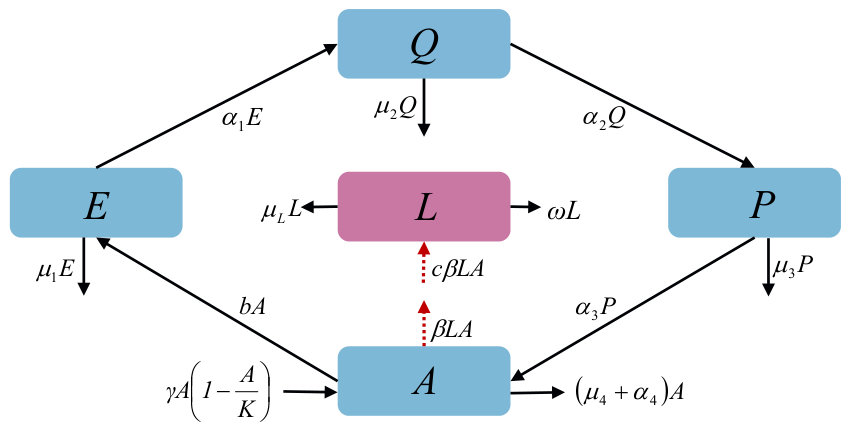
The infestation transmission dynamics flow diagram in Figure 1 can be described by the following ODE system:
d E d t = b A ( α 1 + μ 1 ) E , d Q d t = α 1 E ( α 2 + μ 2 ) Q , d P d t = α 2 Q ( α 3 + μ 3 ) P , d A d t = γ A ( 1 A K ) + α 3 P ( α 4 + μ 4 ) A β L A , d L d t = c β L A ( μ L + ω ) L ,
with initial conditions
E ( t ) 0 , Q ( t ) 0 , P ( t ) 0 , A ( t ) 0 and L ( t ) 0 .

2.3. Model Analysis

System (2) describes the population dynamics of soybean aphids (four developmental stages) and their natural enemy, ladybugs, where all state variables and parameters are non-negative. To systematically characterize the dynamic behavior of the model, we conducted comprehensive kinetic analysis, including the existence of equilibrium points, the stability of equilibrium states, and the derivation of key threshold parameters. The core conclusions of the analysis (lemmas and theorems) are summarized in Table 2, with the detailed proof processes for each lemma/theorem specified to the corresponding subsection in Appendix A for brevity and clarity.
The lemmas in Table 2 verify the basic mathematical properties of the model (non-negativity, boundedness) and the existence of key equilibrium points, which lay the foundation for subsequent stability analysis. The theorems clarify the stability characteristics of the two equilibrium states: the Ladybug-Free Equilibrium (LFE) represents the population dynamic state when no ladybugs are released, and its stability depends on whether the basic reproduction number R 0 is less than or greater than 1, and the Coexistence Equilibrium (CE) corresponds to the stable coexistence state of soybean aphids and ladybugs under artificial release measures, and its stability determines the long-term effectiveness of biocontrol strategies. Notably, Lemma A3 explicitly clarifies the threshold condition for the stability of LFE, which is closely related to the basic reproduction number R 0 .
All mathematical derivations, including the proof of non-negativity and boundedness of state variables (Theorem A1, Appendix A.1), the solution process of LFE (Lemma A1, Appendix A.2), the derivation of CE (Lemma A2, Appendix A.3), the stability analysis of equilibrium points (Theorems A2–A5, Appendix A.4, Appendix A.5, Appendix A.7 and Appendix A.8), and the clarification of the LFE stability threshold (Lemma A3, Appendix A.6), are detailed in the specified subsections of Appendix A. This arrangement ensures the integrity of the model analysis while keeping the main text concise and focused on the biological interpretation of mathematical results, rather than overly technical derivations.

2.4. Cost-Effectiveness Analysis Methods

To scientifically evaluate the economic feasibility and practical application value of different biocontrol strategies for soybean aphids, this study constructed a comprehensive evaluation system covering total cost (TC), total benefit (TB), cost-effectiveness ratio (CER), and incremental cost-effectiveness ratio (ICER). This system systematically quantifies the input–output efficiency of various biocontrol measures, providing a quantitative basis for the optimization and selection of green prevention and control strategies for soybean aphids in field production.
TC refers to the direct economic investment generated during the implementation of various biocontrol strategies, combined with the cost accounting standards for green prevention and control of agricultural pests and diseases and the characteristics of ladybug-based biocontrol measures. Key cost components include: laboratory rearing costs of ladybugs, transportation and field release costs, and optimization costs for predation-related parameters. TB is a quantitative indicator based on the reduction in soybean aphid population harm after the implementation of biocontrol strategies, combined with the difference in the degree of harm caused to soybeans by aphids at different developmental stages, and weighted by specific weight coefficients.
Referring to the national evaluation standards for the effectiveness of pest and disease prevention and control, the weights are set as follows: adult soybean aphids A ( t ) directly affect population reproduction and the spread of harm, with a weight of ω A = 0.5 ; 1st–2nd stage nymphs E ( t ) indirectly determine the subsequent population size, with a weight of ω E = 0.2 ; 3rd–4th stage nymphs Q ( t ) , P ( t ) actively feed on tender soybean tissues and contribute to the adult population, with a combined weight of ω Q + ω P = 0.3 . The total benefit is calculated as
T B = ω A · Δ A + ω E · Δ E + ( ω Q + ω P ) · ( Δ Q + Δ P ) ,
where Δ X ( X = A , E , Q , P ) represents the peak population difference between the control group and the non-control group, and the data are derived from the numerical simulation results in Section 3.1. The CER is used to measure the cost required for a unit of benefit and intuitively reflects the basic cost-effectiveness of a strategy. The formula is
C E R = T C T B .
The smaller the CER value, the lower the economic input of unit control benefits, and the higher the cost-effectiveness of this strategy. The ICER is used to compare the incremental investment and benefits between different strategies [33,34,35], and evaluate the additional economic value of strategy upgrades [36]. The formula is
I C E R = T C 1 T C 2 T B 1 T B 2 ,
where Strategy 1 is a higher-level strategy with higher cost, and Strategy 2 is a basic strategy with lower cost. A smaller ICER value indicates that the incremental input of strategy upgrading brings more significant incremental benefits, and the upgrading scheme is more economically reasonable.

3. Results

3.1. Data Fitting and Parameter Estimation

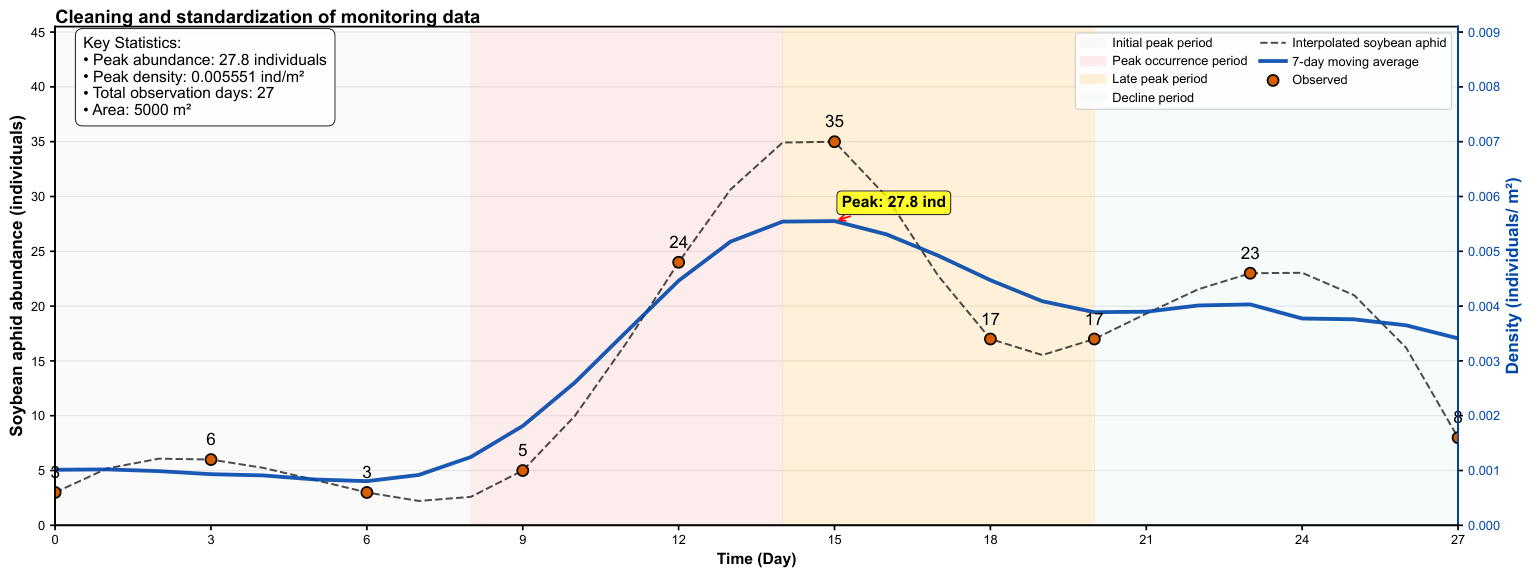
Field monitoring and preprocessed soybean aphid density dynamics are shown in Figure 2. The smoothed time series obtained after interpolation and 3-day moving average processing clearly illustrates the overall trend of aphid population fluctuation over the monitoring period, including the initial slow growth stage, rapid outbreak stage, and gradual decline stage. The peak aphid density during the monitoring period was 27.8 individuals per square meter. To accurately characterize the population dynamics of the soybean aphid without the intervention of the artificial release of its natural enemy, the ladybug, a segmented nonlinear least squares method [37] was adopted for data fitting and parameter estimation. This subsection addresses the limitations of traditional global least squares by incorporating the biological characteristics of the soybean aphid’s outbreak cycle.
The fitting process was based on the simplified Nymphs–Adults–Ladybugs (EQPAL) model, as the field monitoring data used in this study were collected from plots without the artificial release of ladybugs. The core improvement of the proposed segment fitting method lies in a priori segmentation based on biological laws and cumulative pest dynamics. According to the criterion in [38], the population stages are determined by cumulative insect proportion: the initial peak period is defined when cumulative pests reach 16% of the total; the peak occurrence period occurs at 50%; and the late peak period occurs at 84%. Based on the monitored population dynamics of soybean aphids in Changchun from 17 July to 14 August, the entire observation period was divided into four consecutive phases corresponding to distinct population stages. The first phase (Day 1–8, Initial peak period) corresponds to the initial buildup stage when cumulative aphids reach 16% of the total. The second phase (Day 8–14, Peak occurrence period) represents the main outbreak stage when cumulative aphids reach 50% of the total, with rapid reproduction and rapid population expansion. The third phase (Day 14–20, Late peak period) corresponds to the late outbreak stage when cumulative aphids reach 84% of the total. The fourth phase (Day 20–27, Decline period) is the population regulation and decline stage, where aphid abundance gradually decreases.
We estimated two core time-varying parameters: the intrinsic growth rate γ of adult aphids and the adult rate α 4 . Other parameters are determined based on the published biological literature and field observations (References in Table 1) to ensure consistency with the physiological and ecological characteristics of soybean aphids. To quantify the uncertainty in the fitting results, a 95% confidence interval was generated using a parameter sampling method.
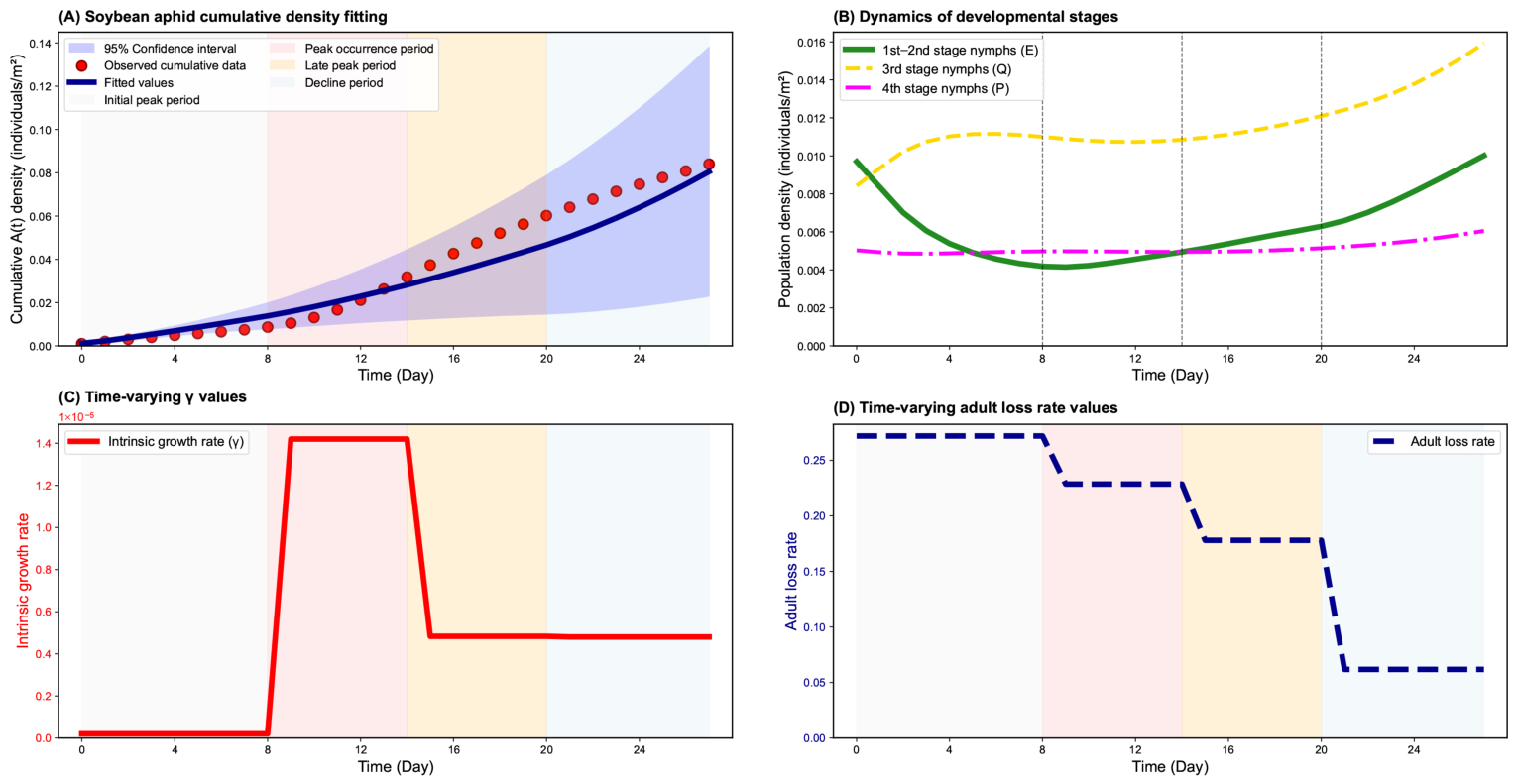
Figure 3A and Table 3 show the segmented nonlinear least squares fitting results. As shown in Figure 3A, the observed adult aphid density was fitted with three phase-specific curves corresponding to the four population stages. The fitting performance indicators (Table 3) further validated the effectiveness of the model: the overall goodness of fit was R 2 = 0.8204 , and the RMSE was 0.009903, indicating strong consistency between the model predictions and observed field data. We obtained dynamic changes in other developmental stages by extending the fitted core parameters to the entire EQPAL model (Figure 3B). The nymph densities (E, Q, P) reach their peaks synchronously with adult reproduction, while the 4th stage nymphs show a slight delay compared to younger nymph stages, reflecting the sequential developmental characteristics of the soybean aphid’s life cycle.
The estimated time-varying parameters ( γ and α 4 ) are visualized in Figure 3C,D. The intrinsic growth rate γ reaches its maximum during the peak occurrence period, consistent with the peak reproductive activity of adult aphids. The adult senescence rate α 4 shows a clear decreasing trend from the late peak period to the decline period, indicating a gradual reduction in physiological loss as the population stabilizes and declines. These time-varying parameter dynamics effectively capture the adaptive responses of the soybean aphid population to environmental changes and developmental needs, verifying that the segment-specific fitting method can reveal ecological mechanisms that global fitting might overlook.

3.2. Numerical Simulation and Analysis of Prevention and Control Effects

Based on the validated EQPAL predation dynamic model, a series of numerical simulation experiments were designed to systematically explore the regulatory effects of key biocontrol factors on the population dynamics of soybean aphids and their natural enemy, ladybugs. The simulations focused on four core control factors: initial ladybug release amount L ( 0 ) , ladybug predation rate β , predation conversion rate c, and emigration rate ω . By setting gradient parameter values, the influence patterns of each factor on the population dynamics of soybean aphids at different developmental stages were quantified, and optimal biocontrol strategies were identified.
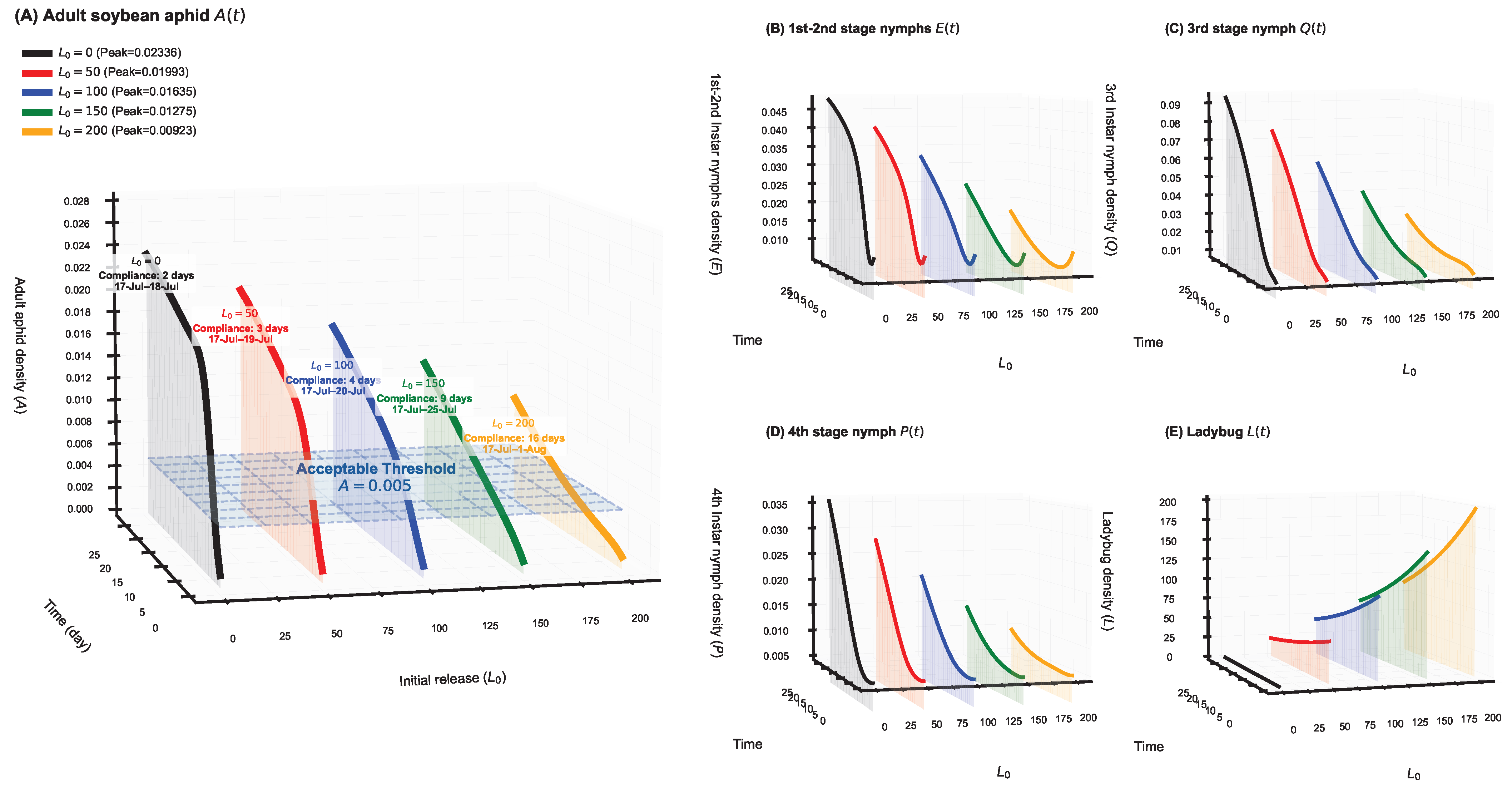
Combined with practical field biocontrol scenarios, simulations were conducted with a one-time artificial release of ladybugs in the early stage of soybean aphid outbreak. The five gradient levels of initial release amounts were set with reference to the experimental criteria in [39], corresponding to no release (0), low density (50), medium density (100), high density (150), and saturation density (200) individuals/m2. Other parameters remained consistent with the fitting results in Section 3.1, and the simulation period covered the entire field monitoring period. The corresponding dynamic simulation results are presented in Figure 4. The results show a significant negative correlation between the initial ladybug release amount and the peak density of adult soybean aphids: the peak density of adults in the no-release group reached 0.02336 individuals/m2, while that in the 200 individuals/m2 release group decreased to 0.00923 individuals/m2, with a control inhibition rate of 60.5%. Notably, the peak occurrence time of adult soybean aphids was consistent across all treatment groups, indicating that the artificial release of ladybugs mainly reduces outbreak intensity by preying on adults rather than altering the intrinsic temporal rhythm of soybean aphid population development, which is highly consistent with the developmental cycle characteristics of soybean aphids. The dynamic responses of soybean aphid nymph stages to ladybug release further revealed the biocontrol mechanism of this strategy: the densities of 1st–2nd stage nymphs E(t), 3rd stage nymphs Q(t), and 4th stage nymphs P(t) all decreased synchronously with the increase in ladybug release amount, with their peaks showing a gradual downward trend and peak times slightly delayed compared to adults. This phenomenon indicates that ladybug predation on adults indirectly reduces the input of new nymphs, thereby inhibiting population expansion in subsequent developmental stages, verifying the biocontrol chain effect of “preying on adults-–blocking reproduction-–suppressing populations”. The population dynamics of ladybugs showed that in the early stage, with sufficient prey resources, the ladybug population grew rapidly, and the peak density increased with the initial release amount; after Day 15, as the soybean aphid density decreased, the ladybug population gradually declined due to reduced food resources, natural mortality, and emigration. High-release groups maintained a higher population density for a longer period, exerting a sustained inhibitory effect on soybean aphids. Through linear interpolation, the critical release amount required to reduce the peak density of adult soybean aphids to the threshold (A = 0.0050 individuals/m2) was calculated as 277.6 individuals/m2, providing a quantitative basis for determining the actual field release amount.
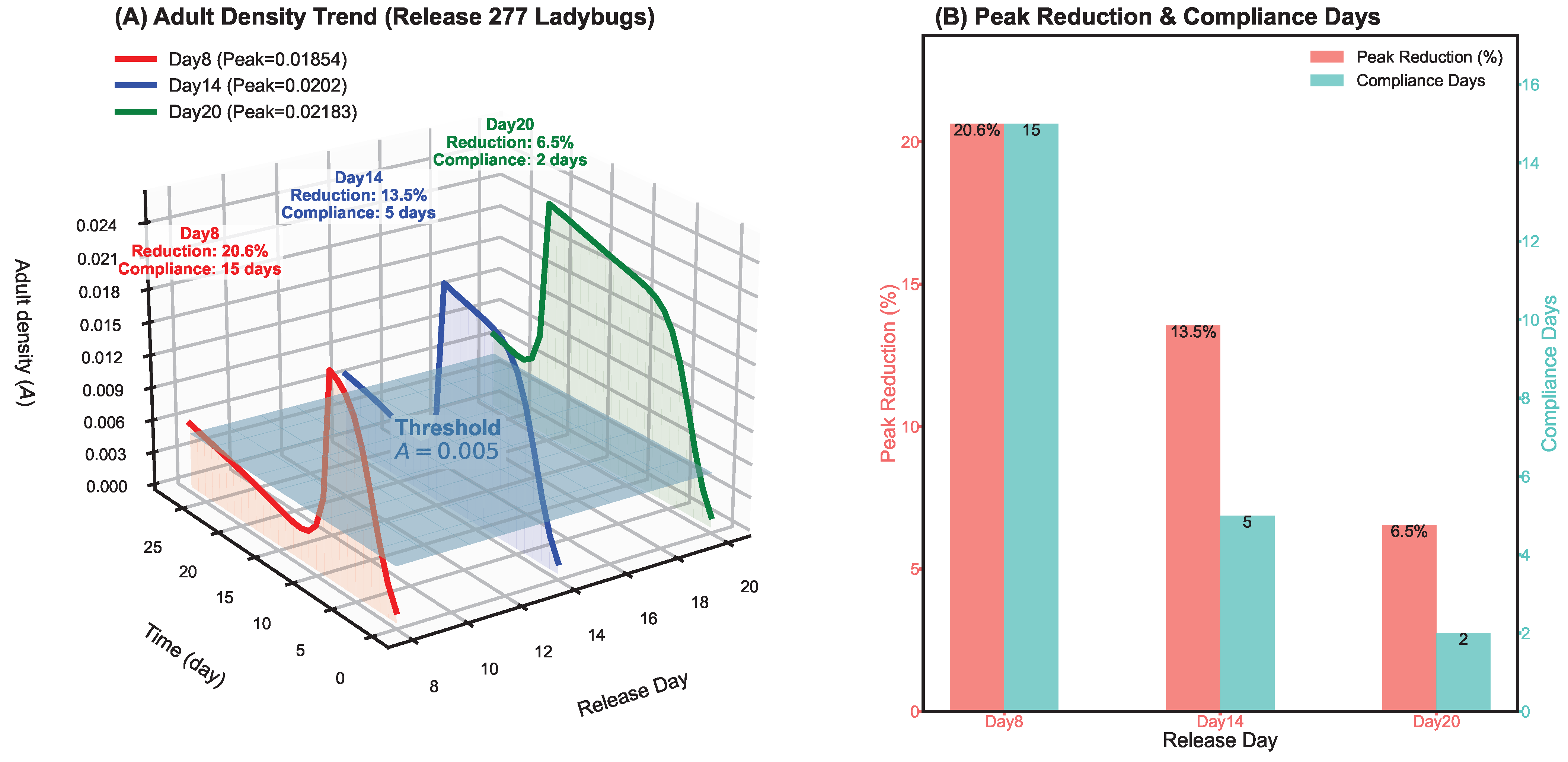
To clarify the optimal release timing, three key time points (Day 8, Day 14, and Day 20 of the outbreak) were set, with 277 ladybugs released per m2 at each time point to compare the differences in control effects (Figure 5). The results showed that release timing had a significant impact on control effectiveness: the group released on Day 8 had the lowest peak density of adults with a peak reduction rate of 20.6% and a compliance duration of 15 days; the group released on Day 14 had a peak reduction rate of 13.5% and a compliance duration of 5 days; the group released on Day 20 had the worst control effect, with a peak reduction rate of only 6.5% and a compliance duration of only 2 days. Quantitative comparison results further verified that early release could effectively block the reproductive process of soybean aphids in the early stage of outbreak and significantly reduce their population growth base; in contrast, delayed releases occurred when soybean aphids had entered the rapid proliferation period or were close to the population peak, making it difficult for ladybugs to suppress population growth in a short time, resulting in greatly reduced control effects. This result indicates that the biological control of soybean aphids should follow the principle of early detection and early release, and intervention in the early stage of population outbreak can maximize control benefits.
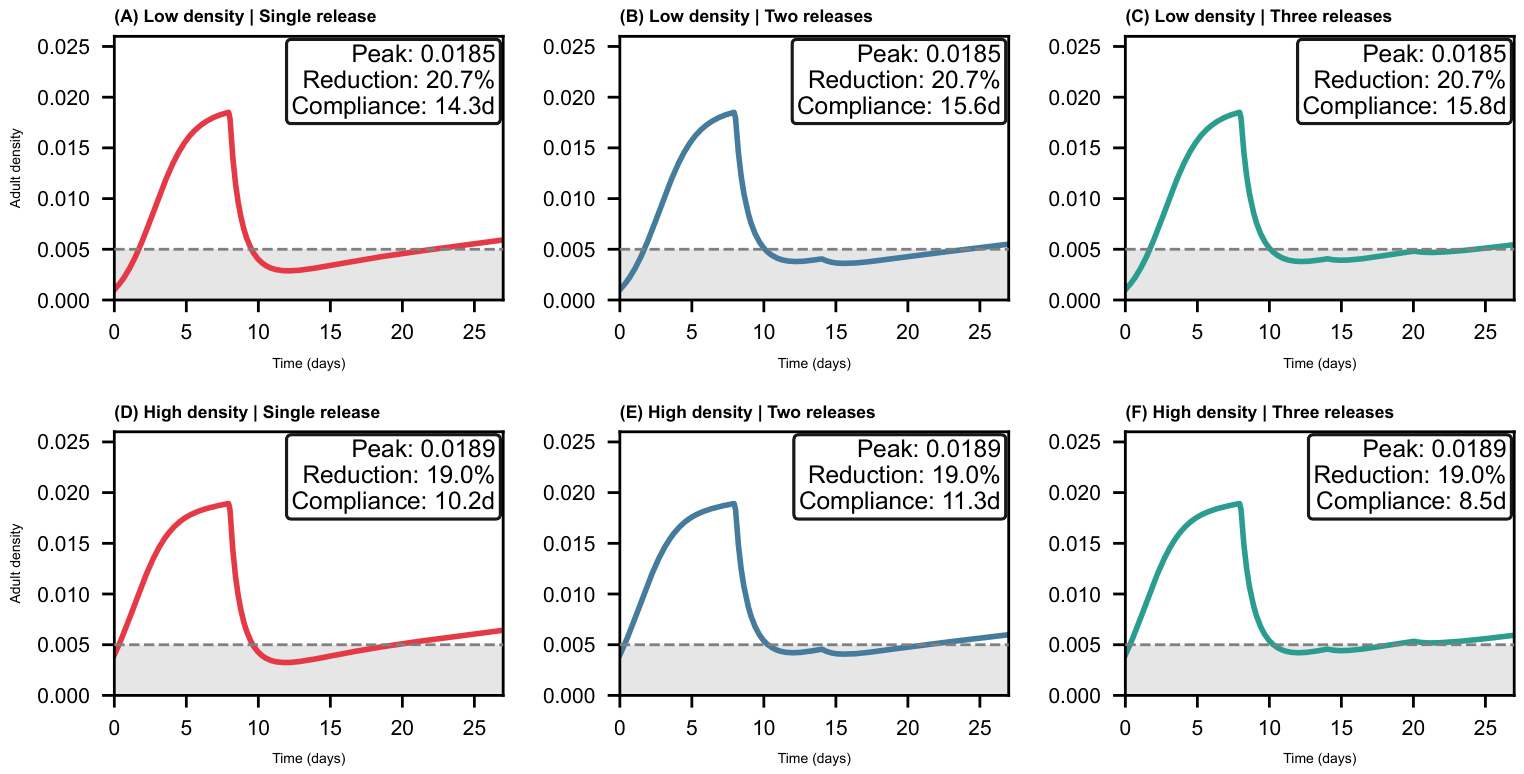
Considering the resource constraints and continuous control needs in practical field control, three release strategies were designed with the same total release amount to compare their control effects under low initial density and high initial density (Figure 6). Specifically, a single-release method involved releasing 277 individuals/m2 on Day 8; a two-release method involved releasing 240 individuals/m2 on Day 8 plus a supplementary release of 34 individuals/m2 on Day 14; and a three-release involved releasing 200 individuals/m2 on Day 8, 40 individuals/m2 on Day 14, and 34 individuals/m2 on Day 20. Simulation results showed that under low initial density conditions, the adult aphid peaks were consistently 0.0185 individuals/m2 across all strategies, with an identical peak reduction rate of 20.7%. The compliance duration was gradually prolonged with increasing release frequency, extending from 14.3 days for a single release to 15.6 days for two releases and further to 15.8 days for three releases, indicating that multiple releases achieved better control performance under low initial aphid density. Under high initial density conditions, the adult aphid peaks remained stable at 0.0189 individuals/m2, with a consistent reduction rate of 19.0%. The compliance duration was the longest in the two-release strategy (8.5 days), followed by the three-release strategy (10.2 days) and the single release strategy (11.3 days), indicating that the two-release strategy performs optimally under high initial aphid density. Overall, under low-density infestation, multiple releases can better prolong the effective control duration; under high-density infestation, the two-release strategy achieves the best control persistence, providing a flexible and efficient scheme for strategy selection under different pest pressure conditions.
Collectively, the series of numerical simulation experiments led to the following key conclusions: the artificial release of ladybugs is an effective green control measure for soybean aphids, with the initial release amount positively correlated with the aphid suppression effect; a critical release amount of 277.6 individuals/m2 can reduce the adult density below the threshold, and the release amount has no significant impact on the peak occurrence time of soybean aphids. Release strategies should be tailored to the initial pest density: under low-density infestation, while the overall control effectiveness among single, double, and triple releases is not statistically significant, triple releases still outperform the other strategies in terms of control persistence, providing more stable and long-lasting suppression. Under high-density infestation, double releases show clear superiority over single and triple releases, achieving the longest effective control duration and the most stable population suppression. These results confirm that appropriately splitting the total release amount into multiple supplementary releases can enhance biocontrol efficacy, especially under high pest pressure, providing a flexible and efficient scheme for practical soybean aphid management.

3.3. Cost-Effectiveness Analysis

Based on the cost-effectiveness evaluation framework established in Section 2.4, a comprehensive economic analysis was carried out to compare the practical efficiency and economic feasibility of different biological control strategies against the soybean aphid. The total cost (TC), total benefit (TB), cost-effectiveness ratio (CER), and incremental cost-effectiveness ratio (ICER) were quantified to identify the optimal strategy with the highest input–output efficiency.
Based on the cost-effectiveness indicators shown in Table 4, among the single biocontrol strategies, S1 has the smallest CER value (0.0178), which is significantly better than S2 (Predation Rate Enhancement, CER = 0.0219) and S3 (Conversion Rate Improvement, CER = 0.0232). This indicates that direct artificial release of ladybug as a basic biocontrol measure has the highest cost-effectiveness and is the optimal choice among single strategies. The CER values of the combined strategies are all lower than those of single strategies: S5 has the smallest CER value (0.0161), followed by S4 (combined strategy of ladybug release + β enhancement, CER = 0.0169). This confirms that the collaborative implementation of multiple biocontrol measures can effectively improve the control benefits per unit cost and optimize input–output efficiency.
From the incremental cost-benefit analysis results in Table 5, based on the non-control strategy (NS), the ICER value of S1 in single strategies is lower than that of S2 and S3, further verifying the economic rationality of S1 as a single biocontrol strategy for soybean aphids. The ICER value of S4 compared to the single strategy, S1, is 5.0523, which is the lowest value among all incremental comparison combinations. This indicates that adding the incremental investment of S2 on the basis of S1 can achieve the most significant incremental benefits, and this strategy upgrade scheme has the best economic feasibility. The ICER value of S5 compared to S4 is 6.3441, which is higher than the incremental benefit ratio of S4 compared to S1, indicating that the marginal increase in biocontrol benefits from adding S3 is limited, and the economic return on incremental investment has decreased. However, the ICER value of S5 compared to S1 is 5.5602, which is still lower than the ICER values of S2 and S3 compared to NS, indicating that the overall incremental benefit of the integrated strategy, S5, still has practical rationality.
Based on the above analysis, the following optimization suggestions for biocontrol strategies are proposed for different resource input scenarios:
  • For resource-sufficient scenarios, the integrated strategy, S5, can be prioritized. Although this strategy has the highest total input (44,300), it has the lowest CER value (0.0161) and can achieve comprehensive suppression of soybean aphid adults and nymphs with the most thorough and long-lasting biocontrol effect.
  • For resource-limited scenarios, the combined strategy, S4, or the single strategy, S1, can be prioritized. S4 has a CER value close to that of S5 and the optimal ICER value, and thus can achieve significant collaborative biocontrol benefits while controlling input costs. If economic input capacity is severely limited, the single strategy, S1, can be used as a basic biocontrol plan to quickly suppress soybean aphid population outbreaks through the low-cost deployment of ladybugs.
  • The single strategy S3 should be avoided for independent implementation. It has the highest CER value among all strategies and a higher ICER value than S1 when compared to NS, resulting in the lowest cost-effectiveness when implemented alone. It is only recommended as a supplementary measure to combined strategies rather than a core biocontrol measure.

4. Discussion

Population dynamic models of pests with distinct developmental stages are critical for understanding outbreak mechanisms and optimizing biocontrol strategies. This study addressed existing gaps by developing the EQPAL stage-structured predation dynamic model, which integrates four developmental stages of soybean aphids and a natural enemy compartment, explicitly incorporating ladybug-mediated biocontrol logic. The model’s biological rationality was validated through rigorous dynamic analyses, including solution positivity, boundedness, and stability of key equilibria, providing a robust theoretical framework for simulating soybean aphid dynamics under natural enemy interventions in Northeast China.
The segmented nonlinear least squares fitting method adopted in this study effectively captured the phase-specific population dynamics of soybean aphids, achieving an overall goodness of fit R 2 = 0.8204 using field monitoring data from Changchun, Jilin Province. This high fitting accuracy underscores the model’s adaptability to the ecological and climatic conditions of Northeast China. It is important to note that the practical applicability of our findings is primarily confined to Northeast China, as soybean aphid population dynamics, ladybug predation efficiency, and environmental carrying capacity are strongly influenced by regional climatic factors, host plant phenology, and agricultural management practices. Extrapolation to other soybean-producing regions should be accompanied by local parameter calibration and field validation to account for regional ecological differences.
Numerical simulations confirmed that artificial release of H. axyridis is an effective green control measure for soybean aphids, reducing adult peak density by up to 60.5%. Our finding that early release maximizes control efficacy aligns with the early intervention principle widely recognized in integrated pest management (IPM) research. Similarly, the identification of ladybug predation rate β , predatory conversion rate c, and emigration rate ω as core regulatory parameters is consistent with previous models of predator–prey dynamics, which emphasize the importance of predator efficiency and retention for biocontrol success [40,41].
Our analysis of release strategies demonstrated that triple releases perform best under low initial aphid density, while double releases achieve the optimal control persistence under high initial density. This finding complements existing literature on biocontrol optimization [42,43] and provides targeted guidance for soybean aphid management in Northeast China.
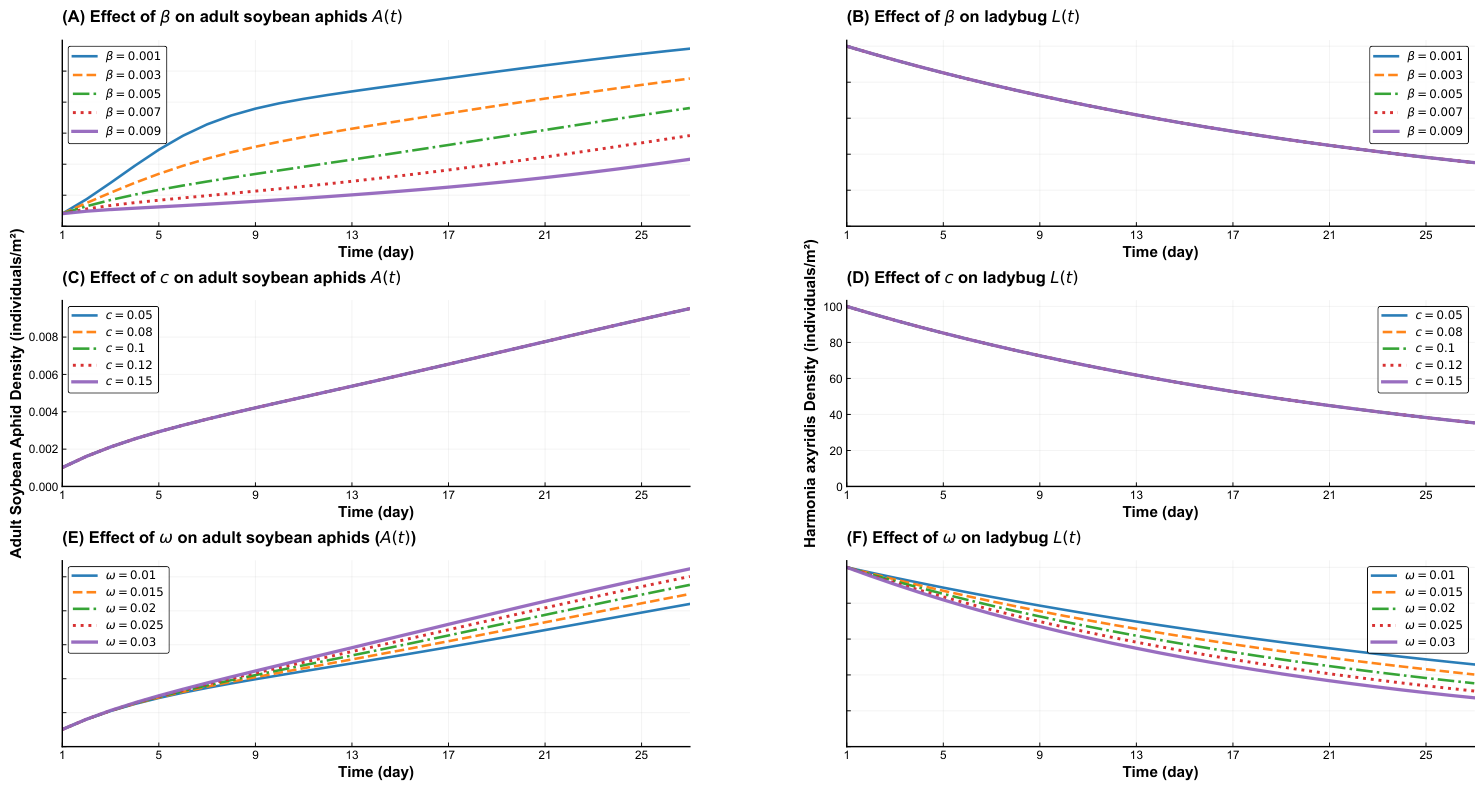
To further clarify the underlying mechanisms driving the biocontrol efficacy of Harmonia axyridis against Aphis glycines, we performed numerical simulations to identify core regulatory parameters. Gradient values of β , c, and ω were set to quantify their independent effects on population dynamics (Figure 7). When β varied in the range of 0.001–0.009 individual−1·day−1, higher β values resulted in more significant inhibition of adult soybean aphid density, with the adult peak decreasing gradually with increasing β . Simultaneously, the ladybug population density increased with β , indicating that higher predation efficiency can promote ladybug population growth. Within the range of day−1, higher predation conversion rates could promote the rapid reproduction of ladybugs, thereby enhancing their inhibitory effect on adult soybean aphids. However, compared with the impact of predation rate, the regulatory effect of c on control effectiveness was weaker, indicating that the predation capacity of ladybugs is the core driving factor of pest control effect, while reproductive capacity is an auxiliary enhancing factor. When ω increased in the range of 0.01–0.03 day−1, the ladybug population declined rapidly due to increased emigration, and their inhibitory effect on soybean aphids was significantly weakened. The low emigration rate group ( ω = 0.01 day−1) could maintain a high-density ladybug population for a longer time, continuously suppressing the soybean aphid population; in contrast, the high emigration rate group ( ω = 0.03 day−1) showed a sharp decline in the ladybug population in a short period, with a rapid recovery of adult soybean aphid density. This result indicates that reducing the ladybug emigration rate is key to extending the control cycle.
Cost-effectiveness analysis further validated the practical value of our findings, identifying the integrated strategy as the most cost-efficient for resource-sufficient scenarios, and the combined strategy as optimal for resource-limited smallholder farms. This aligns with Katherine et al. [44] and Colmenarez et al. [45], who emphasized that context-specific, economically feasible biocontrol strategies are critical for adoption in agricultural practice. The low cost-effectiveness of single parameter optimization also supports the IPM principle of multi-tactic coordination.
This study has several limitations. First, the model does not account for the seasonality of soybean aphid populations. Soybean aphid growth, reproduction, and developmental rates are inherently influenced by seasonal variations in temperature, photoperiod, and host plant phenology, which are critical for accurately capturing long-term population dynamics in field conditions. This aligns with Li et al. [46], who highlighted the importance of incorporating seasonality in modeling the transmission dynamics of Schistosomiasis japonica in China. Second, the model assumes a one-time initial release of ladybugs, whereas continuous release of natural enemies is a more practical and effective biocontrol strategy in agricultural production. Sustained supplementation of ladybugs can maintain stable predator densities and enhance long-term pest suppression, as demonstrated by Chang et al. [47], who considered the continuous release of virus-carrying mosquitoes for disease control and achieved improved intervention outcomes. Third, the parameter estimation method adopted in this study relies on segmented nonlinear least squares, which has limitations in capturing complex time-varying dynamics. Future studies could employ physics-informed neural networks (PINNs) [48] to integrate the pest dynamic model as physical constraints, enabling more accurate fitting of time-varying parameters. Additionally, replacing fixed weights in the model with adaptive weight adjustment mechanisms, similar to the approach proposed by Liu et al. [49], would further enhance the model’s flexibility and adaptability to dynamic field conditions.
Future work could also expand on the model by incorporating other biocontrol components, such as the synergy between ladybugs and other natural enemies or the impact of habitat manipulation. Additionally, long-term field trials to validate the model’s predictive performance across multiple growing seasons and different soybean varieties would strengthen its practical applicability. Overall, the EQPAL model and associated findings provide a theoretical basis for the sustainable management of soybean aphids, supporting the transition from chemical insecticides to environmentally friendly biocontrol strategies in soybean production [50,51].

5. Conclusions

This study proposed an EQPAL stage-structured predation dynamic model integrating four developmental stages of soybean aphid and artificial release of its natural enemy ladybug, complemented by rigorous dynamic analysis of equilibria stability and basic reproduction number R 0 . Numerical simulations confirmed that artificial release of H. axyridis and optimization of key regulatory parameters significantly inhibited the population reproduction of soybean aphids, reducing the peak density of adult aphids effectively. Cost-effectiveness analysis identified the integrated strategy as the most cost-efficient, while the combined strategy of ladybug release and predation rate enhancement offered optimal incremental benefits. These findings provide a solid theoretical framework and practical guidance for the green, sustainable, and economical management of soybean aphids.

Author Contributions

Conceptualization: W.L., X.C., S.L. and Y.G.; methodology: X.C., S.L. and Y.G.; software: W.L., X.C., T.P. and Y.G.; validation: W.L., Y.Z., T.P. and Y.G.; formal analysis: W.L., X.C., S.L. and Y.G.; investigation: X.C., Y.Z. and Y.G.; resources: Y.Z., T.P. and Y.G.; data curation: Y.Z. and T.P.; writing—original draft preparation: W.L.; writing—review and editing: X.C., S.L., Y.Z., T.P. and Y.G.; visualization: W.L. and X.C.; supervision: S.L. and Y.G.; project administration: S.L. and Y.G.; funding acquisition: S.L. and Y.G. All authors have read and agreed to the published version of the manuscript.

Funding

This research was funded by the National Natural Science Foundation of China (Grant No. 12301627 for Suli Liu); the Science and Technology Research Projects of the Education Office of Jilin Province, China (Grant No. JJKH20250046KJ for Suli Liu); the National Key Research and Development Program of China (Grant No. 2023YFD1401000 for Yu Gao); the Earmarked Fund for China Agriculture Research System of MOF and MARA (Grant No. CARS04 for Yu Gao).

Institutional Review Board Statement

Not applicable.

Informed Consent Statement

Not applicable.

Data Availability Statement

All pest data and Python source code in the article can be obtained from the following repositories: https://github.com/jluLWX/Data-and-code-of-soybean-aphid (accessed on 15 March 2026).

Conflicts of Interest

The authors declare no conflicts of interest.

Appendix A. Mathematical Proof Process of Kinetic Analysis

Appendix A.1. Theorem A1

Theorem A1. 
Let Ω = { ( E , Q , P , A , L ) R + 5 : E ( 0 ) > 0 , Q ( 0 ) > 0 , P ( 0 ) > 0 , A ( 0 ) > 0 , L ( 0 ) > 0 } . For any initial condition in Ω, the solutions ( E ( t ) , Q ( t ) , P ( t ) , A ( t ) , L ( t ) ) of system (2) are positive for all t 0 .
Proof. 
We prove the positivity of each state variable sequentially using separation of variables and integral inequalities.
From the first equation of system (2):
d E d t = b A ( α 1 + μ 1 ) E ,
integrating the above equality using the method of separation of variables and considering the initial condition when solving the state variable E ( t ) , we obtain:
E ( t ) E ( 0 ) e ( α 1 + μ 1 ) t > 0 ,
since E ( 0 ) > 0 and the exponential function is always positive, E ( t ) > 0 for all t 0 .
Let us take the second equation:
d Q d t = α 1 E ( α 2 + μ 2 ) Q ,
integrating from 0 to t with Q ( 0 ) > 0 , we have:
Q ( t ) Q ( 0 ) e ( α 2 + μ 2 ) t > 0 .
Similarly, considering the remaining two equations of system (2), we derive the following inequalities:
d P d t ( α 3 + μ 3 ) P , d L d t ( μ L + ω ) L .
and thus obtain the corresponding solutions:
P ( t ) Q ( 0 ) e ( α 3 + μ 3 ) t > 0 , L ( t ) Q ( 0 ) e ( μ L + ω ) t > 0 ,
From the fourth equation of system (2):
d A d t = γ A ( 1 A K ) + α 3 P ( α 4 + μ 4 ) A β A L ,
since α 3 P ( t ) > 0 . To confirm A ( t ) > 0 , we use a contradiction: suppose there exists a smallest t 0 > 0 such that A ( t 0 ) = 0 and A ( t ) > 0 for all t [ 0 , t 0 ) . Substituting t = t 0 into the equation gives:
d A d t t = t 0 = α 3 P ( t 0 ) > 0 ,
implying A ( t ) is increasing at t 0 , which contradicts A ( t 0 ) = 0 . Thus, A ( t ) > 0 for all t 0 . Therefore, the solution of system (2) with positive initial value is positive. This completes the proof. □

Appendix A.2. Lemma A1

Lemma A1. 
Let N ( t ) = E ( t ) + Q ( t ) + P ( t ) + A ( t ) + L ( t ) denote the total abundance of soybean aphids and their natural enemy, ladybugs, at time t. For any initial conditions ( E ( 0 ) , Q ( 0 ) , P ( 0 ) , A ( 0 ) , L ( 0 ) ) R + 5 , all solutions of system (2) are bounded, and the biological feasible region is as follows:
Ω = ( E , Q , P , A , L ) R + 5 : N ( t ) C 2 K 4 γ
Then Ω is positively invariant set for system (2).
Proof. 
We first compute the time derivative of N ( t ) by summing all equations in system (2):
d N d t = d E d t + d Q d t + d P d t + d A d t + d L d t = b A ( α 1 + μ 1 ) E + α 1 E ( α 2 + μ 2 ) Q + α 2 Q ( α 3 + μ 3 ) P + γ A 1 A K + α 3 P ( α 4 + μ 4 ) A β A L + c β A L ( μ L + ω ) L .
Simplifying by canceling intermediate terms, we obtain:
d N d t = b A μ 1 E μ 2 Q μ 3 P + γ A 1 A K ( α 4 + μ 4 ) A + β A L ( c 1 ) ( μ L + ω ) I = A b + γ 1 A K ( α 4 + μ 4 ) μ 1 E μ 2 Q μ 3 P + β A L ( c 1 ) ( μ L + ω ) I .
Since all mortality terms ( μ 1 E , μ 2 Q , μ 3 P , ( μ L + ω ) L , β A L ) are non-negative, we obtain the inequality:
d N d t A b + γ ( α 4 + μ 4 ) γ K A 2 .
Let C = b + γ ( α 4 + μ 4 ) > 0 . The right-hand side is a quadratic function in A, which is bounded above and satisfies:
d N d t C 2 K 4 γ for all t 0 .
Thus, 0 < N ( t ) C 2 K 4 γ . This indicates that the system (2) is positive invariance and bounded t > 0 . Hence, the system is well posed and biologically realistic. □

Appendix A.3. Lemma A2

Lemma A2. 
The Ladybug-Free Equilibrium (LFE) of system (2) exists and is uniquely determined when the natural enemy (ladybug) population density L ( t ) = 0 . The LFE is denoted as
E 0 = b A 0 α 1 + μ 1 , α 1 b A 0 ( α 1 + μ 1 ) ( α 2 + μ 2 ) , α 1 α 2 b A 0 ( α 1 + μ 1 ) ( α 2 + μ 2 ) ( α 3 + μ 3 ) , A 0 , 0 .
Proof. 
For the proposed soybean aphid–ladybug predation model, the ladybug-free equilibrium (LFE) is denoted as E 0 = ( E 0 , Q 0 , P 0 , A 0 , 0 ) . To derive E 0 , we set all time derivatives to zero under the disease-free assumption:
0 = b A 0 ( α 1 + μ 1 ) E 0 , 0 = α 1 E 0 ( α 2 + μ 2 ) Q 0 , 0 = α 2 Q 0 ( α 3 + μ 3 ) P 0 , 0 = γ A 0 1 A 0 K + α 3 P 0 ( α 4 + μ 4 ) A 0 β A 0 · 0 , 0 = c β A 0 · 0 ( μ L + ω ) · 0 .
Solving the first three equations recursively by substitution, we obtain:
E 0 = b A 0 α 1 + μ 1 , Q 0 = α 1 b A 0 ( α 1 + μ 1 ) ( α 2 + μ 2 ) , P 0 = α 1 α 2 b A 0 ( α 1 + μ 1 ) ( α 2 + μ 2 ) ( α 3 + μ 3 ) .
Substituting P 0 into the fourth equation and factoring out A 0 , we have:
γ 1 A 0 K + α 1 α 2 α 3 b ( α 1 + μ 1 ) ( α 2 + μ 2 ) ( α 3 + μ 3 ) ( α 4 + μ 4 ) = 0 .
Rearranging gives:
A 0 = K γ γ + α 1 α 2 α 3 b ( α 1 + μ 1 ) ( α 2 + μ 2 ) ( α 3 + μ 3 ) ( α 4 + μ 4 ) .
All compartments E 0 , Q 0 , P 0 , A 0 0 if and only if the term in parentheses is positive:
γ + α 1 α 2 α 3 b ( α 1 + μ 1 ) ( α 2 + μ 2 ) ( α 3 + μ 3 ) > α 4 + μ 4 .
Thus, the DFE is:
E 0 = b A 0 α 1 + μ 1 , α 1 b A 0 ( α 1 + μ 1 ) ( α 2 + μ 2 ) , α 1 α 2 b A 0 ( α 1 + μ 1 ) ( α 2 + μ 2 ) ( α 3 + μ 3 ) , A 0 , 0 .

Appendix A.4. Theorem A2

Theorem A2. 
The ladybug-free equilibrium E 0 of system (2) is locally asymptotically stable (LAS) if R 0 < 1 and unstable if R 0 > 1 .
Proof. 
Firstly, we derive the basic reproduction number R 0 , which is defined as the spectral radius of the next-generation matrix(NGM) FV 1 . We focus on the predation-related compartments to construct the predation generation matrix F and the transition matrix V :
F = 0 0 c β A 0 0 , V = 0 0 0 μ L + ω .
The next-generation matrix is:
FV 1 = 0 0 0 c β A 0 μ L + ω .
The spectral radius of FV 1 is its non-zero diagonal element, thus define R 0 = C β A 0 μ L + ω .
Next, the Jacobian matrix of the system (2) at LFE is given by:
J ( E 0 ) = ( α 1 + μ 1 ) 0 0 b 0 α 1 ( α 2 + μ 2 ) 0 0 0 0 α 2 ( α 3 + μ 3 ) 0 0 0 0 α 3 J 44 β A 0 0 0 0 0 ( μ L + ω ) ,
where J 44 = γ 1 2 A 0 K + α 3 P 0 A 0 ( α 4 + μ 4 ) . From the feasibility condition of E 0 , γ 1 A 0 K + α 3 P 0 A 0 = ( α 4 + μ 4 ) , so substituting this into J 44 gives J 44 = γ A 0 K < 0 .
The first three diagonal entries give eigenvalues:
λ 1 = ( α 1 + μ 1 ) , λ 2 = ( α 2 + μ 2 ) , λ 3 = ( α 3 + μ 3 ) ,
The fifth eigenvalue λ 5 = c β A 0 ( μ L + ω ) . If R 0 < 1 , then c β A 0 < μ L + ω λ 5 < 0 . All eigenvalues have negative real parts, so E 0 is locally asymptotically stable. If R 0 > 1 , then c β A 0 > μ L + ω , implying λ 5 > 0 , so E 0 is unstable. □

Appendix A.5. Theorem A3

Theorem A3. 
If the basic reproduction number R 0 < 1 , then the ladybug-free equilibrium E 0 is globally asymptotically stable in Ω.
Proof. 
Consider the Lyapunov function L = L . Calculating the time derivative of L ( t ) along the solution of system (2):
L ˙ = d L d t = c β A L ( μ L + ω ) L = L ( β A ( μ L + ω ) ) = L μ L + ω ( R 0 1 ) 0 .
When R 0 < 1 , it follows that L ˙ ( t ) 0 for all t 0 . Furthermore, the largest compact invariant set in L ˙ ( t ) = 0 is the singleton { E 0 } . Combining LaSalle’s Invariance Principle [52] and the local stability of E 0 , the ladybug-free equilibrium E 0 is globally asymptotically stable in Ω . □

Appendix A.6. Lemma A3

Lemma A3. 
The Coexistence Equilibrium (CE) of the system (2) exists and is uniquely determined. The CE is denoted as
E = b ( μ L + ω ) c β ( α 1 + μ 1 ) , α 1 b ( μ L + ω ) c β ( α 1 + μ 1 ) ( α 2 + μ 2 ) , α 1 α 2 b ( μ L + ω ) c β ( α 1 + μ 1 ) ( α 2 + μ 2 ) ( α 3 + μ 3 ) , μ L + ω c β , L ,
Proof. 
To determine the coexistence equilibrium E = ( E , Q , P , A , L ) with L > 0 , we set all time derivatives in system (2) to zero, resulting in system:
0 = b A ( α 1 + μ 1 ) E , 0 = α 1 E ( α 2 + μ 2 ) Q , 0 = α 2 Q ( α 3 + μ 3 ) P , 0 = γ A 1 A K + α 3 P ( α 4 + μ 4 ) A β A L , 0 = c β A L ( μ L + ω ) L .
For L > 0 , the fifth equation can be divided by L , yielding c β A ( μ L + ω ) = 0 . This gives the healthy adult population at coexistence equilibrium:
A = μ L + ω c β .
Substituting A into the first equation allows us to solve for the E population:
E = b A α 1 + μ 1 = b ( μ L + ω ) c β ( α 1 + μ 1 ) .
Using this E in the second equation gives the Q population:
Q = α 1 E α 2 + μ 2 = α 1 b ( μ L + ω ) c β ( α 1 + μ 1 ) ( α 2 + μ 2 ) .
Substituting Q into the third equation results in the P population:
P = α 2 Q α 3 + μ 3 = α 1 α 2 b ( μ L + ω ) c β ( α 1 + μ 1 ) ( α 2 + μ 2 ) ( α 3 + μ 3 ) .
To find the population L , substitute A and P into the fourth equation:
0 = γ A 1 A K + α 3 P ( α 4 + μ 4 ) A β A L .
Rearranging to solve for L gives:
L = 1 β γ 1 A K + α 3 P A ( α 4 + μ 4 ) .
Substituting P into the ratio α 3 P A simplifies to a constant:
α 3 P A = α 1 α 2 α 3 b ( α 1 + μ 1 ) ( α 2 + μ 2 ) ( α 3 + μ 3 ) = C ,
where C depends only on fixed parameters. At the ladybug-free equilibrium E 0 , the adult population A 0 satisfies
γ 1 A 0 K + α 3 P 0 A 0 ( α 4 + μ 4 ) = 0 ,
by the same substitution as above, α 3 P 0 A 0 = C , so
γ 1 A 0 K = ( α 4 + μ 4 ) C .
Substituting (A34) and (A35) into (A32) simplifies I to
L = 1 β γ 1 A K + C ( α 4 + μ 4 ) = γ β K A 0 A .
By definition of the basic reproduction number R 0 = c β A 0 μ L + ω , R 0 > 1 implies c β A 0 > μ L + ω , so A 0 > μ L + ω c β = A . Since γ , β , K > 0 and A 0 A > 0 , we conclude
L = γ β K A 0 A > 0 .
The coexistence equilibrium is biologically feasible if all compartments are non-negative. Thus, the coexistence equilibrium is:
E = b ( μ L + ω ) c β ( α 1 + μ 1 ) , α 1 b ( μ L + ω ) c β ( α 1 + μ 1 ) ( α 2 + μ 2 ) , α 1 α 2 b ( μ L + ω ) c β ( α 1 + μ 1 ) ( α 2 + μ 2 ) ( α 3 + μ 3 ) , μ L + ω c β , L ,
where L = γ β K ( A 0 A ) > 0 when R 0 > 1 . □

Appendix A.7. Theorem A4

Theorem A4. 
For the system (2), if the basic reproduction number R 0 > 1 , then E is locally asymptotically stable.
Proof. 
We first construct the Jacobian matrix J = ( J i j ) 5 × 5 of system (2) at E . By calculating partial derivatives of each state variable’s time derivative and substituting E , the Jacobian matrix is obtained as:
J ( E ) = ( α 1 + μ 1 ) 0 0 b 0 α 1 ( α 2 + μ 2 ) 0 0 0 0 α 2 ( α 3 + μ 3 ) 0 0 0 0 α 3 J 44 β A 0 0 0 c β L 0 ,
where J 44 is simplified using the equilibrium condition of adults:
J 44 = γ 1 2 A K + Φ ( α 4 + μ 4 ) β L = γ A K .
Since γ > 0 , A > 0 , and K > 0 .
The Jacobian matrix J is block lower triangular, so its eigenvalues are the union of eigenvalues of the 3 × 3 block J 1 and 2 × 2 block J 2 :
J 1 = ( α 1 + μ 1 ) 0 0 α 1 ( α 2 + μ 2 ) 0 0 α 2 ( α 3 + μ 3 ) ,
J 2 = γ A K β A c β L 0 ,
For J 1 , a lower triangular matrix, its eigenvalues are the diagonal elements: λ 1 = ( α 1 + μ 1 ) , λ 2 = ( α 2 + μ 2 ) , λ 3 = ( α 3 + μ 3 ) .
For J 2 , the characteristic equation is derived from det ( J 2 λ I ) = 0 , expanding the determinant yields:
λ 2 + γ A K λ + c β 2 A L = 0 ,
Let p = γ A K > 0 and q = c β 2 A L > 0 . By the Routh–Hurwitz criterion for quadratic equations, the sum of the eigenvalues is p < 0 and the product is q > 0 . These conditions imply that either both eigenvalues are real and negative (if p 2 4 q 0 ) or complex conjugates with negative real parts (if p 2 4 q < 0 ). In both cases, all eigenvalues of J 2 have negative real parts, confirming the local stability of J 2 .
Since all eigenvalues of the Jacobian matrix J ( E ) have negative real parts, the coexistence equilibrium E is locally asymptotically stable when R 0 > 1 . This completes the proof. □

Appendix A.8. Theorem A5

Theorem A5. 
The coexistence equilibrium E of (2) is globally asymptotically stable in Ω if R 0 > 1 .
Proof. 
Define the Lyapunov function:
V = c 1 V ( E , E 1 ) + c 2 V ( Q , Q 1 ) + c 3 V ( P , P 1 ) + c 4 V ( A , A 1 ) + c 5 V ( L , L 1 ) ,
where V ( x , x ) = x x x ln x x for x > 0 and x > 0 , and c 1 , c 2 , c 3 , c 4 , c 5 are to be determined.
By the inequality ln z z 1 for z > 0 , V ( x , x ) 0 for all x > 0 , and V ( x , x ) = 0 if and only if x = x . Thus, V 0 for all positive state variables, and V = 0 if and only if ( E , Q , P , A , L ) = E .
The time derivative of V is:
V ˙ = i = 1 5 c i · x i x i x i · x ˙ i ,
where ( x 1 , x 2 , x 3 , x 4 , x 5 ) = ( E , Q , P , A , I ) and x ˙ i denotes the right-hand side of system (2). Calculating each term:
  • Term E:
    V ˙ 1 = c 1 · E E E b A ( α 1 + μ 1 ) E = c 1 b · ( E E ) ( A A ) E + c 1 ( α 1 + μ 1 ) 2 E E E 2 E .
  • Term Q:
    V ˙ 2 = c 2 · Q Q Q α 1 E ( α 2 + μ 2 ) Q = c 2 α 1 · ( Q Q ) ( E E ) Q + c 2 ( α 2 + μ 2 ) 2 Q Q Q 2 Q .
  • Term P:
    V ˙ 3 = c 3 · P P P α 2 Q ( α 3 + μ 3 ) P = c 3 α 2 · ( P P ) ( Q Q ) P + c 3 ( α 3 + μ 3 ) 2 P P P 2 P .
  • Term A:
    V ˙ 4 = c 4 · A A A A ˙ = c 4 α 3 · ( A A ) ( P P ) A + c 4 γ · ( A A ) ( A A A 2 / K + A 2 / K ) A c 4 β L · ( A A ) 2 A c 4 β A · ( A A ) ( L L ) A .
  • Term L:
    V ˙ 5 = c 5 · L L L c β A L β ( μ L + ω ) L = c 5 c β A · ( L L 1 ) ( A A ) A + c 5 c β ( μ L + ω ) 2 L L L 2 L .
To eliminate cross terms, choose weights satisfying:
c 1 ( α 1 + μ 1 ) = c 2 α 1 , c 2 ( α 2 + μ 2 ) = c 3 α 2 , c 3 ( α 3 + μ 3 ) = c 4 α 3 , c 5 = c 4 = 1 .
Explicitly, c 3 = α 3 / ( α 3 + μ 3 ) , c 2 = α 2 α 3 / [ ( α 2 + μ 2 ) ( α 3 + μ 3 ) ] , and c 1 = α 1 α 2 α 3 / [ ( α 1 + μ 1 ) ( α 2 + μ 2 ) ( α 3 + μ 3 ) ] .
With these weights, all cross terms cancel, and V ˙ simplifies to:
V ˙ = D E + D Q + D P + D A + D L ,
where each D · 0 :
D E = c 1 ( α 1 + μ 1 ) E E E 2 , D Q = c 2 ( α 2 + μ 2 ) Q Q Q 2 , D P = c 3 ( α 3 + μ 3 ) P P P 2 , D L = c β ( μ L + ω ) L L L 2 , D A = β L · ( A A ) 2 A γ · ( A A ) ( A A A 2 / K + A 2 / K ) A .
By the inequality z + z 1 2 for z > 0 , D E , D Q , D P , D I 0 with equality iff E = E , Q = Q , P = P , L = L . For D A , substituting A = μ 5 + σ d / β and L > 0 (from R 0 > 1 ), D A 0 with equality iff A = A . Thus, V ˙ 0 for all positive state variables, with V ˙ = 0 if and only if E = E , Q = Q , P = P , A = A , L = L . By boundedness of solutions and LaSalle’s Invariance Principle [52], all solutions converge to E as t . Hence, E is globally asymptotically stable. □

References

  1. Gao, Y.; Shi, S.S.; Xu, M.L.; Cui, J. Current research on soybean pest management in China. Oil Crop Sci. 2018, 3, 215–227. [Google Scholar]
  2. Majidian, P.; Ghorbani, H.R.; Farajpour, M. Achieving agricultural sustainability through soybean production in Iran: Potential and challenges. Heliyon 2024, 10, e26389. [Google Scholar] [CrossRef] [PubMed]
  3. Baker, B.P.; Green, T.A.; Loker, A.J. Biological control and integrated pest management in organic and conventional systems. Biol. Control 2020, 140, 104095. [Google Scholar] [CrossRef]
  4. DeBach, P.; Schlinger, E.I. Biological Control of Insect Pests and Weeds; Chapman and Hall: London, UK, 1964; pp. 101–844. [Google Scholar]
  5. Zhang, Z.B. Grassland rodent damage and management strategy. Bull. Chin. Acad. Sci. 2003, 5, 343–347. [Google Scholar]
  6. Lenteren, J.C. Biological and integrated pest control in greenhouses. Annu. Rev. Entomol. 1988, 33, 239–269. [Google Scholar] [CrossRef]
  7. Briggs, C.J.; Godfray, H.C.J. The dynamics of insect-pathogen interactions in stage-structured populations. Am. Nat. 1995, 145, 855–887. [Google Scholar] [CrossRef]
  8. Brown, G.C. Stability in an insect-pathogen model incorporating age-dependent immunity and seasonal host reproduction. Bull. Math. Biol. 1984, 46, 139–153. [Google Scholar] [CrossRef]
  9. Moerbeek, M.; Van Den Bosch, F. Insect-pathogen dynamics: Stage-specific susceptibility and insect density dependence. Math. Biosci. 1997, 141, 115–148. [Google Scholar] [CrossRef]
  10. Wang, X.; Song, X. Mathematical models for the control of a pest population by infected pest. Comput. Math. Appl. 2008, 56, 266–278. [Google Scholar] [CrossRef]
  11. Rafikov, M.; Balthazar, J.M.; von Bremen, H.F. Mathematical modeling and control of population systems: Applications in biological pest control. Appl. Math. Comput. 2008, 200, 557–573. [Google Scholar] [CrossRef]
  12. Sun, S.; Chen, L. Mathematical modelling to control a pest population by infected pests. Appl. Math. Model. 2009, 33, 2864–2873. [Google Scholar] [CrossRef]
  13. Bakhtiar, T.; Fitri, I.R.; Hanum, F.; Kusnanto, A. Mathematical model of pest control using different release rates of sterile insects and natural enemies. Mathematics 2022, 10, 883. [Google Scholar] [CrossRef]
  14. Tang, S.; Chen, L. Modelling and analysis of integrated pest management strategy. Discrete Contin. Dyn. Syst. Ser. B 2004, 4, 759–768. [Google Scholar] [CrossRef]
  15. Pathak, S.; Maiti, A. Pest control using virus as control agent: A mathematical model. Nonlinear Anal. Model. Control 2012, 17, 67–90. [Google Scholar] [CrossRef]
  16. Ghosh, S.; Bhattacharyya, S.; Bhattacharya, D.K. The role of viral infection in pest control: A mathematical study. Bull. Math. Biol. 2007, 69, 2649–2691. [Google Scholar] [CrossRef]
  17. Rodríguez, N. On an integro-differential model for pest control in a heterogeneous environment. J. Math. Biol. 2015, 70, 1177–1206. [Google Scholar] [CrossRef] [PubMed]
  18. Raezah, A.A.; Basir, F.A.; Tiwari, P.K.; Sinha, A.; Chowdhury, J. A Mathematical Model to Study the Combined Uses of Infected Pests and Nutrients in Crop Pest Control: Stability Changes and Optimal Control. Mathematics 2025, 14, 16. [Google Scholar] [CrossRef]
  19. Wang, L.; Chen, L.; Nieto, J.J. The dynamics of an epidemic model for pest control with impulsive effect. Nonlinear Anal. Real World Appl. 2010, 11, 1374–1386. [Google Scholar] [CrossRef]
  20. Tan, Y.; Chen, L. Modelling approach for biological control of insect pest by releasing infected pest. Chaos Solitons Fractals 2009, 39, 304–315. [Google Scholar] [CrossRef]
  21. Bhattacharyya, S.; Bhattacharya, D.K. Pest control through viral disease: Mathematical modeling and analysis. J. Theor. Biol. 2006, 238, 177–197. [Google Scholar] [CrossRef]
  22. Gardiner, M.M.; Landis, D.A. Impact of intraguild predation by adult Harmonia axyridis (Coleoptera: Coccinellidae) on Aphis glycines (Hemiptera: Aphididae) biological control in cage studies. Biol. Control 2007, 40, 386–395. [Google Scholar] [CrossRef]
  23. Mignault, M.P.; Roy, M.; Brodeur, J. Soybean aphid predators in Quebec and the suitability of Aphis glycines as prey for three Coccinellidae. Biol. Control 2006, 51, 89–106. [Google Scholar] [CrossRef]
  24. Koch, R.L.; Costamagna, A.C. Reaping benefits from an invasive species: Role of Harmonia axyridis in natural biological control of Aphis glycines in North America. Biol. Control 2017, 62, 331–340. [Google Scholar] [CrossRef]
  25. Moscardi, F.; Sosa-Gómez, D.R. Microbial Control of Insect Pests of Soybean. In Field Manual of Techniques in Invertebrate Pathology: Application and Evaluation of Pathogens for Control of Insects and Other Invertebrate Pests; Springer: Dordrecht, The Netherlands, 2007; pp. 411–426. [Google Scholar]
  26. Mondal, A.; Pal, A.K.; Samanta, G.P. Analysis of a delayed eco-epidemiological pest–plant model with infected pest. Biophys. Rev. Lett. 2019, 14, 141–170. [Google Scholar] [CrossRef]
  27. Bannerman, J.A.; Costamagna, A.C.; McCornack, B.P.; Ragsdale, D.W. Comparison of relative bias, precision, and efficiency of sampling methods for natural enemies of soybean aphid (Hemiptera: Aphididae). J. Econ. Entoml. 2015, 108, 1381–1397. [Google Scholar] [CrossRef] [PubMed]
  28. Xiao, Y.; Van Den Bosch, F. The dynamics of an eco-epidemic model with biological control. Ecol. Model. 2003, 168, 203–214. [Google Scholar] [CrossRef]
  29. Selig, P.; Keough, S.; Nalam, V.J.; Nachappa, P. Jasmonate-dependent plant defenses mediate soybean thrips and soybean aphid performance on soybean. Arthropod-Plant Interact. 2016, 10, 273–282. [Google Scholar] [CrossRef]
  30. Chen, X.; Fan, Y.; Zhang, W.; Tian, Z.; Liu, J.; Zhao, K. Soybean aphid, Aphis glycines (Hemiptera: Aphididae), developmental and reproductive capacity on white clover, Trifolium repens (Rosales: Leguminosae), in northeast China. Appl. Entomol. Zool. 2017, 52, 491–495. [Google Scholar] [CrossRef]
  31. Hodgson, E.W.; McCornack, B.P.; Tilmon, K.; Knodel, J.J. Management recommendations for soybean aphid (Hemiptera: Aphididae) in the United States. J. Integr. Pest Manag. 2012, 3, E1–E10. [Google Scholar] [CrossRef]
  32. Huo, D.; Tian, Z.; Liu, D.; Wu, C.; Wang, L.; Liu, J. Adaptability of two soybean aphid species to high diurnal temperatures. Environ. Entomol. 2022, 51, 1241–1248. [Google Scholar] [CrossRef] [PubMed]
  33. Asamoah, J.K.K.; Yankson, E.; Okyere, E.; Sun, G.Q.; Jin, Z.; Jan, R. Optimal control and cost-effectiveness analysis for dengue fever model with asymptomatic and partial immune individuals. Results Phys. 2021, 31, 104919. [Google Scholar] [CrossRef]
  34. Abidemi, A.; Aziz, N.A.B. Optimal control strategies for dengue fever spread in Johor, Malaysia. Comput. Methods Programs Biomed. 2020, 196, 105585. [Google Scholar] [CrossRef]
  35. Ayele, T.K.; Doungmo Goufo, E.F.; Mugisha, S. Co-infection mathematical model for HIV/AIDS and tuberculosis with optimal control in Ethiopia. PLoS ONE 2024, 19, e0312539. [Google Scholar] [CrossRef]
  36. Seidu, B.; Makinde, O.D. Optimal control of HIV/AIDS in the workplace in the presence of careless individuals. Comput. Math. Methods Med. 2014, 2014, 831506. [Google Scholar] [CrossRef]
  37. Li, W.; Chen, X.; Liu, S.; Zhang, C.; Liu, G. Using a multi-strain infectious disease model with physical information neural networks to study the time dependence of SARS-CoV-2 variants of concern. PLoS Comput. Biol. 2025, 21, e1012778. [Google Scholar] [CrossRef]
  38. Zhou, Y.; Pei, T.; Li, X.; Zhang, L.; Du, Z.; Zhao, Y.; Wang, L.; Gao, Y. Occurrence Dynamics and Chemical Control of Mycterothrips glycines in Soybean Field in Northeast China. Insects 2026, 17, 365. [Google Scholar] [CrossRef]
  39. Sun, W.; Han, L.; Dai, C.; Hu, Z.; Zhao, K. Control Effects of Three Predatory Natural Enemies on Soybean Aphid in Soybean Fields. J. Biol. Control 2015, 31, 193–201. (In Chinese) [Google Scholar]
  40. Al-Darabsah, I.; Tang, X.; Yuan, Y. A prey-predator model with migrations and delays. Discrete Contin. Dyn. Syst. Ser. B 2016, 21, 737–761. [Google Scholar] [CrossRef]
  41. Jansen, V.A.A. The dynamics of two diffusively coupled predator–prey populations. Theor. Popul. Biol. 2001, 59, 119–131. [Google Scholar] [CrossRef] [PubMed]
  42. Lopes, C.; Spataro, T.; Lapchin, L.; Arditi, R. Optimal release strategies for the biological control of aphids in melon greenhouses. Biol. Control 2009, 48, 12–21. [Google Scholar] [CrossRef]
  43. Zhou, H.; Chen, L.; Liu, Y.; Chen, J.; Francis, F. Use of slow-release plant infochemicals to control aphids: A first investigation in a Belgian wheat field. Sci. Rep. 2016, 6, 31552. [Google Scholar] [CrossRef]
  44. Lee, K.; McDermott, S.; Fernandez, L. Using economics to inform and evaluate biological control programs: Opportunities, challenges, and recommendations for future research. BioControl 2024, 69, 237–252. [Google Scholar] [CrossRef]
  45. Colmenarez, Y.C.; Vasquez, C. Benefits associated with the implementation of biological control programmes in Latin America. BioControl 2024, 69, 303–320. [Google Scholar] [CrossRef]
  46. Li, Y.; Ye, C.; Xu, G.; He, D. Modeling and Prediction of Seasonal Transmission of Schistosomiasis in China. Available at SSRN. Available online: https://ssrn.com/abstract=4219214 (accessed on 21 April 2026).
  47. Chang, L.; Yu, J.; Zheng, B. A Periodic Delay Differential Equation Model for Mosquito Suppression Based on Beverton–Holt-Type of Birth. J. Geom. Anal. 2025, 35, 17. [Google Scholar] [CrossRef]
  48. Sel, K.; Mohammadi, A.; Pettigrew, R.I.; Jafari, R. Physics-informed neural networks for modeling physiological time series for cuffless blood pressure estimation. npj Digit. Med. 2023, 6, 110. [Google Scholar] [CrossRef]
  49. Liu, Y.; Cai, L.; Chen, Y.; Wang, B. Physics-informed neural networks based on adaptive weighted loss functions for Hamilton–Jacobi equations. Math. Biosci. Eng. 2022, 19, 12866–12896. [Google Scholar] [CrossRef]
  50. Pei, T.; Wang, L.; Zhao, Y.; Shi, S.; Gao, Y. Toxicity and Efficacy of Thirty Insecticides Against Thrips flavus in Northeast China: Laboratory, Semifield, and Field Trials. Insects 2025, 16, 405. [Google Scholar] [CrossRef]
  51. Wang, Z.; Wang, S.; Li, L.; Chen, L.; Gao, Y.; Yuan, M.; Wang, Y.; Shi, S. The Effect of Different Thiamethoxam Concentrations on Riptortus pedestris Development and Fecundity. Toxics 2024, 12, 460. [Google Scholar] [CrossRef]
  52. LaSalle, J.P. The Stability of Dynamical Systems; With an Appendix: “Limiting Equations and Stability of Nonautonomous Ordinary Differential Equations” by Z. Artstein, Regional Conference Series in Applied Mathematics; Society for Industrial and Applied Mathematics: Philadelphia, PA, USA, 1976. [Google Scholar]
Figure 1. Flow diagram for system (2).
Agronomy 16 00861 g001
Figure 2. Time dynamics of preprocessed soybean aphid density (individuals/m2). The blue solid line represents the 3-day moving average of aphid density, and the red dots represent the original observed values. The abscissa represents days, where day 0 corresponds to the specific start date of the monitoring.
Agronomy 16 00861 g002
Figure 3. Fitting results and dynamic characteristics of soybean aphid populations. (A) Cumulative density fitting of adult soybean aphids with observed data (red dots), fitted curve (dark blue line), and 95% confidence interval (light blue shaded area). Four developmental phases are shaded in light gray (Day 0–8: Initial peak period), light coral (Day 8–14: Peak occurrence period), orange (Day 14–20: Late peak period), and light blue (Day 20–27: Decline period), respectively. gray (Day 0–8), light blue (Day 8–15), and orange (Day 15–27). (B) Simulated population dynamics of 1st-2nd stage nymphs (E, green), 3rd stage nymphs (Q, yellow), and 4th stage nymphs (P, magenta) across different developmental stages. (C) Temporal variation in the intrinsic growth rate γ of adult soybean aphids. (D) Temporal variation in the adult loss rate α 4 of soybean aphids.
Agronomy 16 00861 g003
Figure 4. Dynamics of soybean aphid and ladybug under different initial ladybug releases. X-axis: initial released amount of ladybugs ( L ( 0 ) : 0, 50, 100, 150, 200), Y-axis: time (0–27 days), Z-axis: population density.
Agronomy 16 00861 g004
Figure 5. Comparison of biocontrol effectiveness for soybean aphids following ladybug release on Day 8, Day 14, and Day 20. (A) Temporal dynamics of adult aphid density under different release times; the gray dashed line denotes the control threshold (A = 0.0050 individuals/m2). (B) Quantitative comparison of peak reduction rate and effective control duration under different release times. Peak reduction was calculated relative to the no-release peak.
Agronomy 16 00861 g005
Figure 6. Population dynamics of adult aphids under different release strategies (single, two, and three releases) at low and high initial aphid densities. The gray dashed line indicates the control threshold (A = 0.0050).
Agronomy 16 00861 g006
Figure 7. Population dynamics of different parameters predation coefficient β , predatory conversion rate c and ladybug emigration rate ω of soybean aphid under different initial infected adult densities.
Agronomy 16 00861 g007
Table 1. Parameter definitions and values.
ParametersDefinitionsValueUnitReferenece
bDaily nymph production rate per adult aphid3.2Individual/Day[30]
KEnvironmental carrying capacity of adult aphids 2 × 10 4 Individuals/m2[31]
α 1 Molting rate from 1st–2nd stage nymphs to 3rd stage nymphs0.18Day−1[30]
α 2 Molting rate from 3rd stage nymphs to 4th stage nymphs0.15Day−1[30]
α 3 Molting rate from 4th stage nymphs to adult aphids0.12Day−1[30]
μ 1 Natural mortality rate of 1st–2nd stage nymphs0.03Day−1[32]
μ 2 Natural mortality rate of 3rd stage nymphs0.04Day−1[32]
μ 3 Natural mortality rate of 4th stage nymphs0.05Day−1[32]
μ 4 Natural mortality rate of adult aphids0.06Day−1[32]
γ Intrinsic growth rate of adult aphidsEstimatedDay−1-
α 4 Adult aphid senescence rate (physiological decline rate)EstimatedDay−1-
β Predation coefficient-Adult−1 Day−1-
cPredatory conversion rate-Day−1-
μ L Natural mortality rate of ladybugs-Day−1-
ω Ladybug emigration rate-Day−1-
Table 2. Core lemmas and theorems of the EQPAL model dynamic analysis.
CategoryIdentifierCore Conclusions Appendix Reference
TheoremTheorem A1Non-negativity and boundedness of the model’s state variablesAppendix A.1
LemmaLemma A1Existence and calculation of the Ladybug-Free Equilibrium (LFE) of the modelAppendix A.2
LemmaLemma A2Existence and derivation of the Coexistence Equilibrium (CE) of the modelAppendix A.3
TheoremTheorem A2Local asymptotic stability of the Ladybug-Free Equilibrium (LFE)Appendix A.4
TheoremTheorem A3Global asymptotic stability of the Ladybug-Free Equilibrium (LFE)Appendix A.5
LemmaLemma A3Threshold condition for the stability of CE and Existence and calculation of the CE of the modelAppendix A.6
TheoremTheorem A4Local asymptotic stability of the Coexistence Equilibrium (CE)Appendix A.7
TheoremTheorem A5Global asymptotic stability of the Coexistence Equilibrium (CE)Appendix A.8
Table 3. Fitting performance indicators of each time segment for soybean aphid EQPA model.
Time SegmentCumulative R 2 Cumulative MSECumulative RMSENumber of Observations
Day 0–8 (Initial peak)0.87660.000008660.0029438
Day 8–14 (Peak occurrence)0.94110.000023420.0037716
Day 14–20 (Late peak)0.64560.000042070.0109686
Day 20–27 (Decline)0.65830.000140880.0118698
Overall (Day 0–27)0.82040.000098070.00990328
Table 4. Cost-effectiveness ratios (CER) of different control strategies for soybean aphid.
Control StrategyDescriptionTotal CostTotal BenefitCost-Effectiveness Ratio
No Strategy (NS)No preventive or control measures implemented00-
S1: Ladybug Initial ReleaseOne-time release of soybean aphid (30 individuals/m2)18,00032500.0178
S2: Predation Rate EnhancementOptimization of predation efficiency ( β ) of ladybugs14,50024800.0219
S3: Conversion Rate ImprovementEnhancement of predatory conversion rate (c) of ladybugs11,80020500.0232
S4: S1 + S2 CombinedConcurrent implementation of ladybug release and β  enhancement32,50061200.0169
S5: S1 + S2 + S3 CombinedIntegrated strategy of ladybug release, β and c enhancement44,30079800.0161
Table 5. Incremental cost-effectiveness ratios (ICER) of control strategy combinations.
Strategy ComparisonIncremental Cost ( Δ TC)Incremental Benefit ( Δ TB)Incremental Cost-Effectiveness Ratio (ICER)
S1 vs. NS18,00032505.5385
S2 vs. NS14,50024805.8468
S3 vs. NS11,80020505.7561
S4 vs. S114,50028705.0523
S5 vs. S411,80018606.3441
S5 vs. S126,30047305.5602
Disclaimer/Publisher’s Note: The statements, opinions and data contained in all publications are solely those of the individual author(s) and contributor(s) and not of MDPI and/or the editor(s). MDPI and/or the editor(s) disclaim responsibility for any injury to people or property resulting from any ideas, methods, instructions or products referred to in the content.