Next Article in Journal
Dynamic Predation Model for Controlling Soybean Aphids (Aphis glycines): A Case Study of Simulated Artificial Release of Ladybugs (Harmonia axyridis)
Previous Article in Journal
Bioherbicidal Activity of Aromatic Plants’ Hydrodistillation Water Residues Against Avena sterilis and Echinochloa crus-galli, with Selectivity for Zea mays
 
 
Correction published on 3 August 2026, see Agronomy 2026, 16(15), 1489.
Article

Optimization and Experimental Study on No-Tillage Dense Planting Precision Seed-Fertilizer Co-Sowing System for Maize Oriented to High-Yield Agronomy


1
College of Science, China Agricultural University, Beijing 100193, China
2
College of Agricultural Unmanned System, China Agricultural University, Beijing 100193, China
3
Shandong Academy of Agricultural Machinery Science, Jinan 250010, China
4
Maize Research Institute, Shandong Academy of Agricultural Sciences, Jinan 250100, China
5
Beijing Zhiyuan Zhihe Technology Co., Ltd., Beijing 100193, China
6
Shandong Qilixin Agricultural Services Co., Ltd., Dezhou 253000, China
*
Author to whom correspondence should be addressed.
Agronomy 2026, 16(9), 860; https://doi.org/10.3390/agronomy16090860
Submission received: 25 March 2026 / Revised: 21 April 2026 / Accepted: 23 April 2026 / Published: 24 April 2026 / Corrected: 3 August 2026
(This article belongs to the Section Innovative Cropping Systems)

Abstract

To solve the problems of low seeding precision and the poor operational adaptability of traditional no-till seeders under dense planting mode, and meet the agronomic requirements for high maize yield, this study carried out optimization and experimental research on the no-till precision fertilizer-seed co-sowing system for maize with wide-narrow row dense planting, relying on the experimental base of the Science and Technology Courtyard for Super High-Yield Cropping Systems in Qihe, China Agricultural University. Through modular integration and the optimization of key components, precise row spacing adjustment and improved sowing depth consistency in complex plots were achieved. A tractor-implement integrated a kinematic model and a dynamic model of the seed metering tube, which were constructed to quantify the correlation between operational parameters and motion states, providing theoretical support for structural parameter optimization. Field tests showed that all operational quality indicators of the system met the local high-yield requirements for no-till dense planting; the comprehensive performance was optimal at a density of 75,000 plants·ha−1, with the best seeding uniformity (coefficient of variation: 5.65%), seedling emergence and seedling uniformity, which is well adapted to the agronomic characteristics of the wheat–maize rotation areas in the Huang-Huai-Hai Plain. Subsequent optimization by reducing the operating speed and increasing the spring stiffness can further improve the operational quality, realize the deep integration of agronomy and agricultural machinery, provide agricultural machinery support for high-yield and high-quality maize cultivation, and is of great significance for improving agricultural production efficiency and resource utilization.

1. Introduction

Maize accounts for over 35% of China’s total grain output, serving as a core crop for safeguarding national food security [1]. Based on the Technical Demonstration Base of the Science and Technology Courtyard for Super High-Yield Cropping Systems of China Agricultural University in Qihe, our research team established a 10 hm2 digital and intelligent farmland, which has become a critical approach for integrating high-yield technologies and improving per unit yield efficiency. This farmland integrates air-ground information acquisition, integrated water and fertilizer management, and intelligent operation equipment technologies, providing a demonstration model for regional agricultural modernization through full-factor monitoring and precise management [2]. Among the adopted technologies, the maize no-till dense planting technology has emerged as the core agronomic model for achieving high-yield goals in digital and intelligent farmland, owing to its advantages of optimizing field light and heat resources and having a yield increase potential of 10–15%. However, its popularization and application are restricted by the lack of adaptive technologies and equipment.
The soil in Qihe’s digital and intelligent farmland is mostly cinnamon soil, with a year-round moisture content of 18–22% [3]. After wheat harvest, the straw stubble height ranges from 20 to 40 mm, and such special working conditions impose precise and intelligent adaptation requirements on no-till seeding equipment. Nevertheless, traditional equipment and existing technologies face multiple bottlenecks: first, the insufficient adaptability of mechanical structures, including the fixed layout of seed metering units, poor flexibility in adjusting wide-narrow row spacing (40–50 cm/60–80 cm), which makes it difficult to meet the local dense planting demand of 5000–7000 plants per 666.67 m2. In addition, the rear layout of fertilizer tubes leads to low control precision of seed-fertilizer spacing and excessive sowing depth, while the weak profiling performance exacerbates the unevenness of sowing depth; second, the disconnection between theoretical modeling and practical application: most existing studies focus on the optimization of a single component, lacking tractor-implement integrated dynamic analysis, and insufficient research on the motion law inside seed-fertilizer tubes and structural stability under straw disturbance, which fails to provide accurate guidance for parameter optimization; third, obvious shortcomings in intelligent control systems, such as the insufficient fusion precision of inertial measurement, the inability of deviation solution and coordinate transformation algorithms to offset field disturbance errors, the failure of control algorithms to dynamically adapt to different planting densities and working conditions, and the weak collaborative linkage capability of multiple modules; fourth, the limited adaptability of domestic and foreign equipment: foreign equipment suffers from poor specialization and high price, while domestic equipment still has gaps in seed-fertilizer coordination precision and adaptability to complex plots, and an integrated solution of “structure–modeling–control” has not yet been formed. In response to these problems, experts and scholars at home and abroad have carried out a series of relevant research [4]. Yang et al. [5] investigated the influence of the structural design of no-till maize precision seeders on their vibration stability performance. Taking the seeding device of the no-till maize precision seeder as the research object, they established a vibration model by means of MATLAB 2018b/Simulink 2019b and carried out a three-factor and three-level orthogonal experiment to optimize the optimal operating parameters of the seed metering mechanism. The experimental results can provide technical support for the research of similar precision seeding equipment in the future. Wang et al. [6] aimed to solve the problem of field waterlogging during wheat sowing in rice–wheat rotation areas, and proposed an inclined ditching method based on laser alignment technology. They adopted the discrete element method (DEM) to simulate and study the influence of different combinations of structural parameters on slope stability, identified the optimal parameter combination, and thus provided a new ditching method and theoretical basis for the development of a combined ditching and seeding machine for rice stubble fields. Li et al. [7] developed a soil contact disc based on involute tip design, and used the discrete element method (DEM) to simulate the performance of four different tooth numbers of discs, including soil resistance and structural disturbance, which improved the efficiency of straw cleaning and provided a feasible solution for field straw removal during high-speed sowing. To address the challenges faced by traditional no-till seeders due to significant lateral surface undulation, Li et al. [8] developed a slope-adaptive covering and compaction device (SACCD), and established a DEM-MBD coupled simulation model to simulate the interaction between the SACCD and soil particles under different slope conditions after ditching. This study evaluated the effects of slope angle and the elastic coefficient of the adaptive spring on soil compaction. To improve the seeding uniformity of seeders during high-speed operation, Liu et al. [9] designed a flexible energy-dissipating receiving device, and revealed the motion characteristics of four types of energy dissipators by combining high-speed camera technology. They established a quadratic regression equation between test factors and indicators, and determined the optimal thickness of the energy dissipator to be 7 mm. The designed energy-dissipating device is conducive to improving the overall working performance of high-speed precision seeders. To improve the scalability, seeding precision, and operating speed range of the electric drive system (EDS) for precision seeders, Ling et al. [10] constructed an EDS based on the Controller Area Network (CAN) bus and designed a motor controller by adopting the Field-Oriented Control (FOC) algorithm. Full-factorial bench and field tests were conducted based on seed spacing and operating speed, which verified that the performance of the EDS met the specified requirements. The results can provide a reference for the design and optimization of the EDS for maize precision seeders and offer an effective solution for increasing maize yields. López-Gómez et al. [11] focused on developing two types of corn seeders, which have different metering systems coupled with agricultural robots. The first seeder has a traditional mechanically driven seed metering system with drive wheels and sprockets, while the second seeder has an electronically driven metering system based on a DC motor and a digital encoder controlled by a microcontroller. Both seeders are connected to a remote-controlled robot vehicle and evaluated on real farmland, reducing the workload related to planting. Gonçalves et al. [12] evaluated the impact of the installation location of seeding monitoring sensors on the pneumatic seeder for corn seeds at different operating speeds based on readings obtained on the testing platform. The results indicate that the installation position of the monitoring sensor directly affects the efficiency of readings, with a significant amount of misreading occurring in the middle and upper positions. The experiment reveals that the sensor tends to be more assertive when installed on the final portion of the conductive tube.
In summary, existing studies lack systematicness in field tests and performance evaluation, mostly focusing on the test of a single index. They have not conducted in-depth analysis on the seedling emergence law under different planting densities and the correlation mechanism between fertilizer tube layout and sowing depth, thus failing to provide effective support for screening the optimal equipment configuration and planting parameters for digital and intelligent farmland. Therefore, based on the construction of digital and intelligent farmland in Qihe and the demand for a high yield of maize under no-till dense planting, it is imperative to carry out the structural optimization of seeders, dynamic modeling, R&D of intelligent control systems and systematic field tests. This research is intended to address the core problems such as low sowing precision in straw-covered plots, poor seed-fertilizer coordination, and inadequate intelligent regulation, so as to realize the deep integration of agricultural machinery performance and digital-intelligent agronomy. This study can not only improve the theoretical system of the integration of agricultural machinery and agronomy, but also provide important theoretical support and practical guarantees for the iteration of high-yield technologies in digital and intelligent farmland and the improvement of grain production capacity in the rotation areas of the Huang-Huai-Hai Plain.

2. Materials and Methods

2.1. Agronomic Requirements for High Yield of Maize Under No-Till Dense Planting

To implement the New Round of Action for Increasing Grain Production Capacity by 100 Billion Jin and focus on the annual “15,000 kg per hectare grain yield” research for wheat–maize rotation systems, Qihe County (36.675° N, 116.645° E) in Dezhou City, Shandong Province—a core production area in the Huang-Huai-Hai wheat–maize rotation zone—was selected as the research site. This study was conducted at the Smart Technology Demonstration Base of the Science and Technology Courtyard for Super High-Yield Cropping Systems in Qihe, China Agricultural University. The core technical system for the high yield of maize under no-till dense planting in Qihe is defined as density-tolerant varieties + no-till precision sowing + precise water and fertilizer management + lodging and stress resistance + timely mechanical harvesting. Combined with the characteristics of wheat–maize rotation in the summer maize region of the Huang-Huai-Hai Plain, the system is integrated with full-process mechanization and intelligent technologies to construct a high-yield and lodging-resistant population for dense maize planting. For key agronomic requirements, variety selection and seed treatment prioritize density-tolerant, lodging-resistant varieties with resistance to stalk rot, rust and high temperature, appropriate maturity and suitability for mechanical harvesting (e.g., Denghai 605), which require rapid grain dehydration and ear rot resistance. Seeds are coated with insecticidal and fungicidal seed dressings before sowing to control underground pests and seedling diseases. Seed coating agent: Chloramphenicol + Imidacloprid Suspension Seed Coating Agent. Seed ratio: 1:200 (in line with local high-yield agronomic standards). Coating method: evenly coat with mechanical stirring, sow after 24 h of drying in the shade. Explicitly stated: Seed coating has minimal impact on seeding performance and can be ignored, without affecting the test results. Moisture content of a 0–10 cm soil layer during sowing: 18.3%, moisture content of 10–20 cm soil layer during sowing: 20.7%; Recharge within 24 h after sowing. Supplementary irrigation method: Micro spray strip irrigation, and single irrigation amount: 450 m3·hm−2. The fertilizer type is corn-specific slow-release compound fertilizer, with a fertilizer application rate of 600 kg·hm−2. The particle diameter is 3.0~4.0 mm, and the bulk density is 1.28 g·cm−2. For key no-till sowing technologies, wheat straw should be crushed to a length of ≤10 cm, evenly covered on the soil surface and rotary-tilled for soil pulverization before sowing; the width of stubble cleaning in the seed belt is controlled at 10–15 cm to avoid straw blockage affecting sowing precision and seedling emergence [13]. No-till precision seeders are equipped with Beidou navigation and precision seeding systems to ensure uniform row spacing and seed metering, with non-clogging seed metering devices, uniform seed distribution, non-tangling and non-clogging openers, and profiling mechanisms with rapid response to surface undulation.
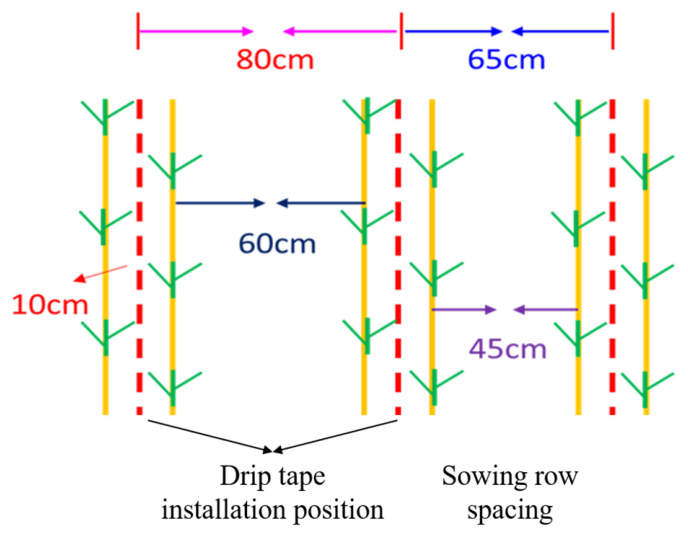
Summer maize in this study is sown timely after wheat harvest when the stable soil temperature reaches ≥10 °C; supplementary irrigation is applied immediately after sowing if soil moisture is insufficient. The sowing depth is controlled at 30–50 mm with simultaneous soil compaction for moisture conservation. Rational planting density and sowing parameters are shown in Table 1. Soil testing-based formulated fertilization is adopted, with combined basal and topdressing application of 675–825 kg ha−1 of slow/controlled-release fertilizer, supplemented with ≥15 kg ha−1 of zinc fertilizer. As shown in Figure 1, the horizontal seed-fertilizer spacing is 100–200 mm; row spacing can be set as 650 mm equal row spacing or 800 + 400 mm wide-narrow row spacing, with plant spacing adjusted precisely according to planting density. Single-seed precision sowing is implemented to avoid multiple seeds per hole. In addition, combined operation technologies including independent closed tillage bin + heavy roller compaction, co-located profiling + pneumatic precision sowing and seed belt conditioning + subsoiling and fertilization are adopted, supplemented by precise information regulation to achieve accurate seed positioning and uniform distribution, ensuring a complete, uniform and robust seedling stand.

2.2. Structural Analysis and Working Principle

2.2.1. Structure and Working Principle of the No-Till Precision Seeder for Dense Maize Planting

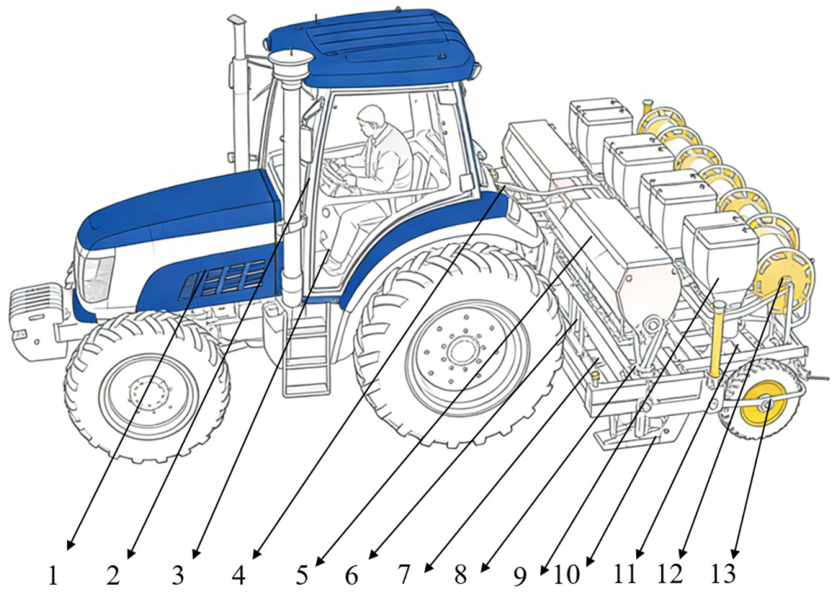
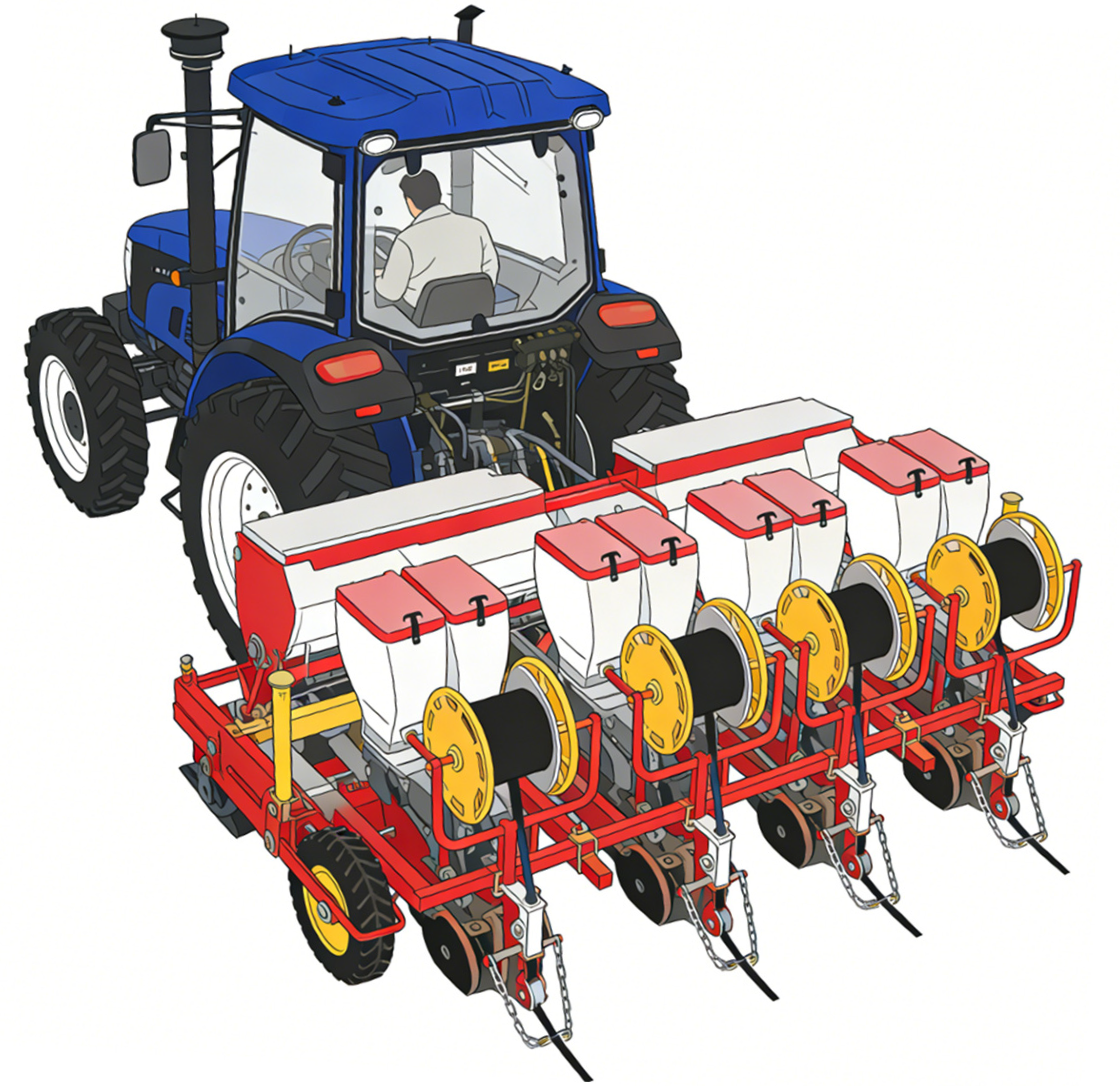
The optimized no-till precision seeder for dense maize planting proposed in this study integrates navigation and intelligent seed metering control technologies, enabling high-precision linear sowing, improved utilization efficiency of light and temperature resources for crops, and enhanced harvesting efficiency [14]. Its operational efficiency meets the demand for the timely sowing of summer maize and adapts to the operational rhythm of full-process mechanization. As shown in Figure 2, the seeder (Shandong Dahua Machinery Co., Ltd., Jining, China) is composed of five core components: a frame assembly, a precision seed metering system, a seed-fertilizer coordinated conveying system, a profiling and compaction system, and an intelligent control system. All components work collaboratively to achieve precision seed-fertilizer co-sowing for dense maize planting under no-till conditions. The basic parameters of the traction tractor (Lovol Heavy Industry Group Co., Ltd., Qingdao, China) are presented in Table 2. The seeder takes a modular frame assembly as the core load-bearing structure, which is rigidly connected to the tractor via a three-point hitch mechanism [15]. With an operational width of 2.4 m for four-row maize planting, it balances operational flexibility and efficiency. A ditching and soil-crushing mechanism combining double-disc ditching blades and shallow rotary blades is integrated at the front of the frame, adapting to the complex working conditions of no-till plots. A 40 L seed hopper and a 120 L fertilizer hopper with anti-bridging agitators are arranged in parallel in the middle to ensure continuous material supply [16]. The sowing and conveying module consists of independent pneumatic precision seeding units, which realize synchronous seed-fertilizer conveying through the linkage between the precision control system and tractor speed, with the seed and fertilizer tubes arranged in parallel on the side. An adaptive operation unit is installed at the rear of the frame, including rubber compaction wheels with spring-preloaded profiling openers and three-level adjustable compaction intensity. A reel-type drip tape laying mechanism with a 50 cm diameter is integrated at the rearmost part, which can be linked with the compaction wheels for synchronous laying. The entire seeder is fabricated from Q235 lightweight steel with a total weight of ≤800 kg, achieving a good balance between structural strength and operational maneuverability.
As shown in Table 3 and Figure 3, the frame assembly of this no-till precision maize seed-fertilizer co-sowing machine is connected to a Lovol MW2104-6 MAX tractor (50–80 kW) via a three-point hitch traction device to meet the mounting requirements. The main and side beams are made of square steel to ensure rigidity and strength, and adjustable modular mounting brackets facilitate the assembly and adjustment of functional modules. A hydraulically liftable double-disc cutting-type straw clearing device is integrated at the front of the frame, driven by the tractor’s power take-off shaft to clear straw, adapting to no-till working conditions with different straw mulch thicknesses. The tractor is equipped with a high-horsepower engine and a multi-gear gearbox, whose stable power output matches the air-suction fan of the seeder, balancing operational stability and driving comfort. The core working process of the seeder is as follows: first, pre-till and crush the soil according to the wheat straw mulch coverage; then adjust parameters such as row spacing, fertilizer application depth, and drip tape laying device to meet the dense planting requirements [17]. During field sowing, regularly check the smoothness of seed and fertilizer metering components; after operation, thoroughly clean straw residues on the machine, clean the filter element and lubricate transmission parts to ensure sowing precision, operational efficiency and service life of the machine.
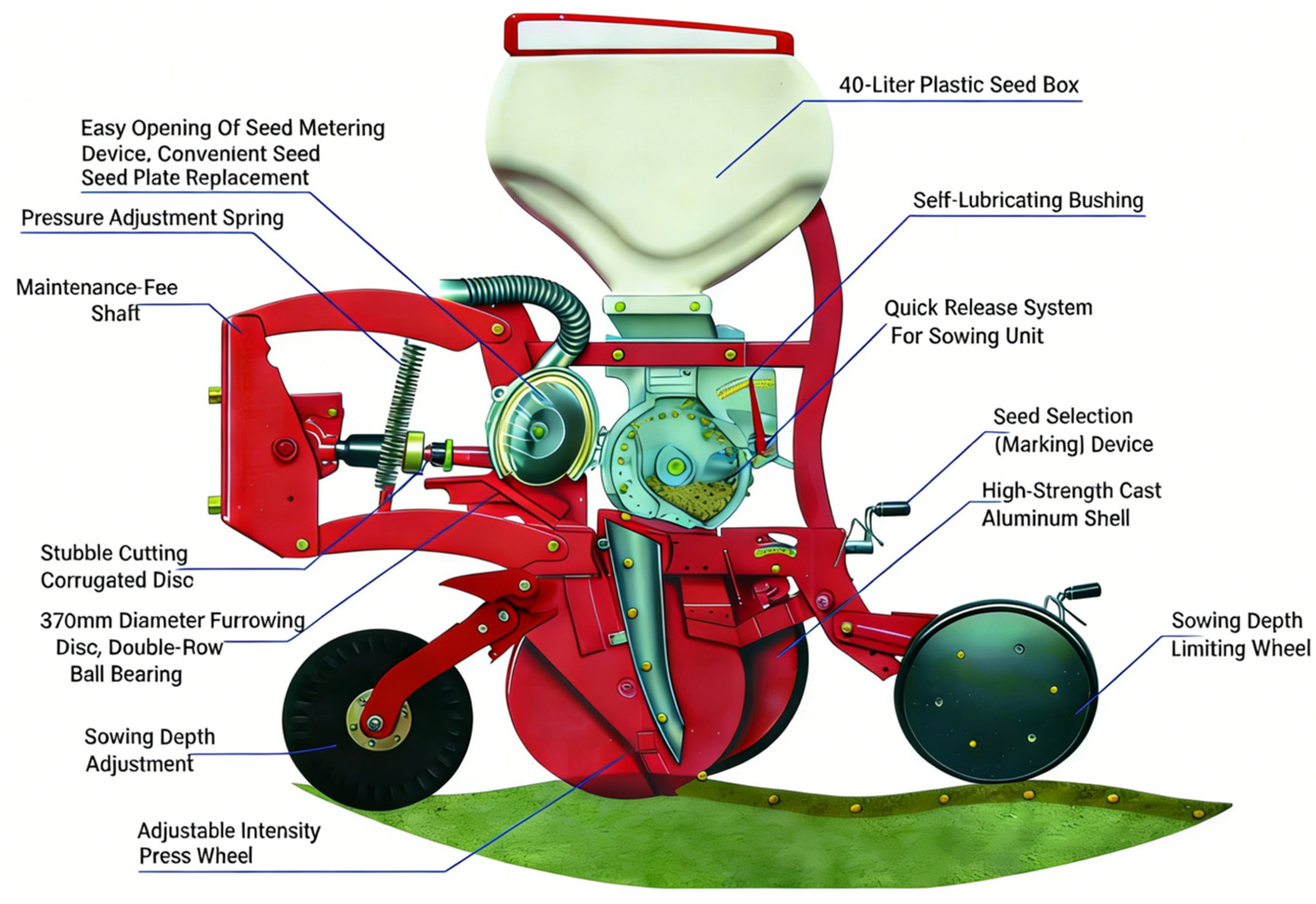
Tailor-designed for the wheat–maize rotation areas in the North China and Huang-Huai-Hai Plains, this machine is a heavy-duty no-till seeder integrating four core functions: heavy-duty stubble clearing, pneumatic precision seeding, layered fertilization and drip tape laying, capable of completing multiple operations in a single pass. Its seed metering mechanism relies on an integrated mechanical structure and collaborative operation logic to achieve precise seed delivery in no-till plots, with the operational principle as follows: After the start of operation, tractor power is transmitted to the seed metering unit via a drive shaft to synchronously drive the operation of all functional components. The front corrugated disc stubble cutter (Shandong Dahua Machinery Co., Ltd., Jining, China) rolls to work first, removing straw stubble within the sowing width by its cutting and crushing capacity, and creating a clean seedbed with the subsoiling function of the opener. After seeds are supplied from the seed hopper, the pneumatic seed metering device with a high-strength cast aluminum shell completes precision seed metering, achieving high-precision sowing with stable vacuum pressure. The quantitatively discharged seeds are transported to the ditching disc via the seed delivery pipe, which cuts a seed furrow as the unit moves forward. The sowing depth limiting wheel accurately controls the ditching depth to 30–50 mm (in line with agronomic requirements) through mechanical linkage. Meanwhile, the layered fertilization system synchronously completes fertilization by delivering fertilizer to a depth of 80–120 mm, realizing the spatial isolation of seeds and fertilizer. After seeds fall into the seed furrow, the rear profiling compaction wheel with a four-bar linkage profiling mechanism and adjustable compaction intensity immediately rolls close to the soil surface, adjusting the compaction intensity and compacting the soil through a spring mechanism to ensure tight contact between seeds and soil and consistent sowing depth, completing the integrated process of sowing, soil covering, and compaction. During operation, the pneumatic auxiliary seed hole fertilization device matched with the seed metering mechanism can realize precise intermittent fertilizer delivery according to seed dropping signals. The seed metering unit lifts in time when encountering obstacles to avoid component damage and effectively reduce the failure rate. The mechanism works synchronously with the drip tape laying device, ultimately achieving the precision seeding effect of a single seed per hole, precise depth, and neat seed belts for maize in no-till plots. Throughout the process, the control system monitors seed and fertilizer metering parameters in real-time via sensors and dynamically adjusts them, realizing precise seeding for dense maize planting and collaborative seed-fertilizer operation in no-till plots while minimizing soil disturbance.

2.2.2. Working Mechanism of the Seed Metering Mechanism

As shown in Figure 4, the wide-narrow row adjustable seed metering mechanism features an integrated structural design and integrates precise row spacing adjustment, isolated seed-fertilizer conveying, and self-adaptive profiling compaction. It enables precise and stable wide-narrow row operation for dense maize planting. The main body of the mechanism is supported by an aluminum alloy unit bracket and equipped with a lead screw-slider row spacing adjustment mechanism [18]. A hand crank drives the lead screw to drive the transverse movement of the seed metering device mounting base, achieving row spacing adjustment of 60–80 cm (wide rows) and 40–50 cm (narrow rows). Lock nuts at both ends of the lead screw prevent row spacing deviation caused by operational vibration. The detachable seed metering device mounting base and arc-shaped seed-fertilizer tube fixing frame maintain the positional stability of seed-fertilizer tubes. The profiling mechanism connecting base is connected to the parallel four-bar linkage profiling mechanism via a pin shaft to ensure the profiling movement of the unit. The isolated precise seed-fertilizer conveying mechanism adopts wear-resistant PVC tubes. With a bolt-type transverse adjustment bracket and a longitudinal timing control module, the arc-shaped guide plate at the outlet ensures accurate seed and fertilizer placement into furrows [19]. The self-adaptive profiling compaction device is equipped with an elastic adjustment component, a soil scraper, and a straw comb anti-winding device, which can effectively avoid soil adhesion and straw entanglement. This mechanism realizes the integrated operation of precise wide-narrow row seeding, isolated seed-fertilizer conveying, and stable profiling compaction, meeting the agronomic requirements of no-till dense planting in the wheat–maize rotation areas of the North China and Huang-Huai-Hai Plains.

2.2.3. Dynamic Modeling and Analysis

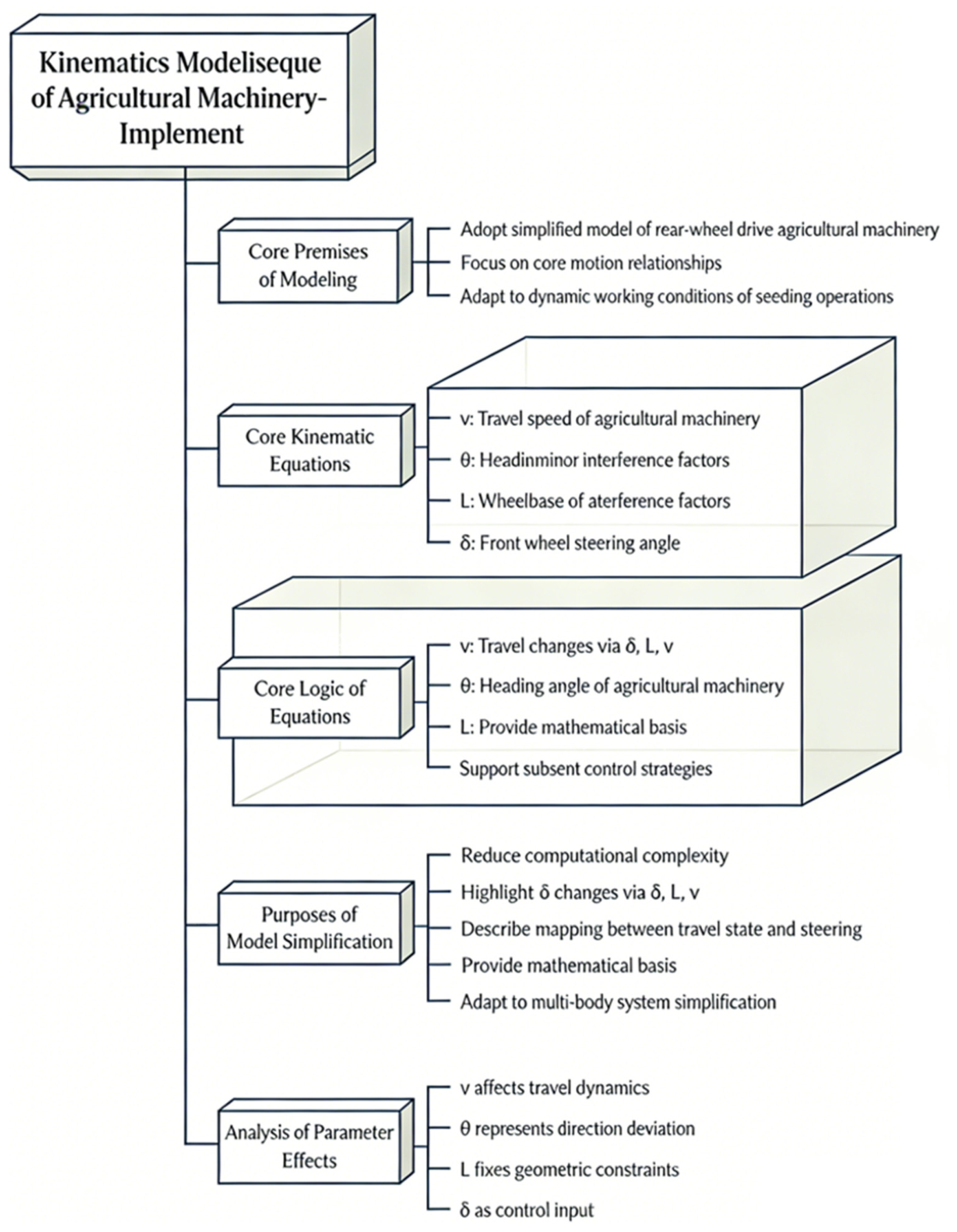
The advancement of automatic navigation and precision operation technologies for agricultural machinery demands the high accuracy and real-time performance of kinematic models [20]. This study constructs a tractor-implement integrated kinematic model based on the simplified rear-wheel driven agricultural machinery model, which provides a reliable mathematical foundation for subsequent automatic control algorithms (Figure 5). The tractor and seeder form a multi-body system, and the simplified kinematic equations of the rear-wheel driven agricultural machinery establish a direct quantitative mapping between inputs and states [21]. These equations fully describe the planar motion state of the machinery and provide continuously differentiable state-space expressions for model predictive control, path tracking, and other algorithms. To solve the problem of ground wheel-driven seed metering being susceptible to slip, a motor direct-drive seed metering device is adopted with the optimal gear axial drive mode. The meshing of the drive gear and seed metering disc reduces torque and mechanism size, ensuring operational stability at high speeds. Meanwhile, a dynamic model for the movement of seeds and fertilizers in the conveying tube is established [22]. The simplified kinematic equation of the rear-wheel driven agricultural machinery for the tractor-seeder multi-body system during sowing is as follows:
x · = v cos ( θ ) y · = v sin ( θ ) θ · = v tan ( δ ) L
where v—travel speed of the agricultural machinery (linear velocity along the longitudinal axis of the body); θ—heading angle of the agricultural machinery (angle between the longitudinal axis of the body and the X-axis of the global coordinate system); L—wheelbase of the agricultural machinery (fixed distance between the centers of the front and rear wheels); δ—front wheel steering angle (angle between the front wheels and the longitudinal axis of the body). These parameters form the minimal variable set for describing the motion state of the agricultural machinery, where L is a fixed geometric constraint, v and δ are control inputs, and θ is the state output.
To simplify the structure of the electric-driven seeding device and reduce the torque required to drive the seed metering device, a gear axial drive mode for the seed metering disc is adopted. The external gear-type disc provides a mechanical structural basis for seed filling and carrying [23]. The drive gear is designed to mesh with the seed metering disc for electric-driven seed metering, which reduces the driving torque and the overall size of the power drive mechanism, ensuring more stable seed metering during high-speed operation. The calculation of gear meshing contact ratio is given in Equation (2):
ε α = Z 1 ( tan   α α 1 tan   α ) + Z 2 ( tan   α α 2 tan   α ) 2 π
where ε—contact ratio; α′—meshing angle (°); Z1—number of teeth of drive gear; Z2—number of teeth of seed metering disc; αa1—addendum circle pressure angle of drive gear (°); αa2—addendum circle pressure angle of seed metering disc (°).
A dynamic model of seeds and fertilizers in the conveying tube was established to analyze their motion characteristics and optimize the structural parameters of the tube [24]. Seeds and fertilizers were assumed to be rigid spheres, with the seed mass denoted as m1 and the fertilizer particle mass as m2; the friction coefficient of the tube’s inner wall μ = 0.15, and the gravitational acceleration g = 9.8 m/s2. The motion equation of seeds in the tube is given as follows:
m 1 d 2 s 1 d t 2 = m 1 g s i n   α μ m 1 g c o s   α
where s1—seed displacement in the tube (m); α—angle between the tube and the horizontal (°); t—time (s).
Similarly, the motion equation for fertilizer particles is:
m 2 d 2 s 2 d t 2 = m 2 g s i n   β μ m 2 g c o s   β
where s2—displacement of fertilizer particles in the tube (m); β—angle between the fertilizing tube and the horizontal (°).

2.3. Design and Optimization of the Precision Seeding Control System

2.3.1. System Hardware Integration

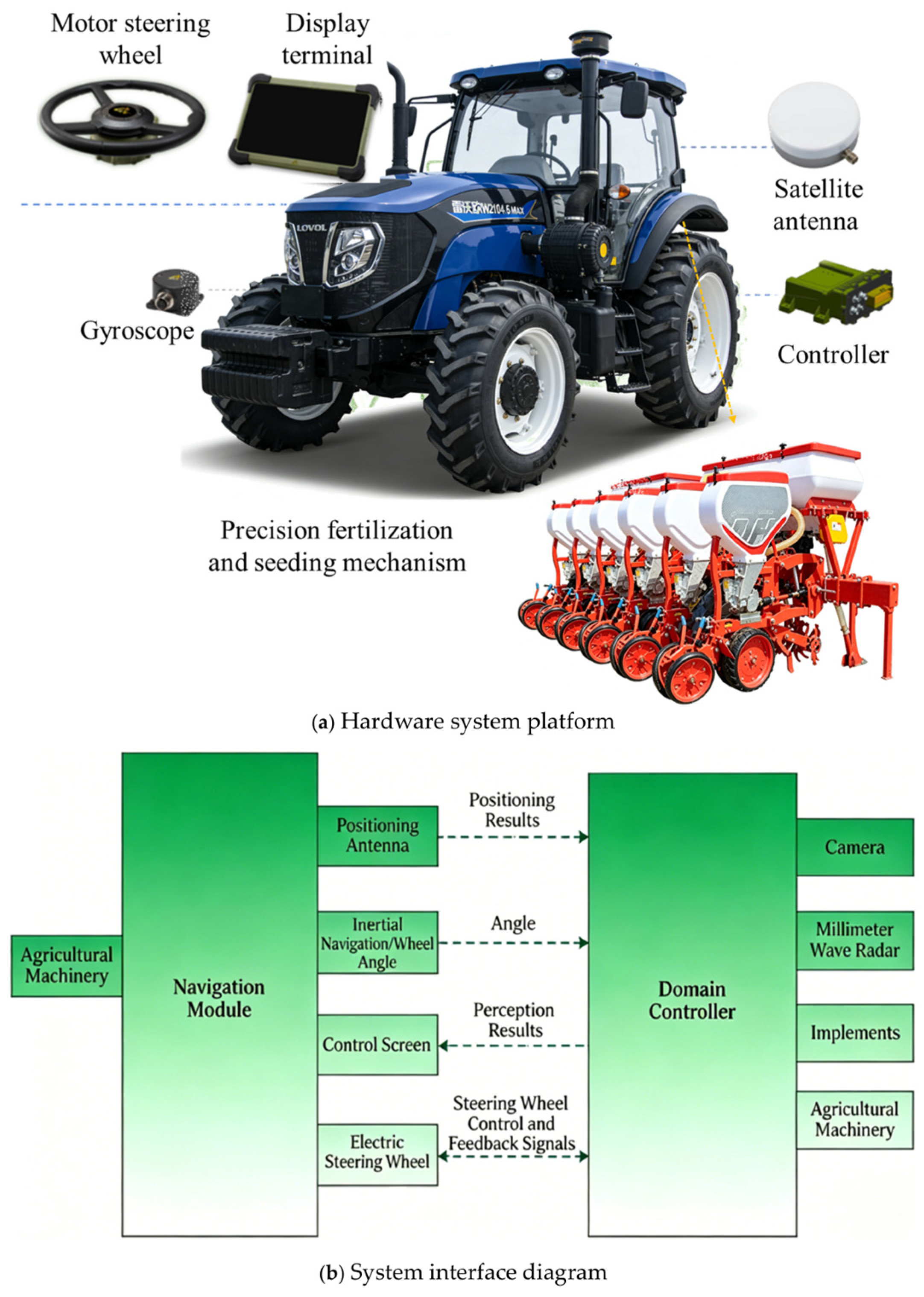
Based on the Lovol MW2104-6 tractor as the power bearing platform, the precision seeding control system is designed to meet the agronomic requirements of dense maize planting and follow the principles of modularization and adjustable adaptability. A closed-loop integrated hardware architecture integrating perception, control, and execution is constructed to provide stable support for precision operation [25]. As shown in Figure 6, the system takes the STM32 microcontroller as the core and integrates independent modules including the frame assembly and precision seed metering and conveying unit. All modules are connected via standardized interfaces, and key operational parameters can be adjusted over a wide range to adapt to agronomic practices, plot conditions, and maize variety requirements in different production areas [26]. The perception layer consists of a satellite antenna and an attitude sensor, which collaboratively collect centimeter-level position, travel speed, as well as the tractor’s heading angle and attitude information to provide an accurate spatiotemporal reference. The control layer is centered on an embedded controller and integrates a CAN bus drive circuit, realizing peripheral device management and fault handling, and achieving the closed-loop control of seed metering based on the PID algorithm [27]. The execution layer includes a Huace Navigation steering wheel, combined with the wide-narrow row adjustable seed metering unit and self-adaptive profiling compaction device, to realize high-precision path tracking and precise collaborative seeding with co-located and different zones. The interaction layer adopts a TFT-LCD touch screen for the display and visual configuration of key operational parameters. In addition, the system is equipped with a modular power supply, signal acquisition module and chip drive module, realizing data sharing through interaction with the tractor ECU via the CAN bus. The rational layout of all core components provides reliable support for the transplantation of control algorithms and field tests.

2.3.2. System Software Design

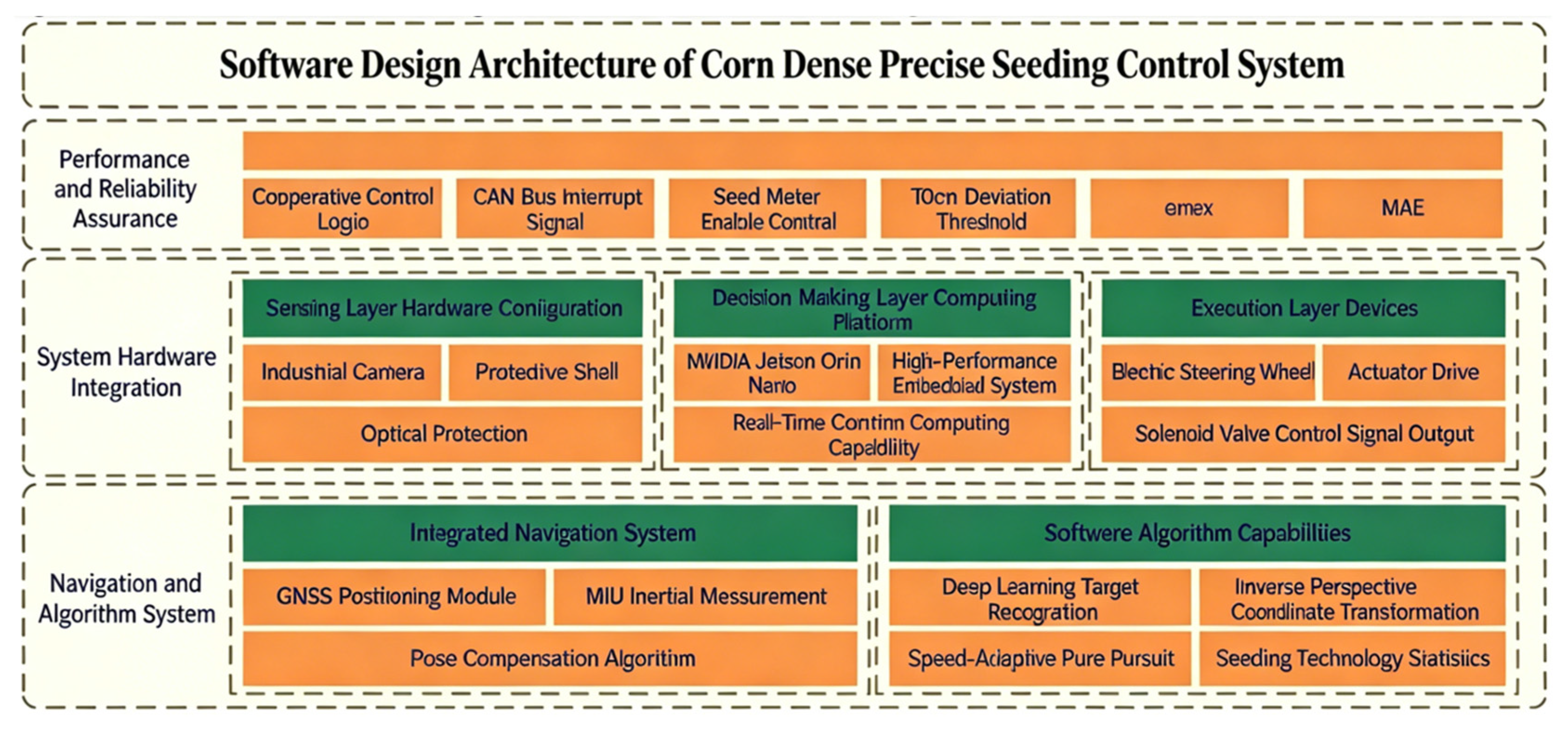
The software of the precision seeding control system adopts a hierarchical decoupling architecture in its entirety, which balances system reliability, real-time performance and scalability, and provides core software support for the precision operation objectives [28]. As shown in Figure 7, the software architecture consists of three collaborative and interactive layers: the performance and reliability guarantee layer serves as the fundamental support, which realizes multi-module timing scheduling and state coordination through collaborative control logic, completes real-time communication and fault response of hardware nodes via CAN bus interrupt signals, and ensures the dynamic operational stability of real-time monitoring by the seed metering device enabling control module; the system hardware integration layer is responsible for interfacing with underlying hardware resources, driving all hardware modules of the perception, control, execution, and interaction layers accurately, realizing the data acquisition of perception devices such as positioning antennas and attitude sensors, as well as the command driving of execution devices such as electric steering wheels and precision seeding mechanisms, and adapting to the operational requirements of modular power supplies, signal acquisition modules, and drive modules; the navigation and algorithm system layer acts as the software core, integrating multi-source navigation and core control algorithms. It fuses the GNSS positioning module, IMU inertial measurement unit, and pose compensation algorithm to achieve the centimeter-level positioning and attitude solution of agricultural machinery. It also embeds the PID control algorithm to realize closed-loop seed metering control, and integrates the speed-adaptive pure pursuit algorithm to achieve high-precision navigation with the electric steering wheel. This layer provides data support for subsequent operation optimization, enabling precise and intelligent seeding management and control through the collaborative linkage of software and hardware.
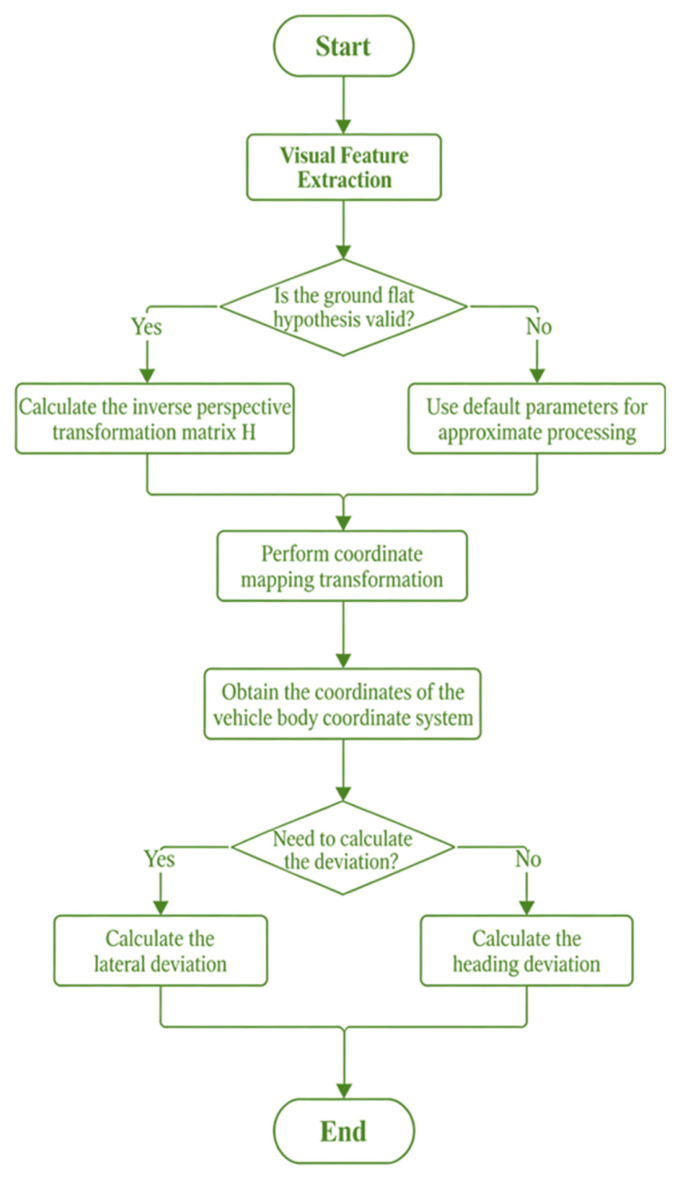
The software flow for the visual navigation deviation calculation of the precision seeding system starts with visual feature extraction, providing accurate pose feedback for the automatic navigation of agricultural machinery. As shown in Figure 8, after system startup, key visual features such as seed belts and furrows are first extracted from field images captured by an industrial camera, followed by terrain flatness hypothesis verification to adapt to different plots: for flat plots, the inverse perspective transformation matrix is calculated based on camera parameters to achieve accurate mapping between pixel coordinates and the body coordinate system; for non-flat plots, preset terrain parameters are called for coordinate mapping compensation. Upon the completion of coordinate mapping, the system converts image feature points into 3D coordinates of the body coordinate system, and calculates lateral deviation (path offset) and heading deviation as required. This flow balances the calculation accuracy for flat plots and the robustness for complex terrain, and the output deviation data supports the improved pure pursuit control algorithm, ensuring the centimeter-level path tracking accuracy of the system.

2.3.3. Deviation Solution Model and Coordinate Transformation

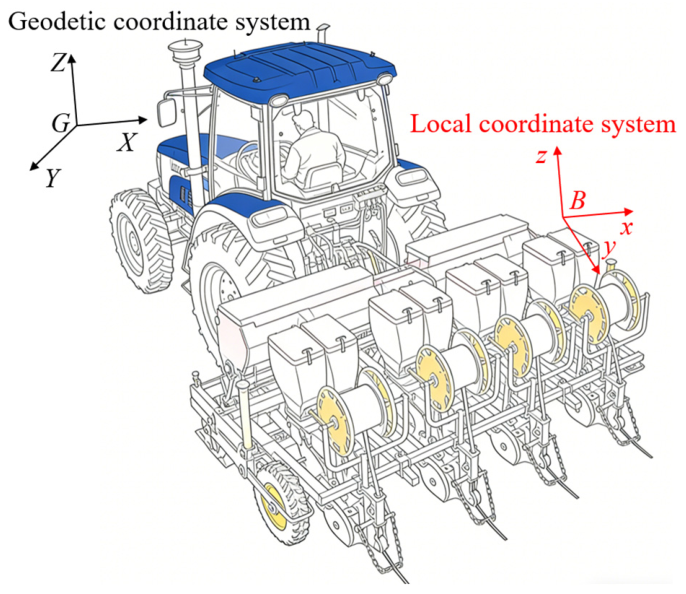
Owing to the pitch, roll, and sideslip of the seeding unit during operation caused by the uneven and inhomogeneous hardness of field ground, the actual motion trajectory of each seed metering device is a spatial curve. The seeding unit can be regarded as a rigid body due to the integrated fixed connection between the seeder and tractor [29]. A rigid-body spatial kinematic model for the dense maize seeding unit is established, as shown in Figure 9. Let G be the origin of the geodetic coordinate system G-XYZ, and a local coordinate system B-xyz be established with B, the installation point of the main antenna received by the dual-antenna RTK-GNSS rover station, as the origin. Rotational motion represents the spatial attitude change in the seeding unit, and the rotation matrix is expressed as:
R B G = Q Z , α Q Y , β Q X , y
Q Z , α = cos  α sin  α 0 sin  α cos  α 0 0 0 1 Q Y , β = cos  β 0 sin  β 0 1 0 sin  β 0 cos  β Q X , y = 1 0 0 0 cos  γ sin  γ 0 sin  γ cos  γ
where α —heading angle of the unit; β —pitch angle of the unit; γ —roll angle of the unit; Q Z , α —rotation matrix about the Z-axis; Q Y , β —rotation matrix about the Y-axis; Q X , y —rotation matrix about the X-axis; R B G —spatial rotation matrix.
Translational motion describes the spatial position change in the seeding unit. Since the translation line is parallel to the x-axis of the local coordinate system B, the expression of a point i on the operating line L of the c ( i , l ) seed metering device in the geodetic coordinate system is given by:
r c G ( i , l ) = G R B c B ( i , l ) + G r c B ( i , l ) = c x ( i , l )       c y       c z T
where r c G ( i , l ) —position vector of point in the geodetic coordinate system G; r G —position vector of the origin of local coordinate system B in the geodetic coordinate system G; c B ( i , l ) —position vector of point P in the local coordinate system B.

2.4. Field Trial

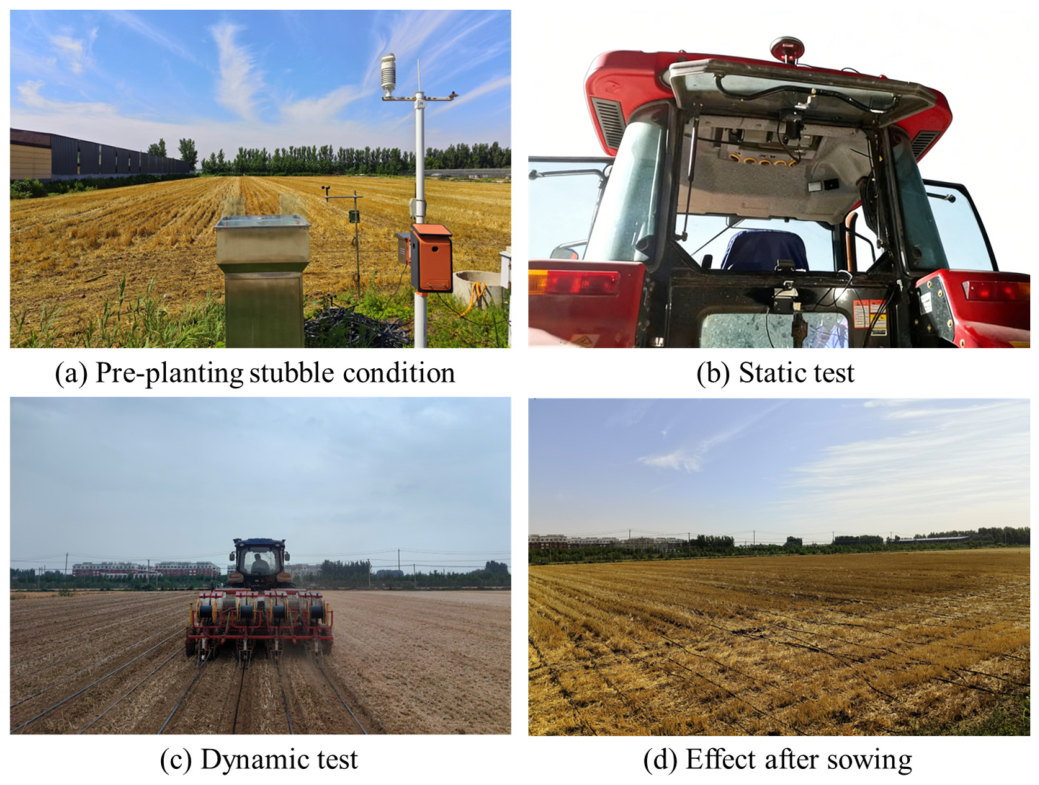
To verify the operational performance of the optimized no-till precision seed-fertilizer co-sowing system for dense maize planting and its compatibility with the agronomic practices of super high-yield farmland in Qihe, Shandong, field experiments were conducted (Figure 10) [7]. The experiments were carried out in June 2025 at the Smart Technology Demonstration Base of the Science and Technology Courtyard for Super High-Yield Cropping Systems, China Agricultural University in Qihe (36.675° N, 116.645° E), with the standardized wheat–maize rotation planting mode and agronomic requirements as the core reference. The experimental plot covered an area of approximately 2 hm2, with cinnamon soil as the soil type, a soil moisture content of 18–22%, and wheat as the previous crop. A randomized block design was adopted, with three treatment groups and three replicates per group; each plot had an area of 0.2 hm2 with a 5 m interval between adjacent plots. All treatment groups adopted the dense planting mode with planting densities of 75,000, 90,000, and 105,000 plants·ha−1, fully matching the agronomic parameters of super high-yield farmland in Qihe. Data were collected from the stable operation section of the machine at an operational speed of 4–6 km/h. The ditching depth was measured via vertical soil cutting to calculate the qualified index of ditching depth and the coefficient of variation for consistency. Core indicators including the coefficient of variation in sowing depth were counted simultaneously. A comparative analysis of the performance differences among all treatment groups was conducted, providing a solid experimental basis for the optimization, improvement, and popularization of the system.

2.5. Test Data Processing, Analysis, and Evaluation Indices

Test data processing and performance evaluation in this study were conducted in accordance with the national standard GB/T 20865-2017 [30] No-Till (Reduced-Till) Fertilizer Seeder, and combined with the agronomic requirements for high-yield no-till dense maize planting in the super high-yield farmland of Qihe, Shandong. A core evaluation index system was constructed, and scientific data processing methods were adopted to quantify the system performance, providing a basis for compatibility assessment. Data processing followed the principles of multi-point sampling and repeated verification; after excluding outliers, the mean, standard deviation and coefficient of variation in three repeated measurements were calculated. Core evaluation indices focused on agronomic compatibility and operational precision, as specified below:
(1) Seedling Emergence Number and Rate
At 3, 10, and 20 days after sowing, stable sowing operation areas were randomly selected in each experimental treatment to record the actual number of emerged maize seedlings, respectively. Measurements were taken at five sampling points and the mean value was calculated; the effective seedling number per hectare (i.e., seedling emergence density) was determined according to Equation (8).
M = 10000 10 / M H × B / N
where M—effective seedling number (i.e., seedling emergence density), plants/hm2; MH—mean actual emerged seedling number within 10 m, plants; B—width of each production unit, 3 m; N—number of maize rows in each production unit.
The seedling emergence rate was determined following the same measurement method synchronously with the seedling number investigation, calculated according to Equation (9).
C = M H 10 × X × 100 %
where C—seedling emergence rate, %; X—theoretical plant spacing (adjusted on the seeder as required). For the planting mode with a sowing row spacing of 650 mm, the theoretical plant spacings corresponding to the maize sowing densities of 75,000, 90,000, and 105,000 plants·ha−1 are 195 mm, 158 mm, 139 mm, and 121 mm, respectively.
(2) Plant Spacing Qualification Rate
Measured synchronously with seedling number investigation using the same method. 30–50 actual emerged plant spacings were determined continuously, and the number of qualified plant spacings was recorded, where those ranging from 0.5 to 1.5 times the theoretical plant spacing were defined as qualified. The plant spacing qualification rate was calculated according to Equation (10).
Z = Z H 30 ~ 50 × 100 %
where Z—plant spacing qualification rate, %.
(3) Sowing Uniformity
Five maize seed belts were staggeredly selected in the operation area, and a 2 m2 sampling section was chosen for each seed belt in sequence to record the seed belt width and the number of seedlings in each section, respectively. The total number of seedlings in all sampling sections was denoted as T, and the total number of sampling sections as U. The uniformity index was calculated using the coefficient of variation, with a smaller coefficient of variation indicating better sowing uniformity.
W = T U
σ = i = 1 n ( T i W ) 2 n
C v = σ W × 100 %
where W—average number of seeds; Ti—number of seeds in the i-th sampling section.
(4) Sowing Depth Qualification Rate
Five maize seed belts were staggeredly selected in the operation area, with 20 measurement points set in each seed belt. After sowing and soil covering, the soil layer was removed to measure and record the soil covering thickness; a thickness ranging from 30 to 50 mm was regarded as a qualified sowing depth, denoted as V. The calculation formula for each parameter is given as follows:
η 1 = n 1 N 1 × 100 %
h ¯ = h i N 1
S h = ( h i h ¯ ) 2 N 1
V h = S h h × 100 %
where η 1 —sowing depth qualification rate, %; n 1 —number of qualified sowing depth measurements; N 1 —total number of sowing depth measurement points; h ¯ —average sowing depth, mm; h i —individual sowing depth measurement, mm; S h —sowing depth standard deviation, mm; V h —sowing depth coefficient of variation, %.

3. Results and Discussion

3.1. Operational Quality and Performance Analysis

The experimental results indicated that all core operational quality indices of the optimized no-till precision seeders for dense maize planting were excellent and fully complied with the agronomic requirements for high-yield no-till dense maize cultivation in Qihe. As shown in Table 4, in terms of sowing depth, the average depth was stably maintained within the agronomically suitable range of 40 mm; the profiling and compaction performance was superior, which effectively ensured close contact between seeds and soil and laid a solid foundation for seedling emergence. For seed-fertilizer co-application, the average fertilizer application depth was controlled within 100 mm. The sowing accuracy reached over 95%, the plant spacing qualification rate was as high as 95%, and the coefficient of variation for sowing uniformity across all rows met the index requirement of ≤5.0%. In summary, the optimized system featured excellent operational quality and strong agronomic compatibility, demonstrating promising prospects for large-scale popularization and application in the super high-yield farmlands of Qihe, Shandong.

3.2. Sowing Uniformity Analysis

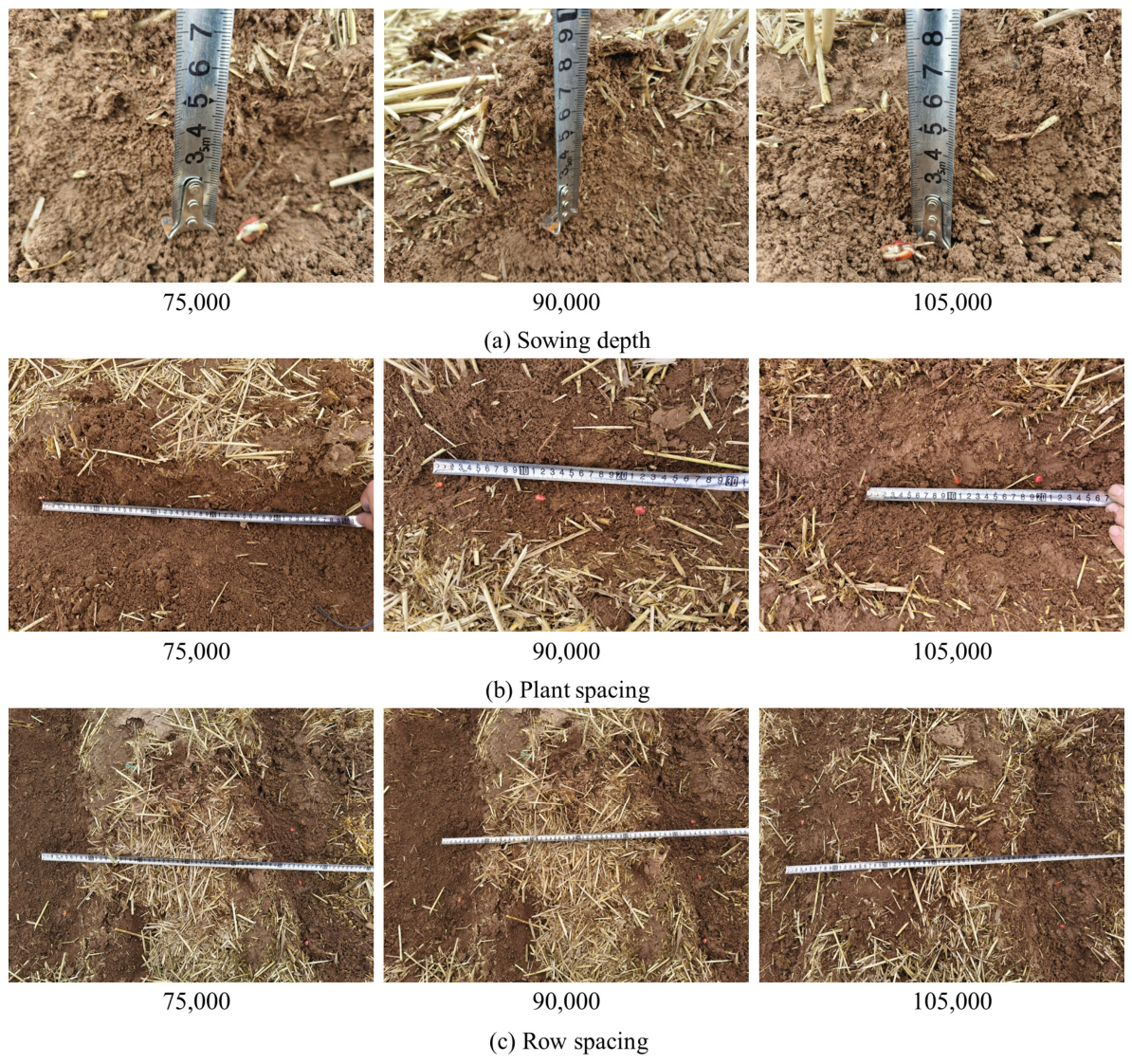
To meet the high-yield requirements of no-till dense maize planting in Qihe, Shandong, a field experiment on sowing uniformity was conducted with three planting densities set at 75,000, 90,000, and 105,000 plants·ha−1, using a 2 m2 sampling area (with the seed belt width regarded as a fixed value) (Figure 11). The results are presented in Table 5. Under the three densities, the measured number of seeds per sampling area fluctuated around 15, 18, and 21 grains, respectively, which corresponded to the converted values of the target density for 2 m2 and were slightly higher than the theoretical target values. This phenomenon is speculated to be related to slight seed bouncing during seed metering and counting errors. The overall sowing uniformity was excellent, with the coefficients of variation being 5.65%, 8.33%, and 7.34% respectively, all below the qualified threshold of 10%. Under low density, there was less inter seed interference and more stable seeding; The process of filling, carrying, and dropping seeds was smoother, with less bouncing and precise seed dropping; Stable seedbeds and more uniform plant spacing distribution resulted in the lowest coefficient of variation. Among them, the density of 75,000 plants·ha−1 yielded the smallest coefficient of variation and the best uniformity.
The experimental results of sowing depth under the three planting densities are presented in Table 6, indicating that planting density had no significant effect on sowing depth stability [31]. The average sowing depth of the seeder was consistently 40 mm across all three densities, falling stably within the agronomically recommended range of 30–50 mm for maize planting in Qihe, Shandong. The coefficients of variation for sowing depth were only 8.84%, 8.30% and 6.28%, demonstrating excellent consistency. This lays a solid foundation for subsequent uniform seedling emergence and high-yield, confirming the seeder’s suitability for dense and high-yield maize cultivation in Qihe, Shandong.
Based on the field test results of the three dense planting modes (5000, 6000, and 7000 plants per 666.67 m2) for maize in Qihe, Shandong, a three-dimensional analysis of sowing uniformity from sowing depth, row spacing, and plant spacing revealed that the optimized maize precision seeding system was fully compatible with the local agronomic requirements for no-till dense planting. The average sowing depth was stably maintained at 40 mm, falling within the agronomically recommended range of 30–50 mm, with a coefficient of variation of only 6.28–8.84%, and planting density had no significant effect on sowing depth stability. The sowing row spacing was precisely adjusted to the required 650 mm via the wide-narrow row regulation function of the seed metering mechanism, with good consistency. Sowing uniformity was correlated with planting density, with the 75,000 plants·ha−1 density yielding the optimal performance: the coefficient of variation for seed number in the 2 m2 sampling area was only 5.65%. For the 75,000 and 90,000 plants·ha−1 densities, the coefficients of variation were 8.33% and 7.34% respectively, all below the 10% qualified threshold, indicating that the seeding precision was sufficient to ensure uniformity control. In summary, the 75,000 plants·ha−1 density achieved the best overall sowing uniformity. Subsequent performance improvements can be realized by reducing operational speed to minimize disturbances, increasing spring stiffness for better stubble clearing, and optimizing seed tube structure to reduce seed collision, thereby further enhancing sowing uniformity to better meet the local high-yield cultivation requirements.

3.3. Seedling Emergence Performance

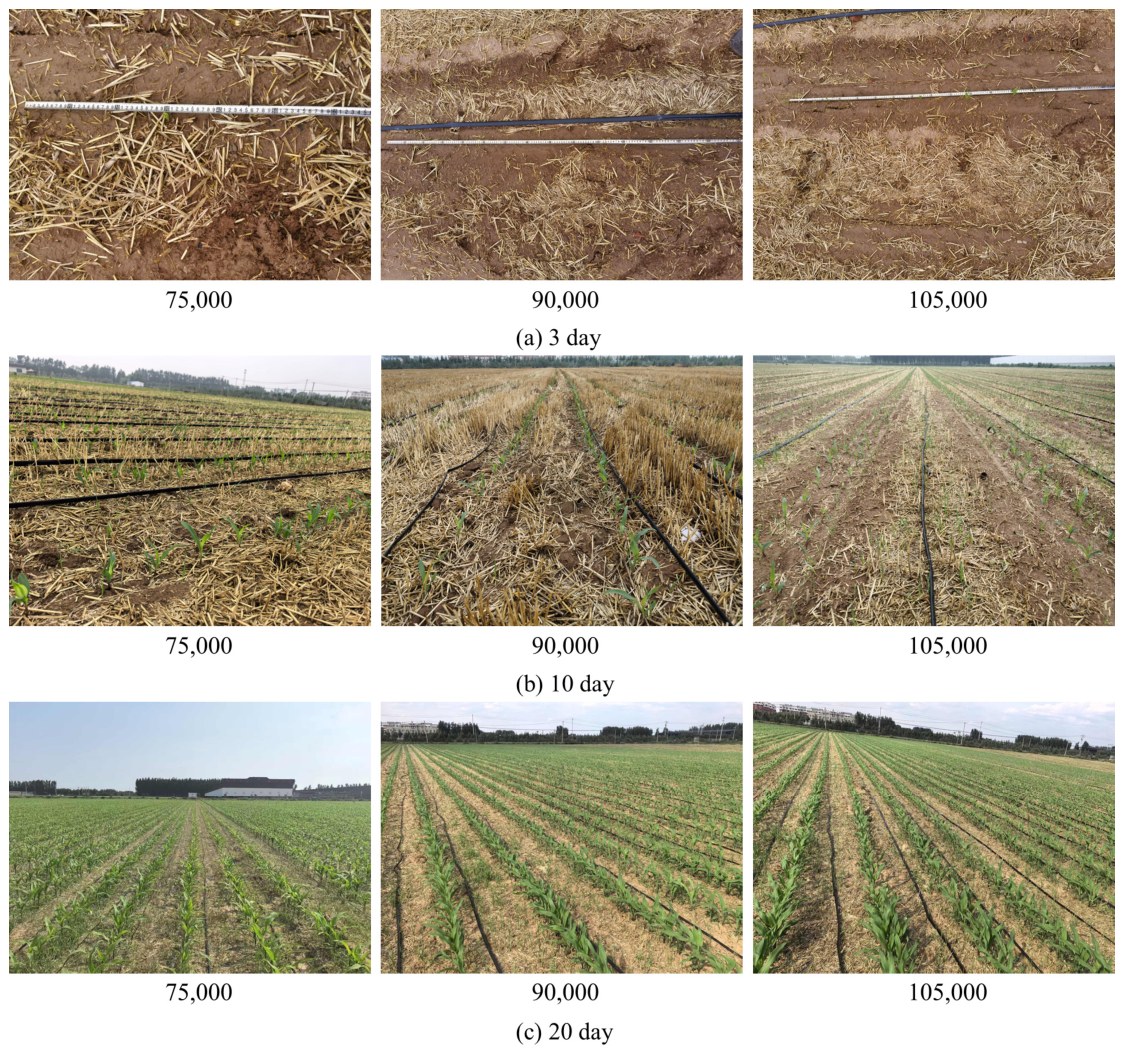
The maize seedling emergence performance after field sowing is shown in Figure 12, which was found to be excellent. The optimized no-till precision seeder for dense maize planting exhibited superior operational performance, and its seedling emergence effect met the requirements for direct precision sowing of maize in the wheat–maize rotation system in the Huang-Huai-Hai Plain [32]. Combined with the sowing test conditions in no-till cinnamon soil plots in Qihe, Shandong, a systematic investigation of seedling emergence was conducted at 3, 10, and 20 days after sowing for three maize dense planting modes (75,000, 90,000 and 105,000 plants·ha−1). Focusing on seedling emergence rate, uniformity and population consistency, and integrating the earlier indicators such as sowing depth and plant spacing uniformity, the influence of planting density on the process and quality of seedling emergence was analyzed.
At three days after sowing (the initial emergence stage), sporadic seedling emergence was observed under all three densities, with generally low and non-significantly different emergence rates. The low-density plots showed a slightly faster initiation of emergence due to weaker inter-plant competition. At 10 days after sowing (the peak emergence stage), the emergence rates under all densities increased significantly with gradually apparent differences, and the 75,000 plants·ha−1 density performed the best. This benefit was attributed to the optimal sowing uniformity (coefficient of variation: 5.65%) under this density, where rational seed distribution and moderate nutrient competition provided balanced nutrients for seedling germination. In contrast, the high-density plots (90,000 and 105,000 plants·ha−1) had intensified competition for nutrients and light due to narrow inter-plant spacing, resulting in lower emergence rates than the medium-density plot and a slower population emergence speed. At 20 days after sowing (the stable emergence stage), the emergence rates under all densities stabilized and generally maintained the trends from the peak stage. The 75,000 plants·ha−1 density still retained its advantages with the best seedling emergence uniformity, showing good consistency in seedling stem diameter and leaf number.
In summary, under the no-till dense planting conditions, the 75,000 plants·ha−1 density exhibited the optimal performance in seedling emergence periods. It not only ensured a high emergence rate and good uniformity but also matched the local agronomic requirements for high yield. There can provide equipment support for high-yield cultivation of corn through no-tillage and dense planting in the Huang Huai Hai region and even nationwide. In contrast, high density tended to induce competitive stress while low density easily led to a sparse population, both of which were unfavorable for improving seedling emergence quality. Meanwhile, the uniformity of sowing depth the and consistency of plant spacing had a continuous influence on seedling emergence at stages, serving as the core factors for regulating seedling emergence quality.

4. Conclusions

Aiming at the technical bottlenecks of traditional no-till seeders under the wide-narrow row dense planting mode, this study conducted optimization and experimental research on a no-till wide-narrow row dense planting precision seed-fertilizer co-sowing system for maize oriented to high-yield agronomy, based on the Technology Demonstration and Test Base of the Science and Technology Courtyard for Super High-Yield Cropping Systems, China Agricultural University in Qihe. The main research conclusions are as follows:
(1) The no-till dense planting precision seeding system for maize was designed and optimized, meeting the core agronomic requirements for dense planting in Qihe. Through the modular integration and optimization of key components, the system is effectively adapted to the precision maize seeding scenarios in the wheat–maize rotation area of Qihe, Shandong. The adjustable seed metering mechanism enables the precise row spacing regulation, and the self-adaptive profiling compaction device improves the consistency of sowing depth in complex plots. The overall structure effectively solves the problems of anti-clogging and seeding precision in straw-covered plots.
(2) An integrated kinematic model of agricultural tractor and implement, and a dynamic model inside the seed metering tube were constructed, which quantified the correlation between operational parameters and motion states, providing a reliable theoretical basis for the optimization of system structural parameters. Adopting the modular design concept, an overall architecture including frame assembly, precision seed metering system, profiling compaction system, and intelligent control system was built to adapt to the operational requirements of no-till plots.
(3) The intelligent precision seeding control system achieves accurate regulation. With the STM32 microcontroller as the core, the system integrates independent modules such as frame assembly and precision seed metering and conveying, all connected via standardized interfaces. Equipped with a modular power supply, signal acquisition module, and chip drive module, the system realizes data sharing through interaction with the tractor ECU via the CAN bus, which provides a spatiotemporal reference for precision operation and meets the intelligent operational demands of large-scale high-yield farmland in Qihe.
(4) Field experiments verify the excellent comprehensive performance of the system and determine the optimal planting parameters. Field experiments in Qihe, Shandong show that all operational quality indices of the system meet the local requirements for high-yield no-till dense planting. Among the three planting densities, the 75,000 plants·ha−1 density achieves the best comprehensive performance, with the optimal sowing uniformity (coefficient of variation: 5.65%) and the best seedling emergence and seedling uniformity. The operational quality can be further improved by reducing the operational speed and increasing the spring stiffness, realizing the deep integration of high-yield agronomy and agricultural machinery equipment.
(5) The system has popularization and application value and can support regional high-yield production. It realizes integrated operations including straw clearing, precision seeding, layered fertilization, ditching and compaction, and drip irrigation laying, adapting to the agronomic characteristics of Qihe, Shandong and the wheat–maize rotation areas in the Huang-Huai-Hai Plain. Its structural design and control strategy can provide a reference for the research, development and optimization of similar no-till seeding equipment, promoting the large-scale popularization and application of no-till dense planting precision seed-fertilizer co-sowing technology. This provides stronger support of agricultural machinery equipment for high-yield and high-quality maize cultivation in China, and is of great significance for improving agricultural production efficiency and resource utilization rate.

Author Contributions

Conceptualization, Z.Y. and X.H.; methodology, Z.Y., X.H., S.S. and Y.G.; software, G.W. and K.R.; validation, C.L. and X.N.; formal analysis, Z.Y.; investigation, Z.Y. and Y.G.; resources, X.H. and S.S.; data curation, Z.Y., and K.R.; writing—original draft preparation, Z.Y.; writing—review and editing, Z.Y., S.S. and Y.G.; visualization, G.W. and X.N.; supervision, C.L.; project administration, X.H. and Y.G.; funding acquisition, X.H. All authors have read and agreed to the published version of the manuscript.

Funding

This work was supported by the 2115 talent development program of China Agricultural University (No. 2115-89052), the earmarked fund for China Agriculture Research System (No. CARS-28), the National Key Research and Development Program Project (No. 2025YFE0208900), 2025 China Association for Science and Technology Youth Talent Support Project Doctoral Program, the National Key Laboratory Project, and the National Natural Science Foundation of China (No. 31761133019).

Data Availability Statement

The original contributions presented in this study are included in the article. Further inquiries can be directed to the corresponding author(s).

Acknowledgments

The authors would like to thank all other staff of CCAT and CAUS, all the teachers and students of the High Yield Planting System Science and Technology College of China Agricultural University for their significant contributions to this work.

Conflicts of Interest

Authors Kuan Ren and Xing Nian was employed by the company Beijing Zhiyuan Zhihe Technology Co., Ltd. Author Chaogang Li was employed by the company Shandong Qilixin Agricultural Services Co., Ltd. The remaining authors declare that the research was conducted in the absence of any commercial or financial relationships that could be construed as a potential conflict of interest.

References

  1. Wang, Y.; Li, H.; Hu, H.; He, J.; Wang, Q.; Lu, C.; Liu, P.; Yang, Q.; He, D.; Jiang, S.; et al. A noncontact self-suction wheat shooting device for sustainable agriculture: A preliminary research. Comput. Electron. Agric. 2022, 197, 106927. [Google Scholar] [CrossRef] [Scilit]
  2. Wang, J.; Xu, Y.; Wang, C.; Xiang, Y.; Tang, H. Design and simulation of a trenching device for rice straw burial and trenching based on MBD-DEM. Comput. Electron. Agric. 2023, 207, 107722. [Google Scholar] [CrossRef] [Scilit]
  3. Liu, B. Effect of Land Use Type on Soil Moisture Dynamics in the Sloping Lands of the Black Soil (Mollisols) Region of Northeast China. Agriculture 2024, 14, 1261. [Google Scholar]
  4. Ajay, A.; Reddy, K.V.S.R. Design and Development of Mini Tractor Operated Twin-rowMaize Planter. J. Exp. Agric. Int. 2025, 47, 363–374. [Google Scholar] [CrossRef] [Scilit]
  5. Yang, J.; Wu, H.; Guo, A.; Rugerinyange, R.; Liu, C.; Zhao, Z.; Han, W.; Yin, L. Performance Optimization and Simulation Test of No-Tillage Corn Precision Planter Based on Discrete Element Method (DEM). Machines 2024, 12, 465. [Google Scholar] [CrossRef] [Scilit]
  6. Wang, Q.; Peng, M.; He, J.; Lu, C.; Wang, C.; Tong, Z. Design and experiment of the ditching device for wheat seeders capable of ditching sloped drainage furrows in rice-wheat rotation areas. Int. J. Agric. Biol. Eng. 2025, 18, 154–164. [Google Scholar] [CrossRef] [Scilit]
  7. Li, S.; Diao, P.; Zhang, Y.; Li, X.; Zhao, Y.; Zhao, H. Design and performance evaluation of notched type discs for application in no-till seeding process using discrete element method and field trials. Biosyst. Eng. 2025, 257, 104222. [Google Scholar] [CrossRef] [Scilit]
  8. Li, H.; He, J.; Wang, Q.; Wang, C.; Wu, Z.; Guo, Z. Analysis of slope-adaptive in covering-compacting device for no-till sowing based on DEM-MBD. Comput. Electron. Agric. 2025, 233, 110175. [Google Scholar] [CrossRef] [Scilit]
  9. Liu, R.; Wu, G.; Dong, J.; Yan, B.; Meng, Z. Improving Sowing Uniformity of a Maize High-Speed Precision Seeder by Incorporating Energy Dissipator. Agriculture 2024, 14, 1237. [Google Scholar] [CrossRef] [Scilit]
  10. Ling, L.; Xiao, Y.; Huang, X.; Wu, G.; Li, L.; Yan, B.; Geng, D. Design and Testing of Electric Drive System for Maize Precision Seeder. Agriculture 2024, 14, 1778. [Google Scholar] [CrossRef] [Scilit]
  11. Gómez, J.A.L.; Espejel, J.E.P.; López, N.V.; Chávez, D.I.S.; Van Loon, J. Design and Comparison of Two Maize Seeders Coupled with an Agricultural Robot. Machines 2024, 12, 935. [Google Scholar] [CrossRef] [Scilit]
  12. Gonçalves, M.F.; Ganancini, Z.G.; Paulo, J.S.; Silva, F.R.D.; Daniel, S. Sensors installation position and its interference on the precision of monitoring maize sowing. Smart Agric. Technol. 2023, 4, 100150. [Google Scholar] [CrossRef] [Scilit]
  13. Qi, Z.; Liu, C.; Wang, Y.; Zhang, Z.; Sun, X. Design and Experimentation of Targeted Deep Fertilization Device for Corn Cultivation. Agriculture 2024, 14, 1645. [Google Scholar] [CrossRef] [Scilit]
  14. Xue, C.; Chen, L.Q.; Liu, C.; Wang, W.W. A method for optimising the parameters of connecting parts of a corn no-till planter. Biosyst. Eng. 2024, 245, 177–189. [Google Scholar] [CrossRef] [Scilit]
  15. Wang, S.; Wu, X.; Zhao, X.; Zhang, S.; Wang, S.; Zhu, M.; Xie, B.; Song, Z.; Wang, D. A novel energy management strategy based on Game Theory for distributed hybrid electric tractor to reduce equivalent fuel consumption and improve traction efficiency. Comput. Electron. Agric. 2025, 239, 110922. [Google Scholar] [CrossRef] [Scilit]
  16. Qu, J.; Zhang, Z.; Qin, Z.; Guo, K.; Li, D. Applications of Autonomous Navigation Technologies for Unmanned Agricultural Tractors: A Review. Machines 2024, 12, 218. [Google Scholar] [CrossRef] [Scilit]
  17. Zhang, S.; Huang, Y.; Gao, X.; Bi, Y.; Dong, J.; Zhao, H.; Zhao, P.; Jia, X. Evaluating the influence of straight-plain types of rotary tiller blades with various edge curves on maize residue using DEM. Biosyst. Eng. 2025, 250, 49–61. [Google Scholar] [CrossRef] [Scilit]
  18. Li, C.; Cui, T.; Zhang, D.; Yang, L.; He, X.; Li, Z.; Jing, M.; Dong, J.; Xing, S. Design and experiment of a centrifugal filling and cleaning high-speed precision seed metering device for maize. J. Clean. Prod. 2023, 426, 139083. [Google Scholar] [CrossRef] [Scilit]
  19. Zhou, L.; Ma, Y.; Zhou, H.; Niu, K.; Zhao, B.; Wei, L.; Bai, S.; Zheng, Y.; Zhang, W. Design and Test of Sowing Depth Measurement and Control System for No-Till Corn Seeder Based on Integrated Electro-Hydraulic Drive. Appl. Sci. 2023, 13, 5823. [Google Scholar] [CrossRef] [Scilit]
  20. Ding, L.; Yuan, Y.; Dou, Y.; Li, C.; He, Z.; Guo, G.; Zhang, Y.; Chen, B.; Li, H. Design and Experiment of Air-Suction Maize Seed-Metering Device with Auxiliary Guide. Agriculture 2024, 14, 169. [Google Scholar] [CrossRef] [Scilit]
  21. Li, X.; Zhang, Y.; He, H.; Wang, B.; Zhou, H.; Geng, D.; Zhang, Y. Design and Experiment of Row Cleaner with Staggered Disc Teeth for No-Till Planter. Agriculture 2023, 13, 1373. [Google Scholar] [CrossRef] [Scilit]
  22. Zhou, L.; Sun, K.; Zhao, X.; Wang, J.; Chen, Y.; Sun, Y.; Wang, W. Design and optimisation of an air-assisted helical seed-guiding device for high-speed maize planters using DEM-CFD coupling. Biosyst. Eng. 2026, 262, 104356. [Google Scholar] [CrossRef] [Scilit]
  23. Deng, S.; Feng, Y.; Cheng, X.; Wang, X.; Zhang, X.; Wei, Z. Disturbance analysis and seeding performance evaluation of a pneumatic-seed spoon interactive precision maize seed-metering device for plot planting. Biosyst. Eng. 2024, 247, 221–240. [Google Scholar] [CrossRef] [Scilit]
  24. Zhang, Q.; Fang, H.; Xu, G.; Niu, M.; Li, J. Experimental and Numerical Analysis of Straw Motion under the Action of an Anti-Blocking Mechanism for a No-Till Maize Planter. Agriculture 2024, 14, 1001. [Google Scholar] [CrossRef] [Scilit]
  25. Abdul, M.M.; Mounem, M.A. An automated system of soil sensor-based site-specific seeding for silage maize: A proof of concept. Comput. Electron. Agric. 2023, 209, 107872. [Google Scholar] [CrossRef] [Scilit]
  26. Du, Z.; Yang, L.; Zhang, D.; Cui, T.; He, X.; Xie, C.; Jiang, Y.; Zhang, X.; Mu, J.; Wang, H.; et al. Design and experiment of a soil organic matter sensor-based variable-rate seeding control system for maize. Comput. Electron. Agric. 2025, 229, 109752. [Google Scholar] [CrossRef] [Scilit]
  27. Wang, W.; Shi, W.; Liu, C.; Wang, Y.; Liu, L.; Chen, L. Development of automatic wheat seeding quantity control system based on Doppler radar speed measurement. Artif. Intell. Agric. 2025, 15, 12–25. [Google Scholar] [CrossRef] [Scilit]
  28. Gao, R.; Sun, Y.; Chen, Y.; Jiang, H.; Wang, D.; Ning, T.; Wang, K.; Qiao, Y. Individual plant detection and tracking for agricultural robotics in precision field management. Comput. Electron. Agric. 2025, 239, 111063. [Google Scholar] [CrossRef] [Scilit]
  29. Weng, W.; Wang, C.; Zhu, G.; Gu, Z.; Tang, H.; Wang, J.; Wang, J. Optimization of and Experiment on Simulation Parameters for Rotary Hole Filling Corn Precision Metering Device. Agriculture 2023, 13, 1093. [Google Scholar] [CrossRef] [Scilit]
  30. Zhao, P.; Ju, X.; Yang, P.; Zheng, Z.; Huang, Y.; Gao, X.; Shi, J. Design and experiment of fertilizer pipe front-mounted wheat wide seedling belt rotary tillage fertilization planter. Trans. Chin. Soc. Agric. Eng. 2024, 40, 12–21. [Google Scholar]
  31. Chen, F.; Yang, L.; Cui, T.; Zhang, D.; He, X.; Zhang, K.; Jiang, Y.; Zhang, X.; Wang, X.; Mou, J. Design and experiment of sowing depth control system based on forward direction surface slope. Comput. Electron. Agric. 2026, 243, 111376. [Google Scholar] [CrossRef] [Scilit]
  32. Zhang, C.; Wang, X.; Guo, M.; Zhao, J.; Li, M. A compacting device of rice dry direct-seeding planter based on DEM-MFBD coupling simulation significantly improves the seedbed uniformity and seedling emergence rate. Biosyst. Eng. 2024, 246, 26–40. [Google Scholar] [CrossRef] [Scilit]
Figure 1. Schematic diagram of high-yield planting mode with dense planting of corn.
Agronomy 16 00860 g001
Figure 2. Structural schematic diagram of no-tillage precision seed-fertilizer co-sowing machine for maize: 1. Tractor body; 2. Precision fertilizer placement/seed control system; 3. Cab; 4. Three-point hitch; 5. Fertilizer hopper; 6. Frame assembly; 7. Furrow-opening rotary tillage mechanism; 8. Fertilizer distribution system; 9. Seed hopper; 10. Furrow opener; 11. Packing roller; 12. Drip tape laying mechanism; 13. Travel wheels.
Agronomy 16 00860 g002
Figure 3. 3D model diagram of no-tillage precision seed-fertilizer co-sowing machine for maize.
Agronomy 16 00860 g003
Figure 4. Schematic diagram of the working mechanism of the seeding mechanism.
Agronomy 16 00860 g004
Figure 5. Flow chart of dynamic modeling analysis.
Agronomy 16 00860 g005
Figure 6. Hardware system and system interface diagram of no-tillage dense planting precision seeder for maize.
Agronomy 16 00860 g006
Figure 7. Software design of no-tillage dense planting precision seeder for maize.
Agronomy 16 00860 g007
Figure 8. Hardware system of no-tillage dense planting precision seeder for maize.
Agronomy 16 00860 g008
Figure 9. Rigid body spatial kinematics model of the seeder.
Agronomy 16 00860 g009
Figure 10. Field performance experiments of machine.
Agronomy 16 00860 g010
Figure 11. Measurement results of sowing uniformity.
Agronomy 16 00860 g011
Figure 12. Maize emergence status in field trials at different growth stages.
Agronomy 16 00860 g012
Table 1. High-yield dense planting sowing parameters for corn.
Plot TypeVariety TypeSowing Density (Plants·ha−1)
Conventional fieldDense-planting75,000
High-yield demonstration fieldDense-planting90,000
High-yield experiment fieldDense-planting105,000
Table 2. Main technical parameters of tractor.
ParametersNumerical Value/Form
ModelMW2104-6 MAX
Appearance size (length × width × height)/(mm× mm× mm)5420 × 2350 × 3200
Rated power/kW154
Engine modelWeichai WP7H240E61
Drive typeFour-wheel drive
PTO speed (r/min)540/1000
Maximum lifting capacity/kN≥35
Machine weight/kg6200
Tire specificationFront: 14.9–28, Rear: 18.4–38
Table 3. Basic technical parameters of precision seed-fertilizer application mechanism.
ParametersNumerical Value/Form
Model2BMYFQ-4D
Overall dimensions (Length × Width × Height)/(mm × mm × mm)2000 × 3000 × 1500
Working rows4 rows
Rotary tillage depth/mm200
Working width/mm1600~2800
Sowing depth/mm30~50
Fertilization depth/mm80~120
Seed box capacity/L40
Fertilizer box capacity/L120
Matching power/HP≥130
Operating speed (km/h)4~6
Machine weight/kg1280
Applicable cropsDense-planted crops such as corn, soybean, etc.
Table 4. Performance requirements and test results of the indexes.
Test ParametersStandard ValueMean ± SD
Rotary tilling depth/mm≥180200 ± 6.5
Average sowing depth/mm30~5040 ± 2.4
Sowing depth qualification rate/%≥9095 ± 3.5
Average application depth of fertilizer/mm80~120100 ± 4.5
Deep fertilizer application qualification rate/%≥9095 ± 3.2
Seeding precision/%≥9596 ± 2.4
Coefficient of variation for uniformity of seeding per row/%≤5.04.2 ± 1.2
Qualified rate of plant spacing/%≥9595 ± 2.5
Operating efficiency of E/(hm2⋅h−1)≥1.52 ± 0.4
Table 5. Experiment results of seed distribution uniformity.
Sowing Density
(Plants·ha−1)
Mean Value/GrainsStandard DeviationCoefficient of
Variation/%
MeasuredTargeted
75,00014.8150.8375.65
90,00017.8181.4838.33
105,00020.2211.4837.34
Table 6. Experiment results of sowing depth.
Sowing Density
(Plants·ha−1)
Mean Value/mmStandard DeviationCoefficient of
Variation/%
MeasuredTargeted
75,00040403.5368.84
90,00041.2403.4218.30
105,00041.2402.5886.28
Disclaimer/Publisher’s Note: The statements, opinions and data contained in all publications are solely those of the individual author(s) and contributor(s) and not of MDPI and/or the editor(s). MDPI and/or the editor(s) disclaim responsibility for any injury to people or property resulting from any ideas, methods, instructions or products referred to in the content.