Article

CLR-YOLO: A Lightweight Detection Method for Mechanically Transplanted Rice Seedlings

1
Ministry of Agriculture and Rural Affairs (MARA) Key Laboratory of Sustainable Crop Production, Middle Reaches of the Yangtze River (Co-Construction by Ministry and Province), Jingzhou 434025, China
2
College of Agriculture, Yangtze University, Jingzhou 434025, China
*
Author to whom correspondence should be addressed.
Agronomy 2026, 16(9), 850; https://doi.org/10.3390/agronomy16090850
Submission received: 14 March 2026 / Revised: 18 April 2026 / Accepted: 21 April 2026 / Published: 22 April 2026
(This article belongs to the Section Precision and Digital Agriculture)

Abstract

Accurate identification of plant numbers is crucial for evaluating the effectiveness of mechanical rice seedling transplanting, which directly affects yield estimation and replanting decisions in precision agriculture. Conventional manual counting methods are time-consuming and labor-intensive, which hinders their application in modern agriculture, where efficiency and precision are paramount. Therefore, this study constructed a dataset based on images collected by consumer-grade Unmanned Aerial Vehicles (UAVs) and proposed an improved lightweight detection model named CLR-YOLO (Complex-scene Lightweight Rice-detection YOLO) based on the YOLOv11n. The model replaces the original C3k2 module with C3k2-PConv to improve computational efficiency while maintaining feature extraction capability. Additionally, it reconstructs the neck network using the Heterogeneous Selective Feature Pyramid Network (HSFPN) to optimize the handling of features from both large and small targets. Finally, the PConvHead detection head is designed to enhance feature utilization efficiency and reduce both false positives and missed detections in dense rice seedling scenarios. Experimental results demonstrated that CLR-YOLO achieved an average precision (AP@0.5) of 93.9%. While maintaining comparable accuracy, the model reduced parameters to 1.4 M, computational cost to 3.7 GFLOPs, and model size to 2.9 MB—reductions of 46.2%, 41.3%, and 44.2%, respectively, compared to the baseline model. This model provides significant support for rice seedling detection and offers valuable insights to assist agricultural producers in making subsequent decisions.

1. Introduction

Global rice production faces dual pressures from escalating labor costs and a shrinking agricultural workforce [1]. The heavy reliance of conventional rice cultivation on manual labor, particularly during the transplanting stage, results in low efficiency. Furthermore, high-intensity manual operations exacerbate the dilemma of labor shortages [2,3]. In this context, mechanical transplanting technology has been adopted on a large scale due to its significant advantages in operational efficiency and cost control, becoming key to resolving labor issues, improving productivity, and supporting the development of precision agriculture [4,5,6]. However, the inability of existing mechanical transplanting equipment to accurately assess planting quality often leads to problems such as missed plantings and seedling damage, which directly compromise rice yield [7]. Consequently, achieving precise identification of mechanically transplanted rice seedlings is imperative for optimizing operational parameters, guiding precise replanting, and ultimately improving overall planting quality.
UAVs are particularly well-suited for crop phenotyping due to their low acquisition costs, rapid data collection, flexible real-time monitoring capabilities, and strong real-time data transmission abilities [8,9,10]. Remote sensing image recognition methods based on UAV platforms fall primarily into two categories: methods based on spectral feature analysis and methods based on computer vision. Spectral analysis identifies plants by analyzing their spectral characteristics within the near-infrared range. Zhao et al. [11] compared various vegetation indices using low-altitude UAV remote sensing technology, finding that the Excess Green minus Excess Red (ExG-ExR) index performed best in rapeseed target recognition and morphological feature extraction. They subsequently constructed a multivariate linear regression model via stepwise regression to explore the relationship between plant count and morphological parameters. Li et al. [12] proposed a method to estimate potato crop emergence based on UAV imagery, utilizing the Excess Green (ExG) index and Otsu thresholding to calculate emergence rates, achieving a classification accuracy of 96.6% across three diverse test fields. Hu et al. [13] analyzed the Digital Number (DN) values of different bands for ground targets—such as soil, rapeseed seedlings, and weeds—based on UAV RGB imagery. They constructed the Green-Blue-Red Difference Index (GBRDI) and utilized its characteristics to select image segmentation thresholds for extracting rapeseed seedlings, achieving recognition rates exceeding 90% in complex environments. However, traditional spectral analysis methods are susceptible to variations in data types, spectral characteristics, and viewing angles during classification, leading to confusion between ground objects and reduced classification accuracy [14].
The advancement of deep learning technology has brought new breakthroughs to agricultural vision tasks. Object detection methods based on Convolutional Neural Networks CNNs have demonstrated immense potential and have been widely applied in several key aspects, including pest and disease detection [15], weed recognition [16], crop phenotyping [17], and crop growth monitoring [18]. In recent years, seedling recognition technologies based on the YOLO series have developed rapidly, with lightweight improvements and embedded deployment becoming significant trends. Chen et al. [19] verified that YOLOv8n combines optimal recognition accuracy and efficiency at a flight height of 12 m by comparing the YOLOv8n, YOLOv9t [20], and YOLOv10n [21] models, demonstrating the practical value of lightweight networks. Li et al. [22] developed the RDRM-YOLO model, which integrated Hor-BNFA and SPDConv modules. The model achieved a detection accuracy of 94.3% on a 5930-image dataset while maintaining a compact model size of 7.9 MB. He et al. [23] developed an embedded monitoring system integrating an improved YOLOv5-Lite and ByteTrack. By introducing attention mechanisms and adaptive filtering algorithms, they achieved a 90.3% detection accuracy for missing seedlings on the Jetson Nano platform, demonstrating a deep integration of lightweight design and edge computing capabilities. Song et al. [24] proposed the YOLO-Rice model for rice panicle detection in complex field environments. It employs a FasterNet backbone and a dual detection head design, compressing the parameter count to 32.6% of the original model while achieving an average detection precision of 95.9%.
Although existing methods have achieved some progress, most models suffer from high computational complexity, which hinders their adaptation to lightweight deployment scenarios. Moreover, issues such as water surface reflections, duckweed coverage, target occlusion, and low image resolution in paddy field environments further reduce the accuracy of small-target detection. To address the above challenges, this study proposes CLR-YOLO based on YOLOv11. The main improvements are as follows:
(1)
Lightweight C3k2-PConv Design: This module integrated Partial Convolution (PConv [25]) to reduce redundant computation. This approach lowered model complexity while simultaneously maintaining strong feature extraction capabilities.
(2)
Introduction of Heterogeneous Selective Feature Pyramid Network (HSFPN [26]): HSFPN leveraged high-level features to selectively guide the fusion of lower-level features, enhancing the model’s responsiveness to small and occluded targets while effectively filtering redundant information.
(3)
Design of the Efficient Detection Head PConvHead: Partial Convolution was employed to construct the feature extraction HeadStem, which substantially reduced the number of parameters while maintaining the receptive field.
The proposed method significantly reduces model complexity while maintaining high accuracy, providing a feasible technical solution for precise and efficient field rice seedling detection tasks.

2. Materials and Methods

2.1. Experimental Design and Data Acquisition

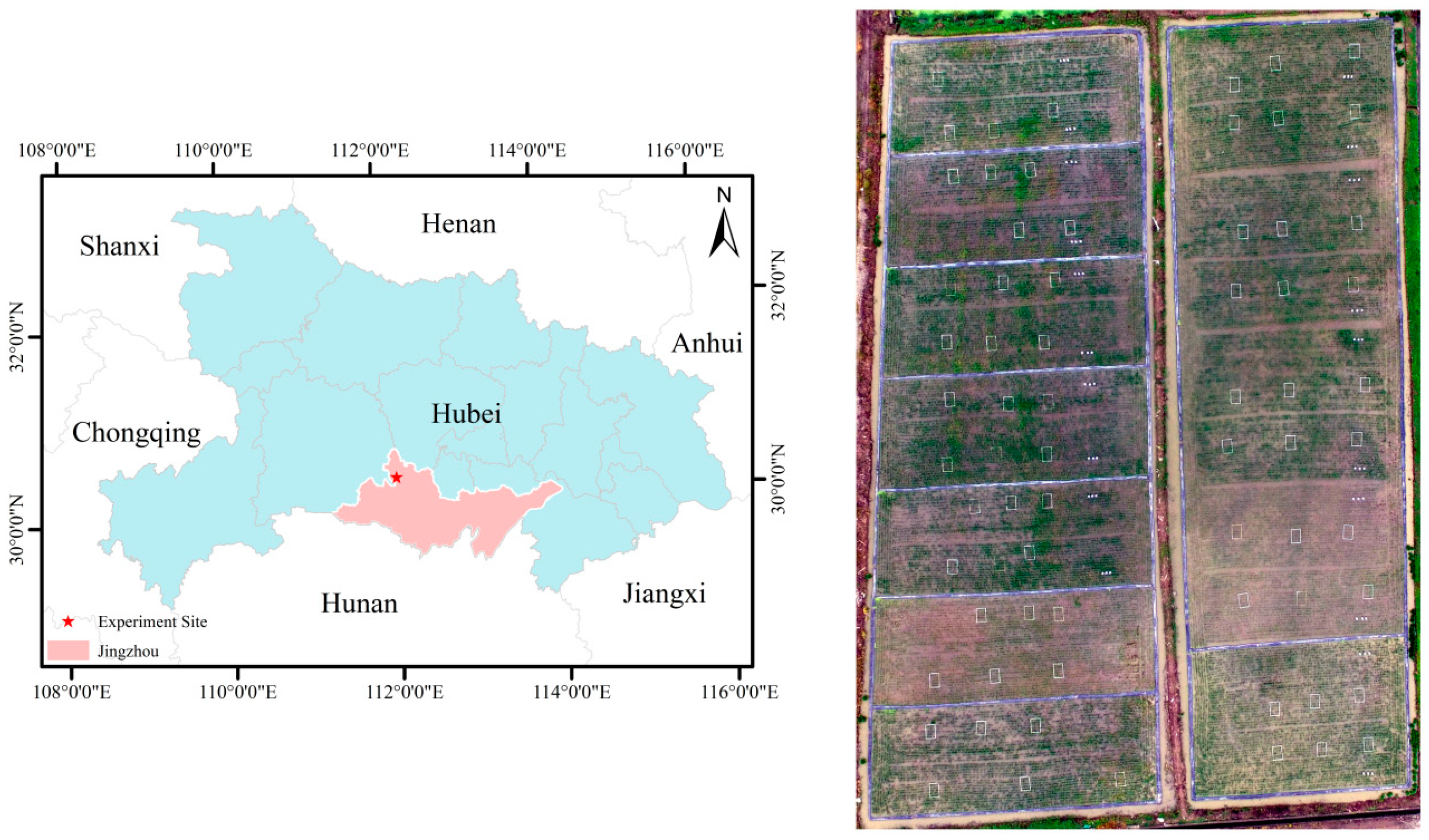
The experiment was conducted at the Huazhong Agricultural High-tech Industrial Development Zone, Jingzhou City, Hubei Province, China ( 30 ° 22   N ,   112 ° 4   E ). The rice variety used was Quanliangyousimiao No. 1, which was transplanted on 1 June 2023. To obtain images of rice seedlings with varying growth characteristics under complex field backgrounds, the experiment included seven distinct fertilization treatments, including traditional broadcasting and various nitrogen reduction strategies. The specific details of these seven treatments are presented in Table 1.
A consumer-grade UAV, the DJI Phantom 4 (SZ DJI Technology Co., Shenzhen, China), was selected for image acquisition to approximate the deployment conditions of low cost and high flexibility relevant to actual farmers and agricultural machinery. The data collection was performed at 12:00 PM on June 7 under sunny and light-wind weather conditions. The UAV maintained a flight altitude of 10 m. It was equipped with a 12-megapixel camera and an real-time kinematic (RTK) module to enhance positioning accuracy, with a battery life of 25 min. The camera was set to shutter priority mode to capture clear images. The images were then stitched using Pix4Dmapper 4.4.10 (Pix4D SA, Prilly, Switzerland) software, and the result is shown in Figure 1.

2.2. Data Preprocessing

Images of the study area were segmented using ArcGIS Pro 3.0.2 (Esri, Redlands, CA, USA), with the output image pixel size set to 512 × 512. A total of 791 images containing rice seedlings were obtained. High-quality training data is the cornerstone of building high-performance deep learning models [27]. To improve labeling efficiency and accuracy, this study utilized the computer vision-assisted labeling tool AnyLabeling 0.4.10. This tool integrates the “Segment Anything Model (SAM)” proposed by Kirillov et al. [28], enabling the real-time generation of high-quality detection bounding boxes through simple click-based interactions. The SAM played only an auxiliary role: correct boxes were retained, while incorrect ones were manually adjusted. A total of 44,496 rice seedling bounding boxes were labeled. All annotations were subsequently reviewed and approved by two domain experts through cross-checking to ensure label quality. The dataset was divided into a training set, a validation set, and a test set in a 6:2:2 ratio. The training set was used for model parameter learning, the validation set for hyperparameter tuning and model selection, and the test set for evaluating the model’s final generalization performance. To enhance the model’s generalization ability and robustness across different scenarios and to reduce the risk of overfitting, data augmentation techniques were applied to the original training set. Specifically, increasing or decreasing brightness and contrast simulates varying lighting conditions such as strong light, cloudy, or shaded, while adding noise, rotation, and flipping further improves the model’s adaptability to diverse field environments. To ensure the authenticity and reliability of the evaluation results, data augmentation was applied exclusively to the training set, while the validation and test sets maintained their original data distributions. The detailed split, augmentation methods, and final quantities are presented in Table 2.

2.3. CLR-YOLO Construction

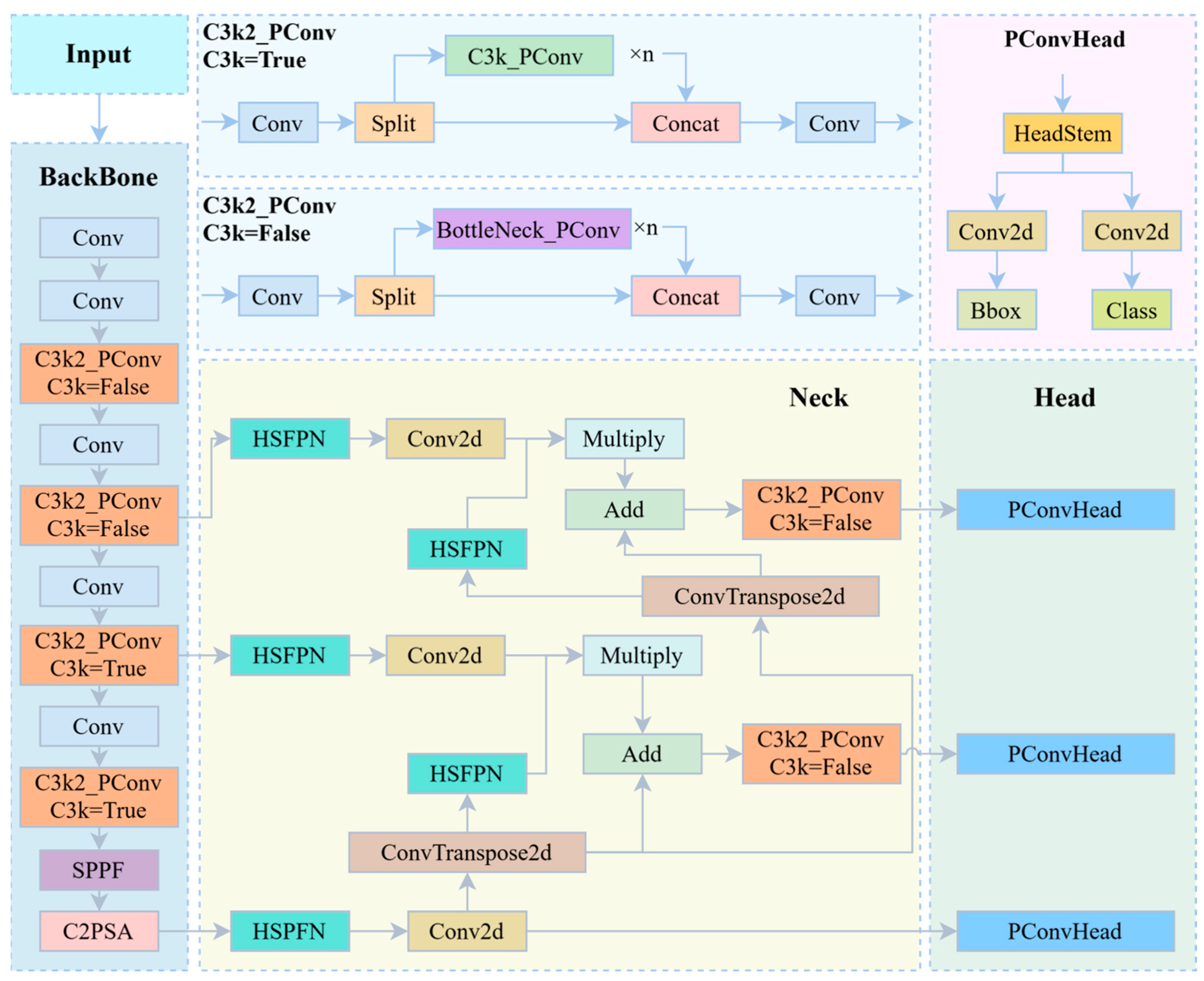
Targeting efficient and accurate recognition of rice seedlings and addressing the problems of large parameter sizes and high model complexity, this study proposes the CLR-YOLO model, an improved lightweight approach based on the YOLO series algorithm, YOLOv11n [29] launched by Ultralytics in September 2024. The overall architecture is illustrated in Figure 2. This method replaces the C3k2 modules in the network with C3k2-PConv, introduces the Heterogeneous Selective Feature Pyramid Network (HSFPN) to reconstruct the neck network for enhanced multi-scale feature fusion, and designs a detection head based on partial convolution (PConvHead) to optimize the calculation process. This optimized feature utilization efficiency and reduced both false positives and false negatives in dense rice seedling scenarios.

2.4. Model Improvements and Optimizations

2.4.1. C3k2-PConv

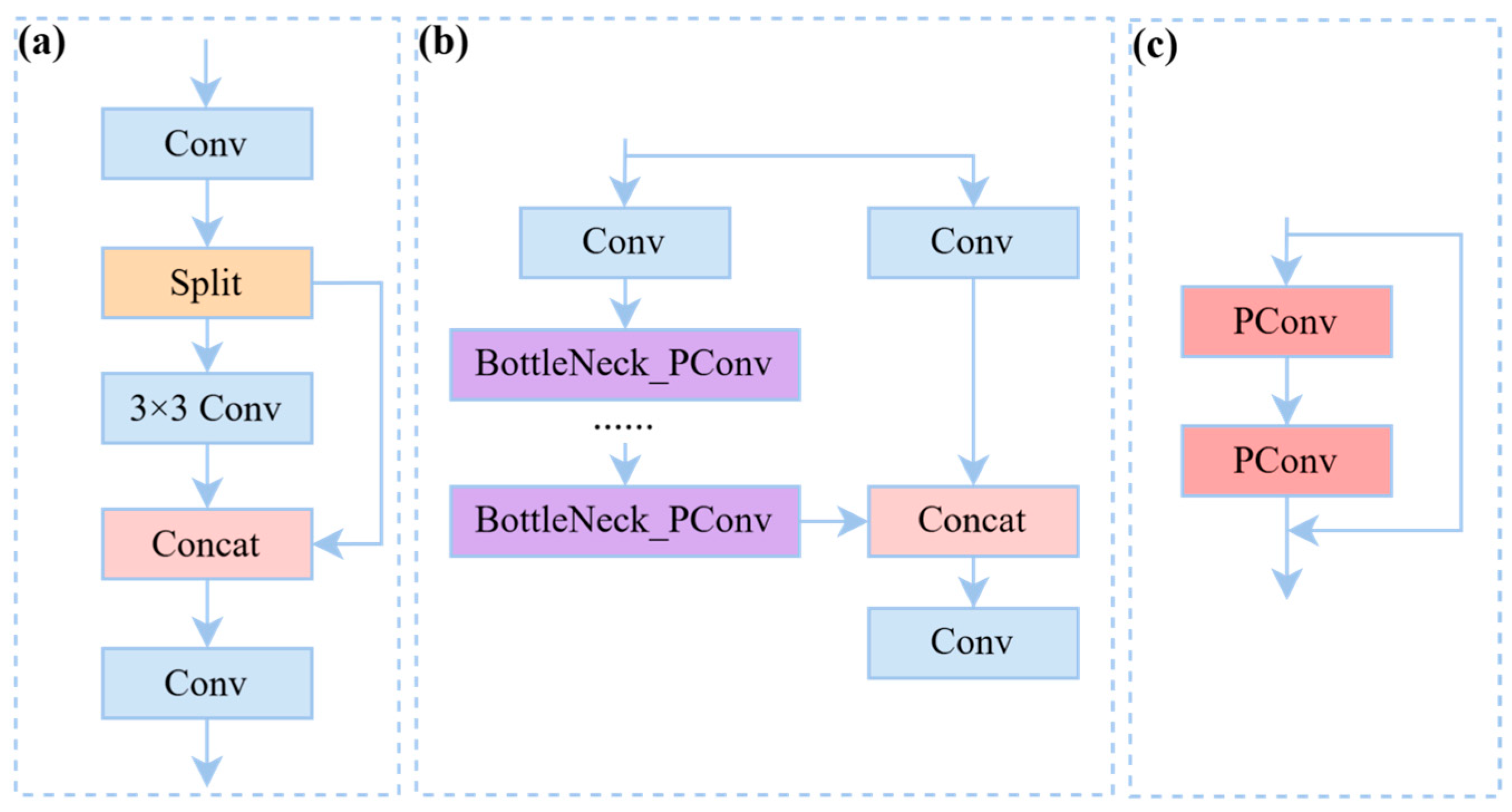
In the task of rice seedling identification, targets often coexist within complex scenes characterized by water reflection, soil shadows, weed interference, and mutual occlusion and overlap among seedlings, all of which interfere with effective feature extraction. To address these issues, this paper designs the PConv-based lightweight module, C3k2-PConv. This module is used to reconstruct the C3k2 structures within the backbone and neck networks of the baseline model, aiming to maintain feature representation capability while enhancing the model’s forward inference efficiency, as shown in Figure 3.
The C3k2-PConv module maintains the overall architecture of the original C3k2, but replaces its core components with lightweight PConv-based versions (Bottleneck-PConv and C3k-PConv). PConv functions by segmenting the input feature map along the channel dimension. Only a fraction of the channels (typically 1/4) undergo spatial convolution to extract local features, while the remaining channels are preserved via identity mapping. The two resulting outputs are then concatenated. Bottleneck-PConv replaces the standard convolution layers within the original Bottleneck structure with PConv layers. C3k-PConv stacks multiple Bottleneck-PConv units, extending the lightweight design from the module level to the overall network architecture to achieve a deeper reduction in complexity. By performing spatial computation on only a subset of channels, this design significantly reduces the number of parameters and computational complexity. Concurrently, it enhances the model’s feature extraction and inference efficiency in complex scenes, thereby strengthening its ability to swiftly and accurately identify and localize rice seedlings. This enhancement ultimately improves the model’s deployment feasibility and generalization ability in complex real-world environments.

2.4.2. Heterogeneous Selective Feature Pyramid Network (HSFPN)

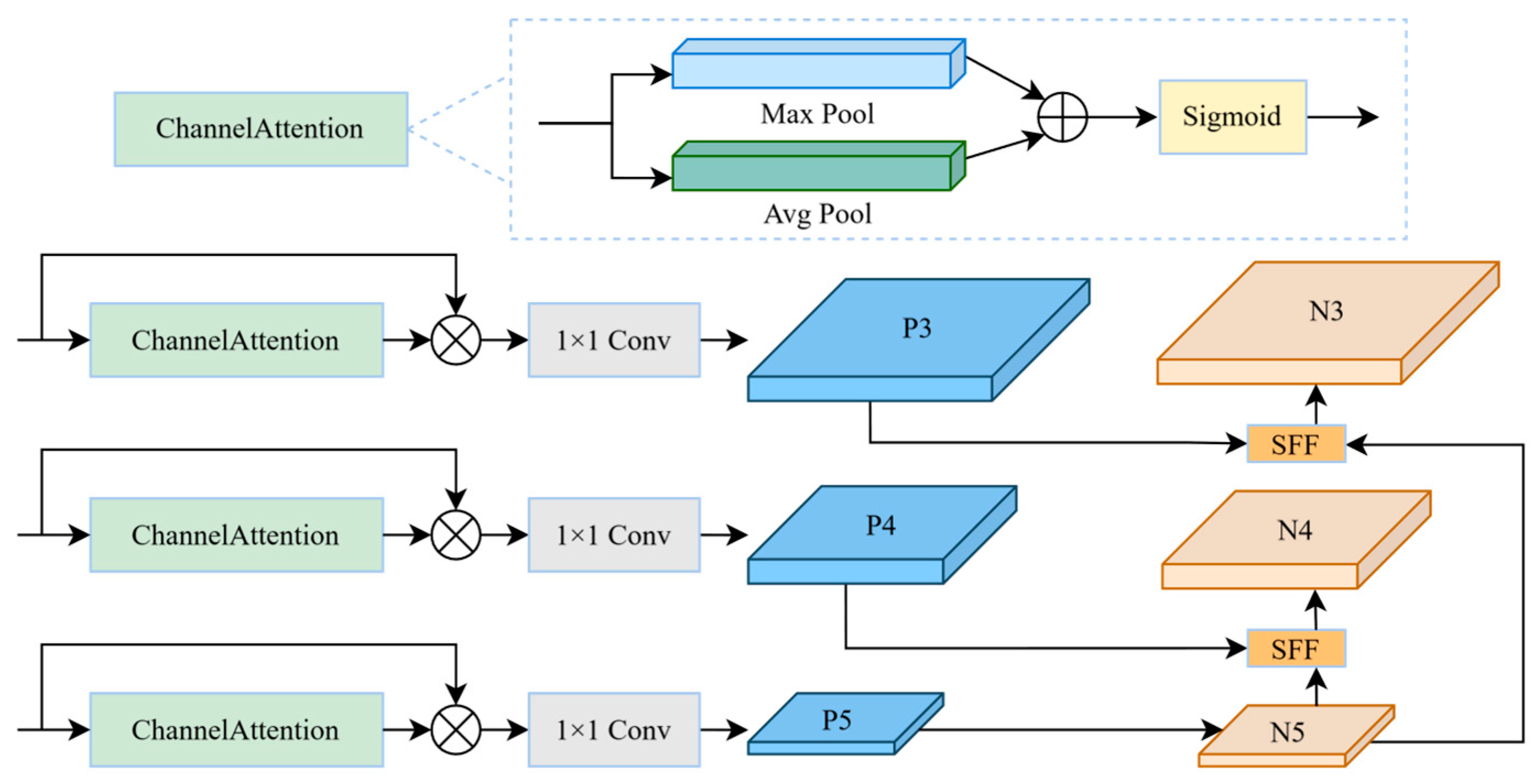
In the task of mechanized rice seedling detection, traditional Feature Pyramid Networks (FPNs) frequently face issues of redundancy and semantic conflict during multi-scale feature fusion, owing to the varying scale, dense spatial distribution, and complex field background interference experienced by the seedlings. To address this issue, this study introduces the Heterogeneous Selective Feature Pyramid Network (HSFPN) (Figure 4). The core of the HSFPN structure is composed of the Channel Attention (CA) module and the Selective Feature Fusion (SFF) module (Figure 5).
In the feature selection section, the CA module acquires global information by compressing spatial dimensions through global average pooling (GAP) and global max pooling (GMP). This approach enhances the response of important features while effectively filtering redundant channels.
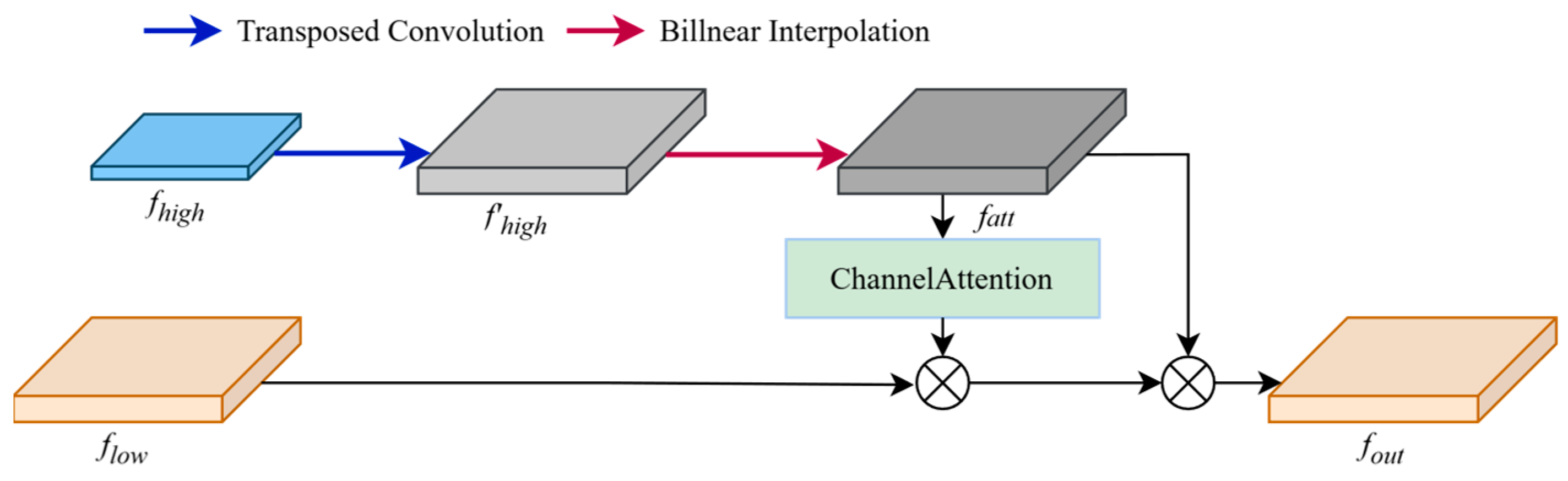
In the feature fusion section, the SFF module first performs spatial upsampling of high-level features via Transposed Convolution and Bilinear Interpolation to align them with lower-level features in scale. Subsequently, this upsampled feature is fed into the CA module to generate corresponding channel attention weights, which are learnable parameters optimized during training. These weights are then used to perform selective screening and integration of the lower-level features.
This synergistic design of feature selection and efficient fusion enables the model to adaptively focus on the critical spatial and semantic information of rice seedlings, thereby significantly improving the model’s perception capability of weak-feature targets such as small and occluded objects.

2.4.3. PConv-Based Efficient Detection Head (PConvHead)

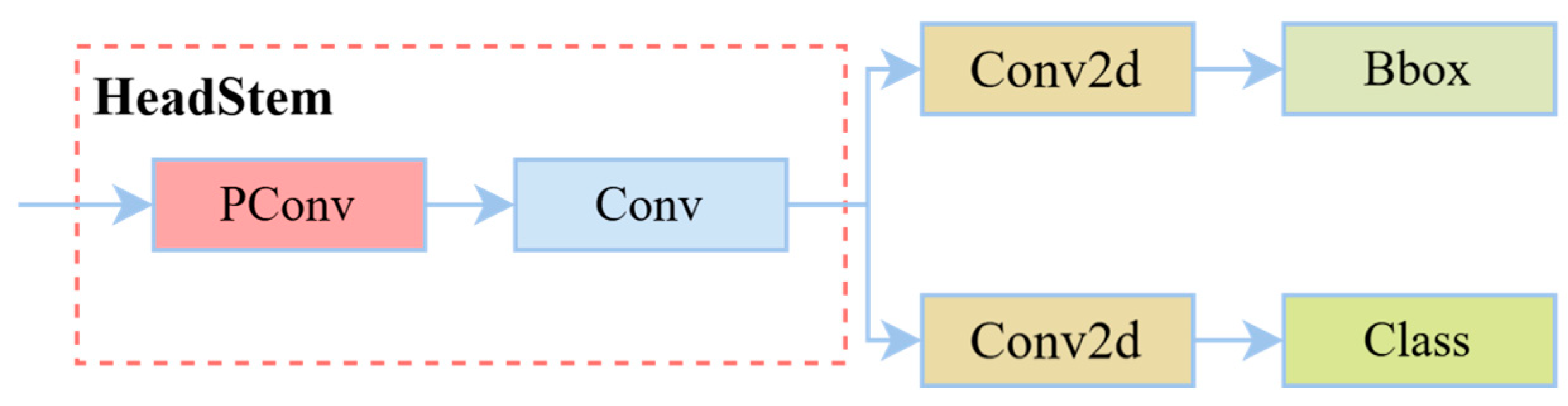
To further enhance computational efficiency and generalization capabilities in complex rice seedling recognition scenarios, this paper proposes PConvHead, whose structure is shown in Figure 6.
PConvHead introduces a lightweight feature preprocessing module, HeadStem, designed for preliminary and efficient feature refinement of multi-scale feature maps from the neck network. It consists of a PConv layer and a 1 × 1 standard convolution layer. Leveraging the sparse computation property of PConv, this module performs spatial convolution only on a small number of channels, significantly reducing the computational overhead of initial feature extraction. Subsequently, the 1 × 1 convolution effectively fuses the sparse features with the retained original features while adjusting the channel dimension. This unified HeadStem design simplifies the detection head architecture while ensuring efficient feature refinement, ultimately enhancing computational efficiency, generalization capability, and overall complexity reduction in the model.

2.5. Experimental Environment and Parameter Configuration

The operating system used for this experiment was Windows Server 2019 Datacenter. The hardware setup included an Intel(R) Xeon(R) Platinum 8352V processor and an RTX 4090 D graphics card with 24 GB of VRAM. The software environment utilized the CUDA 12.1 parallel computing framework, Python 3.11, and the PyTorch 2.2.2 deep learning framework.
During the model training process, all input samples were resized to 640 × 640. The network training parameters were configured as follows: the number of epochs was set to 200, the early stopping mechanism patience was set to 30, and the batch size was 16. All experimental results were obtained by running the model with five different random seeds and averaging the performance across these runs. The core training parameter configurations for this study are detailed in Table 3.

2.6. Experimental Evaluation Metrics

This study adopts Precision, Recall, F1-Score, AP@0.5, Parameters, Computational Complexity (GFLOPS), and Model Size as comprehensive evaluation metrics to systematically assess model performance from multiple dimensions. F1-Score is used to measure the model’s classification performance at a specific confidence threshold. AP@0.5 comprehensively evaluates its classification and localization capabilities at an Intersection over Union (IoU) threshold of 0.5. Parameters and Computational Complexity reflect the model’s structural complexity and single inference computation requirement, respectively, while Model Size serves as an indicator for lightweight deployment, reflecting the storage resource consumption in practical applications. This evaluation system comprehensively covers the three dimensions of recognition accuracy, computational efficiency, and resource consumption, providing a multi-perspective basis for model performance analysis. The calculation formulas for F1-Score and AP are as follows:
Precision (P) and Recall (R) are defined based on the confusion matrix, as shown in Equation (1) and Equation (2), respectively:
P = T P T P + F P
R = T P T P + F N
The F1-Score is the harmonic mean of Precision and Recall, suitable for measuring the model’s overall detection performance, balancing misdetections and missed detections (Equation (3)):
F 1 S c o r e   = 2 × P   × R P + R
AP (Average Precision) is obtained by calculating the precision at different recall rates and taking the area under the Precision-Recall (P-R) curve, which comprehensively considers the model’s overall performance across various confidence thresholds (Equation (4)).
A P = 0 1 P R d R

3. Results

3.1. Analysis of C3k2-PConv Improvement Positioning

To validate the adaptability of the C3k2-PConv module across different stages of the network and its influence on seedling detection performance, this study designed comparative experiments based on three deployment strategies, while maintaining consistency in the HSFPN and PConvHead improvements: (1) Backbone Optimization (Strategy 1), which exclusively replaces the C3k2 modules in the backbone to evaluate the impact of lightweight operators on low-level feature extraction; (2) Neck Optimization (Strategy 2), which targets the neck network to assess the optimization effect during the multi-scale feature fusion phase; and (3) Global Network Optimization (Strategy 3), which performs a comprehensive replacement of all C3k2 modules within the model.
As illustrated in Table 4, all three strategies achieved superior detection accuracy compared to the baseline YOLOv11n model while significantly reducing model complexity, thereby verifying the efficiency of the C3k2-PConv module in rice seedling feature extraction. A comparative analysis reveals that Strategy 3 achieved the optimal performance, with an F1-Score of 89.1% and a minimized GFLOPs of 3.7. These results indicate that the simultaneous integration of C3k2-PConv modules in both the backbone and neck stages effectively suppresses global computational redundancy, achieving a high degree of model lightweighting without compromising detection robustness.

3.2. Ablation Study

To validate the contribution of each proposed module to the overall model performance, this study conducted an ablation study using YOLOv11n as the baseline model. All experiments were executed under consistent hyperparameters and environment settings. The results of the ablation study, detailed in Table 5, clearly demonstrate the impact of each improved module.
The YOLOv11n model, which serves as the baseline, demonstrated detection accuracy of 89.0% F1-Score and 93.8% AP@0.5, 2.6 million parameters, 6.3 GFLOPs, and a model size of 5.2 MB. Upon introducing the C3k2-PConv module, the model’s parameter count decreased from 2.6 million to 2.2 million, a reduction of 15.4%. GFLOPs decreased by 12.7% (from 6.3 to 5.5), and the model size was reduced by 15.4% (from 5.2 MB to 4.4 MB). Concurrently, the F1-Score decreased by 0.3 percentage points, while AP@0.5 improved from 93.8% to 94.1%. Following the integration of the HSFPN structure, the model’s parameter count decreased to 1.8 million, and the model size was reduced to 3.8 MB, corresponding to reductions of 30.8% and 26.9% compared to the baseline, respectively. The GFLOPs value was 5.6. The F1-Score was 88.7% (a 0.3 percentage point decrease), and the AP@0.5 value of 93.8% remained unchanged from the baseline model. With the adoption of PConvHead, the model’s GFLOPs decreased by 20.6% (from 6.3 to 5.0). AP@0.5 reached 94.0%, an increase of 0.2 percentage points compared to the baseline.
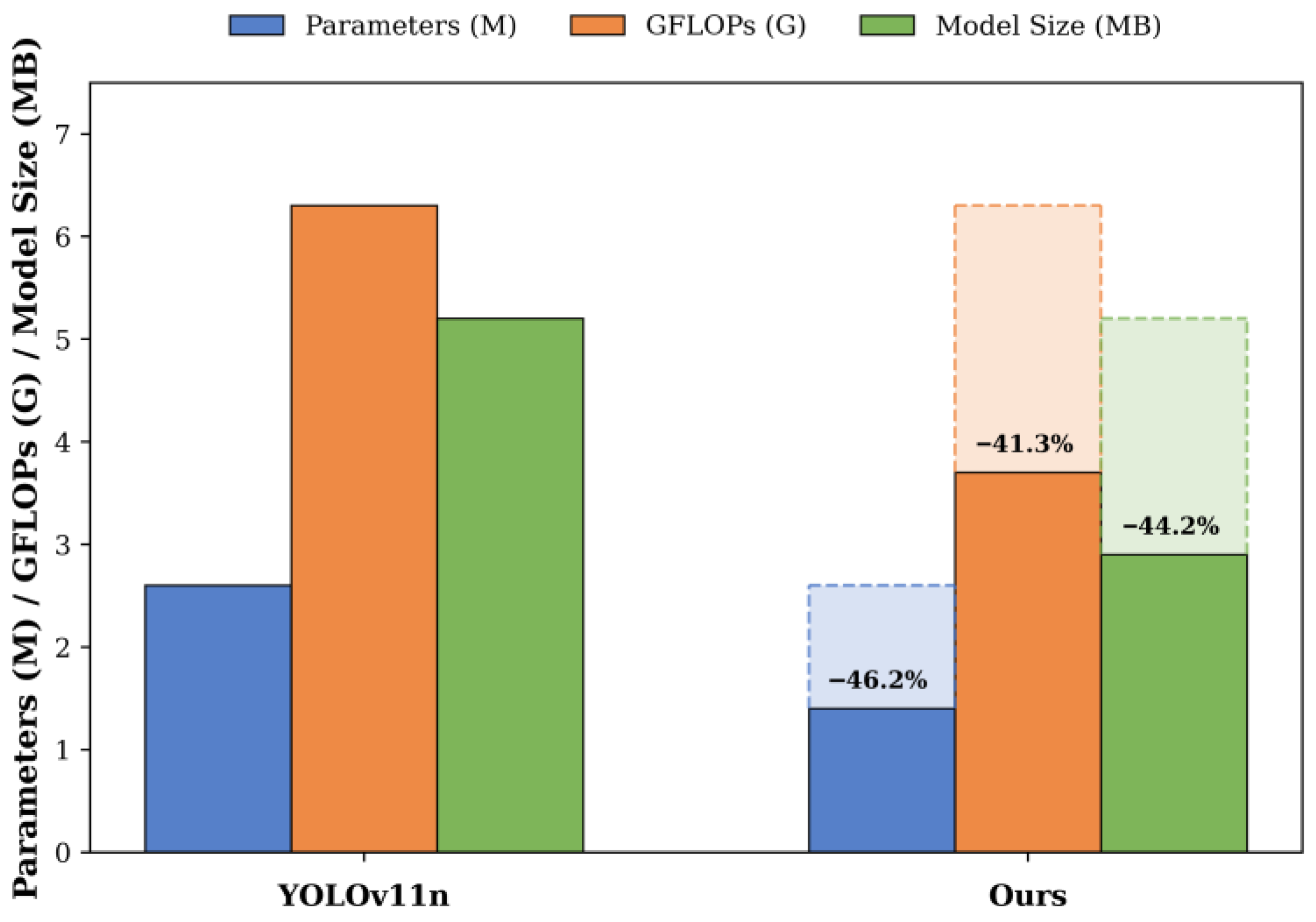
Ultimately, the fully integrated CLR-YOLO model achieved a favorable balance between detection precision and computational efficiency. As illustrated in Table 5 and Figure 7, CLR-YOLO attained an F1-Score of 89.1% and an mAP@0.5 of 93.9%, maintaining detection accuracy comparable to the baseline model while simultaneously undergoing substantial lightweight optimization. Compared to the baseline YOLOv11n model, CLR-YOLO achieved the following compression: specifically, the number of parameters, computational complexity (GFLOPs), and model weight size were reduced from 2.6 M, 6.3 G, and 5.2 MB to 1.4 M, 3.7 G, and 2.9 MB, respectively, representing corresponding reductions of 46.2%, 41.3%, and 44.2%. These experimental results validated that CLR-YOLO achieved optimized computational resource requirements while maintaining detection performance.

3.3. Comparison with Mainstream Detection Models

The detection performance and lightweight nature of the CLR-YOLO model were validated by comparing it against YOLO series models and other mainstream detection algorithms. The experimental results are presented in Table 6.
Compared with non-YOLO series models, although Faster R-CNN and TOOD achieve slightly higher F1-Scores (with 90.0% and 89.4%, respectively), their model complexity is substantial (with parameters of 41.3 M and 32.0 M, respectively), making them difficult to deploy in resource-constrained scenarios. The transformer-based RTDETR achieves an F1-Score of 88.4% and AP@0.5 of 92.2%, both lower than those of CLR-YOLO (89.1% and 93.9%, respectively). More critically, its resource demands are exorbitant: 32.0 M parameters, 103.4 GFLOPs, and 63.1 MB model size, corresponding to 22.9, 27.9, and 21.8 times larger than those of CLR-YOLO, respectively. Although RTMDet-tiny is also a lightweight design, CLR-YOLO comprehensively outperforms RTMDet-tiny across all accuracy metrics (F1-Score is 1.9 percentage points higher, AP@0.5 is 0.6 percentage points higher). Concurrently, the Parameters, GFLOPs, and Model Size are reduced by 71.4%, 51.3%, and 84.0%, respectively.
Compared with the YOLO series, CLR-YOLO demonstrates a significant advantage in lightweightness while maintaining competitive detection accuracy. In terms of accuracy, CLR-YOLO achieves F1-Score (89.1%) and AP@0.5 (93.9%). Regarding lightweightness, CLR-YOLO’s Parameters (1.4 M) and GFLOPs (3.7 GFLOPs) are significantly lower than all other comparative models. Compared to YOLOv12n, the model with the next lowest parameter count in the same series, CLR-YOLO further reduces its parameters by 44% and GFLOPs by 36.2%, while achieving an F1-Score that is 3.6 percentage points higher. Furthermore, CLR-YOLO’s Model Size is only 2.9 MB, the lowest among all contrasted models. The results consistently demonstrate that the lightweight design strategy adopted in this study significantly reduces model complexity and storage overhead without sacrificing detection accuracy, thereby better meeting the demanding lightweight requirements of practical agricultural application scenarios.

3.4. Visual Analysis of CLR-YOLO Results

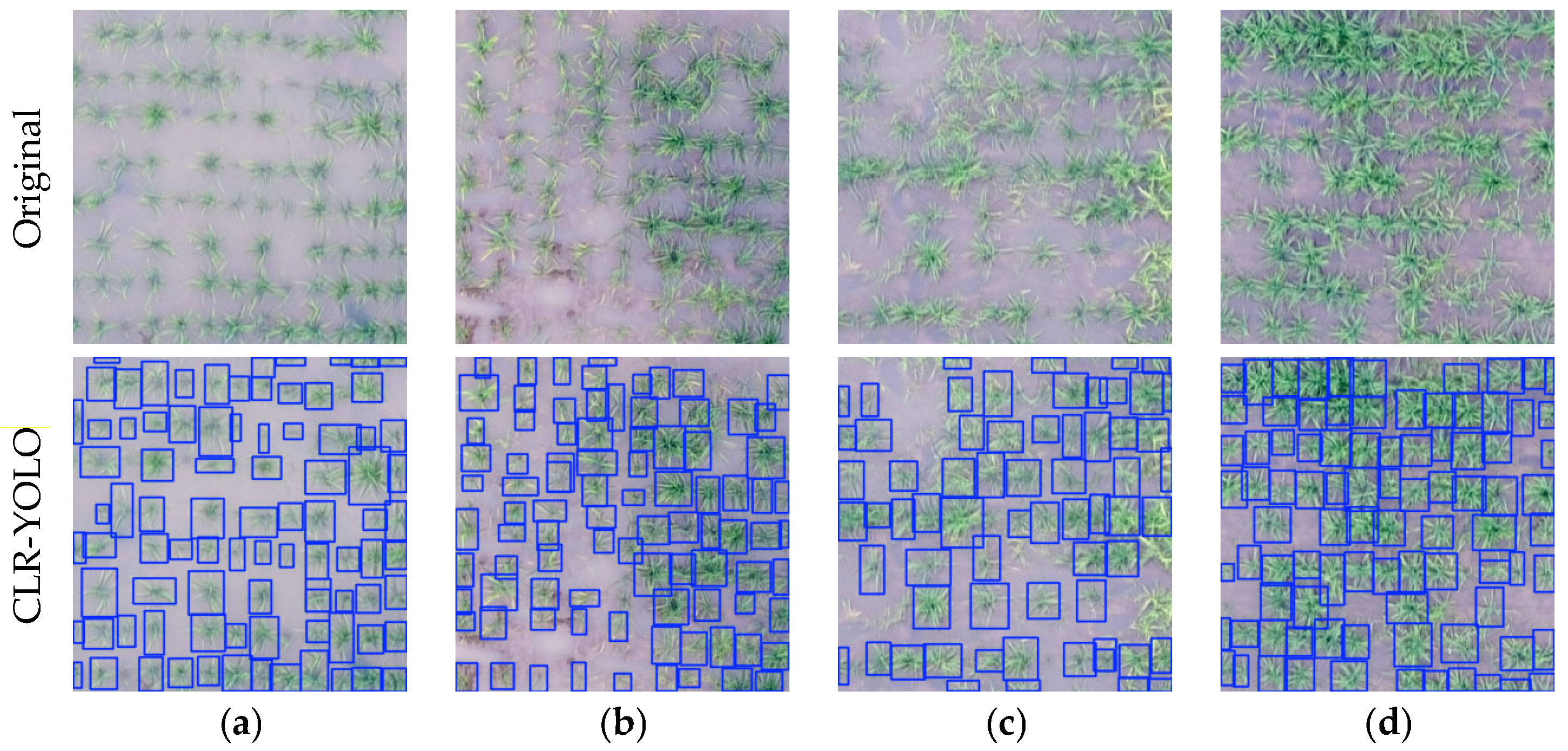
For visual evaluation of the proposed CLR-YOLO model’s detection performance and robustness in real-world complex field environments, this study selected four representative rice seedling detection scenarios for analysis: clear targets, multi-scale targets, blurry targets, and object overlapping cases, as shown in Figure 8. In clear scenarios (Figure 8a), the CLR-YOLO model demonstrates excellent fundamental detection capability, achieving high-precision localization and recognition of rice seedlings with complete morphology and clear structure. All seedlings are accurately bounded with no apparent missed or false detections, fully validating the model’s stability and accuracy under ideal conditions. When facing multi-scale targets (Figure 8b), CLR-YOLO effectively detects both large and small objects simultaneously. This demonstrates the effectiveness of the Heterogeneous Selective Feature Pyramid Network (HSFPN) in multi-scale perception and feature fusion, enabling full utilization of semantic and spatial information from different hierarchical levels. In blurry scenarios affected by wind factors (Figure 8c), although localization accuracy decreases somewhat, the majority of seedlings are still successfully recognized. For densely overlapped scenarios (Figure 8d), the model effectively separates and distinguishes most individual rice seedling instances, generating reasonable bounding boxes even in partially overlapped regions, thereby reducing missed detections caused by occlusion and crowding.
Overall, CLR-YOLO not only maintains stable and accurate performance under ideal clear conditions but also effectively handles various complex field scenarios, including multi-scale targets, motion blur, and dense overlaps. These results confirm the model’s robustness and practical deployment potential for real-world agricultural applications.

4. Discussion

4.1. Comparative Analysis with Related Studies and Technical Advantages

Recent deep learning-based studies on rice seedling and panicle detection have achieved significant progress. Long et al. [36] collected rice panicle images at a flight altitude of 10 m and applied the HSFPN structure for multi-scale feature fusion and small-target detection. This is consistent with our study, which also adopts a 10 m flight altitude and the HSFPN structure to handle multi-scale seedlings and dense overlapping scenarios. Song et al. [24] proposed YOLO-Rice for rice panicle detection, adopting the partial convolution (PConv) concept and validating the deployability of lightweight models on low-power devices. This idea aligns well with our strategy of replacing the original C3k2 module with C3k2-PConv and designing a PConv-based efficient detection head in the YOLOv11 model. Anandakrishnan et al. [37] proposed the Li-YOLOv9 model on their rice seedling dataset, which uses a 3D feature adaptation module (3D-FAM), CBAM and CAM attention mechanisms, and depthwise convolution (DWC) to compress parameters to 9.97 M with 55.4 GFLOPs. In contrast, our CLR-YOLO has only 1.4 M parameters and 3.7 GFLOPs, with a model size of 2.9 MB, demonstrating a clear advantage in lightweight design for practical applications.
To address the specific challenges of small targets, dense overlapping, large parameter sizes and high model complexity in rice seedling detection, this study adopts the following strategies. At the data level, augmentation techniques such as brightness/contrast adjustment and noise addition are employed to simulate real-field interferences. At the model level, C3k2-PConv is used to reduce redundant computation for low-power devices, HSFPN enhances multi-scale feature fusion to improve the recognition rate of distant small seedlings, and PConvHead suppresses false positives and false negatives in dense scenes. Together, these measures provide a feasible solution for rice seedling detection in complex paddy field scenarios.

4.2. Analysis of Performance Variations

During UAV data acquisition, motion blur caused by drone vibration and wind often leads to blurred edges of rice seedlings [38], while the complex water-soil mixed background [39] and seedling occlusion [40] further increase the difficulty of accurate detection. While CLR-YOLO demonstrates robust performance across various scenarios, further analysis identifies some limitations. In blurry scenarios (Figure 8c), missed detections primarily occur where edge features are severely degraded. This is attributed to motion blur induced by both UAV vibration and wind factors, which obscures the fine textures of rice seedlings. Such degradation makes it challenging for the PConv operator in the lightweight backbone to extract sufficient discriminative features, as the high-frequency information essential for seedling identification is lost in the blurred regions. Consequently, this leads to confidence scores falling below the detection threshold. In overlapping cases (Figure 8d), although most instances are identified, the regression precision of bounding boxes decreases when leaves are highly interlaced, leading to slight localization offsets. Future work could explore more advanced strategies to further mitigate such issues. Despite these limitations, CLR-YOLO still achieves competitive recognition accuracy in the majority of challenging scenarios, confirming its practical utility for real-world rice seedling detection.

4.3. Limitations and Future Work

Despite the advantages of CLR-YOLO, several aspects remain to be addressed in future work. To mitigate performance degradation under blur or occlusion, spatio-temporal attention mechanisms leveraging information from consecutive video frames will be explored. Moreover, a Hybrid Reinforcement Learning (HRL) framework [41] will be investigated to enable autonomous adjustment of UAV flight parameters based on real-time detection feedback. Future efforts will also focus on enhancing model generalization across different growth stages and rice varieties, as well as developing multi-task learning approaches to provide richer phenotypic insights. Although data augmentation helps simulate variability, future work still requires images from different times and weather conditions to validate generalization. Finally, the edge-deployment efficiency of CLR-YOLO will be validated on diverse hardware platforms.

5. Conclusions

In this study, we proposed CLR-YOLO, a lightweight object detection model based on an improved YOLOv11n architecture, to address the complex challenges of rice seedling identification in machine-transplanted cultivation. By integrating the C3k2-PConv module, HSFPN, and the PConvHead detection head, the method achieves significant reductions in model parameters, computational cost, and storage footprint while maintaining accuracy comparable to the baseline. Compared with the baseline model, CLR-YOLO achieves an AP@0.5 of 93.9%, reduces model size from 5.2 MB to 2.9 MB, decreases parameters from 2.6 M to 1.4 M, and lowers computational cost from 6.3 GFLOPs to 3.7 GFLOPs, better meeting the needs of lightweight deployment. The model provides data support for early-stage emergence rate monitoring and autonomous replanting decisions, while reducing reliance on labor-intensive manual surveys, and offers technical support for integrating deep learning into automated agricultural machinery. Furthermore, the lightweight nature of CLR-YOLO makes it suitable for other vision-based crop planting tasks, such as the detection of wheat, maize, or soybean seedlings. Overall, CLR-YOLO provides an efficient and deployable solution for automated rice seedling detection, contributing to the digital transformation of sustainable rice production.

Author Contributions

L.Z.: Conceptualization, Methodology, Writing—Original Draft, Software, Investigation. S.S.: Methodology, Software, Writing—Review and Editing. L.G.: Data Curation, Software, Writing—Review & Editing. L.L.: Investigation, Validation, Writing—Review & Editing. Y.Z.: Visualization, Writing—Review & Editing. M.W.: Data Curation, Writing—Review & Editing. Y.L.: Conceptualization, Supervision, Funding Acquisition, Resources, Writing–Review & Editing. All authors have read and agreed to the published version of the manuscript.

Funding

This research was funded by Department of Science and Technology of Hubei Province (2021BBA229).

Data Availability Statement

The raw data supporting the conclusions of this article will be made available by the authors on request.

Conflicts of Interest

The authors declare no conflicts of interest.

References

  1. Nawaz, A.; Rehman, A.U.; Rehman, A.; Ahmad, S.; Siddique, K.H.M.; Farooq, M. Increasing Sustainability for Rice Production Systems. J. Cereal Sci. 2022, 103, 103400. [Google Scholar] [CrossRef] [Scilit]
  2. Rajendran, M.; Ranganathan, T. Advancements in Paddy Transplanter Mechanization Implications for Sustainable Agriculture. Sustain. Futures 2025, 10, 101235. [Google Scholar] [CrossRef] [Scilit]
  3. Yeh, J.-F.; Lin, K.-M.; Yuan, L.-C.; Hsu, J.-M. Automatic Counting and Location Labeling of Rice Seedlings from Unmanned Aerial Vehicle Images. Electronics 2024, 13, 273. [Google Scholar] [CrossRef] [Scilit]
  4. Guru, P.K.; Sahu, P.; Shukla, P.; Diwan, P.; Panwar, G.; Tiwari, P.; Nagori, A.; Carpenter, G.; Sanodiya, R.; Meena, B.S.; et al. A Critical Review on Rice Cultivation and Mechanization Level in Indian Perspective. Results Eng. 2025, 26, 105632. [Google Scholar] [CrossRef] [Scilit]
  5. Yan, F.; Sun, X.; Chen, S.; Dai, G. Does Agricultural Mechanization Improve Agricultural Environmental Efficiency? Front. Environ. Sci. 2024, 11, 1344903. [Google Scholar] [CrossRef] [Scilit]
  6. Xu, T.; Li, X.; He, J.; Han, S.; Wang, G.; Yin, D.; Zhou, M. Research Progress and Future Prospects of Key Technologies for Dryland Transplanters. Appl. Sci. 2025, 15, 8073. [Google Scholar] [CrossRef] [Scilit]
  7. Wu, S.; Ma, X.; Jin, Y.; Yang, J.; Zhang, W.; Zhang, H.; Wang, H.; Chen, Y.; Lin, C.; Qi, L. A Novel Method for Detecting Missing Seedlings Based on UAV Images and Rice Transplanter Operation Information. Comput. Electron. Agric. 2025, 229, 109789. [Google Scholar] [CrossRef] [Scilit]
  8. Lan, M.; Liu, C.; Zheng, H.; Wang, Y.; Cai, W.; Peng, Y.; Xu, C.; Tan, S. RICE-YOLO: In-Field Rice Spike Detection Based on Improved YOLOv5 and Drone Images. Agronomy 2024, 14, 836. [Google Scholar] [CrossRef] [Scilit]
  9. Ren, Z.; Zheng, H.; Chen, J.; Chen, T.; Xie, P.; Xu, Y.; Deng, J.; Wang, H.; Sun, M.; Jiao, W. Integrating UAV, UGV and UAV-UGV Collaboration in Future Industrialized Agriculture: Analysis, Opportunities and Challenges. Comput. Electron. Agric. 2024, 227, 109631. [Google Scholar] [CrossRef] [Scilit]
  10. Eladl, S.G.; Haikal, A.Y.; Saafan, M.M.; ZainEldin, H.Y. A Proposed Plant Classification Framework for Smart Agricultural Applications Using UAV Images and Artificial Intelligence Techniques. Alex. Eng. J. 2024, 109, 466–481. [Google Scholar] [CrossRef] [Scilit]
  11. Zhao, B.; Ding, Y.; Cai, X.; Xie, J.; Liao, Q.; Zhang, J. Seedlings Number Identification of Rape Planter Based on Low Altitude Unmanned Aerial Vehicles Remote Sensing Technology. Trans. Chin. Soc. Agric. Eng. 2017, 33, 115–123. [Google Scholar] [CrossRef]
  12. Li, B.; Xu, X.; Han, J.; Zhang, L. The Estimation of Crop Emergence in Potatoes by UAV RGB Imagery. Plant Methods 2019, 15, 15. [Google Scholar] [CrossRef] [Scilit]
  13. Hu, L.; Zhou, Z.; Yin, L.; Zhu, M.; Huang, D. Rape Identification at Seedling Stage Based on UAV RGB Image. J. Agric. Sci. Technol. 2022, 24, 116–128. [Google Scholar] [CrossRef]
  14. Bouguettaya, A.; Zarzour, H.; Kechida, A.; Taberkit, A.M. Deep Learning Techniques to Classify Agricultural Crops through UAV Imagery: A Review. Neural Comput. Appl. 2022, 34, 9511–9536. [Google Scholar] [CrossRef] [Scilit]
  15. Tang, R.; Aridas, N.K.; Talip, M.S.A.; Yang, J.; Tang, J. High-Precision Pest and Disease Detection in Greenhouses Using the Novel IM-AlexNet Framework. NPJ Sci. Food 2025, 9, 68. [Google Scholar] [CrossRef] [Scilit] [PubMed]
  16. Punithavathi, R.; Delphin, A.; Sughashini, K.; Kurangi, C.; Nirmala, M.; Ahmed, H.; Balamurugan, H.F.T. Computer Vision and Deep Learning-Enabled Weed Detection Model for Precision Agriculture. Comput. Syst. Sci. Eng. 2023, 44, 2759–2774. [Google Scholar] [CrossRef] [Scilit]
  17. Rolland, V.; Farazi, M.R.; Conaty, W.C.; Cameron, D.; Liu, S.; Petersson, L.; Stiller, W.N. HairNet: A Deep Learning Model to Score Leaf Hairiness, a Key Phenotype for Cotton Fibre Yield, Value and Insect Resistance. Plant Methods 2022, 18, 8. [Google Scholar] [CrossRef] [Scilit]
  18. Li, Z.; Wang, J.; Gao, G.; Lei, Y.; Zhao, C.; Wang, Y.; Bai, H.; Liu, Y.; Guo, X.; Li, Q. SGSNet: A Lightweight Deep Learning Model for Strawberry Growth Stage Detection. Front. Plant Sci. 2024, 15, 1491706. [Google Scholar] [CrossRef] [Scilit] [PubMed]
  19. Chen, S.; Li, W.; Chen, D.; Xie, Z.; Zhang, S.; Cen, F.; Huang, X.; Tu, L.; Gao, Z. Recognition of Rice Seedling Counts in UAV Remote Sensing Images via the YOLO Algorithm. Smart Agric. Technol. 2025, 12, 101107. [Google Scholar] [CrossRef] [Scilit]
  20. Wang, C.-Y.; Yeh, I.-H.; Liao, H.-Y.M. YOLOv9: Learning What You Want to Learn Using Programmable Gradient Information. arXiv 2024, arXiv:2402.13616. [Google Scholar] [CrossRef] [Scilit]
  21. Wang, A.; Chen, H.; Liu, L.; Chen, K.; Lin, Z.; Han, J.; Ding, G. YOLOv10: Real-Time End-to-End Object Detection. arXiv 2024, arXiv:2405.14458. [Google Scholar] [CrossRef] [Scilit]
  22. Li, P.; Zhou, J.; Sun, H.; Zeng, J. RDRM-YOLO: A High-Accuracy and Lightweight Rice Disease Detection Model for Complex Field Environments Based on Improved YOLOv5. Agriculture 2025, 15, 479. [Google Scholar] [CrossRef] [Scilit]
  23. He, L.; Li, Y.; An, X.; Yao, H. Real-Time Monitoring System for Evaluating the Operational Quality of Rice Transplanters. Comput. Electron. Agric. 2025, 234, 110204. [Google Scholar] [CrossRef] [Scilit]
  24. Song, Z.; Ban, S.; Hu, D.; Xu, M.; Yuan, T.; Zheng, X.; Sun, H.; Zhou, S.; Tian, M.; Li, L. A Lightweight YOLO Model for Rice Panicle Detection in Fields Based on UAV Aerial Images. Drones 2024, 9, 1. [Google Scholar] [CrossRef] [Scilit]
  25. Chen, J.; Kao, S.-H.; He, H.; Zhuo, W.; Wen, S.; Lee, C.-H.; Chan, S.-H.G. Run, Don’t Walk: Chasing Higher FLOPS for Faster Neural Networks. In Proceedings of the 2023 IEEE/CVF Conference on Computer Vision and Pattern Recognition, Vancouver, BC, Canada, 17–24 June 2023; IEEE: New York, NY, USA, 2023; pp. 12021–12031. [Google Scholar] [CrossRef] [Scilit]
  26. Chen, Y.; Zhang, C.; Chen, B.; Huang, Y.; Sun, Y.; Wang, C.; Fu, X.; Dai, Y.; Qin, F.; Peng, Y.; et al. Accurate Leukocyte Detection Based on Deformable-DETR and Multi-Level Feature Fusion for Aiding Diagnosis of Blood Diseases. Comput. Biol. Med. 2024, 170, 107917. [Google Scholar] [CrossRef] [Scilit]
  27. Li, Z.; Guo, R.; Li, M.; Chen, Y.; Li, G. A Review of Computer Vision Technologies for Plant Phenotyping. Comput. Electron. Agric. 2020, 176, 105672. [Google Scholar] [CrossRef] [Scilit]
  28. Kirillov, A.; Mintun, E.; Ravi, N.; Mao, H.; Rolland, C.; Gustafson, L.; Xiao, T.; Whitehead, S.; Berg, A.C.; Lo, W.-Y.; et al. Segment Anything. In Proceedings of the IEEE/CVF International Conference on Computer Vision, Vancouver, BC, Canada, 17–24 June 2023; IEEE: New York, NY, USA, 2023; pp. 4015–4026. [Google Scholar] [CrossRef] [Scilit]
  29. Khanam, R.; Hussain, M. Yolov11: An Overview of the Key Architectural Enhancements. arXiv 2024, arXiv:2410.17725. [Google Scholar] [CrossRef] [Scilit]
  30. Ren, S.; He, K.; Girshick, R.; Sun, J. Faster R-CNN: Towards Real-Time Object Detection with Region Proposal Networks. IEEE Trans. Pattern Anal. Mach. Intell. 2017, 39, 1137–1149. [Google Scholar] [CrossRef] [Scilit]
  31. Feng, C.; Zhong, Y.; Gao, Y.; Scott, M.R.; Huang, W. TOOD: Task-Aligned One-Stage Object Detection. In Proceedings of the 2021 IEEE/CVF International Conference on Computer Vision, Montreal, QC, Canada, 10–17 October 2021; IEEE: New York, NY, USA, 2021; pp. 3490–3499. [Google Scholar] [CrossRef] [Scilit]
  32. Zhao, Y.; Lv, W.; Xu, S.; Wei, J.; Wang, G.; Dang, Q.; Liu, Y.; Chen, J. DETRs Beat YOLOs on Real-Time Object Detection. In Proceedings of the 2024 IEEE/CVF Conference on Computer Vision and Pattern Recognition, Seattle, WA, USA, 16–22 June 2024; IEEE: New York, NY, USA, 2024; pp. 16965–16974. [Google Scholar] [CrossRef] [Scilit]
  33. Lyu, C.; Zhang, W.; Huang, H.; Zhou, Y.; Wang, Y.; Liu, Y.; Zhang, S.; Chen, K. RTMDet: An Empirical Study of Designing Real-Time Object Detectors. arXiv 2022, arXiv:2212.07784. [Google Scholar] [CrossRef] [Scilit]
  34. Tian, Y.; Ye, Q.; Doermann, D. YOLOv12: Attention-Centric Real-Time Object Detectors. arXiv 2025, arXiv:2502.12524. [Google Scholar]
  35. Lei, M.; Li, S.; Wu, Y.; Hu, H.; Zhou, Y.; Zheng, X.; Ding, G.; Du, S.; Wu, Z.; Gao, Y. YOLOv13: Real-Time Object Detection with Hypergraph-Enhanced Adaptive Visual Perception. arXiv 2025, arXiv:2506.17733v2. [Google Scholar]
  36. Long, Y.; Li, K.; Liu, D.; Long, T.; Pan, C.; Chen, W.; He, M.; Guo, W.; Li, J.; Chen, R. Rice Panicle Recognition and Yield Estimation Based on UAV Remote Sensing Images. Trans. Chin. Soc. Agric. Mach. 2026, 57, 109–118. [Google Scholar]
  37. Anandakrishnan, J.; Sangaiah, A.K.; Darmawan, H.; Son, N.K.; Lin, Y.-B.; Alenazi, M.J.F. Precise Spatial Prediction of Rice Seedlings From Large-Scale Airborne Remote Sensing Data Using Optimized Li-YOLOv9. IEEE J. Sel. Top. Appl. Earth Obs. Remote Sens. 2025, 18, 2226–2238. [Google Scholar] [CrossRef] [Scilit]
  38. Li, R.; Zhao, X. A Transformer-Based Motion Deblurring Network for UAV Images. In Proceedings of the 2024 IEEE International Geoscience and Remote Sensing Symposium, Athens, Greece, 7–12 July 2024; IEEE: New York, NY, USA, 2024; pp. 6572–6575. [Google Scholar]
  39. Huang, D.; Chen, Z.; Zhuang, J.; Song, G.; Huang, H.; Li, F.; Huang, G.; Liu, C. DRPU-YOLO11: A Multi-Scale Model for Detecting Rice Panicles in UAV Images with Complex Infield Background. Agriculture 2026, 16, 234. [Google Scholar] [CrossRef] [Scilit]
  40. Zang, H.; Wang, Y.; Peng, Y.; Han, S.; Zhao, Q.; Zhang, J.; Li, G. Automatic Detection and Counting of Wheat Seedling Based on Unmanned Aerial Vehicle Images. Front. Plant Sci. 2025, 16, 1665672. [Google Scholar] [CrossRef] [Scilit]
  41. Hazem, Z.B.; Saidi, F.; Guler, N.; Altaif, A.H. A Hybrid Reinforcement Learning Framework Combining TD3 and PID Control for Robust Trajectory Tracking of a 5-DOF Robotic Arm. Automation 2025, 6, 56. [Google Scholar] [CrossRef] [Scilit]
Figure 1. Data collection sites in Jingzhou, China, and UAV-captured field RGB images.
Agronomy 16 00850 g001
Figure 2. CLR-YOLO Network Structure.
Agronomy 16 00850 g002
Figure 3. Lightweight Design and Architecture of the C3k2-PConv Module. (a) Schematic diagram of the Partial Convolution (PConv) structure, illustrating its channel partitioning and parallel processing mechanism. (b) Schematic diagram of the PConv-based C3k-PConv structure, designed to replace the original C3k module. (c) Schematic diagram of the PConv-based Bottleneck-PConv structure, designed to replace the original bottleneck layer.
Agronomy 16 00850 g003
Figure 4. Structure of the Heterogeneous Selective Feature Pyramid Network (HSFPN).
Agronomy 16 00850 g004
Figure 5. Structure of the Selective Feature Fusion (SFF) module.
Agronomy 16 00850 g005
Figure 6. Structure of the PConv-based Efficient Detection Head (PConvHead) model.
Agronomy 16 00850 g006
Figure 7. Comparison of model complexity between YOLOv11n and CLR-YOLO.
Agronomy 16 00850 g007
Figure 8. Visualization of Detection Performance. (a) Clear Targets; (b) Multi-scale Targets; (c) Blurry Targets; (d) Overlapping Targets.
Agronomy 16 00850 g008
Table 1. Different strategies for plant growing practices.
Exp. IDFertilization Treatment
Exp. 1Traditional broadcasting
Exp. 2Zero nitrogen application (No-N)
Exp. 3Full-amount side-deep placement of basal-tiller and panicle fertilizer
Exp. 410% reduction in total nitrogen for basal-tiller and panicle fertilizer
Exp. 520% reduction in total nitrogen for basal-tiller and panicle fertilizer
Exp. 610% reduction in nitrogen for basal-tiller fertilizer
Exp. 720% reduction in nitrogen for basal-tiller fertilizer
Table 2. Comparison of Dataset Size Before and After Data Augmentation.
DatasetSplit Quantity (Images)Data Augmentation MethodsAugmented Quantity (Images)
Training Set475Increase/Decrease Brightness/Contrast2850
Counter-Clockwise Rotation (90°)
Horizontal Flip
Adding Noise
Validation Set158No Augmentation158
Test Set158No Augmentation158
Table 3. Experimental Environment and Core Parameter Configuration.
HyperparametersSettings
Image Size640 × 640
Epochs200
Batch Size16
Initial Learning Rate0.01
Momentum0.937
Patience30
Works8
OptimizerSGD
Table 4. Ablation experiment of the C3k2-PConv module.
StrategyPrecision (%)Recall (%)F1-Score (%)AP@0.5 (%)Parameters (M)GFLOPsModel Size (MB)
YOLOv11n89.688.389.093.82.66.35.2
189.388.588.993.91.4 3.8 2.9
289.388.588.993.91.4 3.8 2.9
3 (Ours)89.288.989.193.91.4 3.7 2.9
Table 5. Ablation Study of the proposed CLR-YOLO model.
ModelPrecision (%)Recall (%)F1-Score (%)AP@0.5 (%)Parameters (M)GFLOPsModel Size (MB)
YOLOv11n89.688.389.093.82.66.35.2
YOLOv11n + C3k2-PConv89.488.088.794.12.25.54.4
YOLOv11n + HSFPN88.988.588.793.81.85.63.8
YOLOv11n + PConvHead89.088.888.994.02.35.04.7
Table 6. Comparison of the Proposed Model with Mainstream Detection Algorithms.
ModelPrecision (%)Recall (%)F1-Score (%)AP@0.5 (%)Parameters (M)GFLOPsModel Size (MB)
Faster R-CNN [30]90.489.590.093.941.3134158.0
TOOD [31]89.789.189.493.932.0123122.5
RTDETR [32]88.288.188.192.232.0103.463.1
RTMDet-tiny [33]86.987.387.193.24.98.018.8
YOLOv5n90.288.787.393.82.57.15.0
YOLOv8n90.089.186.793.73.08.16.0
YOLOv10n89.989.086.193.62.78.25.5
YOLOv11n89.688.389.093.82.66.35.2
YOLOv12n [34]89.488.285.593.62.55.85.2
YOLOv13n [35]89.189.284.993.92.46.25.2
CLR-YOLO (Ours)89.288.989.193.91.43.72.9
Disclaimer/Publisher’s Note: The statements, opinions and data contained in all publications are solely those of the individual author(s) and contributor(s) and not of MDPI and/or the editor(s). MDPI and/or the editor(s) disclaim responsibility for any injury to people or property resulting from any ideas, methods, instructions or products referred to in the content.