Article

Establishment of an Efficient Protoplast-Based Base Editing Platform in Lettuce

1
School of Life Sciences, Jishou University, Jishou 416000, China
2
Shanghai Key Laboratory of Plant Functional Genomics and Resources, Shanghai Chenshan Botanical Garden, Shanghai 201602, China
*
Author to whom correspondence should be addressed.
These authors contributed equally to this work.
Agronomy 2026, 16(8), 776; https://doi.org/10.3390/agronomy16080776
Submission received: 14 February 2026 / Revised: 26 March 2026 / Accepted: 3 April 2026 / Published: 9 April 2026
(This article belongs to the Special Issue Advances in Crop Molecular Breeding and Genetics—2nd Edition)

Abstract

Lettuce (Lactuca sativa L.) is an important leafy vegetable crop, yet the efficiency and reliability of genome editing platforms in lettuce remain limited, particularly for precision base editing applications. In this study, we established an optimized PEG-mediated protoplast transformation system for lettuce through systematic evaluation of key parameters, including protoplast density, incubation time, plasmid size, and transformation method. Under optimized conditions, a maximum transient transformation efficiency of up to 81% was achieved. Using this optimized protoplast platform, we comparatively evaluated the performance of three single-base editing systems—adenosine base editor (ABE), glycosylase-based guanine base editor (gGBE), and rice alkylpurine DNA glycosylase-mediated A-to-K base editor (rAKBE)—targeting the LsALS gene, encoding acetolactate synthetase as a herbicide target with great value in weed control. Among the tested editors, ABE exhibited the highest A-to-G editing efficiency, reaching 9.3%. In contrast, gGBE and rAKBE showed lower editing efficiencies. Together, this study established a robust and reproducible protoplast-based platform for transient genome editing in lettuce and provides a practical framework for the rapid evaluation of base editing tools and target sites, firstly for gGBE and rAKBE evaluation in lettuce. The optimized system facilitates functional genomics studies and supports the development of precision breeding strategies in lettuce.

1. Introduction

Lettuce (Lactuca sativa L.) is one of the most widely cultivated leafy vegetables worldwide and serves as an important source of vitamins, minerals, and dietary fiber [1,2,3,4]. Owing to its short growth cycle, relatively small genome, and established transformation systems, lettuce has emerged as a suitable model for functional genomics and molecular breeding studies in leafy crops [5,6,7,8]. In recent years, genome editing technologies have accelerated lettuce improvement by enabling targeted modification of genes associated with nutritional quality, flowering time, and stress responses [5,6,9,10,11]. However, efficient and reproducible genome editing platforms in lettuce remain technically challenging, particularly for precision base editing and prime editing applications, with only a few cases of low-efficiency editing having been published [12].
Protoplast-based transient expression systems provide a rapid and flexible approach for gene function analysis and genome editing without stable transgene integration [13,14]. The absence of a cell wall facilitates the uptake of exogenous nucleic acids, making protoplasts an effective system for evaluating genome editing tools, optimizing editing parameters, and screening guide RNAs [15,16,17]. PEG-mediated transformation of plant protoplasts has been widely applied in various species, including potato, tomato, and Brassicaceae crops, and has proven valuable for transient CRISPR/Cas-based genome editing [15,16,17,18,19]. Nevertheless, protoplast isolation and transformation efficiencies are highly species-dependent, and protocols optimized for one crop are often not directly transferable to another [13,14,20,21].
In lettuce, recent studies have reported improvements in protoplast isolation and transient expression systems, as well as successful DNA-free genome editing using in vitro transcribed CRISPR reagents [6,10,12,22]. Despite these advances, several key limitations remain unresolved. First, transformation efficiency can be variable and sensitive to experimental parameters, limiting reproducibility. Second, the performance of emerging base editing systems in lettuce has not been systematically evaluated. Third, potential byproducts such as deletions associated with certain base editors remain underexplored in this species. These gaps hinder the broader application of precision genome editing technologies in lettuce breeding and functional genomics.
Base editing, derived from CRISPR/Cas technology, enables precise single-nucleotide substitutions without inducing double-strand DNA breaks. Cytosine and adenine base editors have been successfully applied in major crops such as rice and wheat [23,24,25,26], while newer editors, including glycosylase-based guanine base editors (gGBEs) and alkylpurine DNA glycosylase-mediated editors (AKBEs), have expanded the range of editable base conversions [27,28,29]. However, the efficiency, specificity, and mutation profiles of these editors are highly context- and species-dependent, necessitating systematic evaluation in individual crops such as lettuce.
In this study, we aimed to evaluate the efficiency of newer base editors in lettuce by optimized protoplast systems through (i) optimizing key parameters affecting PEG-mediated protoplast transformation in lettuce, (ii) establishing a robust and reproducible transient genome editing platform, and (iii) comparatively evaluating the editing efficiency and mutation outcomes of ABE, gGBE, and rAKBE systems in lettuce targeting the LsALS gene (acetolactate synthetase, ALS), a herbicide target for weed control [30,31]. Our results provide a practical framework for rapid assessment of genome editing tools in lettuce and lay a technical foundation for future precision breeding efforts.

2. Materials and Methods

2.1. Plant Material and Protoplast Isolation

Wild-type lettuce (Lactuca sativa L., cultivar WD40) plants were grown in soil under standard greenhouse conditions with a temperature of 23 °C, a humidity level of 50% and a light cycle of 20 h of light under 15,000 lux and 4 h of darkness under 500 lux. Young, fully expanded leaves were collected for protoplast isolation. Leaf tissues (near 0.5 g leaves in fresh weight) were cut into 0.5–1 mm strips and incubated in 20 mL freshly prepared enzyme solution (1.5% cellulase R-10 and 0.3% macerozyme R-10, purchased in Yakult Honsha, Tokyo, Japan) for 4–5 h in the dark with gentle shaking (50 rpm). After digestion, protoplasts were released, filtered through a 100 μm mesh, and collected in a round-bottom tube by centrifugation at 100× g at 4 °C for 5 min. The protoplast pellet was washed with 5 mL chilled W5 solution (freshly prepared, including 154 mM NaCl, 125 mM CaCl2, 5 mM KCl, and 2 mM MES (pH = 5.7), purchased in BBI, Shanghai, China) and resuspended in 1 mL chilled MMG solution (freshly prepared, including 0.4 M mannitol, 15 mM MgCl2, and 4 mM MES, purchased in BBI, Shanghai, China) for subsequent experiments.
Protoplast density was determined using a hemocytometer, and viability was assessed by fluorescein diacetate (FDA, purchased in BBI, Shanghai, China) staining [32]. Only preparations with viability exceeding 85% were used for transformation experiments.
Protoplast viability = protoplast cell number with FDA florescence/total cell number × 100%.

2.2. PEG-Mediated Protoplast Transformation and Optimization

Transient transformation was performed using a PEG-mediated method. Protoplast suspensions (200 µL) were mixed with plasmid DNA (10 µg in 20 µL), followed by the addition of PEG solution (220 µL, 40% PEG4000, 0.2–0.4 M mannitol and 0.1 M CaCl2) and gentle mixing (PEG4000 was purchased from Merck, Darmstadt, Germany). The total transformation reaction volume was constantly 440 µL. The final PEG concentration and protoplast density in the transformation mixture were 20% and 4.76 × 10⁵ cells mL−1, respectively, when 40% PEG4000 and a density of 1 × 10⁶ cells mL−1 were used. Transformation was performed in the dark at room temperature for 15 min unless otherwise stated. To optimize transformation efficiency, single-factor experiments were conducted to evaluate the effects of incubation time, protoplast density, plasmid size, transformation temperature, and mannitol concentration in PEG solution. Other parameters, such as DNA amount and volume, protoplast suspension volume, concentration of other ingredients in PEG solution and total reaction volume, were held constantly in single-factor experiments unless otherwise stated. After transformation, reactions were terminated by 800 µL of chilled W5 solution with gentle inversion. After centrifugation at 100× g for 2 min to remove the W5 solution, the transformed protoplasts were resuspended in 1 mL of WI solution (freshly prepared, including 0.5 M mannitol, 20 mM KCl, and 4 mM MES (pH = 5.7)). The transfected protoplasts in the WI solution were placed horizontally and incubated at 25 °C in the dark for over 14 h prior to fluorescence observation.
For transformation optimization, efficiency was evaluated based on mGFP expression observed under a fluorescence microscope under 495 nm for fluorescence excitation, using at least five randomly selected fields per replicate. Architecture of vectors loaded with mGFP was shown in Figure S1.
Transformation efficiency = protoplast cell number with bright green florescence/total cell number × 100%.
For genome editing assays, protoplasts were transformed with plasmids encoding ABE, gGBE, or rAKBE systems targeting the LsALS gene to enhance herbicide tolerance in lettuce. After incubation at 25 °C for 48 h, transformed protoplasts were collected by centrifugation for genomic DNA extraction.

2.3. Construction of Base Editing Vectors

Sequences encoding adenosine base editor (ABE) [33], glycosylase-based guanine base editor (gGBE) [28], and rice alkylpurine DNA glycosylase-mediated A-to-K base editor (rAKBE) [34] were codon-optimized for expression in dicot (Lactuca sativa) plants and synthesized by GenScript. LsALS (acetolactate synthetase, Lsat_1_v5_gn_4_80820 in phytozome (https://phytozome-next.jgi.doe.gov/, accessed on 31 March 2026)) was selected as the base editing target and two target sites were designed by CRISPOR (https://crispor.gi.ucsc.edu/, accessed on 31 March 2026). Base editor vectors were constructed using Goldengate assembly (New England Biolabs, Ipswich, MA, USA). Architecture of vectors loaded with base editors and sgRNAs was shown in Figure S1. Final vectors were purified by a Promega PureYiel Plasmid Midiprep System (Promega Biotech, Madison, WI, USA).

2.4. Next-Generation Sequencing and Mutation Analysis

Protoplast DNA was extracted by the CTAB method [35]. Specifically, collected protoplast pellets were suspended in TPS buffer (10 mM Tris-HCl, 0.1 M KCl, 1 mM EDTA, pH = 8.0). After rough vortex and incubation at 65 °C for over 20 min, supernatant was directly used as a template for subsequent PCR. Referring to the SuperDecode toolkit [36], specific primers with common homology arms (Forward: 5′-ctcggagtgatcgcacCCATTGTTGCCATCACCG-3′, Reverse: 5′-ctgagaggctggatggGGGTACGACTAATTGTTGC-3′) were designed to amplify the targeted sequence using 2× Taq Master Mix (Dye Plus) (Vazyme, Nanjing, China). PCR reactions were carried out as follows: 94 °C for 3 min and then 10 cycles of 96 °C for 10 s, 58 °C for 20 s, 68 °C for 5 s, 72 °C for 5 s and 68 °C for 5 s, followed by 18 cycles of 96 °C for 10 s, 68 °C for 5 s, 72 °C for 5 s and 68 °C for 5 s, with a final 72 °C extension for 1 min. To introduce barcodes into products for sequencing, common primers with specific barcodes were designed for further PCR, using the products from the above PCR as templates. Further PCR reactions were carried out as follows: 94 °C for 2 min and then 8 cycles of 96 °C for 10 s, 57 °C for 15 s, 68 °C for 5 s, 72 °C for 10 s and 68 °C for 5 s, followed by 10 cycles of 96 °C for 10 s, 68 °C for 10 s, 72 °C for 10 s and 68 °C for 5 s, with a final 72 °C extension for 1 min. The final PCR products were checked by electrophoresis. Roughly the same amount of each sample was mixed and purified using Zymoclean Gel DNA Recovery Kit (ZYMO Research, Orange, CA, USA). DNA concentrations were measured and pooled, and PCR products were sequenced commercially (JMDNA, Shanghai, China) using the DNBSEQ-T7 platform.
Analysis of editing efficiencies was performed using the SuperDecode toolkit (https://github.com/xiexr/SuperDecode, accessed on 31 March 2026) with custom shell scripts to analyze the different editing outcome types. Based on the operation manual of SuperDecode, quality filtering criteria were as follows: the qualified quality Phred was set at 15; the unqualified percent limit was set between 15% and 40%. The complexity threshold was set at 30. The frequency of editing was calculated as follows: percentage (number of reads with editing)/(number of total reads). The editing profiles of different base editors were shown in Figure S2.

2.5. Statistical Analysis

All experiments were performed with at least three biological replicates. Data are presented as the mean ± standard deviation (SD). Statistical significance was determined using one-way ANOVA or appropriate t-tests by R Studio 4.2.0. Graphs were generated using GraphPad Prism 10.

3. Results

3.1. Isolation and Viability of Lettuce Mesophyll Protoplasts

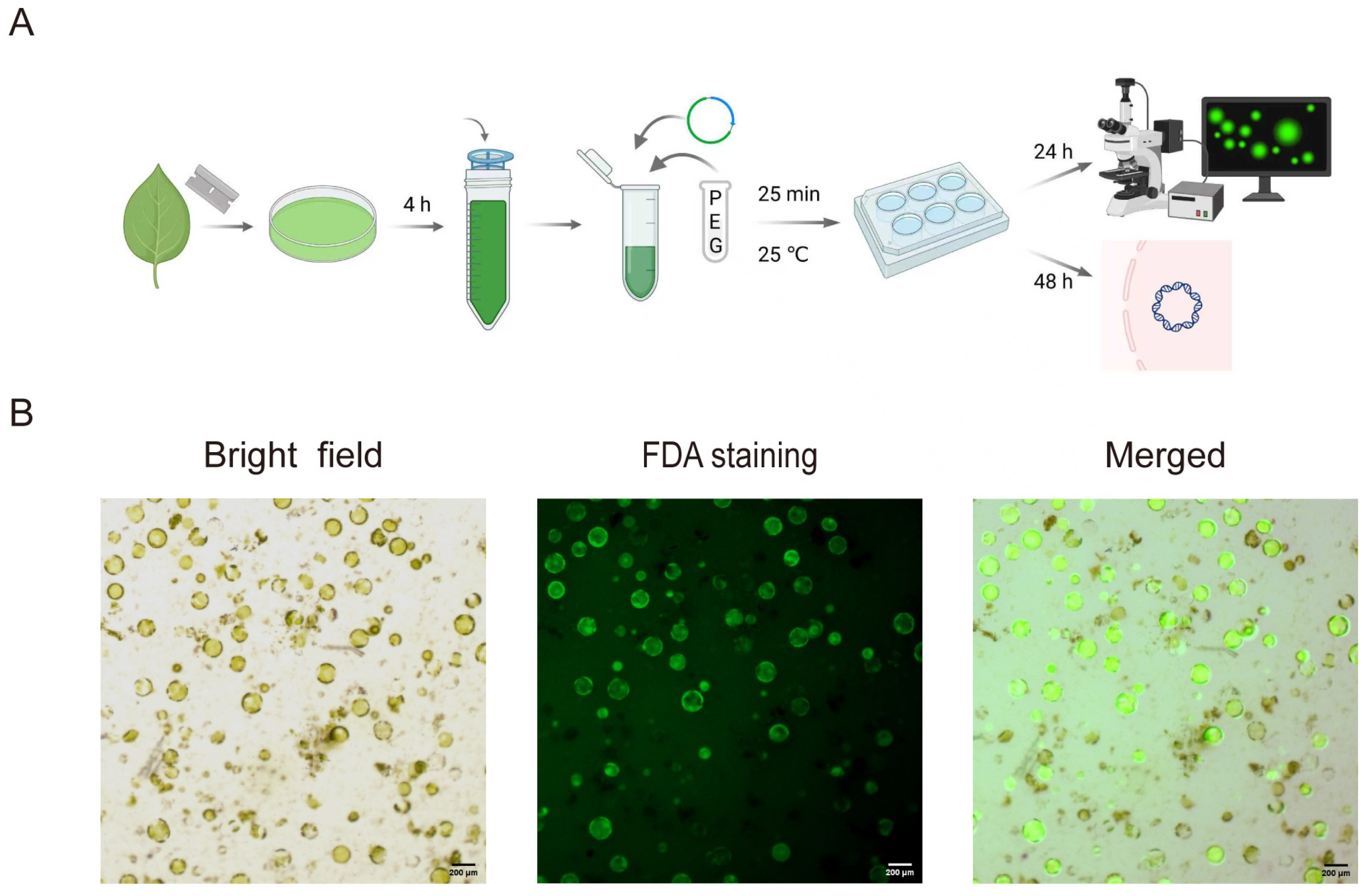
As illustrated in the flowchart in Figure 1A, lettuce protoplasts are isolated from shredded young fresh leaf by enzyme digestion. Subsequently mediated by PEG, vectors are transformed into protoplasts for functional verification. In a practical trial, high-quality mesophyll protoplasts were successfully isolated from young lettuce leaves using enzymatic digestion, reaching 2 × 10⁷ cells/g fresh weight. Under bright-field microscopy, the isolated protoplasts exhibited intact spherical morphology with uniform size distribution (Figure 1B). FDA staining further confirmed high cell viability, with more than 85% of protoplasts displaying strong green fluorescence, indicating that the isolation procedure preserved membrane integrity and metabolic activity. These viable protoplasts were suitable for subsequent transient transformation and genome editing experiments.

3.2. Effect of Protoplast Density and Vector Sizes on Transformation Efficiency

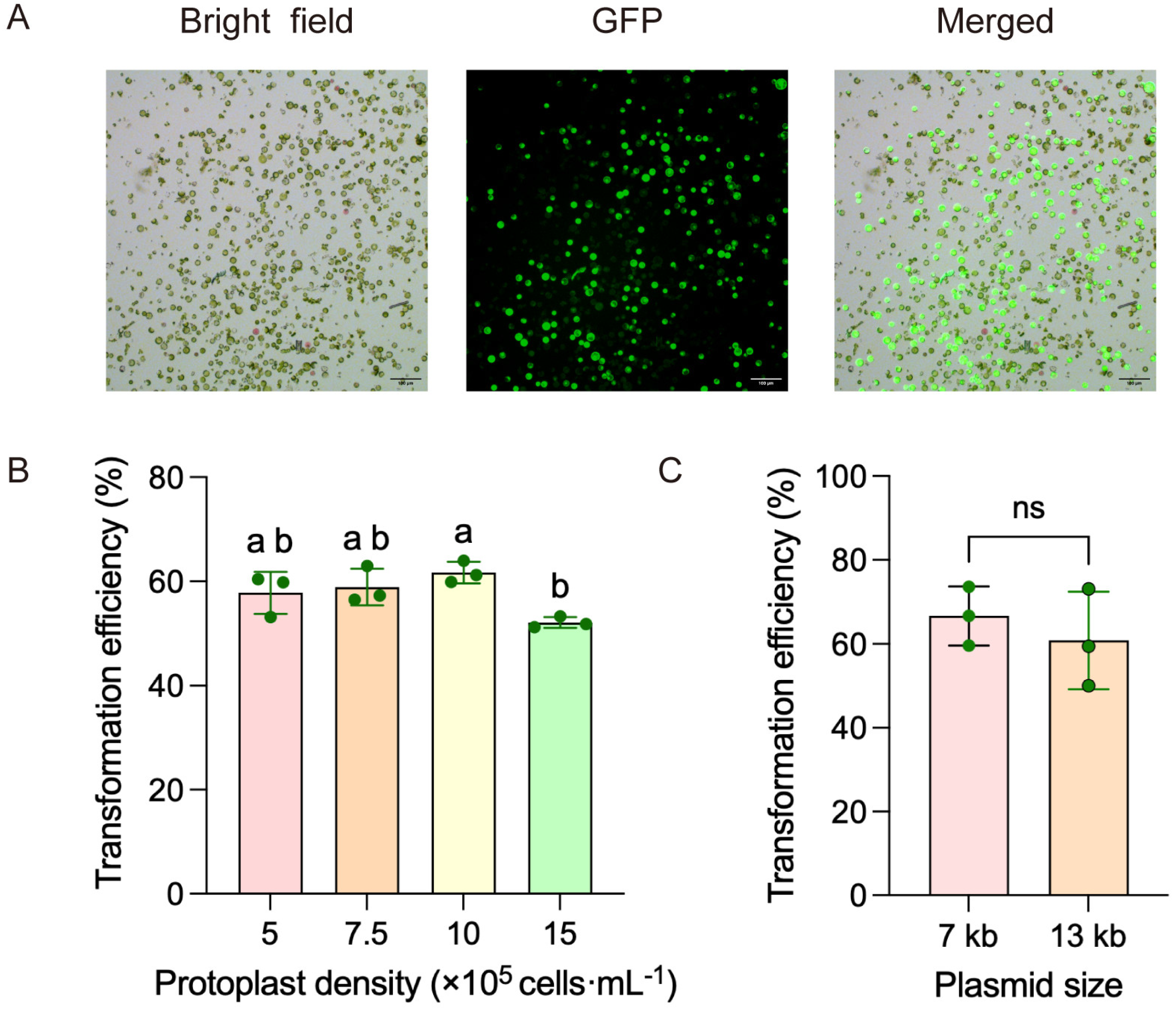
Based on prepared lettuce protoplasts, a vector loaded with mGFP was transformed into protoplast cells and the florescence signal was detected by a fluorescence microscope (Figure 2A). The signal showed that prepared lettuce protoplasts were in a suitable condition for transformation. To determine the optimal protoplast density for PEG-mediated transformation, four cell concentrations were evaluated: 5 × 10⁵, 7.5 × 10⁵, 1.0 × 10⁶, and 1.5 × 10⁶ cells mL−1. Transformation efficiency remained comparable at densities between 5 × 10⁵ and 1.0 × 10⁶ cells mL−1, with mean efficiencies of approximately 60% (Figure 2B). In contrast, a significantly lower efficiency was observed at 1.5 × 10⁶ cells mL−1, indicating that excessively high protoplast densities negatively affect transformation efficiency under a fixed vector aliquot. Based on these results, a protoplast density of 1.0 × 10⁶ cells mL−1 was selected for subsequent experiments.
Additionally, the impact of plasmid size on transformation efficiency was evaluated by comparing a 7 kb plasmid with a 13 kb plasmid. The smaller plasmid consistently produced higher transformation efficiency and lower variability across replicates. While the larger plasmid showed slightly reduced mean efficiency and increased variability, this difference was not statistically significant, indicating that large editor constructs can be successfully delivered (Figure 2C). Since the differences were not with significance, to some extent, plasmids with large cargo, such as genome editors, could be effectively transformed into lettuce protoplast cells with little impact on efficiency.

3.3. Effects of Heat Shock Treatment on Transformation Efficiency

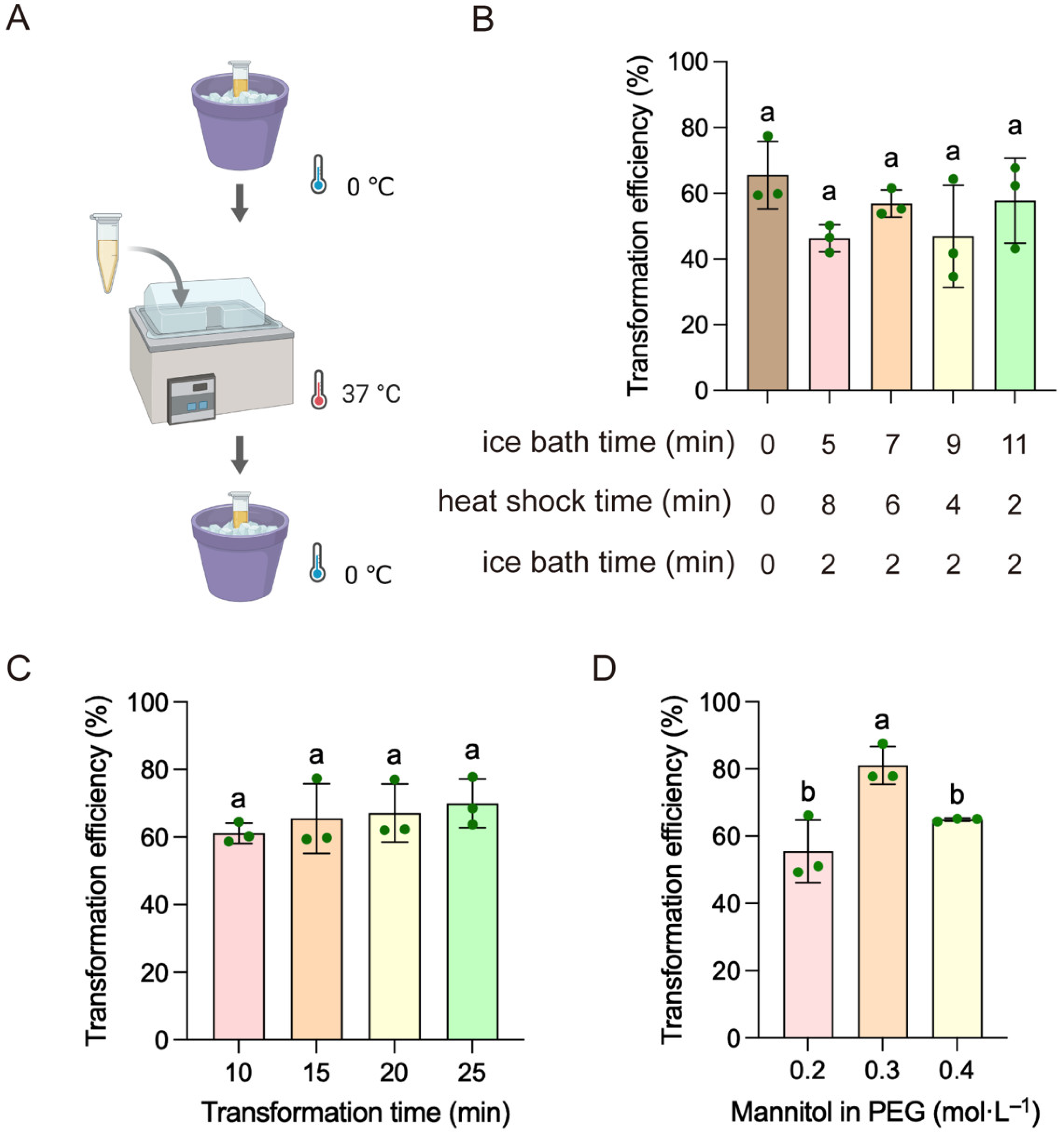
Besides protoplast density and vector size, incubation temperature and time are also important for transformation. As described before, ice–heat shock–ice protocols showed a better performance in Brassica crops instead of incubation at 25 °C (Figure 3A) [37]. To assess whether thermal treatment could improve lettuce protoplast transformation efficiency, a series of ice–heat shock–ice protocols involving heat shock at 37 °C were tested. None of these tested heat shock conditions resulted in higher transformation efficiency (>60%) compared with the standard room temperature protocol (Figure 3B), indicating that ice–heat shock–ice protocols do not confer additional benefits for lettuce protoplast transformation.

3.4. Influence of Incubation Time on Transformation Efficiency

Transformation efficiency was also assessed at incubation times of 10, 15, 20, and 25 min. No significance was detected among these time points (Figure 3C). However, a modest increase in mean transformation efficiency was observed at 25 min, suggesting that extended incubation does not impair protoplast viability and may slightly enhance DNA uptake. So, 25 min for incubation was selected for subsequent transformation.

3.5. Influence of Mannitol Concentration on Transformation Efficiency

As known, mannitol concentration in MMG affects plant protoplast isolation [37,38,39]. But few reports showed that the mannitol concentration in the PEG-mediated transformation method is essential for success. In contrast to the assessed factors described above, mannitol concentration in the PEG solution significantly influenced transformation outcomes. Transformation efficiency increased as the mannitol concentration rose from 0.2 M to 0.3 M, reaching the highest level at 0.3 M, around 81%, and then declined at 0.4 M (Figure 3D). These results indicate that an optimal osmotic environment is critical for efficient PEG-mediated DNA uptake in lettuce protoplasts.
Above all, through systematic optimization of lettuce protoplast systems focusing on key factors like protoplast density, incubation method and transformation solutions, we achieved a significant improvement in transformation efficiency compared to unoptimized methods, by which transformation efficiency was around 60%: a protoplast density of 1.0 × 10⁶ cells mL−1 was used to incubate 10 µg vectors in PEG with 0.3 M mannitol for 25 min at room temperature, which will achieve high transformation efficiency in lettuce protoplasts.

3.6. Comparative Performance of Base Editing Systems in Lettuce Protoplasts

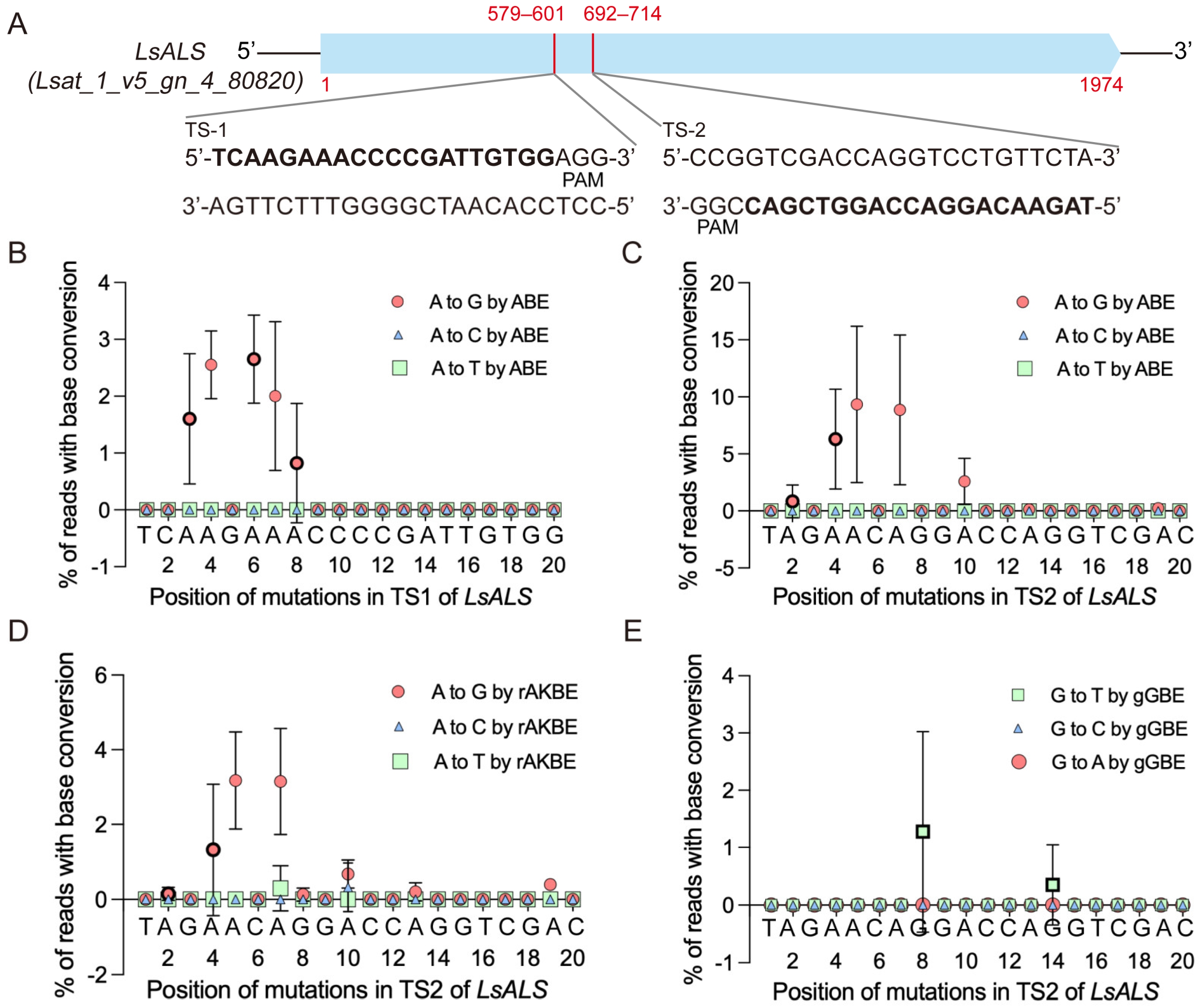
Using the optimized protoplast transformation system, we evaluated the editing efficiency and mutation profiles of three base editing systems—ABE, gGBE, and rAKBE—targeting the LsALS gene, which encodes acetolactate synthetase in lettuce. In LsALS, several single-nucleotide polymorphisms (SNPs) have been shown to confer herbicide resistance in plants [12,30,31,40,41]. The mutants of LsALSP184F obtained herbicide resistance [42] and is therefore a high value target for herbicide resistance and yield improvement in agriculture. Two sgRNAs were designed (Figure 4A) and editing outcomes were assessed by next generation sequencing (NGS).
ABE-mediated editing resulted in precise and efficient A-to-G base conversions. When guided by sgRNA-2, compared with TS-1 (Figure 4B and Figure S2), ABE achieved a maximum editing efficiency of 9.3%, with no detectable A-to-C or A-to-T substitutions (Figure 4C and Figure S2). Similarly, rAKBE showed limited A-to-G editing efficiency (3.2%) and close editing window (Figure 4D). In contrast, gGBE primarily induced G-to-T editing at a low frequency (1.28%) and appeared to show site specificity, as detailed in Figure 4E. High indel frequency of gGBE indicated the need for further optimization (Figure S3). Overall, among the tested editors, ABE demonstrated the highest editing efficiency and gGBE showed the best site specificity in the lettuce protoplast system. The above editing cases suggested that the protoplast system is suitable for precision base editing system evaluation in lettuce, which will accelerate genome editing development in lettuce.

4. Discussion

Efficient and reproducible genome editing platforms are essential for functional genomics and precision breeding in lettuce. In this study, we established an optimized PEG-mediated protoplast transformation system and demonstrated its utility for evaluating multiple base editing tools in a transient context. Our yield and transformation were comparable with the latest publications (yield: over 2 × 10⁷ cells/g fresh weight; transformation efficiency: over 80%) [43]. The optimization of the lettuce protoplast system provides a valuable tool for genome editing development. Although there are potential off-target risks in base editing, they are widely applied in plant studies and molecular breeding [24,27,33,40,42]. Lettuce offers unique advantages as a model organism in dicots, and while gene knockout studies have been fully reported, technical gaps remain in precise genome editing [12]. Through optimization of lettuce protoplast transformation procedures, this study investigated the editing efficiency of several base editors, which set an example for genome editing toolkit development in lettuce. In future, systematic and high-throughput testing of different base editor versions, promoters in vectors and locus-specific sgRNAs will benefit the updating of the toolkits to promote genome editing in application.
Transformation efficiency in lettuce protoplasts was strongly influenced by protoplast density, plasmid size, and osmotic conditions during PEG treatment. Excessively high protoplast densities likely impose metabolic or physical constraints that reduce DNA uptake efficiency, whereas moderate densities provide a favorable physiological state for transformation, enabling more efficient uptake and processing of transfection materials, which manifests as higher transfection efficiency. The typical concentration range for protoplast cells is between 5 × 10⁴ and 1 × 10⁶ cells mL−1 [44]. For instance, in protoplast isolation from Apium graveolens leaves, a density of 3 or 5 × 10⁵ cells mL−1 significantly enhances transformation efficiency. However, excessively high densities (e.g., 7 or 10 × 105 cells mL−1) can lead to a significant reduction in transformation efficiency [39]. When protoplast density is increased to some extent, the average number of uptake vectors per cell will decrease. Also, nutrition depletion will be more severe in a more crowded situation. Both factors will reduce the transformation and survival of transformed cells, which present a reduced transformation efficiency.
Similarly, to some extent, smaller plasmids may traverse cellular and nuclear membranes more efficiently, resulting in higher transformation performance. This difference may be attributed to the physical constraints associated with the uptake and intracellular trafficking of larger DNA fragments. In both Brachypodium distachyon and Vitis vinifera, large plasmids showed lower transformation efficiency, but to a different extent [45,46]. Meanwhile, transformation time also affected the efficiency of distinct plasmid sizes [46], which implied the changes in efficiency by plasmid sizes are species-specific and affected by multiple factors, needing further investigation.
The application of heat shock has been reported to enhance transformation efficiency in some plant species. In oil palm mesophyll protoplasts [47], a 90 s heat shock at 42 °C was found optimal for PEG-mediated transfection, yielding approximately 56% efficiency. Conversely, in Physcomitrium patens protoplasts [48], a 3 min heat shock at 45 °C negatively impacted viability. For Brassicaceae crops [37], a 6 min heat shock at 37 °C increased transfection efficiency to 86%. However, our results indicate that a 37 °C heat shock protocol does not provide additional benefits in lettuce. This observation underscores the species-specific nature of protoplast transformation responses and suggests that optimization strategies effective in other crops may not be directly transferable to lettuce.
Regarding transformation duration, although no significance was observed among several groups, transformation efficiency was slightly higher at 25 min compared to 10 min, suggesting a potential trend of modest improvement with prolonged incubation. In mango protoplast transformation systems, transfection time significantly influenced efficiency, with a 30 min incubation achieving up to 84.38% transformation efficiency [49]. Similarly, optimization studies on sugarcane protoplast isolation and transformation demonstrated that appropriate incubation duration enhanced efficiency [50], whereas excessively short or long durations reduced it. Further investigations with larger sample sizes or extended time gradients may clarify whether prolonged transformation duration is effective for improving efficiency.
The optimal mannitol concentration identified in this study highlights the importance of maintaining appropriate osmotic balance during PEG-mediated transfection. The transformation efficiency was relatively low at 0.2 M mannitol in the PEG solution, increasing to a higher level at 0.3 M, and then declining at 0.4 M. This suggests that moderately elevating the mannitol concentration within a certain range may enhance transformation efficiency. When the mannitol concentration was too low (0.2 M), the external osmotic pressure was insufficient to balance the internal osmotic pressure of protoplasts, leading to water influx, swelling, and increased membrane tension, making protoplasts more susceptible to membrane rupture and cell death during PEG treatment. Conversely, when the mannitol concentration was too high (0.4 M), protoplasts underwent excessive dehydration and shrinkage. Although membrane mechanical stability was enhanced under such conditions, membrane fluidity decreased and metabolic activity was suppressed, which in turn hindered the transmembrane transport and intracellular uptake of exogenous DNA [51,52].
Comparative evaluation of ABE, rAKBE, and gGBE in lettuce protoplasts revealed clear editor-dependent differences in efficiency and mutation profiles. ABE consistently produced the highest A-to-G conversion rates, particularly at TS2 (9.3%), with editing windows concentrated around protospacer positions 4–8. In contrast, TS1 exhibited markedly lower activity and off-target editing (Figure S4), underscoring strong target site dependency, a phenomenon widely reported in plant base editing systems and often attributed to local sequence context, sgRNA structure, and chromatin accessibility [53,54,55,56]. Importantly, ABE-mediated editing displayed high product purity, with negligible levels of alternative substitutions, consistent with previous reports showing that TadA-derived editors generally exhibit predictable editing windows and limited byproduct formation in plants [57,58]. rAKBE showed moderate efficiencies (~3–4%) and occasional low-frequency A-to-T substitutions, suggesting potential competition among repair pathways during mismatch resolution.
The glycosylase-based editor (gGBE) exhibited comparatively lower efficiencies and a narrow editing window, with G-to-T conversions generally below 3%. Glycosylase-mediated base editing relies on the generation of abasic intermediates that require downstream processing by endogenous repair machinery [28,29], and variability in base excision repair (BER) engagement has been proposed to influence editing outcomes in plants [59,60]. The reduced activity observed here may therefore reflect species-specific repair dynamics in lettuce cells. Collectively, the efficiency hierarchy (ABE > rAKBE > gGBE) indicates that adenine base editing currently provides the most robust and predictable platform for precise nucleotide substitution in lettuce. The pronounced target dependence observed between TS1 and TS2 further highlights the necessity of pre-validating editor–sgRNA combinations using transient systems prior to stable transformation, particularly for precision breeding applications such as ALS-mediated herbicide resistance.
In summary, we have established a protoplast system with high transient transformation efficiency (81%). However, our application of this system for base editing revealed a significant bottleneck, with editing efficiencies remaining low (max 9.3%). This suggests that achieving high levels of protein expression (GFP) does not guarantee high-frequency genome editing. This platform is therefore useful for detecting highly active editors but may not be sensitive enough for evaluating or optimizing less efficient tools. Future work should focus on bridging this gap by investigating delivery methods (e.g., RNP), target site accessibility, and editor architecture.

Supplementary Materials

The following supporting information can be downloaded at https://www.mdpi.com/article/10.3390/agronomy16080776/s1: Figure S1: Architecture of vectors used in this study. (A) 7 kb and 13 kb vectors used to compare effect of plasmid size on transformation efficiency. Base editor (B) and sgRNA (C) architecture in vectors; Figure S2: The editing profiles of different base editors. (A) ABE-TS1, (B) ABE-TS2, (C) gGBE-TS2, (D) rAKBE-TS2. PAM sequences and gRNA sequences were illustrated in red square and black lines below, respectively; Figure S3: Indel frequency of different base editors. The standard deviation was calculated from biological replicates, n = 4. Different letters indicate statistically significance across groups using a one-way analysis of variance (ANOVA), q < 0.05, otherwise no significance; Figure S4: The off-target editing detected by NGS. A and B were from ABE-TS1 group. PAM sequences and gRNA sequences were illustrated in red square and black lines below, respectively. Unexpected editing were illustrated in black squares.

Author Contributions

Conceptualization, Q.Z.; methodology, Q.Z.; software, Y.J. and G.P.; validation, Y.J. and G.P.; formal analysis, Y.J. and G.P.; investigation, Y.J. and G.P.; writing—original draft preparation, Y.J. and G.P.; writing—review and editing, Q.Z.; visualization, G.P. and Q.Z.; supervision, Q.Z.; project administration, Q.Z.; funding acquisition, Q.Z. All authors have read and agreed to the published version of the manuscript.

Funding

This project was supported by the Special Fund for Scientific Research of Shanghai Landscaping & City Appearance Administrative Bureau (grant nos. G252401) and the National Natural Science Foundation of China (grant nos. 32370274).

Data Availability Statement

The original contributions presented in this study are included in the article/Supplementary Materials. Further inquiries can be directed to the corresponding author.

Acknowledgments

We thank Yu-Guo Jiang (State Key Laboratory of Plant Molecular Genetics, CEMPS, Shanghai Institute of Plant Physiology and Ecology, Chinese, Academy of Sciences, Shanghai, China) for the kind and generous help. GenAI was used for manuscript polishing only.

Conflicts of Interest

The authors declare no conflict of interest.

References

  1. Rolnik, A.; Olas, B. The Plants of the Asteraceae Family as Agents in the Protection of Human Health. Int. J. Mol. Sci. 2021, 22, 3009. [Google Scholar] [CrossRef]
  2. Shi, M.; Gu, J.Y.; Wu, H.J.; Rauf, A.; Emran, T.B.; Khan, Z.; Mitra, S.; Aljohani, A.S.M.; Alhumaydhi, F.A.; Al-Awthan, Y.S.; et al. Phytochemicals, Nutrition, Metabolism, Bioavailability, and Health Benefits in Lettuce-A Comprehensive Review. Antioxidants 2022, 11, 1158. [Google Scholar] [CrossRef] [PubMed]
  3. Thoma, F.; Somborn-Schulz, A.; Schlehuber, D.; Keuter, V.; Deerberg, G. Effects of Light on Secondary Metabolites in Selected Leafy Greens: A Review. Front. Plant Sci. 2020, 11, 497. [Google Scholar] [CrossRef]
  4. Kim, M.J.; Moon, Y.; Tou, J.C.; Mou, B.Q.; Waterland, N.L. Nutritional value, bioactive compounds and health benefits of lettuce (Lactuca sativa L.). J. Food Compos. Anal. 2016, 49, 19–34. [Google Scholar] [CrossRef]
  5. Livneh, Y.; Agmon, D.; Leor-Librach, E.; Vainstein, A. Viral-Based Gene Editing System for Nutritional Improvement of Fructan Content in Lettuce. Int. J. Mol. Sci. 2025, 26, 2594. [Google Scholar] [CrossRef]
  6. Livneh, Y.; Leor-Librach, E.; Agmon, D.; Makov-Bouaniche, T.; Tiwari, V.; Shor, E.; Yeselson, Y.; Masci, T.; Schaffer, A.; Charuvi, D.; et al. Combined enhancement of ascorbic acid, β-carotene and zeaxanthin in gene-edited lettuce. Plant Biotechnol. J. 2025, 23, 1954–1967. [Google Scholar] [CrossRef]
  7. Tao, H.F.; Wu, Y.Z.; Liu, S.X.; Yang, S.X.; Xu, X.M. Over-expression of LsEXPA6, a lettuce expansin gene, improves cadmium stress tolerance in transgenic Arabidopsis. Gene 2025, 933, 148927. [Google Scholar] [CrossRef]
  8. Weiss, J.; Gruda, N.S. Enhancing nutritional quality in vegetables through breeding and cultivar choice in protected cultivation. Sci. Hortic. 2025, 339, 113914. [Google Scholar] [CrossRef]
  9. Qian, Y.X.; Liu, X.; Wang, B.J.; Li, D.Y.; Wu, Z.H.; Tong, J. Genome-Wide Identification of the LsaPHR1 Gene Family and Preliminary Functional Validation of LsaPHR1.1 in Phosphorus Tolerance in Lactuca sativa. Int. J. Mol. Sci. 2025, 26, 10466. [Google Scholar] [CrossRef] [PubMed]
  10. Choi, S.H.; Ahn, W.S.; Jie, E.Y.; Cho, H.S.; Kim, S.W. Development of late-bolting plants by CRISPR/Cas9-mediated genome editing from mesophyll protoplasts of lettuce. Plant Cell Rep. 2022, 41, 1627–1630. [Google Scholar] [CrossRef] [PubMed]
  11. Queiroz, L.N.; Monteiro, T.R.; Gomes, A.; Cabral, G.B.; Aragao, F.J.L. Enhanced folate content in bioengineered lettuce stably expressed under field conditions. Transgenic Res. 2025, 34, 20. [Google Scholar] [CrossRef] [PubMed]
  12. Lee, E.; Kim, Y.; Kim, M.; Lee, D.; Kang, B.-C. DNA-free base editing in lettuce via in vitro transcribed base editors. J. Integr. Plant Biol. 2025, 67, 199–201. [Google Scholar] [CrossRef]
  13. Mukundan, N.S.; Satyamoorthy, K.; Babu, V.S. Advancing plant protoplasts: Innovative techniques and future prospects. Plant Biotechnol. Rep. 2025, 19, 659–678. [Google Scholar] [CrossRef]
  14. Chen, K.B.; Chen, J.L.; Pi, X.; Huang, L.J.; Li, N. Isolation, Purification, and Application of Protoplasts and Transient Expression Systems in Plants. Int. J. Mol. Sci. 2023, 24, 16892. [Google Scholar] [CrossRef]
  15. Fu, X.; Wang, N.; Li, L.; Qiao, D.; Qi, X.; Liu, C.; Gao, Z.; Xie, C.; Zhu, J. Development of cytosine and adenine base editors for maize precision breeding. J. Integr. Plant Biol. 2025, 67, 2731–2743. [Google Scholar] [CrossRef]
  16. Sun, C.; Lei, Y.; Li, B.; Gao, Q.; Li, Y.; Cao, W.; Yang, C.; Li, H.; Wang, Z.; Li, Y.; et al. Precise integration of large DNA sequences in plant genomes using PrimeRoot editors. Nat. Biotechnol. 2024, 42, 316–327. [Google Scholar] [CrossRef]
  17. Zhao, Y.; Huang, Z.; Zhou, X.; Teng, W.; Liu, Z.; Wang, W.; Tang, S.; Liu, Y.; Liu, J.; Wang, W.; et al. Precise deletion, replacement and inversion of large DNA fragments in plants using dual prime editing. Nat. Plants 2025, 11, 191–205. [Google Scholar] [CrossRef]
  18. Liu, Y.; Xiong, Y. Protoplast for Gene Functional Analysis in Arabidopsis. Protoplast Technol. Methods Protoc. 2022, 2464, 29–47. [Google Scholar] [CrossRef]
  19. Stelmach-Wityk, K.; Szymonik, K.; Jones, A.M.P.; Grzebelus, E. A novel protocol for protoplast isolation, transfection, and culture in Cannabis sativa. BMC Plant Biol. 2025, 25, 1629. [Google Scholar] [CrossRef] [PubMed]
  20. Le, L.L.; Ma, Y.W.; Xie, X.Y.; Zhang, W.T.; Fu, F.F.; Wang, G.B.; Cao, F.L.; Yang, X.M. Protoplast technology in woody plants: Current advances and potential applications in genetic improvement. Tree Physiol. 2025, 45, tpaf138. [Google Scholar] [CrossRef] [PubMed]
  21. Reyna-Llorens, I.; Ferro-Costa, M.; Burgess, S.J. Plant protoplasts in the age of synthetic biology. J. Exp. Bot. 2023, 74, 3821–3832. [Google Scholar] [CrossRef]
  22. Kim, Y.; Lee, E.; Kang, B.C. Etiolation promotes protoplast transfection and genome editing efficiency. Physiol. Plant. 2024, 176, e14637. [Google Scholar] [CrossRef]
  23. Lee, J.; Oh, N.; Yun, J.Y.; Choi, H.S.; Seo, J.K.; Kang, J.H.; Jung, C. Application of CRISPR-Based C-to-G Base editing in rice protoplasts. Appl. Biol. Chem. 2023, 66, 18. [Google Scholar] [CrossRef]
  24. Jiang, C.D.; Li, Y.Y.; Wang, R.; Sun, X.; Zhang, Y.; Zhang, Q. Development and optimization of base editors and its application in crops. Biochem. Biophys. Res. Commun. 2024, 739, 150942. [Google Scholar] [CrossRef]
  25. Yarra, R.; Sahoo, L. Base editing in rice: Current progress, advances, limitations, and future perspectives. Plant Cell Rep. 2021, 40, 595–604. [Google Scholar] [CrossRef] [PubMed]
  26. Gaillochet, C.; Fernandez, A.P.; Goossens, V.; D’Halluin, K.; Drozdzecki, A.; Shafie, M.; Van Duyse, J.; Van Isterdael, G.; Gonzalez, C.; Vermeersch, M.; et al. Systematic optimization of Cas12a base editors in wheat and maize using the ITER platform. Genome Biol. 2023, 24, 6. [Google Scholar] [CrossRef] [PubMed]
  27. Li, X.B.; Xie, J.Y.; Dong, C.; Zheng, Z.; Shen, R.D.; Cao, X.S.; Chen, X.Y.; Wang, M.G.; Zhu, J.K.; Tian, Y.F. Efficient and heritable A-to-K base editing in rice and tomato. Hortic. Res. 2024, 11, uhad250. [Google Scholar] [CrossRef] [PubMed]
  28. Tong, H.W.; Liu, N.N.; Wei, Y.H.; Zhou, Y.S.; Li, Y.; Wu, D.N.; Jin, M.; Cui, S.N.; Li, H.B.; Li, G.L.; et al. Programmable deaminase-free base editors for G-to-Y conversion by engineered glycosylase. Natl. Sci. Rev. 2023, 10, nwad143. [Google Scholar] [CrossRef]
  29. Wei, Y.H.; Cao, X.; Huang, S.H.; Yue, Y.; Luo, M.H.; Liu, Z.J.; Liu, B.; Zhang, Q.J.; Wu, Y.S.; Wang, L.Q.; et al. Efficient glycosylase-mediated base editing with minimal off-target effects in mammalian embryos. Genome Biol. 2025, 26, 360. [Google Scholar] [CrossRef]
  30. Merriam, A.B.; Malone, J.M.; Hereward, J.P.; Gill, G.; Preston, C. Point mutations including a novel Pro-197-Phe mutation confer cross-resistance to acetolactate synthase (ALS) inhibiting herbicides in Lactuca serriola in Australia. Pest Manag. Sci. 2023, 79, 5333–5340. [Google Scholar] [CrossRef]
  31. Tranel, P.J.; Wright, T.R. Resistance of weeds to ALS-inhibiting herbicides: What have we learned? Weed Sci. 2002, 50, 700–712. [Google Scholar] [CrossRef]
  32. Larkin, P.J. Purification and Viability Determinations of Plant Protoplasts. Planta 1976, 128, 213–216. [Google Scholar] [CrossRef]
  33. Jin, S.; Zong, Y.; Gao, Q.; Zhu, Z.X.; Wang, Y.P.; Qin, P.; Liang, C.Z.; Wang, D.W.; Qiu, J.L.; Zhang, F.; et al. Cytosine, but not adenine, base editors induce genome-wide off-target mutations in rice. Science 2019, 364, 292–295. [Google Scholar] [CrossRef]
  34. Li, Y.; Li, S.; Li, C.; Zhang, C.; Yan, L.; Li, J.; He, Y.; Guo, Y.; Xia, L. Fusion of a rice endogenous N-methylpurine DNA glycosylase to a plant adenine base transition editor ABE8e enables A-to-K base editing in rice plants. aBIOTECH 2024, 5, 127–139. [Google Scholar] [CrossRef]
  35. Xu, X.; Kawasaki, S.; Fujimura, T.; Wang, C. A protocol for high-throughput extraction of DNA from rice leaves. Plant Mol. Biol. Rep. 2005, 23, 291–295. [Google Scholar] [CrossRef]
  36. Li, F.; Tan, X.; Li, S.; Chen, S.; Liu, L.; Huang, J.; Li, G.; Lu, Z.; Wu, J.; Zeng, D.; et al. SuperDecode: An integrated toolkit for analyzing mutations induced by genome editing. Mol. Plant 2025, 18, 690–702. [Google Scholar] [CrossRef]
  37. Yu, X.; Yu, J.; Lu, Y.; Li, W.; Huo, G.; Zhang, J.; Li, Y.; Zhao, J.; Li, J. An efficient and universal protoplast-based transient gene expression system for genome editing in Brassica crops. Hortic. Plant J. 2024, 10, 983–994. [Google Scholar] [CrossRef]
  38. Kim, K.; Shin, J.; Lee, J.D.; Kim, W.C. Establishment of efficient hypocotyl-derived protoplast isolation and its application in soybean (Glycine max L. Merr.). Front. Plant Sci. 2025, 16, 1587927. [Google Scholar] [CrossRef]
  39. Du, J.; Zhang, H.; Li, W.; Li, X.; Wang, Z.; Zhang, Y.; Xiong, A.; Li, M. Optimization of Protoplast Preparation System from Leaves and Establishment of a Transient Transformation System in Apium graveolens. Agronomy 2023, 13, 2154. [Google Scholar] [CrossRef]
  40. Jiang, Y.Y.; Chai, Y.P.; Lu, M.H.; Han, X.L.; Lin, Q.P.; Zhang, Y.; Zhang, Q.; Zhou, Y.; Wang, X.C.; Gao, C.X.; et al. Prime editing efficiently generates W542L and S621I double mutations in two ALS genes in maize. Genome Biol. 2020, 21, 257. [Google Scholar] [CrossRef] [PubMed]
  41. Ouyang, C.; Jin, X.X.; Zhao, H.M.; Chen, S.L.; Zhao, G.M.; Li, D.; Liu, W.; He, X.Y.; Wu, Y.Z.; Yang, J.; et al. Generating Broad-Spectrum Resistance to ALS-Inhibiting Herbicides in Rice by CRISPR/Cas9-Mediated NHEJ. Rice 2025, 18, 86. [Google Scholar] [CrossRef]
  42. Zhang, R.; Liu, J.; Chai, Z.; Chen, S.; Bai, Y.; Zong, Y.; Chen, K.; Li, J.; Jiang, L.; Gao, C. Generation of herbicide tolerance traits and a new selectable marker in wheat using base editing. Nat. Plants 2019, 5, 480–485. [Google Scholar] [CrossRef]
  43. Xiang, L.; Li, R.-X.; Zheng, Q.-J.; Huang, Z.-T.; Yu, P.-F.; Shi, Z.-X.; Li, Y.-W.; Zhao, H.-M.; Cai, Q.-Y.; Hou, X.-W.; et al. Optimization of Protoplast Isolation and Transient Expression Systems for Lettuce (Lactuca sativa L.). ACS Agric. Sci. Technol. 2025, 5, 36–48. [Google Scholar] [CrossRef]
  44. Reed, K.M.; Bargmann, B.O.R. Protoplast Regeneration and Its Use in New Plant Breeding Technologies. Front. Genome Ed. 2021, 3, 734951. [Google Scholar] [CrossRef] [PubMed]
  45. Zhao, F.-L.; Li, Y.-J.; Hu, Y.; Gao, Y.-R.; Zang, X.-W.; Ding, Q.; Wang, Y.-J.; Wen, Y.-Q. A highly efficient grapevine mesophyll protoplast system for transient gene expression and the study of disease resistance proteins. Plant Cell Tissue Organ Cult. (PCTOC) 2016, 125, 43–57. [Google Scholar] [CrossRef]
  46. Hong, S.-Y.; Seo, P.J.; Cho, S.-H.; Park, C.-M. Preparation of leaf mesophyll protoplasts for transient gene expression in Brachypodium distachyon. J. Plant Biol. 2012, 55, 390–397. [Google Scholar] [CrossRef]
  47. Fizree, M.P.M.A.A.; Masani, M.Y.A.; Shaharuddin, N.A.; Chai-Ling, H.; Manaf, M.A.A.; Parveez, G.K.A. Efficient PEG-mediated transformation of oil palm mesophyll protoplasts and its application in functional analysis of oil palm promoters. S. Afr. J. Bot. 2023, 155, 187–195. [Google Scholar] [CrossRef]
  48. Liu, Y.C.; Vidali, L. Efficient polyethylene glycol (PEG) mediated transformation of the moss Physcomitrella patens. J. Vis. Exp. 2011, 2560. [Google Scholar] [CrossRef] [PubMed]
  49. Adjei, M.O.; Zhao, H.; Tao, X.; Yang, L.; Deng, S.; Li, X.; Mao, X.; Li, S.; Huang, J.; Luo, R.; et al. Using A Protoplast Transformation System to Enable Functional Studies in Mangifera indica L. Int. J. Mol. Sci. 2023, 24, 11984. [Google Scholar] [CrossRef] [PubMed]
  50. Wang, Q.; Yu, G.; Chen, Z.; Han, J.; Hu, Y.; Wang, K. Optimization of protoplast isolation, transformation and its application in sugarcane (Saccharum spontaneum L.). Crop J. 2021, 9, 133–142. [Google Scholar] [CrossRef]
  51. Lieber, M.R.; Hesse, J.E.; Nickol, J.M.; Felsenfeld, G. The mechanism of osmotic transfection of avian embryonic erythrocytes: Analysis of a system for studying developmental gene expression. J. Cell Biol. 1987, 105, 1055–1065. [Google Scholar] [CrossRef] [PubMed]
  52. Ren, R.; Gao, J.; Lu, C.; Wei, Y.; Jin, J.; Wong, S.-M.; Zhu, G.; Yang, F. Highly Efficient Protoplast Isolation and Transient Expression System for Functional Characterization of Flowering Related Genes in Cymbidium Orchids. Int. J. Mol. Sci. 2020, 21, 2264. [Google Scholar] [CrossRef] [PubMed]
  53. Aravind, B.; Molla, K.; Mangrauthia, S.K.; Mohannath, G. Strategies to improve genome editing efficiency in crop plants. J. Plant Biochem. Biotechnol. 2023, 32, 661–672. [Google Scholar] [CrossRef]
  54. Kumar, U.; Dwivedi, D.; Das, U. Advancements in CRISPR-Mediated Multiplex Genome Editing: Transforming Plant Breeding for Crop Improvement and Polygenic Trait Engineering. Biotechnol. J. 2025, 20, e70148. [Google Scholar] [CrossRef]
  55. Krausz, S.L.; Simon, D.A.; Bartos, Z.; Biczók, Z.; Varga, É.; Huszár, K.; Kulcsár, P.I.; Tálas, A.; Ligeti, Z.; Welker, E. ProPE expands the prime editing window and enhances gene editing efficiency where prime editing is inefficient. Nat. Catal. 2025, 8, 1100–1116. [Google Scholar] [CrossRef]
  56. Dixit, S.; Kumar, A.; Srinivasan, K.; Vincent, P.; Krishnan, N.R. Advancing genome editing with artificial intelligence: Opportunities, challenges, and future directions. Front. Bioeng. Biotechnol. 2024, 11, 1335901. [Google Scholar] [CrossRef]
  57. Yan, D.Q.; Ren, B.; Liu, L.; Yan, F.; Li, S.F.; Wang, G.R.; Sun, W.X.; Zhou, X.P.; Zhou, H.B. High-efficiency andmultiplex adenine base editing in plants using new TadA variants. Mol. Plant 2021, 14, 722–731. [Google Scholar] [CrossRef] [PubMed]
  58. Li, C.; Zong, Y.; Wang, Y.P.; Jin, S.; Zhang, D.B.; Song, Q.N.; Zhang, R.; Gao, C.X. Expanded base editing in rice and wheat using a Cas9-adenosine deaminase fusion. Genome Biol. 2018, 19, 59. [Google Scholar] [CrossRef]
  59. Verma, P.; Tandon, R.; Yadav, G.; Gaur, V. Structural Aspects of DNA Repair and Recombination in Crop Improvement. Front. Genet. 2020, 11, 1103. [Google Scholar] [CrossRef]
  60. Zhao, Y.; Chen, D.; Grin, I.R.; Zharkov, D.O.; Yu, B. Developing plant-derived DNA repair enzyme resources through studying the involvement of base excision repair DNA glycosylases in stress responses of plants. Physiol. Plant. 2025, 177, e70162. [Google Scholar] [CrossRef]
Figure 1. Schematic illustration of lettuce protoplast preparation. (A) Flowchart of lettuce protoplast preparation and transformation. (B) FDA staining of isolated protoplasts, bar = 200 µm.
Agronomy 16 00776 g001
Figure 2. The effect of protoplast density and vector size on lettuce protoplast transformation efficiency. (A) The expression of GFP was observed after 14 h protoplast transformation using a fluorescence microscope, bar = 100 µm. (B) The effect of the protoplast density on transformation efficiency. (C) The effect of plasmid size on transformation efficiency. In (B,C), the standard deviation was calculated from biological replicates, n = 3. In (B), different letters indicate statistical significance across groups using a one-way analysis of variance (ANOVA), q < 0.05, otherwise no significance. In (C), ns indicates that there is no statistical significance between the groups as determined by the paired samples t-test, p > 0.05.
Agronomy 16 00776 g002
Figure 3. The effect of heat shock on protoplast transformation efficiency. (A) Flowchart of 37 °C heat shock transformation method. (0, 0, 0) indicated incubation at room temperature for 15 min, as control. (B) The effect of 37 °C heat shock transfection method on transfection efficiency. Four different treatments were performed. (C) The effect of protoplast transformation time on transformation efficiency. (D) The effect of mannitol concentration in PEG on transformation efficiency. In (BD), the standard deviation was calculated from biological replicates, n = 3. Different letters indicate statistical significance across groups using a one-way analysis of variance (ANOVA), q < 0.05, otherwise no significance.
Agronomy 16 00776 g003
Figure 4. Base editing analysis induced by ABE, gGBE, and rAKBE in LsALS. (A) Target sequences in LsALS were designed for base editing. (BE) The base editing efficiency of ABE in TS1 (B)/TS2 (C) and rAKBE (D)/gGBE (E) in TS2. Each point shows the average of biological replicates, n = 4, with error bars for standard deviation. Amino acid substitutions by base edition are illustrated by high border thickness circles or squares in (BE). The resulting amino acid substitution was Q194R, E195G, T196A in (B), L238P, V237A in (C), V237A in (D) and P236H, P234H in (E), from left to right in order.
Agronomy 16 00776 g004
Disclaimer/Publisher’s Note: The statements, opinions and data contained in all publications are solely those of the individual author(s) and contributor(s) and not of MDPI and/or the editor(s). MDPI and/or the editor(s) disclaim responsibility for any injury to people or property resulting from any ideas, methods, instructions or products referred to in the content.