Article

Root-Zone Microbiome Responds to Organic Mulch Cover by Reducing Fungal Pathogen Load and Boosting Tree Establishment in High-Density Apple Orchards

1
School of Plant and Environmental Sciences, Virginia Polytechnic Institute and State University, Blacksburg, VA 24060, USA
2
Department of Biological Sciences, North Carolina State University, Raleigh, NC 27607, USA
3
Department of Plant, Soil and Microbial Sciences, Michigan State University, East Lansing, MI 48824, USA
4
School of Integrated Plant Science—Horticulture Section, Cornell University, Ithaca, NY 14853, USA
*
Authors to whom correspondence should be addressed.
Agronomy 2026, 16(7), 762; https://doi.org/10.3390/agronomy16070762
Submission received: 22 February 2026 / Revised: 25 March 2026 / Accepted: 3 April 2026 / Published: 5 April 2026
(This article belongs to the Section Soil and Plant Nutrition)

Abstract

High-density apple (Malus domestica Borkh.) orchards yield fruits as early as three years after planting but nutrient inputs and availability are paramount to a successful orchard; sustainable practices that balance tree growth and production with environmental concerns are not widely available. In this three-year study, we implemented a split-plot design in three orchards across the Mid-Atlantic region of the USA to evaluate integrated soil management approaches that combine locally sourced carbon-based organic mulch with fertilizers on rhizosphere microbes and tree growth. Bacterial and fungal communities were sampled at the end of the first and third growing seasons in addition to soil and tree-related physicochemical properties. Mulch treatment showed the most significant effect on both the bacterial and fungal groups. Most of these changes reflect the increase in soil organic matter and the increase in carbon cycling. Sequence variants belonging to Flavobacteria and Cytophaga were enriched by the mulch application. A key result from this project is the suppression of the relative abundance of potential soil-borne plant fungal pathogens in all orchards in all years. Additionally, arbuscular mycorrhizal fungi were enriched under the mulch treatment. Microbial shifts accompanying the mulch treatments supported higher trunk cross-sectional areas by the third sampling year that increased by 33.5%. Fertilizer treatments had less pronounced effects on microbial communities. These results highlight the potential for using sustainable, integrated nutrient management strategies to promote healthy orchard soils and support vigorous tree growth while reducing fungal pathogens. Our work will contribute to regional and location-specific fertilizer recommendations for apple producers.

1. Introduction

Commercial apple (Malus domestica Borkh.) orchards in the Mid-Atlantic region of the USA are shifting from low- (400 trees/ha) to high-tree-density systems (>3000 trees/ha). This shift has been driven by greater yields and thus profitability [1]. High-density orchards require the use of smaller “dwarf” trees that can bear fruit soon after the orchard is planted [2]. Orchard soils must be properly managed to support the increased tree nutrient and water demands, while balancing the effects on soil health and environmental sustainability [3,4,5,6]. Knowledge gaps remain regarding sustainable soil management practices that ensure successful orchard establishment, maintain soil health, and optimize tree productivity, especially in the Mid-Atlantic region.
The use of synthetic fertilizers, mainly nitrogen (N), has revolutionized agriculture and supports grower and global food security, but those benefits can also result in soil and water quality degradation and organic nutrient pool depletion [7]. The reduction in soil organic matter (SOM) and carbon can negatively affect soil microbial communities, shifting their structure, diversity, and functioning [8]. Organic amendments are known to enhance soil health, but compared to using integrated treatments with both synthetic and organic amendments, they can be beneficial to plant productivity, soil health, and microbial diversity, with fewer detrimental effects on the environment [7,9]. More recent studies show that organic inputs, such as mulch-based amendments, have multiple positive effects on soil, plant health, and yield in several cropping systems [10,11,12]. This approach can help meet sustainability goals while providing immediate and longer-term pools of nutrients to productive and healthy apple orchards and soil microbiomes [5,13,14]. Understanding the multi-year and cumulative effects of different integrated treatments during the first three years of establishment will help to discern management practices for high-density orchards [6].
Soil health is highly dependent on organic matter and microbial communities [15,16,17,18]. Soil microbes derive energy from organic matter and play a critical role in the mineralization and recycling of soil nutrients for plant use [19,20]. In addition to nitrogen, nutrients such as iron (Fe) and phosphorus (P) are mobilized for plant uptake. Both saprotrophic and mutualistic bacteria and fungi can be promoted relative to that of pathogenic microbes, perhaps suppressing the activity of pathogens when organic matter is amended to soil [21,22,23]. However, disease reduction is reportedly inconsistent, perhaps because tree rootstock genotypes can influence rhizosphere microbiome structure and diversity, as can soil amendments [5,13,24,25]. In addition, most of the previous works focuses on either a single location or a single year, lacking the effects of longer-term impacts of these amendments. Hence, more research, inclusive of multiple locations and years, is needed to understand how changing management practices that include the integration of high-quality organic wastes supports nutrient demands and soil health in high-density orchards [26].
The objective of this study is to identify fertilizer management scenarios and determine soil microbial communities and plant and soil health indicators during orchard establishment. First, it was hypothesized that integrated carbon-based mulch amendments would have a significant impact on soil microbial communities and be closely linked to improvements in soil health. It was also hypothesized that fertilizer treatment would affect the communities, as shown by our previous work and others. We implemented the study across three orchards in the Shenandoah Valley and Piedmont regions of the Mid-Atlantic United States using both carbon-based (organic) mulch as the main plot and four fertilizer treatments as sub-plot factors. Soil and plant physicochemical properties were assessed in all years, along with tree growth measurements.

2. Materials and Methods

2.1. Site Description

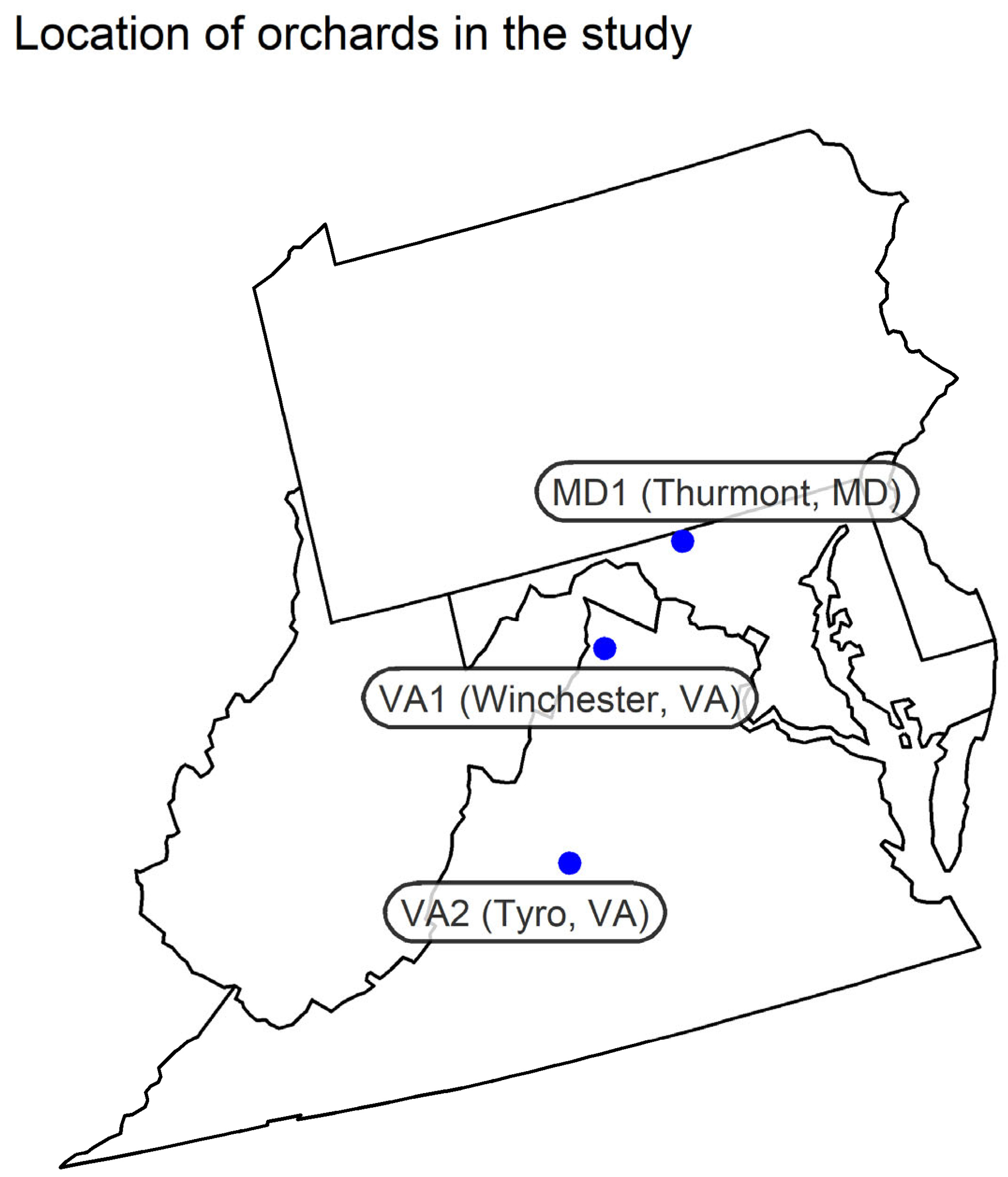
Two-year-old ‘Honeycrisp’ trees grafted onto ‘Budagovsky 9’ rootstocks were all acquired from the same nursery. The trees were planted in late April to mid-May 2014 at the Virginia Tech Agricultural Research and Extension Center in Winchester, VA, USA (VA1) on Frederick–Poplimento loam soil with 7 to 15 percent slopes, at a commercial orchard in Tyro, VA, USA (VA2), on Unison loam soil with 7 to 15 percent slopes, and Thurmont MD (MD1) on Murrill gravelly loam with 3 to 8 percent slopes (Figure 1) [27]. The climates of the three locations are broadly similar because they all lie in the Mid-Atlantic region of the eastern United States and fall within the humid subtropical to humid continental transition zone. Summer highs commonly reach 30 °C, while winter highs are typically 3–6 °C (https://www.climatehubs.usda.gov/, accessed on 23 March 2026). However, differences in elevation and proximity to the Appalachian Mountains create meaningful variation in temperature, snowfall, and growing-season conditions. Winchester is in the Northern Shenandoah Valley, which moderates temperatures and allows for a longer growing season (early April to late October). Tyro is in the eastern slope of the Blue Ridge Mountains, which allows for slightly cooler summers, colder winters, and more snowfall than the other two sites. The growing season in Tyro is typically shorter than the other two sites. The climate at the Thurmont orchard is more similar to Winchester than Tyro but is also influenced by the proximity to Catoctin Mountain.

2.2. Experimental Design and Field Setup

A split-plot, completely randomized block design with four four-tree replications for each treatment was used at each location. Blocking was based on location within the orchard to remove the impact of variability across the site. The two main plots were (1) a mulch and (2) no-mulch control. The four subplots were: (1) compost, (2) calcium nitrate (CaNO3), (3) compost and CaNO3, and (4) an unfertilized control (Figure S1). There was an untreated buffer tree between each subplot and two untreated buffer trees between the main plots.
Prior to application, compost was analyzed by the Pennsylvania State University Agricultural Analytical Services Laboratory (University Park, PA, USA) to ensure N was applied at an equal rate among fertilizer treatments (Table S1). All fertilizer treatments were applied at 40 t nitrogen/ha, regardless of source (CaNO3, compost, or both). For the combined compost and CaNO3 treatment, 20 t nitrogen/ha was applied from each source. Compost application was based on total N.
Mulch was applied at a 1 m width and 10 cm depth and mostly consisted of large-aggregate material that was sourced locally for each site. The nitrogen contribution from the mulch was not accounted for in the CaNO3 or compost application rates.

2.3. Sampling and Processing

Trees were planted in mid-May 2014 at Winchester, VA, research station (VA1) and Tyro, VA, commercial orchard (VA2), and in April 2014 at a commercial orchard in Thurmont, MD (MD1). Treatments were applied in mid-July 2014 at VA1 and VA2 and at the end of August 2014 for MD1. A second application of CaNO3 was administered during leaf sampling. Leaves were sampled in September 2014, while soil was sampled for microbial communities and physicochemical analyses in October 2014. In 2016, soil and leaf samples were collected from all sites in August 2016.
Soil and leaf samples were taken uniformly from each tree in each experimental unit, regardless of the number of trees. A 10 cm soil depth was taken from two locations on each side of each sample tree for a total of 4 samples/tree. Soil probes with one-inch internal diameters were used for sampling while being wiped with 70% ethanol to minimize cross-contamination. Soil samples were stored in a cooler with ice. The soil was then sieved through a #10 (2 mm mesh). Soil (100 g) was aliquoted in WhirlPack bags and stored in a −80 °C freezer for DNA extraction. The remaining soil was sieved to remove stones and root fragments using a 2 mm mesh (US number 10) soil sieve and stored at 4 °C until biological and physiochemical analyses commenced. Soil pH, mineral nutrients, soil organic matter, and soluble salts were measured at the Cornell Nutrient Analytical Lab (Ithaca, NY, USA), as described in [6].
Twenty leaves were collected from each tree (10 per side) from side branches located between 1 and 2 m above the soil surface. Leaves were placed in labeled paper bags and were dried at 80 °C for 72 h. Leaf mineral nutrient analysis was performed at the Penn State Agricultural Analytical Services Laboratory (University Park, PA, USA) using the methods described in [6].

2.4. DNA Library Preparation and Sequencing

DNA was extracted from the soil samples using MoBio PowerSoil® DNA Isolation kit product no. 12888-100 (MoBio Laboratories, Carlsbad, CA, USA). For the 2014 bacterial communities, the V3-V4 region was amplified using the forward S-D-Bact-0341-b-S-17 (5′-CCTACGGGNGGCWGCAG-3′) primer and reverse S-D-Bact-0785-a-A-21 (5′-GACTACHVGGGTATCTAATCC-3) primer [28]. The sequencing library was prepared following the Illumina 16S Metagenomic Sequencing Library Preparation guidelines [29]. Both primers were ordered with the Illumina overhang sequencing adapters ligated to them. Each sample in the PCR reaction contained 12.5 μL of Kapa Hifi. PCR products were cleaned using Agencourt AMPure XP magnetic beads (Cat no. A63881, Beckman Coulter, Brea, CA, USA). Sample barcodes were used from Nextera XT Index Kit v2 set A (Catalog no. FC-131-2001, Illumina Inc., San Diego, CA, USA). Following a final magnetic beads purification, DNA concentration was quantified fluorometrically on the Qubit® 2.0 platform using the Qubit dsDNA HS Assay Kit (Life Technologies, Carlsbad, CA, USA). Samples were diluted into ~4 nM equimolar concentrations and then pooled for sequencing. Sequencing was performed using a 500 cycle v2 kit on the Illumina MiSeq instrument (Illumina Inc, San Diego, CA, USA) at the Biocomplexity Institute Genomics Sequencing Center (GSC) (now Fralin Life Sciences Institute) at Virginia Tech (Blacksburg, VA, USA).
For the 2014 fungal communities, the smaller ITS region between the 18S rRNA and 5.8S rRNA was amplified using the forward ITS1f (5′-CTTGGTCATTTAGAGGAAGTAA-3′) and reverse ITS2r (5′-GCTGCGTTCTTCATCGATGC-3′) primer pairs [30]. DNA was amplified using the following protocol: an initial denaturing step of 95 °C for 3 min, followed by 30 cycles of 30 s of 95 °C, 30 s of 60 °C, 30 s of 72, and then a final step of 5 min at 72 °C. Preparation followed the same sequencing and was also performed at the Virginia Tech core labs on the Illumina MiSeq 500 cycle.
The 16S rRNA V4 region was amplified for the 2016 sequencing library using the forward 515F Parada primers GTGYCAGCMGCCGCGGTAA and the reverse 806R Appril GGACTACNVGGGTWTCTAAT [31,32,33,34]. The forward primers included a twelve-base barcode sequence that supports pooling of up to 2167 different samples in each lane. The fungal communities. The 2016 fungal genomic library was prepared using the same ITS primers used with the 2014 fungal library but with the twelve-base barcode sequence included with the reverse primer. Both 16S rRNA and ITS libraries were pooled together on a single lane for sequencing. Sequencing libraries were prepared as detailed in [35]. Preparation of both 2016 16S rRNA bacterial and ITS fungal genomic libraries, as well as sequencing, were performed at the Environmental Samples Preparation and Sequencing Facility (ESPSF) at Argonne National Laboratory (Lemont, IL, USA).

2.5. Data Processing

The 2014 16S rRNA and ITS datasets samples were provided in a demultiplexed form and barcodes were trimmed by the sequencing center. Reads were imported into QIIME 2 v2022.2 [36]. Sequenced read quality was assessed visually using the output of the QIIME2 command ‘qiime demux summarize’. For the 2014 16S rRNA dataset, the reverse pair reads were of low quality and were discarded from analysis. Only the forward reads were retained for downstream processing. Quality control was performed using the DADA2 denoise-single mode to trim the forward primer and truncate reads from the 3′ end at 196 bp.
The 2014 ITS dataset primers were trimmed in cutadapt v.4.0 using the following parameters: from the 5′ and 3′, an initial quality filtering of 15 for both reads and a 100 bp minimum read length [37]. The trimmed reads were then imported into QIIME 2. Reads were joined using the vsearch join-pairs plugin using the ‘allowmergestagger’ flag and ‘minmergelen’ of 170 bp [38]. The merged reads quality was filtered using the ’quality-filter q-score’ plugin with a ‘min-quality’ threshold score of 20 in QIIME 2. Reads were exported, and after generating a new manifest, they were reimported to QIIME 2 using a ‘SingleEndFastqManifestPhred33V2’ input format. Reads were further processed permissively using the DADA2 denoise-single mode with 0 truncation length, trunc-q 2, --pooling-method ‘pseudo’ and --p-chimera-method ‘pooled’. Taxonomy was assigned using the Unite database version 9 release 11292022 [39]. Fungi taxa that were not assigned a phylum were further filtered out. For the overall dataset analysis, a minimum threshold for filtering sample and rarefaction of 1631 was applied, while for downstream analysis, a minimum threshold of 6130 for VA2 and 3752 for MD1 was used.
The 2016 16S rRNA and ITS datasets were provided in the same single files for each of the forward reads, reverse reads and index barcodes as provided by the Argonne National labs sequencing facility. They were extracted and demultiplexed using deML [40]. The ITS dataset was extracted by having the index barcodes reverse-complemented before running deML as the reverse amplification primer was ligated to the barcode as mentioned above in the sequencing library preparation.
The 2016 16S rRNA reads were imported to QIIME2 and processed in DADA2 using the denoise-paired mode. Primer regions were already truncated from the datasets by the sequencing facility. Both reads were truncated at 249 bp. Due to quality issues, the forward read was trimmed at 12 bp from the 5′ side and the reverse reads were trimmed at position 65 from its 5′ side as well.
Phylogenetic trees were generated for both 2014 and 2016 16S rRNA datasets. First, the filtered representative sequences were aligned using the mafft plugin in QIIME2 [41]. Hypervariable positions were masked using the alignment mask plugin. A tree was generated using FastTree plugin v.2.1.10 [42]. Finally, the tree was mid-point rooted for use in downstream diversity analyses.
The 2016 ITS dataset was processed following the same steps and similar parameters to the 2014 ITS dataset.
All sequenced reads quality processing and QIIME2 commands were run on the Academic Research Computing cluster (ARC) at Virginia Tech.

2.6. Statistical Analysis

Diversity analyses were performed in DADA2 on the rarefied reads using the thresholds mentioned in the results section for filtering. For the 16S rRNA datasets, the core phylogenetic diversity plugin was used, whereas for the ITS datasets, the non-phylogenetic core diversity plugin was used.
The following metrics were used to measure different facets of alpha diversity (Shannon, Pielou’s evenness, and Observed Features). In addition, Faith’s PD was calculated for the 16S rRNA datasets. For beta diversity, the weighted and unweighted UniFrac distances were used for the 16S rRNA, whereas Bray–Curtis and Jaccard were used for the ITS datasets. The statistical significance of the relationship of study covariate factors with the microbial communities was assessed using the non-parametric Analysis of Similarity (ANOSIM) and Permutational analysis of variance (PERMANOVA) tests, using the default bootstrap of 999. In addition, to evaluate whether differences in treatment responses were associated with variation in within-treatment group variation, homogeneity of multivariate dispersion was assessed using the betadisper function in the vegan R package v 2.6-2 [43,44]. A differential abundance test of taxonomical differences was performed using of taxa for different taxonomy levels which were performed using the ALDEx2 v1.28.1 package in R v.4.2.1 [45]. Results were filtered for the expected value of the Benjamini–Hochberg corrected p-value less than 0.05 and effect zero overlap proportion less than 0.20.
To compare the year-to-year variation in the microbial communities, each location sample was agglomerated at the species level and then merged with the matching sample from the other year. Aitchison distance was used for this analysis.
To determine significant taxa associated with the mulch treatment, LEfSe implementation in mothur v.1.48.0 was used [46,47].
FungalTraits v.1.2 was used to gain insights into lifestyles and potential plant-specific pathogenicity of the fungal taxa [48]. Wilcoxon rank-sum tests were used to test the hypothesis that potential pathogens are depressed on the addition of mulch. Fungal genera
Mantel tests were used to assess the correlations between soil, leaf physicochemical properties, potential yield, and the different microbial datasets. The physicochemical properties datasets were log-transformed and standardized before the comparisons. The Mantel correlations were compared among the Euclidean distances for the physicochemical properties and the relevant dissimilarity matrix for the microbial data. The correlations of individual elements or properties were calculated using the envfit function of the vegan package and by non-metric dimensional scaling (NMDS) of the microbial communities. The loadings were extracted, and p-values were adjusted for false-discovery rates (FDR) using the Benjamini–Hochberg correction.

3. Results

3.1. Treatment Effects on Microbial Community Structure

3.1.1. Bacteria

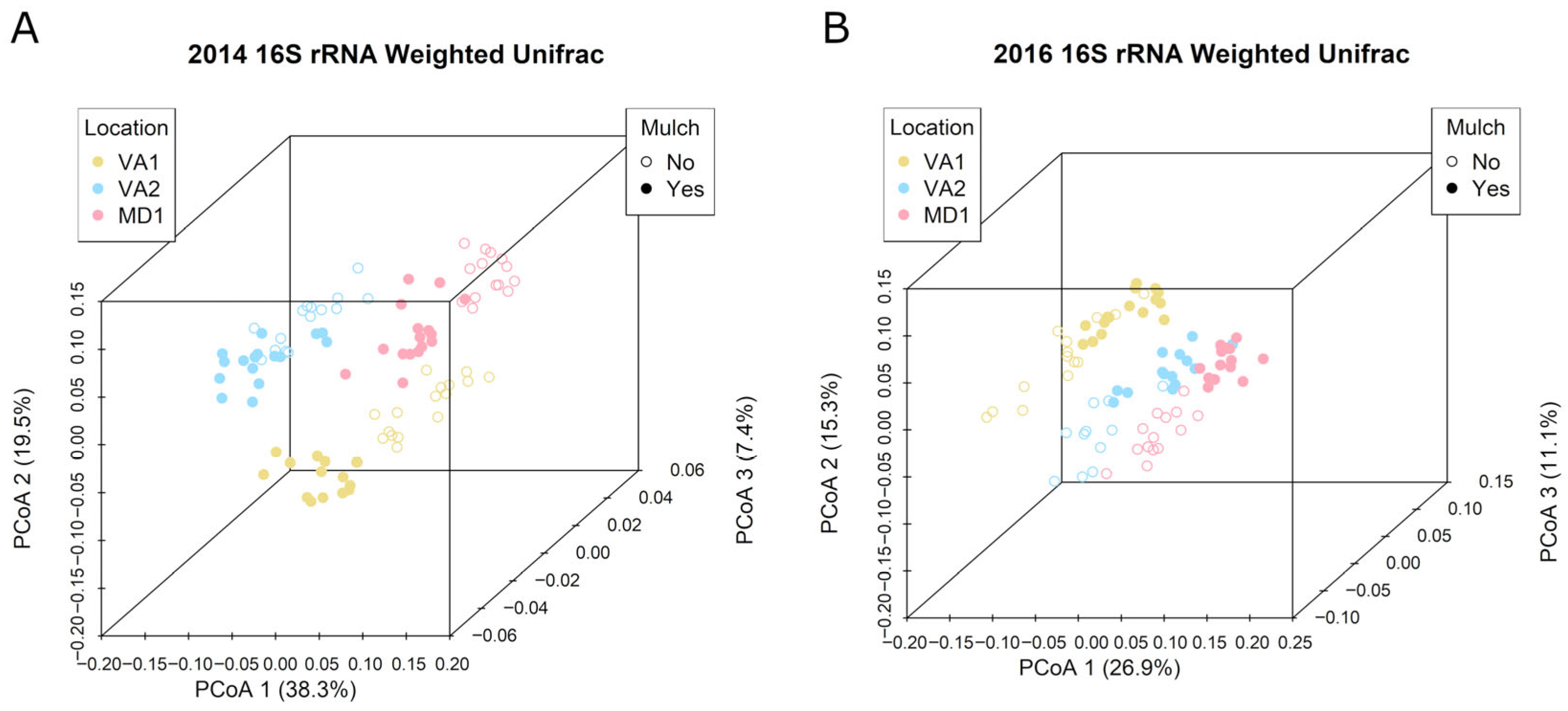
The rootzone bacterial communities of the apple trees were sampled from three orchards in the Mid-Atlantic region. The geographic location of the orchard had a very strong impact on the overall community structure. This was evident by a distinct clustering for each location’s samples (Figure 2). The dissimilarity was particularly strong (ANOSIM R: 0.94) in 2014 (Table 1).
The mulching treatment was the main significant effect observed in this study. All three locations showed significant shifts in the bacterial community structure and composition in response to mulch application. The effect was consistent in both sampling years (Figure 2). There was no effect observed for the fertilizer treatment on the beta diversity for any location in any year. There were few statistically significant interactions of the mulch and fertilizer treatments that were observed (Table 1). This interaction was particularly evident only at the MD1 site in 2016 (ANOSIM R: 0.4, p-value < 0.01). Otherwise, these interactions were generally of low effect and driven by the strong mulch signal.
Distance matrices were generated at the species level to compare the effect of the sampling year since different primer regions were amplified in 2014 and 2016. The bacterial community structure varied significantly between the years (Figure S2). The response of the bacterial communities to the mulch treatment was consistent in both years across all locations, as shown by the non-significant results of beta-dispersion tests.

3.1.2. Fungi

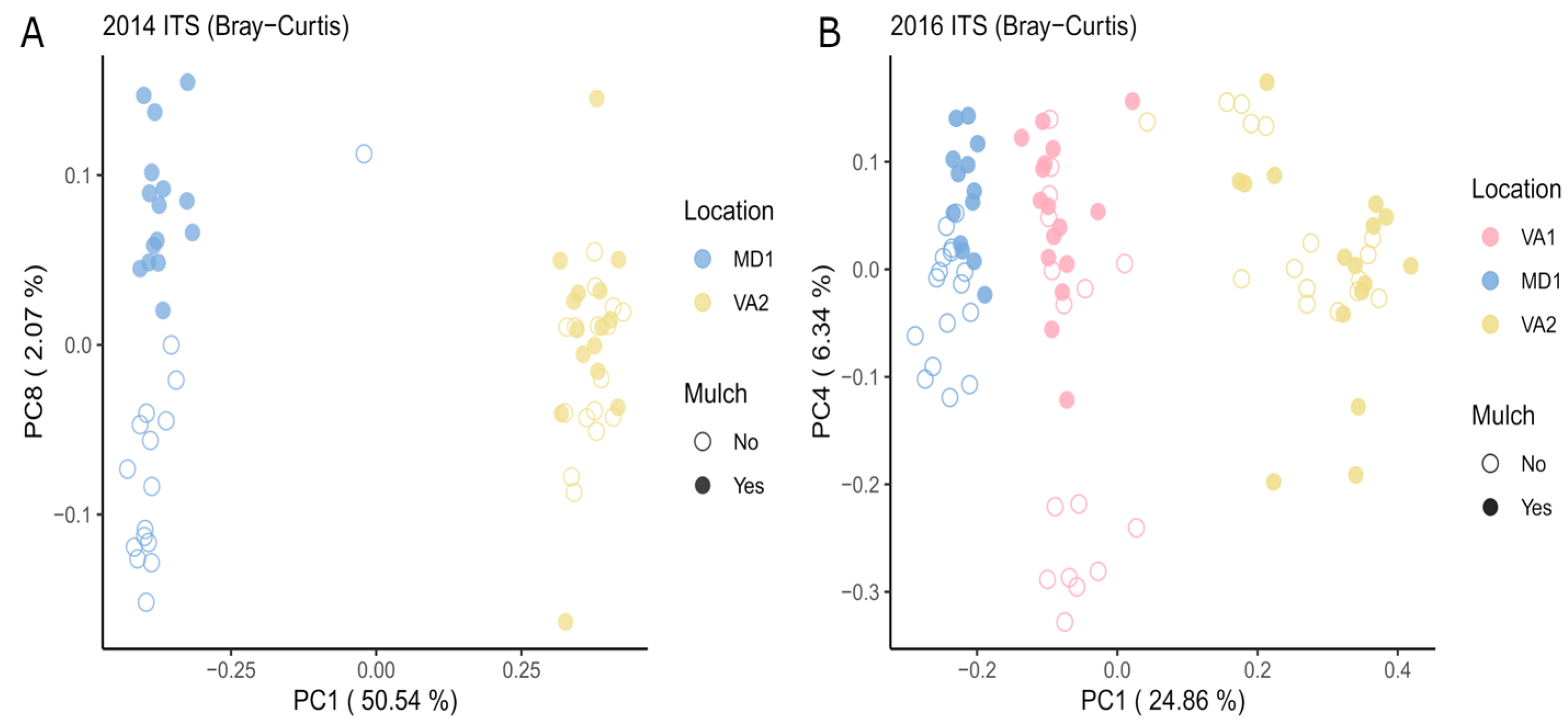
Fungal DNA was obtained from VA2 and MD1 in 2014 and from all three orchards in 2016. Similar to the bacterial communities, geographic location was the predominant distinguishing feature for the fungal communities in both years (Figure 3). Also, the ANOSIM dissimilarity correlation was very strong between both orchards in 2014 (ANOSIM R = 0.99, p-value < 0.001) (Table 1).
Mulch caused a significant change in the fungal community structure at the VA1 and MD1 orchards. However, there was no effect for mulch in the VA2 site in either sampling year (ANOSIM R: 0.02 in both 2014 and 2016). Additionally, the fertilizer treatment did not affect the beta diversity for any site in either year. No interactions existed in any site and any year with the exception of the MD1 orchard in 2016 (ANOSIM R: 0.166, p-value = 0.002). This was also the only instance with a high ANOSIM R for the bacterial communities.
Fungal DNA was sequenced for VA2 and MD1 in 2014, and all three sites in 2016. Community diversity was significantly different among sampling years for each location (Figure 3). There was a greater beta dispersion affect for the fungal community in mulch in 2014 than in 2016 at MD1. This difference was statistically significant between the mulch treatments in 2016 (Figure S3) (Tukey’s HSD adjusted p-value: 0.01).

3.2. Treatment Effect on Microbial Community’s Diversities

3.2.1. Bacteria

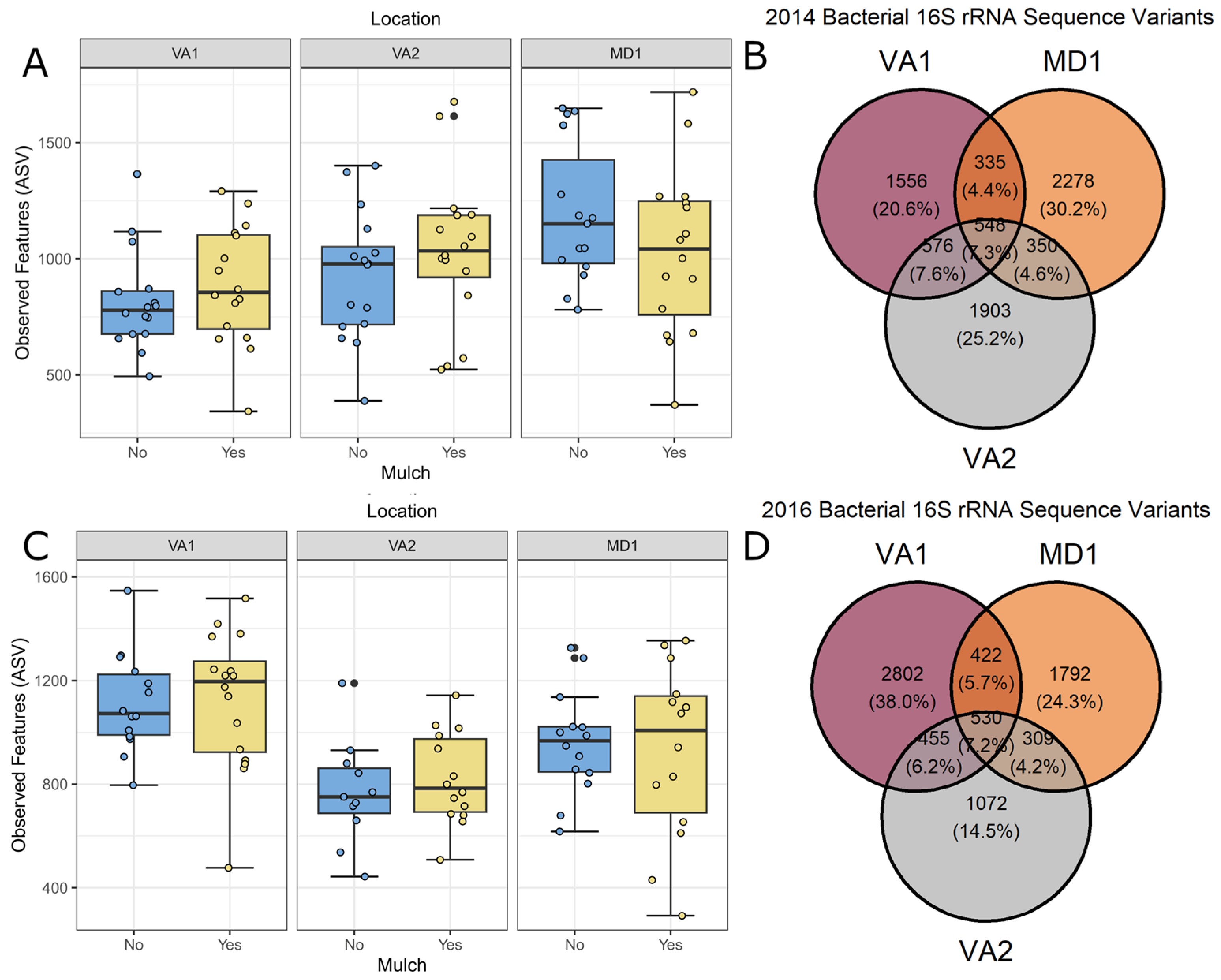
In 2014, sequencing of the 16S rRNA gene yielded 5,110,721 sequences with a mean amplicon length of 179 bp, using only the forward reads set. They were classified into 8302 amplicon sequence variant features (ASV). Approximately 75% were unique to each of the orchards with fewer ASVs shared among the orchards (Figure 4B). Similarly, there was a very significant effect of orchard location (p-value = 0.006) for the alpha diversity richness metric. This was mainly due to the large difference between VA1 and MD1 orchards (Figure 4A). The 2016 16S rRNA gene sequencing resulted in 3,636,959 sequences with a mean length of 245 bp. They were assigned to 7987 ASVs. Likewise, nearly 77% of these ASVs were unique to each of the sites (Figure 4D).
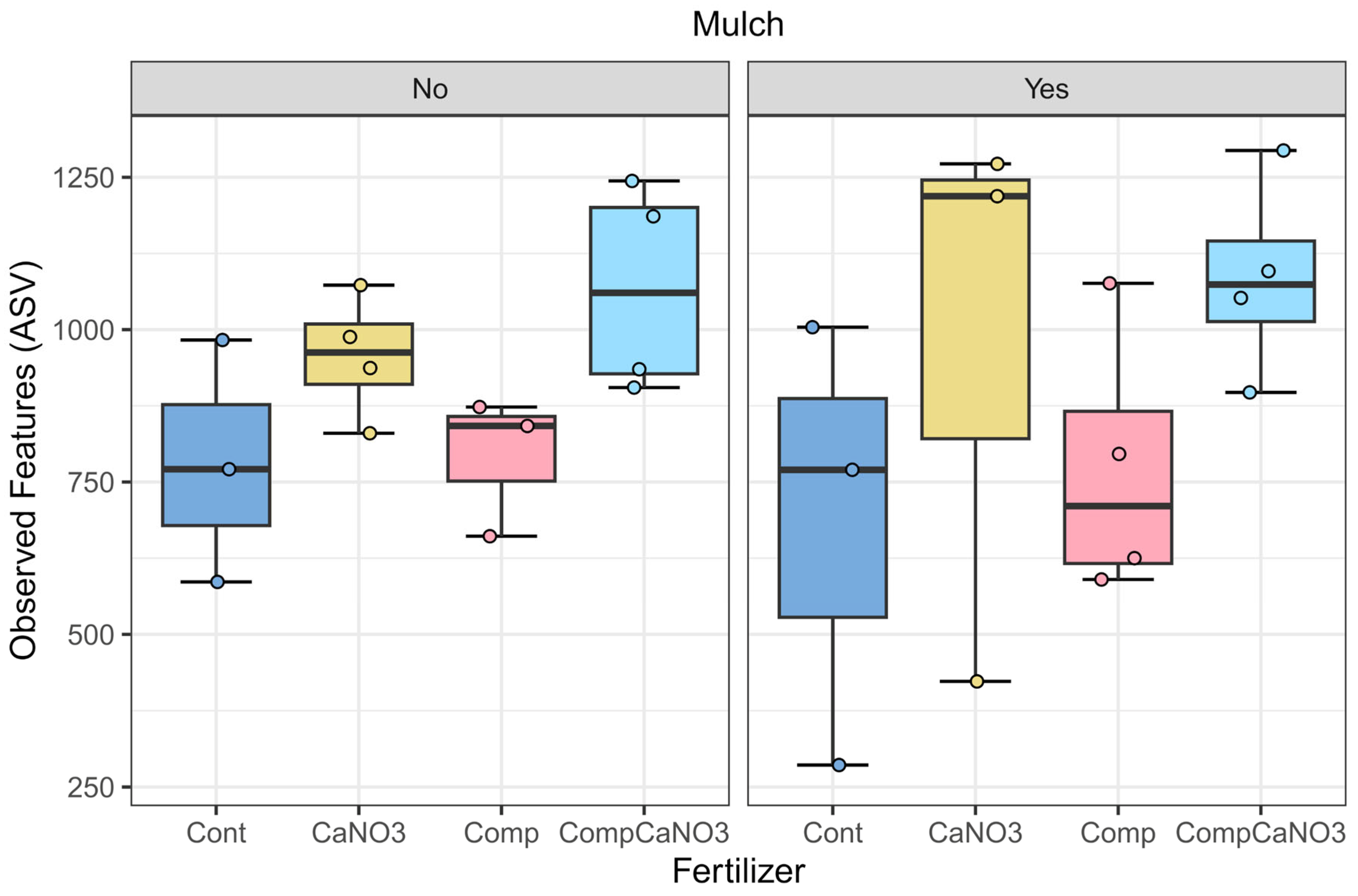
Mulch increased Peilou’s evenness index at VA1 in 2014 (p-value 0.021). Aside from that, mulch had no other effect on any of the alpha diversity metrics for any location in any year (Figure 4A,C). However, the fertilizer treatment was evident on the MD1 site in 2016 as the CaNO3 treatments had a greater faith phylogenetic diversity (p-value: 0.012) and richness (p-value: 0.024) than the control and compost treatments (Figure 5). This effect was consistent regardless of the effect of mulch.

3.2.2. Fungi

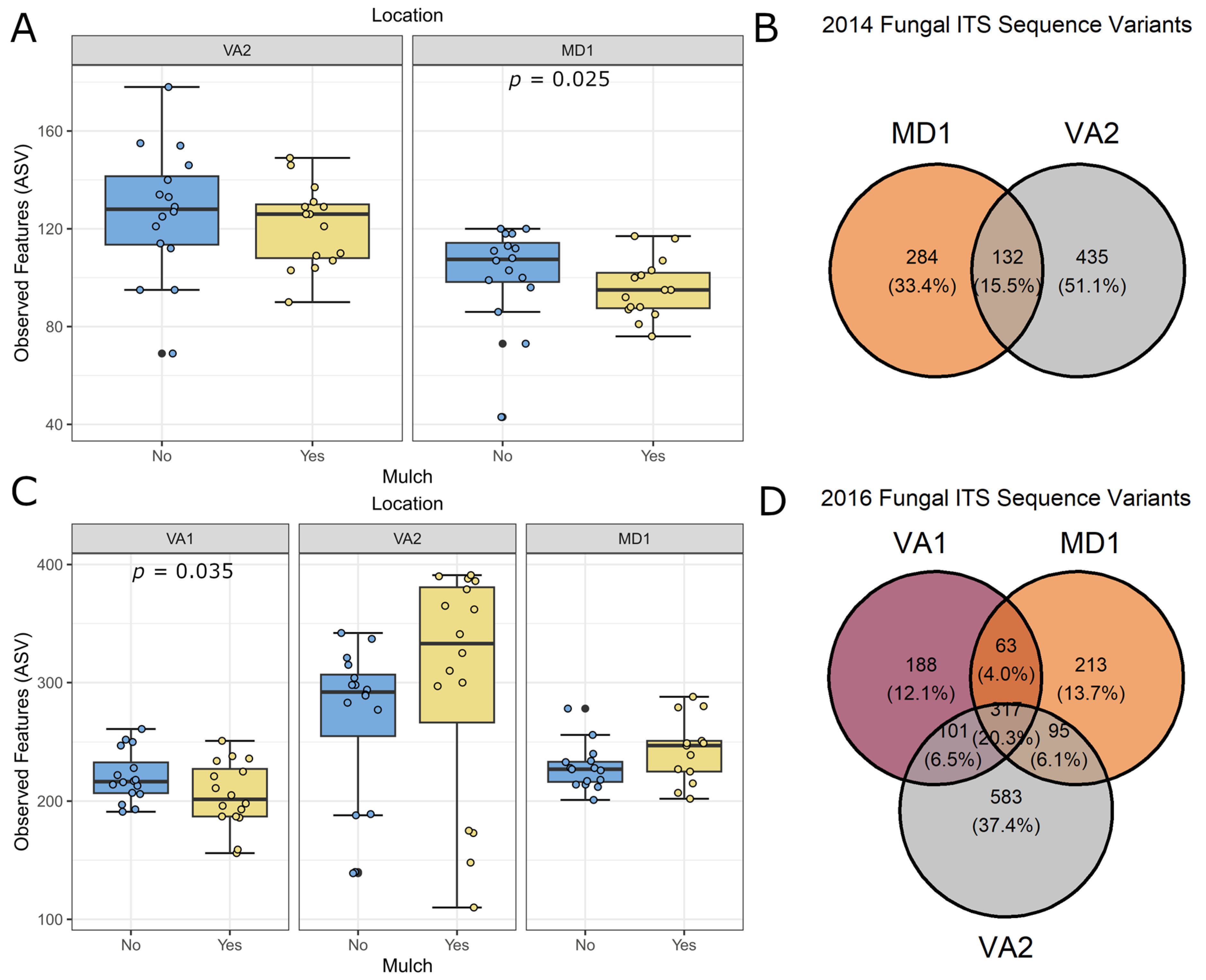
Sequencing of the fungal ITS region in 2014 resulted in 1,324,013 reads that were binned into 877 ASVs. Similar to the bacterial communities, only 15% of these ASVs were shared between both sites, with most unique taxa being limited to VA2 (Figure 6B). Consequently, the difference in richness between both locations was significant (p-value < 0.001). In 2016, the ribosomal ITS region sequencing produced 1,119,287 reads that were classified into 1576 ASVs. More than half of these ASVs were also unique to each orchard, mainly VA2, which accounted for 37% of the unique ASV. This was reflected in a significant location effect on the community richness (p-value = 3.5 × 10⁻⁵) (Figure 6C,D).
In 2014, the addition of mulch suppressed the fungal richness at MD1 (Figure 6A). That effect was not observed in 2016. Also, the addition of mulch reduced the fungal richness of the VA1 site in 2016 (Figure 6C). No effect was observed for fertilizer treatments in any location in either year. Also, neither mulch nor fertilizer affected alpha diversity for VA2 in any year.

3.3. Microbial Community Composition and Taxonomic Profiles

3.3.1. Bacteria

The bacterial community composition reflected some of the similar trends reflected by the alpha and beta diversities. Forty-eight phyla were detected in 2014. The ALDEx2 comparisons revealed that 29 phyla were found to be significantly changing between the different locations. Similarly, in 2016, 43 phyla were reported, of which 32 phyla were found to be significantly changing among locations (Figure S4B). Within each location, mulch was the primary driver for all significant changes in taxa abundance.
In VA1, the most abundant phyla were Proteobacteria (27.3%), followed by Acidobacteria (20.5%), Planctomycetes (11.1%) and Verrucomicrobia (10.2%). Actinobacteria was the fifth most abundant phylum and was significantly changing due to mulch, being reduced from 9.46% to 6.39% (p = 0.004). Additionally, ALDEx2 tests have revealed that the mulch treatment affected the abundances of 21 ASVs belonging to mainly Bacteriodetes and Proteobacteria. Fertilizer applications did not affect any of the bacterial communities. The order of the top abundant phyla changed in 2016. While Proteobacteria (33.3%) and Acidobacteria (22.7%) remained the most abundant phyla, Verrucomicrobia (11.8%) and Bacteroidetes (9.67%) were the third and fourth most abundant, respectively. Five phyla were significantly different under mulch treatment, including Planctomycetes.
In MD1, the top four most abundant phyla were Proteobacteria (30.7%), Acidobacteria (17.0%), Planctomycetes (10.9%), and Actinobacteria (9.9%). Two low-abundant phyla significantly changed in response to the mulch treatment. In 2016, Proteobacteria (38.7%), Acidobacteria (19.1%), and Bacteriodetes (10.9%) were the dominant phyla. Verrucomicrobia (5.9%) and Actinobacteria (5.4%) were the fourth and fifth most abundant phyla, respectively. Fourteen phyla changed significantly in response to the mulch, among which Verrucomicrobia was depleted, and Actinobacteria was enriched.
In 2014, the most abundant bacterial phyla were Proteobacteria (28.3%), Acidobacteria (17.6%), Actinobacteria (13.7%), Verrucomicrobia (8.4%), and Planctomycetes (7.9%) at VA2. Among these, the latter three phyla were significantly lower under the mulch treatment. Actinobacteria was reduced from 15.2% to 12.3%, Verrumicrobia from 8.79% to 8.07%, and Planctomycetes from 8.2% to 7.7%. In 2016, the top two abundant phyla remained the same as in 2014, with Proteobacteria accounting for 34.1% and Acidobacteria for 21.4%. Verrucomicrobia (11.9%), Bacteriodetes (8.3%), and Actinobacteria (8.2%) were the third through fifth most abundant phyla. Actinobacteria, Verrumicrobia, and Planctomycetes have still shown downward trends similar to what was observed in 2014 without being statistically significant. However, Cyanobacteria was always significantly repressed in response to mulch in most treatments.
At the class level, top abundant taxa followed their parent phyla (Figure S5). However, several taxa showed consistent and statistically significant responses to mulch treatment based on ALDEx2 analyses. In particular, the Bacteroidetes classes Cytophagia and Flavobacteria increased significantly under mulch. In 2014, Cytophagia increased from 1.29% to 2.31%, 0.77% to 1.55%, and 0.91% to 1.30% at MD1, VA1, and VA2, respectively. Similarly, Flavobacteria increased from 0.32% to 0.90%, 0.26% to 0.76%, and 0.12% to 0.26% across these orchards. Identical patterns were observed in 2016. Cytophagia increased from 2.97% to 4.85% at MD1, 1.09% to 1.55% at VA1, and 1.09% to 1.86% at VA2, while Flavobacteria increased from 0.41% to 0.75%, 0.19% to 0.62%, and 0.05% to 0.26% at the respective orchards.

3.3.2. Fungi

As observed with the bacterial community, overall, the fungal communities also reflected the trends observed in the beta-diversities. Given the nature of the soil fungal community makeup, just 13 phyla were observed at the three sites in both 2014 and 2016 (Figure S4C,D). In 2014, using ALDEx2, changes in five phyla were significantly different between VA2 and MD1, including the top three abundant phyla accounting for 90% of the total community abundance, in addition to Glomeromycota and lowly abundant Olipidiomycota (Figure S4C). In 2016, the top three abundant phyla accounted for 97% of the total abundance. However, changes in six phyla were statistically significant between the three locations, including Glomeromycota and other very lowly abundant phyla.
The top abundant phyla were Mortierellomycota (54.1%), Ascomycota (30.8%), Basidiomycota (11.3%) and Glomeromycota (2.2%). Only the less abundant Chytridiomycota changed significantly in response to mulching, being suppressed from 0.6% to 0.1%. Glomeromycota also increased from 1.8% to 2.6%, although it was not statistically significant.
For VA2, in 2014, the top abundant phyla were Basidiomycota (45.6%), Mortierellomycota (32.4%), Ascomycota (10.3%), Rozellomycota (5.5%) and Glomeromycota (4.1%). Only the low-abundance Chytridiomycota was significantly different in response to the mulch treatment, being reduced from 2.75% to 0.85%. Additionally, Glomeromycota increased from 3.4% to 4.8% in response to mulch, but that change was not statistically significant. In 2016, just Mortierellomycota (40.2%), Ascomycota (38.3%), and Basidiomycota (19.2%) were the top abundant phyla, but none were significantly changing.
The MD1 orchard in 2014 was dominated by Mortierellomycota (58.3%), followed by Ascomycota (22.7%), Basidiomycota (10.9%), Rozellomycota (3.9%), and Chytridiomycota (3.5%). As with VA1 and VA2, Chytridiomycota was the only fungal phylum with a significant change under the mulch treatment, being reduced from 5.8% to 1.2%. In 2016, the most abundant phylum was Mortierellomycota (44.5%), followed by Ascomycota (41.8%) and Basidiomycota (11.0%). Under the mulch treatment, Chytridiomycota was reduced from 1.6% to 0.1%. In addition, three phyla increased under the mulch treatment, with Basidiomycota increasing from 6.9% to 16.0%, Glomeromycota from 0.76% to 1.07%, and the other lowly abundant Rozellomycota as well, from 0.38% to 0.54%.

3.4. Mulch Effect on Potential Fungal Pathogens

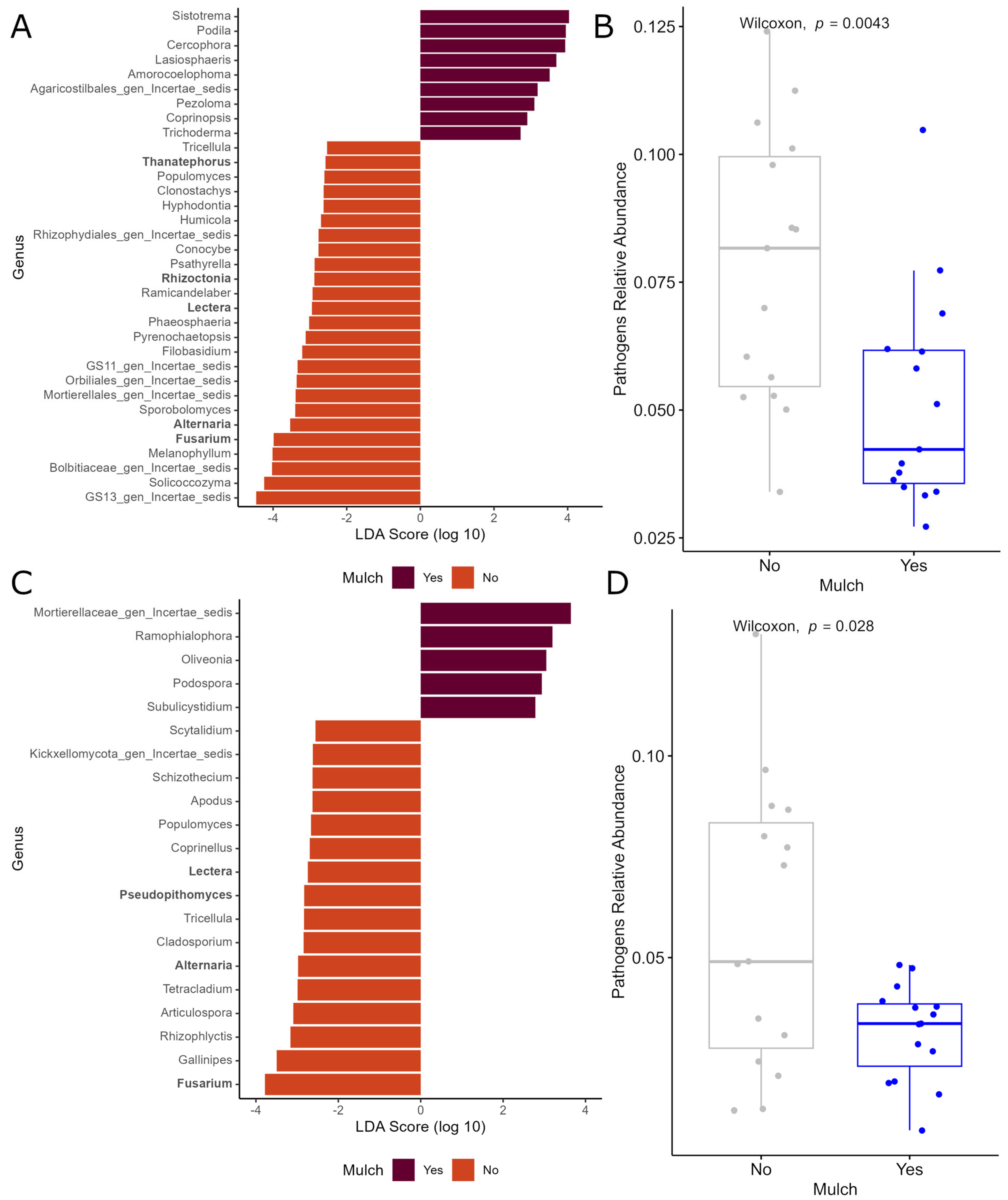
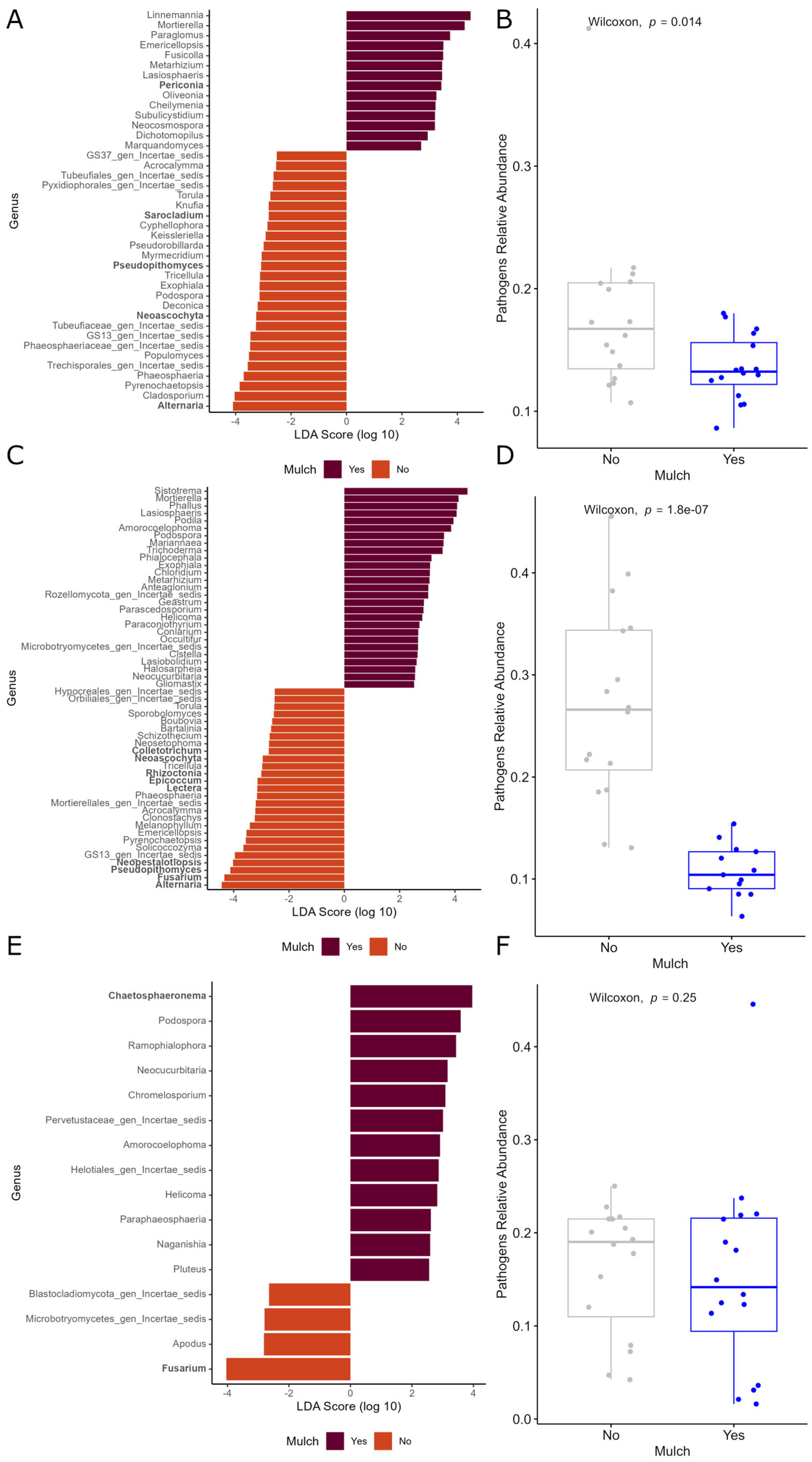
LEfSe analysis was conducted on the fungal genera to identify taxa associated with the mulch treatment. In 2014, more taxa of Fungi were found in the plots without the mulch, but there were also more potential plant pathogens in these plots (Figure 7). Fusarium and Alternaria were always associated with the no mulch treatment and observed in all sites in both years. In 2014, for the MD1 site, Alternaria changed from 0.68% to 0.26%, Fusarium from 6.72% to 4.77%, and Rhizoctonia from 0.21% to 0.02%. At VA2, Alternaria and Fusarium were reduced from 0.14% to 0.10% and 1.46% to 1.1%, respectively. Mulch treatment produced similar trends in 2016 (Figure 8). In MD1, Alternaria was reduced from 6.23% to 2.17% and Fusarium went down from 13.99 to 8.86%. Alternaria was reduced from 3.63% to 1.50% at VA1, and Fusarium was reduced from 6.59% to 5.27% at VA2, passing the threshold for LEfSe. While most potentially pathogenic fungi were associated with the no mulch treatment, the saprotrophic and potentially pathogenic Chaetosphaeronema was observed in the mulch treatment in the VA2 orchard in 2016 (Figure 8). The differential abundance of all combined potential plant pathogens was tested to gain further insights into the association of diseases with the mulch treatment. Again, all sites in both years were found to have a significant suppression of pathogenic groups in the mulch treatment compared to the no mulch (Figure 7B,D). Similarly, VA2 in 2016 was the exception where the abundance of pathogens was relatively similar between both mulch treatments (Figure 8F). Some of these potentially plant-pathogenic genera are implicated in apple replant disease, such as Rhizoctonia (Figure 7A and Figure 8C) [49].

3.5. Correlation of Soil and Leaf Parameters to Changes in the Microbial Communities

Several soil and leaf physicochemical metrics and nutrients showed a variety of significant changes in response to the main treatments at various locations for both years (Tables S10–S15 and S22–S27). These changes were correlated and fitted to the changes in the different microbial communities’ structures and assemblages (Figures S6–S9). Mantel tests were used to assess the correlation between these changes and the responses of both the bacterial and fungal communities (Table 2).

3.5.1. Bacteria

Weak correlations were observed between the soil parameters and the bacterial communities in 2014 for all sites. The correlations were only statistically significant for VA1 (Mantel R 0.19, p-value = 0.048). This was due to a significant correlation between iron, manganese, and potassium with the mulch treatment (Figure S6A). In 2016, the Mantel correlations increased, especially at MD1 and VA2 where there were no correlations in 2014, which increased to a Mantel R of 0.20 in 2016. Different soil nutrients were associated with each mulch treatment, specifically higher soil organic matter and active carbon were consistently associated with the mulch treatment (Figure S6D–F). In VA1, pH was significantly associated with the mulch treatment. On the other hand, zinc was always higher in the no mulch treatment at all sites and was more significant at VA1 and MD1.
Similar correlation patterns were observed for the leaf mineral content parameters and the bacterial communities with weaker correlations in 2014 and stronger correlations later in 2016. The main exception was the VA1 site which had a stronger correlation between the bacterial communities and leaf nutrients in 2014, but that was reversed in 2016. Both VA2 and MD1 had a stronger correlation in 2016 compared to 2014, especially at MD, which had a Mantel R of 0.46 (p = 0.001) compared to 0.15 in 2014 (Table 2).
While significantly greater in 2016, the correlations of changes in leaf mineral content to the bacterial communities responded differently in each location to the mulch treatment. Mainly, increases in potassium and phosphorus were associated with the responses of the bacterial communities in all three orchards, though potassium had a significant loading, but not phosphorus, at MD1, with the reverse being true at VA2 and VA1. On the other hand, leaf magnesium was significantly correlated with the no mulch treatment at MD1 while it was correlated with the addition of mulch at VA1 (Figure S7).

3.5.2. Fungi

Very weak or no correlations were found between changes in soil and leaf parameters and the fungal communities in either 2014 or 2016. The only exception was the MD1 site in 2016 when the soil parameters had a much stronger correlation with the changes in fungal communities (Mantel R: 0.489, p-value: 0.002) and leaf nutrients had a weaker but significant relation, as well (Mantel R: 0.201, p-value 0.01). Active carbon in the soil was found to correlate with the mulch treatment (Figure S8E). Greater leaf potassium and boron were correlated with the mulch-associated fungal communities in 2016 (Figure S9E).

3.6. Treatment Effects on Tree Growth and Microbial Communities

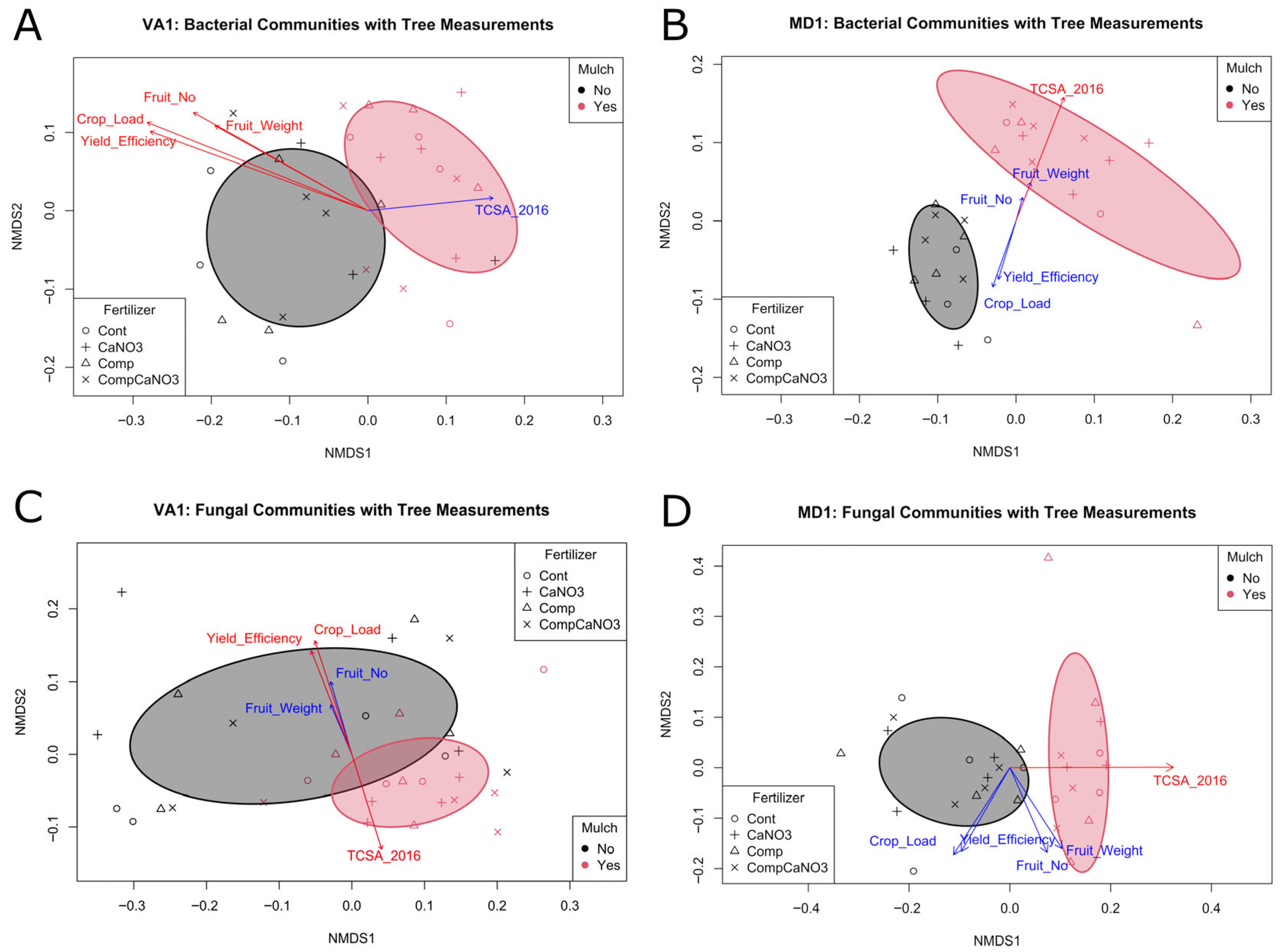
To gain preliminary insights into the effect of treatments on the correlations of changes in microbial communities and tree growth, some physical tree and agronomic parameters in the third year were assessed in relation to both microbial communities. The most consistent result was a consistent and generally significant correlation between a larger trunk cross-sectional area (TCSA) and both mulch-associated responses in the bacterial and fungal communities in the soil (Figure 9). Generally, a higher TCSA was associated with mulch treatment with an overall average increase of 33.5%. This ranged from an increase of 26.8% at MD1 (p-value = 0.051), 29.9% at VA2 (p-value = 0.011), to 37.4% at VA1 (p-value = 0.008) (Tables S2–S4).

4. Discussion

The main hypothesis of the study was that mulch cover and fertilizer treatments would affect the below-ground soil microbiome in newly planted apple orchards. We aimed to determine if microbiome changes would be detectable and if patterns remained consistent across years and multiple study locations. The addition of high organic matter amendments was expected to positively affect apple growth and, over time, soil–plant nutrients. Results generally supported the hypotheses linking changes in plant, microbiome, and soil properties for the main mulch amendments, but with fewer effects from synthetic fertilizer amendments. Compared to the mycobiome, the bacteriome showed the most pronounced and consistent responses across treatments and years. LEfSe analysis, however, revealed fungal genera like Fusarium and Alternaria, often associated with soil-borne root diseases, declined in abundance in response to mulch amendment across years. The question remains whether the decline in pathogenic fungal abundance was related to direct mulch effects on the soil abiotic environment or related to favorable changes that enhanced non-pathogenic microbes suppressing pathogenic ones. Overall, commercial orchards benefited from organic mulches by altering root-zone microbiomes, soil health, and plant productivity in the early establishment years.
While these results provide valuable insights into how organic mulch amendments and integrated management strategies positively influence soil microbial communities and above-ground tree growth, a few experimental design limitations should be considered in interpreting the results. First, different 16S rRNA regions were used in assessing the bacterial communities, where the 2014 samples were limited to the V3 region, and the 2016 samples were based on the V4 region (see Methods). This may influence the taxonomic resolution as V4–V5 may amplify more Planctomycetes [50]. However, the consistency of observed patterns across the years, such as the increase in Bacteriodetes in response to mulch, supports the results. Second, the observed reduction in potential pathogenic fungal genera needs to be followed up with the respective functional assay to confirm it, as assessing disease incidence is not part of the study design. Finally, as with other similar microbial ecology studies, the nature of the compositional data of the sequenced marker amplicons reflects a community structure rather than an absolute abundance and population size. Nevertheless, the results offer novel insights into not only understanding how soil microbiomes respond to management practices, but also the sustainable establishment of apple orchards.

4.1. Mulch-Associated Microbiome Changes Reflect Positively on Tree Size and Nutrient Provisioning

Greater tree growth (TCSA) due to woodchip mulch amendments that were associated with the dynamic change in bacteriome and mycobiome (Figure 9) assembly suggests a possible link between microbiome structure and tree health and productivity. Other studies have also shown similar relationships between soil and root microbiomes and greater health of vegetation [51,52,53]. It is well known that soil microbiomes and their members can cause disease as well as offer growth promotion to plants sharing the same habitat, but ecological shifts in microbiome structure, where alterations in the abundances and types of multiple microbes co-occur, have not been clearly tied to plant productivity and health.
Several studies have documented the nutrient-provisioning effects of organic amendments like those from woodchips, and thus provide parsimonious explanations for changes in tree growth [54,55]. However, the high C:N ratio of wood chip mulch has just as much potential to limit nutrient availability, at least temporarily, and thus reduce the likelihood that the mulch itself was a major and direct supplier of nutrients that supported greater apple productivity in the absence of microbial community change. This logically suggests that the impact of the mulch created an indirect change to the system that likely altered the ecological functioning and cycling of nutrients tied to root–soil microbiome dynamics. Notably, apple productivity was less affected by inorganic nutrient amendments, indicating that the organic mulch may promote productivity not solely through nutrient supply but also through its influence on microbiome dynamics. This raises the possibility that specific microbiome structures induced by organic amendments could play a functional role in enhancing tree growth and yield, beyond what is achievable through nutrient supplementation alone [51,52,53]. Flavobacteria and Cytophaga, for example, were always enriched in response to mulch across locations and years, possibly related to their active roles in lignocellulose degradation and decomposition of plant litter [56,57,58]. They are also known to have a role in organic matter turnover and in utilizing complex carbon, such as that provided by the organic mulch and in the apple rhizosphere [59,60,61]. The consistent enrichment of these groups across all locations indicates a strong ecological signal and highlights a potential link between bacterial community shifts and improved tree growth under mulch amendments.

4.2. Mycobiome Change Varied but Fungal Patho-Genera Were Consistently Reduced Across All Orchards

The mycobiome also reflected a strong influence of the mulch amendments, but unlike the bacteriome, it was more variable across the orchards. Hence, location-derived changes, such as the initial site-specific mycobiomes, soil type and climate differences across different seasons, are important factors for consideration in management of soil root-zone mycobiomes. This variation across location–years in mycobiomes agrees in part with previous studies of apples, in commercial orchards and wild apple forests [17,62,63]. Glomeromycota, which comprise the arbuscular mycorrhizal fungi (AMF), are mostly plant symbionts. AMF are known to improve plant acquisition of nitrogen, phosphorus, and improve plant resilience in drought conditions, which is a desirable trait in early tree establishment [64,65]. Organic management and reduction in fertilizer application may sustain diverse AMF communities in apple orchards [66]. However, this is more dependent on soil conditions and nutrient availability, which, if lacking, may lead to competition with the plant and suppress its growth [67]. Thus, these observed increases are unlikely to reflect a direct inoculation by mulch inputs but rather indirect improvements in soil conditions and microbial processes that support this increase, which eventually reflects on the above-ground tree growth.
Unlike the variability observed on the overall mycobiome, mulch amendments consistently reduced the relative abundance of several genera commonly associated with disease. The genera Alternaria and Fusarium both contain common plant- and apple-related pathogens. These disease-causing genera were reduced in abundance in response to mulch, even where a general mycobiome effect was not observed (Figure 8D–F). The disease suppression ability of organic matter inputs typically varies by the type of amendment used and the range of pathogens targeted [68]. Organic mulches, including straw used as ground cover in apple orchards, were related to suppressed apple scab disease, which is hypothesized to be the result of the decomposition of disease-harboring leaf litter [69]. This was achieved through increasing the abundance of other soil organisms and an increase in soil active carbon. The active soil carbon pool is derived from greater microbial respiration, which supports the notion that heterotrophic microbial activity negatively influences disease-causing genera like those of Alternaria, which are commonly found in the global core apple mycobiome [70]. Other possible mechanisms for mulch effects on pathogens are through the disruption of overwintering of these microbes in leaf residues, which are removed through microbial decomposition [71]. Another possible mechanism can emanate from microbiome changes due to mulch-suppressing fungal pathogens, like Fusarium [72].
Bacteria and fungi often occupy different niches in the soil but both are often plant-associated and produce antifungal metabolites [73,74]. Organic amendments improve plant health by encouraging the growth of these organisms, whether through plant-influenced recruitment, or improving the soil conditions conducive to their growth. Taking all these possibilities into consideration, reductions in disease-causing plant fungi by organic mulch amendments thus has great promise for reducing disease in apple orchards. However, controlled ecological studies are needed to clearly show whether mulches and which types of mulch provide sustainable nutrient provisioning and disease control in orchard systems.

4.3. Limited Effects of Synthetic Inorganic Fertilizer on Orchard System

In contrast with mulch, synthetic inorganic fertilizers played a relatively minor and inconsistent role in shaping soil microbial community structure and promoting tree growth. Both beta-diversity and alpha-diversity metrics show insignificant differences across treatments. A minor exception was noted in treatments involving calcium nitrate. The effect was only for a single orchard in one year. Calcium nitrate has been linked to soil organic carbon persistence in soil through multiple mechanisms and may facilitate the turnover of plant litter and its incorporation into microbial biomass [75]. Long-term use of inorganic fertilizers, while initially boosting plant yields, is detrimental to soil health, fertility, and ultimately to the plants through decreased soil microbial diversity and soil quality [76,77]. The detrimental effects on plants are multifarious, but often involve disrupting the plant–rhizosphere feedback, whereby rhizosphere organisms respond less to plant exudates when high levels of inorganic fertilizers are used [78]. Inorganic fertilizers most often maintain or enhance productivity in the short term, but the plant–soil–microbial feedback breaks down and has negative consequences for sustainable cropping [13]. Organic matter-based fertilizers, in contrast, change the organism community structure while increasing microbial richness and evenness that have been linked to increased crop yields [79].
The weak microbiome response to fertilizer treatments parallels the minimal effects these inputs have on tree growth. Synthetic fertilizers typically supply readily available nutrients but do not contribute organic carbon or substantially modify soil physical conditions [77]. As a result, the chemical changes synthetic fertilizers induce are relatively small and transient, which may explain why they did not produce measurable or consistent shifts in soil microbial communities. In contrast, organic mulch inputs alter multiple soil properties simultaneously—carbon availability, moisture, temperature, and nutrient cycling—which likely underpins their stronger and more repeatable effects on microbiome structure.

4.4. Location Effect and Recommendation of Use

The effect of orchard location had the strongest effect on shaping both bacterial and fungal communities than either mulch or the fertilizer treatment. This outcome highlights natural variation in ecosystems, underpinning the challenges in using natural organic amendments to manage soils and microbiomes in apple orchard systems. The distinct microbiomes reflect different soil types and different climate and management legacies that change how the system responds to new management. Spatial variability across apple orchards, including the native apple-growing regions, changes bacteriomes in ways that may lead to better understanding of how to manage them [80]. This would also require understanding the factors such as rainfall amounts and annual distributions that affect tree growth and the rates of mulch degradation [81,82]. While mulch has not likely provided biologically relevant levels of new soil nutrients, it affects the microbial processes interacting in the soil and feeding-back above-ground to the plants. Adjusting management based on factors such as mulch and nutrient inputs through integrating a site-appropriate recommendation remains unwieldy and may itself change by season [83]. Despite variability across season and location, the strong signal indicating consistent microbiome change connected to hypothesized pathogen suppression indicates the potential for natural wood-based organic matter amendments to replace non-sustainable use of synthetic inorganic fertilizers in high-density apple orchards.

5. Conclusions

The outcomes of this regional-scale field experiment demonstrate that organic mulches can be a successful strategy in the sustainable establishment of apple orchards. Both bacterial and fungal communities showed changes that differed by location; however, consistent signals were enhanced abundance of Flavobacteria and Cytophaga and decreased abundances of general soil-borne fungal pathogens, suggesting the potential for disease reduction. The reasons underlying these responses remain unclear but support the long-running hypotheses about the benefits of using slowly decomposable organic-based fertilizers and their ability to shape positive microbial and ecosystem ecology. Longer-term studies are needed to assess if the management practice benefits are maintained as the orchard system matures, and whether other outcomes are manifested, including sustainable soil processes that sequester carbon and recycle bioavailable plant nutrients. While the study was conducted in the Mid-Atlantic region, these results are relevant for apple growers in other parts of the United States and the world.

Supplementary Materials

The following supporting information can be downloaded at: https://www.mdpi.com/article/10.3390/agronomy16070762/s1, Figure S1: Treatment list and field maps depicting the experimental design at each location; Figure S2: Ordination highlights the effect of mulch and growing season on the beta-diversity of bacterial communities at (A) VA1, (B) VA2 and (C) MD1; Figure S3: Ordination highlights the effect of mulch and growing season on the beta-diversity of fungal communities at (A) VA2 and (B) MD1; Figure S4: Taxonomy summary of the showing top relative abundance of the top 10 phyla in 2014 and 2016 of the bacterial communities (A,B) and fungal communities (C,D) across orchards in response to the mulch treatment; Figure S5: Taxonomy summary of the showing top relative abundance of the top 15 classes in (A) 2014 and (B) 2016 bacterial communities across orchards in response to the mulch treatment; Figure S6: Non-metric multidimensional scaling (NMDS) of the Unweighted Unifrac distances of the bacterial communities and their relationship to soil parameters; Figure S7: Non-metric multidimensional scaling (NMDS) of the unweighted UniFrac distances of the bacterial communities and their relationship to leaf nutrients; Figure S8: Non-metric multidimensional scaling (NMDS) of the Bray-Curtis distances of the fungal communities and their relationship to soil parameters; Figure S9: Non-metric multidimensional scaling (NMDS) of the Bray-Curtis distances of the fungal communities and their relationship to leaf nutrients. Table S1: The carbon (C):nitrogen (N) ratio, organic matter (OM), total C, organic N, ammonium (NH4-N), nitrate (NO3-N), phosphorous (P), and potassium (K) content of the composts as measured from a single homogenized sample in 2014 prior to application; Table S2: Trunk cross-sectional area (TCSA) at VA1; Table S3: Trunk cross-sectional area (TCSA) at MD1; Table S4: Trunk cross-sectional area (TCSA) at VA2; Table S5: 2016 fruit yields at VA1; Table S6: 2016 fruit yields at MD1; Table S7: Summer 2014 soil analysis results at VA1; Table S8: Summer 2014 soil analysis results at MD1; Table S9: Summer 2014 soil analysis results at VA2; Table S10: Fall 2014 soil analysis results at VA1; Table S11: Fall 2014 soil analysis results at MD1; Table S12: Fall 2014 soil analysis results at VA2; Table S13: 2014 foliar analysis results at VA1; Table S14: 2014 foliar analysis results at MD1; Table S15: 2014 foliar analysis results at VA2; Table S16: 2015 soil analysis results at VA1; Table S17: 2015 soil analysis results at MD1; Table S18: 2015 soil analysis results at VA2; Table S19: 2015 foliar analysis results at VA1; Table S20: 2015 foliar analysis results at MD1; Table S21: 2015 foliar analysis results at VA2; Table S22: 2016 soil analysis results at VA1; Table S23: 2016 soil analysis results at MD1; Table S24: 2016 soil analysis results at VA2; Table S25: 2016 foliar analysis results at VA1; Table S26: 2016 foliar analysis results at MD1; Table S27: 2016 foliar analysis results at VA2.

Author Contributions

Conceptualization, H.S., M.W. and G.P.; methodology, H.S., M.W. and G.P.; validation, H.S., M.W. and G.P.; formal analysis, H.S., M.W. and G.P.; investigation, H.S., M.W. and G.P.; resources, M.W. and G.P.; data curation, H.S., M.W. and G.P.; writing—original draft preparation, H.S., M.W. and G.P.; writing—review and editing, H.S., M.W. and G.P.; visualization, H.S.; supervision, M.W. and G.P.; project administration, M.W. and G.P.; funding acquisition, M.W. and G.P. All authors have read and agreed to the published version of the manuscript.

Funding

Funding was received from the USDA-Sustainable Agriculture Research and Education program (project number LS13-258).

Data Availability Statement

The data presented in this study are openly available in the NCBI Short Read archive under project access PRJNA1425275.

Acknowledgments

Field and lab assistance provided by Mike Brown, Cody Kiefer, Abby Kowalski, Simmone Landau, and Ashley Thompson. Soil-sample processing and DNA library preparations were prepared by Jude Moon, Deepak Poudel, Chelsea Cereghino, and Kerri Mills.

Conflicts of Interest

The authors declare no conflicts of interest.

References

  1. Ho, S.-T.; Gonzalez Nieto, L.; Rickard, B.J.; Reig, G.; Lordan, J.; Lawrence, B.T.; Fazio, G.; Hoying, S.A.; Fargione, M.J.; Sazo, M.M.; et al. Effects of Cultivar, Planting Density and Rootstock on Long-Term Economic Performance of Apple Orchards in the Northeastern U.S. Sci. Hortic. 2024, 332, 113194. [Google Scholar] [CrossRef]
  2. Weber, M.S. Optimizing the Tree Density in Apple Orchards on Dwarf Rootstocks. Acta Hortic. 2001, 557, 229–234. [Google Scholar] [CrossRef]
  3. Jiang, X.; He, L. Investigation of Effective Irrigation Strategies for High-Density Apple Orchards in Pennsylvania. Agronomy 2021, 11, 732. [Google Scholar] [CrossRef]
  4. Reig, G.; Lordan, J.; Fazio, G.; Grusak, M.A.; Hoying, S.; Cheng, L.; Francescatto, P.; Robinson, T. Horticultural Performance and Elemental Nutrient Concentrations on ‘Fuji’ Grafted on Apple Rootstocks under New York State Climatic Conditions. Sci. Hortic. 2018, 227, 22–37. [Google Scholar] [CrossRef]
  5. Thompson, A.A.; Williams, M.A.; Peck, G.M. Compost and Geneva® Series Rootstocks Increase Young ‘Gala’ Apple Tree Growth and Change Root-Zone Microbial Communities. Sci. Hortic. 2019, 256, 108573. [Google Scholar] [CrossRef]
  6. Thompson, A.A.; Peck, G.M. Alternative Fertility Management for Establishing New Apple Orchards in the Mid-Atlantic. HortScience 2017, 52, 1313–1319. [Google Scholar] [CrossRef]
  7. Mulvaney, R.L.; Khan, S.A.; Ellsworth, T.R. Synthetic Nitrogen Fertilizers Deplete Soil Nitrogen: A Global Dilemma for Sustainable Cereal Production. J. Environ. Qual. 2009, 38, 2295–2314. [Google Scholar] [CrossRef]
  8. Bastida, F.; Eldridge, D.J.; García, C.; Kenny Png, G.; Bardgett, R.D.; Delgado-Baquerizo, M. Soil Microbial Diversity–Biomass Relationships Are Driven by Soil Carbon Content across Global Biomes. ISME J. 2021, 15, 2081–2091. [Google Scholar] [CrossRef]
  9. Sabir, M.S.; Shahzadi, F.; Ali, F.; Shakeela, Q.; Niaz, Z.; Ahmed, S. Comparative Effect of Fertilization Practices on Soil Microbial Diversity and Activity: An Overview. Curr. Microbiol. 2021, 78, 3644–3655. [Google Scholar] [CrossRef]
  10. Liao, Y.; Cao, H.-X.; Liu, X.; Li, H.-T.; Hu, Q.-Y.; Xue, W.-K. By Increasing Infiltration and Reducing Evaporation, Mulching Can Improve the Soil Water Environment and Apple Yield of Orchards in Semiarid Areas. Agric. Water Manag. 2021, 253, 106936. [Google Scholar] [CrossRef]
  11. Wang, M.; Liu, Z.; Zhai, B.; Zhu, Y.; Xu, X. Long-Term Straw Mulch Underpins Crop Yield and Improves Soil Quality More Efficiently than Plastic Mulch in Different Maize and Wheat Systems. Field Crops Res. 2023, 300, 109003. [Google Scholar] [CrossRef]
  12. Song, J.; Zhang, D.; Wang, C.; Song, J.; Haider, S.; Chang, S.; Shi, X.; Bai, J.; Hao, J.; Yang, G.; et al. Enhancing Soybean Yield Stability and Soil Health through Long-Term Mulching Strategies: Insights from a 13-Year Study. Eur. J. Agron. 2024, 161, 127383. [Google Scholar] [CrossRef]
  13. Sharaf, H.; Thompson, A.A.; Williams, M.A.; Peck, G.M. Compost Applications Increase Bacterial Community Diversity in the Apple Rhizosphere. Soil Sci. Soc. Am. J. 2021, 85, 1105–1121. [Google Scholar] [CrossRef]
  14. Zhu, Z.; Bai, Y.; Lv, M.; Tian, G.; Zhang, X.; Li, L.; Jiang, Y.; Ge, S. Soil Fertility, Microbial Biomass, and Microbial Functional Diversity Responses to Four Years Fertilization in an Apple Orchard in North China. Hortic. Plant J. 2020, 6, 223–230. [Google Scholar] [CrossRef]
  15. Pérez-Guzmán, L.; Phillips, L.A.; Seuradge, B.J.; Agomoh, I.; Drury, C.F.; Acosta-Martínez, V. An Evaluation of Biological Soil Health Indicators in Four Long-Term Continuous Agroecosystems in Canada. Agrosyst. Geosci. Environ. 2021, 4, e20164. [Google Scholar] [CrossRef]
  16. Wagg, C.; Bender, S.F.; Widmer, F.; van der Heijden, M.G.A. Soil Biodiversity and Soil Community Composition Determine Ecosystem Multifunctionality. Proc. Natl. Acad. Sci. USA 2014, 111, 5266–5270. [Google Scholar] [CrossRef] [PubMed]
  17. Ajeethan, N.; Ali, S.; Fuller, K.D.; Abbey, L.; Yurgel, S.N. Apple Root Microbiome as Indicator of Plant Adaptation to Apple Replant Diseased Soils. Microorganisms 2023, 11, 1372. [Google Scholar] [CrossRef]
  18. Wu, L.; Ren, C.; Jiang, H.; Zhang, W.; Chen, N.; Zhao, X.; Wei, G.; Shu, D. Land Abandonment Transforms Soil Microbiome Stability and Functional Profiles in Apple Orchards of the Chinese Losses Plateau. Sci. Total Environ. 2024, 906, 167556. [Google Scholar] [CrossRef]
  19. Chen, Q.; Song, Y.; An, Y.; Lu, Y.; Zhong, G. Soil Microorganisms: Their Role in Enhancing Crop Nutrition and Health. Diversity 2024, 16, 734. [Google Scholar] [CrossRef]
  20. Li, Z.; Tian, D.; Wang, B.; Wang, J.; Wang, S.; Chen, H.Y.H.; Xu, X.; Wang, C.; He, N.; Niu, S. Microbes Drive Global Soil Nitrogen Mineralization and Availability. Glob. Change Biol. 2019, 25, 1078–1088. [Google Scholar] [CrossRef]
  21. Bonanomi, G.; Lorito, M.; Vinale, F.; Woo, S.L. Organic Amendments, Beneficial Microbes, and Soil Microbiota: Toward a Unified Framework for Disease Suppression. Annu. Rev. Phytopathol. 2018, 56, 1–20. [Google Scholar] [CrossRef]
  22. Orth, N.; Krueger, J.; Liu, B.; Mahmoud, F.M.; Benning, S.; Beerhues, L.; Schloter, M.; Boy, J.; Guggenberger, G.; Winkelmann, T. Linking Soil Characteristics, Rhizosphere Microbiome Composition, and Plant Defence Reaction to Apple Replant Disease Severity. Plant Soil 2025, 512, 515–539. [Google Scholar] [CrossRef]
  23. Hauschild, K.; Orth, N.; Giongo, A.; Reim, S.; Liu, B.; Menssen, M.; Beerhues, L.; Flachowsky, H.; Smalla, K.; Winkelmann, T. Apple Genotypes and Soil Properties Shape the Soil Microbiome and Influence the Plant Response to Replant Disease-Affected Soil. Phytobiomes J. 2025, 9, 403–418. [Google Scholar] [CrossRef]
  24. Chai, X.; Wang, L.; Yang, Y.; Xie, L.; Zhang, J.; Wu, T.; Zhang, X.; Xu, X.; Wang, Y.; Han, Z. Apple Rootstocks of Different Nitrogen Tolerance Affect the Rhizosphere Bacterial Community Composition. J. Appl. Microbiol. 2019, 126, 595–607. [Google Scholar] [CrossRef] [PubMed]
  25. Duan, Y.; Zhang, L.; Yang, J.; Zhang, Z.; Awasthi, M.K.; Li, H. Insight to Bacteria Community Response of Organic Management in Apple Orchard-Bagasse Fertilizer Combined with Biochar. Chemosphere 2022, 286, 131693. [Google Scholar] [CrossRef] [PubMed]
  26. Somera, T.; Mazzola, M.; Cook, C. Directing the Apple Rhizobiome toward Resiliency Post-Fumigation. Agriculture 2023, 13, 2104. [Google Scholar] [CrossRef]
  27. Soil Survey Staff Keys to Soil Taxonomy, 12th ed.; USDA-Natural Resources Conservation Service: Washington, DC, USA, 2014.
  28. Klindworth, A.; Pruesse, E.; Schweer, T.; Peplies, J.; Quast, C.; Horn, M.; Glöckner, F.O. Evaluation of General 16S Ribosomal RNA Gene PCR Primers for Classical and Next-Generation Sequencing-Based Diversity Studies. Nucleic Acids Res. 2013, 41, e1. [Google Scholar] [CrossRef] [PubMed]
  29. Illumina. 16S Metagenomic Sequencing Library Preparation: Preparing 16S Ribosomal RNA Gene Amplicons for the Illumina MiSeq System. 2013. Available online: https://support.illumina.com/documents/documentation/chemistry_documentation/16s/16s-metagenomic-library-prep-guide-15044223-b.pdf (accessed on 21 February 2026).
  30. Smith, D.P.; Peay, K.G. Sequence Depth, Not PCR Replication, Improves Ecological Inference from Next Generation DNA Sequencing. PLoS ONE 2014, 9, e90234. [Google Scholar] [CrossRef]
  31. Apprill, A.; McNally, S.; Parsons, R.; Weber, L. Minor Revision to V4 Region SSU rRNA 806R Gene Primer Greatly Increases Detection of SAR11 Bacterioplankton. Aquat. Microb. Ecol. 2015, 75, 129–137. [Google Scholar] [CrossRef]
  32. Caporaso, J.G.; Lauber, C.L.; Walters, W.A.; Berg-Lyons, D.; Huntley, J.; Fierer, N.; Owens, S.M.; Betley, J.; Fraser, L.; Bauer, M.; et al. Ultra-High-Throughput Microbial Community Analysis on the Illumina HiSeq and MiSeq Platforms. ISME J. 2012, 6, 1621–1624. [Google Scholar] [CrossRef]
  33. Caporaso, J.G.; Lauber, C.L.; Walters, W.A.; Berg-Lyons, D.; Lozupone, C.A.; Turnbaugh, P.J.; Fierer, N.; Knight, R. Global Patterns of 16S rRNA Diversity at a Depth of Millions of Sequences per Sample. Proc. Natl. Acad. Sci. USA 2011, 108, 4516–4522. [Google Scholar] [CrossRef]
  34. Parada, A.E.; Needham, D.M.; Fuhrman, J.A. Every Base Matters: Assessing Small Subunit rRNA Primers for Marine Microbiomes with Mock Communities, Time Series and Global Field Samples. Environ. Microbiol. 2016, 18, 1403–1414. [Google Scholar] [CrossRef]
  35. Kaplan, I.; Bokulich, N.A.; Caporaso, J.G.; Enders, L.S.; Ghanem, W.; Ingerslew, K.S. Phylogenetic Farming: Can Evolutionary History Predict Crop Rotation via the Soil Microbiome? Evol. Appl. 2020, 13, 1984–1999. [Google Scholar] [CrossRef] [PubMed]
  36. Bolyen, E.; Rideout, J.R.; Dillon, M.R.; Bokulich, N.A.; Abnet, C.C.; Al-Ghalith, G.A.; Alexander, H.; Alm, E.J.; Arumugam, M.; Asnicar, F.; et al. Reproducible, Interactive, Scalable and Extensible Microbiome Data Science Using QIIME 2. Nat. Biotechnol. 2019, 37, 852–857. [Google Scholar] [CrossRef]
  37. Martin, M. Cutadapt Removes Adapter Sequences from High-Throughput Sequencing Reads. EMBnet. J. 2011, 17, 10–12. [Google Scholar] [CrossRef]
  38. Rognes, T.; Flouri, T.; Nichols, B.; Quince, C.; Mahé, F. VSEARCH: A Versatile Open Source Tool for Metagenomics. PeerJ 2016, 4, e2584. [Google Scholar] [CrossRef] [PubMed]
  39. Nilsson, R.H.; Larsson, K.-H.; Taylor, A.F.S.; Bengtsson-Palme, J.; Jeppesen, T.S.; Schigel, D.; Kennedy, P.; Picard, K.; Glöckner, F.O.; Tedersoo, L.; et al. The UNITE Database for Molecular Identification of Fungi: Handling Dark Taxa and Parallel Taxonomic Classifications. Nucleic Acids Res. 2019, 47, D259–D264. [Google Scholar] [CrossRef]
  40. Renaud, G.; Stenzel, U.; Maricic, T.; Wiebe, V.; Kelso, J. deML: Robust Demultiplexing of Illumina Sequences Using a Likelihood-Based Approach. Bioinformatics 2015, 31, 770–772. [Google Scholar] [CrossRef]
  41. Katoh, K.; Standley, D.M. MAFFT Multiple Sequence Alignment Software Version 7: Improvements in Performance and Usability. Mol. Biol. Evol. 2013, 30, 772–780. [Google Scholar] [CrossRef]
  42. Price, M.N.; Dehal, P.S.; Arkin, A.P. FastTree 2—Approximately Maximum-Likelihood Trees for Large Alignments. PLoS ONE 2010, 5, e9490. [Google Scholar] [CrossRef]
  43. Oksanen, J.; Simpson, G.L.; Blanchet, F.G.; Kindt, R.; Legendre, P.; Minchin, P.R.; O’Hara, R.B.; Solymos, P.; Stevens, M.H.H.; Szoecs, E.; et al. Vegan: Community Ecology Package; Version 2022; R Archive Network (CRAN): Vienna, Austria, 2022. [Google Scholar]
  44. Anderson, M.J.; Ellingsen, K.E.; McArdle, B.H. Multivariate Dispersion as a Measure of Beta Diversity. Ecol. Lett. 2006, 9, 683–693. [Google Scholar] [CrossRef] [PubMed]
  45. Fernandes, A.D.; Reid, J.N.; Macklaim, J.M.; McMurrough, T.A.; Edgell, D.R.; Gloor, G.B. Unifying the Analysis of High-Throughput Sequencing Datasets: Characterizing RNA-Seq, 16S rRNA Gene Sequencing and Selective Growth Experiments by Compositional Data Analysis. Microbiome 2014, 2, 15. [Google Scholar] [CrossRef]
  46. Schloss, P.D.; Westcott, S.L.; Ryabin, T.; Hall, J.R.; Hartmann, M.; Hollister, E.B.; Lesniewski, R.A.; Oakley, B.B.; Parks, D.H.; Robinson, C.J.; et al. Introducing Mothur: Open-Source, Platform-Independent, Community-Supported Software for Describing and Comparing Microbial Communities. Appl. Environ. Microbiol. 2009, 75, 7537–7541. [Google Scholar] [CrossRef] [PubMed]
  47. Segata, N.; Izard, J.; Waldron, L.; Gevers, D.; Miropolsky, L.; Garrett, W.S.; Huttenhower, C. Metagenomic Biomarker Discovery and Explanation. Genome Biol. 2011, 12, R60. [Google Scholar] [CrossRef]
  48. Põlme, S.; Abarenkov, K.; Henrik Nilsson, R.; Lindahl, B.D.; Clemmensen, K.E.; Kauserud, H.; Nguyen, N.; Kjøller, R.; Bates, S.T.; Baldrian, P.; et al. FungalTraits: A User-Friendly Traits Database of Fungi and Fungus-like Stramenopiles. Fungal Divers. 2020, 105, 1–16. [Google Scholar] [CrossRef]
  49. Mazzola, M.; Manici, L.M. Apple Replant Disease: Role of Microbial Ecology in Cause and Control. Annu. Rev. Phytopathol. 2012, 50, 45–65. [Google Scholar] [CrossRef] [PubMed]
  50. Soriano-Lerma, A.; Pérez-Carrasco, V.; Sánchez-Marañón, M.; Ortiz-González, M.; Sánchez-Martín, V.; Gijón, J.; Navarro-Mari, J.M.; García-Salcedo, J.A.; Soriano, M. Influence of 16S rRNA Target Region on the Outcome of Microbiome Studies in Soil and Saliva Samples. Sci. Rep. 2020, 10, 13637. [Google Scholar] [CrossRef]
  51. Du, T.-Y.; He, H.-Y.; Zhang, Q.; Lu, L.; Mao, W.-J.; Zhai, M.-Z. Positive Effects of Organic Fertilizers and Biofertilizers on Soil Microbial Community Composition and Walnut Yield. Appl. Soil Ecol. 2022, 175, 104457. [Google Scholar] [CrossRef]
  52. Wang, Z.; Yang, T.; Mei, X.; Wang, N.; Li, X.; Yang, Q.; Dong, C.; Jiang, G.; Lin, J.; Xu, Y.; et al. Bio-Organic Fertilizer Promotes Pear Yield by Shaping the Rhizosphere Microbiome Composition and Functions. Microbiol. Spectr. 2022, 10, e03572-22. [Google Scholar] [CrossRef]
  53. Shi, C.-H.; Wang, X.-Q.; Jiang, S.; Zhang, L.-Q.; Luo, J. Revealing the Role of the Rhizosphere Microbiota in Reproductive Growth for Fruit Productivity When Inorganic Fertilizer Is Partially Replaced by Organic Fertilizer in Pear Orchard Fields. Microb. Biotechnol. 2023, 16, 1373–1392. [Google Scholar] [CrossRef]
  54. Eyles, A.; Bound, S.A.; Oliver, G.; Corkrey, R.; Hardie, M.; Green, S.; Close, D.C. Impact of Biochar Amendment on the Growth, Physiology and Fruit of a Young Commercial Apple Orchard. Trees 2015, 29, 1817–1826. [Google Scholar] [CrossRef]
  55. Djalali Farahani-Kofoet, R.; Schneider, D.; Feller, C. Apple Growth and Yield in Replant Soils Supplemented by Organic Soil Additives. Agronomy 2024, 14, 678. [Google Scholar] [CrossRef]
  56. Yan, J.; Wang, L.; Hu, Y.; Tsang, Y.F.; Zhang, Y.; Wu, J.; Fu, X.; Sun, Y. Plant Litter Composition Selects Different Soil Microbial Structures and in Turn Drives Different Litter Decomposition Pattern and Soil Carbon Sequestration Capability. Geoderma 2018, 319, 194–203. [Google Scholar] [CrossRef]
  57. Kirchman, D.L. The Ecology of Cytophaga–Flavobacteria in Aquatic Environments. FEMS Microbiol. Ecol. 2002, 39, 91–100. [Google Scholar] [CrossRef] [PubMed]
  58. Zhu, Y.; McBride, M.J. The Unusual Cellulose Utilization System of the Aerobic Soil Bacterium Cytophaga Hutchinsonii. Appl. Microbiol. Biotechnol. 2017, 101, 7113–7127. [Google Scholar] [CrossRef]
  59. Zhou, Z.; Li, Z.; Chen, K.; Chen, Z.; Zeng, X.; Yu, H.; Guo, S.; Shangguan, Y.; Chen, Q.; Fan, H.; et al. Changes in Soil Physicochemical Properties and Bacterial Communities at Different Soil Depths after Long-Term Straw Mulching under a No-till System. SOIL 2021, 7, 595–609. [Google Scholar] [CrossRef]
  60. Ling, N.; Wang, T.; Kuzyakov, Y. Rhizosphere Bacteriome Structure and Functions. Nat. Commun. 2022, 13, 836. [Google Scholar] [CrossRef]
  61. Cao, H.; Xu, L.; Song, J.; Xun, M.; Zhang, W.; Yang, H. Bacterial Community Structure and Co-Occurrence Networks in the Rhizosphere and Root Endosphere of the Grafted Apple. BMC Microbiol. 2024, 24, 53. [Google Scholar] [CrossRef] [PubMed]
  62. Jiao, H.; Liu, L.; Wang, R.; Qin, W.; Zhang, B. The Rhizosphere Microbiome of Malus sieversii (Ldb.) Roem. in the Geographic and Environmental Gradients of China’s Xinjiang. BMC Microbiol. 2023, 23, 26. [Google Scholar] [CrossRef]
  63. Deakin, G.; Tilston, E.L.; Bennett, J.; Passey, T.; Harrison, N.; Fernández-Fernández, F.; Xu, X. Spatial Structuring of Soil Microbial Communities in Commercial Apple Orchards. Appl. Soil Ecol. 2018, 130, 1–12. [Google Scholar] [CrossRef]
  64. Wang, M.; Xiang, L.; Tang, W.; Chen, X.; Li, C.; Yin, C.; Mao, Z. Improving Apple Orchard Health: The Role of Arbuscular Mycorrhizal Fungi in Alleviating Replant Disease and Strengthening Soil Microbial Communities. Appl. Soil Ecol. 2024, 196, 105278. [Google Scholar] [CrossRef]
  65. Gąstoł, M.; Domagała-Świątkiewicz, I.; Bijak, M. The Effect of Mycorrhizal Inoculation and Phosphorus Application on the Growth and Mineral Nutrient Status of Apple Seedlings. J. Plant Nutr. 2016, 39, 288–299. [Google Scholar] [CrossRef]
  66. van Geel, M.; Ceustermans, A.; van Hemelrijck, W.; Lievens, B.; Honnay, O. Decrease in Diversity and Changes in Community Composition of Arbuscular Mycorrhizal Fungi in Roots of Apple Trees with Increasing Orchard Management Intensity across a Regional Scale. Mol. Ecol. 2015, 24, 941–952. [Google Scholar] [CrossRef]
  67. Wang, M.; Wang, Z.; Guo, M.; Qu, L.; Biere, A. Effects of Arbuscular Mycorrhizal Fungi on Plant Growth and Herbivore Infestation Depend on Availability of Soil Water and Nutrients. Front. Plant Sci. 2023, 14, 1101932. [Google Scholar] [CrossRef]
  68. Bonanomi, G.; Antignani, V.; Capodilupo, M.; Scala, F. Identifying the Characteristics of Organic Soil Amendments That Suppress Soilborne Plant Diseases. Soil Biol. Biochem. 2010, 42, 136–144. [Google Scholar] [CrossRef]
  69. Webber, S.M.; Bailey, A.P.; Huxley, T.; Potts, S.G.; Lukac, M. Traditional and Cover Crop-Derived Mulches Enhance Soil Ecosystem Services in Apple Orchards. Appl. Soil Ecol. 2022, 178, 104569. [Google Scholar] [CrossRef]
  70. Abdelfattah, A.; Freilich, S.; Bartuv, R.; Zhimo, V.Y.; Kumar, A.; Biasi, A.; Salim, S.; Feygenberg, O.; Burchard, E.; Dardick, C.; et al. Global Analysis of the Apple Fruit Microbiome: Are All Apples the Same? Environ. Microbiol. 2021, 23, 6038–6055. [Google Scholar] [CrossRef] [PubMed]
  71. Harteveld, D.O.C.; Akinsanmi, O.A.; Dullahide, S.; Drenth, A. Sources and Seasonal Dynamics of Alternaria Inoculum Associated with Leaf Blotch and Fruit Spot of Apples. Crop Prot. 2014, 59, 35–42. [Google Scholar] [CrossRef]
  72. Tayyab, M.; Islam, W.; Lee, C.G.; Pang, Z.; Khalil, F.; Lin, S.; Lin, W.; Zhang, H. Short-Term Effects of Different Organic Amendments on Soil Fungal Composition. Sustainability 2019, 11, 198. [Google Scholar] [CrossRef]
  73. Zhou, L.; Song, C.; Li, Z.; Kuipers, O.P. Antimicrobial Activity Screening of Rhizosphere Soil Bacteria from Tomato and Genome-Based Analysis of Their Antimicrobial Biosynthetic Potential. BMC Genom. 2021, 22, 29. [Google Scholar] [CrossRef]
  74. Jabiri, S.; Legrifi, I.; Benhammou, M.; Laasli, S.-E.; Mokrini, F.; Amraoui, M.B.; Lahlali, R. Screening of Rhizobacterial Isolates from Apple Rhizosphere for Their Biocontrol and Plant Growth Promotion Activity. Appl. Microbiol. 2023, 3, 948–967. [Google Scholar] [CrossRef]
  75. Shabtai, I.A.; Wilhelm, R.C.; Schweizer, S.A.; Höschen, C.; Buckley, D.H.; Lehmann, J. Calcium Promotes Persistent Soil Organic Matter by Altering Microbial Transformation of Plant Litter. Nat. Commun. 2023, 14, 6609. [Google Scholar] [CrossRef]
  76. Cesarano, G.; De Filippis, F.; La Storia, A.; Scala, F.; Bonanomi, G. Organic Amendment Type and Application Frequency Affect Crop Yields, Soil Fertility and Microbiome Composition. Appl. Soil Ecol. 2017, 120, 254–264. [Google Scholar] [CrossRef]
  77. Li, X.; Li, B.; Chen, L.; Liang, J.; Huang, R.; Tang, X.; Zhang, X.; Wang, C. Partial Substitution of Chemical Fertilizer with Organic Fertilizer over Seven Years Increases Yields and Restores Soil Bacterial Community Diversity in Wheat–Rice Rotation. Eur. J. Agron. 2022, 133, 126445. [Google Scholar] [CrossRef]
  78. Ai, C.; Liang, G.; Sun, J.; Wang, X.; He, P.; Zhou, W.; He, X. Reduced Dependence of Rhizosphere Microbiome on Plant-Derived Carbon in 32-Year Long-Term Inorganic and Organic Fertilized Soils. Soil Biol. Biochem. 2015, 80, 70–78. [Google Scholar] [CrossRef]
  79. Hartmann, M.; Frey, B.; Mayer, J.; Mäder, P.; Widmer, F. Distinct Soil Microbial Diversity under Long-Term Organic and Conventional Farming. ISME J. 2015, 9, 1177–1194. [Google Scholar] [CrossRef]
  80. Chai, X.; Yang, Y.; Wang, X.; Hao, P.; Wang, L.; Wu, T.; Zhang, X.; Xu, X.; Han, Z.; Wang, Y. Spatial Variation of the Soil Bacterial Community in Major Apple Producing Regions of China. J. Appl. Microbiol. 2021, 130, 1294–1306. [Google Scholar] [CrossRef]
  81. Dietrich, G.; Recous, S.; Pinheiro, P.L.; Weiler, D.A.; Schu, A.L.; Rambo, M.R.L.; Giacomini, S.J. Gradient of Decomposition in Sugarcane Mulches of Various Thicknesses. Soil Tillage Res. 2019, 192, 66–75. [Google Scholar] [CrossRef]
  82. Duryea, M.L.; English, R.J.; Hermansen, L.A. A Comparison of Landscape Mulches: Chemical, Allelopathic, and Decomposition Properties. Arboric. Urban For. 1999, 25, 88–97. [Google Scholar] [CrossRef]
  83. Ji, L.; Wu, Z.; You, Z.; Yi, X.; Ni, K.; Guo, S.; Ruan, J. Effects of Organic Substitution for Synthetic N Fertilizer on Soil Bacterial Diversity and Community Composition: A 10-Year Field Trial in a Tea Plantation. Agric. Ecosyst. Environ. 2018, 268, 124–132. [Google Scholar] [CrossRef]
Figure 1. A map showing geographic locations of orchard samples of the study within the USA’s Mid-Atlantic region.
Agronomy 16 00762 g001
Figure 2. The observed main effects on beta-diversity of the bacterial communities in the first year (A) 2014 and the third year (B) 2016. 3-dimensional principal coordinate plots of the Weighted UniFrac distances of the bacterial communities show a strong location effect on separating the samples and a consistent effect of mulch on shaping the bacterial communities in each location for both years.
Agronomy 16 00762 g002
Figure 3. The observed main effects on beta-diversity of the fungal communities in the first year (A) 2014 and the third year (B) 2016. Principal coordinate plots of the Bray–Curtis distances of the fungal communities show a strong location effect on separating the samples and a consistent effect of mulch on shaping the fungal communities in each location for both years.
Agronomy 16 00762 g003
Figure 4. The alpha diversity of bacterial communities. The left panel shows the effect of mulch on the richness at each location in (A) 2014 and (C) 2016 and the mulch treatment, where mulch had no effect on richness at any location or year. The Venn diagrams in the right panel show the distribution of fungal taxa between (B) two orchards in 2014 and (D) all three in 2016. No significant effects were observed for the mulch treatment on the alpha diversities.
Agronomy 16 00762 g004
Figure 5. The effect of fertilizer treatment on the alpha-diversity of the bacterial community at the MD1 orchard in 2016. The fertilizer treatments are control (Cont), calcium nitrate (CaNO3), compost (Comp) and compost + calcium nitrate (CompCaNO3). The Kruskal–Wallis test revealed a statistically significant difference among fertilizer treatments groups (p = 0.024). No significant effects were observed for the mulch treatment, nor an interaction.
Agronomy 16 00762 g005
Figure 6. The alpha diversity of fungal communities. The left panel shows the effect of mulch on the richness at each location in (A) 2014 and (C) 2016. Only significant p-values from Wilcoxon rank-sum tests are shown in the corresponding sub-panels. The Venn diagrams in the right panel show the distribution of fungal taxa between (B) VA2 and MD1 in 2014 and (D) all three sites in 2016.
Agronomy 16 00762 g006
Figure 7. Fungal communities associated with mulch treatment in 2014 for MD1 and VA2. (A,C) Fungi genera were identified by Linear Discriminant Analysis Effect Size (LEfSe) and filtered by an LDA score of 2.5 and p-value < 0.05. (B,D) All pathogens were grouped together, and differences in the relative abundance among mulch treatments were statistically evaluated using Wilcoxon rank-sum tests, with significant differences indicated within each panel. Plant pathogen-containing genera are shown in bold.
Agronomy 16 00762 g007
Figure 8. Fungal communities associated with mulch treatment in 2016 for VA1, MD1 and VA2 orchards. (A,C,E) Fungi genera were identified by Linear Discriminant Analysis Effect Size (LEfSe) and filtered by an LDA score of 2.5 and p-value < 0.05. (B,D,F) All pathogens were grouped together, and differences in the relative abundance among mulch treatments were statistically evaluated using Wilcoxon rank-sum tests, with significant differences indicated within each panel. Plant pathogen-containing genera are shown in bold.
Agronomy 16 00762 g008
Figure 9. The effect of study treatments on microbial communities and above-ground agronomic measurements. Non-metric multidimensional scaling (NMDS) of the unweighted UniFrac distances of the bacterial communities (A,B) and Bray–Curtis distances of the fungal communities (C,D) were performed on the 2016 sampling. Tree cross-sectional area (TCSA) and agronomic indicators are fitted to the ordinations, where red vectors highlight the significantly correlated measurements (FDR p-value <= 0.05). The fertilizer treatments are control (Cont), calcium nitrate (CaNO3), compost (Comp) and compost + calcium nitrate (CompCaNO3). No fruits were produced in the VA2 orchard and it was not shown on the plot.
Agronomy 16 00762 g009
Table 1. A summary of the overall effects of the study treatments on the beta-diversity of the bacterial and fungal communities.
LocationFactorANOSIM RANOSIM p-ValuePermanova p-Value
Bacteria (2014)
OverallLocation0.9440.0010.001
Mulch
VA1 0.4870.0010.001
VA2 0.2990.0010.001
MD 0.4300.0010.001
Fertilizer
VA1 −0.0380.7550.587
VA2 −0.0370.7700.700
MD −0.0250.6750.638
Mulch x Fertilizer
VA1 0.2740.0010.01
VA2 0.1650.0160.004
MD 0.2010.0020.009
Bacteria (2016)
OverallLocation0.6900.0010.001
Mulch
VA1 0.4410.0010.001
VA2 0.5480.0010.001
MD 0.6320.0010.001
Fertilizer
VA1 −0.0560.8950.844
VA2 −0.15310.999
MD 0.0080.3690.672
Mulch x Fertilizer
VA1 0.2340.0060.001
VA2 0.1340.0920.043
MD 0.4000.0010.001
Fungi (2014)
OverallLocation0.9980.0010.001
Mulch
VA1 n.a.n.a.n.a.
VA2 0.0240.2280.334
MD 0.2760.0020.001
Fertilizer
VA1 n.a.n.a.n.a.
VA2 −0.0380.7390.855
MD −0.1100.9990.979
Mulch x Fertilizer
VA1 n.a.n.a.n.a.
VA2 −0.0850.8640.890
MD −0.0080.5000.462
Fungi (2016)
OverallLocation0.6820.0010.001
Mulch
VA1 0.2700.0020.001
VA2 0.0240.1800.167
MD 0.4900.0010.001
Fertilizer
VA1 −0.0690.9670.865
VA2 −0.0490.8790.900
MD −0.0990.9990.994
Mulch x Fertilizer
VA1 0.0510.2180.211
VA2 −0.1220.9850.992
MD 0.1660.0020.006
Table 2. Correlations between soil biological properties, leaf minerals and microbial communities. Mantel correlations were assessed for each location in both growing seasons. Unweighted UniFrac distances were used for the bacterial communities while Bray–Curtis distances were used for the fungal communities.
SoilLeaf
LocationMantelp-ValueMantelp-Value
Bacteria (2014)
VA10.19350.0480.29490.002
VA2−0.038720.5810.15580.101
MD10.14150.0970.15680.081
Bacteria (2016)
VA10.25210.0040.1790.051
VA20.20290.0210.20250.015
MD10.30140.0390.46050.001
Fungi (2014)
VA20.0920.1480.0750.183
MD10.1290.0780.0760.173
Fungi (2016)
VA10.0050.4710.1380.071
VA2−0.1160.856−0.0170.536
MD10.4890.0020.2090.010
Disclaimer/Publisher’s Note: The statements, opinions and data contained in all publications are solely those of the individual author(s) and contributor(s) and not of MDPI and/or the editor(s). MDPI and/or the editor(s) disclaim responsibility for any injury to people or property resulting from any ideas, methods, instructions or products referred to in the content.