Article

Climate Change May Promote Locust Outbreaks in Eurasia—Future of Dociostaurus Maroccanus by Ecological Modelling


1
German Remote Sensing Data Center (DFD), German Aerospace Center (DLR), 82234 Wessling, Germany
2
Department of Biology, Faculty of Science, Akdeniz University, Antalya 07058, Turkey
3
Scientific Research Institute of Plant Quarantine and Protection, Tashkent 111215, Uzbekistan
4
Institute of Zoology, Academy of Science of the Republic of Uzbekistan, Tashkent 100053, Uzbekistan
5
Department of Agriculture, University of Sassari, 07100 Sassari, Italy
6
Innovative Agriculture Interdepartmental Center, University of Sassari, 07041 Alghero, Italy
7
Desertification Research Centre (NRD), University of Sassari, 07100 Sassari, Italy
8
National Institute of Plant Protection, El Harrach 16200, Algeria
9
Institute of Plant Biology and Biotechnology (IPBB), Almaty 050050, Kazakhstan
10
Research Center AgriBioTech, Almaty 050040, Kazakhstan
11
Research Institute of Plant Protection and Quarantine, Almaty 050040, Kazakhstan
12
European Network of Research Ethics Committees (EUREC), 53113 Bonn, Germany
13
TMG Research gGmbH, 10829 Berlin, Germany
14
Locusts and Transboundary Plant Pests and Diseases, Plant Production and Protection Division (NSP), Food and Agriculture Organization (FAO), 00153 Rome, Italy
*
Author to whom correspondence should be addressed.
Agronomy 2026, 16(7), 749; https://doi.org/10.3390/agronomy16070749
Submission received: 24 February 2026 / Revised: 26 March 2026 / Accepted: 29 March 2026 / Published: 1 April 2026
(This article belongs to the Special Issue Locust and Grasshopper Management: Challenges and Innovations)

Abstract

The Moroccan locust (Dociostaurus maroccanus) is one of the most economically significant locust species in the Caucasus and Central Asia. In the past, the Mediterranean region also experienced severe damage to crops and pastures, until widespread grassland conversion to cropland began in the second half of the 20th century. However, climate change, environmental shifts, land-use changes, cropland abandonment, and overgrazing are likely to alter the spatial distribution and outbreak patterns of this pest. Understanding potential changes and geographic shifts is essential for proactive pest management, including effective monitoring and control strategies. In this study, we apply Ecological Niche Modelling (ENM) using 12 machine learning algorithms, historical survey data covering the species’ full distribution range, and relevant abiotic variables to identify the most suitable areas for potential mass breeding during 1991–2020 and the near future (2021–2040), based on the “middle-of-the-road” Shared Socioeconomic Pathway (SSP2-4.5) scenario. Our results indicate significant regional shifts. Notably, breeding suitability is projected to increase in parts of Greece, Turkey, Armenia, Georgia, Kyrgyzstan, and Tajikistan. In contrast, countries such as Turkmenistan, Afghanistan, Pakistan, and Spain are likely to experience a decline in optimal breeding areas. The forecast results support field observations of a geographical shift northward and toward higher altitudes. Additionally, higher temperatures in suitable areas suggest more drought-like conditions, which typically promote locust population explosions and outbreaks. If left unaddressed, such outbreaks can cause severe economic damage to affected regions.

1. Introduction

Agricultural pests such as insects, mites, rodents, and pathogenic microbes pose a significant threat to food security worldwide [1]. Locusts, in particular, have long been a severe problem due to their destructive potential and highly migratory nature [2]. Around 25 locust and grasshopper species globally are considered serious pests to varying degrees, causing both economic and social damage [3]. Even though technological advancements in recent decades have helped minimize damage [4,5], these transboundary pests remain among the most serious threats [2].
The most recent large-scale plague was caused by desert locusts (Schistocerca gregaria Forskål, 1775), with severe damage in parts of East Africa and West Asia between 2019 and 2022 [6,7]. At the moment, desert locust outbreaks are observed in Northwestern Africa, requiring detailed monitoring and control operations (https://www.fao.org/locust-watch/en, accessed on 23 March 2026). At the same time, regional outbreaks of other locust species were reported in Central Asia, South America and even Europe (https://therevelator.org/locusts-landmines-ukraine/, accessed on 1 December 2025), underlining that devastation caused by locust and grasshoppers can re-emerge suddenly, even after decades without major plagues [3,8,9,10].
Locust plagues and outbreaks result during favorable ecological conditions related to temperature, rainfall and vegetation development in suitable breeding areas [11].
Consequently, rising temperatures and shifting rainfall patterns due to climate change profoundly affect locust population dynamics and outbreak potential [12,13,14,15,16,17]. In addition to ecological factors, anthropogenic activities such as farming and grazing significantly impact locust habitats and their population dynamics. Furthermore, agricultural policy, institutional changes in plant protection and pest management organizations can indirectly promote locust outbreaks [2,18]. Limited physical access to breeding grounds, armed conflicts, and inefficient or absent pest control systems further hinder early warning and response [2,19].
In Eurasia, three major transboundary locust species have historically caused significant damage: the Italian locust Calliptamus italicus (Linnaeus, 1758), the Moroccan locust Dociostaurus maroccanus (Thunberg, 1815), and the migratory locust Locusta migratoria (Linnaeus, 1758). The population dynamics of all three species are highly sensitive to land-use change. For instance, large-scale outbreaks of D. maroccanus and C. italicus have been linked to agricultural abandonment [18,20,21]. D. maroccanus has caused outbreaks in various parts of its range, and upsurges can occur suddenly—even after decades of low activity [20]. Due to anthropogenic pressures, D. maroccanus has largely disappeared from regions such as southern Crimea, parts of the Fergana Valley in Uzbekistan, southern and southeastern Kazakhstan, southern Turkmenistan, and areas of southern and eastern Europe [18,20,22]. However, this trend has reversed since the early 21st century. After decades of dormancy, outbreaks have re-emerged in the North Caucasus and previously unaffected areas such as Stavropol, Russia [20]. Similar reappearances have been recorded in the Carpathian Basin [23], Croatia [24] and Sardinia, Italy [9]. Also, in Spain, the economic impact of D. maroccanus has been present [25].
Understanding how climate change and land-use transformation (e.g., agricultural abandonment, overgrazing, or expansion) will affect the future distribution and outbreak potential of D. maroccanus is therefore of high importance. Recent field evidence indicates a shift in breeding habitats toward higher altitudes [20] and a northward expansion [22]. Model-based studies by Malakhov and Zlatanov [26] show that newly favorable breeding areas have emerged between Afghanistan and Turkmenistan, while some traditional habitats have become less suitable under current climate conditions. Çıplak and Uluar [27] projected a significant expansion of D. maroccanus distribution in Anatolia for 2061–2080, emphasizing the need for continued monitoring and control efforts. In the eastern part of its geographic range, spanning the Caucasus and Central Asia, D. maroccanus has been reported to damage over 210 plant species from 36 botanical families, including more than 50 cultivated crops [20]. These comprise key cereals, legumes, vegetables, forage and oil crops, industrial plants, fruit trees, and even coniferous species [18].
Given the economic importance of D. maroccanus and the growing influence of climate change, this study aims to assess potential geographical shifts in suitable breeding areas. To this end, we model the species’ habitat distribution under current (1991–2020) and near-future (2021–2040) environmental conditions using remote sensing datasets and various modeling techniques. Specifically, we apply an Ecological Niche Model (ENM) based on presence data from the past 30 years at a spatial resolution of approximately 4.5 km. Future projections are based on the Shared Socioeconomic Pathways (SSP) 2-4.5 scenario, which assumes moderate global development trends [28,29]. The results can be used as an indicator for future pest management programs. The information on future shifting of the geographical extent of D. maroccanus breeding areas and the potential of outbreaks is essential for preparedness and awareness of territories affected by a changing threat situation.

2. Ecological Background

2.1. Life Cycle and Ecology of a Univoltine Locust Species

Knowledge of locust biological and behavioral traits and habitat characteristics is of key importance for data-driven approaches and interpretation of results. Univoltine locust species of the temperate zone, such as D. maroccanus, produce one generation per year, whereas the sub-tropical/tropical multivoltine species, such as desert locust (Schistocerca gregaria (Forskål, 1775)) or Australian plague locust (Chortoicetes terminifera (Walker, 1870)), can produce 2–4 generations per year. Therefore, univoltine species and their life cycle are more predictable, and only the exact timing of different life cycle phases varies from year to year depending on meteorological variations.
It is important to mention that locusts can exist in two different phases. This so-called phase polyphenism [30] depends on population density. The solitary phase is harmless, and locusts are an important part of the ecosystem. Therefore, D. maroccanus is present in many regions without being an agricultural threat. However, during the gregarious phase, locusts create dense groups called bands (nymph stage) and finally flying swarms (adult stage). The gregarious phase is characterized by rapid population increase (upsurge), accelerated development stages and behavioral changes. Importantly, the diet of gregarious locusts differs dramatically compared to the solitary phase. Ecological conditions are the main determinant controlling the phase transition from the solitary to the gregarious phase.
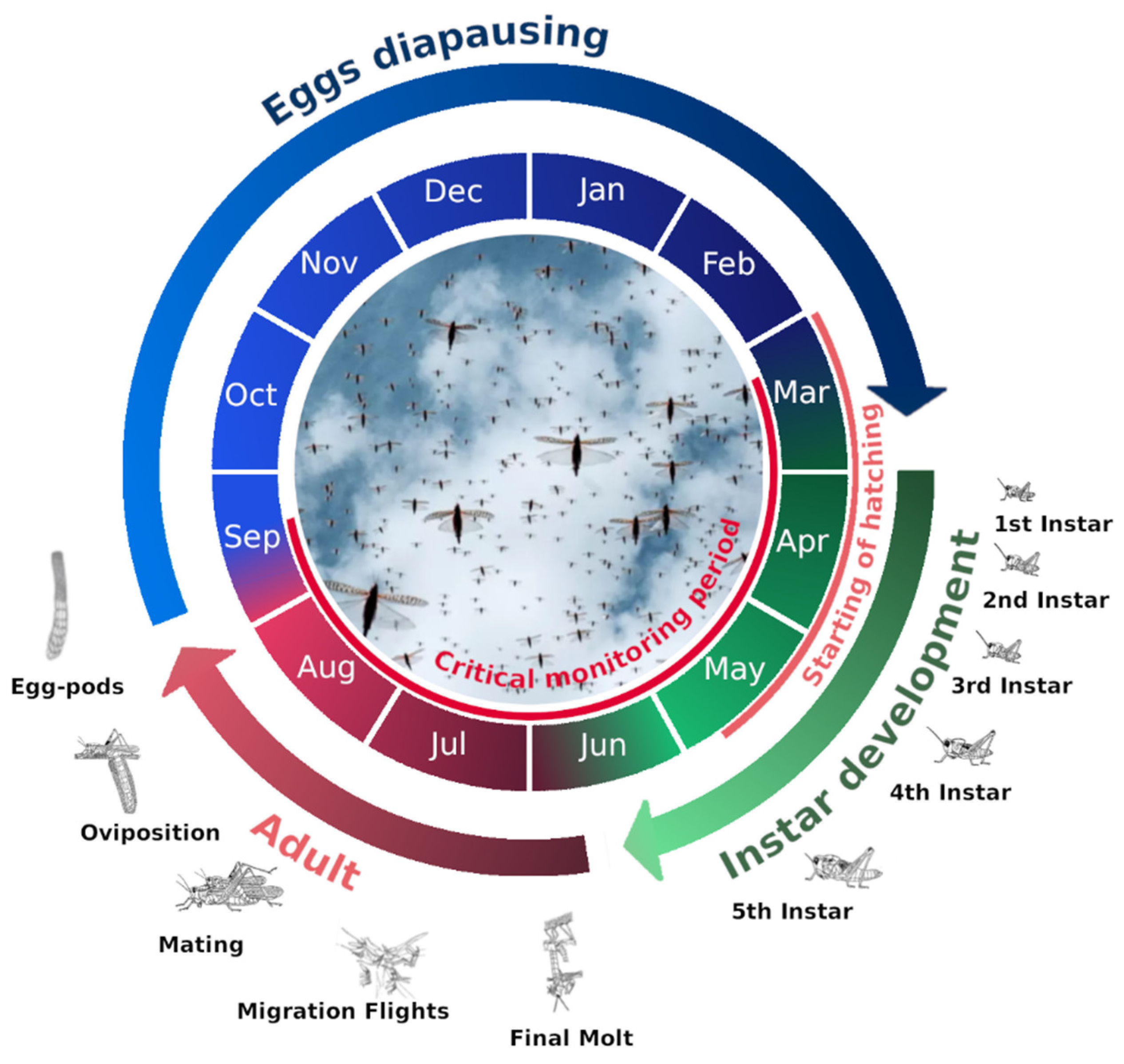
A new generation of D. maroccanus hatches in spring following egg diapause during the cold winter. The start of hatching can be estimated by using the hydro-thermal degree-days sum method [20] and is one of the most important assumptions to prepare ground monitoring and management campaigns. After hatching, D. maroccanus undergoes five instar (also nymph) stages. The duration of each instar phase varies between 5–8 days, depending on the temperature, with warmer conditions leading to faster development. Locust movement and their vegetation consumption increase with each instar phase. Reaching the fourth instar, the locusts in the gregarious phase can move several hundred meters per day in groups called hopper bands. The emergence of dense hopper bands represents a critical signal of an escalating locust situation, preceding the formation of adult swarms [8]. After fledging, locusts are capable of flying and reaching distant areas, which complicates control efforts. Compared to other transboundary locust pests, Moroccan locust swarms usually do not migrate far, with a total distance during the migration period between 50 and 75 km [20]. The final stage of the locust’s active life cycle is the mating stage, followed by oviposition. Females lay between one and four egg-pods, with a varying range from 16 to 40 eggs [8]. Egg-pods enter and remain in diapause throughout the winter period until the favorable meteorological conditions lead to the beginning of hatching. During the diapause, temperature and soil moisture are critical factors defining the survival of eggs. Figure 1 illustrates the life cycle of a univoltine locust species (e.g., D. maroccanus, C. italicus, L. migratoria) in northern hemisphere temperate zones.

2.2. Geographical Distribution and Habitat Characteristics

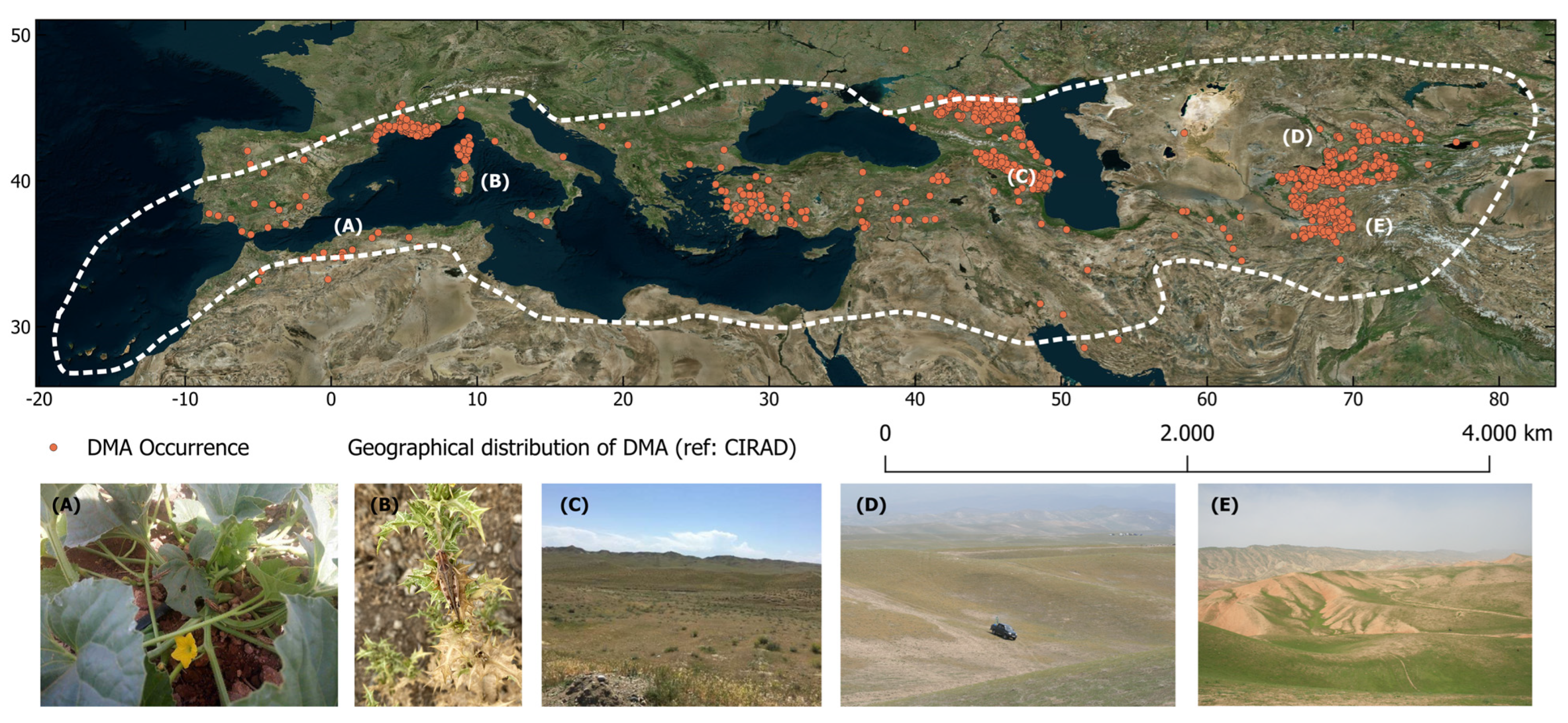
The geographical range of D. maroccanus is presented in Figure 2. It stretches from the Atlantic Ocean Islands to Central Asia across Northwestern Africa, Southern Europe, the Near East, and the Caucasus. D. maroccanus is found in the solitary phase in most of its range. D. maroccanus inhabits semi-arid to arid grasslands, steppes, and lightly grazed or fallow lands characterized by sparse vegetation and open landscapes with patches of bare ground. These environments are critical for successful oviposition [18,26,31]. In some fragmented habitats, it reaches high population densities. In the absence or failure of management, the increase of locust population density lead to invasive outbreaks and swarms causing high economic damage to pastures and agricultural fields. Usually, D. maroccanus is found in dry-steppe habitats but can also occupy overgrazed grass-type steppes [20]. The sites of permanent oviposition are dominated by a few herbaceous plants such as Plantago spp. and Hordeum spp. [31] bulbous bluegrass (Poa bulbosa) with the specification of drying out in summer and leaving numerous bunches of dry bulbs [18]. Precipitation is crucial for egg survival, especially in the months after egg laying and before hatching in spring (Figure 1). Besides, agricultural activities such as soil plowing reduce egg survival, while desertification, overgrazing and undisturbed land abundance create conditions favorable for Moroccan locusts.

3. Materials and Methods

3.1. Ground Truth Occurrence Data

We obtained species occurrence data from a variety of platforms and sources. Specifically, 9744 records were retrieved from the Food and Agriculture Organization (FAO) of the United Nations’ Caucasus and Central Asia Locust Management System (https://ccalm.org), and 729 records from the French National Inventory of Natural Heritage (http://openobs.mnhn.fr), and 73 locations were collected in 2022–2024 in field campaigns in Sardinia during the D. maroccanus outbreak. These locations were collected from the central part of Sardinia (valley of the Tirso river), which has been a primary breeding hotspot of several infestations in the past [32,33]. Therefore, these occurrence points were used to represent this unique primary reproduction area and enable a better model fit of the historical habitat suitability. The same rationale was applied for other occurrence locations, which were collected after the year 2020 within historical primary breeding hotspots. Additionally, 86 records were obtained through literature review and personal documentation to further enrich the occurrence dataset for these locations of permanent breeding hotspots (provided by M. Lazar for Algeria based on reports between 2018 and 2022, and B. Ciplak for Turkey based on field observations in 1996 and 2021).
The initial dataset with 10,632 records (compare to Supplementary Material Figure S1) was filtered to include only records corresponding to egg pods, hoppers, and hopper bands, in order to focus exclusively on breeding locations representing breeding sites. Therefore, observations of adults or swarms were excluded as they can migrate long distances and documented coordinates can be far away from their hatching origin. To reduce spatial sampling bias, a spatial thinning was applied following Aiello-Lammens et al. [34] using the rationale of the “double cell size method”. This resulted in the thinning of occurrence points around approximately 10 km due to the pixel resolution of the spatial datasets of 4.5 km (compare Section 3.2). A sensitivity and specificity analysis was conducted using different thinning distances applied to the species occurrence data. The results indicate that a 10 km thinning distance produced the highest true positive rate and the largest area under the curve (AUC), demonstrating superior discrimination performance (compare Supplementary Material Figure S2). The data preparation process yielded a total of 980 unique occurrence points for further integration in ENM for training and validation of the model. Considering that Moroccan locusts can migrate approximately 3–5 km during the nymphal stage [18,20], an additional 5 km buffer was added for pseudo-absence point generation. Pseudo-absence points were randomly sampled outside the 15 km buffer around presence locations, which served as a distance constraint to avoid pseudo-sampling in areas potentially influenced by short-range locust migration during the nymphal stage. The sampling domain for pseudo-absences was randomly sampled outside this buffer, and was matched to presence records using a 1:1 ratio, resulting in a final dataset of 980 occurrence points and 980 pseudo-absence points.

3.2. Geo-Spatial Datasets and Pre-Processing

In this study, we utilized open-source geospatial datasets as input predictor variables. Monthly mean raster datasets for precipitation, minimum temperature, and maximum temperature from 1991 to 2020 were sourced from the WorldClim data portal (https://worldclim.org), with a spatial resolution of approximately 4.5 km (2.5 arc minutes). The time period from 1991 to 2020 was selected to represent recent climatic conditions and the baseline of this study. Monthly means were averaged over the 30-year period, and bioclimatic variables (BIO) were derived using the dismo package in R version 4.3 (https://cran.r-project.org/web/packages/dismo/dismo.pdf, access on 15 August 2023). In addition, seasonal means (winter, spring, summer, autumn) and an overall annual mean were computed. To represent future climate conditions, we selected the SSP2-4.5 scenario, which reflects a “middle-of-the-road” trajectory where social, economic, and technological trends largely follow historical patterns [28,29]. This scenario was selected due to its relevance for climate policy planning and its broad acceptance in modeling studies. We used SSP2-4.5 projections for the 2021–2040 period and incorporated outputs from seven different Global Climate Models (GCMs) available through the WorldClim database. These models are based on the Coupled Model Intercomparison Project Phase 6 (CMIP6). The datasets included precipitation, minimum and maximum temperatures, and derived bioclimatic variables for each GCM. A multi-model ensemble approach was applied to compute averaged values for each variable.
Furthermore, soil moisture (MRSOS) and net primary productivity (NPP) data were retrieved from the CMIP6 archive using the accmip6 Python (version 3.12) library (https://pypi.org/project/acccmip6/), employing the same GCMs used in the WorldClim dataset (Table 1). CMIP6 data are provided with a longitudinal grid ranging from 0° to 360°, which splits the dataset at the Greenwich meridian. To address this, we converted the longitudinal coordinates to the standard −180° to 180° format. Raster data were extrapolated by one pixel at the edges to eliminate border gaps, reprojected to the EPSG:4326 (WGS 84) coordinate reference system, and resampled to match the spatial resolution of the WorldClim dataset using bilinear interpolation with GDAL in Python version 3.12 (https://gdal.org/). Ensemble means were then calculated across all GCMs for each variable. From these, long-term seasonal averages for soil moisture, monthly averages for NPP, and overall annual means for both variables were derived.
Beyond meteorological parameters, soil characteristics are critical for D. maroccanus breeding and regeneration [8,20]. The importance of soil variables in modeling locust habitats has been emphasized in prior studies [8,9,18,23,26]. We incorporated several soil properties, including bulk density of the fine earth fraction (BDOD), volumetric fraction of coarse fragments (CFVO), organic carbon density (OCD), and the proportions of silt, sand, and clay in the fine earth fraction. These variables were extracted from the SoilGrids 2.0 database (https://soilgrids.org) at two depth intervals (0–5 cm and 5–15 cm) and a spatial resolution of 250 m. Minor data voids were corrected using a 3-by-3 pixel moving window. A weighted mean was used to aggregate values into a single depth layer (0–15 cm), following the method of Han et al. [42].
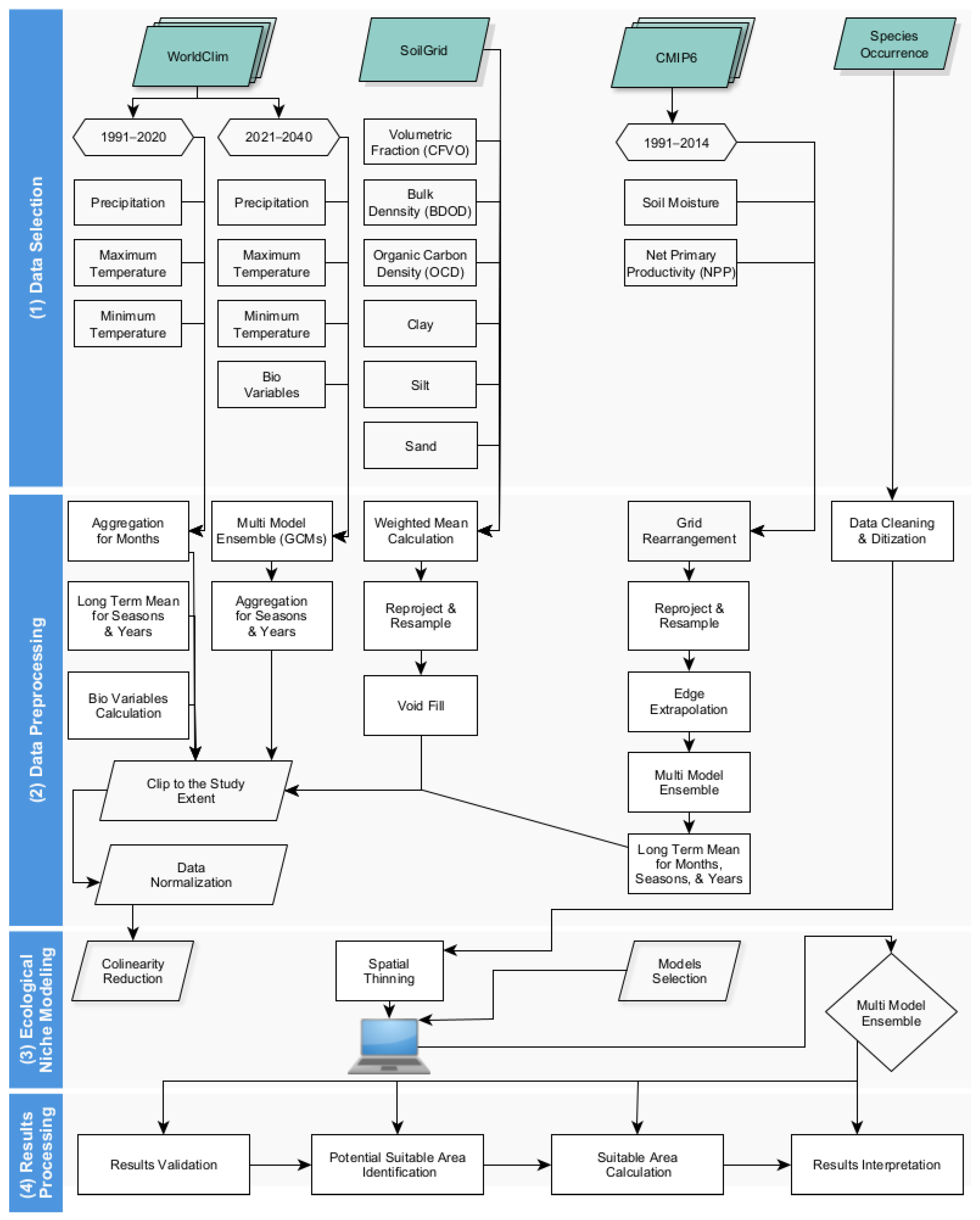
Table 2 provides an overview of all datasets and the preprocessing steps performed to create a harmonized input base with consistent spatial and temporal resolution. Additionally, Figure 3 illustrates the entire data ingestion and preprocessing workflow.
Additionally, topographic variables were derived from the Global 30 Arc-Second Elevation (GTOPO30) dataset, including elevation, slope, and aspect. All datasets were reprojected to EPSG:4326 (WGS 84) and resampled to the spatial resolution of the WorldClim dataset. Since D. maroccanus breeding is observed across all ranges of elevation, slope and aspect (Supplementary Material Table S1), we did not include it in the model to enable a more realistic projection of climate-induced shifts with regard to altitude and topography. Because Moroccan locust outbreak hotspots are found in such a large range, this will avoid a bias of these variables, enabling the model to predict and more realistically reflect the future distribution caused by climate change.

3.3. Ecological Niche Modelling

Different modelling approaches, such as ENM, Habitat Suitability Index (HSI) and Species Distribution Models (SDM) have been increasingly used to assess both current geographical distribution and potential shifts under climate change scenarios [14,25,26,43,44]. ENM models the relationship between observed species presence (and ideally observed absence) and relevant environmental variables affecting the species of interest. As the methodology gains popularity among researchers, new tools and techniques are being developed. One such advancement is the ENMTML under the R package, which integrates state-of-the-art methods and provides an efficient framework for conducting ecological niche modeling [45].
When working with heterogeneous datasets from multiple sources, data normalization is a critical preprocessing step, particularly for scale-sensitive algorithms. Normalization ensures that all predictor variables contribute equally during the modeling process, thereby enhancing model performance [46]. In this study, we employed z-score standardization (Equation (1)), which expresses the distance of each data point from the mean in units of standard deviation. The ENMTML package, which supports multiple modeling algorithms within an ensemble framework, was used on a unified dataset. Z-score normalization was applied to all predictor variables to reduce potential bias from differences in data scale and to ensure consistent input for model training (Figure 3).
Z - score = i μ σ
where,
i = individual observation in a single dataset
μ = mean of a single dataset
σ = standard deviation of a single dataset
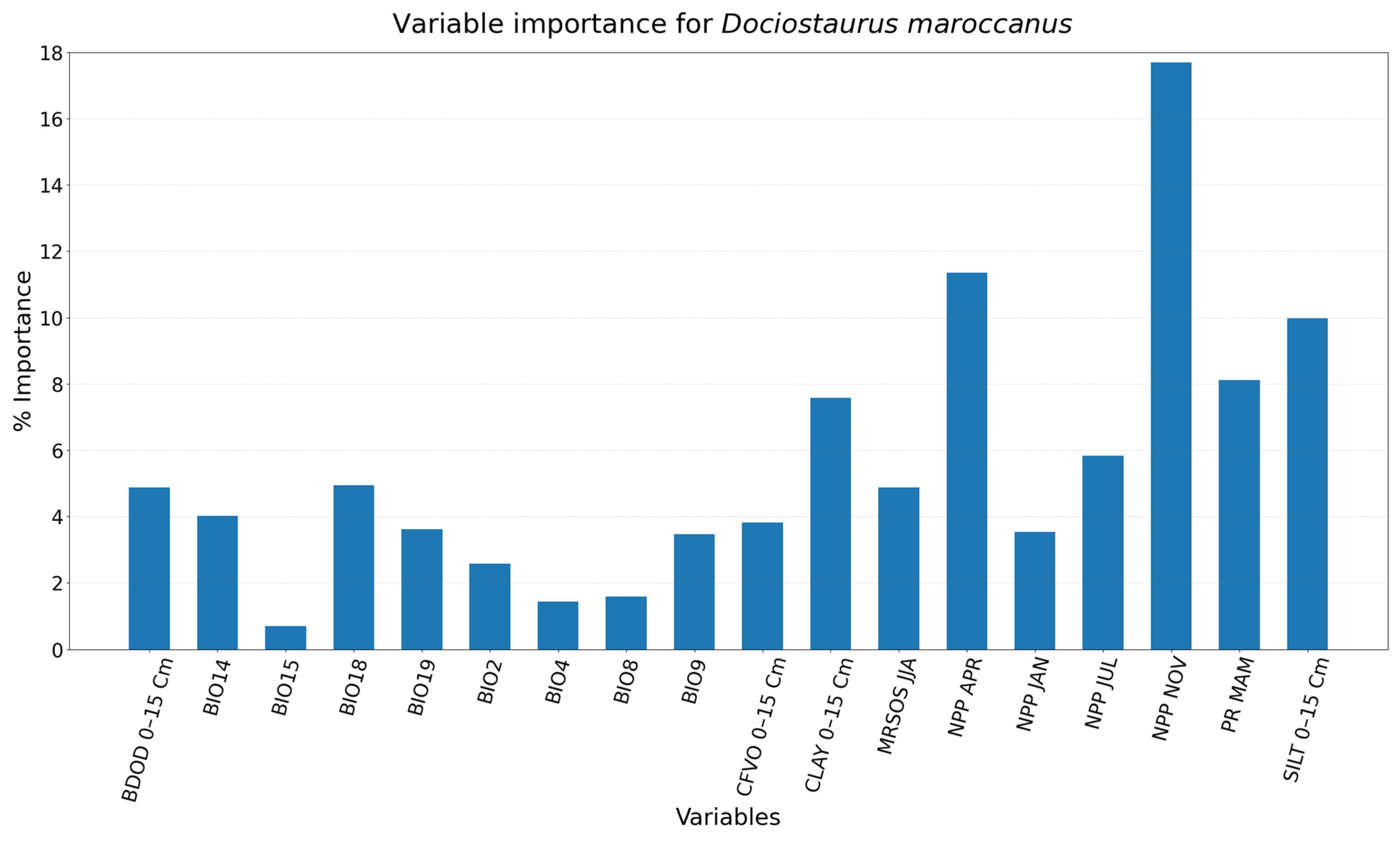
After data normalization, the modeling algorithm ingests both the predictor variables and species occurrence data and performs an initial data cleaning process. This includes procedures such as spatial thinning of occurrence points and reduction of multicollinearity among predictors, based on user-defined parameters. To address collinearity, we applied the Variance Inflation Factor (VIF) method to the set of selected and normalized variables. From an initial pool of 58 predictor variables (Table 2), a total of 18 variables were retained for model fitting (Figure 4) based on the VIF default threshold of 10, which means that variables with VIF higher than 10 were removed as they are considered to have problematic collinearity. Four monthly NPP, especially in November and April, spring precipitation, four physical soil property parameters, summer soil moisture and eight variables of biovar showed the most impact. The model was trained using these variables for the historical period 1991–2020 and subsequently projected to future conditions for the period 2021–2040.

3.4. Model Evaluation

For model evaluation, we employed the Area Under the Receiver Operating Characteristic Curve (AUC), which provides a threshold-independent measure of overall model accuracy. An AUC value below 0.5 indicates performance worse than random, a value of 0.5 denotes no discriminatory ability, and a value of 1 indicates perfect discrimination between presence and absence [47]. Thus, the closer the AUC value is to 1, the better the model’s predictive performance.
In addition to AUC, we used Cohen’s Kappa as a complementary accuracy metric, which quantifies the agreement between predicted and actual classifications beyond chance [48]. A Kappa value of +1 indicates perfect agreement, while values approaching 0 or below suggest poor or no predictive capacity [49].
To validate model performance, we adopted a K-fold cross-validation technique with five folds. In this approach, the dataset is partitioned into five equal subsets; in each iteration, one subset is used for testing while the remaining four are used for training. This process is repeated five times, and model accuracy is calculated by averaging the results across all iterations.
All models achieved high AUC values above 0.9. However, three models—DOM, MAH, and BIO—performed below the overall average AUC (0.984), with DOM showing the lowest performance. Similarly, Cohen’s Kappa values for all models except MAH, DOM, and MXS exceeded 0.9. To ensure ensemble quality, only nine models with above-average performance in both AUC and Kappa metrics (overall average 0.881) were included in the final ensemble modeling process (Table 3).

4. Results and Discussion

4.1. Current and Future Breeding Suitability

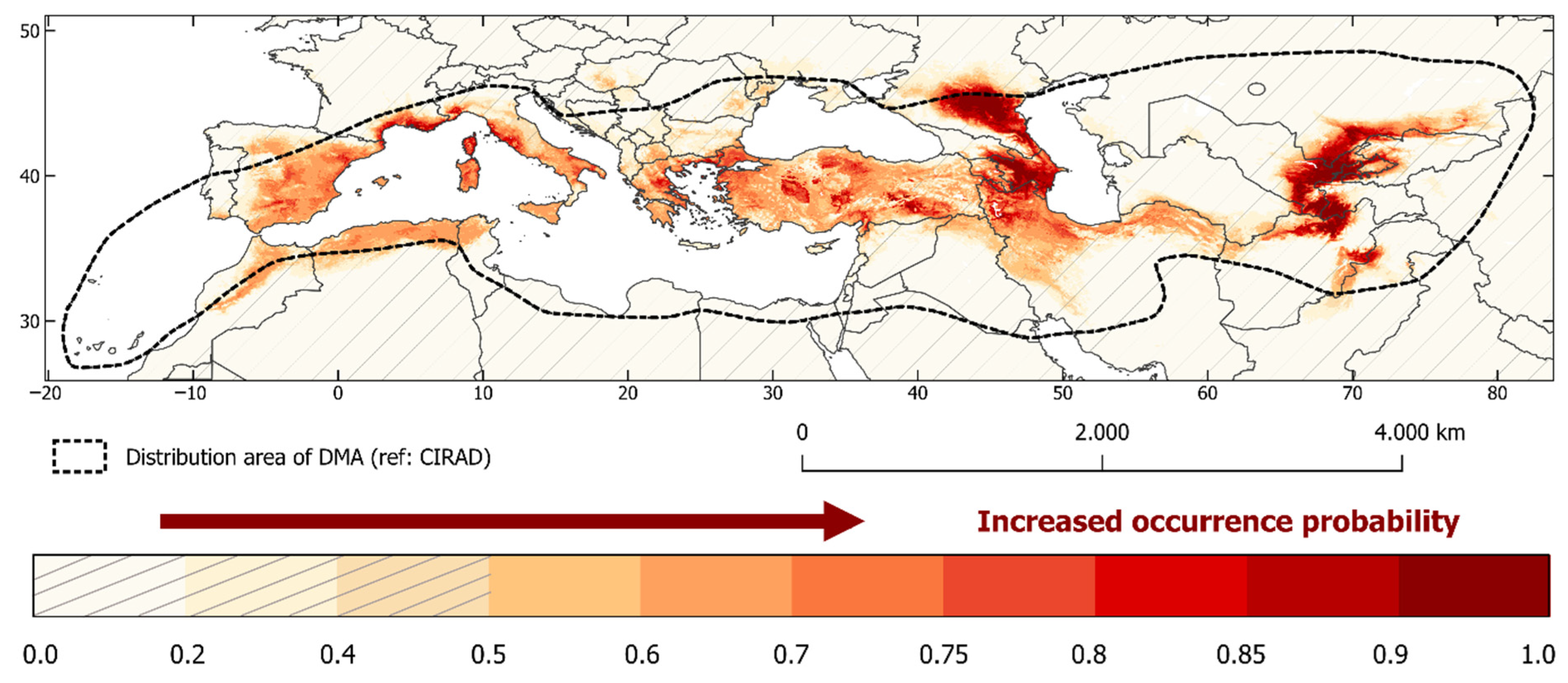
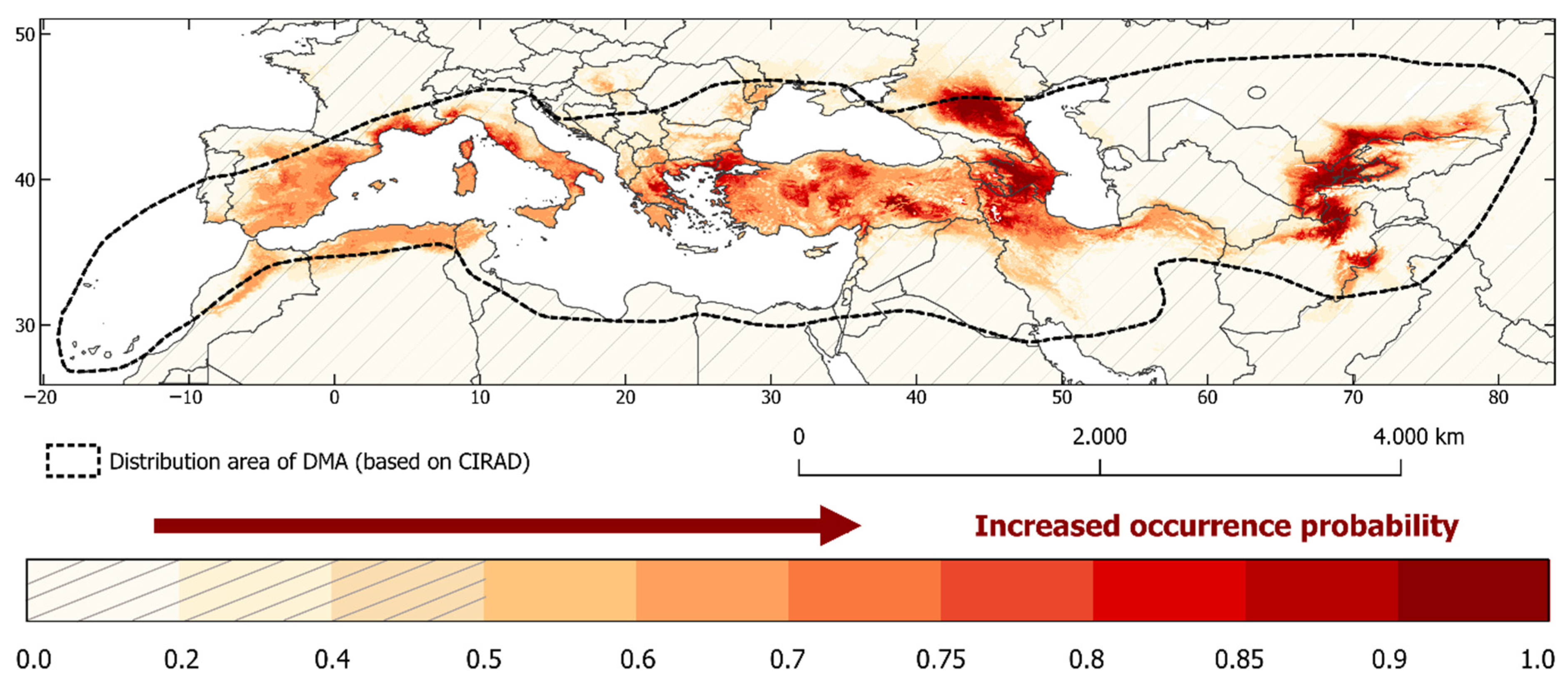
The modeled occurrence probability—interpreted as breeding suitability—for Dociostaurus maroccanus during the historical (1991–2020) and near-future (2021–2040) periods (Figure 5 and Figure 6) reveals highly similar spatial patterns. Probability values range from 0.0 to 1.0 and are classified into the following suitability categories for interpretation: 0.0–0.5 (very unlikely/very unsuitable), 0.5–0.6 (possible/suitable), 0.6–0.8 (likely/very suitable), and 0.8–1.0 (highly likely/optimal).
The results show strong agreement with known field observations, underscoring one of the key strengths of Ecological Niche Modelling [26]. Hotspots of highest suitability—particularly in Central Asia and the Caucasus—as well as other favorable regions in the Mediterranean, including Greece, Turkey, and northern Iran, align well with the historically documented distribution of the Moroccan locust.

4.2. Projected Changes and Geographic Shifts of Breeding Hotspots

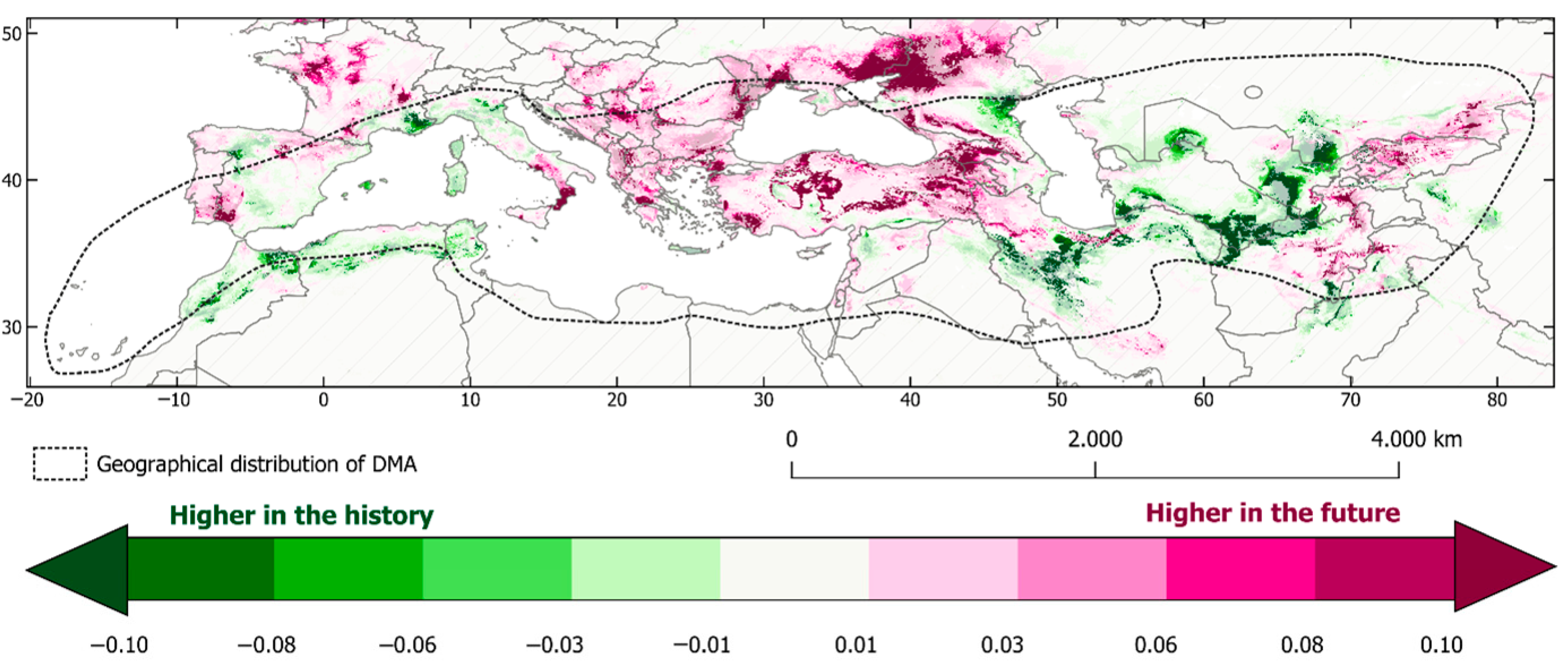
To better understand the projected changes in breeding suitability, we calculated the difference in modeled occurrence probabilities between the two time periods and visualized the results in Figure 7. The most notable increases are projected north of the species’ current geographic range, with higher breeding probabilities in northern Portugal, Spain, France, Southeastern Europe, southern Ukraine, and southwestern Russia. Additional increases are evident along the northeastern Tien Shan Mountains on the Kazakhstan–China border and south of the Zagros Mountains in southeastern Iran. Interestingly, our model’s projections align with recent field observations of D. maroccanus in Xinjiang (northwestern China), a region where the species had not previously been reported (Prof. Zhang Long, personal communication, 2025).
Substantial shifts—both increases and decreases—are also projected within the current distribution range. Most of these changes occur in areas with lower suitability indices (<0.6), likely driven by variations in climatic and vegetation-related variables, while more static abiotic factors, such as soil type and texture, remain unchanged over the short term. Nonetheless, future climate conditions may enhance breeding suitability in marginal areas, potentially increasing the risk of invasion and population expansion during outbreak events.
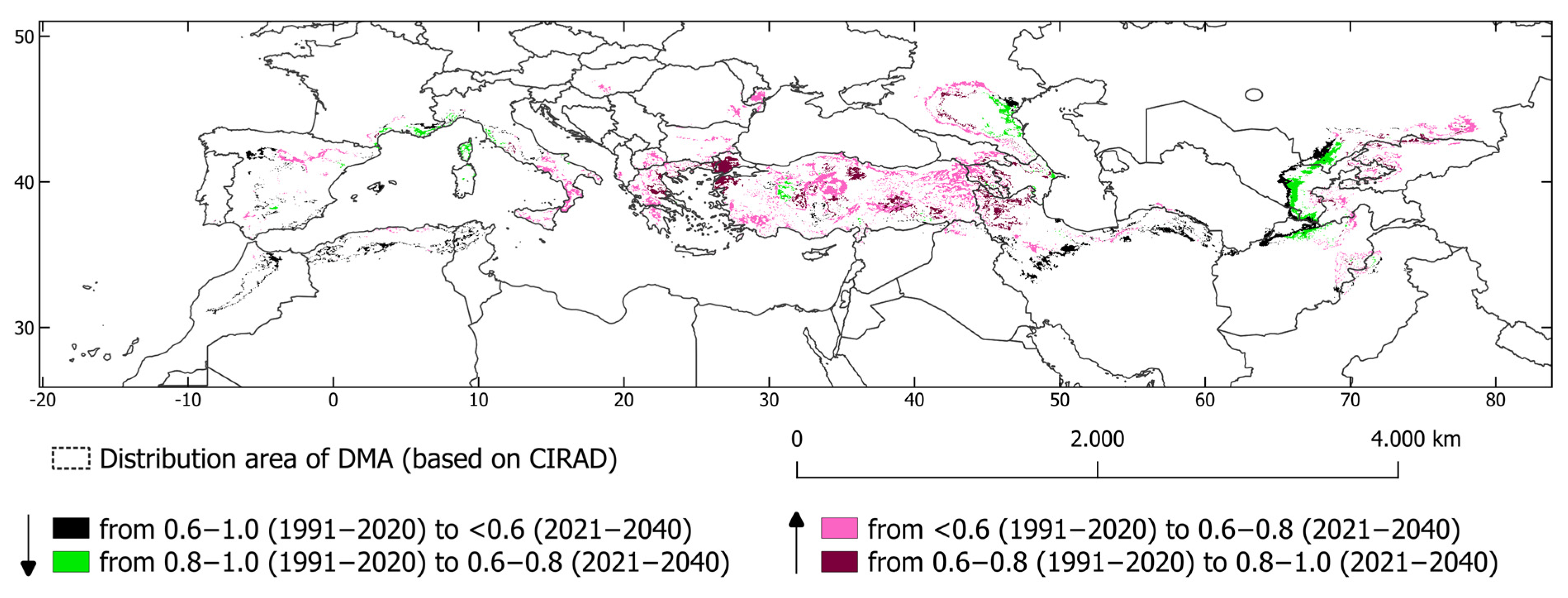
Changes within the higher suitability range (0.6–1.0) are of particular importance, as these areas represent key breeding habitats with high potential for mass breeding and gregarization of D. maroccanus. To facilitate interpretation, we categorized changes into two main types: loss of suitable breeding habitat and emergence of new suitable breeding habitat (Figure 8).
Habitat loss was defined by the following transitions:
From 0.6–1.0 in 1991–2020 to <0.6 in 2021–2040
From 0.8–1.0 in 1991–2020 to 0.6–0.8 in 2021–2040
Emerging suitable habitat was defined by:
From <0.6 in 1991–2020 to 0.6–0.8 in 2021–2040
From 0.6–0.8 in 1991–2020 to 0.8–1.0 in 2021–2040
A projected decrease in suitable breeding habitats is most evident in the southern part of the species’ current range, particularly in the Atlas Mountains (North Africa), the western slopes of the Tien Shan (Central Asia), and regions along Iran’s Zagros and Elburz Mountains. In contrast, marked increases in habitat suitability are projected for Greece, Turkey, northern Iran, the Caucasus, southwestern Russia, and parts of Kazakhstan and Kyrgyzstan. Historical data indicate that, over the 20th century, the northern boundary of D. maroccanus in the Caucasus region has shifted approximately 200–250 km northward compared to its distribution a century ago [20].
These findings suggest that historically affected regions such as western Anatolia and Mesopotamia—known for major D. maroccanus outbreaks in the early 20th century—may once again become breeding hotspots under ongoing climate change, as also noted by Çiplak [12].
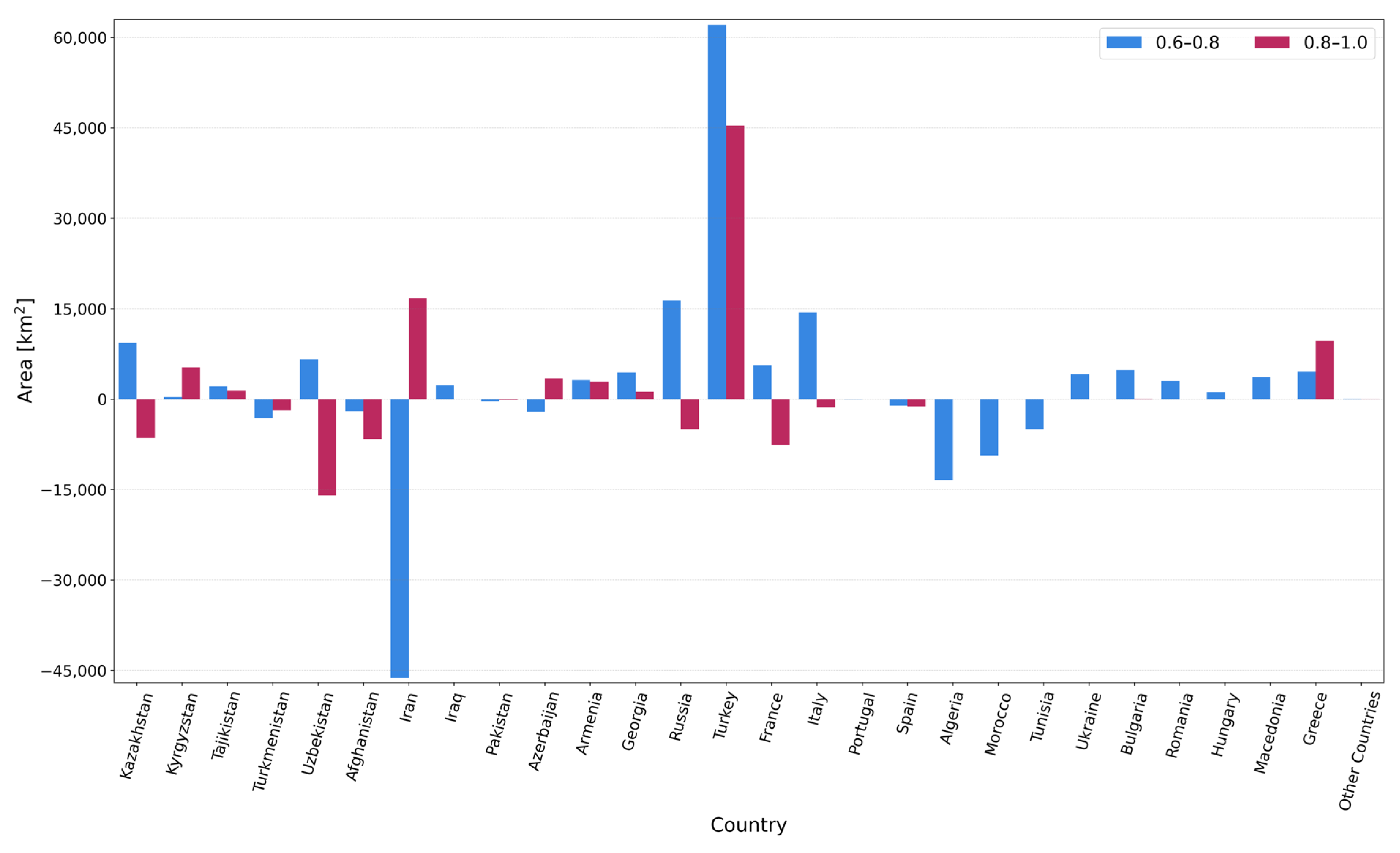
Significant gains in both very suitable and optimal breeding areas are modelled for Turkey (62,112 km2, 45,392 km2), Greece (4544 km2, 9680 km2), Armenia (3136 km2, 2864 km2), Georgia (4416 km2, 1216 km2), Kyrgyzstan (336 km2, 5232 km2) and Tajikistan (2096 km2, 1376 km2). Additional increases are seen across Eastern and Southeastern Europe. In contrast, notable losses are projected for Turkmenistan (3088 km2, 1856 km2), Afghanistan (2016 km2, 6656 km2), and Spain (1104 km2, 1216 km2). Furthermore, declines of very suitable breeding areas are modelled also for North African countries Algeria (13,440 km2), Morocco (9344 km2) and Tunisia (4976 km2).
Some countries exhibit mixed trends, with gains in one category and losses in another. For instance, Kazakhstan (9312 km2), Uzbekistan (6592 km2), Russia (16,352 km2), France (5616 km2), and Italy (14,368 km2) are projected to gain very suitable habitat, while simultaneously losing areas classified as optimal (6464 km2, 15,984 km2, 5008 km2, 7585 km2, and 1360 km2, respectively). In contrast, Iran and Azerbaijan show a vice versa development, losing very suitable areas (46,240 km2, 2080 km2) but gaining optimal areas (16,784 km2, 3424 km2). Overall, very suitable areas are projected to expand by 64,304 km2, and optimal areas by 39,792 km2 across the full geographic range. See Figure 9 and Supplementary Table S2 for country-specific details.

4.3. Future Effect of Temperature and Precipitation on D. Maroccanus Pest Status

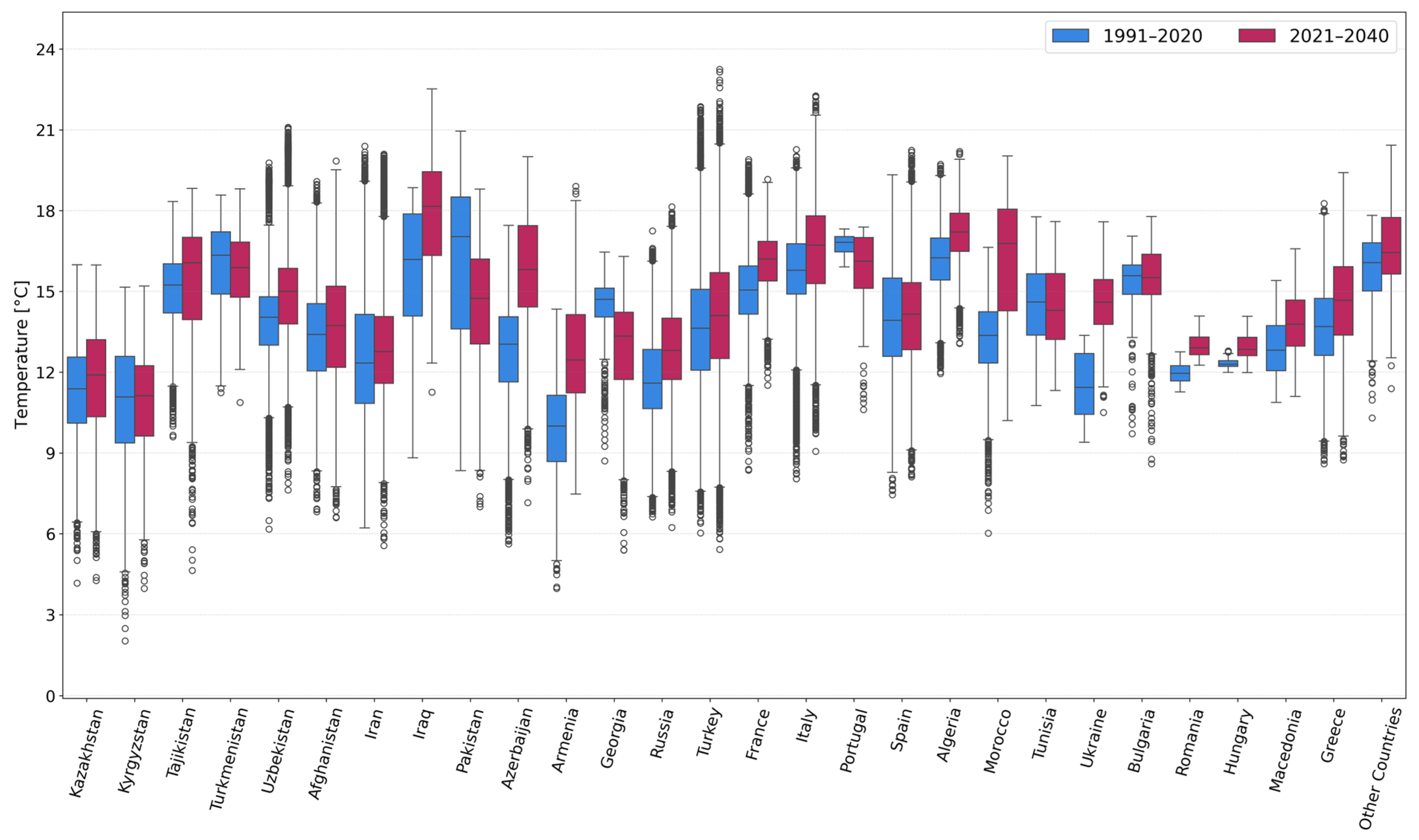
Rising temperatures are projected across most regions classified as very suitable to optimal for D. maroccanus breeding (Figure 10). High temperatures and drought periods (compare Supplementary Material Figures S5 and S6 for precipitation) are recognized as key factors promoting population increases in this species. However, outbreak development typically requires a concurrent deficit in spring precipitation, which affects vegetation patchiness—critical for the locust’s survival and gregarization [26,31]. Therefore, both the amount and timing of spring rainfall play a decisive role in vegetation and ultimately locust development. Field evidence suggests that two consecutive warm and dry years can already trigger mass breeding events, potentially culminating in outbreaks [20]. This highlights how drought-like conditions—characterized by elevated temperatures and reduced precipitation, increasingly associated with climate change—can foster locust gregarization and population increase. Additionally, elevated temperatures during the nymphal development phase accelerate maturation, thus narrowing the window for implementing effective control measures. Climate change in the 21st century has also caused a gradual decline in perennial forage plants and an increase in annual species in pasture lands, facilitating locust spread. This shift has altered steppe grass-wormwood communities toward dominance by species such as Poa bulbosa, Medicago minima, Plantago spp., Hordeum murinum, Carex pachystylis and Artemisia austriaca, which support Moroccan locust spread [20,31].

4.4. The Role of Topography for D. maroccanus Pest Status

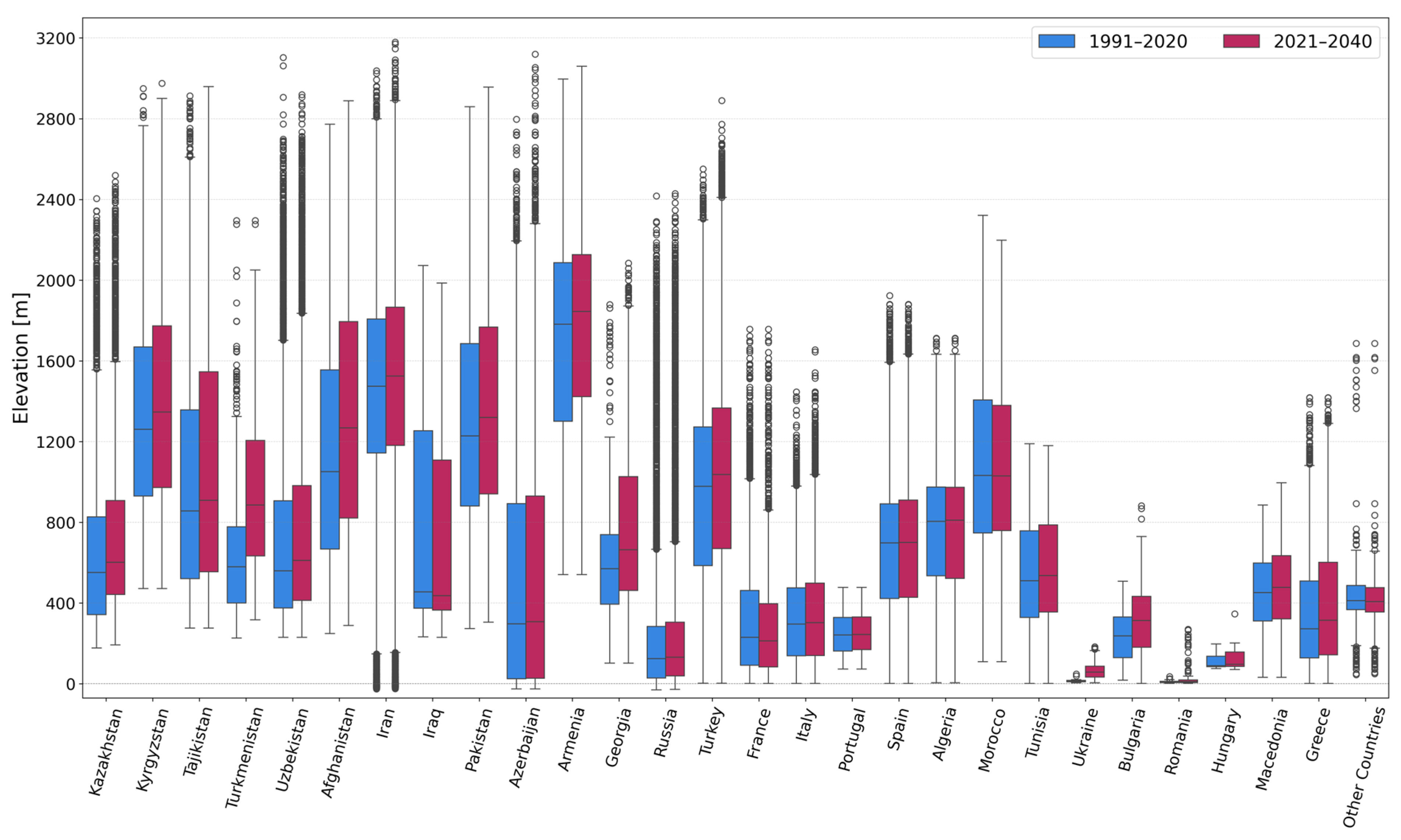
Moreover, the model confirms a marked upward shift of suitable habitats towards higher elevations (Figure 11), a trend that aligns with field observations over the past years. This shift is likely driven by rising temperatures, which are influencing the vertical migration of ephemeral vegetation zones and associated plant communities. The species is now found up to 300 m higher in elevation in the 21st century than in the 20th century [20,22]. For example, a study in Tajikistan recorded oviposition at 1080 m above sea level in 2019 [8]. Our model supports the continuation of this altitudinal shift, as illustrated in Figure 11. It shows that, in most countries, very suitable and optimal breeding habitats are projected to occur at higher altitudes and across a broader elevation range during the 2021–2040 period compared to 1991–2020 (compare Supplementary Material Figure S4 for probability across elevation). This trend presents significant challenges for locust control operations due to complex topography and limited infrastructure at higher elevations. Moreover, the dispersal of D. maroccanus populations across multiple elevation zones will lead to asynchronous hatching and variable nymph development rates. This will result in longer, more logistically demanding, and more costly control campaigns, as efforts must be sustained over an extended period and across diverse terrain.
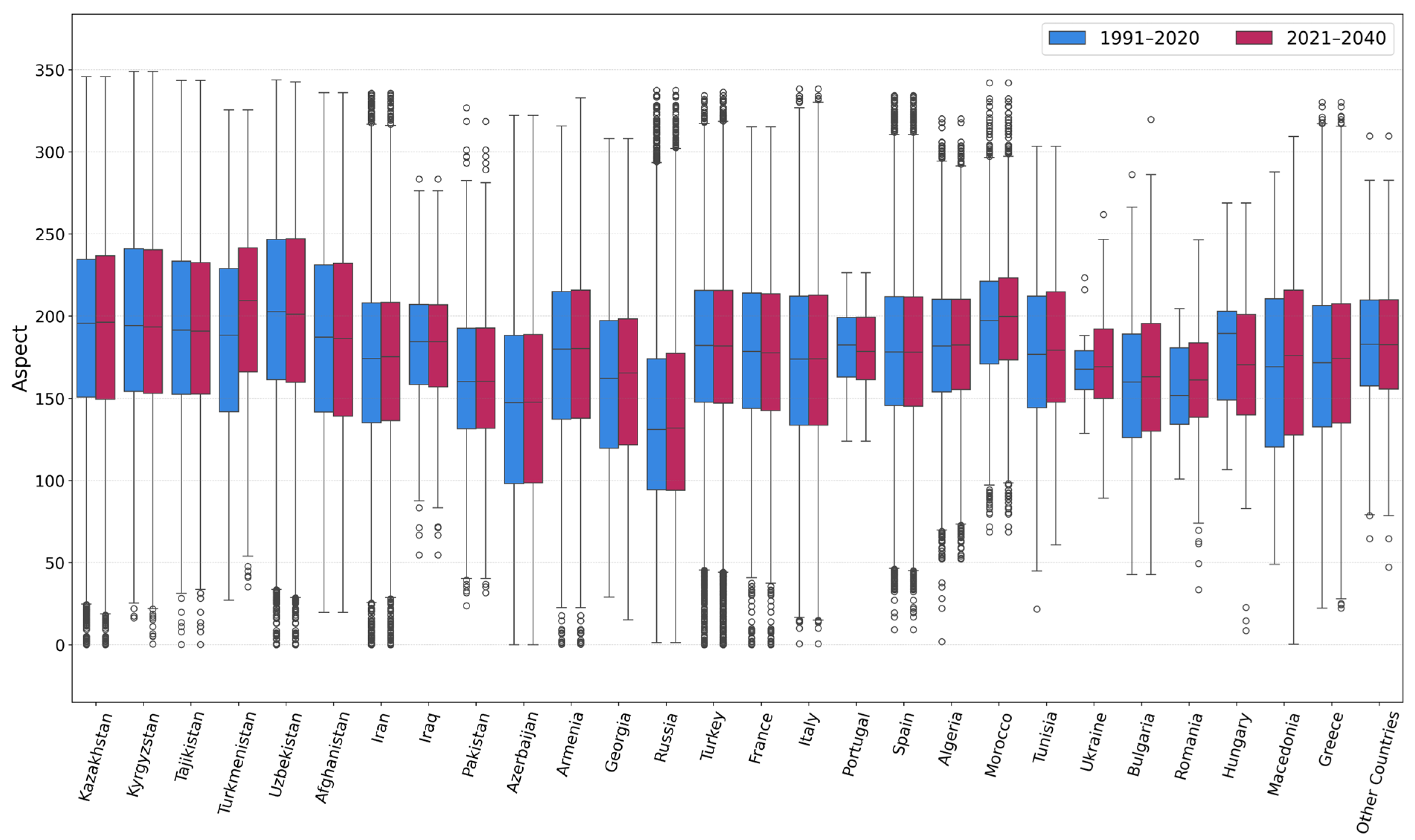
Interestingly, regardless of elevation or geographic region, the orientation of suitable habitats is predominantly concentrated between southwest, south, and southeast exposures across all countries and both modeled time periods (Figure 12). This pattern aligns with ecological observations indicating that optimal breeding habitats typically consist of open landscapes with minimal shade. Such conditions maximize solar radiation, which is crucial for accelerating nymphal development and enhancing overall reproductive success [8].

4.5. The Role of Land Use for D. Maroccanus Pest Status

Despite the robust projections, it is important to recognize that the Moroccan locust is part of a group of swarming locust species characterized by irregular cycles of intense activity followed by prolonged periods of remission. These recessions are not necessarily cyclical; populations may persist in scattered, solitary phases within survival biotopes for decades before rapidly transitioning to a gregarious phase when favorable environmental conditions occur. This shift can lead to dramatic population increases and outbreaks.
However, breeding biotopes have been considerably reduced by human-driven changes such as agricultural expansion and deforestation, particularly the loss of forest edges and clearings. For the Moroccan locust, a shift in favorable climate conditions to the North and simultaneous expansion of intensive agricultural areas would not lead to additional hotspot outbreak areas, as the observed trend of cropland expansion in Eurasia would counteract outbreaks. Human activities and land management decisions are significant but difficult-to-quantify drivers of locust outbreaks. Consequently, ENM, including the one used in this study, primarily focuses on abiotic factors to identify permanent breeding sites and potential outbreak hotspots without the effect of land use changes.
Nevertheless, areas projected to be highly suitable for mass breeding require close attention, especially where land-use practices are changing and agricultural land is abandoned. Historical outbreaks of the Moroccan locust have been linked to agricultural abandonment or reduced cultivation, often triggered by war or post-war labor shortages [12,18]. In particular, a decline in agricultural activity, overgrazing [50], and the coincidence of drought years with favorable spring precipitation have been shown to promote upsurges not only of D. maroccanus, but also of other locust pests such as Calliptamus italicus.
To further understand the interconnection of D. maroccanus in this matter, and enable better future predictions using land use activities and human–environmental feedback [51], more harmonized datasets and future projections of land use are required. Although the FAO platform for Caucasus and Central Asia (https://ccalm.org/) represents a promising step, comparable open-access data from other highly affected regions (see Figure 2 and Supplementary Material Table S2) remain limited. Also, Kulessa et al. [52] noted a general neglect of Orthoptera species in Europe, leading to gaps in research and inconsistent databases. On the other hand, the open data policy for the desert locust (https://www.fao.org/locust-watch/en, Accessed on 23 March 2026) has facilitated broader scientific engagement using machine learning and modeling tools. Yet, some recent publications lack regional expertise, occasionally resulting in misinterpretations. In this context, Gebregiorgis et al. [53] emphasize the ethical and moral responsibility of using artificial intelligence and big data in locust outbreak prediction and control strategies. Furthermore, to improve the understanding of micro-habitats, higher spatial resolution data and approaches focusing on the regional to local scale can provide new insights, especially in heterogenic complex terrain.

5. Conclusions

This study provides an in-depth analysis of the spatial distribution of Moroccan locusts (Dociostaurus maroccanus) under the SSP2-4.5 climate change scenario for the period 2021–2040. Using an Ecological Niche Modelling (ENM) approach, we integrated a comprehensive set of climate, soil, and vegetation predictors with high-quality occurrence data and rigorous model evaluation techniques.
Our findings show that habitat suitability patterns remain relatively stable between the historical (1991–2020) and predicted (2021–2040) periods, with core breeding areas concentrated in Central Asia, the Caucasus, Anatolia and some parts of the Mediterranean. Despite regional variation, very suitable and optimal breeding habitats are projected to expand by 64,304 km2 and 39,792 km2, respectively. Major increases are projected for Anatolia, North Iran, along the northeastern Tien Shan Mountains (on the Kazakhstan–China border), the Caucasus region and southwestern Russia. The projected decreases are found particularly in the southern part of the species’ geographic range, including the Atlas Mountains in North Africa, the western margins of the Tien Shan Mountains in Central Asia and regions in Iran along the Zagros and the Elburz Mountains.
Core breeding areas will be characterized by higher altitudes and a broader elevation range. These upward shifts highlight the species’ adaptability but may complicate effective control operations across elevation zones due to variation in hatch timing, life cycle speed, and challenging high-altitude conditions. Additionally, the core breeding areas will also be characterized by temperature increases. This, combined with irregular spring precipitation, is likely to lead to more drought-like conditions that promote D. maroccanus outbreaks.
Overall, our future projection underlines a northward and upward shift of favorable climatic conditions and supports trends observed in the field over the past decades [20]. The results reveal a notable impact of future climate conditions on the geographical distribution of D. maroccanus and breeding habitat suitability. This emphasizes the need for regional adaptive locust management strategies that consider climatic variables, land-use trends and topographic characteristics. Beyond abiotic factors, anthropogenic influences such as land-use change, overgrazing, and the abandonment of agricultural practices have led to locust outbreaks in the past and remain critical in understanding future risks. In this context, locust outbreaks might occur more often in the future due to a combination of inefficient management, regional instabilities or conflicts, changing climate and environmental conditions, as well as agricultural and pastoral activities.
In view of the population growth potential of locusts in the gregarious phase, reliable projections of the distribution range and potential shifts over time are critical to set up and implement efficient monitoring programs. As a consequence, accurate modeling of suitable locust habitats and distribution changes is included in the World’s Best Practice Locust Management [54], with the aim to predict outbreak hotspots and direct aerial or ground surveys where upsurges are most likely to occur and ensure early response and anticipatory action, such as timely control applications. Ultimately, this study offers a vital foundation for anticipating Moroccan locust outbreaks and guiding proactive monitoring efforts and early warning amid accelerating environmental change.

Supplementary Materials

The following supporting information can be downloaded at: https://www.mdpi.com/article/10.3390/agronomy16070749/s1, Table S1: Environmental characteristics for present time interval (1991–2020) across all pixels where the projected suitable conditions are higher than 0.6. Table S2: Total suitable habitat area for D. maroccanus mass breeding based on modelling results for present and under future scenario. Figure S1: Temporal distribution of occurrence records. Figure S2: Specificity vs sensitivity curve for different thinning distance applied to the species occurrence data. Figure S3: Agreement maps for all models (above: 1991–2020, below: 2021–2040). Figure S4. Projected changes in probability vs. elevation. Figure S5: Annual mean precipitation across all pixels with suitable conditions higher than 0.6. Figure S6: Spring mean precipitation across all pixels with suitable conditions higher than 0.6.

Author Contributions

Conceptualization, I.K.; methodology and programming, I.K. and R.S.D.; formal analysis I.K., R.S.D., N.R., M.L., B.C., A.C., F.G. and A.V.L.; investigation, I.K., N.R., B.C., F.G., B.D. and A.V.L.; writing—original draft preparation, I.K. and R.S.D.; writing—review and editing, I.K., R.S.D., A.C., E.L., N.R., B.C., C.E., F.G. and A.V.L.; visualization, R.S.D. and I.K.; data acquisition, R.S.D., N.R., M.L., B.C., A.C., F.N. and I.F.; supervision, I.K.; project administration, I.K.; funding acquisition, A.M., E.L. and I.K. All authors have read and agreed to the published version of the manuscript.

Funding

This research has been performed within the project “Festlegung einer neuen Governance für die Intergration innovativer Technologien in Frühwarn-und Frühaktionssysteme für grenzüberschreitende klimaempfindliche Schädlinge und Krankheiten: Eine Fallstudie über Heuschrecken” funded by the Bundesministerium für wirtschaftliche Zusammenarbeit und Entwicklung (BMZ) Gz.: G34 E5030-0061/008. AC and IF received financial support from the RESTART-UNINUORO Project “Azioni per la valorizzazione delle risorse agroforestali della Sardegna centrale/Actions for the valorisation of agroforestry resources in central Sardinia” (Regione Autonoma della Sardegna, D.G.R. N. 29/1 of 7 June 2018—fondi FSC 2014–2020).

Institutional Review Board Statement

Not applicable.

Data Availability Statement

The presented results in this study are available on request from the corresponding author and will be shared with interested researchers. The geo-spatial datasets used as input are available at the provided sources of origin. Restrictions apply to the availability of occurrence data, which were obtained from different sources [compare Section 3.1] and require their permission.

Acknowledgments

We would like to thank three anonymous reviewers for their attention to detail and constructive feedback, which has had a substantial impact on improving this paper. We thank V.I. Pankov and V.E. Kambulin (deceased [November 2021]) for their time and for sharing their valuable knowledge and experience gained over several decades.

Conflicts of Interest

Author A.M. was employed by the company TMG Research gGmbH. The remaining authors declare that the research was conducted in the absence of any commercial or financial relationships that could be construed as a potential conflict of interest.

References

  1. Deutsch, C.A.; Tewksbury, J.J.; Tigchelaar, M.; Battisti, D.S.; Merrill, S.C.; Huey, R.B.; Naylor, R.L. Increase in Crop Losses to Insect Pests in a Warming Climate. Science 2018, 361, 916–919. [Google Scholar] [CrossRef]
  2. Lecoq, M.; Cease, A. What Have We Learned after Millennia of Locust Invasions. Agronomy 2022, 12, 472. [Google Scholar] [CrossRef]
  3. Word Ries, M.; Adriaansen, C.; Aldobai, S.; Berry, K.; Bal, A.B.; Catenaccio, M.C.; Cigliano, M.M.; Cullen, D.A.; Deveson, T.; Diongue, A.; et al. Global Perspectives and Transdisciplinary Opportunities for Locust and Grasshopper Pest Management and Research. J. Orthoptera Res. 2024, 33, 169–216. [Google Scholar] [CrossRef]
  4. Cheke, R.A.; Young, S.; Wang, X.; Tratalos, J.A.; Tang, S.; Cressman, K. Evidence for a Causal Relationship between the Solar Cycle and Locust Abundance. Agronomy 2020, 11, 69. [Google Scholar] [CrossRef]
  5. Matthews, G.A. New Technology for Desert Locust Control. Agronomy 2021, 11, 1052. [Google Scholar] [CrossRef]
  6. Marescot, L.; Fernandez, E.; Dridi, H.; Benahi, A.S.; Hamouny, M.L.; Maeno, K.O.; Escorihuela, M.-J.; Paolini, G.; Piou, C. A Forecasting Model for Desert Locust Presence during Recession Period, Using Real-Time Satellite Imagery. Remote Sens. Appl. Soc. Environ. 2025, 37, 101497. [Google Scholar] [CrossRef]
  7. Showler, A.T.; Shah, S.; Sulaiman; Khan, S.; Ullah, S.; Degola, F. Desert Locust Episode in Pakistan, 2018–2021, and the Current Status of Integrated Desert Locust Management. J. Integr. Pest Manag. 2022, 13, 1. [Google Scholar] [CrossRef]
  8. Khairov, K.S.; Lazutkaite, E.; Latchininsky, A.V. Distribution, Population Dynamics, and Management of Moroccan Locust Dociostaurus Maroccanus (Thunberg, 1815) (Orthoptera, Acrididae) in Tajikistan. Insects 2024, 15, 684. [Google Scholar] [CrossRef]
  9. Klein, I.; Cocco, A.; Uereyen, S.; Mannu, R.; Floris, I.; Oppelt, N.; Kuenzer, C. Outbreak of Moroccan Locust in Sardinia (Italy): A Remote Sensing Perspective. Remote Sens. 2022, 14, 6050. [Google Scholar] [CrossRef]
  10. Trumper, E.V.; Cease, A.J.; Cigliano, M.M.; Copa Bazán, F.; Lange, C.E.; Medina, H.E.; Overson, R.P.; Therville, C.; Pocco, M.E.; Piou, C.; et al. A Review of the Biology, Ecology, and Management of the South American Locust, Schistocerca Cancellata (Serville, 1838), and Future Prospects. Agronomy 2022, 12, 135. [Google Scholar] [CrossRef]
  11. Piou, C.; Lebourgeois, V.; Benahi, A.S.; Bonnal, V.; Jaavar, M.E.H.; Lecoq, M.; Vassal, J.-M. Coupling Historical Prospection Data and a Remotely-Sensed Vegetation Index for the Preventative Control of Desert Locusts. Basic Appl. Ecol. 2013, 14, 593–604. [Google Scholar] [CrossRef]
  12. Çiplak, B. Locust and Grasshopper Outbreaks in the Near East: Review under Global Warming Context. Agronomy 2021, 11, 111. [Google Scholar] [CrossRef]
  13. Lazutkaite, E.; Klein, I.; Kimathi, E.; Sabiiti, G.; Tonnang, H.; Endris, H.S.; Amdihun, A.; Igbokwe, V.K.; Müller, A. The Role of Climate Change for Transboundary Crop Pest Outbreaks in IGAD Member States—Challenges for Integrated EWS and Governance. A Review. AfricArXiv 2024. [Google Scholar] [CrossRef]
  14. Liu, X.; Zhang, D.; He, X. Unveiling the Role of Climate in Spatially Synchronized Locust Outbreak Risks. Sci. Adv. 2024, 10, eadj1164. [Google Scholar] [CrossRef] [PubMed]
  15. Meynard, C.N.; Lecoq, M.; Chapuis, M.; Piou, C. On the Relative Role of Climate Change and Management in the Current Desert Locust Outbreak in East Africa. Glob. Change Biol. 2020, 26, 3753–3755. [Google Scholar] [CrossRef]
  16. Wang, B.; Deveson, E.D.; Waters, C.; Spessa, A.; Lawton, D.; Feng, P.; Liu, D.L. Future Climate Change Likely to Reduce the Australian Plague Locust (Chortoicetes Terminifera) Seasonal Outbreaks. Sci. Total Environ. 2019, 668, 947–957. [Google Scholar] [CrossRef]
  17. Youngblood, J.P.; Cease, A.J.; Talal, S.; Copa, F.; Medina, H.E.; Rojas, J.E.; Trumper, E.V.; Angilletta, M.J.; Harrison, J.F. Climate Change Expected to Improve Digestive Rate and Trigger Range Expansion in Outbreaking Locusts. Ecol. Monogr. 2023, 93, e1550. [Google Scholar] [CrossRef]
  18. Latchininsky, A.V. Moroccan Locust Dociostaurus Maroccanus (Thunberg, 1815): A Faunistic Rarity or an Important Economic Pest. J. Insect Conserv. 1998, 2, 167–178. [Google Scholar] [CrossRef]
  19. Showler, A.; Lecoq, M. Incidence and Ramifications of Armed Conflict in Countries with Major Desert Locust Breeding Areas. Agronomy 2021, 11, 114. [Google Scholar] [CrossRef]
  20. Latchininsky, A.V.; Sergeev, M.G.; Fedotova, A.A.; Childybaev, M.K.; Temreshev, I.I.; Gapparov, F.A.; Kokanova, E.O. Moroccan Locust Dociostaurus maroccanus (Thunberg, 1815): Morphology, Distribution, Ecology, Population Management; FAO: Rome, Italy, 2023. [Google Scholar]
  21. Sergeev, M.G.; Childebaev, M.K.; Ji, R.; Molodtsov, V.V.; Baturina, N.S.; Van’kova, I.A.; Kim-Kashmenskaya, M.N.; Popova, K.V.; Zharkov, V.D.; Yefremova, O.V. Ecologo-Geographic Distribution Patterns of the Italian Locust Calliptamus Italicus (Lin-naeus) (Orthoptera: Acrididae) in the Easternmost Part of Its Range. Insects 2025, 16, 211. [Google Scholar] [CrossRef] [PubMed]
  22. Kokanova, E.O. Natural Foci of the Moroccan Locust (Dociostaurus Maroccanus, Orthoptera, Acrididae) in Turkmenistan and Their Current State. Entmol. Rev. 2017, 97, 584–593. [Google Scholar] [CrossRef]
  23. Nagy, B. Are Locust Outbreaks a Real Danger in the Carpathian Basin in the near Future? J. Orthoptera Res. 1995, 143–146. [Google Scholar] [CrossRef]
  24. Kasalo, N.; Tvrtković, N.; Bogić, D.; Kokan, B.; Vuković, M.; Kučinić, M.; Skejo, J. An Overview of Orthoptera Mass Occurrences in Croatia from 1900 to 2023. Insects 2024, 15, 82. [Google Scholar] [CrossRef] [PubMed]
  25. Aragón, P.; Coca-Abia, M.M.; Llorente, V.; Lobo, J.M. Estimation of Climatic Favourable Areas for Locust Outbreaks in Spain: Integrating Species’ Presence Records and Spatial Information on Outbreaks. J. Appl. Entomol. 2013, 137, 610–623. [Google Scholar] [CrossRef]
  26. Malakhov, D.; Zlatanov, B.V. An Ecological Niche Model for Dociostaurus Maroccanus, Thunberg, 1815 (Orthoptera, Acrididae): The Nesting Environment and Survival of Egg-Pods. Biosis Biol. Syst. 2020, 1, 8–24. [Google Scholar] [CrossRef]
  27. Çıplak, B.; Uluar, O. Anatolian Short-Horned Grasshoppers Unveiled: Integrating Biogeography and Pest Potential. Insects 2024, 15, 55. [Google Scholar] [CrossRef]
  28. Fricko, O.; Havlik, P.; Rogelj, J.; Klimont, Z.; Gusti, M.; Johnson, N.; Kolp, P.; Strubegger, M.; Valin, H.; Amann, M.; et al. The Marker Quantification of the Shared Socioeconomic Pathway 2: A Middle-of-the-Road Scenario for the 21st Century. Glob. Environ. Change 2017, 42, 251–267. [Google Scholar] [CrossRef]
  29. Riahi, K.; Van Vuuren, D.P.; Kriegler, E.; Edmonds, J.; O’Neill, B.C.; Fujimori, S.; Bauer, N.; Calvin, K.; Dellink, R.; Fricko, O.; et al. The Shared Socioeconomic Pathways and Their Energy, Land Use, and Greenhouse Gas Emissions Implications: An Overview. Glob. Environ. Change 2017, 42, 153–168. [Google Scholar] [CrossRef]
  30. Uvarov, B.P. Grasshoppers and Locusts. In A Handbook of General Acridology; Cambridge University Press: Cambridge, UK, 1966; Volume 1. [Google Scholar]
  31. Uvarov, B.P. Ecological Studies on the Moroccan Locust in Western Anatolia. Bull. Entomol. Res. 1932, 273–287. [CrossRef]
  32. Molinu, A.; Cesaroni, C.; Pantaleoni, R.A. Arsenic Locusts—The Control of Locusts in Sardinia in the First Half of Twentieth Century; Composita: Sassari, Italy, 2004. [Google Scholar]
  33. Ortu, S.; Prota, R. Possibilità Di Lotta Biologica Contro Le Cavallette: Il Caso Del Dociostaurus Maroccanus Thunb. (Osservazioni Preliminari). Proc. SITE 1989, 8, 89–97. [Google Scholar]
  34. Aiello-Lammens, M.E.; Boria, R.A.; Radosavljevic, A.; Vilela, B.; Anderson, R.P. spThin: An R Package for Spatial Thinning of Species Occurrence Records for Use in Ecological Niche Models. Ecography 2015, 38, 541–545. [Google Scholar] [CrossRef]
  35. Xin, X.; Wu, T.; Shi, X.; Zhang, F.; Li, J.; Chu, M.; Liu, Q.; Yan, J.; Ma, Q.; Wei, M. BCC BCC-CSM2MR Model Output Prepared for CMIP6 ScenarioMIP Ssp245. World Data Center for Climate (WDCC) at DKRZ. 2019. Available online: https://www.wdc-climate.de/ui/entry?acronym=C6SPBCBCMs245 (accessed on 28 March 2026).
  36. Lovato, T.; Peano, D.; Butenschön, M. CMCC CMCC-ESM2 Model Output Prepared for CMIP6 ScenarioMIP Ssp245. World Data Center for Climate (WDCC) at DKRZ. 2021. Available online: https://www.wdc-climate.de/ui/entry?acronym=C6SPCMCMCs245 (accessed on 28 March 2026).
  37. EC-Earth Consortium (EC-Earth). EC-Earth-Consortium EC-Earth3-Veg Model Output Prepared for CMIP6 ScenarioMIP Ssp245. Earth System Grid Federation. 2019. Available online: https://www.wdc-climate.de/ui/cmip6?input=CMIP6.ScenarioMIP.EC-Earth-Consortium.EC-Earth3.ssp245 (accessed on 28 March 2026).
  38. NASA Goddard Institute for Space Studies (NASA/GISS). NASA-GISS GISS-E2-1-G-CC Model Output Prepared for CMIP6 Sce-narioMIP Ssp245. World Data Center for Climate (WDCC) at DKRZ. 2022. Available online: https://www.wdc-climate.de/ui/entry?acronym=C6SPGIGEGs245 (accessed on 28 March 2026).
  39. Boucher, O.; Denvil, S.; Levavasseur, G.; Cozic, A.; Caubel, A.; Foujols, M.-A.; Meurdesoif, Y.; Cadule, P.; Devilliers, M.; Dupont, E.; et al. IPSL IPSL-CM6A-LR Model Output Prepared for CMIP6 ScenarioMIP Ssp245. Earth System Grid Federation. 2019. Available online: https://www.wdc-climate.de/ui/cmip6?input=CMIP6.ScenarioMIP.IPSL.IPSL-CM6A-LR.ssp245 (accessed on 28 March 2026).
  40. Schupfner, M.; Wieners, K.-H.; Wachsmann, F.; Steger, C.; Bittner, M.; Jungclaus, J.; Früh, B.; Pankatz, K.; Giorgetta, M.; Reick, C.; et al. DKRZ MPI-ESM1.2-HR Model Output Prepared for CMIP6 ScenarioMIP Ssp245; World Data Center for Climate (WDCC) at DKRZ. 2019. Available online: https://www.wdc-climate.de/ui/entry?acronym=C6SPDKME2s245 (accessed on 28 March 2026).
  41. Good, P.; Sellar, A.; Tang, Y.; Rumbold, S.; Ellis, R.; Kelley, D.; Kuhlbrodt, T. MOHC UKESM1.0-LL Model Output Prepared for CMIP6 ScenarioMIP Ssp245. World Data Center for Climate (WDCC) at DKRZ. 2019. Available online: https://www.wdc-climate.de/ui/entry?acronym=C6SPMOU0s245 (accessed on 28 March 2026).
  42. Han, E.; Ines, A.V.M.; Koo, J. Development of a 10-Km Resolution Global Soil Profile Dataset for Crop Modeling Applications. Environ. Model. Softw. 2019, 119, 70–83. [Google Scholar] [CrossRef]
  43. Kimathi, E.; Tonnang, H.E.Z.; Subramanian, S.; Cressman, K.; Abdel-Rahman, E.M.; Tesfayohannes, M.; Niassy, S.; Torto, B.; Dubois, T.; Tanga, C.M.; et al. Prediction of Breeding Regions for the Desert Locust Schistocerca Gregaria in East Africa. Sci. Rep. 2020, 10, 11937. [Google Scholar] [CrossRef]
  44. Klein, I.; Van Der Woude, S.; Schwarzenbacher, F.; Muratova, N.; Slagter, B.; Malakhov, D.; Oppelt, N.; Kuenzer, C. Predicting Suitable Breeding Areas for Different Locust Species—A Multi-Scale Approach Accounting for Environmental Conditions and Current Land Cover Situation. Int. J. Appl. Earth Obs. Geoinf. 2022, 107, 102672. [Google Scholar] [CrossRef]
  45. Andrade, A.F.A.D.; Velazco, S.J.E.; De Marco Júnior, P. ENMTML: An R Package for a Straightforward Construction of Complex Ecological Niche Models. Environ. Model. Softw. 2020, 125, 104615. [Google Scholar] [CrossRef]
  46. Singh, D.; Singh, B. Investigating the Impact of Data Normalization on Classification Performance. Appl. Soft Comput. 2020, 97, 105524. [Google Scholar] [CrossRef]
  47. Fielding, A.H.; Bell, J.F. A Review of Methods for the Assessment of Prediction Errors in Conservation Presence/Absence Models. Environ. Conserv. 1997, 24, 38–49. [Google Scholar] [CrossRef]
  48. Manel, S.; Williams, H.C.; Ormerod, S.J. Evaluating Presence–Absence Models in Ecology: The Need to Account for Prevalence. J. Appl. Ecol. 2001, 38, 921–931. [Google Scholar] [CrossRef]
  49. Cohen, J. A Coefficient of Agreement for Nominal Scales. Educ. Psychol. Meas. 1960, 20, 37–46. [Google Scholar] [CrossRef]
  50. Le Gall, M.; Overson, R.; Cease, A. A Global Review on Locusts (Orthoptera: Acrididae) and Their Interactions with Livestock Grazing Practices. Front. Ecol. Evol. 2019, 7, 263. [Google Scholar] [CrossRef]
  51. Word, M.L.; Hall, S.J.; Robinson, B.E.; Manneh, B.; Beye, A.; Cease, A.J. Soil-Targeted Interventions Could Alleviate Locust and Grasshopper Pest Pressure in West Africa. Sci. Total Environ. 2019, 663, 632–643. [Google Scholar] [CrossRef] [PubMed]
  52. Kulessa, A.K.; Balzani, P.; Soto, I.; Kouba, A.; Renault, D.; Tarkan, A.S.; Haubrock, P.J. The Neglect of Nonnative Orthopterans as Potential Invaders: A Call for Awareness. Insect Sci. 2024, 31, 994–1000. [Google Scholar] [CrossRef] [PubMed]
  53. Gebregiorgis, D.; Asrat, A.; Birhane, E.; Tiwari, C.; Kiage, L.M.; Ramisetty-Mikler, S.; Kallam, S.; Kabengi, N.; Gebrekirstos, A.; Wanjiru, S.; et al. Critical Gaps in the Global Fight against Locust Outbreaks and Addressing Emerging Challenges. npj Sustain. Agric. 2025, 3, 29. [Google Scholar] [CrossRef]
  54. Hunter, D. World’s Best Practice Locust and Grasshopper Management: Accurate Forecasting and Early Intervention Treatments Using Reduced Chemical Pesticide. Agronomy 2024, 14, 2369. [Google Scholar] [CrossRef]
Figure 1. Schematic life cycle of a univoltine locust species in northern hemisphere temperate zones.
Agronomy 16 00749 g001
Figure 2. Moroccan locust distribution and selected breeding occurrences based on ground monitoring. Exemplary photos: (A) infestation in Algeria; (B) infestation in Sardinia, Italy; (C) habitat in Azerbaijan; (D) habitat in Uzbekistan; (E) habitat in Tajikistan.
Agronomy 16 00749 g002
Figure 3. Schematic workflow of data processing steps.
Agronomy 16 00749 g003
Figure 4. Variable importance for 18 remaining variables for model fitting (JJA: summer months, MAM: spring months).
Agronomy 16 00749 g004
Figure 5. Current D. maroccanus occurrence probability based on data from 1991–2020.
Agronomy 16 00749 g005
Figure 6. Future D. maroccanus occurrence probability based on SSP2-45 scenario for 2021–2040.
Agronomy 16 00749 g006
Figure 7. Change in D. maroccanus habitat suitability (occurrence probability) under future climate conditions (2021–2040 relative to 1991–2020). Changes below 95% significance level are less bright.
Agronomy 16 00749 g007
Figure 8. Changes of D. maroccanus are very suitable and optimal habitats between current and future occurrence probability.
Agronomy 16 00749 g008
Figure 9. Total area of increase and decrease of very suitable and optimal habitats.
Agronomy 16 00749 g009
Figure 10. Annual mean temperature box plots across all projected pixels with suitable conditions higher than 0.6.
Agronomy 16 00749 g010
Figure 11. Elevation box plots across all projected pixels with suitable conditions higher than 0.6.
Agronomy 16 00749 g011
Figure 12. Aspect box plots across all projected pixels with suitable conditions higher than 0.6.
Agronomy 16 00749 g012
Table 1. Detailed descriptions of the used Global Climate Models (GCMs).
#CMIP6 Model NameSpatial Resolution
(Longitude by Latitude in Degrees)
Key Reference
1BCC-CSM2-MR1.1 × 1.1°[35]
2CMCC-ESM21.2 × 0.9°[36]
3EC-Earth3-Veg0.7 × 0.7°[37]
4GISS-E2-1-G2.5 × 1.1°[38]
5IPSL-CM6A-LR2.5 × 1.3°[39]
6MPI-ESM1-2-HR0.9 × 0.9°[40]
7KESM1-0-LL1.9 × 1.2°[41]
Table 2. Used datasets and pre-processing steps.
Variables1991–2020 Download1991–2020
Processed
2021–2040 Download2021–2040
Processed
Soil layers:
CFVO (1),
BDOD (1),
OCD (1),
Clay (1),
Silt (1),
Sand (1)
International Soil Reference and Information Centre (ISRIC) World Soil Information, 250 mWeighted mean of two layers < e.g., [42], Voids were filled using 3 × 3 moving window, resampled to ~4.5 km (bilinear)International Soil Reference and Information Centre (ISRIC) World Soil Information, 250 mSame as 1991–2020 scenario
biovar (19 variables)WorldClim historical monthly data, ~4.5 kmCalculated from monthly average of P, TMIN, TMAX
using dismo package in R
Biovariables calclulated from WorldClim, ~4.5 kmMultimodel ensemble mean (MEM) based on 7 models from Table 1, resampled to ~4.5 km (bilinear)
TMIN (5),
TMAX (5)
WorldClim historical monthly data, ~4.5 kmLong-term mean calculated for months, seasons, years Worldclim, ~4.5 km
PSUM (5)WorldClim
historical monthly data, ~4.5 km
Long-term mean calculated for months, seasons, years Worldclim, ~4.5 km
NPP (13),
MRSOS (5)
CMIP6
(subset from 1850–2014)
Re-gridding, extrapolated by one pixel, re-projected, and re-sampled using bilinear, multi-ensemble meanCMIP6
(subset from 2015–2100)
Multimodel ensemble mean (MEM) based on 7 models from Table 1,
resampled to ~4.5 km (bilinear)
Table 3. Internal model evaluations based on AUC and Kappa values for each model during 5 K-Fold cross validations (red: excluded from ensemble).
AlgorithmAcronymAUCKappa
Bioclim (Envelope Score)BIO0.9820.921
Boosted Regression TreesBRT0.9940.951
DomainDOM0.9420.787
Generalized Additive ModelsGAM0.9890.940
Bayesian Gaussian ProcessGAU0.9960.959
Generalized Linear ModelsGLM0.9910.959
MahalanobisMAH0.9560.386
Maximum LikelihoodMLK0.9900.914
Maximum Entropy default (all features)MXD0.9930.949
Maximum Entropy simple (only linear and quadratic features)MXS0.9890.891
Random ForestRDF0.9960.957
Support Vector MachineSVM0.9940.961
Disclaimer/Publisher’s Note: The statements, opinions and data contained in all publications are solely those of the individual author(s) and contributor(s) and not of MDPI and/or the editor(s). MDPI and/or the editor(s) disclaim responsibility for any injury to people or property resulting from any ideas, methods, instructions or products referred to in the content.