Systematic Review

Irrigation Management and Water Productivity of Potato Crop in Mediterranean Countries—A Review

Institute of BioEconomy, National Research Council (IBE-CNR), 95126 Catania, Italy
*
Author to whom correspondence should be addressed.
Agronomy 2026, 16(7), 740; https://doi.org/10.3390/agronomy16070740
Submission received: 22 January 2026 / Revised: 20 March 2026 / Accepted: 30 March 2026 / Published: 31 March 2026

Abstract

Potato (Solanum tuberosum L.), as a shallow-rooted crop, is relatively sensitive to soil water deficits; therefore, irrigation plays a crucial role in achieving economically viable production and quality. However, due to the scarcity of water, which has become more precious and less available due to climate change, it is essential to optimize irrigation management and enhance water productivity. The present systematic review, drawing on the most relevant scientific literature, discusses the current state of knowledge on irrigation management and water productivity in potato crop production in semi-arid regions, particularly within Mediterranean countries. Overall, the main findings indicate different possible solutions for saving irrigation water and increasing water productivity by adopting a combination of water-saving strategies, such as static or dynamic deficit irrigation, or partial root-zone drying, and by using a suitable irrigation method like drip irrigation. In addition, the importance of other agronomic factors, namely planting dates, soil texture, and fertilization management, has also emerged, prompting scientists to pay greater attention to them in the future, along with the selection or breeding of appropriate cultivars, which may represent the long-term solution to the problem of water scarcity.

1. Introduction

The potato (Solanum tuberosum L.) is the most important non-grain food crop in the world, with an annual production of approximately 380 million tons [1]. It plays an important role in global food security and human nutrition since it is a low-fat, carbohydrate-rich food, and an important source of protein, starch, vitamins, minerals, and antioxidants [2]. The potato plant is characterized by versatility in terms of productivity across a wide range of agro-ecological conditions [3].

1.1. Mediterranean Region

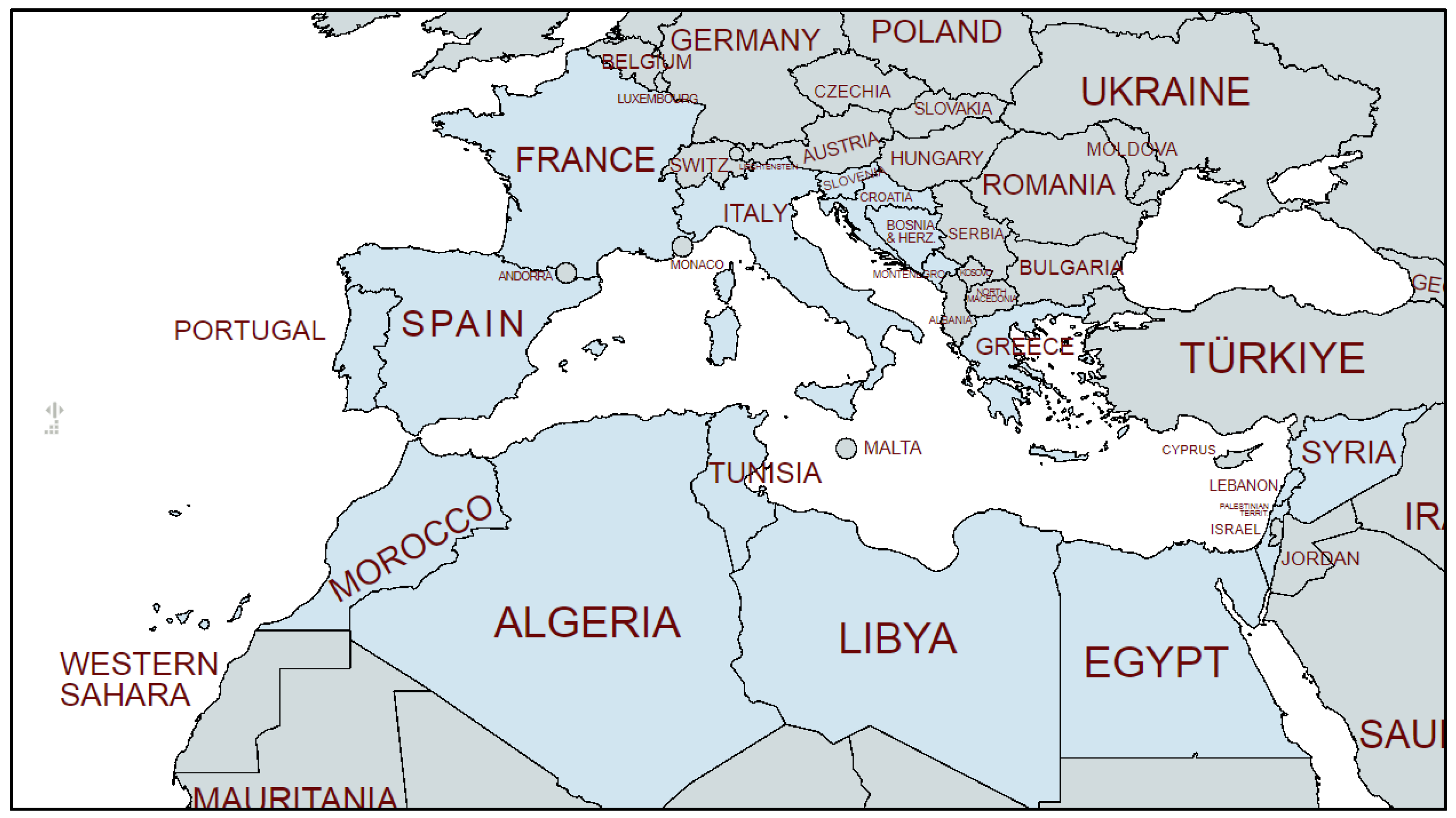
In Mediterranean countries, potatoes play an important role, occupying an overall area of just less than one million ha and producing about 25 Mt of tubers [1]. The Mediterranean region includes the countries that border the Mediterranean basin across Europe, Africa, and Asia. Some of them are in Southern Europe (Spain, France, Monaco, Italy, Slovenia, Croatia, Bosnia and Herzegovina, Montenegro, Albania, and Greece), others in North Africa (Morocco, Algeria, Tunisia, Libya, and Egypt), and others in Western Asia (Turkey, Syria, Lebanon, and Israel) (Figure 1). The main potato-producing countries in the Mediterranean region include Egypt (8 Mt year−1), which is also a major exporter to Europe and the Middle East, Turkey (7 Mt year−1), Algeria (around 4.5 Mt year−1), Morocco and Spain (about 2 Mt year−1), and Italy (1.5 Mt year−1) [1]. The Mediterranean region is characterized by mild, wet winters, hot and dry summers, and abundant sunlight—conditions that are generally favorable for potato cultivation, especially when irrigation is available. Unlike colder regions, Mediterranean climates allow multiple planting seasons: autumn planting with winter harvest, winter planting with spring harvest, and early spring planting with early summer harvest. This makes the region an important supplier of early-season potatoes for Europe [4].

1.2. Water Availability

Water availability is one of the major limiting factors in the production and quality of potatoes, due to the crop’s high sensitivity to water deficit (essentially attributable to its shallow root system) [4,5], which causes a reduction in the number and size of leaves, delays tuber differentiation, slows subsequent growth, and has negative effects on tuber yields and earliness [6,7]. It is therefore evident that when rainfall is unable to satisfy the water needs of the crop, supplemental irrigation becomes essential to ensure stable crop yields and to reduce inter-annual variability in production [8,9,10]. Unfortunately, water is often used inefficiently, resulting in significant water losses, due to both over-irrigation with excessive water inputs (up to 250–300 mm per crop season) that exceed the actual requirements of the crop, and inefficient irrigation methods (such as furrow or macro-sprinklers) [11]. At the same time, by analyzing water use data at a finer spatial scale, it is possible to identify a critical situation in the Mediterranean region where water resources have long been chronically scarce, while the population continues to grow, especially along the southern Mediterranean shoreline. In Mediterranean countries over the last 20 years, the number of irrigated farms has decreased by about 22%, while irrigated areas have declined by approximately 9% [12]. Further reductions are expected in the future due to urban expansion, which increasingly limits the availability of arable land, as well as climate change [13]. A sectoral analysis of water use in the Mediterranean region shows that about 72% of the available water resources in the region are used for agricultural purposes, and agriculture will continue to be the main water-consuming sector [13]. Considering the specific case of Italy, the country uses about 42 km3 of water per year, distributed as follows: 8 km3 for civil use, 8 km3 for industry, 20 km3 for irrigation, and 6 km3 for energy. Out of the 20 km3 used for irrigation nationwide, the South and the Islands, where potato cultivation is widespread—although they represent only 33% of Italy’s land area—use about 95% of the irrigation water [14]. In this context—characterized by reduced water availability and growing competition for water from other sectors—agriculture, which is the largest consumer of freshwater in the Mediterranean region, is increasingly required to reduce its water consumption. The sector faces the urgent need to adopt new approaches to water resource management that ensure both efficient use and the long-term protection and sustainability of water resources [15,16,17]. Climate change—characterized by a gradual but persistent rise in temperatures—along with higher crop evapotranspiration demand, is expected to increase water requirements in the Mediterranean region, further complicating water management [18,19,20].
Given the decline in water resources and the rising costs of irrigation, there is growing interest in improving water productivity in crop production [21,22]. The primary challenge lies in identifying ways to reduce excessive irrigation inputs while maintaining or even improving crop yields, thereby increasing water productivity [15]. Although there are many papers and reviews on irrigation and water productivity in potato, a systematic review focused on the Mediterranean region is still lacking among the most recent ones [23,24,25]. The present review synthesizes the most relevant scientific literature on irrigation management and water productivity in potato production, with a focus on research conducted in Mediterranean countries.

2. Methodology

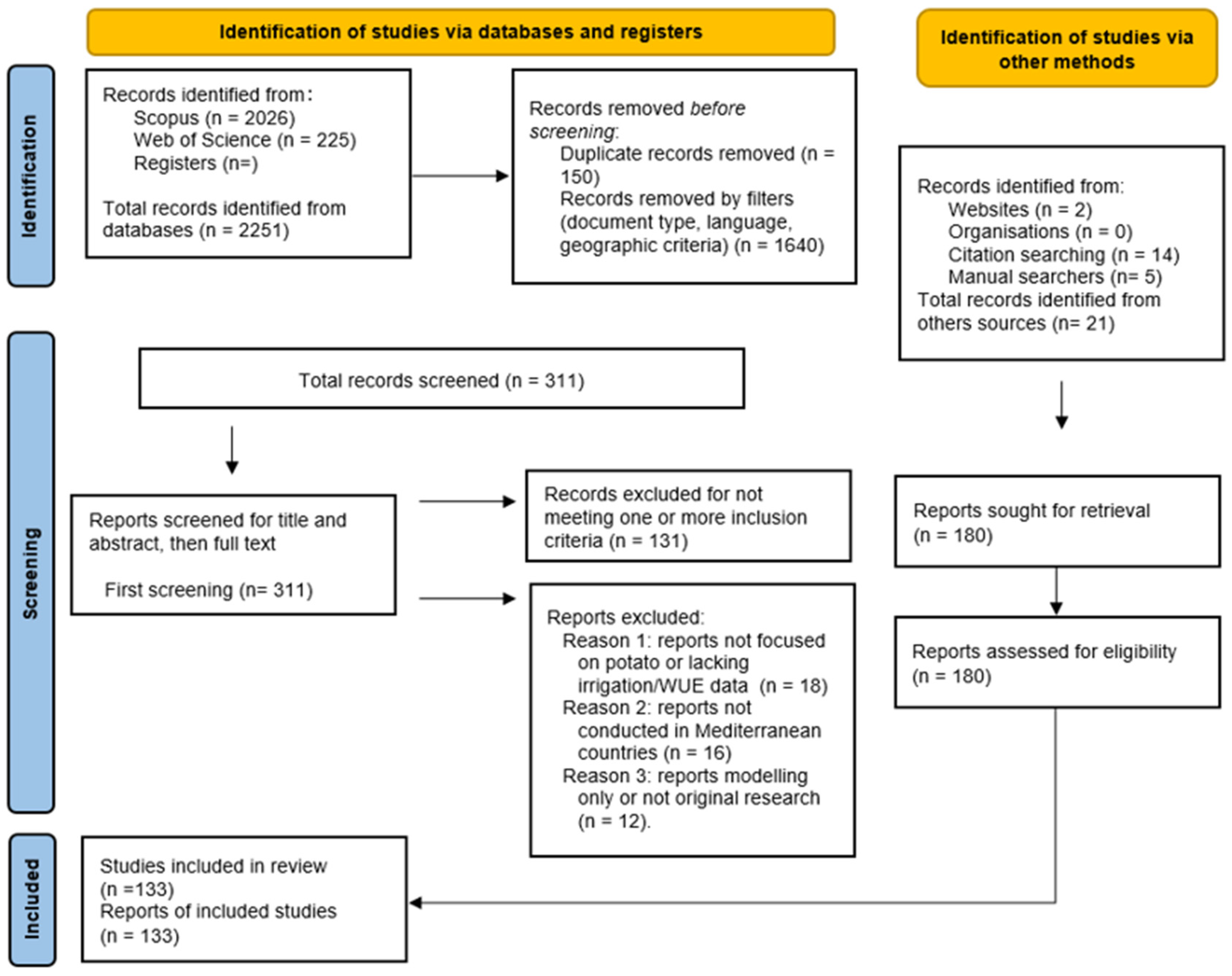
To conduct this systematic review, the objectives were defined using the PICO (Population, Intervention, Comparison, Outcome) framework [26], and the methodology followed the guidelines described by Fohrafellner [27]. A bibliographic search was conducted in accordance with the PRISMA guidelines (see Supplementary Materials) [28], focusing on peer-reviewed literature retrieved from Scopus (Elsevier B.V., Radarweg 29, 1043 NX Amsterdam, The Netherlands) and Web of Science Core Collection (Clarivate Plc, 70 St. Mary Axe, London EC3A 8BE, UK), with additional records identified through Google Scholar, manual searches, citation tracking, and gray literature sources. The detailed search strings and applied filters, including language and geographic restrictions, are reported in Table 1 and Table 2.
The initial database search identified a total of 2251 records, including 2026 from Scopus and 225 from Web of Science. Several filters were then applied to refine the dataset. First, records were limited to articles, resulting in 1692 records in Scopus and 225 in Web of Science. Subsequently, the results were restricted to English-language publications, reducing the dataset to 1529 records in Scopus and 224 in Web of Science. A geographic filter was then applied to focus on studies conducted in Mediterranean and semi-arid regions; after this step, 256 records from Scopus and 205 records from Web of Science remained, resulting in 461 records. Duplicate records between the two databases were subsequently identified and removed (n = 150), leaving 311 records for the screening phase.
The screening process followed a three-stage approach, as recommended by Fohrafellner [27]. First, titles and abstracts were screened to determine their relevance to the objectives of this review, focusing on studies related to potato cultivation, irrigation practices, and water use efficiency or water productivity. During this stage, 131 records were excluded, primarily because they were not directly related to potato cultivation, irrigation practices, or water productivity. The remaining 180 reports were sought for retrieval, and all full texts were successfully retrieved and assessed for eligibility. During the full-text assessment, 46 reports were excluded because they did not meet one or more of the eligibility criteria: 18 studies were excluded because they were not focused on potato cultivation or lacked irrigation or water productivity data, 16 studies were excluded because they were not conducted in Mediterranean countries, and 12 studies were excluded because they were modeling studies or did not include original empirical research. In addition to the database search, 21 additional records were identified from other sources, including manual searches, citation tracking, and gray literature sources such as reports, books, and online materials.
After the eligibility assessment, a total of 133 studies met the inclusion criteria and were included in the systematic review. These consisted of 108 research articles, 8 review papers, and 17 additional sources, including technical reports, datasets, and web resources. The final dataset of included studies was then analyzed to identify the main research themes related to irrigation strategies and water management in potato cultivation within the Mediterranean region. Data extraction was performed using a standardized approach. The following information was collected: study location, experimental conditions, irrigation treatments, water use variables, and main agronomic outcomes (i.e., crop evapotranspiration, tuber yield, water use efficiency, irrigation water productivity, and tuber quality parameters). Additional variables included environmental conditions, irrigation methods, deficit irrigation strategies, planting dates, fertilization practices, and cultivar type. Data were extracted by the authors and cross-checked to ensure consistency and accuracy. The studies were further categorized according to their primary focus, including irrigation methods, factors affecting water productivity or water use efficiency, and crop evapotranspiration (ETc). The detailed selection process is illustrated in the PRISMA 2020 flow diagram presented in Figure 2.
The present review summarizes the results of the included studies through different sections, addressing (a) crop evapotranspiration (ETc), (b) production functions, (c) irrigation methods used, and (d) water use efficiency and water productivity with particular emphasis on water-saving strategies.
A formal risk of bias assessment using standardized tools (e.g., Cochrane RoB or Newcastle-Ottawa Scale) was not conducted. These tools were originally developed for clinical trials and are not well suited to the highly heterogeneous designs typical of agronomic field experiments (lysimeter studies, multi-year open-field trials, greenhouse experiments, and different irrigation methods). Moreover, the review includes a mixture of study types (108 research articles, 8 review papers, and 17 gray literature sources), for which no validated risk-of-bias instrument currently exists in agricultural sciences. Instead, the reliability of the included studies was evaluated qualitatively, considering experimental design, methodological clarity, number of replicates, consistency of results across years and locations, and potential sources of bias such as non-randomized treatments or limited replication. Potential reporting bias was also considered qualitatively. The inclusion of diverse data sources, including gray literature, helped reduce the risk of selective reporting.
This review was not prospectively registered, and no formal protocol was prepared prior to the conduct of the study.
Data extracted from primary studies used different terminology for water productivity metrics (e.g., water use efficiency—WUE, irrigation water productivity—IWP, crop water productivity—CWP). These were harmonized where possible according to the definitions provided in Section 6 (CWP = yield/ETc; IWP = yield/applied irrigation water; TWP = yield/total water supply). Heterogeneity among studies was explored narratively by grouping findings according to irrigation strategy (static DI, dynamic DI, PRD, etc.), climatic conditions, soil texture, irrigation method, planting date, fertilization level, and cultivar. No statistical meta-analysis was performed due to the large variability in experimental conditions, measurement protocols, and reported variables.

3. Crop Evapotranspiration (ETc)

Crop evapotranspiration (ETc) represents the total amount of water used by a crop, including water lost through plant transpiration, evaporation from the soil surface, and a small portion retained in plant tissues. In fact, only about 1% of the water absorbed by plants is used for metabolic processes. Therefore, ETc effectively reflects the overall water consumption of a crop and is a fundamental parameter for estimating the water requirements during the growing season at a specific location. Potato water use is influenced by several factors, such as local climatic conditions, irrigation practices, and other environmental and management variables (Table 3). For potato crops, which generally have a phenological cycle of 120–150 days, seasonal water requirements range from 350 to 625 mm, depending on climatic conditions [29]. In the Central Bekaa Valley of Lebanon, the seasonal irrigation requirement for potatoes was approximately 530 mm [30]. Under semiarid conditions in Turkey, ETc values ranged from 445 to 683 mm [31], while in Cyprus, potato water use was around 290 mm [32]. ETc values generally increase with greater water availability. For example, in the hot and dry climate of Spain, ETc ranged from 172 mm for rainfed potatoes to 436 mm for fully irrigated crops [33]. Similarly, in cool semiarid environments, ETc values were about 195 mm for unirrigated crops and 445 mm for well-irrigated crops [34]. In Southern Italy, reported ETc values were 162 mm for the unirrigated control, 296 mm under 50% ETc irrigation, and 429 mm under full (100% ETc) irrigation [35]. Similarly, under Turkish climatic conditions, four irrigation regimes (0%, 33%, 66%, and 100% full irrigation) were evaluated, and the seasonal irrigation amounts were reported to range from 102 to 302 mm in the first season and 88 to 268 mm in the second [36]. The cumulative Penman potential evapotranspiration (Etp) at the end of the season reached around 400 mm, and the total depth of water applied between planting and harvest through irrigation (I) and rainfall (P) varied from 68 mm in rain-fed treatments to 670 mm in the wettest treatment [37]. In Southern Italy, under Mediterranean conditions, potato seasonal irrigation amounts of 330 mm and 237 mm were recorded in two consecutive years under full irrigation treatment [38]. In Turkey’s semiarid climate, seasonal potato actual evapotranspiration (ETa) ranged from 445 to 683 mm. When subjected to full irrigation and reduced irrigation levels of 66%, 33%, and 0%, ETa varied from 226 to 473 mm and 166 to 392 mm, respectively [31]. In Turkey, it was found that water consumption ranged from 190 to 754 mm, with water applied as 1.00, 0.75, 0.50, 0.25, and 0.00% (as control) of evaporation from a Class A Pan, corresponding to a 2-day irrigation frequency by drip irrigation under unheated greenhouse conditions [39].
ETc is influenced by the stage of crop growth; as crop cover increases, ETc rises and reaches its peak just before the crop achieves effective full cover, primarily due to the expansion of leaf area and increased transpiration. ETc varied from about 120 mm to around 280 mm, corresponding to a daily mean value at the maximum stage of growth (55 days after planting) from about 1.3 mm to around 5.6 mm for fully irrigated crops [37]. Additionally, ETc varies according to soil characteristics. Potato seasonal evapotranspiration was 413.2 ± 15 mm in a loam soil and 362.1 ± 16 mm in clay soil in Valenzano, Italy [40]. Water requirements also varied with the potato crop cycle. In southern Italy, potato crops were grown in three different crop cycles: a spring-summer cycle on high hilly ground or in the mountains, a winter–spring cycle, and a summer–autumn cycle for early potato production in coastal areas. Irrigation water requirements were found to range from about 300 m3 ha−1 to about 2200 m3 ha−1 [41].

4. Water Production Functions

High tuber yields are strongly dependent on an adequate soil water supply. This relationship is demonstrated by the strong correlation between rainfall and yield, which also explains why variations in water availability are a major factor contributing to year-to-year fluctuations in crop yield.

4.1. Linear Relationships

Linear relationships were developed between potato yield and seasonal evapotranspiration with different regression slopes and intercepts under different environments [42,43,44]. Studies conducted in semi-arid regions have shown that potato yield responds linearly to applied water where irrigation plus rainfall is less than or equal to evapotranspiration (ETc). The yield response to rainfall combined with irrigation represents the simplest crop yield/water production function. During the potato tuber ripening stage, the irrigation management has the greatest impact, as demonstrated by the significant coefficient of the applied irrigation amount during ripening (w3) within the linear production function [45]. In Turkey, a strong linear relationship between potato yield and crop evapotranspiration was reported, with an R2 value of 0.94 [34]. A linear relationship between potato tuber yield and seasonal water supply has been reported, with a high R2 value of 0.973 and a regression slope indicating a yield increase of 92 kg ha−1 for each millimeter of applied water [46]. Likewise, another study identified a similar linear relationship, with an R2 value of 0.674 and a regression slope of approximately 84 kg ha−1 per millimeter of applied water [47]. Similar relationships have been reported by other authors [48,49]. In addition, differences in regression slopes were reported between sprinkler and trickle irrigation systems, with higher water productivity under sprinkler irrigation than under trickle irrigation in Turkey [50].

4.2. Polynomial Relationships

Moreover, it was found that a second-order polynomial regression model best fits the relation between the total water use (irrigation + rainfall) and the resulting crop yield [51]. A marked quadratic relationship was found between tuber yield and the seasonal applied irrigation water by several authors [30,43,44]. The relationship between the total tuber fresh weight and total water use displayed a linear function (R2 = 0.66) [37]. A cubic polynomial relationship between potato yield and the seasonal amount of applied irrigation water has also been reported [52]. Overall, such relationships may vary considerably in terms of linear regression slopes, intercepts, constants in polynomial equations, and coefficients of determination. These differences are influenced by factors such as crop management practices, irrigation methods and scheduling, potato genotypes, soil characteristics, climatic conditions, and other environmental and agronomic factors [53].

5. Irrigation Methods

Various irrigation methods, including furrow, sprinkler, surface drip, and subsurface drip irrigation, are employed in potato crops. The effectiveness of these methods varies with local climate and soil conditions, often leading to contrasting outcomes across different studies. Each irrigation technique has its own advantages and disadvantages that affect its effectiveness, largely depending on how efficiently water is delivered to the root zone for plant uptake. Moreover, the irrigation method can also influence fertilizer absorption [54].

5.1. Furrow Irrigation

One of the most widely used irrigation methods worldwide is furrow irrigation, in which crops are planted on ridges between furrows and water is conveyed through the furrows, reaching the roots through vertical and lateral infiltration. Furrow irrigation is simple and inexpensive as it requires no material purchases; however, it demands significant labor, poses challenges in accurately measuring water quantities, leads to uneven water distribution along furrows, and has relatively low efficiency (approximately 60%, or even less in highly permeable soils). Research on the effects of furrow length (10, 25, and 40 m) and flow rate (0.4, 0.6, and 0.8 L s−1) found that potato crop yields decreased with increasing furrow length but improved with higher flow rates [55].

5.2. Sprinkler Irrigation

Another widely used irrigation method for potato cultivation is sprinkler irrigation, which can save approximately 40% of water compared with furrow irrigation. In this system, water is applied in the form of artificial rainfall through sprinklers connected to pressurized pipelines powered by motor–pump units. Sprinkler systems can be classified as mobile, semi-permanent, or permanent. Giant self-propelled sprinklers must be used with caution because their high rainfall intensity may result in uneven water distribution, soil erosion, and the exposure of tubers, which can cause them to turn green [56]. Similarly, rain-wing systems require careful management to prevent soil degradation, water stagnation, and damage to the plant’s aerial parts. Low-intensity irrigation using mini-sprinklers is generally preferable, as these devices apply water more gently over the crop canopy. Their light jets produce minimal soil impact due to the low spray trajectory and close spacing (7–15 m). Mini sprinklers are particularly suitable for windy areas, such as coastal regions, where they can achieve distribution uniformity above 70%, even on uneven terrain, thanks to flow regulation mechanisms. The efficiency of the sprinkler irrigation method is moderate (0.70) but can be increased to 0.75–0.80 when using micro sprinklers. Additionally, sprinkler irrigation resulted in better visual quality and a significantly lower incidence of sugar ends [57]. However, sprinkler irrigation can also favor the development of oospores of Phytophthora infestans [58].

5.3. Drip Irrigation

In contrast, in arid and semi-arid regions with limited rainfall, drip irrigation is increasingly adopted in potato cultivation due to its high efficiency (0.85–0.90). This system delivers water directly to the soil through emitters or drippers connected to a network of small-diameter plastic pipes, applying water at low rates (2–20 L h−1) [59]. Drip lines can be installed on the soil surface in surface drip irrigation (SDI) or buried below the soil in subsurface drip irrigation (SSDI). Surface drip irrigation directs water downward by gravity, while subsurface drip irrigation moves water upward through capillarity, achieving the highest efficiency (0.90–1.0). Drip irrigation is suitable for all soil types, particularly light or shallow soils with low water-holding capacity, and is ideal when water supplies are limited or brackish. Additionally, drip systems allow for fertigation—the injection of soluble fertilizers into the irrigation water—offering an effective approach to manage water and nutrient use efficiently [60]. Furthermore, a comparison of surface and subsurface drip irrigation across four irrigation regimes showed that the choice of irrigation method did not significantly affect tuber yield [36]. Similarly, a study in Southern Italy evaluated furrow and drip irrigation supplying 0, 33, 66, 100, and 133% of the maximum evapotranspiration (ETm) and found no significant differences in tuber yield between the two irrigation methods [8]. Two field experiments in two successive summer seasons at the experimental farm of the National Research Centre were conducted in El-Nubaria, Egypt, to investigate the effects of two drip irrigation systems, namely SDI and SSDI, on potato [61]. The results showed that SSDI proved superior to SDI for all vegetative and yield growth characteristics, as well as irrigation water productivity (IWP). However, in many regions worldwide, the high initial investment costs make drip irrigation systems economically challenging for potato farmers. Additionally, retrieving polyethylene pipes after use adds labor and expense. The system’s vulnerability to damage by rodents further increases field repair costs, making it less accessible for farmers with limited financial resources [41].

6. Water Productivity

This section distinguishes between Crop Water Productivity (CWP), Irrigation Water Productivity (IWP), and Total Water Productivity (TWP) as essential metrics for evaluating agricultural efficiency at different scales. CWP serves as a measure of biological efficiency, quantifying yield relative to evapotranspiration (ET), and is influenced primarily by crop type and environmental conditions. In contrast, IWP focuses on field-level management, demonstrating that yield per unit of applied irrigation can be optimized through technologies like drip systems and deficit irrigation strategies. TWP provides the most comprehensive view for basin-scale sustainability by accounting for both rainfall and irrigation, though it remains highly sensitive to factors such as water salinity. Ultimately, optimizing these metrics requires a strategic balance between yield goals and water conservation, with the choice of metric determined by whether the objective is field-level performance, system-wide planning, or biological assessment.

6.1. Water Productivity and Climate

Potatoes have been reported to have high Crop Water Productivity (CWP) among the major food crops [62,63,64]. Water productivity (WP) has been reported to range between 12 and 25 kg m−3 in temperate climates [65,66], 10–13 kg m−3 in sub-humid climates [67], and 9–13 kg m−3 in hot and dry environments [68,69]. In Mediterranean countries, average CWP values of around 11 kg m−3 were observed in Southern Italy, comparable to those reported in Portugal [51] (WUE in original study), and higher than the approximately 8.5 kg m−3 reported in Turkey [36] (WUE in original study). CWP can, however, be modified or optimized by implementing water-saving strategies, selecting appropriate irrigation methods, adopting improved agronomic practices, and choosing suitable cultivars.

6.2. Water Productivity and Water-Saving Strategies

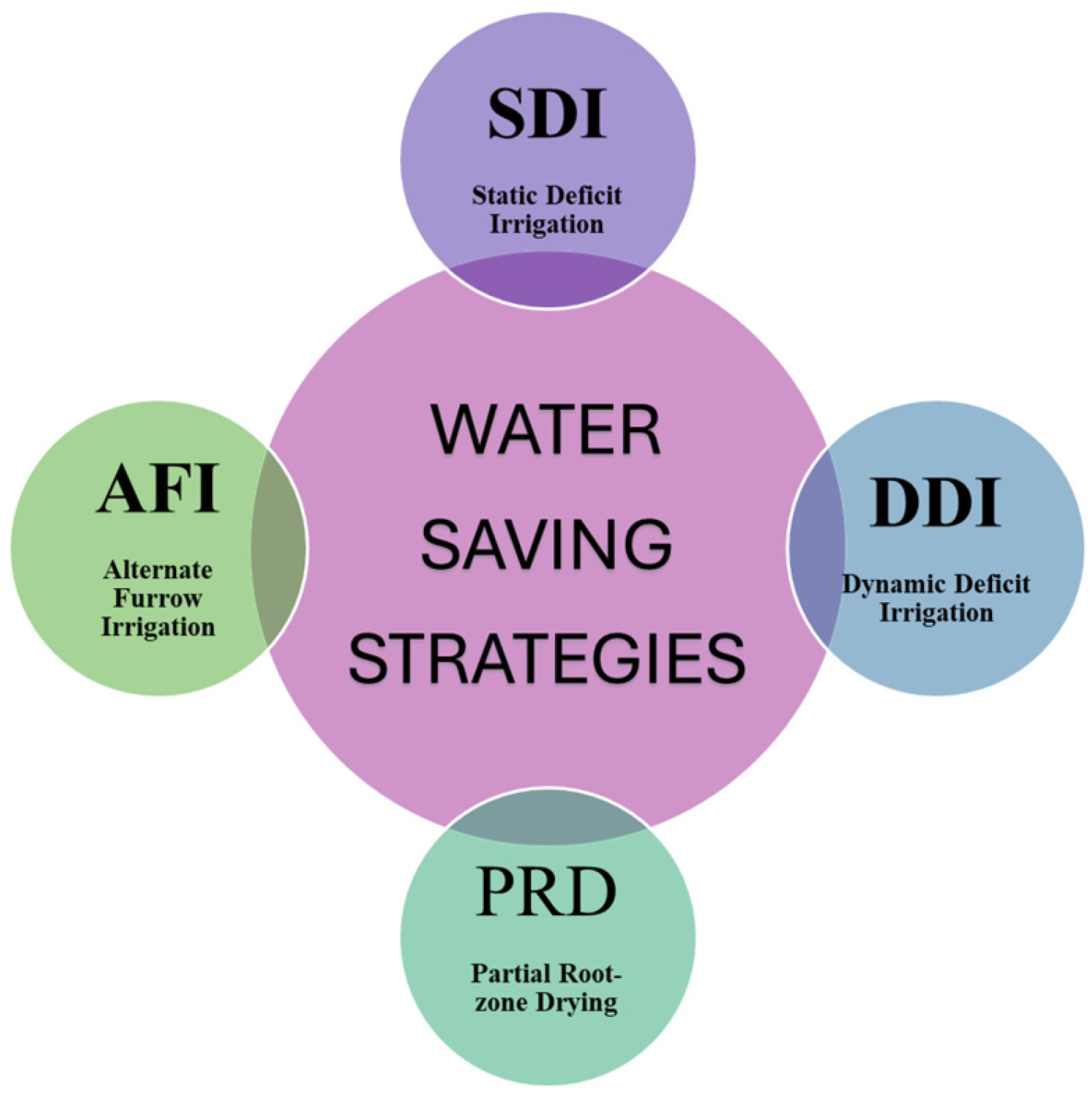
To save water resources without causing severe yield reductions, and consequently improve irrigation water productivity (IWP), some water-saving irrigation strategies have been studied in potato crop cultivation. The main successful water-saving strategies studied in potato crops are summarized in Figure 3.
One of the most studied water-saving strategies in potato crops is Deficit Irrigation (DI) [70]. In DI, the crop can be under-irrigated throughout the whole growing season (Static Deficit irrigation—SDI) or only at a particular growth stage (Dynamic Deficit Irrigation—DDI) [71,72].

6.2.1. Static Deficit Irrigation

In SDI, water deficit is applied over the full growing cycle, and the crop receives slightly less irrigation water amounts than the crop’s actual evapotranspiration. In field experiments conducted in Sicily (Southern Italy) [8], the effects of 0, 33, 66, and 100% ETm supply were studied, and no significant yield differences were reported between 100 and 66% of ETm on potato tuber yield, with a consequent increase in IWP in the irrigation regime involving 66% ETm. In other field experiments conducted in Sicily (Southern Italy) [35], two potato cultivars were examined under varying planting dates and irrigation regimes (50% and 100% ETm). Plants subjected to moderate water deficit (50% ETm) exhibited increased diffusive leaf resistance, reduced photosynthetic rate, inhibited tuber growth, and ultimately diminished tuber yield compared to well-watered controls, but with a clear increase in IWP. Recent advancements, such as utilizing spectral information tools, have enhanced the ability to assess physiological responses to water stress in potatoes [73]. In other research conducted in the same environment, reducing irrigation from 100% to 50% ETm resulted in approximately 55% increase in IWP [74], and supplying 50% ETc, compared with 100% ETc, significantly increased IWP by 71% or 77% (WUE in original study) when tubers were harvested at early or final stages, respectively [11], achieving a save of about 380 m3 ha−1 of irrigation water for early harvests and 600 m3 ha−1 for final harvests. In a subsequent study, an increase in IWP was observed under 50% ETc, compared with 100% ETc [38]. In Spain [51], the effects of four irrigation treatments namely 60, 80, 100, and 120% of potato crop water requirement (CWR) were studied during a two-year experiment: the IWP ranged from 8.6 to 11.6 kg m−3 in the first year and 7.1 to 8.4 kg m−3 in the second year (WUE in original study). A study also examined the effects of injecting hydrogen peroxide (oxygenation) at concentrations of 0, 300, and 600 ppm through subsurface irrigation combined to with different irrigation regimes in heavy clay soils and it was found that oxygenating the irrigation water significantly enhanced vegetative growth and productivity, particularly when 600 ppm hydrogen peroxide was combined with deficit irrigation, achieving also the highest IWP [75].
Two successive summer field experiments at the National Research Centre farm in El-Nubaria, El-Behira, Egypt, investigated four irrigation levels (120, 100, 80, and 60% ETc) on three potato varieties (Spunta, Hermes, and Cara). Results revealed that IWP significantly increased with decreasing irrigation level up to 80% ETc, while the lowest values were obtained by 60% ETc treatment in the two studied seasons [61]. In a field trial conducted in Tunisia, it was observed that reducing irrigation resulted in an average tuber yield decrease of about 21% for 40% deficit irrigation and of about 47% for 70% deficit irrigation over a two-year study, indicating that potatoes are not highly sensitive to moderate water stress [76]. Furthermore, statistically similar tuber yields were observed under 40% DI and full irrigation, whereas this parameter was significantly lower under 70% DI [77]. The highest irrigation water use efficiency (IWUE) and total water use efficiency (TWUE) (original study terms for IWP and TWP, respectively) were observed at 70% deficit irrigation (DI), with values of 19.28 kg m−3 and 13.56 kg m−3, respectively, during the spring season, and 14.83 kg m−3 and 8.24 kg m−3, respectively, in the autumn season. In a study conducted in Turkey [36], IWP ranged from 9.33 to 36.44 kg ha−1 m−3 (WUE in original study). The maximum IWP was achieved under a treatment supplying 33% of maximum evapotranspiration. Total water productivity (TWP) ranged from 6.17 to 14.01 kg ha−1 m−3. Another Turkish study under unheated greenhouse conditions [39] applied water at 1.00, 0.75, 0.50, 0.25, and 0.00% (control) of evaporation from a Class A pan, using a 2-day irrigation frequency. The highest values for WUE and IWUE (original study terms for CWP and IWP, respectively) were found to be 4.84 and 4.29 kg m−3 for the 0.75% treatment. In another 2-year experiment in Turkey, the impact of different drip irrigation treatments (100%, 66%, and 33% of field capacity) on potato yield, quality and WUE was also investigated [78]. Full irrigation produced the highest total tuber yield, whereas the 66% field capacity irrigation treatment had the highest IWP in both years. Overall, studies in Mediterranean countries show that applying Static Deficit Irrigation (SDI), where crops receive slightly less water than actual evapotranspiration (50–80% ETc), can significantly reduce irrigation water use while maintaining acceptable yields and improving IWP.
The finding that static deficit irrigation at 50–80% of ETc consistently improves irrigation water productivity (IWP) while limiting yield penalty is supported by at least 12 independent field studies conducted in Italy (Sicily), Spain, Turkey, Tunisia, and Egypt. These studies involved different cultivars, soil types, and climatic conditions over multiple seasons, showing highly consistent directional trends. Confidence in this conclusion is therefore considered moderate to high for Mediterranean semi-arid environments.

6.2.2. Dynamic Deficit Irrigation

Another way of reducing water applications is Dynamic Deficit Irrigation (DDI), which involves limiting the applications of irrigation water to the drought-sensitive growth stages (critical stages) of the crop, while water deficit is applied during growth stages less sensitive to water scarcity. Overall, the critical stage in potatoes is recognized to be tuber bulking, while less sensitive growth stages are both early vegetative growth and late tuber bulking [79,80]. Results from multiple experiments in Mediterranean countries indicate that the impact of water deficit on potato tuber yield depends on both the amount of water supplied and the growth stage at which the deficit occurs (vegetative growth, tuber initiation, bulking, or ripening). While yield losses may be relatively small, significant irrigation water savings can be achieved. For example, in a semi-arid region of Albacete, Spain, the effects of deficit irrigation were evaluated at three crop stages: vegetative growth, tuber bulking, and ripening [55]. Although potato yield declined under deficit irrigation at each stage, a significant increase in irrigation water productivity (IWP) was observed. However, larger tubers were produced under full irrigation and when deficit irrigation was applied during the ripening stage. The smallest tubers were observed when deficit irrigation was applied during the growth period, although this resulted in a higher number of tubers per plant.
A lysimeter experiment was performed in Italy [81] to test three irrigation regimes: 40%, 60%, and 80% of ET; water was withheld for 80 mm based on ET at three critical growth stages: tuber initiation, early tuber growth, and late tuber growth; a fully irrigated control treatment was included for comparison. Withholding water during tuberization significantly hindered plant physiological processes and resulted in reduced tuber yield. IWP remained relatively constant across treatments, indicating that while less water was applied, the efficiency with which the plants used the available water was consistent.
In Southern Italy [82], the effects of water deficit during the first part of tuber growth (from tuber initiation to 50% tuber growth) or the second part (from 50% tuber growth to the end of tuber growth) were explored, while ensuring that 100% of ETm was supplied during the opposite growth phase. Studies have shown that applying irrigation up to approximately 50% of tuber growth, rather than from mid-growth to harvest, is more effective for maximizing production. Compared with full-season irrigation, this approach results in only a slight reduction in tuber yield (around 10%) while saving roughly 900 m3 ha−1 of water per irrigation season.
The same authors, in the same environment and in a field experiment, sequentially analyzed different levels of water supply in the second part of tuber growth, in addition to 0% ETm, 50%, and 75% ETm [83]. In a comparison with fully irrigated controls, applying 100% of ETm from tuber initiation up to 50% of tuber growth and 50% of ETm from mid-growth to harvest resulted in similar tuber yields while increasing from 14.9 to 21.1 kg FW m−3 and saving approximately 820 m3 ha−1 of irrigation water. A study in the Central Bekaa Valley of Lebanon examined the effects of severe water deficits (0% ETm) applied during two critical growth stages—tuber bulking (75 days after planting) and tuber ripening (90 days after planting)—over two years [30]. Marketable yield declined by 12% when the deficit occurred during tuber bulking and by 42% when imposed during tuber ripening. Under limited water conditions, the irrigation level that maximized net income per unit of water (Ww) enabled water savings of 10–15% of the total applied. These results underline the sensitivity of potatoes to water stress at critical growth stages, particularly during tuber ripening, where the impact on yield is much more pronounced. Overall, in Dynamic Deficit Irrigation, it has been observed that the water supply in the critical stage for potato crop (tuber bulking) cannot be less than 50% of the ETc, without incurring considerable yield reductions.
Results on dynamic (stage-specific) deficit irrigation are based on 10 studies, mainly from Italy, Spain, Lebanon, and Turkey. While yield responses varied depending on the exact growth stage affected (tuber initiation vs. bulking vs. ripening), the directional finding that water deficit should not fall below 50% ETc during tuber bulking to avoid substantial yield losses is consistent across experiments. Evidence strength is rated moderate.

6.2.3. Partial Root-Zone Drying

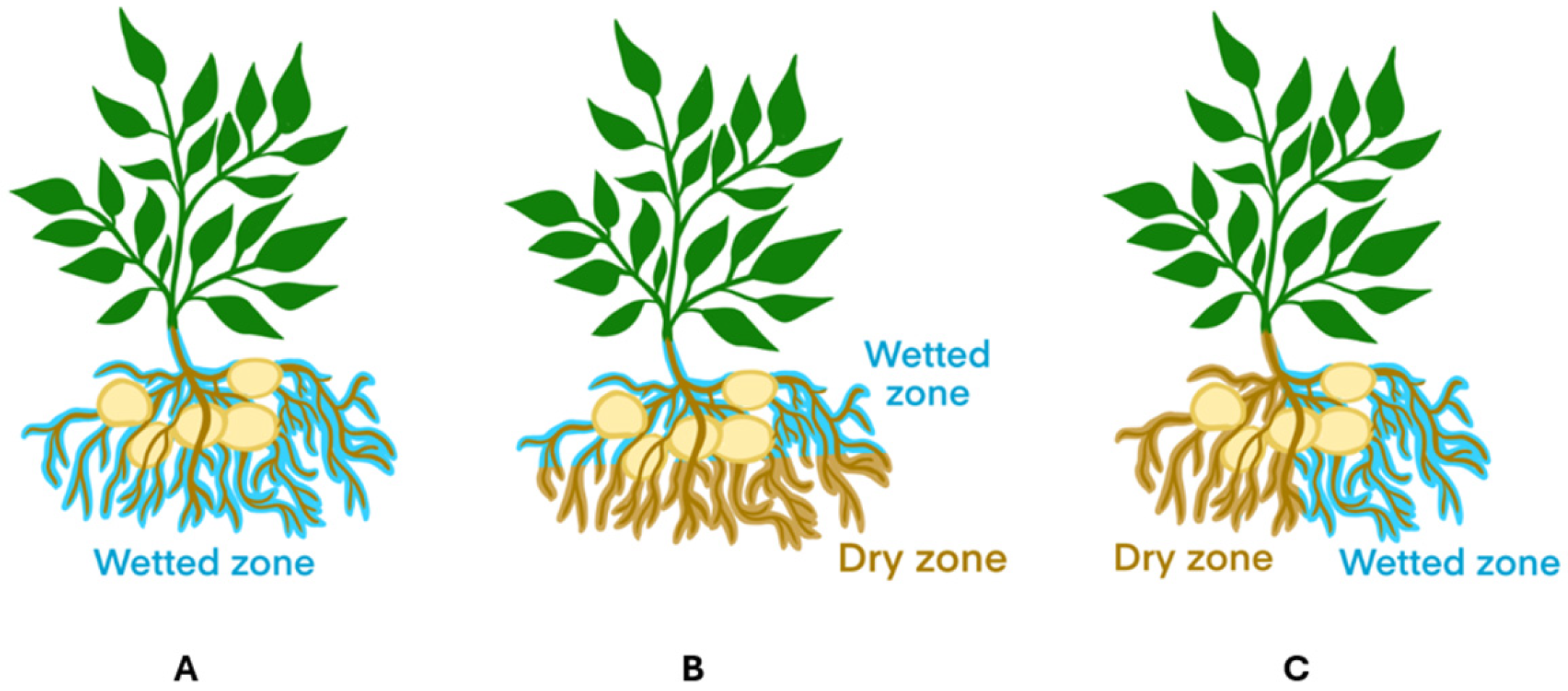
Another water-saving irrigation strategy, namely partial root-zone drying (PRD), has been developed in the last twenty years. This technique consists of watering, at alternating periods, only half of the root zone, while the other half remains dry (Figure 4). The frequency of changing irrigation from one-half to the other depends on the soil water balance and the growth phase of the crop. The first studies on the effects of PRD in potatoes for saving irrigation water were conducted in the United Kingdom [84,85] and in Denmark [86,87,88,89].
In a 2007 field experiment conducted over two years, the effects of FI and PRD with 70% of FI water application were assessed for yield, tuber size, and IWP of potatoes [65]. PRD saved 30% of irrigation water and achieved a 61% increase in irrigation water productivity (IWP), while maintaining overall tuber yield and improving marketable tuber size. Results on root distribution [90] revealed that potatoes irrigated with water-saving irrigation techniques (PRD and DI) did not show statistically significant differences in dry root mass and root length density compared with root development in fully irrigated (FI) potatoes. Results on gas exchange [91] revealed that the transpiration efficiency of PRD was higher than that of DI, indicating slightly better water use with PRD. This improvement was attributed to the modulation of stomatal morphology under PRD, resulting in smaller stomata and lower stomatal density compared to DI. These changes effectively reduced transpiration rates and conserved water [92]. Furthermore, PRD-treated plants exhibited smaller and denser stomata compared to both FI and DI treatments. This stomatal adaptation likely optimized leaf gas exchange, contributing to enhanced IWP [93].
Other authors found that both DI50 and PRD50 treatments significantly reduced water loss by lowering stomatal conductance and transpiration rates. The PRD50 treatment showed an increase in ABA levels, which may help the plant better manage water stress by further reducing transpiration. The water-stressed conditions due to PRD and DI also resulted in increased chlorophyll concentrations and, consequently, a reduced senescence rate, although this was associated with a reduced tuber yield under greenhouse conditions with increased water stress [94,95].
In another field experiment carried out in Northern Italy [96], the PRD irrigation strategy was compared with RDI, and it was found that PRD increased total and first-class tuber yield by about 5% compared to RDI, with a higher tuber weight (+14.9 g); however, IWP was similar between irrigation treatments. In two field experiments conducted on a farm in Egypt, the effects of partial root-zone drying (PRD) and deficit irrigation (DI) at 100%, 75%, and 50% of ETc were evaluated. The results showed no significant differences in yield and water productivity (WP) between full irrigation at 100% ETc and PRD, with the ranking of treatments as follows: FI + 100% ETc > PRD > FI + 75% ETc > FI + 50% ETc [97]. A two-year study in Egypt further examined various irrigation strategies. In the first year, treatments included full irrigation at 100% ET (V100), a 50% reduction until the end of tuber initiation (V50–100), a 50% reduction from mid-tuber bulking to maturity (V100–50), and no irrigation after plant establishment (V0). In the second year, the study expanded to include deficit irrigation at 50% ET for the entire season (DI50) and PRD at 75% or 50% ET for the whole season (PRD75 and PRD50). The results indicated that deficit irrigation improved WP, particularly under the V100–50 treatment, suggesting that water use efficiency is more closely influenced by the crop’s growth stage than by the soil’s overall water availability. In the second year, despite receiving the same amount of water, yield reductions were more pronounced with DI50 (41%) compared to PRD50 (28%), demonstrating the superiority of PRD50 in maintaining yield and increasing IWP. These findings suggest that PRD, particularly when combined with subsurface irrigation, enhances water efficiency and is a promising strategy for water conservation in potato cultivation under arid conditions. Overall, PRD showed a yield penalty similar to that caused by both Static and Dynamic Deficit Irrigation when deficit levels close to 50% Etc were utilized.
PRD effects on potato are documented in fewer Mediterranean studies (approximately 6–7 field and greenhouse experiments in Italy, Egypt, and Tunisia) compared with deficit irrigation. Nevertheless, the observed similar or slightly better IWP compared with conventional deficit irrigation at equivalent water volumes is consistent, particularly when combined with subsurface drip irrigation. Evidence is promising but still moderate due to the lower number of independent studies.

6.2.4. Alternate Furrow Irrigation

From the PRD technique, the alternate furrow irrigation (AFI) was developed, where the irrigation applied through the furrow method is alternated between the furrows. AFI is a simple, easy-to-operate, efficient, and low-cost technology that can drastically reduce the amount of water used. In Tunisia, a comparison of alternate furrow irrigation, fixed furrow irrigation, and conventional furrow irrigation revealed that average irrigation amounts were 65 mm, 60 mm, and 91 mm, respectively, with WP values of 8.0 kg m−3 (alternate), 8.7 kg m−3 (fixed), and 5.9 kg m−3 (conventional) [98]. Importantly, alternate furrow irrigation achieved these gains with no reduction in yield compared to conventional methods. These results highlight the potential of alternate furrow irrigation to conserve water and enhance IWP without compromising yield.
Alternate furrow irrigation results are supported by a limited number of studies (mainly from Tunisia), yet they show clear and consistent water savings and improved water productivity without yield reduction compared with conventional furrow irrigation. Further confirmation across more countries would strengthen this evidence.

6.3. Water Productivity and Tuber Quality

In addition to tuber yield, the main nutritional characteristics were also influenced by water-saving strategies in Mediterranean countries (Table 4). Tubers’ specific gravity, which is one of the characteristics determining harvest quality and is used by the potato industry for storability, fry quality, and baking characteristics, in general, tends to increase in deficit irrigated potatoes both in SDI [78,94,99,100] and DDI [101]. A reduction in tuber-specific gravity associated with late-season irrigation was reported by Silva [102]. However, paradoxically, season-long uniform stress does not have the same negative effect on potato tubers.
Dry matter content, which is the percentage of solids in a potato, is closely related to specific gravity, and it has also been found to increase in SDI and DDI trials conducted in Mediterranean countries [11,30,78,100,101,103].
Starch content, another important nutritional trait, also increases under all water saving strategies studied [78,96,100,101,103,104] similarly to dry matter, which is expected because starch represents about 70% of tuber dry. With regard to sugar content, it should be noted that different studies [96,100,103,105] on the effects of water stress and water saving strategies (both static and dynamic deficit irrigation) on sugar content have led to contrasting results, suggesting that the impact of irrigation water management on the potato sugar content might be genotype-dependent [106], as has also been noted in a specific review [107].
Effects of water-saving strategies on tuber quality traits (specific gravity, dry matter, starch) are supported by more than 15 studies across Italy, Turkey, Lebanon, Egypt, and Morocco, with highly consistent increases in dry matter and starch content under moderate deficit. Effects on sugar and protein content are more variable and appear partly genotype-dependent. Overall evidence for improved processing quality under controlled deficit is considered moderate to strong.
Table 4. Potato tuber nutritional traits as affected by irrigation water saving strategies in Mediterranean countries.
ParameterWater StrategyTrendCountryReferences
Specific GravitySDIIncreaseTurkey[78]
Specific GravitySDIIncreaseItaly[99]
Specific GravityDDIIncreaseTurkey[101]
Dry MatterSDIIncreaseTurkey[78]
Dry MatterSDIIncreaseItaly[11]
Dry MatterSDINo EffectsItaly[108]
Dry MatterDDIIncreaseItaly[103]
Dry MatterDDIIncreaseItaly[100]
Dry MatterDDIIncreaseLebanon[30]
Dry MatterDDIIncreaseTurkey[101]
Dry MatterSDIIncreaseTurkey[78]
StarchSDIIncreaseEgypt[104]
StarchDDIIncreaseItaly[103]
StarchDDIIncreaseItaly[100]
StarchDDIIncreaseTurkey[101]
StarchPRD vs. DDIIncreaseItaly[96]
CarbohydrateSDINo EffectsItaly[108]
SugarPRD vs. SDIDecreaseMorocco[105]
SugarDDINo EffectsItaly[100]
SugarDDIIncreaseItaly[103]
Reducing SugarsPRD vs. DDIDecreaseItaly[96]
ProteinDDIDecreaseItaly[103]
ProteinDDIDecreaseItaly[100]
ProteinDDIDecreaseTurkey[101]
ProteinPRD vs. SDIDecreaseMorocco[105]
AshDDIDecreaseItaly[103]
AshDDIDecreaseItaly[100]
MetabolitePRD vs. SDIIncreaseMorocco[105]
In another field experiment carried out in Northern Italy [96], the PRD irrigation strategy was compared with RDI and it was found that PRD produced significantly more starch and fewer reducing sugars than RDI in dry years, but this effect was not observed in the rainy year. In two field experiments on a farm in Egypt, the results on the effect of PRD and DI (100% ETc, 75% ETc and 50% ETc) techniques with furrow irrigation indicated that there were no significant differences in quality traits between 100% ETc and PRD, with the ranking of treatments being FI + 100% ETc > PRD > FI + 75% ETc > FI + 50% ETc [97]. Studying the impact of two sowing dates and two irrigation levels (50% and 100% crop ET recovery) during early cultivation in Sicily, it was found [108] that dry matter and carbohydrate contents were minimally affected by the irrigation regime in the season studied, probably due to rainfall events. Regarding proteins and ashes, studies indicate that applying water-saving strategies such as DDI and PRD leads to decreases [100,101,103,105]; this can be explained by the fact that frequent irrigation creates a humid soil environment, which improves nutrient (specifically nitrogen) solubility and availability, enhancing mineral uptake by the plant. In addition, higher metabolite content in potato tubers under PRD than under DI was observed, with smaller decreases in glucose and fructose concentrations and approximately twice the amount of mannitol [105]. Moreover, diverse polyphenolic profiles were correlated with variations in gene expression, which were highly genotype-specific and influenced by drought-induced changes [109].
Considering the numerous results on potato crops, water-saving strategies represent an important opportunity to improve irrigation water productivity (IWP) while maintaining acceptable yields. A controlled reduction in water supply induces a decrease in leaf water potential and stimulates stomatal regulation mediated by abscisic acid (ABA), resulting in reduced transpiration and photosynthesis [86,91]. This physiological response limits vegetative growth, particularly leaf expansion and leaf area index, thereby reducing the crop’s evaporative demand [85]. At the same time, moderate water stress can alter the distribution of assimilates, favoring their allocation to reserve organs (i.e., tubers) [11]. However, potatoes are particularly sensitive to water shortages during tuber initiation and growth, as water restriction can reduce cell division and expansion in tubers, negatively affecting both number and final weight [83]. Nevertheless, moderate water deficit conditions may result in increased dry matter and starch content in tubers, attributable to an increase in cell solute concentration (osmotic adjustment) to maintain cellular turgor under conditions of water deficit [35]. Lastly, controlled deficit irrigation can represent an effective compromise between water savings, yield maintenance, and improved product quality.

6.4. Water Productivity and Irrigation Methods

Selecting an appropriate irrigation method is also essential for optimizing water productivity (WP), as different methods vary in field application efficiency—that is, the proportion of water that reaches the soil zones where plant roots can absorb it. The effect of furrow length (10, 25, and 40 m), and flow rate (0.4, 0.6, and 0.8 L s−1) on irrigation performance, crop yield and water use was studied, showing a decreasing trend in WP as furrow length increased and an increasing trend as flow rate increased [55]. In Saudi Arabia, the effects of two techniques (dual-lateral drip, intermittent flow) that change the wetting pattern of subsurface drip irrigation on WP were studied and WP increased in response to dual-lateral drip (up to 30%) and intermittent flow (~14%) [110]. In Turkey, a comparison of surface and subsurface drip irrigation combined with four irrigation regimes (0, 33, 66, and 100% of full irrigation) showed no significant differences in tuber yield between the irrigation methods; however, surface drip irrigation achieved the highest IWP and is recommended for potato production under Mediterranean conditions [36]. Similarly, when comparing furrow and drip irrigation, no differences were observed in potato yield or yield components, but IWP increased from 5.13 to 7.38 kg m−3 for furrow-irrigated treatments and from 6.907 to 10.257 kg m−3 (original study term for WUE) for drip-irrigated treatments [111]. No significant differences in tuber yield were observed between gun irrigation and drip fertigation in a three-year field experiment; WP was similar between treatments, except in one year, where drip fertigation had significantly greater WP than gun irrigation [112]. In another field experiment, the highest total tuber yield was achieved under sub-irrigation with drain tiles, followed by sub-surface drip irrigation, sprinkler irrigation, and seepage irrigation [113]. The authors attributed the superior tuber yields under sub-irrigation to its efficient and rapid soil water drainage capacity. The study also found that sub-irrigation produced the highest yields of misshapen, decayed, internally heat-necrotic, and brown-centered tubers, while growth-cracked and green tubers were highest under seepage irrigation, likely due to runoff from slow water drainage. These findings underscore the influence of irrigation methods and water management on tuber quality and crop outcomes.
Comparisons of irrigation methods (drip vs. furrow vs. sprinkler) are based on approximately 10–12 studies, predominantly from Turkey, Italy, Egypt, and Tunisia. Drip irrigation (especially surface drip) repeatedly showed higher IWP than furrow irrigation with similar or higher yields. Consistency across studies supports moderate confidence in recommending drip systems under water-scarce Mediterranean conditions.

6.5. Water Use Efficiency and Other Agronomical Aspects

Other agronomic aspects, such as planting date, fertilization management, and cultivar choice, can modify the water productivity of potato crops, optimizing the use of water resources.

6.5.1. Planting Date

Planting date is a critical agronomic practice that influences water productivity in potatoes, primarily due to its impact on rainfall patterns, air temperatures, and the resulting evapotranspirative demand. In the Mediterranean region, a study on irrigated early potato crops revealed significant differences in water productivity between two planting dates just a few weeks apart (5 and 30 January) [11]. Plants sown on the second date showed greater capacity to use irrigation water efficiently under moderate stress, with an increase in Total Water Productivity (TWP) of +77% compared to +66% for the first date (IWUE original study term). These differences are likely due to reduced water availability for the second planting, which received less irrigation (110 mm vs. 130 mm) and rainfall (159 mm vs. 206 mm). Moreover, lower rainfall during the second planting coincided with the critical tuber bulking stage, when water demand peaks [114,115]. In Tunisia, TWP for tuber production also varied with planting time, ranging from 6 to 8 kg m−3 in winter, 8–9 kg m−3 in autumn, and 11–14 kg m−3 in spring (WUE in original study) [116]. Similarly, in a warm tropical environment, studies on three cultivars showed water productivity values of 10–16 kg m−3 in winter and 3–5 kg m−3 in summer [117].

6.5.2. Fertilization Management

Fertilization management also influenced by TWP. Research has shown that in irrigated plots, WP improves with increased nitrogen (N) supply [46,50,118], phosphorus (P) supply, or potassium (K) supply [111]. A study in Italy [42] demonstrated WP rises with higher N-P-K fertilization rates, ranging from 5.3 kg m−3 at the lowest fertilization level to 9.3 kg m−3 at the highest level. In a field experiment conducted in Egypt [46], potato plants were subjected to four irrigation treatments—100%, 80%, 60%, and 40% of ET—combined with four nitrogen (N) levels: 160, 220, 280, and 340 (kg N ha−1). Results showed WP at 100% ET was 146 kg ha−1 mm−1 with N340 (WUE in original study); however, WP increased to 195 kg ha−1 mm−1 at 40% ET with N220 (WUE in original study), indicating better efficiency under reduced water supply when nitrogen was optimized. Moreover, combining three irrigation treatments with six potassium doses (K0, K40, K80, K120, K160, and K200 kg ha−1) [119], showed the optimum irrigation × potassium interaction at I100 × K120 and I100 × K160 for plant and yield parameters, and at I33 × K120 and I33 × K160 for tuber quality. Contrary to other studies, the authors found the highest WP at I100 for both years, decreasing as irrigation decreased; WP increased up to K40 but decreased afterward.

6.5.3. Soil Texture

Although soil texture’s influence on WP is often overlooked in the literature, findings from a multi-year experiment in the Mediterranean region emphasize WP improvement by selecting a suitable soil type [62]. Potato crops grown in clay soil exhibited water stress characteristics during active growth, adversely affecting performance [120]. In contrast, loam soil provided better conditions for water availability and uptake, supporting improved WP and crop yields. The study revealed WP in clay soil was 22–25% lower compared to loam soil (WUE in original study), accompanied by significant decreases in yield and ET. Moreover, PRD was more favorable in fine-textured soils, as plants had sufficient time to adjust to soil water status; in contrast, light-textured soils induced rapid water stress, limiting plant adaptation [121]. Conversely, other research [122] suggested light sandy loam and deep porous soils are best for PRD; shallow sandy soils impose chronic stress, while deep clay soils are less effective due to slow wetting and lateral water spread, reducing irrigation efficiency.

6.5.4. Mulching

Mulching helps conserve water. Research indicates that unmulched land loses more water than plastic-mulched soil, as exposed soil is vulnerable to solar radiation, wind, and heat, leading to higher evaporation. Plastic mulch acts as a protective layer, reducing water loss and improving soil moisture retention. Plastic mulching outperforms traditional tillage in WP; plastic film mulch for half the growing season maximized WP and yield (increased ~82%) in semi-arid agroecosystems [123].

6.5.5. Genotype

Potato cultivars show different responses to drought stress and water-saving strategies [61,124,125,126]. Cultivars producing many tubers per hill generally perform worse under non-irrigated conditions than those producing fewer [127]. Cultivars with stem-type canopies, which typically have higher dry matter and deeper roots, show enhanced drought tolerance [128,129]. A study on two potato cultivars, Producent (leaf-type) and Tomba (stem-type), explored the relationship between shoot and tuber yield under rainfed and irrigated conditions over two years [130]. Varying seasonal rainfall and supplemental irrigation revealed key differences in cultivar responses to water availability. Stem-type (Tomba) showed resilience under water deficit due to larger aboveground biomass, advantageous in water-limited soil. For leaf-type, tuber yield increased linearly with shoot yield, indicating efficient biomass-to-tuber conversion. In the Egypt area three different irrigation levels were evaluated: 100, 75 and 50% of ET during two growing seasons on cultivars Arizona, Diamant, Markies, Spunta and Valor; tuber yield increased with increasing irrigation from 50 to 100% ET for all varieties, with no substantial differences in WP [104]. It was long believed that sensitivity to water deficit was linked to maturity class, with early-maturing varieties considered more tolerant than late-maturing ones [131]. However, drought tolerance does not solely relate to “escape” in early genotypes; genotypes from different maturity classes with specific canopy architectures can also exhibit strong tolerance [130,132]. Tolerant genotypes maintain higher photosynthetic activity under water deficit. Cultivar responses may vary with moderate water stress and harvest timing [133]. In a recent study [11], under moderate water stress, Spunta used irrigation water more efficiently during early harvest than Sieglinde; however, by the final harvest, Sieglinde outperformed Spunta in water use, highlighting genotype-specific responses and the importance of cultivar selection for improving WP.
The modifying effects of planting date, fertilization, soil texture, mulching, and genotype on water productivity are supported by multiple independent studies (collectively >20) performed in Italy, Tunisia, Egypt, and Turkey. Although the number of studies per individual factor is sometimes limited, the directional trends are largely consistent, indicating that appropriate agronomic management can further enhance the benefits of water-saving irrigation strategies.

7. Conclusions

Irrigation is essential in many semi-arid areas of the Mediterranean region to achieve both yield and quality targets in potato cultivation. However, limitations in water resources necessitate optimizing irrigation management and increasing water productivity to conserve water resources. The present systematic review, which for the first time focuses exclusively on studies conducted in the Mediterranean region, highlights the effectiveness of appropriate irrigation management and water-saving strategies in increasing water productivity. Overall, the use of drip irrigation and the application of Static Deficit Irrigation (SDI), Dynamic Deficit Irrigation (DDI), and Partial Root-zone Drying (PRD)—with deficit levels close to 50% of crop water requirements—allow not only a yield penalty limitation but also the maintenance of tuber quality and significant reduction of water waste.
The overall certainty of evidence across the reviewed studies is considered moderate. Most conclusions are supported by consistent directional trends observed in multiple independent studies and countries, despite methodological heterogeneity and the absence of formal risk-of-bias tools specifically validated for agronomic research.

8. Practical Implications and Future Research Directions

Improvements in irrigation management and irrigation water productivity in potato crops can be achieved through the adoption and transfer of scientific research results into practical agricultural practices. The success of a water-saving strategy depends on context-specific factors, such as the level of deficit applied, whether it is applied throughout the entire growing cycle or only during critical phases, and whether irrigation is alternated or continuous.
Soil type can affect the efficiency of a water-saving strategy, and the strategy itself could influence soil hydraulic properties. Therefore, future research should focus on evaluating different water-saving strategies across a wide range of soil types and hydroclimatic conditions in the Mediterranean region.
Other fields of research that deserve exploration include studying Water Productivity in relation to water quality, especially given the increasing use of non-conventional water sources for irrigation, and investigating the relationship between Water Productivity and mineral supply, to demonstrate the importance of well-founded fertilization practices.
A crucial factor in successful water-saving strategies is the selection of suitable genotypes. Currently, potato production in the Mediterranean region predominantly relies on cultivars chosen to meet growers’ needs for tuber yield and consumer preferences for quality characteristics. It is hoped that future research will support the breeding or selection of new genotypes characterized by high water use efficiency, potentially offering a long-term solution to water scarcity, a challenge expected to intensify under future climate change.

Supplementary Materials

The following supporting information can be downloaded at: https://www.mdpi.com/article/10.3390/agronomy16070740/s1. PRISMA 2020 Checklist.

Author Contributions

Conceptualization, A.I.; resources, data curation, writing—original draft preparation, illustrations and table preparation, V.C., A.P. and A.I.; review and editing, V.C. and A.I.; supervision, A.I. All authors have read and agreed to the published version of the manuscript.

Funding

This research received no external funding.

Data Availability Statement

No new data were created or analyzed in this study. Data sharing is not applicable to this article.

Conflicts of Interest

The author declares no conflicts of interest.

References

  1. FAOSTAT. Available online: http://www.fao.org/faostat/en/#data/QC (accessed on 13 December 2025).
  2. Charrondie, R.; Burlingame, B.; Mouille, B. Nutrients, Bioactive Non-Nutrients and Anti-Nutrients in Potatoes. J. Food Compos. Anal. 2009, 22, 494–502. [Google Scholar] [CrossRef]
  3. Hijmans, R.J. The Effect of Climate Change on Global Potato Production. Am. J. Potato Res. 2003, 80, 271–279. [Google Scholar] [CrossRef]
  4. Opena, G.B.; Porter, G.A. Soil Management and Supplemental Irrigation Effects on Potato: II. Root Growth. Agron. J. 1999, 91, 426–431. [Google Scholar] [CrossRef]
  5. Ierna, A. Water Management in Potato. In Potato Production Worldwide; Çalışkan, M.E., Bakhsh, A., Jabran, K., Eds.; Elsevier: Amsterdam, The Netherlands, 2022; pp. 87–100. [Google Scholar]
  6. Fleisher, D.H.; Timlin, D.J.; Reddy, V.R. Elevated Carbon Dioxide and Water Stress Effects on Potato Canopy Gas Exchange, Water Use, and Productivity. Agric. For. Meteorol. 2008, 148, 1109–1122. [Google Scholar] [CrossRef]
  7. Deblonde, P.M.K.; Ledent, J.F. Effects of Moderate Drought Conditions on Green Leaf Number, Stem Height, Leaf Length and Tuber Yield of Potato Cultivars. Eur. J. Agron. 2001, 14, 31–41. [Google Scholar] [CrossRef]
  8. Foti, S.; Mauromicale, G.; Ierna, A. Influence of Irrigation Levels on Growth and Yield of Potato Cv. Spunta. Potato Res. 1995, 38, 307–318. [Google Scholar] [CrossRef]
  9. Ierna, A. Characterization of Potato Genotypes by Chlorophyll Fluorescence during Plant Aging in a Mediterranean Environment. Photosynthetica 2007, 45, 568–575. [Google Scholar] [CrossRef]
  10. Ierna, A.; Lombardo, G.M.; Mauromicale, G. Yield, Nitrogen Use Efficiency and Grain Quality in Durum Wheat as Affected by Nitrogen Fertilization under a Mediterranean Environment. Exp. Agric. 2016, 52, 314–329. [Google Scholar] [CrossRef]
  11. Ierna, A.; Mauromicale, G. How Moderate Water Stress Can Affect Water Use Efficiency Indices in Potato. Agronomy 2020, 10, 1034. [Google Scholar] [CrossRef]
  12. Gobin, A. Climate Adaptive Water Management in Potato Production. Potato Res. 2025, 68, 4357–4373. [Google Scholar] [CrossRef]
  13. Solomon, S.; Qin, D.; Manning, M.; Chen, Z.; Marquis, M.; Averyt, K.B.; Tignor, M.; Miller, H.L. Climate Change 2007: The Physical Science Basis. Contribution of Working Group I to the Fourth Assessment Report of the Intergovernmental Panel on Climate Change: Summary for Policymakers; Cambridge University Press: Cambridge, UK, 2007. [Google Scholar]
  14. Caliandro, A.; Steduto, P.; Cantore, V.; Xiloyannis, C. Tecnica Agronomica Dell’irrigazione: Parte Generale; Aracne (Genzano di Roma): Lazio, Italy, 2024; Volume 1. [Google Scholar]
  15. Mastrorilli, M.; Zucaro, R. Towards Sustainable Use of Water in Rainfed and Irrigated Cropping Systems: Review of Some Technical and Policy Issues. Agric. Food Secur. 2016, 1, 294–314. [Google Scholar] [CrossRef]
  16. Katerji, N.; Mastrorilli, M.; Rana, G. Water Use Efficiency of Crops Cultivated in the Mediterranean Region: Review and Analysis. Eur. J. Agron. 2008, 28, 493–507. [Google Scholar] [CrossRef]
  17. Ierna, A. Towards Sustainable Intensification of Crop Production—Yield Gaps and Water Use Efficiency in Farming Systems. Agronomy 2021, 11, 710. [Google Scholar] [CrossRef]
  18. Pachauri, R.K.; Allen, M.R.; Barros, V.R.; Broome, J.; Cramer, W.; Christ, R.; Church, J.A.; Clarke, L.; Dahe, Q.; Dasgupta, P. Climate Change 2014—Synthesis Report: Contribution of Working Groups I, II and III to the Fifth Assessment Report of the Intergovernmental Panel on Climate Change; IPCC: Geneva, Switzerland, 2014. [Google Scholar]
  19. Lionello, P.; Scarascia, L. The Relation between Climate Change in the Mediterranean Region and Global Warming. Reg. Environ. Change 2018, 18, 1481–1493. [Google Scholar] [CrossRef]
  20. Hallouz, F.; Meddi, M.; Cherfaoui, H.; Hallouz, M.; Ali, R.S. Irrigation Efficiency in the Large Irrigated Perimeters: Case of Upper Cheliff Perimeter (Northwestern Algeria). Taiwan Water Conserv. 2021, 69, 58–88. [Google Scholar] [CrossRef]
  21. Reddy, P. Deficit Irrigation. In Sustainable Intensification of Crop Production; Springer: Singapore, 2016; pp. 241–252. [Google Scholar]
  22. Hamdy, A.; Ragab, R.; Scarascia-Mugnozza, E. Coping with Water Scarcity: Water Saving and Increasing Water Productivity. Irrig. Drain. 2003, 52, 3–20. [Google Scholar] [CrossRef]
  23. Djaman, K.; Irmak, S.; Koudahe, K.; Allen, S. Irrigation Management in Potato (Solanum tuberosum L.) Production: A Review. Sustainability 2021, 13, 1504. [Google Scholar] [CrossRef]
  24. Shrestha, B.; Darapuneni, M.; Stringam, B.L.; Lombard, K.; Djaman, K. Irrigation Water and Nitrogen Fertilizer Management in Potato (Solanum tuberosum L.): A Review. Agronomy 2023, 13, 2566. [Google Scholar] [CrossRef]
  25. Nasir, M.W.; Toth, Z. Effect of Drought Stress on Potato Production: A Review. Agronomy 2022, 12, 635. [Google Scholar] [CrossRef]
  26. Tawfik, G.M.; Dila, K.A.S.; Mohamed, M.Y.F.; Tam, D.N.H.; Kien, N.D.; Ahmed, A.M.; Huy, N.T. A Step by Step Guide for Conducting a Systematic Review and Meta-Analysis with Simulation Data. Trop. Med. Health 2019, 47, 46. [Google Scholar] [CrossRef]
  27. Fohrafellner, J.; Zechmeister-Boltenstern, S.; Murugan, R.; Keiblinger, K.; Spiegel, H.; Valkama, E. Meta-Analysis Protocol on the Effects of Cover Crops on Pool Specific Soil Organic Carbon. MethodsX 2023, 11, 102411. [Google Scholar] [CrossRef]
  28. Page, M.J.; Moher, D.; Bossuyt, P.M.; Boutron, I.; Hoffmann, T.C.; Mulrow, C.D.; Shamseer, L.; Tetzlaff, J.M.; Akl, E.A.; Brennan, S.E.; et al. PRISMA 2020 Explanation and Elaboration: Updated Guidance and Exemplars for Reporting Systematic Reviews. BMJ 2021, 372, n160. [Google Scholar] [CrossRef]
  29. Doorenbos, J.; Pruitt, W.O. Crop Water Requirement; FAO Irrigation and Drainage Paper; FAO: Rome, Italy, 1977; p. 156. [Google Scholar]
  30. Karam, F.; Amacha, N.; Fahed, S.; Asmar, T.E.L.; Domínguez, A. Response of Potato to Full and Deficit Irrigation under Semiarid Climate: Agronomic and Economic Implications. Agric. Water Manag. 2014, 142, 144–151. [Google Scholar] [CrossRef]
  31. Erdem, T.; Erdem, Y.; Orta, H.; Okursoy, H. Water-Yield Relationships of Potato under Different Irrigation Methods and Regimens. Scientia 2006, 63, 226–231. [Google Scholar] [CrossRef]
  32. Neophytides, S.P.; Eliades, M.; Mavrovouniotis, M.; Papoutsa, C.; Papadavid, G.; Hadjimitsis, D.G. Improved Water Resources Management for Smart Farming: A Case Study for Cyprus. Sci. Rep. 2024, 14, 31751. [Google Scholar] [CrossRef] [PubMed]
  33. Ferreira, T.C.; Carr, M.K.V. Responses of Potatoes (Solanum tuberosum L.) to Irrigation and Nitrogen in a Hot, Dry Climate: I. Water Use. Field Crop. Res. 2002, 78, 51–64. [Google Scholar] [CrossRef]
  34. Kiziloglu, F.M.; Sahin, U.; Tunc, T.; Diller, S. The Effect of Deficit Irrigation on Potato Evapotranspiration and Tuber Yield under Cool Season and Semiarid Climatic Conditions. J. Agron. 2006, 5, 284–288. [Google Scholar] [CrossRef]
  35. Ierna, A.; Mauromicale, G. Physiological and Growth Response to Moderate Water Deficit of Off-Season Potatoes in a Mediterranean Environment. Agric. Water Manag. 2006, 82, 193–209. [Google Scholar] [CrossRef]
  36. Onder, S.; Çalışkan, M.E.; Onder, D.; Caliskan, S. Different Irrigation Methods and Water Stress Effects on Potato Yield and Yield Components. Agric. Water Manag. 2005, 73, 73–86. [Google Scholar] [CrossRef]
  37. Ferreira, T.C.; Fernandes, M.L.M.; Thies, D.F.; Rego, Z.C. The Effect of Rigid Scheduling on Productivity and Water-Use of Potatoes (Solanum tuberosum L.) Grown under Small-Scale Irrigation. Int. J. Water 2002, 2, 138–153. [Google Scholar] [CrossRef]
  38. Paredes, P.; D’Agostino, D.; Assif, M.; Todorovic, M.; Pereira, L.S. Assessing Potato Transpiration, Yield and Water Productivity under Various Water Regimes and Planting Dates Using the FAO Dual Kc Approach. Agric. Water Manag. 2018, 195, 11–24. [Google Scholar] [CrossRef]
  39. Ayas, S. The Effects of Different Regimes on Potato (Solanum tuberosum L. Hermes) Yield and Quality Characteristics under Unheated Greenhouse Conditions. Bulg. J. Agric. Sci. 2013, 19, 87–95. Available online: https://www.agrojournal.org/19/01-11.pdf (accessed on 20 November 2025).
  40. Katerji, N.; Mastrorilli, B.M.; Lahmar, C.F. FAO-56 Methodology for the Stress Coefficient Evaluation under Saline Environment Conditions: Validation on Potato and Broad Bean Crops. Agric. Water Manag. 2011, 98, 588–596. [Google Scholar] [CrossRef]
  41. Ierna, A. L’irrigazione Della Patata. In Tecnica Agronomica Dell’irrigazione: Parte Generale; Albrizio, R., Boari, F., Cantore, V., Montesano, F.F., Eds.; Aracne (Genzano di Roma): Lazio, Italy, 2024; pp. 15–656. [Google Scholar]
  42. Ierna, A.; Mauromicale, G. Potato Growth, Yield and Water Productivity Response to Different Irrigation and Fertilization Regimes. Agric. Water Manag. 2018, 201, 21–26. [Google Scholar] [CrossRef]
  43. Fabeiro, C.; Martin de Santa Olalla, F.; De Juan, J.A. Yield and Size of Deficit Irrigated Potatoes. Agric. Water Manag. 2001, 48, 255–266. [Google Scholar] [CrossRef]
  44. Yuan, B.; Nishiyama, S.; Kang, Y. Effects of Different Irrigation Regimes on the Growth and Yield of Drip-Irrigated Potato. Agric. Water Manag. 2003, 63, 153–167. [Google Scholar] [CrossRef]
  45. Cappert, M.R.; Powelson, M.L.; Christensen, N.W.; Stevenson, W.; Rouse, D. Assessment of Irrigation as a Method of Managing Potato Early Dying. Phytopathology 1994, 84, 792–800. [Google Scholar] [CrossRef]
  46. Badr, M.A.; El-Tohamy, W.A.; Zaghloul, A.M. Yield and Water Use Efficiency of Potato Grown under Different Irrigation and Nitrogen Levels in an Arid Region. Agric. Water Manag. 2012, 110, 9–15. [Google Scholar] [CrossRef]
  47. Ayas, S.; Korukçu, A. Water-Yield Relationships in Deficit Irrigated Potato. J. Agric. Fac. Uludag Univ. 2010, 24, 23–36. Available online: https://acikerisim.uludag.edu.tr/bitstreams/6399f089-4da3-4416-ba7e-05c041a3489c/download (accessed on 1 December 2025).
  48. Cantore, V.; Wassar, F.; Yamaç, S.; Sellami, M.H.; Albrizio, R.; Stellacci, A.M.; Todorovic, M. Yield and Water Use Efficiency of Early Potato Grown under Different Irrigation Regimes. Int. J. Plant Prod. 2014, 8, 409–428. [Google Scholar] [CrossRef]
  49. Islam, T.; Sarker, H.; Alam, J.; Ur-Rashid, H. Water Use and Yield Relationships of Irrigated Potato. Agric. Water Manag. 1990, 18, 173–179. [Google Scholar] [CrossRef]
  50. Ünlü, M.; Kanber, R.; Şenyigit, U.; Onaran, H.; Diker, K. Trickle and Sprinkler Irrigation of Potato (Solanum tuberosum L.) in the Middle Anatolian Region in Turkey. Agric. Water Manag. 2006, 79, 43–71. [Google Scholar] [CrossRef]
  51. Camargo, D.C.; Montoya, F.; Ortega, J.F.; Corcoles, J.I. Potato Yield and Water Use Efficiency Responses to Irrigation in Semiarid Conditions. Agron. J. 2015, 107, 2120–2131. [Google Scholar] [CrossRef]
  52. Ross, C.W. The Effect of Subsoiling and Irrigation on Potato Production. Soil Tillage Res. 1986, 7, 315–325. [Google Scholar] [CrossRef]
  53. Quirroz, R.; Chujoy, E.; Mares, V. Crop Yield Response to Water. FAO Irrig. Drain. 2012, 66, 184–189. [Google Scholar]
  54. da Silva, A.L.B.R.; Zotarelli, L.; Dukes, M.D.; van Santen, E.; Asseng, S. Nitrogen Fertilizer Rate and Timing of Application for Potato under Different Irrigation Methods. Agric. Water Manag. 2023, 283, 108312. [Google Scholar] [CrossRef]
  55. Eshetu, S.; Zeleke, K.; Zerihun, D. Effect of Furrow Length and Flow Rate on the Performance of Short-Furrows Used to Irrigate Potatoes in Gojam, Ethiopia. Int. Agric. Eng. J. 2009, 18, 53–63. [Google Scholar]
  56. Afzaal, H.; Farooque, A.A.; Abbas, F.; Acharya, B.; Esau, T. Precision Irrigation Strategies for Sustainable Water Budgeting of Potato Crop in Prince Edward Island. Sustainability 2020, 12, 2419. [Google Scholar] [CrossRef]
  57. Trout, T.J.; Kincaid, D.C.; Westermann, D.T. Comparison of Russet Burbank Yield and Quality under Furrow and Sprinkler Irrigation. Am. Potato J. 1974, 71, 15–28. [Google Scholar] [CrossRef]
  58. Cohen, Y.; Farkash, B.A.; Shaw, D.S. Sprinkling Irrigation Enhances Production of Oospores of Phytophthora infestans in Field-Grown Crops of Potato. Phytopathology 2000, 90, 1105–1111. [Google Scholar] [CrossRef]
  59. Amer, K.; Samak, A.; Hatfield, J. Effect of Irrigation Method and Non-Uniformity of Irrigation on Potato Performance and Quality. Water Resour. Prot. 2016, 8, 277–292. [Google Scholar] [CrossRef]
  60. Mohammad, M.J.; Zuraiqi, S.; Quasmeh, W.; Papadopoulos, I. Yield Response and Nitrogen Utilization Efficiency by Drip-Irrigated Potato. Nutr. Cycl. Agroecosyst. 1999, 54, 243–249. [Google Scholar] [CrossRef]
  61. Tolba, R.; Samir, A.-S.; El-Shirbeny, M.; Fouad, Z. Assessment of Potato Growth and Yield under Smart Irrigation. Egypt. J. Soil Sci. 2023, 63, 553–569. [Google Scholar] [CrossRef]
  62. Katerji, N.; Mastrorilli, M. The Effect of Soil Texture on the Water Use Efficiency of Irrigated Crops: Results of a Multi-Year Experiment Carried out in the Mediterranean Region. Eur. J. Agron. 2009, 30, 95–100. [Google Scholar] [CrossRef]
  63. Pereira, L.S.; Cordery, I.; Iacovides, I. Improved Indicators of Water Use Performance and Productivity for Sustainable Water Conservation and Saving. Agric. Water Manag. 2012, 108, 39–51. [Google Scholar] [CrossRef]
  64. FAO. Potato and Water Resources; Hidden Treasure: International Year of the Potato. Available online: http://www.potato2008.org/en/potato/water.html (accessed on 19 September 2024).
  65. Shahnazari, A.; Liu, F.; Andersen, M.; Jacobsen, S.-E.; Jensen, C. Effects of Partial Root-Zone Drying on Yield, Tuber Size and Water Use Efficiency in Potato under Field Conditions. Field Crop. Res. 2007, 100, 117–124. [Google Scholar] [CrossRef]
  66. Ahmadi, S.H.; Andersen, M.; Plauborg, F.; Poulsen, R.; Jensen, C.; Sepaskhah, A.; Hansen, S. Effects of Irrigation Strategies and Soils on Field Grown Potatoes: Yield and Water Productivity. Agric. Water Manag. 2010, 97, 1923–1930. [Google Scholar] [CrossRef]
  67. Shae, J.B.; Steele, D.D.; Gregor, B.L. Irrigation Scheduling Methods for Potatoes in the Northern Great Plains. Trans. ASAE 1999, 42, 351–360. [Google Scholar] [CrossRef]
  68. Ferreira, T.; Gonçalves, D.A. Crop-Yield/Water-Use Production Functions of Potatoes (Solanum tuberosum L.) Grown under Differential Nitrogen and Irrigation Treatments in a Hot, Dry Climate. Agric. Water Manag. 2007, 90, 45–55. [Google Scholar] [CrossRef]
  69. Kang, Y.; Wang, F.-X.; Liu, H.-J.; Yuan, B.-Z. Potato Evapotranspiration and Yields under Different Drip Irrigation Regimes. Irrig. Sci. 2004, 23, 133–143. [Google Scholar] [CrossRef]
  70. Marshall, J. Deficit Irrigation. I. Analytical Framework. J. Irrig. Drain. Eng. 1990, 116, 399–412. [Google Scholar] [CrossRef]
  71. Geerts, S. Deficit Irrigation as an On-Farm Strategy to Maximise Crop Water Production in Dry Areas. Agric. Water Manag. 2009, 96, 1275–1284. [Google Scholar] [CrossRef]
  72. Kirda, C. Deficit Irrigation Scheduling Based on Plant Growth Stages Showing Water Stress Tolerance; FAO: Rome, Italy, 2002; pp. 3–10. [Google Scholar]
  73. Romero, A.; Alarcón, A.; Valbuena, R.; Galeano, C. Physiological Assessment of Water Stress in Potato Using Spectral Information. Front. Plant Sci. 2017, 8, 1608. [Google Scholar] [CrossRef] [PubMed]
  74. Ierna, A.; Pandino, G.; Lombardo, S.; Mauromicale, G. Tuber Yield, Water and Fertilizer Productivity in Early Potato as Affected by a Combination of Irrigation and Fertilization. Agric. Water Manag. 2011, 101, 35–41. [Google Scholar] [CrossRef]
  75. Abd Elhady, S.; Abd El-Gawad, H.; Ibrahim, M.; Mukherjee, S.; El Kelish, A.; Azab, E.; Gobouri, A.; Farag, R.; Ibrahim, H.; El-Azm, N. Hydrogen Peroxide Supplementation in Irrigation Water Alleviates Drought Stress and Boosts Growth and Productivity of Potato Plants. Sustainability 2021, 13, 899. [Google Scholar] [CrossRef]
  76. Mokh, F.; Nagaz, K.; Masmoudi, M.; Ben Mechlia, N. Yield and Water Productivity of Drip-Irrigated Potato under Different Nitrogen Levels and Irrigation Regime with Saline Water in Arid Tunisia. Am. J. Plant Sci. 2015, 6, 501–510. [Google Scholar] [CrossRef]
  77. Mokh, F.; Nagaz, K.; Masmoudi, M.; Ben Mechlia, N. Effects of Surface and Subsurface Drip Irrigation Regimes with Saline Water on Yield and Water Use Efficiency of Potato in Arid Conditions of Tunisia. J. Agric. Environ. Int. Dev. 2014, 108, 258. [Google Scholar] [CrossRef]
  78. Akkamış, M.; Çalışkan, S. Responses of Yield, Quality and Water Use Efficiency of Potato Grown under Different Drip Irrigation and Nitrogen Levels. Sci. Rep. 2023, 13, 36934. [Google Scholar] [CrossRef]
  79. Hack, H.; Gall, H.; Klemke, T.; Klose, R.; European Association for Potato Research. The BBCH scale for phenological growth stages of potato (Solanum tuberosum L.). In Proceedings of the 12th Triennial Conference; Institut National de la Recherche Agronomique: Paris, France, 1953; pp. 153–154. [Google Scholar]
  80. Shock, C.; Pereira, A.; Eldredge, E. Irrigation Best Management Practices for Potato. Am. J. Potato Res. 2007, 84, 29–37. [Google Scholar] [CrossRef]
  81. Dalla Costa, L.; Delle Vedove, G.; Gianquinto, G.; Giovanardi, R.; Peressotti, A. Yield, Water Use Efficiency and Nitrogen Uptake in Potato: Influence of Drought Stress. Potato Res. 1997, 40, 19–34. [Google Scholar] [CrossRef]
  82. Ierna, A.; Mauromicale, G. Tuber Yield and Irrigation Water Productivity in Early Potatoes as Affected by Irrigation Regime. Agric. Water Manag. 2012, 115, 276–284. [Google Scholar] [CrossRef]
  83. Ierna, A.; Mauromicale, G. Eco-Physiological and Productive Response of Deficit Irrigated Potatoes. Agronomy 2023, 13, 591. [Google Scholar] [CrossRef]
  84. Saeed, H.; Grove, I.; Kettlewell, P.; Hall, N.W. Potential of Partial Rootzone Drying as an Alternative Irrigation Technique for Potatoes (Solanum tuberosum L.). Ann. Appl. Biol. 2007, 152, 71–80. [Google Scholar] [CrossRef]
  85. Saeed, H.; Grove, I.G.; Kettlewell, P.S.; Hall, N.W. Potato Root and Shoot Growth under Different Water Management Strategies. Asp. Appl. Biol. 2005, 73, 85–91. [Google Scholar]
  86. Liu, F.; Shahnazari, A.; Andersen, M.; Jacobsen, S.E.; Jensen, C. Effects of Deficit Irrigation (DI) and Partial Root Drying (PRD) on Gas Exchange, Biomass Partitioning, and Water Use Efficiency in Potato. Sci. Hortic. 2006, 109, 113–117. [Google Scholar] [CrossRef]
  87. Liu, F.; Shahnazari, A.; Andersen, M.N.; Jacobsen, S.E.; Jensen, C.R. Physiological Responses of Potato (Solanum tuberosum L.) to Partial Root-Zone Drying: ABA Signalling, Leaf Gas Exchange, and Water Use Efficiency. J. Exp. Bot. 2016, 57, 3727–3735. [Google Scholar] [CrossRef]
  88. Shahnazari, A.; Ahmadi, S.H.; Lærke, P.E.; Liu, F.; Plauborg, F.; Jacobsen, S.-E.; Jensen, C.R.; Neumann, M.A. Nitrogen Dynamics in the Soil-Plant System under Deficit and Partial Root-Zone Drying Irrigation Strategies in Potatoes. Eur. J. Agron. 2007, 28, 65–73. [Google Scholar] [CrossRef]
  89. Andersen, M.; Lærke, P.; Ahmadi, S.H.; Shahnazari, A.; Plauborg, F.; Liu, F.; Jensen, C. Partial Root-Zone Drying Increases Water Use Efficiency and Marketable Yield of Potato. Ital. J. Agron. 2008, 3, 635. [Google Scholar]
  90. Ahmadi, S.H.; Plauborg, F.; Andersen, M.; Sepaskhah, A.; Jensen, C.; Hansen, S. Effects of Irrigation Strategies and Soils on Field Grown Potatoes: Root Distribution. Agric. Water Manag. 2011, 98, 1280–1290. [Google Scholar] [CrossRef]
  91. Ahmadi, S.H.; Andersen, M.N.; Plauborg, F.; Poulsen, R.T.; Jensen, C.R.; Sepaskhah, A.R.; Hansen, S. Effects of Irrigation Strategies and Soils on Field-Grown Potatoes: Gas Exchange and Xylem [ABA]. Agric. Water Manag. 2010, 97, 1486–1494. [Google Scholar] [CrossRef]
  92. Yan, F.; Sun, Y.; Song, F.; Liu, F. Differential Responses of Stomatal Morphology to Partial Root-Zone Drying and Deficit Irrigation in Potato Leaves under Varied Nitrogen Rates. Sci. Hortic. 2012, 145, 76–83. [Google Scholar] [CrossRef]
  93. Sun, Y.; Yan, F.; Cui, X.; Liu, F. Plasticity in Stomatal Size and Density of Potato Leaves under Different Irrigation and Phosphorus Regimes. J. Plant Physiol. 2014, 171, 1248–1255. [Google Scholar] [CrossRef] [PubMed]
  94. Zin Elabadin, T.; Mattar, M.; Al-Ghobari, H.; Alazba, P. Water-Saving Irrigation Strategies in Potato Fields: Effects on Physiological Characteristics and Water Use in Arid Region. Agronomy 2019, 9, 172. [Google Scholar] [CrossRef]
  95. Ramirez, D.; Yactayo, W.; Gutierrez Rosales, R.; Mares, V.; de Mendiburu Delgado, F.; Adolfo, P.; Roberto, Q. Chlorophyll Concentration in Leaves Is an Indicator of Potato Tuber Yield in Water-Shortage Conditions. Sci. Hortic. 2014, 168, 202–209. [Google Scholar] [CrossRef]
  96. Battilani, A.; Jensen, C.; Liu, F.; Plauborg, F.; Andersen, M.; Solimando, D. Partial Root-Zone Drying (PRD) Feasibility on Potato in a Sub-Humid Climate. Acta Hortic. 2014, 1038, 495–502. [Google Scholar] [CrossRef]
  97. Ramadan, A. Effect of Partial Root Zone Drying and Deficit Irrigation Techniques for Saving Water and Improving Productivity of Potato. Int. J. ChemTech Res. 2016, 9, 170–177. [Google Scholar]
  98. Slatni, A.; Khemaies, Z.; Zairi, A.; Yacoubi, S.; Salvador, R.; Playán, E. Assessing Alternate Furrow Strategies for Potato at the Cherfech Irrigation District of Tunisia. Biosyst. Eng. 2011, 108, 154–163. [Google Scholar] [CrossRef][Green Version]
  99. Jensen, C.R.; Battilani, A.; Plauborg, F.; Psarras, G.; Chartzoulakis, K.; Janowiak, F.; Stikic, R.; Jovanovic, Z.; Li, G.; Qi, X.; et al. Deficit Irrigation Based on Drought Tolerance and Root Signalling in Potatoes and Tomatoes. Agric. Water Manag. 2010, 98, 403–413. [Google Scholar] [CrossRef]
  100. Mauro, R.; Ierna, A. Tuber Growth and Nutritional Traits in Deficit Irrigated Potatoes. Agronomy 2025, 15, 1019. [Google Scholar] [CrossRef]
  101. Günel, E.; Karadoĝan, T. Effect of Irrigation Applied at Different Growth Stages and Length of Irrigation Period on Quality Characters of Potato Tubers. Potato Res. 1998, 41, 9–19. [Google Scholar] [CrossRef]
  102. Silva, G.H.; Chase, R.W.; Hammerschmidt, R.; Vitosh, M.L.; Kitchen, R.B. Irrigation, Nitrogen and Gypsum Effects on Specific Gravity and Internal Defects of Atlantic Potatoes. Am. Potato J. 1991, 68, 751–765. [Google Scholar] [CrossRef]
  103. Ierna, A.; Mauromicale, G. How Irrigation Water Saving Strategy Can Affect Tuber Growth and Nutritional Composition of Potato. Sci. Hortic. 2022, 299, 111034. [Google Scholar] [CrossRef]
  104. Samy, M. Differential Response of Some Potato Varieties Grown under Drought Conditions. J. Appl. Hortic. 2021, 23, 310–317. [Google Scholar] [CrossRef]
  105. Elhani, S.; Maroua, H.; Csákvári, E.; Hamim, A.; Villányi, V.; Douaik, A.; Zsófia, B. Effects of Partial Root-Zone Drying and Deficit Irrigation on Yield, Irrigation Water-Use Efficiency and Some Potato (Solanum tuberosum L.) Quality Traits under Glasshouse Conditions. Agric. Water Manag. 2019, 224, 105745. [Google Scholar] [CrossRef]
  106. Muttucumaru, N.; Powers, S.J.; Elmore, S.; Mottram, D.; Halford, N. Effects of Water Availability on Free Amino Acids, Sugars and Acrylamide-Forming Potential in Potato. J. Agric. Food Chem. 2015, 63, 2566–2575. [Google Scholar] [CrossRef]
  107. Thompson, A.; Love, S.; Sowokinos, J.; Thornton, M.; Shock, C. Review of the Sugar End Disorder in Potato (Solanum tuberosum L.). Am. J. Potato Res. 2008, 85, 375–386. [Google Scholar] [CrossRef]
  108. Proietti, S.; Moscatello, S.; Battistelli, A.; Mauromicale, G.; Ierna, A. Quality of Early Potato in Sicily as Affected by Cultivar, Sowing Time and Irrigation. Acta Hortic. 2005, 684, 171–176. [Google Scholar] [CrossRef]
  109. Andre, C.; Schafleitner, R.; Legay, S.; Lefèvre, I.; Alvarado, C.; Nomberto, G.; Hoffmann, L.; Hausman, J.F.; Larondelle, Y.; Evers, D. Gene Expression Changes Related to the Production of Phenolic Compounds in Potato Tubers Grown under Drought Stress. Phytochemistry 2009, 70, 1107–1116. [Google Scholar] [CrossRef]
  110. Elnesr, M.N.; Alazba, A.A. The Effects of Three Techniques That Change the Wetting Patterns over Subsurface Drip-Irrigated Potatoes. Spanish J. Agric. Res. 2015, 13, e1204. [Google Scholar] [CrossRef]
  111. Ati, A.; Ayada, A.; Alagele, S. Water Use Efficiency of Potato (Solanum tuberosum L.) under Different Irrigation Methods and Potassium Fertilizer Rates. Ann. Agric. Sci. 2012, 57, 99–103. [Google Scholar] [CrossRef]
  112. Zhou, Z.; Plauborg, F.; Parsons, D.; Andersen, M. Potato Canopy Growth, Yield and Soil Water Dynamics under Different Irrigation Systems. Agric. Water Manag. 2018, 202, 9–18. [Google Scholar] [CrossRef]
  113. Silva, A.; Zotarelli, L.; Dukes, M.; Agehara, S.; Asseng, S.; van Santen, E. Irrigation Method and Application Timing Effect on Potato Nitrogen Fertilizer Uptake Efficiency. Nutr. Cycl. Agroecosyst. 2018, 112, 253–264. [Google Scholar] [CrossRef]
  114. Doorenbos, J.; Kassam, A. Yield Response to Water, Irrigation and Drainage; FAO: Rome, Italy, 1979; p. 15. [Google Scholar]
  115. Jefferies, R. Responses of Potato Genotypes to Drought. I. Expansion of Individual Leaves and Osmotic Adjustment. Ann. Appl. Biol. 1993, 122, 93–104. [Google Scholar] [CrossRef]
  116. Attia, A.K.; Badawi, M.; Abido, W.; Sharief, A. Effect of Water Stress and Fertilization with Inorganic Nitrogen and Organic Chicken Manure on Yield and Yield Components of Potato. Aust. J. Basic Appl. Sci. 2011, 5, 997–1005. [Google Scholar]
  117. Kijne, J.; Barker, R.; Molden, D. Water Productivity in Agriculture: Limits and Opportunities for Improvement; CABI Publishing: Oxon, UK, 2004. [Google Scholar] [CrossRef]
  118. Foti, S.; Mauromicale, G.; Ierna, A. Response of Seed-Grown Globe Artichoke to Different Levels of Nitrogen Fertilization and Water Supplies. Acta Hortic. 2006, 681, 237–242. [Google Scholar] [CrossRef]
  119. Aytekin, R.; Çalışkan, S. Irrigation and Potassium Fertilization Effects on Plant Growth, Tuber Yield, Quality, and Water Use Efficiency of Potato. Irrig. Sci. 2023, 42, 367–385. [Google Scholar] [CrossRef]
  120. Zhao, H.; Wang, R.-Y.; Ma, B.-L.; Xiong, Y.; Qiang, S.-C.; Wang, C.-L.; Liu, C.-A.; Li, F.-M. Ridge-Furrow with Full Plastic Film Mulching Improves Water Use Efficiency and Tuber Yields of Potato in a Semiarid Rainfed Ecosystem. Field Crop. Res. 2014, 161, 137–148. [Google Scholar] [CrossRef]
  121. Bechir, B.N.; Rezig, M.; Hassouna, B.; Ben Ammar, H. Effect of Partial Root-Zone Drying Irrigation Technique (PRD) on the Total Dry Matter, Yield and Water Use Efficiency of Potato under Tunisian Semi-Arid Conditions. J. Agric. Sci. 2016, 8, 129. [Google Scholar] [CrossRef]
  122. Kriedmann, P.E.; Goodwin, I. Regulated Deficit Irrigation and Partial Root-Zone Drying: Irrigation Insights; Land and Water Australia: Canberra, Australia, 2003; p. 102. [Google Scholar]
  123. Zhao, H.; Xiong, Y.; Li, F.-M.; Wang, R.-Y.; Qiang, S.-C.; Yao, T.-F. Plastic Film Mulch for Half Growing-Season Maximized WUE and Yield of Potato via Moisture-Temperature Improvement in a Semi-Arid Agroecosystem. Agric. Water Manag. 2012, 104, 68–78. [Google Scholar] [CrossRef]
  124. Hassanpanah, D. Evaluation of Potato Cultivars for Resistance Against Water Deficit Stress Under In Vivo Conditions. Potato Res. 2010, 53, 383–392. [Google Scholar] [CrossRef]
  125. Ibrahim, S.; Eric, I.; Naawe, K.; Emin, M. Morpho-Physiological Evaluation of Potato Genotypes Reveals Differential Responses to Drought Stress under Field Conditions. Am. J. Potato Res. 2023, 100, 382–398. [Google Scholar] [CrossRef]
  126. Ibrahim, S.I.; Naawe, E.K.; Çaliskan, M.E. Effect of Drought Stress on Morphological and Yield Lines. Potato Res. 2024, 67, 529–543. [Google Scholar] [CrossRef]
  127. Shock, C.; Feibert, E.B.G.; Saunders, L.D.; James, S.R. “Umatilla Russet” and “Russet Legend” Potato Yield and Quality Response to Irrigation. HortScience 2003, 38, 1117–1121. [Google Scholar] [CrossRef]
  128. Lahlou, O.; Ledent, J. Root Mass and Depth, Stolons and Roots Formed on Stolons in Four Cultivars of Potato under Water Stress. Eur. J. Agron. 2005, 22, 159–173. [Google Scholar] [CrossRef]
  129. Krystyna, Z.; Boguszewska-Mańkowska, D.; Nosalewicz, A. Differences in Size and Architecture of the Potato Cultivars Root System and Their Tolerance to Drought Stress. Plant Soil Environ. 2017, 63, 159–164. [Google Scholar] [CrossRef]
  130. Schittenhelm, S.; Sourell, H.; Löpmeier, F.-J. Drought Resistance of Potato Cultivars with Contrasting Canopy Architecture. Eur. J. Agron. 2006, 24, 193–202. [Google Scholar] [CrossRef]
  131. Levy, D. Genotypic Variation in the Response of Potatoes (Solanum tuberosum L.) to High Ambient Temperatures and Water Deficit. Field Crop. Res. 1986, 15, 85–96. [Google Scholar] [CrossRef]
  132. Soltys-Kalina, D.; Plich, J.; Strzelczyk-Żyta, D.; Śliwka, J.; Marczewski, W. The Effect of Drought Stress on the Leaf Relative Water Content and Tuber Yield of a Half-Sib Family of ‘Katahdin’-Derived Potato Cultivars. Breed. Sci. 2016, 66, 328–331. [Google Scholar] [CrossRef]
  133. Scavo, A.; Mauromicale, G. Dissecting the Genotype × Environment Interaction for Potato Tuber Yield and Components. Agronomy 2023, 13, 101. [Google Scholar] [CrossRef]
Figure 1. Map of the Mediterranean Sea and surrounding countries. Highlighted countries indicate the focus of the present review. The figure was generated from Map Chart. Available at: https://www.mapchart.net/world.html (accessed on 10 December 2025).
Agronomy 16 00740 g001
Figure 2. PRISMA 2020 flow diagram showing the identification, screening, eligibility assessment, and inclusion of studies in the systematic review on irrigation management and water productivity or water use efficiency in potato cultivation within Mediterranean countries. Source: Page et al. 2021 [28]. Licensed under CC BY 4.0.
Agronomy 16 00740 g002
Figure 3. Main water saving strategies studied in potato crops.
Agronomy 16 00740 g003
Figure 4. Root system moisture profiles as a function of irrigation type: conventional (A). Deficit Irrigation (B). Partial Root-zone Drying (C).
Agronomy 16 00740 g004
Table 1. Search strings used in Scopus (Elsevier B.V.) and Web of Science Core Collection (WoS) databases.
DatabaseSearching String
Scopus(“potato” OR “potatoes” OR “Solanum tuberosum”) AND (“irrigation” OR “deficit irrigation” OR “drip irrigation”) AND (“water use efficiency” OR “WUE” OR “water productivity” OR “water use” OR “water”)
WoS(potato OR potatoes OR Solanum tuberosum) AND (irrigation OR deficit irrigation OR drip irrigation) AND (water use efficiency OR WUE OR water productivity OR water use OR water)
Table 2. Filters applied to Scopus and Web of Science Core Collection databases during the search.
Filter TypeScopus (Elsevier B.V.)Web of Science Core Collection (Clarivate)
LanguageEnglishEnglish
Publication years1995–20251995–2025
Document typeArticleArticle
Geographic restrictionCountry/Territory: Algeria, Bosnia and Herzegovina, Croatia, Egypt, France, Greece, Israel, Italy, Lebanon, Libya, Montenegro, Morocco, Slovenia, Spain, Syria, Tunisia, TurkeyCountries/Regions: Algeria, Bosnia and Herzegovina, Croatia, Egypt, France, Greece, Israel, Italy, Lebanon, Libya, Montenegro, Morocco, Slovenia, Spain, Syria, Tunisia, Turkey
Other refinementsLimited to peer-reviewed journals; excluded books, conference proceedings, editorials Limited to peer-reviewed journals; excluded books, conference proceedings, editorials
Table 3. Crop water use as affected by local climate, irrigation regimes, and management conditions.
Crop Water Use [ETc (mm)]CauseCountryReferences
288.9ClimateCyprus[32]
530.0ClimateLebanon[30]
445–683ClimateTurkey[31]
172–436Irrigation supplying from 0% to 100% ETc Spain[33]
195–445Irrigation supplying from 0% to 100% ETcTurkey[34]
162–296–429Irrigation supplying 0–50–100% ETc Italy[35]
102–302Irrigation supplying 0–100% ETc (1st year)Turkey[36]
88–268Irrigation supplying 0–100% ETc (2nd year)Turkey[36]
165–330Irrigation supplying 50–100% ETc (1st year)Italy[38]
118.5–237Irrigation supplying 50–100% ETc (2nd year)Italy[38]
226–473Irrigation supplying 0–100% ETc (1st year)Turkey[31]
166–392Irrigation supplying 0–100% ETc (2nd year)Turkey[31]
190–754Irrigation supplying 0–100% ETcTurkey[39]
362–413Clay soil–loam soilItaly[40]
Disclaimer/Publisher’s Note: The statements, opinions and data contained in all publications are solely those of the individual author(s) and contributor(s) and not of MDPI and/or the editor(s). MDPI and/or the editor(s) disclaim responsibility for any injury to people or property resulting from any ideas, methods, instructions or products referred to in the content.