Article

Proline-Rich Specific Yeast Derivatives Enhance Grapevine (Vitis vinifera L.) Water Status and Enable Reduced Irrigation Volumes

1
Department of Sustainable Crop Protection, Università Cattolica del Sacro Cuore, Via Emilia Parmense 84, 29122 Piacenza, Italy
2
Lallemand Inc., Via Gioacchino Rossini 14, 37060 Castel d’Azzano, VR, Italy
*
Author to whom correspondence should be addressed.
Agronomy 2025, 15(12), 2759; https://doi.org/10.3390/agronomy15122759 (registering DOI)
Submission received: 8 October 2025 / Revised: 26 November 2025 / Accepted: 27 November 2025 / Published: 29 November 2025

Abstract

In plants, proline acts as a compatible osmolyte with multiple stress-related functions, contributing to cell turgor regulation and the dissipation of excess energy. In this study, the use of a proline-rich yeast derivative (SYD) on pot-grown grapevines cv. Chardonnay was tested as a priming strategy to enhance vine water status and water deficit tolerance. Well-watered control vines were compared to those subjected to reduced irrigation at 80% of daily evapotranspiration for 43 days, with and without foliar SYD applications. Additionally, a group of vines received only 40% of daily evapotranspiration (ET) along with foliar SYD applications. The soil moisture content clearly mirrored the three irrigation levels (full water, 80% ET, and 40% ET). However, considering vines kept at 80%ET, SYD-treated vines had a consistently higher midday leaf water potential than controls (+0.22 MPa on Day of Year—DOY—214). SYD-treated vines kept at 80% ET and control vines at 100% ET exhibited similar stomatal conductance and assimilation rates (0.24 vs. 0.25 mol m−2 s−1, and 14.9 vs. 15.3 μmol m−2 s−1 on average from all measurements), while control vines kept at 80% ET lagged behind SYD-treated vines at 80% ET. On July 20th (DOY 201), in SYD-treated vines kept at 80% ET, leaves accumulated nearly twice the proline concentration compared to control vines receiving the same irrigation (17.7 vs. 10.6 µmol/g). Treated vines kept at 40% ET had stomatal conductance and leaf assimilation rates comparable to control vines at 80% ET (0.17 vs. 0.20 mol m−2 s−1 and 11.7 vs. 11.5 μmol m−2 s−1 on average). At harvest, the average yield of SYD-treated vines kept at 80% ET was similar to fully watered control vines maintained at 100% ET (1.75 vs. 1.82 kg), but showed higher soluble solids concentrations (20.9° Brix, vs. 19° Brix in fully watered control vines) and lower average titratable acidity (6.62 g/L vs. 7.7 g/L in fully watered control vines), while no differences were observed in the average titratable acidity between control vines kept at 80% ET and SYD-treated vines kept at 40% ET (6.15 g/L). Proline-rich SYD increased endogenous leaf proline levels and vine water status, also interacting with H2O2 accumulation, and resulted in long-term better physiological functioning at comparable water availability. The applications improved grapevine productive performance, effectively mitigating the negative impacts of reduced irrigation.

1. Introduction

Water stress is a major limiting factor in agriculture. Grapevine (Vitis vinifera L.), one of the world’s most significant crops, is cultivated under both irrigated and rainfed conditions, depending on water availability. In the current climate change scenario, the wine industry faces increasing summer heat stress and water scarcity. In rainfed vineyards, drought and high temperatures shorten the phenological stages of growth, impairing plant growth, yield, and fruit composition, thereby reducing profitability [1,2]. Where water is available, rising temperatures lead to increased crop evapotranspiration, necessitating substantial irrigation volumes to support canopy growth and crop formation. In both scenarios, growers are seeking new tools to enhance vine summer stress tolerance and vineyard performance under reduced water availability [2].
Recent studies have investigated the role of biostimulants and foliar applications in enhancing crop tolerance to abiotic stress [3,4,5] and the environmental impact of using such formulations in agriculture [6]. Among these, specific yeast derivatives (SYD) have shown promise in improving plant water status and canopy functionality. Del Zozzo et al. [7] demonstrated that a proline-rich SYD enhanced leaf water status and reduced both leaf hydrogen peroxide (H2O2) and grape sunburn. The proposed mechanism of action was linked to a proline priming effect. Proline is a functional amino acid involved in plant water stress tolerance and adaptation. The role of proline in plants under abiotic stress remains debated. While some authors consider proline just a marker of environmental stress, others highlight its role as a compatible osmolyte [8,9] and other studies propose proline as a key factor in preventing energy excess through its role in scavenging reactive oxygen species from the chloroplast [10,11,12,13]. For instance, Lehr et al. [14] reported that proline and its related enzymes serve as markers of heat and water stress. They concluded that leaf proline is the best proxy for combined heat and water stress among leaf metabolites, whereas abscisic acid responds only to water availability. Ozden et al. [15] showed that exogenous proline application significantly increased endogenous proline levels in grapevine leaves and, when applied prior to oxidative stress, markedly reduced H2O2 accumulation. Wei et al. [16] clarified the genes involved in grapevine leaf proline and catabolism in relation to osmotic and oxidative stress and reported the day/night turnover of proline already observed in other plants. In their extensive review, Szabados and Savouré [12] propose that this turnover underlies one of the principal stress-related functions of proline in leaves. During daylight, proline biosynthesis under stress regenerates NADP+, which can act as an electron acceptor and thereby reduce singlet oxygen production. At night, the reverse process takes place, with proline being reconverted to glutamate, but this occurs in the absence of light-induced energy stress. In this context, the application of formulations containing proline or promoting its accumulation is clearly gaining interest in both rainfed and irrigated vineyards, where water is available but limited. Additionally, their application cost is low, especially since it can be combined with pathogen control sprays. Considering the ongoing increase in irrigation material costs and the projected rise in water prices, the technical and economic advantages of their use are likely to grow in the near future. Accordingly, this study aims to (a) assess the impact of a proline-rich SYD formulation on the water status and physiological performance of potted grapevines under varying irrigation regimes and (b) examine the effects on yield and fruit composition. Our hypothesis was that proline priming could improve vine water status, prevent leaf photoinhibition, and improve grapevine physiological performances at comparable applied water levels. Our broad goal was to understand whether the application of proline-rich SYD enables vines to sustain adequate physiological and productive traits with significantly reduced irrigation requirements, due to a proline priming effect.

2. Materials and Methods

2.1. Experimental Layout and Weather Conditions

The experiment took place in an outdoor area in Piacenza, Italy (45°02′14.7″ N 9°43′41.3″ E) in 2023, involving 16 three-year-old potted vines (Vitis vinifera L.) cv. Chardonnay grafted onto SO4 rootstock and trained to a cane-pruned (Guyot) trellis with vertical shoot positioning (Supplementary Figure S1). These vines were potted in 2022 on a substrate consisting of loamy soil (40%), river sand (40%), and peat (20%) in 35 L white pots and were aligned in a NE-SW orientation. The first wire was set at 80 cm above the ground, with the last wire positioned 1 m above the first. During winter pruning, 12 nodes per vine were retained, with 10 on the cane and 2 on the spur. Fertilization was carried out with 7.1 g of N2, 2.3 g of P2O5, and 2.3 g of K2O per vine, through soil NPK fertilization on Day of Year (DOY) 96, followed by two ammonium nitrate applications on DOY 110 and 131. Trimming was performed twice during the season when shoots extended 10 cm beyond the last wire. Standard pathogen control practices were implemented to prevent disease spread. On DOY 145, the vines were randomly assigned to the following treatments (four vines per treatment under a full randomization design):
  • Well-watered control vines (WW-C): These vines received full irrigation, equating to 100% of the daily evapotranspiration (ET), which averaged 5 L per vine per day, from DOY 171 to DOY 214.
  • Moderate irrigation reduction control vines (WS1-C): These vines were irrigated daily at 80% ET, averaging 4 L per vine per day, from DOY 171 to DOY 214.
  • Moderate irrigation reduction treated vines (WS1-T): These vines also received daily irrigation at 80% ET, averaging 4 L per vine per day, from DOY 171 to DOY 214, and were subjected to multiple foliar applications of a proline-rich SYD.
  • Severe irrigation reduction treated vines (WS2-T): These vines were irrigated daily at 40% ET, averaging 2 L per vine per day, from DOY 171 to DOY 214, and were subjected to multiple foliar applications of a proline-rich SYD.
Irrigation was managed by an automated system, ensuring the vines were well-watered until DOY 170. Irrigation was then adjusted as described above from DOY 171, corresponding to the phenological stage of groat-size berries (BBCH 73), until harvest (BBCH 89) [17]. From DOY 171, daily 100% ET was weekly measured by weighing the well-watered (WW) pots each Monday at 8:30 after irrigation, and again 24 h apart. In the absence of a clear sky, measurements were postponed to the first sunny day. On a weekly basis, 80% ET and 40% ET were calculated accordingly. Irrigation levels were established based on the approach of Keller et al. [18], with ET reductions adjusted to pot conditions. In their study, deficit irrigation of 70% crop evapotranspiration (Etc) and 25% ETc from fruit set to harvest was tested under field conditions, compared to full irrigation at 100% ETc. Considering the limited soil volume in pots, we deemed it appropriate to increase these levels to 80% ET and 40% ET for WS1 and WS2, respectively.
The experimental design consisted of a single factor (treatment) with four levels, as described above. Based on the existing literature, proline-rich SYD may enhance vine water status even under similar levels of water availability. Therefore, our objective was to compare WS1-C and WS1-T, with WS2-T included as an additional treatment, to assess whether a further reduction in irrigation volume in treated vines could yield effects comparable to WS1-C. Due to limitations in space in the phenotyping platform used and the plant material being limited to 16 uniform vines, we had to make the decision whether to keep a control treatment at 40% ET irrigation or use a WW-C as a benchmark reference for fully irrigated vines. We opted for the second option, and therefore, a WS2 control treatment could not be included.
Treated vines (T) received multiple foliar applications of LalVigne ProHydro, an inactivated Saccharomyces cerevisiae yeast extract enriched with bacterial-derived proline [7]. The SYD was applied five times between the groat-sized and full-veraison phenological stages (i.e., BBCH 73 to 81) [17] at the manufacturer-recommended dose of 3.3 g/L, as detailed by Del Zozzo et al. [7]. The application dates were DOY 145, 156, 163, 177, and 191, corresponding to 25 May; 5, 12, and 26 June; and 10 July, respectively.
The weather parameters, including rainfall and daily mean, maximum, and minimum temperatures, were recorded by a weather station situated outdoors and analyzed from 1 April (DOY 91) to 30 October (DOY 304). The accumulated growing degree days (GDD) for this period, using a base temperature of 10 °C, were calculated following the method of Baskerville and Emin [19]. Soil moisture content was periodically measured on three vines per treatment across seven dates between DOY 172 and DOY 214. Soil moisture probes (EC-5, Meter Group Inc., Pullman, WA, USA) were positioned 5 cm from the bottom of the pot, and data was collected using a pro-check reader (Meter Group Inc., Pullman, WA, USA).

2.2. Leaf Gas Exchange Parameters and Vine Vegetative Growth

Leaf gas exchange parameters were assessed on a well-exposed mature leaf from each vine, with four replicates per treatment, using an infra-red LCi-T pro analyzer (ADC Bioscientific Ltd., Hoddesdon, Hertfordshire, UK) on seven occasions throughout the season (22, 27 June; 5, 11, 20, 27 July; and 2 August, respectively). Leaves located between nodes 4 and 8 from the basal bud were selected to measure leaf net assimilation (AN), transpiration (E), and stomatal conductance (gs). Measurements were conducted at 13:00 under saturating light conditions, using a cuvette equipped with a narrow leaf chamber with an area of 5.80 cm2. The reference CO2 concentration was approximately 450 ppm, and the flow rate was set to 200 mL/min. Intrinsic leaf water use efficiency (WUE) was calculated as the ratio of leaf AN to leaf gs.
On the same seven dates, the HandyPea chlorophyll fluorescence system (Hansatech Instruments Ltd., Norfolk, UK) was employed to measure the photosystem efficiency of the same leaves. Leaf clips were attached an hour prior to the measurements to allow the photosystem to adapt to dark conditions, facilitating the assessment of initial fluorescence yield (Fo), variable fluorescence (Fv), and maximum fluorescence (Fm). The photosystem II quantum yield, expressed as the ratio of variable to maximum fluorescence (Fv/Fm), was automatically calculated by the instrument. Subsequently, the midday leaf water potential (Ψ) was measured on the same leaves using a Sholander pressure chamber 3500 model (Soilmoisture Corp., Santa Barbara, CA, USA).
Just before the leaves began to fall, all the leaves on one shoot per vine were detached and sampled, with the primary and lateral leaves separated. The leaf area of these samples was measured using a LI-3000A leaf area meter (Li-COR Biosciences, Lincoln, NE, USA). The average surface area for both primary and lateral leaves was then calculated. After the leaves had fallen, the nodes from the primary and lateral shoots on each vine were counted. The leaf area of the vine’s main and lateral shoots was estimated by multiplying the number of nodes by the average area of the main and lateral leaves, respectively.

2.3. Leaf Metabolites

On DOY 173 and 201, four leaves per treatment were sampled and immediately frozen in liquid N2. The samples were stored at −80 °C, then individually washed with deionized water to remove deposits, and ground into a fine powder using a mortar and pestle under liquid N2. Proline was quantified following the method of Troll and Lindsley [20], with minor modifications. A 0.05 g portion of the ground leaf sample was weighed and suspended in 500 μL of an extraction solution composed of water and ethanol (30:70 v/v) and homogenized using a vortex. Then, 500 μL of the homogenized extract was added to an Eppendorf tube containing 1 mL of 1% ninhydrin (w/v) in a reaction mixture of 60% acetic acid and 20% ethanol [21] and centrifuged at 10,000 rpm for 5 min at 4 °C. The resulting solution was placed in a hot water bath at 95 °C for 20 min and then subjected to another centrifugation at 10,000 rpm for 1 min at 4 °C. Absorbance was measured at 520 nm using a JascoV-530 spectrophotometer (Jasco analytical instruments, Easton, MD, USA).
Leaf H2O2 was measured according to Loreto and Velikova [22]. A measure of 0.05 g of frozen leaf sample was mixed with 1 mL of 1% trichloroacetic acid (w/v) in an Eppendorf tube and homogenized. After centrifugation at 10,000 rpm at 4 °C for 5 min, 0.75 mL of the resulting supernatant was added to 0.75 mL phosphate buffer (pH 7) and 1.5 mL of 1 M KI solution in a cuvette. Blank cuvettes were prepared to calibrate the spectrophotometer with 1.5 mL of KI and 1.5 mL of phosphate-buffered solution. The absorbance was read at 390 nm by means of a Jasco V-530 UV spectrophotometer (Jasco analytical instruments, Easton, MD, USA).

2.4. Yield, Vine Balance, and Fruit Composition

The vines were harvested when the grape total soluble solid (TSS) concentrations averaged 20° Brix across all treatments. At harvest, vine yield was measured, and the number of bunches per vine was recorded, followed by bunch weight measurements. Three representative bunches from each vine were sampled for fruit composition analysis. Measurements included bunch weight, number of berries per bunch, berry mass, and rachis length. Bunch compactness (g/cm) was calculated as the ratio of bunch weight to rachis length. The leaf-to-fruit ratio was determined by dividing vine yield by the total leaf area of the vine.
Berries were then crushed to produce juice. TSS concentration was measured using a digital refractometer SMART-1 (Atago, Bellevue, WA, USA), and pH was assessed with a pH-meter (pH 60 VioLab Giorgio Bornac, Capri, MO, Italy). Titratable acidity was measured with an AT 1000 Potentiometer titrator (Hach Company, Loveland, CO, USA) by titrating 0.1 N NaOH to a pH of 8.2 as the endpoint, expressed as g/L tartaric acid equivalents.

2.5. Data Statistical Analysis

After verifying data homoscedasticity and performing Levene’s test, the data were subjected to one-way ANOVA using SPSS v29.0.1.0 (IBM Corp., Armonk, NY, USA). Leaf AN and gs data for WS1-C and WS1-T were analyzed using analysis of covariance (ANCOVA) in the same software. Correlations were generated for all treatments using SigmaPlot 11 (Systat Software Inc., San Jose, CA, USA). Bootstrapping analyses were also performed in SPSS.

3. Results

3.1. Weather Conditions

In 2023, the experimental site experienced its warmest period from 9 July (DOY 190) to 20 July (DOY 201) (Figure 1). During the phase when water supply was adjusted between treatments (DOY 172-DOY 214), the average maximum (Tmax), minimum (Tmin), and mean (Tmean) temperatures were 36.2 °C, 20.9 °C, and 28.1 °C, respectively, with Tmax reaching its peak on DOY 191 at 41.2 °C. The GDD accumulated from 1 April (DOY 91) to the end of the measurements was 1459, while from DOY 91 to 304, it was 2625. Total rainfall between DOY 90 and 304 amounted to 283.2 mm, with 41% of it occurring between DOY 127 and 141. During the period of modulated water supply, only two rainfall events were recorded on DOY 183 (17.4 mm) and DOY 208 (8.4 mm). On these two occasions, irrigation was halted and resumed the following morning.

3.2. Soil Moisture and Leaf Water Status

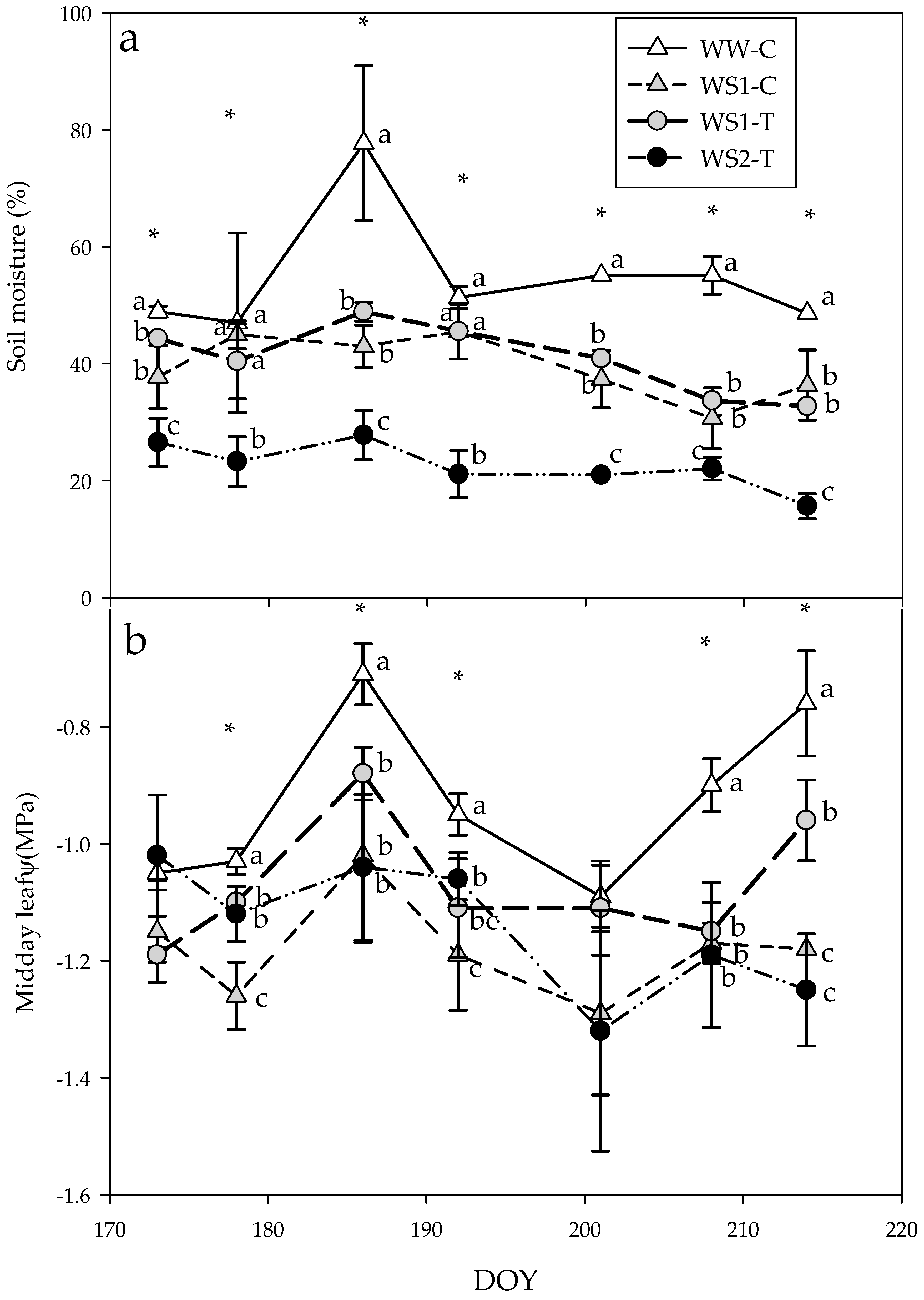
WW-C vines showed a high average soil moisture content of 55% throughout the experiment (Figure 2a). Though the WS1 vines (WS1-C and WS1-T) initially showed comparable moisture content to that of WW-C vines (ranging between 40 and 50% on DOY 178), with the progression of the season, the effects of reduced irrigation in WS1-C and WS1-T reduced the soil moisture to ~38–40% on DOY 201, with no difference between the two WS1 treatments. At the end of measurements on DOY 214, the WS1-T and WS1-C presented similar moisture content of 33–36%, compared to the 48.6% presented by WW-C vines. In WS2-T vines, soil moisture was consistently lower than with WS1 treatments (ranging between 20 and 27%), and at harvest (on DOY 214), it achieved the lowest level (15.6%).
WW-C had a significantly higher midday leaf Ψ (ranging from −0.7 and −1.08 MPa) than WS1-C during the entire experiment (Figure 2b). WS1-T vines showed better Ψ water status than WS1-C. In detail, WS1-T exhibited a less negative midday leaf Ψ than WS1-C Ψ on DOY 178 (+0.15 MPa), 186 (+0.14 MPa), 201 (+0.18 MPa), and 214 (+0.22 MPa), and comparable to WW-C leaf Ψ on DOY 201. WS1-C and WS2-T had similar midday leaf Ψ from DOY 201—DOY 214.

3.3. Leaf Gas Exchanges and Photosystem Efficiency

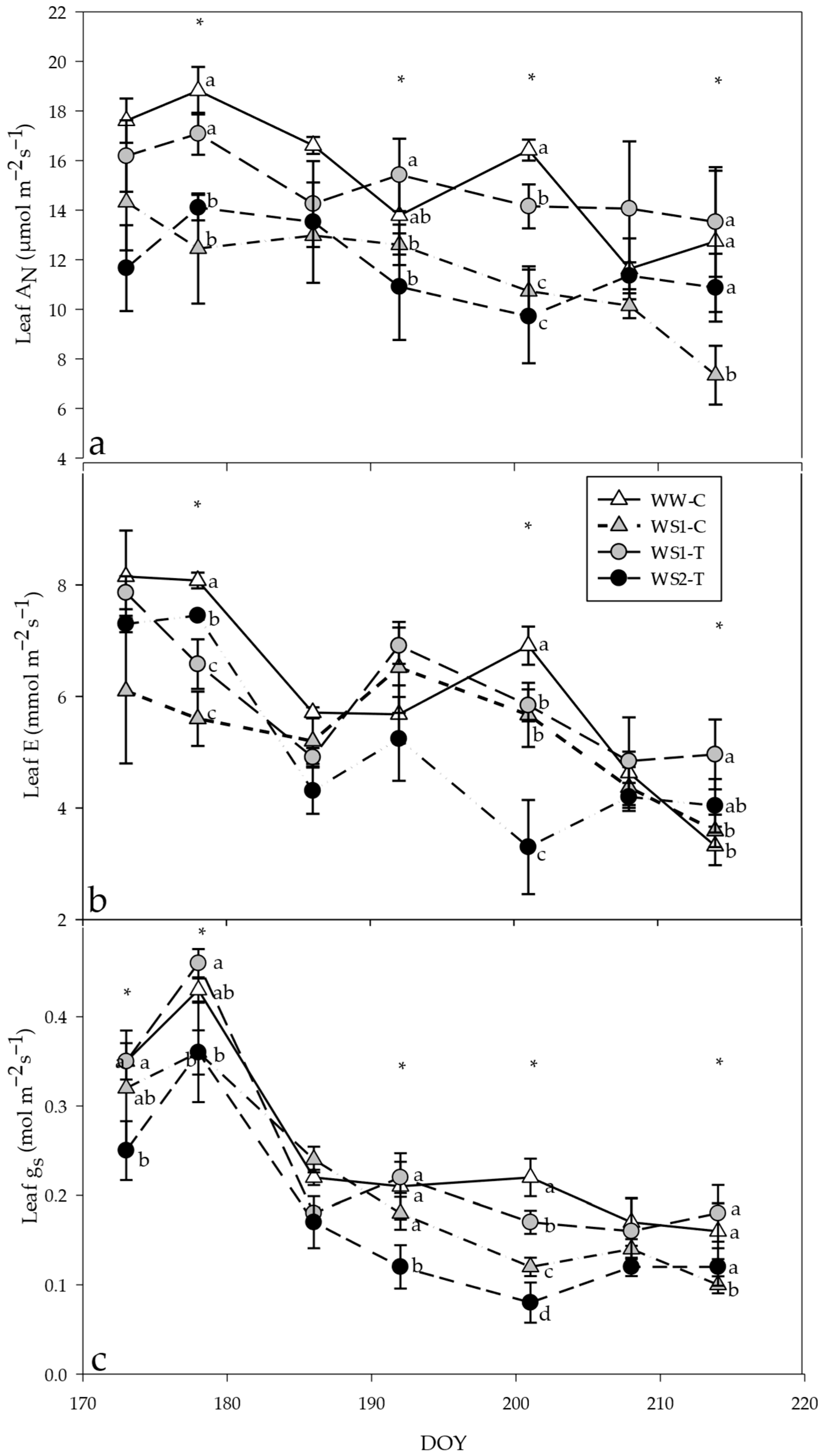
On most of the dates examined, WW-C and WS1-T vines exhibited similar leaf AN (Figure 3a). The only exceptions were on DOY 186 and 201, where WW-C showed a significantly higher leaf AN than WS1-T, with increases of +2.35 and +2.27 µmol m−2 s−1, respectively. WS2-T vines displayed leaf AN comparable to WS1-C and even surpassed WS1-C at the experiment’s conclusion, with an increase of +3.52 µmol m−2 s−1. When data for the entire period were pooled, the average leaf AN was 15.37 µmol m−2 s−1 for WW-C, 11.5 µmol m−2 s−1 for WS1-C, 14.94 µmol m−2 s−1 for WS1-T, and 11.72 µmol m−2 s−1 for WS2-T. WW-C vines maintained the highest leaf E until DOY 186 (Figure 3b). Subsequently, no significant and consistent differences were observed between the treatments, except on DOY 201, when leaf E varied according to the applied water. For the period from DOY 186 to 214, the average leaf E was 5.24 mmol m−2 s−1 for WW-C, 5.07 mmol m−2 s−1 for WS1-C, 5.49 mmol m−2 s−1 for WS1-T, and 4.22 mmol m−2 s−1 for WS2-T. Initially, WS1-C showed gs comparable to WS1-T (Figure 3c), but from DOY 192 until harvest, WS1-T vines exhibited a significantly higher gs than WS1-C, with an average increase of +0.05 mol m−2 s−1 during this period. WS2-T had a significantly lower leaf gs than WS1-C from DOY 178 to DOY 201, with an average decrease of −0.04 mol m−2 s−1, but from DOY 208 to harvest, no differences were noted between the two treatments.
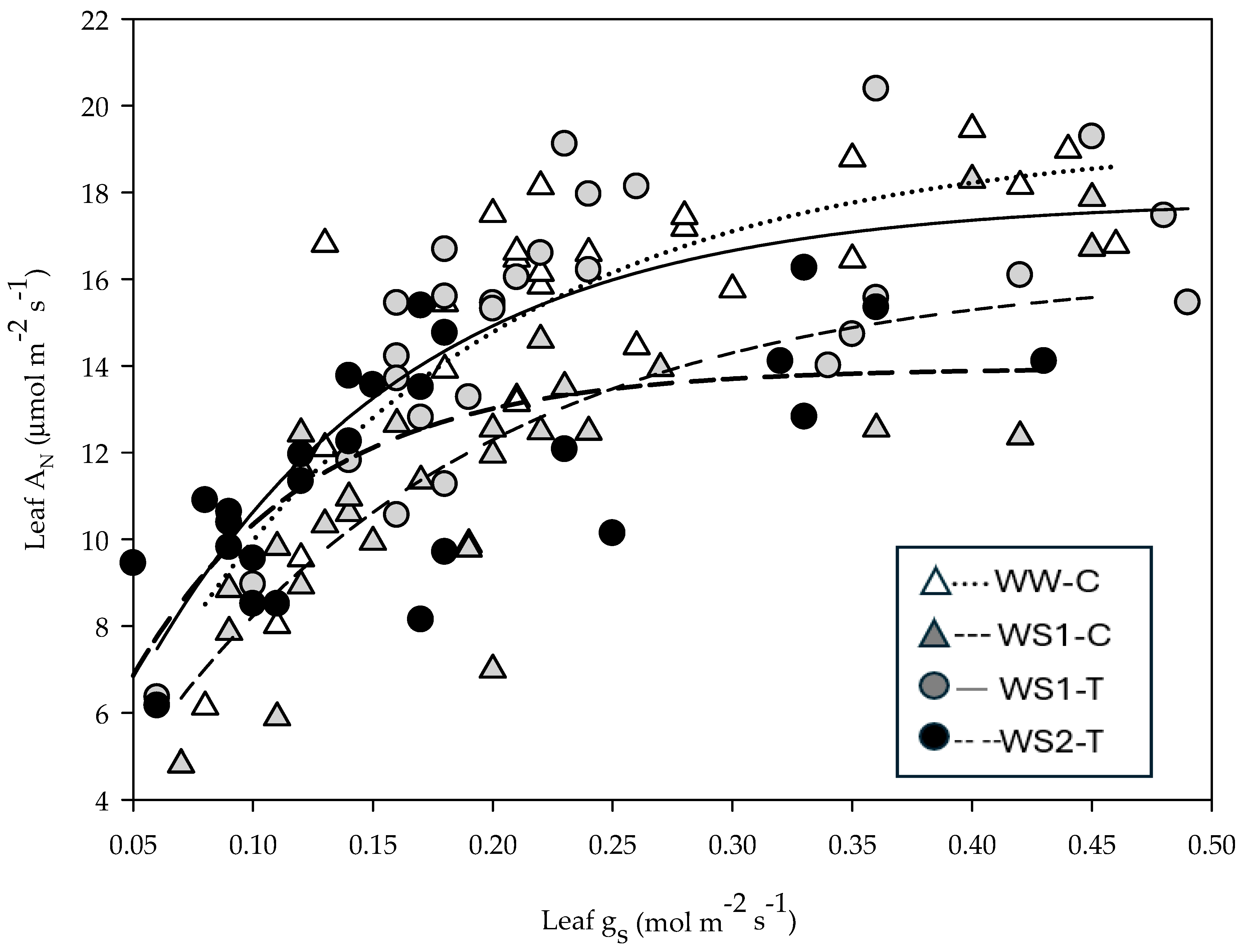
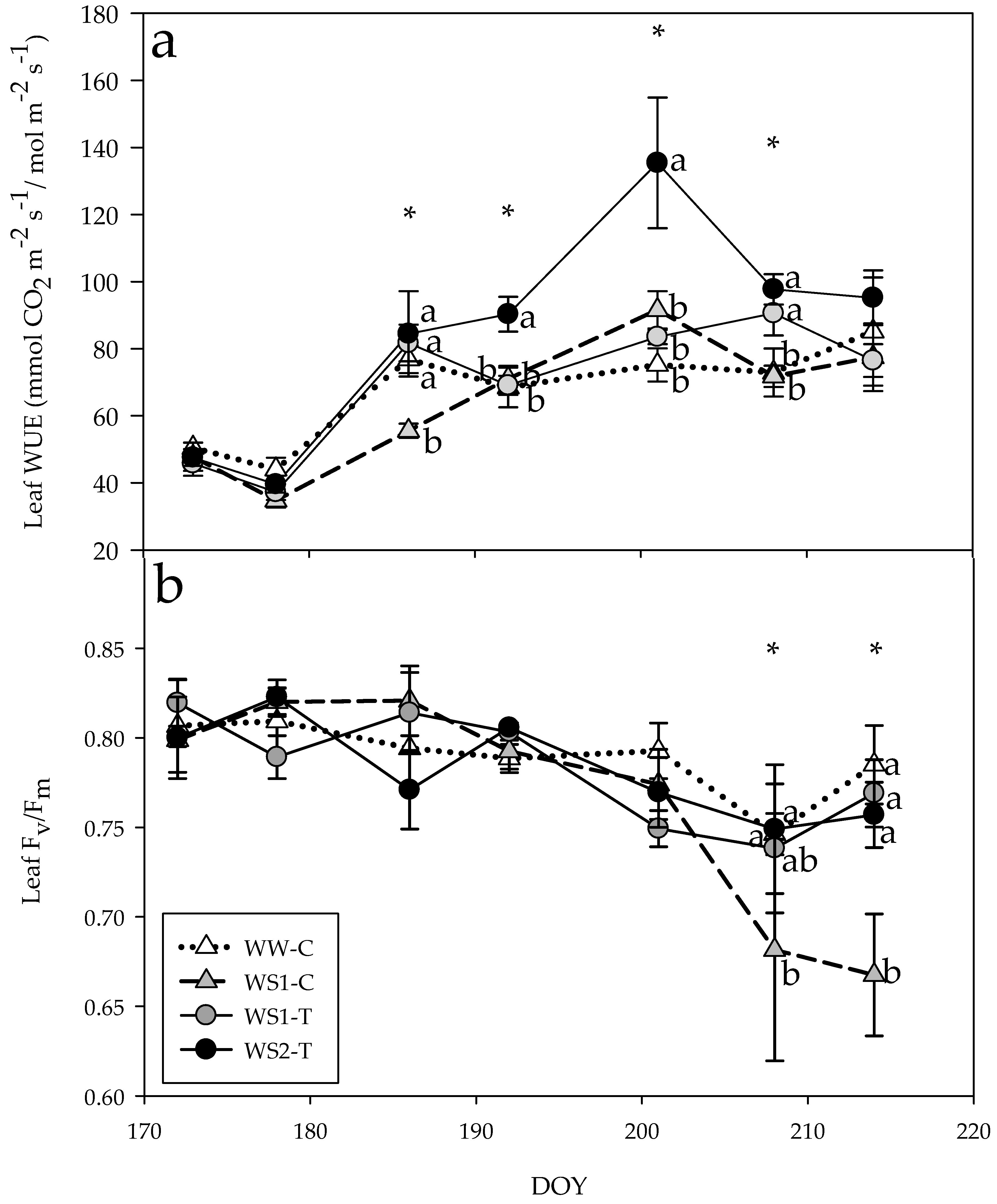
Table 1 reports the analysis of covariance for the effects of WS1-C and WS1-T treatments on leaf A at varying the covariate gs. Results show a significant interaction between fixed factor (treatments) and gs on AN., meaning that in WS1-T leaf, AN was assuming different values at increasing gs, compared to what occurred in WS1-C. The correlation between leaf AN and leaf gs was then fitted to different asymptotic models for the four treatments. Figure 4 illustrates that WW-C and WS1-T exhibited higher leaf AN than WS1-C and WS2-T when gs exceeded 0.20 mol m−2 s−1. Conversely, for gs values below 0.20 mol m−2 s−1, WW-C and WS1-T displayed similar leaf AN, while WS1-C showed lower leaf AN compared to the other treatments. Supplementary Table S1 reports the results of Pearson’s coefficient between leaf AN and gs for the four treatments and the bootstrap simulation results. Consequently, during the period from day 186 to 214, WS2-T demonstrated the highest leaf WUE, averaging 100.6 µmol m−2 s−1/mol m−2 s−1 (Figure 5a). On days 186 and 208, WS1-C had a significantly lower leaf WUE than WS1-T, with reductions of 26.18% and 18.83%, respectively. No differences in leaf Fv/Fm were observed until day 214 (Figure 5b). On the final measurement date, WS1-C had a significantly lower Fv/Fm (0.667) compared to the other treatments, which pooled at 0.770 for WW-C, WS1-T, and WS2-T.

3.4. Leaf Metabolites

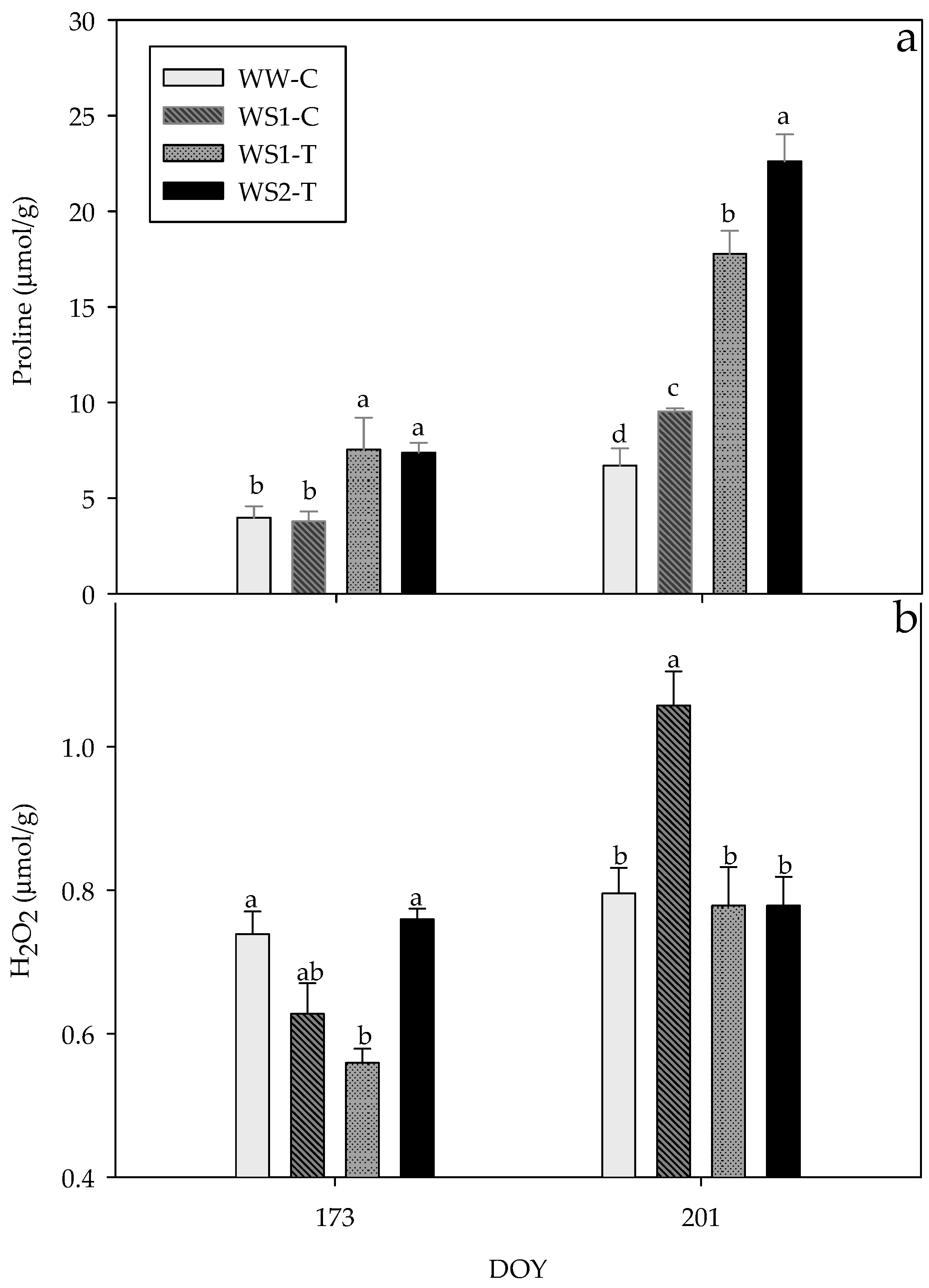
On DOY 173, WS1-T and WS2-T leaves showed comparable proline concentrations (7.54 and 7.38 µmol/g, respectively), while WS1-C and WW-C leaves had a significantly lower proline concentration (4.74 and 3.99 µmol/g, respectively) (Figure 6a).
On DOY 201, WS2-T and WS1-T had the highest leaf proline concentrations (22.6 and 17.8 µmol/g, respectively), while WS1-C showed significantly lower leaf proline concentrations (10.6 µmol/g) than the treated vines, yet higher than WW-C (+6.72 µmol/g).
On DOY 173, WS2-T and WW-C leaves showed higher leaf H2O2 concentrations (0.76 and 0.74 µmol/g, respectively) than WS1-C (0.62 µmol/g), while WS1-T leaves had the lowest H2O2 concentrations (0.56 µmol/g) (Figure 6b). On DOY 201, WS1-T and WS2-T had similar leaf H2O2 concentrations (~0.78 µmol/g) that were comparable to the unstressed WW-C vines (0.7 µmol/g). Conversely, WS1-C vines showed a dramatic increase in leaf H2O2 accumulation to 1.06 µmol/g.

3.5. Yield and Fruit Composition

Harvest took place on 2 August 2023 (DOY 214). The WW-C and WS1-T vines produced the highest yields (Table 2). Although WS2-T yielded less than WW-C and WS1-T, the difference between WS1-C and WS2-T was not significant. No differences were observed between treatments regarding bunch compactness, vine leaf area, and leaf-to-fruit ratio. At harvest, WS2-T developed significantly higher grape total soluble solid (TSS) concentrations than WW-C, with increases of +1.89 Brix and +2.06° Brix, respectively, while WS1-C and WS1-T showed intermediate values (Table 3). Although the pH differences among treatments were negligible, WW-C vines exhibited a significantly higher TA than WS1-C and WS2-T (+1.62 g/L). WS1-T had an intermediate TA, slightly lower than WW-C. The WS2-T vines demonstrated significantly higher TSS/TA than WW-C (+0.98), whereas WS1-C and WS1-T showed slightly lower TSS/TA, with no significant difference from WS2-T (−0.18 and −0.26, respectively).

4. Discussion

Despite receiving similar water amounts, WS1-T vines consistently showed higher midday leaf Ψ than WS1-C (Figure 2b), in agreement with results from field-non-irrigated vines [7]. Although the WS1-T vine leaf Ψ slightly lagged behind the WW-C leaf Ψ, their leaf AN and leaf gs were comparable to WW-C throughout the measurement period (Figure 3a,c), indicating that the observed difference in water status did not lead to significant differences in leaf AN and leaf gs. This trend was also evident under severe water reduction (40% ET), with WS2-T vines showing comparable midday leaf Ψ and higher AN and gs than moderately reduced irrigation control vines WS1-C (Figure 2b and Figure 3a,c). In short, independent from the amount of water applied, SYD application successfully increased midday leaf Ψ by 0.1 to 0.3 MPa during the season, resulting in higher AN and gs. This explains the findings observed in field conditions, in previous work [7]. Furthermore, the WS2-T vines demonstrated the highest WUE, while WS1-C had a significantly lower leaf WUE than WS1-T (Figure 5a) on most of the dates examined, suggesting that treated vines maintained their leaf photosynthetic rates despite reduced stomatal conductance under water-limiting conditions. Notably, the differences in WS1-T and WS1-C leaf Ψ were consistently observed despite very similar soil moisture conditions (Figure 2b). This suggests that the difference in plant water status was related to leaf traits. Although space and plant material constraints prevented us from including a direct comparison between control and treated vines under 40% ET irrigation (i.e., the WS2 level), our experimental setup was the sole approach capable of fully assessing the potential of proline-rich SYD application under progressively reduced water availability.
Leaf Ψ is influenced by leaf morpho-anatomical features, vapor pressure deficit, and soil water availability [23]. Therefore, shifting water potential by a few decimal points might be only achieved through direct irrigation or environmental conditioning, or alternatively, through long-term approaches such as soil management (e.g., mowing water-demanding grasses or cover crops) [23]. Regarding leaf traits, solutes and osmolytes drive turgor balance, the elasticity of membranes, and osmotic stress tolerance. Proline functions as a compatible osmolyte and, when applied exogenously, can be absorbed by plant tissues and translocated via both the xylem and phloem [12,24]. Notably, genetically modified plants deficient in proline accumulation exhibit impaired stomatal regulation, reduced cell turgor maintenance, and decreased tolerance to water and salt stress [25,26,27]. Conversely, exogenous application of proline improves plant physiology and development under abiotic stress by improving stomatal functioning, reducing oxidative stress, increasing osmotic potential, and reducing turgor loss point [7,8,15]. In our experiment, SYD application significantly influenced leaf proline concentration at both sampling dates (Figure 6a). Specifically, on DOY 173, leaf proline levels in WS1-T and WS2-T were already higher than those in WS1-C. The difference became more pronounced by DOY 201, when proline concentrations in WS1-T and WS2-T increased markedly to 17.76 and 22.61 µmol/g, respectively, while WS1-C showed only a modest increase to 10.66 µmol/g. In our work, while soil water concentration (Figure 2a) and VPD were uniform between plants, leaf proline changed significantly, demonstrating that it plays an active role in regulating vine leaf water status. Accordingly, proline-enriched SYD formulations can influence plant water balance by modulating leaf biochemical composition and osmolyte profiles, inducing a priming effect on water stress tolerance of WS1-T and WS2-T leaves, thus providing answers to the effects previously observed in the field [7].
Two open questions remain: i. whether the observed enhancement in leaf functioning was a direct effect of SYD application or an indirect consequence of improved vine water status; ii. whether the leaf endogenous proline measured reflected the proline supplied in the formulation or newly synthesized proline. Regarding the first point, while several studies have reported that SYD enhances leaf photosynthetic rates across various crops [28], improvements in leaf AN, gs, and WUE align with the higher leaf Ψ found in T vines. However, if the improved leaf physiology is solely a result of enhanced leaf water status, no significant changes would be expected in the relationship between AN and gs. In contrast, Table 1 demonstrates that the two WS1 treatments significantly interact with gs in determining leaf AN. This indicates that AN assumed different values at varying gs in WS1-T, compared to WS1-T. Figure 4 also shows that WS1-T consistently exhibited higher maximum AN values than WS1-C (first coefficient of the function) at saturating gs levels. Even if this data can be considered preliminary and field correlations between soil or leaf water potential and leaf AN, gs, and E are needed to provide a final picture of gas exchanges relationships, the results suggest that the observed improvement in leaf physiology cannot be attributed solely to better water status but rather indicates a direct effect of SYD on enhancing leaf functional performance, particularly under non-limiting conditions, alongside its action on vine water status. Indeed, several studies have discussed the effects of yeast derivatives on plant physiological performance by increasing chlorophyll concentrations, plant height, and the number of leaves [29,30,31]. Concerning the second pending point, Del Zozzo et al. [7] showed that the proline concentration observed after applying proline-rich SYD could not be attributed solely to the exogenous supply, as the total amount detected was substantially higher. This indicates that proline-rich SYD triggers endogenous proline biosynthesis. Indeed, it is well established that exogenous proline can induce significant de novo endogenous proline production [8,16,32].
Additionally, SYD may play a role in reducing oxidative stress, enhancing scavenging activity, and preventing ROS formation. Although the Fv/Fm values were initially similar across all vines at the onset of stress, the WS1-C vines concluded the experiment with the lowest Fv/Fm levels (Figure 5b). The irreversible damage observed in WS1-C vines (Supplementary Figure S2) towards the experiment’s end was absent in WS1-T and WS2-T vines, which received only 40% of daily ET. Several studies highlight proline’s role in scavenging reactive oxygen species from the chloroplast and generating NAD(P)+, a terminal electron acceptor in the electron transport chain, which prevents the accumulation of radicals and reactive oxygen species, thereby averting permanent photoinhibition of leaf photosystems [33]. In this context, Figure 6 offers valuable insights. In WS1-T and WS2-T vines, a marked increase in proline on DOY 201 coincided with reduced H2O2 accumulation. Conversely, WS1-C vines showed lower proline accumulation at the same time point, during which significant H2O2 accumulation was already evident. Notably, a decline in Fv/Fm in WS1-C leaves was observed only from DOY 208 onwards, likely due to toxic ROS accumulation. In comparison, the ROS-scavenging effect of proline seems to have prevented such damage in WS1-T despite lower water availability and comparable water status. Overall, our data suggest that a profound metabolic shift occurs in SYD-treated leaves, with three concurrent processes contributing to improved vine performance under water stress: (i) enhanced water status resulting from better osmotic adjustment and turgor maintenance, (ii) improved photosynthesis at comparable stomatal conductance levels, and (iii) proline-related priming that increases the availability of reductive power (i.e., the NADP+ pool), thereby promoting ROS scavenging and preventing photoinhibition.
The current literature on the application of SYD in grapevines primarily addresses induced pathogen resistance, such as against downy mildew [34], and only a few papers have described effects on yield components. Del Zozzo et al. [7] found that grapevines cv. Barbera subjected to proline-rich SYD applications had a higher yield, due to a reduction in sunburn-driven berry turgor loss. However, the effects of SYD on productivity under abiotic stress have also been largely explored in other crops like cabbage, tomatoes, and wheat [28,35]. In our study, the productive traits and fruit composition mirrored the plant’s physiological performance, as the yield of WS1-T vines was comparable to that of WW-C vines (Table 2 and Table 3). Similarly, the yield of WS2-T was akin to that of WS1-C. Notably, the grape TSS at harvest in WS1-T and WS2-T exceeded that of WW-C (Table 3). These effects were closely linked to variations in berry growth, with both berry and bunch size directly influencing yield. In our experiment, water modulation between treatments commenced on DOY 171, when berries were at the groat-sized stage, and continued until harvest. Consequently, both stress and treatment conditions impacted berry growth during stage I (cell multiplication) and stage II (cell enlargement), as outlined by Coombe and McCarthy [36]. While water availability in WS2-T affected berry size compared to WW-C, this was not observed in WS1-T. Similarly, the difference in water availability between WS1-C and WS2-T did not result in significant differences in berry size or yield. Our data suggest that SYD enhanced leaf water status and carbon assimilation, effectively compensating for variations in water availability. This likely facilitated adequate dry matter accumulation in the berry during stage I of development, which is crucial for final berry size and yield. The pending question is how much water can be saved using SYD foliar application. Although field data will be needed to drive adequate conclusions, projecting our study to a vineyard with a standard planting density of 3333 vines per hectare, we applied a total of 860 m3 of irrigation water per hectare to the WW treatment, 690 m3 to WS1, and approximately 350 m3 to WS2, based on the water used per vine. Additionally, 26 mm of rainfall, equivalent to 260 m3 of water per hectare, occurred during the same period and was equally added to all treatments. The results suggest that SYD application allowed about 170 m3 of water per hectare to be saved, maintaining full physiological performances (WS1 vs. WW irrigation levels), or 340 m3 per hectare, maintaining a partial physiological functioning (WS2 vs. WS1 irrigation levels). Unfortunately, our limitations in space and plant material made it impossible to directly compare WS2-T vines with a control treatment maintained at 40% ET, and therefore, we cannot draw conclusions about the photoinhibition or general physiological conditions that such a treatment would have exhibited. However, despite such a limit, it is clear that the physiology of WS2-T vines is aligned with that of WS1-C vines, while WS1-T vines performed similarly to WW-C vines.
In terms of fruit composition, various studies have employed different SYD formulations, mainly on red grapes, leading to increased anthocyanins, stilbenes, lower pH, thicker grape skins, and higher concentrations of volatiles, ultimately enhancing the quality of grapes and wine [37,38,39]. Pastore et al. [38] reported that a S. cerevisiae-derived SYD increased cv. Sangiovese grapes’ skin anthocyanins. In the same framework, Portu et al. [39] also found an increase in grapes’ anthocyanins and phenolics after SYD application. Similarly, Del Zozzo et al. [7] found a higher concentration of total anthocyanins and phenolics in cv. Barbera grapes subjected to proline-rich SYD applications, suggesting that the effect was related to a reduction in sunburn-driven degradation of anthocyanins. The only work addressing the composition of white grapes reported that SYD application could increase the presence of specific aromatic compounds [40]. Moving to trials on the application of exogenous application of proline with no SYD formulation, Garde-Cerdan et al. [41,42] found that proline effects were minimal compared to phenylalanine sprays. However, their proline application protocol differed substantially from ours. In their study, proline was applied only once at veraison, whereas we applied the proline-rich SYD multiple times between fruit set and harvest. In our experiment, the effects on grapes appear to be primarily a reflection of water status and overall physiological functioning; WS2-T vines showed significantly higher TSS compared to WW-C, likely due to the reduced yield. Notably, aside from TSS, no other differences in fruit composition were observed between WS1-T and WW-C. While excessive sugar accumulation during summer stress can be problematic, for white grapes, increased sugar levels without changes in TA can be beneficial. This allows for an earlier harvest while achieving the same alcohol concentration but with higher acidity, a significant advantage for white and sparkling wine production in the context of climate change. No differences in fruit composition were noted when comparing WS2-T and WS1-C.

5. Conclusions

Our study indicates that proline-rich SYD improves vine physiological and productive performance at different water availability levels. Despite receiving 80% of the irrigation water applied to WW vines, WS1-T vines exhibited comparable leaf water status, photosynthetic gains, yield, and fruit composition to WW-C. Meanwhile, WS2-T vines demonstrated broadly comparable physiology and fruit composition to WS1-C, despite a significant reduction in yield components.
In our experiment, proline-rich SYD enabled a saving of 170 m3 of irrigation water per hectare when transitioning from WW to WS1 conditions, or 340 m3 per hectare when moving from WS1 to WS2 conditions, with negligible adverse effects compared to WS1-C vines. While further studies are needed to confirm and validate these results in the field, the fact that WS1-T and WS2-T vines performed physiologically on par with WW-C and WS1-C vines, respectively, underscores the potential for the application of SYD formulations in vineyards and for other crops under limited water availability.

Supplementary Materials

The following supporting information can be downloaded at: https://www.mdpi.com/article/10.3390/agronomy15122759/s1, Figure S1: Overview of experimental vines with different irrigation treatments; Figure S2: On the left a WS1-C vine showing basal leaves photoinhibitions, on the right a WS1-T vine exhibiting no symptoms. Table S1: Pearson coefficients for the correlation between leaf photosynthesis and stomatal conductance, and results of bootstrap, in potted grapevines cv. cv. Chardonnay subjected to multiple applications of proline rich specific yeast derivates (T) and control vines (C) according to different irrigation levels based on measured daily evapotranspiration (ET): WW = 100% ET; WS1 = 80% ET; WS2 = 40% ET.

Author Contributions

Conceptualization, T.F.; methodology, T.F. and S.P.; validation, S.P. and F.B.; investigation, H.T., P.G.B. and C.R.; resources, T.F. and S.P.; data curation, H.T. and T.F.; writing—original draft preparation, H.T. and T.F.; writing—review and editing, F.B. and S.P.; supervision, T.F. All authors have read and agreed to the published version of the manuscript.

Funding

This study was supported by the PhD in Agro-Food System (AgriSystem) of the Università Cattolica del Sacro Cuore, Italy.

Data Availability Statement

The raw data supporting the conclusions of this article will be made available by the authors upon request.

Conflicts of Interest

Author Fabrizio Battista was employed by the company Lallemand Inc. The remaining authors declare that the research was conducted in the absence of any commercial or financial relationships that could be construed as a potential conflict of interest.

Abbreviations

The following abbreviations are used in this manuscript:
SYDSpecific yeast derivative
WWWell-watered vines
WS1Vines maintained at 80% ET irrigation
WS2Vines maintained at 40% ET irrigation
CUntreated control
TVines subjected to SYD foliar application
ROSReactive oxygen species
DOYDay of Year
GDDGrowing degree days
WUEWater use efficiency
TSSTotal soluble solids
TATitratable acidity

References

  1. Bertamini, M.; Zulini, L.; Muthuchelian, K.; Nedunchezhian, N. Effect of water deficit on photosynthetic and other physiological responses in grapevine (Vitis vinifera L. cv. Riesling) plants. Photosynthetica 2006, 44, 151–154. [Google Scholar] [CrossRef]
  2. Buesa, I.; Mirás-Avalos, J.M.; De Paz, J.M.; Visconti, F.; Sanz, F.; Yeves, A.; Guerra, D.; Intrigliolo, D.S. Soil management in semi-arid vineyards: Combined effects of organic mulching and no-tillage under different water regimes. Eur. J. Agron. 2021, 123, 126198. [Google Scholar] [CrossRef]
  3. Frioni, T.; VanderWeide, J.; Palliotti, A.; Tombesi, S.; Poni, S.; Sabbatini, P. Foliar vs. soil application of Ascophyllum nodosum extracts to improve grapevine water stress tolerance. Sci. Hortic. 2021, 277, 109807. [Google Scholar] [CrossRef]
  4. Rouphael, Y.; Cardarelli, M.; Bonini, P.; Colla, G. Synergistic action of a microbial-based biostimulant and a plant derived-protein hydrolysate enhances lettuce tolerance to alkalinity and salinity. Front. Plant Sci. 2017, 8, 131. [Google Scholar] [CrossRef]
  5. Monteiro, E.; Gonçalves, B.; Cortez, I.; Castro, I. The Role of Biostimulants as Alleviators of Biotic and Abiotic Stresses in Grapevine: A Review. Plants 2022, 11, 396. [Google Scholar] [CrossRef]
  6. Samuels, L.J.; Setati, M.E.; Blancquaert, E.H. Towards a Better Understanding of the Potential Benefits of Seaweed Based Biostimulants in Vitis vinifera L. Cultivars. Plants 2022, 11, 348. [Google Scholar] [CrossRef] [PubMed]
  7. Del Zozzo, F.; Barmpa, D.M.; Canavera, G.; Giordano, L.; Palliotti, A.; Battista, F.; Poni, S.; Frioni, T. Effects of foliar applications of a proline-rich specific yeast derivative on physiological and productive performances of field-grown grapevines (Vitis vinifera L.). Sci. Hortic. 2024, 326, 112759. [Google Scholar] [CrossRef]
  8. Ben Ahmed, C.; Ben Rouina, B.; Sensoy, S.; Boukhriss, M.; Ben Abdullah, F. Exogenous proline effects on photosynthetic performance and antioxidant defense system of young olive tree. J. Agric. Food Chem. 2010, 58, 4216–4222. [Google Scholar] [CrossRef]
  9. Semida, W.M.; Abdelkhalik, A.; Rady, M.O.A.; Marey, R.A.; Abd El-Mageed, T.A. Exogenously applied proline enhances growth and productivity of drought stressed onion by improving photosynthetic efficiency, water use efficiency and up-regulating osmoprotectants. Sci. Hortic. 2020, 272, 109580. [Google Scholar] [CrossRef]
  10. Hoque, M.A.; Banu, M.N.A.; Nakamura, Y.; Shimoishi, Y.; Murata, Y. Proline and glycinebetaine enhance antioxidant defense and methylglyoxal detoxification systems and reduce NaCl-induced damage in cultured tobacco cells. J. Plant Physiol. 2008, 165, 813–824. [Google Scholar] [CrossRef]
  11. Sivakumar, P.; Sharmila, P.; Pardha Saradhi, P. Proline Alleviates Salt-Stress-Induced Enhancement in Ribulose-1,5-Bisphosphate Oxygenase Activity. Biochem. Biophys. Res. Commun. 2000, 279, 512–515. [Google Scholar] [CrossRef] [PubMed]
  12. Szabados, L.; Savouré, A. Proline: A multifunctional amino acid. Trends Plant Sci. 2010, 15, 89–97. [Google Scholar] [CrossRef]
  13. Vendruscolo, E.C.G.; Schuster, I.; Pileggi, M.; Scapim, C.A.; Molinari, H.B.C.; Marur, C.J.; Vieira, L.G.E. Stress-induced synthesis of proline confers tolerance to water deficit in transgenic wheat. J. Plant Physiol. 2007, 164, 1367–1376. [Google Scholar] [CrossRef]
  14. Lehr, P.P.; Hernández-Montes, E.; Ludwig-Müller, J.; Keller, M.; Zörb, C. Abscisic acid and proline are not equivalent markers for heat, drought and combined stress in grapevines. Aust. J. Grape Wine Res. 2022, 28, 119–130. [Google Scholar] [CrossRef]
  15. Ozden, M.; Demirel, U.; Kahraman, A. Effects of proline on antioxidant system in leaves of grapevine (Vitis vinifera L.) exposed to oxidative stress by H2O2. Sci. Hortic. 2009, 119, 163–168. [Google Scholar] [CrossRef]
  16. Wei, T.L.; Wang, Z.X.; He, Y.F.; Xue, S.; Zhang, S.Q.; Pei, M.S.; Liu, H.N.; Yu, Y.H.; Guo, D.L. Proline synthesis and catabolism-related genes synergistically regulate proline accumulation in response to abiotic stresses in grapevines. Sci. Hortic. 2022, 305, 111373. [Google Scholar] [CrossRef]
  17. Lorenz, D.H.; Eichorn, K.W.; Bleiholder, H.; Klose, R.; Meier, U.; Weber, E. Growth Stages of the Grapevine: Phenological growth stages of the grapevine (Vitis vinifera L. ssp. vinifera)—Codes and descriptions according to the extended BBCH scale. Aust. J. Grape Wine Res. 1995, 1, 100–103. [Google Scholar] [CrossRef]
  18. Keller, M.; Romero, P.; Gohil, H.; Smithyman, R.P.; Riley, W.R.; Casassa, L.F.; Harbertson, J.F. Deficit Irrigation Alters Grapevine Growth, Physiology, and Fruit Microclimate. Am. J. Enol. Vitic. 2016, 67, 426–435. [Google Scholar] [CrossRef]
  19. Baskerville, G.L.; Emin, P. Rapid Estimation of Heat Accumulation from Maximum and Minimum Temperatures. Ecology 1969, 50, 514–517. [Google Scholar] [CrossRef]
  20. Troll, W.; Lindsley, J. A photometric method for the determiation of proline. J. Biol. Chem. 1955, 215, 655–660. [Google Scholar] [CrossRef]
  21. Carillo, P.; Gibon, Y. Protocol: Extraction and determination of proline. Prometh. Wiki 2011. [Google Scholar]
  22. Loreto, F.; Velikova, V. Isoprene produced by leaves protects the photosynthetic apparatus against ozone damage, quenches ozone products, and reduces lipid peroxidation of cellular membranes. Plant Physiol. 2001, 127, 1781–1787. [Google Scholar] [CrossRef] [PubMed]
  23. Deloire, A.; Pellegrino, A.; Rogiers, S. A few words on grapevine leaf water potential. IVES Tech. Rev. Vine Wine 2020. [Google Scholar] [CrossRef]
  24. Hayat, S.; Hayat, Q.; Alyemeni, M.N.; Wani, A.S.; Pichtel, J.; Ahmad, A. Role of proline under changing environments: A review. Plant Signal. Behav. 2012, 7, 1456–1466. [Google Scholar] [CrossRef]
  25. Apel, K.; Hirt, H. Reactive oxygen species: Metabolism, oxidative stress, and signal transduction. Annu. Rev. Plant Biol. 2004, 55, 373–399. [Google Scholar] [CrossRef]
  26. Kueh, J.S.H.; Bright, S.W.J. Biochemical and genetical analysis of three proline-accumulating barley mutants. Plant Sci. Lett. 1982, 27, 233–241. [Google Scholar] [CrossRef]
  27. Alvarez, M.E.; Savouré, A.; Szabados, L. Proline metabolism as regulatory hub. Trends Plant Sci. 2022, 27, 39–55. [Google Scholar] [CrossRef]
  28. Campobenedetto, C.; Agliassa, C.; Mannino, G.; Vigliante, I.; Contartese, V.; Secchi, F.; Bertea, C.M. A biostimulant based on seaweed (Ascophyllum nodosum and Laminaria digitata) and yeast extracts mitigateswater stress effects on tomato (Solanum lycopersicum L.). Agriculture 2021, 11, 557. [Google Scholar] [CrossRef]
  29. Abdelaal, K.; Attia, K.A.; Niedbała, G.; Wojciechowski, T.; Hafez, Y.; Alamery, S.; Alateeq, T.K.; Arafa, S.A. Mitigation of drought damages by exogenous chitosan and yeast extract with modulating the photosynthetic pigments, antioxidant defense system and improving the productivity of garlic plants. Horticulturae 2021, 7, 510. [Google Scholar] [CrossRef]
  30. Johnson, R.; Puthur, J.T. Biostimulant priming in Oryza sativa: A novel approach to reprogram the functional biology under nutrient-deficient soil. Cereal Res. Commun. 2022, 50, 45–52. [Google Scholar] [CrossRef]
  31. Nassar, R.M.A.; Shanan, N.T.; Reda, F.M. Active yeast extract counteracts the harmful effects of salinity stress on the growth of leucaena plant. Sci. Hortic. 2016, 201, 61–67. [Google Scholar] [CrossRef]
  32. Gohari, G.; Panahirad, S.; Sepehri, N.; Akbari, A.; Zahedi, S.M.; Jafari, H.; Dadpour, M.R.; Fotopoulos, V. Enhanced tolerance to salinity stress in grapevine plants through application of carbon quantum dots functionalized by proline. Environ. Sci. Pollut. Res. 2021, 28, 42877–42890. [Google Scholar] [CrossRef]
  33. Matysik, J.; Alia; Bhalu, B.; Mohanty, P. Molecular mechanisms of quenching of reactive oxygen species by proline under stress in plants. Curr. Sci. 2002, 82, 525–532. [Google Scholar]
  34. De Miccolis Angelini, R.M.; Rotolo, C.; Gerin, D.; Abate, D.; Pollastro, S.; Faretra, F. Global transcriptome analysis and differentially expressed genes in grapevine after application of the yeast-derived defense inducer cerevisane. Pest Manag. Sci. 2019, 75, 2020–2033. [Google Scholar] [CrossRef]
  35. Dima, Ș.-O.; Constantinescu-Aruxandei, D.; Tritean, N.; Ghiurea, M.; Capră, L.; Nicolae, C.-A.; Faraon, V.; Neamțu, C.; Oancea, F. Spectroscopic Analyses Highlight Plant Biostimulant Effects of Baker’s Yeast Vinasse and Selenium on Cabbage through Foliar Fertilization. Plants 2023, 12, 3016. [Google Scholar] [CrossRef] [PubMed]
  36. Coombe, B.G.; McCarthy, M.G. Dynamics of grape berry growth and physiology of ripening. Aust. J. Grape Wine Res. 2000, 6, 131–135. [Google Scholar] [CrossRef]
  37. Mayfield, S.E.; Threlfall, R.T.; Howard, L.R. Impact of Inactivated Yeast Foliar Spray on Chambourcin (Vitis Hybrid) Wine Grapes. ACS Food Sci. Technol. 2021, 1, 1585–1594. [Google Scholar] [CrossRef]
  38. Pastore, C.; Allegro, G.; Valentini, G.; Pizziolo, A.; Battista, F.; Spinelli, F.; Filippetti, I. Foliar application of specific yeast derivative enhances anthocyanins accumulation and gene expression in Sangiovese cv (Vitis vinifera L.). Sci. Rep. 2020, 10, 11627. [Google Scholar] [CrossRef]
  39. Portu, J.; López, R.; Baroja, E.; Santamaría, P.; Garde-Cerdán, T. Improvement of grape and wine phenolic content by foliar application to grapevine of three different elicitors: Methyl jasmonate, chitosan, and yeast extract. Food Chem. 2016, 201, 213–221. [Google Scholar] [CrossRef] [PubMed]
  40. Šuklje, K.; Antalick, G.; Buica, A.; Coetzee, Z.A.; Brand, J.; Schmidtke, L.M.; Vivier, M.A. Inactive dry yeast application on grapes modify Sauvignon Blanc wine aroma. Food Chem. 2016, 197, 1073–1084. [Google Scholar] [CrossRef]
  41. Garde-Cerdán, T.; López, R.; Portu, J.; González-Arenzana, L.; López-Alfaro, I.; Santamaría, P. Study of the effects of proline, phenylalanine, and urea foliar application to Tempranillo vineyards on grape amino acid content. Comparison with commercial nitrogen fertilisers. Food Chem. 2014, 163, 136–141. [Google Scholar] [CrossRef] [PubMed]
  42. Garde-Cerdán, T.; Portu, J.; López, R.; Santamaría, P. Effect of Foliar Applications of Proline, Phenylalanine, Urea, and Commercial Nitrogen Fertilizers on Stilbene Concentrations in Tempranillo Musts and Wines. Am. J. Enol. Vitic. 2015, 66, 542–547. [Google Scholar] [CrossRef]
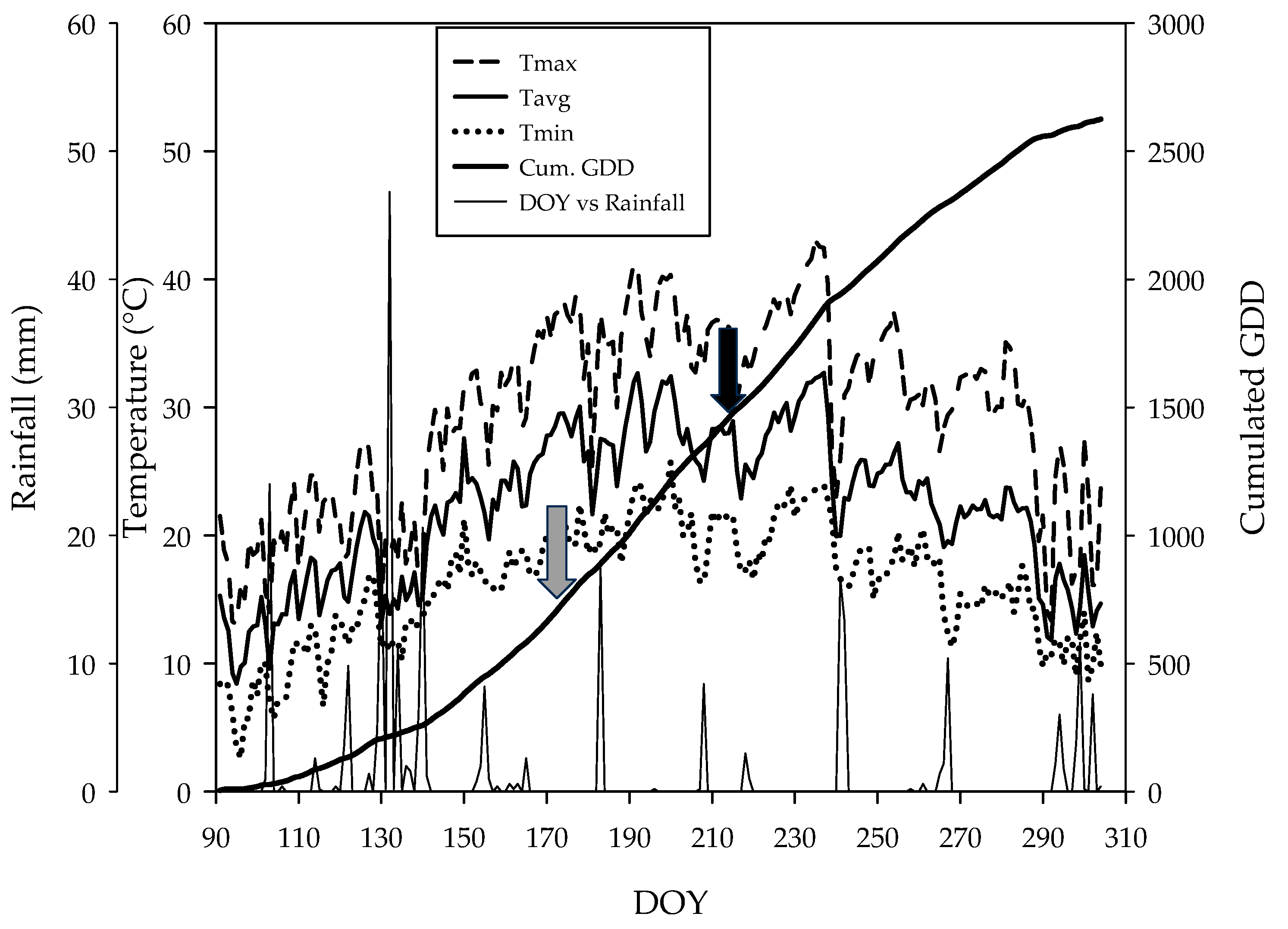
Figure 1. Seasonal evolution of maximum (--), mean (—), and minimum (……) temperatures, rainfall (|), and the cumulative growing degree days (GDD, |) at the experimental location in 2023. DOY represents the Day of Year. Gray arrow = start of water-stress imposition (BBCH 73, groat-sized berries); black arrow = re-watering and harvest (BBCH 89, full ripening).
Agronomy 15 02759 g001
Figure 2. Seasonal evolution of soil moisture (%; panel (a)) and mid-day leaf water potential (Ψ; panel (b)) in grapevines cv. Chardonnay subjected to multiple applications of proline-rich specific yeast derivatives (T) and control vines (C) in accordance with different irrigation levels from Day Of Year (DOY) 171 (BBCH 71, groat-sized berries) to harvest (BBCH89, full ripening), based on measured daily evapotranspiration (ET): WW = 100% ET; WS1 = 80% ET; WS2 = 40% ET. Asterisks indicate significant difference between treatments within date per p < 0.05. Different letters indicate significant difference between treatments within date per p = 0.05 (Tukey’s HSD test). Bars represent standard errors (n = 4).
Agronomy 15 02759 g002
Figure 3. Seasonal evolution of leaf photosynthesis (leaf AN; panel (a)), leaf transpiration (leaf E; panel (b)) and leaf stomatal conductance (leaf gs; panel (c)) in potted grapevines cv. Chardonnay subjected to multiple applications of proline-rich specific yeast derivatives (T) and control vines (C) according to different irrigation levels from Day Of Year (DOY) 171 (BBCH 71, groat-sized berries) to harvest (BBCH 89, full ripening), based on measured daily evapotranspiration (ET): WW = 100% ET; WS1 = 80% ET; WS2 = 40% ET. Asterisks indicate significant difference between treatments within date per p < 0.05. Different letters indicate significant difference between treatments within date per p = 0.05 (Tukey’s HSD test). Bars represent standard errors (n = 4).
Agronomy 15 02759 g003
Figure 4. Correlation between leaf photosynthesis (Leaf AN) and leaf stomatal conductance (Leaf gs) in potted grapevines cv. Chardonnay subjected to multiple applications of proline-rich specific yeast derivatives (T) and control vines (C) according to different irrigation levels from day of year 171 (BBCH 71, groat-sized berries) to harvest (BBCH 89, full ripening), based on measured daily evapotranspiration (ET): WW = 100% ET; WS1 = 80% ET; WS2 = 40% ET. WW-C: f = 19.27*(1 − exp(−7.27*x)), p < 0.05, R2 = 0.65; WS1-C: f = 16.25*(1 − exp(−7.06*x)), p < 0.05, R2 = 0.63; WS1-T: f = 17.83*(1 − exp(−9.06*x)), p < 0.05, R2 = 0.62; WS2-T: f = 13.94*(1 − exp(−13.53*x)), p < 0.05, R2 = 0.56.
Agronomy 15 02759 g004
Figure 5. Seasonal evolution of vine instantaneous WUE (AN/gs; panel (a)) and Fv/Fm (panel (b)) in potted grapevines cv. Chardonnay subjected to multiple applications of proline-rich specific yeast derivatives (T) and control vines (C) according to different irrigation levels from Day Of Year (DOY) 171 (BBCH 71, groat-sized berries) to harvest (BBCH 89, full ripening), based on measured daily evapotranspiration (ET): WW = 100% ET; WS1 = 80% ET; WS2 = 40% ET. Asterisks indicate significant difference between treatments within date per p < 0.05. Bars represent standard errors (n = 4). Different letters indicate significant difference between treatments within date per p = 0.05 (Tukey’s HSD test).
Agronomy 15 02759 g005
Figure 6. Proline (a) and hydrogen peroxide (H2O2, b) concentrations in the leaf samples from potted grapevines cv. Chardonnay subjected to multiple applications of proline-rich specific yeast derivatives (T) and control vines (C) according to different irrigation levels from Day Of Year (DOY) 171 (BBCH 71, groat-sized berries) to harvest (BBCH 89, full ripening), based on measured daily evapotranspiration (ET): WW = 100% ET; WS1 = 80% ET; WS2 = 40% ET. Different letters indicate significant difference between treatments within date per p = 0.05 (Tukey’s HSD test). Bars represent standard errors (n = 4).
Agronomy 15 02759 g006
Table 1. Analysis of covariance between leaf photosynthetic rates and stomatal conductance gs in potted grapevines cv. Chardonnay subjected to multiple applications of proline-rich specific yeast derivatives (T) and control vines (C) subjected to a daily irrigation of 80% their evapotranspiration. DF = degree of freedom; SS = sum of squares.
TreatmentDFSig. 1FSS
Corrected model2***27385.415
Intercept1***27837.709
Interaction
(treatmentx gs)
2***27385.415
1 *** indicate significant differences per p < 0.005.
Table 2. Yield components, leaf area, and vine balance in potted grapevines cv. Chardonnay subjected to multiple applications of proline-rich specific yeast derivatives (T) and control vines (C) according to different irrigation levels based on measured daily evapotranspiration (ET): WW = 100% ET; WS1 = 80% ET; WS2 = 40% ET.
TreatmentYield
(kg/Vine)
Cluster Weight
(g)
Berry Weight (g) Cluster
Compactness
(g/cm)
Vine
Leaf Area (m2)
Leaf Area/
Yield
(m2/kg)
WW-C 1.82 a 1126.07 ab1.62 a10.992.581.44
WS1-C 1.54 ab118.62 ab1.40 ab9.782.411.49
WS1-T1.76 a134.7 a1.59 a11.851.861.39
WS2-T1.37 b105 b1.21 b9.732.321.51
Sig.** 2 * ** nsnsns
1 Different letters indicate significant differences per p = 0.05 (Tukey’s HSD test); 2 *, ** indicate significant differences per p < 0.05 and 0.01, respectively. ns = no difference.
Table 3. Fruit composition in potted grapevines cv. Chardonnay subjected to multiple applications of proline-rich specific yeast derivatives (T) and control vines (C) according to different irrigation levels based on measured daily evapotranspiration (ET): WW = 100% ET; WS1 = 80% ET; WS2 = 40% ET.
TreatmentTSS
(Brix)
pHTA
(g/L)
TSS/TA
WW-C19.00 b 13.157.77 a2.45 b
WS1-C19.89 ab3.186.15 b3.23 ab
WS1-T20.89 ab3.196.62 ab3.16 ab
WS2-T21.06 a3.186.15 b3.42 a
Sig.** 2nsns*
1 Different letters indicate significant differences per p = 0.05 (Tukey’s HSD test); 2 *, ** indicate significant differences per p < 0.05 and 0.01, respectively. ns = no difference.
Disclaimer/Publisher’s Note: The statements, opinions and data contained in all publications are solely those of the individual author(s) and contributor(s) and not of MDPI and/or the editor(s). MDPI and/or the editor(s) disclaim responsibility for any injury to people or property resulting from any ideas, methods, instructions or products referred to in the content.